Live lab updates
Phase 2 started on 30 Oct 2026, a day ahead of plan. CricketOne, the smart wicket that is its own umpire, is our first product. Phase 1 research is done: 24 products, one smart item per sport, home zone, kids learning setting and industry. Now we make CricketOne accurate, safe and to standards. That means global-shutter cameras in every stump to track a 90 mph ball, a design that survives the ball, the heat and the rain, and a test plan for each. Next comes a design review with real clubs and umpires, then the build.
Concepts, not for sale yet · all design and testing done in-house
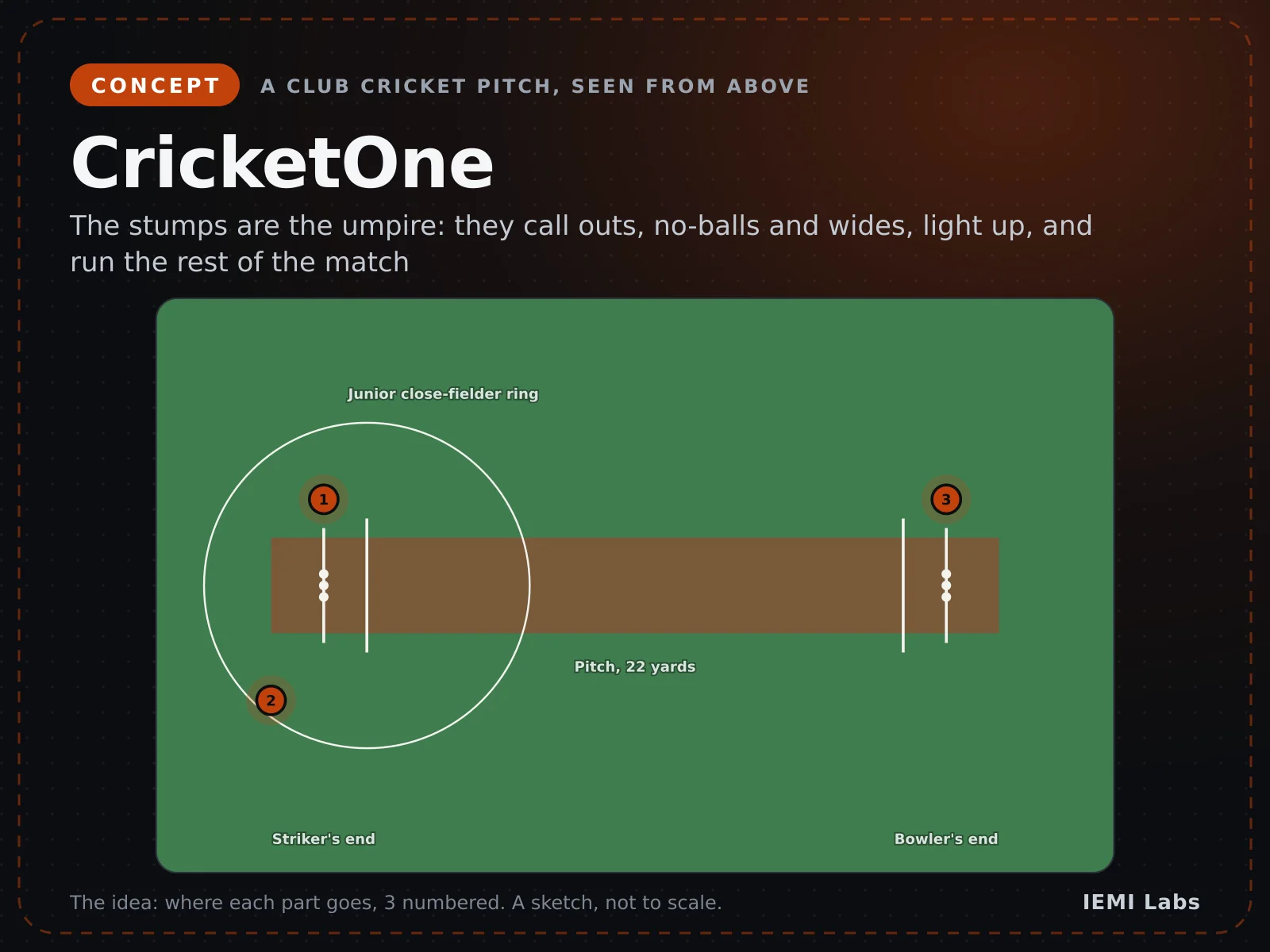 Designing now: CricketOne, our one product for Cricket
Where we are
- Market check (done)Oct 2026Tested the whole portfolio against competitors, prices and buyers, and chose one product per sport and per industry.
- Phase 1 · Research (done)Done 30 Oct 2026Product and market research: 24 products, one per sport, home zone, kids learning setting and industry, each refined with a buyer check, parts prices and a CAD review. Done a day ahead of plan.
- Phase 2 · CricketOne engineering (in progress)In progress · From 30 Oct 2026Our first product, CricketOne, made accurate, safe and to standards: ball tracking, impact, heat, weather and the test plan.
- Phase 3 · Design review (next)Nov–Dec 2026Clubs, umpires and leagues review CricketOne and change it; then we order its parts.
- Phase 4 · Build and test (next)Q1 2027Printed wickets with the real parts, then the bench, ball-cannon, heat and rain tests.
- First users (next)Q3 2027Working wickets in front of real clubs, umpires and junior coaches.
How the lab works
- We start from products people already buy (stumps, IV stands, troughs, pill organisers) and make them smart with something extra.
- Every design is code-first CAD: printable parts, real bought parts fitted inside and checked for collisions.
- Each idea gets real market research: who pays, what they use today, what it costs and the rules that apply.
- Software is tested with the design: CAD checks, site checks and automated API tests on every update.
- Everything is published here as it is made, including the honest limits of each idea.
Follow the build
One email per milestone, including what we test and what fails.
Prefer a feed reader? RSS
Our plan
Research done. Now CricketOne, engineered properly.
Research finished on 30 October 2026, a day ahead of plan: 24 products, one for every sport, home zone, learning setting and industry. CricketOne, the smart wicket, is our first product. In phase 2 we make its design accurate, safe and to standards, in the open. We order parts only after real buyers have reviewed it. See the engineering.
- Phase 1Done, 30 Oct 2026Product and market researchOne smart product for every sport, home zone, kids learning setting and industry: 24 products, each refined with a buyer check, parts prices and a CAD review.First pass: every place has its product24/24Stage 2 refinement24/24
- Phase 2We are hereCricketOne engineeringFrom 30 Oct 2026CricketOne, the smart wicket, is our first product. We make its design accurate, safe and to standards: ball tracking at up to 200+ frames a second, impact, heat and weather, and a test plan for each.
- Phase 3Nov–Dec 2026Design review with real buyersClubs, umpires and leagues review CricketOne and change it. Only then do we order its parts.
- Phase 4Q1 2027 onwardBuild, test and first usersPrint and assemble, run the bench, impact, heat and rain tests, then put working wickets in front of first clubs.
What we are doing, every 30 minutes
Live from the lab · phase 2: CricketOne engineering · a new lab run every 30 minutes · 650 updates so far
- Sports: cricketLatestCricketOne
- Next: the 71 fast signals routed by hand or by a layout engineer (camera 100 ohm pairs, USB 90 ohm, antenna 50 ohm, card and SDIO length-matched), auto-route the rest, DRC 0 unconnected, then Gerbers and quotes with real files
What we researched and changed
- Market need we found
- Owner: "Auto-route first pass".
- Why this product
- The boards had every pad on its net but no copper between them.
- What changed
- Planes: solid ground on inner layer 1 under all three boards; 3.3 V on inner layer 2 (main board and camera head, ground on the base disc)
- 192 vias, one beside each ground and 3.3 V pad with a short track: no via in pad, none in the antenna zone or under the card socket; checked against every pad, via and track
- KiCad DRC: 0 copper errors (clearance, shorts, holes, keep-outs); 183 of 499 connections made, 316 to route (48 crowded plane pads, 71 fast signals, 72 power, 125 slower signals)
- Freerouting 2.5.0 (official release, checksum-verified) reached its first pass with 0 violations, but its Windows build crashes before saving (a serialization bug in that build); the Java version needs Java 25, not downloaded. The board is exported for the router (test-board.dsn in the zip)
- Back-side parts kept out of the antenna's copper-free zone too (it covers both sides)
See this update on the product pageResearch and design3D CAD modelDownload STL
- Sports: cricketCricketOne
- Need: correct calls on wet balls on the days matches are really played (Law 4, https://www.lords.org/mcc/the-laws-of-cricket/the-ball).
- Our answer: checked against climate records, the wet balls that matter are dew-wet in the evening sun, and our told error already covers them; the bench now tests dew first.
- Tested in-house: simulated with real climate records, 6 of 6 checks; a misted ball is measured at bring-up step 66.
What we researched and changed
- Market need we found
- The stumps must judge a wet ball as well as a dry one on the days cricket is really played, in an English June, a Mumbai November and a Melbourne January (Law 4, the ball: https://www.lords.org/mcc/the-laws-of-cricket/the-ball; climate records: https://en.wikipedia.org/wiki/Climate_of_London , https://en.wikipedia.org/wiki/Mumbai#Climate , https://en.wikipedia.org/wiki/Climate_of_Melbourne).
- Why this product
- A wet ball only leans the measured centre when the sun is out, and our last six wet-ball checks assumed how sunny and how rainy each ground is. This row checked those assumptions against the published climate records before we spend bench time on the wrong kind of wet ball.
- What changed
- New simulation sim/wetsun-r151.mjs (6 of 6 checks): the same match days, with the skies and rain reweighted to each ground's 1991-2020 sunshine hours and rain days
- Learned: our skies were too sunny: the records give 42 % sunshine in a London June and 61 % in a Melbourne January, against the 79 % we assumed; Mumbai's November matches, but it has only 0.6 rain days
- Learned: wet balls with the sun out are fewer than we assumed (67 in 1000 over the three seasons, not 79), and 96 % of them are wet from evening dew, not rain
- Designed: no code change, because the told error still covers 97.2 % of them; the bench now starts with a lightly misted ball under a low lamp, as Mumbai's evening dew (bring-up step 66). No part, CAD or cart change
- Boards: no new board-level CricketOne detail since the last run; all 24 boards re-run (0 problems, reviews 0 fail, DRC 0). Next: R152 checks when and how often dew really wets the ball
See this update on the product pageResearch and design3D CAD modelDownload STL
- Sports: cricketCricketOne
- Need: correct calls on wet balls from seam bowlers and spinners alike (Law 4, https://www.lords.org/mcc/the-laws-of-cricket/the-ball).
- Our answer: we checked whether water in the seam leans the ball on its own; it is too small to need a correction, so the wet-ball work now waits on the bench measurements.
- Tested in-house: simulated only (est.), 6 of 6 checks; a wet seam is measured at bring-up step 65.
What we researched and changed
- Market need we found
- The stumps must judge a wet ball as well as a dry one, whoever is bowling: seam bowlers and spinners both bowl through dew and damp outfields (Law 4 for the ball and its seam, https://www.lords.org/mcc/the-laws-of-cricket/the-ball; Law 41, https://www.lords.org/mcc/the-laws-of-cricket/unfair-play).
- Why this product
- Water collects in the seam's stitches, and the seam is a raised band that turns with the spin, so a wet seam could glint on its own and pull the ball's measured centre a different way from the rest of the wet ball. This row measured how much that matters before writing any code for it.
- What changed
- New simulation sim/wetseam-r150.mjs (6 of 6 checks, est.): R148's 126 match days (60 wet) with a wet seam's own glint, look by look as the ball spins, for seam bowlers and spinners
- Learned: a wet seam moves the ball's measured centre very little, 0.044 mm for seam bowlers and 0.021 mm for spinners (worst 5 %); the spin averages it out, more for spinners, whose tilted seam sweeps both ways
- Learned: it does not add to what the wet correction leaves (wet balls 0.26 to 0.25 mm, worst 5 %), even held still or twice as bright, because it points wherever the seam is, not along the sun
- Designed: no new code; track2d.py gets a note saying why a wet seam needs no term of its own; the told error still covers 97 % of wet balls, with no false new balls and no sure LBW decision firm and wrong
- Bring-up step 65 turns a soaked ball so the seam crosses its highlight and logs the lean wet and dry. No part, CAD or cart change
- Boards: no new board-level CricketOne detail since the last run; all 24 boards re-run. Next: R151 checks how often a wet day really has the sun out, against climate records for the three grounds
See this update on the product pageResearch and design3D CAD modelDownload STL
- Sports: cricketCricketOne
- Need: correct calls on wet balls on every kind of wet day (Law 41, https://www.lords.org/mcc/the-laws-of-cricket/unfair-play).
- Our answer: we tested reading the water's shine from the ball's own highlight and found it is not steady enough yet; the bench measures it first.
- Tested in-house: simulated only (est.), 7 of 7 checks; a wet ball's highlight is measured at bring-up step 64.
What we researched and changed
- Market need we found
- The stumps must judge a wet ball as well as a dry one: how much a wet ball's water film shines changes from day to day, and dew and a wet outfield are normal in evening and November cricket (Law 41, https://www.lords.org/mcc/the-laws-of-cricket/unfair-play).
- Why this product
- The stumps already see the ball's small highlight in every picture. If its brightness or its width told how much the water film shines that day, the wet correction could be sized with nothing added. This row tested that before writing any code.
- What changed
- New simulation sim/wetcoat-r149.mjs (7 of 7 checks, est.): R148's 126 match days (55 wet), with the highlight's brightness and width read each over in sun, and 21 ways of using them
- Learned: the brightness hardly follows the water film (the highlight is under one pixel on a ball 2.8 pixels wide); the width follows it only roughly (correlation 0.387)
- Learned: no reader learns the day's film shine better than our one figure; the best takes wet balls 0.21 to 0.19 mm (worst 5 %) on the days it was picked on, but only 0.00 and 0.02 mm on other days, and a plain larger figure gets most of it
- Designed: no new code; track2d.py keeps the wet sizing from two runs ago and gets a note saying why; no false new balls and no sure LBW decision firm and wrong
- Bring-up step 64 measures how steady a wet ball's highlight width really is at 20 m; a read about three times steadier than assumed would be worth another look. No part, CAD or cart change
- Boards: no new board-level CricketOne detail since the last run; all 24 boards re-run. Next: R150 does water held in the seam lean the ball differently
See this update on the product pageResearch and design3D CAD modelDownload STL
- Sports: cricketCricketOne
- Need: correct calls on wet balls on every kind of wet day (Law 41, https://www.lords.org/mcc/the-laws-of-cricket/unfair-play).
- Our answer: we tested learning the day's wet darkening and found it does not help; the next step reads the water's shine instead.
- Tested in-house: simulated only (est.), 6 of 6 checks; a soaked ball is measured at bring-up step 63.
What we researched and changed
- Market need we found
- The stumps must judge a wet ball as well as a dry one on every kind of wet day: how dark a soaked ball looks changes with the day, and the umpire dries the ball at intervals (Law 41, https://www.lords.org/mcc/the-laws-of-cricket/unfair-play; Law 15, https://www.lords.org/mcc/the-laws-of-cricket/intervals).
- Why this product
- If the stumps could learn how dark a fully wet ball looks on the day, from the wettest overs or from the ball the umpire has just dried, their wet correction would be sized better with nothing added. This row tested whether that works before writing any code.
- What changed
- New simulation sim/wetfall-r148.mjs (6 of 6 checks, est.): R147's 126 match days (60 wet), plus the umpire drying a wet ball with a towel at each interval, and 95 ways of learning the day's figure
- Learned: none of them reads the day's darkening better than our one figure: an over's darkening is the day's figure times how wet the ball is, and spray off the bounce tells the wetness only roughly; the umpire's towel reads no better
- Learned: what is left on a wet ball is how much the water film shines, not how dark it looks: knowing the shine would take wet balls 0.25 to 0.21 mm and soaked balls 0.36 to 0.26 mm (worst 5 %), knowing the day's darkening would not move them
- Designed: no new code; track2d.py keeps R147's wet sizing and gets a note saying why; no false new balls and no sure LBW decision firm and wrong
- Bring-up step 63 measures a soaked ball's darkening, its highlight width and its lean, before and after a towel; no part, CAD or cart change
- Boards: no new board-level CricketOne detail since the last run; all 24 boards re-run (0 problems, reviews 0 fail, KiCad DRC 0). Next: R149 read the water film's shine from the wet ball's own highlight
See this update on the product pageResearch and design3D CAD modelDownload STL
- Sports: cricketCricketOne
- Need: correct calls on damp, soaked and dewy balls alike (Law 41, https://www.lords.org/mcc/the-laws-of-cricket/unfair-play).
- Our answer: the stumps read how wet the ball is from how much darker it looks, and size the correction to match.
- Tested in-house: simulated only (est.), 6 of 6 checks; a real ball's dimming is measured at bring-up step 62.
What we researched and changed
- Market need we found
- The stumps must judge a damp ball and a soaked ball as well as a dry one: dew and a wet outfield are normal in evening and November cricket, and the umpire dries the ball between balls (Law 41, https://www.lords.org/mcc/the-laws-of-cricket/unfair-play).
- Why this product
- A wet ball looks darker to the stumps' own cameras, and the wetter it is the darker it looks. The same brain that tracks the ball can read that dimming and size its wet correction, with nothing added.
- What changed
- New simulation sim/wetsize-r147.mjs (6 of 6 checks, est.): R146's 126 match days, with the ball's dimming read against the last over that looked dry
- Learned: the dimming follows how wet the ball is (correlation 0.67); its largest error is how dark a fully wet ball gets on the day, 6 to 12 % (est.)
- Designed: the wet correction is now sized from the dimming on an over with a wet sign, and switches itself on at a clear dimming with no sign, never in the new-ball window (track2d.py WetSize, self-test added)
- Result: soaked balls 0.39 to 0.31 mm, a worn wet ball 0.29 to 0.23 mm, every wet ball 0.27 to 0.24 mm (worst 5 %); dry balls unchanged; no false new balls; no sure LBW decision firm and wrong
- Bring-up step 62 measures a real ball's dimming as it dries, beside its lean; no part, CAD or cart change
- Boards: no new board-level CricketOne detail since the last run; every board re-run. Next: R148 learn the day's own wet dimming
See this update on the product pageResearch and design3D CAD modelDownload STL
- Sports: cricketCricketOne
- Need: a pack that is shorted, overloaded or run flat in a field or a stadium must cut itself off, whatever the charger does
- Our answer: one shared check counts protectors against chargers on every board; four boards fixed in one run
- Next: R147, reading how wet the ball is from its own dimming (CricketOne); circuits for the other boards once the owner has reviewed the CricketOne test board
What we researched and changed
- Market need we found
- Carry each new CricketOne board finding to every product's board in the same week. The CricketOne test-board circuit puts a protector chip and two switching transistors on its cells, separate from the charger (TI BQ2970 datasheet: https://www.ti.com/product/BQ2970).
- Why this product
- A charger only stops charging. A short circuit, too much current or a fully drained pack needs its own cut-off, set for the cells it guards. The 18650 cells on our boards (Samsung INR18650-35E) have no protection of their own.
- Customised from
- every product that runs on cells (5 boards)
- What changed
- New shared rule cellguard and a check on every cell-powered board: one protector for each charger, or a cell that carries its own protector board
- Proved the check works: it found four boards with a charger and no protector the first time it ran
- DiamondOne: the plate pack and the base pack each get a TI BQ2970 protector and a dual transistor in their power blocks
- FootballOne: the post pack and the crossbar cell each get the same
- FarmOne: U53, a protector and dual transistor beside the fuel gauge on the power wing (size est.); the board check passed first time
- AthleticsOne: the starter unit's 500 mAh pouch cell is now a protected cell; the finish posts already had one; RacketOne already had one
- Every board re-run: 23 boards with no problems, every review 0 fail, KiCad design-rule check 0 on all 24 board packs; quotes and design-review notes of the four boards updated
- CricketOne's own board notes are the owner's and already have the protector (U31 with Q30)
See this update on the product pageResearch and design3D CAD modelDownload STL
- Sports: cricketCricketOne
- Need: correct calls on wet and dewy days as well as dry ones (Law 41, https://www.lords.org/mcc/the-laws-of-cricket/unfair-play).
- Our answer: when the stumps see the ball is wet, they correct for its extra shine and say the call carries a little more error.
- Tested in-house: simulated only (est.), 6 of 6 checks; the real wet lean is measured at bring-up step 61.
What we researched and changed
- Market need we found
- The stumps must judge a wet ball as well as a dry one: dew and a wet outfield are normal in evening and November cricket, and the umpire dries the ball between balls (Law 41, https://www.lords.org/mcc/the-laws-of-cricket/unfair-play).
- Why this product
- A wet ball shines like a new one, which leans its picture towards the sun a little more; the stumps already know when the ball is wet from spray and darker grass, so the same brain can correct it.
- What changed
- New simulation sim/wetlean-r146.mjs (6 of 6 checks, est.): 126 match days with a wet outfield and evening dew, the wet film's own shine added
- Learned: the film adds 0.10 mm (median) and 0.41 mm (worst 5 %) to the lean at the stumps; the dry correction leaves 0.42 mm on wet balls against 0.17 mm on dry ones, most on a worn ball
- Designed: on an over with a wet sign the shine correction adds one wet table (a fifth of a full coat) and the told error carries 0.15 mm more (track2d.py, self-test added)
- Result: wet balls 0.42 to 0.29 mm, dew at Mumbai 0.44 to 0.30 mm, the worst 1 % of every ball 0.36 to 0.30 mm; dry balls 0.17 to 0.20 mm; no sure LBW decision firm and wrong
- Bring-up step 61 measures a wet worn ball's lean on the bench; no part, CAD or cart change
- Boards: no new board-level CricketOne detail since the last run; every board re-run. Next: R147 read how wet the ball is from its own dimming
See this update on the product pageResearch and design3D CAD modelDownload STL
- Sports: cricketCricketOne
- Need: every board must talk to the phone app from the first power-on, so every module gets the clock its own datasheet names
- Our answer: one shared check finds the Wi-Fi clock on every board; seven boards fixed in one run
- Next: R146, the lean of a wet ball (CricketOne); circuits for the other boards once the owner has reviewed the CricketOne test board
What we researched and changed
- Market need we found
- Carry each new CricketOne board finding to every product's board in the same week. The CricketOne test-board circuit (drawn pin by pin from the makers' pin tables) found the AP6256 Wi-Fi/Bluetooth module runs from a 37.4 MHz reference clock (AMPAK AP6256 datasheet rev 1.0).
- Why this product
- A wrong or missing reference clock means no Wi-Fi or Bluetooth at all, so no app and no link between the two ends. Our board notes had it as 26 MHz on two boards and left it out on five.
- Customised from
- every product with an AP6256 Wi-Fi module (12 boards)
- What changed
- New shared rule wificlock and a check on every board with an AP6256: a 37.4 MHz clock next to the module, a MEMS oscillator where the product takes knocks of 1,000 g or more
- AthleticsOne and RacketOne: U11 said 26 MHz; now a 37.4 MHz MEMS oscillator, the 32 kHz sleep clock from the processor
- CellOne, ChillOne, GarageOne, PumpOne and StudyOne: Y3, a 37.4 MHz MEMS oscillator, placed next to the module; CourtOne, DiamondOne, FootballOne and PoolOne already had it
- Proved the check works: RacketOne's old board fails it; CellOne's first Y3 spot landed on the watchdog chip, its board check and KiCad's design-rule check both caught it, and Y3 moved to the other side of the module
- CellOne's tower CAD (rev T) re-run with the new part: nothing touches a wall; 3D models of the seven boards rebuilt
- Every board re-run: 24 boards with no problems, every review 0 fail, KiCad design-rule check 0 on every board pack; the design-review notes of the seven boards say what changed
- CricketOne's own board notes are the owner's: its circuit already has the 37.4 MHz MEMS oscillator (Y1), and its review now reads it from the circuit
See this update on the product pageResearch and design3D CAD modelDownload STL
- Sports: cricketCricketOne
- Need: the stumps must know how shiny the ball is without being fooled by a wet one (Law 4, https://www.lords.org/mcc/the-laws-of-cricket/the-ball).
- Our answer: use the match rule for when a new ball is allowed, and ask the umpire in the app when a duller ball comes with spray or darker grass.
- Tested in-house: simulated only (est.), 7 of 7 checks; the real wet fall is measured at bring-up step 60.
What we researched and changed
- Market need we found
- A wet ball must never pass for a new ball: last run's check finds a new ball when the ball looks duller in one over, and a wet ball looks duller too. Law 4 sets when a new ball may be taken (https://www.lords.org/mcc/the-laws-of-cricket/the-ball).
- Why this product
- A wrong new ball makes the stumps correct a worn ball as if it were shiny, so wet days need their own check before the first stump plays in evening dew.
- What changed
- New simulation sim/wet-r145.mjs (7 of 7 checks, est.): 126 match days with a wet outfield, evening dew and a ball cleaned at breaks
- Learned: a wet or cleaned ball dimmed past the limit 346 times against 120 real new balls; 142 reset the count, so wet days got worse than with no check (0.14 to 0.45 mm at the stumps)
- Designed: the stumps ignore a duller ball until a new ball is allowed (80 overs in a Test, set per match), ask the umpire in the app about a wet one at that time, and ask when the new ball is due and nobody logged it (track2d.py, self-test added)
- Result: false new balls 142 to 1, wet balls back to 0.15 mm, the unlogged new ball still found by its fifth over on 124 of 125 days; no sure LBW decision firm and wrong
- Bring-up step 60 wets a worn ball on the bench to measure its real fall; no part, CAD or cart change
- Boards: no new board-level CricketOne detail since the last run; every board re-run. Next: R146 a wet ball’s own lean
See this update on the product pageResearch and design3D CAD modelDownload STL
- Sports: cricketCricketOne
- Next: routing (MIPI 100 ohm, USB 90 ohm, antenna 50 ohm, ground plane layer 2), DRC 0 unconnected, then Gerbers and quotes with real files
What we researched and changed
- Market need we found
- Owner: "Yes, start layout".
- Why this product
- The circuit is drawn; the boards now need real footprints, pads and placement before routing.
- What changed
- Board built with KiCad 10's own Python (layout.py): the three boards in one 4-layer file, 153 footprints, 835 pads, each pad on its net from the schematic
- 9 footprints of ours (IEMI.pretty: module LGA grid from Boardcon's pin table, flex, lead, cell and charge pads; 4 placeholders marked on the board: AP6256 pads, OV9281 pitch, lens holder screws, D2F pins); the hinged microSD socket is now the Hirose DM3D-SF from KiCad's library, the buzzer the CUI CMT-8504
- Placement: module on side A under the heat bar, AP6256 and antenna at the top end with a 9.5 mm keep-out, microSD on side B, camera chip under the lens holder, lights at the strips, cell pads and charger on the base disc; every small part next to its chip
- KiCad DRC: 0 errors in spacing, courtyards and holes (design rules 0.1 mm clearance, 0.12 mm tracks, 0.45/0.2 mm vias in the project file); 499 connections to route
- Main board 30 mm wide (was 28) so the 28.75 mm module fits: 5.2 mm each side of the centre plane at the edges of the 31.75 mm bore on paper; stump CAD check (rev U) before routing
See this update on the product pageResearch and design3D CAD modelDownload STL
- Sports: cricketCricketOne
- To confirm before layout: OV9281 ball map and pitch (from Antmicro's open board), the module pad count (240 read, Boardcon says 238), AP6256 inductor ends, oscillator level, gauge pins and sense side, protector thresholds, LED current, power budget
- Next: 15 footprints of our own, placement in the stump shape, 4-layer routing, DRC, then quotes with real files
What we researched and changed
- Market need we found
- Owner: "Yes, start the circuit" — the test board with a soldered Boardcon LGA1126B module on our own plain 4-layer boards, starting our software from the microSD card.
- Why this product
- Until today the board was a plan of where parts sit; a maker needs the circuit: every pin and what it connects to.
- What changed
- Circuit as code: products/_shared/kicad-sch.mjs turns a list of parts and nets into a real KiCad 10 schematic (KiCad library symbols with their own pin numbers, box symbols from makers' pin tables), runs ERC and exports the PDF, netlist and parts list
- CricketOne test board: main board, camera head, base board joined by soldered leads; 153 parts, 119 nets, KiCad ERC 0 errors (3 intended warnings, 15 footprints of our own still to draw)
- Module pins from the Boardcon LGA1126B manual: SDMMC0 to the card, SDIO and UART1 to the AP6256, MIPI RX0 2-lane to the OV9281, I2C2 to the sensors, debug, USB and Maskrom to factory pads
- Found while drawing: the BQ25070 charger has no current resistor (the processor sets 935 mA by pulses on its control pin, so the base lead is 8 wires); the AP6256 needs a 37.4 MHz clock, now a shock-rated MEMS oscillator instead of quartz; the 1-cell gauge is the MAX17260; bail sensors are the 20 Hz DRV5032FA
- Page /build/cricketone-test-board with the schematic PDF, KiCad files, parts list and the 8 items to confirm before layout
See this update on the product pageResearch and design3D CAD modelDownload STL
- Sports: cricketCricketOne
- Need: the new-ball correction holds through real match days, even when the new-ball log is missed, late or a used ball replaces a lost one
- Our answer: the stumps notice a new ball from its brightness and keep the count for a replacement ball, in software only
- Tested in-house: simulated: gloss error 0.48 to 0.16 mm p95; 126 of 126 unlogged new balls found, 6 noise dips undone
What we researched and changed
- Market need we found
- The new-ball correction must work through whole match days, including the real slips: the umpire forgetting to log the new ball, logging it late, or a lost ball replaced by a used one (Law 4 of the Laws of Cricket, MCC).
- Why this product
- The stumps already read each ball's brightness every over to correct for wear. A new ball is clearly duller than an 80-over one, so the same reading can notice a new ball the umpire did not log, with no new part.
- What changed
- What we learned: last run's new-ball term holds up through 126 simulated match days on three grounds under seven skies. It cuts the error from a shiny ball at the stumps from 0.48 to 0.16 mm (p95), and in a new ball's first 20 overs from 0.65 to 0.23 mm, even when every ball's lacquer, the square's wear and our own table are off
- A missed new-ball log loses almost all of that on the new ball (0.57 mm), and a log five overs late loses those five overs
- So the stumps now notice a new ball themselves: a new ball is about 5 % duller than an 80-over one, and the brightness reading falls by more than its noise in a single over. It found all 126 unlogged new balls; six random dips in 11,478 overs were undone when the next over came back up
- A used ball that replaces a lost one must keep the count: logged as a new ball it leaves 0.39 mm against 0.08 mm. The app gets a "Replacement ball (same wear)" choice next
- The shiny highlight is under one pixel, so it is a worse gauge of the gloss than counting overs; combined with the count it gains only about 0.02 mm, so it waits for the bench
- How we checked it: a simulation built on the match-day model of row R136, 8 of 8 checks pass, no LBW decision firm and wrong in any case. All numbers are simulated (est.) until bring-up step 59. No part, shape or order change
- Boards: no new CricketOne board detail when this run started; every product board was re-run (24 boards, 0 problems, every review 0 fail, 0 design-rule errors). The first real CricketOne circuit (test board rev A-1, with its schematic and electrical rule check) arrived during this run; carrying it to the other boards comes first next run
- What is next: the next CricketOne engineering row (R145): whether a wet outfield or the umpire cleaning the ball can fake a new ball for two overs
See this update on the product pageResearch and design3D CAD modelDownload STL
- Sports: cricketCricketOne
- The circuit (schematic), pads and copper are the gap; everything else is reused
- Proved on the dev kit before ordering: 10 starts from power-off with the eMMC empty, the card restarted by its switch, 1,000 power cuts while writing
What we researched and changed
- Market need we found
- Put the card in, switch on, and the board starts our program; the board must be easy for a third party to make, quickly and near us, before the 3D-printed parts.
- Why this product
- The owner saw that the board did not look real and that starting from the card was not designed. Both were true: the board is a placement plan with no circuit yet, and Rockchip chips try their eMMC before the card, so the boards that said the eMMC kept a copy would have started from the eMMC.
- Customised from
- every product with a board (24)
- What changed
- Every board: the eMMC ships empty and our loader on the card reads the card first (17 board reviews and their parts said the eMMC kept a fallback copy)
- Every card socket on every board gets its own card power switch and ESD array with series resistors, fit-checked (CricketOne U12 and U13; U90 onwards on the others; CourtOne and SiteOne have 3 sockets)
- Shared rule sdstart with four checks on every board: socket, a switch and ESD per socket, the card wins the start, industrial card grade; all 24 reviews 0 fail
- ChillOne's overlap check compared the wrong fields and never ran; fixed, and the board had no overlaps
- CricketOne board notes, quote and factory test start from the card on every board
- New page /build/cricketone-board-plan: where the board stands, what a maker needs (12 files), two ways to get it made: a test board with a soldered Boardcon LGA1126B module on a plain 4-layer board, made in Texas in 1–2 weeks (est.), then the full rigid-flex stump board
- 18 quote requests drafted for the owner to send: makers and design firms in Austin, Round Rock, Pflugerville, Granger, Houston, Stafford, Richardson and Wylie, US prototype services, two module makers
See this update on the product pageResearch and design3D CAD modelDownload STL
- Sports: cricketCricketOne
- Need: the LBW line stays right from the first over with a shiny new ball, and with a pink ball that glows less than assumed
- Our answer: a new-ball term in the tracking software; the pink ball is followed from its shading alone, glow or not
- Tested in-house: simulated: pink ball ready 100 % under full cloud at any glow; new-ball lean up to 5.7 % now taken off
What we researched and changed
- Market need we found
- Every match starts with a shiny new ball, and day-night matches use a pink one that may glow less than we assumed. The stumps' LBW line must stay right from the first over to the last, whatever the ball's shine and colour.
- Why this product
- The same cameras and software already track the ball and correct the lean the sun puts on it. Measuring how much a new ball's shine adds, and how little the pink ball depends on its glow, keeps the calls accurate with a few lines of software and no new part.
- What changed
- What we learned: last run's pink-ball fix did not really need the ball's glow. Even with no glow at all, the ball's bright top and darker underside under grey cloud are enough: the pink ball stays ready on every call under full cloud, from a new ball to over 40
- A shiny new ball throws a small bright highlight on the side facing the sun. It sits just beyond the centre of the lit part of the ball, so it pulls the tracked centre a little further toward the sun: up to 5.7 % more lean on a new red ball when the sun is behind the ball, about 1.3 mm at the stumps
- That is more than our lean model's 1.8 % leftover until about over 40, as the shine wears off. The software now adds it from the number of overs since the umpire logged the new ball, per ball colour, camera and sun angle
- Under grey cloud a shiny top makes the red ball a little harder for the orange camera over the pitch (92 % to 81 % of looks), but the two clear cameras at each end still find every look
- Not changed: the orange camera does not lead the red ball at dusk. The dusk sky is blue, the orange plate passes only a fifth of it, and the red ball has no glow, so the orange camera finds it on 3 % of looks against 100 % for the clear ones
- How we checked it: a simulation built on last run's light model, 10 of 10 checks pass. All numbers are simulated (est.) until the bench measures a new and a worn ball in sun (bring-up step 58). No part, shape or order change
- Boards: the main CricketOne work's new start-up rule (every board starts from our microSD card, with its own card power switch and protection) was already carried to all 24 boards in its own update; every product board was re-run after it (0 problems, every review passes, 0 design-rule errors)
- What is next: run the new-ball term through whole match days, including a missed new-ball log and a ball changed mid-innings
See this update on the product pageResearch and design3D CAD modelDownload STL
- Sports: cricketCricketOne
- Need: the stumps follow a pink ball from release to the stumps under full grey cloud
- Our answer: the orange camera leads the pink ball over the pitch on grey days; the ball's glow and shading carry the rest
- Tested in-house: simulated: pink ball under full cloud 0 % -> 100 % of calls ready; screen, gain and exposure ruled out
What we researched and changed
- Market need we found
- Day-night cricket uses a pink ball, and many club and county days are under full grey cloud. Last run found the pink ball not ready in that light and blamed the black sightscreen. The stumps have to follow a pink ball the whole way, from release to the stumps, on a grey day.
- Why this product
- The same cameras and software already track the red and white balls. Finding exactly which part of the flight goes missing, and why, lets the existing orange camera and the ball's own light carry it, with no new part.
- What changed
- What we learned: last run named the wrong part. The pink ball shows clearly against the black sightscreen; it was lost over the pitch. Under even grey cloud the side of the ball facing the camera gets about half the sky's light, the pitch gets all of it, and the pink reflects about twice what the clay does, so on average they come out the same grey
- What parts them is the ball's own light: under cloud a ball is bright on top and darker underneath, and the finder sees both halves; a fluorescent pink also glows orange-red, which our orange camera passes while it blocks the clay's blue-green. With both, every look over dry, green or damp pitches is found
- Not the cause: the camera gain, the exposure and the sightscreen's paint or cloth. Nothing over-exposes under cloud, so last run's short-frame fix is not involved
- End to end over whole match days: the pink ball under full cloud goes from 0 % to 100 % of calls ready with one orange camera an end; with every camera clear, the pink ball's glow fills in its dark side at one low sun on a clear day (67 %), one more reason for the orange plate
- What we designed: the tracking software now names the parts of the flight the call needs at each end and lets the orange camera lead the pink ball's pitch looks under cloud. The rule that both ends must see the pitch and screen stays
- How we checked it: a simulation built on last run's light model, 10 of 10 checks pass. All numbers are simulated (est.); the glow of a real pink ball is an assumed value until the bench rolls one over a pitch on a grey day (bring-up step 57). No part, shape or order change
- Boards: no new board decision from the main CricketOne work since the last update, so no shared rule changed; every product board was re-run (0 problems, every review passes, 0 design-rule errors)
- What is next: a real pink ball's glow as it wears, and a shiny new ball's highlight
See this update on the product pageResearch and design3D CAD modelDownload STL
- Sports: cricketCricketOne
- Need: the stumps trust each camera for what it sees best, with one orange camera an end
- Our answer: a clear or orange tag per camera with its own light limits and sun table; the orange plate goes in the middle stump
- Tested in-house: simulated: line at the stumps 0.2 mm -> 0.02 mm with its own table; calls ready on every sky as with all clear or better
What we researched and changed
- Market need we found
- Last run put a small orange plate inside one camera at each end, so a red ball stands out against a bright sky. The software has to know which camera sees through it, trust each camera for what it sees best, and still make the whole call from both ends of the pitch.
- Why this product
- The six cameras already send every look of the ball to one fit. Telling each camera what kind it is, with its own light limits and its own correction for the sun, lets the fit use the orange camera against the sky and the clear ones everywhere else without any special rules.
- What changed
- What we designed: each camera in the tracking software now carries a tag (clear or orange), its own light limits and its own table for how the sun leans the ball in the picture. Below its limits a camera says unsure on its own and the others carry the call
- What we learned: without its own sun table the orange camera would move the line at the stumps by 0.2 mm on every sunny ball; with it, 0.02 mm. The middle stump is the right one for the plate: all three stumps see the release against the sky equally (87 % of looks), and the middle one does not change sides with a left-handed batter
- End to end over whole match days, with the call needing both ends of the pitch: one orange camera an end makes at least as many calls ready as all clear or all orange on every sky (red ball on a clear day 100 %, against 56 % with every camera orange)
- Found a new gap to work on: a pink ball in front of a black sightscreen under full grey cloud is not ready in any layout of cameras
- How we checked it: a simulation that reads the numbers straight out of the tracking code, 8 of 8 checks pass. All numbers are simulated (est.) until the bench measures them; the bring-up plan gets step 56. No part, shape or order change
- Boards: no new board decision from the main CricketOne work since the last update, so no shared rule changed; every product board was re-run (0 problems, every review passes, 0 design-rule errors)
- What is next: the pink ball on a black sightscreen under full cloud
See this update on the product pageResearch and design3D CAD modelDownload STL
- Sports: cricketCricketOne
- Need: a red ball found against a bright sky without losing the stumps' sight at dusk, on dull days or under floodlights
- Our answer: one camera an end behind a small orange plate inside the camera, two clear; the strengthened clear window stays
- Tested in-house: simulated: red ball found on every sky; every dusk and dull-day check held; orange glass in the window ruled out (9 m/s against 40)
What we researched and changed
- Market need we found
- Last run chose an orange glass in front of the camera so a red ball stands out from a blue sky. Cricket is also played on dull days, at dusk and under floodlights, and the stump is hit by a hard ball, so the glass had to be checked against all of those before it goes into the design.
- Why this product
- Each end of the pitch has three stumps with a camera in each. They do not all need to see the same colours: one camera can be tuned for the red ball against the sky while the other two keep the full light for everything else.
- What changed
- What we learned: at dusk the sky's light is blue, so the orange glass lets through only about a fifth of it. With every camera behind the glass, the stumps would lose their own aim, the bail line and the white ball at dusk. Through the glass a red ball also looks the same grey as a dry pitch
- What we designed: one camera at each end (the middle stump's) gets the orange glass, and the two outer cameras stay clear. In the simulation the red ball is then found in every frame on every kind of sky, and the clear cameras keep every dusk and dull-day check where it was
- What we changed from last run: orange filter glass cannot take a hard ball in the window (it holds to about 9 m/s against 40 m/s), so the window stays the strengthened clear glass on all six stumps and a 1 mm orange plate goes inside that one camera, behind its lens. The stump's shape and board do not change
- How we checked it: a simulation of dusk, dull days, LED and older floodlights and six kinds of match-day sky, for the red, white and pink balls, our blue bails and white tops, the ball's lean model and a ball hitting the window. 10 of 10 checks pass. All numbers are simulated (est.) until the bench measures them; the bring-up plan gets step 55
- Boards: no new board decision from the main CricketOne work since the last update, so no shared rule changed; the orange plate is an option in the camera's lens holder on the same board; every board was re-run
- What is next: teach the software that one camera at each end sees through orange glass (its own light limits and lean table), and check which stump's camera sees the release best. The first stump order is unchanged
See this update on the product pageResearch and design3D CAD modelDownload STL
- Sports: cricketCricketOne
- Need: the red ball found in every frame when a low sun behind the camera makes it the same grey as the sky
- Our answer: the stump's window disc in orange glass, which darkens the blue sky and keeps the red ball bright, with no new parts inside
- Tested in-house: simulated: red ball against the sky found 65 % -> every frame; about half the light kept under LED floodlights, every ball still found on its sightscreen
What we researched and changed
- Market need we found
- Last run found that with a low sun behind one of our cameras, a sunlit red ball looks about the same grey as a blue sky to it, so the ball is found in only 59-70 % of those frames. Red-ball cricket is played in long afternoons with a low sun, so the calls need that ball in every frame.
- Why this product
- Our camera is black and white: it adds up every colour it sees. A coloured glass in front of it changes which colours are added, so we can choose the colours where the ball and the sky are most different, without any new electronics.
- What changed
- What we learned: most of a clear sky's light is blue and green, while red leather reflects mostly red. An orange glass that takes out blue and green leaves the sky dim and the ball bright, so the red ball is found against the sky in every frame, whatever filter the camera has today and however the leather looks in infrared. It costs about half the light under LED floodlights and on a dull day, and every ball is still found against its own sightscreen
- What we rejected: an infrared filter (LED floodlights make no infrared, so the stump would be blind under lights), taking the camera's own filter out on its own (it only helps in some cases), and finding the ball by its shadow or its edge (the shadow falls metres away and is too faint)
- What we designed: the production stump's window becomes the same 16 mm disc in orange glass, in the same place, so the stump's shape does not change. The first stump keeps its clear window until the bench shows which filter its camera has; the bring-up plan gets step 54 for that
- How we checked it: a simulation of every colour from violet to near infrared, through the low sun, a dull day and two kinds of floodlight, for the red, white and pink balls against the sky, grass, pitch and sightscreens, through five filters. 9 of 9 checks pass. All numbers are simulated (est.) until the bench measures them
- Boards: no new CricketOne board decision since the last update, so no shared rule changed; every board was re-run
- What is next: run the orange window through the other parts of the design that depend on the light (the bail line at dusk, floodlit matches and whole match days) and check it can take a hit from the ball. No part changes, so the first stump order is unchanged
See this update on the product pageResearch and design3D CAD modelDownload STL
- Sports: cricketCricketOne
- Need: red-ball LBW calls that stay sure when a low sun lights the far sightscreen
- Our answer: a shorter exposure only on the frames where the ball's spot was washed out, with no new parts
- Tested in-house: simulated: sure red-ball calls with the sun in front 55-61 % -> 66-80 %, white 89-90 %, none firm and wrong
What we researched and changed
- Market need we found
- Last run found that when a low sun shines into one end's cameras, red-ball LBW calls stay sure less often than white-ball calls (59-69 % against 88-90 %). A club or county side playing with the red ball needs those calls as often as anyone else.
- Why this product
- Each end has three cameras, one in each stump, and we can simulate every frame of every camera at both ends. That lets us find exactly which frames are lost, and why, before choosing a fix.
- What changed
- What we learned: the frames lost next to the sun's bright image are the ball leaving the bowler's hand, far away, where a frame counts least, and the cameras in the neighbouring stumps are too close together to see round it. The red ball's real loss was at the other end: when the sun is in front of one end it is behind the other, and those cameras look at the far white sightscreen in full sun. That screen is brighter than the camera can hold at our settings, so 14-28 % of the red ball's frames there were washed out, mostly around the bounce. The white ball plays in front of a black screen and loses none
- What we designed: the tracking program now halves the exposure of the next frame only where the ball's expected spot was washed out in the frame before, with a self-test. Two other fixes were tried and rejected: setting the brightness without the sun's part of the picture (no fewer washed-out frames) and a shorter exposure on every frame (it costs the other frames too much). The bring-up plan gets step 53: a white board in full sun behind a rolled red ball
- How we checked it: a simulation of about 19,300 balls a case over London, Mumbai and Melbourne days, white and red balls, clean, dusty and wet windows, now with all three cameras at each end and both ends frame by frame. 9 of 9 checks pass. Sure red-ball calls with the sun in front go from 55-61 % to 66-80 %, white stays at 89-90 %, and none was firm and wrong. All numbers are simulated (est.) until the bench measures them
- Boards: no new CricketOne board decision since the last update, so no shared rule changed; every board was re-run
- What is next: the red ball against a bright sky with the sun behind the camera, where it is about the same grey as the sky to our camera. No part changes, so the first stump order is unchanged
See this update on the product pageResearch and design3D CAD modelDownload STL
- Sports: cricketCricketOne
- Need: LBW calls that stay right when a low sun shines into one end's cameras
- Our answer: keep those cameras and drop only the frames next to the sun's image, with no new parts and no hood sticking out of the stump
- Tested in-house: simulated: ball found on 91-98 % of frames; sure calls with the sun in front 7-21 % -> 59-90 %, none firm and wrong
What we researched and changed
- Market need we found
- Last run we found that in the first and last hour of play the sun is often low in front of one end's cameras, behind the ball. Our first rule for that was to ignore those cameras and let the other end make the LBW call. A buyer needs those calls to stay right without giving most of them to the umpire.
- Why this product
- The glare a low sun puts in a camera is still from one frame to the next, and our ball finder looks only at what changes between frames. So we could check, frame by frame, how much of the ball the camera still sees, instead of guessing.
- What changed
- What we learned: the stump's camera window lets a low sun into the lens, and no hood that fits inside a legal stump could stop it, because the sun is too low. But the glare drops out of the frame-to-frame difference. With the sun behind the ball, the ball shows up as a dark shape against the pitch, the sightscreen or a bright sky, with more contrast than usual, and is found on 91-98 % of frames. Only the frames where the ball passes next to the sun's own bright image are lost (2-9 %)
- What we designed: the tracking program keeps those cameras, drops only the frames next to the sun's image, and gives each frame its own error from how clearly it saw the ball, with a self-test. This replaces the old rule. Keeping the cameras keeps 59-90 % of these calls sure instead of 7-21 %, and none was firm and wrong. The bring-up plan gets step 52: rolling balls on the bench with the sun in front of the camera, with a clean and a wet window
- How we checked it: a simulation of about 19,000 balls a case over London, Mumbai and Melbourne days, white and red balls, clean, dusty and wet windows, using the window and lens sizes from our own CAD and the ball finder's own rules. 8 of 8 checks pass. All numbers are simulated (est.) until the bench measures them
- Boards: no new CricketOne board decision since the last update, so no shared rule changed; every board was re-run
- What is next: the frames lost next to the sun's image, and why the red ball keeps fewer sure calls when the sun is in front. No part changes, so the first stump order is unchanged
See this update on the product pageResearch and design3D CAD modelDownload STL
- Sports: cricketCricketOne
- Need: LBW calls that stay right all day, in any weather and with a new ball
- Our answer: sun-angle and ball-wear corrections from both ends' cameras, reset with each new ball, with no new parts
- Tested in-house: simulated: decisions moved 5.1 -> 2.9 per 1000 sure calls, clear-day error to about 0.9-1.2 mm
What we researched and changed
- Market need we found
- Last run we found two small corrections that take most of the error out of the stumps' sun correction: one for the sun's angle to each camera and one for how worn the ball is. We had only scaled the result. A buyer needs to know what they do to real LBW calls over a whole day, at different grounds and in different weather.
- Why this product
- The corrections are known before each ball (the clock, the pitch heading and the ball's brightness), so they can run ball by ball through the same simulated match days we used for the sun correction, with both ends' cameras, the breaks and a new ball at 80 overs.
- What changed
- What we learned: over three grounds and seven kinds of sky, the error left on a clear day falls from about 1.7-2.3 mm to 0.9-1.2 mm, and LBW decisions that move fall from 5 to 3 in 1000 sure calls, with none firm and wrong. What is left on a clear day is now about what is left under cloud, so the sun's angle and the ball's wear are no longer the limit. In the first and last hour the sun is low and outside our measured table on up to 43 % of balls; the stump says so and keeps its error honest. A new ball must not use the old ball's wear reading: that would add 0.5 mm in its first over
- What we designed: the tracking program now combines both ends' sun angles for each call and keeps the wear reading per ball, emptied when the umpire logs a new ball in the app, with a self-test. The bring-up plan gets step 51: two more sun angles on the bench, which cut the balls outside the table from 11 % to 3 %
- How we checked it: a simulation of 68,904 balls over London, Mumbai and Melbourne match days in seven skies. 8 of 8 checks pass. All numbers are simulated (est.) until the bench measures them
- Boards: no new CricketOne board decision since the last update, so no shared rule changed; every board was re-run
- What is next: what a low sun in front of a camera does beyond the lean (glare in the lens, the ball's dark side). No part changes, so the first stump order is unchanged
See this update on the product pageResearch and design3D CAD modelDownload STL
- Sports: cricketCricketOne
- Need: the LBW line as close to true as possible on a sunny day
- Our answer: a sun-angle table and a ball-wear term, measured on the bench, with no new parts
- Tested in-house: simulated: the lean model leftover from about 15 % to under 2 %, the clear-day floor to about 0.6-1.0 mm
What we researched and changed
- Market need we found
- After the last fixes the stumps' sun correction still left about 2.2 mm where the ball seems to be on a clear day, and almost all of it came from the lean model itself. A buyer needs the LBW line as close to true as we can make it, so we took the model apart.
- Why this product
- The model used one number for every ball. We changed one thing at a time in a simulation (the seam, the ball's wear, the blur, the pixels and the sun's place) to see which part that one number misses, and which parts the stump can know before the ball is bowled.
- What changed
- What we learned: the leftover is the sun's angle to the camera, not the ball. The lean is biggest with the sun just behind the ball and smaller both ways. The seam, the blur and the pixels average out over a delivery's 30 looks. A worn ball leans about 5 % more than a new one, and its brightness against the grass shows how worn it is
- What we designed: a small table of the lean at five sun angles, filled on the bench by turning the stump to the sun, and a once-an-over wear term from the ball's own brightness. Both are in the stump's tracking program with a self-test, and in the bring-up plan (step 50). When the sun is outside the table the stump says so and widens its error for that camera
- How we checked it: a simulation of 60 balls for each change, eleven sun places and a fresh innings of 240 balls. 10 of 10 checks pass. The model leftover falls from about 15 % to under 2 % of the lean, and the clear-day floor from 2.2-2.4 mm to about 0.6-1.0 mm (est.)
- Boards: no new CricketOne board decision since the last board update, so no shared rule changed; every board was re-run
- What is next: run the new terms through full simulated match days. No part changes, so the first stump order is unchanged
See this update on the product pageResearch and design3D CAD modelDownload STL
- Construction and miningSiteOne
- Need: boards inside the site's own entry turnstile that make the gate's calls without ever holding the exit.
- Our answer: one RK3576J main board with an entry camera and a rotor radar chip, small boards for the site camera and the reader head, call lights and voice, LTE-M through a lid antenna, and a power board that holds only the entry.
- Tested in-house: 110 parts at their sizes; every call through its window, KiCad checks passed; antenna, windows, radar and reader head fixed; design review 0 fail; costs est.
What we researched and changed
- Market need we found
- A principal contractor buys SiteOne as the site's pedestrian entry turnstile: the same full-height turnstile in the hoarding line, which must still turn freely in the exit direction on a power cut or a fire alarm (IBC 1010.3.1, https://codes.iccsafe.org/content/IBC2021P2/chapter-10-means-of-egress). So the electronics must be boards an assembly house makes and tests the same way every time, inside the turnstile's own steel canopy and reader housing, wired only to the controller's entry-hold input.
- Why this product
- The turnstile checks hard hat, hi-vis and boots at every entry, keeps the signed on-site list and the muster list, calls tailgating and after-hours entry, sets the heat flag, and warns of dust, smoke and noise. One RK3576J (V2) with an entry camera chip (C1) and a rotor radar chip makes the entry calls; two small ESP32-S3 boards carry the site camera and the reader head, because both sit too far from the processor for a camera ribbon.
- What changed
- What we designed: boards of our own inside the turnstile's 1,400 × 1,400 × 200 mm steel canopy and its reader housing, the last product in our board programme. An 8-layer main board lies flat on the canopy floor near the street wall with the processor and a heat block straight to the shaded steel floor, memory, the security chip, the latched microSD card, a motion chip, LTE-M with a soldered eSIM and Bluetooth; the radar chip hangs under it, looking down through the floor into the rotor. A street strip on a flex carries the entry camera, the call lights, the buzzer, the voice amp, a noise mic and the lid tamper sensor. A site board carries the site camera and the site light; a side board the air chip and the sun-load sensor behind the vent; a power board the supply, one backup cell and the controller contacts; and a reader board in the reader head the tap chip, the e-paper and the PPE light.
- How we checked it: the boards are written as code and opened in KiCad (0 design-rule violations). The code places 110 parts at their sizes and checks no overlaps, the heights in every gap, every board inside the canopy or the reader head, the radar tab clear of the main board, the lights behind their slots, the e-paper in its window, the air chip behind the vent, the lead voltage drops, and that every call from the CAD (hard hat, vest and boots at the mouth, the next person in the queue, a person at the reader after hours; smoke over the site and to the side, the muster point, people leaving; one or two people in each compartment) is in view through its window. The shared design review gives 16 pass, 5 fixed, 9 to prove and 0 fail, and writes the quote pack.
- What we learned: a closed steel canopy stops LTE-M and Bluetooth, so a puck antenna now goes through the lid at 2.4 m, out of reach. Boots at the turnstile mouth lie 72° off the street wall, so the round 14 mm camera window became 40 × 42, and the site window 24 × 26. The radar window moved over the front compartment so the radar chip can sit on a short hinge under the processor board, and still sees the back compartment. The reader head's e-paper window shrank so the panel covers its edge, and the PPE light got a slot to shine through. All drawn in the CAD the same day. The egress stays the controller's: our boards can hold one entry, never the exit.
- What is next: every product in our line now has its own boards. Next the board work goes back to CricketOne's phase 2 rows, and each later CricketOne board lesson is carried to all 24 boards in the same run. For SiteOne: the tab brackets, mic duct and boards inside the turnstile CAD with every part checked in 3D, the canopy temperature in summer sun, the turnstile makers' controller wiring, and LTE-M through the puck. See the boards at /build/siteone-boards.
See this update on the product pageResearch and design3D CAD modelDownload STL
- Public sector, roads and airfieldsRoadOne
- Need: boards inside the crossing's own signal head that make the crossing's calls without touching the controller's lamp drive.
- Our answer: one RK3576J main board, an approach camera in the door corner, a crossing camera in the road-side wall, a kerb radar chip, call lights and LTE-M, and a power board that only senses the lamp feeds.
- Tested in-house: 68 parts at their sizes; every call through its window, KiCad checks passed; approach window, crossing window and supply fixed; design review 0 fail; costs est.
What we researched and changed
- Market need we found
- A council or DOT buys RoadOne as the near-side signal head at a signalised crossing: the same 3-section 12 in head on the same pole, with the bottom 8 to 19 ft above the footway (MUTCD 4D.15, https://mutcd.fhwa.dot.gov/htm/2009/part4/part4d.htm). So the electronics must be boards an assembly house makes and tests the same way every time, inside that head behind its own LED modules, without touching the controller's lamp drive.
- Why this product
- The head places walk demand, crossing extension and vehicle demand on the controller's own detector inputs, counts every vehicle, cyclist and person, and reports red-light running, near misses, a blocked crossing and a dark lamp. One RK3576J (V2) with two camera chips (C1) sees the approach and the crossing, a radar chip finds people at the kerb, and current sensors on the lamp feeds tell it which aspect is showing.
- What changed
- What we designed: boards of our own inside the signal head, behind its own three LED modules, which stay the controller's. An 8-layer main board lies flat on the head floor with the processor and a heat block to an aluminium spreader bolted to the steel pole bracket, memory, the security chip, the latched microSD card, a motion chip and a small buzzer over the tone holes. A small corner board stands behind the door's bottom road-side corner with the approach camera and the door tamper sensor. A back strip carries the kerb radar chip, the white "seen you" and red confirmation lights, and LTE-M and Bluetooth at the far side of the head from the pole. A side strip carries the crossing camera. A power board on the left wall holds the supply, current sensors the lamp wires pass through, three isolated contacts for the controller and a backup cell.
- How we checked it: the boards are written as code and opened in KiCad (0 design-rule violations). The code places 68 parts at their sizes and checks no overlaps, the heights in every gap, every board behind the 100 mm module zone, the corner board clear of the green module, the lights behind their slots, the antennas away from the pole, the lead voltage drop, and that every call from the CAD (the first car waiting, the queue, a vehicle 60 m out, a cyclist, the opposing lane; a car over the stop line, people in both lanes and at the far kerb, a near miss, a car on the studs; people waiting at the kerb and still crossing) passes through its window from where each lens really sits. The shared design review gives 16 pass, 3 fixed, 10 to prove on the first boards and 0 fail, and writes the quote pack.
- What we learned: from a window in the head's floor, the count line 60 m up the approach lies 88° off the floor, so no floor window could show it. The door faces the approach, and its bottom corner below the green module is solid, so the approach camera now looks out of a 24 × 24 window there. The crossing window grew from a round 18 mm to 56 × 28 because a car over the stop line lies 70° off the road-side wall. We also found that a plain head has only its three switched lamp feeds, and a supply on one could hide a dead red module from the controller's lamp-out check, so the boards take an unswitched feed on a spare conductor and only sense the lamp feeds. The CAD moved the same day. There were no new CricketOne board decisions since the last update, and every other board was re-run and still passes.
- What is next: the spreader, tab brackets and boards inside the head CAD with every part checked in 3D; the head's temperature in full summer sun; the highway authority's wiring rules for the feed and the controller contacts; LTE-M beside the steel pole; and the last board, SiteOne. See the boards at /build/roadone-boards.
See this update on the product pageResearch and design3D CAD modelDownload STL
- Basketball and indoor courtsCourtOne
- Need: boards inside the backboard frame, ring box and shot clock box that make the court’s calls and run on the gym’s shot-clock feed.
- Our answer: one RV1126B main board with an 8 MP top camera, a 5 MP corner camera board in each side rail, a rim board, light sections and the shot clock’s digit and power boards.
- Tested in-house: 182 parts at their sizes; every call through its window, KiCad checks passed; top window and corner windows fixed; design review 0 fail; costs est.
What we researched and changed
- Market need we found
- A club or school buys CourtOne as the backstop front at both ends of its court: the backboard, ring and shot clock at FIBA 2026 equipment size (https://assets.fiba.basketball/image/upload/documents-corporate-fiba-official-rules-2026-equipment-v1-0.pdf). So the electronics must be boards an assembly house makes and tests the same way every time, inside the 50 × 60 mm frame tube, the ring box and the shot clock box, on the gym's shot-clock feed, with nothing sticking out of the frame.
- Why this product
- The backboard calls made baskets and their value, the shot clock reset on a touch of the ring, goaltending and a lodged ball, and lights its edges and shows the shot clock. One RV1126B (V1) in the top rail with its camera chip (C1) sees the ring and the arc; a small ESP32-S3 board (S1) with its own camera chip in each side rail sees the corners; a motion chip on the ring plate feels the rim. The same set goes in both backboards.
- What changed
- What we designed: boards of our own in each backboard. An 8-layer main board lies flat in the top rail with the processor and a heat block into the aluminium frame, memory, the Wi-Fi module behind a new radio window, the security chip, the latched microSD card, a magnet sensor for the service cover and a small call tone. Its camera chip sits on a small head tilted 51° down at the ring and the arc. A corner board stands in each side rail with an ESP32-S3 and a 5 MP camera chip looking out of the side face; it keeps the last 2 s of frames and sends only the ones round a shot. A rim board on the ring plate feels every rim and net hit. Twenty-nine light sections line the frame’s slots, and the shot clock box holds two digit boards and a power board on the gym’s shot-clock feed.
- How we checked it: the boards are written as code and opened in KiCad (0 design-rule violations). The code places 182 parts at their sizes and checks no overlaps, the heights in every gap, each board inside its rail or box, the lights over their slots, the gap between the mains and 5 V sides, the lead voltage drops, and that every call from the CAD (the ball in and through the ring, the ring’s front edge, goaltending, the free-throw line, the feet on the arc, the wing and both corners) passes through its window from where each lens really sits. The shared design review: 23 pass, 2 fixed, 11 to prove, 0 fail, with a request for quote written from the parts.
- What we learned: the ball through the net is 74° below level from the top rail, so its line of sight leaves the front face far below the lens; the small round window could never pass it. An M8 lens low in the rail and an 18 × 39 slot window pass every call. The corner cameras looked through the front face turned 55° out, which put the corner spot 84° off the face; they now look out of the side faces, 61° at worst. The CAD moved the same day, with a radio window in the aluminium frame and the tone holes over the board. There were no new CricketOne board decisions since the last update, and every other board was re-run and still passes.
- What is next: the head brackets and the boards inside the backboard CAD with every part checked in 3D; Wi-Fi range through the radio window; the corner frames’ transfer time on the dev kit; the lights and digits read from across the court; and the next board, RoadOne.
See this update on the product pageResearch and design3D CAD modelDownload STL
- RetailAisleOne
- Need: boards inside each gondola run's own canopy that make the aisle's calls, read price labels across the aisle and run on the canopy's own light feed.
- Our answer: one RK3576J board set per run with two 12 MP camera chips at the middle turned out to the aisle ends, call lights along the canopy and a mains power board.
- Tested in-house: 110 parts at their sizes; 28 calls in view, window and KiCad checks passed; cameras moved to the middle; design review 0 fail; costs est.
What we researched and changed
- Market need we found
- A grocer buys AisleOne as the aisle's own pair of gondola runs, fitted by the shelving installer and left in the store for years. So the electronics must be boards an assembly house makes and tests the same way every time, inside each run's 3,660 × 460 × 80 mm top canopy, on the canopy's own light feed, never below 1.83 m and never past the base deck into the aisle (ADA 307.2).
- Why this product
- The aisle calls shelf gaps and checks restocks, reads price labels, calls spills and the wet-floor sign, a blocked aisle and a person down, all from cameras looking across at the other run and the floor between. One RK3576J (V2) per canopy with two camera chips (C1) at the middle of the run, turned out to the aisle ends, sees every one of those calls; the same board set goes in both runs, and run A merges them into one task list.
- What changed
- What we designed: boards of our own in the top canopy of each gondola run, the same set in both. An 8-layer main board lies on the canopy floor at the middle of the run with the processor and a heat block into the aluminium canopy, memory, the security chip, the latched microSD card and a small piezo over the tone holes. Two camera chips sit on small tabs off its front edge, each turned 30° out to its end of the aisle and 30° down, the lens just inside the cover. A light strip stands behind the opal cover with 48 call lights, the Wi-Fi module and a magnet sensor for the cover; two small light boards at the run's ends carry 12 more each; a power board at the back takes the canopy's own light feed through a fuse to a soldered supply.
- How we checked it: the boards are written as code and opened in KiCad (0 design-rule violations). The code places 110 parts at their sizes and checks no overlaps, the heights in every gap, the lights behind the opal, the piezo over its holes, the gap between the mains and 5 V sides, and that all 28 aisle calls from the CAD (the opposite bottom and top shelves at the end and the middle, the aisle floor at the end and at the opposite base deck, a person down) are in view from where each lens really sits. The shared design review: 15 pass, 2 fixed, 11 to prove, 0 fail, with a request for quote written from the parts.
- What we learned: the bench cameras sat a quarter of the way along each run on 1 m ribbons, too far for a camera chip on our board, so both moved to the middle and turned out; the CAD's windows and tone holes moved with them and every view still passes. From the middle the farthest price label is 2.7 m away, and the review showed an 8 MP chip under a wide lens gives its digits 6.4 px where the reader needs 8; a 12 MP chip under a narrower lens covers every call and gives 8.6 px, which we prove on the first boards. There were no new CricketOne board decisions since the last update, and every other board was re-run and still passes.
- What is next: the camera brackets and the boards inside the canopy CAD with every part checked in 3D; Wi-Fi range from inside the aluminium canopy across the aisle; the label read on real shelf labels; and the next board, CourtOne.
See this update on the product pageResearch and design3D CAD modelDownload STL
- HomeGarageOne
- Need: boards inside the opener's own head that make the garage's calls, warn before every remote close, keep watching in a power cut and never drive the motor.
- Our answer: an RV1126B board at the door end with an 8 MP camera chip and two light strips, and a power board at the back with the heat chip, mic, opener link and a backup cell.
- Tested in-house: 57 parts at their sizes; 12 calls in view, window and KiCad checks passed; vents moved to the back wall; design review 0 fail; costs est.
What we researched and changed
- Market need we found
- A family buys GarageOne as the garage door opener itself, fitted by the garage door installer and left on the ceiling for years. So the electronics must be boards an assembly house makes and tests the same way every time, inside the opener's own 300 × 460 × 180 mm head beside its motor and UL 325 logic board, through hot summers and freezing winters, and never in charge of the motor (16 CFR 1211).
- Why this product
- The opener calls a door left open, refuses a close with someone in the doorway, sees a car home with the engine running, someone inside while the family is away, a freezing garage and a wet heater pan, and hears the home's smoke and CO alarms. One RV1126B (V1) with one 8 MP camera chip (C1) at the door end, a heat chip at the back end and a mic does all of it; the opener only needs its wall-button input pressed, exactly as the wall control does.
- What changed
- What we designed: boards of our own in the two end bays of the opener head, either side of the opener's own motor. An 8-layer main board stands behind the door-end wall with the processor under a finned heat sink, memory, the security chip, the latched microSD card, Wi-Fi with its antenna in the corner farthest from the motor's steel, the piezo over the tone holes, and the door camera chip on a small tab at its window, 25° down. Two light strips fold out from its ends onto the side walls, 8 LEDs each behind the call-light slots, one with a magnet sensor for the cover. A 4-layer power board stands at the back end with the opener's mains into a class II supply, one soldered backup cell, the opener link (one isolated relay on the wall-button input, the door-position output and the opener's own backup battery), the mic, the temperature chip and the heat chip on a tab at the back window. See it at /build/garageone-boards.
- How we checked it: the boards are written as code and opened in KiCad (0 design-rule violations). The code places 57 parts at their sizes and checks no overlaps, the heights in every gap, the LEDs behind their slots, the piezo over its holes, and that all 12 garage calls from the head's CAD (both ends of the door's bottom edge and its top, a child and an adult in the doorway, both cars, the driveway 3 m out, someone by the side wall, the heater pan and relief pipe, the back of the bay) are in view from where each lens or chip really sits, through the windows the head already has. The shared design review: 18 pass, 1 fixed, 9 to prove, 0 fail.
- What we learned: the water heater's relief pipe is under one heat pixel at 3 m, so the drip call reads the water landing in the pan, and stays a call that only assists. The bench head had its mic and temperature vents in a side wall that a board on the back wall cannot reach, so they moved to the back-end wall in front of the chips; both bay walls gained a notch for the board lead and the cover a small boss for the tamper magnet. All drawn in the head CAD in the same run; every fit check and camera view still passes. There were no new CricketOne board decisions since the last update, and every board was re-run: no problems, every review 0 fail, KiCad 0 violations.
- What is next: the boards inside the head CAD with every part checked in 3D; Wi-Fi range next to the opener's steel motor frame; the opener link with each opener maker's wall-button input; and the next board, AisleOne.
See this update on the product pageResearch and design3D CAD modelDownload STL
- SportsFootballOne
- Need: boards inside the goal's own posts and crossbar that call goals, keeper rules and the goal-kick countdown, show each call on the posts, reach the referee and last a tournament day.
- Our answer: one RV1126B board in every post with a global-shutter goal-line camera and an 8 MP pitch camera, four cells and call lights, and an ESP32-S3 crossbar board for the wrist unit.
- Tested in-house: 66 parts at their sizes; 14 calls in view, window and KiCad checks passed; goal-line camera moved up; design review 0 fail; costs est.
What we researched and changed
- Market need we found
- A club buys FootballOne as its pair of full-size goals, socketed at both ends of the pitch and left out all season. So the electronics must be boards an assembly house makes and tests the same way every time, inside the goal's own 120 × 100 aluminium posts and crossbar (IFAB Law 1), running a full tournament day on their own cells and taking shots on the frame.
- Why this product
- The goal calls goals and no goals, goal kicks and corners near the goal, the keeper rules and the goal-kick countdown, and shows each call on its own lights. A goal-line call needs a camera that freezes a 120 km/h ball, so each post gets a global-shutter camera chip at 120 frames a second beside an 8 MP pitch camera chip, both read by one RV1126B (V1 with two C1 camera chips); the crossbar gets a small ESP32-S3 board (S1) that reaches the referee anywhere on the pitch.
- What changed
- What we designed: one board of our own that fits all four posts, and one in each crossbar. The post board is an 8-layer spine, 92 × 760 mm, standing up the inside of the oval post with the processor (a copper block to the back wall, so the post is the heat sink), memory, the security chip, a motion chip for hits and tilt, four soldered cells with their charger and a capped charge socket, the call lights and the horn. Small heads on flexes carry the pitch camera chip behind its window, the goal-line camera chip folded to the inside face (turned round in the right posts, so the same board fits every post), the antenna behind a new radio window, the tamper switch and microSD card under the crossbar joint, and in the home left post the wrist unit's charge pads. The crossbar board carries the ESP32-S3 module, a motion chip, one cell and the junction where both posts' leads meet. See it at /build/footballone-boards.
- How we checked it: the boards are written as code and opened in KiCad (0 design-rule violations). The code places 66 parts at their sizes and checks every corner of every part inside the oval bore in 3D, no overlaps, the lights, horn, antenna and charge socket on their openings, and that all 14 goal calls (the ball on the line from the middle to the far post and up to the crossbar, the goal line 16.5 m beyond the far post, the keeper's feet on the line, the penalty mark, the area line and the goal-area corners) are in view from where the chips really sit. The design review runs every shared rule: 23 pass, 3 fixed, 6 to prove on the first boards, 0 fail. A size 5 ball is 32 px across at the far top corner and frozen to 16.5 mm at 120 km/h; four cells give 12.2 h of a 10-hour day with the cells aged and cold.
- What we learned: on our own board the bench goal-line camera, 1.22 m up, would have been a metre of camera lanes from the processor. It moved up to 2.0 m and tilts 10° down, and every goal-line call is still in view. The pitch window grew from 16 to 20 mm for our lens, and each post gained a 20 mm radio window and a capped charge socket; the wrist-unit dock moved up to 1.5 m so its pads sit on the same board. All drawn in the goal CAD in the same run; Law 1 sizes, every fit check and every camera view still pass. There were no new CricketOne board decisions since the last update, and every board was re-run: no problems, every review 0 fail, KiCad 0 violations.
- What is next: the board inside the goal CAD with every part checked in 3D; Wi-Fi and BLE range from the windows in the aluminium; the goal-line camera on the development kit at 120 frames a second; and the next board, GarageOne.
See this update on the product pageResearch and design3D CAD modelDownload STL
- Water, energy and utilitiesPumpOne
- Need: boards inside the lift station's own control panel that read its level and pumps, see the hatch, the gauges and the gate, watch the breakers for heat and call the operator, on the panel's own 120 V.
- Our answer: our own RV1126B boards on the panel's side wall and door, with the camera and radar at their windows, isolated station inputs, LTE-M with its antenna outside the stainless box, and a backup cell.
- Tested in-house: 62 parts at their sizes; 13 calls in view, window and KiCad checks passed; antenna moved outside the box; design review 0 fail; costs est.
What we researched and changed
- Market need we found
- A utility buys PumpOne as the lift station's own duplex pump control panel, on its stand beside the wet well, on the panel's own 120 V control circuit. So the electronics must be boards an assembly house makes and tests the same way every time, inside the same 24 × 20 × 8 in stainless panel, beside its breakers and contactors, reading the station's own level and pump signals without ever taking over the pumps.
- Why this product
- The station needs level, pump and power calls from its own signals, a camera on the hatch, the riser gauges and the gate, a radar for people at the hatch at night, a heat camera on the breakers, and a callout over LTE-M. The RV1126B (V1) runs one 8 MP camera chip (C1) and the person model on its 3 TOPS engine; a precision ADC with isolated inputs reads the station; the panel already has 120 V, so one class II supply on its own board feeds everything, and one cell keeps the power-lost call going.
- What changed
- What we designed: three boards of our own inside the panel. An 8-layer main board stands inside the right side wall, towards the wet well, with the processor (a heat block to the stainless wall), memory, the security chip, the microSD card with our software, the LTE-M modem with a soldered eSIM and Bluetooth; two small tabs hold the camera chip and the 60 GHz radar chip just inside their windows. Below it, a power board beside the pump leads takes the panel's 120 V control circuit, a backup cell, and every station signal on spring-clamp terminals: both current clamps, the level loop through an isolated amplifier, the high float and both pump run calls through optocouplers, and a relay to the panel's own alarm light. A door board carries the heat chip looking back at the breakers, the e-paper, the call light, the tone and a door tamper sensor. See it at /build/pumpone-boards.
- How we checked it: the boards are written as code and opened in KiCad (0 design-rule violations). The code places 62 parts at their sizes and checks each sits on its board inside the panel, with no overlaps and room for its height beside the panel's own breakers; that the lens and the radar chip sit 0.3 mm inside the wall; that the e-paper, LEDs and piezo sit in their door openings; and that all 13 station calls (the hatch and its corners, both riser gauges, the gate, a person at the hatch and the riser, both breakers, both contactors and the terminal strip) are in view from where the chips really sit. The design review runs every shared rule: 18 pass, 2 fixed, 8 to prove on the first boards, 0 fail.
- What we learned: the bench LTE-M board and its antenna sat inside the closed stainless box, which stops the signal. A sealed 2-in-1 puck antenna now goes through the top wall under the station's sun shield, and the camera window grows from a 14 mm disc to a 20 mm square for our lens and the gate call; both drawn in the panel CAD in the same run, and all 13 CAD views still pass. That finding became a new rule for every board: a radio inside a closed metal box fails the review unless its antenna is outside the metal. DockOne, KitchenOne, PoolOne, RacketOne and ChillOne were re-checked against it the same day; each already uses a plastic window, and their reviews now name it.
- What is next: the boards inside the panel CAD with the heat block, the tab brackets and the tamper magnet; LTE-M range under the sun shield at a rural station; and the next board, FootballOne.
See this update on the product pageResearch and design3D CAD modelDownload STL
- Waste and recyclingBayOne
- Need: boards inside the tipping bay's own signal head that see every load, the pile's heat, people near the truck and the trucks reversing in, on the light's own feed.
- Our answer: our own RK3576J boards lining the head's walls, with the bay and heat cameras looking down the bay, a radar chip, the aspects, LTE-M, and mains, a backup cell and the fire-panel relay on their own board.
- Tested in-house: 120 parts at their sizes; 15 calls in view, window and KiCad checks passed; windows moved to the back wall; design review 0 fail; costs est.
What we researched and changed
- Market need we found
- A transfer station or recycling site manager buys BayOne as the tipping bay's own 3-aspect traffic light, on the push wall end, on the light's own feed. So the electronics must be boards an assembly house makes and tests the same way every time, inside the same 300 × 260 × 860 mm signal head, seeing the whole bay and the yard, with nothing plugged together inside.
- Why this product
- The bay needs a camera on every tipped load, a heat camera on the pile, a radar for people near the truck and the loader, and a camera on the trucks reversing in, all making calls in under a second. The RK3576J (V2) runs two 8 MP camera chips (C1) and the load model on its 6 TOPS engine; the signal head already has mains, so one class II supply on its own board feeds everything, and one cell keeps the heat watch going in a power cut.
- What changed
- What we designed: boards of our own lining the walls of the signal head. An 8-layer main board lies flat on the head floor with the processor, a heat block to an aluminium plate bolted to the steel base plate, memory, the security chip, the microSD card with our software and the horn amp. A back strip holds the bay camera chip and the heat chip on small tabs looking down the bay; a radar strip holds the 60 GHz radar chip behind the bay-side radome; a tall front board behind the door carries 24 LEDs behind each aspect, the approach camera between the green and amber aspects, the LTE-M modem with a soldered eSIM and the Bluetooth module, their antennas in the door's solid top corners. A power board on the left wall keeps mains on its own: the supply, one soldered backup cell with its thermistor, and the relay to the site's fire panel. It replaces the Raspberry Pi 5, two camera modules, the heat-camera board, the radar module, six LED sticks, the LTE-M board and five other bought boards. See /build/bayone-boards
- How we checked it: the boards are written as code and opened in KiCad (0 design-rule violations). The code places 120 parts at their sizes and checks each sits on its board inside the head, with no overlaps and room for its height; that each sensor tab, lens and chip sits 0.3 mm inside its wall; that every LED sits inside its 200 mm aspect; and that all 15 bay calls (the fresh load, a battery at the front, the far side of the tip, the 4 m line, smoke, the pile middle and corners, people at the bay mouth and near the loader, the fleet number, the next truck) are in view from where the chips really sit. The shared design review gives 17 pass, 2 fixed, 10 to prove and 0 fail: a gas bottle at the far side of the tip about 44 pixels across, a fleet-number digit about 31.
- What we learned: from the bay-side wall, the pile against the near push wall lies 87 degrees off the wall, so no window there could show it. The bay and heat cameras now look out of the back wall, which faces down the bay, 45 mm from the bay edge so the push wall top does not hide the near corner; the radar slot and the approach window grew to the size our chips need. All drawn in the signal-head CAD in the same run, and all 15 CAD views still pass. The heat chip sees a 1 m hot patch at the back wall as about one pixel: enough for heat that keeps growing over minutes, and checked with a hot plate at 15 m on the first boards.
- What is next: the boards inside the signal-head CAD with the heat plate, the tab brackets and the door magnet; LTE-M range in a steel hall; and the next board, PumpOne.
See this update on the product pageResearch and design3D CAD modelDownload STL
- Farms: crops and livestockFarmOne
- Need: one board inside a stock trough's valve cover that sees both paddocks day and night and runs all year on a 6 W panel.
- Our answer: our own RV1126B board round the water meter, with a camera and heat chip turned to each paddock, an always-on ESP32-S3, LTE-M and four solar-charged cells.
- Tested in-house: 72 parts at their sizes; 20 calls in view, window and KiCad checks passed; windows fixed; design review 0 fail; costs est.
What we researched and changed
- Market need we found
- A grazing farmer buys FarmOne as the 600 L stock trough a paddock already needs, on the fence line between two paddocks, with the float valve and its air gap kept and no mains at the water point. So the electronics must be one board an assembly house makes and tests the same way every time, inside the trough's own valve cover, running on the 6 W panel in its top, with nothing plugged together inside.
- Why this product
- The water point needs a camera and a heat camera looking out over each paddock, and an off-farm link. The RV1126B (V1) runs two 8 MP camera chips (C1), but with a camera it draws about 1.6 W, more than a 6 W panel can feed all day. So an always-on ESP32-S3 (S1) watches the meter, the float, the heat chips and the mic on about a tenth of a watt and wakes the RV1126B only while stock are at the water, about 3 hours a day (est.).
- What changed
- What we designed: one rigid-flex board round the water meter in the valve cover. An 8-layer main wing on the paddock A side carries the RV1126B with a heat block to the cover floor over the shaded float bay, memory, the security chip, the microSD card with our software, the always-on ESP32-S3, the LTE-M modem with a soldered eSIM and a GNSS patch beside the solar panel, the float-height chip over its floor window and the tamper switch. A flex bridge on the floor, between the water-side face and the inlet pipe, joins a 4-layer power wing on the paddock B side with the solar charger, four soldered 18650 cells and their thermistor, the sounder and solder pads for the panel, the water meter and the probe. Four small tabs on flex arms hold a camera chip and a heat chip for each paddock behind the water-side face, two lamp strips sit under the call-light slots, and an end strip carries the mic and the air chip. It replaces the Raspberry Pi Zero 2 W, two camera modules, two heat-camera boards, the Walter LTE-M board and seven other bought boards. See /build/farmone-boards
- How we checked it: the board is written as code and opened in KiCad (0 design-rule violations). The code places 72 parts at their sizes and checks each sits on its piece inside the cover's rounded outline, clear of the water meter and the inlet pipes, with no overlaps and room for its height; that each camera and heat tab, holder and lens stays 0.3 mm inside the water-side face; and that all 20 water-point calls (cows at the rim, an animal down, a calf 3 m out, a fox across the paddock, the far end of the water, a hot head, calving at night, ice) are in view from where the chips really sit. The shared design review gives 27 pass, 1 fixed, 5 to prove and 0 fail: about 66 hours on four aged, cold cells (two days of cloud), a fox 7.4 m away about 87 pixels tall.
- What we learned: with our lenses just inside the face on tabs turned 30 degrees to each paddock, the rays to the calls cross the 4 mm face up to 13 mm off the window centre, so the round windows would cut the view. The camera windows grow from 18 mm round to 25 x 18 mm and the heat windows from 16 mm round to 25 x 18 mm in the rev T cover CAD, in the same run.
- What is next: the rev T trough CAD with the board inside, the tamper pin on the bay partition, the flex arms with the flex maker, and the next board, BayOne.
See this update on the product pageResearch and design3D CAD modelDownload STL
- EducationClassOne
- Need: boards inside a classroom whiteboard's own frame that count heads from the header, read CO2 4.5 ft up and take tap-ins at a child's reach.
- Our answer: our own RK3576J board in the header rail with two camera chips and the time bar, plus a CO2 board in the side frame and a tap-in board in the pen tray on one latched bus.
- Tested in-house: 144 parts at their sizes; 3D view, window and KiCad checks passed; camera windows fixed; design review 0 fail; costs est.
What we researched and changed
- Market need we found
- A school buys ClassOne as the classroom whiteboard it already needs (a framed 2,400 x 1,200 board to EN 14434, on the front wall, under the ADA 100 mm protrusion limit), and in California the CO2 monitor must sit 3 to 6 ft up, 5 ft from doors and windows, within 75 ppm at 1,000 ppm (Public Utilities Code 1625). So the electronics must be boards an assembly house makes and tests the same way every time, inside the board's own header rail, side frame and pen tray, with nothing plugged together inside.
- Why this product
- The header rail counts heads from two 8 MP views every 10 seconds and runs the time bar, which needs the bigger V2 core (the RK3576J, 6 TOPS) with two camera chips (C1). The CO2 chip has to sit in the side frame and the tap-in reader at a child's reach in the pen tray, 1.2 m below the header, so those two small boards hang on one latched bus down the side frame, as DockOne's two guards share one lead.
- What changed
- What we designed: one rigid-flex piece in the header rail and three small boards. The 8-layer main board lies flat on the rail floor with the RK3576J and a heat block into the aluminium rail (the 2.4 m extrusion is the heat sink), memory, the security chip, the microSD card with our software, the speaker amp and the camera supplies. Two small camera tabs hang off its front edge on flex hinges, each with an 8 MP camera chip whose lens passes through the opal cover to just inside its face, turned 30 degrees out and 20 down. A 640 mm light strip stands behind the cover with the 96-LED time bar, the Wi-Fi module and a magnet-held tamper sensor. A mic tab sits over the rail's mic port. At the rail's end an inlet tab takes the USB-C power; in the side frame, 4.5 ft up, an air board carries the CO2 chip; under the pen tray lid a tray board carries the NFC chip and its printed coil. It replaces the Raspberry Pi 5, two camera modules, the SCD30 module, the PN532 board, 12 LED sticks and four other bought boards. See /build/classone-boards
- How we checked it: the boards are written as code and opened in KiCad (0 design-rule violations). The code places 144 parts at their sizes and checks each sits on its board inside the rail, the pocket or the tray with no overlaps and fits its height; in 3D, that each camera tab, holder and lens stays clear of the cover, the rail floor, the main board and the light strip; that every call in the design (front and back desks on both sides, the centre, the back corners, the reading-group table and the door) is inside its camera's view; that each lens's view clears its window; the CO2 height for the California rule; the mic over its port; the USB-C in its hole; and the lead drops and bus length. Design review with the shared rules: 16 pass, 1 fixed, 10 to prove, 0 fail. A pupil's head at the back seat, 7.6 m away, fills about 43 pixels against a 20-pixel need. A 3D model shows the boards in a see-through whiteboard or laid flat, and the quote pack and design files are on the board page
- What we learned: a camera in a wall-mounted header sees a door at the front corner almost along the wall: the line of sight runs 80 degrees from the cover. With our lens sitting in the cover that costs little, but the far side of the lens rim still needs room, so both camera windows now open outward (30 x 30 to 63 x 34, drawn in the whiteboard CAD the same day); both, because the door can be on either side of a real classroom. The bench SCD30 module gives way to Sensirion's SCD43 chip soldered on our air board; its accuracy against the 75 ppm rule is read from the data sheet and checked against a reference meter on rev A. About $165 a whiteboard in electronics at 1,000 (est.), about $135 less than the bench boards
- What is next: the rev T whiteboard CAD with the boards inside, the camera brackets, the magnet pockets and the side frame's cable channel, every part checked in 3D; the tap-in read range through the lid; Wi-Fi from inside the rail; and the next product's board, FarmOne
See this update on the product pageResearch and design3D CAD modelDownload STL
- Home poolPoolOne
- Need: boards inside two 50 mm gate posts that see the pool, the deck and the strip outside the fence from where a legal pool gate stands.
- Our answer: our own RV1126B board up the latch post with a pool camera, a radar and a Hall chip, and an ESP32-S3 board up the hinge post that sends the outside camera's pictures over the wired link.
- Tested in-house: 56 parts at their sizes; window, 3D view and KiCad checks passed; radar window fixed; design review 0 fail; costs est.
What we researched and changed
- Market need we found
- A family buys PoolOne as the self-closing, self-latching pool gate its barrier needs (ISPSC Section 305 and AS 1926.1: a gate at least 1,200 mm high, gaps under 100 mm, the latch release at 1,500 mm or more), so the electronics must be boards an assembly house makes and tests the same way every time, inside the gate's own 50 mm aluminium posts, with nothing plugged together inside, and still seeing the deck, the water and the strip outside the fence from there.
- Why this product
- The latch post makes the pool-area calls from an 8 MP camera and a radar and reads the gate itself, which needs the V1 vision core (the RV1126B). The hinge post's camera is 1.1 m away across the gate leaf, too far for a camera lane, so it gets the S1 core (the ESP32-S3), which compresses its pictures and sends them over the wired link the posts already share; the one brain runs every model.
- What changed
- What we designed: one rigid-flex board of our own up each gate post, shaped as a narrow spine that stands in the 46 mm bore. The latch-post board, 8 layers, carries the RV1126B with a copper block to the post wall (the aluminium post is the heat sink), memory, Wi-Fi and Bluetooth, the security chip, a 3D Hall chip that reads the leaf magnet through the wall, two soldered cells with their charger, eight call lights on each face and the sounder. A head tilted 20 degrees down holds the 8 MP pool camera chip just inside the pool window; a second head lies flat behind the radar window with the 60 GHz radar chip and the Wi-Fi antenna; a tab under the cap holds the tamper switch and the microSD card with our software. The hinge-post board, 4 layers, carries the ESP32-S3 module, the outside camera chip on a head tilted 35 degrees down, one cell, the 12 V input from the buried lead and the link to the latch post. It replaces two Pi Zero 2 W boards, two camera modules, the radar module and the Adafruit and Pololu boards. See /build/poolone-boards
- How we checked it: the boards are written as code and opened in KiCad (0 design-rule violations). The code places 56 parts at their sizes and checks each sits on its board inside the post bore with no overlaps; that the lights, sounder, radar and antenna sit on their openings; in 3D, that both camera heads and lenses stay inside the posts and clear of the spines; that every call in the design (the pool corners, someone in the water at the far corner 10.3 m away, the deck inside the gate, the fence line, the strip outside) is inside its sensor's view; and that each lens's widest ray clears the edge of its window. Design review with the shared rules: 18 pass, 1 fixed, 7 to prove, 0 fail. A 3D model shows the boards in see-through posts or laid flat, and the quote pack and design files are on the board page
- What we learned: the first gate design put the radar behind a 1 mm aluminium skin, and a 60 GHz radar cannot see through metal at all. The slot now goes right through the pool face with a clear 1.5 mm radome bonded in (the rev T post design), and the Wi-Fi antenna shares it, since the post is otherwise a metal tube. The outside lens was chosen from its calls: cropping its rows keeps the view down to the strip inside what the window's edge leaves (the window lesson from DockOne). Black pool fence posts get hot, so the boards call for a heat-reflective black finish and keep the cells low in the post (est. 56 degrees C in full sun, to prove). About $105 a gate in electronics at 1,000 gates (est.)
- What is next: the rev T post CAD with the boards inside, every part checked in 3D; Wi-Fi range from the radome slot; the Hall field at each gate position; and the next product's board, ClassOne
See this update on the product pageResearch and design3D CAD modelDownload STL
- Baseball and softballDiamondOne
- Need: boards inside a flush home plate and three bases that see the strike zone, the pitch and the bag from where those items legally sit.
- Our answer: our own RV1126B plate board with a zone camera up in the middle window and a radar and camera bent to look at the pitcher, and an ESP32-S3 board in each base.
- Tested in-house: 73 parts at their sizes; window, 3D view and KiCad checks passed; design review 0 fail; costs est.
What we researched and changed
- Market need we found
- A youth, school or club league buys DiamondOne as its home plate and bases, so the electronics must be boards an assembly house makes and tests the same way every time, inside items of the legal size (Official Baseball Rules 2.02 and 2.03: a flush 17 in plate, 15 in bases), with nothing plugged together inside, and with cameras and a radar that still see the zone and the pitch from a plate set flush in the ground.
- Why this product
- The plate makes the zone and pitch calls from two 120 fps cameras and a radar, which needs the V1 vision core (the RV1126B); each base makes its own force-out and fair-or-foul calls from one camera, a mic and four foot sensors, which the S1 sensor core (the ESP32-S3) can do. So one board in the plate and one board, made three times, for the bases.
- What changed
- What we designed: one rigid-flex board of our own in the home plate and one in each base. The plate board, 8 layers, is cut to the plate's five-sided shape and lies 40 mm under the top: the RV1126B with a copper block down to a cast boss on the tub floor (the ground under the plate is the heat sink), memory, Wi-Fi and Bluetooth with the antenna under the radome, the security chip, the latched microSD card with our software, four soldered cells with their charger, the call light and the tamper switch. A small head on a flex tail holds the zone camera chip (OmniVision OV9281, global shutter, 120 frames a second) up in the middle window, looking straight up the strike zone; two tabs bent up and back look 30 degrees up at the pitcher, one with a TI 60 GHz radar chip, one with a second OV9281. Each base board carries the ESP32-S3 module, its cells and charger, the four foot sensors' tails soldered on, and a strip bent up behind the camera face with an OV2640 camera chip, a mic and the call light. It replaces the Pi Zero 2 W, the AI Camera, the radar module, three XIAO boards and the Adafruit power and light boards. See /build/diamondone-boards
- How we checked it: the boards are written as code and opened in KiCad (0 design-rule violations). The code places 73 parts at their sizes and checks each sits on its board with no overlaps and fits its gap; that the sounders, mic, call lights and tamper switches sit on their openings; and, in 3D, that the tabs and lenses stay inside the plate or up in their window wells under the covers, and that every call in the design (zone corners for batters 1.50 to 1.87 m, the pitch 1 and 2 m out, the ball off the bat, the throw into the glove, the runner's foot, the ball on each foul line, a tag, the double first base) is inside its sensor's view. Design review with the shared rules: 27 pass, 2 fixed, 8 to prove, 0 fail. A 3D model shows the boards in the see-through plate and a base or laid flat, and the quote pack and design files are on the board page
- What we learned: the plate's windows were holes in the middle of its 20 mm top, so from 7 to 10 mm under the ground a ray 15 degrees up toward the pitcher hit the top before it left. The radome and the front window now run out to the plate's front bevel under flush clear skins (the rev T plate design), and even so the flush radar reads a knee-high pitch only from about 2.5 m in, so the release speed is worked back with a drag model and checked against a reference gun (est.). About $201 a set in electronics at 1,000 sets (est.)
- What is next: the rev T plate and base CAD with the windows to the bevel, the heat boss, the tamper posts and a wider base window, with every board part checked in 3D; the radar against a reference gun in a cage; and the next product's board, PoolOne
See this update on the product pageResearch and design3D CAD modelDownload STL
- Care homes and hospitalsCareOne
- Need: one board in the bedside locker that sees the bed edge and the floor beside the bed without a camera, runs on 5 V from the wall and keeps calling through a power cut.
- Our answer: our own rigid-flex board on the ESP32-S3, with a 60 GHz radar chip bent to look down at the bed, the call key and mic beside the pillow, two weigh chips and backup cells.
- Tested in-house: 42 parts at datasheet sizes; window, 3D radar-view and KiCad checks passed; design review 0 fail; costs est.
What we researched and changed
- Market need we found
- A care home or ward buys CareOne as the bedside locker at every bed, so its electronics must be one board an assembly house makes and tests the same way every time, with nothing plugged together inside, no mains in the furniture (UL 962), no camera in a private room (CQC surveillance guidance), a sealed wipe-clean top (HBN 00-09), and a radar that still sees the bed edge and the floor beside the bed from inside the locker.
- Why this product
- CareOne makes its calls from a radar, two weigh plates and a call key, all in the locker's sealed 70 mm top, so the S1 sensor core (the ESP32-S3) is enough and one rigid-flex board reaches every opening: flat over the service tray, bent up behind the front face and the bed-side face, and down the bed-side panel to the floor glow.
- What changed
- What we designed: one rigid-flex board of our own in the bedside locker. A 4-layer top board, 454 by 436 mm, lies 8 mm over the printed service tray, notched round the two load-cell blocks, with the ESP32-S3 module (its antenna at the edge away from the bed), the security chip, the latched microSD card with our software, two weigh chips beside the water-jug and hand-rub load cells, the charger and two soldered backup cells, and the tamper switch pressed by the tray. A strip bent up behind the front face carries the call light and the sounder; a strip bent up behind the bed-side face carries the sealed call key beside the pillow and the voice-note mic; a small tab bent up 65 degrees holds the TI 60 GHz radar chip looking 25 degrees down at the bed; and a 12 mm flex about 0.7 m long runs down the bed-side panel to eight floor-glow LEDs. No camera. It replaces the XIAO ESP32-S3, the LD2450 radar module, two load-cell boards, the mic board, the panel key, two LED sticks, the security board and the PowerBoost charger. See /build/careone-boards
- How we checked it: the board is written as code and opened in KiCad (0 design-rule violations). The code places 42 parts at their datasheet sizes and checks each sits on its board with no overlaps and fits its gap; that the call light, sounder, call key, mic, tamper switch and floor glow sit on their openings in the locker design; and, in 3D, that the bent radar tab stays 3.8 mm inside the front face and all seven bed-bay calls in the locker design (bed edge, legs over, lying and turning, someone on the floor beside the bed and at its foot, the carer at the bedside) are inside the radar chip's view, the closest 10 degrees from its edge. Design review with the shared rules: 8 pass, 0 fixed, 8 to prove, 0 fail. A 3D model shows the board in the see-through locker or laid flat, and the quote pack and design files are on the board page
- What we learned: the bench radar had to be turned 40 degrees to the bed and tilted 25 degrees down; the 60 GHz chip sees ±70 degrees across, so the tilt alone covers every call and the tab needs only one fold. Its low-power tracking brings the power-cut draw to about 0.55 W, so two cells aged to 80 % last about 27 hours against the 24 we need (est.; the bench radar alone drew 0.6 W). About 4 a locker in electronics at 1,000 (est.)
- What is next: the rev T locker CAD with the 1.5 mm tamper boss on the tray, the tray slot and clip channel for the glow tail, the mic port and a radar skin set for 60 GHz, with every board part checked in 3D; the call-key cap tried by residents; and the next product's board, DiamondOne
See this update on the product pageResearch and design3D CAD modelDownload STL
- Logistics and warehousesDockOne
- Need: one board in each steel dock-door guard that sees the trailer and the dock floor through the steel, runs from the door's own mains and survives forklift strikes.
- Our answer: our own rigid-flex boards, the RK3576J with two 8 MP camera chips and a certified mains supply in guard A, the ESP32-S3 with the stereo door camera, radar and air chip in guard B, joined by one latched lead.
- Tested in-house: 91 parts at datasheet sizes; window, 3D camera-view and KiCad checks passed; design review 0 fail; costs est.
What we researched and changed
- Market need we found
- A warehouse buys DockOne as the pair of steel track guards at a dock door, so the electronics inside both guards must be boards an assembly house makes and tests the same way, with nothing plugged together inside, mains handled by a certified supply (IEC/UL 62368-1), boards that survive forklift strikes (PAS 13:2017), and cameras that see the trailer, its creep and the dock floor through the steel.
- Why this product
- DockOne watches the trailer from both sides of the door and the dock floor at once, so it needs our bigger vision core (the RK3576J, 6 TOPS) for two 8 MP camera chips in guard A, and the S1 sensor core (ESP32-S3) in guard B for the second door camera, the radar and the air chip. Each guard has one sealed top bay, so one rigid-flex board per guard reaches its bay plate, front face and nose; the two guards are joined by one latched lead, the only cable a pair either side of a door cannot avoid.
- What changed
- What we designed: one rigid-flex board in each of the two steel guards, the first on our bigger RK3576J core. In guard A an 8-layer main board, 166 by 142 mm, sits 12 mm over the steel bay plate, with the RK3576J pressing an aluminium block into the plate (the guard is its heat sink), 4 GB memory, 32 GB eMMC, a certified 5 V supply soldered on for the dock door's own 120 V circuit, its fuse and push-in terminal, and the latched lead to guard B. A strip behind the front face carries the call lights, the sounder, the Wi-Fi module behind a new antenna window and the dock camera chip; a strip behind the nose carries more call lights and the door camera chip. Each camera chip is on a small tab cut from its strip, held on its aim by a printed bracket. Guard B has the same three pieces with the ESP32-S3, an OV2640 door camera chip (the second view for stereo), the 60 GHz radar chip 4 mm behind its window and the air chip. It replaces the Raspberry Pi 5, two Camera Module 3 boards on ribbons, the XIAO ESP32-S3 Sense, the radar, motion, air and security boards and four LED sticks. See /build/dockone-boards
- How we checked it: both boards are written as code and opened in KiCad (0 design-rule violations). The code places 91 parts at their datasheet sizes and checks each sits on its board with no overlaps and fits its gap; that the call lights, sounders, radar, air chip and antennas sit behind their openings in the guard design; and, in 3D, that each camera's holder clears the steel by 0.3 mm, its tab clears its strip, and every one of the 14 door and dock calls in the guard design is inside its camera's view. Design review with the shared rules: 24 pass, 1 fixed, 10 to prove, 0 fail. A 3D model shows both guards see-through or laid flat, and the quote pack and design files are on the board page
- What we learned: the bench cameras sat behind 20 mm holes turned 35 and 30 degrees from the steel face, so much of their view was the inside of the guard, and a first try with a wide 100 degree lens needed a hole wider than the guard. Choosing each lens from its calls (60 degrees with the door chip turned on its side, 70 degrees for the dock), and putting the lens front just inside the face, keeps every call's line of sight within 67 degrees of the face through 44, 40 and 28 mm holes with flush clear covers. This is a new shared lesson for every board with a turned camera. A 20 mm creep step 3 m away fills 13 pixels on guard A and 7 on guard B against the 4 needed (est.). The shared quote tool now names each board's own Rockchip core, so V2 boards get the right quote. About $139 a door in electronics at 1,000 (est.)
- What is next: the RK3576J outline and ball map from Rockchip's datasheet; the rev T guard CAD with the bigger camera holes, the antenna windows, the camera brackets, the cap magnet pocket and the conduit entry, with every board part checked in 3D; the window heater for freezer docks; and the next product's board, CareOne
See this update on the product pageResearch and design3D CAD modelDownload STL
- Kids learningStudyOne
- Need: one board inside a child's desk lamp that reads the page and the child's posture, with only 5 V inside and a reading light safe for young eyes.
- Our answer: our own rigid-flex board with the RV1126B, an 8 MP page camera chip, a folded eye-distance tab, light chip, mic, reading and call light, radio and security chip, from the head arm down to the base.
- Tested in-house: 60 parts at datasheet sizes; window, camera-view, fold and KiCad checks passed; design review 0 fail; costs est.
What we researched and changed
- Market need we found
- A parent buys StudyOne as the child's desk lamp, so its electronics must be one board an assembly house makes and tests the same way, with nothing plugged together inside the lamp, only 5 V in a child's luminaire (IEC 60598-2-10), a reading light that is safe for a child's eyes (IEC 62471), and enough camera detail to read a child's handwritten answer at the far corner of the page.
- Why this product
- StudyOne reads handwriting and follows reading aloud on the lamp itself, which needs the V1 vision core already designed for CricketOne, CellOne and ChillOne (the RV1126B with its memory, eMMC, Wi-Fi module and the latched microSD card) and a camera chip on the same board (C1). The lamp keeps everything in the hollow head arm except the power inlet and the speaker in the base, so one board with a flex down the column reaches both without a second board.
- What changed
- What we designed: one rigid-flex board inside the desk lamp. An 8-layer head board, 358 by 50 mm, lies flat in the hollow steel head arm 12 mm over the opal cover. Underneath, an 8-megapixel camera chip under a small lens looks straight down at the page; sixteen white LEDs (4000 K, high colour quality, no flicker) are the reading light and eight colour LEDs the call light; a light chip under a short light pipe reads the page light; the mic sits over a new port in the cover; the tamper switch and the latched microSD card sit there too. On top, the RV1126B presses a small aluminium block into the steel arm, which is its heat sink, with the memory, Wi-Fi, security chip and the camera's supplies. At the front end a 12 by 12 mm tab is cut free on a 2 mm hinge and folded 45 degrees down, so the eye-distance chip looks at the child's head. An 18 mm flex runs about half a metre down the column to an 80 by 60 mm base board with the USB-C power inlet, its protection and the speaker amp. It replaces the Pi Zero 2 W, the Camera Module 3 on its ribbon, the mic, distance, light, security and amp boards and three LED sticks. See /build/studyone-boards
- How we checked it: the board is written as code and opened in KiCad (0 design-rule violations). It places 60 parts at their datasheet sizes and checks that each sits on its board with no overlaps, clear of the tab's slot, with heights that fit every gap; that the camera, reading and call lights, light chip, mic and tamper switch sit on their windows in the lamp design; that all seven camera calls in the lamp design (four page corners, a phone either side of the book, the pencil at the near edge) are in view, the worst at 33.4 degrees against 45; that the folded tab's axis meets the eye window exactly and both too-close calls are inside its cone (4.3 and 10.2 degrees against 13.5); that the boards clear the arm, the column and the speaker; and that the USB-C sits in the back inlet. Design review with the shared rules: 15 pass, 2 fixed, 7 to prove, 0 fail. A 3D model shows it in a see-through lamp or laid flat, and the quote pack and design files are on the board page
- What we learned: a 4 mm handwritten digit at the far page corner fills about 20 pixels on the 8 MP chip with a 90 degree lens, against the 15 the reading model needs (est.), at 5 frames a second and 12 % of the camera link. With the camera chip on the board under a lens holder, the camera window must grow from 14 to 17 mm, and the eye window from 8 by 10 to 11 by 12 mm for the folded tab: both changes go into the lamp design. The steel arm makes a good heat sink, but its touch temperature with the reading light at full is measured on rev A. About $98 a lamp in electronics at 1,000 (est.), about $32 less than the bench boards
- What is next: the camera chip and lens holder from their makers' drawings; the board placed in the lamp CAD with every part checked in 3D and the five lamp changes (two bigger windows, a mic port, a tamper boss, the ballast moved forward); and the next product's board, DockOne
See this update on the product pageResearch and design3D CAD modelDownload STL
- HomeBedsideOne
- Need: one board through a bedside table that watches the pills and the nights, with no mains inside, and keeps the lamp on in a power cut.
- Our answer: our own rigid-flex board with the pill camera, weigh chips, radar turned to the bed, walker chip, mic, lights, radio, security chip and backup cells, from the lamp head to the kick board.
- Tested in-house: 52 parts at datasheet sizes; window, radar-view, fold, flex and KiCad checks passed; design review 0 fail; costs est.
What we researched and changed
- Market need we found
- A family buys BedsideOne as the bedside table and lamp beside an older parent's bed, so its electronics must be one board an assembly house makes and tests the same way, with nothing plugged together inside the table, no mains wiring in the furniture (UL 962), and it must keep the lamp on and the family told in a power cut, when a home oxygen concentrator stops (NHS Highland home oxygen guidance).
- Why this product
- BedsideOne uses the S1 sensor core already designed for KitchenOne, DampOne and RoomOne (the certified ESP32-S3 module, the security chip, the power block and the latched microSD card) and adds what a bedside needs: a camera chip over the pill box, two weigh chips beside the load cells, a wide-view radar chip turned to the bed, a distance chip for the walker spot, a mic for the concentrator, the lamp, call light and floor glow, and two backup cells. The table keeps its electronics in the lamp head, the hollow top and the kick board, so one board with two long flexes reaches all three without a second board.
- What changed
- What we designed: one rigid-flex board through the whole bedside table. A head board lies over the opal lamp cover: underneath, the camera chip looks straight down at the pill box, sixteen LEDs make the reading lamp and call light, a sounder chimes and the mic listens through its port; on top sit the radio, the security chip and the microSD card. A top board lies in the hollow top under the weigh plates, notched round the load-cell blocks, with the two weigh chips beside the cells, the charger, two backup cells and one latched lead from the 5 V adapter; a strip bends up behind the front face with the walker-spot chip, and a small tab on it turns the radar chip 15 degrees to the bed. An 18 mm flex runs up the lamp upstand to the head board, and a 12 mm flex runs down the side panel to eight floor-glow LEDs behind the kick board. It replaces the XIAO Sense, two NAU7802 boards, the LD2450 radar, the VL53L1X board, three NeoPixel sticks, the piezo, the ATECC608 board and the PowerBoost. See /build/bedsideone-boards
- How we checked it: the board is written as code and opened in KiCad (0 design-rule violations). It places 52 parts at their datasheet sizes and checks that each sits on its board with no overlaps, clear of the load-cell notches, with heights that fit every gap; that the camera, lamp LEDs, sounder, mic, tamper switch, walker chip, radar and floor glow sit on their windows in the table design; that every corner of the turned radar tab stays behind the front skin; that all five radar calls in the table design (hips and legs at the bed edge, lying on the bed, walking across the room, the bedroom door) are inside the radar chip's view, the worst at 54.5 degrees against 70; that the walker seat and all four pill-box corners are in view; and that both long flexes fit the cable way and the side panel. Design review with the shared rules: 16 pass, 5 to prove, 0 fail. A 3D model shows it in a see-through table or laid flat, and the quote pack and design files are on the board page
- What we learned: the bench radar module saw 60 degrees each side, too little for the legs at the bed edge without its 15-degree turn; the TI chip quotes about 70 degrees, but only as plots, so the edge is measured on its evaluation board beside a real bed. A camera chip flat on the head board sees the whole pill box straight down, so the bench camera's tilt goes, and one 6 mm tablet fills about 21 pixels. Two cells give about 27 hours with the dim lamp on in a power cut, with the cells aged. The table design needs five small changes for the board (a mic port, a tamper boss, slots for the glow flex, a lead grommet, the straight-down camera view). About $57-75 a table at 1,000 (est.)
- What is next: the radar, camera and weigh chips from their makers' drawings; the board placed in the table CAD with every part checked in 3D; and the next product's board, StudyOne
See this update on the product pageResearch and design3D CAD modelDownload STL
- HomeKitchenOne
- Need: one board inside a steamy, greasy range hood that keeps watching a gas hob in a power cut.
- Our answer: our own rigid-flex board with the heat camera, radar, mic, lights, touch strip, radio, security chip and backup cells soldered on, a strip on the hood floor and one bent up behind the front.
- Tested in-house: 40 parts at datasheet sizes; window, fold, antenna and KiCad checks passed; design review 0 fail; costs est.
What we researched and changed
- Market need we found
- A family buys KitchenOne as the range hood over its hob, fitted like any chimney hood, so its electronics must be one board an assembly house makes and tests the same way, with nothing plugged together inside a hood that takes steam and grease every day, and it must keep watching a gas hob when the power goes, because gas keeps burning in a power cut.
- Why this product
- KitchenOne uses the S1 sensor core already designed for DampOne and RoomOne (the certified ESP32-S3 module, the 60 GHz radar chip, the security chip, the power block and the latched microSD card), and adds what a kitchen needs: a heat-camera chip over the hob, a mic for whistles and alarms, the call light, sounder and touch strip, the fan and lamp lines, and two backup cells with a charger. The hood's front compartment is a long sealed strip with holes below and windows in front, so one board with a single bend reaches all of them.
- What changed
- What we designed: one rigid-flex board in the hood's sealed front compartment, away from the hot grease filter. A long main strip lies flat on the compartment floor: underneath, the heat-camera chip looks down at the hob through its window, with the sounder and the mic over their holes; on top sit the radio, the security chip, the microSD card, the charger, two backup cells and two latched leads, one from the hood's own 5 V supply (which stays and still feeds the lamps) and one to the hood fan. A flex bends a front strip up behind the fascia with the radar chip, sixteen call-light LEDs, the tamper switch and the touch-strip pads facing the room. It replaces the XIAO, heat-camera, mic, radar, NeoPixel, piezo, ATECC608 and PowerBoost boards. See /build/kitchenone-boards
- How we checked it: the board is written as code and opened in KiCad (0 design-rule violations). It places 40 parts at their datasheet sizes and checks that each sits on its strip with no overlaps and heights that fit every gap; that the heat camera, mic, sounder, radar, call light, tamper switch and touch pads sit on their holes and windows in the hood design; that the bent strip stays inside the compartment, 7 mm behind the front; that the radio antenna is at the edge under the plastic fascia with no copper in front of it; and that warm parts are 91 mm or more from the heat camera. It is the first board made with every shared design-review rule from the start: 9 pass, 5 to prove and 0 fail. A 3D model shows it in a see-through hood or laid flat, and the quote pack and design files are on the board page
- What we learned: a 16 cm pan on the farthest burner fills 3.5 heat-camera pixels from 700 mm, and a lit burner with nothing on it fills 2.0, enough because a flame only has to be found; two cells on the board give about 25 hours of alerts in a power cut with the cells aged; the hood's steel canopy means the radio is measured on rev A, with its antenna under the plastic fascia. Every hole and window the board needs is already in the hood design. About $66-82 a hood at 1,000 (est.)
- What is next: the bare heat-camera can, the cell holder and the connectors from the makers' drawings; the board placed in the hood CAD with every part checked in 3D; and the next product's board, BedsideOne
See this update on the product pageResearch and design3D CAD modelDownload STL
- HomeDampOne
- Need: the page shows the bathroom fan as sold, with our own board inside, not the bench prototype.
- Our answer: rev T grille with the ring board and its folded wall-camera tab checked part by part inside, the window moved onto the camera's line of sight, a lead grommet and a 1.5 mm radar skin, and the wiring and program pointing at its chips.
- Tested in-house: nothing touches with 0.3 mm clearance; the 15 view checks and the assembly check pass; every board re-run.
What we researched and changed
- Market need we found
- A family or landlord reading the DampOne page should see the bathroom extractor fan as it will be sold: one ring-shaped board of our own in the grille. Until now the 3D view, the parts list and the wiring still lit the bench parts (a XIAO module, two heat-camera boards, a humidity board, a radar module, a mic board, two LED sticks, a buzzer and a security board), so the page showed a prototype, not the product.
- Why this product
- The board is already code with every part at its datasheet size and place, and its 3D model folds the wall-camera tab up exactly as fitted. Placing that same model inside the grille CAD lets the computer check every chip against the rim floor, the side wall, the windows and the air path in 3D, so the page and the CAD can never disagree.
- What changed
- What we designed: DampOne rev T, the extractor fan with our board in the grille, the last of the five products to get this step after AthleticsOne, RacketOne, CellOne and RoomOne. Every bench part comes out of the grille; only the 5 V mains supply stays, above the ceiling in the fan housing. The grille gets the three changes the board asked for: the side window for the wall heat camera moves 2 mm down so it sits exactly on the folded camera's line of sight, a 6 mm hole with a grommet in the top lets the lead from the housing reach the board, and the plastic over the 60 GHz radar chip is thinned from 2 to 1.5 mm to suit its wavelength. The Wiring and Program sections now name our board: the ESP32-S3 reads both heat-camera chips, the humidity chip on its tongue, the radar chip and the mic chip, and drives the call light, sounder and fan. See /products/dampone/ and /build/dampone-boards
- How we checked it: every board part was checked in 3D against the grille, with a 0.3 mm skin inside every wall, window and vent, and against the supply in the housing. Nothing touches: the floor heat camera's lens is 0.4 mm above the grille floor, and the folded wall camera 0.48 mm from the side wall, on its window's centre within 0.23 mm. The mic's sound seal sits on the grille floor round its port. All 15 camera and radar view checks still pass at the new window height, and the assembly check shows no problems. DampOne's board review now passes its "board inside the product CAD" check.
- Every board re-run: the board code, the design reviews and the design packs for all seven boards (0 problems, 0 fails, KiCad 0 violations). No new CricketOne decisions since the last update, so nothing new was carried to the other boards this time.
- What is next: all five earlier boards now sit inside their products. The next step is a new board, KitchenOne (row B7), made with every board rule from the start.
See this update on the product pageResearch and design3D CAD modelDownload STL
- Facilities and hospitalityRoomOne
- Need: the page shows the guest-room thermostat as sold, with our own board inside, not the bench prototype.
- Our answer: rev T thermostat with the flat board checked part by part inside, a 60 GHz radar window, a particle window and a tamper rib, and the wiring and program pointing at its chips.
- Tested in-house: nothing touches with 0.3 mm clearance; the radar views and the assembly check pass; every board re-run.
What we researched and changed
- Market need we found
- A hotel owner reading the RoomOne page should see the guest-room thermostat as it will be sold: one flat board of our own inside it. Until now the 3D view, the parts list and the wiring still lit the bench parts (a XIAO module, an air module on a cable, a radar module, an e-paper board, key buttons, an LED stick, a buzzer and a power board), so the page showed a prototype, not the product.
- Why this product
- The board is already code with every part at its datasheet size and place, and its 3D model sits it flat in the thermostat. Placing that same model inside the thermostat CAD lets the computer check every chip against the front face, the windows and the wall plate in 3D, so the page and the CAD can never disagree.
- What changed
- What we designed: RoomOne rev T, the thermostat with our board inside, done the way CricketOne, AthleticsOne, RacketOne and CellOne put their boards in. Every bench part comes out and nothing bought stays: the board does every job. The thermostat gets the three changes the board asked for: the radar window is now 1.5 mm thick to suit the 60 GHz radar chip (it was 1.0 mm for the old 24 GHz module), a 6 mm particle window with a clear cover sits over the new particle sensor, and the wall plate has a small rib that presses the tamper switch on the board's back, so taking the thermostat off the wall is logged. The Wiring and Program sections now name our board: the ESP32-S3 reads the radar chip and the four air chips in the slotted air corner, and drives the relays, e-paper, keys, call light and sounder. See /products/roomone/ and /build/roomone-boards
- How we checked it: every board part was checked in 3D against the body and the wall plate, with a 0.3 mm skin inside every wall and window. Nothing touches: the closest part is 2.7 mm from the front face and 2.9 mm from the wall plate (the wire terminal). The rib stops 0.3 mm short of the tamper switch body, so it presses only the switch's plunger. The seven radar-view checks still pass, and the assembly check shows no problems.
- Every board re-run: the board code, the design reviews and the design packs for all seven boards (0 problems, 0 fails, KiCad 0 violations). No new CricketOne decisions since the last update, so nothing new was carried to the other boards this time; RoomOne's board review now passes its "board inside the product CAD" check.
- What is next: the same step for DampOne (the fan-grille ring), the last of the five, then the next new board (row B7 onwards).
See this update on the product pageResearch and design3D CAD modelDownload STL
- Manufacturing plantsCellOne
- Need: the page shows the signal tower as sold, with our own board inside, not the bench prototype.
- Our answer: rev T tower with the folded board checked part by part inside, an aluminium floor plate with chip pockets, and the wiring and program pointing at its chips.
- Tested in-house: the camera head moved onto its line of sight through the window; nothing touches with 0.3 mm clearance; every board re-run.
What we researched and changed
- Market need we found
- A plant buyer reading the CellOne page should see the signal tower as it will be sold: one board of our own running up the tower. Until now the 3D view, the parts list and the wiring still lit the bench parts (a Pi Zero, a camera module, a heat-camera board, a mic board, an analogue reader, LED sticks and a power board), so the page showed a prototype, not the product.
- Why this product
- The board is already code with every part at its datasheet size and place, and its 3D model folds it up the Ø70 tower. Placing that same model inside the tower CAD lets the computer check every chip against every tier, plate and window in 3D, so the page and the CAD can never disagree.
- What changed
- What we designed: CellOne rev T, the signal tower with our board inside, done the way CricketOne, AthleticsOne and RacketOne put their boards in. Every bench part comes out and nothing bought stays: the board does every job. The base disc lies on a new 3 mm aluminium floor plate that carries its heat to the machine's steel guard, with a pocket under each chip on its underside and a hole for the tower's M12 machine socket. The tower gets the two changes the board asked for: a 56 x 6 mm slot in every tier plate, so the lamp sections and the spine pass through, and a square floor hole for the M12 socket. The Wiring and Program sections now name our board: the RV1126B reads the camera, heat chip, mic, motion sensor and the four isolated tier inputs, and drives the lamps and sounder. See /products/cellone/ and /build/cellone-boards
- How we checked it: every board part was checked in 3D against every tier, plate and window, with 0.3 mm clearance, and against the floor plate. One real fix came out: the camera looks 45 degrees down, and with its chip level with the window, its line of sight left the wall 14 mm below the window, so the lens holder and lens reached into the wall. The camera head moved up and in onto that line (centre 119 mm up), so the camera now looks out through the middle of its window with the lens 1.1 mm inside the wall. The riser flex grew 40 mm (the board is 712 mm unfolded), and the board code now checks the line of sight, the lens rim and the holder corners in 3D. The ten camera-view checks still pass; the assembly check shows no problems.
- Every board re-run: the board code, the design reviews and the design packs for all seven boards. No new CricketOne decisions since the last update, so nothing new was carried to the other boards this time; CellOne's lesson matches the fit3d lesson RacketOne taught.
- What is next: the same step for RoomOne (the thermostat plate) and DampOne (the fan grille ring), one product at a time.
See this update on the product pageResearch and design3D CAD modelDownload STL
- Tennis and pickleball clubs and parksRacketOne
- Need: the page shows the net posts as sold, with our own board inside, not the bench prototype.
- Our answer: rev T posts with the folded board checked part by part inside, and the wiring and program pointing at its chips.
- Tested in-house: the line camera head moved 0.8 mm off the wall; nothing touches with 0.3 mm clearance; all seven boards re-run, reviews 0 fail, DRC 0.
What we researched and changed
- Market need we found
- A club or park buyer reading the RacketOne page should see the net posts as they will be sold: one board of our own up each post. Until now the 3D view, the parts list and the wiring still lit the bench parts (a Pi Zero with an AI camera, two XIAO boards, a radar module, an e-paper board and a Walter board), so the page showed a prototype, not the product.
- Why this product
- The board is already code with every part at its datasheet size and place, and its 3D model folds it into the round post. Placing that same model inside the post CAD lets the computer check every chip against the aluminium tube and the cells in 3D, so the page and the CAD can never disagree.
- What changed
- What we designed: RacketOne rev T, the net posts with our board inside, done the way CricketOne and AthleticsOne put their boards in. The bench electronics come out of both posts; the folded board goes in: the cell tab over the four cells in the foot, the spine 22 mm in front of the post middle with every chip facing the court-face windows, the kitchen camera head low behind its window, the key tabs folded round to both faces of the net, the RV1126B brain on solid wall, the radio section with the radar chip and every antenna behind the radio window, and the line camera head behind its window on the half's face. The post itself gets the changes the board asked for: a 50 x 60 mm radio window, the tone holes and mic port on the court face, the service hatch on the court face and a screw-locked M8 charge socket. The Wiring and Program sections now name our board: the ESP32-S3 keeps the score, keys, radar and noise between rallies and wakes the RV1126B for match play. See /products/racketone/ and /build/racketone-boards
- How we checked it: every board part was checked in 3D against the tube, with 0.3 mm clearance, and against the four cells. One real fix came out: the line camera head is turned 60 degrees and tilted 15 degrees, and a corner reached 0.07 mm into the wall, with the lens rim 0.11 mm into the window. The board's own check had only looked along the head's centre line. The head moved 0.8 mm back along its own axis (it still looks through the middle of its window), and the board code now checks every head corner and lens rim in 3D. After that nothing touches and the assembly check finds no problems. All seven boards were re-run: 0 placement problems, every design review 0 fail, KiCad design-rule checks 0, packs rebuilt
- What we learned: a turned or tilted part has to be checked in the product, in 3D, not only on the flat board. That is now a shared rule for every board (fit3d): each board's design review shows whether it has been checked inside its product, and the ones not yet placed (CellOne, RoomOne, DampOne, ChillOne) show it as still to prove. No new CricketOne board decisions since the last update
- What is next: the same step for CellOne, then RoomOne and DampOne: board in the product CAD and the Wiring and Program sections on our own board
See this update on the product pageResearch and design3D CAD modelDownload STL
- Schools and athletics clubsAthleticsOne
- Need: the page shows the finish posts as sold, with our own board inside, not the bench prototype.
- Our answer: rev T posts with the folded board checked part by part inside, and the wiring and program pointing at its chips.
- Tested in-house: no part of the board touches a wall or a cell after two holes were added; all seven boards re-run, reviews 0 fail, DRC 0.
What we researched and changed
- Market need we found
- A buyer reading the AthleticsOne page should see the finish posts as they will be sold: one board of our own up each post. Until now the 3D view, the parts list and the wiring still lit the bench parts (a Pi Zero, a camera module, a Walter board and eight breakout boards), so the page showed a prototype, not the product.
- Why this product
- The board is already written as code with every part at its datasheet size and place, and its 3D model folds it into the post. Placing that same model inside the post CAD lets the computer check every chip against the aluminium walls, the steel base and the cells, so the page and the CAD can never disagree.
- What changed
- What we designed: AthleticsOne rev T, the finish posts with our board inside, done the way CricketOne rev T put its board in the stump. The bench electronics come out of both posts and the starter unit; the folded board goes in: base section and battery system in the steel base, riser flex up into the post, the RV1126B brain on the track-face wall, the radio section with the always-on ESP32-S3 behind the radio window, the OV9281 camera head behind the camera window, the heat chips under the black top and the gun-mic tab on the start-side wall (home post only). The away post carries the same board without its 14 home-only parts. The starter unit gets its own small board on its floor. The Wiring and Program sections now name our board: the ESP32-S3 runs the always-on jobs and wakes the RV1126B on the same board for each race. See /products/athleticsone/ and /build/athleticsone-boards
- How we checked it: every board part was checked against every wall and every bought part that stays (four 18650 cells, the starter cell). Two real fixes came out: the home base top needed a sealed hole for the two dock pins that charge the starter unit, and the starter shell floor a hole for its spring pins; the starter cell moves up onto a foam pad over its board. After that nothing touches, the assembly check finds no problems, and every wiring part lights its chip in the 3D view. All seven boards were re-run in the same pass: 0 placement problems, every design review 0 fail, KiCad design-rule checks 0, packs rebuilt. No new CricketOne board decisions since the last update, so no new shared rules this time
- What we learned: a board drawn for a viewer and a board placed in CAD turn the same angles in a different order; the CAD script now applies the viewer's order, so a part shown lying flat is checked lying flat. Sloped flex runs are listed in 2 mm slices so the fit check follows the slope
- What is next: the same step for RacketOne, CellOne, RoomOne and DampOne: board in the product CAD and the Wiring and Program sections on our own board
See this update on the product pageResearch and design3D CAD modelDownload STL
- Factories and homesCellOne and RoomOne
- Need: buyers see where every chip sits inside the tower and the thermostat, not a flat drawing.
- Our answer: 3D models of both boards built from the board code, folded inside the real equipment, on the product and board pages.
- Tested in-house: all seven boards re-run, 0 placement problems, design reviews 0 fail, KiCad DRC 0; packs rebuilt; site checks passed.
What we researched and changed
- Market need we found
- Every product page now shows our own board the way CricketOne does: in 3D, folded inside the real equipment, with every part clickable. CellOne (the machine signal tower) and RoomOne (the thermostat) still showed only a flat drawing, so a buyer could not see where the cameras, radar and air chips sit inside.
- Why this product
- Both boards are already written as code with every part at its datasheet size and place, so the same code can build the 3D model: no hand modelling, and the model can never drift from the board.
- What changed
- What we designed: 3D models of both boards for the board viewer. CellOne: the 672 mm rigid-flex spine folded up the 70 mm tower: the base disc on its aluminium floor plate with the RV1126B, memory, latched microSD and M12 machine socket; the riser and tamper tab up the wall; the colour camera head tilted 45 degrees down behind its window; the wall flex round to the heat head on the side wall; the mic tip at the mic holes; the spine up the centre through each tier plate, with a lamp section in each coloured tier and the sounder tab under the cap. RoomOne: the flat 128 x 98 board in the thermostat, room side to the screen, keys, radar, particle and tone windows, wall side with the radio, relays and wire terminal, and the air corner shown cut off by its L slot. Both product pages now show the 3D board (In the tower / In the thermostat, or laid flat) in place of the drawing, and both board pages open with it. See /build/cellone-boards and /build/roomone-boards
- How we checked it: the models are generated from the same board code that KiCad opens, and a script checks that every CellOne part lies inside the 32 mm inner radius of the tower and below the cap. Every board was re-run in the same pass: AthleticsOne, RacketOne, CellOne, RoomOne, DampOne, ChillOne and CricketOne all place with no problems, every design review has 0 fail, KiCad design-rule checks are 0 on all seven, and the quote and design packs were rebuilt (DampOne's 3D model now shows its latched microSD card). No new CricketOne board decisions since the last update, so no new shared rules this time
- What we learned: CellOne's placement code holds no part heights yet, so the 3D model lists them from the datasheets with the lens holder, M12 socket and sounder marked est.; the fold positions of its riser and heads come from the placement code and are set exactly in the next step, the board in the tower CAD
- What is next: the Wiring and Program sections of AthleticsOne, RacketOne, CellOne, RoomOne and DampOne switched from the bench parts to the parts on our own boards, then each board fitted in its product CAD the way CricketOne's is
See this update on the product pageResearch and design3D CAD modelDownload STL
- Food, cold chain and pharmaChillOne
- Need: one board inside a walk-in door frame that sweats at every opening and must still alarm when the power is off.
- Our answer: our own rigid-flex board with the brain, camera, radar, heat camera, LTE-M, probe, door sensor, lights, display, supply and backup cell soldered on, from the header down the hinge jamb.
- Tested in-house: 65 parts at datasheet sizes; window, camera fold, door, probe, mains creepage and KiCad checks passed; design review 0 fail; costs est.
What we researched and changed
- Market need we found
- A restaurant, clinic or grocer buys ChillOne as the walk-in's own door frame, fitted by their refrigeration contractor, so its electronics must be one board an assembly house makes and tests the same way, with nothing plugged together inside a frame that sweats every time the door opens and must still send an alarm when the power is off.
- Why this product
- ChillOne uses the V1 brain core from CricketOne (the RV1126B, memory, eMMC, latched microSD and certified Wi-Fi/Bluetooth module) and the C1 colour camera chip from CellOne, and adds what a cold room needs: a 60 GHz radar chip, the heat-camera chip, an LTE-M modem with a soldered eSIM, a buffered ±0.1 °C probe, a door sensor, the call lights, the display, the mains supply and a backup cell. The frame is a hollow tube round the door, so one rigid-flex board reaches every window from the header and the hinge jamb.
- What changed
- What we designed: one rigid-flex board inside the door frame. A rigid head stands upright in the header behind the room windows, with the RV1126B, its memory and microSD card, Wi-Fi and the LTE-M modem on the kitchen side, and the heat-camera chip, the inside call light and the air chip (on its own slotted tongue at the vents) on the room side. A tab cut from the head folds 35 degrees out so the colour camera chip and the radar chip look down into the room. A flex tip lies on the header floor over the door with a 3D Hall chip, replacing the strike-jamb reed switch and its wire; a flex finger carries the probe chip into the glycol vial; and a flex tail runs down through the header floor into the hinge jamb to a panel at eye height with the e-paper, the outside call light and sounder, the frame's 120 V feed into a fused, certified supply, and the backup cell with its charger. It replaces the Pi Zero, Camera Module 3, heat-camera, radar, SHT45, probe, Walter, ATECC608, NeoPixel, PowerBoost and e-paper boards and the reed switch. See /build/chillone-boards
- How we checked it: the board is written as code and opened in KiCad (0 design-rule violations). It places 65 parts at their datasheet sizes and checks that each sits on its section, clear of the slots and flexes, with no overlaps and heights that fit every gap; that the heat camera, both call lights, the air chip, display and sounder sit on their windows in the frame design; that the folded camera's axis meets the camera window's centre and stays clear of the face; that the door chip sits 10.9 mm from the door magnet; that the probe tip is inside its vial; and that every low-voltage part is 6.4 mm or more from the mains parts. The shared design review gives 13 pass, 1 fixed, 7 to prove and 0 fail. A 3D model shows the board in a see-through frame or laid flat, and the quote pack and design files are on the board page
- What we learned: a camera chip flat on an upright board looks level, so the room view needs a folded tab, and its 105 degree view needs the camera window to grow from 12 to 26 mm; the door contact can move from the strike jamb to the header floor over the door, which removes the only wire across the doorway. Seven changes to the frame design are listed for rev B. About $144-178 a frame at 1,000 (est.)
- What is next: the camera chip, mains terminal and flex bend radius from the makers' drawings; the radar through the frame face and a cold start on a freezer door on the dev kit; the board in the frame CAD with its rev B changes; and the next product's board, KitchenOne
See this update on the product pageResearch and design3D CAD modelDownload STL
- Sports: cricketCricketOne
- Next: every run carries the newest CricketOne details to every board first, then 3D models for CellOne and RoomOne, the wiring sections, CAD fit checks, and new boards from ChillOne on
What we researched and changed
- Market need we found
- Every lesson from CricketOne's board design review must reach every product's board, product page and quote pack, not wait for its own design phase.
- Why this product
- Every product's board should get each lesson as soon as CricketOne learns it, instead of waiting for its own design phase, so no board is ordered with a mistake another board already found.
- What changed
- What changed for every board: CricketOne's review lessons are shared rules every board is checked against (products/_shared/board-rules.mjs): MEMS clocks where a product takes shocks, a latched microSD fitted on every board with our software on it, underfill, conformal coating, battery for a 10-hour day with aged and cold cells, camera pixels and frame rates. See /build/boards
- Five more products show their own board: AthleticsOne, RacketOne, CellOne, RoomOne and DampOne now have the board, its design review (0 fail), a quote pack and the design files on their product pages. See /products/racketone#board
- What the review caught: DampOne's heat cameras were named as the narrow 55° version (now the 110° MLX90640 BAA, and the same fix in PumpStation's buy list); DampOne's wall camera needs the fan within 2 m of the outside wall; RoomOne and DampOne had no card socket for our software
- Battery for a 10-hour day, worst case: AthleticsOne 16.4 h, RacketOne 12.8 h, with one night on the charger putting back a full day (est., measured on rev A)
See this update on the product pageResearch and design3D CAD modelDownload STL
- Sports: cricketCricketOne
- Need: boards that work the first time.
- Our answer: a design review of every board-level parameter that runs on every change, with the fixes made.
- Tested in-house: 22 checks, none failing; CAD fit with three cells passed; KiCad 0 violations.
What we researched and changed
- Market need we found
- Before the first boards are ordered, every board-level number the calls depend on must be checked: camera pixels and frame rate, a battery that lasts 10 hours and more, heat in full sun, shock from a ball hit, radio and software.
- Why this product
- A board that is built and then does not work costs weeks. Each number the calls need is checked against its target with its source, and the check runs on every change.
- What changed
- What we checked: 22 board-level checks: 13 pass, 3 fixed by the review, 6 to prove on the development kit before ordering, 0 fail. See /products/cricketone#board
- What the review changed: two cells gave only 6.1 hours worst case, so every stump now carries three 3.4 Ah LiFePO4 cells, 13.8 hours worst case (aged cells at 5 °C) for a 10-hour day. The quartz clocks became shock-rated MEMS clocks, the microSD socket got a hinged lid that cannot eject on a ball hit, and the stump finish is the cool blue that keeps the cells at 52.5 °C in full sun
- What we prove before ordering: the 200 fps camera band mode, the AI engine time per frame, the camera image when hot, the antenna next to the metal collar, the underfilled chips under ball hits, and the Wi-Fi range
- The quote request and the design pack carry every change, and the product page now shows the review
See this update on the product pageResearch and design3D CAD modelDownload STL
- HomeDampOne
- Need: one board in the fan grille, nothing plugged together in a rim that sits in shower steam every day.
- Our answer: our own ring-shaped board with both heat-camera chips, the radio, radar, humidity chip, mic, call light, tone and fan drive soldered on, and one bend for the wall camera.
- Tested in-house: 35 parts at datasheet sizes; window, wall-camera view, humidity, radio and fit checks and KiCad's design-rule check passed; costs and timeline est.
What we researched and changed
- Market need we found
- A family or landlord buys DampOne as the bathroom's extractor fan, so its electronics must be one board an assembly house makes and tests the same way, with nothing plugged together inside a 30 mm grille rim that sits in shower steam every day.
- Why this product
- DampOne uses the S1 sensor core from RoomOne (the certified ESP32-S3 radio module, the 60 GHz radar chip, the humidity chip, the security chip and the power block) and adds what a bathroom needs: two bare heat-camera chips for the cold wall and the floor, a mic chip for running water and the washer, the call light and tone, and the fan drive. The grille rim runs all the way round the air path, so one ring-shaped board reaches every window.
- What changed
- What we designed: one board in the fan grille's sealed rim, a 194 mm square ring around the air path, lying flat with the room side down. On the room side: the floor heat camera over its window, the radar chip under the grille skin, sixteen call-light LEDs behind the two opal slots and the sounder under the tone holes. On the ceiling side: the ESP32-S3 module with its antenna at the ring's edge, the security chip, the tamper switch under its plunger, a mic over a hole in the board, one latched 4-way lead from the housing (5 V and the fan's speed signals, so mains never comes below the ceiling), and the humidity chip on its own tongue at the side vents, cut free by a U-shaped slot. The wall heat camera sits on a small tab that a 4 mm flex bends 60 degrees up, so it looks 30 degrees down out of the side window at the outside wall. It replaces the XIAO, both Adafruit heat-camera boards, the SHT45, radar, mic, NeoPixel and ATECC608 boards and their leads. See /build/dampone-boards
- How we checked it: the board is written as code and opened in KiCad (0 design-rule violations). It places 35 parts at their datasheet sizes and checks that each sits on the ring or the tab, clear of the air path, the notch and the tongue slot, with no overlaps; that heights fit both sides of the rim; that the floor camera, radar, sounder, mic, tamper switch and both light rows sit on their windows in the grille design; that the humidity chip is at the vents, 170 mm from the radio and power parts; and that the folded wall camera looks along the grille design's wall view, 0.2 mm from its window centre and 0.5 mm clear of the wall. All checks pass. A 3D model shows the board in a see-through grille or laid flat
- What we learned: the side-looking wall camera is the only part that cannot lie flat, and its window must move 2 mm down to meet the folded camera's axis; the rim also needs a grommet for the lead from the housing. The two heat-camera chips are most of the board's cost (about $93-113 a fan at 1,000, est.), so a cheaper floor camera is a rev B option once the water tests show how many pixels the floor needs
- What is next: the heat-camera can, the latched header and the fan's own connector from the makers' drawings, the flex bend radius, the 60 GHz rule for a ceiling device, the board in the grille CAD with its quote pack, and the next product's board, ChillOne
See this update on the product pageResearch and design3D CAD modelDownload STL
- Sports: tennis and pickleballRacketOne
- Need: one board per net post, nothing plugged together inside a round 76 mm post outdoors all year.
- Our answer: our own rigid-flex board with both camera chips, the processor, radar, always-on radio, e-paper, lamp, tone, keys and battery system soldered on, the same in both posts.
- Tested in-house: 63 parts at datasheet sizes; round-post, window, camera-view, radio, heat and flex checks and KiCad's design-rule check passed; costs and timeline est.
What we researched and changed
- Market need we found
- A club, park or HOA buys the smart net posts as one pair per court, so each post must be one board an assembly house makes and tests the same way, with nothing plugged together inside a round 76 mm post that stands outdoors all year and takes ball and body hits.
- Why this product
- RacketOne uses all three core circuits on one board: the V1 processor core from CricketOne reads both cameras and makes the line, service and kitchen calls; two C1 camera chips sit on small heads at their windows; and the S1 ESP32-S3 module and radar chip from RoomOne stay awake for the score, keys, e-paper, court use and lets while the processor sleeps. Both posts carry the same board; the away post leaves the 3 home-only parts off.
- What changed
- What we designed: one rigid-flex board up each net post. In a round tube a flat board is widest through the middle, but every window is on the court face, so the board stands 22 mm forward, still 52 mm wide. From the bottom: a flat tab on the cells, the battery system with a screw-locked charge socket and the tamper switch, the kitchen camera chip on a head turned 16 degrees to its own half, the call lamp and tone with two small tabs folding round to the team keys, the e-paper panel soldered on by its own tail, the RV1126B brain cooled through a small aluminium block into the post, the radar chip, always-on ESP32-S3 and every radio behind one radio window, and the line camera chip on a head turned 60 degrees and tilted 15 down at its window under the net cord. It replaces the Pi Zero, the AI camera ribbon, two XIAO boards, the radar module, the e-paper board, the PowerBoost, the breakouts and, on the home post, the Walter. See /build/racketone-boards
- How we checked it: the board is written as code and opened in KiCad (0 design-rule violations). It places 63 parts at their datasheet sizes and checks that each fits its section and stays inside the round post, nothing overlaps, the lamp, tone, mic, charge socket, tamper and e-paper tail sit on their places, both camera axes leave through the middle of their windows with lenses wide enough for the post design's camera checks, the radar and every antenna face the radio window, the processor sits on solid wall, the board stays clear of the net cord, and every flex is long enough. All checks pass. A 3D model shows the board folded in a see-through post or laid flat
- What we learned: the round post decides the board. A board in the middle would leave the cameras and radar 36 mm behind their windows, looking out through a keyhole, so the spine moves toward the court face and the post design changes in six places: the tone and mic move to the court face, the radar slot grows into one radio window, the hatch and a screw-locked charge socket move to the court face, and the keys become sealed plungers
- What is next: the key switches, charge socket and e-paper tail from the makers' drawings, whether the RV1126B takes both cameras at 120 frames a second, the radar and radios through the window on a test post, and the next product's board, DampOne
See this update on the product pageResearch and design3D CAD modelDownload STL
- Sports: cricketCricketOne
- Need: a board that fits the stump exactly and arrives ready to run.
- Our answer: rev T, the board checked in the stump CAD, and a turnkey request for quote.
- Tested in-house: CAD fit check of all three stumps passed; KiCad 0 violations; site checks passed.
What we researched and changed
- Market need we found
- The stump’s own circuit board must fit the stump design exactly, and board makers must be able to quote boards that arrive ready to run: power from the battery, our software on a microSD card, no setup.
- Why this product
- A board that only looks right on its own can still hit a carrier, a pocket or a heat bar inside the stump. We put the folded board into the stump CAD and checked every part, then wrote a request for quote that asks for boards tested and ready to run.
- What changed
- What we designed (rev T): every stump now carries our board instead of the bought first-stump electronics. The CAD check moved the bail sensors into the head’s Hall pockets, gave the call lights two flex wings that shine into the clear strips, narrowed the tail to the carrier’s back wire channel, moved the base’s charge pins onto the board, shortened the heat bar so no metal sits near the antenna, and held the brain in card guides
- How we checked it: the board was placed in all three stump types against every printed part and every bought part. Clearance pockets were cut where it needs room (at most 5 % of any part), nothing is left touching, and KiCad’s design rule check shows 0 violations
- What we published: the product page now shows the board in 3D with its parts listed below, and the old first-stump sections are gone. A request for quote and the full design pack are on /build/cricketone-quote
- What is next: quotes from two board makers in China and two in the US
See this update on the product pageResearch and design3D CAD modelDownload STL
- Sports: athleticsAthleticsOne
- Need: one board per finish post, nothing plugged together inside, in a post only 16 mm deep.
- Our answer: our own rigid-flex board with the processor, camera chip, always-on radio, lamp, tone and battery system soldered on, the same in both posts.
- Tested in-house: 71 parts at datasheet sizes, all fit, height, window, antenna and flex-length checks and KiCad's design-rule check passed; costs and timeline est.
What we researched and changed
- Market need we found
- A school or club buys the finish posts as one pair to stand out at every meet and every training session, so each post must be one board an assembly house makes and tests the same way, with nothing plugged together inside a 16 mm deep post that is carried, knocked and left in the sun.
- Why this product
- AthleticsOne is our first product to use all three core circuits on one board: the V1 processor core from CricketOne, the C1 camera chip on its own head, and the S1 ESP32-S3 radio module from RoomOne, which stays awake for the heat and lightning watch while the processor sleeps between races. Both posts carry the same board; the away post leaves the home-only parts off.
- What changed
- What we designed: one rigid-flex board up each finish post. A flat base section in the steel base holds the charger, protection, gauge, the screw-locked charge socket, the tamper switch and the dock pins. A spine runs up the post: the RV1126B brain pressed on the aluminium track face for cooling, a radio section behind the radio window (the always-on ESP32-S3, and on the home post the LTE-M modem, lightning chip and an NFC loop drawn in the board copper), the call lamp and tone on the track face, the global-shutter camera chip on a head tilted 10 degrees down at its window, and the air and black-top heat chips under the cap. The starter unit gets a small board of its own. It replaces the Walter, the Pi Zero, the camera ribbon, the PowerBoost and six breakout boards. See /build/athleticsone-boards
- How we checked it: the board is written as code and opened in KiCad (0 design-rule violations). It places 71 parts at their datasheet sizes and checks that each fits its section and the 16 mm post depth, nothing overlaps, the camera, lamp, tone, vent, gun mic and dock parts sit on their places in the post design, every antenna faces the radio window, the processor sits on solid wall, and every flex is long enough. All checks pass. A 3D model shows the board folded in a see-through post or laid flat
- What we learned: the narrow post decides the board. Every section stands on edge, so each side has only 2 to 13 mm of room, and the processor must give its heat to the track face, the only solid metal close enough. The NFC loop needs a thin ferrite sheet behind it, or the aluminium wall 6 mm away detunes it
- What is next: the M8 charge socket and dock pins from one maker's drawings, the NFC and radio range through the window on a test post, and the next product's board, RacketOne
See this update on the product pageResearch and design3D CAD modelDownload STL
- Sports: cricketCricketOne
- Need: a clear view of the board and who can build it.
- Our answer: an interactive 3D model, a tidy page and a maker comparison.
- Tested in-house: model generated from the same board code; KiCad check 0 violations; page checked on desktop and phone.
What we researched and changed
- Market need we found
- The stump board must be easy to understand at a glance: what is on it, where each part sits in the stump, how far the design has got, and who can make it.
- Why this product
- Drawings alone were hard to read. A 3D model you can turn shows the board in the stump and laid flat, and a clean page puts the status, files and makers in one place.
- What changed
- What we built: a 3D model of the board with all 40 parts at their real size, shown folded inside a see-through stump or laid flat. Click any part to name it, or jump to the camera, bail sensors, call lights, brain or battery system. See /build/cricketone-boards
- What we learned about makers: the one-piece board needs rigid-flex with ball-grid assembly. PCBWay, NextPCB and ALLPCB in China and Sierra Circuits, Cirexx, Advanced Circuits and Epec in the US all list rigid-flex; JLCPCB makes flex but not rigid-flex today. We plan three quotes once the files for the maker are ready
- Where it stands: stage 1 of 6 (shape and placement) done; schematic and footprints next
See this update on the product pageResearch and design3D CAD modelDownload STL
- Facilities and hospitalityRoomOne
- Need: one board per thermostat, nothing plugged together inside, and a temperature reading the electronics do not warm.
- Our answer: our own flat board with the radio module, radar chip, air chips, relays and 24 VAC supply soldered on, and the air chips in a slotted corner.
- Tested in-house: 36 parts at datasheet sizes, all fit, height, window and heat-distance checks and KiCad's design-rule check passed; costs and timeline est.
What we researched and changed
- Market need we found
- A hotel fits RoomOne to every guest room at once, 50 to 300 thermostats, so each must be one board an assembly house makes and tests the same way, with nothing plugged together inside and a temperature reading that is the room's, not the electronics'.
- Why this product
- RoomOne is our first Sensor product on its own board, so it sets the S1 core that DampOne, KitchenOne, BedsideOne and CareOne copy: the ESP32-S3 radio module soldered on, the air and security chips and the power block. Only what a guest room needs is new: a radar chip that sees breathing, three HVAC relays and the room's 24 VAC.
- What changed
- What we designed: one flat 128 by 98 mm board that fills the thermostat. The side facing the room carries everything that works through the front: a 60 GHz radar chip with its antennas built in, a fanless particle sensor, gas and humidity chips, the key switches, eight call-light LEDs, the sounder and the e-paper panel's soldered tail. The side facing the wall carries the radio module, CO2 sensor, three relays, the 24 VAC supply, the wire terminal and the tamper switch. It replaces the bench build's air module on a cable, radar module, display board and breakouts. See /build/roomone-boards
- How we checked it: the board is written as code and opened in KiCad (0 design-rule violations). It places 36 parts at their datasheet sizes and checks that each fits, nothing overlaps, every part's height fits its side, the keys, radar, sounder, particle sensor, display and call light sit on their windows in the thermostat design, and the wires land inside the wall plate opening. All checks pass
- What we learned: a thermostat's hardest board problem is reading the room, not cooling. A 1 mm slot cuts off an air corner for the temperature, humidity, gas and particle chips, 47 mm from the nearest warm part. Dropping the fan module and the radar module also halves the estimated power, to about 0.6 to 0.9 W
- What is next: Bosch's rules for the particle sensor's flex tail and window, a side-by-side smoke and vape test of the new chips against the bench air module, the 60 GHz radar rules for each market, and the next product's board, AthleticsOne
See this update on the product pageResearch and design3D CAD modelDownload STL
- ManufacturingCellOne
- Need: one board per tower, nothing plugged together inside, made and tested the same way every time.
- Our answer: our own rigid-flex board in the tower's shape, with the processor, both camera chips, radio, 24 V input, tier inputs and every lamp on it.
- Tested in-house: 68 parts at datasheet sizes, all fit and overlap checks and KiCad's design-rule check passed; costs and timeline est.
What we researched and changed
- Market need we found
- A plant fits CellOne to 5 to 60 machines at once, so every tower must be one board an assembly house makes and tests the same way, on the machine's own 24 V lead, with nothing plugged together inside.
- Why this product
- CellOne is a Vision product like CricketOne, so it copies CricketOne's chip, memory and power layout and its software. Only what a tower on a machine needs is new: the 24 V input with hold-up, read-only inputs for the controller's lamp lines, the lamp fall-back, a heat-camera chip and a lamp section in each tier.
- What changed
- What we designed: one board that runs up the whole tower. A 60 mm disc with the RV1126B chip, memory, Wi-Fi and the machine socket lies on an aluminium plate that passes its heat to the machine's steel guard. Flexible sections climb the wall to the colour camera chip and the heat-camera chip behind their windows and to the mic, and a spine up the centre carries one lamp section per tier and the sounder under the cap. It replaces our first sheet, which used a bought module, a camera cable, a harness and spring contacts. See /build/cellone-boards
- How we checked it: the board is written as code and opened in KiCad (0 design-rule violations). It places 68 parts at their datasheet sizes and checks that each fits its section, nothing overlaps, the camera, mic and tamper switch sit at the tower design's heights, the flex paths have slack, and each lamp section stands inside its tier and passes through the plate slots. All checks pass
- What we learned: our first sheet named the wrong version of the heat-camera chip (the narrow 55 degree lens). The board now takes the 110 degree version the tower's view checks use. The tower becomes one sealed unit with a slot in each tier's plate, which removes the spring contacts between tiers
- What is next: the plain towers' socket pinouts, the camera chip's package drawing from the maker, and the next product's board, RoomOne
See this update on the product pageResearch and design3D CAD modelDownload STL
- Sports: cricketCricketOne
- Need: a clear picture of what is where in the stump board, and what stage it is at.
- Our answer: a folded side view, close-ups of both sides, a full parts table and the design files to download.
- Tested in-house: fit checks pass; KiCad design rule check 0 violations; lights moved to their CAD height.
What we researched and changed
- Market need we found
- Anyone looking at the stump board should see exactly where the camera, bail sensors, lights, antenna, processor and battery parts sit, and which design stage it is at.
- Why this product
- A board drawing alone does not show how it sits in the stump, and a placement file is easy to mistake for a finished board. We drew both and said plainly what is done and what is not.
- What changed
- What we published: a side view of the board folded inside the stump with every key part at its height, close-ups of every section from both sides with every part named, a table of all 40 parts with their height in the stump, and the design files (KiCad board, 3D model, side A and side B drawings, placement and parts lists). See /build/cricketone-boards
- What we fixed: the call lights moved from the camera head to the camera flex at 621 mm, behind the head’s clear light strip, where the stump design has them
- Where it stands: stage 1 of 6 (shape and placement) is done and passes KiCad’s design rule check with 0 violations. The schematic, footprints and copper routing come next; the board maker gets files only after those
- What is next: Rockchip’s hardware design guide for the schematic, then footprints and routing
See this update on the product pageResearch and design3D CAD modelDownload STL
- Sports: cricketCricketOne
- Need: one board per stump, nothing plugged in, made and tested the same way every time.
- Our answer: our own rigid-flex board with the processor, camera chip, radio, battery system and sensors on it, shaped to the stump.
- Tested in-house: 40 parts placed at datasheet sizes, all fit and overlap checks passed; costs and timeline est.
What we researched and changed
- Market need we found
- Every part of a smart stump’s electronics should sit on one board of our own, in the stump’s own shape, with nothing to plug in, fit by hand or shake loose.
- Why this product
- Joining bought boards with cables and adapters is where our bench faults came from. Putting the chips straight onto our own board removes every plug, and the shape can follow the stump exactly.
- What changed
- What we designed: one board that folds into the stump. Its camera head sits behind the window, two flexible fingers carry the bail sensors, and a 28 mm-wide brain with the RV1126B chip, memory, storage, Wi-Fi and Bluetooth sits on the heat bar. A long flexible tail runs past the cells to a round base disc with the charger, cell protection, battery gauge and tamper switch. See /build/cricketone-boards
- How we checked it: the board is written as code. It places every chip at its datasheet size and checks that each one fits its section, that nothing overlaps, that the antenna is clear of the metal heat bar, that the camera sits where the stump design has it (662 mm) and that the flex tail is within the maker’s length limit. All checks pass
- What changed in the plan: every product gets one board of its own in its own shape, built on core circuits we design once and reuse. See /build/boards
- What is next: the RV1126B development kit and Rockchip’s hardware design guide, the schematics, and an engineer review of the chip’s memory and power layout before the first boards are made
See this update on the product pageResearch and design3D CAD modelDownload STL
- ManufacturingCellOne
- Need: towers that are made, tested and set up the same way every time, on the machine's own 24 V lead.
- Our answer: CricketOne's brain and camera board plus an industrial supply, isolated tier inputs, a lamp fall-back and a lamp board per tier.
- Tested in-house: sizes from the tower CAD; every connection keyed, latched and listed; costs and timeline est.
What we researched and changed
- Market need we found
- A plant fits CellOne to 5 to 60 machines at once, so every tower must be made, tested and set up the same way by an assembly house, on the machine's own 24 V lead, with no hobby boards, ribbons or adapters.
- Why this product
- CellOne is a Vision product like CricketOne, so it uses the same compute module, software image and camera board. Only the parts a tower on a machine needs are new: an industrial 24 V supply, isolated inputs for the controller's lamp lines and a lamp board in each tier.
- What changed
- What we designed: the brain lies flat in the tower's base on the same RV1126B module as CricketOne, on an aluminium plate that passes its heat through the bracket screws to the machine's steel guard. Our camera board is fitted with a colour chip that already has a Linux driver; the heat camera chip and a digital mic sit on their own board; each lamp tier gets a small ring of LEDs. See /build/cellone-boards
- What we learned and changed: the bench design ran a camera ribbon through the twisting joint between the base and the sensor tier. On our boards those two become one screwed unit, and only slow lamp lines cross the twist-on tiers, on doubled spring contacts. If the brain ever stops, a watchdog hands each lamp back to the machine's own line, exactly like a plain tower
- How it was checked: board sizes from the tower CAD (Ø64 inside); every joint listed with its key and lock, including the lead's M12 pinout against the plain tower and the camera cable's contact side, the fault that shorted our test board; electronics about $186-249 a tower at 10 units and $103-133 at 1,000 (est.)
- What is next: CricketOne's boards prove the module and software first; then the colour camera and heat chip on the development kit, and CellOne's rev A boards in February 2027 (est.)
See this update on the product pageResearch and design3D CAD modelDownload STL
- Sports: cricketCricketOne
- Need: products that are made and tested the same way every time, from 10 units to 10,000.
- Our answer: our own boards on two core designs, one software image and a factory test for every unit; CricketOne first.
- Tested in-house: board sizes checked against the stump CAD; every connection keyed, latched and listed; costs and timeline est.
What we researched and changed
- Market need we found
- Twenty-plus products, each sold in tens and later thousands, cannot be built from hobby boards, ribbons and adapters: every unit must be made, tested and set up the same way by an assembly house.
- Why this product
- On the bench a bought camera ribbon reversed every pin on a test board and overheated it, and the bench parts need adapters, hand-wired battery protection and hand setup. Checking the parts lists of all 24 products showed they need only two kinds of brain, so a few boards of our own can cover all of them.
- What changed
- What we learned: all 24 products are either Vision (camera and on-device AI) or Sensor (radar, distance and climate). Four board designs cover them: a Vision core, a later bigger Vision core, a Sensor core and our own camera board. See /build/boards
- What we designed for CricketOne first: three boards inside every stump, the brain on an RV1126B compute module (the only one narrow enough for the 31.75 mm bore), our own camera board with a keyed cable we design, and a power board in the base with charger, cell protection and battery gauge. See /build/cricketone-boards
- How it is checked: every pair of parts that plug together is checked against both makers’ drawings, and every board gets a current-limited first power-on and an automatic test at the factory before it goes into a stump
- What is next: quotes for the compute module and its development kit, our camera and tracking code on that kit, then rev A schematics and layouts. The first test stump on the Pi Zero 2 W keeps going to prove the calls
See this update on the product pageResearch and design3D CAD modelDownload STL
- Sports: cricketCricketOne
- Need: the LBW line as close to true as possible on a sunny day
- Our answer: a tighter bench test and a heading read from the far stumps' shadow, with no new parts
- Tested in-house: simulated: the bench number from 6.4 % to 2.5 %, the pitch heading to under 1 degree, the clear-day floor down by about a sixth
What we researched and changed
- Market need we found
- On a clear day the stumps' sun correction still leaves about 2.5 mm where the ball seems to be. A buyer needs the LBW line as close to true as the bench tests can make it, so we found where those last millimetres come from.
- Why this product
- Three things set the floor: a number measured on the bench, the lean model itself, and the direction the pitch points. Each can be checked on its own in a simulation before the first stump is on the lawn.
- What changed
- What we learned: most of the floor is the lean model's own leftover, not the bench. The bench test as first written measured its number to about 6 %, mostly because the camera's aim creeps as the sun warms the stump between two runs
- What we designed: one bench run that swaps sun and shade hold by hold, the ball turned for a second run, at two sun heights: about 2.5 %. And each stump now reads the far stumps' own shadow before play and at the breaks to learn which way the pitch points, to under 1 degree instead of the map's 3. Both are in the stump's tracking program with a self-test, and in the bring-up plan
- How we checked it: a simulation of clear match days at three grounds and 4,000 simulated bench days for each way of measuring. 9 of 9 checks pass. The clear-day floor falls from 2.6-2.8 mm to 2.3-2.4 mm
- What is next: the lean model itself, now the largest part. No part changes, so the first stump order is unchanged
See this update on the product pageResearch and design3D CAD modelDownload STL
- Sports: cricketCricketOne
- Need: proof that the whole sun correction holds up through a real match day without changing calls it should not
- Our answer: run every piece together, and average the last two seconds of sun readings so a dull day is left alone
- Tested in-house: simulated: 2-3 mm left at the stumps in every sky (from 14-21 mm), no LBW decision firmly wrong in about 82,000 sure balls
What we researched and changed
- Market need we found
- The stumps now correct the shiny ball's small lean toward the sun with five pieces built one at a time. A buyer needs to know they work together on a real match day, from morning to evening, with clouds passing and breaks for drinks, lunch and tea, and do not change an LBW call they should not.
- Why this product
- Each piece was checked alone. Small errors could add up across a day: an old sun reading after lunch, a cloud edge, a low evening sun, or a dull overcast day where there is nothing to correct.
- What changed
- What we learned: uncorrected, the lean moves where the ball seems to be by 14-21 mm, enough to change about 62 sure LBW decisions in 1000. With every piece working together only 2-3 mm is left in any sky, and no decision is firmly wrong; the few that still move are close calls the app already shows as close
- What we designed: on a fully overcast day a single sun reading corrected a little that was not there, so the stumps now average the last two seconds of readings. It is in the stump's tracking program, with a self-test
- How we checked it: a simulation of 24 match days at grounds in London, Mumbai and Melbourne under seven kinds of sky, about 92,000 balls in all, with every piece run as the stump runs it. 9 of 9 checks pass
- What is next: the 2-3 mm left on a clear day comes from the numbers we set on the bench, not the sky, so the next step works out how the first stump's bench tests can set them tighter. A bench check on an overcast day is added to the bring-up plan. No part changes, so the first stump order is unchanged
See this update on the product pageResearch and design3D CAD modelDownload STL
- Sports: cricketCricketOne
- Need: a safe rule for how long the stumps may trust their last reading of the sun between shadows
- Our answer: keep the reading and move it with the brightness of the grass, telling the call more uncertainty as it ages
- Tested in-house: simulated: under a tenth of a pixel at every ball in five skies, and half the error of a plain kept reading after a minute with no shadow
What we researched and changed
- Market need we found
- The stumps read how much sun gets through cloud from a player's shadow, but they cannot see a shadow in every frame, and between overs nobody may stand where they can. They need a safe rule for how long to trust the last reading.
- Why this product
- The sun reading corrects a small lean in where the ball seems to be. Kept too long under passing cloud it moves a close line or LBW call; dropped too soon it leaves the lean in. The rule has to work on a clear day, under fast cumulus and after a drinks break.
- What changed
- What we learned: no fixed time works. Under fair-weather cumulus the sun reading can change within 3-5 seconds as a soft cloud edge crosses, while on a clear day it holds for minutes. But at each ball the batter is in his stance in view, so the reading is only half a second old, and keeping it matters most between overs
- What we designed: the stumps keep the last reading and watch the brightness of the grass. When a cloud comes over the grass darkens at once, so the kept reading is moved with it; when the grass is steady the reading stays as it was. The longer since a real shadow, the more uncertainty the call is told. It is now in the stump's tracking program, with a self-test
- How we checked it: a simulation of five kinds of sky, from clear to broken cloud in a fast wind, with whole matches of overs and breaks at two sun places, and long gaps of up to five minutes. At each ball the kept reading leaves a tenth of a pixel or less (dropping it leaves three times more), and after a minute with no shadow, moving it with the grass leaves about half the error of keeping it unchanged. We also found the far players' shadows are too thin in the picture to help. 10 of 10 checks pass
- What is next: run the whole sun correction together on one simulated match day, from morning to evening, and measure what is left in the line and LBW calls at the stumps. A bench-lawn test of the kept reading is added to the bring-up plan. No part changes, so the first stump order is unchanged
See this update on the product pageResearch and design3D CAD modelDownload STL
- Sports: cricketCricketOne
- Need: the sun correction needs a reliable reading of how much sun gets through cloud, from a real shadow on the grass
- Our answer: a shadow finder that looks only where a player's shadow must fall, from the player's feet and the sun's direction
- Tested in-house: simulated at both ends of the pitch, 94 % of frames read, within 0.07, no wrong readings in six tricky cases (est.)
What we researched and changed
- Market need we found
- To keep the sun correction right under thin or broken cloud, the stumps must read how much sun gets through, and the only sure way is a player's shadow on the grass. Our first shadow finder missed most shadows and could mistake a wet patch for one, so it had to be made reliable before it goes on the stump.
- Why this product
- The stumps make line and LBW calls themselves. The shadow they read must be a real player's shadow, never a wet patch, a mown stripe or a dark sweater, or a close call could move by a few millimetres.
- What changed
- What we learned: a shadow is easiest to trust when you already know where it must be. The stumps know where the players stand (they are bright in whites) and where the sun is (from the clock and the pitch direction), so each player's shadow can only lie in one strip on the grass
- What we designed: a second shadow finder that finds a player, places their feet, works out the strip where their shadow must fall, and compares the middle of that strip with the lit grass beside it in the same picture. It needs no stored picture of the ground, so a batter standing still does not hide their own shadow, and a passing cloud dims both at once. Both ends run it and share the reading over their radio link. It is now in the stump's tracking program, with a self-test
- How we checked it: simulated frames at both ends with the cut strip, mown stripes, a wet patch, a footmark, players in whites and dark trousers, four suns and four amounts of cloud. It read a shadow in 94 % of frames, measured the sun within 0.07, followed a passing cloud with no delay, and never gave a wrong reading in six tricky cases, including the wet patch under a cloud's edge that fooled the first version. 14 of 14 checks pass
- What is next: with the sun almost straight behind one camera the finder reads 71-84 % of frames, so the next step works out how long the last reading can safely be kept between shadows. A bench-lawn test with a person in a white top and a dark sweater is added to the bring-up plan. No part changes, so the first stump order is unchanged
See this update on the product pageResearch and design3D CAD modelDownload STL
- Sports: cricketCricketOne
- Need: the stumps must find a real shadow on the grass to read how much sun gets through cloud.
- Our answer: a shadow finder that reads the batter's shadow; a first version is built and checked, with two fixes next.
- Tested in-house: simulation, 9 of 9 checks; the batter's shadow is in view at every sun (est.).
What we researched and changed
- Market need we found
- To keep the sun correction right under thin or broken cloud, the stumps must read how much sun gets through. Our last step showed the only sure way is a shadow on the grass in the camera's view, so the stumps have to find one between balls.
- Why this product
- The stumps make line and LBW calls themselves. A wrong reading of the sun can move a close call by a few millimetres, so the shadow they read must be a real shadow, never a wet patch or a dark trouser leg.
- What changed
- What we learned: the batter standing near the stumps casts a usable shadow in the camera's view whatever the sun's place; the players 20 metres away cast only thin slivers. When our first shadow finder has the batter's shadow, the amount of sun it reads is close (within 0.12). But it misses most shadows, because a shadow starts at a player's feet, and it can take a wet patch under the edge of a cloud for a shadow
- What we designed: a first shadow finder in simulation that compares each frame with a slow picture of the ground and keeps a patch only if it is a clear step darker, has moved, and still shows the grass texture, so dark clothes are not taken. We also tried a separate sun curve for each sun height and kept the single curve, as the extra curve did not help
- How we checked it: simulated frames of the ground with the cut strip, mown stripes, a wet patch, a footmark, players in whites and dark trousers, moving shadows, a passing cloud and four suns. 9 of 9 checks pass, five of them findings that keep this step open
- What is next: tie each shadow to a moving player and the sun's direction, which a wet patch never has, then move the finder onto the stump. No part changes, so the first stump order is unchanged
See this update on the product pageResearch and design3D CAD modelDownload STL
- Sports: cricketCricketOne
- Need: the sun correction must stay right under thin or broken cloud.
- Our answer: scale it by the sun read from a shadow on the grass, and set the pitch direction on the phone's map.
- Tested in-house: simulation, 9 of 9 checks, about 0.1 pixel left (est.).
What we researched and changed
- Market need we found
- Our last step taught the stumps to take out the 2 cm shift a shiny ball shows toward the sun. Cricket is often played under thin or broken cloud, so the stumps must know how much sun is getting through, and which way the pitch faces, before they can trust that correction.
- Why this product
- The stumps make line and LBW calls themselves. If the sun correction is fully on when it should be half on, or the pitch direction is 10 degrees out, a close call can still be a few millimetres wrong.
- What changed
- What we learned: the shift comes on fast. A quarter of the sun through thin cloud already gives half of it, so a simple sunny-or-not switch leaves up to half a pixel. The grass brightness alone cannot tell thin sun from a bright cloud, but a shadow on the grass can: the gap between lit grass and the same grass in shadow is the sun alone. And a phone compass alone is not accurate enough for the pitch direction
- What we designed: the correction now scales with how much sun gets through, read from lit grass against a shadow in the camera's view. At set-up the scorer turns a pitch outline onto the pitch on the phone's map, and the phone's compass only checks which end is which
- How we checked it: the same shaded, spinning ball in simulation at five amounts of sun under four suns, one held back as a fresh test, and thousands of simulated match days with calibration, haze and cloud errors. What is left is about 0.1 pixel, under our limit. 9 of 9 checks pass
- What is next: teaching the tracker to find a shadow on the grass between balls. No part changes, so the first stump order is unchanged
See this update on the product pageResearch and design3D CAD modelDownload STL
- Sports: cricketCricketOne
- Need: line and LBW calls must not drift toward the sun on a sunny day.
- Our answer: work out the sun's position and take its 2 cm shift out of every sighting.
- Tested in-house: simulation, 8 of 8 checks, shift cut to about 2.5 mm (est.).
What we researched and changed
- Market need we found
- Our last step found that a shiny cricket ball in sunshine looks shifted toward the sun to the camera, by about 2 cm. LBW calls are often decided by less than that, so the shift had to be measured and taken out.
- Why this product
- The stumps make line and LBW calls themselves. A ball that reads 2 cm to one side can turn "pitched in line" into "outside leg", so the tracker must place the ball where it really is in any light.
- What changed
- What we learned: no way of finding the centre from the picture alone fixes it, because the shaded half of the ball looks like the grass and the camera only sees the lit side. But the shift follows the sun exactly, so it can be worked out. We also learned the two sets of stumps do not cancel each other out, as we expected: both see the ball shifted toward the sun, so the shift adds up to about 2 cm
- What we designed: the tracker now works out where the sun is from the clock and the pitch's place, and takes the shift out of each sighting. It needs the pitch's compass direction to within 5 degrees, and it switches off under cloud, where there is no shift
- How we checked it: a shaded, spinning ball in simulation under seven suns, two of them new to this test, plus even light. The shift dropped from up to 0.9 pixels (about 2 cm) to under 0.12 pixels everywhere in the picture, about 2.5 mm on the pitch. 8 of 8 checks pass
- What is next: telling sun from thin cloud from the camera picture, and getting the pitch direction from the phone at set-up. No part changes, so the first stump order is unchanged
See this update on the product pageResearch and design3D CAD modelDownload STL
- Sports: cricketCricketOne
- Need: the bench must measure the camera noise a real, shiny ball gives in flight.
- Our answer: swing the ball round on a thread so it crosses pixels like a flying ball.
- Tested in-house: simulation, 9 of 9 checks across five suns and even light (est.).
What we researched and changed
- Market need we found
- The bench step that measures the camera's noise was checked on a flat, evenly lit ball in simulation. A real cricket ball is shiny and round, with a bright spot from the sun, so the step had to be checked on a ball that looks like one.
- Why this product
- The tracker uses the noise the bench measures to decide which calls are sure. If the shine makes the bench read the noise low, the tracker would be told the ball is steadier than it is and make sure calls it should leave to the umpire.
- What changed
- What we learned: the bright spot on a shiny ball pulls the found centre toward one pixel. On a ball held still that is a fixed offset, but a flying ball crosses pixels every frame and sees it as wobble, so in sun the still step read the noise 27-51 % low. Turning the ball did not help; moving it across pixels did
- What we designed: the bench step now swings the ball round in a small circle on a thread, so it crosses pixels both ways like a flying ball. Bright and dull light are both measured and the larger kept, so the tracker is never told the ball is steadier than it is
- How we checked it: a shaded, spinning ball in simulation, with the sun low and high from either side and in even light. The swung ball returned the moving noise within 1 % in even light and 8-17 % low in side sun, which the keep-the-larger rule covers. 9 of 9 checks pass
- What is next: the shine also leans the found centre about 2 cm toward the sun at 20 m, so the next step corrects that lean. No part changes, so the first stump order is unchanged
See this update on the product pageResearch and design3D CAD modelDownload STL
- Sports: cricketCricketOne
- Need: the tracker must be told the camera's real noise, measured on the bench.
- Our answer: a still-ball step that measures it with the tracker's own finder.
- Tested in-house: simulation, 11 of 11 checks at three noise levels (est.).
What we researched and changed
- Market need we found
- The tracker and the first bench test both assume the camera places the ball to a quarter of a pixel, and nothing measured it. If the real camera is noisier or quieter, every sure call and every bench mark is set on the wrong number.
- Why this product
- The bench program already runs the ball finder. Holding the ball still on a stand and watching how much its found centre wobbles measures the noise with the same code that tracks a real delivery, with no new hardware.
- What changed
- What we learned: a still ball has to be measured the way the finder sees a moving one. Our first version read half as much again too high on a dim ball; using the finder's own frame difference and checks fixed it. One hold can be 20 % off depending on where the ball sits on its pixel, so the step takes eight
- What we designed: a still-ball step in the bench program that writes the measured noise into the result file, and the tracker and bench reader now use that number. The rms pass mark gained a small floor for the stump's own roll, so clear runs pass at every noise
- How we checked it: in simulation the step returned the noise it was given within 10 % at three levels and two brightnesses, and every clear run passed the bench reader at the measured noise. 11 of 11 checks pass
- What is next: check how the shine on a real ball changes the reading. No part changes, so the first stump order is unchanged
See this update on the product pageResearch and design3D CAD modelDownload STL
- Sports: cricketCricketOne
- Need: the bench test must catch a tracker told the wrong camera noise.
- Our answer: a mark on the share of balls whose fit error is over 1.1 times the told noise.
- Tested in-house: simulation, 9 of 9 checks on 11 seeds, 7 of them fresh (est. rates).
What we researched and changed
- Market need we found
- The first bench test must catch a stump whose camera noise is bigger than the tracker is told, because a tracker told the wrong noise trusts its calls too much. Last run showed the bench marks barely noticed it.
- Why this product
- The result file already holds each ball's fit error in pixels. Comparing it with the noise the tracker is told gives a direct check, without new hardware or new fields.
- What changed
- What we learned: the share of balls whose fit error is over 1.1 times the told noise is 0-2 in 100 on a clear bench and 16-27 when the stump rolls four times what the tracker is told. Twice the told noise does not show in 100 balls; it costs a few sure calls rather than wrong ones. One of last run's marks failed a fresh clear run, so it is now reported only
- What we designed: a new pass mark in the bench reader, 5 balls in 100 over 1.1 times the told noise, and a new bring-up step that says what to re-measure when it fails
- How we checked it: four candidate marks tried on 8 clear simulated seeds and 3 fresh seeds at two and four times the told roll noise. 9 of 9 checks pass: every clear run passes and every four-times run fails
- What is next: measure the camera's real noise on the bench with a still ball, so the tracker is told the right number. No part changes, so the first stump order is unchanged
See this update on the product pageResearch and design3D CAD modelDownload STL
- Sports: cricketCricketOne
- Need: a plain pass or fail for the first bench test, with marks we can show.
- Our answer: seven marks per 100 balls, set from the clear view and named when they fail.
- Tested in-house: simulation, 9 of 9 checks on 6 seeds, 2 of them fresh (est. rates).
What we researched and changed
- Market need we found
- When the first Pi Zero 2 W arrives on 6 November, the bench test must end in a plain pass or fail: a clear bench passes, a bench with false looks fails, and the marks must come from somewhere we can show.
- Why this product
- A file full of numbers is not a test until it has marks. Setting them from the simulation's clear view, and checking them on balls they were not set on, lets the first bench run tell us at once whether the tracker behaves as designed.
- What changed
- What we learned: the marks that see clutter are the looks the tracker had to drop, 0-1 balls in 100 on a clear view against 86 or more with false looks. The two marks we flagged last time (a call leaning on one look or one stretch of looks) do not see clutter at all, because the tracker cleans false looks before the fit; they only catch a fit that is worse than the simulation
- What we designed: seven pass marks per 100 called balls in the bench reader, which now prints one line per mark and a single PASS, FAIL or NOT ENOUGH BALLS line
- How we checked it: marks set on four simulated seeds and tried on two fresh ones. 9 of 9 checks pass: every clear run passes, every run with false looks fails, and a fit told a quarter of the real camera noise fails one mark, though only just
- What is next: a direct mark for a fit told the wrong camera noise. No part changes, so the first stump order is unchanged
See this update on the product pageResearch and design3D CAD modelDownload STL
- Sports: cricketCricketOne
- Need: a bench result file the same checks can read, ready before the Pi arrives.
- Our answer: one fixed row per ball and a reader that runs every check on it.
- Tested in-house: simulation, 11 of 11 checks on a sample of 1,200 balls (est. rates).
What we researched and changed
- Market need we found
- When the first Pi Zero 2 W arrives on 6 November, the bench test has to write every number our checks need for each ball, and we need to read that file back with the same checks we run on the simulation.
- Why this product
- A check that only runs on the simulation proves nothing about the real stump. One fixed row per ball, read by the same checks, makes the bench test answer the same questions the simulation did.
- What changed
- What we learned: the bench file now carries everything our checks need, and the simulation's own balls come back through it with the same answers. Two bench marks (a call leaning on one look, or on one stretch of looks) are not zero even with a clear view: about 10-20 balls in 100, so those marks must be set from the clear view
- What we designed: the bench program writes one row of 24 fixed numbers per ball (the call, every confidence term, looks kept and left out, the reason when it is unsure), and a reader runs every check on that file on any computer
- How we checked it: a sample file of 1,200 simulated balls (clear view, our set clutter rates and five times those) read back from disk. 11 of 11 checks pass: every field present, every call and reason the same as the simulation, and a broken file is caught
- What is next: set the bench pass marks so a clear bench passes and a cluttered one fails. No part changes, so the first stump order is unchanged
See this update on the product pageResearch and design3D CAD modelDownload STL
- Sports: cricketCricketOne
- Need: an unsure-call reason that stays true on balls the stump was never tuned on.
- Our answer: the stump says the ball was on the edge and clutter may have cost the call, with one estimate floored.
- Tested in-house: simulation, 10 of 10 checks on 300 fresh balls, no false looks, set and five-times rates (est.).
What we researched and changed
- Market need we found
- When the stump will not call a ball and blames clutter, the umpire and the bench need that reason to stay true on balls the stump has never seen, not only on the balls we tuned it on.
- Why this product
- A margin tuned on 100 balls can be luck. Trying it on 300 new ones shows whether it is real, and if it is not, what the stump can honestly say instead.
- What changed
- What we learned: on 300 fresh deliveries our clutter margin also blamed clutter on balls that were unsure with a clear view. No margin tells them apart: the balls clutter really cost were just inside our 25 mm line with a clear view, the others just outside it, a gap smaller than the estimate itself. Every one was on the edge
- What we designed: the stump now says what is true for all of them: "on the edge, and clutter hid frames: with a clear view it may have been sure". We also found one broken estimate on a fresh ball and put a floor under it. The calls themselves do not change
- How we checked it: our six-camera ball-tracking model on 300 new deliveries with no false looks, at our set rates and at five times those rates. 10 of 10 checks pass: clutter is never blamed with a clear view, and it catches as many of the balls clutter really cost as any margin
- What is next: the first Pi Zero 2 W arrives on 6 November, so we make the bench result file readable by these same checks before it lands. No part changes, so the first stump order is unchanged
See this update on the product pageResearch and design3D CAD modelDownload STL
- Sports: cricketCricketOne
- Need: an honest reason on the watch and in the app when clutter is blamed for an unsure call.
- Our answer: the stump checks whether the missing views would have made the call before it blames clutter.
- Tested in-house: simulation, 9 of 9 checks on 100 balls with no false looks, set and five-times rates (est.).
What we researched and changed
- Market need we found
- When the stump will not call a ball and says "clutter hid frames", the umpire and the bench need that to be true: a ball that a clear view would also leave unsure should get its own reason, not blame the clutter.
- Why this product
- The stump knows which looks it left out and when they were taken, so it can work out how sure the call would have been had it seen them, and blame clutter only when that would have made the call. It costs about a millisecond on an unsure ball (est.).
- What changed
- What we learned: putting the missing views back barely changes the tracking error itself. What clutter really does is leave one camera's stretch of views with gaps, so the rest lean harder. The balls clutter really cost were already close to our 25 mm line with a clear view
- What we designed: before saying "clutter hid frames", the stump now estimates how sure the call would have been with the missing views back in. It says clutter only if that comes close to the line; otherwise it says the call's error is over the line. The calls themselves do not change
- How we checked it: our six-camera ball-tracking model on the same 100 deliveries as the last seventeen updates, with no false looks, at our set rates and at five times those rates. 9 of 9 checks pass: under heavy clutter the clutter reason falls from 16 balls to the 3 it really cost, and no clear-view ball is blamed on clutter
- What is next: the closeness margin was set on these same 100 balls and works only in a narrow band, so we check it on 300 fresh deliveries. No part changes, so the first stump order is unchanged
See this update on the product pageResearch and design3D CAD modelDownload STL
- Sports: cricketCricketOne
- Need: a clear reason on the watch and in the app whenever the stump will not call a ball.
- Our answer: one plain reason from the stump's own fit for every unsure call, with the call itself unchanged.
- Tested in-house: simulation, 8 of 8 checks on 100 balls with no false looks, set and five-times rates (est.).
What we researched and changed
- Market need we found
- When a smart stump cannot make a sure call, the umpire and the players need to know why, so they can decide quickly and keep trusting the calls it does make. Until now the stump and the app only said "unsure".
- Why this product
- The stump already knows why a call is unsure from its own fit: how many looks it had after the bounce, how far from the stumps the ball stopped, whether one look or one camera carries the call, and how many looks it had to leave out. One plain reason costs about a tenth of a millisecond (est.).
- What changed
- What we learned: with a clear view most unsure balls are unsure for the game's own reasons: the ball hit the batter soon after the bounce (17 of 100), or stopped far from the stumps (17), or is just over our 25 mm line (14). Under heavy clutter the reason moves only to what the lost views explain, never to a false look left in
- What we designed: every unsure call now carries one plain reason, such as "clutter hid frames", "too few looks after the bounce" or "the ball stopped far from the stumps", sent with the call to the umpire's watch and the app and kept with the clip. The sure calls themselves do not change
- How we checked it: our six-camera ball-tracking model on the same 100 deliveries as the last sixteen updates, with no false looks, at our set rates and at five times those rates. 8 of 8 checks pass: every unsure ball gets exactly one reason, the four cluttered balls we traced by hand last time get the same reasons, and no call or confidence changed
- What is next: 13 of the 16 balls that say "clutter" would be unsure with a clear view too, so the stump will test whether the clutter really tipped the call before blaming it. No part changes, so the first stump order is unchanged
See this update on the product pageResearch and design3D CAD modelDownload STL
- Sports: cricketCricketOne
- Need: honest sure calls under clutter, and a clear reason when a call cannot be made.
- Our answer: the 4 unsure cluttered balls lost real frames of the ball, not the right call; the stump rightly holds back.
- Tested in-house: simulation, 9 of 9 checks on 100 balls with no false looks, set and five-times rates (est.).
What we researched and changed
- Market need we found
- A smart stump has to give a sure call on as many balls as it honestly can, even when a fielder's sleeve or a second ball clutters a camera's view. After our last update 38 of 100 heavily cluttered balls were sure, against 42 with a clear view, so 4 balls were still unsure.
- Why this product
- Before trying more fixes we needed to know why each of the 4 stayed unsure: a false look left in the fit, a fit that settled in the wrong place, or simply too few real looks of the ball.
- What changed
- What we learned: the 4 balls are honestly unsure. In each one every false look was thrown out and the call sits within 5 mm of the clear-view call. The sleeve or second ball sat where the ball was in 9 to 16 frames, so those views of the ball were never seen. Three of the four were already right on the edge with a clear view; on the fourth, one remaining look carried the height
- What we designed: nothing new on the board this time. Two more fixes were tried and not used: judging the fit's own drop again each round won nothing, and a second start won one other ball for about a tenth of a second more per ball (est.). No fit can win back views of the ball that were never seen
- How we checked it: our six-camera ball-tracking model on the same 100 deliveries as the last fifteen updates, with no false looks, at our set rates and at five times those rates. 9 of 9 checks pass: each lost ball has a named reason, no sure call is wrong or more confident than it should be with any fix, and the board stays inside its time budget (est.)
- What is next: the stump will say why a call is unsure (clutter hid frames, one look carries the call, too few looks after the bounce and so on), on the stump and in the app. No part changes, so the first stump order is unchanged
See this update on the product pageResearch and design3D CAD modelDownload STL
- Sports: cricketCricketOne
- Need: as many honest sure calls as possible when a sleeve or a second ball clutters a camera.
- Our answer: the stump's first guess judges every look again from loose to tight and keeps the real ones; 38 of 100 cluttered balls sure, up from 34.
- Tested in-house: simulation, 11 of 11 checks on 100 balls with no false looks, set and five-times rates (est.).
What we researched and changed
- Market need we found
- A smart stump has to give a sure call on as many balls as it honestly can, even when a fielder's sleeve or a second ball clutters a camera's view. Our last update found that the stump's first rough guess of the flight, bent by clutter, threw out more real ball looks than false ones, and 8 cluttered balls that a clear view would call stayed unsure.
- Why this product
- The first guess drops any camera look far from its track and searches again. When clutter bends that first track, real looks also sit far from it and are thrown out for good. Judging every look again from each new, less bent track, and starting with a loose limit, should keep them.
- What changed
- What we learned: judging every look again each round keeps the real looks (63 thrown out over 100 cluttered balls instead of 1,795), but that alone won no call back. Starting loose, so the first round throws out only the looks far off, gives a much less bent starting track, and that is what brings the calls back
- What we designed: the stump's first guess now judges every camera look again each round, at 16, then 10, then 6 pixels from the track. It is the same short search on the board, with no new parts. Two other ways were tried and not used: trimming each camera's worst looks moved a clean call, and dropping the worst camera first still threw out real looks and was too slow
- How we checked it: our six-camera ball-tracking model on the same 100 deliveries as the last fourteen updates, with no false looks, at our set rates and at five times those rates. 11 of 11 checks pass: under heavy clutter 38 balls are now sure (was 34; 42 with a clear view), at our set rates 40 (was 39), no sure call is more confident than it should be, no clean call moved, no wrong sure call, and the board stays inside its time budget (est.)
- What is next: 4 cluttered balls are still unsure that a clear view would call. The next update finds what keeps each of them unsure. No part changes, so the first stump order is unchanged
See this update on the product pageResearch and design3D CAD modelDownload STL
- Sports: cricketCricketOne
- Need: as many honest sure calls as possible when a sleeve or a second ball clutters a camera.
- Our answer: the stump puts back the real looks its first guess threw out and fits again; 34 of 100 cluttered balls sure, up from 29.
- Tested in-house: simulation, 10 of 10 checks on 100 balls with no false looks, set and five-times rates (est.).
What we researched and changed
- Market need we found
- A smart stump has to give a sure call on as many balls as it honestly can, even when a fielder's sleeve or a second ball clutters a camera's view. Our last update made it never too confident under clutter, but it then called only 29 of 100 cluttered balls sure, against 42 with a clear view.
- Why this product
- We expected the clutter that stays in the fit to be the problem, and tried throwing out the most suspicious block of camera looks. That won nothing back. Looking closer, the stump's first rough guess of the flight, bent by the clutter, was throwing out more real ball looks than false ones, so the final call had less to go on.
- What changed
- What we learned: under heavy clutter the first guess threw out 3,238 looks over 100 balls, and only 1,443 of them were false. Throwing out suspicious blocks did not help and even threw away good looks on clean balls, so we did not use it
- What we designed: after the stump fits the flight, it now puts back every look it threw out that sits right on the fitted flight (within 2 pixels) and fits once more. It is one more short fit on the board, with no new parts
- How we checked it: our six-camera ball-tracking model on the same 100 deliveries as the last thirteen updates, with no false looks, at our set rates and at five times those rates. 10 of 10 checks pass: under heavy clutter 34 balls are now sure (was 29; 42 with a clear view), no sure call is more confident than it should be, no clean call moved, no wrong sure call, and the board stays inside its time budget (est.)
- What is next: 8 cluttered balls are still unsure that a clear view would call. The next update makes the first guess itself keep the real looks. No part changes, so the first stump order is unchanged
See this update on the product pageResearch and design3D CAD modelDownload STL
- Sports: cricketCricketOne
- Need: a sleeve or second ball that spoils several looks on one camera must make the call less sure, never falsely confident.
- Our answer: the stump leaves out each camera's short block of looks in turn and widens its error bar to match; no over-confident sure calls left in our tests.
- Tested in-house: simulation, 10 of 10 checks on 100 balls with no false looks, set and five-times rates (est.).
What we researched and changed
- Market need we found
- When a smart stump says it is sure, it has to be right about how sure. A fielder's sleeve standing in one camera's view, or a second ball rolling through it, spoils several looks in a row, and that must make the call less sure, never falsely confident.
- Why this product
- Our last update made the stump check how far its call would move if any single camera look were left out. A sleeve that spoils four looks in a row hides from that test, because the other three still hold the call in place. The stump needs to leave out a whole run of looks from one camera at a time.
- What changed
- What we learned: leaving out one camera's looks over a twentieth of a second at a time is the right size of test. Leaving out a whole camera is too harsh and throws away good calls, and leaving out a whole end of the pitch does not work at all, because one end alone cannot see enough of the ball's flight to call it
- What we designed: the stump now splits each ball's camera looks into about 24 short blocks, one camera and a twentieth of a second each, asks how far the call would move without each block, and makes its error bar at least that wide. It is a few small sums on the board, with no new parts
- How we checked it: our six-camera ball-tracking model on the same 100 deliveries as the last twelve updates, with no false looks, at our set rates and at five times those rates. 10 of 10 checks pass: no sure call is more confident than it should be in any of the three cases (under heavy clutter it was 6 % of sure calls before), no call moved, no wrong sure call anywhere, and no extra time on the board (est.). A few more balls are now called "unsure", which is the honest answer
- What is next: under heavy clutter only 29 of 100 balls are called sure, against 42 with a clean view. The next update tries throwing out the one block that sways the call most and calling again, to win some of those back. No part changes, so the first stump order is unchanged
See this update on the product pageResearch and design3D CAD modelDownload STL
- Sports: cricketCricketOne
- Need: a false look next to the ball must make the call less sure, never falsely confident.
- Our answer: the stump checks how much each look sways the call and widens its error bar to match; over-confident calls halved under heavy clutter.
- Tested in-house: simulation, 9 of 9 checks on 100 balls with no false looks, set and five-times rates (est.).
What we researched and changed
- Market need we found
- When a smart stump says it is sure, it has to be right about how sure. A fielder's sleeve or a second ball sitting right next to the real ball in a camera's view must make the call less sure, never falsely confident.
- Why this product
- Our last update taught the stump to leave out looks that do not fit the ball's path. Looks right next to the ball pass that test, and under heavy clutter a few calls ended up surer than they should have been. The stump needs a second way to notice when a few looks are carrying too much of the call.
- What changed
- What we learned: when we looked ball by ball, the over-confident calls were mostly not caused by a false look left in. They came from real looks lost when false ones took their place, so the stump knew less than it thought near the stumps. In the one ball that did keep a false look, the fit had bent itself to it, so no distance test could catch it
- What we designed: we tried five fixes. The one that works asks, for every camera look, how much the call would move if that look were left out, and makes the stump's error bar at least that wide. A look the fit leans on now counts in full. Down-weighting odd looks moved good calls by up to 30 mm, and bringing dropped looks back made things worse, so we did not use them
- How we checked it: our six-camera ball-tracking model on the same 100 deliveries as the last eleven updates, with no false looks, at our set rates and at five times those rates. 9 of 9 checks pass: under heavy clutter the share of sure calls that were more confident than they should be halved (12 % to 6 %), at our set rates it is 2 %, no call moved, no wrong sure call anywhere, and no extra time on the board (est.). Some balls are now called "unsure" instead, which is the honest answer
- What is next: a sleeve or a second ball spoils several looks on one camera at once. The next update tries leaving out one camera's whole block of looks, and checks that both ends of the pitch agree. No part changes, so the first stump order is unchanged
See this update on the product pageResearch and design3D CAD modelDownload STL
- Sports: cricketCricketOne
- Need: a glint, a bird, a sleeve or a second ball must never become a wrong call, nor cost the stump its calls.
- Our answer: the stump leaves out looks that do not fit its path and fits again: 46 % of balls sure (was 2 %), no wrong sure call.
- Tested in-house: simulation, 9 of 9 checks on 100 balls with false looks at set and five-times rates (est.).
What we researched and changed
- Market need we found
- A smart stump on a real ground will sometimes see something that is not the ball: a glint, a bird, a fielder's white sleeve, a second ball thrown back. None of these may ever turn into a wrong "out", and they should not cost the stump its calls either.
- Why this product
- Our last update let the stump find the ball's path from its own camera looks alone, but it still treated every look as the ball. One wrong look among hundreds can bend the path, so the stump has to notice looks that do not fit and leave them out before it calls.
- What changed
- What we learned: in our model, false looks at the rates we set did not cause a single wrong call even before this change, because the stump's own check said "unsure". But that check fired on almost every ball: the share of balls it was sure about fell from 48 % to 2 %. On a busy ground that would make it nearly useless
- What we designed: two simple clean-ups. The stump's first guess now leaves out any look more than 6 pixels from its path and guesses again; the full fit then leaves out any look more than 2 pixels off and fits again. If a look is still that far off, the stump will not say it is sure. No real look in our 100 test balls was ever that far off, so nothing changes when there are no false looks
- How we checked it: our six-camera ball-tracking model on the same 100 deliveries as the last ten updates, with false looks added at set rates and at five times those rates. 9 of 9 checks pass: 46 % of balls sure again, 380 of 383 false looks thrown out, no wrong sure call at either rate, and about 174 ms a ball on the board (est.) against the 800 ms we have
- What is next: under the heavy rate a few false looks sit right next to the ball and stay in; they made 3 sure calls less accurate than the stump believed (still within 25 mm). The next update teaches the fit to allow for that. No part changes, so the first stump order is unchanged
See this update on the product pageResearch and design3D CAD modelDownload STL
- Sports: cricketCricketOne
- Need: the stump finds the ball's path from its own cameras alone and calls within a second.
- Our answer: a first guess from the camera looks, then the full fit: the same calls on all 100 balls, about 123 ms a ball (est.).
- Tested in-house: simulation, 7 of 7 checks; the same calls and certainty as the guided fit on all 100 balls.
What we researched and changed
- Market need we found
- A smart stump that says "out" must work out the ball's path from its own cameras alone: no one hands it a starting point on the field, and the call must still come within a second.
- Why this product
- Our last update put the whole ball-path fit on the stump's small board, but it still started from a point our simulation gave it, close to the true path. On the field nobody knows the true path, so the stump has to find a good enough starting point from what its six cameras saw.
- What changed
- What we learned: a quick first guess built only from the camera looks lets the fit find exactly the same calls on all 100 test balls (no call moved more than half a millimetre). Where the guess reads the ball's release mattered most: read straight off at the moment of release, 4 balls the stump was sure of came out "unsure" (none wrong); read in the middle of the flight and traced back with the air's drag, all 4 came back
- What we designed: the tracker now treats each camera look as a line in space that the ball must lie on, fits a simple path to those lines before and after the bounce, searches for the bounce moment, and hands the result to the full fit. The fit now needs nothing but the looks. A new day-one test fits a known ball from this guess alone and times it on the board
- How we checked it: our six-camera ball-tracking model on the same 100 deliveries as the last nine updates, started from the new guess and compared ball by ball. 7 of 7 checks pass; guess and fit together take about 123 ms a ball on the board (est.), 225 ms for the hardest, against the 800 ms we have
- What is next: teach the guess and the fit to throw out a wrong look (a white sleeve, a bird, a second ball) so it can never turn into a wrong call. No part changes, so the first stump order is unchanged
See this update on the product pageResearch and design3D CAD modelDownload STL
- Sports: cricketCricketOne
- Need: the call and its certainty worked out on the stump's own small board within a second of the ball.
- Our answer: the whole fit in the tracker's code, the same calls on all 100 balls, about 70 ms a ball on the board (est.).
- Tested in-house: simulation, 8 of 8 checks; the same calls and certainty on all 100 balls, inside the time budget.
What we researched and changed
- Market need we found
- A smart stump that says "out" must work out the ball's whole path and its own certainty on the small board inside the stump, and show the call within a second of the ball reaching the stumps.
- Why this product
- Our last update made the ball-flight step fast on the board, but the search around it (which path best fits what the six cameras saw, how sure the call is, and whether to say "unsure") still ran only in our simulation on a desktop computer. The stump cannot make a call with code that lives elsewhere.
- What changed
- What we learned: the whole fit, written in the tracker's own code on the board, gives exactly the same call, the same certainty and the same "sure or unsure" answer on all 100 test balls, and should take about 70 ms a ball on the board (est.), 167 ms for the hardest ball, against the 800 ms we have
- What we designed: one function in the tracker that takes every camera look from both ends and returns the call at the stumps, how sure it is and whether it may be shown; it also flies all its final trial paths in one go, which saves 12 % of the work. A new day-one test fits a known ball and times the whole fit on the board
- How we checked it: our six-camera ball-tracking model on the same 100 deliveries as the last eight updates, ending the fit the new way and counting every step the board will do. 8 of 8 checks pass, with room left even if the board is three times slower than we expect
- What is next: work out the fit's starting point on the stump itself from the two ends' camera tracks, and check it the same way. No part changes, so the first stump order is unchanged
See this update on the product pageResearch and design3D CAD modelDownload STL
- Sports: cricketCricketOne
- Need: the call on the lights and in the app within a second of the ball, on the first stump's small board.
- Our answer: the fit's inner loop in compiled C, the same calls, about 61 ms a ball on the board (est.).
- Tested in-house: simulation, 10 of 10 checks; the same calls on all 100 balls, inside the time budget with room to spare.
What we researched and changed
- Market need we found
- A smart stump that says "out" must show its call on the stumps' lights and in the phone app within a second of the ball reaching the stumps, on the small board inside the first stump.
- Why this product
- Our last update showed the ball-flight fit written in the board's array library gives the right calls but would take about 5 seconds a ball there, because each tiny array step costs more than its arithmetic. Only the innermost loop, the same few lines for every trial path, needed to be faster.
- What changed
- What we learned: with the innermost loop in compiled C, every one of the 100 test balls gets exactly the same call, and the board should do a ball in about 61 ms (est.), 142 ms for the hardest ball, against the 800 ms we have: about 86 times faster
- What we designed: a small C file the board builds for itself during set-up, called from the tracker's Python; if it is ever missing, the tracker falls back to the slower code and still makes the same calls. Day-one tests now check C against Python on the board and time both
- How we checked it: our six-camera ball-tracking model on the same 100 deliveries as the last seven updates, with a line-for-line copy of the C code. 10 of 10 checks pass, with room left even if the board is four times slower than we expect
- What is next: write the rest of the fit around this loop in the board's own code and check it the same way. No part changes, so the first stump order is unchanged
See this update on the product pageResearch and design3D CAD modelDownload STL
- Sports: cricketCricketOne
- Need: the call on the lights and in the app within a second of the ball, on the first stump's small board.
- Our answer: the fit written in the board's own code with the same calls; its inner step moves into compiled C next.
- Tested in-house: simulation, 8 of 8 checks; the same calls on all 100 balls, about 5 s a ball as plain array code (est.), so not yet fast enough.
What we researched and changed
- Market need we found
- A smart stump that says "out" must show its call on the stumps' lights and in the phone app within a second of the ball reaching the stumps, on the small board inside the first stump.
- Why this product
- Our last update showed the trimmed ball-flight fit is quick enough if it runs as fast compiled code. The first stump's board runs Python, so we wrote the fit the fastest way Python's array library allows, and checked both that it gives the same calls and how long it would take there.
- What changed
- What we learned: flying all the trial paths together gives exactly the same calls on every ball and cuts the loop five times. But each step is about a hundred tiny array operations, and on a small board each one costs more than the arithmetic: about 5 seconds a ball (est.), against the 0.8 s we have
- What we designed: the tracker's flight code in the board's own language, flying every trial path as one array, and a bench test that times it on the board the day it arrives. The fit's logic stays in Python; only its inner step, the same few lines for every path, moves into a small compiled function next
- How we checked it: our six-camera ball-tracking model on the same 100 deliveries as the last six updates, with a step-for-step copy of the new code. 8 of 8 checks pass
- What is next: write that inner step as a small C function the board builds itself, and check it gives the same calls. No part changes, so the first stump order is unchanged
See this update on the product pageResearch and design3D CAD modelDownload STL
- Sports: cricketCricketOne
- Need: the call on the lights and in the app within a second of the ball, on the first stump's small board.
- Our answer: a coarser flight step and an early stop, 7 times less work with the same calls.
- Tested in-house: simulation, 9 of 9 checks; about 0.16 s a ball, 0.38 s at worst on the board (est.).
What we researched and changed
- Market need we found
- A smart stump that says "out" must show its call on the stumps' lights and in the phone app within a second of the ball reaching the stumps, on the small board inside the first stump.
- Why this product
- Our last update made the ball-flight fit more accurate with one more number, which costs time. We counted the fit's work on every ball and scaled it to the first stump's Pi Zero 2 W board: as first written the call would come too late, up to about 2 seconds after the ball.
- What changed
- What we learned: almost all the time goes on re-flying the ball's path in very small steps, 13 times over for each improvement. A step four times coarser moves no call by more than a quarter of a millimetre, and half the improvement rounds gained nothing
- What we designed: the tracker now flies the ball in 2 ms steps and stops once a round gains almost nothing. That is 7 times less work: about 0.16 s a ball on the Pi Zero 2 W, 0.38 s at worst (est.), inside the 0.8 s left after waiting for the far stumps and lighting up. No call moved more than 0.4 mm, and the same confident calls
- How we checked it: our six-camera ball-tracking model on the same 100 deliveries as the last five updates, four ways, timing every ball. 9 of 9 checks pass
- What is next: on the board the fit must run as fast array code, not a plain loop, so the next update writes it that way and checks it gives the same calls. No part changes, so the first stump order is unchanged; the bench adds one timing step for when the board arrives
See this update on the product pageResearch and design3D CAD modelDownload STL
- Sports: cricketCricketOne
- Need: every confident call within 25 mm, with an honest error bar on each ball.
- Our answer: follow a swing that changes in flight and count the drift after the bounce in the error bar.
- Tested in-house: simulation, 9 of 9 checks; 4 % of confident calls outside twice their bar (was 31 %), none lost.
What we researched and changed
- Market need we found
- A smart stump that says "out" must place the ball to within about 25 mm at the stumps and say "unsure" instead of guessing. The error bar it shows on each call should be honest: about 1 in 20 calls outside twice the bar, no more.
- Why this product
- After our last update every confident call was within 25 mm, but about a third were further off than their own error bar said. A real ball's swing changes during its flight and it drifts a little after the bounce, and our flight model left both out.
- What changed
- What we learned: the missing piece was the ball's flight, not the cameras. Counting the changing swing and the drift after the bounce in the error bar brings the calls outside twice their bar from 31 % to 6 %, with the same confident calls
- What we designed: the tracker now follows a swing that changes during the flight (one more number in its flight model), which trims the worst height error from 20 to 18.5 mm, and counts the drift after the bounce in its error bar, which the short flight after the bounce cannot measure. Together: 4 % outside twice the bar, every confident call within 25 mm, none lost
- How we checked it: our six-camera ball-tracking model on the same 100 deliveries as the last four updates, four ways. 9 of 9 checks pass
- What is next: one more number makes the fit slower, so the next update times it on the first stump's small Pi Zero 2 W board, so the call still reaches the lights and the app within a second. No part changes, so the first stump order is unchanged; the bench adds one step
See this update on the product pageResearch and design3D CAD modelDownload STL
- Sports: cricketCricketOne
- Need: every confident call within 25 mm, and an honest error estimate on every ball.
- Our answer: count each camera's small tilt and clock error in the estimate, so balls one camera decides become "unsure".
- Tested in-house: simulation, 10 of 10 checks; every confident call within 25 mm, 48 of 51 kept.
What we researched and changed
- Market need we found
- A smart stump that says "out" must place the ball to within about 25 mm at the stumps, and must say "unsure" instead of guessing. To do that it needs an honest estimate of its own error on every ball.
- Why this product
- Our tracker only calls a ball when its own error estimate is small. In our model nearly half of those confident calls were further off than that estimate said, and the worst was 26 mm, just over the limit. An error estimate that leaves things out lets a wrong call through.
- What changed
- What we learned: each camera keeps a tiny leftover tilt and clock error that the tracker did not count in its error estimate. On most balls they change it by about 1 %, but on the few balls where one camera decides the call they matter: with them counted, those balls are called "unsure" and every confident call is within 25 mm (worst 8 mm across, 20 mm in height)
- What we designed: the tracker's error estimate now adds each camera's tilt and clock, camera by camera, and the "sure" rule uses the larger estimate. We keep 48 of 51 confident calls
- How we checked it: our full six-camera ball-tracking model on the same 100 deliveries as the last three updates, with only the error estimate changed, also on a day with twice the tilt. 10 of 10 checks pass
- What is next: about a third of confident calls are still a little further off than their estimate, because a real ball's swing changes during its flight and our flight model has one swing. That is the next update. No part changes, so the first stump order is unchanged; the bench adds one step
See this update on the product pageResearch and design3D CAD modelDownload STL
- Sports: cricketCricketOne
- Need: one late piece of the far wicket's sightings should not throw away the rest, and must never make a call unsafe.
- Our answer: use the rest when one middle piece is missing and mark it; a missing first or last piece still means the near wicket alone.
- Tested in-house: simulation, 9 of 9 checks; every confident call within 25 mm in line with a middle or bounce piece missing.
What we researched and changed
- Market need we found
- A smart stump that says "out" must place the ball to within about 25 mm at the stumps, and must never guess. The ball tracker uses both wickets' sightings, sent across the wickets' own Wi-Fi in small pieces; sometimes one piece does not arrive in time.
- Why this product
- With both wickets' sightings, half the calls are confident; with the near wicket alone, only one in six. If most of the far sightings arrived, throwing them all away for one missing piece wastes them, but only if using the rest is still safe.
- What changed
- What we learned: a missing piece from the middle of the far wicket's view, or the piece where the ball bounces, is safe to do without: every confident call stays within the 25 mm limit. A missing first piece is not: without the far wicket's first look, the worst confident call drifts to 32 mm in height. The last piece marks the end of the view, so without it the tracker cannot know the view is over
- What we designed: when exactly one piece from the middle of the far view is missing, the tracker now uses the rest and records which piece was missing with the clip. A missing first or last piece, or two pieces, still means the near wicket decides alone
- How we checked it: our full six-camera ball-tracking model on the same 100 deliveries as the last two updates, each run again with one piece taken out, then mixed with our model of the wickets' Wi-Fi over 20 simulated club days. 9 of 9 checks pass. It is rare (8 balls in 10,000), so it adds few confident calls today, but more if the real Wi-Fi loses more than we estimate
- What is next: even with every piece, some confident calls are further off than the tracker's own error estimate says, because the cameras' tiny leftover tilt is not in that estimate. No part changes, so the first stump order is unchanged; the bench adds one step
See this update on the product pageResearch and design3D CAD modelDownload STL
- Sports: cricketCricketOne
- Need: the far wicket's ball sightings must reach the near one within a tenth of a second, every ball.
- Our answer: small pieces sent twice while the ball is in the air, power saving off, a tenth-of-a-second wait, then the near wicket alone.
- Tested in-house: simulation, 9 of 9 checks; 99.8 % of balls complete in time against 75 % before, on the same 100 deliveries.
What we researched and changed
- Market need we found
- A smart stump that says "out" must place the ball to within about 25 mm at the stumps, and quickly: a wide is called a tenth of a second after the ball passes. The ball tracker uses what both wickets' cameras see, so the far wicket's sightings must cross the wickets' own Wi-Fi in time, every ball.
- Why this product
- With both wickets' sightings, half the calls are confident; with the near wicket alone, only one in six. Every ball whose far sightings arrive late or broken loses most of that.
- What changed
- What we learned: one delivery's far sightings are about 5 to 6 kB, too big for one Wi-Fi frame, so sent as one message about 1 ball in 25 never arrives whole. The Wi-Fi's power saving also holds a quarter of them past a tenth of a second in the overs where the deciding wicket is not the one running the network
- What we designed: each wicket now sends its sightings in small pieces while the ball is still in the air, each piece twice, with power saving off. The tracker waits a tenth of a second at most after its own view ends, then decides on the near wicket alone. Pieces that come later are kept with the clip and the 3D replay, never used to change a call
- How we checked it: our full six-camera ball-tracking model on the same 100 deliveries as the last update, mixed ball by ball with a model of the wickets' Wi-Fi over 20 simulated club days of 600 balls. 9 of 9 checks pass: 99.8 % of balls get every piece in time, as good as perfect delivery, and no call is ever over the 25 mm limit
- What is next: when one piece is missing, can the tracker safely use the pieces that did come instead of falling back to one wicket? No part changes, so the first stump order is unchanged; the bench adds one step
See this update on the product pageResearch and design3D CAD modelDownload STL
- Sports: cricketCricketOne
- Need: both wickets' cameras feed one ball track, and the sun tips the two ends' cameras opposite ways.
- Our answer: each wicket corrects its own sightings and sends its tip and its age to the other; with no fresh tip, the near wicket's sightings are used alone.
- Tested in-house: simulation, 8 of 8 checks; 35 mm off with the far tip lost, 4.2 mm with both sent, on the same 100 deliveries.
What we researched and changed
- Market need we found
- A smart stump that says "out" must place the ball to within about 25 mm at the stumps. Each wicket's cameras now correct for the sideways tip the sun gives them, but the ball tracker also uses what the far wicket's cameras see, and those face the other way, so the same sun tips them the opposite way. The question was how the far wicket's tip should reach the near one, and what to do when it does not.
- Why this product
- The tracker fits one flight to the sightings from both wickets. A far-end sighting that is not corrected for its own camera's tip turns the fitted ball sideways at the stumps just as much as an uncorrected near-end one.
- What changed
- What we learned: if the far wicket's tip never arrives, every confident call is about 35 mm off in line, and the tracker's own fit check still passes some of them. Correcting the far sightings with the near wicket's own tip is worse still, 71 mm, because the two ends tip opposite ways. When the far tip is missing, using only the near wicket's sightings gives fewer confident calls (16 in 100) but none outside the 25 mm limit
- What we designed: each wicket now corrects its own ball sightings before sending them, and sends its latest tip and how old it is in the signal the two wickets already exchange twice a second. If the far wicket's tip is missing or over 34 minutes old, the tracker uses the near wicket alone, and any call that used the far sightings is marked unsure with its clip kept for the umpire
- How we checked it: in simulation, our full ball-tracking model with six cameras, the same 100 deliveries as the last update in five cases. 8 of 8 checks pass. The delay on the link between the wickets turned out not to matter: the tip changes far too slowly
- What is next: the ball sightings' own trip over the wickets' Wi-Fi, how big they are and what a lost or late message does to the call. No part changes, so the first stump order is unchanged; the bench adds one step
See this update on the product pageResearch and design3D CAD modelDownload STL
- Sports: cricketCricketOne
- Need: the ball must be placed within about 25 mm at the stumps all day, and the sun tips the camera up to half a degree.
- Our answer: the tracker corrects every ball sighting by the tip measured at each aim check, and calls are marked unsure if that measurement gets old.
- Tested in-house: simulation, 8 of 8 checks; 36 mm off without the correction, 4.2 mm with it, on the same 100 deliveries.
What we researched and changed
- Market need we found
- A smart stump that says "out" must place the ball to within about 25 mm at the stumps. On a sunny day the stump's tube leans and tips its camera sideways by up to half a degree, and the stump now measures that tip every minute. The question was how much it matters to the ball calls.
- Why this product
- The ball tracker fits one flight to what all six stump cameras see. If it assumes a camera is level when it is tipped, every point it sees is turned slightly, and the fitted ball moves sideways at the stumps.
- What changed
- What we learned: measuring the tip only once at set-up is not enough. By the afternoon the sun's tip puts every confident call about 36 mm off in line, half a ball, and the tracker's own fit check does not notice it. Measured at every aim check, the error is 4.2 mm against 3.1 mm with no tip at all
- What we designed: the ball tracker now turns each ball point back by the latest measured tip before it fits the flight, and if no new tip has come for 34 minutes the stump marks its ball calls as unsure and keeps the clip for the umpire
- How we checked it: in simulation, our full ball-tracking model with six cameras, the same 100 deliveries in six cases from no tip to the worst sunny afternoon. 8 of 8 checks pass. The bail calls are not affected
- What is next: the far wicket's stumps tip the other way in the same sun, so their tip must travel with their ball sightings over the link between the two wickets. No part changes, so the first stump order is unchanged; the bench adds one step
See this update on the product pageResearch and design3D CAD modelDownload STL
- Sports: cricketCricketOne
- Need: the camera's sideways tip must be known all match, because the sun leans the stump and tips the camera up to half a degree.
- Our answer: each aim check also reads the white crease line on the ground in front of the stump, skipping the batter's feet, and corrects for it.
- Tested in-house: simulation, 8 of 8 checks; worst tip error 0.016° at dusk with the batter on the line; the far stumps were tried and could not do it.
What we researched and changed
- Market need we found
- The stump's ball calls depend on knowing exactly where its camera points, including how far it is tipped sideways. On a sunny day the tube leans and tips the camera up to half a degree, which moves the picture's corners by about 6 pixels.
- Why this product
- The stump already re-checks where it points every minute from the far stump tops, but three tops in a row cannot show a sideways tip. Something straight and fixed in every picture can: the white crease line painted on the ground just in front of the stump.
- What changed
- What we learned: the far stumps cannot measure the sideways tip. Our own far stumps bend in the same sun, and even wooden ones are under 2 pixels wide 20 m away, so their edges read it wrong by 0.4° to 1.6°. The crease line on the ground does not bend and crosses the whole picture, so it reads the tip about 40 times finer than we need
- What we designed: every time the stump re-checks its aim, it also reads the near crease line over the same 30 frames, skips the parts covered by the batter's pads, shoes or worn paint, corrects for the camera's turn, and sends the sideways tip to the ball tracker
- How we checked it: in simulation, rendered pictures at seven tips up to half a degree, four light levels down to dusk, with the batter standing on the line and worn paint. Worst error 0.016°, against the 0.061° that would matter; the picture's corner error drops from 6.35 to 0.22 pixels. 8 of 8 checks pass
- What is next: put the sideways tip into the ball tracker and measure how much it improves the line and height calls on a sunny day. No part changes, so the first stump order is unchanged; the bench adds a taped-line test
See this update on the product pageResearch and design3D CAD modelDownload STL
- Sports: cricketCricketOne
- Need: the camera's aim must stay right through a sunny match day, and the stump must know when an aim is too old.
- Our answer: the stump re-checks its aim every minute, every 10 seconds after a cloud, and trusts an unchecked aim for 34 minutes, not 12 hours.
- Tested in-house: simulation, 8 of 8 checks; worst aim error 0.274° when checking only after hits, 0.021° with the new rule; 0 false alarms.
What we researched and changed
- Market need we found
- The stump's ball calls depend on knowing exactly where its camera points. Over a match day in the open, that aim must stay right, and the stump must know when an old aim is too old to trust.
- Why this product
- The camera sits on top of a glass-fibre tube standing in the sun. One side warms, the tube bends a little, and the camera turns with it. The stump can already find the far stump tops in its picture, so it can simply check its aim often.
- What changed
- What we learned: in simulation of sunny English match days, the sun bends the tube enough to swing the far stump tops about 0.4° in the picture, eight times our alarm limit. On a clear day the aim drifts past that limit in about 34 minutes; when a cloud passes, in about a minute and a half. Checking the aim only after the stump is hit left it wrong for over 6 hours of the worst day. The far stump bends too, but 20 m away that is too small to matter
- What we designed: the stump now re-checks its aim every minute, and every 10 seconds for 20 minutes after the light on the grass changes (a cloud). Each new aim is saved with its time. After refused taps, an aim is trusted for 34 minutes after the last check that saw the far stumps, not 12 hours
- How we checked it: in simulation, five match days (clear, breezy, broken cloud, wet ground), both ends of the pitch, six checking rules side by side on the same sun and noise. The kept rule held the aim within 0.021° all day with no false alarms. 8 of 8 checks pass
- What is next: the sun also tilts the camera sideways (a roll), which three stump tops in a row cannot show. The next step checks whether the stumps' upright edges can measure it. No part changes, so the first stump order is unchanged; the bench adds a lamp test on the bare tube
See this update on the product pageResearch and design3D CAD modelDownload STL
- Sports: cricketCricketOne
- Need: when taps keep failing in front of a still crowd in poor light, the stump needs a safe fallback and must never store a wrong top.
- Our answer: longer looks were tried and did not help, so after two refused taps the stump keeps the aim it stored earlier that day, or says the ball calls are unsure until an aim is set.
- Tested in-house: simulation, 8 of 8 checks; four rules on the same 152 taps on our stumps in crowds, each 141 / 9 / 0 on the first / second / third tap, 2 never; 0 wrong tops; 0 of about 3,150 repeated wrong taps stored wrong.
What we researched and changed
- Market need we found
- When the scorer's taps on the far stump tops keep being refused in front of a crowd that never moves, in poor light, the stump needs a clear fallback, and trying harder must never store a wrong top.
- Why this product
- A crowd that never moves gives the stump the same picture every time, so only a quieter (longer) look could help. If it cannot, the stump should keep the aim it already stored that day instead of asking for more taps.
- What changed
- What we learned: after two taps, 2 of 152 scorer taps on our stumps in front of a crowd still never set, both a crowd that does not move at all in very poor light. In simulation we gave the later tap looks two and three times longer. They set none of the 2, stored nothing wrong and added up to 1 s. The limit is the crowd's own pattern beside the stumps (one picture fits a wicket a stump to the side, one hides the white heads), not the camera's noise
- What we designed: the later tap keeps its short look. After two refused taps the stump now checks for an aim stored earlier that day on this pitch and keeps using it (the re-aim after knocks still holds it); with none, the app says the ball calls stay unsure until an aim is set. Bail calls never need the aim
- How we checked it: in simulation, on exactly the same pictures and taps as the last step (18 scenes, four light levels, 272 scorer taps, about 3,150 repeated wrong taps), four rules side by side; the last step's results repeat exactly (141, 9 and 0 set on the first, second and third tap, 2 never). 0 wrong tops and 0 repeated wrong taps stored wrong under every rule. 8 of 8 checks pass
- What is next: how long a stored aim holds over a match day (sun warming the tube, knocks), so the stump knows when an old aim is too old to keep. No part changes, so the first stump order is unchanged; the bench adds one step for a still crowd in poor light
See this update on the product pageResearch and design3D CAD modelDownload STL
- Sports: cricketCricketOne
- Need: when a tap is refused in front of a crowd, the scorer's second tap should set the far tops, and trying again must never store a wrong top.
- Our answer: a later tap is stored only when two looks a second apart agree, and after two refusals the app says what to change instead of asking again.
- Tested in-house: simulation, 8 of 8 checks; our stumps in crowds set 141 / 9 / 0 on the first / second / third tap of 152, 0 wrong tops, repeated wrong taps stored wrong 2 to 0 of about 3,150.
What we researched and changed
- Market need we found
- When a scorer's tap on the far stump tops is refused in front of a crowd, the scorer taps again; that second tap should set the aim, and trying again must never store a wrong top.
- Why this product
- A crowd keeps moving, so a second tap a couple of seconds later sees a new picture behind the same stumps. Asking that later tap's two looks to agree keeps a repeated mistake from slipping through.
- What changed
- What we learned: after the last step, 11 of 152 scorer taps on our stumps in front of a crowd still asked to tap again. In simulation the scorer's second tap sets 9 of them, and none set on a third try. But a scorer who keeps tapping the same wrong place gives the stump many chances to be fooled: with the old rule 2 of about 3,150 such repeated wrong taps were stored about 3 px off
- What we designed: a tap after a refused one, in front of a crowd, is now stored only when two looks a second apart agree. The stump counts refused taps, and after two the app stops asking and says what to change: put up the sight-screen, put the bails on, or set the aim between overs while the last stored aim stays in use. On the way we found and fixed a slip: since two steps ago the app had stopped asking the scorer to confirm crowd taps
- How we checked it: in simulation, on exactly the same pictures and taps as the last two steps (18 scenes, four light levels, 272 scorer taps), with up to three taps per scorer and every refused wrong tap repeated at the same place. Our stumps in crowds set 141, 9 and 0 on the first, second and third tap of 152, with no wrong top and no repeated wrong tap stored. A guide dot to help the scorer's finger added nothing, so it was not kept. 8 of 8 checks pass
- What is next: 2 of 152 never set, both a crowd that never moves in poor light; the next step tries a longer look there and decides when the app keeps the last aim. No part changes, so the first stump order is unchanged; the bench adds one step for the second tap
See this update on the product pageResearch and design3D CAD modelDownload STL
- Sports: cricketCricketOne
- Need: in front of a crowd, the stump should set the far tops on the first tap as often as it safely can, and never offer a wrong top.
- Our answer: when a tap is refused, wait a second for the crowd to move, look once more and read it with the same agreement test.
- Tested in-house: simulation, 8 of 8 checks; our stumps in crowds set 136 to 141 of 152, 0 wrong tops, 0 of 1,904 wrong taps stored.
What we researched and changed
- Market need we found
- When the scorer taps the far stump tops in the app in front of a crowd, the smart stump should set the aim on the first try as often as it safely can, and never offer a wrong top.
- Why this product
- A crowd moves. When the stump cannot tell the far top from one look, a second look a second later sees a different crowd behind the same stumps, so the same agreement test can often decide it without asking the scorer again.
- What changed
- What we learned: after the last step, 16 of 152 scorer taps on our stumps in front of a crowd still asked the scorer to tap again, mostly in poor light, where a patch of crowd beside a white head can hide it in one picture
- What we designed: after a refused tap in a crowd, the stump waits one second for the crowd to move, takes one more short look and reads it on its own with the same agreement test. Only an agreed top is offered; anything else still asks to tap again
- How we checked it: in simulation, on exactly the same pictures and taps as the last step: 18 scenes at four light levels, 272 scorer taps and 1,904 deliberately wrong taps. Taps set on our stumps in crowds went from 136 to 141 of 152, with no wrong top and no wrong tap stored. Pooling both looks into one test set fewer (138), so it was not kept. A crowd that never moves gains nothing. 8 of 8 checks pass
- What is next: 11 of 152 still ask to tap again, so the next step measures the scorer's own second tap and what the app should say after two. No part changes, so the first stump order is unchanged; the bench adds one step with a moving poster
See this update on the product pageResearch and design3D CAD modelDownload STL
- Sports: cricketCricketOne
- Need: in front of a crowd, the stump must take the scorer's tap on the far stump tops and never offer a wrong top, even from a wrong tap.
- Our answer: read the white heads and blue tubes together across the tap, keep the top only when every reading agrees, and refuse when a second wicket would fit a stump over.
- Tested in-house: simulation, 8 of 8 checks; wrong taps stored 3 to 0 of 1,904, 0 wrong tops from 272 scorer taps, 136 of 188 crowd taps set.
What we researched and changed
- Market need we found
- When the scorer taps the far stump tops in the app in front of a crowd, the smart stump must never offer a wrong top, even when the tap lands on the wrong stump or a little high or low.
- Why this product
- The stump reads two cues in a crowd, our white heads and the blue tubes under them. Putting every reading of both through one agreement test, and checking that no second wicket fits a stump to the side, lets it refuse a wrong tap instead of offering a wrong top.
- What changed
- What we learned: the last step's agreement test only ran as a last resort. The heads and tubes on their own could still store a top from one reading, so a few deliberately wrong taps were stored, one of them about 2 px off and two a whole stump to the side
- What we designed: in a crowd there is now one path. The stump reads both cues at the place it found and at nine places across the tap, keeps every reading that passes, and sets the top only when they all agree, and when no wicket would also fit one stump to the side. A real wicket passes across about 1.5 px, so the agreement allows 2 px, under half the gap between stumps
- How we checked it: in simulation, the old and new rules on exactly the same pictures: 18 scenes at four light levels, 272 scorer taps and 1,904 deliberately wrong taps each. Wrong taps stored went from 3 to 0, no wrong top from a scorer's tap, and good crowd taps set went from 142 to 136 of 188 (each of the 6 is a "tap again"). Two other ideas were tried and not kept. 8 of 8 checks pass
- What is next: 16 of 152 taps on our stumps in front of a crowd still ask the scorer to tap again, most in poor light, so the next step tries one more look after a refusal. No part changes, so the first stump order is unchanged; the bench adds one step of wrong taps on a mixed poster
See this update on the product pageResearch and design3D CAD modelDownload STL
- Sports: cricketCricketOne
- Need: at a ground with no sight-screen, the stump must find the far stump tops from the scorer's tap even in front of a crowd in mixed light and dark clothes, and never store a wrong one.
- Our answer: read our white heads and blue tubes at several places across the tap and keep the top only when they agree.
- Tested in-house: simulation, 8 of 8 checks; mixed crowds 32 and 27 of 40 to 40 and 38 of 40, 0 wrong tops from 272 scorer taps.
What we researched and changed
- Market need we found
- At a club ground with no sight-screen, the crowd behind the far wicket is often a mix of light and dark clothes. The smart stump must still find the far stump tops from the scorer's tap there, and never store a wrong one.
- Why this product
- The stump already had two cues, our white heads and the blue tubes under them, and between them they show through a mixed crowd. What failed was where it looked: it can read both cues at several places across the tap and keep the top only when they agree.
- What changed
- What we learned: on a mixed crowd the tap set the far tops in only 6 of 12 tries. Most refusals were not the cues failing: the stump settled half a stump spacing to the side of the tap, into the gaps, because a crowd patch beside a stump can look like one
- What we designed: the stump now reads the white heads and the blue tubes at nine places across the tap and sets the top only when every place that passes agrees, so two different readings are never averaged. The scorer still confirms the marks in a crowd
- How we checked it: in simulation, the old and new rules on the same 18 scenes at four light levels, with 40 tries on each mixed crowd. Mixed crowds went from 32 and 27 of 40 to 40 and 38 of 40, crowd taps stored from 123 to 147 of 188, and no wrong top from a scorer's tap. Two other ideas were tried and not kept: reading both cues row by row (no gain) and averaging five looks half a second apart (little gain, 2 s slower). 8 of 8 checks pass
- What is next: a few more deliberately wrong taps now get through, all a whole stump to the side where the scorer sees them, and one wrong tap on plain wooden stumps was stored 2.25 px off by the older head rule, so the next step uses one agreement test for every crowd cue. No part changes, so the first stump order is unchanged; the bench adds one step on a mixed poster
See this update on the product pageResearch and design3D CAD modelDownload STL
- Sports: cricketCricketOne
- Need: at a ground with no sight-screen, the stump must find the far stump tops from the scorer's tap even behind a pale crowd or an umpire in white, and never store a wrong one.
- Our answer: read the sharp edge where our white head meets the blue tube, one head-length under the top, on all three stumps, with checks that refuse a wrong edge.
- Tested in-house: simulation, 8 of 8 checks; light crowds and an umpire in white 0-1 to 11-12 of 12, 0 wrong tops from 204 scorer taps.
What we researched and changed
- Market need we found
- Many club grounds have no sight-screen, and on a summer day the people behind the far wicket wear pale clothes, or the umpire in white stands right behind it. The smart stump must still find the far stump tops from the scorer's tap there, and never store a wrong one.
- Why this product
- Our white stump heads vanish against white, but the blue tube under each head does not: it is darker than a pale background in every row, and it meets the white head in a sharp painted edge that sits exactly one head-length under the top. The stump can measure that edge and count back to the top.
- What changed
- What we learned: with only the white heads to go on, the tap set the far tops on a light crowd in 1 of 12 tries and behind an umpire in white in 0 of 12. The blue tube under each head is the cue a pale background cannot hide
- What we designed: a second check on the stump. It looks for the edge where the white head meets the blue tube, a head-length under the tap, on all three stumps, checks that each tube is darker than both sides and that no second such edge sits lower, and takes the top a head-length above it. In a crowd the white heads are tried first, then the tubes, and the scorer still confirms the marks
- How we checked it: in simulation, the old and new rules on the same 17 scenes at four light levels, 204 scorer taps and 1,428 deliberately wrong ones each. Light crowds and an umpire in white went from 0-1 to 11-12 of 12, crowd taps stored from 21 to 72 of 120, with no wrong top from a scorer's tap. Two traps we found and closed: a tap a head-length high could catch the bail's top edge, and the crowd's lower edge could look like a second edge. 8 of 8 checks pass
- What is next: a mixed crowd, with patches both lighter and darker than our paint, still sets the aim in only 6 of 12, so the next step reads the heads and the tubes together. No part changes, so the first stump order is unchanged; the bench adds one step on a pale sheet
See this update on the product pageResearch and design3D CAD modelDownload STL
- Sports: cricketCricketOne
- Need: a scorer at a ground with no sight-screen must set the far stump tops from the phone in seconds, and a wrong tap must never be stored.
- Our answer: two taps (the second zoomed in), then the stump refines the tap within 2 pixels and checks it against the bails or our white heads before storing; with a crowd the scorer confirms the marks.
- Tested in-house: simulation, 8 of 8 checks; 0 wrong tops from 168 scorer taps, 0 wrong taps stored wrong on quiet backgrounds.
What we researched and changed
- Market need we found
- At a club ground with no sight-screen the smart stump cannot always find the far stump tops by itself, so the scorer sets them from the phone. That has to take seconds, and a slip of the finger must never become the stored aim the stump calls from.
- Why this product
- A finger is coarse but a person knows which stump is which; the camera is precise but can be fooled by a crowd. So the scorer points and the stump refines: it only pulls the tap onto the stump under it, checks the top against the bails or our white heads, and asks again when they do not agree.
- What changed
- What we learned: one tap on the whole picture round the far wicket is too coarse, landing past half a stump spacing in most taps, because the far stumps are only about 4 pixels apart. A second tap on a zoom round the first lands within 2 pixels 95 times in 100
- What we designed: a two-tap set-up screen in the app and a check on the stump. The stump searches only 2 pixels either side of the tap, reads the top from the bails on a quiet background or from our white stump heads in front of a crowd, and stores nothing when the tap does not match, saying why. With a crowd behind, the app shows the three marks and the scorer confirms them
- How we checked it: in simulation, 168 scorer taps and 1,176 deliberately wrong ones over 14 scenes and four light levels: no scorer tap gave a wrong top, no wrong tap was stored wrong on a quiet background, and the 2 in 588 that slipped past on a still crowd sat a whole stump spacing off, plain to see on the confirm screen. About 8 seconds at worst (est.). 8 of 8 checks pass
- What is next: a light crowd or an umpire in white behind the far wicket hides our white heads, so the set-up still asks for the sight-screen there; the next step finds another cue. No part changes, so the first stump order is unchanged; the bench adds one tap step
See this update on the product pageResearch and design3D CAD modelDownload STL
- Sports: cricketCricketOne
- Need: at club grounds with no sight-screen, a crowd or hedge behind the far wicket must never be taken for the stumps during set-up.
- Our answer: the three stumps must agree edge for edge, row by row, and a busy background makes the set-up ask for a tap in the app instead of guessing.
- Tested in-house: simulation, 7 of 7 checks; wrong tops with a crowd 23 to 0, no loss on sight-screens, shadows, an umpire or a fielder.
What we researched and changed
- Market need we found
- Before a match the smart stump finds the exact tops of the far stumps by itself. Many club grounds have no sight-screen, so a crowd, a hedge or parked cars can sit right behind the far wicket, and the set-up must never take them for stumps.
- Why this product
- Three real stumps are the same wood against the same background, so row by row their edges are all darker or all lighter together; a mark that sits on the crowd has a pattern of its own. And a crowd is busy in a way a sight-screen, grass or a shadow is not, which can be measured against the picture's own noise.
- What changed
- What we learned: with a still crowd and no sight-screen, the stump finder settled half or a whole stump spacing to the side in about 1 in 10 set-ups, and crowd rows could pass for the bails, giving far-stump tops up to about 10 pixels out (23 wrong in 236 simulated set-ups). Checking the stumps' spacing does not help, because the finder lays the marks at the legal spacing itself
- What we designed: two checks before the set-up keeps its marks. The three stumps' edges must agree row by row (darker or lighter together), and the background beside the wicket must not be busy for that picture. If either fails, the set-up says "cannot tell" and the scorer taps the tops in the app, or puts up the sight-screen
- How we checked it: in simulation, on 18 scenes (our stumps and wooden ones, white and black screens, an umpire, a fielder, a shadow, bails off and eight kinds of crowd) from full sun to a hundredth of daylight: wrong tops in crowds went from 23 to 0, every set of marks off the stumps was refused, and all 139 sure results on screens, shadows, an umpire and a fielder stayed. 7 of 7 checks pass
- What is next: design the tap in the app, so a scorer at a ground with no sight-screen can set the far tops in seconds and a wrong tap can never be stored. No part changes, so the first stump's order is unchanged; the bench adds one step with a busy poster behind a printed wicket
See this update on the product pageResearch and design3D CAD modelDownload STL
- Sports: cricketCricketOne
- Need: the stump must read the far stumps' exact tops on wooden club sets as well as ours, even when an evening sky holds the picture dark.
- Our answer: the bails' line is judged against the picture's own noise, measured in the same picture, instead of a fixed brightness step.
- Tested in-house: simulation, 8 of 8 checks; wooden tops sure down to an eighth of normal brightness (the fixed step lost them), no wrong tops where the stumps were found.
What we researched and changed
- Market need we found
- Before a match the smart stump must find the exact tops of the far stumps, on our own stumps and on a club's plain wooden set, in whatever light the evening gives. It reads them by the bails' thin line between the stumps, so that line must still be read when the picture is dark.
- Why this product
- The bails' line was judged against a fixed brightness step. A picture held dark by a bright sky is also quieter, so judging the line against the picture's own noise, as the head check already does with the light, keeps the faint line readable without letting noise pass as bails.
- What changed
- What we learned: with the picture held dark (the grass at about an eighth of its normal brightness), plain wooden bails on a white sight-screen made a line of only 2 to 4 brightness steps, under the fixed 5, so the set-up said "cannot tell". Yet the line stood 10 to 20 times above the picture's noise: the fixed step, not the picture, was the limit
- What we designed: the set-up now measures the noise in the same picture, on the grass under the far wicket, and asks the bails' line to stand 8 times above it (5 times on its last, quietest look). With no noise reading it keeps the old fixed step
- How we checked it: in simulation, on 13 scenes (our stumps and wooden ones, white and black screens, an umpire behind, a fielder, a shadow, a crowd, bails off) from full brightness down to an eighth and out of camera gain at 0.01 of daylight, the tops are sure at every level tried, with no wrong tops where the stumps were found. Pure noise never came within half of the new step. We also found that with a crowd and no sight-screen the stump finder can settle a little to the side; that is the next row. 8 of 8 checks pass
- What is next: make the stump finder refuse a crowd's marks that sit beside the stumps. No part changes, so the first stump's order is unchanged; the bench adds one step that prints the measured noise
See this update on the product pageResearch and design3D CAD modelDownload STL
- Sports: cricketCricketOne
- Need: the stump must find the far wicket at set-up with a low sun or sunset sky behind it, as club evening matches often have.
- Our answer: the set-up measures brightness only where the far wicket can be and leaves the bright sky out, so the picture comes up to the brightness the far stumps need.
- Tested in-house: simulation, 8 of 8 checks; wooden and our stumps found to 0.03 of daylight with skies up to 16 times the grass (the old set-up lost wooden tops at a third of daylight), no wrong wicket in 768.
What we researched and changed
- Market need we found
- Before a match the smart stump must find the far wicket in its camera picture, and club matches often start or run on with a low sun or a sunset sky behind one end. The set-up has to work in that light, not only on a plain grey day.
- Why this product
- The set-up already brings the picture to match brightness before it looks (our last update), but it guarded against anything getting too bright across the whole picture, and the evening sky is the brightest thing in it. Measuring only the part of the picture where the far wicket can stand, and leaving the sky out, lets the brightness come up to what the far stumps need.
- What changed
- What we learned: the camera looks slightly down, so the sky still fills about a fifth of its picture. With a sky 8 times brighter than the grass, the old set-up kept the grass at under a third of its normal brightness, and plain wooden bails on a white sight-screen could no longer be told from the stump tops below a third of daylight. Our own stumps still held, thanks to their white heads
- What we designed: the set-up now measures brightness only in the window where the far wicket can be, and leaves out rows that are much brighter than the grass (sky, or a sunlit screen). Our first try, which left out rows over a fixed brightness, stalled at the sight-screen's soft top edge, so the rule compares rows with the grass instead
- How we checked it: in simulation, with skies from a plain day to a sunset 16 times the grass and light down to 0.03 of daylight, our stumps and plain wooden ones are found with sure tops to 0.03 of daylight with every sky, and no wrong wicket in 768 found. In full sun our white heads still stay under the camera's limit. 8 of 8 checks pass
- What is next: let the bail line's smallest step follow the picture's own noise, as the head check already does. No part changes, so the first stump's order is unchanged; the bench adds a set-up with a bright lamp in the top of the picture
See this update on the product pageResearch and design3D CAD modelDownload STL
- Sports: cricketCricketOne
- Need: the stump must find the far wicket at set-up and after every knock, in the evening light club matches are played in.
- Our answer: set-up now uses the same longer-exposure picture as the match, so the far wicket is found down to 0.03 of daylight, past the point where ball calls already turn unsure.
- Tested in-house: simulation, 10 of 10 checks, no wrong wicket in 84 runs, and a stored aim within 0.012° after a knock during an 800 µs exposure; the bench repeats it in a dimmed room.
What we researched and changed
- Market need we found
- A smart stump has to know exactly where the far wicket sits in its camera picture before it can make calls, and find it again after every knock from the ball. Club matches run into the evening, so this set-up and re-aim must keep working at least as long as the ball calls do.
- Why this product
- The camera now gathers more light with a longer exposure as the evening comes in (our last update). The set-up and re-aim steps can use the same brighter picture, and a stump that rings after a knock only smears the far stumps by a pixel or two, which the matching averages out.
- What changed
- What we learned: the step that finds the far wicket at set-up started the camera at a fixed short exposure, because the brightness control needs the far wicket to measure from. In the real camera picture it lost the far wicket at a tenth of daylight
- What we designed: before set-up, the camera now brings the picture to match brightness from the grass it sees, longer exposure first and then gain. The "set the aim before dark" warning moves from a third of daylight to under a twentieth, because the ball calls now stop being sure before the aim is ever lost
- How we checked it: in simulation, with our stumps and plain wooden ones on white and black sight-screens, the far wicket is found and re-found after a knock down to 0.03 of daylight (it was 0.1, and an earlier estimate 0.2), with no wrong wicket in 84 runs. A knock that makes the stump ring while the shutter is open smears the far stumps by up to 1.9 pixels, yet every stored aim lands within 0.012 degrees of where the camera came to rest. 10 of 10 checks pass
- What is next: check the set-up brightness when a bright sunset sky sits behind the far wicket. No part changes, so the first stump's order is unchanged; the bench adds a dim-room set-up and a filmed knock to measure how long the stump really rings
See this update on the product pageResearch and design3D CAD modelDownload STL
- Sports: cricketCricketOne
- Need: the stump must keep following a red ball in evening light, as long as the umpires play on
- Our answer: the camera keeps its shutter open longer before it raises its gain, and times each frame at the middle of its exposure
- Tested in-house: 8 of 8 simulated checks; the bench will measure the camera noise and which edge each board times, which are estimates until then
What we researched and changed
- Market need we found
- Club cricket is mostly played with a red ball, often into the evening. A stump that makes calls must keep following a dark red ball as the light fades, at least as long as the umpires keep playing, without blurring the ball or getting its timing wrong.
- Why this product
- The camera can gather more light by keeping its shutter open longer. At 120 frames a second there is plenty of time, and a ball at 162 km/h moves less than half its own width while the shutter is open, so the tracker still sees one round ball.
- What changed
- What we learned: turning up the camera's gain does not help a faint red ball once it clears the tracker's floor, because the gain raises the ball and the noise together. The light reaching the sensor is the real limit
- What we designed: as the light falls, the camera now lengthens its exposure first, from 100 up to 800 microseconds, and raises its gain only after that. Each frame's time is moved to the middle of its exposure, so the two stumps of a pair still agree when one stands in sun and the other in shade
- How we checked it: in simulation the red ball is now followed down to a twentieth of daylight (it was a third), and the white ball too; a 162 km/h ball smears only 1.4 pixels and is still found every frame. 8 of 8 checks pass. Averaging two frames in the tracker gained little, so we left it out
- Next: check the far-wicket set-up and re-aim with the longer exposure. No part, print or order change
See this update on the product pageResearch and design3D CAD modelDownload STL
- Sports: cricketCricketOne
- Need: the stump must know when its camera can no longer follow the ball on any ground, so its calls turn unsure at the right moment
- Our answer: the camera adjusts its own gain and measures the light on our own white far stump heads, which are lit like the ball
- Tested in-house: 10 of 10 simulated checks over ten scenes; the bench test will measure the camera noise and head brightness, which are estimates until then
What we researched and changed
- Market need we found
- In evening club cricket the light falls slowly and the umpires decide when it is too dark. A stump that makes calls must know exactly when its camera stops following the ball, on any ground: brown or striped grass, dew, a fielder standing in its view or the low sun must not fool it.
- Why this product
- The stump already finds its own white stump heads at the far end. They are a known white, standing upright like the ball, so the camera can measure the light on them, using its own gain read back from the sensor, instead of guessing from the grass.
- What changed
- What we learned: the camera ran at a fixed gain, so the picture got darker with the light and the ball tracker stopped earlier than our last check assumed. A red ball is lost under about a third of daylight, not a fifth, and a white ball under about a seventh. We corrected the limits
- What we designed: the camera now raises its gain slowly as the light falls, which brings white-ball tracking back to about a fifteenth of daylight (a red ball still stops at a third). Each second the stump reads its gain back from the sensor and measures the light on its far white heads. If the heads and the grass disagree for 30 seconds (dew, a brown or mown outfield, a fielder parked in view), the app is asked to check; calls never change because of it
- How we checked it: ten scenes in simulation, from full sun to a twentieth: the heads read the light within 2 %, the grass was off by up to 2.1 times. 10 of 10 checks pass
- Next: find how a red ball can be tracked in poorer light without blurring it. No part, print or order change
See this update on the product pageResearch and design3D CAD modelDownload STL
- Sports: cricketCricketOne
- Need: as the light fades, the stump must stop making sure ball calls before its camera loses the ball, and tell the umpire in time
- Our answer: the stump measures the light each second and turns its ball calls to "unsure: light" below the limit for the ball in use
- Tested in-house: light swept from sun to a twentieth on rendered pictures, 10 of 10 checks passing, 0 wrong far-wicket or aim answers; light levels are estimates until the bench test
What we researched and changed
- Market need we found
- Club and evening cricket often plays on as the light fades, and the umpires decide when it is too dark. A stump that makes calls has to know when its own camera can no longer follow the ball, say "unsure" instead of guessing, and tell the umpire early enough to act.
- Why this product
- The stump already measures the light in its own picture. Testing each part of its eyes as the light falls gives a clear limit for each ball colour, so one number decides when its ball calls stop being sure, while the bails keep working in any light.
- What changed
- What we designed: the stump now measures the light every second. Below the limit for the ball in use, every ball call goes to the app as unsure with the reason "light", and the clip is kept. The app is told when the light is falling, when to set the aim before it goes, and when the light comes back. Bail calls never change
- What we learned: on rendered pictures with the light falling from full sun to a twentieth, a red ball is tracked to about a fifth of daylight and a white ball to a twentieth; set-up finds the far wicket to a fifth, and an aim set in daylight keeps working after a knock to about a fifteenth. Nothing was ever marked in the wrong place
- What we fixed: the ball tracker's noise threshold could drop too low under heavy cloud and take noise for a ball (28 wrong fixes in 99 frames). It now uses a steadier noise measure: 0 wrong, and the original daylight tests still pass
- Next: read the light from the camera's own exposure and gain, so a brown or striped outfield cannot fool it. No part, print or order change
See this update on the product pageResearch and design3D CAD modelDownload STL
- Sports: cricketCricketOne
- Need: set-up and the stored aim must work on a black sight-screen at dusk and as the light fades, and never mark the wrong place
- Our answer: the stump measures the light in its own picture and matches the aim by its pattern, not its brightness
- Tested in-house: rendered far-wicket pictures in 31 scenes, 12 of 12 checks passing, 0 wrong in 137 wickets found; light levels are estimates until the bench test
What we researched and changed
- Market need we found
- Each smart stump finds the far wicket by itself at set-up and reads the real stump tops. White-ball matches use a black sight-screen and clubs play into the evening, but at dusk on a black screen our own stumps always said unsure. Set-up has to work then too, keep the aim all evening as the light fades, and never mark the wrong place.
- Why this product
- The stump can measure the light itself, from the grass in the same picture, and expect fainter edges when the light is low. Matching the stored aim by its pattern rather than its brightness keeps it working as the light fades, while a fielder in front still breaks the pattern and is refused.
- What changed
- What we designed: the camera program now reads the light off the grass below the far wicket and lowers its white-top check to match, never below six times the picture's own noise. The stored aim is now matched by its pattern, allowing for brightness and contrast, instead of by its raw brightness
- What we learned: in 31 rendered scenes, 137 wickets found, it was never wrong, with shadows, bails off, fielders and an umpire included. Our stumps on a black screen at dusk now give the real tops five times in five, where before they were never sure. We also found that the old aim match lost every mark as soon as a cloud cut the light by 40 %; the new match keeps them all from sun to deep dusk and still refuses a fielder in whites standing in front
- What we decided: the thin bail line keeps its old threshold, because at dusk it is already close to the noise. No part, print or order change; the first stump's bench test gets a black-card, dimmed-light step
- Next: find exactly where the far-wicket finder, the aim and the ball tracking stop as the light goes, and when the app should warn the umpire
See this update on the product pageResearch and design3D CAD modelDownload STL
- Sports: cricketCricketOne
- Need: set-up must find the far wicket's real stump tops in shade, at dusk and under floodlights, and never mark the wrong place
- Our answer: look again on more pictures, then accept a fainter bail line only when three separate looks agree on it
- Tested in-house: rendered far-wicket pictures in 22 scenes, 9 of 9 checks passing, 0 wrong in 103 wickets found; light levels are estimates until the bench test
What we researched and changed
- Market need we found
- Each smart stump finds the far wicket by itself at set-up and reads the real stump tops from the bails' thin line. In deep shade pale wooden bails gave one unsure answer in five, and an evening match or floodlights are darker still. Clubs play into the evening, so set-up has to work then too, and it must never mark the wrong place.
- Why this product
- When the bails' line is faint the camera can simply look again: on more pictures averaged together, and with a fainter line that three separate looks must all agree on. A wrong top would need the same false line three times at the same height, which noise does not give.
- What changed
- What we designed: when the bails' line is too faint, the camera program now looks again on 60 and then 90 pictures averaged, and then accepts a fainter line only if three separate looks all find it at the same height. We also looked at the bails' ends at the outer stumps, but the Laws put them on top of the stumps, not past them, so they show no line of their own
- What we learned: in 22 rendered scenes, 103 wickets found, it was never wrong. Averaging more pictures alone did not help, because the bail is so thin that its own contrast is the limit, not the noise. The three agreeing looks found wooden bails at dusk three times in five, where before it was never sure. Floodlights work as in sun. Our own stumps on a black screen at dusk still say unsure
- What we decided: set the aim at the toss in daylight or under lights, never at dusk; set-up takes about 7 seconds at worst on the stump's computer (est.). No part, print or order change; the first stump's bench test gets one dimmed-light step
- Next: let the white-top check scale with the light, so our stumps on a black screen answer at dusk too, without ever taking a shadow for a stump top
See this update on the product pageResearch and design3D CAD modelDownload STL
- Sports: cricketCricketOne
- Need: the stump must know where the far wicket's real tops are on any sight-screen, so its camera aim check gives the same answer on every ground
- Our answer: read the bails' line across the gaps, and our white tops' own lower edge, to report the real tops; say unsure when neither is clear
- Tested in-house: rendered far-wicket pictures in 15 scenes, 8 of 8 checks passing, true tops within about a pixel and no wrong answers
What we researched and changed
- Market need we found
- We kept our stump tops white, so the camera that finds the far wicket marks the bottom of the white part on a white sight-screen and the real top on a black one. A stored aim that depends on the screen behind the far wicket is not good enough: the stump must know where the real tops are on any ground.
- Why this product
- The bails sit on the tops of every wicket, ours and plain wooden ones, so the thin line of the bails across the gaps between the stumps marks the tops. On a black screen our blue bails barely show, but there our white tops do, and their own lower edge says the camera is on the real top.
- What changed
- What we designed: the camera program now looks along the two gaps between the far stumps for the bails' thin line, and checks our white tops' lower edge below its marks. From these it says whether it found the top, the bottom of the white part, or a point lower down, and works out the real tops
- What we learned: in rendered pictures with white and black sight-screens, sun and shade, an umpire behind, a fielder beside and a shadow, it found the real tops of our stumps within about a pixel every time, where before the mark moved by six pixels between screens. In 70 wickets found it was never wrong; with the bails off on a white screen it says it is unsure instead of guessing
- What we decided: the aim is set with the bails on, and again at the toss when the screen behind the far wicket changes colour. A fallen bail alone needs nothing. No part, print or paint change, and nothing to buy
- Next: make the bail line hold up in deep shade, at dusk and under floodlights, where pale wooden bails are hard to see. Full write-up on the CricketOne design page
See this update on the product pageResearch and design3D CAD modelDownload STL
- Sports: cricketCricketOne
- Need: our own stumps must be found by our camera against a white sight-screen as well as a black one, without making the cap's glue run hotter
- Our answer: keep the white tops (paint would warm the glue or not help) and use the blue bail line in software to report the true tops
- Tested in-house: four paint options in rendered far-wicket pictures plus a heat estimate, 8 of 8 checks passing
What we researched and changed
- Market need we found
- Last run taught the stump's camera to find the far wicket by itself. It works, but our own white stump tops disappear against a white sight-screen in the camera's black-and-white picture, so it marks the bottom of the white part instead. We asked whether painting the top darker would fix that.
- Why this product
- The far camera sees only the sides of the far stumps, and a painted band costs nothing to make. But the lower part of our white top is the aluminium collar, and its colour sets how hot the glue that holds the cap gets on a sunny day.
- What changed
- What we compared: our white top as drawn, a thin carbon-black ring on the cap above the glue, the same ring in cyan, and the whole top in cyan, in rendered pictures of the far wicket against white and black sight-screens, in shade, with an umpire behind and a fielder beside
- What we learned: only a fully coloured top shows its true top on every screen. A thin ring is too short to change what the camera picks, and colouring the whole top would warm the cap's glue and undo the hot-day margin we won earlier. The Laws set the stumps' size and shape, not their colour
- What we decided: the tops stay white. The camera's mark is a fixed point either way, so its shift check works; the blue bail sits exactly one top-length above, so the software can tell which point it found
- Next: teach the camera to use the blue bail line to report the true tops on any sight-screen. No part, print or paint change. Full write-up on the CricketOne design page
See this update on the product pageResearch and design3D CAD modelDownload STL
- Sports: cricketCricketOne
- Need: setting up the smart stump on a new pitch should need no typing of picture positions, only placing the stumps
- Our answer: the camera finds the far wicket itself from the Laws' fixed sizes and its own drawn position, and asks for help only when it is not sure
- Tested in-house: rendered pictures of the far wicket in sun, shade, shadow, with crowds, umpires and fielders, 7 of 7 checks passing
What we researched and changed
- Market need we found
- Last run taught the stump's camera to notice when it has shifted, by re-finding the far wicket's three stump tops. But setting it up on a new pitch still needed someone to read those tops off a live picture and type their positions in. A club setting up its own stumps should not have to do that.
- Why this product
- The Laws fix the far wicket: 22 yards away, three stumps 9 inches across and 28 inches tall. From the stump's own drawing we know where the camera sits and how it tilts, so we know where in the picture the far wicket must be and what it must look like there: three thin upright lines a set distance apart.
- What changed
- What we designed: the camera program now finds the far wicket by itself. It looks where the drawing and the Laws say the far wicket must be, picks out three thin upright lines the right distance apart with nothing above them, and only accepts them when three looks a second apart agree
- What we learned: with a sight-screen behind, in sun or shade, with the umpire behind or a fielder beside, it found the stump tops within about a pixel, and it never invented a wicket where there was none. With a crowd behind and no sight-screen it asks for help instead of guessing
- What we learned: our own white stump tops disappear against a white sight-screen in the camera's black-and-white picture, so it finds the bottom of the white part instead. That still works for the camera check, but it is a reason to look at a darker band on the top
- Next: decide whether our stump tops need a darker band to show against a white sight-screen. No part change. Full write-up on the CricketOne design page
See this update on the product pageResearch and design3D CAD modelDownload STL
- Sports: cricketCricketOne
- Need: the stump must notice by itself when its camera has shifted, because a shifted camera makes wrong calls
- Our answer: the camera re-checks its aim against the far wicket after every knock and restart, and holds its calls as unsure until the aim is steady and the umpire has checked the top
- Tested in-house: rendered far stump tops and thousands of simulated re-aims (still, wobbling, jumped and loose cameras), 10 of 10 checks passing
What we researched and changed
- Market need we found
- Last run joined the "check the cap" ask to the stump's match program. One of its three reasons is a camera that has shifted, which happens if a loose top stops holding the camera bracket down. The stump's camera program did not yet measure that shift, so that reason could never fire. This run writes the measurement.
- Why this product
- Every camera already re-finds its aim from the far wicket, which the Laws put 22 yards away on every pitch. Comparing where the three far stump tops appear now with where they were when the aim was stored tells how far the camera has turned or tilted, with no new part.
- What changed
- What we designed: after a knock or a camera restart, the stump's camera program finds the three far stump tops in its picture, works out how far it has turned or tilted over 30 frames, and passes that to the cap check
- What we learned: a stump top 20 m away is under 2 pixels wide, yet matching a small picture of it finds it to a few hundredths of a pixel. A camera that has not moved reads about a thousandth of a degree, fifty times inside the alarm line; a 0.3 degree jump is reported at once
- What we learned: one smart stump on its own can raise the "camera moved" and "knock with no ball" asks; the "ball hit the top" ask needs the second stump, because it needs the ball's 3D track
- Next: find the far stump tops by themselves, so setting up needs no typing. No part change. Full write-up on the CricketOne design page
See this update on the product pageResearch and design3D CAD modelDownload STL
- Sports: cricketCricketOne
- Need: the stump's top check has to run by itself in a real match, not as a separate test
- Our answer: the match program feeds every ball and knock into the check, asks the umpire in the app, and marks camera calls unsure until they answer
- Tested in-house: a simulated over with two hits on the top, a camera shift and a loose answer, all 28 of 28 checks passing
What we researched and changed
- Market need we found
- Last run designed a check that asks the umpire to push a stump's top by thumb after a hit that could have loosened it. It was written as a separate piece, not yet part of the program the stump runs in a match, and the ball tracker did not yet report how high and how fast a ball met the stump. This run joins it in, so the first stump runs the check in a match with no extra step.
- Why this product
- The stump already has every input the check needs: the knock from its motion sensor, the ball's track from its cameras and the camera's own aim check. What was missing was the wiring between the programs and a way for the umpire to answer from the app.
- What changed
- What we designed: the ball tracker now reports the ball's height and speed where it meets the stump, worked out from its 3D track
- What we designed: the stump's match program now runs the cap check on every ball and knock. Each "check the cap" request is a signed line in the stump's call record, and the umpire answers "firm" or "loose" from the phone app
- What we learned: the ball that hits the top keeps its own call, because it was tracked while the top was still firm. Only the balls after it wait for the umpire. The bail calls never change
- Next: the camera must measure its own aim shift after a knock, so the "camera moved" alarm can fire. No part change. Full write-up on the CricketOne design page
See this update on the product pageResearch and design3D CAD modelDownload STL
- Sports: cricketCricketOne
- Need: a stump that tells the umpire when its top may have worked loose, before a call depends on it
- Our answer: it watches for hard hits on the top, asks for a thumb check in the app, and holds its camera calls as unsure until then
- Tested in-house: each sensor checked against the 3D design files (9 of 9 checks)
What we researched and changed
- Market need we found
- Last run showed that if a very hard hit on a hot day breaks the glue under a stump's printed top, the four screws keep the top on but let it rock. A rocking top has to be re-glued, and today only the umpire's thumb finds it. We checked whether the stump can notice by itself, with the sensors it already has.
- Why this product
- We read every size from the current 3D design files and went through each sensor in turn: the two bail sensors in the top, the camera's own aim check, the motion sensor in the stump, and the ball tracker.
- What changed
- What we learned: no sensor sees the rocking itself. The bail sensors sit in the top and rock with it, the camera is held by the metal collar below and stays still, and the motion sensor reads full scale on every ball
- What we learned: the camera is the safety net. If a loose top ever lifted enough to free the camera, the camera's aim check would see the jump at once, about twelve times over its alarm level
- What we designed: a small new program that watches for the hits that could loosen a top (a tracked ball on the top at 30 m/s or more, or a knock with no ball seen) and asks the umpire in the app to push the top by thumb; until they answer, that stump's camera calls are marked unsure. No part change, and a bench step joins the build guide
- Next: joining this check to the stump's match program. Full write-up on the CricketOne design page
See this update on the product pageResearch and design3D CAD modelDownload STL
- Sports: cricketCricketOne
- Need: a stump top that can never come off, even if its glue gives way on a hot day
- Our answer: the four screws keep the top captive on any day; a loose top is found by a thumb check and re-glued
- Tested in-house: the screw lock re-checked on a cool day and three hot cases against the 3D design files (12 of 12 checks)
What we researched and changed
- Market need we found
- The printed top of each stump is glued to its metal collar, with four small screws as a second hold in case the glue softens on a hot day. Since we lengthened the glued plug under the top, our older sum for those screws no longer matched the design, so we re-checked what they really have to do: never let the top come off the stump.
- Why this product
- We re-ran the screw-lock sum with every size read from the current 3D design files, on a cool day and on 40 °C days in sun and still air, and checked each way the lock could give: the plastic crushing round a screw, the plastic tearing out under it, and the screw itself snapping.
- What changed
- What we learned: if the glue ever lets go, the plastic round each screw dents well before it could tear out or the screw could snap, so the top stays on the stump on any day (estimate from published material data)
- What we learned: with no glue at all, the plug and screws take a full 145 km/h ball on a cool day, but only about two thirds of it on a 40 °C day, so the glue stays the first line and the screws the second
- What we designed: no part change; slightly larger screws were checked and left out, because their heads would sit right against the glued step we cleared last run; a quick thumb check of the top before each match joins the build guide
- Next: whether the stump can tell by itself that its top has worked loose. Full write-up on the CricketOne design page
See this update on the product pageResearch and design3D CAD modelDownload STL
- Sports: cricketCricketOne
- Need: screw holes in the stump top that never become the place the metal tires first
- Our answer: the holes are safe where they are; the screws move down 0.6 mm so their heads clear the glued step
- Tested in-house: a season of hits at every hole and the thin neck, checked against the 3D design files (7 of 7 checks)
What we researched and changed
- Market need we found
- Four small screws hold the printed top on the metal collar of each stump, so the top stays on even if its glue softens in the sun. Two of their holes sit where a ball from the bowler stretches the metal, and any hole in stretched metal is a place it can tire. We want a stump top that lasts 10 seasons or more.
- Why this product
- We checked each screw hole and the thin ring of metal above them the same way we checked the breather hole last run: a season of hits, including balls that arrive at an angle and throws from the field, against the aluminium's published fatigue data, with every size read from the 3D design files.
- What changed
- What we learned: the screw holes sit close under the spot a ball hits the top, so the metal there bends far less than lower down, and they would last far longer than the stump itself at our worst-case count (estimate); a 145 km/h ball on the top leaves six times the margin
- What we learned: the thin ring of metal above the screws, even where it is only 1.15 mm thick, holds too
- What we designed: the countersunk screw heads ran right into the step where the printed top is glued on, so all four screws move down 0.6 mm in the 3D files; the second order's collar and top files and machining note change (nothing bought)
- Next: re-check the older screw-lock sum against the longer glued plug we designed since. Full write-up on the CricketOne design page
See this update on the product pageResearch and design3D CAD modelDownload STL
- Sports: cricketCricketOne
- Need: a sealed stump top whose breather hole does not become the place the metal tires first
- Our answer: the hole moved 40 degrees round the collar, lasting about 21 seasons at our worst-case count instead of 6
- Tested in-house: a sweep round the collar against a season of hits, the camera mount and rain run-off, checked against the 3D design files (8 of 8 checks)
What we researched and changed
- Market need we found
- Last run showed that the tiny breather hole in the metal collar at the top of each stump sits exactly where a ball from the bowler stretches the metal most, so after about 6 seasons of hard hits the metal round it could start to crack. We want a stump top that lasts 10 seasons or more.
- Why this product
- We turned the hole round the collar in small steps in the 3D design files and, at each place, worked out the stretch from a season of hits (balls that arrive at an angle and throws from the field too), using the aluminium's published fatigue data, and checked that the camera mount inside and the rain running off the bail groove stay clear of it.
- What changed
- What we learned: 40 degrees round from the back is the best place: the metal round the hole now lasts about 21 seasons at our worst-case count of hits (estimate), up from about 6, and a 145 km/h ball on the top has more margin too
- What we learned: further round, the camera mount's arms and the rain running off the bail groove get too close, and on the outer stumps the vent must go on the same side as the release button, because their cameras (and the mount's arms) turn outward
- What we designed: the vent hole, its flat and the vent itself moved in the 3D files of all three collars; the second order's collar files and machining note change (nothing bought)
- Next: check the four small locking-screw holes near the top of the collar the same way. Full write-up on the CricketOne design page
See this update on the product pageResearch and design3D CAD modelDownload STL
- Sports: cricketCricketOne
- Need: a stump top that keeps its strength after we cut a seat for the vent
- Our answer: a small cutter that leaves 2.4 mm of metal, and the vent hole moving next to where the wall hardly bends
- Tested in-house: wall, ball on top, throw on the back and a season of hits checked against the 3D design files (9 of 9 checks)
What we researched and changed
- Market need we found
- Last run we milled a small flat inside the metal collar at the top of each stump, so the breather vent can seal. That leaves the metal a little thinner right behind it, and a stump gets hit by a hard ball many times a season.
- Why this product
- We measured the wall in the 3D design files exactly as a machine shop would cut it, then checked it against a 145 km/h ball on the top of the stump, a throw on the back, and a season of repeated hits, using the aluminium's published strength and fatigue data.
- What changed
- What we learned: the cutter we had named would have bulged past the flat and left under 1 mm of metal; a small 1/4 inch cutter (or spark erosion) leaves 2.41 mm, and the 3D files now show the flat exactly as that cutter leaves it
- What we learned: with that, the wall takes a 145 km/h ball on the top with margin, and a throw on the back still breaks the glass-fibre tube before the metal
- What we learned: the tiny vent hole sits where a ball from the bowler bends the wall hardest, so it is where the metal would tire first, after about 6 seasons at our worst-case hit count (estimate)
- Next: move the vent hole toward the side of the collar, where the wall hardly bends. The collar files change and the second order gets a note on which cutter to use (nothing bought). Full write-up on the CricketOne design page
See this update on the product pageResearch and design3D CAD modelDownload STL
- Sports: cricketCricketOne
- Need: let the sealed stump top breathe without letting rain or hose water in
- Our answer: a named Gore vent on a new flat inside the collar, with the hole tilted so water drains out
- Tested in-house: vent size, seal, breathing, a stuck drop and a hose jet checked against the 3D design files and IEC 60529 (9 of 9 checks); the first stump's hose test aims at the vent
What we researched and changed
- Market need we found
- Each stump top is sealed, so it breathes through a tiny hole under a stick-on vent that lets air through but not water. Until now our design used a rough size for that vent and only knew it could take a dip, while a stump also gets rained on and hosed down.
- Why this product
- We picked the real part from the maker's own data sheet (Gore), then checked it against the 3D design files: how it sits on the round inside of the metal collar, whether it lets the stump breathe when a cold shower hits a hot stump, what a drop of water stuck in the hole does, and how hard a hose jet presses on it compared with its rating (IEC 60529).
- What changed
- What we learned: the vent is a Gore VE90308, 3.3 × 7.6 mm and a third of a millimetre thick, rated for a dip; but the maker asks for a flat face, and the round inside of the collar bows more than the vent is thick, so it could not seal there
- What we learned: no data sheet covers a hose jet on a vent mounted inside, and a standard hose test presses about twice as hard as a 1 m dip
- What we designed: a small flat milled at the back of each collar for the vent, and the vent hole tilted down to the outside so a stuck drop runs out; the first stump's hose test now aims straight at the vent, and the care guide says rinse, never hose. The collar files change and the vent joins the second order (nothing bought)
- Next: check the slightly thinner metal wall behind the vent against a ball hit. Full write-up on the CricketOne design page
See this update on the product pageResearch and design3D CAD modelDownload STL
- Sports: cricketCricketOne
- Need: keep rain and hose water in the open bail groove out of the camera and electronics inside the stump top
- Our answer: the groove sheds water over its ends, and every way in is sealed with the same tested glue, including the four locking screws we found open
- Tested in-house: every water path checked against the 3D design files and IEC 60529 (8 of 8 checks); a dyed-water flood test is set for the first stump
What we researched and changed
- Market need we found
- The groove the bails sit in on top of each stump is open to the sky, and the two bail sensors sit in pockets in its floor. A stump stands in the rain and gets hosed down, so we needed to know where water in that groove goes and whether any of it can reach the camera and electronics inside the head.
- Why this product
- We followed every way water could get from the outside to the inside of the head, using the sizes in the 3D design files: the groove itself, the glue over each sensor, the glued seam of the top, the four small locking screws and the breather vent, and checked them against the international water rating standard (IEC 60529).
- What changed
- What we learned: the groove floor runs right out through the rounded top at both ends, so rain runs off; at most about 1 ml of water (est.) stands in it, and a wet bail still falls freely
- What we learned: the four small screws that lock the top on were going in dry, through the glue line, ending about 1 mm from a sensor wire hole, so they were a way in for water; and the glue filling each sensor pocket sits under standing water
- What we designed: one shot of the same tough two-part glue that holds the top on now fills both sensor pockets and seals all four screws; the water target becomes IP65 and IP67, so a hose is covered as well as a dip; a dyed-water flood test of the groove joins the first stump's bench tests. No part change and nothing new to buy
- Next: the small breather vent in the head, checked against a hose jet with its real size from the maker. Full write-up on the CricketOne design page
See this update on the product pageResearch and design3D CAD modelDownload STL
- Sports: cricketCricketOne
- Need: hold each bail sensor in its pocket, keep the wire hole clear, and keep the solder joints whole when a ball hits the stump top
- Our answer: a gel glue in two steps, a tack before the top goes on and a fill over the joints after it cures
- Tested in-house: three glues and the ball, landing and heat cases checked against the 3D design files (8 of 8 checks)
What we researched and changed
- Market need we found
- Each bail sensor sits in a small pocket under the stump top's bail groove, with three fine wires running down a 2.5 mm hole from the pocket floor. We needed a glue that holds the sensor without running into that hole, and to know whether the sensor's solder joints survive a cricket ball on the top.
- Why this product
- We compared three glues from their makers' data sheets against the pocket and hole sizes in the 3D design, then worked out the shock a 145 km/h ball puts through the stump top and what each wire's own weight pulls on its joint.
- What changed
- What we learned: a runny or light-cured glue would creep down into the wire hole and lock the wires before the top is pressed home; a thick gel glue stays put, about 1 mm above the hole
- What we learned: a ball drives the top sideways, so the wires lie against the hole wall and each joint carries only about 1.6 newtons, about a third of what it can hold (est.); only an extreme case, a whole wire hanging straight down at that shock, would be too much for a bare joint
- What we designed: two steps with one gel glue: a dot at each end of the sensor before the top is glued on, then, once the top has cured, the pocket filled over the joints so any pull goes into the copper and the pocket walls; this also keeps rain off the joints. No part change; the second parts order adds one tube of gel glue
- Next: where rain in the open bail groove goes, and whether any of it can reach the camera inside the head. Full write-up on the CricketOne design page
See this update on the product pageResearch and design3D CAD modelDownload STL
- Sports: cricketCricketOne
- Need: sensor wires that pass the stump top's slanted hole, bend gently and crimp into the plug without straining the sensor
- Our answer: three loose fine silicone wires, threaded with a tinned tip and drawn down by hand; no 3-core cable this small fits and crimps
- Tested in-house: four wires and cables checked against the 3D design files (6 of 6 checks; last run's wire checks 7 of 7)
What we researched and changed
- Market need we found
- Each bail sensor in the stump top needs three thin wires down its 2.5 mm slanted hole and into the head's plug. Before the first stump is built we asked whether one small 3-core cable would thread more easily than three loose wires.
- Why this product
- We compared four real wires and cables from their makers' pages against the hole, the bend behind the camera mount, the plug's crimp and the pull on the sensor as the top is pressed home, then re-ran last runs' wire checks with the choice.
- What changed
- What we learned: small round 3-core cables come jacketed at about 4 mm and a 3-wire silicone ribbon is 2.5 mm across its diagonal, so neither fits the 2.5 mm hole
- What we learned: the finest flat cable does fit, but its wires are too thin for the plug's crimp, which grips insulation 0.8 to 1 mm across
- What we designed: the three loose 0.8 mm wires stay, with no part change; the bench steps now tack the sensor in its pocket, tin the wire ends into one stiff tip to thread them, and draw them down by hand so the sensor's pins carry almost no pull
- Next: the glue that tacks the sensor, and whether its legs survive a ball on the stump top. Full write-up on the CricketOne design page
See this update on the product pageResearch and design3D CAD modelDownload STL
- Sports: cricketCricketOne
- Need: sensor wire holes in the printed stump top that come out of the printer clear and take the wires easily
- Our answer: 2.5 mm slanted holes, sized from three printing services' design guides, with bench steps to clear them
- Tested in-house: four hole sizes checked against the 3D design files of all three stumps (6 of 6 checks; last run's wire checks 7 of 7)
What we researched and changed
- Market need we found
- Last run slanted the bail sensors' wire holes through the printed stump top, 2 mm across and 28 mm long. Printed nylon parts come out of the printer packed in loose powder, and a long thin hole can stay blocked, so we checked what 3D printing services say before the first stump's top is ordered.
- Why this product
- Three printing services publish design guides with hole, channel and wall sizes. We compared four hole sizes against those guides and against the 3D design files of all three stumps, then re-drew the chosen size and re-ran last run's wire checks.
- What changed
- What we learned: the guides recommend holes of 2 mm or more (1 mm minimum) with 1 mm walls, and larger sizes for closed channels; our holes are open at both ends, so they count as holes, but 2 mm left only 0.28 mm round the wires
- What we designed: the holes are now 2.5 mm, the largest that keeps 1 mm of plastic to the locking screws and stays inside the sensor pocket (3 mm would break into the pocket). All three stump tops and their maker files were re-made
- What we learned: a straight 2 mm pin cannot pass right through the slant, so the bench steps are: blow through, a 2 mm drill turned by hand, a thin wire, then thread the wires
- Next: loose wires or a small 3-core cable through the hole. Full write-up on the CricketOne design page
See this update on the product pageResearch and design3D CAD modelDownload STL
- Sports: cricketCricketOne
- Need: sensor wires that run through the stump top without a tight bend that could crack them under a hard ball
- Our answer: slanted holes in the printed top that bring the wires out behind the camera mount, with a gentle bend
- Tested in-house: the new holes and wire path checked against the 3D design files of all three stumps (7 of 7 checks, last run's gluing checks 10 of 10)
What we researched and changed
- Market need we found
- Last run found the bail sensors' wires must squeeze over the back of the camera mount inside the stump top with a very tight 1.9 mm bend. A wire bent that tightly is a risk in a stump that is hit by a hard ball, so we wanted a gentler path before the first stump is printed.
- Why this product
- Slanting the wire holes in the printed top lets the wires leave it already behind the camera mount. We drew the slanted holes in the 3D design files of all three stumps and re-checked the wire path, the plastic left round each hole and last run's gluing checks.
- What changed
- What we designed: each sensor's wire hole now slants back about 26° from its pocket, so the wires come out behind the camera mount and turn only a little to drop straight down. All three stump tops and their maker files were re-made
- What we learned: the wires now bend at 5 times their thickness or more (up to 8 mm), against 1.9 mm before, and stay 0.81 mm or more from every part
- What we learned: our first slant passed 0.68 mm from a locking screw's hole, too thin to print and tap, so the holes moved closer to the middle (1.39 mm). Last run's 170 mm wire length was also short: each wire is now cut 190 mm
- Next: check with the 3D printing services' design guides that the loose powder can be cleared from a slanted 2 mm hole, and widen it if needed. Full write-up on the CricketOne design page
See this update on the product pageResearch and design3D CAD modelDownload STL
- Sports: cricketCricketOne
- Need: sensor wires that fit through the stump top and past the camera without being pinched when the top is glued on
- Our answer: 30 AWG wire on a drawn path behind the camera mount, cut long and threaded through the open collar before gluing
- Tested in-house: the wire path checked against the 3D design files of all three stumps (6 of 6 checks)
What we researched and changed
- Market need we found
- The two bail sensors in the stump's printed top each need three wires down past the camera to the plug that joins the head to the rest of the stump. Last run found they have about 4 mm of room to turn, so the whole path had to be drawn and the threading worked out before the first stump is built.
- Why this product
- We drew the wire path straight from the 3D design files of all three stumps: through the hole in the top, under its plug, over the camera mount and down behind it to the plug, checking how close it comes to every part, and how the wires are threaded when the top is glued on.
- What changed
- What we learned: the 26 AWG wire on the first-stump parts list is 1.5 mm thick, so three of them cannot pass the 2 mm hole in the top. 30 AWG wire, 0.8 mm thick, can, and it carries the sensors' small current easily
- What we learned: the real obstacle is the back plate of the camera mount, not the camera. The wires cross over it under the top's plug with a 1.9 mm bend and drop behind it, staying clear of every part and of the soft pad
- What we designed: threading steps for the first stump (wires cut 170 mm, pulled down through the collar as the top goes on, plug crimped last) and one line added to the second parts order. No part or file changes
- Next: slant the holes in the top so the wires leave already behind the camera mount, for a gentler bend in production. Full write-up on the CricketOne design page
See this update on the product pageResearch and design3D CAD modelDownload STL
- Sports: cricketCricketOne
- Need: a stump top that can be glued on without glue reaching the camera mount's pad or the camera
- Our answer: the same pad and press, with the glue put on the plug instead of inside the collar, and the pad laid before the glue is mixed
- Tested in-house: the pad and press checks re-run from the 3D design files of all three stumps (10 of 10 checks)
What we researched and changed
- Market need we found
- Last run made the plug on the stump's printed top 3 mm longer so the glued joint holds a fast ball on a hot day. That moved the soft pad that holds the camera mount still, the sensor wires and the glue 3 mm closer to the camera, so the pad, the gluing press and the gluing steps had to be checked again on the new design.
- Why this product
- We re-ran the pad and press checks straight from the 3D design files of all three stumps instead of fixed numbers: where the squeezed pad spreads, what comes near it, how much grip it gives, how the press sits on the top, and where the extra glue goes when the top is pushed home.
- What changed
- What we learned: the soft pad, the printed press and the clamp all still fit the longer plug. The parts close with no gap, the pad sits on flat metal, nothing else comes within 1 mm of it, and its grip on the camera mount is the same
- What we learned: the old gluing steps put the glue inside the collar, and the longer plug would push the extra down onto the pad and towards the camera 4 mm below. Glue on the plug instead, with its last 1 mm bare, comes out at the outside seam where it is wiped off
- What we designed: new gluing steps for the first stump (pad in first, glue on the plug, under 5 minutes of work inside the glue's 10). No part or file changes, and nothing to change in the parts orders
- Next: draw the path of the two sensor wires from the top past the camera, which now have about 4 mm to turn. Full write-up on the CricketOne design page
See this update on the product pageResearch and design3D CAD modelDownload STL
- Sports: cricketCricketOne
- Need: a stump top that stays glued on when a fast ball hits it on a hot, sunny day
- Our answer: a longer plug on the top, made possible by lowering the camera mount, plus a white collar and the four screws as a backup
- Tested in-house: three joint designs compared in the 3D design at real sun temperatures, with the maker files re-checked (10 of 10 checks)
What we researched and changed
- Market need we found
- The stump's printed top is glued onto its aluminium collar, and last run showed that on paper the glue alone is not quite strong enough for a very fast ball on the top once a sunny day passes about 27 °C. Cricket is played at 25-40 °C, so the joint itself had to get stronger.
- Why this product
- We compared three ways to make the joint hold, inside the stump's 3D design and around the camera and its mount: a longer plug on the top going down into the collar, a screw thread on the collar's neck, and more screws. Each one was checked at the glue temperatures we worked out last run, from the glue maker's data sheet.
- What changed
- What we learned: the plug that goes down inside the collar carries most of the hit, and its strength grows with its length. Lowering the camera mount's top ring by 3 mm makes room for an 11 mm plug instead of 8 mm, and the mount is still about five times as strong as it needs to be
- What we learned: with a white collar the joint now holds a very fast ball on the top up to about 41 °C in full sun (it was about 27 °C). A thread would burst the thin printed skirt first, and extra screws carry nothing until the glue has already broken, so both were dropped
- What we designed: the longer plug and the lower mount ring, drawn in the 3D design, with the two maker files re-made and every fit check passing. No new parts are needed, and the test pass marks for the glue samples are updated
- Next: re-check the soft pad under the top and the gluing press on the new design before the first stump is built. Full write-up on the CricketOne design page
See this update on the product pageResearch and design3D CAD modelDownload STL
- Sports: cricketCricketOne
- Need: a stump top that stays on when a fast ball hits it on a hot, sunny day
- Our answer: a cooler white collar and four small screws that hold the top on if the glue softens
- Tested in-house: a heat model of the head in full sun for three collar colours, and a fit check of the screws in the 3D design (10 of 10 checks)
What we researched and changed
- Market need we found
- The stump's printed top is glued onto its aluminium collar, and the glue gets weaker when hot. We needed to know how hot that glue really gets on a sunny day, and whether a few screws should back it up.
- Why this product
- We built a heat model of the stump's head from its 3D design, with the sun, the wind and the parts inside, for three colours of collar, and checked the glue's strength at those temperatures from its maker's data sheet.
- What changed
- What we learned: the glue runs at the temperature of the aluminium collar, not of the white top, so the collar's colour matters most. In full sun a blue collar runs about 21 °C over the air, a white one about 12 °C
- What we learned: on paper the glue alone is not quite strong enough for a very fast ball on the top on a warm sunny day, whatever the colour. Small test pieces may show a better number, but we plan for the paper one
- What we designed: four small countersunk screws through the collar into the top, drawn in the 3D design, with the maker files re-made. They keep the top on the stump if the glue lets go. We also recommend a white (or plain metal) collar instead of blue
- Next: a joint for the top that holds a very fast ball on a hot day on its own. Full write-up on the CricketOne design page
See this update on the product pageResearch and design3D CAD modelDownload STL
- Sports: cricketCricketOne
- Need: a glue joint on the stump's top that holds a fast ball, even on a hot day
- Our answer: an acrylic glue made for nylon, a cleaning and roughening routine, and a 24-hour clamp, with test pieces deciding between two glues
- Tested in-house: a data-sheet comparison of four glues on both sides of the joint, hot and cold (10 of 10 checks); finding: heat is the real risk
What we researched and changed
- Market need we found
- The stump's printed top is glued onto its aluminium collar. The glue has to hold a fast ball on the top, on a hot day too, and the person building it needs time to fit and clamp the top before the glue sets.
- Why this product
- We compared four glues from their makers' data sheets, on both the plastic and the metal side of the joint, at room temperature and at 60 °C, and timed the bench steps against how long each glue stays workable.
- What changed
- What we learned: the plastic side of the joint decides, and no glue's published number on nylon is quite strong enough on paper, so small test pieces will give the real figure. We also found an earlier figure we had used for one glue was too high, and corrected it
- What we learned: heat matters most. Both of the best glues lose a third to three quarters of their strength at 60 °C, so the hot test is now the hard one. A general epoxy drops out: it grips nylon weakly and softens at 62 °C
- What we designed: the first pick is an acrylic glue made for nylon, with a second acrylic tested beside it, one glue gun for both, a clear cleaning and roughening routine, about 5 minutes to fit and clamp (inside the glue's 10 minutes) and the clamp left on for 24 hours. The bench guide has new pass marks for the test pieces
- Next: working out how hot the top really gets in the sun, and adding two small screws only if it needs them. Full write-up on the CricketOne design page
See this update on the product pageResearch and design3D CAD modelDownload STL
- Sports: cricketCricketOne
- Need: press the stump's top down firmly while the glue sets, without marking it or touching the bail sensors
- Our answer: a printed press cup and foot ring and a one-hand bar clamp, with a feeler check front and back
- Tested in-house: a point-by-point check of our 3D files and a strength calculation (10 of 10 checks): it presses only the two flat strips and holds the clamp's full force
What we researched and changed
- Market need we found
- When the stump's top is fitted, it has to be pressed down firmly until the glue sets, or the camera pad under it lifts the back. The press must not touch the bail groove or the two bail sensors in it, and must not pinch the camera cable.
- Why this product
- We designed two small printed parts, a cup for the top and a ring for the bottom, and checked them against the 3D files of the real top and collar, point by point, at the full force a hand clamp can give.
- What changed
- What we learned: the only safe places to press are the two flat strips beside the bail groove. And a hand clamp can't be set to an exact force, so every part must take the clamp's full force
- What we designed: a printed cup that touches only those two strips, with a channel and a key over the groove, and a printed foot ring that lets the camera cable out to the side. Both print without supports; the bench guide now uses them with a one-hand bar clamp
- What we checked: the cup never comes nearer than 0.2 mm to the top except where it is meant to press, stays 5.6 mm from the bail sensors, and every part holds at the clamp's full 136 kg. If the clamp is slightly off-centre the top needs about 30 kg, more than the 25 kg we counted before; a firm squeeze gives it, and a feeler gauge proves it
- Next: choosing the glue for the top and how long the clamp stays on. Full write-up on the CricketOne design page
See this update on the product pageResearch and design3D CAD modelDownload STL
- Sports: cricketCricketOne
- Need: a camera pad that never touches the cable and always sits on solid metal
- Our answer: a slightly wider ring on the camera bracket and a pad cut 3 mm off-centre, pressed down with 25 kg until the cap is glued
- Tested in-house: a new calculation and a scan of our 3D files (9 of 9 checks): nothing within 1 mm of the pad, which stays at least 0.3 mm inside every edge
What we researched and changed
- Market need we found
- The small rubber pad that holds the camera still inside the stump head spreads out when it is squeezed. It must never press on the camera cable or wires, and it must sit on solid metal so it does not get cut or lose its grip.
- Why this product
- We worked out where the squeezed pad goes from our 3D design, then scanned the 3D files of every part around it and the bought parts (camera board, ribbon cable, sensor wires) for anything within 1 mm.
- What changed
- What we learned: nothing presses on the camera cable (it runs 13.5 mm below) and the nearest wires are 2.3 mm away. But the pad, cut through its centre, hung past the ends of the metal ring it sits on from the start, and when squeezed about a third of it rolled over a machined edge
- What we designed: the ring on the camera bracket now runs 1 mm further in, and the pad is cut 3 mm behind its centre, so the whole squeezed pad sits on flat metal with room to spare. The bracket file for the first stump is re-made; nothing new to buy
- What we checked: the pad pushes off-centre, so the cap needs a firm 25 kg press to sit down all round until it is glued; the bench guide now says so, with a feeler check front and back
- Next: a printed press cup so the bench can apply that press without marking the top of the stump. Full write-up on the CricketOne design page
See this update on the product pageResearch and design3D CAD modelDownload STL
- Sports: cricketCricketOne
- Need: a camera pad cut from a sheet we can buy, in a heat-proof grade, that always lands in the right squeeze
- Our answer: three sheet thicknesses plus thin shims, picked by measured thickness, cut with a compass cutter, bought only with a test report showing a low set
- Tested in-house: a new calculation from our 3D design and published sheet data (10 of 10 checks): 77.9 % of gaps covered by the sheets alone, all of them with shims
What we researched and changed
- Market need we found
- The small rubber pad that holds the camera still inside the stump head has to be cut from a sheet we can actually buy, in a grade that does not flatten in the heat, and it has to land in the right squeeze every time it is fitted.
- Why this product
- We searched sellers and datasheets for 50A silicone sheet in the three thicknesses, checked their links, and compared the sheets' own thickness tolerance and the gap range under the cap (from our 3D design) with the squeeze the pad needs. We also checked which tools can cut the thin half ring.
- What changed
- What we learned: three sheet thicknesses leave two small ranges of gap where no pad lands in the right squeeze; a 0.1 or 0.2 mm shim under the pad closes them. A sheet can be 0.3 mm off its label, enough to leave the pad slack, so the bench now measures the sheet as well as the gap
- What we learned about the market: the published silicone test reports that meet our heat rule (19.6 % and 15 % set) are for compounds; the stocked sheets either give a number without the test conditions or name a standard without the number, so the second order asks the seller for the test report before paying
- What we decided: a compass cutter (about $11-15) cuts the half ring at the drawn size; common hole punches either overrun the bore or make a ring too thin to stand. No design shape changed; the first-stump list and the bench guide are updated
- Next: check what sits just inside the pad when it is squeezed, so it never presses on the camera cable. Full write-up on the CricketOne design page
See this update on the product pageResearch and design3D CAD modelDownload STL
- Sports: cricketCricketOne
- Need: a camera holder that stays pressed still through hot summers so the stump keeps its aim
- Our answer: keep the silicone pad, bought in a grade with a stated low set, and check it on the bench after the heat test
- Tested in-house: calculated from the 3D design and four silicone datasheets (10 of 10 checks): about 36.5 N of grip left after a season at 50 °C, 12.2 N in the worst case, against 3.2 N needed
What we researched and changed
- Market need we found
- The camera holder inside the stump head is pressed still by a small rubber pad under the cap. If the pad slowly flattens in summer heat, the holder works loose and the camera loses its aim, so we checked how long a silicone pad keeps its grip and whether a small steel spring would be better.
- Why this product
- Rubber makers publish how much a pad stays flattened after a hot test (compression set). We carried those figures down to the heat inside a stump in the sun, added the slow relaxation every rubber has, and compared the grip left with what the holder needs. We sized a steel wave spring for the same space too.
- What changed
- What we learned: the silicone pad keeps its grip. The makers test at 175 °C; at 50 °C the same change takes tens of thousands of hours, so a season flattens the pad only about 6 % (est.). Even the worst grade we found, at 60 °C, keeps about 12 N on the holder, which needs 3.2 N
- What we decided: keep the silicone pad. A steel wave spring would press into the printed cap with three small points, would rock on the half-ring seat, and no catalogue size fits, so it would be a custom part. The second order should use a silicone sheet whose datasheet states a low set (25 % or less)
- What we checked: 10 of 10 checks in a new calculation that reads the pad and gap from our 3D design and uses four published silicone datasheets; no design file changed. The bench guide now measures the pad again after the heat test and swaps it before the ball-hit test if it has flattened more than 0.1 mm
- Next: find buyable silicone sheets in the three thicknesses with a stated set, and a clean way to cut the half-ring pad. Full write-up on the CricketOne design page
See this update on the product pageResearch and design3D CAD modelDownload STL
- Sports: cricketCricketOne
- Need: a camera holder that keeps its aim through heat, knocks and drops in the first stump's tests
- Our answer: a printed holder only for the first desk test; the machined aluminium holder for every test that heats, shakes or hits the stump
- Tested in-house: calculated from the 3D design (10 of 10 checks): printed feet pressed about 86.2 MPa when warm against 38 MPa for aluminium, which does not creep
What we researched and changed
- Market need we found
- The first stump will be shaken, heated, dropped and hit by balls in its tests. The camera holder inside its head must keep the camera aimed to about a hundredth of a degree through all of that, so we checked whether a cheap 3D-printed holder is good enough or whether it must be the machined aluminium one.
- Why this product
- A printed holder is quick and cheap, but plastic gets softer and slowly flattens when it is warm and pressed. The holder rests on a narrow ledge and is pressed down by a pad, so we worked out how hard that ledge is pressed and how far each material would give.
- What changed
- What we learned: the holder stands on a ledge only half a millimetre wide. Warm and pressed by the pad, a printed holder's feet slowly flatten: it would get through one 2-hour heat test, but over a season it sinks about 0.598 mm (est.) and the pad lets go. It is also soft enough that a 4 g shake tilts the camera by its whole aim budget, while the aluminium holder needs about 299 g
- What we decided: the first bench test, which only times camera frames and finds the ball on a still desk, can use a printed holder or none. The heat, drop, bail and ball-hit tests use the aluminium holder, so a failure in those tests is the stump and not a stand-in part
- What we checked: 10 of 10 checks in a new calculation that reads the holder's shape from our 3D design; no design file changed. The parts list for the second order now says the aluminium holder is needed before the bail test, and the bench guide says to use it for the camera tap test
- Next: check whether the silicone pad itself relaxes in summer heat, and compare it with a small steel wave spring in the same space. Full write-up on the CricketOne design page
See this update on the product pageResearch and design3D CAD modelDownload STL
- Sports: cricketCricketOne
- Need: a stump head that a normal machine shop can make, at a price that fits a $100 ± 50 smart stump (est.)
- Our answer: a plain turned collar plus a small drop-in camera holder, the same holder in all three stumps
- Tested in-house: every lens, board, window, view and ball-hit check passes on the new CAD, with no clashes in the assembled stump
What we researched and changed
- Market need we found
- The metal part at the top of the stump has to be something an ordinary machine shop can make at a fair price. Last run showed the old shape needed a 5-axis machine and two pockets no standard cutter can reach.
- Why this product
- Turning a plain tube on a lathe is the cheapest way to make a round metal part. Moving the camera holder out into its own small part leaves the collar as lathe work, and lets one holder fit all three stumps.
- What changed
- What we designed: the aluminium collar at the top of each stump is now a plain turned tube inside, with a small step for the camera holder to sit on and a short slot at the back that sets which way it faces. The camera holder is its own small aluminium part that drops in from the top and is held down by the cap. One holder fits all three stumps
- What we checked: the lens, the camera board, the window, what the cameras see and the ball-hit strength all pass again on the new shape, the 3D assembly has no clashes, and the files a machine shop needs were re-made, with a new one for the camera holder
- What we learned: the two hard-to-make pockets are not needed; the camera board we expect keeps 0.35 mm to the plain wall. One of our own checks also over-read how close the board came to a round wall, and now measures it properly. The collar is 6 g lighter, and with the 8 g holder the head is about the same weight. Est. cost from public price ranges: about $430-775 for one, $94-204 each for thirty
- Next: check how square the drop-in holder keeps the camera, and what that does to the ball-tracking accuracy. The first stump's first order does not change. Full write-up on the CricketOne design page
See this update on the product pageResearch and design3D CAD modelDownload STL
- Sports: cricketCricketOne
- Need: a stump head that a normal machine shop can make, at a price that fits the stump.
- Our answer: keep the collar a plain turned part and make the camera holder a small drop-in piece; drop the pockets the camera board does not need.
- Tested in-house: a feature-by-feature tool check of the 3D design and a cost model from public price ranges, 10 of 10 checks pass.
What we researched and changed
- Market need we found
- The metal part at the top of the stump has to be something a machine shop can make at a fair price, or the stump never leaves the drawing board. Our last change put the camera holder and two small pockets inside that metal part.
- Why this product
- A design is only finished when it can be made. Checking which side every cutter comes from, how deep it reaches and what it costs shows whether the part is ready for a quote, and what to change before asking for one.
- What changed
- What we checked: every feature of the aluminium collar, one by one: which side a cutting tool comes from, how far it has to reach and what corners it leaves, against what standard shop tools can do
- What we learned: the outside and most of the inside are ordinary lathe work, but the two tiny pockets beside the camera board sit too deep behind the bore for any standard cutter, and the tilted camera holder needs a 5-axis machine. One collar as drawn would cost about $850-1,700 (est., public price ranges). Good news: the camera board we expect fits without those pockets at all
- What we designed next: a simpler collar, turned as a plain tube with the camera holder as a small separate part that drops in from the top and is held by the cap. About $430-775 for one and $94-204 each for thirty (est.), with the window and walls still in metal. The first stump's first order does not change; the parts list now says not to send the old collar file for a quote
- Next: draw the drop-in camera holder and the turned collar, and re-run every fit and ball check on it. Full write-up on the CricketOne design page
See this update on the product pageResearch and design3D CAD modelDownload STL
- Sports: cricketCricketOne
- Need: a stump head that keeps working when the ball hits the camera window.
- Our answer: the camera section is now one aluminium part with a strengthened glass window, and only a small plastic cap on top.
- Tested in-house: the 3D design re-checked (fits, camera view, no clashes) and hand calculations of a 145 km/h ball, 12 of 12 checks pass.
What we researched and changed
- Market need we found
- A stump has to take a hard ball anywhere on it, including right on the camera window at the top, and keep making calls. Real cricket balls reach about 145 km/h (40 m/s), and our last check showed the printed top around the camera would break first.
- Why this product
- The camera window, its ledge and the thin wall beside the camera board all sat in printed plastic, with a glued joint just below them. Moving the metal part up past the camera puts all of them in aluminium in one piece, so a ball on the window has no glue joint to break.
- What changed
- What we designed: the aluminium collar now runs up past the camera to just under the bails, so the window, its ledge, the camera holder and the pockets beside the camera board are all metal; the printed part is now a small cap with the dome, the bail groove and the bail sensors, and a short plug that goes down into the collar
- How we checked it: we re-ran last time's hand calculations on the new drawing. The strengthened glass window now holds 2.3 times a 145 km/h ball, the ledge 6.42 times and the wall beside the camera 2.63 times (it was under half); the cap's joint holds 2.54 times thanks to the plug. The camera's view still clears the window in all three stumps, and every part still fits
- What it costs: about 36 g more per stump (more than the 27 g we estimated), and a longer machined part. The first stump's first order does not change; the maker files for the head are re-made and the parts list notes the change before the second order
- Next: check that a machine shop can cut the small pockets inside the collar, and price the collar from public price lists. Full write-up on the CricketOne design page
See this update on the product pageResearch and design3D CAD modelDownload STL
- Sports: cricketCricketOne
- Need: a stump head that keeps working when the ball hits the camera window.
- Our answer: a strengthened glass window and an aluminium camera section, with the plastic cap kept for the dome and bail sensors.
- Tested in-house: hand calculations of a 145 km/h ball on the window and beside it, 10 of 10 checks, and a step-by-step ball test plan for the bench.
What we researched and changed
- Market need we found
- A stump has to take a hard ball anywhere on it, including right on the camera window at the top, and keep making calls. Real cricket balls reach about 145 km/h (40 m/s), and the top of a stump is often clipped in play.
- Why this product
- Our earlier checks looked at a ball hitting the head a little lower down. A ball landing on the camera window itself pushes on the small window, on the thin plastic beside the camera, and on the glued joint just below, so each of those needed its own numbers before the ball test.
- What changed
- What we checked: hand calculations of a 145 km/h ball landing on the camera window and just beside it, using the sizes from the stump head drawing and the ball forces from our earlier impact work
- What we learned: a plastic or printed window would crack on the first hard ball, so the window must be strengthened glass (as our first impact study said); the thin plastic over the camera board's corners and the glued joint to the metal collar below are the next weak points, because a ball at the window height bends that joint almost four times harder than a ball lower down
- What we designed next: the metal collar will run up past the camera, so the window, its ledge and the camera pockets sit in aluminium and the plastic cap only carries the dome and the bail sensors; this adds about 27 g. The bench plan now has ball tests on the camera side, with what to look at after each hit
- The first stump's first order (the Pi, cameras and card) does not change. Next: draw the aluminium camera section and check it again. Full write-up on the CricketOne design page
See this update on the product pageResearch and design3D CAD modelDownload STL
- Sports: cricketCricketOne
- Need: a stump head that fits the real camera board and stays strong around it.
- Our answer: the head drawn from the measured board size, with smaller corner pockets and a thicker wall outside them.
- Tested in-house: board fit passes (0.5 mm clear, 1.85 mm wall), lens and camera views unchanged, no clashes in the assembled stump.
What we researched and changed
- Market need we found
- The camera board inside each stump head must fit the head that gets printed, checked against the board we actually have (the owner measures it on 2 Nov), with enough plastic left around it to take a hit from the ball.
- Why this product
- Tilted down to see the pitch, the camera board's top corners are the widest part of the camera and lean out into the head's wall. Reading the board's size from the same file as the lens means one set of measurements re-checks the whole camera.
- What changed
- What we designed: the stump head is now drawn from the camera board's width, height, depth and corner shape in the lens file, so the board, its bracket and the two small pockets for its corners follow the measured board
- How we checked it: a new check tilts the board with the lens in all three heads and needs 0.3 mm to every printed part and at least 1.5 mm of plastic outside the corner pockets; with today's estimate it passes (0.5 mm and 1.85 mm), the lens and camera views are unchanged, all parts fit with no clashes, and the head printer files were made again
- What we learned: the old corner pockets left under 1 mm of plastic between the board's corners and the outside of the head. They are now sized to the corner, which almost doubles that wall. A board up to 25 mm wide fits; a wider one would need a change, and the re-check says so
- The first stump's first order (the Pi, cameras and card) does not change, and the head still waits for the measured camera before printing. Next: check a ball hitting the camera side of the head. Full write-up on the CricketOne design page
See this update on the product pageResearch and design3D CAD modelDownload STL
- Sports: cricketCricketOne
- Need: a stump camera that never touches its window, checked against the lens we actually have.
- Our answer: the camera bracket set back 0.45 mm for today's estimate, and a re-check that gives the exact move for the measured lens.
- Tested in-house: lens check passes (0.3 mm to the window), camera views unchanged, no clashes in the assembled stump.
What we researched and changed
- Market need we found
- The camera inside each stump head must sit behind its clear window with a small, safe gap, and the head can only go to the printer once that gap is checked against the real lens (the owner measures it on 2 Nov).
- Why this product
- The last check found the estimated lens would press on the window. Moving only the camera bracket fixes it without touching the window, the stump shape or its strength, and one number in one file now sets that move for any lens.
- What changed
- What we designed: the camera bracket, the camera board and its lens now sit 0.45 mm further back in all three stump heads, set by one number in the lens file; the clear window and its hole stay where they were
- How we checked it: the lens now clears the window by 0.3 mm and the hole wall by 0.8 mm; the camera views and window checks give the same results as before; all parts fit with no clashes, and the printer files for the heads were made again
- What we learned: the right amount depends on the real lens. A slightly shorter lens fits with no move at all, and moved back it would lose the edge of its view through the hole. So the re-check now prints the one number each lens needs
- The first stump's first order (the Pi, cameras and card) does not change. The head waits for the measured lens before printing. Next: read the camera board's measured size into the head the same way. Full write-up on the CricketOne design page
See this update on the product pageResearch and design3D CAD modelDownload STL
- Sports: cricketCricketOne
- Need: the stump camera sits behind a clear window with a small, safe gap, checked against the real lens.
- Our answer: all lens sizes in one file and one re-check command, with a new tilted-lens fit check in the design.
- Tested in-house: same results as before for all earlier checks; found a 0.45 mm clash to fix before printing.
What we researched and changed
- Market need we found
- The camera inside each stump head has to see out through a small window without touching it, so the head can only be printed once the real lens is measured (the owner measures it on 2 Nov).
- Why this product
- Our lens sizes were guesses written in four separate checks. Keeping them in one file means one set of caliper numbers updates every check at once, and one command says whether the head fits or what to change.
- What changed
- What we designed: one lens file for the stump design and both camera-view simulations, and a one-command re-check that answers "print as drawn" or "move the camera this much"
- How we checked it: with today's estimates every earlier check gives the same result as before; a new check draws the lens tilted the way it really sits and measures its gap to the window and the hole
- What we learned: tilted 12° downwards, the estimated lens's top edge reaches about 0.1 mm past where the clear window sits, so it would press on it; the head as drawn fits only a 7 mm tall lens. We will not print the head until the real lens is measured
- The first stump's first order (the Pi, cameras and card) does not change; the head is printed later. Next: move the camera bracket by the measured amount. Full write-up on the CricketOne design page
See this update on the product pageResearch and design3D CAD modelDownload STL
- Sports: cricketCricketOne
- Need: the whole popping crease in view, out to the return creases 1.32 m either side.
- Our answer: the outer stump heads' cameras turned out 12°, drawn in the CAD; the off head is a mirror of the leg head.
- Tested in-house: window clear for both lenses; nearest part 2.75 mm away; crease seen 100 %; 21 of 21 view checks.
What we researched and changed
- Market need we found
- Run-outs and front feet can happen right out at the return creases, 1.32 m either side of the middle stump (MCC Law 7.4), so between them the three cameras at an end must see the whole popping crease.
- Why this product
- Our last check found the outer stumps' cameras in the newest drawings looked straight ahead and missed the ends of the crease. Turning just the camera parts of those two heads out 12° fixes it without touching anything else in the stump.
- What changed
- What we designed: the leg and off stump heads now have their camera, window and bracket turned 12° outwards; the off head is the exact mirror of the leg head, so one print file makes both
- How we checked it: both camera lenses we have see out through the turned window with nothing in the way, and the turned parts stay clear of the head button, the light strips and the bail sensor (the nearest is 2.75 mm away)
- What we learned: with the turn drawn, the three cameras see all of the popping crease (74 % before) and 99 % of where the bowler's front foot lands
- The first stump we are building is the middle one, whose camera stays straight, so its parts list does not change. Next: put the lens measurements in one place so the 2 Nov caliper numbers update every check at once. Full write-up on the CricketOne design page
See this update on the product pageResearch and design3D CAD modelDownload STL
- Sports: cricketCricketOne
- Need: every crease and stump a call depends on in the cameras' view, with nothing of the wicket in the way.
- Our answer: middle camera straight, the two outer cameras turned out 12°, so together they see the whole popping crease and the far wicket.
- Tested in-house: 19 of 19 checks; 0 % of the picture blocked; crease seen 74 % straight, 100 % turned; tilt can be 7-17°.
What we researched and changed
- Market need we found
- A wicket that umpires itself has to see the creases, the far stumps and the ball from cameras inside the stump heads, with nothing of the wicket itself in the way. The laws put the return creases 1.32 m either side of the middle stump (MCC Law 7.4), so run-outs and front feet can happen right out there.
- Why this product
- Each stump head carries one camera, 662 mm up and tilted 12° down. Tracing every pixel past the bails, the other stumps and the head's own collar shows what each one sees, and which calls the three cameras at an end make together.
- What changed
- What we checked: what each of the three head cameras at one end can see, for both lenses we have, with the bails, the other stumps and the far wicket in the picture
- What we learned: nothing at the wicket gets in the way. The bails sit just behind the lens, the other stumps are far outside the view, and the far wicket hides neither the release nor the bowler's back foot
- We also found that our newest stump drawings had lost the 12° outward turn of the outer stumps' cameras. Without it the cameras miss the ends of the popping crease (74 % seen); with it they see all of it, and 99 % of where a bowler's front foot lands
- The first stump we are building is the middle stump, whose camera looks straight ahead, so its parts list does not change. Next: draw the turned cameras in the outer stump heads. Full write-up on the CricketOne design page
See this update on the product pageResearch and design3D CAD modelDownload STL
- Sports: cricketCricketOne
- Need: every stump's button shielded by its neighbour, and a glued head joint proven before it takes a hard ball.
- Our answer: a mirror-image collar for the off stump, one core for all three, and a coupon, soak and hang test for the glue.
- Tested in-house: the mirror collar matches to 0.00 mm³, the key fits both hands, maker files 36 of 36, test plan 10 of 10.
What we researched and changed
- Market need we found
- A smart wicket has three stumps, and each one's spring button should face a neighbouring stump so a ball cannot reach it. Last time we found the off stump's button would face out of the wicket, and that the glued joint on the stump head needed a real test.
- Why this product
- The head's metal collar is symmetric apart from the button, so the off stump can use its exact mirror image, and a glued joint can be proven on small samples with a torque wrench before the real head is ever hit.
- What changed
- What we designed: a mirror-image metal collar for the off stump, with its button on the other side, made from the same machining program mirrored. The inside core's locating key moved to the front, so one core fits all three stumps
- What we learned: the only published strength for glue on printed nylon is about 5 MPa, which would leave the glued head joint only about 8 % above a 40 m/s ball on the head (est.), not the 50 % margin we want
- So we designed a three-step glue test: small ring samples with three adhesives turned with a torque wrench (pass at 53.7 N·m), a wet and hot repeat, then a 15.8 kg weight hung on the real stump head before any ball hits it. If no glue passes, two small hidden screws lock the joint
- Checked in-house: the mirror collar matches the original exactly, the key fits both, and all 36 maker-file checks and 10 of 10 test-plan checks pass. Next: what the head camera can see from its real height. Full write-up on the CricketOne design page
See this update on the product pageResearch and design3D CAD modelDownload STL
- Sports: cricketCricketOne
- Need: a stump head that takes a hard ball like a wooden top, with a tube that ordinary shops can drill.
- Our answer: a machined aluminium collar with the printed camera top glued on, and the button hole moved to the side of the tube where the bowler's ball does not load it.
- Tested in-house: 12 of 12 checks on the new head and hole, 33 of 33 on the maker files; the collar and top fit with no collisions in the 3D drawing.
What we researched and changed
- Market need we found
- A stump top has to survive a hard ball, and the stump has to be made by ordinary workshops. Last time we found the CricketOne head needs a machined aluminium lower part, and that the tube was then weakest at the button hole on its back.
- Why this product
- The head is small and simple, so we can draw the metal and printed parts exactly, give makers real files, and check from the drawing where a ball can reach the hole once it moves to the side.
- What changed
- What we designed: the head is now two real parts. A machined aluminium collar (65 g) holds the seal, the spring button and the light windows, and the printed white top (37 g) with the camera and the bail sensors is glued over a short neck on it. Both have maker files
- The spring button's hole in the tube moved from the back to the side. A ball from the bowler or a throw from behind now meets solid tube, about 22 % stronger than it needs for a 40 m/s ball on the head (est.), where the back hole was about 40 % short
- What we learned: the two outer stumps shield the middle one from balls coming along the wicket line, but the off stump's outer side has no shield, so it needs a mirror-image collar. That is our next step, with a glue test for the joint
- The button now holds about 1,240 N before the tube would tear, the glued joint carries a 40 m/s hit with its lap (est.), and the metal collar sits clear of the Wi-Fi path to the phone and the far stump
- For the first stump: the tube hole is drilled on the side, and the head is ordered as one machined collar and one printed top. Full write-up on the CricketOne design page
See this update on the product pageResearch and design3D CAD modelDownload STL
- Sports: cricketCricketOne
- Need: a stump top that survives a hard ball like a wooden one, with the camera inside it.
- Our answer: a machined aluminium lower head with the printed camera top bonded on, and the button hole moving to the side of the tube next.
- Tested in-house: 13 of 13 checks; every slice of the new head holds a 40 m/s ball on paper (est.); the tube hole is the next thing to fix.
What we researched and changed
- Market need we found
- A ball often clips the top of a stump. Our last check found that a hard ball on the CricketOne sensor head would break the printed joint that holds it on the tube, so the head had to become as strong as a wooden stump top before the first stump is built.
- Why this product
- The head is a small part with a simple shape, so we can check its strength slice by slice from the drawing, try the fix suggested last time, and see where the next weak point moves to.
- What changed
- We checked the metal sleeve suggested last time against the drawing. It does not fit: the spring button's pocket cuts right through it, and the seal groove would sit on 0.4 mm of plastic
- What we learned: the head's plastic wall just above the tube is as weak as the joint itself, so a sleeve in the joint alone would only move the break a few millimetres up
- What we designed: the lower part of the head becomes one machined aluminium collar of exactly the same shape, with the printed top (camera holder, window, bail groove) bonded on. By our model it now carries a 40 m/s ball with at least 23 % to spare, for about 42 g more (est.)
- The next weak point is the stump tube at the button hole on its back. Moving the hole to the side should fix it (est.), so that is the next step, and the first stump's tube is not drilled until then
- Next: draw the collar as its own part with maker files and move the button hole. Full write-up on the CricketOne design page
See this update on the product pageResearch and design3D CAD modelDownload STL
- Sports: cricketCricketOne
- Need: a stump that comes through falls and hard ball hits, including on its top, like a wooden one.
- Our answer: the rev S test plan finds the weak point before the build (the head joint) and adds a metal sleeve study and a spare head.
- Tested in-house: 13 of 13 checks; drops pass at the new heights; a ball on the head is the one case that fails on paper (est.).
What we researched and changed
- Market need we found
- A stump is knocked over, dropped and hit by a hard ball all day, often near its top. Before the first CricketOne stump is built, its drop and ball tests had to fit the simpler rev S design, where the camera now sits in a printed head on top of the tube.
- Why this product
- The same test models we used for the earlier design can be re-run on rev S straight from its drawing, so we can see which part takes each knock before anything is broken.
- What changed
- We re-ran the drop and ball test plans on the rev S stump: every inside part at its new height, the head on its push-button joint, and the plain stock tube with its one hole
- What we learned: drops change little. But a ball hitting the head would break the printed joint that holds it on, while a wooden stump top survives the same hit by our model. The head now gets a metal sleeve study, and one spare head goes into the order
- The tube we buy is about five times weaker across its fibres than the dearer G-10 tube (est.), so the first stump is also our test of the cheaper tube
- Both bench test programs now run the rev S plan: 98 ball hits, with the head hits last, and a list of what to look for by hand after each step
- Next: draw the metal sleeve in the head and check it. Full write-up on the CricketOne design page
See this update on the product pageResearch and design3D CAD modelDownload STL
- Sports: cricketCricketOne
- Need: makers quote and build from standard 3D and flat files that match the design exactly.
- Our answer: one script writes every rev S file from the stump drawing itself, so the files and the design always agree.
- Tested in-house: 30 of 30 checks: each file reads back as a closed solid of the right size, and the hole matches the head, the parts list and the drawing.
What we researched and changed
- Market need we found
- Tube suppliers, laser cutters and print bureaus quote and build from standard CAD files. The simpler rev S stump needed its own set before the rest of the first stump is ordered, because the old files described the earlier tube with six machined features.
- Why this product
- Every size in the rev S stump already lives in one drawing script, so the maker files can be written straight from it and checked against it, and can never disagree with the design.
- What changed
- We wrote the rev S maker files: the plain stock-length tube with its one button hole (as a 3D file and as a flat drawing), both sensor heads, the bonded foot with its spike, the round bail, and a cutting file for the clear camera window and light strips
- What we learned: the tube no longer needs a machine shop, only one drilled hole. And the stump's printed blue wrap would have covered that hole, so the head could not be opened; the wrap now gets an 8 mm hole over the button
- Reading the files back also caught a flaw in today's sealed head: one slot met the inside bore along a knife edge, which a print shop's repair tool could close the wrong way. It now opens cleanly, and every stump print checks out as one clean solid
- Nothing to add to or remove from the first stump's parts list; its notes now ask for the hole in the wrap and a re-upload of the two head prints
- Next: the drop and ball test plan for the rev S tube. Full write-up on the CricketOne design page
See this update on the product pageResearch and design3D CAD modelDownload STL
- Sports: cricketCricketOne
- Need: a set of stumps must charge between matches with no plugs to fiddle with, and never the wrong way round.
- Our answer: a printed cradle with spring pins, a keyed foot so each stump only fits one way, and one USB-C charger for three stumps.
- Tested in-house: 11 of 11 cradle checks, part fit and assembly checks, and the full stump drawing re-run with the new groove.
What we researched and changed
- Market need we found
- The simpler rev S stump charges through two small metal pads at its foot. It needed something to stand in between matches that charges a whole set at once, and that cannot charge it the wrong way round.
- Why this product
- The pads, the stump's foot and the spring contacts all have known sizes, so the cradle can be drawn and checked against them before anything is printed or bought.
- What changed
- We drew a printed charging cradle for one end's three stumps: each spike drops into a socket and two small spring pins press on each pad. One USB-C charger powers all three, with a fuse for each stump
- What we learned: the two pads swap if a stump is put in back to front, and the charger inside has no protection against that. So the stump's foot now has a small groove and the cradle a matching rib: put in any other way, the stump stays 12 mm up and never touches the pins
- The first stump's list now asks for a re-uploaded foot print, a pack of spring pins, a USB-C board and three fuses; the cradle is printed at home
- Next: maker files for rev S, then the tube drop and ball test plan. Full write-up on the CricketOne design page
See this update on the product pageResearch and design3D CAD modelDownload STL
- Sports: cricketCricketOne
- Need: the sensor head must stay on through hard landings and pulls, with nothing sticking out of the stump, and still come off for charging and repairs.
- Our answer: a 1/4 in × 3/16 in spring button on a printed seat, the hole moved further from the tube end, opened with a 5 mm hex key.
- Tested in-house: a new check (12 of 12) and the CAD fit, bore, clash and heat-bar checks; the first stump gets a pull test on the real head.
What we researched and changed
- Market need we found
- In the simpler rev S stump, one small spring button is all that holds the sensor head on the tube. Before the first stump is built we had to pick a real button, keep it inside the stump's legal size, and be sure it holds when a hit stump lands hard or a player pulls a stuck stump out by its top.
- Why this product
- A spring button is a catalogue part with known sizes, and the tube and printed head have known strengths, so the fit and the hold can be worked out from the drawing before anything is bought.
- What changed
- We checked the common catalogue spring buttons against the head and tube: the usual size for this tube is too big for the hole and would stick out 4 mm. A 1/4 in button, 3/16 in tall, is the one
- What we learned: even that button stood 0.3 mm proud, so a thin printed pad now seats it and its tip stays 0.3 mm inside the stump. And the hole was only 5.5 mm from the tube end, where a hard pull can split glass fibre along its length. The head now reaches 3 mm further into the tube and the hole sits 9.5 mm down: it holds about 490 N (est.), 1.6 times the worst pull we expect
- A finger cannot press a button through a tube this thick, so the head opens with a 5 mm hex key kept in the charging cradle. That also stops players popping the head off
- The first stump's build list now asks for the new hole and the 3/16 in button from the kit already in the cart. Next: the charging cradle drawing. Full write-up on the CricketOne design page
See this update on the product pageResearch and design3D CAD modelDownload STL
- Sports: cricketCricketOne
- Need: the stump's camera must see the creases, the far stumps and the ball from its new place in the head, through a window that is flush and strong.
- Our answer: the view passes the window with room to spare; the window now sits flush on a 1.6 mm ledge instead of standing proud on a 0.2 mm one.
- Tested in-house: a new check (18 of 20, the 2 misses being the old window, now fixed) and the CAD fit and clash checks; the real lens is measured on 2 Nov.
What we researched and changed
- Market need we found
- The new, simpler rev S stump puts its camera higher, in a white sensor head behind a small clear window. Before the first stump is built, we had to know the camera still sees the whole game from there, and that the window is safe to be hit.
- Why this product
- The camera's view can be traced exactly from the drawing: every edge of the picture, through the window, out onto a real-size pitch. So we can check it before anything is printed.
- What changed
- We traced the edge of the camera's picture through the head's window, for the lens we design for and the wider lens arriving on 2 Nov: nothing is cut off
- From its new height the camera sees the pitch about 7 % more finely along its length. It sees 5-6 cm less grass right at its own foot, but the batter's crease stays in view, and so do the far stumps and the bowler's hand
- What we learned: the drawn window disc stood 0.77 mm proud of the round head, a new edge a ball could catch, and sat on a ledge only 0.2 mm thick. We added a solid block behind it, so the ledge is 1.6 mm, and made the disc smaller (16 mm) so it sits flush
- The window disc for the first stump's second order is now 16 mm, and the build list says so. Next: sizing the spring button that holds the head on. Full write-up on the CricketOne design page
See this update on the product pageResearch and design3D CAD modelDownload STL
- Sports: cricketCricketOne
- Need: the time on every signed call should be the real time, even after the stumps were switched off at a break with no internet at the ground.
- Our answer: the phone gives the stumps its network time when the app joins; one stump moves forward between balls, signs it, and the other follows.
- Tested in-house: a new check (24 of 24) on 4,000 simulated power cuts and phone joins per board; it runs on the real boards from 6 Nov.
What we researched and changed
- Market need we found
- Every call a stump makes carries the time it was made. After the batteries are pulled at a break, the stumps come back behind the real time by however long they were off, and the ground has no internet to fix it. Our last check found this gap.
- Why this product
- The scorer's phone already joins the stumps' Wi-Fi, and its clock is set by the mobile network. So the phone can hand the stumps the real time.
- What changed
- When the app joins, it sends the phone's time. The stump that keeps the pair's time moves its clock forward to it, never back, and the other stump follows within seconds
- The clock only moves in the quiet seconds after a ball, or when no ball has come for two minutes, and the move is signed in the call log so the app can correct earlier calls
- On 4,000 simulated power cuts per board, the stumps were about 20 minutes behind after a long switch-off. With a phone on network time they are now within about half a second
- What we learned: our first rule sometimes moved the clock just as the next ball came (about 7 % of the time), so we narrowed it to 5-20 seconds after a ball. Phones with the time set by hand are refused, and the app asks to turn automatic time on. Next: the camera view at the new rev S stump height. Full write-up on the CricketOne design page
See this update on the product pageResearch and design3D CAD modelDownload STL
- Sports: cricketCricketOne
- Need: calls signed after a power cut must never carry earlier times than calls signed before it, even when both stumps go down together.
- Our answer: each stump starts its clock from its own last alive mark, written seconds before the cut, and signs the jump.
- Tested in-house: a new check (26 of 26) on 4,000 simulated double power cuts per board; it runs on the real boards from 6 Nov.
What we researched and changed
- Market need we found
- Every call a stump makes is signed with its time, in an order that can never be changed. Our last check found that if both stumps lose power at the same moment, the first one back starts from a time saved up to an hour earlier, so its new calls could carry times before the calls it signed before the cut.
- Why this product
- Each stump already writes a small alive mark to its card every two seconds. That mark is the newest time it is sure of, so it can start from there instead of from the last hourly save.
- What changed
- A new start-up step runs before anything else on the stump. It sets the clock to no earlier than the stump’s own last alive mark or last signed call, and never moves it back
- The jump is signed as a note in the call log, so the app sees exactly what happened. Calls stay marked until the stump syncs with its partner
- On 4,000 simulated double power cuts per board, new calls used to be signed earlier than old ones almost every time (98.7 to 99.8 %). Now this never happens, and after a short cut the pair is within about a minute of the real time
- What we learned: after a long switch-off, say at a break, the stumps are still behind by the time they were off, because nothing at the ground knows the real time. The phone does. Next: the app gives the stumps the phone’s time when it joins. Full write-up on the CricketOne design page
See this update on the product pageResearch and design3D CAD modelDownload STL
- Sports: cricketCricketOne
- Need: after a power cut at a ground with no internet, the two stumps’ signed calls must still agree on the time, or the umpire is asked about the wrong seconds.
- Our answer: one stump keeps the time and the other follows it; the seconds before it catches up are marked and corrected by a signed step.
- Tested in-house: a new check (29 of 29) on 400 simulated days per board; it runs on the real boards from 6 Nov.
What we researched and changed
- Market need we found
- Every call a stump makes is signed with its time, and the umpire is asked about the seconds a stump was down. At the ground the stumps’ own Wi-Fi has no internet, and the first stump’s computer has no clock chip, so after a power cut its clock could be minutes or an hour out for the rest of the match (found in our last check).
- Why this product
- The two stumps already talk to each other twice a second. One of them can keep the time and the other follow it, with the same free time-keeping program most Linux computers use.
- What changed
- Both stumps now run a time-keeping program with the other stump as their only time source. One stump keeps the time; the other follows it within about a millisecond
- A stump back from a power cut finds the keeper and follows it in 2 to 4 seconds. The keeper role is never handed back during a match, like the Wi-Fi in our earlier design
- Calls signed in those seconds are marked, and the size of the clock jump is signed as well, so the app corrects them. Nothing already signed is rewritten
- On 400 simulated club days per board, the two stumps were typically 28 to 57 minutes apart before. Now every call, and the window the umpire is asked about, agrees within about a millisecond
- What we learned: if both stumps lose power at the same moment, the first one back has only an old saved time. Next: each stump starts from its own last saved second, not the last hour. Full write-up on the CricketOne design page
See this update on the product pageResearch and design3D CAD modelDownload STL
- Sports: cricketCricketOne
- Need: on day one the owner must prove that when one stump loses power, the other keeps the umpire’s video and keeps the phone connected, without reading logs by hand.
- Our answer: one program on a laptop watches both stumps while the owner pulls the power, and passes or fails six marks.
- Tested in-house: a new check (35 of 35) ran it on thousands of simulated pairs; it runs on the real boards from 6 Nov.
What we researched and changed
- Market need we found
- When the first two stumps arrive, the owner must be able to prove in one go that they look after each other: when one loses power, the other keeps the video the umpire needs and keeps the phone connected (our R36 and R37 designs). Until now that meant reading three logs by hand on two boards.
- Why this product
- Both stumps already write every change as a signed line and share it over their own Wi-Fi, so a laptop on that Wi-Fi can read them both, like the phone does, and time each step.
- What changed
- A new day-one check runs on any laptop joined to the stumps’ Wi-Fi, with nothing to install but Python. It reads both stumps every half second, tells the owner when to pull the power on one, and gives a pass or fail
- It checks six things: the other stump notices within 3 seconds, it takes the Wi-Fi over (when needed), the laptop is back on the network within 30 seconds, no signed call goes missing, the pulled stump comes back and joins, and the kept video is deleted on time afterwards
- Each stump now reports its clock and the video clips it is keeping, so the check needs no access to the boards themselves
- On 2,000 simulated runs per board and side, a working pair never failed, and every fault we put in (no hold, no takeover, a clip kept too long, a missing call) was caught every time
- What we learned: the takeover takes 12-15 seconds, not the 12 we first wrote, because the stump signs it once the Wi-Fi is really up; the steps now say about 15. And the stumps’ clocks can drift apart after a power cut, since their own Wi-Fi has no internet. Next: the stumps keep each other’s time. Full write-up on the CricketOne design page
See this update on the product pageResearch and design3D CAD modelDownload STL
- Sports: cricketCricketOne
- Need: when the stump that runs the Wi-Fi goes down, the phone must stay connected to the other stump, its calls and its kept video.
- Our answer: the other stump takes the network over within about 12 seconds, and the phone is back in about 23 seconds instead of 43-48.
- Tested in-house: a new check (32 of 32) runs 2,000 hard club days on both test boards. It runs on the real boards, as a pair, from 6 Nov.
What we researched and changed
- Market need we found
- When the stump that runs the stumps' own Wi-Fi loses power, the phone must not go blind for its whole restart: the other stump's calls, the video it keeps for the umpire and the umpire's answer still have to get through (rev O: the umpire decides from the clip, never from a guess; our R36 check left this open).
- Why this product
- Both stumps have the same radio and the same Wi-Fi software, so either one can run the network. The other stump notices within seconds that the network has gone and can start it itself.
- What changed
- Both middle stumps now carry the same Wi-Fi set-up, each on its own fixed address, so the phone always finds each stump at the same place whichever one runs the network
- When the stump running the network goes down, the other one waits 6 seconds (longer than the short Wi-Fi drop-outs), checks the network is really gone, and starts it itself. The phone joins it again without anyone touching it
- The network is not handed back during a match, because that would cut the phone off a second time. If both stumps ever run their own network, the far stump finds the other within about a minute and joins it
- On 2,000 hard simulated club days the phone was back in about 23 seconds instead of 43-48, every call made in that time still reached the app, and the far stump's kept video was there when the umpire was asked
- What we learned: the 6-second wait has only a thin margin over a long Wi-Fi drop-out plus a slow reconnect, so the field soak test will measure the real drop-outs. Next: one pair check on day one that measures all of this on the real boards. Full write-up on the CricketOne design page
See this update on the product pageResearch and design3D CAD modelDownload STL
- Sports: cricketCricketOne
- Need: when the umpire is asked about a time one stump could not see, the video of every ball in that time must still be there.
- Our answer: the other stump notices its partner is quiet within 1.5 seconds and keeps those clips until the umpire answers, then deletes them.
- Tested in-house: a new check (38 of 38) runs 2,000 hard club days on both test boards. It runs on the real boards, as a pair, from 6 Nov.
What we researched and changed
- Market need we found
- When one stump is down and the umpire is asked what happened in that time, the umpire needs the video of every ball bowled then, not a guess (rev O rule: unsure means unsure; our R35 check found the Pi had lost 39 % of those clips).
- Why this product
- The two middle stumps can hear each other. When one goes quiet, the other knows straight away and can keep the video before its short memory runs over it.
- What changed
- The two middle stumps now say "here" to each other twice a second over their own Wi-Fi, but only while their match program is awake
- When one goes quiet for 1.5 seconds, the other keeps a 10-second clip of every ball from the moment its partner was last awake
- The clips are deleted as soon as the umpire answers, or 2 minutes after the partner is back, and never kept more than an hour (privacy)
- On 2,000 hard simulated club days every ball in a time the umpire is asked about had its clip, on both test boards (the Raspberry Pi kept 61 % before). About 4 clips a day are held, at most 19 at once (95 MB)
- What we learned: about 1 clip in 13 is still being finished when the app asks, so the app will show "clip coming" for a few seconds. Next: what happens when the stump that runs the Wi-Fi is the one that goes down. Full write-up on the CricketOne design page
See this update on the product pageResearch and design3D CAD modelDownload STL
- Sports: cricketCricketOne
- Need: a wicket the stump could not see during a power cut must go to the umpire, not disappear.
- Our answer: the stump knows how long it was off and asks the umpire about that time, only when a ball was bowled in it.
- Tested in-house: a new check (28 of 28) runs 2,000 hard club days on both test boards. It runs on the real boards from 6 Nov.
What we researched and changed
- Market need we found
- When the stump could not see a wicket, because it was booting after a power cut, the umpire must be told it was blind and when, never left to guess (rev O rule: unsure means unsure; owner bring-up plan, 1 Nov 2026).
- Why this product
- A stump that loses power cannot see, but it can remember when it was last awake. A tiny mark on its memory card every 2 seconds tells it, as it starts, exactly how long it was off.
- What changed
- The stump now writes a small "I am awake" mark to its memory card every 2 seconds, and when it starts it works out how long it was off
- A quick program restart (about 2.5 seconds) only adds a note in the app. Nothing for the umpire to answer, because a wicket in that time is still seen when the stump starts
- After a power cut the app gets one "unsure" call saying the stump was down from when to when, and asks the umpire only if the other stump saw a ball bowled in that time
- On 2,000 hard simulated club days, every wicket the stump still missed after the last update fell inside one of these questions, on both test boards, and quiet restarts asked nothing
- What we learned: on the Raspberry Pi the other stump's 40-second video memory has already lost about 39 % of those balls' clips by the time the app asks. Next: the other stump keeps its clips as soon as its partner goes quiet. Full write-up on the CricketOne design page
See this update on the product pageResearch and design3D CAD modelDownload STL
- Sports: cricketCricketOne
- Need: a wicket must not go missing when the stump restarts or the power blinks as the bails fall.
- Our answer: the stump reads both bails as it starts and sends any fall it did not see to the umpire with the clip.
- Tested in-house: a new check (29 of 29) runs 2,000 hard club days on both test boards. It runs on the real boards from 6 Nov.
What we researched and changed
- Market need we found
- A wicket must never go missing because the stump's program was restarting or the power blinked at the moment the bails came off, and a wicket the stump did not see must go to the umpire, not be guessed (rev O rule: unsure means unsure; owner bring-up plan, 1 Nov 2026).
- Why this product
- The bail switches always show whether a bail is on or off, even when nothing was watching them fall. Reading them once as the program starts, and remembering on the card whether the wicket was already down, catches the fall with no new part.
- What changed
- When the stump program starts it now looks at both bails at once, and remembers on its memory card whether the wicket was already down
- A bail found off with the wicket up turns the light red, and if it is still off a fifth of a second later the umpire gets an "unsure" call with the video clip to decide. We never call "out" for a fall we did not see
- A wicket that was already called is never called twice, and a bail that only wobbles as the program starts makes no call
- On 2,000 hard simulated club days (a restart and a power cut set off by a hit every day), the old program missed about 2 wickets a day on both test boards. Now about 0.2 on the Raspberry Pi and 0.14 on the Radxa, with no false calls
- What is left: a wicket whose bails are put back while the stump is still booting after a power cut. Next: the stump tells the app it was off from when to when, so the umpire is asked about that moment. Full write-up on the CricketOne design page
See this update on the product pageResearch and design3D CAD modelDownload STL
- Sports: cricketCricketOne
- Need: no call, above all a wicket, may go missing when the stump program restarts or the power blinks.
- Our answer: every call is saved on the stump's card before it is sent and picked up again after a restart.
- Tested in-house: a new check (25 of 25) runs a full club day with restarts and power cuts on both test boards. It runs on the real boards from 6 Nov.
What we researched and changed
- Market need we found
- Every call the stump makes, above all a wicket, must reach the signed match log even if the stump's own program restarts or the power is cut for a moment (rev O rule: signed calls in an append-only log; owner bring-up plan, 1 Nov 2026).
- Why this product
- The stump already waits for the signing program to confirm each call; writing that waiting list to its memory card before sending means a restart picks up exactly where it left off, with no new part.
- What changed
- Each call now goes onto the stump's memory card before it is sent, and waits there until the signing program confirms it is signed and saved
- After a restart or a power cut the stump reads its waiting list back with the same numbers, sends the unanswered calls again in order and carries on counting from where it stopped
- Found before any board arrived: if the stump had forgotten its last number after a quiet restart, the next call, perhaps a wicket, would have been confirmed but never signed. A one-line header on the card now keeps that number
- On a simulated club day with 8 restarts of the signing program, 6 of the stump program and 2 power cuts, the old way lost 2 of 624 calls on both test boards. Now none is lost or signed twice
- Next: read the bails as soon as the stump program starts, so a bail that falls during a restart still gets a call for the umpire. Full write-up on the CricketOne design page
See this update on the product pageResearch and design3D CAD modelDownload STL
- Sports: cricketCricketOne
- Need: no call, above all a wicket, may go missing from the signed log when a program restarts.
- Our answer: numbered calls that are kept and sent again until the signing program confirms each one is saved.
- Tested in-house: a new check (26 of 26) runs a full club day with 8 restarts on both test boards. It runs on the real boards from 6 Nov.
What we researched and changed
- Market need we found
- Every call the stump makes, above all a wicket, must reach the signed match log, even if the program that signs calls restarts for a moment during play (rev O rule: signed calls in an append-only log; owner bring-up plan, 1 Nov 2026).
- Why this product
- The stump program already knows every call it made, so numbering each one and keeping it until the signing program confirms it is saved lets it send any missed call again, with no new part.
- What changed
- Each call the stump makes now carries a number and the time it was made, and waits in a small outbox until the signing program answers that it is signed and saved on the card
- Calls not yet answered are sent again every half second, in order. The signing program signs each number once and only in order, so the log never misses or repeats a call
- After a restart the signing program reads back where it was from its own log, and a line cut short by a power cut is skipped and noted, never rewritten
- Found before any board arrived: on a simulated club day with the signing program restarted 8 times, the old way lost 5 to 11 of 629 calls on both test boards. Now none is lost or signed twice; a call made during a restart arrives about 2 s late with its own time
- Next: keep the outbox on the card too, so a restart of the stump program itself loses no call. Full write-up on the CricketOne design page
See this update on the product pageResearch and design3D CAD modelDownload STL
- Sports: cricketCricketOne
- Need: a stalled or late camera must keep the calls unsure in a match.
- Our answer: the camera's own frame times in its "still alive" signal, so the stump counts only frames taken after a knock or a stop.
- Tested in-house: a new check (19 of 19) runs five camera streams on both test boards. It runs on the real boards from 6 Nov.
What we researched and changed
- Market need we found
- In a match the stump must never call a ball "sure" while its camera is not really seeing it, for example just after the ball knocks the stump or the camera stops for a moment (rev O rule: unsure means unsure; owner bring-up plan, 1 Nov 2026).
- Why this product
- The camera program already knows exactly when each frame was taken, so sending that time with its "still alive" signal lets the stump program tell new frames from a backlog of old ones, with no new part.
- What changed
- The camera program's "still alive" signal to the stump program now carries the time the newest frame was taken, not just a count
- The stump program counts only frames taken after a knock or a camera stop before it trusts the camera again, and keeps a ball unsure if the frames arrive late or stop coming
- Found before any board arrived: the old count called three of five faulty camera streams "sure" on both test boards (a knock with a queue of older frames, a camera stop whose old queue emptied, and frames arriving 80 ms late). All three are unsure now
- A healthy camera is trusted again 0.4 s after a knock, a little slower than before, and a healthy minute of play never turns a call unsure by mistake
- Next: calls made while the call service restarts will be resent, so none is lost. Full write-up on the CricketOne design page
See this update on the product pageResearch and design3D CAD modelDownload STL
- Sports: cricketCricketOne
- Need: the drop and ball-hit tests judging the camera the same way on either test board.
- Our answer: one frame counter in the shared camera program, judging each frame by when it was taken, at 120 frames a second.
- Tested in-house: a new check (23 of 23) runs the test rules on simulated falls and hits for both boards. It runs on the real boards from 6 Nov.
What we researched and changed
- Market need we found
- The first stump's drop and ball-hit tests must prove the camera keeps working after a fall or a hit, on whichever of the two test boards is picked (owner bring-up plan and board pick, 1 Nov 2026).
- Why this product
- Both boards now share one camera program, so one frame counter in it lets the same two tests run on either board, and judging each frame by the moment it was taken, not when it arrived, shows whether the camera really came back.
- What changed
- Added a small frame counter to the shared camera program: it keeps only each frame's time and number, on either test board
- Moved the drop test and the ball-hit test onto it, at the 120 frames a second the match uses; the pass marks are unchanged
- Found two things before any board arrived: a camera that stalls at a hit and then hands over frames taken just before it would have passed both tests (it now fails, as it should); and the old count ran at 30 frames a second, which made the ball-hit test fail every hit because the guard calls the camera lost after 25 ms
- Fixed an older software check that had not learned two set-up packages added in the last update
- Next: the match itself gets the same idea, so a stalled camera keeps the calls unsure in a game. Full write-up on the CricketOne design page
See this update on the product pageResearch and design3D CAD modelDownload STL
- Sports: cricketCricketOne
- Need: the bails, guard switches, sensors and call light working on either test board.
- Our answer: one table by header pin for both boards, with the second board's sensor bus on pins 27 and 28 and its pull-ups set at start-up.
- Tested in-house: a new check (26 of 26) matches the table against the board maker's pin table and the board's own system files. It runs on the real boards from 6 Nov.
What we researched and changed
- Market need we found
- The first stump must sense a falling bail, a tampered case and a knock, and light the call, on whichever of the two test boards is picked (owner bring-up plan and board pick, 1 Nov 2026).
- Why this product
- Both boards have the same 40-pin header, so one table that names every stump wire by its pin number lets the same programs run on either board; only what the second board does differently needs handling.
- What changed
- Wrote one board table that names every stump wire by its header pin and says what that pin is on each test board: the two bail sensors, the lid and tamper switches, the call light and the sensor bus
- Moved every program that reads the bails, switches and sensors or signs a call onto that table, so the match, guard, drop, T1 and power tests can run on either board
- Found two things before any board arrived: the second board's pins 3 and 5 already serve its own USB-C chip, so on that board the sensor bus moves to pins 27 and 28 (two wires, no part change); and its system would have silently skipped the pull-ups our bail and tamper sensors need, which would have read random bail-offs, so its set-up now sets them
- Added the table, the buses and the pull-ups to the second board's day-one run
- Next: the drop and T1 tests' camera frame counters on the shared camera program. Full write-up on the CricketOne design page
See this update on the product pageResearch and design3D CAD modelDownload STL
- Sports: cricketCricketOne
- Need: keep the clip and the slow-motion review of every call on either test board.
- Our answer: one clip keeper on both boards through the shared camera program; the second board keeps its clip in memory and encodes it after the event.
- Tested in-house: a new check (27 of 27) gives every simulated trigger its full 300-frame clip and fits both boards' memory. It runs on the real boards from 6 Nov.
What we researched and changed
- Market need we found
- The first stump must keep the 10 second clip and the slow-motion review strip around every call on whichever of the two test boards is picked (owner bring-up plan and board pick, 1 Nov 2026).
- Why this product
- Both boards already get their camera frames from one shared camera program, so the clip keeper only had to move onto it; the second board, whose video encoder we cannot reach yet, keeps its clip in memory and encodes it after the event.
- What changed
- Moved the clip keeper, the match program that owns the camera, onto the shared camera program, so a match can run on either test board
- On the second board the 10 second clip now comes from a 40 second picture ring in memory (307 MB of its 2 GB), made into a video after the event
- Found and fixed three things before any board arrived: the second board's set-up did not install the video tool, the first board's clip cut needed key frames the shared camera program did not set, and "keep that ball" gives the whole clip up to 34 seconds after the ball, not 40
- Added the clip keeper's self-test, a short real clip run and the card speed test to the second board's day-one run
- Next: the bails, lights and sensors on the second board's pins. Full write-up on the CricketOne design page
See this update on the product pageResearch and design3D CAD modelDownload STL
- Sports: cricketCricketOne
- Need: aim and focus the lens on either test board from a phone, with something better than judging by eye.
- Our answer: one live view on both boards through the shared camera program, with a focus number and the real frame rate on screen.
- Tested in-house: a new check (20 of 20) boxes the simulated ball in 58 of 60 frames and confirms the exposure fix. It runs on the real Pi on 6 Nov.
What we researched and changed
- Market need we found
- The owner must aim and focus the camera lens from a phone on 7 Nov, on whichever of the two test boards they try (owner bring-up plan, 1 Nov 2026).
- Why this product
- Both boards already get their camera frames from one shared camera program, so the live view only had to move onto it to work on either board.
- What changed
- Moved the phone live view onto the shared camera program, so the lens can be aimed and focused on either test board
- Added a focus number and the real frame rate to the top of the picture: turn the lens until the number peaks, instead of judging sharpness by eye on a small screen
- Found and fixed a way the second board would have cut a long set-up exposure short (10 ms became 8.3 ms), by setting the frame timing before the exposure
- Made the simulated test ball true size (2.9 pixels at 20 m) and added the live view self-test to both boards' day-one runs
- Next: the clip keeper, the match's one camera owner, on either board. Full write-up on the CricketOne design page
See this update on the product pageResearch and design3D CAD modelDownload STL
- Sports: cricketCricketOne
- Need: one clear, repeatable answer to "which board goes into the first stump", straight from both boards' results.
- Our answer: one program that fills the seven-question sheet from both result files and gives the pick by the written rules, or says exactly what is still missing.
- Tested in-house: a new check (30 of 30) confirms every file it reads is one the boards really write, and that the rules give the right pick in nine simulated outcomes. It runs on the real Pi on 6 Nov.
What we researched and changed
- Market need we found
- The owner must pick which of the two test boards goes into the first stump from seven written questions, using both boards' day-one results (owner bring-up plan, 1 Nov 2026).
- Why this product
- Both boards already send their results back as one file each, so one program can read both and apply the written rules the same way every time.
- What changed
- Wrote one program that reads both boards' day-one result files and fills the seven-question sheet: camera found, raw and real frame rates, the AI chip, secure start-up, heat and price
- It prints which board goes into the first stump by the written rules, says "not yet" for anything still missing, and marks the pick as provisional until each camera has started ten times out of ten
- Found and fixed a way a frame rate could have been misread from one kind of camera tool output, and wrote the missing rule for "only the second board passes"
- Fixed an older software check that had been failing quietly since the camera module was added
- Next: the live view for aiming and focusing the lens on either board. Full write-up on the CricketOne design page
See this update on the product pageResearch and design3D CAD modelDownload STL
- Sports: cricketCricketOne
- Need: the second test board must set up and find our camera on its first start, so the two boards can be compared on day one.
- Our answer: every set-up step read against the board maker's real files, with two steps that would have stopped now fixed and a clear message if the boot setting is not on.
- Tested in-house: a new check (23 of 23) reads the maker's kernel files and runs our boot-setting lookup on sample files; the earlier camera, driver and settings checks still pass. It runs on the real board this week.
What we researched and changed
- Market need we found
- The second test board must set itself up from a fresh copy of its system with no surprises, so the owner can compare the two boards on day one (owner bring-up plan, 1 Nov 2026).
- Why this product
- The board maker publishes its system packages, its image recipe and its set-up tool, so every set-up step can be read against what a fresh board really has before it arrives.
- What changed
- Read the board maker's own kernel files, image recipe and set-up tool, and the Debian package list, against every step of our set-up and day-one scripts
- Found the step most likely to stop: the board's system treats any compiler warning as an error, and it was built with an older compiler than the board has, so our camera driver could have failed to build. It now builds with warnings kept as warnings, and prints both compiler versions
- Added a missing library for the signed-call self-test, and set-up now installs one package at a time so a missing one names itself
- Set-up now reads where the board keeps its boot settings, and says straight away if our camera setting is not switched on, instead of after the restart
- Next: one results sheet that reads both boards' day-one results and shows which board goes into the first stump. Full write-up on the CricketOne design page
See this update on the product pageResearch and design3D CAD modelDownload STL
- Sports: cricketCricketOne
- Need: the second test board must find our camera on its first start, so the owner can compare the two boards on day one.
- Our answer: camera settings checked line by line against the board's real system files, and a day-one test that finds the camera by its full name.
- Tested in-house: a new check (20 of 20) reads both versions of the board's start-up files and runs the fixed test line; the earlier camera and driver checks still pass. It runs on the real board this week.
What we researched and changed
- Market need we found
- The camera settings file for the second test board must match the system that board really runs, or the camera never appears on day one (owner bring-up plan, 1 Nov 2026).
- Why this product
- The board maker publishes the exact system files the board boots from, so every setting we rely on can be checked against them before the board arrives.
- What changed
- Read the second board's real start-up files, straight from the maker's own system package, and checked every part our camera settings point at: all 12 are there and switched off until our settings turn them on
- Checked that nothing else on the board uses the camera's wires, and that the camera route is the same one the chip maker uses on its own test board
- Matched one setting the chip maker's board has and ours did not (how many data lanes the camera uses)
- Fixed a real bug in the day-one test: it looked for the camera under a shortened name, so every camera setting after it would have missed
- Next: read every set-up step against a fresh copy of that board's system. Full write-up on the CricketOne design page
See this update on the product pageResearch and design3D CAD modelDownload STL
- Sports: cricketCricketOne
- Need: the second board must run the camera at 120 frames a second, or the owner's choice of board would be decided by a driver, not the hardware.
- Our answer: our own build of the camera driver that picks the fast mode, built on the board during set-up, with a clear line in the results saying which driver ran.
- Tested in-house: a new check (18 of 18) confirms the change, the mode it picks, and that every file uses the same names; the change applies cleanly to both versions of the maker's driver. It is built for the first time on the real board this week.
What we researched and changed
- Market need we found
- The ball needs the camera at 120 frames a second, and the owner will pick the first stump's computer by how fast our own camera test runs on each board (owner bring-up plan, 1 Nov 2026).
- Why this product
- The second board's chip can carry 120 frames a second; only its camera driver held it back, so a small change to the driver, built on the board itself, lets the two boards be compared on fair numbers.
- What changed
- Found that the operating system for the second board has no driver for our camera at all, so on day one the camera would not have started
- Wrote our own small version of the board maker's camera driver that picks the 120 frames-a-second mode, and a set-up step that builds it on the board for whatever system it runs
- Made the set-up check every download against a fixed fingerprint and fall back to a stock driver only if ours cannot be built
- Added a day-one line that shows which driver took the camera, so the results say plainly what ran
- Next: check our camera settings file against that board's own system description. Full write-up on the CricketOne design page
See this update on the product pageResearch and design3D CAD modelDownload STL
- Sports: cricketCricketOne
- Need: the same camera test on both boards, so the owner can choose the one for the first stump on fair numbers.
- Our answer: one camera module for both boards, and an early warning that the second board's camera driver will show 30 frames a second until we change it.
- Tested in-house: a new check (15 of 15) confirms the module's low-level layout matches the Linux kernel and that every test program uses it. It runs on the real boards when they arrive this week.
What we researched and changed
- Market need we found
- The owner is trying two small computers for the first stump and will choose one by how fast our own camera program runs on each (owner bring-up plan, 1 Nov 2026).
- Why this product
- One camera module that both boards share means the same test runs on each, so the choice is fair and nothing is written twice.
- What changed
- Wrote one camera module that gives every program its frames and their times, on either board, with nothing extra to install
- Moved the camera speed test onto it, so the same test now runs on both boards
- Read the second board's own camera driver and found it sends only 10-bit pictures, always picks its slower 30 frames-a-second mode, and reports timing that would give the camera half the light
- Fixed the second board's day-one script, which asked for a picture format the camera does not have, and made the module measure the timing itself
- Next: a small driver change so the second board runs the camera at 120 frames a second. Full write-up on the CricketOne design page
See this update on the product pageResearch and design3D CAD modelDownload STL
- Sports: cricketCricketOne
- Need: the camera hole in the stump must show the camera's whole view, and the camera arrives tomorrow.
- Our answer: a ready table from the lens height to the hole size, and a fix for a hidden clash between the camera board and the soft case.
- Tested in-house: a new view trace (9 of 9 checks) agrees with the earlier camera check, and the 3D design's fit and clash checks pass with the new windows. The bench test checks the view behind a sample hole before the tube is drilled.
What we researched and changed
- Market need we found
- The first camera arrives on Mon 2 Nov, before the Pi, and its lens decides the size of the camera hole in the stump wall before the tube is drilled (owner bring-up plan, 1 Nov 2026).
- Why this product
- Reading the hole size from one measurement on Monday lets the tube be drilled right the first time, with nothing bought twice.
- What changed
- Put the camera board at its real 12° tilt inside the soft case and traced the camera's view through the wall for every lens height, lens width and board corner shape
- Found that the design's straight fitting box had hidden a clash: tilted, the board's top corners pushed through the soft case and almost touched the tube
- Cut a small window in the soft case at each top corner and moved the camera back 0.4 mm; two prints are new, and nothing to buy changes
- Wrote a table for Monday: a lens 7.5 mm tall or more keeps the drawn 10 mm hole; shorter lenses need 11 to 12.5 mm, drilled out after the jig
- The bring-up plan now asks for four measurements on Monday. Full write-up on the CricketOne design page
See this update on the product pageResearch and design3D CAD modelDownload STL
- Sports: cricketCricketOne
- Need: day one runs start to finish on a fresh Pi card the day the parts arrive.
- Our answer: one install line that could have stopped set-up is split out and made safe, and set-up now reports back what it did.
- Tested in-house: a new desk check (15 of 15 pass) reads every program, flag, library and package list; all 15 system packages exist for both Pi releases and every self-test loads without the camera or sensor libraries. The first real run is on the Pi on 6 Nov.
What we researched and changed
- Market need we found
- The first chip and camera arrive on 2 and 6 Nov, and day one must run in one go on a freshly flashed Raspberry Pi OS Lite card, with nothing to fix by hand (owner bring-up plan, 1 Nov 2026).
- Why this product
- A set-up script that stops half-way costs a day of the bench test. Checking every package against the real Pi package lists before the Pi arrives finds those stops now, from the desk.
- What changed
- Checked every program day one runs, and every library it installs, against the real package lists for the Pi (PyPI, and the Raspberry Pi and Debian archives for both current releases)
- Found one stop: the secure-element library has no ready-made package for the Pi and needs a build tool the fresh image lacks; it shared one install line with the sensor libraries, so its failure would have left them all out
- Set-up now builds that library on its own with the build tools installed, and only warns if it fails (only the second order needs it)
- Set-up keeps a log, and day one sends it back with the results
- No change to either order: nothing to buy, add or remove, and no print or wire changes
See this update on the product pageResearch and design3D CAD modelDownload STL
- Sports: cricketCricketOne
- Need: the first stump must take hard ball hits with everything inside still in place (CricketOne first-stump plan, ball test T1).
- Our answer: a screw through a printed bridge into each end of the heat bar, so it cannot bounce onto its small top seats; one screw alone was tried and rejected.
- Tested in-house: the design checks (threads, screws, clashes, the camera cable gap) and a two-end hit simulation, 9 of 9 checks; the bridges have a thin margin, so the ball test T1 checks them first.
What we researched and changed
- Market need we found
- The first stump must survive the ball test T1 (balls up to 40 m/s, including hits at the top of the stump) with every part inside still in place (the CricketOne first-stump plan). Our last update found that a ball on the front of the stump makes the heat bar inside bounce back hard onto two small printed seats.
- Why this product
- A cracked holder after the first ball test means a rebuild and a lost week. Holding the bar firmly in the design now costs two small screws and a reprint that was not ordered yet.
- What changed
- Simulated both ends of the heat bar on their own in ball hits up to 42 m/s, front and back, with the first stump's real weight and three pad stiffnesses
- Learned that one screw at the top end makes it worse: the bar pivots about it and its other end swings 0.8 mm, almost to the tube wall
- Drew a small printed bridge past each end of the bar, with a screw through each into a thread in the bar; the design now checks every run that the threads stay inside the bar and the screws, their heads and the key to turn them clear everything
- With both screws the bar moves 0.07 mm instead of 0.66 mm and the worst seat load drops from about 35 to 18 MPa, under our 24 MPa mark (est.); the computer stays 0.73 mm clear
- The first-stump plan now says first: two M3 screws and an M3 tap join the second order, and the top carrier print must be re-uploaded. Full write-up on the CricketOne design page
See this update on the product pageResearch and design3D CAD modelDownload STL
- Sports: cricketCricketOne
- Need: the first stump must take hard ball hits with everything inside still in place (CricketOne first-stump plan, ball test T1).
- Our answer: side walls and end stops for the heat bar in the top carrier, and a check of every hold in every design run; the bounce onto the top seats is the next fix.
- Tested in-house: the design checks (holds, clashes, the camera cable gap) and a hit simulation, 9 of 9 checks; real hits come in T1.
What we researched and changed
- Market need we found
- The first stump must survive the ball test T1 (balls up to 40 m/s, including hits at the top of the stump) with every part inside still in place (the CricketOne first-stump plan). Our last update made the heat bar heavier so the computer runs cool; a heavier part pushes harder on whatever holds it when the ball hits.
- Why this product
- A cool computer is only useful if its heat bar stays put in a hit. Checking the holds in the design now costs nothing; finding a cracked holder after the first ball test costs a rebuild.
- What changed
- Made the design measure, every time it runs, how much area holds the heat bar from behind, from the sides and at its ends
- Simulated the bar in ball hits up to 42 m/s, from the front and the back, with the first stump's real weight
- Learned that nothing held the bar along the stump or its top end sideways, so we drew small side walls at both ends and a stop at each corner (a new print for the top carrier, nothing new to buy)
- Learned that the computer stays safe (the bar never comes closer than 0.74 mm), but in a hit on the front the bar bounces back hard onto its two small top seats (est.), so the next update fixes that before the ball test
- The first-stump plan says first which print to re-upload. Full write-up on the CricketOne design page
See this update on the product pageResearch and design3D CAD modelDownload STL
- Sports: cricketCricketOne
- Need: the first stump must stay under 75 °C in its 2-hour bench test, and the fix has to be in the parts we print.
- Our answer: the heat bar is our own aluminium rod with three flat cuts, its round face pressed on the tube wall through a sliding thermal strip and a window in the soft case.
- Tested in-house: the CAD checks fit, clearance and the strip's 17.8 % squeeze on every run; the real bench test on the first stump measures the heat.
What we researched and changed
- Market need we found
- The first stump must pass its own 2-hour bench test with the computer at or below 75 °C (the CricketOne first-stump plan). Our last update found the fix on paper; the parts that get printed have to carry it before the owner orders them.
- Why this product
- A fix only counts once it is in the design that gets built. Drawing it in the CAD shows whether it fits beside everything else in a 38 mm stump, and tells the owner exactly which print to re-upload.
- What changed
- Designed the new heat bar as a piece of the 30 mm aluminium rod we already ordered, with three flat cuts: because the rod sits on the stump's centre line, its own round surface meets the tube wall, with no hand-shaping (37.2 g)
- Designed a thin thermal strip on that face, covered with tape we already ordered so it slides into the tube without tearing, and a window in the soft case for it
- Checked it in the CAD on every run: the bar sits on its seats, clears the computer, the case and the wall, and the strip presses on the wall over 1341 mm²
- Learned that the heavier bar pushes about 35 % harder on its seats when a ball hits the stump (est.), so the next update checks those seats
- Nothing new to buy; only the soft case's top print changed, and the first-stump plan says so first. Full write-up on the CricketOne design page
See this update on the product pageResearch and design3D CAD modelDownload STL
- Sports: cricketCricketOne
- Need: the first stump must stay under 75 °C in its 2-hour bench test and through a match in the sun.
- Our answer: the heat bar presses on the tube wall through a thermal strip, cut from parts already ordered, and a heat-reflecting blue for outdoor play.
- Tested in-house: 10 of 10 checks pass in simulation; the real soak test on the first stump measures it.
What we researched and changed
- Market need we found
- The first stump must run its camera and computer for a whole match without overheating, and pass its own 2-hour bench test with the computer at or below 75 °C (the CricketOne first-stump plan). The heat model we had was for an older build, before the soft case.
- Why this product
- Heat can be modelled on paper from the stump's CAD before anything is built. Finding a heat problem now costs a different cut of a bar we already ordered; finding it after the build would cost a failed test and a rebuild.
- What changed
- Learned that, as drawn, the first stump would fail its own bench test: the computer would reach about 81 °C in a 20 °C room, because its heat bar has no path to the tube wall
- Learned that painting the bar black helps by about 10 °C but is not enough
- Designed the fix: the heat bar keeps one round face and presses on the wall through a soft thermal strip and a window in the soft case. About 54 °C in a 25 °C room, with nothing new to buy
- Learned that in full sun the paint matters more than anything inside: ordinary blue keeps the batteries under their limit only up to about 29 °C air, a heat-reflecting blue up to about 36 °C, and the stump marks calls unsure rather than overheat
- Checked it in-house: 10 of 10 checks over 4 builds, 3 paints, bench and match days (simulated). No change to the parts order. Next: draw the new bar and window in the CAD. Full write-up on the CricketOne design page
See this update on the product pageResearch and design3D CAD modelDownload STL
- Sports: cricketCricketOne
- Need: every stump camera must know its own lens to a twentieth of a pixel before its calls can be sure.
- Our answer: a guided bench step with a printed board on a stand, and a program that checks its own result.
- Tested in-house: 13 of 13 checks pass in simulation; the first real calibration is on the camera when the first order arrives.
What we researched and changed
- Market need we found
- Each stump camera must know its own lens almost perfectly, within a twentieth of a pixel, or its aim drifts too far to make sure calls (our camera self-calibration study on the CricketOne design page). The first stump's camera has a wider lens than the design, and nothing yet measured it.
- Why this product
- The lens can be measured at the bench with a printed board before the stump is built. Simulating that step now, before the camera arrives, tells the owner how to do it and lets the program tell a good result from a bad one by itself.
- What changed
- Learned that holding a printed board by hand is not good enough: it leaves about three times the error our calls can take in the worst runs
- Learned that a printed A3 board on a stand, 25 tilted positions and 10 pictures averaged at each one reach the target, once the stump's own half-second re-aim is counted
- Learned that this wider lens needs the full lens model: the simple one leaves seventeen times too much error
- Designed a guided calibration program: it tells the owner where to put and tilt the board, keeps only still, sharp positions, and passes only when five held-back positions agree with the result
- Checked it in-house: 13 of 13 checks pass over 15 simulated set-ups. Nothing to buy, no printed part and no wire changed: one free A3 print on foam board. Full write-up on the CricketOne design page
See this update on the product pageResearch and design3D CAD modelDownload STL
- Sports: cricketCricketOne
- Need: the first stump's bench tests can start the day its computer arrives, with no hunting for missing software.
- Our answer: one set-up script that installs everything, and a day-one check that names any problem and the test it would stop.
- Tested in-house: 24 of 24 checks pass; the first real run is on the Pi when the first order arrives.
What we researched and changed
- Market need we found
- The first stump's computer and camera arrive first, and the bench tests can only start once one set-up script has installed everything the stump's programs need on the Pi the owner sets up (the first stump build plan on the CricketOne design page).
- Why this product
- Every program had its own self-test, but none checked the set-up itself. Checking it now, before the parts arrive, means the first day goes on the camera test instead of on install errors.
- What changed
- Learned that the set-up script installed only 4 of the 11 outside libraries the stump's programs use, and never switched on the two wiring buses the sensors and the call light need, so six programs would have stopped at their first line
- Learned that the newest Raspberry Pi system changed the library that reads the bail sensors, so the bail programs would have failed on a freshly set-up card
- Designed the fix: the set-up script now installs everything and switches the buses on, and one small new file reads the bail sensors on the old and the new system alike
- Added a two-minute day-one check that tests every library, tool, setting, sensor address, the camera and the free memory, and says which bench test each problem would stop
- Checked it in-house: 24 of 24 checks pass, including eight simulated set-ups. Nothing to buy, no printed part and no wire changed. Full write-up on the CricketOne design page
See this update on the product pageResearch and design3D CAD modelDownload STL
- Sports: cricketCricketOne
- Need: with no umpire on the field, the stump must watch everything at once and recover from a fault by itself.
- Our answer: the stump runs as three self-restarting parts, with the bails kept apart from the camera so a wicket is always called.
- Tested in-house: 21 of 21 checks pass on a simulated over; the first stump will measure the real memory and timings.
What we researched and changed
- Market need we found
- A stump that umpires a whole club match must keep watching the bails, the camera, knocks and tampering at the same time, all day, and recover by itself from a fault, with no one on the field to restart it (the CricketOne page's "makes the call" section).
- Why this product
- Each bench test had its own program, written and checked alone. Joining them now, before the parts arrive, shows whether they fit on the small computer in the first stump and whether they agree in a real over.
- What changed
- Designed the match program: the stump runs as three parts, one for the camera, one for the bail, knock and tamper sensors with the call light, and one that seals the calls and talks to the phone; each restarts by itself within a second
- Learned that only one program at a time can use the camera, and five of ours did, so in a match only the camera part opens it and sends a heartbeat to the others
- Kept the bails apart from the camera: if the camera stops, a wicket is still called and the light still shows it
- Tested it on a simulated over (a sure and an unsure ball, a bail that lifted and fell back, a bowled ball, a tamper pull, a camera stop): every call, clip and light came out as expected, and a bowled ball no longer asks the captains a question the bails already answered
- Fixed an over count that skipped unsure balls. Nothing to buy, no printed part and no wire changed. Full write-up on the CricketOne design page
See this update on the product pageResearch and design3D CAD modelDownload STL
- Sports: cricketCricketOne
- Need: with no umpire on the field, captains need a record of every call that nobody can quietly change.
- Our answer: every call is sealed by the security chip inside the stump, linked to the one before, and checked by the phone app.
- Tested in-house: 16 of 16 checks pass on a simulated match log we attacked seven ways; the first stump will measure the real timings.
What we researched and changed
- Market need we found
- With no umpire on the field, captains must be able to trust the stumps' record of every call: our own security promise is a signed record that cannot be changed without the app noticing (the CricketOne page's security section).
- Why this product
- Writing the signed call record and the link to the phone now, before the stump exists, and attacking it on simulated logs shows what it catches, what it misses and how fast a call reaches the phone.
- What changed
- Designed a call record: every call the stump makes is one line, sealed with a signature from the stump's security chip and linked to the line before, and a sealed summary line every over
- Tested it by attacking our own simulated match log: an edited result, a deleted or swapped line, a forged seal and a whole log re-sealed with another key were all caught
- Learned that cutting off the newest lines leaves a perfect-looking record, so the phone now keeps the last summary it saw and asks for a new one after every wicket and unsure call
- Learned that the small computer in our first stump cannot check its own software at start-up, so the first stump is for testing; the production stump board can
- A call reaches the phone about a fifth of a second after the stump decides (estimate); the stump lights show it at once. Nothing to buy, no printed part and no wire changed. Full write-up on the CricketOne design page
See this update on the product pageResearch and design3D CAD modelDownload STL
- Sports: cricketCricketOne
- Need: when the stumps are unsure, the umpire or captains need a clip that can settle a close call before the next ball.
- Our answer: a 10-second clip plus a 120 frames-a-second slow-motion strip around every call, on the phone in about 11 seconds.
- Tested in-house: 13 of 13 checks pass on simulated wickets, run-out scrambles, late unsure calls and a slow memory card, which loses frames as it should. The real stump measures the numbers.
What we researched and changed
- Market need we found
- When the stumps are unsure, the call goes to a person with the video, so the first stump must keep a clip good enough to settle a close call (our own rule that the stumps never guess, and the 10-second clips promised on the CricketOne page).
- Why this product
- Writing the clip keeper now, before the stump exists, and running it on simulated wickets and run-out scrambles shows whether the small stump computer has the memory, the card speed and the time between balls to do it.
- What changed
- Learned that the everyday 30 frames-a-second clip is not enough on its own: a bat sliding over the line moves about 17 cm between its frames, more than a close run-out
- Designed a clip keeper that saves a 10-second clip and a short 120 frames-a-second slow-motion strip around every wicket, knock, unsure call or request from the app, and sends both to the phone in about 11 seconds, before the next ball
- Found that the memory card is the tight spot: in a scramble of five quick run-out tries it must write about 19 MB a second, close to what the stump computer's card slot can do, so the first bench test measures it
- Learned that 30 days of kept clips take about 5 GB of the 32 GB card once each strip becomes a slow-motion file
- Nothing to buy, no printed part and no wire changed. Full write-up on the CricketOne design page
See this update on the product pageResearch and design3D CAD modelDownload STL
- Sports: cricketCricketOne
- Need: the first stump must take a hard ball at 40 m/s, keep working and know it was hit.
- Our answer: a ready-to-run ball-hit test with its 93 hits and pass marks set in advance, a motion sensor that catches every hit itself, and a phone film that measures how the stump flies.
- Tested in-house: 12 of 12 checks pass on simulated hits and films, including a reset, a lost camera, a moved battery pack, a sagging cell and a stump that flies wrong, which all fail as they should. The real stump measures the numbers.
What we researched and changed
- Market need we found
- A stump is there to be hit by a hard ball, so the first stump must prove it survives a ball at 40 m/s and still works (the ball-cannon test T1 on the first-stump list, iemilabs.com/build/cricketone-first-stump).
- Why this product
- Writing the hit test as a program before the stump exists, and running it on simulated hits, means each hit is judged the same way every time, and it found a gap in the stump's own software we could close for free.
- What changed
- Wrote the ball-hit test program: 93 hits from 30 to 40 m/s at four heights, in a set order, with each hit judged on whether the computer kept running, the camera came back within a quarter of a second, the tamper seal stayed shut and the battery stayed steady
- Learned that a ball hit lasts about a thousandth of a second, shorter than the gap between the stump computer's readings, so its knock check would have missed every hit. The motion sensor now catches each hit itself and holds it until the computer asks, with no new part or wire
- Showed that a phone filming in 240 fps slow motion can measure how fast the stump is thrown to within about 6-9 %, by comparing it with the ball's own speed in the same clip, so the test does not depend on the bowling machine being exact
- Learned that our stump is thrown at about two thirds of a wooden stump's speed at every ball speed, as the weight study predicted, so the test checks that number rather than distance
- Nothing to buy and no printed part changed. Full write-up on the CricketOne design page
See this update on the product pageResearch and design3D CAD modelDownload STL
- Sports: cricketCricketOne
- Need: the first stump must come through being knocked over and dropped, and know when it happened.
- Our answer: a ready-to-run drop test with steps and pass marks set in advance, and the motion sensor catching every landing itself.
- Tested in-house: 21 of 21 checks pass on simulated falls, including a lost camera, a reset, a moved battery pack and a sagging cell, which all fail as they should. The real stump measures the numbers.
What we researched and changed
- Market need we found
- A stump gets knocked over, dropped and thrown in a kit bag, so the first stump must prove it comes through a fall still working and knows it fell (the knock and drop test on the first-stump list, iemilabs.com/build/cricketone-first-stump).
- Why this product
- Setting the drop steps and pass marks before the stump is built, and checking them on simulated falls, means the test can only be read one way, and it showed a sensing problem we could fix in software before it cost anything.
- What changed
- Wrote the drop test program: it tells a flat drop from a stump falling over and from a knock, works out how high a drop was from how long it was falling, and checks after each fall that the camera, the computer, the tamper seal and the battery are all fine
- Learned that a landing on grass lasts only 2 to 3 thousandths of a second, so the stump's computer, reading its motion sensor about 400 times a second, would miss most of them. The sensor now catches every one itself and holds the result until the computer asks, with no new part or wire
- Learned that a stump falling over lands no harder than a wooden ash stump, and spares the batteries because they sit low; a flat drop from waist height is harder on them, so those steps come last
- Set four drop steps, from a soft drop onto a gym mat to a 1 m drop onto grass, never onto a hard floor
- Nothing to buy and no printed part changed. Full write-up on the CricketOne design page
See this update on the product pageResearch and design3D CAD modelDownload STL
- Sports: cricketCricketOne
- Need: the first stump's bail and battery tests must give clear answers the day it is built.
- Our answer: two ready-to-run test programs with pass marks set in advance, and a phone at 240 frames a second as the stopwatch.
- Tested in-house: 20 of 20 checks pass on simulated bail edges and battery logs, including a weak power supply, an overheating computer and a reboot, which all fail as they should. The real stump measures the numbers.
What we researched and changed
- Market need we found
- Before the first stump is built, its bench tests need clear pass marks: each bail must be timed as it comes off, and the battery must run the stump for 2 hours without overheating (the first-stump test list, iemilabs.com/build/cricketone-first-stump).
- Why this product
- Writing the test programs and their pass marks now, and checking them on simulated data, means the day the stump is built it can be tested straight away, and the results can only be read one way.
- What changed
- Wrote the bail-off test program: a bail counts as off only when it stays off for a fifth of a second, but the time logged is the very first moment it moved, and a bail that lifts and drops back into its groove is never counted as a wicket
- Worked out how to check the bail sensor's timing with just a phone filming at 240 frames a second: the stump lights red at once, and the program subtracts the light's own delay
- Wrote the 2-hour soak program: it logs the battery, power and temperature every minute and gives a clear pass or fail
- Learned that the first stump needs about 2.9 W at full rate (est.): enough for a T20 evening or a nets session even with old cells in the cold, and a full 50-over day only with new cells, so the stump will drop to a low-power mode between balls
- Nothing to buy and no printed part changed. Full write-up on the CricketOne design page
See this update on the product pageResearch and design3D CAD modelDownload STL
- Sports: cricketCricketOne
- Need: the stump must tell a ball hit from someone opening it, and get its camera back within a quarter of a second after a hit.
- Our answer: a magnetic tamper switch that the magnet slides past, plus simple rules: knocks are flagged, only a real pull raises the alarm, and the camera restarts itself.
- Tested in-house: 15 of 15 script checks pass; on seven simulated streams no hit raised a false alarm, a real pull alarmed in 0.09 s, and the camera was back 0.21 s after a hit. The first stump measures the real numbers.
What we researched and changed
- Market need we found
- A smart stump must sound a tamper alarm only when someone really opens it, never when a ball hits it, and must get its camera back straight after a hit (our security rule and the bowling-machine pass marks in build/FIRST-STUMP.md, iemilabs.com/build/cricketone-first-stump). Our shock check found the small tamper switch rattles on every hit.
- Why this product
- A magnetic switch has no moving parts, so a knock cannot shake it open. Drawing it into the first stump's design and testing the rules on simulated hits now means the first stump is built right the first time, using spare parts already in the order.
- What changed
- Drew a second tamper sensor into the first stump: a spare magnetic (Hall) switch in a small post on the base, facing a spare magnet in a fork on the battery carrier
- Learned that a magnet pulled straight away needs about 11 mm before the switch is sure to let go, so the magnet slides past the switch instead: it now lets go within 2.8 mm of pull in all seven tolerance cases we tried, and is held firmly at home with 1.5 times the field it needs
- The fork also stops the base turning inside the stump, which it could do before
- Gave the aluminium heat bar two seats on the carrier, so a ball hit loads the carrier and not the small computer under it
- Wrote the rules into the stump software: a knock is two full-scale readings in a row, only the magnetic switch raises the alarm, and the camera restarts itself after three lost frames
- Three printed parts changed shape; nothing to buy changed. Full write-up on the CricketOne design page
See this update on the product pageResearch and design3D CAD modelDownload STL
- Sports: cricketCricketOne
- Need: a smart stump should move like a plain stump when the ball hits it, and the first stump's weight must be known before it is built.
- Our answer: the first stump is about 1,012 g and flies about half as far as ash, but its bails fall just as fast; a lighter production build of about 750 g is the next target.
- Tested in-house: 11 of 11 script checks pass on a paper model from the CAD; weighing the real stump and the bowling-machine test give the real answer.
What we researched and changed
- Market need we found
- A smart stump must behave like a plain stump when the ball hits it: it flies and the bails fall (our "behaves like the plain item" rule). Before the first stump is built (build/FIRST-STUMP.md, iemilabs.com/build/cricketone-first-stump), we need its real weight and how far a ball will throw it compared with a wooden ash stump.
- Why this product
- Weighing the design on paper from its own CAD files tells us what the scales and the bowling-machine test should show, and which changes would bring later stumps closer to ash, before we buy anything more.
- What changed
- Weighed the first stump on paper from the CAD files of every printed part, with each bought part at its place inside: about 1,012 g with its balance point at 295 mm, against about 584 g and 327 mm for an ash stump (the old 938 g came from an earlier build)
- Found where the weight is: the glass-epoxy tube is 41 % of it and the three safe lithium iron phosphate cells 23 %
- Worked out how a ball throws it: about two thirds of an ash stump's speed, so it flies about half as far; the bails still start to fall within 1.7 ms against 1.1 ms for ash, well inside one camera frame, so the bowled call is not slowed
- Changed the bowling-machine pass mark from "flies like ash" to "flies as predicted for its weight"
- Costed lighter production builds: a thinner glass-fibre wall, two cells, our own board and a cast top come to about 751 g; we propose 750 g as the production target, after drop tests on the thinner wall
- No change to either parts order; full write-up on the CricketOne design page
See this update on the product pageResearch and design3D CAD modelDownload STL
- Sports: cricketCricketOne
- Need: the first stump must survive a hard ball at full pace and keep making calls, like a plain stump does.
- Our answer: the weak parts are protected first (taped ribbon latches and card, a solid-state tamper sensor, a knock flag that works when the motion sensor is full), and production removes the ribbon, the card and the switch.
- Tested in-house: 10 of 10 script checks pass on an upper-bound model; the bowling-machine test T1 on the real stump gives the real answer.
What we researched and changed
- Market need we found
- A smart stump must take a hard ball at full pace and keep working, exactly like a plain stump that flies and is put back. Before the first stump faces a bowling machine (test T1, build/FIRST-STUMP.md, iemilabs.com/build/cricketone-first-stump), we need to know which parts inside it are weakest and what passing looks like.
- Why this product
- Working out the knock on paper against each part's own published shock rating shows which parts to protect before the stump is built, so T1 checks a design we have already worked through instead of finding the weak part by breaking it.
- What changed
- Worked out how hard each part inside the stump is shaken when a 30-42 m/s ball hits it, from low down to the top, using where each part sits in the CAD (an upper bound: the real tube flexes and softens it)
- Compared each shake with that part's own published rating: the two weakest parts are the two mechanical ones, the camera ribbon's latches and the tamper switch, by six times or more; the chips and the memory card are far stronger
- Found from the tamper switch's datasheet that it misfires at 30 g, so it would chatter on every hit; the first stump adds a solid-state tamper sensor from a spare Hall sensor and magnet already in the order, and the switch's openings during a knock are logged, not alarmed
- Found that the motion sensor's ±16 g range is full on every hit, so the knock flag is now "sensor full", and the camera restarts its stream and re-aims after each knock
- Wrote the pass marks for the bowling-machine test T1: no reset, picture back within a quarter of a second, no false tamper alarm, steady cell voltage, and the stump flies like our plain ash stump
- Nothing to buy changes. Checked by script: 10 of 10 checks pass (sim/shock-revq.mjs). Next: the stump's weight and balance against ash
See this update on the product pageResearch and design3D CAD modelDownload STL
- Sports: cricketCricketOne
- Need: the first stump's camera must reach 120 frames a second on a small chip and see its whole view through the stump wall.
- Our answer: the camera runs in its 8-bit mode with 26 % to spare, a raw test splits camera limits from program limits, and the camera now sits right behind the wall so the 10 mm hole no longer cuts its view.
- Tested in-house: 10 of 10 script checks and the CAD fit checks pass; the real numbers come from bench test B1 when the chip and camera arrive.
What we researched and changed
- Market need we found
- Before a club trusts a stump to call a match, its camera must see every ball at 120 frames a second or more and see its whole view out of the stump. The first stump (a Raspberry Pi Zero 2 W and a 1 MP global-shutter camera in a glass-fibre tube) tests this first, in bench test B1 (build/FIRST-STUMP.md, iemilabs.com/build/cricketone-first-stump).
- Why this product
- Checking the camera's data path and its view through the stump wall on paper, before the chip and camera arrive, means the first bench test checks a design we have already worked through, and a fault in our drawing is fixed before anything is printed.
- What changed
- Worked out the Pi's data path at 1280 x 800, 120 frames a second: the camera's 8-bit mode leaves 26 % to spare, but its 10-bit mode tops out at about 121, so the bench program now always asks for 8 bits
- Added a raw camera test that skips the image processor, the video encoder and Python, so a slow camera and a slow program can be told apart
- Traced the camera's view through the 10 mm hole in the stump wall and found a fault in our own drawing: with the camera where we had put it, the hole cut most of its view
- Moved the camera forward in the CAD so its lens sits about 1 mm behind the wall; now the whole view passes. The tube, its hole, the drilling jig and the maker files stay as they are; only the top carrier print is re-cut
- Rewrote bench test B1 in the build guide: the raw test, three runs at 119 frames a second with no dropped frames, a lens measurement, a check behind a real hole in a glass-fibre offcut, and the call lights read from 20 m
- Checked by script: 10 of 10 checks pass (sim/b1-revq.mjs); the CAD checks pass with nothing colliding. Next: the shock check for a ball hitting the stump at 10 m/s
See this update on the product pageResearch and design3D CAD modelDownload STL
- Sports: cricketCricketOne
- Need: a 3D replay of every ball from any angle, on the players' own phones at a club ground.
- Our answer: the stumps send 7.1 kB a ball and the phone draws the bowler's eye, umpire, side-on, overhead and follow-the-ball views from it; a wide end view is stitched from three stump cameras on request.
- Tested in-house: 29 of 29 simulation checks pass (sim/game-view.mjs); real-ball tests follow the first stump's bench test.
What we researched and changed
- Market need we found
- Players, coaches and parents want to see each ball again in 3D from any angle, as on televised cricket, on their own phones at a club ground with no broadcast truck. The pitch, creases and stumps must be drawn to the Laws of Cricket sizes (Laws 6-8, lawsofcricket.lords.org).
- Why this product
- The stumps already track the ball in 3D and see the players to make their calls, so the same numbers can rebuild the whole delivery on any phone, from any angle, without sending video.
- What changed
- Built a working prototype of the 3D game view: one simulated delivery, the batter and bowler as 17-point figures, and the pitch, creases and stumps at their legal sizes
- Five views from the same data: bowler's eye, umpire's view, side-on, overhead and follow the ball; plus a 94° wide end view stitched from the three stump cameras at one end
- Measured the data: 7.1 kB a ball for all five 3D views (a whole T20 is 1.9 MB), against 9 MB of video for the stitched end view, so 3D is the default replay and video comes on request
- Checked by script: 29 of 29 checks pass, including the ball, stumps and batter in every view and the batter and pitch clear of the stitch seams
- What we learned: the stitched view is clean beyond about 22 m but shows close objects twice at the seams, and the umpire's view needs a wide lens to show the bowler's hand. Nothing in the parts order changes
- Next: the bench test on the real chip and camera when they arrive, and the app screen built from our sample ball
See this update on the product pageResearch and design3D CAD modelDownload STL
- Sports: cricketCricketOne
- Need: the same blue, striped look on every stump, inside the Laws' size
- Our answer: one print-and-cut vinyl wrap file, and a 37.6 mm production tube
- Tested in-house: 23 of 24 checks; the 24th found the size issue we fixed
What we researched and changed
- Market need we found
- The owner asked for stumps that look like their reference picture: blue with cyan stripes and a white top. Every stump has to look the same, with its camera window and light slots left clear, and stay inside the size the Laws of Cricket allow (Law 8.2, lawsofcricket.lords.org).
- Why this product
- One printed and plotter-cut wrap, made from the stump wall's own drawing, gives every stump the same look without a spray booth, and leaves every opening clear.
- What changed
- Designed one wrap for all three stumps: 130 x 657 mm, blue, two cyan chevron stripes and the name up the front and back
- Six openings, each 0.5 mm bigger than its hole, cut by the printer's plotter so no knife goes near the camera window; the seam sits on the plain left side
- Checked by script: 23 of 24 checks pass, including the stripes meeting at the seam and every opening clear
- What we learned: the 24th check found that a wrap, or paint, makes our 38.1 mm test tube 38.4 mm, just over the 38.1 mm the Laws allow. The first stump is a lab test stump and stays as ordered; production tubes are now 37.6 mm so the finished stump is 37.8-38.0 mm
- Next: wrap the offcuts for the drop and ball tests, then the 3D game view
See this update on the product pageResearch and design3D CAD modelDownload STL
- Sports: cricketCricketOne
- Need: white stump tops for every wicket, made cheaply in-house
- Our answer: a silicone mould and printed box for casting the top
- Tested in-house: 45 of 45 CAD checks, same outside as the printed top
What we researched and changed
- Market need we found
- Every CricketOne stump has a white top that holds the bails, their sensors and the cap screw. A printed top from a bureau costs far more than the resin in it, and a club wicket pair needs six (build/SHELL.md, rev R).
- Why this product
- A silicone mould we pour once, round a printed master, lets us cast tops in-house in tough urethane, with the same outside as the printed top the first stump is tested with.
- What changed
- We read the makers' data for the mould silicone and two casting resins: we chose the tough one that shrinks only 0.25 %, and made the master that much bigger
- We learned that a cast resin top cannot take a heat-set screw insert, so the brass insert is cast in on a screw through the mould wall
- Designed six prints: two masters (middle and outer stumps), a two-half mould box, a lid that forms the inside holes and lets the air out, and a guide for drilling the sensor wire holes
- Checked in CAD: 45 of 45 checks pass, including the same outside as the printed top, a clear wire path from each sensor, and the top still fitting the stump wall
- The first stump keeps its printed top; nothing in its orders changes. Next: the vinyl wrap artwork (R7), then the 3D game view
See this update on the product pageResearch and design3D CAD modelDownload STL
- Sports: cricketCricketOne
- Need: files any tube shop or print bureau can quote from
- Our answer: STEP and DXF made from the drawing's own numbers
- Tested in-house: 29 of 29 checks, every file a closed solid within 0.01 mm
What we researched and changed
- Market need we found
- The tube shops and print bureaus that can make CricketOne's stump walls and ends quote from CAD files, and several take only STEP or DXF, not the STL files we had (build/SHELL.md section 4, rev R).
- Why this product
- Files made from the drawing's own numbers let any shop quote the same stump, and a script proves on every run that the drawing, the drilling jig and the files agree.
- What changed
- New STEP files of the machined stump wall, the two printed tops and the printed base, for tube shops and print bureaus
- New DXF drawings: the stump wall laid out flat (119.69 x 651 mm) with every hole and slot from one datum line, and the outlines of the top and base for a lathe or a mould
- Checked by script: 29 of 29 checks pass. Every file reads back as a closed solid within 0.01 mm of our CAD, and every hole and slot is where the drawing puts it
- What we learned: the bail groove cuts the top's crown to 710.7 mm, as on a wooden stump; the bails sit in it, so the wicket height is unchanged
- No change to either parts order. Next: the mould plan for the cast white top, then the vinyl wrap from the same flat pattern
See this update on the product pageResearch and design3D CAD modelDownload STL
- Sports: cricketCricketOne
- Need: every stump wall drilled the same, with no machine shop
- Our answer: a three-part printed drilling jig
- Tested in-house: 22 of 22 CAD checks, every guide on its drawing feature
What we researched and changed
- Market need we found
- Every CricketOne stump wall needs six features (a notch, a camera hole, a screw hole, two light slots and a lead hole) in exactly the same places, or the camera and lights will not line up. Shops charge to machine each tube, and our cheap glass-fibre tubes are cut in the lab (build/SHELL.md, rev R).
- Why this product
- A printed jig puts every hole in the same place with a hand drill and a file, so the first stump and every cheap tube after it match the drawing without a machine shop.
- What changed
- New printed drilling jig in three parts: a top collar for the camera hole, screw hole and cap notch; a middle collar for both light slots and the lead hole; and a foot with a rail that sets the middle collar's height from the tube's bottom end
- Both collars clamp with zip ties on one pencil line along the tube, so every feature lies on one line as the drawing asks
- Checked in CAD: 22 of 22 checks pass, including a probe through every guide that finds it open exactly on its drawing feature; every part fits a 256 mm printer bed
- The three prints and four zip ties join order 2; order 1 (chip and camera) is unchanged
- Next: drill the first tube with it, and the 3D game view in the app
See this update on the product pageResearch and design3D CAD modelDownload STL
- Sports: cricketCricketOne
- Need: B1 answered the day the chip and camera arrive
- Our answer: bench, live-view and ball-finder software, ready now
- Tested in-house: ball found in 100 % of simulated frames in good light
What we researched and changed
- Market need we found
- The owner ordered the stump computer and camera first so programming can start. The biggest open question for the first stump is bench test B1: does the Pi Zero 2 W reach 120 frames a second at 1280 x 800 with our camera while it records 720p video (one user saw about 30, the maker claims 143; build/FIRST-STUMP.md).
- Why this product
- Software that is ready before the parts arrive turns B1 into an afternoon instead of a week, and a ball finder checked in simulation tells us what to look for on the real frames.
- What changed
- New stump software: a set-up script, the B1 bench test, a live view in any browser to aim and focus, and the 2D ball finder (products/cricketone/software)
- B1 reads the camera's own time stamp on every frame, so the frame rate and every dropped frame come from the sensor; a 720p clip records alongside from every 4th frame
- The ball finder compares each frame with the two before it, so only the moving ball shows, and takes only small blobs with nothing round them, so a bowler or bat is never taken for the ball
- Checked on simulated frames of a 135 km/h delivery 20 m away: ball found in 100 % of frames in good light, centre within 0.048 pixels; 99 % in dull light at 0.457 pixels, where the light rule already makes calls unsure
- The simulation caught two faults in our first versions (ghost balls from a learned background, and balls missed across block corners); both are fixed
- Nothing on order 1 or order 2 changes
See this update on the product pageResearch and design3D CAD modelDownload STL
- Sports: cricketCricketOne
- Need: a stump that looks the part and opens for service
- Our answer: a soft case on a pull cord, block bails and a blue shell
- Next: bench test B1 when the Pi and camera arrive
What we researched and changed
- Market need we found
- The owner asked for stumps and bails that look like LED stumps (blue, white tops, square bails with a window), every inside part in a soft case that slides in and out for battery changes and maintenance, makers for our glass-epoxy walls with our CAD help, a cheaper shell the lab can make, and the chip and camera ordered first so programming can start.
- Why this product
- A stump that opens in a minute is one a club can look after, and a shell we can make for about $10-13 instead of a $161 tube is what makes six stumps per wicket affordable.
- What changed
- New look: blue stump walls with cyan stripes and our name, the printed cap as the white top, and the outer stumps to match
- Printed block bails at Law 8.3 lengths, 10.5 mm above the stumps, 10.7 g, magnets over the same sensors
- Soft case: three split TPU sleeves on slimmer carriers, eight light ribs on the bore, a Kevlar pull cord that lifts the whole core out, and one M3 screw holding the cap
- A new CAD check keeps every inside part off the bore. It found and fixed two old overhangs: the Pi rails and the camera bracket
- Makers to quote from our machining drawing: Xometry, Protolabs, The Gund Co, a blue-tube maker in China, and Max-Gain for pultruded tube the same size
- Lab production route: a pultruded tube, a drilling jig, paint and vinyl under a 2K clear coat, and cast white tops. About $10-13 a stump (est.), once a drop test clears the tube
- Order 1 is just the chip and camera ($278.33) so programming starts now; the rest waits for order 2
See this update on the product pageResearch and design3D CAD modelDownload STL
- Sports: cricketCricketOne
- Need: a computer that fits inside a real ash stump and runs both cameras
- Our answer: our own 22 x 68 mm board on the RV1126B-P camera chip, about $69 a stump at 100 kits (est.)
- Tested in-house: fit, camera data and power worked out from the datasheets in sim/stump-board.mjs; first boards after the first stump passes its tests
What we researched and changed
- Market need we found
- The production CricketOne is a real English ash stump with a 28 mm bore (MCC Law 8.1, https://lawsofcricket.lords.org/laws-of-cricket/setting-up-the-game/the-wickets), so its computer must be a board no wider than 22 mm; the smallest ready-made board on the right camera chip is 34 x 30 mm (https://www.cnx-software.com/2026/04/17/boardcon-tiny1126b-smaller-lighter-rockchip-rv1126b-system-on-module-yet-with-more-ios/).
- Why this product
- One camera chip, the Rockchip RV1126B, has the two camera inputs, the neural engine and the video encoder a stump needs, in a 14 mm package, so one narrow board of our own can do every job inside the stump.
- What changed
- Outlined our own stump board, 22 x 68 mm, on the RV1126B-P: memory, storage, a pre-certified Wi-Fi module, power for the three cells, the motion sensor, the secure element, the call-light driver and the bail inputs, every size from its datasheet
- Checked it in the ash stump: it fits the round carrier in the 28 mm bore with 3.4 mm to spare and sits just under the camera, above the light inserts
- Learned that both cameras together use 71 % of the chip's image input, so the 180 frames a second tracking mode is well inside its rating, and the neural engine runs the pose model at full rate
- Learned that the cheapest board from our earlier cost study cannot go into an ash stump (it is 30 mm wide), so production needs its own board; ours costs about $69 a stump at 100 kits (est.), with a pre-certified radio
- Listed three kinds of design house with cost ranges ($10,000-50,000 est.) and the request to send them; nothing asked or bought. The first stump's parts list is unchanged
- Next: the 3D game view in the app (row Q11)
See this update on the product pageResearch and design3D CAD modelDownload STL
- Sports: cricketCricketOne
- Need: a stump that is real wood (Law 8.1) with the electronics inside
- Our answer: bored English ash from two glued halves, filled solid inside, stainless window cup, clear light inserts
- Tested in-house: wall, window and radio worked out from wood data, and the shape checked in the CAD; ball-cannon test T1 to come
What we researched and changed
- Market need we found
- MCC Law 8.1 says stumps must be wooden (https://lawsofcricket.lords.org/laws-of-cricket/setting-up-the-game/the-wickets), so the CricketOne clubs buy must be a real ash stump with the electronics inside.
- Why this product
- A real English ash stump bored to 28 mm leaves a 5 mm wooden wall: room for the cells and our own narrow board, legal wood on the outside, and lighter than solid ash.
- What changed
- Designed how the production stump is made: two matched ash halves, each with a half-channel, glued and then turned true on the bore, so the spike stays solid ash and the top closes with an ash crown plug
- Learned that a ball pushes a bored wall across the grain, where ash is about 15 times weaker: a hollow wall would split, so every height of the bore is filled solid and bonded to the wood with a thin silicone layer (no foam)
- The camera glass now sits in a small stainless cup, because a wooden ledge would crush; the call lights shine through 12 small clear inserts on the side walls
- Checked the radio through wood: at most 2.45 dB lost through a soaked stump, against a 15.9 dB margin
- Drew and checked it in the CAD: 5.05 mm wall, the cells and a 22 mm board fit, 324 g for the wooden shell against 613 g for a solid ash stump. The first stump's parts list is unchanged
- Next: the outline of our own 22 mm stump board (row Q10)
See this update on the product pageResearch and design3D CAD modelDownload STL
- Sports: cricketCricketOne
- Need: prove one smart stump before buying six
- Our answer: one stump, parts in carts, about $920-1,010 without tools (est.)
- Next: bench test B1 the day the Pi and camera arrive
What we researched and changed
- Market need we found
- The owner asked to define our first build and order its hardware: one smart stump first, parts only, with every element of the rev Q design taken into account, and every 30-minute lab run now refining CricketOne.
- Why this product
- One stump answers the biggest open questions (camera frame rate, bail-off, power, heat, weight against a real ash stump) for about a fifth of the cost of six, before we spend on the rest.
- What changed
- The first build is the striker's middle stump: two bail sensors, the full electronics and the brain, in a G-10 tube at real stump size, standing between two plain ICC ash stumps
- The parts list is checked against every element of rev Q: wall and shock, bails, sensing, computer and camera, power, lights and tone, security, heat, fit and keys, software
- Added for rev Q: the G-10 tube, plain ash stumps to test against, a clear strip for the light slots, a step drill, files and dust masks. Removed: the umpire band's parts
- What one stump cannot prove is written down: 3D ball tracking, LBW and bounce need the far-end cameras, so they wait for the other five stumps
- The full design document is now on the website, next to the build guide and the user manual
See this update on the product pageResearch and design3D CAD modelDownload STL
- Sports: cricketCricketOne
- Ordering on hold until the design is right
- Six new hard questions on the product page
- Next: the production ash stump and our own 22 mm board
What we researched and changed
- Market need we found
- Before paying for the first build, the owner reviewed CricketOne and asked: can the cameras see the ball at an 80 m boundary, can a small board handle the video, is a plastic tube right for a hard ball, why is part of the stump underground, why is there an umpire band, how does video reach phones, and which board is right. Ordering is on hold until these are fixed.
- Why this product
- A smart stump has to be a real stump first: Law 8.1 says stumps are wooden, a match stump has nothing but its spike in the ground, and every claim on the page has to survive a hard ball and a club ground.
- What changed
- Cameras: our 1 MP global-shutter camera tracks the ball to about 22 m (the wickets are 20.12 m apart) and puts 0.8 pixels on it at 80 m; nothing that fits a stump can track a 90 mph ball at the boundary, and a stump only ever sees 39-57 % of it. So the stumps make no boundary calls, and the middle stumps get a colour scene camera for viewers
- Video: every stump handles only its own camera and encodes it in hardware; a phone takes one stump at a time, and replays come on request. A 3D game view rebuilds the ball path, the players' poses and the pitch, so viewers can turn the scene to any angle
- Stump wall: clear polycarbonate is only a tenth as stiff as ash and is not wood, which Law 8.1 needs. Production is a real English ash stump bored to 28 mm; the first build uses a G-10 glass-epoxy tube with the same bore
- Real size: all three cells are now above the grass and only a solid 102 mm spike goes in the ground: 711.2 mm above the ground, 813 mm overall, like a match stump
- The umpire band is gone: calls show on the stumps and in the phone app, with a buzz on the umpire's own smartwatch
- Board: the Raspberry Pi Zero 2 W for the first build (our camera works on it today); our own board on the Rockchip RV1126B for production (two cameras, a 3 TOPS neural engine, hardware video)
See this update on the product pageResearch and design3D CAD modelDownload STL
- Sports: cricketCricketOne
- Need: one sure tap from a cold or gloved hand for each close ball, and a band that lasts a full day.
- Our answer: FAIR is always the left key and the asked call always the right, 32 mm apart, each with its own buzz; a link to both wickets; charged on the stump overnight.
- Tested in-house: 200,000 simulated taps per hand gave no wrong answers (about 3 % with three live keys), and 74 % battery left after a 50-over day.
What we researched and changed
- Market need we found
- An umpire needs to answer the few close balls the stumps hand back with one sure tap, even with cold hands or gloves on an April morning, and the band must last a full 50-over day; hands lose dexterity sharply when the skin falls to about 15 °C (https://repository.tno.nl/SingleDoc?docId=8413).
- Why this product
- The umpire has already made the call by the Law, so the band only has to take it in quickly and without mistakes. Placing the keys so a slip can never land on the other answer, and giving each answer its own buzz, makes that true for any hand.
- What changed
- We simulated 200,000 taps for each kind of hand on the band's three keys: warm, cold, thin gloves and winter gloves, with the umpire's eyes on play
- What we learned: with all three keys live, about 3 % of taps from a cold hand in a thin glove landed on the wrong answer. So the question card now always puts FAIR on the left key and the call the stumps are asking about on the right key, 32 mm apart. No wrong answers in any hand; a gloved tap between keys just gets a "tap again" buzz
- Each answer has its own buzz pattern (one long for fair, two short for a no-ball, four for a wide), so the umpire can feel what they entered without looking, and can undo it within 3 seconds
- The battery: about 88 mAh of 500 for a full 50-over day, leaving 74 % on an older battery on a cold morning. It charges on the stump overnight
- The band now keeps a link to both middle stumps, so the umpire's body never blocks it: 99.95 % of questions arrive within 1.5 seconds. If the band drops out, the scorer's app says so and the scorer enters the umpire's signal
- We also found that one band is only at the bowling end every other over. That gives 99.22 % answered before the next ball, against 99.52 % with one band per umpire; the owner will decide on a second band
- Next: bigger, shaped key caps for gloved hands, drawn in the 3D design
See this update on the product pageResearch and design3D CAD modelDownload STL
- Sports: cricketCricketOne
- Need: the close balls the stumps hand back answered between deliveries, so the over count stays right without slowing a club game.
- Our answer: the umpire taps the call they already made on the band; with no umpire the scorer answers from the clip and the batting side can challenge until the over is called.
- Tested in-house: 20,000 simulated club overs: 99.5 % answered before the next ball with the band, 87 % with no official, and play never waited.
What we researched and changed
- Market need we found
- A club needs the few close balls the stumps hand back to be answered between deliveries without slowing the game, because under MCC Law 17.5.1 the over as the umpire counts it stands, and club leagues ask for about 16 overs an hour (https://lawsofcricket.lords.org/laws-of-cricket/the-over-scoring-runs-dead-ball-and-extras/the-over).
- Why this product
- The umpire already makes and signals every no-ball and wide, and the scorer already watches those signals. The stumps only need that call entered quickly, on the band the umpire already wears or the phone the scorer already holds.
- What changed
- We simulated 20,000 club overs at 16 overs an hour, timing every close ball the stumps hand back (about 0.67 an over) from the ball going dead to the answer
- What we learned: the Law settles most of it. With an umpire, the answer is the call the umpire already made. One tap on the umpire's wrist band answered 99.5 % of questions before the next ball, with about 24 seconds to spare
- With no official, asking both sides to agree each time was too slow: only 78 % in time. So the scorer now answers from the 10-second clip and the ball counts at once, and the batting side can challenge on its own phone until the over is called: 87 % in time
- A ball with no answer yet is never guessed. It stays pending while the stumps count the balls after it, and the over light only shows white "check count" if an answer is still missing when the over is called. That answer always came during the change of ends, so play never had to wait
- The app's no-official screen now opens with the question card and the clip. No part changes; a new match test will time every answer in two club games
- Next: the umpire band's question card, its taps and its battery for a full day
See this update on the product pageResearch and design3D CAD modelDownload STL
- Sports: cricketCricketOne
- Need: the front foot of bowlers who land wide of the crease called against the popping crease, sure on more close landings, so the umpire or captains are asked less often.
- Our answer: the outer stump camera places a flat heel by itself, the far stumps check it is not raised, and a no-ball still needs both views: within 12 mm at 95 %, sure on 92 % of these landings.
- Tested in-house: 40,000 simulated landings with no wrong sure calls, and the over count re-run at 0.67 answers an over.
What we researched and changed
- Market need we found
- A club needs the stumps to be sure about the front foot of bowlers who land wide of the crease, close to the line, because under MCC Law 21.5.2 some part of the front foot, grounded or raised, must land behind the popping crease, and after the back-foot work these were again the balls the stumps most often handed back to the umpire (https://lawsofcricket.lords.org/laws-of-cricket/the-over-scoring-runs-dead-ball-and-extras/no-ball).
- Why this product
- The outer camera in the bowler's own stumps already sees these heels land, and the far stumps already see the bowler's leg. Placing the heel more closely needs better use of those two views, not a new part.
- What changed
- We simulated 20,000 front-foot landings wide of the crease, plus 20,000 fresh ones to check the result, now including the far cameras' small fixed errors and the wobble in the painted line
- What we learned: our first method crossed the outer camera's view with the far stumps' view of the bowler's shin, 20 m away. With those fixed errors in, it was sure on only 60 % of these landings and made one wrong call in 20,000. Faster or staggered pictures barely help
- When the heel is flat on the ground, the outer camera can place it by itself, within a few millimetres. That made the stumps sure on 93 % of landings, but a slightly raised heel taken for a flat one looks further forward, and that gave 14 wrong no-ball calls
- So we added two rules: the far stumps check the gap under the heel, and because that mistake can only ever point towards a no-ball, the flat-heel answer may only confirm a fair ball; a no-ball still needs both views to agree. With both rules there were no wrong calls however often a raised heel was mistaken
- Together: within 12 mm at 95 % (was 62 mm), sure on 92 % of these landings (was 60 %), with no wrong sure calls
- The over count now needs about 0.67 answers an over (was 0.89). No part changes; a new nets test with 300 wide-of-the-crease landings, some with the heel raised
- Next: how the umpire or captains answer those close balls in the app between deliveries
See this update on the product pageResearch and design3D CAD modelDownload STL
- Sports: cricketCricketOne
- Need: the back foot called against the return crease from 20 m away, sure on more close landings, so the umpire or captains are asked less often.
- Our answer: the far stumps find where the sole meets the ground along its whole edge, read the painted line at the foot and learn each bowler's shoe: within 18 mm at 95 %, sure on 96 % of the landings they see.
- Tested in-house: 40,000 simulated landings with no wrong sure calls, and the over count re-run at 0.89 answers an over.
What we researched and changed
- Market need we found
- A club needs the stumps to be sure about a back foot that lands close to the return crease, because under MCC Law 21.5.1 the back foot must land within and not touching it, and after the front-foot work these were the balls the stumps most often handed back to the umpire (https://lawsofcricket.lords.org/laws-of-cricket/the-over-scoring-runs-dead-ball-and-extras/no-ball).
- Why this product
- Only the far stumps, 20 m away, can see the back foot, and they already watch it land. Placing it more closely needs better use of what those cameras see, not a new part.
- What changed
- We simulated 20,000 back-foot landings, plus 20,000 fresh ones to check the result, now including the wobble in the painted line that our first check left out
- What we learned: from 20 m away one camera pixel covers about 22 mm, so taking more or faster pictures barely helps. The errors that matter are the ones that stay the same in every picture: exactly where the shoe meets the ground, where the paint edge is under the foot, and how high the edge of the sole sits
- So the far stumps now find the ground contact along the whole edge of the sole, read the painted line right at the foot, and learn each bowler's shoe from their earlier balls. Staggered shutters and the short fast burst from row P31 are used here too
- Together they place the foot within 18 mm at 95 % (was 24.4 mm) and are sure on 95.73 % of the landings they see, with no wrong sure calls; close to the line (within 50 mm) they are now sure 42.7 % of the time (was 15.7 %)
- We also checked whether the cameras in the bowler's own stumps could help: they never see the back foot, which lands beside or behind them. The batter's pads still hide 8 % of back feet; those stay with the umpire
- The over count now needs about 0.89 answers an over (was 1.07). No part changes; a new nets test with 300 back-foot landings on fresh and worn lines
- Next: the front foot of bowlers who land wide of the crease, now the biggest share of the calls the stumps leave to the umpire
See this update on the product pageResearch and design3D CAD modelDownload STL
- Sports: cricketCricketOne
- Need: the front foot called where it lands, sure on close landings, so the umpire or captains are asked less often.
- Our answer: staggered camera shutters, a short fast burst at the stride, a heel-landing model and the line edge found under the heel: within 2.6 mm at 95 %, sure on 98 % of close landings.
- Tested in-house: 40,000 simulated landings with no wrong sure calls, and the over count re-run at 1.07 answers an over.
What we researched and changed
- Market need we found
- A club needs the stumps to be sure about a front foot that lands close to the line, because under MCC Law 21.5.2 what counts is where the foot lands against the back edge of the popping crease, and close landings were the balls the stumps most often handed back to the umpire (https://lawsofcricket.lords.org/laws-of-cricket/the-over-scoring-runs-dead-ball-and-extras/no-ball).
- Why this product
- The cameras in the bowler's-end stumps already follow the heel down to the ground. Seeing it more often and more sharply in the last moments before it lands needs only camera timing and software, no new part.
- What changed
- We simulated 20,000 front-foot landings near the stumps, plus 20,000 fresh ones to check the result, now including two things our first check left out: the painted line is never perfectly straight, and the heel slows down just before it lands
- What we learned: with those added, our first method was sure on 93.5 % of close landings, and about 0.74 balls an over still went to the umpire or captains for the front foot alone
- We tried four changes. Starting the three cameras' frames a fraction apart (staggered shutters) helped most; a short burst of faster frames for the 60 ms around the stride, a model of how each bowler's heel lands, and finding the line edge right under the heel each helped too
- Together they place the landing within 2.6 mm at 95 % (was 9.9 mm) and are sure on 98.21 % of close landings, with no wrong sure calls. A smaller safety margin also passed, but we kept the larger one until real bowlers are measured
- The over count now needs about 1.07 answers an over (was 1.38); the faster burst ends before the ball is released, so ball tracking is unchanged
- No part changes. New bench step for the faster camera mode and a nets test with 300 close landings on fresh and worn lines
- Next: the back foot close to the return crease, now the biggest share of the calls the stumps leave to the umpire
See this update on the product pageResearch and design3D CAD modelDownload STL
- Sports: cricketCricketOne
- Need: a leg-side wide judged on the batter's reach, as the full Laws ask, from the same stumps that call the limited-overs line.
- Our answer: the match setup chooses the rule; on reach the stumps use the batter's position, normal guard and height, and are sure on 86 % of leg-side balls.
- Tested in-house: 20,000 simulated leg-side balls with no wrong sure calls at the chosen margin, and the over count re-run for full-Laws matches.
What we researched and changed
- Market need we found
- A club that plays the Laws of Cricket in full (MCC Law 22) needs the stumps to call a leg-side wide on the batter's reach, not just the leg-stump line: a wide only if the ball was out of reach of a normal stroke both where the batter stood and from their normal guard (https://lawsofcricket.lords.org/laws-of-cricket/the-over-scoring-runs-dead-ball-and-extras/wide-ball).
- Why this product
- The stumps already see where the ball crossed and whether it touched anything, and the far stumps already see the batter's body. Reach is the one new thing, and the batter's height and earlier stances give most of it.
- What changed
- We simulated 20,000 leg-side balls to batters from 1.40 to 1.95 m tall, some moving towards the ball and some away, with an estimated reach for a normal stroke
- What we learned about the game: limited-overs club games and matches that play the full Laws judge the leg side differently. Using the leg-stump line in a full-Laws match would call 81.1 % of leg-side balls wrongly wide, so the app now asks which rule the match plays when you set it up
- One reach for everyone, as a rule of thumb, got 2.6 % wrong: juniors and tall adults reach very differently
- Our call: the far stumps place the batter and their normal guard, the reach comes from their height, and the stumps call a wide only when the ball was clearly out of reach from both. That was sure on 86 % of leg-side balls with no wrong sure calls; at a smaller margin one call was wrong, so we kept the larger margin
- Learning each batter's reach from their own strokes during the innings lifts sure calls to 90 %
- In a full-Laws match the over count needs about 1.36 answers an over, about the same as limited-overs games (1.38)
- No part changes. New nets test planned: 300 leg-side balls with two umpires judging reach on their own
- Next: the front foot close to the line, now the biggest share of the calls the stumps leave to the umpire
See this update on the product pageResearch and design3D CAD modelDownload STL
- Sports: cricketCricketOne
- Need: front-foot no-balls for wide-landing bowlers and close run-outs and stumpings, called by the same cameras in the stumps, with few calls left to the umpire.
- Our answer: the outer stump cameras stay turned out 12°, the angle that leaves the fewest unsure calls in a club match (about 112, against 136 facing straight).
- Tested in-house: front-foot, over-count and 40,000 run-out and stumping simulations re-run at seven angles, with any angle that made a wrong sure call ruled out.
What we researched and changed
- Market need we found
- A club needs the same stumps to call the front foot of bowlers who land wide of the crease (MCC Law 21.5.2) and run-outs and stumpings at the popping crease (Laws 29.1, 30.1.2, 38 and 39), with as few calls as possible left to the umpire.
- Why this product
- Turning the cameras in the two outer stumps outwards helps the first call and costs a little on the second. We had measured them separately, so this time we put both on one scale: how often a whole club match would need the umpire or captains to answer.
- What changed
- We re-ran our front-foot, over-count and run-out simulations at seven angles from 0° to 14°, on the same simulated balls as before
- What we learned about the game: run-outs and stumpings are only a few percent of dismissals (about 3 % and 2 % in Tests, more in club limited-overs play), while a bowler's front foot is checked on every ball, so seeing wide-landing bowlers matters more over a match
- Result: facing straight, a club match would need about 136 answers; turned out 12°, about 112, the fewest. 10° is close (113) and would only win if an unsure run-out counted as much as about six unsure balls, a question we will put to umpires
- One angle, 9°, made one wrong sure call in 20,000 simulated landings, so it is ruled out: the stumps never guess
- We also checked whether the far stumps, 20 m away, could add a third view of the batting crease for run-outs. They cannot: looking straight down the pitch they place the bat only to about 870 mm along it
- So the 12° already in our 3D design stays, and no part changes
- Next: rate the leg-side wide by the batter's reach as well as the leg-stump line
See this update on the product pageResearch and design3D CAD modelDownload STL
- Sports: cricketCricketOne
- Need: run-outs, stumpings and wide-of-the-crease no-balls all called by the same three cameras in each wicket.
- Our answer: the outer stump cameras turn 12° outwards inside the stump, drawn and checked in the 3D design; run-outs stay within 10.2 mm and stumpings within 3.9 mm at 95 % (simulated).
- Tested in-house: 40,000 simulated run-outs and stumpings with the cameras straight and turned, with no wrong sure calls after a stricter margin for feet landing from the air.
What we researched and changed
- Market need we found
- A club needs run-outs and stumpings called closely at the popping crease (MCC Laws 29.1, 30.1.2, 38 and 39), and the front-foot no-ball called for bowlers who land wide of the crease (Law 21.5.2), both by the same stumps.
- Why this product
- Last time we chose to turn the cameras in the two outer stumps 12° outwards so the stumps can see wide-landing bowlers. That changes what the same cameras see at the crease for run-outs, so it had to be drawn in the 3D design and the run-out check run again.
- What changed
- The 3D design now has two kinds of outer stump, a left and a right: the camera, its lens, the glass window and the window hole turn 12° round the stump, away from the middle stump. The stump is round, so nothing gets closer to the wall, and the design checks that the window stays clear of the radio slot, the heat bar, the charge pads and the sounder
- Our 3D viewer on the site can now show a part turned inside a round stump
- We re-ran 20,000 simulated run-outs and 20,000 stumpings with the cameras straight and turned. Turned, the stumps see 96.7 % of run-outs (90.2 % straight), out to about 1.4 m wide, but fewer bats are seen by all three cameras, so the call is a little looser: within 10.2 mm for run-outs and 3.9 mm for stumpings at 95 % (simulated)
- What we learned: one stumping with the foot coming down from the air, seen by only two cameras close together, was called wrongly when sure. Those calls now need twice the margin, and there are no wrong sure calls. The price: 57 % of run-outs and 71 % of stumpings are sure, the rest go to the umpire with the clip
- Smaller turns cost less at the crease but see fewer wide-landing bowlers, so the next step weighs the two together
- Next: choose the turn angle on both calls, and check whether the far stumps can add a third view of the crease; then bench tests with turned cameras
See this update on the product pageResearch and design3D CAD modelDownload STL
- Sports: cricketCricketOne
- Need: the front-foot no-ball for bowlers who land wide of the crease, not only those close to the stumps.
- Our answer: the outer stump cameras turn 12° outwards and the far stumps help, so 93 % of wide landings can be called, with no wrong sure calls (simulated).
- Tested in-house: a 20,000-landing simulation of five designs; one camera alone made wrong calls, and the over count now needs 1.38 answers an over, down from 1.63.
What we researched and changed
- Market need we found
- A club needs the front-foot no-ball called for every bowler, including those who run in and land wide of the crease, where the Law still asks whether some part of the front foot landed behind the popping crease (MCC Law 21.5.2).
- Why this product
- Our earlier check found the stumps saw the landing foot of only about a quarter of bowlers who land wide of the crease, so the stumps had to ask about every one. The cameras must stay inside the stumps, so the question was whether the cameras already there could see it if they pointed a little differently or worked together.
- What changed
- A new simulation re-ran the same 20,000 front-foot landings five ways: as built, the outer cameras turned outwards, a wider lens, the far stumps' cameras helping, and the outer cameras turned out with the far cameras helping
- What it found: one camera alone sees every wide foot but cannot tell a raised heel from one further forward, so it made wrong calls (93 turned out, 4 with a wide lens)
- What we designed: the cameras in the two outer stumps turn 12° outwards inside the round stump (no new parts, nothing on the field), and the far stumps' cameras, 20 m away, fix where the bowler's leg is sideways. Together they can call 93 % of wide landings (was 24 %) with no wrong sure calls (simulated)
- What we learned: these calls are less precise than the two-camera ones, so fewer are sure; the over count now needs about 1.38 answers an over instead of 1.63, and is right on 99.3 % of overs. Fewer points on the popping crease are now seen by all three cameras, though two or more still see 94.5 %
- Our review script re-checks every engineering number (47 of 47 match); the product page, call table and engineering answers are updated
- Next: draw the 12° turn in the 3D design and re-check run-outs and stumpings with it; then a bench test with a shoe landing wide and a camera 20 m away, and 200 landings from club bowlers in nets
See this update on the product pageResearch and design3D CAD modelDownload STL
- Sports: cricketCricketOne
- Need: a leg-side wide is called only when the ball passes outside leg stump without touching bat or batter.
- Our answer: the stumps track the ball before and after the batter and place the pads and bat; sure on 83 % of leg-side balls with no wrong sure calls (simulated).
- Tested in-house: a 600-ball simulation; the track alone would have got 2.8 % wrong, and the over count now needs 1.63 answers an over, down from 2.07.
What we researched and changed
- Market need we found
- A club needs a wide called when the ball passes the batter down the leg side outside leg stump and touches neither bat nor batter (ICC limited-overs playing conditions, clause 22, which most club leagues copy).
- Why this product
- Until now the stumps asked about every close leg-side ball, about one answer every two overs. The line is the leg stump, which the cameras already know, so one set of stumps can make this call too; the hard part is proving the ball did not brush the pads. This run checked it.
- What changed
- A new simulation bowls 600 balls down the leg side past a batter, with pads that hide the ball from some cameras, shots at the ball, pad brushes, thin edges and full hits
- What it found: calling from the ball track alone got 2.8 % wrong, because a brush of the pad or a thin edge barely turns the ball
- What we changed: a wide now needs three things together: the ball clearly outside leg stump, a second track after the batter that shows no turn, and the far cameras placing the pads and bat clearly away from the ball. That was sure on 83 % of balls with no wrong sure calls (simulated)
- What we learned: a small turn is not proof of a touch, so those balls stay unsure; and with this, the over count needs about 1.63 answers an over instead of 2.07. The over light is right on 99.4 % of overs. Nothing changes in the stumps
- Our review script re-checks every engineering number (45 of 45 match), and the product page, the call table and the engineering answers are updated
- Next: the front foot of bowlers who land wide of the crease, now most of the answers left; then 300 leg-side balls in nets with an umpire and a high-speed side camera
See this update on the product pageResearch and design3D CAD modelDownload STL
- Sports: cricketCricketOne
- Need: the over ends on the sixth valid ball, so every wide, no-ball and dead-ball call under it must be right.
- Our answer: count only balls the stumps are sure of and ask about each unsure one; right on 99.5 % of overs, about 2.07 answers an over for now (simulated).
- Tested in-house: a 20,000-over simulation; our first plan would have lit the wrong ball in 37.8 % of overs.
What we researched and changed
- Market need we found
- A club needs the over to end on the sixth valid ball: wides, no-balls, dead balls and balls never delivered do not count (MCC Laws of Cricket, Law 17.3, 2026 edition).
- Why this product
- We had rated the over count at about 99.5 % and never checked it. Counting looks easy, but every wide, no-ball and dead-ball call sits under it, so one wrong call puts the over light on the wrong ball. This run checked it.
- What changed
- A new simulation bowls 20,000 club overs with wides, no-balls, high full tosses, dead balls, run-ups pulled out, dropped balls and run-out tries at the bowler's end
- What it found: a counter that guesses every close wide and no-ball, as we first planned, put the light on the wrong ball in 37.8 % of overs
- What we changed: a ball now counts only when the stumps see the stride, the release and the ball track and are sure it was fair; each unsure ball is answered in the app before the next ball. Then the light was right on 99.5 % of overs (simulated)
- What we learned: that takes about 2.07 answers an over, mostly feet the cameras cannot see clearly and leg-side wides we have not rated yet. With an umpire this is their usual signal; with no umpire it is too many, so it is our next work. Nothing changes in the stumps
- Our review script re-checks every engineering number, and the product page, the call table and the engineering answers are updated
- Next: rate leg-side wides and the front foot of bowlers who run in wide of the crease, to cut the answers; then 40 club overs with an umpire, the scorer's book against the stumps
See this update on the product pageResearch and design3D CAD modelDownload STL
- Sports: cricketCricketOne
- Need: hit wicket is out only for the batter's own bat, body or kit while playing or still off balance, and never off a no-ball or a fielder's push.
- Our answer: the far stumps check who broke the wicket, the batter's balance, the no-ball and nearby fielders; sure on 47.8 % of hit wickets, the rest go to the umpire (simulated).
- Tested in-house: a 20,000-case simulation with no wrong sure calls; our first plan would have got 12.0 % wrong.
What we researched and changed
- Market need we found
- A club with one umpire, or none, needs hit wicket called right: the batter is out when their bat, body or kit breaks the wicket while playing the ball or still off balance from the shot, but not when making ground, pushed by a fielder, or off a no-ball (MCC Laws of Cricket, Laws 35, 29 and 21, 2026 edition).
- Why this product
- We had rated hit wicket at about 95 % and never checked it. It is the hardest call for the stumps: the batter's own stumps face up the pitch, so only the far stumps, 20 m away, can see the batter, and the batter's body is in the way. This run checked it.
- What changed
- A new simulation runs 20,000 times the batter's wicket is broken with the batter close by: bat and foot hits, a falling helmet, off-balance falls, batters who had regained balance, fielder pushes, no-balls, batters diving back for a run, and keepers breaking the wicket
- What it found: reading the stump hit and one view of the batter's balance, as we first planned, got 12.0 % of calls wrong, nearly all no-balls and fielder pushes called out
- What we changed: the stumps now call hit wicket only when four things agree: the far cameras see the bat, body or helmet nearest the stump that was hit, it came before the batter regained balance, the ball was a fair delivery, and no fielder was within a metre. That was sure on 47.8 % of hit wickets with no wrong sure calls (simulated)
- What we learned: about half of real hit wickets are hidden behind the batter from 20 m, mostly a back foot or pad, so they show unsure and the umpire or captains watch the clip. The rules do not allow a camera anywhere else, so we state this as a limit rather than add one. Nothing changes in the stumps
- Our review script re-checks every engineering number (40 of 40 match), and the product page, the call table and the engineering answers are updated
- Next: a bench test with a swung bat, a pad and a dropped helmet against a glove knocking the bails, filmed from 20 m; then 200 staged hit wickets in nets. The owner decides when the bench kit is bought
See this update on the product pageResearch and design3D CAD modelDownload STL
- Sports: cricketCricketOne
- Need: bowled means the ball itself broke the wicket and a bail came completely off, not the keeper or a rebound.
- Our answer: the stumps match the bail coming off with the ball track arriving and the struck stump feeling the hit; sure on 97.5 % of bowled balls (simulated).
- Tested in-house: a 20,000-delivery simulation with no wrong sure calls; going by the bail alone would have got about 1 in 10 wickets down wrong.
What we researched and changed
- Market need we found
- A club with one umpire, or none, needs bowled called right: the batter is out bowled when the ball from the bowler breaks the wicket, even off the bat or body, and only when a bail is completely removed (MCC Laws of Cricket, Laws 32 and 29).
- Why this product
- We had rated bowled at about 99 % and never checked what else can knock a bail off during a ball: the keeper breaking the wicket for a stumping, a ball that hit the keeper first, or a brushed bail. This run did.
- What changed
- A new simulation runs 20,000 deliveries that end close to the wicket: stump hits, bail-only clips, light grazes, balls played on off the bat or pad, bails that lift and drop back, and a keeper standing up who tries stumpings, brushes a bail or lets a ball rebound onto the stumps
- What it found: going by the bail alone, about 1 in 10 wickets down would be called bowled when it was not, nearly all keepers breaking the wicket for a stumping
- What we changed: the stumps now call bowled only when three things agree: the bail comes off and stays off, it does so within a few hundredths of a second of the ball track reaching the stumps, and the motion sensor in the struck stump feels the ball hit (or the ball clearly clipped only the bail). That was sure on 97.5 % of bowled balls with no wrong sure calls (simulated)
- What we learned: light grazes that barely move a stump are the hard ones, so they are called unsure and the clip goes to the umpire or captains. A later bail-off goes to the stumping and run-out checks. Nothing is added to the field, and the parts were already inside the stumps
- Our review script re-checks every engineering number (38 of 38 match), and the product page, the call table and the engineering answers are updated
- Next: a bench test fires a ball cannon at a wicket with hits, bail clips and grazes, and a glove knocks the bails after misses; a nets test films 300 deliveries with a keeper standing up. The owner decides when the bench kit is bought
See this update on the product pageResearch and design3D CAD modelDownload STL
- Sports: cricketCricketOne
- Need: a run-out or stumping turns on which came first, the bat or body grounded behind the popping crease or the bail coming off.
- Our answer: the three cameras in the stumps at that end follow the bat through the crease and time it against the bail sensor, within 6.5 mm at 95 % for run-outs and 2.8 mm for stumpings (simulated).
- Tested in-house: a 40,000-event simulation from our CAD camera positions; no wrong sure calls when two cameras see the bat, and one-camera views now go to the umpire.
What we researched and changed
- Market need we found
- A club with one umpire, or none, needs close run-outs and stumpings called fairly: a batter is in only when the bat or body is grounded behind the popping crease, 1.22 m in front of the stumps, before a bail is completely removed (MCC Laws of Cricket, Laws 29, 30 and 7).
- Why this product
- We had rated these calls at about 20 mm and never checked them, or checked what happens when the bat is in the air over the line. This run did.
- What changed
- A new simulation runs 20,000 run-outs and 20,000 stumpings past the three cameras inside the stumps at that end, at their exact places in our CAD: bats sliding in at 3-8 m/s or dropping from the air, batters running wide, and a bowler or fielder standing in front of the stumps
- What it found: taking the last camera frame before the bail came off, as we first planned, is too coarse. A sliding bat moves 17-44 mm between frames, so it was 35.1 mm out for 19 calls in 20 and made wrong calls even when it felt sure
- What we changed: the stumps now follow the bat through every picture from all three cameras (their shutters take turns, 540 pictures a second) and work out the moment it crosses the line and the moment it touches down, against the moment the bail loses contact. That gives 6.5 mm for run-outs and 2.8 mm for stumpings, 19 times in 20 (simulated), with no wrong sure calls
- What we learned: one camera alone cannot tell a bat in the air from one further away, so a bat seen by one camera only is now always unsure. A batter running more than about 0.75 m wide of the stumps, or a fielder standing in the way, is also left to the umpire. We add no camera to the field
- Our review script re-checks every engineering number (36 of 36 match), and the product page, the call table and the engineering answers are updated
- Next: a bench rig sweeps a bat over a painted crease while a solenoid pulls a bail at known times, and a nets test films 300 real dives and stumpings at 1,000 frames a second. The owner decides when the bench kit is bought
See this update on the product pageResearch and design3D CAD modelDownload STL
- Sports: cricketCricketOne
- Need: a back-foot no-ball must be judged where the back foot lands against the inner edge of the return crease, touching the line counts as a no-ball.
- Our answer: the three cameras in the far stumps find the foot's outer edge against the line within 25.3 mm at 95 % (simulated) and call only when it is clear.
- Tested in-house: a 20,000-landing simulation from our CAD camera positions; the far stumps see 92.2 % of landings past the batter, with no wrong sure calls.
What we researched and changed
- Market need we found
- A club with one umpire, or none, needs back-foot no-balls called too: Law 21.5.1 says the bowler's back foot must land within and not touching the return crease, whose inner edge is 1.32 m from the middle stump (MCC Laws of Cricket, Laws 21 and 7).
- Why this product
- We had rated this call at about 40 mm from the far stumps and never checked it, or checked that the batter does not block the view. This run did.
- What changed
- A new simulation lands the bowler's back foot 20,000 times beside the stumps, with the batter standing at the far end and the bowler's own front leg in the air, against the cameras inside all six stumps at their exact places in our CAD
- What it found: the stumps at the bowler's end can never see the back foot, because it lands beside or behind them. The three far stumps, 20 m away, see it 92.2 % of the time. The batter's pads hide the rest, always on the batter's leg side
- At 20 m one pixel covers 21.9 mm, but this call is across the camera's view, so the stumps compare the edge of the foot with the painted line in the same picture and need no depth
- Our first rating was about right on spread (41.1 mm for 19 landings in 20) but its rule for when to be sure made 14 wrong calls. What we changed: the stumps now average the first five frames after the foot lands from every far camera that sees it, giving 25.3 mm, and call only when the foot is clearly in or over. That made no wrong calls; close ones stay with the umpire
- Our review script re-checks every engineering number (33 of 33 match), and the product page, the call table and the engineering answers are updated
- Next: a bench rig places a shoe at known distances from a painted line 20 m from two cameras, and a nets test films 300 real back-foot landings from above. The owner decides when the bench kit is bought
See this update on the product pageResearch and design3D CAD modelDownload STL
- Sports: cricketCricketOne
- Need: an off-side wide must be judged where the ball passes the popping crease against the painted wide guideline, about 888 mm from middle stump.
- Our answer: all six stump cameras follow the ball after the bounce and on past the stumps, placing it at the crease within 1.6 mm at 95 % (simulated).
- Tested in-house: a 400-delivery simulation from our CAD camera positions, with the batter in the way; no wrong sure calls, and close calls the stumps cannot be sure of stay with the umpire.
What we researched and changed
- Market need we found
- A club with one umpire, or none, needs off-side wides called against the wide guideline that limited-overs games paint 17 inches inside the return crease, about 888 mm from middle stump (ICC playing conditions, clause 7; MCC Laws of Cricket, Law 22).
- Why this product
- We had rated the wide call at about 50 mm without checking it. The cameras inside the stumps already watch the ball after it bounces, so this run measured how well they can place it against the line.
- What changed
- A new simulation flies 400 deliveries past the six cameras inside the stumps, at their exact places in our CAD, with balls that drift after the bounce, the batter in the way, and the small timing and aiming errors our earlier checks measured
- What it found: following the ball on past the stumps puts it at the popping crease within 1.6 mm for 19 balls in 20, and 2.6 mm at worst (simulated). Our 50 mm rating was far too cautious
- When the batter hides the near cameras, the far stumps alone still place the ball within about 21 mm, but more of the close ones are marked unsure, never wrong
- What it changes: the line is no longer the hard part. Close wides depend on the Law: whether the batter moved to reach the ball or it touched the bat or body. When the stumps are not sure of that, they say unsure and the umpire or captains decide. Leg-side wides are not rated yet
- The product page, the demo scene and the engineering answers are updated, and our review script re-checks every engineering number (31 of 31 match). No CAD change: the cameras already sit where this call needs them
- Next: a bench rig launches balls past a painted guideline beside a high-speed camera, and a nets test films 300 balls near the line. The owner decides when the bench kit is bought
See this update on the product pageResearch and design3D CAD modelDownload STL
- Sports: cricketCricketOne
- Need: a front-foot no-ball must be judged where the foot lands, grounded or raised, against the back edge of the popping crease.
- Our answer: two cameras in the bowler's-end stumps fit the exact landing spot, within 10.7 mm at 95 % (simulated), instead of reading the foot after it slides.
- Tested in-house: a 20,000-landing simulation from our CAD camera positions; the old method got 9.1 % of calls wrong, the new one made no wrong sure calls.
What we researched and changed
- Market need we found
- A club with one umpire, or none, needs front-foot no-balls called where the bowler's foot lands, not where it ends up: Law 21.5.2 says some part of the front foot, grounded or raised, must land behind the popping crease (MCC Laws of Cricket, Law 21).
- Why this product
- We had rated this call at about 15 mm on the idea that a planted foot is still. Nobody had checked that against how fast bowlers really land, so this run did.
- What changed
- A new simulation lands the bowler's front foot 20,000 times in front of the three cameras inside the bowler's-end stumps, at their exact places in our CAD, with feet that slide, heels that land raised, and the bowler's own legs in the way
- What it found: reading the foot once it has stopped got 9.1 % of calls wrong. A foot that lands fairly just behind the line often slides over it, and that is still a fair ball
- What we changed: the stumps now follow the heel down in 3D with two cameras and work out the exact spot it lands, within 10.7 mm for 19 landings in 20 (simulated). It calls only when that spot is clearly clear of the line, and made no wrong calls that way
- Where it cannot help: when a bowler lands well wide of the crease, the stump cameras see the foot only 24.1 % of the time, so those calls stay with the umpire. We do not add cameras to the field
- The product page, the demo scene and the engineering answers are updated, and our review script re-checks every engineering number (30 of 30 match)
- Next: a bench rig steps a shoe onto a painted crease beside a high-speed camera, and a nets test films 300 real landings. The owner decides when the bench kit is bought
See this update on the product pageResearch and design3D CAD modelDownload STL
- Sports: cricketCricketOne
- Need: a run-out must be timed at the moment a bail loses contact with the stumps, to about a millisecond.
- Our answer: a measuring magnetic sensor under every groove with a watcher chip in each stump, within 0.278 ms (simulated), replacing a switch that was about 11 ms late.
- Tested in-house: a 20,000-lift simulation from the datasheets and the CAD; every engineering number re-checked by our review script (28 of 28 match).
What we researched and changed
- Market need we found
- A club needs a run-out decided at the exact moment the wicket is broken: the ICC replay protocol takes it as the first moment a bail has lost all contact with the stumps, and at 6 m/s the bat moves 6 mm every millisecond (CricketOne phase 2, bail-off timing).
- Why this product
- Our tracking work assumed the sensor under each bail groove logs that moment to a millisecond. Nobody had checked that against the sensor itself, so this run did.
- What changed
- A new simulation lifts the bails 20,000 times, from a slow nudge to a direct hit, with the magnet, gap and sensor figures from our CAD and the makers' datasheets
- What it found: the on/off magnetic switch we had drawn only lets go after the bail has lifted several millimetres, so it logged the wicket about 11 ms late in the median and 40 ms late for 1 lift in 20. For a close run-out that is far too late
- What we changed: a sensor that measures the magnet's field, in the same tiny spot under each groove, plus a small chip in each stump that watches it on its own and flags the moment the field drops by 5 %. That logs the wicket within 0.278 ms (simulated), so our run-out figures stand
- A bail that is only nudged and settles back is not counted: the call waits until the bail stays off and the far stump camera agrees
- About $13 more in parts per kit (est.); the CAD, parts list, buying list, wiring and product page are updated
- Next: a new bench step lifts a bail with a solenoid beside a high-speed camera to check the timing on real parts, and a field test of 1,000 hits checks that no bail-off is missed. The owner decides when the bench kit is bought
See this update on the product pageResearch and design3D CAD modelDownload STL
- Sports: cricketCricketOne
- Need: every stump camera must hold its aim to 0.01° all match, though stumps are knocked and pitched again after every wicket.
- Our answer: each camera re-finds its aim between deliveries from the far stumps and the creases, about 0.005° (simulated), with two factory calibration steps.
- Tested in-house: a 2,000-trial simulation in seven cases (dull light, one frame, worn creases, wicket down, uncalibrated parts); every number re-checked by our review script (26 of 26 match).
What we researched and changed
- Market need we found
- A club needs each of the six stump cameras to know where it points to within 0.01°, all match, even though stumps are knocked and pitched again after every wicket; our own ball-tracking simulation found aim is the biggest risk to a fair LBW call (CricketOne phase 2, camera self-calibration).
- Why this product
- Every camera can see the far wicket and the painted creases, whose sizes and places the Laws fix, so this run checked whether those alone let each camera find its own aim, with no extra targets on the field.
- What changed
- A new self-calibration simulation puts each camera at its place in the stump and lets it find its aim from half a second of frames between deliveries: the far stumps and bails, and the creases, each allowed to be a few millimetres off where the Laws put them
- What it found: the aim lands within about 0.003° side to side, 0.005° up and down and 0.001° in roll (simulated), inside the 0.01° target; even a single frame passes, so a camera can re-check during the run-up
- Both are needed: the far wicket gives the direction and the creases give the roll. Because the far wicket is the LBW target itself, where it was pitched does not matter
- Two factory steps become part of the design: calibrating each stump's motion sensor (out of the box its lean error pushes the aim to 0.014°) and each camera lens to 0.05 px
- A knocked stump re-aims before the next ball; if the far wicket is down at the same time, its calls go to the umpire until both are standing. Software and factory steps only, so no change to parts or price
- Next: new bench step B1.15 checks the self-calibration on a turntable with a printed far wicket 20 m away. The owner decides when the bench kit is bought
See this update on the product pageResearch and design3D CAD modelDownload STL
- Sports: cricketCricketOne
- Need: the six stump cameras must agree on the time to 0.05 ms all match day, or the ball tracks and LBW evidence drift off.
- Our answer: careful software sync on a real-time system plus a light flash between the wickets, about 0.005 ms, ten times better than needed.
- Tested in-house: an 8-hour clock simulation of three ways of syncing, and the ball-tracking simulation re-run at four clock errors; every number is re-checked by our review script (24 of 24 match).
What we researched and changed
- Market need we found
- A club needs every call that uses both wickets, LBW tracks above all, to rest on six cameras that agree on the time to within a twentieth of a millisecond, because a 145 km/h ball moves 2 mm in that time (CricketOne phase 2, clock sync).
- Why this product
- Our ball-tracking simulation assumed the six stumps agree on the time; this run checked whether six small computers on Wi-Fi can actually hold that all day, before anything is built.
- What changed
- A new clock-sync simulation steps an 8-hour match day: each stump's clock drifting as it warms in the sun and with every delivery, Wi-Fi delays including the odd slow message, and the delay before the computer notices each new camera picture
- What it found: the plain way (one time check a second on a standard system) is about 0.512 ms out, ten times too much. Re-running our tracking with that error cut the sure ball tracks from 47 % to 26 % and let one sure call 31 mm out through
- The design now syncs carefully: 16 time checks a second keeping the fastest, a drift fit over 8 seconds, a real-time system and frame times fitted to the camera's steady rate, about 0.018 ms
- A light-flash check closes the last gap: at setup and each break, each wicket's call lights flash at a set moment and the far cameras find the flash, bringing it to about 0.005 ms. It uses parts already in the stumps, so no cost change
- If a stump ever loses sync, the calls that need both wickets go unsure and the umpire band says so; each wicket's own run-outs and bowled calls carry on
- Next: bench test B1.6 now runs three boards for 8 hours on a logic analyser, and new step B1.14 tests the light-flash check. The owner decides when the bench kit is bought
See this update on the product pageResearch and design3D CAD modelDownload STL
- Sports: cricketCricketOne
- Need: every stump must last a full 50-over club day, cold and with old cells, and be ready again the next morning.
- Our answer: three cells per stump, call lights switched off between calls, and a charging case that refills the kit overnight in about 4.6 hours.
- Tested in-house: a power simulation of four kinds of club day in six conditions; the worst case ends 10 % above the reserve, and every number is re-checked by our review script (21 of 21 match).
What we researched and changed
- Market need we found
- A club needs the stumps to last a whole match day, a 50-over Saturday with setup and the tea break included, on a cold morning and with cells a few years old, without anyone opening a sealed stump (CricketOne phase 2, power budget).
- Why this product
- Before anything is built we checked the battery against real club days, not against an average, so the cell count, the lights and the charging plan rest on numbers.
- What changed
- A new power simulation steps one stump through a T20 evening, a 40-over Sunday, a 50-over Saturday and a two-hour nets session, at 20 °C and 5 °C, with new and with old cells, using the loads from our heat model plus the call lights
- What it found: three cells last every day. A 50-over Saturday ends with 39 % left above the safety reserve on new cells at 20 °C, and 10 % on old cells at 5 °C
- The lighter two-cell stump from the weight study runs out on a cold 50-over day, so the stumps keep three cells
- The LED call lights draw a little power even when dark, about 0.77 Wh over a long day, so they get a switch that turns them off between calls
- No battery that fits in a stump lasts a 50-over Saturday and a 40-over Sunday back to back, so the kit is charged every night: the charging case refills a stump after a 50-over day in about 4.6 hours. The product page now shows the charging case, not the old charging lead
- Next: bench test B1.9 measures the real currents and the script is re-run with them; new test T9 runs a full 50-over day at 5 °C on aged cells. The owner decides when the bench kit is bought
See this update on the product pageResearch and design3D CAD modelDownload STL
- Sports: cricketCricketOne
- Need: a call the stumps mark sure must really be within 12.5 mm at the stumps (CricketOne open item 13).
- Our answer: a stricter sure rule, twice the track's own error estimate within 12.5 mm, which keeps every sure track within 6.7 mm.
- Tested in-house: 400 simulated deliveries at 180 fps, half of them fresh balls the rule was not tuned on; no sure call outside the limit.
What we researched and changed
- Market need we found
- An umpire can only trust the stumps if a call they mark sure really is right. The rule is that a sure LBW track is within 12.5 mm at the stumps, and our phase 2 review found one simulated sure call 14.9 mm out (CricketOne open item 13).
- Why this product
- Before anything is built we tested the sure rule itself on deliveries it had never seen, so the line between sure and unsure is set by evidence, not by hope.
- What changed
- The tracking simulation now saves every delivery, and a new script tries four sure rules on the first 200 simulated deliveries and on 200 fresh ones
- What it found: on the fresh deliveries the old rule let a call 22 mm out through. The tracker's own error estimate knows the camera noise but not the clock error or how a real ball's swing and bounce change, so real errors reached about 10 times it
- New rule: a track is sure only when twice its own error estimate is within 12.5 mm, in both line and height. Every sure track in all 400 deliveries was then within 6.7 mm, about half the limit
- The cost: about 3 in 10 deliveries are sure instead of about half (half when the pad is within 1 m). The rest go to the umpire with the clip, as before
- The Engineering section on the product page gains this question, and the phase 2 review script now checks 18 numbers, all matching
- Next: ball-machine test B2 checks the rule against a 1,000 fps reference camera; umpires in the phase 3 review judge whether 3 in 10 is enough. The owner decides when the bench kit is bought
See this update on the product pageResearch and design3D CAD modelDownload STL
- Sports: cricketCricketOne
- Need: every call depends on the stump camera seeing its whole 70° x 46° view through a 9 mm opening (CricketOne open item 10).
- Our answer: the lens comes up to the lining, 14 mm out from the stump's middle, and the product uses a 2.7 mm lens so the tracking numbers hold.
- Tested in-house: a ray-trace of the picture edge through the window; the CAD and the phase 2 review script (now 16 numbers, all matching) check it every run.
What we researched and changed
- Market need we found
- Every call the stumps make (wides, run-outs, LBW) needs the camera inside each stump to see a view 70° wide and 46° tall through its small round window. Our seals work in row P5 found the lens sat too far behind the window to see all of it (CricketOne open item 10).
- Why this product
- Before anything is built we traced the edge of the picture through the window, the glass and the round stump wall to find exactly where the lens must sit, and checked it fits inside the stump.
- What changed
- New ray-trace in the design files: the edge of the needed view traced from the lens through the hole in the aluminium lining, the 1.5 mm toughened glass and the window pocket in the round stump
- What it found: from where the lens sat before, only a view about 23° across got through whole, a third of what the calls need. The whole view gets through once the lens is 12.3 mm or more out from the middle of the stump
- The 3D CAD now has the camera split into its board and a lens barrel brought up to the lining: the lens is 14 mm out and 0.6 mm above the window centre, with about 2 mm of height tolerance, and the CAD check fails if anyone moves it back
- Also learned: the camera maker's stock lens is 78.5° wide, which puts about 14 % fewer pixels on the ball than our tracking simulation assumed, so the product uses a 2.7 mm lens (70.8°); the bench kit can start on the stock lens
- Nothing on the outside changes: the window, seals, radio slot and weight are as before. The Engineering section on the product page gains this question
- Next: bench step B1.13 measures the real lens and holder and films a chart through a lined tube with the window to check the corners; the owner decides when the bench kit is bought
See this update on the product pageResearch and design3D CAD modelDownload STL
- Sports: cricketCricketOne
- Need: lower the cost of each wicket at volume without losing the radio approval the design relies on (CricketOne open item 7).
- Our answer: keep the ready-made computer and add one long, thin board of our own with a bare camera, about $105 less a kit at 100 kits (est.).
- Tested in-house: a cost model over four options from public prices; the phase 2 review script now checks 15 numbers and all match.
What we researched and changed
- Market need we found
- A club buys a wicket once, so the price has to come down as we build more. Our phase 2 review listed one cost question still open: would our own long, thin camera and computer board inside each stump be the big saving at volume (CricketOne open item 7)?
- Why this product
- Before designing a board we priced every way to build the stump electronics from public prices, including what each one does to the radio approval the design already relies on.
- What changed
- New cost model in the design files: four ways to build the electronics in each stump, priced at 1, 100 and 1,000 kits from public list prices (no quotes asked, nothing bought)
- What it found: the ready-made Radxa ZERO 3W computer costs less than its own chips bought one by one at our volumes, so a fully custom computer board saves less, costs $30,000-60,000 to design (est.) and would need its radio tests again
- Recommended for the first market: keep the ZERO 3W and add one long, thin board of ours (26 x 120 mm) with a bare camera module. About $105 saved a kit at 100 kits (about 15 % of the parts), paid back after about 50-90 kits, and the radio approval stays as it is
- A smaller camera chip was checked too: it handles 150 million pixels a second against the 166 million our 180 frames a second mode needs, so it is not used
- So the custom board is a useful saving but not the main cost step; the custom call-light strip saves about as much. The Engineering section on the product page gains this question with its numbers
- Next: the bench kit B1 stays on the ready-made boards; the owner decides on the carrier board after B1 passes, and whether to ask for a bulk computer price
See this update on the product pageResearch and design3D CAD modelDownload STL
- Sports: cricketCricketOne
- Need: the 2026 Laws added a keeper's-gloves no-ball at the moment of release (Law 27.3.1), and our open items asked whether the stumps can call it.
- Our answer: we checked, and they cannot see it reliably, so the call stays with the umpire and is listed openly as a gap.
- Tested in-house: a view check in the 3D design script over 1,440 glove positions (6 % seen from the striker's end, far-end depth ±58 cm); all design checks still pass.
What we researched and changed
- Market need we found
- Since 1 October 2026 the Laws of Cricket (MCC 2026, Law 27.3.1, reported by Wisden) let a keeper standing up have the gloves in front of the stumps during the run-up, but they must be wholly behind the stumps when the ball is released, or it is a no-ball. Our phase 2 review left one open question: can the cameras inside CricketOne's stumps make that call?
- Why this product
- A wicket that umpires itself must only claim calls it can really see. The keeper stands right behind the striker's stumps, so before adding the call we tested the view from the real camera positions in the 3D design.
- What changed
- New check in the 3D design script: 1,440 glove positions of a keeper standing up (up to 150 mm in front of the stumps, 350 mm either side) tested against all six stump cameras at their real positions, angles and view
- What it found: the striker's-end cameras look down the pitch, so a glove just ahead of the stumps sits beside them and they see only 6 % of those positions; a glove must be about 30-35 cm ahead before they see it
- The far-end cameras see a third of the positions past the batter, but from 20 m away they cannot judge depth closer than about ±58 cm, far too coarse for a call decided by a few centimetres
- Decision: CricketOne does not make this call. It is listed as a gap and the umpire keeps it; we add no camera anywhere else on the field to get it
- The Engineering section on the product page gains this question with the numbers, and the design notes record a possible later assist (a keeper taking the ball well in front of the stumps) for the bench tests to judge
- Next: the owner decides when to buy the B1 bench kit (about $200, est.); the bench film of a keeper standing up checks this blind band too
See this update on the product pageResearch and design3D CAD modelDownload STL
- Sports: cricketCricketOne
- Need: every number we publish about a self-umpiring wicket must match our own simulations before anything is built (phase 2 review, row P10).
- Our answer: an automatic check of 14 key numbers, one correction (worst sure call 15 mm, not 13), and the radio slot drawn into the 3D design.
- Tested in-house: all 14 numbers now match; the CAD checks pass with the slot, and the heat model shows it costs under 0.1 °C (est.).
What we researched and changed
- Market need we found
- A smart wicket that makes umpiring calls must have numbers that agree with each other before anything is built. Phase 2 row P10 asked us to re-check every engineering number against our simulations, close or list each open item, and put the radio slot found in row P8 into the 3D design (products/FLAGSHIP-PLAN.md).
- Why this product
- Ten rounds of engineering changed the stumps many times: new cameras, a glass-fibre tube, an aluminium heat lining, a lighter build, a capped radio. A number that was right for an earlier version can quietly go stale, so we wrote a check that compares the page with the simulation results and fails when they disagree.
- What changed
- New check: sim/review.mjs compares 14 key numbers on the Engineering page (tracking, heat, impact, weight, light and radio) with what our simulations actually wrote, and fails if any page number no longer matches
- What it found: 12 matched; one was wrong. The worst sure LBW call is 15 mm at the camera mode we chose (1280 x 720 at 180 frames a second), not 13 mm, which was the figure for a faster mode. The page now says 15 mm, and the bench test will tune the sure rule so sure calls stay within 12.5 mm
- 3D design: the 41 x 6 mm radio slot from row P8 is now cut in the aluminium lining, on the off side beside the stump computer, clear of the camera window. The CAD script checks where it sits; the assembly still has no collisions or floating parts
- Heat: the heat model now splits the lining into two halves so the slot can block one path. The computer runs under 0.1 °C warmer, so the rating stays every call to 38 °C in still air (est.)
- Phase 2 on paper is complete: tracking, heat, impact, seals, weight, light, radio, certification and the buyer review kit, with seven open items listed on the product page. Nothing is a test result yet
- Next: the owner decides when to buy the B1 bench kit (about $200, est.) and glass-fibre test pieces; meanwhile runs keep the design and the page in step with the checks
See this update on the product pageResearch and design3D CAD modelDownload STL
- Sports: cricketCricketOne
- Need: clubs, leagues, umpires and keepers must accept how the smart wicket plays and what it costs before it is built (our phase 2 engineering limits).
- Our answer: a review kit that shows them our real numbers, asks ten people in five roles, and says in advance what each answer changes in the design.
- Tested in-house: every topic traced to a simulation or calculation in engineering.json; no review has been held yet, the owner decides when it starts.
What we researched and changed
- Market need we found
- Before a smart wicket is built, the people who pay for it and use it must judge the numbers we cannot settle alone: how it plays, how often it says unsure, and the price. Phase 2 row P9 asked for the review questions for club chairs, umpires, keepers and leagues (products/FLAGSHIP-PLAN.md).
- Why this product
- Our simulations and calculations now give honest numbers, some of them not yet good enough. Only umpires and keepers can say how close to a wooden stump is close enough, and only clubs and leagues can say what they will pay and allow, so we ask them before we spend on parts and tests.
- What changed
- What we will ask: eight topics taken straight from our engineering limits: weight and swing, unsure calls, light, heat and battery, strength and the camera window, the lights and tone on the stumps, price, and which country first
- Who we will ask: ten conversations with five kinds of role: club chairs or ground leads, league secretaries, club umpires through a county officials association, wicket-keepers or a keepers coach, and a nets coach. Kinds of role only, never named people; junior players are never interviewed or filmed
- The numbers we will show as they are: a smart stump is about 950 g against about 650 g for ash and swings about 0.78x as fast when only clipped (est.); about half of deliveries give a sure ball track (simulated); LBW evidence is always unsure under club floodlights (est.)
- A short anonymous survey and a table of what each answer changes: for example, if umpires want a stump within 10 % of ash, the lighter two-cell build becomes standard; if clubs prefer $1,490, the nets pair becomes the first product
- Fixed on the product page: the price tiers still showed the earlier $1,690 and $1,290; they now match the $1,990 target and $1,490 for an extra pair, and a new question explains who we will ask
- For the owner to decide: when the review starts, which country first (this also sets the first certification market), and whether to bring a weighted mock-up stump so umpires and keepers can feel it
- Next: row P10, the phase 2 review: every engineering number checked again against the simulations and sources, and the radio slot added to the 3D design
See this update on the product pageResearch and design3D CAD modelDownload STL
- Sports: cricketCricketOne
- Need: stumps whose radio is legal in the US, UK and Europe and safe next to a keeper's gloves (FCC rules, EU and UK radio rules).
- Our answer: keep the stump computer's certified radio, use 2.4 GHz only at a capped power that needs no body test, and cut a slot in the heat lining so the signal gets out.
- Tested in-house: the certificates read from the maker's files, an exposure and range calculation, and a lining check; bench test B1.12 and lab pre-scans come next.
What we researched and changed
- Market need we found
- Stumps that talk by radio must be legal to sell in the US, the UK and Europe, and safe right next to a keeper's gloves. Phase 2 row P8 asked whether the stump computer's radio is already certified, what certifying the whole kit takes, and what it costs (products/FLAGSHIP-PLAN.md).
- Why this product
- Designing and certifying our own radio would cost months. Checking the certificates of the computer already inside every stump, and the conditions they come with, shows how much is already done and what our design must change to use them.
- What changed
- What we learned: the stump computer (Radxa ZERO 3W) already holds a US radio grant (FCC ID 2BC6T-ZERO3W, May 2024) and a European radio test certificate, so we do not certify a radio from scratch
- The US grant assumes people stay 20 cm away, and a stump is touched. A new script (sim/rf.mjs) uses the FCC's own formula: the 2.4 GHz Wi-Fi needs no body test if its power is capped at about 2.8 mW, Bluetooth needs no change, and 5 GHz would need a cap so low that the stumps use 2.4 GHz only. The cap is locked in the signed firmware (est.)
- With the cap the links keep a good margin: wicket to wicket 27 dB, to the scorer at 75 m 16 dB, to the umpire band 19 dB (free space, est.). The umpire band is capped at 1 mW, which needs no body test at any distance
- A problem we found in our own design: the thin aluminium heat lining added two rows ago closes the radio in a metal tube. A 41 mm slot over the antenna lets the signal out; a new bench test (B1.12) measures it, and row P10 puts it in the CAD and re-runs the heat model
- In the UK and Europe every stump radio is below the 20 mW low-power level, and Great Britain accepts the CE mark for radio equipment, so one set of tests covers both
- A first market set of tests (US, UK, EU, India, Australia: radio, EMC, safety, IP67, climate and shock, battery) costs about $35,000-70,000 and 10-16 weeks (est.); nothing is booked. The owner decides the first markets and when to ask labs for quotes
- The product page's Engineering section has a new question, "Radio that is certified and safe in a stump players touch", and an updated radio standard
- Next: row P9 writes the phase 3 review questions for clubs, umpires, keepers and leagues
See this update on the product pageResearch and design3D CAD modelDownload STL
- Sports: cricketCricketOne
- Need: a wicket that knows when the light is too poor to call, as umpires do (MCC Law 2).
- Our answer: each stump measures the light on every ball and marks a call unsure when it cannot see sharply enough; a red filter for the red ball goes to the bench first.
- Tested in-house: a light model for three ball colours and six kinds of lighting, and a sun-angle check for three latitudes; bench test B1.11 and a floodlit field test B4 come next.
What we researched and changed
- Market need we found
- An umpiring wicket must know when it cannot see well enough: a dull day, club floodlights or a low sun straight down the pitch. Umpires already judge the light themselves (MCC Law 2). Phase 2 row P7 asked how much light the stump cameras need for a 0.1 ms exposure, daylight against club floodlights, and the rule for when calls go unsure (products/FLAGSHIP-PLAN.md).
- Why this product
- A 90 mph ball moves 4 mm in a tenth of a millisecond, so the camera gets very little light per frame. Working out the light it needs, for each ball colour and each kind of lighting, shows which calls can be trusted where clubs really play, and turns "unsure in bad light" into a rule the stumps can measure.
- What changed
- A new light model (sim/light.mjs) works out the light a stump camera needs, from its 3 µm pixels and f/1.8 lens, for red, pink and white balls against grass, in sun, overcast, dull light, professional and club floodlights, and training lights
- What we learned: daylight is plenty, with one surprise. To a camera without colour, a red ball looks almost as dark as green grass, so it needs about 13,600 lux on the ball; on an overcast day the LBW track goes unsure (est.)
- A red filter on the lens fixes the red ball (grass absorbs red light, the leather reflects it) but makes the white ball harder under floodlights, so a new bench test (B1.11) films all three balls on real turf before we choose
- Club floodlights (about 200 lux on the ball) are too dim for a sure LBW track with any ball. Bowled, run-outs, stumpings and no-balls stay sure with a white ball
- Low sun blinds one end only on pitches that run roughly east-west (up to about 1 h 50 min on an English midsummer evening), never both ends. North-south pitches were never blinded in our cases
- The new rule, measured every ball: the exposure each camera needs decides which calls can be sure (LBW up to 0.25 ms, bowled 0.75 ms, run-outs 2 ms, no-balls 3.3 ms), and a sun check drops a blinded end. When both ends lose the light, the band says "umpires' call"
- The product page's Engineering section has a new question, "Enough light to see the ball", with these numbers
- Next: row P8 checks the radio certificates of the stump computer and plans the certification tests and their costs
See this update on the product pageResearch and design3D CAD modelDownload STL
- Sports: cricketCricketOne
- Need: smart stumps that play like ash when the ball clips them, so the bails fall the same way.
- Our answer: CricketOne no longer fills its stumps solid: about 950 g each, swinging 0.78 times as fast as ash when clipped (est.), with the weight kept low.
- Tested in-house: weighed from the 3D design against ash at three wood densities; a side-by-side pendulum test (T8) comes with the first units.
What we researched and changed
- Market need we found
- Smart stumps must still fall, fly and drop their bails like plain wooden stumps, or a faint touch could be judged differently from a normal wicket (MCC Law 29: the wicket is down only when a bail comes off). Phase 2 row P6 asked for the stump mass and balance against ash (products/FLAGSHIP-PLAN.md).
- Why this product
- Weight and where it sits decide how fast a stump moves when the ball clips it. Weighing the real 3D design slice by slice, against a solid ash stump of the same legal shape, shows whether the electronics change the game, and where to take weight out.
- What changed
- The 3D design script now weighs each stump: the shell is cut into 10 mm slices and every part sits at its real height. The results are saved with the design and on the product page
- What we learned: held in place with solid potting, a stump weighed about 1.23 kg, nearly twice a solid ash stump (about 650 g), and its top would swing at under half the speed of ash when clipped. Our earlier figure of about 700 g was too low
- The empty glass-fibre stump already weighs and swings like ash; the extra came from the solid potting high in the stump and the solid top
- New design: the boards are bonded to the aluminium bar and lining, only a small ring of hard epoxy backs the camera window, the rest is light foam, and the top becomes a glass-filled nylon plug. About 950 g, and 0.78 times ash in how fast a clipped stump swings (est.)
- The batteries stay: they sit low, so dropping one saves 100 g but changes play by only 1 %
- New test T8: a pendulum ball clips smart and ash stumps side by side, filmed at 1,000 frames a second, to compare how they move and whether the bails fall
- Next: row P7 works out how much light the cameras need, and when calls must say unsure in low sun or under floodlights
See this update on the product pageResearch and design3D CAD modelDownload STL
- Sports: cricketCricketOne
- Need: stumps that stay sealed in dew and drizzle, with every heat and impact fix fitting inside a legal 38 mm stump.
- Our answer: CricketOne now has an O-ring spike seal, a bonded toughened glass window, bonded charge pads and a breathing vent, all drawn in the glass-fibre stump.
- Tested in-house: the 3D design passes Law 8, fit and collision checks, and the script checks the O-ring squeeze and stretch; water tests (IP67) come with the first units.
What we researched and changed
- Market need we found
- A wicket left out in dew, drizzle and wet outfields must keep water out of its cameras and batteries, and every change from the heat and impact work must really fit inside a Law 8 stump. Phase 2 row P5 asked for the seals and those changes in the 3D design (products/FLAGSHIP-PLAN.md).
- Why this product
- Calculations only count once the parts fit. Drawing the seals in the real stump shows whether the O-ring, the window, the vent and the new glass-fibre tube work together at legal size, and the script now checks the seal numbers every time the design changes.
- What changed
- The 3D design now has the glass-fibre tube (38 mm outside, 2.5 mm wall), the thin aluminium heat lining from the heat model, and no light slot: the call light shines through an unpainted band
- Seals drawn and checked: a standard AS568-122 O-ring on the spike plug (18 % squeeze and 1.6 % stretch, inside the handbook range), the toughened glass camera window bonded on its ledge, the charge pads bonded in, and a Gore waterproof breathing vent under the crown
- Every opening now sits on the sides of the stump, where a ball from either end puts the least stress; the front and back walls carry only the camera window
- What we learned: a flat window on a round stump sits 1 mm deep at its centre so it never stands proud, which means it rests on the aluminium lining; and the camera lens sits too far behind its small opening to see its full 70° view. That goes into bench test B1: measure the real lens and bring it forward into the opening
- Checked: the stump is still exactly Law 8 size, every bought part fits, nothing floats or collides in the assembled wickets
- Next: row P6 weighs each stump and its balance against wooden ash stumps
See this update on the product pageResearch and design3D CAD modelDownload STL
- Sports: cricketCricketOne
- Need: a stump that takes a 90 mph ball as well as a wooden one, with a camera window that does not crack.
- Our answer: CricketOne's ball-test stumps use a glass-fibre tube stronger than ash, toughened glass windows and no slots on the stressed faces.
- Tested in-house: hand calculations of five impact cases; coupon bending and ball-cannon tests come next, and nothing is built yet.
What we researched and changed
- Market need we found
- A smart stump must take a hard cricket ball at 90 mph, over and over, without breaking, cracking its camera window or harming the parts inside. Phase 2 row P4 asked for hand calculations of the wall, the light slot, the window and the shock on the boards, and a choice of material for the ball-test stumps (products/FLAGSHIP-PLAN.md).
- Why this product
- Hand calculations cost nothing and show, before any ball-cannon day, which parts of the design are too weak. No standard exists for stump impact, so we compared ours with a plain ash stump, which survives almost every hit.
- What changed
- New impact calculations (products/cricketone/sim/impact.mjs): the ball's push, the stump's bending strength against ash, the light slot and holes, the camera window and the shock on the boards (estimates, not measurements)
- What we learned: a 3 mm plastic tube is only about a quarter as strong in bending as a solid ash stump, and bends about ten times as far. A 1.5 mm plastic camera window would crack under the ball. Our light slots and charge-pad holes sat exactly where the stump is most stressed. And soft mounts cannot soften a hit inside a 38 mm stump: there is about 1 mm of room and they would need about 7 mm
- What we designed: the ball-test stumps get a glass-fibre tube, about 1.25 times as strong as ash and about as stiff (est.), and clear to the stumps' radio (carbon fibre blocks Wi-Fi). The call light shines through an unpainted band, so no slot is cut. The charge pads and sounder move to the sides. The camera window becomes toughened glass, backed by the aluminium lining from the heat model
- The parts are potted solid for about 1,800 g, and after any knock the stump re-aims its camera from the crease lines before its calls count as sure again
- Parts for a pair at qty 1 rise from about $1,283 to about $1,469 (est.); the $1,990 price is kept. Coupons of tube, wall and window are tested against ash stumps before any full stump is made, when the owner decides to order them
- Next: row P5 puts the seals and these changes into the 3D design
See this update on the product pageResearch and design3D CAD modelDownload STL
- Sports: cricketCricketOne
- Need: a sealed stump that keeps making calls through a hot afternoon in full sun.
- Our answer: CricketOne adds a thin aluminium lining that spreads the computer's heat over the top of the stump, and stays white.
- Tested in-house: a heat model of 36 cases over 8 hours of play; the chamber test T4 (45 °C under a sun lamp) checks it, and nothing is built yet.
What we researched and changed
- Market need we found
- A smart stump stands in full sun all afternoon with a small AI computer sealed inside it. Phase 2 row P3 asked us to model where its heat goes at 30, 40 and 45 °C air, white or black, in still air and in a breeze, and to set a heat rating from it before anything is built (products/FLAGSHIP-PLAN.md).
- Why this product
- A heat model costs nothing and shows, before a chamber test, whether the sealed stump can get rid of its heat. It checks our earlier estimate against the real limits of the chip, the camera and the cells.
- What changed
- New heat model (products/cricketone/sim/thermal.mjs): one stump through 8 hours of play, 36 cases, with the sun, the electronics, the wall and the soil (estimates, not measurements)
- What we learned: the plastic wall conducts heat so poorly that our aluminium bar could only shed it through a strip about 4 cm wide. The computer reached about 88 °C at 40 °C in still air, past the 70 °C point where it slows down. Our earlier estimate had assumed the whole stump took the heat
- What we designed: a 0.5 mm aluminium lining inside the top 30 cm of the stump, bonded to the bar. It spreads the heat round the whole stump and cuts the computer by about 16 °C, to about 60 °C at 40 °C air in a light breeze. It goes into the 3D design with the seals in the next CAD step (row P5)
- The stump stays white: a black one runs about 41 °C hotter in the model
- New heat rating (est.): every call up to 38 °C air in still air and 45 °C in a light breeze, in full sun; above that the heat guard drops extra features before any call
- On hot days the camera runs above its 50 °C clean-picture range, so the bench test gains a step that checks the picture at 60 °C. Next: row P4, impact hand calculations
See this update on the product pageResearch and design3D CAD modelDownload STL
- Sports: cricketCricketOne
- Need: a fast global-shutter camera that really runs on the stump computer, with a known fallback.
- Our answer: CricketOne uses a 180 fps mode the standard Linux driver already has, which our simulation shows tracks as well as the faster mode we first planned.
- Tested in-house: the tracking simulation re-run for four real camera modes (200 deliveries each); the bench test B1 steps are written, and nothing is built yet.
What we researched and changed
- Market need we found
- The stumps can only track a 90 mph ball if their fast camera really runs on the small computer inside each stump. Our rev P design assumed a cropped 200 fps camera mode on the Radxa ZERO 3W, and phase 2 row P2 asked us to check the driver, the modes and the fallback before buying any bench parts (products/FLAGSHIP-PLAN.md).
- Why this product
- Checking the public driver code and other builders' reports is free and fast, and re-running our tracking simulation for each camera mode that really exists tells us what each one costs in accuracy, before we write any driver code or buy a board.
- What changed
- Driver check: the OV9281 camera is not on Radxa's supported list, but others have it running on the Radxa ZERO 3W at about 120 fps (Radxa forum, 2025 and Sep 2026), with a small driver fix and a device-tree overlay that nobody has published, so we will carry our own
- The upstream Linux driver already has a 1280 x 720 mode at up to 180 fps (8-bit); the cropped 200 fps band we planned would need new driver code
- Simulation re-run for each real mode (products/cricketone/sim/track-sim.mjs, simulated, not measured): 1280 x 720 at 180 fps tracks as well as the 200 fps band (47 % of deliveries sure, line within 6.4 mm and height within 8.5 mm for 95 % of sure calls); even the plain 120 fps mode keeps every sure call within 23 mm
- Decision: 180 fps at 1280 x 720 on the Radxa ZERO 3W. The Pi Zero 2 W stays the fallback: the same camera driver with no patch, but no AI chip, so its pose model runs about 7 times slower (est.) and calls that need body positions would become assist-only
- New bench test B1 plan in DESIGN.md: nine steps with pass marks (frame rate, dropped frames, short exposure, time stamps within 0.05 ms, pose rate, camera aim drift under 0.01°, power). Bench kit about $200 (est.), not bought; the owner decides when
- The product page's Engineering section shows the new camera mode and numbers; no change to the parts, the 3D design or the price. Next: row P3, the heat model
See this update on the product pageResearch and design3D CAD modelDownload STL
- Sports: cricketCricketOne
- Need: an LBW track an umpire can trust, with an honest accuracy and a clear "unsure".
- Our answer: CricketOne fits one flight through every camera look and calls only when its own uncertainty is small; in simulation, sure calls were within 13 mm at the stumps.
- Tested in-house: a 200-delivery and 200-run-out simulation with the cameras at their 3D-design positions; nothing is built yet, so every number is simulated until bench and field tests.
What we researched and changed
- Market need we found
- An umpire, and a league, will only trust an LBW track if they know how close it is and when it is not sure. Our rev P design gave a ±25 mm target at the stumps as an estimate (est.), and phase 2 row P1 asked us to check it by simulation before anything is built (products/FLAGSHIP-PLAN.md).
- Why this product
- A simulation is the cheapest honest test. It uses the six cameras exactly where the 3D design puts them, real camera noise and timing errors, a batter in the way and balls that swing, seam and bounce, then fits the flight the way the stumps will on the field.
- What changed
- New simulation products/cricketone/sim/track-sim.mjs: 200 deliveries at 120-150 km/h and 200 run-outs, seen by the six stump cameras at their positions in the 3D design (simulated, not measured)
- LBW: when the stumps rate a call sure, the ball's line and height at the stumps were within 13 mm, inside the ±25 mm target. About half of deliveries were rated unsure, mostly because the batter hides the striker's-end cameras, and the stumps say so rather than guess
- Run-outs: the bat gap at the moment the bails fall was within 3 mm for 95 % of run-outs; the millisecond bail-off time, not the camera, sets that limit
- Biggest risk found: each camera's aim must hold to about 0.01°. At 0.05° no call is sure, so the stumps re-check their aim on the far stumps every over, and bench test B1 will measure the drift
- The product page's Engineering section and DESIGN.md now show the simulated numbers next to the targets; no change to the parts, the 3D design or the price
- Next: row P2 checks that the camera and its fast 200 fps mode really run on the stump computer (bench test B1 plan)
See this update on the product pageResearch and design3D CAD modelDownload STL
- Sports: cricketCricketOne
- Problem: a 30 fps stump camera sees a 90 mph ball only every 1.34 m.
- Fix: a global-shutter camera in all six stumps, shutters staggered: about 1,200 looks a second (est.), joined by a physics model.
- Also: LiFePO4 cells with one below the grass, a heat-spreading ball shield, an IP67-target seal, and a test for every claim.
What we researched and changed
- Market need we found
- Phase 2 has started a day ahead of plan, and CricketOne is our first product. The first engineering review asked four hard questions. Can stump cameras track a 90 mph ball that reaches the batter in 0.44 s? Do the parts inside survive a hard ball at 90 mph? Where does the heat from the cameras and the AI board go? Does it work above 40 °C, below 10 °C and in the rain?
- Why this product
- The honest answer to the first question was no. The rev O cameras ran at 30 fps, so the ball moved 1.34 m between frames: too coarse for an LBW track. Rev P fixes that and adds an impact, heat and weather design, a test for each claim and the standards it is designed to.
- What changed
- Ball tracking: a 1 MP global-shutter camera (OV9281 class) in all six stumps, 120 fps full frame and 200+ fps in a delivery (est.). The shutters are staggered, so the pair looks at the ball about 1,200 times a second, one look every 34 mm (est.). A physics model of the flight joins the points, and the bounce fixes the ball length
- Same build in every stump: a Radxa ZERO 3W computer (NPU) finds the ball in its own frames and sends only points and times; the Pi Zero 2 W is the same-size fallback
- Impact: LiFePO4 cells instead of 18650 Li-ion, with the lowest one below the grass. An aluminium D-bar shields the computer, and the camera window sits on a ledge so a hit cannot push it into the lens. Light slots now have round ends so a hit cannot start a crack
- Heat: white UV-stable shell (the sun is the bigger heat load, about 7 W against 1.5 W from the board, est.); the computer is clamped to the aluminium bar, which carries the heat into the wall. Rated to 40 °C air in full sun (est.)
- Weather: sealed to an IP67 target with flush charge pads instead of a USB port, an ePTFE vent, and water-shedding, anti-fog windows. The stump asks for a wipe when its view is wet
- Test plan B1-B3 and T1-T7 and a standards table (MCC Law 8, IEC 60529, IEC 60068, IEC 62133-2, FCC and UK/EU radio, GDPR and COPPA); the parts estimate is now about $1,280 and the target price is $1,990
See this update on the product pageResearch and design3D CAD modelDownload STL
- Care homes and hospitalsCareOne
- Need: care homes and wards must use bed sensors only inside each resident's written falls plan, and nights are still run by very few staff.
- Our answer: CareOne switches its falls calls on from the resident's falls plan, flags a change in their nights for the plan review, and makes no claim to prevent falls.
- Tested in-house: market and rules check with sources, design checks, page validation and build pass; the locker is not built and every accuracy is still an estimate.
What we researched and changed
- Market need we found
- In August 2026 NHS England told a coroner that bed and chair sensor alarms are only an early warning: they should be used after an individual risk assessment, written into the care plan and told to staff and family, as NICE's 2025 falls guideline (NG249) asks (NHS England response, 7 August 2026). A large hospital trial found bed pressure sensors alone did not reduce falls (REFINE, 2014), and in the US the nursing home staffing minimums were repealed from 2 February 2026, so nights stay thin.
- Why this product
- CareOne is the bedside locker already at the bed head, and its radar and call key already sign every bed-bay call. The same parts can switch the falls calls on from the resident's own falls plan, flag a change in their nights for the plan review, and give the home a signed night workload summary, with no new part.
- What changed
- Market and rules check (DESIGN.md): the NHS England response on falls sensors and NICE NG249, the REFINE bed sensor trial, the CMS repeal of the nursing home staffing minimums and the Sensio RoomMate room sensor, each with what it changes in CareOne (sources M1-M6)
- Bed exit, not back and someone on the floor now switch on per bed only when a carer records that the falls plan asks for them, with the plan's review date; the setting is signed in the log
- New assist call: a night pattern change (more bed exits or calls than the resident's own last two weeks) is flagged to the nurse at handover for the falls plan review; now 9 calls, 5 alone and 4 assist
- No claim that CareOne prevents falls; a signed night workload summary per unit exports for a US nursing home facility assessment
- No CAD change and no new part (the radar, call key and secure element are already in the locker top); price kept at $590 per locker + $15/month per bed
- Product page https://iemilabs.com/products/careone/ gains a falls plan spec and two FAQs (does it prevent falls, how it fits the falls plan); the night shift demo now flags pattern changes at handover
- Next: ask falls leads in the phase 3 buyer review whether they want the calls tied to the falls plan; the next run checks FarmOne
See this update on the product pageResearch and design3D CAD modelDownload STL
- Food and pharmaChillOne
- Need: walk-in owners on 15 lb or larger refrigerant systems must now record every top-up, work out the leak rate and repair big leaks within 30 days.
- Our answer: ChillOne keeps that record signed in the door frame, works out the leak rate and the deadline, and shows the coil and air curve from before each top-up.
- Tested in-house: market and rules check with sources, design checks, page validation and build pass; the frame is not built, and leak detection itself stays a gap.
What we researched and changed
- Market need we found
- Since 1 January 2026, the owner of any refrigeration system with 15 lb or more of HFC refrigerant must work out a leak rate every time refrigerant is added, repair a commercial system leaking over 20 % within 30 days with verification tests, and keep the records three years (EPA fact sheet, January 2026). Meanwhile the food traceability rule will not be enforced before 20 July 2028 (CSP Daily News), and the wall alarm many walk-ins already have sells for $438.49 (WebstaurantStore).
- Why this product
- ChillOne is the walk-in's own door frame and already signs every temperature, door and defrost call, with a heat camera on the coil and the air curve. The same parts can keep the refrigerant top-up record the technician and the owner now need, with the coil picture from before each top-up, with no new part.
- What changed
- Market and rules check (DESIGN.md): EPA's leak-repair rule 40 CFR 84.106 (from 1 January 2026), the FSMA 204 traceability date (not enforced before 20 July 2028) and the $438.49 Kitchen Brains Modularm 75LC walk-in alarm, each with what it changes in ChillOne (sources M1-M5)
- New assist call: a signed refrigerant record per walk-in. The technician enters the full charge and each top-up in the app; the frame works out the leak rate, counts down the 30 days, reminds the verification tests and the yearly inspection, and keeps it three years with the coil picture and air curve. A record aid only: it does not detect leaks
- Two new rule lines in equipment.json (EPA leak repair, FSMA 204 out of scope); now 9 calls, 6 alone and 3 assist
- No CAD change and no new part (the air sensor, probe, heat camera and secure element are already in the frame); price kept at $690 per walk-in + $29/month
- Product page https://iemilabs.com/products/chillone/ gains a refrigerant spec and two FAQs (EPA leak rules, why not a Modularm alarm); the stuck-defrost demo now ends with the top-up record
- Next: ask refrigeration contractors in the phase 3 buyer review whether the record is a reason to fit ChillOne; the next run checks CareOne
See this update on the product pageResearch and design3D CAD modelDownload STL
- ManufacturingCellOne
- Need: plants and machine builders selling into the EU need connected devices on a machine that cannot corrupt it and that record every change, and makers must report exploited flaws within 24 hours.
- Our answer: CellOne only reads the tower's lamp lines, signs its software version and keeps a five-year change record, and IEMI keeps a 24-hour reporting plan.
- Tested in-house: market and rules check with sources, design checks, page validation and build pass; the tower is not built, and EN 18031 and listing tests come with the first build.
What we researched and changed
- Market need we found
- Machines placed on the EU market from 20 January 2027 fall under the new EU Machinery Regulation, which asks that a connected device cannot corrupt the machine and that every intervention is recorded, with logs kept five years (UL, 2026). Since 11 September 2026 the EU Cyber Resilience Act also makes the maker of any connected product report an actively exploited flaw within 24 hours (Jones Day; European Commission). Meanwhile a clip-on lamp-state sensor now sells for $107.70 (Advantech store).
- Why this product
- CellOne is the machine's own signal tower: it only reads the four lamp lines the controller already drives, with no wire back to the controller or the interlocks, and every call is already signed in a secure element. A deeper market check showed that the same design meets the new EU rules with a signed software version and a five-year change record, with no new part.
- What changed
- Market and rules check (DESIGN.md): the EU Machinery Regulation 2023/1230 Annex III 1.1.9 and 1.2.1 (from 20 January 2027), Cyber Resilience Act Article 14 reporting (since 11 September 2026), the RED cybersecurity act with EN 18031 (since 1 August 2025) and Advantech's $107.70 WISE-S100 lamp-state sensor, each with what it changes in CellOne (sources M1-M5)
- The tower now signs its running software version and keeps a signed record of every update, setting change and tamper event for five years; call clips stay 14 days; a record aid, never a conformity claim
- IEMI keeps a security contact, a written 24-hour reporting plan and a stated support period before the first EU sale; two new rule lines and updated security entries in equipment.json
- No CAD change and no new part (the read-only tier-line inputs and the ATECC608 are already in the tower); still 7 calls, 5 alone and 2 assist; price kept at $790 per machine + $29/machine/month
- Product page https://iemilabs.com/products/cellone/ gains two FAQs (EU machine and cyber rules, why not a $108 stack light sensor) and a records spec
- Next: ask machine builders and plants in the phase 3 buyer review whether the change record is a reason to buy; the next run checks ChillOne
See this update on the product pageResearch and design3D CAD modelDownload STL
- Logistics and warehousesDockOne
- Need: warehouse safety managers need dock records that stand up when OSHA's renewed emphasis programme brings an inspection, and sites need proof of how long each trailer was at the door.
- Our answer: DockOne's guards turn the calls they already sign into a monthly dock safety record and a per-carrier door-time export, and a person decides what each one means.
- Tested in-house: market and rules check with sources, design checks, page validation and build pass; the calls are not rated until the dock tests in the first build.
What we researched and changed
- Market need we found
- OSHA renewed its National Emphasis Program for warehouses and distribution centres on 31 July 2026 for five years, with loading docks and forklift and pedestrian interactions named for particular attention and injury records reviewed for four years (ASSP, August 2026; J. J. Keller). At the same door, carriers bill detention after about two free hours, on average $63.71 an hour in ATRI's survey, and there is still no federal rule (J. J. Keller; FreightWaves).
- Why this product
- DockOne is the dock door's own pair of track guards, and every call it makes is already signed in a secure element with an append-only log. A deeper market check showed that the same signed calls and door times answer two new buyer needs, an inspection-ready dock safety record and proof of time at the door, with no new part.
- What changed
- Market and rules check (DESIGN.md): OSHA's renewed warehouse emphasis programme CPL 03-00-026 (31 July 2026, five years), ATRI and FreightWaves on detention fees and FMCSA's open study, and ANSI MH30.3-2022 still the latest restraint standard, each with what it changes in DockOne (sources M1-M5)
- New assist call: a signed monthly dock safety record per door (open edges and how close people came, creep calls, fast forklifts, people in the lane, strikes, doors left open, and the door's temperature); gaps in the log are shown as gaps; a record aid, never a compliance claim. Now 10 calls (7 alone, 3 assist)
- Signed in and out times at each door now export per carrier for detention disputes; the guards see only the door, so gate and yard time stay with the yard's own log
- No CAD change and no new part; price kept at $1,290 per door + $49/door/month; one new rule line in equipment.json and a demo app line
- Product page https://iemilabs.com/products/dockone/ gains two FAQs (OSHA inspections, detention bills) and a records spec
- Next: ask distribution centres and 3PLs in the phase 3 buyer review whether signed door times and the dock safety record are reasons to buy; the next run checks CellOne
See this update on the product pageResearch and design3D CAD modelDownload STL
- Facilities and hospitalityRoomOne
- Need: hotels need smoking-fee evidence that stands up, and guests need not to be charged for hair spray or an empty room.
- Our answer: RoomOne's evidence page sets each air event beside who was in the room and the humidity, says when not to charge, and never charges itself.
- Tested in-house: market and rules check with sources, design checks, page validation and build pass; the event and fee rules are not rated until the room tests in the first build.
What we researched and changed
- Market need we found
- Hotels are charging guests $250 to more than $560 smoking fees on air-sensor alerts alone, and in 2026 news reports many were reversed: hair spray and heat tools set the sensors off, and in some cases nobody was in the room at the time (The Points Guy, February 2026; Checkbook, June 2026). Since May 2025 the FTC fees rule also asks hotels to disclose their charges clearly (Federal Register).
- Why this product
- RoomOne is the room's own thermostat, and it already holds a breathing radar and an air module with humidity. A deeper market check showed that the same sensors can tell the manager whether anyone was in the room during an air event, and whether steam or hair styling is the likely cause, so a fee is never based on one sensor alone.
- What changed
- Market and rules check (DESIGN.md): four reversed smoking fees reviewed by The Points Guy, the June 2026 Checkbook report, the KOMO follow-up, the FTC Rule on Unfair or Deceptive Fees (in force 12 May 2025) and the Rest and Wynd room sensors, each with what it changes in RoomOne (sources M1-M5)
- Smoking-fee assist: the evidence page now puts the signed air curve beside the radar presence log; room empty during the event means 'do not charge', humidity rising with the particles means 'hair styling or steam likely', and a room check comes before any fee. Still 8 calls (6 alone, 2 assist); no new part and no CAD change
- Guest notice: the screen shows 'Air and presence sensor: no camera, no microphone' at the first key press, and the wall plate carries the same line; two new rule lines in equipment.json
- Price kept at $349 per room + $8/mo; the demo scene and the app's evidence page now show the presence log
- Product page https://iemilabs.com/products/roomone/ gains two FAQs (will a fee stand up, will guests know) and a fee-evidence spec
- Next: ask hotels in the phase 3 buyer review whether evidence with the room's presence log changes how often they charge and how many chargebacks they lose; the next run checks DockOne
See this update on the product pageResearch and design3D CAD modelDownload STL
- All sports, home, kids learning and industriesThe stage 2 product line page
- Need: buyers and backers need the whole line in one place before marketing starts on 1 November (close-out task C10).
- Our answer: a /line page built from our design data, with each product's reason to buy, what it decides, its target price and its stage 2 status, plus the plan.
- Tested in-house: the page passes our design checks, type checks, site build and API tests; no parts ordered yet.
What we researched and changed
- Market need we found
- Clubs, schools, families and businesses, and the people who back us, need to see the whole line in one place before marketing starts on 1 November: which product is for their place, what it replaces, what it decides, its target price and how far its design has got. Our phase 1 close-out plan (task C10) asks for that page.
- Why this product
- Every product is already described in the same data: its page, its stage 2 buyer check with a one-line reason to buy, and the list of calls its equipment makes. One page can read all of it at every build, so it never goes out of date as the 30-minute runs refine the designs.
- What changed
- New page https://iemilabs.com/line/ with all 24 products by group (sports, home, kids learning, industries): each one's concept picture, the item it is, the one-line reason to buy from its stage 2 buyer check, the calls it decides itself and the ones where it helps a person decide, its target price and plan, and its stage 2 status
- The four-phase plan on the same page: research until 31 Oct, the stage 2 line and marketing from 1 Nov, the design review with real buyers in Nov and Dec, then the build
- Linked from the header (Line) and from the product line section of the home page
- What we learned putting the line side by side: every product is now an item its place already has, all 24 are stage 2 ready, and each states which calls it makes alone and which it only assists
- Next: close-out C11 on 31 Oct from 18:00, which closes phase 1 and puts phase 2 on the site
See this update on the product pageResearch and design3D CAD modelDownload STL
- All sports, home, kids learning and industriesStage 2 product line: choosing what to build first
- Need: phase 4 must start with one product, and the choice should rest on evidence our plan asks for (close-out task C9).
- Our answer: all 24 products scored on demand, reach, cost, ease, certification and time, with a recommendation and a runner-up for the owner.
- Tested in-house: the scoring passes our design checks, type checks, site build and API tests; no parts ordered yet.
What we researched and changed
- Market need we found
- Phase 4 starts with one product: parts are ordered, built and tested for one before the rest. Our phase 1 close-out plan (task C9) asks for all 24 products to be scored on the same points, with sources, so the first build is chosen on evidence.
- Why this product
- The 24 products differ most in how they would reach a first working unit: some only need a small board stack reading wires the item already has, others need a full goal, turnstile or trough body, or a safety, medical or traffic approval before any test. Scoring them side by side shows which build teaches us the most, soonest, at the least cost.
- What changed
- All 24 stage 2 products scored from 1 to 5 on six points: demand (do buyers already pay for these jobs), reach (who signs and how fast), parts cost, ease of building, certification risk and time to a working unit on a real site (all est., from the stage 2 buyer checks and our pricing table)
- What we learned: the products whose first job works from signals the item already carries, at a low parts cost and with no safety, medical or child-safety approval in the way, score highest; products with a large custom body or a public tender score lowest, however strong their need
- A recommended first product and a runner-up, with the reasons and the risks to manage, are with the owner, who decides; we will publish the choice once it is made
- Next: close-out C10, a /line page showing all 24 products by group, then phase 2 marketing
See this update on the product pageResearch and design3D CAD modelDownload STL
- RetailAisleOne
- Need: grocers must keep shelf prices matching the till, and inspectors pass a store at 98 % or better; staff in the aisle must not be scored or have emotions read.
- Our answer: AisleOne now gives a weekly price-accuracy figure and fix list per aisle from the label reads it already takes, and masks staff like shoppers.
- Tested in-house: rules check, design checks, page validation and build pass; the figure is not rated until the label-size tests in the first build.
What we researched and changed
- Market need we found
- US weights and measures inspectors check shelf prices against the till with the NIST Handbook 130 price verification procedure, where a store passes when at least 98 % of sampled prices match (NIST). In the EU, AI that reads the emotions of people at work has been banned since February 2025 (AI Act Article 5), and a store aisle is a workplace for the staff who restock it.
- Why this product
- AisleOne is the aisle's own shelving, and its cameras already read the shelf-edge labels it can see and match them with the store's price file. A deeper rules and market check showed it can turn those same reads into a weekly price-accuracy figure per aisle, with no new part, and that staff must be named in its privacy rules.
- What changed
- Market and rules check (DESIGN.md): the NIST Handbook 130 price verification procedure (2026 edition), the EU AI Act ban on emotion reading at work, Walmart's store cameras now calling low shelves and spills (October 2026 report), a regional grocer's hourly shelf-camera pilot and shelf vision spreading to chains in Asia, each with what it changes in AisleOne (sources R1-R7)
- New assist call: a weekly price-accuracy check gives each aisle's label match rate against the 98 % guide and the labels to fix; below 85 % of labels read it gives only the list. No new part and no CAD change, now 9 calls
- Privacy: staff are masked like shoppers, restock times are kept per aisle and bay and never per person, no staff scores and no emotion reading; two new rule lines in equipment.json
- Market: the largest chain now wants gaps and spills from one camera system, but shelf cameras are still sold to chains on contract; price kept at $920 per aisle + $15/mo
- Product page https://iemilabs.com/products/aisleone/ gains a price-check FAQ, a staff privacy FAQ and an updated privacy spec
- Next: ask independent grocers in the phase 3 buyer review whether a weekly price-accuracy figure helps them prepare for an inspection; close-out C9 (recommend the first product to the owner) from 30 Oct 00:00
See this update on the product pageResearch and design3D CAD modelDownload STL
- Kids learningClassOne
- Need: a classroom CO2 reading the teacher can act on, which in California schools must be 3 to 6 feet up, alert above 1,100 ppm and be within 75 ppm (PUC 1625).
- Our answer: ClassOne now carries a more accurate SCD30 sensor in the whiteboard's side frame at 4.5 feet, with a California 1,100 ppm setting and the day's peak kept.
- Tested in-house: CAD fit and height checks, assembly check, design checks, page validation and build pass; sensor accuracy is tested in the first build.
What we researched and changed
- Market need we found
- A school needs a classroom CO2 reading the teacher can act on. California's classroom rule (Public Utilities Code 1625) asks for a monitor 3 to 6 feet up the wall, an alert above 1,100 ppm, the day's peak kept, and accuracy within 75 ppm at 1,000 ppm; UK schools follow BB101's 1,500 ppm guide.
- Why this product
- ClassOne is the front whiteboard the class already has, so the air sensor can sit in the board itself at the right height. Moving it from the header to the side frame and choosing a more accurate sensor meets the California rule without a separate monitor on the wall.
- What changed
- Market and rules check (DESIGN.md): California PUC 1625 (AB 841) classroom CO2 monitor rule, the 2024 CALGreen proposal, BB101 unchanged, and 2026 face-recognition attendance cameras, each with what it changes in ClassOne (sources C1-C8)
- Found: the rev A SCD41 is about ±90 ppm at 1,000 ppm (limit 75) and sat about 2.0 m up in the header (limit 6 ft), so it failed two California points
- CAD: the air sensor is now a Sensirion SCD30 (±60 ppm at 1,000 ppm) in a pocket in the board's left side frame at 4.5 ft behind six vent slots, 4.7 m from the door; the CAD asserts both distances; fit check and assembly check pass, no floating parts
- App: a California setting calls "open the window" at 1,100 ppm, shows the day's peak and flags any room over 1,100 ppm more than once a week; BB101 1,500 ppm stays the default
- Parts about $729 at qty 1 (+$9, est.); price kept at $1,090 + $4/mo; BOM, buy list, wiring, rules, demo scene and page updated: https://iemilabs.com/products/classone/
- Next: test the SCD30 against a reference instrument at 1,000 ppm in the first build; close-out C9 (recommend the first product to the owner) from 30 Oct 00:00
See this update on the product pageResearch and design3D CAD modelDownload STL
- Kids learningStudyOne
- Need: parents want homework help that keeps their child's video and voice private, and the 2026 COPPA rule asks for separate consent and written data limits.
- Our answer: StudyOne keeps video and voice on the lamp, asks a second consent for cloud help, deletes on a written schedule and never makes voice or face templates.
- Tested in-house: rules check, design checks, page validation and build pass; consent screens are reviewed with parents in phase 3.
What we researched and changed
- Market need we found
- Parents want homework help at the desk without a camera sending their child's day to the cloud. The FTC's updated children's privacy rule (COPPA) has applied in full since 22 April 2026: a separate parent consent before a child's data goes to anyone else, a written limit on how long data is kept, and voiceprints and face templates now count as a child's personal data (FTC, 16 CFR 312).
- Why this product
- StudyOne is the desk lamp itself and already keeps video and voice inside it, so the stricter rule needed only clearer consent and a written keep-and-delete policy, with no new part.
- What changed
- Market and rules check (DESIGN.md): the amended COPPA Rule in force from April 2026, the EU AI Act ban on emotion recognition in schools and the 2026 delay of its high-risk education rules to December 2027, and new camera homework lamps and projector buddies, each with what it changes in StudyOne (sources K1-K8)
- Privacy: the optional cloud homework help now has its own second consent; a written retention policy (unsure-answer photos 7 days, call log and summaries 12 months, est.); no voice enrolment and no face template; the focus timer never reads faces or feelings
- Rules: two new rule lines in equipment.json (COPPA as amended in 2025 and the EU AI Act); no CAD change and no new part
- Market: 6AM's Vicam camera lamps stream the desk to parents, who still do the checking; no competitor found marks the page on the device. Price kept at $279 + $4/mo
- Product page https://iemilabs.com/products/studyone/ gains a 2026 privacy and AI rules FAQ and a clearer child's data spec
- Next: ask parents in the phase 3 buyer review whether the second consent is clear and whether 7 days for photos is right; close-out C9 (recommend the first product to the owner) from 30 Oct 00:00
See this update on the product pageResearch and design3D CAD modelDownload STL
- HomeGarageOne
- Need: California requires a working battery backup on every new garage door opener, and those batteries wear out in about 2-5 years.
- Our answer: GarageOne's opener has the backup battery and now checks it after every door move, telling the family when it is worn or flat.
- Tested in-house: rules check, design checks, page validation and build pass; the battery reading is not rated until the 30,000-cycle test.
What we researched and changed
- Market need we found
- Every garage door opener sold or installed in California must keep working in a power cut on a battery backup (Health and Safety Code 19891, SB 969, after the 2017 wildfires), and installers say those batteries last about 2-5 years. The federal opener rule took in the 2023 UL 325 revisions from May 2024 (CPSC), and there is still no US rule that switches off a keyless car left running.
- Why this product
- GarageOne is the opener itself, so it already carries the backup battery the law asks for and has a spare channel on its sound converter to read it. A deeper rules and market check showed one small wiring change lets the opener tell the family when that battery is worn, before a power cut finds out.
- What changed
- Market and rules check (DESIGN.md): California's opener battery backup law, the 2024 update of the federal opener rule to the 2023 UL 325 revisions, the keyless ignition rule still not made, and the new 2026 camera openers and controllers, each with what it changes in GarageOne (sources G1-G8)
- New assist call: the head reads the opener's own backup battery through a two-resistor divider on a spare converter channel and says when it is worn or flat; no new part and no CAD change, now 9 calls
- Rules: two new rule lines in equipment.json (California Health and Safety Code 19891 and 16 CFR 1211 as amended in 2024); the cycle test goes from 10,000 to 30,000 door moves to match UL 325
- Market: Chamberlain and LiftMaster's December 2025 line adds video and battery backup, with the B6753T about $740 in a June 2026 review; no shipping opener decides anything. Price kept at $499 + $2/mo
- Product page https://iemilabs.com/products/garageone/ gains a 2026 opener rules FAQ, a battery check in the power-cut answer and the new camera opener price
- Next: ask California garage door installers in the phase 3 buyer review whether the battery check helps, and whether buyers want Matter; close-out C9 (recommend the first product to the owner) from 30 Oct 00:00
See this update on the product pageResearch and design3D CAD modelDownload STL
- HomePoolOne
- Need: new Australian pool barriers move to AS 1926.1:2024 with NCC 2025 (from 1 May 2026 in Victoria, 1 May 2027 in NSW and Queensland), with revised latch and hinge rules and plants kept out of the climb zone.
- Our answer: PoolOne's gate now ships with latch and hinges marked to the 2024 edition, and its outside camera notes plants growing into the strip by the gate.
- Tested in-house: rules check, design checks, page validation and build pass; the plants note is not rated until garden trials.
What we researched and changed
- Market need we found
- New pool barriers in Australia move to AS 1926.1:2024 as the states adopt NCC 2025 (Victoria and the ACT from 1 May 2026, NSW, Queensland and South Australia from 1 May 2027), with revised gate latch and hinge requirements and guidance on keeping objects and plants out of the non-climbable zones (Standards Australia, SPASA). In the US the 2027 pool code reorganises its gate and door section (ICC).
- Why this product
- PoolOne is the pool gate itself, so it already carries the latch and hinges the new edition revises, and its outside camera already watches the 900 mm strip by the gate. A deeper rules and market check showed both can be met with the parts it already has.
- What changed
- Market and rules check (DESIGN.md): AS 1926.1:2024 through NCC 2025 with each state's adoption date (Western Australia keeps the 2012 edition for private pools), the 500 mm boundary barrier rule, the 2025 supplement, the ISPSC 2027 gate section and three competitors, each with what it changes in PoolOne
- Gate hardware: the gate's own self-closing hinges and magnetic latch are bought marked to AS 1926.1:2024, and setup asks which edition the state applies; no CAD change, nothing sits in the latch path
- Assist call widened: the outside camera now also notes plants or branches growing into the 900 mm strip by the gate, with the chairs and bins it already photographs each evening; no new part or camera view
- Rules: two new rule lines in equipment.json, AS 1926.1:2024 by NCC 2025 and the ISPSC 2027 edition (final gate wording to re-check before US sale)
- Competitors: the Trident Safe Signal magnetic latch (about $237, alarm after 15 s unlatched) is now the closest alarm latch beside the MagnaLatch ALERT; no app-connected smart gate found for 2026. Price kept at $699
- Product page https://iemilabs.com/products/poolone/ gains a 2026 pool fence rules FAQ, a latch spec line and the Trident latch in the price FAQ
- Next: ask pool fence installers in Victoria in the phase 3 buyer review whether the marked hardware and a plants-in-the-strip note help at inspection; close-out C9 (recommend the first product to the owner) from 30 Oct 00:00
See this update on the product pageResearch and design3D CAD modelDownload STL
- HomeDampOne
- Need: social landlords must act on cold as well as damp from 30 Nov 2026 (Awaab's Law phase 2), and new homes need fans that run continuously (Approved Document F 2026 edition).
- Our answer: DampOne now records the bathroom's cold hours in its signed damp record and can lock its continuous trickle on for new homes.
- Tested in-house: rules check, design checks, page validation and build pass; the cold-hours call is not rated until bathroom trials.
What we researched and changed
- Market need we found
- From 30 November 2026 social landlords in England must also act on excess cold, falls and other hazards, not only damp and mould, and investigate a serious hazard within 10 working days (Awaab's Law phase 2). From 24 March 2027 new homes in England are designed around continuous extract fans that run without anyone switching them, with a local boost (Approved Document F, Future Homes Standard edition).
- Why this product
- The bathroom fan already runs all day, reads the cold wall and the room air, and keeps a signed damp record, so it is the right place to log cold hours and to run as the continuous fan a new home needs. A deeper rules and market check showed both can be done with the parts it already has.
- What changed
- Market and rules check (DESIGN.md): Awaab's Law phase 2 (30 Nov 2026), the Decent Homes Standard damp rule (2035 for private rentals), the 2026 Approved Document F for new homes (from March 2027), BS 7671 Amendment 4 (no bathroom change found) and five competitors, each with what it changes in DampOne
- New assist call: the signed record now also shows the hours the bathroom stays below 18 °C in the cold season (WHO housing guideline), from the humidity sensor and the wall heat camera already inside; a record line and an app note, never a hazard rating; no new part and no CAD change
- New homes: the installer setting in the app locks the 8 l/s continuous trickle on, so the household changes only the boost, as the 2027 ventilation rules ask
- Rules: two new rule lines in equipment.json, the 2026 Approved Document F and Awaab's Law phase 2
- Competitors: Blauberg Smart Silent WiFi fan (£220.82) adds humidity, temperature and motion modes; OREiN OL05S is the first Matter bath fan in the US (about $266-300 at launch); Vent-Axia Svara and Kair unchanged; none reads the cold wall, sees water or keeps a signed record. Price kept at $349 + $2/month
- Product page https://iemilabs.com/products/dampone/ gains an Awaab's Law FAQ and two spec lines
- Next: ask social landlords in the phase 3 buyer review whether a cold-hours line helps their investigations, and ask a new-build electrician about the locked trickle; close-out C9 (recommend the first product to the owner) from 30 Oct 00:00
See this update on the product pageResearch and design3D CAD modelDownload STL
- HomeBedsideOne
- Need: a family whose parent uses home oxygen needs a safe light and a clear message in a power cut, and to know the concentrator came back on (NHS Highland home oxygen guidance).
- Our answer: BedsideOne keeps its lamp on as a battery lamp, says no candles, and now tells the family if the concentrator has not restarted after the power returns.
- Tested in-house: rules check, design checks, page validation and build pass; the restart call is not rated until home trials with real concentrators.
What we researched and changed
- Market need we found
- Home oxygen concentrators switch off in a power cut; users should switch to the backup cylinder, keep a battery torch or lamp and never use candles with oxygen, and register with their energy supplier as a priority customer (NHS Highland home oxygen guidance). Some concentrators need checking after the power comes back (equipment supplier guidance). Since 2 Feb 2026 a Class I exempt medication reminder keeps only the records and complaint-file duties of the FDA Quality Management System Regulation (21 CFR 890.5050, amended 4 Dec 2025).
- Why this product
- The bedside table already sits within reach of the parent, the lamp and the oxygen concentrator, so it is the right place to light the room and listen for the concentrator in a power cut. A deeper rules and market check showed two moments the table can now cover with the parts it already has.
- What changed
- Market and rules check (DESIGN.md): the US furniture tip-over rule (unchanged since 2023), the FDA reminder rule amended for the new quality system rule, NHS home oxygen power-cut guidance and five competitors, each with what it changes in BedsideOne
- Power cut: the lamp now stays on dim on the table's own backup cells as a battery lamp, so nobody needs a candle near the oxygen, and the family alert says so; backup is about 24 h with the lamp on (est.)
- New assist call: when the power comes back, the table listens for the concentrator and tells the family if it has not restarted within 3 minutes; it uses the mains sense and the microphone already inside, so no new part and no CAD change
- Rules: two new rule lines in equipment.json, the FDA complaint file and records kept before any US sale, and the home oxygen power-cut guidance
- Competitors: Hero is still $29.99 to $59.99 a month for pills only; Walabot HOME about $149.99 plus $4.99 a month for falls in one room; NtelCare and Creatrol radars are for care facilities with no public price; none watches doses, the walker or the oxygen. Price kept at $349 + $5/month
- Product page https://iemilabs.com/products/bedsideone/ gains a home oxygen power-cut FAQ and the new oxygen spec line
- Next: ask families in the phase 3 buyer review whether their parent can reconnect the cylinder alone at night; close-out C9 (recommend the first product to the owner) from 30 Oct 00:00
See this update on the product pageResearch and design3D CAD modelDownload STL
- HomeKitchenOne
- Need: a family whose parent cooks alone on gas needs a hood that never makes a gas leak worse and notices when the day looks different (TotalEnergies, PMUY, iGuardStove).
- Our answer: KitchenOne never switches its fan or lamps during a gas alarm, and now tells the family when the kitchen is not used by the usual time.
- Tested in-house: rules check, 14 of 14 sensor views in the CAD, design checks, page validation and build pass; the routine note is not rated until home trials.
What we researched and changed
- Market need we found
- LPG suppliers tell families not to switch any fan or electrical item on or off while gas may be in the air (TotalEnergies India; PMUY consumer guidance). Every range hood sold in India needs a BIS licence under IS 302 (Part 2/Sec 31) (Electrical Appliances for Kitchen Quality Control Order, 2023). A new radar stove shut-off for older people, iGuardStove ($399), also tells carers when the kitchen stays empty at a usual time (CES 2026 coverage).
- Why this product
- The hood is the one item every kitchen wall already has, so it is the right place to watch the cooking and listen for the alarms. A deeper rules and market check showed what the hood must never do in a gas leak, and one useful daily-routine job it can add from where it already hangs.
- What changed
- Market and rules check (DESIGN.md): the India BIS order for range hoods, the 2026 household appliances order, the 2026 UL 858 oil-ignition test, LPG leak guidance and four competitors, each with what it changes in KitchenOne
- Gas alarm: when the hood hears the home gas alarm and no burner is lit, it now holds its fan and lamps as they are and never switches them, and the call tells the family to open windows and close the regulator (equipment.json). A new Faber chimney does the opposite and switches its fan on when it smells gas
- New assist call: the radar tells the family when the kitchen is not used by the usual time (info only, never an alarm); a 14th view in the CAD checks that someone at the kitchen door 3.5 m away is in the radar view
- Rules: two new rule lines in equipment.json, the BIS licence to sell in India and no electrical switching during a gas leak
- Competitors: iGuardStove radar version ($399, plus a plumber for gas) is the closest; Faber Hood Enigma (about Rs 28,000) and Crompton AirIQ only set the fan; Xiaomi's new gas hob cuts its own gas in China only. Price kept at $369 + $3/month
- Product page https://iemilabs.com/products/kitchenone/ gains a gas-leak FAQ and a daily-routine spec line
- Next: ask families in the phase 3 buyer review whether the daily-routine note is welcome, and recheck the BIS order list before applying; close-out C9 (recommend the first product to the owner) from 30 Oct 00:00
See this update on the product pageResearch and design3D CAD modelDownload STL
- SportsAthleticsOne
- Need: a school using its finish posts as the finish judge needs times its state will accept, and fair handling of the closest ties (IHSA, WIAA, NFHS 3-9-6).
- Our answer: AthleticsOne labels every time by how the race was started, never claims fully automatic timing, and leaves ties under 0.01 s to the referee.
- Tested in-house: rules check, design checks, page validation and build pass; times are not rated until field tests against a certified photo-finish.
What we researched and changed
- Market need we found
- High school meets treat a clock started by the sound of the gun as hand timing, not fully automatic timing, and add 0.24 s to compare it (IHSA bulletin; WIAA, quoting the NFHS rules book). NFHS Rule 3-9-6 lets a meet break ties at 0.001 s. The 2026 World Athletics and 2027 NFHS rule changes do not touch the finish or the start (World Athletics, NFHS).
- Why this product
- Finish posts that act as the finish judge must give times a school can trust and use. A deeper rules and market check on our school athletics flagship showed how states count times, so the posts now say exactly how each time was started and leave the closest ties to the referee.
- What changed
- Market and rules check (DESIGN.md): the World Athletics 2026 rules and amendments, World Masters Athletics 2026, the four NFHS 2027 changes and the high school timing rules, each with what it changes in AthleticsOne
- Times: every time now shows how the race was started (starter unit seeing the flash, or the gun heard at the post) and is never labelled fully automatic; the app can add the state's hand-time conversion in a separate column (equipment.json)
- Ties: the posts read to 0.01 s, so a tie closer than that stays a dead heat for the referee or a certified system (NFHS 3-9-6); two new rule lines in equipment.json
- Competitors: new phone photo-finish apps (SprintLens, June 2026; Photo Finish: Automatic Timing, free with a Pro plan) are good for training but sign nothing and do no heat or lightning jobs; FinishLynx Scholastic is still about $5,375 to $5,699 for championship meets. Price kept at $2,090 a pair + $299/yr
- Product page https://iemilabs.com/products/athleticsone/ gains a high school seeding FAQ and the timing line in its specs
- Next: ask state associations in phase 3 whether a wired start cable from an electronic starting gun would let the times count for seeding; close-out C9 (recommend the first product to the owner) from 30 Oct 00:00
See this update on the product pageResearch and design3D CAD modelDownload STL
- SportsDiamondOne
- Need: a high school field using its bases as the umpire needs the double first base (or an 18 inch base) required from 2027, with the same calls (NFHS).
- Our answer: DiamondOne now comes with a double first base that feels which half each foot touched and calls fair or foul by half, or with an 18 inch first base.
- Tested in-house: CAD size, fit and camera view checks, design checks, page validation and build pass; the new calls are not rated until field tests.
What we researched and changed
- Market need we found
- High school baseball must use a double first base from 1 January 2027 (white half in fair ground, coloured half in foul ground), or since July 2026 an 18 inch first base, and players may not wear devices that record video (NFHS 2026 rules changes and NFHS, 8 July 2026). Little League 2026 changed no field equipment (Little League).
- Why this product
- A plate and bases that act as their own umpire must be the bases the rules require. A deeper rules and market check on our baseball and softball flagship showed that the first base itself changes for high schools, so the set must offer that base with the same calls.
- What changed
- Market and rules check (DESIGN.md): every NFHS 2026 and 2027 change and the Little League 2026 changes listed with what each changes in DiamondOne
- New double first base option in the CAD: the same tray made 30 x 15 inches, the electronics in the white half, four more foot sensors under the coloured half, stems under both halves; size and fit checked (16 of 16 parts fit); the 18 inch base uses the standard tray
- Calls: force outs read which half each foot touched, a ball hitting the white half is fair and the coloured half foul, and a new assist shows which half the runner touched; the ruling on a wrong half stays with the umpire (equipment.json)
- CAD check found the white-half camera cannot see the runner's last 0.6 m before the coloured half, so that touch is felt by the foot sensors, not seen; the camera follows the runner in to 1 m
- Competitors: Musco Umpire Assist (built with USSSA and Little League, one stereo camera, still working on cost, no price) and MLB's 2026 challenge system with 12 stadium cameras; no youth product on sale makes calls with nothing added to the field. Price kept at $1,990 a set + $29/mo
- Product page https://iemilabs.com/products/diamondone/ gains a high school first base FAQ and the 2027 base in its specs
- Next: ask high school athletic directors in phase 3 which first base they will buy for 2027; close-out C9 (recommend the first product to the owner) from 30 Oct 00:00
See this update on the product pageResearch and design3D CAD modelDownload STL
- SportsRacketOne
- Need: a club using its net posts as the official needs calls made under the USA Pickleball 2026 rulebook and the ITF 2026 Rules of Tennis (USA Pickleball, ITF).
- Our answer: RacketOne now tells a ball that bounced in before hitting the post, shows out calls before the next hit, keeps 2026 rally scoring and reminds players to change ends in tie-breaks.
- Tested in-house: design checks, page validation and build pass; the new checks are not rated until field tests.
What we researched and changed
- Market need we found
- USA Pickleball's 2026 rulebook changed how a ball that bounces in and then hits the net post is called, how fast an out call must come, and rally scoring, and spectators must no longer be asked about calls (USA Pickleball 2026 Rulebook Change Document). The ITF's 2026 amendments clarified doubles foot faults and tie-break end errors (ITF).
- Why this product
- Net posts that act as their own official must make their calls under the rules in force. A deeper rules and market check on our tennis and pickleball flagship showed which changes happen at the net, where its cameras and sensors already are.
- What changed
- Market and rules check (DESIGN.md): every ITF 2026 and USA Pickleball 2026 change listed with what it changes in RacketOne; the net post rules are unchanged, so the CAD and the legal checks stand
- Ball on the post: in pickleball the posts now check whether the ball bounced in first; if it did, the hitter wins the rally (rule 10.C.5); if not clearly seen, the point is replayed (equipment.json)
- Out calls are timed to show on the post before the opponent hits the ball (rule 8.F.3); the score follows 2026 rally scoring and the 7-point weather game, and corrections wait for the end of the rally (6.F)
- Tennis: the doubles alley is accepted as a legal place to serve from in the foot-fault evidence, and the posts flash a change-ends reminder in tie-breaks (ITF Rules 18 and 27)
- Competitors: PlayReplay net-post cameras on the PPA Tour and USTA Pro Circuit, Owl AI at Major League Pickleball; all run per event or venue with no public club price, and none is a club product that makes calls with nothing added to the court. Price kept at $1,590 + $29/mo for the pair
- Product page https://iemilabs.com/products/racketone/ gains a 2026 rules FAQ and a rules line in its specs
- Next: ask club pickleball players in phase 3 about No official mode under rule 8.J and rally scoring as the default; close-out C9 (recommend the first product to the owner) from 30 Oct 00:00
See this update on the product pageResearch and design3D CAD modelDownload STL
- SportsCourtOne
- Need: a gym using its backboards as the official needs calls made under the FIBA 2026 rules in force from 1 October 2026 and the NFHS 2026-27 rules (FIBA, NFHS).
- Our answer: CourtOne keeps goaltending clips for the new replay rule, reads the 3-point line from the court size instead of its paint, and times late catch-and-shoot plays for the officials.
- Tested in-house: design checks, page validation and build pass; the new timing is not rated until field tests.
What we researched and changed
- Market need we found
- FIBA's Official Basketball Rules 2026 took effect on 1 October 2026: replay may check goaltending and basket interference after a foul, and courts get more freedom in line colours (FIBA). US high schools add a 0.3 s rule after a late throw-in touch for 2026-27 (NFHS).
- Why this product
- A backboard that acts as its own official must make its calls under the rules in force. A deeper market and rules check on our basketball flagship showed which changes happen at the basket, where its cameras already look.
- What changed
- Market and rules check (DESIGN.md): every FIBA 2026 and NFHS 2026-27 change listed with what it changes in CourtOne; the 2026 equipment rules the boards were built to are unchanged, so the CAD and the legal checks stand
- Goaltending and basket interference: in league games the boards now keep the clip even when a foul is called on the same play, for the new FIBA replay rule (equipment.json)
- 3-point value: the line is placed from the court's measured size at setup, never from its paint, because courts may now use other line colours
- New assist for US schools: the boards time the catch and the shot near the basket against the 0.3 s rule, and the app clock shows tenths for the whole last minute
- Competitors: a new search found no youth or rec basketball product that makes calls; the NBA's camera plans are for arenas. Price kept at $4,990 for the pair
- Product page https://iemilabs.com/products/courtone/ gains a 2026 rules FAQ and the new assist in its specs
- Next: ask school officials in phase 3 whether they would use the 0.3 s timing; close-out C9 (recommend the first product to the owner) from 30 Oct 00:00
See this update on the product pageResearch and design3D CAD modelDownload STL
- HomeAirMate IR
- Need: a household or small office wants the AC off when a room is really empty, without it switching off on someone asleep or reading (EIA 2020 survey; AirMate IR page).
- Our answer: AirMate IR, one radar unit under each split AC, now shown on a drawn plan of a flat with all rooms in one app.
- Tested in-house: the plan passes the idea checks and the concept image builds from it; nothing built yet.
What we researched and changed
- Market need we found
- Air conditioning is in 88% of US homes (EIA 2020 household energy survey); split units in bedrooms and offices run on in empty rooms, while simple motion controls switch them off on people sitting still or asleep (AirMate IR page).
- Why this product
- One small unit per AC can see its own room with radar and send the AC its own remote codes, so each room decides for itself and every room still shows in one app.
- What changed
- Drawn idea plan (idea.json): a two-bedroom flat from above with a split AC in the bedroom, the living room and the home office; pins for the AirMate under each AC and the one app on your phone
- The product picture is now this drawn plan instead of the plain fallback card; drawn from the use cases on the page, not the CAD
- Every catalogue product now has a drawn idea plan. AirMate has no design-folder record, so the product page and the concept builder now also read products/<page>/idea.json directly
- What the plan keeps from the market work: radar and no camera or microphone, one unit per AC because infrared needs a clear view of each AC, and savings stay estimates
- Next: close-out C9 (recommend the first product to the owner) from 30 Oct 00:00; until then a deeper market check on one flagship
- SportsFootballOne
- Need: a youth club using the goals as its referee needs calls made under the 2026/27 Laws in force from 1 July 2026 (IFAB).
- Our answer: FootballOne now runs the new goal kick countdown on its post lights and gives the corner, and says nothing when it cannot see the ball clearly.
- Tested in-house: the CAD view check (14 targets), design checks, page validation and build pass; the countdown is not rated until field tests.
What we researched and changed
- Market need we found
- The 2026/27 Laws of the Game took effect on 1 July 2026 (IFAB). They add a visible 5-second countdown for a goal kick that takes too long, with a corner to the other team when it runs out, and change who gets a dropped ball (IFAB, Concacaf).
- Why this product
- A goal that acts as its own referee must make its calls under the Laws in force. A deeper market and rules check on our football flagship showed that one new rule happens right in front of the goal, where its cameras already look.
- What changed
- Market and rules check (DESIGN.md): every 2026/27 Law change listed with what it changes in FootballOne; Law 1 (the goal itself) is unchanged, so the CAD and the legal checks stand
- New call: the goal kick countdown. With no referee the posts count five white steps when the ball sits too long in the goal area, then show amber for the corner; with a referee, the referee starts it and the posts show it (equipment.json)
- Camera views checked in the CAD: 4 new goal-area targets, 14 in all, pass; the middle of the goal-area front edge is just outside both views, so a ball placed there gets no countdown rather than a guess
- Competitors: a new search found no grassroots goal that makes calls; clubs still choose between video cameras and volunteer referees. Price kept at $4,690
- Product page https://iemilabs.com/products/footballone/ gains a 2026/27 Laws FAQ and the countdown in its calls
- Next: ask youth leagues in phase 3 whether they use the countdown without a referee; close-out C9 (recommend the first product to the owner) from 30 Oct 00:00
See this update on the product pageResearch and design3D CAD modelDownload STL
- SportsCricketOne
- Need: a club using the wicket as its umpire needs calls made under the Laws in force from 1 October 2026 (MCC 2026 Laws, Wisden).
- Our answer: CricketOne's run-out, stumping and hit-wicket calls now follow the new Laws and say unsure when the stumps cannot see the ball held; the page explains how it differs from a stump camera.
- Tested in-house: the design checks, page validation and build pass; the new checks are not rated until field tests.
What we researched and changed
- Market need we found
- The 2026 Laws of Cricket came into force on 1 October 2026 with 73 changes, including stricter control of the ball for run-outs and stumpings and a new hit-wicket case (MCC, reported by Wisden and New Zealand Cricket). A club stump camera, StumpEye, was also promoted to leagues in 2026 (The Cricketer).
- Why this product
- A wicket that makes the calls must make them under the Laws in force. A deeper market and rules check on our cricket flagship showed which calls the new Laws change, and that clubs now meet stump cameras that record video but do not decide.
- What changed
- Market and rules check (DESIGN.md): every 2026 Law change listed with what it changes in CricketOne; Law 8 (the wicket's size) is unchanged, so the CAD and the legal checks stand
- Run-out and stumping calls now check how the wicket was broken: a direct hit, or a hand holding the ball with complete control; when the far camera cannot see the ball held, the call is unsure and goes to the umpire or captains (equipment.json)
- Hit wicket now follows the batter from the shot until balance is regained, and says unsure if a fielder touched the batter just before
- Competitors: StumpEye (club stump camera, video only, price not public) and V6 Sports DRS (professional, India) added; price kept at $1,690
- Product page https://iemilabs.com/products/cricketone/ gains two FAQs: the 2026 Laws, and how it differs from a stump camera
- Next: check the keeper-gloves view in the CAD and add it as an assist call; close-out C9 (recommend the first product to the owner) from 30 Oct 00:00
See this update on the product pageResearch and design3D CAD modelDownload STL
- IndustrialWasteSort Coach
- Need: a facilities or sustainability manager wants less contamination at each recycling station and evidence for waste reports, without buying new bins (sources in DESIGN.md).
- Our answer: WasteSort Coach, a clip-on camera coach for the bins they already own, now described the same way on its page and drawn on an office floor plan.
- Tested in-house: the plan passes the idea checks, the page validates and the concept image builds from it; nothing built yet.
What we researched and changed
- Market need we found
- Office and campus recycling runs at about 25 % contamination on average (WM figure cited by MIT), smart sorting bins cost thousands per unit (Saskatoon paid $23,657 for one, CC Gazette) and dumpster cameras cannot say which station is the problem (WasteSort DESIGN.md market check).
- Why this product
- The rev A design already replaced the motor-lid bin with a clip-on coach for the bins a site owns, but the product page still sold the old bin. Bringing the page in line lets the drawn plan show the real product: one camera pod over each station, light bars on the rims and a weekly ranking for the facilities team.
- What changed
- Product page https://iemilabs.com/products/wastesort-ai/ now matches the rev A design: renamed WasteSort Coach, the motor lids, steel body and 7-inch screen removed, specs from DESIGN.md (pod 125 x 56 x 34 mm, about 4.3 W, hint in 0.4 s target), price $299 + $19 per station a month instead of $399-2,199 + $79-199 a month, and FAQs on bins, wrong guesses and privacy
- Drawn idea plan (idea.json): one office floor from above, with the café counter and coffee machine, seating, a three-bin station by the counter, a second station in the lift lobby and the facilities office; pins for the camera pod on its arm, the light bars, the labels and privacy card, the plug-in supply, the second kit and the dashboard
- The product picture is now this drawn plan instead of the plain fallback card; drawn from the design notes, not the CAD
- What we learned: the page had drifted from the design since 24 Oct; the design answer to poor field accuracy (a light, never a moving lid, and an amber "not sure") is now said on the page
- Next: close-out C9 (recommend the first product to the owner) from 30 Oct 00:00; until then a deeper market check on one flagship
See this update on the product pageResearch and design3D CAD modelDownload STL
- HealthWardPole
- Need: a ward or home-care nurse wants to know before a drip bag runs dry or the backup oxygen runs low, without checking by eye (sources in DESIGN.md).
- Our answer: WardPole, one IV stand that weighs the bags and the cylinder, now shown on a drawn plan of a ward bay.
- Tested in-house: the plan passes the idea checks and the concept image builds from it; nothing built yet.
What we researched and changed
- Market need we found
- Small hospitals, nursing homes and home-care teams check drip bags and backup oxygen cylinders by eye on rounds; NHS England reviewed 120 oxygen cylinder incidents in a year, many with a cylinder empty at the point of use (WardPole DESIGN.md market check).
- Why this product
- The bags and the backup cylinder often hang on the same IV stand, so one crown on top and one cradle low on the pole can weigh all of them with one brain, one battery and one app.
- What changed
- Drawn idea plan (idea.json): a four-bed ward bay from above, with the beds, lockers, IV stands, an oxygen concentrator by bed 2, the door and the nurses' station across the corridor; pins for the crown on the stand, the drip clip, the cradle with the cylinder, the FlowTee on the concentrator line, a second stand at bed 4 and the nurses' phones
- The product picture is now this drawn plan instead of the plain fallback card; drawn from the design notes, not the CAD
- What the plan keeps from the market work: it is a monitor and alert aid on the stand the patient already has, and nurses still make every clinical decision
- Next: close-out C9 (recommend the first product to the owner) from 30 Oct 00:00; until then more drawn idea plans, starting with WasteSort once its page matches the clip-on coach design
See this update on the product pageResearch and design3D CAD modelDownload STL
- HomeWaterLeak AI
- Need: a property manager wants a leak in any flat or riser caught in minutes, where per-home shut-off kits do not work (sources in DESIGN.md).
- Our answer: WaterLeak, battery sensors in each heater pan and pipe chase with a riser valve node, now shown on a drawn plan of one floor.
- Tested in-house: the plan passes the idea checks and the concept image builds from it; nothing built yet.
What we researched and changed
- Market need we found
- Apartment buildings share risers and one meter, so single-home shut-off kits at about $490-810 do not fit, and a water heater claim averages about $4,444 (WaterLeak DESIGN.md market check: Watts, WaterCop, insurer summaries).
- Why this product
- A battery sensor in the pan each heater already stands in, with clips on its pipes, plus the same sensor under sinks and in the chases, all heard by one gateway, covers every flat and the risers with one app.
- What changed
- Drawn idea plan (idea.json): one floor of a small apartment building from above, with four flats off a corridor, a heater closet in each flat, a kitchen sink, the riser chase and the plant room; pins for the pan sensor, the pipe clips, the sink sensor, the chase sensor, the riser valve node, the gateway and the manager's phone
- The product picture is now this drawn plan instead of the plain fallback card; drawn from the design notes, not the CAD
- What the plan keeps from the market work: the valve is fitted by a plumber and closes only on an authenticated command, and the event log is for the insurer
- Next: close-out C9 (recommend the first product to the owner) from 30 Oct 00:00; until then more drawn idea plans, starting with WasteSort once its page matches the clip-on coach design
See this update on the product pageResearch and design3D CAD modelDownload STL
- ManufacturingSwitchRoom
- Need: a dusty plant wants its electrical room watched for hot gear and dust build-up between yearly surveys (sources in DESIGN.md).
- Our answer: SwitchRoom, one thermal head on the wall plus a node in one cabinet, now shown on a drawn plan of the room.
- Tested in-house: the plan passes the idea checks and the concept image builds from it; nothing built yet.
What we researched and changed
- Market need we found
- Dusty plants such as sawmills and feed mills get an infrared survey of the electrical room once a year, while combustible dust settles on the gear and electrical faults are a known ignition source (SwitchRoom DESIGN.md market check: Washington L&I sawmill alert, NFPA 652).
- Why this product
- One thermal head on the wall can see every breaker front, the cable tray and the floor at once, and a dust sensor behind its cowl trends the dust, so one box and one battery node in a cabinet cover the room's three questions.
- What changed
- Drawn idea plan (idea.json): a sawmill electrical room from above, with the switchboard line-up, the motor control centre, the cable tray, the door to the mill and the fire panel; pins for the head on the wall and its view, the hot spots on the switchboard fronts, the door node inside one cabinet, the tray and dust, and the fire panel contact with the phone
- The product picture is now this drawn plan instead of the plain fallback card; drawn from the design notes, not the CAD
- What the plan keeps from the market work: it watches between the annual surveys rather than replacing them, and it alerts people and the fire panel; it makes no claim to prevent a fire
- Next: close-out C9 (recommend the first product to the owner) from 30 Oct 00:00; until then more drawn idea plans for catalogue products
See this update on the product pageResearch and design3D CAD modelDownload STL
- AgricultureTrapTop
- Need: a grower or scout wants each block's moth count every morning without driving the trap line (sources in DESIGN.md).
- Our answer: TrapTop, a camera head on the delta trap they already hang, now shown on a drawn plan of the orchard.
- Tested in-house: the plan passes the idea checks and the concept image builds from it; nothing built yet.
What we researched and changed
- Market need we found
- Orchard scouts read codling moth traps weekly and act at 5 or more moths per trap per week, while camera traps sell as their own trap at about $2,400 each (TrapTop DESIGN.md market check: extension guidance, Trapview, FarmSense).
- Why this product
- The grower already hangs a delta trap per block, so a small camera head on its ridge can count the new moths each day without a new trap, and a beam ring does the same in the bucket traps used for fall armyworm.
- What changed
- Drawn idea plan (idea.json): an apple orchard from above, with four blocks of tree rows, the farm track, the packing shed and a maize field next door; pins for TrapTop heads on the delta traps in blocks 1 and 4, the beam gate in the bucket trap by the maize, the co-op gateway on the shed and the grower's and scout's phones
- The product picture is now this drawn plan instead of the plain fallback card; drawn from the design notes, not the CAD
- What the plan keeps from the market work: the trap, lure and liner stay the grower's own, and each block gets its own count against the spray threshold
- Next: close-out C9 (recommend the first product to the owner) from 30 Oct 00:00; until then more drawn idea plans for catalogue products
See this update on the product pageResearch and design3D CAD modelDownload STL
- AgricultureSmokeSentinel AI
- Need: a ranch or rural community wants smoke on its land seen in minutes, at a small share of an agency camera station (sources in DESIGN.md).
- Our answer: SmokeSentinel AI, solar camera nodes on the ridge and the water tower, now shown on a drawn plan of the ranch.
- Tested in-house: the plan passes the idea checks and the concept image builds from it; nothing built yet.
What we researched and changed
- Market need we found
- Ranches, property-owner groups and rural co-ops in fire country often have no camera watching their land, while agency smoke-camera stations cost about $50,000 a station a year (SmokeSentinel DESIGN.md market check, TechCrunch and MIT Technology Review).
- Why this product
- From one high point a solar node with fixed cameras sees the skyline all day, and a second node on another high point crosses its bearing, so two nodes on land the owner already has can spot and place a plume without a paid network.
- What changed
- Drawn idea plan (idea.json): a Hill Country ranch from above, with its pastures, wooded creek, ridge, water tower, ranch house and county road; pins for the Ridge node on its mast, the 360 node on the water tower and the owner group phones at the house, with the two bearings crossing at a plume
- The product picture is now this drawn plan instead of the plain fallback card; drawn from the design notes, not the CAD
- What the plan keeps from the market work: the nodes are a gap filler that tips off people; a person calls 911 and the node never dials it, and it never replaces agency cameras or evacuation orders
- Next: close-out C9 (recommend the first product to the owner) from 30 Oct 00:00; until then more drawn idea plans for catalogue products
See this update on the product pageResearch and design3D CAD modelDownload STL
- RetailStoreSense
- Need: a shop owner wants to know where buyers are lost on the floor and what to change, without cameras (sources in DESIGN.md).
- Our answer: StoreSense, a door unit and three ceiling zone nodes, now shown on a drawn plan of the shop.
- Tested in-house: the plan passes the idea checks and the concept image builds from it; nothing built yet.
What we researched and changed
- Market need we found
- Independent shops know their takings but not their footfall, queue waits or fitting-room losses; door counters such as Dor and Avia give counts and dashboards, not actions (StoreSense DESIGN.md market check).
- Why this product
- A door counter plus a few camera-free ceiling sensors over the till, an aisle and the fitting rooms, joined to the till sales, covers the whole shop floor with one small brain and one weekly email.
- What changed
- Drawn idea plan (idea.json): an independent clothing shop from above, with the front door on the high street, the till counter and its queue, the aisle, the fitting rooms and the back office; pins for the door unit, three zone nodes and the owner's phone with the till sales feed
- The product picture is now this drawn plan instead of the plain fallback card; drawn from the design notes, not the CAD
- What the plan keeps from the market work: no cameras anywhere, only depth sensors, and the owner gets up to three plain actions a week with a dollar value instead of a dashboard
- Next: close-out C9 (recommend the first product to the owner) from 30 Oct 00:00; until then more drawn idea plans for catalogue products
See this update on the product pageResearch and design3D CAD modelDownload STL
- LogisticsSafeYard
- Need: a yard manager wants customers and forklifts kept apart, the bays and gate counted and the will-call wait known, without four separate systems (sources in DESIGN.md).
- Our answer: SafeYard, one camera head on the yard light pole, now shown on a drawn plan of the yard, its gate, bays and counter.
- Tested in-house: the plan passes the idea checks and the concept image builds from it; nothing built yet.
What we researched and changed
- Market need we found
- Builders' merchants and timber yards let customers drive in, park and walk among forklifts; New Zealand's regulator fined a timber yard after a pack fell on a customer and asked for real control of pedestrian traffic, while today each job is a separate kit: reversing cameras about $950 a truck, plate reading $35 a camera a month, counters $859-919 each (SafeYard DESIGN.md market check).
- Why this product
- In an open yard one camera head high on the light pole sees the people, forklifts, bays, gate lane and the will-call door at once, so one brain can log near misses, bays, gate traffic and the queue, with a small tag in each cab for the chime and the daily check.
- What changed
- Drawn idea plan (idea.json): a builders' merchant yard from above, with the gate off the public road, customer bays, timber racking, the loading lane, the walkway and the will-call counter; pins for the SafeYard head on the light pole, its gate camera, the TruckTag in each forklift cab and the queue lines at the will-call door
- The product picture is now this drawn plan instead of the plain fallback card; drawn from the design notes, not the CAD
- What the plan keeps from the market work: the pole sees the open yard only, so sites with forklifts inside racking aisles or sheds keep a camera on the truck; people are dots and faces are never stored; plates are read only on paid lots
- Next: close-out C9 (recommend the first product to the owner) from 30 Oct 00:00; until then more drawn idea plans for catalogue products
See this update on the product pageResearch and design3D CAD modelDownload STL
- SportsSmartLine AI
- Need: grounds crews want straight, repeatable field lines from one person without a $6,000+ a year robot service (sources in DESIGN.md).
- Our answer: the SmartLine Guide on the school's own striper, now shown on a drawn plan of the field and its base station.
- Tested in-house: the plan passes the idea checks and the concept image builds from it; nothing built yet.
What we researched and changed
- Market need we found
- Schools and youth leagues mark new fields with strings and tapes, about two people for three hours (est.), while robot striping services cost $6,000-16,500 a year (public contract) and one district paid $19,940 in year 1 (SmartLine DESIGN.md market check).
- Why this product
- Most grounds crews already own a battery walk-behind striper, so a centimetre-level guidance kit with its own base station and an automatic paint valve lets one person mark a stored field without buying a robot.
- What changed
- Drawn idea plan (idea.json): a school's U12 soccer field from above, with its halfway line, centre circle, penalty boxes, the corner marker nail and the grounds shed; pins for the Guide on the striper's handlebar, the base station on the corner marker and the field library in the app
- The product picture is now this drawn plan instead of the plain fallback card; drawn from the design notes, not the CAD
- What the plan keeps from the market work: the kit retrofits the striper the school owns, the operator always walks with it, and the base station ships in the box because public correction networks are often closed to schools
- Next: close-out C9 (recommend the first product to the owner) from 30 Oct 00:00; until then more drawn idea plans for catalogue products
See this update on the product pageResearch and design3D CAD modelDownload STL
- RetailStage 2 product line: buyer review prep for industries
- Need: phase 3 reviews must ask every industry buyer the same kinds of questions; our phase 1 close-out plan asks for review prep for the eleven industry products.
- Our answer: who to ask, three open questions and a five-question survey for each of the eleven, with what each answer would change and rules that keep workers, patients and the public out of the reviews.
- Tested in-house: the review page passes our design checks, type checks, site build and API tests; no reviews held yet.
What we researched and changed
- Market need we found
- Before customer reviews start in phase 3, each of our eleven industry products needs a list of who to ask, its three open questions and a short survey. This is close-out task C8 in our phase 1 plan.
- Why this product
- In a business the person who pays is rarely the person who meets the call on the shift, and a third person often decides whether the call counts at all: an auditor, an inspector, an insurer or a brand. A review that skips any of them would miss the real reason a store, a care home, a utility or a council says yes or no.
- What changed
- Section "Industries" in products/BUYER-REVIEW.md: AisleOne, RoomOne, DockOne, CellOne, ChillOne, CareOne, FarmOne, PumpOne, SiteOne, BayOne and RoadOne each get who to ask (the payer, the people on the shift, the channel that sells it and the person who accepts the record, with sources for what they pay today), the three open questions from their stage 2 refinement, a five-question survey and what each answer would change
- Extra rules for industry reviews: we name kinds of business, never firms or people; we meet in an office or by call, and on a site walk we follow the site induction and take no photos of workers, patients, residents, guests or the public; no question suggests a product makes a place safe or compliant
- What we learned: ten of the eleven ask whether buyers would replace a working item or want a kit for the one they own, every product asks which call pays for it first, and in regulated places whether an auditor, inspector or insurer accepts the signed record decides the purchase
- Next: close-out C9 from 30 Oct, scoring all 24 products to recommend a first product to the owner
See this update on the product pageResearch and design3D CAD modelDownload STL
- EducationStage 2 product line: buyer review prep for kids learning
- Need: phase 3 reviews must ask parents and schools the same questions, including privacy; our phase 1 close-out plan asks for review prep for both kids learning products.
- Our answer: who to ask, four child-safety and privacy questions, three open questions and a five-question survey for StudyOne and ClassOne, with what each answer would change.
- Tested in-house: the review page passes our design checks, type checks, site build and API tests; no reviews held yet.
What we researched and changed
- Market need we found
- Before customer reviews start in phase 3, StudyOne and ClassOne need a list of who to ask, their three open questions and a short survey, plus the child-safety and privacy questions every parent and school will ask. This is close-out task C7 in our phase 1 plan.
- Why this product
- With these products a child uses it, a parent or a school pays, and someone else signs off on children's privacy: the parents for a study lamp, and the governors and the data protection lead for a classroom board. A review that skips any of them would miss the real reason a family or a school says yes or no.
- What changed
- Section "Kids learning" in products/BUYER-REVIEW.md: StudyOne and ClassOne each get who to ask (parents, tutoring centres and a teacher for StudyOne; heads, a trust IT lead, teachers, the data protection lead and a governor for ClassOne, with sources), the three open questions from their stage 2 refinement, a five-question survey and what each answer would change
- Extra rules for kids reviews: we never speak to a child alone or ask a child to fill in a survey, never film or photograph a child, a homework page or a classroom, ask nothing about results, needs or health, and never suggest the products keep a child safe
- Four child-safety and privacy questions asked in every kids review: the camera, what leaves the device, who must agree before it is switched on, and how long records are kept, based on the US and UK children's privacy rules and school records law
- What we learned: for both products the camera is the purchase decision, not a feature, so a camera-off first version is ready as an answer; buyers may also want one job first, and whether to pay once or monthly is still open
- Next: close-out C8, the same review prep for the eleven industry products
See this update on the product pageResearch and design3D CAD modelDownload STL
- HomeStage 2 product line: buyer review prep for home
- Need: phase 3 reviews must ask the right people the same questions; our phase 1 close-out plan asks for review prep for every home product.
- Our answer: who to ask, three open questions and a five-question survey for all five home flagships, with what each answer would change.
- Tested in-house: the review page passes our design checks, type checks, site build and API tests; no reviews held yet.
What we researched and changed
- Market need we found
- Before customer reviews start in phase 3, each home product needs a list of who to ask, its three open questions and a short survey, so every review asks the same things and the answers can be counted. This is close-out task C6 in our phase 1 plan.
- Why this product
- At home the person who pays is often not the person who lives with the product: an adult child buys for a parent, a landlord fits a fan in a tenant's bathroom, and an installer fits the pool gate or the garage opener. A review that asks only one of them would miss whether the product fits the home.
- What changed
- Section "Home" in products/BUYER-REVIEW.md: KitchenOne, BedsideOne, DampOne, PoolOne and GarageOne each get who to ask (the payer, the person who lives with it, and the installer or fitter, with sources), the three open questions from their stage 2 refinement, a five-question survey and what each answer would change in the design
- Extra rules for home reviews: no conversations or photos inside anyone's home, older parents answer for themselves, no questions about health, medicines or past accidents, and no question suggests the products prevent harm
- What we learned: all five products share three open themes, so the surveys follow one pattern: would buyers replace a working item or only a failed one (which decides whether a retrofit kit comes first), who should hear a call first and after how long, and the price next to the plain item
- Next: close-out C7, the same review prep for StudyOne and ClassOne, with child-safety and privacy questions for parents and schools
See this update on the product pageResearch and design3D CAD modelDownload STL
- SportsStage 2 product line: buyer review prep for sports
- Need: phase 3 reviews must ask the right people the same questions; our phase 1 close-out plan asks for review prep for every sports product.
- Our answer: who to ask, three open questions and a five-question survey for all six sports flagships, with what each answer would change.
- Tested in-house: the review page passes our design checks, type checks, site build and API tests; no reviews held yet.
What we researched and changed
- Market need we found
- Before customer reviews start in phase 3, each sports product needs a list of who to ask, its three open questions and a short survey, so every review asks the same things and the answers can be counted. This is close-out task C5 in our phase 1 plan.
- Why this product
- In sport the person who pays (a club chair, a facility manager, an athletic director) is rarely the person who meets the call (the umpire, the referee, the players), so a review that asks only the payer would miss whether the call is accepted on the field.
- What changed
- New page products/BUYER-REVIEW.md with the rules for every review: we name kinds of club, league and school, never people; about 8 conversations a product; anonymous surveys with no personal data; no filming of children
- Section "Sports": CricketOne, FootballOne, CourtOne, RacketOne, DiamondOne and AthleticsOne each get who to ask (payer, league or assignor, officials and players, with where to find them), the three open questions from their stage 2 refinement, a five-question survey and what each answer would change in the design
- What we learned: all six products share three open themes, so the surveys follow one pattern: will the league let the equipment make the call, is the price right next to the plain item plus officials or timing, and does it fit the real day (sun, charging, storage, theft)
- Next: close-out C6, the same review prep for the five home products
See this update on the product pageResearch and design3D CAD modelDownload STL
- AgricultureRaidPost
- Need: small farmers next to forest want their crop safe at night without guarding it all night or risking an illegal live-wire fence (sources in DESIGN.md).
- Our answer: RaidPost, the solar repeller pole made smart, now shown on a drawn plan of the field, its raid gaps and the farmer's house.
- Tested in-house: the plan passes the idea checks and the concept image builds from it; nothing built yet.
What we researched and changed
- Market need we found
- Smallholders next to forest or scrub in India lose 10-40% of affected crops to wild boar and nilgai, guard their fields all night, and timer solar flashers (about INR 10,000) blink all night until the animals learn them; illegal live-wire fences have killed elephants and led to cases against farmers (RaidPost DESIGN.md market check).
- Why this product
- An animal only raids through a few gaps, so one smart repeller pole per gap that fires only when an animal is there, changes its pattern each time and rings a bell in the house replaces a night of guarding with light and sound alone.
- What changed
- Drawn idea plan (idea.json): a 2-acre maize field on the forest edge from above, with the north gap and the east boar run, the elephant trail through the forest, the farmer's house and its track; pins for a RaidPost on each gap's pole, a forest-edge post on the elephant trail and the RaidBell in the house
- The product picture is now this drawn plan instead of the plain fallback card; drawn from the design notes, not the CAD
- What the plan keeps from the market work: posts guard gaps and trails, not the whole edge (a post sees about 12 m), elephants get lights and an early warning only, never a siren, and the bell works over its own radio with no network
- Next: close-out C5 (buyer review prep for sports) from 12:00; then C6 to C8 for home, kids learning and industries
See this update on the product pageResearch and design3D CAD modelDownload STL
- HealthRubDock
- Need: infection prevention teams want hand-rub numbers for every shift without paying observers or switching to one maker's dispensers (sources in DESIGN.md).
- Our answer: RubDock, a scale behind the ward's own dispenser and a door counter, now shown on a drawn plan of the ward corridor.
- Tested in-house: the plan passes the idea checks and the concept image builds from it; nothing built yet.
What we researched and changed
- Market need we found
- Hospitals measure hand hygiene by watching staff, and covert observers measured 50% where auditors reported 84%; electronic systems cost about $450-650 per bed a year and need the maker's own dispensers, while the Leapfrog standard asks for 200 observed moments per unit a month (RubDock DESIGN.md market check).
- Why this product
- Every rub leaves the dispenser as about a gram, so a scale behind whatever dispenser the ward owns plus a counter on the door jamb gives rubs per room entry and a refill list with no badges, cameras or names.
- What changed
- Drawn idea plan (idea.json): a hospital ward corridor from above with four patient rooms, a hand-rub dispenser at each door, the nurse station and the infection prevention office; pins for the RubDock and DoorTally at room 1, the same kit at room 2, the ward gateway and the team's report
- The product picture is now this drawn plan instead of the plain fallback card; drawn from the design notes, not the CAD
- What the plan keeps from the market work: it works with any brand of dispenser, the counter sits on the jamb (an overhead sensor sees only 17-36% of the door), and it counts and reports only, with no claim about infections
- Next: close-out C5 (buyer review prep for sports) from 12:00; then C6 to C8 for home, kids learning and industries
See this update on the product pageResearch and design3D CAD modelDownload STL
- HomePureTrack
- Need: RO dealers want to know which homes really need a filter change, instead of visiting by the calendar and losing the sale to a roadside mechanic (sources in DESIGN.md).
- Our answer: PureTrack, a small meter beside the purifier that counts litres and pump hours, now shown on a drawn plan of the kitchen and the dealer's round.
- Tested in-house: the plan passes the idea checks and the concept image builds from it; nothing built yet.
What we researched and changed
- Market need we found
- RO service dealers in India change filters by the calendar, so technicians make wasted visits while customers buy filters from roadside mechanics; a $5 TDS pen cannot measure litres or pump time, and the purifier standard already requires a TDS display on new units (PureTrack DESIGN.md market check).
- Why this product
- The litres at the tap and the pump's run time are what wear the filters, and both can be read from one small meter beside the purifier that the dealer fits, so one box and one due list cover every home.
- What changed
- Drawn idea plan (idea.json): a home kitchen from above with the wall-mounted RO purifier beside the sink, the tap line, the wall socket, the dining table, the front door and the dealer's shop; pins for the meter, the flow sensor and the optional TDS probe on the tap line, the pump lead, the family's phone, the technician's phone at the door and the dealer's weekly due list
- The product picture is now this drawn plan instead of the plain fallback card; drawn from the design notes, not the CAD
- What the plan keeps from the market work: the dealer is the buyer, Bluetooth sync at each visit for homes with no Wi-Fi, and lights on the meter that work with no phone
- Next: close-out C5 (buyer review prep for sports) from 12:00; until then more drawn plans for catalogue products on the fallback card (raidpost, rubdock)
See this update on the product pageResearch and design3D CAD modelDownload STL
- IndustrialQualityCheck AI
- Need: small manufacturers want every part checked with a photo, without paying for a smart camera and then building the lighting and wiring around it (sources in DESIGN.md).
- Our answer: QualityCheck, a taught bench station beside the press that gives pass, fail or unsure per part, now shown on a drawn plan of the bench.
- Tested in-house: the plan passes the idea checks and the concept image builds from it; nothing built yet.
What we researched and changed
- Market need we found
- Small moulders and assemblers inspect parts by eye and miss defects late in a shift; teach-by-example smart cameras cost about $4,500 (Cognex In-Sight 2800, third-party price) to $9,450 (Overview AI OV20i list) before lighting, fixture and reject wiring (QualityCheck DESIGN.md market check).
- Why this product
- Most of the cost and failure of a bare smart camera is the station around it, so one bench station with a fixed light box, nest, hub and isolated I/O makes most jobs look alike and is sold after a paid study on the customer's own parts.
- What changed
- Drawn idea plan (idea.json): the end of an injection press from above with the parts chute, the inspection bench with its light box, the hub and the I/O pod, the stack light, the good tote, reject bin and review tray, the operator's foot switch and the QC office; pins for each
- The product picture is now this drawn plan instead of the plain fallback card; drawn from the design notes, not the CAD
- What the plan keeps from the market work: a bench station at up to 2 parts a second rather than a high-speed inline camera, an unsure verdict that goes to a person, and a fail-safe that rejects every part if the hub goes silent
- Next: close-out C5 (buyer review prep for sports) from 12:00; until then more drawn plans for catalogue products on the fallback card (raidpost, rubdock)
See this update on the product pageResearch and design3D CAD modelDownload STL
- Smart Buildings & PropertyLaundryRoom
- Need: building owners want their own count of laundry cycles, down machines found fast and water on the floor caught before it reaches the flat below (sources in DESIGN.md).
- Our answer: LaundryRoom, one wall hub and a puck on each machine, now shown on a drawn plan of the room.
- Tested in-house: the plan passes the idea checks and the concept image builds from it; nothing built yet.
What we researched and changed
- Market need we found
- Owners of apartment buildings with a shared laundry room cannot check the route operator's statement, see down machines or catch a washer hose leak early; a burst washer hose costs about $5,300 a claim after the deductible (figure attributed to IBHS), and route monitoring belongs to the operator, not the owner (LaundryRoom DESIGN.md market check).
- Why this product
- Every machine already gets a small puck for cycle counts, and the washer's supply hoses sit right behind it, so the same puck can read a leak foot and one wall hub runs every job.
- What changed
- Drawn idea plan (idea.json): a shared laundry room from above with four washers and four dryers along one wall, the floor drain, the folding table and the hallway door; pins for the wall hub, a puck on a washer, the leak foot behind washer 3, a puck on a dryer and the free-now sign with the fault QR by the door
- The product picture is now this drawn plan instead of the plain fallback card; drawn from the design notes, not the CAD
- What the plan keeps from the market work: the owner's own cycle count against the operator's statement, a leak alarm from the washer's own puck with no second radio, and a free-now page for residents
- Next: close-out C5 (buyer review prep for sports) from 12:00; until then more drawn plans for catalogue products on the fallback card (puretrack, qualitycheck-ai)
See this update on the product pageResearch and design3D CAD modelDownload STL
- ManufacturingPlantNode
- Need: maintenance leads at small plants want bearing, idle air, panel heat and dial readings for the compressor without five kits and apps (sources in DESIGN.md).
- Our answer: PlantNode, one node on the starter panel with short leads to the motor, lamp and air header, now shown on a drawn plan of the compressor room.
- Tested in-house: the plan passes the idea checks and the concept image builds from it; nothing built yet.
What we researched and changed
- Market need we found
- Small plants with one to three screw compressors and no reliability engineer stitch together 3 to 5 kits for vibration, run time, air and panel heat (for example a $999 four-sensor vibration kit, or the compressor maker's portal for its own machines only); no product found does all five jobs in one box (PlantNode DESIGN.md market check).
- Why this product
- All five jobs happen on or within 2 m of the compressor, for one buyer, so one head on the starter panel with short leads to the motor, lamp and header can do them all.
- What changed
- Drawn idea plan (idea.json): a compressor room from above with the starter panel, the screw compressor and its motor, dials and status lamp, the receiver tank, the air line to the plant and the maintenance office; pins for the node head, the thermal eye in the panel, the lamp clip, the motor vibration puck, the header pressure tap and the site radio gateway
- The product picture is now this drawn plan instead of the plain fallback card; drawn from the design notes, not the CAD
- What the plan keeps from the market work: one node per compressor instead of five kits, idle air shown in dollars, and a long-range radio because compressor rooms rarely have good Wi-Fi
- Next: close-out C5 (buyer review prep for sports) from 12:00; until then more drawn plans for catalogue products on the fallback card (puretrack, qualitycheck-ai)
See this update on the product pageResearch and design3D CAD modelDownload STL
- Facilities and hospitalityParkSense AI
- Need: small lot operators want the unpaid cars listed with a photo, and landlords want to check what the lot really earns (sources in DESIGN.md).
- Our answer: ParkSense AI, one plate camera at the entry lane matched against the lot's payments, now shown on a drawn plan of the lot.
- Tested in-house: the plan passes the idea checks and the concept image builds from it; nothing built yet.
What we researched and changed
- Market need we found
- Independent operators of small gateless pay lots cannot tell which of 60 cars did not pay, and landlords on a revenue share cannot check the monthly statement; plate-read software alone already sells at about $12 to $35 per camera per month, so the gap is matching cars to payments, not reading plates (ParkSense AI DESIGN.md market check, Rekor and Plate Recognizer price pages).
- Why this product
- Every car passes the one entry lane, so one plate camera there plus the lot's payment records is enough to list the unpaid cars and to audit the month.
- What changed
- Drawn idea plan (idea.json): a 60-space pay lot near a venue from above, with the street, the entry lane, rows A to C, the pay kiosk and the attendant's shed; pins for the Edge Hub in the shed, the plate camera at the entry lane, the overview camera on a light pole, the optional night light, the notice sign and an unpaid car in row C
- The product picture is now this drawn plan instead of the plain fallback card; drawn from the design notes, not the CAD
- What the plan keeps from the market work: plates are read at the lane only and kept briefly, the night light is added only if the pilot needs it, and a person always checks before any notice is left
- Next: more drawn plans for catalogue products that still show the fallback card (coolercheck, laundryroom), then close-out C5 (buyer review prep for sports) from 12:00
See this update on the product pageResearch and design3D CAD modelDownload STL
- Farms: crops and livestockPestTrap
- Need: pecan growers and their consultants want the first moth catch the same day, without driving every trap line every 3 days (sources in DESIGN.md).
- Our answer: PestTrap, a camera delta trap in each block that texts the first catch with a photo, now shown on a drawn plan of the orchard.
- Tested in-house: the plan passes the idea checks and the concept image builds from it; nothing built yet.
What we researched and changed
- Market need we found
- Texas pecan growers time casebearer sprays from the first moth catch, but Texas A&M advises checking traps every 3 to 4 days, so the first catch is missed by days; camera traps cost about $2,400 a unit (Perennia 2025), so farms run too few (PestTrap DESIGN.md market check).
- Why this product
- The moth is already caught on the trap's sticky card, so a camera in the trap roof that counts only new moths gives the first-catch date the same morning, at a price that allows one trap per block.
- What changed
- Drawn idea plan (idea.json): a 300-acre pecan orchard from above in four blocks of trees, with the farm road and the barn; pins for a PestTrap in each block (one with the first catch), the co-op radio gateway on the barn and the consultant's truck on the farm road
- The product picture is now this drawn plan instead of the plain fallback card; drawn from the design notes, not the CAD
- What the plan keeps from the market work: one trap per block instead of one per farm, small counts by radio with full photos only over Wi-Fi when the consultant passes, and a person confirms the first catch
- Next: more drawn plans for catalogue products that still show the fallback card (coolercheck, laundryroom), then close-out C5 (buyer review prep for sports) from 12:00
See this update on the product pageResearch and design3D CAD modelDownload STL
- HealthOxyCart
- Need: families want to know the backup oxygen's hours left without reading a gauge, and to hear at once when a power cut stops the concentrator (sources in DESIGN.md).
- Our answer: OxyCart, the weighing cylinder cart and a flow sensor on the concentrator, now shown on a drawn plan of the bedroom.
- Tested in-house: the plan passes the idea checks and the concept image builds from it; nothing built yet.
What we researched and changed
- Market need we found
- Families of people on long-term home oxygen read the backup cylinder's hours left off a psi gauge, and in a power cut the concentrator's buzzer says it stopped but not how long the cylinder will last; HHS emPOWER counted about 887,000 Medicare users relying on oxygen equipment in April 2023, and plain cylinder carts sell for $117 to $185 (OxyCart DESIGN.md market check).
- Why this product
- The backup cylinder already stands on a cart by the bed, so weighing it there gives hours left for any cylinder the supplier drops off, and one small sensor on the concentrator outlet notices the power going.
- What changed
- Drawn idea plan (idea.json): a bedroom from above with the bed, the concentrator by the wall and its tubing, the backup cylinder on its cart, the socket and the router in the hall; pins for the weighing cart, the FlowTee on the concentrator outlet, the home router and the person on oxygen
- The product picture is now this drawn plan instead of the plain fallback card; drawn from the design notes, not the CAD
- What the plan keeps from the market work: it monitors and alerts only and never sets or switches the oxygen flow, and the power-cut alert works even when the router is down because both units going quiet together is the signal
- Next: more drawn plans for catalogue products that still show the fallback card (parksense-ai, pesttrap-ai), then close-out C5 (buyer review prep for sports) from 12:00
See this update on the product pageResearch and design3D CAD modelDownload STL
- HealthPaceRoll
- Need: physios and families want a walking trend between visits and a nudge to park the brakes, from the walker already in use (sources in DESIGN.md).
- Our answer: PaceRoll, a wheel sensor and handle pod on the rollator, now shown on a drawn plan of the home.
- Tested in-house: the plan passes the idea checks and the concept image builds from it; nothing built yet.
What we researched and changed
- Market need we found
- Physios measure walking speed, the 'sixth vital sign', a few times per episode with a stopwatch, and families cannot see walking at home; brakes depend on memory, and the activity clip on sale ($199 plus a plan) counts movement but not distance, speed or brakes (PaceRoll DESIGN.md market check).
- Why this product
- The rollator goes everywhere the person walks, so a wheel sensor and one handle pod measure every walk where it happens, with no wearable.
- What changed
- Drawn idea plan (idea.json): a small home from above with the bedroom, hallway, bathroom, living room chair and kitchen table, and the rollator's daily route between them; pins for the rollator with its handle pod, the brakes at the chair, the bed tag on the bed leg, the night walk to the bathroom and the physio's weekly view
- The product picture is now this drawn plan instead of the plain fallback card; drawn from the design notes, not the CAD
- What the plan keeps from the market work: walking speed is only taken on straight walks, and walker-down is an alert, not fall detection
- Next: more drawn plans for catalogue products that still show the fallback card (parksense-ai, pesttrap-ai), then close-out C5 (buyer review prep for sports) from 12:00
See this update on the product pageResearch and design3D CAD modelDownload STL
- ManufacturingLineCell
- Need: small moulders want every part checked and tied to what the press was doing, without a $9,450 camera and a monitoring contract (sources in DESIGN.md).
- Our answer: LineCell, one hub at the bench and one head on the press, now shown on a drawn plan of the moulding cell.
- Tested in-house: the plan passes the idea checks and the concept image builds from it; nothing built yet.
What we researched and changed
- Market need we found
- Owners and QC leads at 10 to 200 person moulders check parts by eye and learn about press trouble from the scrap bin; vision cameras cost $4,500 to $9,450 each and monitoring services start near $15,000 a year for 10 machines, and neither ties a bad part to what the press was doing (LineCell DESIGN.md market check).
- Why this product
- The inspection bench stands a few metres from the press that made the parts, so one hub there can judge every part and hear one head on the press cabinet, and each verdict carries the machine state.
- What changed
- Drawn idea plan (idea.json): a moulding cell from above with the 120-tonne press, its mould and clamp, injection unit, pump, cabinet, stack light and air drop, and the inspection bench on the operator side; pins for the hub and part camera at the bench, the cell head on the cabinet, the stack-light clip, the pump motor puck, the air pressure on the air drop, the cabinet heat eye and the gauge camera
- The product picture is now this drawn plan instead of the plain fallback card; drawn from the design notes, not the CAD
- What the plan keeps from the market work: monitoring vendors watch the press and vision vendors watch the parts, and no small-shop product found does both at one cell, so the plan shows both on one floor
- Next: more drawn plans for catalogue products that still show the fallback card (oxycart, paceroll), then close-out C5 (buyer review prep for sports) from 12:00
See this update on the product pageResearch and design3D CAD modelDownload STL
- ManufacturingMotorPulse AI
- Need: small plants want a text when a motor or pump stops off schedule and a warning weeks before a bearing fails, with no analyst contract (sources in DESIGN.md).
- Our answer: MotorPulse, a battery node on each machine and one gateway, now shown on a drawn plan of the plant.
- Tested in-house: the plan passes the idea checks and the concept image builds from it; nothing built yet.
What we researched and changed
- Market need we found
- Plant managers and maintenance leads at plants with 10 to 60 motors, pumps and fans find out about a tripped pump at the next shift and a worn bearing when it seizes; machine-health services are quoted per machine with analysts and basic meters cost $186 to $455 a point plus a gateway (MotorPulse DESIGN.md market check).
- Why this product
- Every rotating machine has a bearing housing to stud-mount on, so one battery node per machine with one gateway covers run, stop, run hours and the bearing trend for the whole plant.
- What changed
- Drawn idea plan (idea.json): a small plant from above with the pump room, the production line, the maintenance office, the cooling tower outside and the loading dock; pins for a node on a booster pump, a node on the cooling-tower fan motor, a node on the line gearbox, the gateway on the wall, the maintenance office and the service contractor's van
- The product picture is now this drawn plan instead of the plain fallback card; drawn from the design notes, not the CAD
- What the plan keeps from the market work: we say only that a bearing trend is getting worse than its own baseline, not a fault diagnosis, and a local mode with no subscription is offered
- Next: more drawn plans for catalogue products that still show the fallback card (oxycart, paceroll), then close-out C5 (buyer review prep for sports) from 12:00
See this update on the product pageResearch and design3D CAD modelDownload STL
- EducationIEMI Gecko
- Need: CS teachers want students to train AI themselves on school Chromebooks, at less than robot sets with no camera AI (sources in DESIGN.md).
- Our answer: IEMI Gecko, a print-it-yourself desk robot with on-board vision, now shown on a drawn plan of the classroom.
- Tested in-house: the plan passes the idea checks and the concept image builds from it; nothing built yet.
What we researched and changed
- Market need we found
- High-school computer science and CTE teachers adding an AI unit need students to train real vision models themselves, on school Chromebooks with no installs and no Wi-Fi, while robot sets cost about $400 each with no camera AI (LEGO SPIKE Prime list price and the Gecko DESIGN.md market check).
- Why this product
- One small robot that the school prints, with the camera, the AI chip and the servos on board and one USB-C cable to the Chromebook, covers building, coding and training in the same lesson, and nothing leaves the robot.
- What changed
- Drawn idea plan (idea.json): a high-school computer science classroom from above with six pair tables, the teacher's desk and the board, and the library printer down the hall; pins for Gecko on a pair's table, the Chromebook editor by USB, training a new class, the teacher's desk and the school printer
- The product picture is now this drawn plan instead of the plain fallback card; drawn from the design notes, not the CAD
- What the plan keeps from the market work: it is a classroom kit and yearly curriculum, not a home companion, since companion robots have a poor market record; it works with no Wi-Fi and no cloud, as school IT asks
- Next: more drawn plans for catalogue products that still show the fallback card (linecell, motorpulse-ai), then close-out C5 (buyer review prep for sports) from 12:00
See this update on the product pageResearch and design3D CAD modelDownload STL
- RetailLaundroLink
- Need: laundromat owners want to know within the hour when a machine is down and whether the coins match the cycles (sources in DESIGN.md).
- Our answer: LaundroLink, one hub at the breaker panel with a clamp per machine, now shown on a drawn plan of the store.
- Tested in-house: the plan passes the idea checks and the concept image builds from it; nothing built yet.
What we researched and changed
- Market need we found
- Owners of coin laundromats with 30 to 60 machines learn a machine is down days late, cannot check coins against cycles, and lose visits when customers find the store full; card systems that track this mean new payment hardware on every machine (LaundroLink DESIGN.md market check).
- Why this product
- Every machine already has its own circuit in the breaker panel, so one hub with a current clamp per circuit sees every cycle in the store without touching the machines.
- What changed
- Drawn idea plan (idea.json): a 40-machine laundromat from above with the washer row, back-to-back washers, the dryer wall, folding tables, the back room with the breaker panel and the front window; pins for the hub at the panel, a washer that goes silent, the pilot vibration puck, the QR fault card on a dryer, the coin check and the free-now sign
- The product picture is now this drawn plan instead of the plain fallback card; drawn from the design notes, not the CAD
- What the plan keeps from the market work: coin-only stores first; the coin gap is a check to be proven in a pilot, and the free-now page is a hypothesis we will measure
- Next: more drawn plans for catalogue products that still show the fallback card (linecell, motorpulse-ai), then close-out C5 (buyer review prep for sports) from 12:00
See this update on the product pageResearch and design3D CAD modelDownload STL
- IndustrialDustWatch AI
- Need: stone shops want to catch a dry cut in seconds and keep a record that they cut wet (sources in DESIGN.md).
- Our answer: DustWatch AI, built on the WetCheck station box at each saw and polisher, now shown on a drawn plan of the shop.
- Tested in-house: the plan passes the idea checks and the concept image builds from it; nothing built yet.
What we researched and changed
- Market need we found
- Small countertop and stone shops cutting engineered stone need to show that they cut wet, but a closed valve, a kinked hose or a quick dry cut goes unseen and leaves no record for the insurer or hygienist (silica sources in the WetCheck DESIGN.md).
- Why this product
- Every saw and polisher already has a water supply and a power feed, so a station box that watches both at each station, plus one dust monitor on the shop wall, gives a live alarm and a monthly wet-cutting record.
- Customised from
- wetcheck
- What changed
- Drawn idea plan (idea.json): a stone fabrication shop from above with the bridge saw, two polishing stations, the slab rack, the water recycling tank and its hoses, and the office; pins for the station box, the flow sensor on the hose, the tool-on plug at a polisher, the dust monitor and the monthly report
- The product picture is now this drawn plan instead of the plain fallback card; drawn from the design notes, not the CAD
- What the plan keeps from the market work: it is early warning and evidence only, it never stops the tool, and the dust monitor shows a trend, never a silica level or an exposure figure
- Next: more drawn plans for catalogue products that still show the fallback card, then close-out C5 (buyer review prep for sports) from 12:00
- HomeGasLock Trolley
- Need: families want to know the gas left and the first day they can book a refill, now that bookings are locked out for 25 days (sources in DESIGN.md).
- Our answer: GasLock Trolley, the cylinder trolley made smart, now shown on a drawn plan of the kitchen.
- Tested in-house: the plan passes the idea checks and the concept image builds from it; nothing built yet.
What we researched and changed
- Market need we found
- Indian households guess the gas left in their LPG cylinder, while in 2026 a refill can be booked only 25 days after the last delivery (35 for double-cylinder homes) and can take 15 to 20 days to arrive (Hitavada, 21 Apr 2026, sources in DESIGN.md).
- Why this product
- The wheeled trolley the cylinder already stands on is the one place that can weigh it all day, so a deck in the trolley and a pod by the stove give gas left, days left and the day to book.
- What changed
- Drawn idea plan (idea.json): a home kitchen from above with the counter, the two-burner stove and its hose, the sink, the cylinder on its trolley under the counter and the spare cylinder by the front door; pins for the wall pod, the weighing deck and a new cylinder being checked at the door
- The product picture is now this drawn plan instead of the plain fallback card; drawn from the design notes, not the CAD
- What the plan keeps from the market work: it sells knowing when to book and a check at the door, and the odd-hours notice is a usage notice, not a leak detector
- Next: more drawn plans for catalogue products that still show the fallback card, then close-out C5 (buyer review prep for sports) from 12:00
See this update on the product pageResearch and design3D CAD modelDownload STL
- AgricultureFrostMast
- Need: growers want the fan to run on the nights the buds are really at risk, not on one air setting all spring (sources in DESIGN.md).
- Our answer: FrostMast, the frost probe on the post made smart, now shown on a drawn plan of the block.
- Tested in-house: the plan passes the idea checks and the concept image builds from it; nothing built yet.
What we researched and changed
- Market need we found
- Orchard and vineyard growers start wind machines from one air probe at one setting all spring, while on clear calm nights the buds run colder than the air and early buds take far more cold than that setting (WSU and MSU frost guides, sources in DESIGN.md).
- Why this product
- The frost post and the wind machine tower are already in every block, so one smart head on each, a stake in the cold pocket and a bell in the house cover the whole frost night.
- What changed
- Drawn idea plan (idea.json): a sloping apple block from above with the tree rows, the wind machine and its reach, the frost post, a cold pocket at the low end and the grower’s house; pins for the frost post head, the tower head and FanLink, a ColdSpot stake and the FrostBell
- The product picture is now this drawn plan instead of the plain fallback card; drawn from the design notes, not the CAD
- What the plan keeps from the market work: it starts the fan only when the buds need it and there is warm air to bring down, and the machine’s own safety stays in charge
- Next: more drawn plans for catalogue products that still show the fallback card, then close-out C5 (buyer review prep for sports) from 12:00
See this update on the product pageResearch and design3D CAD modelDownload STL
- Logistics and warehousesForkGuard AI
- Need: small fleets want impacts, near misses and the daily check recorded for every truck (sources in DESIGN.md).
- Our answer: ForkGuard Log, one small kit per forklift, now shown on a drawn plan of the warehouse floor.
- Tested in-house: the plan passes the idea checks and the concept image builds from it; nothing built yet.
What we researched and changed
- Market need we found
- Small warehouses with 5 to 40 mixed-brand forklifts find rack and door damage days later, never record near misses behind reversing trucks, and keep the OSHA daily pre-shift check on paper (OSHA 1910.178(q)(7), sources in DESIGN.md).
- Why this product
- Every truck already has an overhead guard and a cab, so one camera unit on the guard and a cab pod per truck can log impacts, near misses and the check, with the manager seeing the whole fleet in one place.
- What changed
- Drawn idea plan (idea.json): a small warehouse floor from above with the rack aisles, the pick-face walkway, dock doors, the charging bay and the shift office; pins for the camera unit on a reversing truck, its cab pod, the check tag on a truck in the charging bay and the manager’s dashboard
- The product picture is now this drawn plan instead of the plain fallback card; drawn from the design notes, not the CAD
- What the plan keeps from the market work: it sells evidence, not protection; the cab chime is a driver aid only and it never slows or stops the truck
See this update on the product pageResearch and design3D CAD modelDownload STL
- All sports, home, kids learning and industriesStage 2 product line: quality pass
- Need: every design must be complete and drawn the way it is really assembled before buyers review it; our phase 1 close-out plan asks for one quality pass across the line.
- Our answer: all 127 designs checked; six floating parts on older designs fixed; 0 errors and 0 warnings left, and flagship part sizes must now come from datasheets.
- Tested in-house: design checks, 3D assembly checks on all 127 designs, type checks, the site build and API tests all pass; nothing built yet.
What we researched and changed
- Market need we found
- Before customer reviews, every design in the line must pass our own checks: no missing or wrong parts, no part drawn floating in the 3D model, and every part size on a flagship taken from its datasheet. This is close-out task C4 in our phase 1 plan.
- Why this product
- Customers and buyers judge a product by its 3D design and parts list, so one pass over all 127 designs (the 24 flagships and the older designs behind them) makes sure what they see is complete and built the way it would really be put together.
- What changed
- New section "Quality pass" in products/LINE-REVIEW.md: design checks, 3D assembly checks and the site build run across all 127 designs and 1,071 parts
- Result: 0 errors and 0 warnings; all 24 flagships pass the 3D assembly check with no floating parts
- Fixed six floating parts on older designs: the referee band in FieldSide now rests on the forearm, HeatFlag now shows the clamp sets and rubber pad that hold its sensor arm and battery box to the mast, and the LineCell and QualityCheck AI ring lights now show the two standoffs they hang on
- The SchoolMeet backup stopwatch and the VapeSense AI smoke-test hood are hand-held, so they are now marked that way with the reason instead of being drawn as if fixed
- Our checks are now stricter: from today a flagship part size without a datasheet fails the check instead of only warning
- Next: close-out C5, buyer review preparation for the sports products: who to ask, three open questions each and a five-question survey
See this update on the product pageResearch and design3D CAD modelDownload STL
- All sports, home, kids learning and industriesStage 2 product line: one pricing table
- Need: every product in the line must cost the buyer less than what they use today while still paying for itself; our phase 1 close-out plan asks for one pricing table across all 24.
- Our answer: one table with price, plan, cost, margin and today's price for all 24; all pass the three rules, no price changed, and four products' costs updated to the checked cell price.
- Tested in-house: every number taken from each product's parts list, design notes and buyer check, then compared; the product checks and site build pass; nothing built yet, and all costs are estimates until phase 4 quotes.
What we researched and changed
- Market need we found
- Before customer reviews, every one of the 24 stage 2 products needs a price that is below what the buyer pays today, above what a first batch costs us, and leaves room for an installer or reseller later. This is close-out task C3 in our phase 1 plan, using the buyer checks done for each product.
- Why this product
- One table makes the whole line comparable: each product's price, plan, parts and build cost at 1 and 100 units, gross margin, and what the buyer pays today for the plain item plus the tools it replaces.
- What changed
- New section "Pricing" in products/LINE-REVIEW.md: all 24 products with price, plan, cost at qty 1 and qty 100, margin (est.) and today's price, checked against three rules
- What we learned: every price is below what the buyer pays today and above our first-batch cost, and every product reaches at least 36 % margin at 100 units (est.), so no price had to move
- The look-alike pairs (StudyOne and ClassOne, BedsideOne and CareOne, DampOne and RoomOne) shown side by side, with why each price gap matches the buyer
- CricketOne, FootballOne, RacketOne and CareOne now use the checked battery cell price from the shared-parts review: parts $992, $2,806, $664 and $225, each margin about one point lower, on the design notes and the product pages
- Three old parts totals corrected to match the parts lists (CricketOne, FootballOne, CareOne)
- Tamper switch price checked at a major distributor: $1.23, inside the range the parts lists already carry
- Watch list: KitchenOne, AisleOne and FarmOne have thin first-batch margins because they are already priced close to what buyers pay today; BayOne and RoadOne have wide margins that leave room for tenders and installers
- Next: close-out C4, a quality pass over all 24 designs (checks, 3D assembly and build) until no issue is left
See this update on the product pageResearch and design3D CAD modelDownload STL
- All sports, home, kids learning and industriesStage 2 product line: overlaps and gaps
- Need: a customer should never be asked to buy two of our products for one job; our phase 1 close-out plan asks for each product's buyer and place to be distinct, and for the places we do not cover to be listed with a reason.
- Our answer: all 24 products checked in pairs; none overlaps, six product pages now say plainly who the look-alike product is for, and ten places without a product are listed with the reason and what is next.
- Tested in-house: every product's place, calls, buyers and price compared from its design files and buyer check; one label corrected; no part, price or CAD changed; nothing built yet.
What we researched and changed
- Market need we found
- Before customer reviews, each of the 24 stage 2 products should have its own buyer and its own place, so no customer is asked to buy two products for one job, and the places we do not cover yet should be written down with the reason. This is close-out task C2 in our phase 1 plan.
- Why this product
- Phase 1 close-out: products that work in similar places (a child's desk and a classroom, an older parent's bedside and a care-home bed bay, a home bathroom and a hotel room) were compared side by side on who pays, the place, the item we make smart and the calls it makes.
- What changed
- New section "Overlaps and gaps" in products/LINE-REVIEW.md: six look-alike pairs compared on buyer, place, item, calls and price, with sources from each product's buyer check
- What we learned: no two products share a buyer and a place, so none is folded. StudyOne (a parent, one child's desk lamp) and ClassOne (a school, the classroom whiteboard); BedsideOne (a family, a parent living alone) and CareOne (a care home or ward); DampOne (a home bathroom fan) and RoomOne (a hotel room thermostat) each answer a different buyer
- Each of those six product pages now has a FAQ saying who the other product is for
- Where two products use the same sensor for the same call (bed exit in BedsideOne and CareOne), phase 3 can test that call once for both
- One label fixed: AthleticsOne was filed as "School athletics and swimming" but none of its calls covers a pool; it is now "School athletics" and swimming is a listed gap
- Places with no product yet, each with the reason: rugby and hockey, volleyball and badminton, swimming, golf, children's bedrooms and living rooms, offices, airfields, forklifts, vehicles and gyms
- Four older catalogue products stay listed beside a flagship because they do a job it does not claim: GasLock LPG (exact cylinder refill), DampHome and PureTrack (the water purifier), WaterLeak AI (the building riser and main valve)
- Next: close-out C3, one pricing table for all 24 products with BOM cost, margin and what the buyer pays today
See this update on the product pageResearch and design3D CAD modelDownload STL
- All sports, home, kids learning and industriesStage 2 product line: shared parts
- Need: a hardware line is cheaper to build, secure and support when its products share parts; our phase 1 close-out plan asks for one part per job across all 24 products wherever the jobs allow.
- Our answer: one shared parts table for the line: three brains, two main cameras, one heat camera, two radars, one cellular radio, one secure element, one tamper switch and one app, with a written reason for each exception.
- Tested in-house: every parts list, buy list and wiring file of the 24 products read and compared; 4 cell prices and 1 part number corrected; no part swapped that would change a CAD fit; nothing built yet.
What we researched and changed
- Market need we found
- Before customer reviews and building, the 24 stage 2 products should be built from as few different parts as the jobs allow, so a first pilot run buys in quantity, there are fewer firmware bases to keep secure, and every customer uses one app. This is close-out task C1 in our phase 1 plan.
- Why this product
- Phase 1 close-out: with all 24 flagships refined one by one, this run read every parts list, buy list and wiring file side by side to find which parts the line shares and which ones are still different without a reason.
- What changed
- New line review page products/LINE-REVIEW.md, section "Shared parts": one table of the brain, camera, radar, radio, cell, charger, secure element, tamper switch and app each product uses, with how many products use it, the quantity in one set of all 24, the price and a source link
- What we learned: the stage 2 runs had already pulled the line onto three brains (Raspberry Pi Zero 2 W in 13 products, Raspberry Pi 5 2 GB in 6, XIAO ESP32-S3 in 5), two main cameras, one heat camera, two radars, one cellular radio, and the same secure element and tamper switch in all 24
- The few parts that stay different each have a job reason written down: the baseball speed radar, the narrow finish-line camera for athletics, the flat backup cell where an 18650 does not fit behind the lens, and the cheaper presence radar where only presence matters
- Cell price unified: the Samsung 35E cell is $6.99 today, and four parts lists still had $4.99-5.00 (CricketOne, FootballOne, RacketOne, CareOne); they now match, raising their parts cost by $4 to $36
- Part number fixed: DockOne's second door camera is the XIAO ESP32-S3 Sense (113991115); its parts list had the plain board number
- One set of all 24 uses 66 cells, 47 tamper switches, 34 secure elements, 23 Camera Module 3 Wide and 21 Pi Zero 2 W boards, enough to buy at distributor price breaks from the first pilot run (est.)
- Next: close-out C2, overlaps and gaps between products that work in similar places (for example StudyOne and ClassOne, BedsideOne and CareOne), then C3, one pricing table that carries these cost changes onto the product pages
See this update on the product pageResearch and design3D CAD modelDownload STL
- Public sector, roads and airfieldsRoadOne
- Need: a road authority needs each signalised crossing to serve people waiting and slow walkers, place vehicle demand and count everyone all year; today that is a plain head plus separate detection licences and data services (City of Tulsa bid, Washington State Miovision contract).
- Our answer: RoadOne, the crossing's own 12 in near-side signal head with the brain, two cameras, a kerb radar, lamp sensors and a backup cell inside it, $2,990 + $59 a month per approach; the controller keeps every phase and the push buttons stay.
- Tested in-house: stage 2 ready on paper; $749 of parts with the head, 67-76 % margin (est.), 21 fit checks, 15 views and the CAD review pass; not built yet.
What we researched and changed
- Market need we found
- A city, county or state road team needs every signalised crossing to call the green man for people waiting, hold it for slow walkers, place vehicle demand, count every road user all year and report a dark lamp, mostly with nobody watching. Today it buys the plain signal head on an annual parts bid ($285-295 in public bids) and detection and data separately: a Washington State contract lists Miovision detection licences at $3,000-6,500 per intersection plus $195-750 a year per service, on extra cameras.
- Why this product
- Stage 2 refinement: every crossing already has a near-side red, amber and green head facing the traffic and the people waiting, and it is replaced on a schedule, so the head itself is the one place that can see the approach, the stop line and the kerb; this run checked the buyer, the parts list, the calls and the cost before customer reviews. It is the last of the 24: the stage 2 product line is ready.
- What changed
- Buyer check with sources: 3-section LED head prices from the City of Tulsa bid ($295) and a distributor list ($285), the Florida DOT planning table ($800 with fitting), the Washington State Miovision contract (detection licences $3,000-6,500 per intersection, $195-750 a year per service) and an Iteris city contract (about $4 million for 100 intersections)
- What we learned: the head is a cheap routine bid item, while detection and data are sold per intersection as licences and yearly services on extra cameras; nobody puts the detection inside the head that is already replaced on a schedule
- Parts list prices checked on the Adafruit pages today: $749 per approach at qty 1, of which $405 is our electronics; the 4 GB Raspberry Pi 5 is now $130, so the brain is the same-size 2 GB at $90, and the cameras cost more than we had
- Price kept at $2,990 + $59 a month per approach; cost about $989 at qty 1 and $730 at qty 100, a 67 % to 76 % margin (est.) that funds crossing video recording and pilots beside existing detection
- All 21 part fit checks and 15 camera and radar views in the CAD still pass; about 12 h of fault reporting in a power cut rechecked; CAD review clean with no floating parts and no collisions
- Product page: the first three FAQs answer why not the detection already bought, what it costs, and whether it fits the poles and controller; a power and size spec group
- Next: three questions for signal teams in customer reviews (new heads or a kit, which call matters most and what proof qualifies it, per approach or per intersection), then the phase 1 close-out: shared parts across the line
See this update on the product pageResearch and design3D CAD modelDownload STL
- Waste and recyclingBayOne
- Need: a waste or recycling site needs trucks, people, battery loads and pile heat called at each bay; today that is a plain bay light plus separate load checks and fire watch (NWRA and RRS 2026, Fire Rover 2026 report, Kent County minutes).
- Our answer: BayOne, the bay's own 3-aspect traffic light with the brain, two cameras, a heat camera, a radar and a backup cell inside its head, $3,990 + $49 a month per bay; it signals drivers only and the site fire detection stays.
- Tested in-house: stage 2 ready on paper; $1,138 of parts with the head, 66-76 % margin (est.), 21 fit checks, 15 views and the CAD review pass; not built yet.
What we researched and changed
- Market need we found
- A transfer station or recycling site manager needs people kept out of the way of reversing trucks, batteries pulled from loads before they burn, and pile heat watched through the night. Fires are rising: a 2026 NWRA and RRS report estimates more than 5,000 fires a year at US recycling facilities, and Fire Rover counted a record 448 reported waste and recycling fires in the US and Canada in 2025, with batteries the leading cause. Today a site buys a bay light, load checks and a roof thermal camera or a site-wide suppression system (about $200,000-235,500 plus $2,000-3,650 a month in council papers) separately.
- Why this product
- Stage 2 refinement: every truck at a tipping bay already obeys the bay's red, amber and green light, so the light itself is the one place that can see the truck, the load, the people and the pile; this run checked the buyer, the parts list, the calls and the cost before customer reviews.
- What changed
- Buyer check with sources: the 2026 NWRA and RRS fire report, Fire Rover 2025 fire count, the January 2026 NWRA, ReMA and SWANA battery guide, bay light prices ($316-345 for compact units), Fire Rover purchase and monthly fees from two council papers, and roof thermal cameras and belt vision as competitors
- What we learned: the answers on offer are big site-wide suppression systems or cameras on the roof; nobody makes the bay light itself call people, loads and heat. BayOne is the early warning and bay controller under a suppression system, not against it
- Parts list prices checked on the Adafruit pages today: $1,138 per bay at qty 1, of which $464 is our electronics; the 4 GB Raspberry Pi 5 is now $130, so the brain is the same-size 2 GB at $90, and the cameras cost more than we had
- Price kept at $3,990 + $49 a month per bay; cost about $1,348 at qty 1 and $960 at qty 100, a 66 % to 76 % margin (est.) that funds model training and bay trials
- All 21 part fit checks and 15 camera, heat and radar views in the CAD still pass; about 12 h of heat watch in a power cut rechecked; CAD review clean with no floating parts and no collisions
- Product page: the first three FAQs answer why not a roof thermal camera or a suppression system, what it costs, and whether it fits the light already on site; a power and size spec group
- Next: three questions for site managers in customer reviews (new head or a kit, which call matters most and whether insurers value the signed log, one bay or the whole hall), then RoadOne for public sector and roads
See this update on the product pageResearch and design3D CAD modelDownload STL
- Construction and miningSiteOne
- Need: a contractor with no gateman needs PPE checked at every entry, a right on-site list for the fire marshal and a heat flag; today that is a hired or bought turnstile, sign-in and separate PPE camera or heat services (Coram 2026 guide, Portable Space, Boels).
- Our answer: SiteOne, the site's own full-height turnstile with the brain, two cameras, a radar, heat, dust and sound sensors and a backup cell inside its canopy, $8,990 + $99 a month per entrance; the exit is never held.
- Tested in-house: stage 2 ready on paper; $5,739 of parts with the turnstile, 28-42 % margin (est.), 23 fit checks, 12 views and the CAD review pass; not built yet.
What we researched and changed
- Market need we found
- A contractor running a site with one pedestrian gate and no gateman needs every person checked for a hard hat, hi-vis and boots, a right list of who is on site for the fire marshal, and a heat flag the crews follow. Today it buys or hires a full-height turnstile ($4,600-14,350 a lane installed in a 2026 US guide from Coram, or £215 a week to hire from Portable Space), pays for sign-in, and adds PPE camera software or a heat station.
- Why this product
- Stage 2 refinement: every person on a controlled site passes through the turnstile, so the turnstile itself is the one place that can check PPE, hold one entry, count each turn and show the heat flag; this run checked the buyer, the parts list, the calls and the cost before customer reviews.
- What changed
- Buyer check with sources: 2026 full-height turnstile prices, weekly hire rates in the UK and Europe, PPE detection sold inside site camera subscriptions, and the US heat rule status (still a proposal; the heat emphasis program was renewed in April 2026 to run to 2031, which corrects our rev A note)
- What we learned: sites hire turnstiles by the week as often as they buy them, and PPE checks are moving into camera subscriptions that report after the fact; nobody makes the turnstile itself hold the one entry that is missing a hard hat
- Parts list prices checked on shop pages today: $5,739 per entrance at qty 1, of which $511 is our electronics; the 4 GB Raspberry Pi 5 is now $130, so the brain is the same-size 2 GB at $90, and the dust sensor and cameras cost more than we had
- Price kept at $8,990 + $99 a month per entrance; cost about $6,439 at qty 1 and $5,210 at qty 100, a 28 % to 42 % margin (est.), resting mostly on the turnstile price from the maker
- All 23 part fit checks and 12 camera and radar views in the CAD still pass; about 19 h of on-site list and muster in a power cut rechecked; CAD review clean with no floating parts and no collisions
- Product page: the first three FAQs answer why not a turnstile and a PPE camera service, what it costs, and whether it can be hired or fitted to a turnstile already on site; a power and size spec group
- Next: three questions for contractors in customer reviews (hire or buy, a canopy kit for their own turnstiles, which call matters most and whether the signed gate log is accepted), then BayOne for waste and recycling
See this update on the product pageResearch and design3D CAD modelDownload STL
- UtilitiesPumpOne
- Need: a small utility needs its lift stations to call a high wet well, a failed pump, a power cut and an opened hatch without a drive to every station; today that is a control panel plus a cellular dialer and its yearly service (SJE Rhombus, Mission Communications, Sensaphone).
- Our answer: PumpOne, the station's own duplex control panel with the dialer, a gauge-reading camera, a radar, a heat camera and a backup cell built in, $2,690 + $45 a month per station; the station controller still runs the pumps.
- Tested in-house: stage 2 ready on paper; $1,446 of parts, 34-53 % margin (est.), 16 fit checks, 13 views and the CAD review pass; not built yet.
What we researched and changed
- Market need we found
- A small town or water district with a handful to dozens of lift stations needs to know at once about a high wet well, a failed pump, a power cut or an opened hatch, and today drives to each station to read the gauges and pays for a yearly heat survey. It buys a duplex control panel ($1,000-1,244 for SJE Rhombus NEMA 4X panels at R.C. Worst) and a cellular dialer (the Mission M110 at $1,195 with a $575 yearly service package, as the City of Kittitas paid for 2026, or a Sensaphone Sentinel at $1,561.50 at CDW).
- Why this product
- Stage 2 refinement: every lift station already has a control panel, and the dialer is wired to it anyway, so the panel itself is the right place for the alarms, the gauge reader, the heat camera and the hatch view; this run checked the buyer, the parts list, the calls and the cost before customer reviews.
- What changed
- Buyer check with sources: SJE Rhombus panel prices, the Mission Communications yearly service package (Kittitas, 2026) and Novi install cost, Sensaphone Sentinel and its plan, pump-health software; no panel with cameras and calls built in found on the market
- What we learned: the dialer service, about $48 a month per station, is the recurring cost every small utility already pays, and nobody sells the panel and the dialer as one item
- Parts list prices checked on shop pages today: $1,446 per panel at qty 1 including the enclosure and the plain panel controls (we had about $1,480); the Pi Zero 2 W and Camera Module 3 Wide cost more, the secure element less
- Price kept at $2,690 + $45 a month per station, about what a new panel and a dialer cost today ($2,300-2,800 + about $48 a month) with gauges, panel heat and the hatch added; cost about $1,786 at qty 1 and $1,260 at qty 100, a 34 % to 53 % margin (est.)
- All 16 part fit checks and 13 camera, radar and heat views in the CAD still pass; about 24 h of callouts in a power cut rechecked; CAD review clean with no floating parts and no collisions
- Product page: the first three FAQs answer why not a dialer and a plain panel, what it costs, and whether a working panel must be replaced; a power and size spec group
- Next: three questions for utilities in customer reviews (a new panel or a retrofit kit, does our plan replace their dialer service and feed their SCADA, which extra call matters most), then SiteOne for construction and mining
See this update on the product pageResearch and design3D CAD modelDownload STL
- Farms: crops and livestockFarmOne
- Need: a grazier needs to know a trough has lost its supply, stuck, frozen or has a calving or a dog at it, without the daily water run; today that is a trough, a level monitor and a calving sensor, each with its own plan (Tanks Direct, Farmbot, Moocall).
- Our answer: FarmOne, the 600 L stock trough with the meter, two cameras, two heat cameras, LTE-M and solar in its own valve cover, watching both paddocks, $1,490 + $9 a month including the trough, monitor and alert only.
- Tested in-house: stage 2 ready on paper; $1,107 of parts, 14-44 % margin (est.), 23 fit checks, 21 views and the CAD review pass; not built yet.
What we researched and changed
- Market need we found
- A grazier with 3 to 30 troughs drives a water run every day, because a cut pipe or a stuck float can leave a mob without water within hours, and a calving or a dog among the stock is found only when someone looks. Today the farm buys the trough (a 600 L JFC trough is £318 ex VAT at Tanks Direct), a level monitor (Farmbot Trough Direct A$749 on the NSW DPI catalogue, Ranchbot $489 at its US launch, plus a plan) and a calving sensor (Moocall $329 + $150 a year).
- Why this product
- Stage 2 refinement: every paddock already has a trough and every animal comes to it every day, so the trough's own valve cover is the right place for the meter, the cameras and the calls; this run checked the buyer, the parts list, the calls and the cost before customer reviews.
- What changed
- Buyer check with sources: Tanks Direct trough prices, Farmbot and Ranchbot Trough Direct level monitors, Moocall calving sensors; no camera trough found on the market
- What we learned: the leading trough monitors read the water level only, so a cut supply shows when the trough is already low; and the trough itself costs about $420, not the $300 we assumed
- Parts list prices checked on shop pages today: $1,107 per trough at qty 1 including the trough (the page said $990); the Pi Zero 2 W, Camera Module 3 Wide and float sensor cost more, the solar panel less
- Price raised from $1,290 to $1,490 + $9 a month per trough, because the qty 1 cost had reached the old price; cost and margin table in the design notes: about $1,287 at qty 1 and $840 at qty 100, a 14 % to 44 % margin (est.)
- All 23 part fit checks and 21 camera and sensor views in the CAD still pass; about 4 days with no sun rechecked; CAD review clean with no floating parts and no collisions
- Product page: the first three FAQs answer why not a trough monitor and a calving sensor, what it costs, and whether the farmer has to replace the trough; a power and size spec group
- Next: three questions for farmers in customer reviews (a new trough or a retrofit cover, which calls decide the sale, who else gets the alerts and is LTE-M enough), then PumpOne for water, energy and utilities
See this update on the product pageResearch and design3D CAD modelDownload STL
- Care homes and hospitalsCareOne
- Need: a night carer for 20 or more rooms needs bed exits, floor calls, calls with a reason, turns, drinks and night checks, bought today as pads, acoustic or ceiling monitors and a £360-450 locker (AliMed, Ally Cares, Medi-Plinth).
- Our answer: CareOne, the bed's own bedside locker with a radar, a call key and two weigh plates in its sealed top, $590 + $15 a month per bed, no camera, monitor and alert only.
- Tested in-house: stage 2 ready on paper; $221 of parts, 44-58 % margin (est.), 7 radar views and the CAD review pass; not built yet.
What we researched and changed
- Market need we found
- A care-home unit with one or two carers at night needs to know who is getting out of bed before they stand, who is on the floor, what each call is for, and that turns, drinks and night checks really happened. Today it buys bed-exit pads and alarms ($39-118 at AliMed), acoustic monitoring or ceiling fall units on quote or lease (Ally Cares; Nobi about $240 a month, secondhand figure), and a plain wipe-clean bedside locker at £360-450 (Medi-Plinth).
- Why this product
- Stage 2 refinement: every bed already has a bedside locker at its head, looking at the bed edge and the floor beside it, so the locker is the right place for the radar, the call key and the weigh plates; this run checked the buyer, the parts list, the calls and the cost before customer reviews.
- What changed
- Buyer check with sources: AliMed bed-exit pads and alarms, Ally Cares acoustic monitoring, Nobi and Vayyar Care fall units, Medi-Plinth and Medguard bedside lockers
- What we learned: homes buy bed exit, falls and night checks as separate devices or subscriptions; a plain hospital-grade locker costs about £360, nearly twice what we assumed, so CareOne at $590 is close to a plain locker plus one bed-exit alarm
- Parts list prices checked on shop pages today: $221 per locker at qty 1 (the page said $262); the locker row in the parts list had a comma error and is fixed
- Cost and margin table in the design notes: about $331 at qty 1 and $245 at qty 100, a 44 % to 58 % margin (est.); price kept at $590 + $15 a month per bed
- All 7 radar views in the CAD still pass; the 27 h power-cut time rechecked; CAD review clean with no floating parts and no collisions
- Product page: the first three FAQs answer why not a bed-exit pad or a wall radar, what it costs per bed, and whether there is a camera; a power and size spec group
- Next: three questions for care homes in customer reviews (new lockers or a retrofit lid, radar against acoustic monitoring, writing into the care plan), then FarmOne for farms
See this update on the product pageResearch and design3D CAD modelDownload STL
- Food and pharmaChillOne
- Need: a walk-in must keep a signed temperature log and catch doors, power cuts, iced coils and a person left inside, bought today as a $449 kit, a $312 vaccine logger and a door alarm (ThermoWorks, VWR, Modularm).
- Our answer: ChillOne, the walk-in's own door frame with the probe, cameras, radar and LTE-M inside, kept at $690 + $29 a month with a checked parts list and three questions for buyers.
- Tested in-house: CAD review clean (17 fit checks from datasheets, 11 sensor views checked, no floating parts, no collisions), and all site checks pass.
What we researched and changed
- Market need we found
- A kitchen, small grocer or pharmacy needs its walk-in to keep the food or vaccine temperature log, warn about a propped door, a power cut or an iced coil, and check nobody is left inside. Today they buy three separate boxes: a temperature kit (ThermoWorks walk-in kit $449, ComplianceMate $650 for 2 sensors a year), a vaccine data logger ($312-337 at VWR and Corepoint) and a door-ajar alarm (Modularm, Kelsius).
- Why this product
- Stage 2 refinement: every walk-in already has a door frame with a thermometer in it, looking straight into the room, so the frame is the right place for the cameras, the probe and the calls; this run checked the buyer, the parts list, the calls and the cost before customer reviews.
- What changed
- Buyer check with sources: ThermoWorks walk-in kit, ComplianceMate and LoneStar Tracking plans, CDC-style vaccine data loggers at VWR and Corepoint, Modularm and Kelsius door-ajar alarms
- What we learned: temperature, door and vaccine logging are sold as three boxes by three kinds of supplier; nobody watches the coil, the floor or a person inside, and nobody builds it into the frame
- Parts list prices checked on shop pages today: $429 per frame at qty 1 (the page said about $420); the Pi Zero 2 W is now $19.05 and the camera $38.50
- Cost and margin table in the design notes: about $539 at qty 1 and $405 at qty 100, a 22 % to 41 % margin (est.); price kept at $690 + $29 a month per walk-in
- All 11 camera, heat-camera and radar views in the CAD still pass; the 24 h power-cut time rechecked; CAD review clean with no floating parts and no collisions
- Product page: the first three FAQs answer why not a temperature kit or a logger, what it costs per walk-in, and the vaccine rules; a power and size spec group
- Next: three questions for kitchens and pharmacies in customer reviews (new frame or retrofit strip, $29 a month against sensor plans, a second vaccine probe), then CareOne for care homes and hospitals
See this update on the product pageResearch and design3D CAD modelDownload STL
- ManufacturingCellOne
- Need: a machine cell must show state, cycles and stop reasons and catch heater, dial and bin problems early, paid today as $30-319 per machine a month of monitoring software on top of the tower (Evocon, FourJaw, 2026 cost guides).
- Our answer: CellOne, the machine's own Ø70 signal tower with a camera, heat camera and sensors inside, kept at $790 + $29 a month with a checked parts list and three questions for buyers.
- Tested in-house: CAD review clean (13 fit checks from datasheets, 10 camera views checked, no floating parts, no collisions), and all site checks pass.
What we researched and changed
- Market need we found
- A small moulder or machine shop needs every machine to report its state, cycles and stop reasons, and to catch a cold heater band, a dial out of band or a full bin before it costs parts. Today they pay a monitoring vendor every month for this (Evocon $189-319 per machine a month, FourJaw £36-90, 2026 guides $30-150) and buy the signal tower separately (Banner TL70 wireless about $561).
- Why this product
- Stage 2 refinement: every machine already carries a signal tower in plain view of the cell, so the tower is the right place for the camera, the heat camera, the call and the lamp; this run checked the buyer, the parts list, the calls and the cost before customer reviews.
- What changed
- Buyer check with sources: Evocon and FourJaw monitoring plans per machine a month, 2026 OEE cost guides (TeepTrak, Guidewheel), the Banner TL70 wireless tower at distributors
- What we learned: monitoring is sold as a monthly software line and the tower is bought separately; nobody makes the tower itself the monitor, and our $29 a month sits at the bottom of the software range
- Parts list prices checked on shop pages today: $309 per tower at qty 1 (the page said about $295); the Pi Zero 2 W is now $19.05 and the 24 V supply $23.95; the brain part number fixed to match the buy list
- Cost and margin table in the design notes: about $354 at qty 1 and $260 at qty 100, a 55 % to 67 % margin (est.); price kept at $790 + $29 a month per machine
- All 10 camera and heat-camera views in the CAD still pass; CAD review clean with no floating parts and no collisions
- Product page: the first three FAQs answer why not a wireless tower or software, what it costs per machine, and that it is not a safety device; a power and size spec group
- Next: three questions for plants in customer reviews (swap a working tower or only at refit, $29 against software plans, which call pays first), then ChillOne for food, cold chain and pharma
See this update on the product pageResearch and design3D CAD modelDownload STL
- Logistics and warehousesDockOne
- Need: a dock door must warn at an open edge and a creeping trailer and prove every pallet count, while the trailer stays held by its restraint (BLS dock injuries; OSHA 1910.178(k)(1)).
- Our answer: DockOne, the door's own two track guards with cameras, radar, lights and horn inside, kept at $1,290 + $49 a month per door with a checked parts list and three questions for buyers.
- Tested in-house: CAD review clean (every fit check from datasheets, 16 camera and radar views checked, no floating parts, no collisions), and all site checks pass.
What we researched and changed
- Market need we found
- A distribution centre needs each dock door to warn at an open edge and when a trailer creeps with a forklift inside, and to prove every pallet count: about 33,000 US workers missed work after dock and ramp injuries from 2015 to 2020 (BLS, via HSE Blog), and OSHA 1910.178(k)(1) requires the trailer to be held. Today light kits (Rite-Hite Rite-Vu) and dock camera software (Roboflow, Zimark) are separate systems, all priced on quote.
- Why this product
- Stage 2 refinement: every dock door already has two steel track guards, so the guards are the right place for the cameras, the call and the light; this run checked the buyer, the parts list, the calls and the cost before customer reviews.
- What changed
- Buyer check with sources: Rite-Hite Rite-Vu light and restraint kits and GMR POWER CHOCK Auto through dealers, IDEALVu restraint camera, Roboflow dock safety and pallet counting on existing cameras, Zimark proof of load; none has a public price
- What we learned: buyers pay one vendor for steel and lights and another for camera software on the wall; nobody puts the camera, the call and the light in the guard already at the door
- The Raspberry Pi 5 4 GB is now $130, so the brain is the same-size 2 GB at $90; all 16 camera and radar views in the CAD are unchanged
- Parts list prices checked on shop pages today: $796 per door at qty 1 (the page said about $760); a broken row in the parts list was fixed; cost and margin table in the design notes (about 31 % at qty 1 and 48 % at qty 100, est.)
- Price kept at $1,290 + $49 a month per door against about $2,374 + $278 bought separately; freezer docks counted with the heater pad (11.5 W, inside the 20 W supply)
- Product page: the first three FAQs answer why not a light kit or camera software, what it costs per door, and that it warns but does not hold the trailer; a power and size spec group
- Next: three questions for distribution centres in customer reviews (replace working guards or only at refit, price against quote-only rivals, which call pays first), then CellOne for manufacturing
See this update on the product pageResearch and design3D CAD modelDownload STL
- Facilities and hospitalityRoomOne
- Need: a hotel must set empty rooms back without waking sleeping guests, and wants smoking fees that stand up (ASHRAE 90.1 and Title 24; IHG networked-thermostat rule via Verdant, 2026).
- Our answer: RoomOne, the room's own thermostat with breathing radar and signed smoke and vape events, kept at $349 + $8 a month with a checked parts list and three questions for hotels.
- Tested in-house: CAD review clean (every fit check from datasheets, 7 radar views checked, no floating parts, no collisions), and all site checks pass.
What we researched and changed
- Market need we found
- A select-service hotel must set empty guest rooms back (ASHRAE 90.1, Title 24), and brands now ask for networked occupancy thermostats: IHG rooms are expected to have them by the end of 2026, at about $165 a unit from an approved vendor (Verdant pages, Oct 2026). Motion-only thermostats set back sleeping guests and record no smoke.
- Why this product
- Stage 2 refinement: the hotel is already replacing the room thermostat, so the thermostat itself is the right place for breathing presence and smoke evidence; this run checked the buyer, the parts list, the calls and the cost before customer reviews.
- What changed
- Buyer check with sources: Verdant VX at $165 for IHG owners (networked occupancy thermostats in IHG rooms, end of 2026), Telkonet EcoTouch+ with a motion sensor, Minut room sensors at about $129-150 plus a subscription
- What we learned: brand rules are making the networked thermostat a must-buy, but none of these sees a sleeping guest by breathing or signs smoke and vape events in the same box
- Parts list prices checked on shop pages today: $146 of parts per room at qty 1 (the 5 V regulator rose to $23.95); cost and margin table in the design notes (about 53 % at qty 1 and 68 % at qty 100, est.)
- Price kept at $349 + $8 a month per room; the separate sum is now about $673 + $13 a month with the real networked thermostat price
- Product page: the first three FAQs answer why not a hotel thermostat or a room sensor, what it costs, and that there is no camera or microphone
- Next: three questions for hotels in customer reviews (brand approved-vendor lists, price against a $165 thermostat, which call pays first), then DockOne for logistics
See this update on the product pageResearch and design3D CAD modelDownload STL
- RetailAisleOne
- Need: an independent grocer needs gaps and spills found in minutes, not on the next shelf walk, and cannot buy the chains' shelf cameras or robots (FMS/NGA fiscal 2025 study; vendor news, 2026).
- Our answer: AisleOne, the aisle's own gondola pair that makes the aisle's calls itself, now at $920 + $15 a month with cheaper same-size brains, a checked parts list and three questions for grocers.
- Tested in-house: CAD review clean (every fit check from datasheets, 28 camera views checked, both ADA checks, no floating parts, no collisions), and all site checks pass.
What we researched and changed
- Market need we found
- An independent grocer needs shelf gaps found and refilled, spills called and the wet-floor sign checked while two staff run the store: independents ran 6.6 % out of stock in fiscal 2025 (FMS/NGA via The Shelby Report), and the shelf cameras and robots that do this are sold to chains on contracts with no public price (Vusion, Simbe, Focal Systems, Oct 2026).
- Why this product
- Stage 2 refinement: the two gondola runs that face each other already see each other's shelves and the floor between them, so one smart pair can make the aisle's calls from where it stands; this run checked the buyer, the parts list, the brains, the calls and the cost before customer reviews.
- What changed
- Buyer check with sources: what stores pay for shelving (about $150-350 per 4 ft section), and the closest products: Vusion Captana rail cameras (Carrefour, Feb 2026), Simbe Tally 4.0 robots (regional grocers since June 2026) and icetana spill alerts on existing CCTV, all priced on contract
- What we learned: shelf vision is moving from Walmart down to regional grocers, but nobody sells it as the shelving itself, and nobody covers shelf gaps and spills in one item
- Brains changed: the Raspberry Pi 5 4 GB now costs $130 (was $60), so both canopies use the 2 GB model at $90 on the same board outline; the CAD fit and all 28 camera views are unchanged
- Parts list prices checked on shop pages today: $704 of parts per aisle at qty 1; cost and margin table in the design notes (about 13 % at qty 1 and 36 % at qty 100, est.)
- Price raised from $690 to $920 + $15 a month per aisle, still under about $938 + $91 a month for the separate items (about $1,100 against $2,030 in the first year)
- Product page: the first three FAQs answer the buyer's top questions (why not shelf cameras or a robot, does it recognise faces, what it costs), plus power and size specs
- Next: three questions for grocers in customer reviews (price per aisle or per store, retrofit or from the gondola maker, which call pays first), then RoomOne for facilities and hospitality
See this update on the product pageResearch and design3D CAD modelDownload STL
- Kids learningClassOne
- Need: a primary teacher needs the register, the time, groups, noise and air looked after while teaching a reading group, and today buys three separate gadgets that do not take the register (supplier prices, Oct 2026).
- Our answer: ClassOne, the front whiteboard that makes the classroom's calls itself, now at $1,090 + $4 a month with a cheaper same-size brain, a checked parts list and three questions for schools.
- Tested in-house: CAD review clean (21 fit checks from datasheets, 12 camera views checked, ADA 100 mm check, no floating parts), and all site checks pass.
What we researched and changed
- Market need we found
- A primary classroom needs the register checked, the time and reading groups run, noise and stale air called and the room counted clear in a drill, while the teacher sits with one group: today that is a Time Timer ($41.95), a Yacker Tracker noise light ($156.50), an Aranet4 CO2 monitor (about $190-250) and a tap-in reader, each its own box (maker and supplier prices, Oct 2026).
- Why this product
- Stage 2 refinement: the front whiteboard already faces every desk and the door, so one smart board can make the room's calls from where it hangs; this run checked the buyer, the parts list, the brain, the calls and the cost before customer reviews.
- What changed
- Buyer check with sources: what schools pay today for a timer, a noise light and a CO2 monitor, and the three closest products (HALO 3C room sensor at $713.99, interactive panels at about $2,700-3,600, classroom CO2 sensor platforms)
- What we learned: schools already pay about $700 per room for a sensor that only watches, so a board that also runs the room is in range; noise lights cost about $157, not the $100 we guessed
- Brain changed: the Raspberry Pi 5 4 GB now costs $130 (was $60), so the board uses the 2 GB model at $90 on the same board outline; the CAD fit and all 12 camera views are unchanged
- Parts list prices checked on shop pages today: $720 of parts per classroom at qty 1; cost and margin table in the design notes (about 23 % at qty 1 and 43 % at qty 100, est.)
- Price raised from $990 to $1,090 + $4 a month per classroom, still under about $1,150 + $5 a month for the separate items
- Product page: the first three FAQs answer the buyer's top questions (why not a CO2 monitor, noise light and timer, does it recognise faces, what it costs)
- Next: three questions for schools in customer reviews (price against a room sensor, cameras or taps only, which job matters most), then AisleOne for retail
See this update on the product pageResearch and design3D CAD modelDownload STL
- Kids learningStudyOne
- Need: a parent needs homework, reading, breaks and light looked after at the desk, and today buys a $250 study lamp and about $25 a month of apps with a phone over the page (shop and app prices, Oct 2026).
- Our answer: StudyOne, the desk lamp that makes the study desk's calls itself, now at $279 + $4 a month with a real white reading light, a checked parts list and three questions for parents.
- Tested in-house: CAD review clean (12 fit checks from datasheets, 10 sensor views checked, tilt check passes, no floating parts), and all site checks pass.
What we researched and changed
- Market need we found
- A parent of a child aged about 6 to 12 needs homework checked, reading aloud heard, breaks and eye distance called and good light on the page, often while still at work: today that is an eye-care study lamp (BenQ MindDuo 2 Plus about $250), a homework app (Photomath Plus $9.99 a month) and a reading coach (Ello $14.99 a month), with a phone held over the page.
- Why this product
- Stage 2 refinement: the desk lamp already hangs over the page where every homework moment happens, so one smart lamp can make the desk's calls from where it stands; this run checked the buyer, the parts list, the reading light, the calls and the cost before customer reviews.
- What changed
- Buyer check with sources: what parents pay today for an eye-care study lamp (BenQ MindDuo 2 and 2 Plus), a homework app (Photomath Plus) and a reading-aloud coach (Ello), and the three closest products
- What we learned: Ello already listens to children read aloud on a tablet, so the apps cost about $25 a month, not $22; camera lamps sold well in China, and our edge stays that no video or voice leaves the lamp
- Price raised from $229 to $279 + $4 a month (at $229 a first batch made about 6 %); still under a study lamp plus a reading app for a year
- Reading light fixed: the two RGB light sticks made white by mixing colours, weak and poor on the page; they are now RGBW sticks with their own white LED, on the same size board (Adafruit page checked), so the CAD fit is unchanged
- Parts list prices checked on shop pages today: $188 of parts per lamp at qty 1; cost and margin table in the design notes (about 23 % at qty 1 and 45 % at qty 100, est.)
- Product page: the first three FAQs answer the buyer's top questions (why not a study lamp and a homework app, is there a camera on my child, what it costs)
- Next: three questions for parents in customer reviews (price, the camera, which job matters most), then ClassOne for the classroom
See this update on the product pageResearch and design3D CAD modelDownload STL
- HomeGarageOne
- Need: a garage family needs a door left open closed safely, an unsafe remote close refused and a car left running called, and today a $369 camera opener only shows video (shop prices Oct 2026; NHTSA keyless ignition proposal).
- Our answer: GarageOne, the garage door opener that makes the garage's calls itself, now at $499 + $2 a month with a checked parts list, a 10 W supply with headroom, about 8 hours in a power cut and three questions for families and installers.
- Tested in-house: CAD review clean (12 fit checks from datasheets, 12 sensor views checked, no floating parts), and all site checks pass.
What we researched and changed
- Market need we found
- A family with an attached garage needs the big door closed when it is left open, a remote close that never lands on a bike or a child, and a call when a car is left running: police keep asking residents to close garage doors overnight, keyless cars left running in garages have killed people, and today's camera openers (about $369, storage $3.99-9.99 a month) only stream video.
- Why this product
- Stage 2 refinement: the garage door opener already hangs over the doorway and already moves the door, so one smart opener can make the garage's calls from where it hangs; this run checked the buyer, the parts list, the calls, the power and the cost before customer reviews.
- What changed
- Buyer check with sources: what families pay today for an opener with a camera in it (Chamberlain B4643T about $369), its video storage ($3.99-9.99 a month) and a Tailwind iQ3 controller ($60-94), and the three closest products
- What we learned: the like-for-like product is now a camera opener, not a plain smart opener, so the separate total is about $597, not $528; camera openers show the garage but none checks the doorway before a close
- Price raised from $449 to $499 + $2 a month (at $449 the margin was about 10 %); the page now says plainly that the installer's fitting is extra, as for any opener
- Supply raised to the 10 W Mean Well IRM-10-5, which comes in the same case as the 5 W one (both spec sheets checked), because a call with the backup cell charging sat at the 5 W limit; CAD fit unchanged
- Power-cut time corrected: one backup cell keeps the opener watching for about 8 hours (est.), not 3
- Parts list prices checked on shop pages today: $356 of parts per opener at qty 1; cost and margin table in the design notes (about 19 % at qty 1 and 39 % at qty 100, est.)
- Product page: the first three FAQs answer the buyer's top questions (why not a camera opener, will it close my door on its own, what it costs and who fits it)
See this update on the product pageResearch and design3D CAD modelDownload STL
- HomePoolOne
- Need: a pool family needs to know when the gate did not latch or a child is inside with no adult, and today a $62 gate alarm or a $150 alarm latch only beeps at the gate (CPSC June 2026; shop prices Oct 2026).
- Our answer: PoolOne, the pool gate that makes the pool area's calls itself, now with a checked parts list, a second backup cell for about 10 hours in a power cut, a price that holds (29-47 % margin, est.) and three questions for families and installers.
- Tested in-house: CAD review clean (17 fit checks from datasheets, 15 sensor views checked, no floating parts), and all site checks pass.
What we researched and changed
- Market need we found
- A family with a backyard pool needs to know at once when the gate did not latch or a child is in the pool area with no adult: CPSC's June 2026 report counts about 376 child pool and spa drownings a year, most under five and most at home, and today a gate alarm ($62) or an alarm latch ($150) only beeps at the gate.
- Why this product
- Stage 2 refinement: the self-closing pool gate already stands at the only way into the pool area, so one smart gate can make the area's calls from where it stands; this run checked the buyer, the parts list, the calls, the power and the cost before customer reviews.
- What changed
- Buyer check with sources: what families pay today for a gate, an alarm latch and a gate alarm, the June 2026 CPSC drowning figures, and the three closest products
- What we learned: the cheapest thing a family buys instead is a $62 battery gate alarm (Poolguard GAPT) with no phone or log; the MagnaLatch ALERT is now about $150 at its maker's store, so the separate total fell from about $1,039 to about $999
- Price kept at $699 per gate with its posts + $3 a month; the page now says plainly that the fence installer's fitting is extra, as for a plain gate
- Power recounted: the brain post draws about 2 W, not 1 W, so a second backup cell now sits inside the latch post (CAD fit checked), and both posts keep watching for about 10 hours in a power cut (est.)
- Parts list prices checked on shop pages today: $424 of parts per gate at qty 1; cost and margin table in the design notes (about 29 % at qty 1 and 47 % at qty 100, est.)
- Product page: the first three FAQs answer the buyer's top questions (does it stop drowning, why not a gate alarm, do I have to replace my gate), and the power and price lines match the design
See this update on the product pageResearch and design3D CAD modelDownload STL
- HomeDampOne
- Need: a damp bathroom needs a fan that dries the cold corner and calls leaks, and today a smart fan alone is £117-130 and reads only room humidity (Svara, Kair, Oct 2026).
- Our answer: DampOne, the 100 mm extractor fan that makes the bathroom's damp and water calls itself, now with a checked parts list, a 10 W supply with margin, a price that holds (21-46 % margin, est.) and three questions for families and landlords.
- Tested in-house: CAD review clean (12 fit checks from datasheets, 15 sensor views checked, no floating parts), and all site checks pass.
What we researched and changed
- Market need we found
- A family in a damp home needs the fan to run until the cold corner is dry, a leak or a filling bath called, and a record a landlord will accept: today a smart humidistat fan alone is £117-130 (Vent-Axia Svara, Kair Smart Fan Plus, Oct 2026) and it only reads room humidity.
- Why this product
- Stage 2 refinement: the extractor fan already sits in every bathroom ceiling and looks at the cold wall, the floor and the bath, so one smart fan can make the room's damp and water calls from where it is fixed; this run checked the buyer, the parts list, the calls, the power and the cost before customer reviews.
- What changed
- Buyer check with sources: what families and landlords pay today for a smart fan, damp sensors and leak pucks, and the three closest products
- What we learned: Vent-Axia now sells a fan whose run data social landlords can see (with Switchee), and Kair a £129.99 fan that logs run time; both work from room humidity, not the cold wall, and neither calls water. For private landlords, Awaab's Law is still in consultation (to 18 Dec 2026), with 2027 the earliest start, so families and social landlords come first
- Price kept at $349 + $2 a month, about a smart fan plus one leak sensor
- Safer power: at full boost the fan motor and electronics needed the whole 5 W of the old supply, so we moved to a 10 W supply in the same case and the same place in the fan
- Parts list prices checked on shop pages today: $250 of parts per fan at qty 1; cost and margin table in the design notes (about 21 % at qty 1 and 46 % at qty 100, est.)
- Product page: the first three FAQs answer the buyer's top questions (is there a camera, why not just a smart humidistat fan, does it turn the water off), and the power and size lines match the CAD
See this update on the product pageResearch and design3D CAD modelDownload STL
- HomeBedsideOne
- Need: a parent who lives alone needs the pills, the nights and power cuts watched in one place, and today a pill dispenser plan alone is $360-720 a year (Hero pricing, Oct 2026).
- Our answer: BedsideOne, the bedside table and lamp that make the bedside calls themselves, now with a checked parts list, a price that holds (25-46 % margin, est.) and three questions for families.
- Tested in-house: CAD review clean (16 fit checks from datasheets, 11 sensor views checked, no floating parts), and all site checks pass.
What we researched and changed
- Market need we found
- A family whose parent lives alone with pills, a walker and home oxygen needs one answer to "is Dad all right?": today a pill dispenser alone is $29.99-59.99 a month (Hero pricing page, Oct 2026), and fall radars and bed-exit alarms are extra boxes for one job each.
- Why this product
- Stage 2 refinement: the bedside table and lamp already stand within reach of the pills, the bed and the oxygen, so one smart table can make those calls from where it stands; this run checked the buyer, the parts list, the calls, the power and the cost before customer reviews.
- What changed
- Buyer check with sources: what families pay today for a pill dispenser plan, a fall radar, a bed-exit alarm and a medical alert, and the three closest products
- What we learned: Hero has moved to plans only, $29.99-59.99 a month with no device fee listed, so pills alone cost about $360-720 a year; wall fall radars such as Walabot HOME (about $179-249) and bed alarms ($38-94) do one job each
- Price kept at $349 + $5 a month: about $409 in the first year for the table, lamp, pills, nights and power cuts together
- Parts list prices checked on shop pages today: $205 of parts per table at qty 1 (the walker distance sensor went up to $22.95); cost and margin table in the design notes (about 25 % at qty 1 and 46 % at qty 100, est.)
- Backup power checked: the two cells run in parallel, about 31 h of alerts in a power cut (est.)
- Product page: the first three FAQs answer the buyer's top questions (is it a fall detector, cost and why not a pill dispenser or a fall radar, is there a camera in the bedroom)
See this update on the product pageResearch and design3D CAD modelDownload STL
- HomeKitchenOne
- Need: a parent who cooks alone on gas needs a burner, pan and alarm watch that calls the family, and today that means three apps next to a plain hood (Samarth Community; Smartprix 2026 prices).
- Our answer: KitchenOne, the chimney hood that makes the kitchen's calls itself, now with a checked parts list, a price that pays for itself (10-38 % margin, est.) and safe backup charging.
- Tested in-house: CAD review clean (standard 60 cm canopy, 13 sensor views checked, no floating parts), and all site checks pass.
What we researched and changed
- Market need we found
- A family whose parent cooks alone on gas needs to know when a burner is left on, a pan runs dry or an alarm sounds: elder-care guides tell them to add a gas alarm, a smoke alarm and stove alerts, each with its own app (Samarth Community), on top of a plain chimney that costs Rs 10,690-15,990 (Smartprix, 2026).
- Why this product
- Stage 2 refinement: the chimney hood is the one item that already hangs over every burner, so one smart hood can watch the flames and pans, count whistles and hear the home's alarms from where it hangs; this run checked the buyer, the parts list, the calls, the power and the cost before customer reviews.
- What changed
- Buyer check with sources: what families pay today for a plain 60 cm chimney, for stove guards and for smart hoods, and the three closest products
- New competitor learned: certified stove guards (Innohome, Firechief FSW1) sell for about £400-550 in the UK plus an electrician, and cut power to electric hobs only; KitchenOne watches gas and electric hobs but only alerts, so we say so plainly
- Price raised from $329 to $369 + $3 a month: at $329 the first hand-built hoods made no margin. It is still about $405 in the first year against about $414 for a plain hood plus our separate kitchen products
- Parts list prices checked on shop pages today: $272 of parts per hood at qty 1; cost and margin table in the design notes (about 10 % at qty 1 and 38 % at qty 100, est.)
- Safer backup: the hood's backup cells may only charge below 45 °C, and the strip over a wok can get hotter, so a small switch now holds charging until it cools
- Product page: the first three FAQs answer the buyer's top questions (does it turn the gas off, cost and why not a stove guard, is there a camera), and the specs add the power-cut run time
See this update on the product pageResearch and design3D CAD modelDownload STL
- SportsAthleticsOne
- Need: school tracks still run short of officials (Ohio's 2026 state tournament grew to five divisions), and entry photo-finish now costs $5,699 (FinishLynx, Dec 2025).
- Our answer: AthleticsOne, the finish posts that are their own finish judge and heat and lightning watch, now with a checked parts list, cost (53-68 % margin, est.) and honest race-day power.
- Tested in-house: CAD review clean (80 x 20 mm winning-post profile, 26 camera views checked, no floating parts), and all site checks pass.
What we researched and changed
- Market need we found
- A school track needs places and times called fairly at PE lessons, practice and school meets when officials are short: it already buys finish posts (from $795.50, UCS), entry photo-finish now costs $5,699 (FinishLynx price sheet, Dec 2025), and Ohio's 2026 state tournament grew to five divisions that each need a full crew of officials (MileSplit Ohio).
- Why this product
- Stage 2 refinement: the finish posts are the only items the rules put on the finish line's extension, where places and times are decided, so one smart pair can call them from inside the posts and also watch heat and lightning all season; this run checked the buyer, the parts list, the calls, the power and the cost before customer reviews.
- What changed
- Buyer check with sources: what schools pay for plain finish posts, timing systems, officials and weather services today, and the three closest products (phone photo-finish apps, FinishLynx Scholastic, Perry Weather)
- New competitor learned: a phone photo-finish app (SprintTimer) times a race for about $5, which shows schools will time with what they have; our posts stand on the line already, see both sides, call places with no person on the line, sign results and also run the heat band and lightning clock
- Market price updated: the entry FinishLynx package is now $5,699 on the maker's December 2025 price sheet, not under $5,000
- Parts list prices checked on shop pages today: $648 of parts per pair at qty 1; cost and margin table in the design notes (about 53 % at qty 1 and 68 % at qty 100, est.), price kept at $2,090 a pair + $299 a year
- Power corrected: in a race the home post stays awake to hear the gun and merge both posts, so it draws about 2.8 W and lasts about 15 hours of race time per charge, not 18
- Product page: the first three FAQs answer the buyer's top questions (no officials, cost and why not a phone app, sanctioned meets and records), and the specs add the run time
See this update on the product pageResearch and design3D CAD modelDownload STL
- SportsDiamondOne
- Need: youth and rec leagues cannot book enough umpires at $15-85 a game, and an AI ball-and-strike system for youth leagues is now in development (Musco Umpire Assist, 2026).
- Our answer: DiamondOne, the plate and bases that are their own umpire, now with a checked parts list, cost (28-50 % margin, est.) and honest game-day power.
- Tested in-house: CAD review clean (OBR 2.02 and 2.03 sizes, 12 camera views checked, no floating parts), and all site checks pass.
What we researched and changed
- Market need we found
- A youth, rec or school baseball league needs its games called fairly when it cannot book umpires: it already buys a plate and bases (about $480-580 a set, dealer prices), pays $15-85 per umpire a game (league reports, 2026), and Richmond-area games went ahead with one umpire or none in July 2026 (local news).
- Why this product
- Stage 2 refinement: the home plate and bases are the only items the rules put where balls, strikes and force outs happen, so one smart set can make those calls from inside them; this run checked the buyer, the parts list, the calls, the power and the cost before customer reviews.
- What changed
- Buyer check with sources: what leagues pay for a plain plate and bases and for umpires today, and the three closest products (Musco Umpire Assist, MLB ABS, Trackman and Rapsodo)
- New competitor learned: Musco is building an AI ball-and-strike system for youth leagues from one stereo camera mount, still working on its cost; it proves the need, and our set stays the legal plate and bases with nothing mounted around the field, and also calls the bases
- Parts list prices checked on shop pages today: $1,018 of parts per set at qty 1; cost and margin table in the design notes (about 28 % at qty 1 and 50 % at qty 100, est.), price kept at $1,990 + $29 a month
- Power corrected: the plate's front camera runs all game, so the plate draws about 3.6 W and a charge lasts about 12 hours of games, not 13
- Design data fixed: the design page had lost its dollar signs on prices and umpire fees; they read correctly again
- Product page: the first three FAQs answer the buyer's top questions (no umpire, cost and what it replaces, sanctioned games), and the specs add the run time
See this update on the product pageResearch and design3D CAD modelDownload STL
- SportsRacketOne
- Need: club tennis and pickleball has no umpire, and pro pickleball now calls lines from the net posts (PlayReplay, PPA and MLP 2026).
- Our answer: RacketOne, the net posts that are their own line and net judge, now with a checked parts list, cost (32-54 % margin, est.) and honest match-play power.
- Tested in-house: CAD review clean (ITF and USA Pickleball sizes, 14 camera views checked, no floating parts), and all site checks pass.
What we researched and changed
- Market need we found
- A tennis or pickleball club needs its league nights, ladders and park matches called fairly with no umpire: it already buys net posts (about $559 a pair, court supplier price), players pay $96-300 a year each for phone line-calling apps (App Store), and pro pickleball now uses cameras on the net posts (PlayReplay at PPA and MLP events, 2026).
- Why this product
- Stage 2 refinement: the net posts are the only items the tennis and pickleball rules put at the net, so one smart pair can call lets, near-net lines and kitchen faults from inside the posts; this run checked the buyer, the parts list, the calls, the power and the cost before customer reviews.
- What changed
- Buyer check with sources: what clubs pay for posts, referees and line-calling apps today, and the three closest products (PlayReplay post-mounted cameras, SwingVision on a phone, PlaySight court cameras)
- New competitor learned: PlayReplay puts four cameras on the net posts for pro pickleball and plans to reach clubs, reported at about $3,500-4,500 per court a year; it proves the need, and our posts stay the legal equipment themselves at a one-off price
- Parts list prices checked on maker pages today: $648 of parts per court at qty 1; cost and margin table in the design notes (about 32 % at qty 1 and 54 % at qty 100, est.), price kept at $1,590 + $29 a month
- Power corrected: the line calls need the camera on for the whole match, so a charge lasts about 13.8 hours of play, not 19; busy courts charge from the lighting column
- Design data cleaned: the old rev A parts and gate story in the product data now match the rev O posts; a missing net winder was found and costed for the next CAD step
- Product page: the summary leads with the calls, a new Calls spec group shows what it decides alone and what it only assists, and the first three FAQs answer the buyer's top questions
See this update on the product pageResearch and design3D CAD modelDownload STL
- SportsCourtOne
- Need: gyms run games with no referee and must now add shot clocks (MIAA referee fees and dealer prices in DESIGN.md).
- Our answer: CourtOne, the backboard pair that is its own official, now with a checked parts list, cost and a $4,990 target price (23-43 % margin, est.).
- Tested in-house: CAD review clean (FIBA 2026 sizes, every camera view checked, no floating parts), and all site checks pass.
What we researched and changed
- Market need we found
- A rec centre or school gym needs its open gym and club games called fairly with no referee: varsity officials cost about $92-131 a game each (Massachusetts MIAA fee schedule), and a plain pair of glass boards with a shot clock set already costs about $6,350 (dealer prices, est.).
- Why this product
- Stage 2 refinement: the backboard, ring and shot clock are the only items the FIBA equipment rules put at each end, so one smart backboard pair can call baskets, points, shot clock resets and goaltending from inside the frame; this run checked the buyer, the parts list, the calls and the cost before customer reviews.
- What changed
- Buyer check with sources: what gyms pay for boards, shot clocks, referees and shot tracking today, and the three closest products (Huupe smart hoops and its $699 upgrade kit, Noah shot tracking, Daktronics-style shot clocks); none of them makes calls
- Parts list prices checked on maker pages today: parts $3,328 a pair at qty 1
- Cost and margin table in the design notes: the old $4,690 left only about 18 % at qty 1, so the target price is now $4,990 (about 23 % at qty 1 and 43 % at qty 100, est.), still below plain boards and a shot clock set
- Product page: the summary leads with the calls, the specs list what it calls alone and what it only assists, the shot clock text now matches the rev O design, power 9.5 W per board, and the first three FAQs answer the buyer's top questions
- Stage 2 verdict: stage 2 ready, with three questions for customer reviews (calls in open gym and league games, the price, and the FIBA Level 1 ring and digits)
See this update on the product pageResearch and design3D CAD modelDownload STL
- SportsFootballOne
- Need: youth games without a referee still need goals, goal kicks and corners called fairly (county FA fee rules and goal prices in DESIGN.md).
- Our answer: FootballOne, the goal pair that is its own referee, now with a checked parts list, cost and a 34-52 % margin (est.).
- Tested in-house: CAD review clean (Law 1 sizes, every camera view checked, no floating parts), and all site checks pass.
What we researched and changed
- Market need we found
- A youth football club needs its goals called fairly when no referee turns up: county FAs pay youth referees about £10-45 a match but cannot cover every game (Kent FA, Berks and Bucks FA), and a plain pair of full-size goals already costs the club £1,615-2,775 (The Soccer Store).
- Why this product
- Stage 2 refinement: the goals are the only items Law 1 puts in the goal mouth, so one smart goal pair can call goals, goal kicks, corners and penalty retakes from inside the posts; this run checked the buyer, the parts list, the calls and the cost before customer reviews.
- What changed
- Buyer check with sources: what clubs pay for goals, referees and video today, the three closest products (Veo-style video, SmartGoals training goals, professional goal-line technology), and the one-line reason to buy; price kept at $4,690 for the pair
- Parts list prices checked on maker pages today: parts $2,770 a pair at qty 1; the wrist e-paper part number is now confirmed
- Cost and margin table in the design notes: about 34 % at qty 1 and 52 % at qty 100 (est.); the aluminium frame is about 70 % of the parts cost
- New finding: most youth matches use 21 x 7 or 16 x 7 ft goals, so smaller sizes go to customer reviews first
- Product page: shorter summary, the calls it makes alone listed in the specs, battery corrected to about 15 hours per post (est.), the first four FAQs answer the buyer's top questions
- Stage 2 verdict: stage 2 ready, with three questions for customer reviews (league approval, youth sizes and price, the lights and horn on the field)
See this update on the product pageResearch and design3D CAD modelDownload STL
- SportsCricketOne
- Need: clubs with one umpire or none need run-outs, no-balls and wides called fairly (league umpire rules and the Wicktron comparison in DESIGN.md).
- Our answer: CricketOne, the wicket that is its own umpire, now with a full parts list, a checked cost and a 37-52 % margin (est.).
- Tested in-house: CAD review clean (Law 8 sizes, every camera view checked, no floating parts), and all site checks pass.
What we researched and changed
- Market need we found
- A cricket club with a league side, juniors and nets needs its calls made when there is one umpire or none; leagues invoice clubs for panel umpires and new umpires pay for their own courses (Yorkshire Premier League North, Wiltshire Cricket), and the nearest product, Wicktron, calls only front-foot no-balls.
- Why this product
- Stage 2 refinement: the stumps are the only thing the Laws put at the crease, so one smart wicket can call bowled, run-outs, stumpings, no-balls, wides and the over; this run checked the buyer, the parts list, the calls and the cost before customer reviews.
- What changed
- Buyer check with sources: who pays for umpires today, Zing and Wicktron prices and what they do, and the one-line reason to buy; price kept at $1,690 for both ends
- Parts list fixed: the stereo cameras, call lights, tones, tamper switches and secure elements added in rev O are now in the BOM, prices checked on maker pages; parts $976 at qty 1, about $720 at qty 100 (est.)
- Cost and margin table in the design notes: about 37 % at qty 1 and 52 % at qty 100 (est.)
- Side-stump battery corrected to about 19 hours of play (est.), still a full 50-over day; band part numbers and quantities fixed
- Product page: shorter summary, calls it makes alone listed in the specs, the first five FAQs answer the buyer's top questions
- Stage 2 verdict: stage 2 ready, with three questions for customer reviews (league approval, price per pitch, the light and tone on the field)
See this update on the product pageResearch and design3D CAD modelDownload STL
- HospitalityFloorSafe
- Need: hotels and apartment buildings want spills, back-of-house heat and vaping logged in one place (prices and rules in DESIGN.md).
- Our answer: FloorSafe, one crown on the wet-floor sign with a wall dock, now shown on a drawn plan of the floor.
- Tested in-house: the plan passes the idea checks and the concept image builds from it.
What we researched and changed
- Market need we found
- A hotel or apartment building needs proof its wet-floor signs were out, a log of back-of-house heat under indoor heat rules, and word of vaping in non-smoking areas; today that is staff memory, a handheld meter and our own three single-job products at $1,547 plus $230 a month (sources in DESIGN.md).
- Why this product
- Staff already carry the yellow sign everywhere these jobs happen, and between spills it hangs on a wall dock in the corridor, so one crown on the sign can log it, show the heat colour and watch the air from the dock.
- What changed
- Drawn idea plan (idea.json): a hotel back-of-house floor from above with the laundry, stairwell B, the service lift, the service corridor with a mopped spill, the guest rooms and the engineer's office; pins for a sign out on the floor, two wall docks and the engineer's and manager's phones
- The product picture is now this drawn plan instead of the plain fallback card; drawn from the rev A design notes, not the CAD
- What we kept from the market work: vape and heat are flags for a place, never a person, and the sign log is evidence, not fall prevention; the plan says so through what each pin does
- Next: drawn plans for more catalogue products that still show the fallback card
See this update on the product pageResearch and design3D CAD modelDownload STL
- RetailFlowCount Lane
- Need: venue food stands want the real wait and an early 'open another register' call (prices in DESIGN.md).
- Our answer: FlowCount Lane, two ceiling counters per line, now shown on a drawn plan of the stand.
- Tested in-house: the plan passes the idea checks and the concept image builds from it.
What we researched and changed
- Market need we found
- A ballpark, zoo or museum food stand needs to know the real wait before fans walk away; airport queue systems need many stitched sensors and an integrator, and a stereo counter is about $899 a sensor (sources in DESIGN.md).
- Why this product
- Every line has one way in and one way out, so two counters, one at each end, give the line length and each person's wait from counts alone, with no images sent.
- What changed
- Drawn idea plan (idea.json): concession stand 104 on a ballpark concourse from above with the kitchen, the registers, the line snaking between stanchions and the walkway; pins for the counter over the registers, the counter over the queue mouth, the wait TV and the supervisor's phone
- The product picture is now this drawn plan instead of the plain fallback card; drawn from the design notes, not the CAD
- What we kept from the market work: sold to mid-size venues that buy without an integrator, not airports or small shops; the plan shows why two count lines are enough whatever shape the line takes
- Next: drawn plans for more catalogue products that still show the fallback card
See this update on the product pageResearch and design3D CAD modelDownload STL
- AgricultureFarmMast
- Need: mixed farms want frost, the trough, raiders at the gap and moth counts watched from one place (prices in DESIGN.md).
- Our answer: FarmMast, one solar mast at the field corner, now shown on a drawn plan of the farm.
- Tested in-house: the plan passes the idea checks and the concept image builds from it.
What we researched and changed
- Market need we found
- A mixed farm where an orchard block meets a paddock needs frost at the buds, the stock trough, animals at the field gap and moth counts watched together; today that is a $389 to $1,252 frost alarm, a A$749 to A$1,290 trough monitor and a trap camera near $2,700, each on its own post (Onset, fruitweb, Farmbot and iScout listings, sources in DESIGN.md).
- Why this product
- The four jobs meet at the same corner and the same grower checks all four, so one solar mast with two cameras on one brain can do them, with a wired pod on the trough a short way along the fence.
- What changed
- Drawn idea plan (idea.json): a field corner from above with the end rows of an apple block, the maize field, the hedge gap that boar and deer use, the paddock with its trough and the farmhouse up the track; pins for the mast at the corner, the trough pod and the frost and raid bells in the house
- The product picture is now this drawn plan instead of the plain fallback card; drawn from the rev A design notes, not the CAD
- What we kept from the market work: no product we found does frost, trough, deterrent and trap counting on one mast, so the plan shows all four jobs from one spot and names the limit that the trough must sit within about 15 m of the corner
- Next: drawn plans for more catalogue products that still show the fallback card
See this update on the product pageResearch and design3D CAD modelDownload STL
- AgricultureFieldEdge
- Need: growers by the woods want smoke, pests and crew heat watched at the headland (Cal/OSHA rules and prices in DESIGN.md).
- Our answer: FieldEdge, one solar pole with smoke cameras, a trap camera and a heat flag, now shown on a drawn plan of the orchard.
- Tested in-house: the plan passes the idea checks and the concept image builds from it.
What we researched and changed
- Market need we found
- An orchard or vineyard next to woods in wildfire country needs smoke on the ridge spotted, moth traps counted and the crew's heat watched under Cal/OSHA heat and smoke rules; today that is agency cameras near $50,000 a station a year, weekly trap walks and a $554 handheld heat meter (sources in DESIGN.md).
- Why this product
- All three jobs meet at the headland where the rows meet the scrub, and the smoke camera's brain is already awake all day, so it can count moths and run the heat flag at almost no extra power.
- What changed
- Drawn idea plan (idea.json): an orchard headland from above with the tree rows, the headland track, the scrub and the ridge with a smoke column, the camera views toward the hills and the farm office; pins for the pole, the crew supervisor's phone and the manager's phone
- The product picture is now this drawn plan instead of the plain fallback card; drawn from the rev A design notes, not the CAD
- What we kept from the market work: the pole is a daylight smoke spotter, never a fire detector, and the heat flag is guidance next to the employer's own heat plan; the plan says so through what each pin does
- Next: drawn plans for more catalogue products that still show the fallback card
See this update on the product pageResearch and design3D CAD modelDownload STL
- AgricultureEndGauge
- Need: pivot owners want end pressure, night stops and weak sprays near the end caught without driving out (Extension sources in DESIGN.md).
- Our answer: EndGauge, one solar box on the last span with a pressure tee, now shown on a drawn plan of the field.
- Tested in-house: the plan passes the idea checks and the concept image builds from it.
What we researched and changed
- Market need we found
- A farmer with an older or mixed-brand centre pivot needs end pressure checked at the far end, a stopped-wet alert at night and broken nozzles near the end found fast; one broken nozzle about 1,000 ft out costs $600 to 1,000 of corn (University of Minnesota Extension, sources in DESIGN.md).
- Why this product
- Every guide says to read pressure at the outer end, so one solar box on the last span pipe, with a tee beside the old dial gauge, can watch pressure, position, the last span's sprays and the canopy ahead of the water without being wired to the pivot.
- What changed
- Drawn idea plan (idea.json): a quarter-section corn field from above with the pivot centre and pump, the arm and its four towers, the direction of travel, a dry spot on a knoll and the farmyard; pins for the box on the last span, the pressure tee at the end, the thermal pod on the leading side and the owner's phone
- The product picture is now this drawn plan instead of the plain fallback card; drawn from the rev A design notes, not the CAD
- What we kept from the market work: stopped-wet and GPS alerts already sell for about $299, so they stay as table stakes and the design puts its effort into the pressure trend, the spray check and the hot-spot ring
- Next: drawn plans for more catalogue products that still show the fallback card
See this update on the product pageResearch and design3D CAD modelDownload STL
- AgricultureFanLamp
- Need: night sprayers want a plugged or half-plugged nozzle named the moment it happens (prices and agronomist notes in DESIGN.md).
- Our answer: FanLamp, a blue boom light pair that checks every fan, now shown on a drawn plan of the sprayer at work.
- Tested in-house: the plan passes the idea checks and the concept image builds from it.
What we researched and changed
- Market need we found
- A farmer or custom applicator spraying at night with an 18 to 36 m boom needs to know the moment one nozzle plugs; the cab rate display hides one plugged tip in 48, and a per-nozzle flow kit starts near $1,583 before sensors (TeeJet Sentry listing, sources in DESIGN.md).
- Why this product
- Night sprayers already buy a blue boom light to see the fans, so a camera beside its LEDs can do the looking and name the nozzle, with no plumbing.
- What changed
- Drawn idea plan (idea.json): a trailed sprayer with a 24 m boom in a wheat field at night from above, with the tractor and cab, the fans along the boom, the sprayed crop behind and the strip missed by nozzle 17; pins for the left and right lamps on their arms and the operator's phone
- The product picture is now this drawn plan instead of the plain fallback card; drawn from the rev A design notes, not the CAD
- What we kept from the CAD geometry work: each lamp sits 1.5 m behind the nozzle line and 1 m across the centre line, so one pair checks every fan on a 24 m boom
- Next: drawn plans for more catalogue products that still show the fallback card
See this update on the product pageResearch and design3D CAD modelDownload STL
- HospitalityEdgeBell Front Desk
- Need: small clinics and offices want the locked front door answered and released without anyone walking to it (staff time and intercom prices in DESIGN.md).
- Our answer: EdgeBell Front Desk, one door station plus an indoor relay, now shown on a drawn clinic plan.
- Tested in-house: the plan passes the idea checks and the concept image builds from it.
What we researched and changed
- Market need we found
- A 3 to 25 person clinic or office with a locked front door needs the door answered and released from any staff phone; staff walk to the door about 20 times a day (about 125 hours a year, est.), and cloud intercoms start near $3,995 plus about $20 a door a month (sources in DESIGN.md).
- Why this product
- One PoE station at the door can ring every staff phone and the desk tablet at once, and a separate relay module indoors is the only part wired to the strike, so prying off the station never opens the door.
- What changed
- Drawn idea plan (idea.json): a small dental clinic from above with the street, the locked front door, the waiting room, the front desk and the treatment rooms; pins for the door station, the relay module above the door, the desk tablet and a staff phone in a treatment room
- The product picture is now this drawn plan instead of the plain fallback card; drawn from the rev A design notes, not the CAD
- What we kept from the market work: sold to small businesses, not homes, where no-fee doorbells are a giveaway market; video stays on site and no SIP server is needed
- Next: a drawn plan for the Edge Hub lot counter, then more catalogue products on the fallback card
See this update on the product pageResearch and design3D CAD modelDownload STL
- HospitalityIEMI Edge Hub + VisionCam
- Need: small-lot managers want a free-space count and overstay flags without a sensor in every space (prices in DESIGN.md).
- Our answer: IEMI Edge Hub, one hub and the cameras on site, now shown on a drawn parking-lot plan.
- Tested in-house: the plan passes the idea checks and the concept image builds from it.
What we researched and changed
- Market need we found
- A 20 to 150 space apartment, clinic or hotel lot needs a live free-space count, overstay evidence and a weekly report; per-space sensor and cloud video systems are priced for big operators (sources in DESIGN.md).
- Why this product
- Two to four cameras can read every space in a small lot, so one quiet hub indoors that turns their low-res streams into counts does the whole job and keeps video in the building.
- What changed
- Drawn idea plan (idea.json): a 40-space apartment lot from above with the building, resident and visitor rows, a covered carport and the entrance; pins for the hub in the comms closet, two PoE cameras, a Wi-Fi camera under the carport and the free-space sign at the entrance
- The product picture is now this drawn plan instead of the plain fallback card; drawn from the rev A design notes, not the CAD
- What we kept from the market work: buy weatherproof PoE cameras for outdoors and build our own small camera only where there is no cable run
- Next: drawn plans for more catalogue products that still show the fallback card
See this update on the product pageResearch and design3D CAD modelDownload STL
- HomeDampHome
- Need: monsoon-city families want filter, leak and damp-wall warnings in one place (RO service and price sources in DESIGN.md).
- Our answer: DampHome, one wall hub by the purifier with a flow sensor, a leak foot and a wall tag, now shown on a drawn kitchen plan.
- Tested in-house: the plan passes the idea checks and the concept image builds from it.
What we researched and changed
- Market need we found
- A family with an RO purifier in a damp monsoon city needs to know when filters are really due, to hear about a sink-cabinet leak the day it starts, and to catch a damp wall before mould shows; leaks are among the top RO service calls and leak sensors alone cost about Rs 700 to 2,800 each (sources in DESIGN.md).
- Why this product
- The purifier, the cabinet below it and the wall behind it sit within a metre of each other and share one power adapter, so one wall hub with two short leads covers all three jobs.
- What changed
- Drawn idea plan (idea.json): an Indian home kitchen from above with the counter, the sink and its cabinet, the RO purifier on the wall and the gas stove; pins for the hub beside the purifier, the flow sensor on the tap line, the leak foot on the cabinet floor and the wall tag on the damp wall
- The product picture is now this drawn plan instead of the plain fallback card; drawn from the rev A design notes, not the CAD
- What we kept from the market work: it is sold and fitted through the RO service dealer who already visits, and it is a monitor-and-alert aid only
- Next: drawn plans for more catalogue products that still show the fallback card
See this update on the product pageResearch and design3D CAD modelDownload STL
- HealthDripCrown
- Need: nurses on gravity-drip wards want stopped, drifting and nearly empty lines caught between rounds (ward studies and prices in DESIGN.md).
- Our answer: DripCrown, the ward's own IV stand made smart with a weighing crown and a drip camera, now shown on a drawn ward plan.
- Tested in-house: the plan passes the idea checks and the concept image builds from it.
What we researched and changed
- Market need we found
- A ward or vet clinic that runs gravity drips needs to know about an empty bag, a stopped line or a runaway drip between rounds; in one 114,793-alert ward study 74% of alerts were blockage or rate drift, and a clip-on drop monitor costs about $335 to 480 per line (sources in DESIGN.md).
- Why this product
- Every gravity drip already hangs from an IV stand, so weighing the bag in the stand's own hook top and counting drops with one small clip covers every line without a new device per bed.
- What changed
- Drawn idea plan (idea.json): a six-bed ward bay at night from above with an IV stand by each bed, the corridor and the nurses' station; pins for the crown on a stand, the drip camera on its line, a weight-only crown on another stand and the ward view at the station
- The product picture is now this drawn plan instead of the plain fallback card; drawn from the rev A design notes, not the CAD
- What we kept from the market work: vet clinics first, human wards after clearance; it monitors and alerts only and never touches the flow
- Next: drawn plans for more catalogue products, then deeper market checks on the flagships
See this update on the product pageResearch and design3D CAD modelDownload STL
- LogisticsColdChain Guard AI
- Need: small reefer carriers want a trip temperature record the receiver can check at the dock, without buying a logger per load (prices and 21 CFR 1.908 in DESIGN.md).
- Our answer: ColdChain Guard, one logger that stays in the box with a simulant-bottle probe and a door tag, now shown on a drawn truck-and-dock plan.
- Tested in-house: the plan passes the idea checks and the concept image builds from it.
What we researched and changed
- Market need we found
- A small food carrier with 1 to 20 reefer trucks needs a temperature record for every trip that a receiver can see at the dock, and a warning while there is still time to save the load; today it buys a $20 to $31 single-use logger per load or keeps no record, and US food transport rules ask for records kept 12 months (21 CFR 1.908; sources in DESIGN.md).
- Why this product
- The logger stays in the box for years, so one unit on the front wall, a probe in a product-simulant bottle and a tag on the rear door cover every trip without anyone starting a new logger.
- What changed
- Drawn idea plan (idea.json): a refrigerated box truck backed onto a receiver's dock, seen from above; pins for the logger on the front wall, the product probe in its simulant bottle, the air probe at the reefer's return air and the door tag on the rear door
- The product picture is now this drawn plan instead of the plain fallback card; drawn from the rev A design notes, not the CAD
- What we kept from the market work: it is a record-keeping and early-warning tool, not a compliance claim; the carrier's written procedures stay their job
- Next: drawn plans for more catalogue products that still show the fallback card
See this update on the product pageResearch and design3D CAD modelDownload STL
- HospitalityCycleTap
- Need: apartment owners want their own laundry cycle counts to check the operator's statement and spot dead machines (contract and revenue estimates in DESIGN.md).
- Our answer: CycleTap, a puck on each machine and one mobile-network gateway per room, now shown on a drawn laundry-room plan.
- Tested in-house: the plan passes the idea checks and the concept image builds from it.
What we researched and changed
- Market need we found
- An apartment owner who shares laundry revenue with a route operator needs their own cycle count to check each statement and to negotiate the seven-year renewal; an 8-machine room grosses about $1,800 a month and a 5-point better split is worth about $7,560 over a term (est.; sources in DESIGN.md).
- Why this product
- Every washer and dryer shakes and runs a motor when it works, so a stick-on puck per machine can count cycles from that alone, and one mobile-network gateway per room needs nothing from the building.
- What changed
- Drawn idea plan (idea.json): a shared laundry room from above with four washers, four dryers, a folding table and the corridor door; pins for the room gateway, pucks on two washers and a dryer, and the free-now QR tag on the door
- The product picture is now this drawn plan instead of the plain fallback card; drawn from the rev A1 design notes, not the CAD
- What we kept from the market work: CycleTap sells to the building owner, not to homes or laundromats
- Next: drawn plans for more catalogue products, then deeper market checks on the flagships
See this update on the product pageResearch and design3D CAD modelDownload STL
- HomeAlarmEcho
- Need: landlords want to know about a chirping alarm the day it starts, without the tenant's Wi-Fi (Kidde survey and rental rules in DESIGN.md).
- Our answer: AlarmEcho, a disc beside each alarm and one mobile-network hub per unit, now shown on a drawn rental-unit plan.
- Tested in-house: the plan passes the idea checks and the concept image builds from it.
What we researched and changed
- Market need we found
- A landlord with 10 to 500 rental doors needs to hear about a low-battery chirp the day it starts, before the tenant calls after hours or pulls the battery; Kidde's survey found 7% would rather disconnect the battery than replace it (sources in DESIGN.md).
- Why this product
- Every unit already has listed alarms, so a battery disc beside each one listens for that alarm's own sound, and one small hub per unit sends the events over the mobile network with no tenant Wi-Fi.
- What changed
- Drawn idea plan (idea.json): a two-bedroom rental unit from above with the hallway, both bedrooms, bathroom, kitchen and living room; one numbered pin per disc beside each existing alarm and one for the Echo Link hub in a living-room outlet
- The product picture is now this drawn plan instead of the plain fallback card; drawn from the rev A design notes, not the CAD
- What we kept from the market work: the listed alarm stays the safety device; AlarmEcho is a notifier and a maintenance log
- Next: drawn plans for more catalogue products that still show the fallback card
See this update on the product pageResearch and design3D CAD modelDownload STL
- HealthBagPost
- Need: output logged in mL and a stopped catheter seen in hours, not at the next round (BJN 2021 and NHS cost study in DESIGN.md).
- Our answer: BagPost, the night-bag stand and bed-rail urinal hook that weigh what is passed, now shown on a drawn care-home plan.
- Tested in-house: the plan passes the idea checks and the concept image builds from it.
What we researched and changed
- Market need we found
- A care home or ward needs catheter and urinal output logged in mL and a blocked catheter seen before the next round; ward output charts are correct only 21% of the time (Lim et al., BJN 2021) and 43% of long-term catheter users need out-of-hours care in a year (sources in DESIGN.md).
- Why this product
- Night bags already hang on a stand and urinals on the bed rail, so a load cell in each one knows the mL, logs every emptying and alerts when drainage stops.
- What changed
- Drawn idea plan (idea.json): a care-home corridor at night with three residents' rooms, the night station and the sluice room; pins for a BagPost stand in two rooms and a RailHook on a bed rail
- The product picture is now this drawn plan instead of the plain fallback card; drawn from the rev A and A1 design notes, not the CAD
- BagPost monitors and alerts only; the carer still checks the person
- Next: drawn plans for more catalogue products, then deeper market checks on the flagships
See this update on the product pageResearch and design3D CAD modelDownload STL
- IndustrialAirfieldWatch AI
- Need: a year of bird and wildlife counts at the airfield survey stations for the hazard study, at a fraction of radar cost (USDA and FAA sources in DESIGN.md).
- Our answer: AirfieldWatch AI, solar camera posts at the pond, both runway ends, the creek fence and the ditch, now shown on a drawn airport plan.
- Tested in-house: the plan passes the idea checks and the concept image builds from it; the 3D assembly now has no floating parts.
What we researched and changed
- Market need we found
- A small airport running a 12-month wildlife hazard assessment needs birds and mammals counted at its survey stations through the whole year, not just at monthly dawn and dusk point counts. A study costs $25k to $100k (USDA quote) and an avian radar trial about $133k (sources in DESIGN.md).
- Why this product
- The biologist already picks fixed survey stations (ponds, runway ends, the fence by a creek), so one solar camera post at each station can watch it all day and night and write the same tables the report needs.
- What changed
- Drawn idea plan (idea.json): a small regional airport from above with the runway and its safety area, the stormwater pond, the creek fence, the drainage ditch and the terminal; one numbered pin per survey post and one for the biologist review queue
- The product picture is now this drawn plan instead of the plain fallback card; it comes from the design notes, not the CAD
- What we learned again from the design: posts stand outside the runway safety area and only advise; people decide what to disperse
- CAD fix (backlog 3): the compute backplate floated 10 mm off the mast in the 3D view; the bought weatherproof box it screws into is now shown strapped to the mast, so the assembly check passes with no floating parts
- Next: drawn plans for more catalogue products that still show the fallback card
See this update on the product pageResearch and design3D CAD modelDownload STL
- ManufacturingAirLeak AI
- Need: a weekly dollar figure for compressed-air leaks and proof that repairs held, without a $3,495 detector (sources in DESIGN.md).
- Our answer: AirLeak AI, one box in the compressor room with a clamp per compressor and a header pressure sensor, now shown on a drawn compressor-room plan.
- Tested in-house: the plan passes the idea checks and the concept image builds from it.
What we researched and changed
- Market need we found
- A small plant with one to three screw compressors needs to know what its air leaks cost and whether repairs held. A handheld ultrasonic detector costs $3,495 or more (UE Systems shop) and surveys happen once a year at best (sources in DESIGN.md).
- Why this product
- Every leak adds up at the compressor, so a clamp on each compressor and one header pressure sensor in the compressor room measure the leak load without walking the plant.
- What changed
- Drawn idea plan (idea.json): the compressor room with two compressors, the dryer, the receiver and the main header running to the production floor; pins for the wall box, both current clamps, the header pressure sensor and the handheld probe
- The product picture is now this drawn plan instead of the plain fallback card; drawn from the rev A design, not the CAD
- Next: drawn plans for more catalogue products that still show the fallback card
See this update on the product pageResearch and design3D CAD modelDownload STL
- IndustrialRoadOne
- Need: one thing at each signalised crossing that calls the green man for people waiting, holds it for slow walkers and counts every road user all year (MUTCD Part 4, video detection costs from a Cal Poly study, US DOT SS4A).
- Our answer: RoadOne, the crossing's own near-side signal head, with approach and crossing cameras, a kerb radar, lamp sensors and LTE-M behind its LED modules, placing calls on the controller and making eight calls in one app.
- Tested in-house: CAD review passed: 21 parts fit from datasheets, 15 camera and radar views checked past the pole and visors, MUTCD height and footway headroom met, nothing over the roadway, no floating parts.
What we researched and changed
- Market need we found
- A council or DOT needs one thing at each signalised crossing that calls the green man for people waiting, holds it for slow walkers, places vehicle demand and counts every road user all year. The MUTCD keeps phases with the controller and lets detectors place calls; video detection needs a camera per approach, often on its own arm (about $15,000 for a four-approach intersection in a Cal Poly study), and street counters go on lamp columns; US DOT Safe Streets and Roads for All grants fund this safety data.
- Why this product
- Every crossing already has a signal head on its near-side pole that faces the traffic coming. From 8.7 ft up beside the stop line it sees the approach, the stop line, the whole crossing and the kerb, it is on the signal feed, and the controller already takes detector contacts, so the brain, cameras and radar fit behind its own LED modules with nothing added to the street.
- What changed
- Market check: who buys one product per crossing (city, county and state traffic and road safety teams, UK highway authorities, their signal contractors), the rules (MUTCD Part 4 and 4D.15 mounting heights, detector inputs only, 80 in footway headroom), what they pay separately (a plain head, RoadSense AI, video detection at about $3,750 an approach, est.) and the competitors (Iteris, Econolite, Miovision, VivaCity); sources in DESIGN.md
- New CAD: the crossing's 3-section 12 in near-side signal head (356 x 254 x 1,067 mm, bottom 8.7 ft above the footway) on its pole at the stop line, with a Raspberry Pi 5 brain, an approach camera behind a floor window, a crossing camera in the road-side wall, a kerb radar, lamp clamps, three controller contacts, call lights, a tone, LTE-M, a backup cell, a secure element and a tamper switch behind its own LED modules; 21/21 parts fit from datasheets, 15 camera and radar views checked with a new test that the pole and the visors do not hide them, no collisions, no floating parts
- Design lesson: the approach camera first sat between the green and amber sections, but the green visor would hide its near view, so it moved to a window in the head's floor
- equipment.json: 10 rules met (mounting height, LED sections, detector inputs only, nothing over the roadway, footway headroom, same size, no tickets, electrical, privacy, radio); 8 calls (6 alone), 4 impact cases and every security key
- idea.json crossing plan, integration.json (6 parts, 5 app screens with a No one watching the crossing mode), bom.csv (about $710 an approach with the plain head, est.), buy.json with 10 key parts
- New product page at /products/roadone/ in Public Sector: $2,990 + $59/month per approach against about $5,560 + $95/month bought separately (est.); folds RoadSense AI; AirfieldWatch AI, FlowCount AI and SmokeSentinel AI stay listed (zones with no signal head). Every flagship in the plan now has a first design; next: CAD review backlog and drawn idea plans for older catalogue products
See this update on the product pageResearch and design3D CAD modelDownload STL
- IndustrialRoadSense AI
- Now part of RoadOne: its all-year counts of vehicles, cyclists and people now run inside the crossing's own signal head, with no box on a lamp column.
What we researched and changed
- Market need we found
- A council or DOT needs one thing at each signalised crossing that calls the green man for people waiting, holds it for slow walkers, places vehicle demand and counts every road user all year. The MUTCD keeps phases with the controller and lets detectors place calls; video detection needs a camera per approach, often on its own arm (about $15,000 for a four-approach intersection in a Cal Poly study), and street counters go on lamp columns; US DOT Safe Streets and Roads for All grants fund this safety data.
- Why this product
- Every crossing already has a signal head on its near-side pole that faces the traffic coming. From 8.7 ft up beside the stop line it sees the approach, the stop line, the whole crossing and the kerb, it is on the signal feed, and the controller already takes detector contacts, so the brain, cameras and radar fit behind its own LED modules with nothing added to the street.
- Customised from
- roadone
- What changed
- Now part of RoadOne: https://iemilabs.com/products/roadone/
See this update on the product pageResearch and design3D CAD modelDownload STL
- IndustrialBayOne
- Need: one thing at each tipping bay that keeps people out of the reversing truck's way, catches batteries in loads and finds pile hot spots early (HSE vehicle-strike figures, US EPA battery fire report, Environment Agency fire prevention plans).
- Our answer: BayOne, the bay's own traffic light, with bay, heat and approach cameras, a radar, a horn and LTE-M inside its signal head, making eight calls on its own red, amber and green aspects and in one app.
- Tested in-house: CAD review passed: 21 parts fit from datasheets, 15 camera, heat and radar views checked past the push wall, the head stays over the wall and clear of the bay, no floating parts.
What we researched and changed
- Market need we found
- A waste or recycling site needs one thing at each tipping bay that keeps people out of the reversing truck's way, catches batteries and gas bottles in loads, finds a pile hot spot before it becomes a fire and keeps piles under the permit line. Vehicle strikes are the biggest cause of worker deaths in UK waste (HSE figures reported by letsrecycle.com), the US EPA counted 245 battery fires at 64 facilities and calls it underreported, and the Environment Agency caps piles at 4 m and requires early detection; today operators buy load cameras, thermal fire watch and cab tags separately.
- Why this product
- Every bay already has a red and green light on its push wall end that every driver watches. From the wall top it looks down over the whole bay, it is on mains power and out of the trucks' way, so the brain, cameras, heat camera and radar fit inside it and the light itself can show the calls, with nothing added to the hall.
- What changed
- Market check: who buys one product per tipping bay (transfer stations, MRFs, recycling centres, scrap yards), the safety and fire case (HSE vehicle-strike figures, the US EPA battery fire report, the Environment Agency's fire prevention plan limits: 4 m high, 20 m long, under 6 months, early detection), what they pay separately and the competitors (Greyparrot, AMCS, Fire Rover); sources in DESIGN.md
- New CAD: the bay's 3-aspect 200 mm traffic light (300 x 260 x 860 mm) on the push wall top, with a Raspberry Pi 5 brain, a bay camera and a heat camera looking down over the wall into the bay, a radar, an approach camera behind the door, call lights behind the three aspects, a tone and a horn, LTE-M, a backup cell, a fire-panel relay, a secure element and a tamper switch inside; 21/21 parts fit from datasheets, 15 camera, heat and radar views checked with a new test that the push wall does not hide them, no collisions, no floating parts
- equipment.json: 10 rules met (pile height, length and age, detection, people and vehicles, same size, nothing over the bay, electrical, privacy, radio); 8 calls (6 alone), 4 impact cases and every security key
- idea.json bay plan, integration.json (6 parts, 5 app screens with a No banksman at the bay mode), bom.csv (about $1,190 a bay with the plain head, est.), buy.json with 10 key parts
- New product page at /products/bayone/ in Waste & Recycling: $3,990 + $49/month per bay against about $6,630 + $158/month bought separately (est.); folds RecycleYard and EmberWatch AI; ForkGuard Log (forklift cabs) and WasteSort Coach (office bins) stay listed; next: F18 Public sector, roads and airfields
See this update on the product pageResearch and design3D CAD modelDownload STL
- IndustrialRecycleYard
- Now part of BayOne: its load check, pile heat and near-miss jobs now run inside the bay's own traffic light, with no head on the roof steel and no cab tags.
What we researched and changed
- Market need we found
- A waste or recycling site needs one thing at each tipping bay that keeps people out of the reversing truck's way, catches batteries and gas bottles in loads, finds a pile hot spot before it becomes a fire and keeps piles under the permit line. Vehicle strikes are the biggest cause of worker deaths in UK waste (HSE figures reported by letsrecycle.com), the US EPA counted 245 battery fires at 64 facilities and calls it underreported, and the Environment Agency caps piles at 4 m and requires early detection; today operators buy load cameras, thermal fire watch and cab tags separately.
- Why this product
- Every bay already has a red and green light on its push wall end that every driver watches. From the wall top it looks down over the whole bay, it is on mains power and out of the trucks' way, so the brain, cameras, heat camera and radar fit inside it and the light itself can show the calls, with nothing added to the hall.
- Customised from
- bayone
- What changed
- Now part of BayOne: https://iemilabs.com/products/bayone/
See this update on the product pageResearch and design3D CAD modelDownload STL
- IndustrialEmberWatch AI
- Now part of BayOne: its growing hot-spot watch and fire-panel supervisory contact now run on the heat camera inside the bay's own traffic light.
What we researched and changed
- Market need we found
- A waste or recycling site needs one thing at each tipping bay that keeps people out of the reversing truck's way, catches batteries and gas bottles in loads, finds a pile hot spot before it becomes a fire and keeps piles under the permit line. Vehicle strikes are the biggest cause of worker deaths in UK waste (HSE figures reported by letsrecycle.com), the US EPA counted 245 battery fires at 64 facilities and calls it underreported, and the Environment Agency caps piles at 4 m and requires early detection; today operators buy load cameras, thermal fire watch and cab tags separately.
- Why this product
- Every bay already has a red and green light on its push wall end that every driver watches. From the wall top it looks down over the whole bay, it is on mains power and out of the trucks' way, so the brain, cameras, heat camera and radar fit inside it and the light itself can show the calls, with nothing added to the hall.
- Customised from
- bayone
- What changed
- Now part of BayOne: https://iemilabs.com/products/bayone/
See this update on the product pageResearch and design3D CAD modelDownload STL
- ConstructionSiteOne
- Need: one thing at the site gate that checks PPE on every entry, keeps the on-site and muster list, stops tailgating and sets the heat flag, with no gateman (contractor turnstile and sign-in market; IBC 1010.3.1).
- Our answer: SiteOne, the site's own entry turnstile, with cameras, a rotor radar, heat, dust and sound sensors, call lights, a voice prompt and LTE-M inside its canopy, making eight calls on its own lights and in one app.
- Tested in-house: CAD review passed: 23 parts fit from datasheets, 12 camera and radar views checked, headroom, passage and protrusion rules met in the CAD, no floating parts.
What we researched and changed
- Market need we found
- A contractor needs one thing at the site gate that checks PPE on every entry, knows who is on site when the fire alarm sounds, stops tailgating, and sets the heat flag, without a gateman. Full-height turnstiles are already standard at controlled sites (Sunbelt Rentals hires them; one US rental hub lists a 2-lane access-control turnstile at $1,875 per 4 weeks), but PPE cameras and heat stations are bought separately on their own poles, and OSHA's heat rule is still only a proposal, so sites run their own heat plans.
- Why this product
- Every person walks through the turnstile, so its canopy is the one place that sees each hard hat and hi-vis, counts each turn and knows each pass. The canopy is 2.2 m up, on mains power, out of reach and above the headroom line, so the brain, cameras, radar and heat and dust sensors fit inside it with nothing added to the site.
- What changed
- Market check: who buys one product per site gate (general and principal contractors, quarries, mine surface entrances), what they pay for turnstiles and sign-in (Sunbelt Rentals, Whiting-Turner rental hub $1,875 per 4 weeks, Ramirent about €1,352 a month, Eyrus, MSite), where OSHA's heat rule stands, and the egress, headroom and protrusion rules (IBC 1010.3.1 and 1003.3, ADA 307.2, CDM 2015); sources in DESIGN.md
- New CAD: the single-lane full-height turnstile (1,400 x 1,400 x 2,403 mm, 787 mm passage) with its canopy, lid and reader head: a Raspberry Pi 5 brain, an entry camera and a site camera, a radar looking down into the rotor, dust, air, sun-load and sound sensors, call lights, a voice prompt, LTE-M, a backup cell, a secure element and a tamper switch inside; a tap reader, an e-paper heat flag and a PPE light in the reader head; 23/23 parts fit from datasheets, 12 camera and radar views checked, no collisions, no floating parts
- equipment.json: 10 rules met (free exit, passage width, accessible gate, headroom, protrusion, same size, site access, PPE, privacy, radio); 8 calls (5 alone), 4 impact cases and every security key
- idea.json gate plan, integration.json (6 parts, 5 app screens with a No gateman on site mode), bom.csv (about $5,690 an entrance with the plain turnstile, est.), buy.json with 10 key parts
- New product page at /products/siteone/ in Construction & Mining: $8,990 + $99/month per entrance against about $9,098 + $198/month bought separately (est.); folds PPE Gate AI and HeatGuard AI; DustWatch AI (cutting benches) and SmokeSentinel AI (wildfire) stay listed; next: F17 Waste and recycling
See this update on the product pageResearch and design3D CAD modelDownload STL
- ConstructionPPE Gate AI
- Now part of SiteOne: its hard hat and hi-vis check now runs in the entry camera inside the site turnstile canopy, with no mast.
What we researched and changed
- Market need we found
- A contractor needs one thing at the site gate that checks PPE on every entry, knows who is on site when the fire alarm sounds, stops tailgating, and sets the heat flag, without a gateman. Full-height turnstiles are already standard at controlled sites (Sunbelt Rentals hires them; one US rental hub lists a 2-lane access-control turnstile at $1,875 per 4 weeks), but PPE cameras and heat stations are bought separately on their own poles, and OSHA's heat rule is still only a proposal, so sites run their own heat plans.
- Why this product
- Every person walks through the turnstile, so its canopy is the one place that sees each hard hat and hi-vis, counts each turn and knows each pass. The canopy is 2.2 m up, on mains power, out of reach and above the headroom line, so the brain, cameras, radar and heat and dust sensors fit inside it with nothing added to the site.
- Customised from
- siteone
- What changed
- Now part of SiteOne: https://iemilabs.com/products/siteone/
See this update on the product pageResearch and design3D CAD modelDownload STL
- ConstructionHeatGuard AI
- Now part of SiteOne: its heat flag and rest schedule now come from sensors under the site turnstile lid, shown and spoken to every person at the gate.
What we researched and changed
- Market need we found
- A contractor needs one thing at the site gate that checks PPE on every entry, knows who is on site when the fire alarm sounds, stops tailgating, and sets the heat flag, without a gateman. Full-height turnstiles are already standard at controlled sites (Sunbelt Rentals hires them; one US rental hub lists a 2-lane access-control turnstile at $1,875 per 4 weeks), but PPE cameras and heat stations are bought separately on their own poles, and OSHA's heat rule is still only a proposal, so sites run their own heat plans.
- Why this product
- Every person walks through the turnstile, so its canopy is the one place that sees each hard hat and hi-vis, counts each turn and knows each pass. The canopy is 2.2 m up, on mains power, out of reach and above the headroom line, so the brain, cameras, radar and heat and dust sensors fit inside it with nothing added to the site.
- Customised from
- siteone
- What changed
- Now part of SiteOne: https://iemilabs.com/products/siteone/
- UtilitiesPumpOne
- Need: one thing at each lift station that calls high water, a failed pump, a power cut and entry to the person on call (Ten States Standards s. 46), and reads the gauges and the panel between rounds.
- Our answer: PumpOne, the station's own control panel, with current clamps, a station camera, a radar, a heat camera, LTE-M and a backup cell inside, making eight calls on its own light and in one app.
- Tested in-house: CAD review passed: 16 parts fit from datasheets, 13 camera, radar and heat views checked, the 24 x 20 x 8 in panel kept 3 m from the hatch, no floating parts.
What we researched and changed
- Market need we found
- A town or water district needs one thing at each lift station that calls high water, a failed pump, a power cut and entry to the person on call, as the Ten States Standards (section 46) ask, and that reads the gauges and watches the panel between rounds. Today they pay for a cellular alarm dialer (Mission M110 $1,195 plus service, about $55 per station per month in a Florida utility filing), drive the round to read gauges and pay for a yearly heat survey.
- Why this product
- Every lift station already has a pump control panel on its stand beside the wet well. The panel already carries the pump leads, the level transducer and the floats, and a window in its side wall looks straight at the hatch and the discharge gauges, so the panel itself can make the station's calls with nothing put in the wet well or on a pole.
- What changed
- Market check: who buys one product per lift station (small towns, water districts, HOAs and parks), what they pay for alarm dialers and service (Mission, Sensaphone), what a plain duplex NEMA 4X panel costs (about $1,084, Pollard Water), and the alarm, panel and wet-well rules (Ten States Standards s. 46, UL 508A, NEMA 4X, NEC, NFPA 820); sources in DESIGN.md
- New CAD: the 24 x 20 x 8 in stainless duplex pump control panel with its door and back plate: a Raspberry Pi Zero 2 W brain, a level and current input board, two pump current clamps, LTE-M, a backup cell, a secure element and a tamper switch on the back plate; a station camera and a radar behind side windows; a heat camera, a display, a call light and a tone in the door; 16/16 parts fit from datasheets, 13 camera, radar and heat views checked, no collisions, no floating parts
- equipment.json: 8 rules met (alarm list, UL 508A, NEMA 4X, same size, NEC working space, NFPA 820 distance, pump control kept hard-wired, radio); 8 calls (5 alone), 4 impact cases and every security key
- idea.json station plan, integration.json (6 parts, 5 app screens with a No operator on site mode), bom.csv (about $1,480 a panel with its own controls, est.), buy.json with 10 key parts
- New product page at /products/pumpone/ in Energy, Water and Utilities: $2,690 + $45/month per station against about $3,911 + $87/month bought separately (est.); folds PumpStation, LiftStation AI, GaugeRead AI and PanelHeat AI; MotorPulse AI stays listed for motors outside the wet well; next: F16 Construction and mining sites
See this update on the product pageResearch and design3D CAD modelDownload STL
- UtilitiesPumpStation
- Now part of PumpOne: all three of its jobs now run inside the station's own control panel, with the gauge camera moved inside behind a side window.
What we researched and changed
- Market need we found
- A town or water district needs one thing at each lift station that calls high water, a failed pump, a power cut and entry to the person on call, as the Ten States Standards (section 46) ask, and that reads the gauges and watches the panel between rounds. Today they pay for a cellular alarm dialer (Mission M110 $1,195 plus service, about $55 per station per month in a Florida utility filing), drive the round to read gauges and pay for a yearly heat survey.
- Why this product
- Every lift station already has a pump control panel on its stand beside the wet well. The panel already carries the pump leads, the level transducer and the floats, and a window in its side wall looks straight at the hatch and the discharge gauges, so the panel itself can make the station's calls with nothing put in the wet well or on a pole.
- Customised from
- pumpone
- What changed
- Now part of PumpOne: https://iemilabs.com/products/pumpone/
See this update on the product pageResearch and design3D CAD modelDownload STL
- UtilitiesLiftStation AI
- Now part of PumpOne: its level, pump, power and callout jobs now come from the station's own control panel.
What we researched and changed
- Market need we found
- A town or water district needs one thing at each lift station that calls high water, a failed pump, a power cut and entry to the person on call, as the Ten States Standards (section 46) ask, and that reads the gauges and watches the panel between rounds. Today they pay for a cellular alarm dialer (Mission M110 $1,195 plus service, about $55 per station per month in a Florida utility filing), drive the round to read gauges and pay for a yearly heat survey.
- Why this product
- Every lift station already has a pump control panel on its stand beside the wet well. The panel already carries the pump leads, the level transducer and the floats, and a window in its side wall looks straight at the hatch and the discharge gauges, so the panel itself can make the station's calls with nothing put in the wet well or on a pole.
- Customised from
- pumpone
- What changed
- Now part of PumpOne: https://iemilabs.com/products/pumpone/
See this update on the product pageResearch and design3D CAD modelDownload STL
- UtilitiesGaugeRead AI
- Now part of PumpOne: at lift stations the panel's side camera now reads the discharge gauges on each pump run.
What we researched and changed
- Market need we found
- A town or water district needs one thing at each lift station that calls high water, a failed pump, a power cut and entry to the person on call, as the Ten States Standards (section 46) ask, and that reads the gauges and watches the panel between rounds. Today they pay for a cellular alarm dialer (Mission M110 $1,195 plus service, about $55 per station per month in a Florida utility filing), drive the round to read gauges and pay for a yearly heat survey.
- Why this product
- Every lift station already has a pump control panel on its stand beside the wet well. The panel already carries the pump leads, the level transducer and the floats, and a window in its side wall looks straight at the hatch and the discharge gauges, so the panel itself can make the station's calls with nothing put in the wet well or on a pole.
- Customised from
- pumpone
- What changed
- Now part of PumpOne: https://iemilabs.com/products/pumpone/
- UtilitiesPanelHeat AI
- Now part of PumpOne: at lift stations a heat camera inside the panel door now watches the breakers and contactors.
What we researched and changed
- Market need we found
- A town or water district needs one thing at each lift station that calls high water, a failed pump, a power cut and entry to the person on call, as the Ten States Standards (section 46) ask, and that reads the gauges and watches the panel between rounds. Today they pay for a cellular alarm dialer (Mission M110 $1,195 plus service, about $55 per station per month in a Florida utility filing), drive the round to read gauges and pay for a yearly heat survey.
- Why this product
- Every lift station already has a pump control panel on its stand beside the wet well. The panel already carries the pump leads, the level transducer and the floats, and a window in its side wall looks straight at the hatch and the discharge gauges, so the panel itself can make the station's calls with nothing put in the wet well or on a pole.
- Customised from
- pumpone
- What changed
- Now part of PumpOne: https://iemilabs.com/products/pumpone/
- HealthCareOne
- Need: one thing at each bed that calls a resident getting up, someone on the floor and what a call is for, and fills the care records, with no camera (CQC, FDA 880.2400).
- Our answer: CareOne, the bed's own bedside locker with a radar, two weigh plates and a call key inside, making eight calls on its own lights and in one carers' app.
- Tested in-house: CAD review passed: 16 parts fit from datasheets, 7 radar views checked, the 480 x 460 size and 860 mm top kept, no floating parts.
What we researched and changed
- Market need we found
- A care home or ward needs one thing at each bed that calls a resident getting up before they stand, someone on the floor and what a call is for, and fills the turn, fluid and hand-rub records, without a camera in a private room. CQC asks for the least intrusive option, a bed-exit signal is a Class I exempt bed-patient monitor (21 CFR 880.2400), and homes pay about $240 a room + $19.99 a month for a wall radar (Vayyar) on top of mats and call bells.
- Why this product
- Every bed already has a locker at its head. A radar behind its skin sees the bed edge, the bed and the floor beside it, and the water jug and the hand-rub bottle already stand on its top, so the locker itself can make the bed bay's calls with nothing added to the room.
- What changed
- Market check: who buys one product per bed (care-home groups and wards), what they pay for radar pucks, exit pads and call systems, and the FDA 880.2400, CQC surveillance, HBN 00-09 and WHO hand hygiene rules; sources in DESIGN.md
- New CAD: the bedside locker (480 x 460 mm, 860 mm top, drawer, cupboard, castors) with a XIAO ESP32-S3 brain, a tracking radar behind 2 mm skins, jug and hand-rub weigh plates, a call key and voice-note mic, a call light, a tone, a secure element, a tamper switch and backup cells in its sealed top, and a floor glow on the bed side; 16/16 parts fit from datasheets, 7 radar views checked, no collisions, no floating parts
- equipment.json: 8 rules met (no camera, nurse-call cord kept, cleanable top, same size); 8 calls (5 alone), 4 impact cases and every security key
- idea.json room plan, integration.json (6 parts, 5 app screens with a night shift mode for when no nurse is at the bedside), bom.csv (about $262 a locker), buy.json with 11 key parts
- New product page at /products/careone/ in Healthcare and care homes: $590 + $15/month per bed against about $897 + $27/month bought separately (est.); folds BedSide, CareWatch AI, TurnCup and CallNote; urine bags, drips, oxygen and door dispensers stay with BagPost, WardPole, DripCrown, OxyCart and RubDock; next: F14 Farms
See this update on the product pageResearch and design3D CAD modelDownload STL
- HealthBedSide
- Now part of CareOne: its bed-exit, turn and call jobs now come from inside the bed's own locker, with no hub, caster cups or bag hook on the bed.
What we researched and changed
- Market need we found
- A care home or ward needs one thing at each bed that calls a resident getting up before they stand, someone on the floor and what a call is for, and fills the turn, fluid and hand-rub records, without a camera in a private room. CQC asks for the least intrusive option, a bed-exit signal is a Class I exempt bed-patient monitor (21 CFR 880.2400), and homes pay about $240 a room + $19.99 a month for a wall radar (Vayyar) on top of mats and call bells.
- Why this product
- Every bed already has a locker at its head. A radar behind its skin sees the bed edge, the bed and the floor beside it, and the water jug and the hand-rub bottle already stand on its top, so the locker itself can make the bed bay's calls with nothing added to the room.
- Customised from
- careone
- What changed
- Now part of CareOne: https://iemilabs.com/products/careone/
See this update on the product pageResearch and design3D CAD modelDownload STL
- HealthCareWatch AI
- Now part of CareOne: its radar bed-exit and floor calls now come from the locker at the bed head instead of a puck on the wall.
What we researched and changed
- Market need we found
- A care home or ward needs one thing at each bed that calls a resident getting up before they stand, someone on the floor and what a call is for, and fills the turn, fluid and hand-rub records, without a camera in a private room. CQC asks for the least intrusive option, a bed-exit signal is a Class I exempt bed-patient monitor (21 CFR 880.2400), and homes pay about $240 a room + $19.99 a month for a wall radar (Vayyar) on top of mats and call bells.
- Why this product
- Every bed already has a locker at its head. A radar behind its skin sees the bed edge, the bed and the floor beside it, and the water jug and the hand-rub bottle already stand on its top, so the locker itself can make the bed bay's calls with nothing added to the room.
- Customised from
- careone
- What changed
- Now part of CareOne: https://iemilabs.com/products/careone/
See this update on the product pageResearch and design3D CAD modelDownload STL
- HealthTurnCup
- Now part of CareOne: turn reminders and night watch now come from the radar in the bedside locker, with no cups under the bed.
What we researched and changed
- Market need we found
- A care home or ward needs one thing at each bed that calls a resident getting up before they stand, someone on the floor and what a call is for, and fills the turn, fluid and hand-rub records, without a camera in a private room. CQC asks for the least intrusive option, a bed-exit signal is a Class I exempt bed-patient monitor (21 CFR 880.2400), and homes pay about $240 a room + $19.99 a month for a wall radar (Vayyar) on top of mats and call bells.
- Why this product
- Every bed already has a locker at its head. A radar behind its skin sees the bed edge, the bed and the floor beside it, and the water jug and the hand-rub bottle already stand on its top, so the locker itself can make the bed bay's calls with nothing added to the room.
- Customised from
- careone
- What changed
- Now part of CareOne: https://iemilabs.com/products/careone/
See this update on the product pageResearch and design3D CAD modelDownload STL
- HealthCallNote
- Now part of CareOne: the call key with a reason and a voice note is now on the bedside locker's edge; the bed's nurse-call cord stays.
What we researched and changed
- Market need we found
- A care home or ward needs one thing at each bed that calls a resident getting up before they stand, someone on the floor and what a call is for, and fills the turn, fluid and hand-rub records, without a camera in a private room. CQC asks for the least intrusive option, a bed-exit signal is a Class I exempt bed-patient monitor (21 CFR 880.2400), and homes pay about $240 a room + $19.99 a month for a wall radar (Vayyar) on top of mats and call bells.
- Why this product
- Every bed already has a locker at its head. A radar behind its skin sees the bed edge, the bed and the floor beside it, and the water jug and the hand-rub bottle already stand on its top, so the locker itself can make the bed bay's calls with nothing added to the room.
- Customised from
- careone
- What changed
- Now part of CareOne: https://iemilabs.com/products/careone/
See this update on the product pageResearch and design3D CAD modelDownload STL
- AgricultureFarmOne
- Need: one thing at each water point that calls a cut supply, a stuck float or ice and watches the stock that drink, with the float valve and air gap kept (Guidance Note 9, BS 3445).
- Our answer: FarmOne, the stock trough itself, with cameras, heat cameras, a water meter, LTE-M and solar in its valve cover, making nine calls for both paddocks on its own lights and in one app.
- Tested in-house: CAD review passed: 23 parts fit from datasheets, 21 camera and sensor views checked, the 1,610 x 1,180 x 840 mm trough and its float valve kept, no floating parts.
What we researched and changed
- Market need we found
- A grazing farm needs one thing at each water point that calls a cut supply, a stuck float or ice before the stock go without, and watches the mob that comes to drink: calvings, an animal down, a dog at the water. Water rules keep the float valve and its air gap (Northumbrian Water Guidance Note 9, BS 3445), the welfare rules ask for fresh, clean, unfrozen water every day, and farmers pay about A$749 for a trough monitor (Farmbot) before a flow sensor, a calving camera and a gateway.
- Why this product
- Every paddock already has a trough, every animal comes to it every day, and a trough on the fence line serves two paddocks. Its own valve cover sits right over the inlet and looks across the water at both sides, so the trough itself can make the water point's calls with nothing added to the paddock.
- What changed
- Market check: who buys one product per water point (beef, sheep and mixed farms with 3 to 30 troughs), what they pay for trough monitors, flow sensors and calving cameras (Farmbot, Gallagher), and the water fittings and welfare rules for troughs; sources in DESIGN.md
- New CAD: the 600 L oval stock trough (1,610 x 1,180 x 840 mm) with a smart valve cover over the float bay: a Raspberry Pi Zero 2 W brain, two cameras and two heat cameras (one pair per paddock), a water meter on the inlet riser, a float sensor, a water probe, an air sensor, a mic, LTE-M and GNSS, call lights, a tone, a secure element, a tamper switch, a flush 6 W solar panel and four cells; 23/23 parts fit from datasheets, 21 camera and sensor views checked, no collisions, no floating parts
- equipment.json: 10 rules met (float valve and air gap kept, same size, no overhang, solar only); 9 calls (7 alone), 4 impact cases and every security key
- idea.json fence-line plan, integration.json (6 parts, 5 app screens with a Nobody on the farm mode), bom.csv (about $990 a trough with the body), buy.json with 8 key parts
- New product page at /products/farmone/ in Agriculture: $1,290 + $9/month per trough against about $1,524 + $135/year bought separately (est.); folds TroughTally, CalvingPen and CalveClock; orchard frost, moth traps, crop raiders, pivots, sprayers and smoke stay with FarmMast, FrostMast, TrapTop, PestTrap, RaidPost, EndGauge, FanLamp and FieldEdge; next: F15 Water, energy and utilities
See this update on the product pageResearch and design3D CAD modelDownload STL
- AgricultureTroughTally
- Now part of FarmOne: its meter, level, ice and intake jobs now come from inside the trough's own valve cover, with no rim head or gateway.
What we researched and changed
- Market need we found
- A grazing farm needs one thing at each water point that calls a cut supply, a stuck float or ice before the stock go without, and watches the mob that comes to drink: calvings, an animal down, a dog at the water. Water rules keep the float valve and its air gap (Northumbrian Water Guidance Note 9, BS 3445), the welfare rules ask for fresh, clean, unfrozen water every day, and farmers pay about A$749 for a trough monitor (Farmbot) before a flow sensor, a calving camera and a gateway.
- Why this product
- Every paddock already has a trough, every animal comes to it every day, and a trough on the fence line serves two paddocks. Its own valve cover sits right over the inlet and looks across the water at both sides, so the trough itself can make the water point's calls with nothing added to the paddock.
- Customised from
- farmone
- What changed
- Now part of FarmOne: https://iemilabs.com/products/farmone/
See this update on the product pageResearch and design3D CAD modelDownload STL
- AgricultureCalvingPen
- Now part of FarmOne: a FarmOne trough in each pen times the labour and watches the water, with no barn hub or PenEye.
What we researched and changed
- Market need we found
- A grazing farm needs one thing at each water point that calls a cut supply, a stuck float or ice before the stock go without, and watches the mob that comes to drink: calvings, an animal down, a dog at the water. Water rules keep the float valve and its air gap (Northumbrian Water Guidance Note 9, BS 3445), the welfare rules ask for fresh, clean, unfrozen water every day, and farmers pay about A$749 for a trough monitor (Farmbot) before a flow sensor, a calving camera and a gateway.
- Why this product
- Every paddock already has a trough, every animal comes to it every day, and a trough on the fence line serves two paddocks. Its own valve cover sits right over the inlet and looks across the water at both sides, so the trough itself can make the water point's calls with nothing added to the paddock.
- Customised from
- farmone
- What changed
- Now part of FarmOne: https://iemilabs.com/products/farmone/
See this update on the product pageResearch and design3D CAD modelDownload STL
- AgricultureCalveClock
- Now part of FarmOne: its calving clock now runs on the trough's own cameras, heat cameras and mic, in the paddock or the pen.
What we researched and changed
- Market need we found
- A grazing farm needs one thing at each water point that calls a cut supply, a stuck float or ice before the stock go without, and watches the mob that comes to drink: calvings, an animal down, a dog at the water. Water rules keep the float valve and its air gap (Northumbrian Water Guidance Note 9, BS 3445), the welfare rules ask for fresh, clean, unfrozen water every day, and farmers pay about A$749 for a trough monitor (Farmbot) before a flow sensor, a calving camera and a gateway.
- Why this product
- Every paddock already has a trough, every animal comes to it every day, and a trough on the fence line serves two paddocks. Its own valve cover sits right over the inlet and looks across the water at both sides, so the trough itself can make the water point's calls with nothing added to the paddock.
- Customised from
- farmone
- What changed
- Now part of FarmOne: https://iemilabs.com/products/farmone/
See this update on the product pageResearch and design3D CAD modelDownload STL
- Food and pharmaChillOne
- Need: one thing at the walk-in that keeps the temperature log and calls doors, power cuts, defrosts and people before the food or vaccines are lost (FDA Food Code, CDC).
- Our answer: ChillOne, the walk-in's own door frame with a camera, a heat camera, a radar, a buffered probe and LTE-M inside, making eight calls on its own lights and in one app.
- Tested in-house: CAD review passed: 17 parts fit from datasheets, 11 camera and radar views checked, the 864 mm opening and 4 in depth kept, no floating parts.
What we researched and changed
- Market need we found
- A kitchen, grocer or pharmacy needs one thing at the walk-in that keeps the temperature log, calls a propped door, a power cut or a stuck defrost before the food is lost, and checks nobody is left inside. The FDA Food Code wants a thermometer and cold holding at 5 °C (41 °F), the CDC wants a buffered data logger for vaccines, and kits cost $365 to $449 (ThermoWorks) with a gateway and a paper log.
- Why this product
- Every walk-in already has a door frame with a thermometer, a light switch and a 120 V heater feed. A camera, a heat camera and a radar in the header look straight into the box at the shelves, the floor and the coil, so the frame itself can keep the log and call the room, with nothing added inside.
- What changed
- Market check: who buys one product per walk-in (kitchens, grocers, pharmacies and clinics), what they pay for temperature kits, monitoring plans and replacement doors, and the 10 CFR 431.306, FDA Food Code, CDC vaccine and ADA rules; sources in DESIGN.md
- New CAD: the walk-in's door frame (1,064 x 2,030 x 101.6 mm round a 34 x 76 in opening) with a Raspberry Pi Zero 2 W brain, a room camera, a heat camera, a radar, an air sensor, a buffered probe, LTE-M, a secure element, a tamper switch, two call lights and a tone in the header, the display and a backup cell in the hinge jamb and the door contact in the strike jamb; 17/17 parts fit from datasheets, 11 camera and radar views checked, opening and wall depth checked, no collisions, no floating parts
- equipment.json: 10 rules met (door closer and strip curtain kept, Food Code thermometer, CDC vaccine logger, ADA width, staff notice); 8 calls (6 alone), 3 impact cases and every security key
- idea.json walk-in plan, integration.json (6 parts, 5 app screens with a mode for when no manager is on site), bom.csv (about $420 a frame), buy.json with 9 key parts
- New product page at /products/chillone/ in Food and pharma: $690 + $29/month per walk-in against about $797 + $90/month bought separately (est.); folds ColdRoom; reefer trucks stay with ColdChain Guard; next: F12 Care homes and hospitals
See this update on the product pageResearch and design3D CAD modelDownload STL
- Food and pharmaColdRoom
- Now part of ChillOne: its door, defrost, temperature record and shelf jobs now come from inside the walk-in's own door frame, which also adds LTE-M power-cut alarms and a still-inside check.
What we researched and changed
- Market need we found
- A kitchen, grocer or pharmacy needs one thing at the walk-in that keeps the temperature log, calls a propped door, a power cut or a stuck defrost before the food is lost, and checks nobody is left inside. The FDA Food Code wants a thermometer and cold holding at 5 °C (41 °F), the CDC wants a buffered data logger for vaccines, and kits cost $365 to $449 (ThermoWorks) with a gateway and a paper log.
- Why this product
- Every walk-in already has a door frame with a thermometer, a light switch and a 120 V heater feed. A camera, a heat camera and a radar in the header look straight into the box at the shelves, the floor and the coil, so the frame itself can keep the log and call the room, with nothing added inside.
- Customised from
- chillone
- What changed
- Now part of ChillOne: https://iemilabs.com/products/chillone/
See this update on the product pageResearch and design3D CAD modelDownload STL
- ManufacturingCellOne
- Need: see every stop with its reason, the dials, the heaters and an open gate on each machine without walking the floor (Guidewheel, IEC 60204-1).
- Our answer: CellOne, the machine's own signal tower, makes 7 cell calls from a camera, a heat camera and the lamp lines inside it.
- Tested in-house: CAD review passed: 13/13 parts fit from datasheets, 10 camera views and the size checks pass, no collisions or floating parts.
What we researched and changed
- Market need we found
- A small plant needs one thing on each machine that shows every run and stop with its reason, reads the panel dials, catches a failed heater band and warns at an open gate, without walking the floor. Machine monitoring costs about $125 to $150 per machine per month (Guidewheel, MachineMetrics), and IEC 60204-1 already puts a signal tower on every machine.
- Why this product
- Every production machine already carries a Ø70 signal tower on its guard, wired to the controller's four lamp lines. A camera and a heat camera in one extra tier look down on the gate, the dials, the barrel and the bin, so the tower itself can see the cell and call it on its own lamps, with nothing added to the machine.
- What changed
- Market check: who buys one product per machine (moulders, machine shops and formers), what they pay today for machine monitoring, dial readers, heat sensors and wireless tower transmitters, and the IEC 60204-1 and NFPA 79 lamp rules; sources in DESIGN.md
- New CAD: the machine's Ø70 x 446 mm signal tower with a Raspberry Pi Zero 2 W brain, a lamp-line reader, a cycle sensor, a secure element, a tamper switch and a 24 V supply in the base, a cell camera, a heat camera and a mic in a sensor tier, a light in each of the four lamp tiers and a tone in the cap; 13/13 parts fit from datasheets, 10 camera views checked, size and red-on-top checked, no collisions, no floating parts
- equipment.json: IEC 60204-1 10.3, NFPA 79, OSHA 1910.212 (the machine's guards untouched), same size and lead, IP65, staff notice; 7 calls (5 alone), 4 impact cases and every security key
- idea.json cell plan, integration.json (6 parts, 5 app screens with a mode for when no supervisor is on the floor), bom.csv (about $295 a tower), buy.json with 10 key parts
- New product page at /products/cellone/ in Manufacturing: $790 + $29/machine/month against about $1,703 + $47/month bought separately (est.); folds MachineState; starter panels, compressors, motor bearings and part inspection stay with their own zones; next: F11 Food, cold chain and pharma
See this update on the product pageResearch and design3D CAD modelDownload STL
- ManufacturingMachineState
- Now part of CellOne: its run, stop and cycle tracking now comes from inside the machine's own signal tower, which also reads dials, heaters and bins.
What we researched and changed
- Market need we found
- A small plant needs one thing on each machine that shows every run and stop with its reason, reads the panel dials, catches a failed heater band and warns at an open gate, without walking the floor. Machine monitoring costs about $125 to $150 per machine per month (Guidewheel, MachineMetrics), and IEC 60204-1 already puts a signal tower on every machine.
- Why this product
- Every production machine already carries a Ø70 signal tower on its guard, wired to the controller's four lamp lines. A camera and a heat camera in one extra tier look down on the gate, the dials, the barrel and the bin, so the tower itself can see the cell and call it on its own lamps, with nothing added to the machine.
- Customised from
- cellone
- What changed
- Now part of CellOne: https://iemilabs.com/products/cellone/
- LogisticsDockOne
- Need: warn at an open edge or a creeping trailer, and count every pallet with a photo, in one thing per dock door (BLS, OSHA 1910.178).
- Our answer: DockOne, the door's own track guards, makes 9 door calls from two door cameras, a dock camera and a radar inside them.
- Tested in-house: CAD review passed: 19/19 parts fit from datasheets, 16 camera and radar views and the door-opening checks pass, no collisions or floating parts.
What we researched and changed
- Market need we found
- A warehouse needs one thing at each dock door that warns when the edge is open or a trailer creeps or pulls away with a forklift inside, and counts every pallet with a photo. About 33,000 US workers missed work after dock, dock-plate and ramp injuries from 2015 to 2020 and 49 died (BLS, via HSE Blog), and OSHA 1910.178(k)(1) requires the truck to be held while forklifts board it.
- Why this product
- Every dock door already has two steel track guards bolted beside it, at the door plane and in the forklift lane. Cameras behind flush windows in their top bays see across the doorway into the trailer and over the dock floor, so the door itself can see the trailer, the edge, each pallet and each forklift, with nothing added to the wall, the leveler or a pole.
- What changed
- Market check: who buys one product per dock door (warehouses, distribution centres and 3PLs), what they pay today for track guards, dock lights, restraints and pallet cameras, and the OSHA dock rules; sources in DESIGN.md
- New CAD: the two 48 in steel track guards of a 9 ft dock door, with a Raspberry Pi 5 brain, door and dock cameras, a second door camera, a radar, an air sensor, strike sensors, call lights, tones, secure elements, tamper switches and a potted supply in their sealed top bays; 19/19 parts fit from datasheets, 16 camera and radar views checked, the door opening, height and track notch checked, no collisions, no floating parts
- equipment.json: OSHA 1910.176(a), 1910.178(k)(1), 1910.26, 1910.28(b)(1)(iii) and 1910.144, PAS 13 impact, New York 52-c staff notice; 9 calls (7 alone), 4 impact cases and every security key
- idea.json dock plan, integration.json (6 parts, 5 app screens with a mode for when no dock lead is at the door), bom.csv (about 60 a door), buy.json with 8 key parts
- New product page at /products/dockone/ in Logistics: $1,290 + $49/door/month against about $2,374 + $278/door/month bought separately (est.); folds LoadingDock AI and DoorPost; the yard, the forklift cab, goods in transit and site entrances stay with their own zones; next: F10 Manufacturing plants
See this update on the product pageResearch and design3D CAD modelDownload STL
- LogisticsLoadingDock AI
- Now part of DockOne: its pallet counts, stills and dwell now come from cameras inside the dock door's own track guards, with no edge box or wall cameras.
What we researched and changed
- Market need we found
- A warehouse needs one thing at each dock door that warns when the edge is open or a trailer creeps or pulls away with a forklift inside, and counts every pallet with a photo. About 33,000 US workers missed work after dock, dock-plate and ramp injuries from 2015 to 2020 and 49 died (BLS, via HSE Blog), and OSHA 1910.178(k)(1) requires the truck to be held while forklifts board it.
- Why this product
- Every dock door already has two steel track guards bolted beside it, at the door plane and in the forklift lane. Cameras behind flush windows in their top bays see across the doorway into the trailer and over the dock floor, so the door itself can see the trailer, the edge, each pallet and each forklift, with nothing added to the wall, the leveler or a pole.
- Customised from
- dockone
- What changed
- Now part of DockOne: https://iemilabs.com/products/dockone/
See this update on the product pageResearch and design3D CAD modelDownload STL
- LogisticsDoorPost
- Now part of DockOne: its dock-door jobs (trailer photo, pallet stills, dwell and the door light) now come from inside the door's own track guards.
What we researched and changed
- Market need we found
- A warehouse needs one thing at each dock door that warns when the edge is open or a trailer creeps or pulls away with a forklift inside, and counts every pallet with a photo. About 33,000 US workers missed work after dock, dock-plate and ramp injuries from 2015 to 2020 and 49 died (BLS, via HSE Blog), and OSHA 1910.178(k)(1) requires the truck to be held while forklifts board it.
- Why this product
- Every dock door already has two steel track guards bolted beside it, at the door plane and in the forklift lane. Cameras behind flush windows in their top bays see across the doorway into the trailer and over the dock floor, so the door itself can see the trailer, the edge, each pallet and each forklift, with nothing added to the wall, the leveler or a pole.
- Customised from
- dockone
- What changed
- Now part of DockOne: https://iemilabs.com/products/dockone/
See this update on the product pageResearch and design3D CAD modelDownload STL
- HospitalityRoomOne
- Need: set back empty rooms without waking sleeping guests, and record smoking and vaping with evidence, in one thing per room (ASHRAE 90.1, Title 24, Minut).
- Our answer: RoomOne, the room's own thermostat, makes 8 room calls from a breathing radar and an air module inside it, with no camera and no microphone.
- Tested in-house: CAD review passed: 15/15 parts fit from datasheets, 7 radar views and the ADA checks pass, no collisions or floating parts.
What we researched and changed
- Market need we found
- A hotel needs one thing in each guest room that sets the heating and cooling back when the room is really empty (as ASHRAE 90.1 and California Title 24 require within 30 minutes), records smoking and vaping with evidence, and catches damp. A smoked room costs about $620 to $1,300 to put right (Minut), and vape detectors sell for about $1,500 each (CDW).
- Why this product
- Every guest room already has a thermostat on the wall by the entry, wired to the room heater and cooler and in the path of the room air. A radar that sees breathing and an air module fit inside it, so the room's own thermostat can tell an empty room from a sleeping guest, set it back, and read smoke, vape and damp, with no camera, no microphone and nothing added to the ceiling.
- What changed
- Market check: who buys one product per room (select-service and extended-stay hotels), what they pay today for energy systems, vape detectors and damp checks, and the energy-code rule for empty rooms; sources in DESIGN.md
- New CAD: the 140 x 110 x 32 mm guest-room thermostat on its wall box, with a XIAO ESP32-S3 brain, SEN66 air module, LD2410C breathing radar, 2.13 in e-paper, two keys, call light, tone, secure element, tamper switch, three HVAC relays and 24 VAC power inside; 15/15 parts fit from datasheets, 7 radar views checked, ADA reach and protrusion checks pass, no collisions, no floating parts
- equipment.json: ADA 308, 309 and 307.2, ASHRAE 90.1 and Title 24 set back, UL 60730-2-9, no cameras or recording in guest rooms; 8 calls (6 alone), 3 impact cases and every security key
- idea.json room plan, integration.json (5 parts, 5 app screens with a night mode for when no staff are on the floor), bom.csv (about $142 a room), buy.json with 9 key parts
- New product page at /products/roomone/ in Facilities: $349 + $8/room/month against about $658 + $13/room/month bought separately (est.); folds GuestRoom and VapeSense; laundry, leaks, back-of-house floors and care stay with their own zones; next: F9 Logistics and warehouses
See this update on the product pageResearch and design3D CAD modelDownload STL
- HospitalityGuestRoom
- Now part of RoomOne: its empty-room set back, smoke and vape and damp jobs now come from inside the room's own thermostat, with no ceiling disc or IR pod.
What we researched and changed
- Market need we found
- A hotel needs one thing in each guest room that sets the heating and cooling back when the room is really empty (as ASHRAE 90.1 and California Title 24 require within 30 minutes), records smoking and vaping with evidence, and catches damp. A smoked room costs about $620 to $1,300 to put right (Minut), and vape detectors sell for about $1,500 each (CDW).
- Why this product
- Every guest room already has a thermostat on the wall by the entry, wired to the room heater and cooler and in the path of the room air. A radar that sees breathing and an air module fit inside it, so the room's own thermostat can tell an empty room from a sleeping guest, set it back, and read smoke, vape and damp, with no camera, no microphone and nothing added to the ceiling.
- Customised from
- roomone
- What changed
- Now part of RoomOne: https://iemilabs.com/products/roomone/
See this update on the product pageResearch and design3D CAD modelDownload STL
- HospitalityVapeSense AI
- Now part of RoomOne: its smoke and vape evidence now comes from the same air module inside the room's own thermostat.
What we researched and changed
- Market need we found
- A hotel needs one thing in each guest room that sets the heating and cooling back when the room is really empty (as ASHRAE 90.1 and California Title 24 require within 30 minutes), records smoking and vaping with evidence, and catches damp. A smoked room costs about $620 to $1,300 to put right (Minut), and vape detectors sell for about $1,500 each (CDW).
- Why this product
- Every guest room already has a thermostat on the wall by the entry, wired to the room heater and cooler and in the path of the room air. A radar that sees breathing and an air module fit inside it, so the room's own thermostat can tell an empty room from a sleeping guest, set it back, and read smoke, vape and damp, with no camera, no microphone and nothing added to the ceiling.
- Customised from
- roomone
- What changed
- Now part of RoomOne: https://iemilabs.com/products/roomone/
See this update on the product pageResearch and design3D CAD modelDownload STL
- RetailAisleOne
- Need: shelf gaps, restock checks, spills, the wet-floor sign and label checks in one aisle, without face recognition (FMS/NGA, FTC 2023).
- Our answer: AisleOne, the aisle's own two gondola runs, makes 8 aisle calls from cameras inside their top canopies and sends staff one task list.
- Tested in-house: CAD review passed: 22/22 parts fit from datasheets, 28 camera views and both ADA checks pass, no collisions or floating parts.
What we researched and changed
- Market need we found
- An independent grocer needs one thing in each aisle that finds shelf gaps and checks the restock, calls spills and the wet-floor sign, and flags wrong labels. Independents ran 6.6 % out of stock in fiscal 2025 (FMS/NGA via The Shelby Report), and shelf cameras are sold to chains with no public price (Supermarket News).
- Why this product
- Every aisle already has two gondola runs facing each other, and their top canopies sit 1.83 m up with a clear view across: each run can see the other run's shelves and the floor between them. So the aisle's own shelving can do the shelf, spill and label jobs from inside its canopies, with nothing added to the aisle.
- What changed
- New CAD: two 3,660 mm gondola runs with 460 x 80 mm top canopies and printed opal covers; in each canopy a Raspberry Pi 5, two Camera Module 3 Wide aisle cameras, four call lights, a tone, secure element, tamper switch and a potted power supply; 22/22 parts fit from datasheets, 28 camera views checked, 1,830 mm clear aisle and the canopy behind the base deck (ADA), no collisions, no floating parts
- equipment.json: ADA 403.5.1 and 307.2, UL 962, FTC Rite Aid order (no face recognition) and ICO rules; 8 calls (6 alone), 3 impact cases and every security key
- idea.json aisle plan, integration.json (5 parts, 5 app screens with a 'no staff in the aisle' mode), bom.csv (about $631 an aisle), buy.json with 6 key parts
- New product page at /products/aisleone/ in Retail: $690 + $15/month per aisle against about $938 + $91/month bought separately (est.); folds StoreEye, ShelfScan and SpillGuard; next: F8 Facilities and hospitality
See this update on the product pageResearch and design3D CAD modelDownload STL
- RetailStoreEye
- Now part of AisleOne: its gap, spill, sign and aisle jobs now come from cameras inside the aisle's own gondola canopies, with no ceiling camera.
What we researched and changed
- Market need we found
- An independent grocer needs one thing in each aisle that finds shelf gaps and checks the restock, calls spills and the wet-floor sign, and flags wrong labels. Independents ran 6.6 % out of stock in fiscal 2025 (FMS/NGA via The Shelby Report), and shelf cameras are sold to chains with no public price (Supermarket News).
- Why this product
- Every aisle already has two gondola runs facing each other, and their top canopies sit 1.83 m up with a clear view across: each run can see the other run's shelves and the floor between them. So the aisle's own shelving can do the shelf, spill and label jobs from inside its canopies, with nothing added to the aisle.
- Customised from
- aisleone
- What changed
- Now part of AisleOne: https://iemilabs.com/products/aisleone/
See this update on the product pageResearch and design3D CAD modelDownload STL
- RetailShelfScan AI
- Now part of AisleOne: each gondola run now watches the shelves opposite, straight across, and raises and checks restock tasks.
What we researched and changed
- Market need we found
- An independent grocer needs one thing in each aisle that finds shelf gaps and checks the restock, calls spills and the wet-floor sign, and flags wrong labels. Independents ran 6.6 % out of stock in fiscal 2025 (FMS/NGA via The Shelby Report), and shelf cameras are sold to chains with no public price (Supermarket News).
- Why this product
- Every aisle already has two gondola runs facing each other, and their top canopies sit 1.83 m up with a clear view across: each run can see the other run's shelves and the floor between them. So the aisle's own shelving can do the shelf, spill and label jobs from inside its canopies, with nothing added to the aisle.
- Customised from
- aisleone
- What changed
- Now part of AisleOne: https://iemilabs.com/products/aisleone/
See this update on the product pageResearch and design3D CAD modelDownload STL
- RetailSpillGuard AI
- Now part of AisleOne: four floor views per aisle call spills and check the wet-floor sign, signed with the time.
What we researched and changed
- Market need we found
- An independent grocer needs one thing in each aisle that finds shelf gaps and checks the restock, calls spills and the wet-floor sign, and flags wrong labels. Independents ran 6.6 % out of stock in fiscal 2025 (FMS/NGA via The Shelby Report), and shelf cameras are sold to chains with no public price (Supermarket News).
- Why this product
- Every aisle already has two gondola runs facing each other, and their top canopies sit 1.83 m up with a clear view across: each run can see the other run's shelves and the floor between them. So the aisle's own shelving can do the shelf, spill and label jobs from inside its canopies, with nothing added to the aisle.
- Customised from
- aisleone
- What changed
- Now part of AisleOne: https://iemilabs.com/products/aisleone/
See this update on the product pageResearch and design3D CAD modelDownload STL
- EducationClassOne
- Need: register, timer, reading groups, noise, CO2 and fire-drill count in one classroom, with no face recognition (BB101, NYSED 2023).
- Our answer: ClassOne, the class's own whiteboard, makes 7 room calls from inside its header rail and pen tray and sends the teacher one summary.
- Tested in-house: CAD review passed: 21/21 parts fit from datasheets, 12 camera views and the ADA protrusion check pass, no collisions or floating parts.
What we researched and changed
- Market need we found
- A primary classroom needs one thing that checks the register, keeps the time for the class and the reading groups, watches noise and stuffy air, and counts the room clear in a drill, without face recognition. Schools buy these as separate gadgets today (Time Timer, Yacker Tracker, Aranet4 CO2 monitors); BB101 asks for CO2 under 1,500 ppm on average, and New York banned facial recognition in schools in 2023 (NYSED).
- Why this product
- Every child in the room faces the front whiteboard, and the board's header rail is 2 m up on the front wall: the right place for two cameras that count heads, a CO2 and sound sensor and a time bar everyone can see. The pen tray is where children pass as they come in, so it carries the tap-in reader. One board can see, hear and show the whole room's calls from where it already hangs.
- What changed
- New CAD: the 2,400 x 1,200 whiteboard with a 70 x 80 mm header rail and 70 x 45 mm pen tray, a printed opal header cover and a tray lid; Raspberry Pi 5 brain, two Camera Module 3 Wide room cameras (heads only), SCD41 CO2 sensor, sound mic, 12-stick time bar, speaker, secure element and tamper switch in the header, NFC tap-in reader in the tray; 21/21 parts fit from datasheets, 12 camera views checked, 70 mm from the wall (ADA 100 mm limit), no collisions, no floating parts
- equipment.json: ADA 307.2, EN 14434, 5 V only, no biometric identification (GDPR Article 9, NYSED 2023), FERPA and BB101 rules; 7 calls (5 alone), 3 impact cases and every security key
- idea.json classroom plan, integration.json (6 parts, 5 app screens with a 'no teacher at the front' mode), bom.csv (about $682 a classroom), buy.json with 8 key parts
- New product page at /products/classone/ in Education: $990 + $4/month against about $1,094 + $5/month bought separately (est.); no IEMI product folded (IEMI Gecko stays listed)
See this update on the product pageResearch and design3D CAD modelDownload STL
- HomeStudyOne
- Need: homework checked with hints, reading heard, breaks and eye distance minded, with no child photos leaving the home (BenQ, ByteDance Dali lamp).
- Our answer: StudyOne, the child's desk lamp itself, makes 8 desk calls from inside its own head and sends the parent one evening summary.
- Tested in-house: CAD review passed: 12/12 parts fit from datasheets, 10 sensor views and the tilt check pass, no collisions or floating parts.
What we researched and changed
- Market need we found
- A parent of a school-age child needs one thing on the desk that checks homework without giving answers, listens to reading, calls breaks and minds the eyes, without sending photos of the child to the cloud. Camera study lamps already sell (ByteDance Dali lamp, TechCrunch) and eye-care lamps sell at about $249 (BenQ MindDuo 2), but the camera lamps sent photos of children to parents.
- Why this product
- Every homework moment happens in the lamp's pool of light, and the lamp already stands over the page at the right height for a camera, a mic and an eye-distance sensor. So one lamp can see the page, hear the reading and measure the head distance from inside its own head, and decide for itself.
- What changed
- New CAD: the bar desk lamp (200 x 160 base, 400 mm head arm at 450-480 mm), head cover and base plate, with the brain, page camera, mic, eye-distance and light sensors, reading and call lights, secure element and tamper switch in the head, speaker and amp in the base; 12/12 parts fit from datasheets, 10 sensor views checked, tilt check passes, no collisions, no floating parts
- equipment.json: children's luminaire (IEC 60598-2-10), stability, blue light, COPPA and GDPR-K rules, 8 calls (6 alone), 3 impact cases and every security key
- idea.json desk plan, integration.json (6 parts, 5 app screens with Parent at work mode), BOM, buy.json and DESIGN.md with the market check
- Product page at $229 + $4/month against about $344 + $22/month bought separately (est.); no IEMI product folded: IEMI Gecko stays the classroom robot kit
See this update on the product pageResearch and design3D CAD modelDownload STL
- HomeGarageOne
- Need: close a garage door left open safely, never on a child or a bike, and call a car left running (police advice; 16 CFR 1211).
- Our answer: GarageOne, the garage door opener itself, makes 8 garage calls from inside its own head and keeps the legal eyes and warning.
- Tested in-house: CAD review passed: 12/12 parts fit from datasheets, 12 camera views checked, no collisions or floating parts.
What we researched and changed
- Market need we found
- A family with an attached garage needs one thing that keeps the big door from being left open overnight, never closes it on a child or a bike, and calls a car left running. Police keep asking residents to shut garage doors at night, and US law (16 CFR 1211, UL 325) requires a flashing light and a sound before any remote close.
- Why this product
- The opener already hangs from the ceiling, already moves the door and already holds the legal safety system, and opener makers already fit cameras in the head. So one opener can watch the door, the doorway, the cars and the heater from inside its own head, and decide for itself.
- What changed
- New CAD: the opener head (300 x 460 x 180) and its cover, with the brain, door camera, heat camera, mic, temperature sensor, call lights, tone, secure element, tamper switch, supply and backup cell inside; 12/12 parts fit, 12 camera views checked, no collisions, no floating parts
- equipment.json: UL 325 / 16 CFR 1211 rules (opener eyes and reversal kept, 5 s warning on every remote close), 8 calls (6 alone), 4 impact cases and every security key
- idea.json garage plan, integration.json (6 parts, 5 app screens with No one home mode), BOM, buy.json and DESIGN.md with the market check
- Product page at $449 + $2/month against about $528 for an opener, GarageHome and AlarmEcho; folds GarageHome and GarageEye AI; EdgeBell AI and AlarmEcho stay listed
See this update on the product pageResearch and design3D CAD modelDownload STL
- HomeGarageHome
- Now part of GarageOne: the door, car, person and heater jobs run in the opener head; the side-door bell is a gap.
What we researched and changed
- Market need we found
- A family with an attached garage needs one thing that keeps the big door from being left open overnight, never closes it on a child or a bike, and calls a car left running. Police keep asking residents to shut garage doors at night, and US law (16 CFR 1211, UL 325) requires a flashing light and a sound before any remote close.
- Why this product
- GarageOne does its garage jobs from inside the opener head.
- Customised from
- garageone
- What changed
- Now part of GarageOne: https://iemilabs.com/products/garageone/
See this update on the product pageResearch and design3D CAD modelDownload STL
- HomeGarageEye AI
- Now part of GarageOne: its ceiling camera and wall-button lead are now inside the opener.
What we researched and changed
- Market need we found
- A family with an attached garage needs one thing that keeps the big door from being left open overnight, never closes it on a child or a bike, and calls a car left running. Police keep asking residents to shut garage doors at night, and US law (16 CFR 1211, UL 325) requires a flashing light and a sound before any remote close.
- Why this product
- GarageOne does its garage jobs from inside the opener head.
- Customised from
- garageone
- What changed
- Now part of GarageOne: https://iemilabs.com/products/garageone/
See this update on the product pageResearch and design3D CAD modelDownload STL
- HomePoolOne
- Need: a family pool needs to know the gate really latched every time, and to hear at once when a child is in the pool area with no adult.
- Our answer: PoolOne, the pool gate itself, reads every close with a magnet in the leaf, watches the deck and water from its latch post, and lights, sounds and alerts the family before anything else.
- Tested in-house: code CAD with every part inside the two posts from datasheet sizes, 15 camera and radar views checked against the pool, deck and fence strip, no collisions; next is 10,000 closes on a test gate and child or adult tests at family pools.
What we researched and changed
- Market need we found
- A family pool needs a gate that is known to be latched and someone told at once when a child is in the pool area with no adult. CPSC finds most child drownings at home happen outside swim time, and the pool code (ISPSC 305, AS 1926.1) relies on a self-closing, self-latching gate that families never check. Today they buy a gate, an alarm latch that only beeps at the gate (MagnaLatch ALERT, about $171-210) and cameras that do not know who is an adult.
- Why this product
- The pool area has one door, and it is the gate. Its posts already stand where they can see every close, the deck and the water, and the strip outside the fence. So one gate with a Hall sensor, a pool camera and radar in the latch post and a camera in the hinge post can read every close, count who is in the pool area and keep a signed log an inspector can trust.
- What changed
- New flagship PoolOne: the self-closing, self-latching pool gate made smart, at the same 50 mm posts, 1,200 mm leaf, hinges and latch (84 mm picket gaps, 75 mm under the leaf, latch release at about 1,520 mm, all asserted in the CAD)
- Latch post: Pi Zero 2 W brain, Camera Module 3 Wide over the deck and water, LD2450 radar, DRV5055 Hall sensor, call lights on both faces, tone, ATECC608 secure element, tamper switch and a backup cell; hinge post: outside camera, its computer, 5 V buck, cell and tamper switch; a magnet in the leaf
- Makes 7 pool-area calls (5 alone, 2 assist) and says unsure below a stated confidence, never a drowning call; equipment.json with ISPSC and AS 1926.1 rules, calls, impact and security; yard plan, 6 integration parts, 5 app screens with No adult there mode
- Shared from PoolGuard (close states and the hinge-spring model) and PoolDeck (one brain, one app); dropped the LeafPod, PostTag, ClearZone pods, DeckHub and pad pucks; gaps listed: drowning detection (never claimed), the far fence, the pump pad (WaterLeak stays listed), water chemistry, house doors, commercial after-hours voice
- CAD review: 16/16 parts fit with datasheet sizes, 15 camera and radar views checked, no collisions, no floating parts; page at /products/poolone/, $699 + $3/month vs about $1,039
See this update on the product pageResearch and design3D CAD modelDownload STL
- HomePoolGuard
- Now part of PoolOne: the gate reads every close from inside its latch post and watches the fence strip from its hinge post, with no pods on the fence.
What we researched and changed
- Market need we found
- One product for the home pool (owner decision, 27 Oct 2026).
- Why this product
- PoolGuard's gate-close and fence-strip jobs fit inside the pool gate itself.
- Customised from
- poolone
- What changed
- Its jobs now run in PoolOne, the smart pool gate: /products/poolone/
See this update on the product pageResearch and design3D CAD modelDownload STL
- HomePoolDeck
- Now part of PoolOne: the brain moved from a hub on the fence into the gate latch post; the pump pad leak jobs stay with WaterLeak.
What we researched and changed
- Market need we found
- One product for the home pool (owner decision, 27 Oct 2026).
- Why this product
- PoolDeck's hub, gate and fence jobs fit inside the pool gate itself.
- Customised from
- poolone
- What changed
- Its jobs now run in PoolOne, the smart pool gate: /products/poolone/
See this update on the product pageResearch and design3D CAD modelDownload STL
- HomeDampOne
- Need: a damp bathroom needs its fan to keep running until the cold corner is dry, leaks found the same day, and evidence when a landlord asks whose fault the mould is.
- Our answer: DampOne, the extractor fan itself, reads the outside wall and the floor with two heat cameras, runs on until the wall is dry, calls water, taps, baths and the washer at its grille, and keeps a signed damp record.
- Tested in-house: code CAD with every part in the grille rim from datasheet sizes, 15 sensor views checked against the wall, window, floor, bath and washer, no collisions; next is a cold-corner test against a contact probe through 100 showers.
What we researched and changed
- Market need we found
- Damp homes need the fan to dry the cold wall where mould grows, not just the air, and need leaks found the same day. Social landlords must investigate damp and mould within 10 working days under Awaab's Law (gov.uk guidance), and the argument is usually building fault or lifestyle. Today a family buys a smart fan (Vent-Axia Svara about £115-117), a damp sensor and a leak puck, and none of them measures the cold wall.
- Why this product
- The shower's steam, the cold outside wall, the washer and most home leaks are all in one room, and that room already has a fan in its ceiling looking down at all of it. So one fan with two heat cameras, a humidity sensor, a radar and a mic can run itself on the wall's real damp risk, see water on the floor and keep a record a surveyor can trust.
- What changed
- New flagship DampOne: the 100 mm bathroom extractor fan made smart, at the same cut-out, Ø100 duct and 200 x 200 grille, with only 5 V below the ceiling
- Grille rim: XIAO ESP32-S3 brain, a heat camera tilted at the outside wall and window, a heat camera looking at the floor, bath and washer, SHT45 humidity, LD2410C radar, mic, call lights, tone, ATECC608 secure element and tamper switch; 5 V supply in the housing above the ceiling
- Makes 7 bathroom calls (5 alone, 2 assist) and says unsure below a stated confidence; equipment.json with Approved Document F and BS 7671 zone rules, calls, impact and security; bathroom plan, 7 integration parts, 5 app screens with No one home mode
- Shared from MouldGuard (cold-wall damp record), WaterLeak (floor leak) and CycleTap (washer sound); dropped the wall probe, fan relay, leak pad and cycle puck; gaps listed: water shut-off, leaks behind walls and at the water heater (WaterLeak stays), shared laundry rooms (CycleTap stays), purifiers (PureTrack stays), other rooms
- CAD review: 12/12 parts fit with datasheet sizes, everything out of the air path, 15 sensor views checked, no collisions, no floating parts; page at /products/dampone/, $349 + $2/month vs about $443
See this update on the product pageResearch and design3D CAD modelDownload STL
- HomeMouldGuard
- Now part of DampOne: the fan reads the cold wall with a heat camera and runs itself until it is dry, with no wall probe or relay box.
What we researched and changed
- Market need we found
- One product for the bathroom, laundry and damp (owner decision, 27 Oct 2026).
- Why this product
- MouldGuard's cold-wall and fan jobs fit inside the extractor fan the bathroom already has.
- Customised from
- dampone
- What changed
- Its jobs now run in DampOne, the smart extractor fan: /products/dampone/
See this update on the product pageResearch and design3D CAD modelDownload STL
- HomeBedsideOne
- Need: one answer each morning to whether a parent who lives alone took the pills, got through the night and still has oxygen, without three gadgets and three apps.
- Our answer: BedsideOne, the bedside table itself, sees doses leave the family's own pill box, lights the floor at a night get-up, chimes for the walker and calls a power cut with the cylinder's hours left.
- Tested in-house: code CAD with every part fitted inside the table from datasheet sizes, 11 sensor views checked against the bed, walker and pill box, no collisions; next is the weigh plate and radar bench build.
What we researched and changed
- Market need we found
- Families of a parent who lives alone pay a pill dispenser fee (Hero $99.99 + $29.99-44.99 a month, Hero pricing page) and a medical alert ($25-29 a month, AARP), and the night is the risky time: a third of over-60s' hospital falls were toilet trips, at least 44 % at night and 80 % without the usual walking aid (Rose et al. 2019). They want one answer to 'is Dad all right this morning?': pills, the night and the oxygen.
- Why this product
- Every one of those moments happens within 3 m of the bedside table, which already stands next to the bed at mattress height with the pill box on it and the walker parked in front. So one table with weigh plates, a camera over the box, a radar to the bed and a mic can do the dose, night and power jobs that took a hub, a mast, a bed eye, a cart box and a walker pod.
- What changed
- New flagship BedsideOne: the bedside table and its lamp made smart, at the same 450 x 400 size with a 600 mm top and open shelves (so not a clothing storage unit under the CPSC tip-over rule)
- Lamp head: XIAO ESP32-S3 Sense brain with its camera looking down at the pill box and its mic, lamp and call lights, chime, ATECC608 secure element and tamper switch; top: two weigh plates on 1 kg load cells, a radar turned to the bed, a walker-spot sensor and backup cells; kick board: amber floor glow
- Makes 9 bedside calls (7 alone, 2 assist), says unsure below a stated confidence; equipment.json with rules, calls, impact and security; bedroom plan, 6 integration parts, 5 app screens with Parent alone mode
- Shared from PillPerch, ParentHome and PaceRoll NightPath; dropped the hub, mast, bed eye, cart box and walker pod; gaps listed: cylinder weight (OxyCart stays), walking away from the bedroom (PaceRoll stays), falls in other rooms
- CAD review: 16/16 parts fit with datasheet sizes, 11 sensor views checked, no collisions, no floating parts; page at /products/bedsideone/, $349 + $5/month vs $447 + $14/month plus a table and lamp
See this update on the product pageResearch and design3D CAD modelDownload STL
- HomeParentHome
- Now part of BedsideOne: its pill, night and power jobs run inside the bedside table, with no hub, mast or bed eye.
What we researched and changed
- Market need we found
- One product for an older parent's bedside (owner decision, 27 Oct 2026).
- Why this product
- ParentHome's jobs fit inside the bedside table the bedroom already has.
- Customised from
- bedsideone
- What changed
- Its jobs now run in BedsideOne, the smart bedside table: /products/bedsideone/
See this update on the product pageResearch and design3D CAD modelDownload STL
- HomePillPerch
- Now part of BedsideOne: the weekly box sits on the table's weigh plate under the lamp's camera, with the same dose, wrong-day and fill checks.
What we researched and changed
- Market need we found
- One product for an older parent's bedside (owner decision, 27 Oct 2026).
- Why this product
- PillPerch's jobs fit inside the bedside table the bedroom already has.
- Customised from
- bedsideone
- What changed
- Its jobs now run in BedsideOne, the smart bedside table: /products/bedsideone/
See this update on the product pageResearch and design3D CAD modelDownload STL
- HomeKitchenOne
- Need: a family whose parent cooks alone wants the kitchen's risky moments caught and to be called only when it matters, without a drawer of gadgets and apps.
- Our answer: KitchenOne is the range hood itself: it sees every burner and pan, counts whistles, hears your own alarms, shows each call on its front, signs it, and says unsure instead of guessing.
- Tested in-house: the CAD checks the 700 mm height over the gas hob, that every part fits inside the hood's front strip, and that the heat camera and radar see every burner, pan and person they call; next we design the older parent's bedside (H2).
What we researched and changed
- Market need we found
- Families of a parent who cooks alone on gas are told to add a gas-leak alarm, a smoke alarm, stove-left-on alerts and smart plugs, each with its own app and a response plan (Samarth Community elder-care guide). Every kitchen already has a chimney hood over the hob (about Rs 11,800 to 16,000 for 60 cm in 2026, Smartprix and Amazon India), but today's smart hoods only set their fan from heat (KOBE, GE).
- Why this product
- The hood already hangs 650 to 700 mm over the hob, looking straight down at every burner and pan, close enough to hear whistles and the home's alarms, and it has mains power and a fan to control. So one hood can do the burner, pan, whistle, alarm and fan jobs that took a bar, a pod, a plug, a clip and a disc.
- What changed
- New flagship KitchenOne: the 60 cm chimney range hood made smart, at the same size and mounting, with everything in a sealed strip behind its front fascia
- Inside: XIAO ESP32-S3 brain, MLX90640 heat camera looking down at the hob, LD2410C presence radar, MAX9814 mic, call light and tone, ATECC608 secure element, tamper switch, mains supply and 2 backup cells
- Makes the kitchen's calls itself: burner left on with the kitchen empty, dry pan, smoke, boil-over and flare, whistle target, the home's own alarm sounding, fan speed; night cooking and gas used assist; unsure means unsure
- equipment.json: hood height and IEC 60335-2-31 rules, nothing added to the kitchen, 7 calls, 4 impact cases and every security key; new kitchen plan, 6 integration parts, 5 app screens with a No one home mode
- CAD review: 28 Oct 2026, 13 sensor view checks, all sizes from datasheets, no floating parts, no collisions
- Price $329 + $3/month against about $342 + $6/month for a plain hood plus StoveSentry, CookerCount and AlarmEcho; folds KitchenGuard, StoveSentry and CookerCount
- Gaps listed: gas shut-off (a certified valve), cylinder weight (GasLock stays listed), gas sensing in a hood (LPG sinks), alarms elsewhere in the home (AlarmEcho stays listed)
See this update on the product pageResearch and design3D CAD modelDownload STL
- HomeKitchenGuard
- Now part of KitchenOne: its burner, whistle and alarm jobs now run inside the hood, with no bar, pod or plug.
What we researched and changed
- Market need we found
- One product for the home kitchen (owner decision, 27 Oct 2026).
- Why this product
- KitchenGuard's jobs fit inside the range hood the kitchen already has.
- Customised from
- kitchenone
- What changed
- Its jobs now run in KitchenOne, the smart range hood: /products/kitchenone/
See this update on the product pageResearch and design3D CAD modelDownload STL
- HomeStoveSentry AI
- Now part of KitchenOne: the burner watch and auto fan are now the hood's own heat camera and fan control.
What we researched and changed
- Market need we found
- One product for the home kitchen (owner decision, 27 Oct 2026).
- Why this product
- StoveSentry AI's jobs fit inside the range hood the kitchen already has.
- Customised from
- kitchenone
- What changed
- Its jobs now run in KitchenOne, the smart range hood: /products/kitchenone/
See this update on the product pageResearch and design3D CAD modelDownload STL
- HomeCookerCount
- Now part of KitchenOne: whistles are now counted by the hood, only while it sees the cooker on a flame.
What we researched and changed
- Market need we found
- One product for the home kitchen (owner decision, 27 Oct 2026).
- Why this product
- CookerCount's jobs fit inside the range hood the kitchen already has.
- Customised from
- kitchenone
- What changed
- Its jobs now run in KitchenOne, the smart range hood: /products/kitchenone/
See this update on the product pageResearch and design3D CAD modelDownload STL
- SportsAthleticsOne
- Need: school and club athletics needs places and times that everyone trusts, even when there are not enough officials, or none at all in a PE lesson.
- Our answer: AthleticsOne's finish posts now call places, dead heats, times, finishers and the bell lap, light the winner's lane with a tone, sign each result, and say unsure instead of guessing.
- Tested in-house: the CAD checks that every lane's torso and feet on the line are seen by at least one post, every new part fits inside the 80 x 20 mm post, and nothing collides or floats; all six sports flagships now make their own calls, so next we design the kitchen (H1) as one smart range hood.
What we researched and changed
- Market need we found
- School meets and PE lessons often run short of officials: a high school meet can need 30 to 50 officials, and one US state association had about 165 certified officials for the whole state (USATF Florida). Coaches ask parents to time and record (iBerkshires), and in PE lessons and training there are no officials at all. World Athletics decides places by the torso at the finish line and puts the finish camera in the line's extension, exactly where finish posts stand.
- Why this product
- The finish posts already stand on the finish line's extension at every track, so they see every place and time from where the rules want the camera. A smart starting block would make one call (false starts) and could not see the finish. So the posts make the finish calls themselves, with nothing added to the track.
- What changed
- Rev O: the finish posts are their own finish judge. They call places and dead heats, times, finishers, the bell lap and the lightning start hold alone in school and club play; lanes at the line are evidence for the coach; below a stated confidence they say unsure and keep the strip
- Each post: a call tone, a secure element that signs every result, and a tamper switch under the bolted base plate; each finish camera mounted 10 degrees down
- Home post: a gun mic, so a race is timed from any gun, clapper or whistle with no starter unit (corrected for distance and air temperature, about ± 0.03 s, est.)
- equipment.json: nothing added to the track, 6 calls, 4 impact cases (athlete into the post, topple onto the track, spike or baton on a window, weather) and every security key
- App: new "No official" race mode and finish calls screens; idea plan, product page, BOM and buy list updated; $2,090 a pair vs $3,592 for our products separately plus about $795 for plain posts
- CAD review: 28 Oct 2026, 26 camera view checks, all sizes from datasheets, no floating parts, no collisions
- Gaps listed: false starts (they need sensors in every block), lane infringement away from the finish, lapped runners hidden in a pack
See this update on the product pageResearch and design3D CAD modelDownload STL
- SportsDiamondOne
- Need: leagues short of umpires want the calls made fairly and on time, with evidence, on fields that cannot afford stadium camera systems.
- Our answer: the plate calls balls and strikes from below, the bases call force outs and fair or foul, each call lights up on the item and is signed inside it, and unsure means unsure.
- Tested in-house: the CAD checks the legal sizes, that the plate stays flush, that every part fits inside, and that each camera can see the calls it makes; next we cast a plate and test it against a trained umpire.
What we researched and changed
- Market need we found
- Youth and rec leagues cannot book enough umpires: they pay $35 to $85 a game, and Babe Ruth League umpire numbers fell from 6,229 to 4,995 in five years (Athletic Business). MLB's 2026 ABS system calls balls and strikes from 12 stadium cameras (MLB press release), far beyond a youth field.
- Why this product
- An L-screen stands in a cage and cannot officiate a game. The home plate and the three bases are on every field and see every pitch and every play at a base, so they can make the calls from inside themselves, at their legal size, with nothing added to the field.
- What changed
- Rev O re-checked the equipment: DiamondOne is now a smart home plate and three smart bases (Official Baseball Rules 2.02 and 2.03 sizes, plate flush, checked in the CAD); the rev S L-screen is retired
- Plate: Pi Zero 2 W brain, AI camera looking straight up the strike zone, front camera and OPS243-A radar facing the pitcher, call light, tone, ATECC608 secure element, tamper switch, 4 cells
- Each base: XIAO ESP32-S3 Sense camera and mic, four foot sensors under the cover, call light, tone, ATECC608, tamper switch, 2 cells
- equipment.json: zone (nothing added), 6 calls (5 alone in club play, tags assist; unsure below a stated confidence), 4 impact cases (cleats and slides, 115 J ball, runners on the bags, weather) and every security key
- New diamond plan, 6 integration parts, 5 app screens (No official, Balls and strikes, Plays at the bases, Pitch counts, Cage lane)
- CAD review: 11 camera view checks, all sizes from datasheets, no floating parts, no collisions
- Price $1,990 a set + $29/month against $4,178 + $138/month; folds kept
- Gaps listed: swing distance and replay in cages, lane watch, check swings, outfield plays, fair or foul right in front of the plate
See this update on the product pageResearch and design3D CAD modelDownload STL
- SportsRacketOne
- Need: club and park matches have no officials, and the laws allow nothing extra on the court, so the calls must come from the posts that are already there.
- Our answer: RacketOne's net posts now call lets, net touches, sidelines, service lines, kitchen faults and short serves, light up each call and sign it, and say unsure instead of guessing.
- Tested in-house: the CAD checks every camera view against its calls, every part fits inside the legal Ø76.2 mm post, and nothing collides or floats; next we design the DiamondOne plate and bases as their own umpire.
What we researched and changed
- Market need we found
- Most tennis and pickleball at clubs and parks has no umpire or line judges, so players argue about lets, lines near the net and kitchen faults. Club buyers pay for phone apps (SwingVision, PB Vision) or court camera systems (PlaySight) that need a phone or a fence camera; the ITF Rules (Rule 1) and the USA Pickleball rulebook (2.C) allow only the net, posts and cord on court.
- Why this product
- The net posts are the one item already standing at the line where most disputes happen: next to the net, the kitchen and the sidelines. With a second camera low in each post and the net cord tied off inside it, the posts can see and feel those calls without adding anything to the court.
- What changed
- Rev O: each post now has a kitchen camera (Seeed XIAO ESP32-S3 Sense) behind a flush window low on its court face, a call light (NeoPixel Stick 8), a call tone, a tamper switch and a secure element; the AI camera is turned to its half's lines
- The CAD checks 14 camera views: sidelines, the service line and T, the whole kitchen line, the net and the let ball; the far baseline is evidence only
- equipment.json: nothing added to the court, 8 calls (7 alone in club play, far baseline and foot faults assist; unsure below a stated confidence), 4 impact cases (90 J serve on the windows, player into the post, cord tension, weather) and every security key
- App: new 'No official' match mode, line calls and kitchen and net screens; product page, idea plan, BOM and buy list updated; $1,590 per court vs $2,374 + $44/month for our products separately
- CAD review: 28 Oct 2026, all sizes from datasheets, no floating parts, no collisions
See this update on the product pageResearch and design3D CAD modelDownload STL
- SportsCourtOne
- Need: many basketball games have no referee, and the gym needs the backboard to call baskets, points, the shot clock and goaltending itself.
- Our answer: CourtOne's backboards make those calls with cameras and a rim sensor inside the frame, light up with each call and sign it, and say unsure instead of guessing.
- Tested in-house: the CAD checks every part fits inside the FIBA-size frame and that each camera can see all 10 of its call targets; no collisions, no floating parts.
What we researched and changed
- Market need we found
- Basketball is short of referees: about 500 of Kansas's 2,300 basketball officials left in four years (KSHB, https://www.kshb.com/news/local-news/going-360-examining-impact-of-referee-shortage-on-kansas-city-area), and leagues stretch the rest over double and triple headers (Hawaii Tribune-Herald). Open gyms, PE and club games run with no referee, so the gym needs the backboard itself to call baskets, points, shot clock resets and goaltending (FIBA Official Basketball Rules 2024, Art. 29 and 31), with nothing else on the court.
- Why this product
- The backboard and ring are the only items the rules put at each end, and they stand exactly where baskets, ring touches and goaltending happen. The camera in the top rail already looks down at the ring; tilting it shows the key and the top of the arc too, and a small camera in each side rail sees the corners. The rim sensor on the ring plate feels every ring touch, which is what resets the shot clock.
- What changed
- Rev O design of CourtOne: the backboard now calls made baskets and whether they were worth 1, 2 or 3, resets the shot clock when the ball touches the ring, calls shot clock violations, goaltending, basket interference and a lodged ball, and keeps the score, by itself in club, school, pickup and training play. Fouls near the basket are evidence only. In league games it only assists the referees
- Inside each board: a corner camera behind a small flush window in each side rail, the top camera tilted to see the arc, a call tone, a tamper switch and a secure chip that signs every call. The edges flash green, amber, white or blue for each call in club play and stay FIBA red and yellow in league play. Below a stated confidence it says unsure and the captains check the clip
- Designed for the hits: dunks and hanging on the ring (the ring still bolts to the support frame, never to the glass), ball strikes on the windows and the shot clock, and players running into the padded edge; no new edges. Corner threes right by the board line, fouls away from the basket and a ball on top of the board are listed gaps
- CAD review: every new part sized from its datasheet, the script checks that each camera sees the 10 call targets it needs, no collisions and no floating parts. New app screens, including a no-official game mode. Price $4,690 a pair against about $6,350. Next: RacketOne becomes its own umpire (rev O4); see https://iemilabs.com/products/courtone/
See this update on the product pageResearch and design3D CAD modelDownload STL
- SportsFootballOne
- Need: youth football games often have no referee, and clubs need the goal itself to call goals, corners and penalty retakes, with nothing else on the pitch (county FA figures, IFAB Laws).
- Our answer: FootballOne goals now make six kinds of call alone, light up with each one, say unsure instead of guessing and sign every call.
- Tested in-house: the CAD checks Law 1 sizes, that every part fits inside the posts, and that each camera sees what its calls need.
What we researched and changed
- Market need we found
- Many youth and grassroots football games have no qualified referee: county FAs have reported losing about a quarter of their officials in a season and thousands of games played without one (Edge Hill University, https://blogs.edgehill.ac.uk/isr/?p=4344). Certified goal-line technology costs about £250,000 a ground (https://www.si.com/si-wire/2013/04/25/mls-decides-against-goal-line-technology), so clubs need the goal itself to call goals, corners and penalty retakes, with nothing else on the pitch (IFAB Laws 1, 12 and 14).
- Why this product
- The goals are the only items the Laws put at the goal line, and they stand exactly where goals, goal kicks, corners and penalties happen. A camera in each post's inside face looks straight along the line, so it sees the whole ball cross it edge-on, and the keeper's feet at a penalty. The post-top cameras already watch the area for the keeper's 8 seconds.
- What changed
- Rev O design of FootballOne: the goal now calls goal or no goal, goal kicks and corners near the goal, the penalty keeper rule and the 8-second keeper hold by itself in club, school, youth and training play, and gives evidence on encroachment and keeper handling. In league matches it only assists the referee
- Inside every post: a goal-line camera behind a small flush window, a call light band (green goal, white goal kick, amber corner or retake, blue unsure) behind flush clear strips, a horn, and a tamper switch; a secure chip in each left post signs every call. Below a stated confidence it says unsure and the coaches check the clip in the app
- Designed for the hits: a 200 J shot, a keeper hanging on the crossbar, a goal pulled over and a player running into the post; the post keeps the same section with no new edges. Offside stays a gap because nothing may stand on the halfway line
- CAD review: every new part sized from its datasheet, the script checks that each camera sees the calls it makes, no collisions and no floating parts. New app screens, including a no-official match mode. Price $4,690 a pair against about $7,214. Next: CourtOne becomes its own referee (rev O3); see https://iemilabs.com/products/footballone/
See this update on the product pageResearch and design3D CAD modelDownload STL
- SportsCricketOne
- Need: club and junior cricket with one umpire or none needs the wicket itself to call run-outs, no-balls and wides, with nothing else on the field (ECB, MCC Laws).
- Our answer: CricketOne stumps now make eight kinds of call alone, light up with each one, say unsure instead of guessing and sign every call.
- Tested in-house: the CAD checks Law 8 sizes, that every part fits inside the stumps, and that each camera sees what its calls need.
What we researched and changed
- Market need we found
- Club and junior cricket often has one umpire at the bowler's end with a batting-side player at square leg, or no umpire at all, so run-outs, no-balls and wides are guessed and argued (ECB recreational playing regulations, https://www.ecb.co.uk/news/4307487/new-recreational-cricket-playing-regulations; MCC Laws 21, 22, 29-39, https://www.lords.org/mcc/the-laws-of-cricket). Clubs need the wicket itself to make those calls, with nothing else on the field.
- Why this product
- The stumps are the only items the Laws put at the crease, and they stand exactly where the calls happen: the bails time the wicket being broken, the stumps feel what hit them, and cameras inside the off and leg stumps see the popping crease in stereo. The bowler's-end stump sees the front foot land 1.22 m away, and each end sees the other end's stumps and return crease down the pitch.
- What changed
- Rev O design of CricketOne: the wicket now calls bowled, hit wicket, run-outs, stumpings, front- and back-foot no-balls, wides and the over by itself in club, school, junior and friendly play, and gives LBW evidence. In league matches it only assists the umpires unless the league allows it
- Inside the stumps: a stereo camera in every off and leg stump, a call light (red out, green not out, amber no-ball or wide, white unsure) and a sounder in all twelve stumps, a secure chip that signs every call in each middle stump, and a tamper switch on every spike. Below a stated confidence it says unsure and the captains check the clip in the app
- Designed for the hits: a 150 km/h ball (about 136 J), stumps knocked flying, bat strikes, and bails that still fall freely because nothing magnetic holds them. Security: signed call log, paired encrypted radios, signed updates never during a match, clips kept 30 days, theft lock
- CAD review: every new part sized from its datasheet, the script checks that each camera can see the calls it makes, no collisions and no floating parts. New app screens, including a no-official match mode. Price $1,690 against $4,154 for our separate kits. Next: FootballOne becomes its own referee (rev O2); see https://iemilabs.com/products/cricketone/
See this update on the product pageResearch and design3D CAD modelDownload STL
- SportsAthleticsOne
- Need: one athletics product a school stands up like its plain finish posts, timing every lane at the camera spot World Athletics names, plus the heat and lightning checks coaches must run (NFHS).
- Our answer: AthleticsOne is now the finish posts themselves, giving places, times and lanes from one start and running the heat band, lightning clock and taps.
- Tested in-house: the CAD checks the 80 x 20 profile and the place on the finish line, and every part fits inside the posts and bases with sizes from datasheets.
What we researched and changed
- Market need we found
- A school track already owns one piece of finish-line equipment: a pair of finish posts, 80 x 20 mm on flat bases (Mondo removable winning posts; UCS posts from $795.50, https://morleyathletic.com/collections/track-finish-line-posts). World Athletics puts the finish camera in the extension of the finish line, exactly where those posts stand, and asks that no finish equipment be an obstacle (Technical Rules, https://sports.rainbowschools.ca/pages/watrackrules21.pdf). The product must be those posts, the same size, with every part inside.
- Why this product
- The posts stand on the line all session, outside the running area, so a camera in each one sees every lane cross from both sides. The infield post is the best spot on the site for the heat and lightning readings, and both posts are seen by the whole field, so their lamps can show the heat band and the lightning stop. A starting block would need eight units moved every race; the posts are one pair that is already there.
- What changed
- Redesigned AthleticsOne (rev S) as smart finish posts drawn in code CAD: two 80 x 20 mm aluminium posts, 1.4 m tall, on 400 x 250 mm bases, 1 m inside lane 1 and 1 m outside lane 8 on the finish line's extension; the script checks that nothing sticks out of the 80 x 20 profile above the base
- Inside each post: a camera looking along the line at 100 frames a second with its own small computer, a band lamp, and four cells in the base. Inside the home post: the one brain with its mobile link, the lightning sensor, the air and black-top heat sensors and the wristband tap reader
- The starter unit is the one detachable part: it goes to the start line, hears the gun or sees its flash, starts both posts, and docks on the home post's base. Removed the fence-post station, sideline digits, stop buttons, finish poles, wet-spot pucks, cover tags and rain gauge; pool touch timing (now phone stop buttons), wet-field readings and the wind gauge are listed gaps with the reason
- CAD review: every bought part sized from its datasheet or maker page, both posts standing on the finish line of an 8-lane track with the starter unit docked, no collisions, no floating parts. Price $1,990 a pair + $299/yr against $3,592 + $299/yr for our products separately plus about $795 for plain posts. Next: the redesign table is done, so the next runs make each sports flagship its own official (rev O), starting with CricketOne; see https://iemilabs.com/products/athleticsone/
See this update on the product pageResearch and design3D CAD modelDownload STL
- SportsSchoolMeet
- Now part of AthleticsOne: meet starts and results now come from the smart finish posts and the starter unit.
What we researched and changed
- Market need we found
- One school athletics product, as the smart finish posts themselves.
- Why this product
- AthleticsOne rev S does this job inside the finish posts.
- Customised from
- athleticsone
- What changed
- Still part of AthleticsOne, now redesigned as smart finish posts: https://iemilabs.com/products/athleticsone/
See this update on the product pageResearch and design3D CAD modelDownload STL
- SportsSplitBlock
- Now part of AthleticsOne: one start from the gun now reaches both finish posts; at a gala it reaches timekeepers' phones.
What we researched and changed
- Market need we found
- One school athletics product, as the smart finish posts themselves.
- Why this product
- AthleticsOne rev S does this job inside the finish posts.
- Customised from
- athleticsone
- What changed
- Still part of AthleticsOne, now redesigned as smart finish posts: https://iemilabs.com/products/athleticsone/
See this update on the product pageResearch and design3D CAD modelDownload STL
- SportsSplitPole
- Now part of AthleticsOne: finish times, lanes and sprint gates now run inside the finish posts.
What we researched and changed
- Market need we found
- One school athletics product, as the smart finish posts themselves.
- Why this product
- AthleticsOne rev S does this job inside the finish posts.
- Customised from
- athleticsone
- What changed
- Still part of AthleticsOne, now redesigned as smart finish posts: https://iemilabs.com/products/athleticsone/
See this update on the product pageResearch and design3D CAD modelDownload STL
- SportsFieldSide
- Now part of AthleticsOne: the heat band, lightning clock and taps now run inside the home finish post.
What we researched and changed
- Market need we found
- One school athletics product, as the smart finish posts themselves.
- Why this product
- AthleticsOne rev S does this job inside the finish posts.
- Customised from
- athleticsone
- What changed
- Still part of AthleticsOne, now redesigned as smart finish posts: https://iemilabs.com/products/athleticsone/
See this update on the product pageResearch and design3D CAD modelDownload STL
- SportsFieldFlag
- Now part of AthleticsOne: the heat band, lightning clock and wristband taps now run inside the home finish post.
What we researched and changed
- Market need we found
- One school athletics product, as the smart finish posts themselves.
- Why this product
- AthleticsOne rev S does this job inside the finish posts.
- Customised from
- athleticsone
- What changed
- Still part of AthleticsOne, now redesigned as smart finish posts: https://iemilabs.com/products/athleticsone/
See this update on the product pageResearch and design3D CAD modelDownload STL
- SportsGroundsKit
- Now part of AthleticsOne: the track jobs run in the finish posts; wet-field pucks are a listed gap for now.
What we researched and changed
- Market need we found
- One school athletics product, as the smart finish posts themselves.
- Why this product
- AthleticsOne rev S does this job inside the finish posts.
- Customised from
- athleticsone
- What changed
- Still part of AthleticsOne, now redesigned as smart finish posts: https://iemilabs.com/products/athleticsone/
See this update on the product pageResearch and design3D CAD modelDownload STL
- SportsDiamondOne
- Need: one baseball and softball product a cage installs like a plain L-screen, keeping the lane clear of people while the machine runs (MEL Safety Institute, JUGS).
- Our answer: DiamondOne is now the L-screen itself, measuring every pitch and swing, filming replays, counting live pitches, flagging slow machines and watching the lane.
- Tested in-house: the CAD checks the 7 x 7 ft size, the clear 3 x 3 ft cut-out and the flat hit face, and every part fits inside the tubes with sizes from datasheets.
What we researched and changed
- Market need we found
- A batting-cage facility already buys one thing for every machine lane besides the machine: the L-screen in front of it, 7 x 7 ft with a 3 x 3 ft cut-out (JUGS Protector, $795, https://jugssports.com/products/protector-series-l-shaped-screen.html). Cage rules want nobody crossing to the machine while it runs (MEL Safety Institute, May 2026) and machine makers want the path to the batter clear before feeding (JUGS BP1 instructions). The product must be that screen, the same size, with every part inside.
- Why this product
- The screen stands where every lane job can be seen: it faces the hitter, the ball leaves through its cut-out and comes back at it, a live BP pitcher throws from behind it, and anyone walking out to the machine walks towards it. Its frame has room inside for a small computer, two radars, two cameras and a lamp, and it sits next to the lane's power.
- What changed
- Redesigned DiamondOne (rev S) as a smart L-screen drawn in code CAD: a welded aluminium frame at 2,134 x 2,134 mm with a 914 x 914 mm clear cut-out, and the script checks the size, the cut-out and that nothing sticks out of the face the ball hits
- Inside the main post: the Raspberry Pi 5 brain, the pitch-and-ball radar at release height and a lane radar facing the plate. Inside the top bar: two colour cameras 500 mm apart that both track the ball and film the replay, and a green, amber and red lane lamp
- Removed the lane node on the side net, the radar and replay camera on the back net, the door kiosk, the guard pod and gate contacts, the smart plug and the dial servo. Turning the machine's speed knob, cutting machine power and walk-up card tap-in are now listed gaps with the reason; the pause goes to the facility's own machine control
- CAD review: every bought part sized from its datasheet or maker page, the screen standing 13 m from the plate with the facility's machine behind the cut-out, no collisions, no floating parts. Price $2,490 + $69/month per lane against $4,178 + $138/month for our products separately plus a screen. Next: AthleticsOne as smart finish posts or a smart starting block; see https://iemilabs.com/products/diamondone/
See this update on the product pageResearch and design3D CAD modelDownload STL
- SportsCageLane
- Now part of DiamondOne: swing data, pitch speed and the lane watch now run inside the L-screen in front of the machine.
What we researched and changed
- Market need we found
- One baseball and softball product per lane, as the smart L-screen itself.
- Why this product
- DiamondOne rev S does this job inside the L-screen.
- Customised from
- diamondone
- What changed
- Still part of DiamondOne, now redesigned as a smart L-screen: https://iemilabs.com/products/diamondone/
See this update on the product pageResearch and design3D CAD modelDownload STL
- SportsCageTrax
- Now part of DiamondOne: exit velocity, launch angle and distance now come from two cameras and a radar inside the L-screen.
What we researched and changed
- Market need we found
- One baseball and softball product per lane, as the smart L-screen itself.
- Why this product
- DiamondOne rev S does this job inside the L-screen.
- Customised from
- diamondone
- What changed
- Still part of DiamondOne, now redesigned as a smart L-screen: https://iemilabs.com/products/diamondone/
See this update on the product pageResearch and design3D CAD modelDownload STL
- SportsCoachVision AI
- Now part of DiamondOne: the cage swing replay now comes from the cameras in the L-screen top bar.
What we researched and changed
- Market need we found
- One baseball and softball product per lane, as the smart L-screen itself.
- Why this product
- DiamondOne rev S does this job inside the L-screen.
- Customised from
- diamondone
- What changed
- Still part of DiamondOne, now redesigned as a smart L-screen: https://iemilabs.com/products/diamondone/
See this update on the product pageResearch and design3D CAD modelDownload STL
- SportsRacketOne
- Need: one tennis and pickleball product a club installs like plain net posts, legal under ITF Rule 1 and USA Pickleball 2.C.
- Our answer: RacketOne is now the net posts themselves, with the score, line replays, noise, quiet hours and court use built in, and nothing on the fence.
- Tested in-house: the CAD checks the ITF and USA Pickleball post sizes and fits every part inside the 3 in tube; the assembled court has no collisions and no floating parts.
What we researched and changed
- Market need we found
- A tennis or pickleball club, park or HOA already buys one thing for every court: a pair of net posts. ITF Rule 1 limits posts to 15 cm across with the top no more than 2.5 cm above the cord, and USA Pickleball 2.C.2 limits them to 3 in (https://www.itftennis.com/en/about-us/governance/rules-and-regulations/, https://playpickleball.com/2025-usa-pickleball-rules-section-2-court-and-equipment). The product must be those posts, legal for both sports.
- Why this product
- Every court job we were asked for happens at the net: players score between points, line disputes are about the half each post looks down, the net cord moves on a let, and the posts sit right where the noise and the players are. A 3 in post is legal in both sports and has room inside for a camera, a small computer, a radar, a mic, a score screen and cells.
- What changed
- Redesigned RacketOne (rev S) as a pair of smart net posts: Ø76.2 mm round posts drawn in code CAD, and the script checks ITF Rule 1 (under 15 cm, top 20 mm above the cord, centres 0.914 m outside the doubles court) and USA Pickleball 2.C.2 (3 in maximum)
- Inside each post: an AI camera on its half of the court with a Pi Zero 2 W, a radar behind a flush slot, a mic and motion sensor board, an e-paper score and two team keys, and four cells in the sleeve; the court brain with LTE-M sits in the home post
- Removed the score head above the cord, the solar cap, the base unit, the RallyPads, the fence LineCams, the GateKey and the lights relay; gate and lights now run through the club's own booking-linked lock and lighting controller; far-baseline calls and the spoken score are listed as gaps with the reason
- CAD review: every bought part sized from its maker page or datasheet, both posts in their sleeves on a dual-lined court with the net, no collisions, no floating parts. Price $1,490 per court vs $2,374 + $44/month for our products separately. Next: DiamondOne as a smart pitching machine or L-screen; see https://iemilabs.com/products/racketone/
See this update on the product pageResearch and design3D CAD modelDownload STL
- SportsCourtPost
- Now part of RacketOne: the score, replays, noise and court use now run inside the two net posts.
What we researched and changed
- Market need we found
- One tennis and pickleball product per court, as the smart net posts themselves.
- Why this product
- RacketOne rev S does this job inside the net posts.
- Customised from
- racketone
- What changed
- Still part of RacketOne, now redesigned as smart net posts: https://iemilabs.com/products/racketone/
See this update on the product pageResearch and design3D CAD modelDownload STL
- SportsScorePost
- Now part of RacketOne: team keys, the score screen, challenge replays and let detection are now built into each net post.
What we researched and changed
- Market need we found
- One tennis and pickleball product per court, as the smart net posts themselves.
- Why this product
- RacketOne rev S does this job inside the net posts.
- Customised from
- racketone
- What changed
- Still part of RacketOne, now redesigned as smart net posts: https://iemilabs.com/products/racketone/
See this update on the product pageResearch and design3D CAD modelDownload STL
- SportsPickleQuiet
- Now part of RacketOne: noise, quiet-gear hours, no-shows and lights-off now come from the mic and radar inside the net posts.
What we researched and changed
- Market need we found
- One tennis and pickleball product per court, as the smart net posts themselves.
- Why this product
- RacketOne rev S does this job inside the net posts.
- Customised from
- racketone
- What changed
- Still part of RacketOne, now redesigned as smart net posts: https://iemilabs.com/products/racketone/
See this update on the product pageResearch and design3D CAD modelDownload STL
- SportsCourtOne
- Need: one basketball product a gym hangs like plain backboards and a shot clock, sized to the FIBA 2026 equipment rules.
- Our answer: CourtOne is now the backboard itself, with a camera, a computer, edge lights, a rim sensor and the shot clock built in, and the scorer's tablet as the control.
- Tested in-house: the CAD checks the FIBA sizes and fits every part inside the frame, ring box and clock box; the assembled court has no collisions and no floating parts.
What we researched and changed
- Market need we found
- A rec centre or school gym buys backboards, rings, padding and now a shot clock (32 US state associations used a shot clock in 2025-26, NFHS; a two-clock package is $2,900 plus freight, GHSA). FIBA's 2026 equipment rules fix the board at 1,800-1,830 x 1,050-1,070 mm, the ring at 3,050 mm and 151 mm out, and put the shot clock on the backboard support. The product must be that backstop, legal on the court.
- Why this product
- Every basketball job a gym asks us for happens at the ring: makes and misses, where shots came from, the shot clock and its lights, replays of the play under the basket and the ring itself. FIBA's own rules already put light strips in the board border and the shot clock above the board, so a camera, a small computer, the lights and the clock all fit inside the equipment.
- What changed
- Redesigned CourtOne (rev S) as a smart backboard pair: board, padding, ring and shot clock at both ends drawn in code CAD, and the script checks the FIBA 2026 sizes (board 1,829 x 1,067, ring Ø457 at 3,050 mm and 151 mm out, no ring contact with the glass, clock 320 mm above and behind, light strips on 99 % of each edge)
- Inside each board: an AI camera and a Pi Zero 2 W in the top rail, red and yellow LED edge lights in the frame, a rim sensor on the ring plate, and a double-sided LED shot clock with its power supply above the board
- Removed the ceiling head, far-half head, wall key, rim pods, wall shot clock faces and table key; the scorer's own tablet runs the shot clock in the app, so there is no detachable part; cornhole, gym pickleball and full-game film are listed as gaps with the reason
- CAD review: every bought part sized from its maker page or datasheet, both ends on the gym's support frames 28 m apart, no collisions, no floating parts. Price $4,490 for the pair vs about $6,350 for plain boards and a shot clock set (est.). Next: ball-impact tests on the clock box and the RacketOne smart net posts; see https://iemilabs.com/products/courtone/
See this update on the product pageResearch and design3D CAD modelDownload STL
- SportsCourtCam
- Now part of CourtOne: replays and coaching reps now come from a camera inside each backboard.
What we researched and changed
- Market need we found
- One basketball product per gym, as the smart backboard itself.
- Why this product
- CourtOne rev S does this job inside the backboard.
- Customised from
- courtone
- What changed
- Still part of CourtOne, now redesigned as a smart backboard: https://iemilabs.com/products/courtone/
See this update on the product pageResearch and design3D CAD modelDownload STL
- SportsCourtCall Club
- Now part of CourtOne: the last 30 seconds of play is kept by each backboard and played from the app.
What we researched and changed
- Market need we found
- One basketball product per gym, as the smart backboard itself.
- Why this product
- CourtOne rev S does this job inside the backboard.
- Customised from
- courtone
- What changed
- Still part of CourtOne, now redesigned as a smart backboard: https://iemilabs.com/products/courtone/
See this update on the product pageResearch and design3D CAD modelDownload STL
- SportsSmartHoop Gym
- Now part of CourtOne: makes, shot charts, rim hits and the shot clock now live in the backboard, ring and clock box.
What we researched and changed
- Market need we found
- One basketball product per gym, as the smart backboard itself.
- Why this product
- CourtOne rev S does this job inside the backboard.
- Customised from
- courtone
- What changed
- Still part of CourtOne, now redesigned as a smart backboard: https://iemilabs.com/products/courtone/
See this update on the product pageResearch and design3D CAD modelDownload STL
- SportsCornholeCam
- Now part of CourtOne: cornhole scoring is a listed gap of the backboard; scores are kept in the CourtOne app.
What we researched and changed
- Market need we found
- One basketball product per gym, as the smart backboard itself.
- Why this product
- CourtOne rev S does this job inside the backboard.
- Customised from
- courtone
- What changed
- Still part of CourtOne, now redesigned as a smart backboard: https://iemilabs.com/products/courtone/
See this update on the product pageResearch and design3D CAD modelDownload STL
- SportsFootballOne
- Need: one football product a club installs like plain goals and can still use in league games, sized to IFAB Law 1.
- Our answer: FootballOne is now the goal itself, with cameras, computers, batteries and a radio inside the posts and crossbar, and only the referee wrist unit besides.
- Tested in-house: the CAD checks the Law 1 sizes and fits every part inside the 120 x 100 mm tube; the assembled pitch has no collisions and no floating parts.
What we researched and changed
- Market need we found
- A youth football club buys goals every few years, and IFAB Law 1 fixes their size: 7.32 m between the posts, 2.44 m to the crossbar, posts and crossbar the same width and depth, at most 12 cm, and white (https://www.theifab.com/laws/latest/the-field-of-play/). Our rule is that the product must be that goal, legal on the pitch, with nothing else to carry or set up.
- Why this product
- Most football jobs a club asks us for happen at the goal: the ball crossing the line, shots and saves, headers in crossing drills, the keeper holding the ball, and a goal that can tip. Small AI cameras now run their model on the sensor, so a camera and a 30 mm wide computer fit inside a legal 120 x 100 mm post.
- What changed
- Redesigned FootballOne (rev S) as a smart goal pair: two goals at Law 1 size drawn in code CAD, and the script checks 7.32 m between the posts, 2.44 m to the crossbar and the same 120 x 100 mm section for posts and crossbar
- Inside each goal: an AI camera behind a flush window and a Pi Zero 2 W at the top of each post, four cells in each post foot, and a radio with a motion sensor in the crossbar for woodwork hits and a tilt alarm
- Removed the pitch-side hub, access-point stand, post saddles, heading pod, two halfway boards, flag grips and body camera; offside, buzzer flags, the body camera, the boards and full-match video are listed as gaps with the reason
- The referee wrist unit (reused from CricketOne) is the one detachable part and docks flush in the back of the left post; the keeper's 8-second count is now automatic from the post cameras
- CAD review: every bought part sized from its maker page or datasheet, both goals 100 m apart in their sockets, no collisions, no floating parts. Price $4,490 for the pair vs about $7,214 for our three kits plus plain goals (est.). Next: ball-strike tests on a post and the CourtOne smart backboard; see https://iemilabs.com/products/footballone/
See this update on the product pageResearch and design3D CAD modelDownload STL
- SportsGoalSide
- Now part of FootballOne: goal-mouth stats, the match clock and sin bins now run inside the goal posts.
What we researched and changed
- Market need we found
- One football product per club, as the smart goal itself.
- Why this product
- FootballOne rev S does this job inside the goal.
- Customised from
- footballone
- What changed
- Still part of FootballOne, now redesigned as a smart goal: https://iemilabs.com/products/footballone/
See this update on the product pageResearch and design3D CAD modelDownload STL
- SportsSmartGoal Academy
- Now part of FootballOne: shots, saves and headers at goal now come from cameras inside the posts.
What we researched and changed
- Market need we found
- One football product per club, as the smart goal itself.
- Why this product
- FootballOne rev S does this job inside the goal.
- Customised from
- footballone
- What changed
- Still part of FootballOne, now redesigned as a smart goal: https://iemilabs.com/products/footballone/
See this update on the product pageResearch and design3D CAD modelDownload STL
- SportsOffsideFlag
- Now part of FootballOne: the referee wrist unit and the keeper's 8-second count are now part of the smart goal.
What we researched and changed
- Market need we found
- One football product per club, as the smart goal itself.
- Why this product
- FootballOne rev S does this job inside the goal.
- Customised from
- footballone
- What changed
- Still part of FootballOne, now redesigned as a smart goal: https://iemilabs.com/products/footballone/
See this update on the product pageResearch and design3D CAD modelDownload STL
- SportsCricketOne
- Need: one cricket product a club can pitch like plain stumps and still use in league games, sized to MCC Law 8.
- Our answer: CricketOne is now the wicket itself, with cameras, radios and sensors inside the six stumps and only the umpire band besides.
- Tested in-house: the CAD checks the Law 8 sizes and every part's fit inside a 32 mm bore; the assembled pitch has no collisions and no floating parts.
What we researched and changed
- Market need we found
- A club buys one set of stumps for every match and every nets night, and the Laws of Cricket (MCC Law 8) fix their size: 28 in high, 9 in wide, 1.38-1.5 in across. Our new rule is that the product must be that equipment, legal on the field, with nothing else to carry or set up around the ground.
- Why this product
- Every CricketOne job happens at the wicket: the bails leave the grooves, the bat reaches the crease, the front foot lands, each ball is bowled and the close fielders stand near the striker. Small AI cameras now run their model on the sensor, so a 30 mm wide computer and camera fit inside a legal stump.
- What changed
- Redesigned CricketOne (rev S) as a smart wicket pair: 6 stumps at Law 8 size, each with a screw-in spike, drawn in code CAD; the script checks the stump diameter, height, wicket width and bail rise against the Law
- Inside each middle stump: an AI camera behind a flush window, a Pi Zero 2 W, a charger and two cells; a radio with a motion sensor in each off and leg stump; a sensor under every bail groove (no batteries in the bails)
- Removed the boundary mast, light stand, clock, ReviewPad, two camera pods, ball dock and bowling-machine dial; the over-rate board and the automatic dial are listed as gaps, with the app showing both numbers instead
- The umpire band stays as the one detachable part and docks on the middle stump; new equipment.json proves each Law 8 rule; new idea plan of the pitch; price $1,490 instead of $2,999 (our separate kits $4,154)
- CAD review: every bought part sized from its maker page or datasheet, both wickets pitched 22 yards apart, no collisions, no floating parts. Next: impact tests are planned, and the football goal is next to redesign; see https://iemilabs.com/products/cricketone/
See this update on the product pageResearch and design3D CAD modelDownload STL
- SportsAthleticsOne
- Need: one product for school athletics that is built from parts that really fit, with every size traceable to a published page.
- Our answer: 10 more AthleticsOne parts now use maker or seller sizes, and one wrong battery holder was caught and replaced before any order.
- Tested in-house: the CAD review passes with all 143 fit items, no collisions and no floating parts; 5 sizes are left for the next pass.
What we researched and changed
- Market need we found
- A school athletic director buys one product for the track, the pool and the practice field, so it has to be right the first time it is built. Our own rule is that every bought part inside is drawn at the size its maker publishes before a design is called done.
- Why this product
- AthleticsOne is designed and its jobs are set; this run checked that the real parts fit the printed cases, using maker and seller pages instead of our earlier guesses.
- What changed
- Brain board sized from the LilyGO spec list: 110 x 32 x 20 mm, longer and narrower than we had, so it moved inside the station and its standoffs were redrawn
- Found a wrong part number: the cover tag listed a Keystone 2482, which holds 4 AAA cells. It now uses the Keystone 2468 2 x AAA holder (53 x 24.6 x 13 mm), and the lid screws moved out 1 mm to fit it
- Wet-spot puck battery pocket grown to the Keystone 2462 drawing (59.5 x 32.9 mm); PN532 reader, both XIAO boards, the start mic board and the agility pole checked against their pages
- All 143 fit items pass; the assembled school-track scene has no collisions and no floating parts
- Next: the last 5 sizes (lightning board, 12 Ah pack, two LiPo cells, small OLED), then the retail flagship; see https://iemilabs.com/products/athleticsone/
See this update on the product pageResearch and design3D CAD modelDownload STL
- SportsAthleticsOne
- Need: one morning answer on rain and wet spots at the school track and practice field, from the same product that handles heat, lightning and timing.
- Our answer: a GroundCheck module of AthleticsOne: pucks in the turf and tags on the mat covers, heard by the station and shown on one page.
- Tested in-house: all 17 printed parts pass the fit check, the assembled scene has no collisions or floating parts, and the ground-page, storm-hold, gala and track checks pass.
What we researched and changed
- Market need we found
- After rain, a school athletic director has to know by breakfast which parts of the track field are wet before practice or a meet. Parks and county field-status pages are updated by hand each morning (Loudoun County Field Status), and paint labels say not to mark wet ground (Rust-Oleum AF1600).
- Why this product
- The AthleticsOne station already sits on the fence post by the practice field with a battery, a phone link and a radio hub. A small LoRa receiver inside it can hear the GroundsKit wet-spot pucks and cover tags, so the wet-field job joins the same product, app and morning routine.
- What changed
- New GroundCheck module: 4 wet-spot pucks and 2 cover tags (GroundsKit prints, unchanged) report over LoRa to a RAKwireless RAK3272S receiver added inside the station; a rain gauge sits on the digits post
- New morning ground page: rain, wet spots, covers on or off, and silent pucks shown as missing (4 of 4 checks pass)
- Assembled scene now has a puck in the practice-field turf and a tag on the high-jump mat cover; nothing collides, nothing floats
- Season kit with GroundCheck $2,739 + $299/yr, against $3,592 + $299/yr for our products separately; parts about $1,404 (est.)
- Folds GroundsKit; line marking stays with SmartLine, which reads the same wet-spot map
- Next: datasheet sizes for the 15 bought parts still marked est.; see https://iemilabs.com/products/athleticsone/
See this update on the product pageResearch and design3D CAD modelDownload STL
- SportsGroundsKit
- Now part of AthleticsOne: its wet-spot pucks, cover tags and rain gauge are the AthleticsOne GroundCheck module.
What we researched and changed
- Market need we found
- Schools want one product for heat, lightning, wet fields and race timing, not one per job.
- Why this product
- AthleticsOne does the GroundsKit wet-field jobs with the same pucks and tags and one app.
- Customised from
- athleticsone
- What changed
- GroundsKit page now links to AthleticsOne: https://iemilabs.com/products/athleticsone/
See this update on the product pageResearch and design3D CAD modelDownload STL
- SportsAthleticsOne
- Need: one product for heat, lightning and race timing at a school track, pool and practice field.
- Our answer: AthleticsOne, a fence-post station with a start unit, stop buttons and finish poles, all in one app.
- Tested in-house: all parts pass the fit check, the assembled track scene has no collisions or floating parts, and the gala, track and storm-hold checks pass.
What we researched and changed
- Market need we found
- A high-school athletic director has to follow the heat and lightning rules at every practice and time every gala and sports day. Today that is two vendors: one district pays $10,000 a year plus $4,400 set-up for a weather service alone (Cumberland County Schools, CNHI News), and a wireless pool timing system is $3,277–7,243 (Poolweb).
- Why this product
- Heat, lightning and race timing all happen at the same track and field, run by the same staff. One station on the fence post already reads the weather and is a radio hub, so the start unit, stop buttons and finish poles can be its modules, and a storm can hold a race start automatically.
- What changed
- New flagship AthleticsOne: the FieldSide station is the one brain; the SchoolMeet start unit, TapGrip stop buttons and SplitPole finish poles are its modules
- New storm hold: no race start while the lightning clock runs (4 of 4 checks pass)
- 13 printed parts reused unchanged and assembled at a school track with the practice-field fence; nothing collides, nothing floats
- Season kit $2,490 + $299/yr, against $3,243 + $299/yr for our products separately
- Folds SchoolMeet, SplitBlock, SplitPole, FieldSide and FieldFlag; referee flags stay with FootballOne
- Next: the wet-field module from GroundsKit, and datasheet sizes for 13 bought parts; see https://iemilabs.com/products/athleticsone/
See this update on the product pageResearch and design3D CAD modelDownload STL
- SportsSchoolMeet
- Now part of AthleticsOne: its start unit, stop buttons and finish poles are AthleticsOne modules.
What we researched and changed
- Market need we found
- Schools want one product for heat, lightning and race timing, not one per job.
- Why this product
- AthleticsOne does the SchoolMeet jobs with the same parts and one app.
- Customised from
- athleticsone
- What changed
- SchoolMeet page now links to AthleticsOne: https://iemilabs.com/products/athleticsone/
See this update on the product pageResearch and design3D CAD modelDownload STL
- SportsSplitBlock
- Now part of AthleticsOne: GalaTime stop buttons and the start unit time every gala lane.
What we researched and changed
- Market need we found
- Schools want one product for heat, lightning and race timing, not one per job.
- Why this product
- AthleticsOne does the SplitBlock jobs with the same parts and one app.
- Customised from
- athleticsone
- What changed
- SplitBlock page now links to AthleticsOne: https://iemilabs.com/products/athleticsone/
See this update on the product pageResearch and design3D CAD modelDownload STL
- SportsSplitPole
- Now part of AthleticsOne: its poles are the finish poles on meet day and sprint gates at training.
What we researched and changed
- Market need we found
- Schools want one product for heat, lightning and race timing, not one per job.
- Why this product
- AthleticsOne does the SplitPole jobs with the same parts and one app.
- Customised from
- athleticsone
- What changed
- SplitPole page now links to AthleticsOne: https://iemilabs.com/products/athleticsone/
See this update on the product pageResearch and design3D CAD modelDownload STL
- SportsFieldSide
- Now part of AthleticsOne: its fence-post station is the AthleticsOne main unit and brain.
What we researched and changed
- Market need we found
- Schools want one product for heat, lightning and race timing, not one per job.
- Why this product
- AthleticsOne does the FieldSide jobs with the same parts and one app.
- Customised from
- athleticsone
- What changed
- FieldSide page now links to AthleticsOne: https://iemilabs.com/products/athleticsone/
See this update on the product pageResearch and design3D CAD modelDownload STL
- SportsFieldFlag
- Now part of AthleticsOne: heat band, lightning clock, taps and sideline digits run on the AthleticsOne station.
What we researched and changed
- Market need we found
- Schools want one product for heat, lightning and race timing, not one per job.
- Why this product
- AthleticsOne does the FieldFlag jobs with the same parts and one app.
- Customised from
- athleticsone
- What changed
- FieldFlag page now links to AthleticsOne: https://iemilabs.com/products/athleticsone/
See this update on the product pageResearch and design3D CAD modelDownload STL
- SportsDiamondOne
- Need: every cable in the cage units fits first time at install.
- Our answer: three leads now named as exact cables, each checked against its channel in the case.
- Tested in-house: every part passes the fit check, nothing floats and nothing collides; 8 small board sizes will be measured on delivered parts.
What we researched and changed
- Market need we found
- A batting-cage owner with nobody at the desk needs every DiamondOne unit to go up first time, cables included (MEL Safety Institute batting cage best practices, May 2026). So every wire and lead in our cases must be a real cable we can name and buy.
- Why this product
- Small things like a cable that is thicker than drawn stop an install on the day. Naming the exact wire and USB-C cable, and sizing their channels from the sellers' pages, closes that risk before we print.
- What changed
- Camera strobe wiring is now a named 22 AWG wire, 1.5 mm thick; the pair fits its 3.6 mm grommet
- Both USB-C leads (CageGuard pod and kiosk screen) are now a named 4.5 mm cable; each fits its channel
- Read the radar maker's product brief: board size and USB socket edge match our drawing
- Next: 8 tiny board details the makers do not publish, to be measured on the first parts; see https://iemilabs.com/products/diamondone/
See this update on the product pageResearch and design3D CAD modelDownload STL
- SportsDiamondOne
- Need: a kiosk and lane node that fit their real parts first time at install.
- Our answer: four more parts checked against maker drawings; the touch screen is deeper than we drew and still fits.
- Tested in-house: every part passes the fit check, nothing floats and nothing collides in the assembled lane; 9 small sizes are next.
What we researched and changed
- Market need we found
- A batting-cage owner with nobody at the desk needs the tap-in kiosk and lane node to work from day one (MEL Safety Institute batting cage best practices, May 2026). For us that means every bought part fits its printed case first time at install.
- Why this product
- DiamondOne's kiosk holds a 7 inch touch screen and its lane node holds a Raspberry Pi 5. Checking both against the makers' own drawings, instead of shop listings, is the quickest way to catch a part that is bigger than we drew.
- What changed
- Kiosk touch screen now drawn at its real 13.5 mm depth from the Waveshare drawing (we had 12 mm); it still seats in the 30 mm kiosk with room to spare
- Raspberry Pi 5 port stack and underside measured on the maker's full-size drawing; both sit inside the lane node's space
- Power plug space now sized from the USB-C standard's largest plug
- Next: 9 small board details on the cameras and radars; see https://iemilabs.com/products/diamondone/
See this update on the product pageResearch and design3D CAD modelDownload STL
- SportsDiamondOne
- Need: a cage gate check that holds a real door contact firmly on the cage pipe.
- Our answer: a rev B reed clip sized for the Adafruit 375 contact, plus three more parts checked against maker pages.
- Tested in-house: every part passes the fit check, nothing floats and nothing collides in the assembled lane; 13 sizes are next.
What we researched and changed
- Market need we found
- A batting-cage owner needs the gate check to work every session: the machine must only run with the cage door shut (MEL Safety Institute batting cage best practices, May 2026). That only works if the door contact we name really fits the clip that holds it on the cage pipe.
- Why this product
- DiamondOne already reads the gate with a reed contact on the door post. Naming a real contact and checking its size against the maker page showed it is bigger than the clip we had drawn, so we redesigned the clip instead of finding out at install.
- What changed
- New reed clip rev B: pocket 29.6 x 15.8 x 9.4 mm for the Adafruit 375 door contact (29 x 15.2 x 9 mm), same zip-tie saddle on the 1.9 in cage pipe
- PAUSE key cap now sized from the Adafruit 1441 page; radar and zone-radar board outlines confirmed on the OmniPreSense and Hi-Link pages
- Parts list now names both the door contact and the key
- Next: the last 13 sizes (Pi 5 ports, camera board, servo ears and leads); see https://iemilabs.com/products/diamondone/
See this update on the product pageResearch and design3D CAD modelDownload STL
- SportsDiamondOne
- Need: a lane system that fits together first time, with every bought part sized from its datasheet.
- Our answer: we checked 16 more DiamondOne parts against their datasheets and moved one regulator that was bigger than drawn.
- Tested in-house: every part passes the fit check, nothing floats and nothing collides in the assembled lane; 20 sizes are next.
What we researched and changed
- Market need we found
- A batting-cage owner buys one lane system and expects every part inside it to be real and to fit, because it hangs on a cage net and gets hit by balls every day. Our rule is that each bought part in the 3D design uses the size from its maker's datasheet (Pololu, Adafruit, Arducam and ams OSRAM pages).
- Why this product
- DiamondOne reuses the CageLane prints, so its parts list came with sizes we had drawn from experience. Checking them against datasheets now catches fit problems before anything is printed.
- What changed
- CAD review second pass: 16 bought-part sizes now from datasheets, each with its source in the design file
- The DialDrive's 6 V regulator is really 20.3 x 17.8 x 8.8 mm, taller and longer than we had drawn, so it now sits turned across the electronics tub; the fit check passes with no clash
- ReplayCam lens, lens holder and USB header now from the Arducam B0385 datasheet; the guard pod's PAUSE key is now a named part (Adafruit 1441)
- Next: the last 20 sizes, including a new reed clip for a real 29 x 15.2 x 9 mm door contact; see https://iemilabs.com/products/diamondone/
See this update on the product pageResearch and design3D CAD modelDownload STL
- SportsDiamondOne
- Need: a cage owner wants swing data, video, the right machine speed, pitch counts and an unattended lane, without buying four systems.
- Our answer: DiamondOne, one lane node per cage with radar, ReplayCam, kiosk, guard pod and DialDrive modules, in one app, at $2,990 a lane.
- Tested in-house: every part fit-checked and the lane assembled in 3D with nothing floating or colliding; next, datasheet sizes for 25 inherited parts.
What we researched and changed
- Market need we found
- A batting-cage owner needs one system per lane for swing numbers, swing video, the right machine speed for each hitter and a lane that runs without staff. Today these are separate buys: HitTrax-class data about $17,744 a lane, a programmable machine $4,598.99 (Anytime Baseball Supply), a facility control package $35,000 (JJ Amusements), and house rules that want gates shut and nobody walking to a running machine (MEL Safety Institute, May 2026). Young pitchers throw live BP with nobody counting against the Pitch Smart guideline (MLB and USA Baseball).
- Why this product
- Every one of these jobs happens in the same lane, for the same buyer, around the same pitch. Our CageLane already had one Raspberry Pi 5 per lane running the cameras, the radar, the lane rules and the machine dial, so one colour camera on the same Pi adds the coach video that CoachVision Bay sold separately, and the radar already behind the plate can count a live pitcher's pitches.
- What changed
- New flagship DiamondOne: one lane node (Pi 5) as the brain, with add-on modules of the same product: speed radar, ReplayCam, tap-in kiosk, guard pod and DialDrive, in one app
- Market check: every lane problem mapped to a job (swing stats, replay, right speed, lane rules, pitch counts, machine drift, booking codes); game-day field jobs and grounds listed as gaps with the plan
- New ReplayCam module: the same camera-pod print with a colour global-shutter USB camera on the back-net upright; 17 CageLane prints reused unchanged, 19 printed parts in the assembled lane
- CAD review first pass: no floating parts, no collisions, the brain in the lane node, modules where the idea plan pins them; 25 inherited part sizes still to check against datasheets
- Five app screens (swing stats, swing replay, right speed, lane safety, pitch count); $2,990 + $89/month a lane against $4,178 + $138/month for our products separately
- Folded CageLane, CageTrax and CoachVision Bay into DiamondOne; CoachVision's football game-video kit is the next step for FootballOne
See this update on the product pageResearch and design3D CAD modelDownload STL
- SportsCageLane
- Now part of DiamondOne: the same lane kit is the DiamondOne main unit and modules, now with colour replays and pitch counts.
What we researched and changed
- Market need we found
- A batting-cage owner needs one system per lane for swing numbers, swing video, the right machine speed for each hitter and a lane that runs without staff. Today these are separate buys: HitTrax-class data about $17,744 a lane, a programmable machine $4,598.99 (Anytime Baseball Supply), a facility control package $35,000 (JJ Amusements), and house rules that want gates shut and nobody walking to a running machine (MEL Safety Institute, May 2026). Young pitchers throw live BP with nobody counting against the Pitch Smart guideline (MLB and USA Baseball).
- Why this product
- Every one of these jobs happens in the same lane, for the same buyer, around the same pitch. Our CageLane already had one Raspberry Pi 5 per lane running the cameras, the radar, the lane rules and the machine dial, so one colour camera on the same Pi adds the coach video that CoachVision Bay sold separately, and the radar already behind the plate can count a live pitcher's pitches.
- Customised from
- diamondone
- What changed
- CageLane is now part of DiamondOne: see /products/diamondone/
See this update on the product pageResearch and design3D CAD modelDownload STL
- SportsCageTrax
- Now part of DiamondOne: its swing and pitch numbers and CageGuard lane rules run on the DiamondOne lane node.
What we researched and changed
- Market need we found
- A batting-cage owner needs one system per lane for swing numbers, swing video, the right machine speed for each hitter and a lane that runs without staff. Today these are separate buys: HitTrax-class data about $17,744 a lane, a programmable machine $4,598.99 (Anytime Baseball Supply), a facility control package $35,000 (JJ Amusements), and house rules that want gates shut and nobody walking to a running machine (MEL Safety Institute, May 2026). Young pitchers throw live BP with nobody counting against the Pitch Smart guideline (MLB and USA Baseball).
- Why this product
- Every one of these jobs happens in the same lane, for the same buyer, around the same pitch. Our CageLane already had one Raspberry Pi 5 per lane running the cameras, the radar, the lane rules and the machine dial, so one colour camera on the same Pi adds the coach video that CoachVision Bay sold separately, and the radar already behind the plate can count a live pitcher's pitches.
- Customised from
- diamondone
- What changed
- CageTrax is now part of DiamondOne: see /products/diamondone/
See this update on the product pageResearch and design3D CAD modelDownload STL
- SportsCoachVision Bay
- Now part of DiamondOne: its batting-cage video is the ReplayCam module, a colour clip of every swing on the coach's tablet.
What we researched and changed
- Market need we found
- A batting-cage owner needs one system per lane for swing numbers, swing video, the right machine speed for each hitter and a lane that runs without staff. Today these are separate buys: HitTrax-class data about $17,744 a lane, a programmable machine $4,598.99 (Anytime Baseball Supply), a facility control package $35,000 (JJ Amusements), and house rules that want gates shut and nobody walking to a running machine (MEL Safety Institute, May 2026). Young pitchers throw live BP with nobody counting against the Pitch Smart guideline (MLB and USA Baseball).
- Why this product
- Every one of these jobs happens in the same lane, for the same buyer, around the same pitch. Our CageLane already had one Raspberry Pi 5 per lane running the cameras, the radar, the lane rules and the machine dial, so one colour camera on the same Pi adds the coach video that CoachVision Bay sold separately, and the radar already behind the plate can count a live pitcher's pitches.
- Customised from
- diamondone
- What changed
- CoachVision Bay is now part of DiamondOne: see /products/diamondone/
See this update on the product pageResearch and design3D CAD modelDownload STL
- SportsRacketOne
- Need: a club buying one court product needs the real parts inside to fit and seal, not estimates.
- Our answer: RacketOne now uses the maker datasheet size for every bought part, and two printed parts were widened where the real camera mount is bigger.
- Tested in-house: all 19 printed parts pass the fit check and the assembled court has no collisions; next we design the baseball and softball flagship.
What we researched and changed
- Market need we found
- A club or park buying one product for every court job needs the parts inside to be the real parts it will receive, so the unit it orders fits, seals and lasts. Our own rule for every flagship is that each bought part has its size from the maker datasheet (RacketOne design review, with sources such as the Raspberry Pi Global Shutter Camera mechanical drawing and the Adafruit PM221 key datasheet).
- Why this product
- RacketOne reused proven parts from CourtPost, ScorePost and PickleQuiet, but 26 bought-part sizes in those older designs were still estimates. Checking each one against its datasheet finishes the tennis and pickleball flagship before we start the next sport.
- What changed
- CAD review finished: all 26 estimated sizes in RacketOne replaced with datasheet values, each with its source link; 0 left unverified
- The datasheet showed the camera mount ring is 36 mm across, not 32, so the camera pod and the baseline camera box now have a wider bore; the solar cap rim is 0.6 mm taller for the real 5 mm panel
- Named the exact parts: Adafruit 3423 22 mm keys (IP67 build), Pololu U3V70F5 Pi regulator, Voltaic P103C panel, Adafruit 2011 cell, 1441 and 1192 keys, 3968 speaker; BOM now about $845 for a full court
- Every part passes the fit check again and the assembled court has no collisions or floating parts. See https://iemilabs.com/design/racketone/#cad
See this update on the product pageResearch and design3D CAD modelDownload STL
- SportsRacketOne
- Need: one product for a club or park court that keeps the score, settles line calls, records noise, checks quiet hours, frees no-show bookings, turns lights off and lets only booked players through the gate.
- Our answer: RacketOne, one solar unit on each net post plus RallyPad, LineCam and GateKey modules on the same app, for $1,749 a full court instead of $2,374 and a separate gate system.
- Tested in-house: all 19 printed parts are single solids, every bought part passes the fit check, and the assembled court scene builds with no collisions; next we replace the remaining estimated part sizes with datasheet values.
What we researched and changed
- Market need we found
- A tennis or pickleball club or park wants one product per court for the score, line calls, noise, quiet hours, bookings and lights, and now the gate as well: the LTA links court gates to bookings so a code works only in the booked time, and a booking-linked keypad costs about A$3,800 plus install in Australia (LTA gate access technology; Tennis Australia Igloohome flyer). Our own court products cost $2,374 + $44 a month for one fully kitted court bought separately.
- Why this product
- Every job happens at one court for one buyer, and CourtPost already ran the score, replays, noise, quiet hours and bookings on one net-post brain. The RallyCall pads and baseline cameras already talk to that brain, and the gate only needs the next bookings from it, so all of them become modules of one product with one app.
- What changed
- New product folder products/racketone/ with README, DESIGN (every court problem mapped to a job or a stated gap, market check, main unit and modules, what was left out and why, power, risks, sources), BOM about $813 for a full court, buy.json with 10 parts, integration.json with 7 parts and 5 app screens, and an idea plan of the court with 7 pins
- CAD: 19 printed parts, all reused unchanged (CourtPost court unit, ScorePost RallyPad, PickleQuiet QuietLight case as the new GateKey); one assembled court scene with the net post, the side fence with a LineCam and a RallyPad, and the gate post with the GateKey next to the club's lock
- New: the GateKey module opens the court gate only for a booked phone in its slot, through a relay on the gate lock the club already has, and logs refused tries
- Left out: SmartLine AI (it paints grass fields, so it belongs with grounds products); booking and payment stay with the club's booking platform, which RacketOne links to
- Product page /products/racketone/ set as the Tennis and pickleball flagship: $1,749 + $29/month for a full court instead of $2,374 + $44/month, before a gate system; added to the sports and public-sector industries
- Folded CourtPost, ScorePost and PickleQuiet into RacketOne. Also fixed the CourtOne page, which had been marked as folded into itself and was hidden from the catalogue
See this update on the product pageResearch and design3D CAD modelDownload STL
- SportsCourtPost
- Now part of RacketOne: its net-post score head, solar cap and base unit are the RacketOne court unit, unchanged.
What we researched and changed
- Market need we found
- Tennis and pickleball clubs and parks need one product per court, not several kits and apps.
- Why this product
- RacketOne does this product’s jobs with the same parts, in one app.
- Customised from
- racketone
- What changed
- Folded into RacketOne: see https://iemilabs.com/products/racketone/
See this update on the product pageResearch and design3D CAD modelDownload STL
- SportsScorePost
- Now part of RacketOne: its score head, CHALLENGE replays, RallyCall pads and BaseClips live on as the RacketOne court unit, RallyPads and LineCams.
What we researched and changed
- Market need we found
- Tennis and pickleball clubs and parks need one product per court, not several kits and apps.
- Why this product
- RacketOne does this product’s jobs with the same parts, in one app.
- Customised from
- racketone
- What changed
- Folded into RacketOne: see https://iemilabs.com/products/racketone/
See this update on the product pageResearch and design3D CAD modelDownload STL
- SportsPickleQuiet
- Now part of RacketOne: its noise record, quiet-gear check and booking release run in the RacketOne court unit, and its QuietLight case is the new GateKey.
What we researched and changed
- Market need we found
- Tennis and pickleball clubs and parks need one product per court, not several kits and apps.
- Why this product
- RacketOne does this product’s jobs with the same parts, in one app.
- Customised from
- racketone
- What changed
- Folded into RacketOne: see https://iemilabs.com/products/racketone/
See this update on the product pageResearch and design3D CAD modelDownload STL
- SportsCourtOne
- Need: one product for a gym court booked for pickleball, basketball, cornhole and lessons, plus a shot clock for school games, without four hubs and four apps.
- Our answer: CourtOne, one ceiling camera head per court with a wall key and rim pods, and add-on modules (far-half head, shot clock) on the same app, for $2,970 a full court instead of $9,174.
- Tested in-house: all 10 printed parts are single solids, every bought part passes the fit check, the assembled gym scene builds with no collisions, and the shot clock passes 10 of 10 rule checks.
What we researched and changed
- Market need we found
- A rec centre, YMCA or school gym books the same court for pickleball, basketball shooting and games, cornhole leagues and lessons, and wants one product for it (gym schedules from San Diego and UM-Flint). School games now also need a 35-second shot clock: 32 state associations used one in 2025-26 (NFHS), and a dealer set costs $2,900 plus freight (GHSA). Our own products for these jobs cost $9,174 + $257 a month for one court bought separately.
- Why this product
- Every job happens on one floor for one buyer, and CourtCam already ran replay, make/miss, cornhole scoring and coaching reps on one ceiling camera brain. SmartHoop's shot clock already listens to the same rim pods, so it becomes a module of the same product; a second identical head covers the far half of a full court.
- What changed
- New product folder products/courtone/ with README, DESIGN (market check, jobs covered, main unit and modules, what was left out and why, power, risks, sources), BOM about $560 per court and $1,170 for a full court, buy.json with 8 parts, integration.json with 7 parts and 5 app screens
- CAD: 10 printed parts, all reused unchanged (CourtCam's head, CourtKey and RimPod, and SmartHoop's shot clock faces and ShotKey); one assembled gym scene with the shot clock on the end wall, the ShotKey on the scorer's table and the far-half head on the strut
- New: the ShotKey also sends its start, stop and resets to the head, so shots and the shot clock sit in one game timeline; the operator still presses every reset
- Left out: pickleball line calling (tennis and pickleball flagship), CornholeCam's bar heads (different buyer) and CoachVision's batting cage cameras (baseball flagship)
- Product page /products/courtone/ set as the Basketball and indoor courts flagship: $2,970 + $69/month for a full court instead of $9,174 + $257/month; added to the sports industry
- Folded CourtCam, CourtCall Club, SmartHoop and CornholeCam into CourtOne
See this update on the product pageResearch and design3D CAD modelDownload STL
- SportsCourtCam
- Now part of CourtOne: its ceiling head, CourtKey and RimPods are the CourtOne main unit, unchanged.
What we researched and changed
- Market need we found
- Gyms and indoor courts need one product per court, not several kits and apps.
- Why this product
- CourtOne does this product’s jobs with the same parts, in one app.
- Customised from
- courtone
- What changed
- Folded into CourtOne: see https://iemilabs.com/products/courtone/
See this update on the product pageResearch and design3D CAD modelDownload STL
- SportsCourtCall
- Now part of CourtOne: the REPLAY key and the camera above the court play the last 30 seconds on the court TV.
What we researched and changed
- Market need we found
- Gyms and indoor courts need one product per court, not several kits and apps.
- Why this product
- CourtOne does this product’s jobs with the same parts, in one app.
- Customised from
- courtone
- What changed
- Folded into CourtOne: see https://iemilabs.com/products/courtone/
See this update on the product pageResearch and design3D CAD modelDownload STL
- SportsSmartHoop
- Now part of CourtOne: make/miss, shot charts, the RimPod and the ShotClock module all run in the CourtOne app.
What we researched and changed
- Market need we found
- Gyms and indoor courts need one product per court, not several kits and apps.
- Why this product
- CourtOne does this product’s jobs with the same parts, in one app.
- Customised from
- courtone
- What changed
- Folded into CourtOne: see https://iemilabs.com/products/courtone/
See this update on the product pageResearch and design3D CAD modelDownload STL
- SportsCornholeCam
- Now part of CourtOne: the ceiling camera scores cornhole rounds on league night on the same court.
What we researched and changed
- Market need we found
- Gyms and indoor courts need one product per court, not several kits and apps.
- Why this product
- CourtOne does this product’s jobs with the same parts, in one app.
- Customised from
- courtone
- What changed
- Folded into CourtOne: see https://iemilabs.com/products/courtone/
See this update on the product pageResearch and design3D CAD modelDownload STL
- SportsFootballOne
- Need: one product for a youth club pitch that covers training stats, heading limits, sin bins, quarters and the referee, without three apps and four clocks.
- Our answer: FootballOne, one pitch-side hub with two goal-post cameras and add-on modules (heading pod, two boards, referee kit) on the same radio and app, for $3,990 instead of $4,814.
- Tested in-house: all 24 printed parts are single solids, every bought part passes the fit check, the assembled pitch scene builds, and the heading, sin-bin, quarter and shared-clock checks all pass.
What we researched and changed
- Market need we found
- A youth football club wants one product for its pitch: shooting stats and heading limits at training (FA heading guidance), sin bins and everyone-plays quarters on match day (FA sin-bin rules, AYSO), and help for its referees, who face rising abuse (the FA's body-camera trial, Inside World Football). Today that is three of our products at $4,814 + $150 a month with three apps, or outside tools like Veo, a Spintso watch and beep flags.
- Why this product
- All these jobs happen on one pitch for one buyer, the club's coaching or equipment lead, and they all need one match clock. GoalSide already ran the goal cameras, heading pod and both boards on one Raspberry Pi hub; OffsideFlag's referee kit already used the same small radio chip and the same camera, so it becomes a module that joins the hub's access point.
- What changed
- New product folder products/footballone/ with README, DESIGN (market check, jobs covered, modules, what was left out and why, power, risks, sources), BOM about $1,250, buy.json with 8 parts and photos, integration.json with 6 parts and 5 app screens
- CAD: 24 printed parts, all reused unchanged (GoalSide's 15, and OffsideFlag's flag grip, wrist unit with keeper-count lid and RefCam); one assembled pitch scene with the goal end, the halfway post and the referee
- New: a sin-bin tap on the referee's wrist starts the SinBin board, and RefCam clips join the same match timeline as the goal clips
- Left out: UmpCam (baseball, waits for the baseball flagship) and full-pitch match video (many clubs already pay for Veo or Trace)
- Product page /products/footballone/ set as the Football flagship: $3,990 + $150/month instead of $4,814 + $150/month; added to the sports industry
- Folded GoalSide, SmartGoal Academy and OffsideFlag into FootballOne
See this update on the product pageResearch and design3D CAD modelDownload STL
- SportsGoalSide
- Now part of FootballOne: its hub, goal cameras, heading pod and both match-day boards are the FootballOne main unit and modules.
What we researched and changed
- Market need we found
- Football clubs need one product for the pitch, not several kits and apps.
- Why this product
- FootballOne does this product’s jobs with the same parts, in one app.
- Customised from
- footballone
- What changed
- Folded into FootballOne: see https://iemilabs.com/products/footballone/
See this update on the product pageResearch and design3D CAD modelDownload STL
- SportsSmartGoal Academy
- Now part of FootballOne: its goal-post cameras and HeadCount heading pod are the FootballOne main unit and heading module.
What we researched and changed
- Market need we found
- Football clubs need one product for the pitch, not several kits and apps.
- Why this product
- FootballOne does this product’s jobs with the same parts, in one app.
- Customised from
- footballone
- What changed
- Folded into FootballOne: see https://iemilabs.com/products/footballone/
See this update on the product pageResearch and design3D CAD modelDownload STL
- SportsOffsideFlag
- Now part of FootballOne: its buzzing flags, keeper count, RefCam and two boards are the FootballOne referee kit and boards.
What we researched and changed
- Market need we found
- Football clubs need one product for the pitch, not several kits and apps.
- Why this product
- FootballOne does this product’s jobs with the same parts, in one app.
- Customised from
- footballone
- What changed
- Folded into FootballOne: see https://iemilabs.com/products/footballone/
See this update on the product pageResearch and design3D CAD modelDownload STL
- SportsCricketOne
- Need: one product for a club ground that covers match calls, counts, junior safety rules, the ball record and the nets, without four apps and three wrist units.
- Our answer: CricketOne, one boundary mast with a Raspberry Pi 5 and add-on modules on the same radio and app, for $2,999 instead of $4,154.
- Tested in-house: all 16 printed parts are single solids, every bought part passes the fit check, lids and the ball seat do not clash, and the assembled boundary scene has no collisions.
What we researched and changed
- Market need we found
- A cricket club wants one product for its ground: run-out and front-foot evidence for a lone umpire, an over-rate clock, junior spell and close-fielder limits (ECB fielding rules: under-13s at least 11 yards from the striker), a record of the match ball, and a smarter bowling machine in the nets. Today that is six of our kits at $4,154 with four apps, or outside tools like PitchVision sold through a rep and sponsor-funded LED wickets (Wisden).
- Why this product
- Every one of these jobs happens at one ground for one buyer, and they all need the same thing: a camera and a brain at the boundary that knows the ball count. MatchKit had already put four kits on one Raspberry Pi mast; the last three CreaseCam add-ons (ReviewPad, close-fielder pods, ball dock) were small ESP32 boards that only need the mast's Wi-Fi, so they become modules of the same product.
- What changed
- New product folder products/cricketone/ with README, DESIGN (market check, jobs covered, modules, what was left out and why, power, risks, sources), BOM about $1,618, buy.json with 8 parts and photos, integration.json with 7 parts and 5 app screens
- CAD: 16 printed parts, all reused unchanged (MatchKit mast, clock, band and DialDrive; CreaseCam ReviewPad, BallCheck dock and CloseEye pod); new lid and ball clash checks; one assembled boundary scene with the sightscreen pod and the umpires’ kit table
- CloseCheck now runs on the mast instead of a separate hub or laptop; one CloseEye pod clamps to the mast stand
- Left out: SmartStump LED bails (show feature) and PitchTally baseball kits (wait for the baseball flagship)
- Product page /products/cricketone/ set as the Cricket flagship: $2,999 instead of $4,154; added to the sports industry
- Folded CreaseCam, SmartStump Pro, LengthLock, PitchTally and Cricket MatchKit into CricketOne
See this update on the product pageResearch and design3D CAD modelDownload STL
- SportsCreaseCam
- Now part of CricketOne: its crease camera, ReviewPad, CloseEye pods and BallCheck dock are now the CricketOne mast and modules.
What we researched and changed
- Market need we found
- Cricket clubs need one product for the ground, not several kits and apps.
- Why this product
- CricketOne does this product’s jobs with the same parts, in one app.
- Customised from
- cricketone
- What changed
- Folded into CricketOne: see https://iemilabs.com/products/cricketone/
See this update on the product pageResearch and design3D CAD modelDownload STL
- SportsSmartStump Pro
- Now part of CricketOne: the same wooden stumps are the CricketOne wicket module, heard by the mast.
What we researched and changed
- Market need we found
- Cricket clubs need one product for the ground, not several kits and apps.
- Why this product
- CricketOne does this product’s jobs with the same parts, in one app.
- Customised from
- cricketone
- What changed
- Folded into CricketOne: see https://iemilabs.com/products/cricketone/
See this update on the product pageResearch and design3D CAD modelDownload STL
- SportsLengthLock
- Now part of CricketOne: the mast tracks the nets and the DialDrive is a CricketOne module.
What we researched and changed
- Market need we found
- Cricket clubs need one product for the ground, not several kits and apps.
- Why this product
- CricketOne does this product’s jobs with the same parts, in one app.
- Customised from
- cricketone
- What changed
- Folded into CricketOne: see https://iemilabs.com/products/cricketone/
See this update on the product pageResearch and design3D CAD modelDownload STL
- SportsPitchTally
- Now part of CricketOne: the over-rate clock and spell counts are on the CricketOne clock and umpire band.
What we researched and changed
- Market need we found
- Cricket clubs need one product for the ground, not several kits and apps.
- Why this product
- CricketOne does this product’s jobs with the same parts, in one app.
- Customised from
- cricketone
- What changed
- Folded into CricketOne: see https://iemilabs.com/products/cricketone/
See this update on the product pageResearch and design3D CAD modelDownload STL
- SportsCricket MatchKit
- Now part of CricketOne: MatchKit grew into CricketOne with the ReviewPad, close-fielder pods and ball dock added.
What we researched and changed
- Market need we found
- Cricket clubs need one product for the ground, not several kits and apps.
- Why this product
- CricketOne does this product’s jobs with the same parts, in one app.
- Customised from
- cricketone
- What changed
- Folded into CricketOne: see https://iemilabs.com/products/cricketone/
See this update on the product pageResearch and design3D CAD modelDownload STL
- HomeGarageHome
- Need: a family wants one place to know the garage door is shut, who is at the side door and that the water heater is not leaking.
- Our answer: GarageHome, one ceiling hub that does the job of GarageEye AI, EdgeBell AI and WaterLeak TankWatch for $189 instead of $217, with no subscription.
- Tested in-house: CAD for 15 parts with every bought part fit-checked, the garage assembled with no clashes, and 5 shared checks passing; not built yet.
What we researched and changed
- Market need we found
- Families want to know when the garage door is left open at night (police in Apple Valley MN and Papillion NE keep asking residents to check), who is at the side door, and whether the water heater is leaking. Today that is a myQ hub ($30-50), a video doorbell (myQ list $99.99) and a leak sensor, or our own GarageEye AI, EdgeBell AI and TankWatch kit at $217 together, with three apps.
- Why this product
- All three jobs sit within a few metres of the garage ceiling and the same parent answers them. GarageEye had the powered ceiling spot, EdgeBell had the strongest chip, and TankWatch only needed batteries and a radio gateway because it had no powered neighbour. In the garage it has one.
- What changed
- New product GarageHome: one ceiling hub with one brain (ESP32-P4 with an ESP32-C6 for Wi-Fi), one USB-C supply from the opener outlet, one buzzer and one app runs the garage door, the side-door bell and the water heater
- Checked first: the ceiling camera cannot see a visitor outside the side door, so the bell station stays outside, but as a USB camera head with no brain of its own
- Reused CAD parts unchanged: GarageEye bracket, gasket and door plaque; all six EdgeBell station parts; TankWatch pan finger and both pipe clips. Changed: the hub base (cable slot instead of a gland) and lid (buzzer grille, status light). New: a five-cable rubber grommet. 15 printed parts, each one solid, every bought part fits
- 3D view: a two-car garage with the hub on the ceiling by the opener, the plaque on the door, the bell outside the side door and the heater on its platform with the pan finger and pipe clips
- Program: 5 new checks pass, such as a freeze warning that says the door is open and a phone close refused when someone is in the doorway
- Dropped: EdgeBell's own board, PoE module and strike relay box; TankWatch's battery box, LoRaWAN radio and AA cells; GarageEye's PoE
- Hardware: parts about $95 a kit (est.); priced $189 against $217 for the three separately; product page, parts list, how-it-works and design notes added
See this update on the product pageResearch and design3D CAD modelDownload STL
- HomeGarageEye AI
- Combined into GarageHome: the same door, car and person camera, now also running the side-door bell and the water heater alerts.
What we researched and changed
- Market need we found
- Families want to know when the garage door is left open at night (police in Apple Valley MN and Papillion NE keep asking residents to check), who is at the side door, and whether the water heater is leaking. Today that is a myQ hub ($30-50), a video doorbell (myQ list $99.99) and a leak sensor, or our own GarageEye AI, EdgeBell AI and TankWatch kit at $217 together, with three apps.
- Why this product
- The ceiling camera spot is the one powered place in the garage, so it now hosts the brain for the bell and the heater too, in GarageHome.
- Customised from
- garagehome
- What changed
- Combined into GarageHome (https://iemilabs.com/products/garagehome/); GarageEye AI itself is unchanged
See this update on the product pageResearch and design3D CAD modelDownload STL
- HomeEdgeBell AI
- Combined into GarageHome: the same bell housing at the side door, now a camera head wired to the garage hub.
What we researched and changed
- Market need we found
- Families want to know when the garage door is left open at night (police in Apple Valley MN and Papillion NE keep asking residents to check), who is at the side door, and whether the water heater is leaking. Today that is a myQ hub ($30-50), a video doorbell (myQ list $99.99) and a leak sensor, or our own GarageEye AI, EdgeBell AI and TankWatch kit at $217 together, with three apps.
- Why this product
- At the garage side door the bell does not need its own brain; the ceiling hub runs it, so it joins GarageHome.
- Customised from
- garagehome
- What changed
- Combined into GarageHome (https://iemilabs.com/products/garagehome/); EdgeBell AI itself is unchanged
See this update on the product pageResearch and design3D CAD modelDownload STL
- HomeWaterLeak AI
- Combined into GarageHome: the same pan finger and pipe clips, now wired to the garage hub with no batteries or gateway.
What we researched and changed
- Market need we found
- Families want to know when the garage door is left open at night (police in Apple Valley MN and Papillion NE keep asking residents to check), who is at the side door, and whether the water heater is leaking. Today that is a myQ hub ($30-50), a video doorbell (myQ list $99.99) and a leak sensor, or our own GarageEye AI, EdgeBell AI and TankWatch kit at $217 together, with three apps.
- Why this product
- A heater in the garage sits next to a powered hub, so TankWatch drops its batteries and radio and joins GarageHome.
- Customised from
- garagehome
- What changed
- Combined into GarageHome (https://iemilabs.com/products/garagehome/); WaterLeak AI itself is unchanged
See this update on the product pageResearch and design3D CAD modelDownload STL
- SportsGroundsKit
- Need: the person who marks the fields wants to know where the ground is wet before painting, and to show coaches the facts after rain.
- Our answer: GroundsKit, one kit that does the job of SmartLine Kit and FieldFlag GroundCheck for $2,890 + $39 a month instead of $3,538 + $647 a year.
- Tested in-house: CAD for 15 parts with every bought part fit-checked, the field assembled with no clashes, and 4 shared checks passing; not built yet.
What we researched and changed
- Market need we found
- After rain the groundskeeper must decide whether to mark lines and whether a field is playable: paint makers say to let the field dry fully before striping (Krylon, Rust-Oleum), parks departments post open or closed by 7 am (Montgomery Parks, Rainout Line), and Canberra and Moreton Bay check wet spots with sensors because damage happens under the surface. Our SmartLine Guide and a FieldFlag station with GroundCheck cost $3,538 + $647 a year together.
- Why this product
- The same person marks the lines and is asked if the field is playable. SmartLine needed a fixed GPS base by the field and GroundCheck needed a fixed receiver by the field, so one box on one post can be both, and the striper can act on the wet spots line by line.
- What changed
- New product GroundsKit: one post by the shed is the GPS base for the striper and the receiver for wet-spot pucks, tarp tags and a rain gauge, with one brain (XIAO ESP32S3), one radio link and one app
- Checked first: the striper visits once or twice a week but the pucks report every 15 minutes, so the striper cannot be the receiver; the receiver moved into the GPS base instead
- Reused CAD parts unchanged: the SmartLine mast clamp, antenna puck, handlebar display, control box (printed twice, the second as the GroundBase box) and valve bracket, and the GroundCheck pucks and cover tags. New: a post-top antenna socket and a post saddle. 15 printed parts, each one solid, every bought part fits
- 3D view: a school field with the striper on the touchline, the GroundBase post by the shed with its antenna and rain gauge, a puck flush in the turf and a tag on the rolled infield tarp
- Program: 4 new checks pass, such as holding only the line next to standing water and showing a silent puck as missing, never dry
- Dropped: SmartLine's tripod and its set-up each time, GroundCheck's own receiver box and cable, and the need to buy a heat station first; heat and lightning stay with FieldFlag
- Hardware: parts about $1,200 a kit (est.); priced $2,890 + $39 a month against $3,538 + $647 a year for the two separately; product page, parts list, how-it-works and design notes added
See this update on the product pageResearch and design3D CAD modelDownload STL
- SportsSmartLine Kit
- Combined into GroundsKit: the same striper kit, now with a fixed GPS base on a post and wet lines held on the plan.
What we researched and changed
- Market need we found
- After rain the groundskeeper must decide whether to mark lines and whether a field is playable: paint makers say to let the field dry fully before striping (Krylon, Rust-Oleum), parks departments post open or closed by 7 am (Montgomery Parks, Rainout Line), and Canberra and Moreton Bay check wet spots with sensors because damage happens under the surface. Our SmartLine Guide and a FieldFlag station with GroundCheck cost $3,538 + $647 a year together.
- Why this product
- The SmartLine base station now lives on a post with the ground receiver, and the striper acts on wet spots, so it joins GroundCheck in GroundsKit.
- Customised from
- groundskit
- What changed
- Combined into GroundsKit (https://iemilabs.com/products/groundskit/); SmartLine Kit itself is unchanged
See this update on the product pageResearch and design3D CAD modelDownload STL
- SportsFieldFlag
- Combined into GroundsKit: the same wet-spot pucks, cover tags and rain gauge, now without buying a heat station first.
What we researched and changed
- Market need we found
- After rain the groundskeeper must decide whether to mark lines and whether a field is playable: paint makers say to let the field dry fully before striping (Krylon, Rust-Oleum), parks departments post open or closed by 7 am (Montgomery Parks, Rainout Line), and Canberra and Moreton Bay check wet spots with sensors because damage happens under the surface. Our SmartLine Guide and a FieldFlag station with GroundCheck cost $3,538 + $647 a year together.
- Why this product
- The GroundCheck pucks, tags and rain gauge now report to the GPS base by the shed instead of the heat station, so they join SmartLine in GroundsKit.
- Customised from
- groundskit
- What changed
- Combined into GroundsKit (https://iemilabs.com/products/groundskit/); FieldFlag itself is unchanged
See this update on the product pageResearch and design3D CAD modelDownload STL
- IndustrialLineCell
- Need: a small moulder wants every part checked and to know what the machine was doing when a bad part was made.
- Our answer: LineCell, one cell kit that does the job of QualityCheck AI and PlantNode for $3,990 + $349 a month instead of $5,088 + $438.
- Tested in-house: CAD for 14 parts with every bought part fit-checked, the moulding cell assembled with no clashes, and 5 shared checks passing; not built yet.
What we researched and changed
- Market need we found
- A small moulder checks parts by eye and learns about machine trouble from the scrap bin: start-up after a stop is when most scrap is made, and inspection results are only useful when they can be tied back to the press (Plastics Technology; Fabrico on start-up rejects in moulding). Monitoring kits such as Guidewheel watch the press but not the parts, and vision cameras such as Overview AI watch the parts but not the press. Our own two products for one cell cost $5,088 + $438 a month with two apps that never meet.
- Why this product
- QualityCheck and PlantNode stand at the same machine for the same production manager, and each already had half the answer: QualityCheck knew which parts failed, PlantNode knew what the machine was doing. QualityCheck already brought a hub strong enough to run both, and its I/O pod and the PlantNode head were two small boxes doing similar work a few metres apart.
- What changed
- New product LineCell: one Edge Hub at the inspection bench checks every part and runs every PlantNode job, so each bad part comes with what the machine was doing when it was made
- The PlantNode head on the machine cabinet now also does the QualityCheck I/O pod job: one new head base with two 24 V terminal windows, one USB lead to the hub
- Reused CAD parts unchanged: the QualityCheck camera mount, LED ring holder and diffuser, part nest, panel clip and photo-eye bracket, and the PlantNode lid, motor puck, thermal eye, stack-light clip and tag carrier. 14 printed parts, each one solid, every bought part fits
- 3D view: a moulding machine with its cabinet, stack light, pump motor, dials and air drop, and the inspection bench with the light box, hub and screen beside it, at real size
- Program: 5 new checks pass, such as scrap counted after a restart and a reject spike tagged with the oil temperature or the air pressure
- Dropped: the QualityCheck I/O pod, the PlantNode LoRa radio, its $399 gateway and its 5 V cabinet supply; the compressor-wide idle-air figure stays with PlantNode, LineCell measures the cell's own air leak
- Hardware: parts about $1,420 a cell (est.); priced $3,990 + $349 a month against $5,088 + $438 a month for the two separately; product page, parts list, how-it-works and design notes added
See this update on the product pageResearch and design3D CAD modelDownload STL
- IndustrialQualityCheck AI
- Combined into LineCell: the same light box and hub, now with every verdict tagged with the machine state.
What we researched and changed
- Market need we found
- A small moulder checks parts by eye and learns about machine trouble from the scrap bin: start-up after a stop is when most scrap is made, and inspection results are only useful when they can be tied back to the press (Plastics Technology; Fabrico on start-up rejects in moulding). Monitoring kits such as Guidewheel watch the press but not the parts, and vision cameras such as Overview AI watch the parts but not the press. Our own two products for one cell cost $5,088 + $438 a month with two apps that never meet.
- Why this product
- The QualityCheck light box and hub now also watch the machine that made the parts, so the station joins PlantNode in LineCell.
- Customised from
- linecell
- What changed
- Combined into LineCell (https://iemilabs.com/products/linecell/); QualityCheck AI itself is unchanged
See this update on the product pageResearch and design3D CAD modelDownload STL
- IndustrialPlantNode
- Combined into LineCell: the same head and sensors, now also the inspection station's I/O, with no radio or gateway.
What we researched and changed
- Market need we found
- A small moulder checks parts by eye and learns about machine trouble from the scrap bin: start-up after a stop is when most scrap is made, and inspection results are only useful when they can be tied back to the press (Plastics Technology; Fabrico on start-up rejects in moulding). Monitoring kits such as Guidewheel watch the press but not the parts, and vision cameras such as Overview AI watch the parts but not the press. Our own two products for one cell cost $5,088 + $438 a month with two apps that never meet.
- Why this product
- The PlantNode head and sensors now sit at a moulding machine, report to the QualityCheck hub and drive its reject output, so they join QualityCheck in LineCell.
- Customised from
- linecell
- What changed
- Combined into LineCell (https://iemilabs.com/products/linecell/); PlantNode itself is unchanged
See this update on the product pageResearch and design3D CAD modelDownload STL
- SportsSchoolMeet
- Need: a school wants its swimming gala and its sports day timed from the start signal with far fewer stopwatch volunteers.
- Our answer: SchoolMeet, one kit that does the job of SplitBlock GalaTime and SplitPole MeetTime for $899 instead of $1,098.
- Tested in-house: CAD for 8 parts with every bought part fit-checked, the finish line assembled with no clashes, and the pool, track and shared race checks passing; not built yet.
What we researched and changed
- Market need we found
- A school times its swimming gala and its athletics sports day with parents holding stopwatches, each started late by reaction, and never has enough of them: swimming rules want 1 to 3 timekeepers per lane and athletics hand timing wants 3 or more per race (World Aquatics, UKA and Welsh Athletics guidance); NSW and Sheffield school galas ask schools and parents to supply the timekeepers. Our own two products for these jobs cost $1,098 with two start units and two results pages.
- Why this product
- GalaTime and MeetTime are bought by the same person, the school PE department, and do the same job: hear the start, send one radio message, and time from it. They are used in different weeks, so one kit in one bag can serve the pool and the track. The TapGrips also fill the gap MeetTime left: a backup watch for a runner hidden at the line, now started by the same gun.
- What changed
- New product SchoolMeet: one MeetBox starts every lane from the horn, gun or flash, works out pool lane times from the timekeepers' TapGrips and track times and lanes from two finish SplitPoles, with one results app
- Reused CAD parts unchanged: the GalaTime start box case and TapGrip, and the SplitPole HipHead and ChestPod. New: a MeetBox lid with a small window for the flash sensor. 8 printed parts, each one solid, every bought part fits
- 3D view: a school track finish line at real size, with the finish pole beside lane 1, the second pole outside lane 6, the MeetBox on a pole by the starter and a timekeeper's TapGrip at the line
- Program: the pool and track race rules run unchanged on the MeetBox (10 of 10 and 12 of 12 checks pass) plus 4 new checks, such as a hidden runner timed by a grip on the same start
- Dropped: the SplitPole start pod (its job is now the MeetBox's) and the lead pole's own results page; LanePods and TakeOff strips stay as optional add-ons
- Hardware: parts about $571 a kit (est.); priced $899 against $1,098 for GalaTime and MeetTime separately; product page, parts list, how-it-works and design notes added
See this update on the product pageResearch and design3D CAD modelDownload STL
- SportsSplitBlock
- Combined into SchoolMeet: the same start box and TapGrips now time the school sports day as well as the gala.
What we researched and changed
- Market need we found
- A school times its swimming gala and its athletics sports day with parents holding stopwatches, each started late by reaction, and never has enough of them: swimming rules want 1 to 3 timekeepers per lane and athletics hand timing wants 3 or more per race (World Aquatics, UKA and Welsh Athletics guidance); NSW and Sheffield school galas ask schools and parents to supply the timekeepers. Our own two products for these jobs cost $1,098 with two start units and two results pages.
- Why this product
- The GalaTime start box and TapGrips now also time track races, so GalaTime joins SplitPole MeetTime in SchoolMeet; the LanePod stays in SplitBlock.
- Customised from
- schoolmeet
- What changed
- Combined into SchoolMeet (https://iemilabs.com/products/schoolmeet/); SplitBlock itself is unchanged
See this update on the product pageResearch and design3D CAD modelDownload STL
- SportsSplitPole
- Combined into SchoolMeet: the same finish poles, started by one MeetBox shared with the swimming gala.
What we researched and changed
- Market need we found
- A school times its swimming gala and its athletics sports day with parents holding stopwatches, each started late by reaction, and never has enough of them: swimming rules want 1 to 3 timekeepers per lane and athletics hand timing wants 3 or more per race (World Aquatics, UKA and Welsh Athletics guidance); NSW and Sheffield school galas ask schools and parents to supply the timekeepers. Our own two products for these jobs cost $1,098 with two start units and two results pages.
- Why this product
- MeetTime's finish poles now take their start from the SchoolMeet MeetBox and get synced backup times from the TapGrips, so they join GalaTime in SchoolMeet.
- Customised from
- schoolmeet
- What changed
- Combined into SchoolMeet (https://iemilabs.com/products/schoolmeet/); SplitPole itself is unchanged
See this update on the product pageResearch and design3D CAD modelDownload STL
- SportsGoalSide
- Need: a youth club wants shots, headers, sin bins and quarters tracked on one pitch without three clocks and two apps.
- Our answer: GoalSide, one pitch-side hub that does the job of SmartGoal, HeadCount, the SinBin board and the QuarterBoard for $3,790 + $150 a month.
- Tested in-house: CAD for 15 parts with every bought part fit-checked, the pitch assembled with no clashes, and the sin-bin and quarter rules passing on the hub; not built yet.
What we researched and changed
- Market need we found
- A youth football club trains and plays on one pitch but tracks it all by hand: shooting practice, each player's headers against the FA limits for their age, sin bins that must start at the restart with lost time added (London FA, IFAB guidelines), and who must start each quarter under an everyone-plays rule (AYSO). Our own four products for these jobs cost $4,366 + $150 a month with three clocks and two apps.
- Why this product
- SmartGoal and OffsideFlag's two match-day boards serve the same youth club on the same pitch. SmartGoal already brings a pitch-side hub and an outdoor access point, and the sin-bin and quarter rules are small programs that only lived on the boards and the coaches' phones because OffsideFlag had no hub. On the hub they share one match clock with the goal clips.
- What changed
- New product GoalSide: one pitch-side hub runs shot stats, heading limits, sin-bin timing and everyone-plays quarters, with one access point, one match clock and one club app
- Reused CAD parts unchanged: the SmartGoal GoalCam, post saddle, sun hood, power-bank box, cable clip, hub tray and HeadCount pod, and the OffsideFlag SinBin board and QuarterBoard. 15 printed parts, each one solid, every bought part fits
- 3D view: a goal post with the GoalCam and its battery box, the hub case beside the goal, the heading pod on a slalom pole, and the halfway flag post with both boards
- Program: the sin-bin and quarter rules moved onto the hub and pass all their checks there; a goal clip is tagged with the minute and who is in the sin bin
- Dropped: OffsideFlag's flags, wrist unit and body cameras (the referee's own kit) and SmartGoal's third camera on a stand
- Hardware: parts about $1,030 a kit (est.); priced $3,790 + $150 a month against $4,366 + $150 a month for the four separately; product page, parts list, how-it-works and design notes added
See this update on the product pageResearch and design3D CAD modelDownload STL
- SportsSmartGoal
- Combined into GoalSide: the same goal cameras and heading pod, and the hub now also times sin bins and quarters on match day.
What we researched and changed
- Market need we found
- A youth football club trains and plays on one pitch but tracks it all by hand: shooting practice, each player's headers against the FA limits for their age, sin bins that must start at the restart with lost time added (London FA, IFAB guidelines), and who must start each quarter under an everyone-plays rule (AYSO). Our own four products for these jobs cost $4,366 + $150 a month with three clocks and two apps.
- Why this product
- The goal cameras, heading pod and pitch-side hub now also run the match-day boards, so SmartGoal joins the OffsideFlag boards in GoalSide.
- Customised from
- goalside
- What changed
- Combined into GoalSide (https://iemilabs.com/products/goalside/); SmartGoal itself is unchanged
See this update on the product pageResearch and design3D CAD modelDownload STL
- SportsOffsideFlag
- Combined into GoalSide: the same SinBin board and QuarterBoard, now driven by the club's pitch-side hub on one match clock.
What we researched and changed
- Market need we found
- A youth football club trains and plays on one pitch but tracks it all by hand: shooting practice, each player's headers against the FA limits for their age, sin bins that must start at the restart with lost time added (London FA, IFAB guidelines), and who must start each quarter under an everyone-plays rule (AYSO). Our own four products for these jobs cost $4,366 + $150 a month with three clocks and two apps.
- Why this product
- The SinBin board and QuarterBoard now take their clock from the club's pitch-side hub, so they join SmartGoal in GoalSide; the referee's flags and cameras stay in OffsideFlag.
- Customised from
- goalside
- What changed
- Combined into GoalSide (https://iemilabs.com/products/goalside/); OffsideFlag itself is unchanged
See this update on the product pageResearch and design3D CAD modelDownload STL
- HomePoolDeck
- Need: a pool family wants the gate, the fence strip and the pump pad watched, without two apps and four boxes on Wi-Fi.
- Our answer: PoolDeck, one hub by the pump that does the job of PoolGuard Latch and WaterLeak for $249.
- Tested in-house: CAD for 11 parts with every bought part fit-checked and the whole pool corner assembled with no clashes; not built yet.
What we researched and changed
- Market need we found
- A family with a backyard pool needs three things checked that they now check by eye: that the self-closing gate really shut, that nothing climbable is left against the fence, and that the pump pad is dry. A dripping pump seal wets the motor bearings and shortens the motor's life, and the leak often drips down unseen (VEVOR pool pump guide); faulty gates and climbable objects are the top pool barrier faults (Royal Life Saving WA). Our own two products for this cost $398 with two apps.
- Why this product
- PoolGuard Latch and WaterLeak serve the same family at the same pool, and the pump pad usually sits against the pool fence a few metres from the gate. PoolGuard already puts a camera with an ESP32-S3 on a fence post, and the leak contacts and pipe probes need only two pins on it. Moving that camera onto the post by the pump gives it power from the pump outlet, so it can be the one brain and the only box on Wi-Fi.
- What changed
- New product PoolDeck: one DeckHub on the fence post by the pump runs the gate, fence-strip and pump-pad jobs, with one app and no subscription
- Reused CAD parts unchanged: PoolGuard LeafPod, PostTag, ClearZone pod and wedges. New CAD parts: a longer DeckHub case and lid with a socket for the pad lead and a gland for the power lead, and a pad leak puck that holds two stainless contact heads just above the slab. The WaterLeak pipe clip is resized for pool pipe. 11 printed parts, each one solid, every bought part fits
- 3D view: a pool deck with a glass fence, the gate with its pod, the equipment pad with pump, filter and return pipe, the hub on the pier beside it and a far fence pod
- Dropped: WaterLeak radio, gateway and building valve parts, and PoolGuard commercial camera add-on and wristband (a different buyer)
- Hardware: parts about $168 a kit (est.); priced $249 against $398 for the two products separately; product page, parts list, how-it-works and design notes added
See this update on the product pageResearch and design3D CAD modelDownload STL
- HomePoolGuard
- Combined into PoolDeck: the same gate pod and fence camera, now with one hub by the pump that also spots leaks.
What we researched and changed
- Market need we found
- A family with a backyard pool needs three things checked that they now check by eye: that the self-closing gate really shut, that nothing climbable is left against the fence, and that the pump pad is dry. A dripping pump seal wets the motor bearings and shortens the motor's life, and the leak often drips down unseen (VEVOR pool pump guide); faulty gates and climbable objects are the top pool barrier faults (Royal Life Saving WA). Our own two products for this cost $398 with two apps.
- Why this product
- The gate pod and fence camera now report to one hub by the pump, which also watches the pump pad, so PoolGuard Latch joins WaterLeak in PoolDeck.
- Customised from
- pooldeck
- What changed
- Combined into PoolDeck (https://iemilabs.com/products/pooldeck/); PoolGuard itself is unchanged
See this update on the product pageResearch and design3D CAD modelDownload STL
- HomeWaterLeak AI
- Combined into PoolDeck: the same stainless leak contacts and pipe probes, now on the pool pump pad and read by one hub.
What we researched and changed
- Market need we found
- A family with a backyard pool needs three things checked that they now check by eye: that the self-closing gate really shut, that nothing climbable is left against the fence, and that the pump pad is dry. A dripping pump seal wets the motor bearings and shortens the motor's life, and the leak often drips down unseen (VEVOR pool pump guide); faulty gates and climbable objects are the top pool barrier faults (Royal Life Saving WA). Our own two products for this cost $398 with two apps.
- Why this product
- The pool pump pad needs the same leak contacts and pipe probes WaterLeak uses at a water heater, and the PoolDeck hub can read them, so WaterLeak joins PoolGuard in PoolDeck.
- Customised from
- pooldeck
- What changed
- Combined into PoolDeck (https://iemilabs.com/products/pooldeck/); WaterLeak itself is unchanged
See this update on the product pageResearch and design3D CAD modelDownload STL
- AgricultureCalvingPen
- Need: calving farmers check every pen at night and must keep each pen's water bowl running and unfrozen for the cow that has just calved.
- Our answer: CalvingPen times every labour and rings a bell by the bed, and the same pen cable reads the water bowl, so a cut, frozen or unheated bowl, or a fresh cow that has not drunk, is on the same bell.
- Tested in-house: 10 printed parts in code CAD, every bought part fit-checked, and the whole pen assembled with no clashes; power and lead checks pass on paper; not built yet.
What we researched and changed
- Market need we found
- A calving farmer needs the pens watched at night and the water in each pen kept running for the cow that has just calved. Calving-pen advice is a self-filling bowl in every pen, not buckets (Irish Farmers Journal), winter checklists say to check heated waterers and their cords (Penn State Extension), and advisers say a cow should be offered water as soon as possible after calving (TheCattleSite). Our own two products for a 4-pen barn cost $2,455 and $243 a year.
- Why this product
- CalveClock and TroughTally sit in the same calving pen, for the same farmer, on the same cold nights. CalveClock already runs a powered cable to a camera over each pen, and the pen's water bowl is a few metres away, so the bowl head no longer needs its own radio, batteries or gateway. Together they can say something neither could alone: the cow has calved and has not drunk.
- What changed
- New product CalvingPen: the barn Edge Hub runs the calving clock and the water rules for every pen, with one bell and one app
- Reused CAD parts: CalveClock's PenEye lid and bracket and the BarnBell unchanged, TroughTally's rim clamp, lid and probe sleeve unchanged; the PenEye case gains a gland for the bowl lead, and the bowl head case swaps its radio and batteries for a XIAO RP2040 and an RS-485 board
- New CAD part: a clip that holds the bowl lead on the gate rail, out of the cow's reach. 10 printed parts, each one solid, every bought part fits
- 3D view: a straw-bedded 4.5 m calving pen with the steel trough on the gate, the bowl head on its rim, the camera under a purlin in the far corner, a cow lying down and the bell on the office shelf
- Dropped: TroughTally's LoRa radio, AA cells, aerial and $179 gateway
- Product page https://iemilabs.com/products/calvingpen/: $2,190 + $149 a year for 4 pens instead of $2,455 + $243 a year separately; parts about $1,799 (est.)
See this update on the product pageResearch and design3D CAD modelDownload STL
- AgricultureCalveClock
- Combined into CalvingPen: the same pen camera now also reads the pen's water bowl, and the bell rings when a fresh cow has no water.
What we researched and changed
- Market need we found
- A calving farmer needs the pens watched at night and the water in each pen kept running for the cow that has just calved. Calving-pen advice is a self-filling bowl in every pen, not buckets (Irish Farmers Journal), winter checklists say to check heated waterers and their cords (Penn State Extension), and advisers say a cow should be offered water as soon as possible after calving (TheCattleSite). Our own two products for a 4-pen barn cost $2,455 and $243 a year.
- Why this product
- The camera over each calving pen also powers and reads the pen's water bowl, so CalveClock joins TroughTally in CalvingPen.
- Customised from
- calvingpen
- What changed
- Combined into CalvingPen (https://iemilabs.com/products/calvingpen/); CalveClock itself is unchanged
See this update on the product pageResearch and design3D CAD modelDownload STL
- AgricultureTroughTally
- Combined into CalvingPen: the bowl head runs off the pen camera cable, and in a one-cow pen its meter shows how much a fresh cow drank.
What we researched and changed
- Market need we found
- A calving farmer needs the pens watched at night and the water in each pen kept running for the cow that has just calved. Calving-pen advice is a self-filling bowl in every pen, not buckets (Irish Farmers Journal), winter checklists say to check heated waterers and their cords (Penn State Extension), and advisers say a cow should be offered water as soon as possible after calving (TheCattleSite). Our own two products for a 4-pen barn cost $2,455 and $243 a year.
- Why this product
- In a calving pen the bowl sits a few metres from CalveClock's powered camera, so its radio, batteries and gateway can go.
- Customised from
- calvingpen
- What changed
- Combined into CalvingPen (https://iemilabs.com/products/calvingpen/); TroughTally itself is unchanged
See this update on the product pageResearch and design3D CAD modelDownload STL
- SportsCageLane
- Need: a cage owner needs each lane to measure swings, run without staff and set the machine to a safe speed for each hitter, without buying a new machine.
- Our answer: CageLane turns the lane's own machine dial to the hitter's speed when they tap in, holds it with the radar behind the plate, and still measures every swing and pauses the machine if someone walks out.
- Tested in-house: 17 printed parts in code CAD, every bought part fit-checked, and the whole lane with its machine assembled with no clashes; not built yet.
What we researched and changed
- Market need we found
- A batting-cage owner wants each machine lane to measure every swing, run without staff and give each hitter a pitch speed that suits their age. Posted rules keep under-16s out of the 70–75 mph cages (Fairfax County Park Authority), a used token and card control package for a facility was listed at $35,000 (JJ Amusements), and a programmable touchscreen machine costs $4,598.99 each (Anytime Baseball Supply). Our own two products for it cost $3,188 and $79 a month a lane.
- Why this product
- CageTrax and LengthLock sit in the same lane, for the same owner, and act on the same pitch. CageTrax could only stop a machine that was too fast for a young hitter; LengthLock could turn the speed dial but needed a coach, its own computer and its own camera. Together, one brain sets the machine for each hitter, holds it with the radar that is already there, and keeps the lane running without a desk.
- What changed
- New product CageLane: one Raspberry Pi 5 per lane runs swing data, the unattended-lane rules and the machine speed loop, with one app
- Reused CAD parts unchanged: all 14 CageTrax parts (camera pods, lane node, radar housing, clamps, kiosk, CageGuard pod, gate clips) and LengthLock's DialDrive frame, lid and knob coupler. 17 printed parts, each one solid, every bought part fits first time
- 3D view: one lane as installed, with the camera bar on the side net, the radar behind the plate, the kiosk on the door, the guard pod on the L-screen and the pitching machine with the DialDrive on its speed knob
- Dropped: LengthLock's SightCam (a second Pi 5 and camera; the radar already reads every pitch) and its NetKey pod (the kiosk reads the cards). The DialDrive now runs from a 12 V wall adapter, because cage machines plug into the mains
- Product page https://iemilabs.com/products/cagelane/: $2,790 + $79/month a lane instead of $3,188 + $79/month separately; parts about $848 a lane (est.)
See this update on the product pageResearch and design3D CAD modelDownload STL
- SportsCageTrax
- Combined into CageLane: its speed check now turns the machine down to the hitter's cap instead of stopping the lane.
What we researched and changed
- Market need we found
- A batting-cage owner wants each machine lane to measure every swing, run without staff and give each hitter a pitch speed that suits their age. Posted rules keep under-16s out of the 70–75 mph cages (Fairfax County Park Authority), a used token and card control package for a facility was listed at $35,000 (JJ Amusements), and a programmable touchscreen machine costs $4,598.99 each (Anytime Baseball Supply). Our own two products for it cost $3,188 and $79 a month a lane.
- Why this product
- The same lane, owner and pitch as LengthLock's DialDrive, so they share one brain and one app in CageLane.
- Customised from
- cagelane
- What changed
- Combined into CageLane (https://iemilabs.com/products/cagelane/); CageTrax itself is unchanged
See this update on the product pageResearch and design3D CAD modelDownload STL
- SportsLengthLock
- Combined into CageLane: its DialDrive now holds the speed using the cage radar, without a coach on hand.
What we researched and changed
- Market need we found
- A batting-cage owner wants each machine lane to measure every swing, run without staff and give each hitter a pitch speed that suits their age. Posted rules keep under-16s out of the 70–75 mph cages (Fairfax County Park Authority), a used token and card control package for a facility was listed at $35,000 (JJ Amusements), and a programmable touchscreen machine costs $4,598.99 each (Anytime Baseball Supply). Our own two products for it cost $3,188 and $79 a month a lane.
- Why this product
- In a batting cage, CageTrax's radar and card reader already do the jobs of the SightCam and NetKey, so the DialDrive joins CageTrax in CageLane.
- Customised from
- cagelane
- What changed
- Combined into CageLane (https://iemilabs.com/products/cagelane/); LengthLock itself is unchanged and stays the cricket-nets product
See this update on the product pageResearch and design3D CAD modelDownload STL
- HealthWardPole
- Need: a ward or home-care nurse needs to know when the drip bag and the backup oxygen cylinder beside the same bed will run out, without two devices and two apps.
- Our answer: WardPole puts one brain on top of the IV stand that weighs the bags, counts the drops and weighs the oxygen cylinder standing low on the same pole, and shows both on one card.
- Tested in-house: 10 printed parts in code CAD, every bought part fit-checked, the loaded stand clash-free, and a tip-over estimate of 21 degrees with a full cylinder; not built yet.
What we researched and changed
- Market need we found
- A patient on a gravity drip who also needs oxygen has a bag and a cylinder beside the bed that both run out. NHS England reviewed 120 oxygen cylinder incidents in 12 months, some with the cylinder empty at the point of use, and hospitals pay $78–189 plus a clamp up to $143 for holders that put the cylinder on the IV pole but tell nobody anything. Our own two products for it cost $448 and $10 a month a bed.
- Why this product
- DripCrown and OxyCart are both a weighing scale with a small chip, a light and an app, and the oxygen cylinder often already hangs on the IV stand. One brain at the top of the stand can weigh the bags and the cylinder together, and only together can it tell the nurse that both will need them within the hour.
- What changed
- New product WardPole: one IV stand with one XIAO ESP32-S3 brain in the Crown, one 2 x 18650 battery in a new Cradle low on the pole, one USB-C inlet and one app does the jobs of DripCrown and OxyCart
- Reused CAD parts unchanged: DripCrown's Crown case and lid and DripClip camera clip; OxyCart's FlowTee case and lid. Reworked: OxyCart's cylinder cup and guide collar for the pole. New: the Cradle case and lid with the cylinder load cell, battery, charger and lead sockets. 10 printed parts, each one solid, every bought part fits first time
- 3D view: the loaded IV stand beside a bed, two bags and the drip clip at the top, the E cylinder standing in the Cradle's cup low on the pole, the FlowTee on the concentrator line
- Dropped: OxyCart's cart, mast, ballast, casters and e-paper; the FlowTee's own chip, battery and adapter; two of three ESP32-C3 chips and one 18650
- Product page https://iemilabs.com/products/wardpole/: $349 + $8/month with the FlowTee ($279 without) instead of $448 + $10/month; parts about $194 to $270 at quantity 1 (est.)
See this update on the product pageResearch and design3D CAD modelDownload STL
- HealthDripCrown
- Combined into WardPole: its bag scales, light ring and DripClip camera now run on the same brain that also weighs the oxygen cylinder on the stand.
What we researched and changed
- Market need we found
- A patient on a gravity drip who also needs oxygen has a bag and a cylinder beside the bed that both run out. NHS England reviewed 120 oxygen cylinder incidents in 12 months, some with the cylinder empty at the point of use, and hospitals pay $78–189 plus a clamp up to $143 for holders that put the cylinder on the IV pole but tell nobody anything. Our own two products for it cost $448 and $10 a month a bed.
- Why this product
- Same bed, same nurse and the same IV stand as OxyCart's cylinder, with a shared brain, battery and app in WardPole.
- Customised from
- wardpole
- What changed
- Combined into WardPole (https://iemilabs.com/products/wardpole/); DripCrown itself is unchanged
See this update on the product pageResearch and design3D CAD modelDownload STL
- HealthOxyCart
- Combined into WardPole: its cylinder cup and scale now sit low on the IV stand, and the FlowTee reports through the same brain as the drip bags.
What we researched and changed
- Market need we found
- A patient on a gravity drip who also needs oxygen has a bag and a cylinder beside the bed that both run out. NHS England reviewed 120 oxygen cylinder incidents in 12 months, some with the cylinder empty at the point of use, and hospitals pay $78–189 plus a clamp up to $143 for holders that put the cylinder on the IV pole but tell nobody anything. Our own two products for it cost $448 and $10 a month a bed.
- Why this product
- The backup cylinder already stands beside the drip bags, often on the same IV pole, so it shares DripCrown's brain, battery and app in WardPole.
- Customised from
- wardpole
- What changed
- Combined into WardPole (https://iemilabs.com/products/wardpole/); OxyCart itself is unchanged
See this update on the product pageResearch and design3D CAD modelDownload STL
- HomeGuestRoom
- Need: a small hotel or rental host needs smoking evidence, the AC turned down in empty rooms and damp bathrooms caught early, without three boxes and three apps.
- Our answer: GuestRoom is one ceiling node with one brain that records smoke and vapes, sets the AC back when a radar says the room is really empty, and runs dry mode instead when the bathroom wall is damp.
- Tested in-house: 8 printed parts in code CAD, every bought part fit-checked, and the assembled guest room clash-free; not built yet.
What we researched and changed
- Market need we found
- A small hotel, motel or rental host has three room problems sold separately: smoking in non-smoking rooms ($620–1,300 an incident, Minut), ACs cooling empty rooms (occupancy setback worth up to about $180 a room a year, vendor-reported by Onity, and a BPA study found guests and housekeeping undo plain sensors), and damp bathrooms in humid places where in-room ACs dry poorly (mould repairs $500–10,000+ a room, Hospitality Net). Our own three products for it cost about $547 and $13.50 a month a room.
- Why this product
- VapeSense, AirMate IR and MouldGuard all work in the same guest room for the same owner, and two of them already used the same ESP32-C6 chip. One ceiling disc can run all three, and only together can it do the new thing: when the room is empty but the bathroom wall is damp, run the AC's dry mode instead of switching it off.
- What changed
- New product GuestRoom: one ceiling disc with one ESP32-C6 brain, one Wi-Fi link and one USB-C supply does the jobs of VapeSense, AirMate IR and MouldGuard in a guest room, with one app
- Reused CAD parts unchanged: VapeSense's disc base, cover, twist-lock plate, sensor duct and cable guard; MouldGuard's bathroom wall tag. New: an AC pod (base and lid) beside the disc with the radar behind a 0.9 mm window and four IR LEDs and an IR receiver behind a window facing the AC. 8 printed parts, each one solid, every bought part fits
- 3D view: a guest-room ceiling with the disc and pod, the wall AC, the bed, and the wall tag high in the bathroom with its cable over the door
- Dropped: VapeSense's LoRa radio and building gateway (hotels use their own Wi-Fi), AirMate's own chip, humidity sensor and case, and MouldGuard's weighing board, screen and smart plug (the AC's dry mode does the drying)
- Product page https://iemilabs.com/products/guestroom/: $329 + $8/month a room instead of about $547 + $13.50/month; parts about $116 a room at quantity 1 (est.)
See this update on the product pageResearch and design3D CAD modelDownload STL
- HomeVapeSense
- Combined into GuestRoom: its smoke and vape classifier and evidence cards now run on the same ceiling disc that also controls the AC and watches the bathroom wall.
What we researched and changed
- Market need we found
- A small hotel, motel or rental host has three room problems sold separately: smoking in non-smoking rooms ($620–1,300 an incident, Minut), ACs cooling empty rooms (occupancy setback worth up to about $180 a room a year, vendor-reported by Onity, and a BPA study found guests and housekeeping undo plain sensors), and damp bathrooms in humid places where in-room ACs dry poorly (mould repairs $500–10,000+ a room, Hospitality Net). Our own three products for it cost about $547 and $13.50 a month a room.
- Why this product
- Same owner, same guest room and a shared brain, Wi-Fi and app with the other jobs in GuestRoom.
- Customised from
- guestroom
- What changed
- Combined into GuestRoom (https://iemilabs.com/products/guestroom/); VapeSense itself is unchanged
See this update on the product pageResearch and design3D CAD modelDownload STL
- HomeAirMate IR
- Combined into GuestRoom: its radar and IR LEDs now sit in a small pod beside the GuestRoom disc, with no chip of their own, and it can choose dry mode when the bathroom is damp.
What we researched and changed
- Market need we found
- A small hotel, motel or rental host has three room problems sold separately: smoking in non-smoking rooms ($620–1,300 an incident, Minut), ACs cooling empty rooms (occupancy setback worth up to about $180 a room a year, vendor-reported by Onity, and a BPA study found guests and housekeeping undo plain sensors), and damp bathrooms in humid places where in-room ACs dry poorly (mould repairs $500–10,000+ a room, Hospitality Net). Our own three products for it cost about $547 and $13.50 a month a room.
- Why this product
- Same owner, same guest room and a shared brain, Wi-Fi and app with the other jobs in GuestRoom.
- Customised from
- guestroom
- What changed
- Combined into GuestRoom (https://iemilabs.com/products/guestroom/); AirMate IR itself is unchanged
- HomeMouldGuard
- Combined into GuestRoom: its wall tag now watches the bathroom wall on a cable to the GuestRoom disc, and the room AC does the drying.
What we researched and changed
- Market need we found
- A small hotel, motel or rental host has three room problems sold separately: smoking in non-smoking rooms ($620–1,300 an incident, Minut), ACs cooling empty rooms (occupancy setback worth up to about $180 a room a year, vendor-reported by Onity, and a BPA study found guests and housekeeping undo plain sensors), and damp bathrooms in humid places where in-room ACs dry poorly (mould repairs $500–10,000+ a room, Hospitality Net). Our own three products for it cost about $547 and $13.50 a month a room.
- Why this product
- Same owner, same guest room and a shared brain, Wi-Fi and app with the other jobs in GuestRoom.
- Customised from
- guestroom
- What changed
- Combined into GuestRoom (https://iemilabs.com/products/guestroom/); MouldGuard itself is unchanged
See this update on the product pageResearch and design3D CAD modelDownload STL
- HomeLaundryRoom
- Need: a laundry-room owner needs down machines and real cycle counts, a free-now page for residents and a fast alarm when water reaches the floor, without three systems.
- Our answer: LaundryRoom puts one puck on each machine that counts cycles and, on washers, watches a leak foot behind it, with one wall hub and one app for every job.
- Tested in-house: 12 printed parts in code CAD, every bought part fit-checked, and the assembled laundry room clash-free; not built yet.
What we researched and changed
- Market need we found
- A shared laundry room has three jobs: the owner wants to know which machines are down and how many cycles really ran, to check coins or the route operator's statement (route systems like LaundryView belong to the operator); residents want to know what is free before carrying a basket downstairs; and a burst washer hose costs about $5,300 a claim after the deductible (figure attributed to IBHS). Our own three products for it cost about $1,277 and $153 a month for an 8-machine room.
- Why this product
- LaundroLink, CycleTap and WaterLeak all work in the same laundry room for the same owner. Two of them already put a battery puck on every machine, and the hoses that burst are right behind the machine the puck sits on, so the washer puck can watch the floor behind it and one wall hub can carry every job.
- What changed
- New product LaundryRoom: one wall hub and one battery puck per machine do the jobs of LaundroLink, CycleTap and WaterLeak in the laundry room, with one ESP32-C6 brain in the hub, one Bluetooth link from the pucks, and one app
- Reused CAD parts unchanged: CycleTap's puck top, battery door, mount plate, anti-slip pad, machine tag and hub base and lid; LaundroLink's QR fault placard holder and free-now sign. Changed: the puck base gets a hole for the leak lead. New: a leak foot with two steel contacts just above the floor, and WaterLeak's rope clip made smaller for the lead. 12 printed parts, each one solid, every bought part fits
- 3D view: a washer and dryer against a wall, pucks on top, the lead down the washer back to the leak foot by a puddle, the hub on the wall and the free-now sign on the folding counter
- Dropped: LaundroLink's breaker-panel current sensors (no electrician needed now), WaterLeak's separate battery leak sensors and LoRa gateway in the laundry room. WaterLeak's riser valve stays in WaterLeak Building; LaundryRoom only alerts
- Product page https://iemilabs.com/products/laundryroom/: $549 + $25/month for an 8-machine room instead of about $1,277 + $153/month; parts about $250 a room kit at quantity 1 (est.)
See this update on the product pageResearch and design3D CAD modelDownload STL
- HomeLaundroLink
- Combined into LaundryRoom: its uptime, coin-gap check, free-now page and QR fault reports now run on stick-on pucks and one wall hub, with no breaker-panel work.
What we researched and changed
- Market need we found
- A shared laundry room has three jobs: the owner wants to know which machines are down and how many cycles really ran, to check coins or the route operator's statement (route systems like LaundryView belong to the operator); residents want to know what is free before carrying a basket downstairs; and a burst washer hose costs about $5,300 a claim after the deductible (figure attributed to IBHS). Our own three products for it cost about $1,277 and $153 a month for an 8-machine room.
- Why this product
- Same owner, same laundry room and a shared puck and hub with the other jobs in LaundryRoom.
- Customised from
- laundryroom
- What changed
- Combined into LaundryRoom (https://iemilabs.com/products/laundryroom/); LaundroLink itself is unchanged
See this update on the product pageResearch and design3D CAD modelDownload STL
- HomeCycleTap
- Combined into LaundryRoom: its puck and room gateway are reused unchanged as the counting puck and the one-brain hub, and washer pucks now watch the floor too.
What we researched and changed
- Market need we found
- A shared laundry room has three jobs: the owner wants to know which machines are down and how many cycles really ran, to check coins or the route operator's statement (route systems like LaundryView belong to the operator); residents want to know what is free before carrying a basket downstairs; and a burst washer hose costs about $5,300 a claim after the deductible (figure attributed to IBHS). Our own three products for it cost about $1,277 and $153 a month for an 8-machine room.
- Why this product
- Same owner, same laundry room and a shared puck and hub with the other jobs in LaundryRoom.
- Customised from
- laundryroom
- What changed
- Combined into LaundryRoom (https://iemilabs.com/products/laundryroom/); CycleTap itself is unchanged
See this update on the product pageResearch and design3D CAD modelDownload STL
- HomeWaterLeak AI
- Combined into LaundryRoom: in the laundry room its floor leak alarm now comes from a leak foot wired to each washer puck, with no separate sensor battery or LoRa gateway.
What we researched and changed
- Market need we found
- A shared laundry room has three jobs: the owner wants to know which machines are down and how many cycles really ran, to check coins or the route operator's statement (route systems like LaundryView belong to the operator); residents want to know what is free before carrying a basket downstairs; and a burst washer hose costs about $5,300 a claim after the deductible (figure attributed to IBHS). Our own three products for it cost about $1,277 and $153 a month for an 8-machine room.
- Why this product
- Same owner, same laundry room and a shared puck and hub with the other jobs in LaundryRoom.
- Customised from
- laundryroom
- What changed
- Combined into LaundryRoom (https://iemilabs.com/products/laundryroom/); WaterLeak AI itself is unchanged
See this update on the product pageResearch and design3D CAD modelDownload STL
- RetailStoreEye
- Need: an independent grocer needs empty shelves, spills and floor walks caught and recorded, and to know when the queue loses buyers, without four systems.
- Our answer: StoreEye, one small ceiling camera per aisle that sends restock and spill tasks with a photo, logs the wet-floor sign and walk taps, and counts shoppers, queues and conversion, in one app.
- Tested in-house: CAD for 5 printed parts, every bought part fit-checked and the aisle model clash-free; the view check shows the floor to 4.4 m and the top shelf to 2 m (est.); not built yet.
What we researched and changed
- Market need we found
- Independent grocers have four jobs in every aisle: shelves run empty between shelf walks (independents ran 6.6% out of stock in fiscal 2025, FMS/NGA study), spills wait to be noticed and a slip claim commonly settles at $15–75k (law-firm figures), paper floor-walk logs are easy to back-fill, and owners lose buyers to the till queue without knowing it (Dor counters cost $59–150 a month). Our own four products for it cost about $4,476 and $466 a month for a 6-aisle store.
- Why this product
- ShelfScan, SpillGuard, StoreSense and FlowCount all work in the same aisles of the same shop for the same owner, and three of them already hang something on the same ceiling. One aisle camera sees the shelves, the floor, the wet-floor sign and the shoppers at once, and FlowCount's ceiling node already finds people on the camera chip, so it can also take the shelf photo and watch the floor.
- What changed
- New product StoreEye: one ceiling camera per aisle does the jobs of ShelfScan, SpillGuard, StoreSense and FlowCount, with one Raspberry Pi Zero 2 W brain, one AI camera and one network cable per aisle, and one app
- Reused CAD parts unchanged: FlowCount's ceiling head base, cover with lens window and T-bar clip, and SpillGuard's walk plaque. New part: a 30° aisle wedge (FlowCount's wedge at a steeper angle) so the camera looks down the aisle. 5 printed parts, each one solid, every bought part fits
- 3D view: a grocery aisle with a 3 m drop ceiling, the head at the aisle end, two shelf runs with an empty gap, a shopper, a spill with the wet-floor sign, and the walk plaque on the shelf end
- Dropped: StoreSense's depth-sensor door unit and zone nodes, ShelfScan's battery shelf cameras and store hub, SpillGuard's sign tags and extra cameras, and FlowCount's second node per queue. StoreSense's 'no camera at all' promise is dropped: people are still counted as dots and never stored
- Product page https://iemilabs.com/products/storeeye/: $2,490 + $129/month for a 6-aisle store instead of about $4,476 + $466/month; parts about $132 a head at quantity 1 (est.)
See this update on the product pageResearch and design3D CAD modelDownload STL
- RetailShelfScan AI
- Combined into StoreEye: its shelf photos and restock tasks now come from the aisle ceiling camera, taken only when nobody is in view.
What we researched and changed
- Market need we found
- Independent grocers have four jobs in every aisle: shelves run empty between shelf walks (independents ran 6.6% out of stock in fiscal 2025, FMS/NGA study), spills wait to be noticed and a slip claim commonly settles at $15–75k (law-firm figures), paper floor-walk logs are easy to back-fill, and owners lose buyers to the till queue without knowing it (Dor counters cost $59–150 a month). Our own four products for it cost about $4,476 and $466 a month for a 6-aisle store.
- Why this product
- Same buyer, same aisles and one shared ceiling camera with the other jobs in StoreEye.
- Customised from
- storeeye
- What changed
- Combined into StoreEye (https://iemilabs.com/products/storeeye/); ShelfScan AI itself is unchanged
See this update on the product pageResearch and design3D CAD modelDownload STL
- RetailSpillGuard AI
- Combined into StoreEye: its spill watch, wet-floor sign log and NFC walk plaques now run on the aisle ceiling camera, with no sign batteries.
What we researched and changed
- Market need we found
- Independent grocers have four jobs in every aisle: shelves run empty between shelf walks (independents ran 6.6% out of stock in fiscal 2025, FMS/NGA study), spills wait to be noticed and a slip claim commonly settles at $15–75k (law-firm figures), paper floor-walk logs are easy to back-fill, and owners lose buyers to the till queue without knowing it (Dor counters cost $59–150 a month). Our own four products for it cost about $4,476 and $466 a month for a 6-aisle store.
- Why this product
- Same buyer, same aisles and one shared ceiling camera with the other jobs in StoreEye.
- Customised from
- storeeye
- What changed
- Combined into StoreEye (https://iemilabs.com/products/storeeye/); SpillGuard AI itself is unchanged
See this update on the product pageResearch and design3D CAD modelDownload STL
- RetailStoreSense
- Combined into StoreEye: its door counts, till queue and Monday email now come from ceiling heads over the door and the till.
What we researched and changed
- Market need we found
- Independent grocers have four jobs in every aisle: shelves run empty between shelf walks (independents ran 6.6% out of stock in fiscal 2025, FMS/NGA study), spills wait to be noticed and a slip claim commonly settles at $15–75k (law-firm figures), paper floor-walk logs are easy to back-fill, and owners lose buyers to the till queue without knowing it (Dor counters cost $59–150 a month). Our own four products for it cost about $4,476 and $466 a month for a 6-aisle store.
- Why this product
- Same buyer, same aisles and one shared ceiling camera with the other jobs in StoreEye.
- Customised from
- storeeye
- What changed
- Combined into StoreEye (https://iemilabs.com/products/storeeye/); StoreSense itself is unchanged
See this update on the product pageResearch and design3D CAD modelDownload STL
- RetailFlowCount AI
- Combined into StoreEye: its ceiling node is now the StoreEye head, and one head over the till measures the queue and the wait.
What we researched and changed
- Market need we found
- Independent grocers have four jobs in every aisle: shelves run empty between shelf walks (independents ran 6.6% out of stock in fiscal 2025, FMS/NGA study), spills wait to be noticed and a slip claim commonly settles at $15–75k (law-firm figures), paper floor-walk logs are easy to back-fill, and owners lose buyers to the till queue without knowing it (Dor counters cost $59–150 a month). Our own four products for it cost about $4,476 and $466 a month for a 6-aisle store.
- Why this product
- Same buyer, same aisles and one shared ceiling camera with the other jobs in StoreEye.
- Customised from
- storeeye
- What changed
- Combined into StoreEye (https://iemilabs.com/products/storeeye/); FlowCount AI itself is unchanged
See this update on the product pageResearch and design3D CAD modelDownload STL
- SportsCourtPost
- Need: a park or club with courts near homes needs a noise record, quiet-gear hours that someone checks, no-show courts released, and fewer score and line arguments.
- Our answer: CourtPost, one solar unit on the net post that keeps and calls the score, replays line calls, logs noise and pops, checks quiet hours and releases empty booked courts, in one app.
- Tested in-house: CAD for 14 printed parts, every bought part fit-checked, the net-post model clash-free and a solar budget of about 8.6 Wh a day against a 4 Wh load (est.); not built yet.
What we researched and changed
- Market need we found
- Parks, HOAs and clubs with courts near homes face several jobs on every court: neighbours complain about paddle noise and cities measure by hand at the fence (Cupertino limited hours in May 2026; Denver measured over 70 dB against a 55 dB limit; a Berwyn YMCA closed courts in a lawsuit), quiet-gear hours are posted on signs nobody checks, booked courts at $10–20 an hour sit empty (Tualatin Hills, Kino, Boulder), and rec play has no referee for score and line arguments. Our own two products for it cost $2,074 and $44 a month per court.
- Why this product
- ScorePost and PickleQuiet already both put hardware on the same net post, for the same park or club, during the same games. PickleQuiet's brain already meters sound and reads the radar, so it can also keep the score and drive the screen; the Pi only needs to wake for a challenge. One battery charged by the sun replaces ScorePost's power bank.
- What changed
- New product CourtPost: one unit on the net post does the jobs of ScorePost and PickleQuiet, with one ESP32-S3 brain, one LTE-M radio, one LiFePO4 battery and one app; the Raspberry Pi 5 only wakes for a challenge
- Reused CAD parts unchanged: ScorePost's score head, back, camera pod and BaseClip; PickleQuiet's base unit body, back plate, gasket, mic stalk, retainer, rain hood, battery cradle and post clamp. New part: a white solar cap with a 3.5 W panel that slides over the head and shades the screen. 14 printed parts, each one solid, every bought part fits
- 3D view: a tennis net post with the score head and solar cap on top, the base unit and mic under it on the same post, and a BaseClip on the side fence
- Dropped: ScorePost's power bank and its ESP32 screen board; PickleQuiet's fence-post mount, solar bracket and QuietLight puck (the big screen and a 2-second hold on the middle key replace it). SmartLine AI, a grass-field line painter, did not fit on a net post and was not merged
- Product page https://iemilabs.com/products/courtpost/: $1,290 + $29/month per court instead of $2,074 + $44/month; parts about $485 at quantity 1 (est.)
See this update on the product pageResearch and design3D CAD modelDownload STL
- SportsScorePost
- Combined into CourtPost: its score head, camera pods and BaseClips carry the score and line replays, now run by the shared brain and charged by the sun.
What we researched and changed
- Market need we found
- Parks, HOAs and clubs with courts near homes face several jobs on every court: neighbours complain about paddle noise and cities measure by hand at the fence (Cupertino limited hours in May 2026; Denver measured over 70 dB against a 55 dB limit; a Berwyn YMCA closed courts in a lawsuit), quiet-gear hours are posted on signs nobody checks, booked courts at $10–20 an hour sit empty (Tualatin Hills, Kino, Boulder), and rec play has no referee for score and line arguments. Our own two products for it cost $2,074 and $44 a month per court.
- Why this product
- Same buyer, same net post and one shared brain with the other jobs in CourtPost.
- Customised from
- courtpost
- What changed
- Combined into CourtPost (https://iemilabs.com/products/courtpost/); ScorePost itself is unchanged
See this update on the product pageResearch and design3D CAD modelDownload STL
- SportsPickleQuiet
- Combined into CourtPost: its base unit is now the brain, radio, battery, mic and radar of CourtPost, hung on the net post under the score head.
What we researched and changed
- Market need we found
- Parks, HOAs and clubs with courts near homes face several jobs on every court: neighbours complain about paddle noise and cities measure by hand at the fence (Cupertino limited hours in May 2026; Denver measured over 70 dB against a 55 dB limit; a Berwyn YMCA closed courts in a lawsuit), quiet-gear hours are posted on signs nobody checks, booked courts at $10–20 an hour sit empty (Tualatin Hills, Kino, Boulder), and rec play has no referee for score and line arguments. Our own two products for it cost $2,074 and $44 a month per court.
- Why this product
- Same buyer, same net post and one shared brain with the other jobs in CourtPost.
- Customised from
- courtpost
- What changed
- Combined into CourtPost (https://iemilabs.com/products/courtpost/); PickleQuiet itself is unchanged
See this update on the product pageResearch and design3D CAD modelDownload STL
- IndustrialPumpStation
- Need: a small-town or private pump station needs alarm calls, pump health, gauge readings and a watch on the panel, which today means a dialer, an operator round and a yearly heat survey.
- Our answer: PumpStation, one board in the station's own panel that calls out, tracks each pump, reads the discharge gauges with a camera and watches the breakers for heat, in one app.
- Tested in-house: CAD for 12 printed parts, every bought part fit-checked, the panel-and-stand model clash-free and a power budget of about 0.6 W; not built yet.
What we researched and changed
- Market need we found
- Small towns, water districts and private owners (HOAs, RV parks, mobile-home parks) have three jobs at every pump station: answer the alarm, know each pump is still pumping, and catch a hot connection in the panel. Daily lift-station checklists list alarms, levels and pump readings (MaintainX), pressure is read with pumps off and running (Indiana DNR), a site visit costs $500–2,000 or more (Vista Projects), and a cellular dialer alone is $1,200–1,600 (Mission, Sensaphone). Our own three products for it cost $2,827 and $87 a month per station.
- Why this product
- LiftStation, GaugeRead and PanelHeat all work at the same small pump station for the same buyer. LiftStation already sits in the station's control panel with power, a cellular radio and the pump inputs; the gauges are on the pipe next to the panel, and the breakers are inside it. So one brain in the panel can do all three, and the gauge pressure and the pump current finally show up side by side.
- What changed
- New product PumpStation: one board on the panel's DIN rail does the jobs of LiftStation AI, GaugeRead AI and PanelHeat AI, with one ESP32-S3 brain, one LTE-M radio, the panel's own 24 V and one app
- Reused CAD parts unchanged: LiftStation's board carrier, DIN clamp, cover, backup-cell cradle, wire tag and cable clip; new thermal eye body and magnet back for the inside of the door, and a gauge camera body, back, hood and post clamp; 12 printed parts, each one solid, every bought part fits
- 3D view: a grey pump panel on its two-post stand with the door shown clear, the breaker row and the board inside, the thermal eye on the door, and the camera on the right post facing a gauge board with both pump discharge gauges; nothing in the wet well
- Dropped: GaugeRead's batteries, solar and LoRa radio; PanelHeat's own node, battery, LoRa link, site hub and the $167 RFID tag reader (small panels have plastic-bodied breakers the thermal eye can see). Changed: the camera now plugs in by USB on a 1.5 m lead, and the thermal sensor has a wider 110° lens
- Product page https://iemilabs.com/products/pumpstation/: $1,690 + $49/month instead of $2,827 + $87/month; parts about $308 at quantity 1 (est.)
See this update on the product pageResearch and design3D CAD modelDownload STL
- IndustrialLiftStation AI
- Combined into PumpStation: its board, inputs, current clamps, radio and backup cell are the heart of PumpStation, now also running the gauge camera and the thermal eye.
What we researched and changed
- Market need we found
- Small towns, water districts and private owners (HOAs, RV parks, mobile-home parks) have three jobs at every pump station: answer the alarm, know each pump is still pumping, and catch a hot connection in the panel. Daily lift-station checklists list alarms, levels and pump readings (MaintainX), pressure is read with pumps off and running (Indiana DNR), a site visit costs $500–2,000 or more (Vista Projects), and a cellular dialer alone is $1,200–1,600 (Mission, Sensaphone). Our own three products for it cost $2,827 and $87 a month per station.
- Why this product
- Same buyer, same pump station and one shared brain with the other jobs in PumpStation.
- Customised from
- pumpstation
- What changed
- Combined into PumpStation (https://iemilabs.com/products/pumpstation/); LiftStation AI itself is unchanged
See this update on the product pageResearch and design3D CAD modelDownload STL
- IndustrialGaugeRead AI
- Combined into PumpStation: its camera, infrared flash and needle reading now plug into the PumpStation board by USB, powered by the panel instead of batteries.
What we researched and changed
- Market need we found
- Small towns, water districts and private owners (HOAs, RV parks, mobile-home parks) have three jobs at every pump station: answer the alarm, know each pump is still pumping, and catch a hot connection in the panel. Daily lift-station checklists list alarms, levels and pump readings (MaintainX), pressure is read with pumps off and running (Indiana DNR), a site visit costs $500–2,000 or more (Vista Projects), and a cellular dialer alone is $1,200–1,600 (Mission, Sensaphone). Our own three products for it cost $2,827 and $87 a month per station.
- Why this product
- Same buyer, same pump station and one shared brain with the other jobs in PumpStation.
- Customised from
- pumpstation
- What changed
- Combined into PumpStation (https://iemilabs.com/products/pumpstation/); GaugeRead AI itself is unchanged
- IndustrialPanelHeat AI
- Combined into PumpStation: its thermal array and hot-phase rules now sit in a magnet pod on the panel door, wired to the PumpStation board instead of their own radio and hub.
What we researched and changed
- Market need we found
- Small towns, water districts and private owners (HOAs, RV parks, mobile-home parks) have three jobs at every pump station: answer the alarm, know each pump is still pumping, and catch a hot connection in the panel. Daily lift-station checklists list alarms, levels and pump readings (MaintainX), pressure is read with pumps off and running (Indiana DNR), a site visit costs $500–2,000 or more (Vista Projects), and a cellular dialer alone is $1,200–1,600 (Mission, Sensaphone). Our own three products for it cost $2,827 and $87 a month per station.
- Why this product
- Same buyer, same pump station and one shared brain with the other jobs in PumpStation.
- Customised from
- pumpstation
- What changed
- Combined into PumpStation (https://iemilabs.com/products/pumpstation/); PanelHeat AI itself is unchanged
- AgricultureFieldEdge
- Need: a grower next to woods needs to know about smoke on the ridge, pests in the block and the crew's heat, which today means three devices and three subscriptions.
- Our answer: FieldEdge, one solar pole whose head spots smoke, photographs the trap card and shows the heat flag on a 4-colour beacon, with one app.
- Tested in-house: CAD for 18 printed parts, every bought part fit-checked, the orchard-edge model clash-free and a power budget of about 64 Wh a day, about 8 days with no sun; not built yet.
What we researched and changed
- Market need we found
- Fruit and wine growers next to woods face three jobs in the same summer: smoke from a fire in the hills, pests to count every week, and crews working in heat under California rules (shade from 80 °F, Cal/OSHA §3395; act on smoke from AQI 151, §5141.1). Agency smoke cameras cost about $50,000 a year, camera traps are sold per trap per season, and a Kestrel heat meter is about $554; our own three products for it cost $5,898 and $224 a month.
- Why this product
- SmokeSentinel, PestTrap and HeatGuard all stand on a pole at the same spot, the headland where the rows meet the trees, and the same grower pays for all three. SmokeSentinel already had the strongest brain (a Raspberry Pi CM5 with an AI chip, awake all day to look for smoke), a cellular radio with satellite backup, a big solar kit and an air sensor in a shield. So the same brain can count moths and work out the heat level, and the same air sensor serves both smoke and heat.
- What changed
- New product FieldEdge: one solar pole with one brain does the jobs of SmokeSentinel AI, PestTrap AI and HeatGuard AI, with one cellular radio, one panel, one battery and one app
- Reused CAD parts unchanged: the SmokeSentinel head set and PestTrap's delta trap, card tray and lure basket; new trap camera box and lid, and five arms for the shield, globe, wind sensor, beacon and trap; 18 printed parts, each one solid, every bought part fits
- 3D view: a 3.2 m pole at the edge of an orchard next to a pine tree line, with the head on top, the trap, globe, shield, wind sensor and beacon on arms, and the solar panel and battery box lower down
- Dropped: PestTrap's own chip, LoRa radio, AA cells and gateway; HeatGuard's own brain, modem, panel, battery and e-ink panel; two of SmokeSentinel's four cameras. Added: the official air-quality index in the app next to smoke alerts
- Product page https://iemilabs.com/products/fieldedge/: $2,990 + $49/month instead of $5,898 + $224/month; parts about $1,660 at quantity 1 (est.)
See this update on the product pageResearch and design3D CAD modelDownload STL
- AgricultureSmokeSentinel AI
- Combined into FieldEdge: its head, cameras, brain, radio and solar kit are the top of the FieldEdge pole, now also running the trap and heat jobs.
What we researched and changed
- Market need we found
- Fruit and wine growers next to woods face three jobs in the same summer: smoke from a fire in the hills, pests to count every week, and crews working in heat under California rules (shade from 80 °F, Cal/OSHA §3395; act on smoke from AQI 151, §5141.1). Agency smoke cameras cost about $50,000 a year, camera traps are sold per trap per season, and a Kestrel heat meter is about $554; our own three products for it cost $5,898 and $224 a month.
- Why this product
- Same grower, same headland pole and one shared brain with the other jobs in FieldEdge.
- Customised from
- fieldedge
- What changed
- Combined into FieldEdge (https://iemilabs.com/products/fieldedge/); SmokeSentinel AI itself is unchanged
See this update on the product pageResearch and design3D CAD modelDownload STL
- AgriculturePestTrap AI
- Combined into FieldEdge: its delta trap hangs on the FieldEdge pole, and the pole's brain counts the moths from a camera in the trap lid.
What we researched and changed
- Market need we found
- Fruit and wine growers next to woods face three jobs in the same summer: smoke from a fire in the hills, pests to count every week, and crews working in heat under California rules (shade from 80 °F, Cal/OSHA §3395; act on smoke from AQI 151, §5141.1). Agency smoke cameras cost about $50,000 a year, camera traps are sold per trap per season, and a Kestrel heat meter is about $554; our own three products for it cost $5,898 and $224 a month.
- Why this product
- Same grower, same headland pole and one shared brain with the other jobs in FieldEdge.
- Customised from
- fieldedge
- What changed
- Combined into FieldEdge (https://iemilabs.com/products/fieldedge/); PestTrap AI itself is unchanged
See this update on the product pageResearch and design3D CAD modelDownload STL
- AgricultureHeatGuard AI
- Combined into FieldEdge: its black globe, wind sensor and 4-colour beacon are on FieldEdge arms and share the pole's air sensor, brain and radio.
What we researched and changed
- Market need we found
- Fruit and wine growers next to woods face three jobs in the same summer: smoke from a fire in the hills, pests to count every week, and crews working in heat under California rules (shade from 80 °F, Cal/OSHA §3395; act on smoke from AQI 151, §5141.1). Agency smoke cameras cost about $50,000 a year, camera traps are sold per trap per season, and a Kestrel heat meter is about $554; our own three products for it cost $5,898 and $224 a month.
- Why this product
- Same grower, same headland pole and one shared brain with the other jobs in FieldEdge.
- Customised from
- fieldedge
- What changed
- Combined into FieldEdge (https://iemilabs.com/products/fieldedge/); HeatGuard AI itself is unchanged
- HealthParentHome
- Need: a family caring for a parent at a distance needs to know about pills, backup oxygen and walking, which today means several gadgets and subscriptions.
- Our answer: ParentHome, one hub on the nightstand that weighs and photographs the pill box and hears the oxygen cart and the rollator, with one app.
- Tested in-house: CAD for 17 printed parts, every bought part fit-checked, the bedroom model clash-free and a power budget of about 0.45 W, about 5 days on backup in a power cut; not built yet.
What we researched and changed
- Market need we found
- Families looking after an older parent at a distance often face three worries at once: were the pills taken, how long will the backup oxygen last in a power cut, and is the parent still walking safely, especially on night toilet trips. Today that means a pill dispenser subscription (Hero $29.99-44.99 a month, herohealth.com), a medical alert ($25-29 a month, AARP 2026) and nothing for oxygen or walking; our own three products for it cost $447 and $14 a month with three apps.
- Why this product
- PillPerch, OxyCart and PaceRoll were all sold to the same adult child, and all three jobs happen in or next to the parent's bedroom: the pill box on the nightstand, the backup cylinder by the concentrator and the rollator parked by the bed. PillPerch's hub already had a strong brain with a camera, Wi-Fi and a backup battery, so it can run every job, and its power board can tell when the mains goes off, which was the main job of OxyCart's extra FlowTee box.
- What changed
- New product ParentHome: one hub on the nightstand (PillPerch's base, tray and camera head) with one brain does the jobs of PillPerch, OxyCart and PaceRoll, with one Wi-Fi link and one app
- Reused CAD parts unchanged from the three products, plus a new hub case with a cable port and a new bed eye (case and lid) that moves PaceRoll's bed sensor onto the nightstand side; 17 printed parts, each one solid, every bought part fits
- 3D view: a parent's bedroom with the bed, the hub on the nightstand with a weekly pill box, the bed eye beside it, the oxygen cart next to a concentrator, and the rollator parked by the bed
- Dropped: OxyCart's FlowTee box (the hub senses a power cut itself), the bed sensor's own chip, batteries and buzzer, and PaceRoll's Home Node; the cart and rollator now talk to the hub by short-range radio instead of Wi-Fi
- Product page https://iemilabs.com/products/parenthome/: $329 + $6/month instead of $447 + $14/month; parts about $289 at quantity 1 (est.)
See this update on the product pageResearch and design3D CAD modelDownload STL
- HealthPillPerch
- Combined into ParentHome: its dose, wrong-day and fill checks now run on the ParentHome hub, which is the same base, tray and camera head.
What we researched and changed
- Market need we found
- Families looking after an older parent at a distance often face three worries at once: were the pills taken, how long will the backup oxygen last in a power cut, and is the parent still walking safely, especially on night toilet trips. Today that means a pill dispenser subscription (Hero $29.99-44.99 a month, herohealth.com), a medical alert ($25-29 a month, AARP 2026) and nothing for oxygen or walking; our own three products for it cost $447 and $14 a month with three apps.
- Why this product
- Same family buyer, same bedroom and one shared brain with the other jobs in ParentHome.
- Customised from
- parenthome
- What changed
- Combined into ParentHome (https://iemilabs.com/products/parenthome/); PillPerch itself is unchanged
See this update on the product pageResearch and design3D CAD modelDownload STL
- HealthOxyCart
- Combined into ParentHome: its cylinder cart now sends hours left to the ParentHome hub by radio, and the hub senses power cuts itself, so the FlowTee box is not needed.
What we researched and changed
- Market need we found
- Families looking after an older parent at a distance often face three worries at once: were the pills taken, how long will the backup oxygen last in a power cut, and is the parent still walking safely, especially on night toilet trips. Today that means a pill dispenser subscription (Hero $29.99-44.99 a month, herohealth.com), a medical alert ($25-29 a month, AARP 2026) and nothing for oxygen or walking; our own three products for it cost $447 and $14 a month with three apps.
- Why this product
- Same family buyer, same bedroom and one shared brain with the other jobs in ParentHome.
- Customised from
- parenthome
- What changed
- Combined into ParentHome (https://iemilabs.com/products/parenthome/); OxyCart itself is unchanged
See this update on the product pageResearch and design3D CAD modelDownload STL
- HealthPaceRoll
- Combined into ParentHome: its HandlePod and wheel ring report walks to the ParentHome hub, and its bed sensor is now a wired bed eye on the nightstand.
What we researched and changed
- Market need we found
- Families looking after an older parent at a distance often face three worries at once: were the pills taken, how long will the backup oxygen last in a power cut, and is the parent still walking safely, especially on night toilet trips. Today that means a pill dispenser subscription (Hero $29.99-44.99 a month, herohealth.com), a medical alert ($25-29 a month, AARP 2026) and nothing for oxygen or walking; our own three products for it cost $447 and $14 a month with three apps.
- Why this product
- Same family buyer, same bedroom and one shared brain with the other jobs in ParentHome.
- Customised from
- parenthome
- What changed
- Combined into ParentHome (https://iemilabs.com/products/parenthome/); PaceRoll itself is unchanged
See this update on the product pageResearch and design3D CAD modelDownload STL
- IndustrialRecycleYard
- Need: a waste site needs wrong items in loads caught with a photo, pile heat watched and loader near misses logged, which today means three separate tools.
- Our answer: RecycleYard, one head with one brain and a colour and a thermal camera over the bays, a TruckTag on each loader and a BayLight on each push wall.
- Tested in-house: CAD for 8 printed parts, every bought part fit-checked, the tipping-hall model clash-free and a power budget of about 12 W on one PoE+ cable; not built yet.
What we researched and changed
- Market need we found
- On a waste tipping floor three problems meet: lithium batteries hidden in loads start fires (UK waste firms reported 541 battery fires in the year to March 2026, waste360/ESA), loaders reversing among people on foot lead to big HSE fines (London Energy, £400,000 in 2025), and wrong items in a load cost money unless there is a photo to back-charge the customer (3rd Eye, WM). Our own three products for one hall cost $6,286 and $163 a month.
- Why this product
- WasteSort, EmberWatch and ForkGuard all answer to one site manager on the same 30 x 20 m of concrete in front of the push walls. EmberWatch already used the same Pi 5 with an AI chip as its hub, SafeYard already had a head and a TruckTag we could reuse, and a colour camera and a thermal camera pointed at the same bays help each other: the colour picture tells the heat picture which hot things are just engines. So one head replaces three brains, and only a small tag per loader and a light per bay stay.
- What changed
- New product RecycleYard: one Pi 5 + AI chip head with a colour camera and a FLIR Lepton thermal camera does the jobs of WasteSort AI, EmberWatch AI and ForkGuard AI
- New CAD parts: head case (brain, both cameras, film window pocket, fire-panel relay), lid with visor, thermal film cartridge, 20° column saddle, TruckTag base and lid, and a new BayLight base with a clear glowing lid; every bought part fits and each part is one solid
- 3D view: a transfer-station tipping hall with the head on a column, three push-wall bays, a tipper truck in bay 2, a wheel loader with its TruckTag, a worker on foot and a hot spot in bay 3
- Dropped: WasteSort’s bin pod and per-bin light bars, EmberWatch’s separate heads, hub and colour camera, and ForkGuard’s camera on every truck
- Product page https://iemilabs.com/products/recycleyard/: $2,490 per hall + $119/month instead of $6,286 + $163/month; parts about $950 a hall (est.)
See this update on the product pageResearch and design3D CAD modelDownload STL
- IndustrialWasteSort AI
- Combined into RecycleYard: its contamination photos and right-bin light now come from RecycleYard’s camera over the tipping floor and a BayLight on each push wall.
What we researched and changed
- Market need we found
- On a waste tipping floor three problems meet: lithium batteries hidden in loads start fires (UK waste firms reported 541 battery fires in the year to March 2026, waste360/ESA), loaders reversing among people on foot lead to big HSE fines (London Energy, £400,000 in 2025), and wrong items in a load cost money unless there is a photo to back-charge the customer (3rd Eye, WM). Our own three products for one hall cost $6,286 and $163 a month.
- Why this product
- Same tipping floor, same site manager and one shared brain with the other jobs in RecycleYard.
- Customised from
- recycleyard
- What changed
- Combined into RecycleYard (https://iemilabs.com/products/recycleyard/); WasteSort AI itself is unchanged
See this update on the product pageResearch and design3D CAD modelDownload STL
- IndustrialEmberWatch AI
- Combined into RecycleYard: its thermal pile watch and fire-panel contact now run on the Lepton in RecycleYard’s head, with the colour camera masking hot engines.
What we researched and changed
- Market need we found
- On a waste tipping floor three problems meet: lithium batteries hidden in loads start fires (UK waste firms reported 541 battery fires in the year to March 2026, waste360/ESA), loaders reversing among people on foot lead to big HSE fines (London Energy, £400,000 in 2025), and wrong items in a load cost money unless there is a photo to back-charge the customer (3rd Eye, WM). Our own three products for one hall cost $6,286 and $163 a month.
- Why this product
- Same tipping floor, same site manager and one shared brain with the other jobs in RecycleYard.
- Customised from
- recycleyard
- What changed
- Combined into RecycleYard (https://iemilabs.com/products/recycleyard/); EmberWatch AI itself is unchanged
See this update on the product pageResearch and design3D CAD modelDownload STL
- IndustrialForkGuard AI
- Combined into RecycleYard: its loader near misses come from RecycleYard’s overhead view, and a TruckTag in each cab keeps impacts, the chime and the pre-shift check.
What we researched and changed
- Market need we found
- On a waste tipping floor three problems meet: lithium batteries hidden in loads start fires (UK waste firms reported 541 battery fires in the year to March 2026, waste360/ESA), loaders reversing among people on foot lead to big HSE fines (London Energy, £400,000 in 2025), and wrong items in a load cost money unless there is a photo to back-charge the customer (3rd Eye, WM). Our own three products for one hall cost $6,286 and $163 a month.
- Why this product
- Same tipping floor, same site manager and one shared brain with the other jobs in RecycleYard.
- Customised from
- recycleyard
- What changed
- Combined into RecycleYard (https://iemilabs.com/products/recycleyard/); ForkGuard AI itself is unchanged
See this update on the product pageResearch and design3D CAD modelDownload STL
- IndustrialSafeYard
- Need: a yard where customers park, queue and walk among forklifts needs near-miss records, parking, gate counts and queue times, which today means four separate tools.
- Our answer: SafeYard, one camera head on the yard light pole with one brain that logs forklift near misses and chimes the driver, counts bays and the gate, and times the queue.
- Tested in-house: CAD for 5 printed parts, every bought part fit-checked, the yard model clash-free and a power budget of about 12 W on one PoE+ cable; not built yet.
What we researched and changed
- Market need we found
- A builders’ merchant, timber yard or garden centre lets customers drive in, park, queue at the will-call counter and walk among forklifts. WorkSafe NZ fined a timber yard after a forklift knocked a pack onto a customer and asked yards to control people on foot and show customers where to park. Today each job is a separate tool: about $950 a truck for an AI reversing camera, $35 a month per camera for plate reading, paid processing for traffic counts and $859-919 per people counter.
- Why this product
- ForkGuard, ParkSense, RoadSense and FlowCount all watch vehicles and people sharing one open space, and a yard with public access has all four jobs within one camera view from the light pole. ParkSense, RoadSense and FlowCount already ran the same Raspberry Pi 5 with a Hailo-8 AI chip in their hub, so one brain and two cameras on one pole can replace four brains, a camera on every truck and two ceiling nodes. Only the cab chime and impact log need something on the truck, so ForkGuard’s cab pod stays as a small TruckTag.
- What changed
- New product SafeYard: one Raspberry Pi 5 + AI HAT+ in a pole head does the jobs of ForkGuard, ParkSense, RoadSense and FlowCount
- New CAD parts: outdoor pole head case (Pi 5 + AI chip, a wide yard camera and a gate camera behind two windows, PoE+ splitter, gland and vent in the floor) and lid with a sun visor; pole saddle that tilts the head 20° down; TruckTag base and lid (ESP32-C6, impact sensor, LED bar, chime, button, QR check label); every bought part fits and each part is one solid
- 3D view: a builders’ merchant yard with the head 6 m up the light pole, a forklift reversing out of timber racking with its TruckTag on the guard post, cars in bays, customers queuing at the will-call counter and the gate lane
- Dropped: the camera unit on every forklift, the ParkSense hub and bullet cameras, the RoadSense battery kit, the two FlowCount ceiling nodes and the forklift reverse-signal wiring
- Product page https://iemilabs.com/products/safeyard/: $1,490 per yard + $99/month instead of $6,184 + $367/month; parts about $650 a yard (est.)
See this update on the product pageResearch and design3D CAD modelDownload STL
- IndustrialForkGuard AI
- Combined into SafeYard: its near-miss log, impact log, pre-shift check and cab chime now come from the SafeYard pole camera and a small TruckTag on each forklift; trucks working indoors keep ForkGuard.
What we researched and changed
- Market need we found
- A builders’ merchant, timber yard or garden centre lets customers drive in, park, queue at the will-call counter and walk among forklifts. WorkSafe NZ fined a timber yard after a forklift knocked a pack onto a customer and asked yards to control people on foot and show customers where to park. Today each job is a separate tool: about $950 a truck for an AI reversing camera, $35 a month per camera for plate reading, paid processing for traffic counts and $859-919 per people counter.
- Why this product
- Same yard, same manager and one shared pole camera with the other jobs in SafeYard.
- Customised from
- safeyard
- What changed
- Combined into SafeYard (https://iemilabs.com/products/safeyard/); ForkGuard AI itself is unchanged
See this update on the product pageResearch and design3D CAD modelDownload STL
- IndustrialParkSense AI
- Combined into SafeYard: its bay counts, overstays and cars-against-payments now run on the SafeYard pole head, with plates read only on paid lots.
What we researched and changed
- Market need we found
- A builders’ merchant, timber yard or garden centre lets customers drive in, park, queue at the will-call counter and walk among forklifts. WorkSafe NZ fined a timber yard after a forklift knocked a pack onto a customer and asked yards to control people on foot and show customers where to park. Today each job is a separate tool: about $950 a truck for an AI reversing camera, $35 a month per camera for plate reading, paid processing for traffic counts and $859-919 per people counter.
- Why this product
- Same yard, same manager and one shared pole camera with the other jobs in SafeYard.
- Customised from
- safeyard
- What changed
- Combined into SafeYard (https://iemilabs.com/products/safeyard/); ParkSense AI itself is unchanged
See this update on the product pageResearch and design3D CAD modelDownload STL
- IndustrialRoadSense AI
- Combined into SafeYard: its vehicle counts by type and turn now run every day at the yard gate on the SafeYard gate camera; survey firms keep RoadSense for roadside counts.
What we researched and changed
- Market need we found
- A builders’ merchant, timber yard or garden centre lets customers drive in, park, queue at the will-call counter and walk among forklifts. WorkSafe NZ fined a timber yard after a forklift knocked a pack onto a customer and asked yards to control people on foot and show customers where to park. Today each job is a separate tool: about $950 a truck for an AI reversing camera, $35 a month per camera for plate reading, paid processing for traffic counts and $859-919 per people counter.
- Why this product
- Same yard, same manager and one shared pole camera with the other jobs in SafeYard.
- Customised from
- safeyard
- What changed
- Combined into SafeYard (https://iemilabs.com/products/safeyard/); RoadSense AI itself is unchanged
See this update on the product pageResearch and design3D CAD modelDownload STL
- IndustrialFlowCount AI
- Combined into SafeYard: its queue length and measured wait now come from count lines drawn on the SafeYard yard camera at the loading lane.
What we researched and changed
- Market need we found
- A builders’ merchant, timber yard or garden centre lets customers drive in, park, queue at the will-call counter and walk among forklifts. WorkSafe NZ fined a timber yard after a forklift knocked a pack onto a customer and asked yards to control people on foot and show customers where to park. Today each job is a separate tool: about $950 a truck for an AI reversing camera, $35 a month per camera for plate reading, paid processing for traffic counts and $859-919 per people counter.
- Why this product
- Same yard, same manager and one shared pole camera with the other jobs in SafeYard.
- Customised from
- safeyard
- What changed
- Combined into SafeYard (https://iemilabs.com/products/safeyard/); FlowCount AI itself is unchanged
See this update on the product pageResearch and design3D CAD modelDownload STL
- IndustrialSwitchRoom
- Need: a dusty plant's electrical room needs hot panels, growing hot spots and dust build-up watched, which today means three separate tools.
- Our answer: SwitchRoom, one sensor head on the wall with one brain and a thermal camera, plus a small node inside a cabinet for the busbar joints.
- Tested in-house: CAD for 7 printed parts, every bought part fit-checked, the electrical-room model clash-free and a power budget of about 2 W on one PoE cable; not built yet.
What we researched and changed
- Market need we found
- In a dusty plant (sawmill, joinery, feed mill, recycling plant) the electrical room is where dust and electrical heat meet. Washington L&I's sawmill dust alert lists electrical arcs as an ignition source, and NFPA 652 asks for regular cleaning and control of ignition sources. Today the room needs three tools: a panel heat monitor, a thermal camera for growing hot spots and a dust monitor; our own three cost $4,979 and $80 a month for one room.
- Why this product
- PanelHeat AI, EmberWatch AI and DustWatch AI's dust monitor all answer one question for one maintenance lead in one room: is something getting hot where dust can catch. EmberWatch and PanelSense already used thermal sensors and the same ESP32-S3 and LoRa parts, and one thermal camera on the wall can see every switchboard, the cable tray and the floor. So one head replaces three hubs, and only the joints behind closed doors still need a small node inside the cabinet.
- What changed
- New product SwitchRoom: one ESP32-S3 head with a FLIR Lepton thermal camera, a dust sensor and a room sensor does the jobs of PanelHeat AI, EmberWatch AI and DustWatch AI's dust monitor
- New CAD parts: wall head case (brain board, thermal camera behind a film window, dust sensor chamber, room sensor, LoRa antenna, relay), lid with a dust visor, film window cartridge, dust inlet cowl, 25° wall bracket, and the door node case and lid with magnets; every bought part fits and each part is one solid
- 3D view: a sawmill electrical room with the head high on the wall, four switchboards with dust on top, a see-through door showing the door node, a cable tray and sawdust on the floor
- Dropped: EmberWatch's Edge Hub and colour camera, the PanelSense hub box and the stone-shop saw-water stations (they stay with DustWatch AI)
- Product page https://iemilabs.com/products/switchroom/: $1,390 per room + $29/month instead of $4,979 + $80/month; parts about $660 a room (est.)
See this update on the product pageResearch and design3D CAD modelDownload STL
- IndustrialPanelHeat AI
- Combined into SwitchRoom: its breaker and busbar-joint heat checks now come from SwitchRoom's wall thermal camera and a door node that reports to the same head.
What we researched and changed
- Market need we found
- In a dusty plant (sawmill, joinery, feed mill, recycling plant) the electrical room is where dust and electrical heat meet. Washington L&I's sawmill dust alert lists electrical arcs as an ignition source, and NFPA 652 asks for regular cleaning and control of ignition sources. Today the room needs three tools: a panel heat monitor, a thermal camera for growing hot spots and a dust monitor; our own three cost $4,979 and $80 a month for one room.
- Why this product
- Same room, same maintenance lead and one shared brain with the other jobs in SwitchRoom.
- Customised from
- switchroom
- What changed
- Combined into SwitchRoom (https://iemilabs.com/products/switchroom/); PanelHeat AI itself is unchanged
- IndustrialEmberWatch AI
- Combined into SwitchRoom: its growing hot-spot tracking now runs on SwitchRoom's own thermal camera for electrical rooms; tipping halls and piles keep EmberWatch.
What we researched and changed
- Market need we found
- In a dusty plant (sawmill, joinery, feed mill, recycling plant) the electrical room is where dust and electrical heat meet. Washington L&I's sawmill dust alert lists electrical arcs as an ignition source, and NFPA 652 asks for regular cleaning and control of ignition sources. Today the room needs three tools: a panel heat monitor, a thermal camera for growing hot spots and a dust monitor; our own three cost $4,979 and $80 a month for one room.
- Why this product
- Same room, same maintenance lead and one shared brain with the other jobs in SwitchRoom.
- Customised from
- switchroom
- What changed
- Combined into SwitchRoom (https://iemilabs.com/products/switchroom/); EmberWatch AI itself is unchanged
See this update on the product pageResearch and design3D CAD modelDownload STL
- IndustrialDustWatch AI
- Combined into SwitchRoom: its dust trend now comes from SwitchRoom's dust sensor in the electrical room; the saw-water alarms stay at the cutting bench in DustWatch.
What we researched and changed
- Market need we found
- In a dusty plant (sawmill, joinery, feed mill, recycling plant) the electrical room is where dust and electrical heat meet. Washington L&I's sawmill dust alert lists electrical arcs as an ignition source, and NFPA 652 asks for regular cleaning and control of ignition sources. Today the room needs three tools: a panel heat monitor, a thermal camera for growing hot spots and a dust monitor; our own three cost $4,979 and $80 a month for one room.
- Why this product
- Same room, same maintenance lead and one shared brain with the other jobs in SwitchRoom.
- Customised from
- switchroom
- What changed
- Combined into SwitchRoom (https://iemilabs.com/products/switchroom/); DustWatch AI itself is unchanged
- SportsFieldSide
- Need: a school practice field needs a heat log, a lightning clock, athlete check-in and sprint timing, and its match-day referees want flags that buzz, which today means four separate tools.
- Our answer: FieldSide, one solar station on the fence post with one brain that does the heat band, lightning clock, tap-in and sideline digits and is the radio hub for the referee's flags and the sprint poles.
- Tested in-house: CAD for 10 printed parts, every bought part fit-checked, the field model clash-free and a power budget of about 56 Wh a day with the digits lit; not built yet.
What we researched and changed
- Market need we found
- A high-school practice field shared by football, soccer and track needs a WBGT heat reading and log (UIL rule from 1 Aug 2026, GHSA on-site rule), a 30-minute lightning clock (NFHS guidelines), heat-acclimatization check-in and weekly sprint testing, and hosts league matches where referees use electronic flags. Today that is a Kestrel ($554-786) or a Perry Weather subscription, stopwatches or $940-1,100 gate pairs, and $900 ErvoCom flags.
- Why this product
- FieldFlag, OffsideFlag and SplitPole all work on the same practice field within about 70 m of one fence post, for the same athletic department. FieldFlag's station already has the solar power, the post and the big digits; OffsideFlag's flags and SplitPole's poles already talk over the same ESP-NOW radio. Moving the station to an ESP32-S3 with an LTE-M modem lets one brain run the heat band, the lightning clock, the tap-in, the digits and be the hub for the flags and poles.
- What changed
- New product FieldSide: one LilyGO T-SIM7080G-S3 (ESP32-S3 + LTE-M) in a fence-post station does the jobs of FieldFlag (with HeatFlag's heat sensors), OffsideFlag and SplitPole
- New CAD parts: station case with U-bolt ears and door with a TAP spot (brain, battery, lightning chip, tap reader and globe board inside), sensor arm, radiation shield, 200 mm digit module, referee flag grip, referee band case and lid, sprint pole head and lid; every bought part fits and each part is one solid
- 3D view: a practice-field fence with the station, shield, black globe, wind sensor and solar panel on one post, the digits on the next, a referee flag, a referee band and a sprint pole on the lane
- Shared and dropped: FieldFlag's nRF9151 board, Pico 2 display controller, StrikeClock pod and RollCall pod, SplitPole's lead-pole page and HeatFlag's beacon are gone; the lightning chip and tap reader moved inside the station; the digits now also show the lightning countdown and sprint splits
- Product page https://iemilabs.com/products/fieldside/: $1,690 + $299/yr per field instead of $2,394 + $299/yr; parts about $1,290 a field kit (est.)
See this update on the product pageResearch and design3D CAD modelDownload STL
- SportsFieldFlag
- Combined into FieldSide: its heat station, lightning clock, tap pod and sideline display now run from the one FieldSide station brain, with the lightning chip and tap reader inside the box.
What we researched and changed
- Market need we found
- A high-school practice field shared by football, soccer and track needs a WBGT heat reading and log (UIL rule from 1 Aug 2026, GHSA on-site rule), a 30-minute lightning clock (NFHS guidelines), heat-acclimatization check-in and weekly sprint testing, and hosts league matches where referees use electronic flags. Today that is a Kestrel ($554-786) or a Perry Weather subscription, stopwatches or $940-1,100 gate pairs, and $900 ErvoCom flags.
- Why this product
- Same practice field, same athletic department and one shared radio hub with the other jobs in FieldSide.
- Customised from
- fieldside
- What changed
- Combined into FieldSide (https://iemilabs.com/products/fieldside/); FieldFlag itself is unchanged
See this update on the product pageResearch and design3D CAD modelDownload STL
- SportsHeatFlag
- Combined into FieldSide: its shade sensor, black globe and wind sensor are the heat head of the FieldSide station; the construction-site HeatFlag stays as it is.
What we researched and changed
- Market need we found
- A high-school practice field shared by football, soccer and track needs a WBGT heat reading and log (UIL rule from 1 Aug 2026, GHSA on-site rule), a 30-minute lightning clock (NFHS guidelines), heat-acclimatization check-in and weekly sprint testing, and hosts league matches where referees use electronic flags. Today that is a Kestrel ($554-786) or a Perry Weather subscription, stopwatches or $940-1,100 gate pairs, and $900 ErvoCom flags.
- Why this product
- Same practice field, same athletic department and one shared radio hub with the other jobs in FieldSide.
- Customised from
- fieldside
- What changed
- Combined into FieldSide (https://iemilabs.com/products/fieldside/); HeatFlag itself is unchanged
- SportsOffsideFlag
- Combined into FieldSide: its flags and referee band now also report to the FieldSide station, which logs each flag and buzzes the band STOP for lightning.
What we researched and changed
- Market need we found
- A high-school practice field shared by football, soccer and track needs a WBGT heat reading and log (UIL rule from 1 Aug 2026, GHSA on-site rule), a 30-minute lightning clock (NFHS guidelines), heat-acclimatization check-in and weekly sprint testing, and hosts league matches where referees use electronic flags. Today that is a Kestrel ($554-786) or a Perry Weather subscription, stopwatches or $940-1,100 gate pairs, and $900 ErvoCom flags.
- Why this product
- Same practice field, same athletic department and one shared radio hub with the other jobs in FieldSide.
- Customised from
- fieldside
- What changed
- Combined into FieldSide (https://iemilabs.com/products/fieldside/); OffsideFlag itself is unchanged
See this update on the product pageResearch and design3D CAD modelDownload STL
- SportsSplitPole
- Combined into FieldSide: its sprint poles report to the FieldSide station, which keeps their clocks in step, shows splits on the digits and serves the coach's page.
What we researched and changed
- Market need we found
- A high-school practice field shared by football, soccer and track needs a WBGT heat reading and log (UIL rule from 1 Aug 2026, GHSA on-site rule), a 30-minute lightning clock (NFHS guidelines), heat-acclimatization check-in and weekly sprint testing, and hosts league matches where referees use electronic flags. Today that is a Kestrel ($554-786) or a Perry Weather subscription, stopwatches or $940-1,100 gate pairs, and $900 ErvoCom flags.
- Why this product
- Same practice field, same athletic department and one shared radio hub with the other jobs in FieldSide.
- Customised from
- fieldside
- What changed
- Combined into FieldSide (https://iemilabs.com/products/fieldside/); SplitPole itself is unchanged
See this update on the product pageResearch and design3D CAD modelDownload STL
- SportsCourtCam
- Need: a gym that sells pickleball, shooting, cornhole league nights and coaching on the same court pays for four camera systems and four hubs.
- Our answer: CourtCam, one ceiling head per court with one brain and two cameras that plays replays, counts makes, scores cornhole and cuts coaching reps, switching job with the booking.
- Tested in-house: CAD for 6 printed parts, every bought part fit-checked, the gym model clash-free and a power budget of about 12 W on one PoE+ cable; not built yet.
What we researched and changed
- Market need we found
- A rec centre, YMCA or sportsplex gym is booked by the hour for pickleball, basketball shooting, cornhole leagues and coaching on the same lined floor (Pacific Beach and Fairfax County gym schedules; indoor cornhole leagues in Indianola, Kent County and St. Charles Parish). Each job has its own camera system today: PlayReplay about $3,200 per court a year, Noah $1,500 a basket plus $1,200 a year, Hudl cameras leased yearly.
- Why this product
- CourtCall, SmartHoop, CornholeCam and CoachVision are sold to the same facility manager for the same gym floor, and all four already ran the same Raspberry Pi 5 with a Hailo-8 AI chip in their own hub. One head on the ceiling sees every one of those jobs, so one brain and two cameras per court can replace four hubs and eight-plus cameras, and the job switches with the booking.
- What changed
- New product CourtCam: one Raspberry Pi 5 + AI HAT+ per court in a ceiling head does the jobs of CourtCall, SmartHoop, CornholeCam and CoachVision
- New CAD parts: ceiling head case (Pi 5 + AI chip, a camera looking down through the floor, a camera looking at the hoop, PoE+ splitter) and lid with strut slots and a safety-cable eye; CourtKey base and lid (REPLAY button plus a tap reader under a TAP spot); SmartHoop RimPod reused unchanged; every bought part fits and each part is one solid
- 3D view: a rec-centre gym with the head hanging 7.6 m up over a pickleball court, the hoop and RimPod 9 m away, cornhole boards, and the CourtKey on the wall pad beside the court TV
- Dropped: four hubs, CourtCall fence cameras and Line option, SmartHoop rim arm and baseline camera, CornholeCam lane heads and hole sensor, CoachVision bay cameras and bat metrics
- Product page https://iemilabs.com/products/courtcam/: $1,790 per court + $69/month instead of $8,575 + $257/month; parts about $560 a court (est.)
See this update on the product pageResearch and design3D CAD modelDownload STL
- SportsCourtCall Club
- Combined into CourtCam: its replay button and court TV replay now run from the CourtCam ceiling head, and the button grew into the CourtKey.
What we researched and changed
- Market need we found
- A rec centre, YMCA or sportsplex gym is booked by the hour for pickleball, basketball shooting, cornhole leagues and coaching on the same lined floor (Pacific Beach and Fairfax County gym schedules; indoor cornhole leagues in Indianola, Kent County and St. Charles Parish). Each job has its own camera system today: PlayReplay about $3,200 per court a year, Noah $1,500 a basket plus $1,200 a year, Hudl cameras leased yearly.
- Why this product
- Same gym, same facility manager and the same Pi 5 + AI chip brain as the other jobs in CourtCam.
- Customised from
- courtcam
- What changed
- Combined into CourtCam (https://iemilabs.com/products/courtcam/); CourtCall Club itself is unchanged
See this update on the product pageResearch and design3D CAD modelDownload STL
- SportsSmartHoop Gym
- Combined into CourtCam: make/miss and the shot chart now come from the head's hoop and court cameras, and its RimPod is reused unchanged.
What we researched and changed
- Market need we found
- A rec centre, YMCA or sportsplex gym is booked by the hour for pickleball, basketball shooting, cornhole leagues and coaching on the same lined floor (Pacific Beach and Fairfax County gym schedules; indoor cornhole leagues in Indianola, Kent County and St. Charles Parish). Each job has its own camera system today: PlayReplay about $3,200 per court a year, Noah $1,500 a basket plus $1,200 a year, Hudl cameras leased yearly.
- Why this product
- Same gym, same facility manager and the same Pi 5 + AI chip brain as the other jobs in CourtCam.
- Customised from
- courtcam
- What changed
- Combined into CourtCam (https://iemilabs.com/products/courtcam/); SmartHoop Gym itself is unchanged
See this update on the product pageResearch and design3D CAD modelDownload STL
- SportsCornholeCam
- Combined into CourtCam: cornhole rounds on a gym court are now scored by the head's down camera, with no lane heads or hub.
What we researched and changed
- Market need we found
- A rec centre, YMCA or sportsplex gym is booked by the hour for pickleball, basketball shooting, cornhole leagues and coaching on the same lined floor (Pacific Beach and Fairfax County gym schedules; indoor cornhole leagues in Indianola, Kent County and St. Charles Parish). Each job has its own camera system today: PlayReplay about $3,200 per court a year, Noah $1,500 a basket plus $1,200 a year, Hudl cameras leased yearly.
- Why this product
- Same gym, same facility manager and the same Pi 5 + AI chip brain as the other jobs in CourtCam.
- Customised from
- courtcam
- What changed
- Combined into CourtCam (https://iemilabs.com/products/courtcam/); CornholeCam itself is unchanged
See this update on the product pageResearch and design3D CAD modelDownload STL
- SportsCoachVision Bay
- Combined into CourtCam: hands-free coaching reps on a gym court now come from the head, and its tap reader moved into the CourtKey.
What we researched and changed
- Market need we found
- A rec centre, YMCA or sportsplex gym is booked by the hour for pickleball, basketball shooting, cornhole leagues and coaching on the same lined floor (Pacific Beach and Fairfax County gym schedules; indoor cornhole leagues in Indianola, Kent County and St. Charles Parish). Each job has its own camera system today: PlayReplay about $3,200 per court a year, Noah $1,500 a basket plus $1,200 a year, Hudl cameras leased yearly.
- Why this product
- Same gym, same facility manager and the same Pi 5 + AI chip brain as the other jobs in CourtCam.
- Customised from
- courtcam
- What changed
- Combined into CourtCam (https://iemilabs.com/products/courtcam/); CoachVision Bay itself is unchanged
See this update on the product pageResearch and design3D CAD modelDownload STL
- SportsCricket MatchKit
- Need: a club pays for five cricket kits, two computers and three wrist units for the umpire to get match evidence, counts and smarter nets.
- Our answer: Cricket MatchKit, one mast per crease with one brain that films the crease, hears the stumps, runs the over-rate clock and the umpire band, and moves to the nets midweek.
- Tested in-house: CAD for 10 printed parts, every bought part fit-checked, the boundary model clash-free and a power budget of about 8.7 hours a mast; not built yet.
What we researched and changed
- Market need we found
- A club with a league side and junior nets wants run-out and front-foot evidence for a lone umpire, an over-rate clock, junior spell limits and a smarter bowling machine. Today that is five separate kits, or a nets system from about GBP 2,200 (PitchVision) and sponsor-funded LED wickets (Wisden on Zing).
- Why this product
- CreaseCam, SmartStump Pro, LengthLock and PitchTally's cricket kits are bought by the same club and used on the same ground, and CreaseCam and LengthLock already ran the same Raspberry Pi 5 and camera. The umpire was being asked to wear three wrist units that each count or buzz. One mast per crease with one brain does the match jobs on Saturday and the nets on Tuesday, and one band does every wrist job.
- What changed
- New product Cricket MatchKit: one Raspberry Pi 5 per mast does the jobs of CreaseCam, SmartStump Pro's link and band, LengthLock and PitchTally's OverRate and SpellCount
- New CAD parts: mast case (Pi 5, camera, stump radio dongle, card reader behind a TAP spot) and lid with visor, over-rate clock face and back on the same stand, umpire band pod, lid and TPU keys; LengthLock's DialDrive reused unchanged; every bought part fits and each part is one solid
- 3D view: the mast on its light stand at the boundary with the clock below, the wooden wicket, an umpire's forearm with the band and the bowling machine with the DialDrive
- Dropped: LengthLock's second Pi and camera, three wrist units (pager, counter band, SpellCount Tally), the PaceFace's own chip and battery, the NetKey pod
- Product page https://iemilabs.com/products/matchkit/: $2,799 instead of $3,705 for the five kits; parts about $1,456 (est.)
See this update on the product pageResearch and design3D CAD modelDownload STL
- SportsCreaseCam
- Combined into Cricket MatchKit: its crease camera, front-foot buzz and run-out check now run on the MatchMast, and its pager is part of the umpire band.
What we researched and changed
- Market need we found
- A club with a league side and junior nets wants run-out and front-foot evidence for a lone umpire, an over-rate clock, junior spell limits and a smarter bowling machine. Today that is five separate kits, or a nets system from about GBP 2,200 (PitchVision) and sponsor-funded LED wickets (Wisden on Zing).
- Why this product
- Same club, same ground and the same umpire as the other jobs in the kit.
- Customised from
- matchkit
- What changed
- Combined into Cricket MatchKit (https://iemilabs.com/products/matchkit/); CreaseCam itself is unchanged
See this update on the product pageResearch and design3D CAD modelDownload STL
- SportsSmartStump Pro
- Combined into Cricket MatchKit: the same wooden stumps now report bail-off to the MatchMast, and its counter band is part of the umpire band.
What we researched and changed
- Market need we found
- A club with a league side and junior nets wants run-out and front-foot evidence for a lone umpire, an over-rate clock, junior spell limits and a smarter bowling machine. Today that is five separate kits, or a nets system from about GBP 2,200 (PitchVision) and sponsor-funded LED wickets (Wisden on Zing).
- Why this product
- Same club, same ground and the same umpire as the other jobs in the kit.
- Customised from
- matchkit
- What changed
- Combined into Cricket MatchKit (https://iemilabs.com/products/matchkit/); SmartStump Pro itself is unchanged
See this update on the product pageResearch and design3D CAD modelDownload STL
- SportsLengthLock
- Combined into Cricket MatchKit: the MatchMast replaces the SightCam on nets nights, the DialDrive is reused as it is, and the card reader moved into the mast.
What we researched and changed
- Market need we found
- A club with a league side and junior nets wants run-out and front-foot evidence for a lone umpire, an over-rate clock, junior spell limits and a smarter bowling machine. Today that is five separate kits, or a nets system from about GBP 2,200 (PitchVision) and sponsor-funded LED wickets (Wisden on Zing).
- Why this product
- Same club, same ground and the same umpire as the other jobs in the kit.
- Customised from
- matchkit
- What changed
- Combined into Cricket MatchKit (https://iemilabs.com/products/matchkit/); LengthLock itself is unchanged
See this update on the product pageResearch and design3D CAD modelDownload STL
- SportsPitchTally
- Combined into Cricket MatchKit: its over-rate digits hang under the MatchMast and its SpellCount is part of the umpire band.
What we researched and changed
- Market need we found
- A club with a league side and junior nets wants run-out and front-foot evidence for a lone umpire, an over-rate clock, junior spell limits and a smarter bowling machine. Today that is five separate kits, or a nets system from about GBP 2,200 (PitchVision) and sponsor-funded LED wickets (Wisden on Zing).
- Why this product
- Same club, same ground and the same umpire as the other jobs in the kit.
- Customised from
- matchkit
- What changed
- Combined into Cricket MatchKit (https://iemilabs.com/products/matchkit/); PitchTally itself is unchanged
See this update on the product pageResearch and design3D CAD modelDownload STL
- AgricultureFarmMast
- Need: a mixed farm pays for four gadgets on four poles to watch frost, the trough, crop raiders and the moth trap.
- Our answer: FarmMast, one solar mast with one brain and one LoRa radio that runs a night camera, a trap camera, the frost sensors and a wired trough pod.
- Tested in-house: CAD for 8 printed parts, every bought part fit-checked, the field-corner model clash-free and a power budget of about 0.45 Wh a day; not built yet.
What we researched and changed
- Market need we found
- A mixed farm with an orchard next to its stock paddock pays for a frost alarm, a trough monitor, a crop-raid flasher and a pest-trap camera, each with its own pole, power and app. Commercial versions cost about $389–1,252 for a frost alarm (Onset, fruitweb), A$749–1,290 for a trough monitor (Farmbot) and about $2,700 for a trap camera (iScout, Perennia).
- Why this product
- FrostMast, TroughTally, RaidPost and TrapTop all work outdoors for the same grower, often at the same field corner, and all four already used the same LoRa radio. RaidPost's solar post has power to spare, so one mast there with one brain that can run two cameras does all four jobs: four poles, three brains and four batteries become one.
- What changed
- New product FarmMast: one ESP32-P4 on a solar mast does the jobs of FrostMast, TroughTally, RaidPost and TrapTop
- New CAD parts: mast case (camera, IR, PIR windows and a tilted bud-IR boss), lid with beacon base and sky window, pole saddle, frost shield, trap arm with camera snout, 6 W panel mount, and a chipless trough pod with lid; every bought part fits and each part is one solid
- 3D view: a field corner with the mast beside the end apple tree, the delta trap under the arm, the paddock fence and the trough with the pod on its rim
- Dropped: two XIAO brains and their radios, all AA cells, TroughTally's chip at the trough, TrapTop's bucket gate; WinterWatch, ColdSpot and DewSpot stay separate add-ons
- Product page https://iemilabs.com/products/farmmast/: $499 + $39/year instead of $722 + about $65/year for the four; parts about $376 (est.)
See this update on the product pageResearch and design3D CAD modelDownload STL
- AgricultureFrostMast
- Combined into FarmMast: its bud, sky and dew-point sensors now sit in the FarmMast case and shield, on solar power.
What we researched and changed
- Market need we found
- A mixed farm with an orchard next to its stock paddock pays for a frost alarm, a trough monitor, a crop-raid flasher and a pest-trap camera, each with its own pole, power and app. Commercial versions cost about $389–1,252 for a frost alarm (Onset, fruitweb), A$749–1,290 for a trough monitor (Farmbot) and about $2,700 for a trap camera (iScout, Perennia).
- Why this product
- Same grower, same field corner and the same LoRa radio as the other three jobs.
- Customised from
- farmmast
- What changed
- Combined into FarmMast (https://iemilabs.com/products/farmmast/); FrostMast itself is unchanged
See this update on the product pageResearch and design3D CAD modelDownload STL
- AgricultureTroughTally
- Combined into FarmMast: its level sensor, water probe and meter now feed FarmMast through a chipless rim pod wired to the mast.
What we researched and changed
- Market need we found
- A mixed farm with an orchard next to its stock paddock pays for a frost alarm, a trough monitor, a crop-raid flasher and a pest-trap camera, each with its own pole, power and app. Commercial versions cost about $389–1,252 for a frost alarm (Onset, fruitweb), A$749–1,290 for a trough monitor (Farmbot) and about $2,700 for a trap camera (iScout, Perennia).
- Why this product
- Same grower, same field corner and the same LoRa radio as the other three jobs.
- Customised from
- farmmast
- What changed
- Combined into FarmMast (https://iemilabs.com/products/farmmast/); TroughTally itself is unchanged
See this update on the product pageResearch and design3D CAD modelDownload STL
- AgricultureRaidPost
- Combined into FarmMast: its PIRs, IR camera, strobe, siren and RaidBell now run on the FarmMast brain and panel.
What we researched and changed
- Market need we found
- A mixed farm with an orchard next to its stock paddock pays for a frost alarm, a trough monitor, a crop-raid flasher and a pest-trap camera, each with its own pole, power and app. Commercial versions cost about $389–1,252 for a frost alarm (Onset, fruitweb), A$749–1,290 for a trough monitor (Farmbot) and about $2,700 for a trap camera (iScout, Perennia).
- Why this product
- Same grower, same field corner and the same LoRa radio as the other three jobs.
- Customised from
- farmmast
- What changed
- Combined into FarmMast (https://iemilabs.com/products/farmmast/); RaidPost itself is unchanged
See this update on the product pageResearch and design3D CAD modelDownload STL
- AgricultureTrapTop
- Combined into FarmMast: the grower's delta trap now hangs under the FarmMast arm, with the same camera snout over the liner.
What we researched and changed
- Market need we found
- A mixed farm with an orchard next to its stock paddock pays for a frost alarm, a trough monitor, a crop-raid flasher and a pest-trap camera, each with its own pole, power and app. Commercial versions cost about $389–1,252 for a frost alarm (Onset, fruitweb), A$749–1,290 for a trough monitor (Farmbot) and about $2,700 for a trap camera (iScout, Perennia).
- Why this product
- Same grower, same field corner and the same LoRa radio as the other three jobs.
- Customised from
- farmmast
- What changed
- Combined into FarmMast (https://iemilabs.com/products/farmmast/); TrapTop itself is unchanged
See this update on the product pageResearch and design3D CAD modelDownload STL
- IndustrialPlantNode
- Need: a small plant pays for five kits and five apps to watch one compressor: state, bearings, idle air, panel heat and gauges.
- Our answer: PlantNode, one head on the starter panel with one brain, one LoRa radio and one app, wired to a motor puck, a panel eye, a stack-light clip, a current clamp and joint tags.
- Tested in-house: CAD for 8 printed parts, every bought part fit-checked and the assembled compressor-room model clash-free; not built yet.
What we researched and changed
- Market need we found
- A small plant wants to know, for each compressor or big machine, whether it is running, whether the motor bearings are wearing, how much air leaks while the plant is closed, whether a panel joint is getting hot and what the dials read. Today that is five separate kits, such as a $999 Flir vibration kit, the compressor maker's own portal (Atlas Copco SMARTLINK, its machines only) and a clipboard round.
- Why this product
- MachineState, MotorPulse, AirLeak, PanelSense and GaugeEye all work within 2 m of the same machine for the same maintenance lead. The starter panel beside the compressor has power, and its side is in view of the gauges, so one head there can read every sensor by wire: five chips, three radios and five batteries become one brain, one radio and one app.
- What changed
- New product PlantNode: one ESP32-S3 node head does the jobs of MachineState, MotorPulse, AirLeak, PanelSense and GaugeEye
- New CAD parts: node head (base with six cable glands and magnets, lid with camera window and glare hood), motor puck (body and cap on a 1/4-28 stud), panel thermal eye (front and back), stack-light clip and busbar tag carrier; every bought part fits and each part is one solid
- 3D view: a compressor room with the head on the starter panel looking at the gauges, the puck on the drive motor, the eye inside the open door and the receiver tank behind
- Dropped: MotorPulse and GaugeEye batteries, PanelSense's separate hub, GaugeEye's arm and LTE-M option; AirLeak's handheld probe stays a separate buy
- Product page: $1,190 + $39/month instead of about $2,928 + $85/month for the five; parts about $720 (est.)
See this update on the product pageResearch and design3D CAD modelDownload STL
- IndustrialMachineState
- Combined into PlantNode: its stack-light clip now reads running, idle and alarm for the PlantNode head.
What we researched and changed
- Market need we found
- A small plant wants to know, for each compressor or big machine, whether it is running, whether the motor bearings are wearing, how much air leaks while the plant is closed, whether a panel joint is getting hot and what the dials read. Today that is five separate kits, such as a $999 Flir vibration kit, the compressor maker's own portal (Atlas Copco SMARTLINK, its machines only) and a clipboard round.
- Why this product
- Same machine, same buyer and the same LoRa site as the other four jobs.
- Customised from
- plantnode
- What changed
- Combined into PlantNode (https://iemilabs.com/products/plantnode/); MachineState itself is unchanged
- IndustrialMotorPulse
- Combined into PlantNode: its vibration and temperature sensors move into a wired puck with no battery.
What we researched and changed
- Market need we found
- A small plant wants to know, for each compressor or big machine, whether it is running, whether the motor bearings are wearing, how much air leaks while the plant is closed, whether a panel joint is getting hot and what the dials read. Today that is five separate kits, such as a $999 Flir vibration kit, the compressor maker's own portal (Atlas Copco SMARTLINK, its machines only) and a clipboard round.
- Why this product
- Same machine, same buyer and the same LoRa site as the other four jobs.
- Customised from
- plantnode
- What changed
- Combined into PlantNode (https://iemilabs.com/products/plantnode/); MotorPulse itself is unchanged
See this update on the product pageResearch and design3D CAD modelDownload STL
- IndustrialAirLeak
- Combined into PlantNode: its current clamp, pressure line and idle-air method run on the PlantNode brain.
What we researched and changed
- Market need we found
- A small plant wants to know, for each compressor or big machine, whether it is running, whether the motor bearings are wearing, how much air leaks while the plant is closed, whether a panel joint is getting hot and what the dials read. Today that is five separate kits, such as a $999 Flir vibration kit, the compressor maker's own portal (Atlas Copco SMARTLINK, its machines only) and a clipboard round.
- Why this product
- Same machine, same buyer and the same LoRa site as the other four jobs.
- Customised from
- plantnode
- What changed
- Combined into PlantNode (https://iemilabs.com/products/plantnode/); AirLeak itself is unchanged
See this update on the product pageResearch and design3D CAD modelDownload STL
- IndustrialPanelSense
- Combined into PlantNode: its thermal eye and busbar tags are wired to the PlantNode head, no separate hub.
What we researched and changed
- Market need we found
- A small plant wants to know, for each compressor or big machine, whether it is running, whether the motor bearings are wearing, how much air leaks while the plant is closed, whether a panel joint is getting hot and what the dials read. Today that is five separate kits, such as a $999 Flir vibration kit, the compressor maker's own portal (Atlas Copco SMARTLINK, its machines only) and a clipboard round.
- Why this product
- Same machine, same buyer and the same LoRa site as the other four jobs.
- Customised from
- plantnode
- What changed
- Combined into PlantNode (https://iemilabs.com/products/plantnode/); PanelSense itself is unchanged
- IndustrialGaugeEye
- Combined into PlantNode: its camera and needle reader sit in the PlantNode head, no arm or batteries.
What we researched and changed
- Market need we found
- A small plant wants to know, for each compressor or big machine, whether it is running, whether the motor bearings are wearing, how much air leaks while the plant is closed, whether a panel joint is getting hot and what the dials read. Today that is five separate kits, such as a $999 Flir vibration kit, the compressor maker's own portal (Atlas Copco SMARTLINK, its machines only) and a clipboard round.
- Why this product
- Same machine, same buyer and the same LoRa site as the other four jobs.
- Customised from
- plantnode
- What changed
- Combined into PlantNode (https://iemilabs.com/products/plantnode/); GaugeEye itself is unchanged
- HealthBedSide
- Need: a care home must chart turns, output, calls and hand hygiene for every room, now spread over paper, rounds and five separate devices.
- Our answer: BedSide, one hub on the footboard, reads the bed cups, the bag hook, the call handset, a room radar and the door Dock, and shows one app.
- Tested in-house: all 13 printed parts are single solids, every bought part passes its fit check, the bag hook and Dock carry weight only through their load cells, and the bedroom assembly has no collisions.
What we researched and changed
- Market need we found
- Care homes must keep a turning chart, an output chart, a call log and a hand-hygiene audit for every room, and check residents who are up at night. Today that is paper charts, night rounds, a plain call cord and products such as Vayyar Care (about $240 a room plus $19.99 a month, consumer price) or bed-exit pads, each with its own app.
- Why this product
- CareWatch AI, TurnCup, CallNote, BagPost and RubDock all work at the same bed for the same director of nursing. The bed itself is the shared place: one hub on the footboard can read the cups, the bag, the handset and a room radar by wire, so five chips, four batteries and five apps become one.
- What changed
- New product BedSide: one ESP32-S3 hub on the footboard does the jobs of CareWatch AI, TurnCup, CallNote, BagPost and RubDock
- New CAD parts: the hub (case and lid with a radar window, TurnClock window and 8 cable glands) and a bag hook (clamp and hook) that puts BagPost's load cell on the bed frame; TurnCup's cups, CallNote's handset and cradle, and RubDock's Dock reused; every bought part fits and each part is one solid
- 3D view: a care-home bedroom with the hub on the footboard, a cup under the caster, the handset on the side rail, the night bag on the frame and the Dock by the door
- Dropped: CareWatch's 60 GHz puck and bathroom puck, RubDock's door counter (the hub radar sees visits instead), the handset's own battery, chip and screen, and BagPost's floor stand
- Product page: $449 + $14 a month per bed against $985 + $36 a month for the five products bought separately; parts about $326 per bed at qty 1 (est.)
- New product page: https://iemilabs.com/products/bedside/
See this update on the product pageResearch and design3D CAD modelDownload STL
- HealthCareWatch AI
- Combined into BedSide: room activity and time out of the room now come from a 24 GHz radar in the BedSide hub, read together with the bed cups.
What we researched and changed
- Market need we found
- Owner decision (27 Oct 2026): merge our single-job products into multi-job devices.
- Why this product
- CareWatch AI works at the same care-home bed, for the same director of nursing, as the other BedSide jobs.
- Customised from
- bedside
- What changed
- New product page: https://iemilabs.com/products/bedside/
See this update on the product pageResearch and design3D CAD modelDownload STL
- HealthTurnCup
- Combined into BedSide: the same four caster cups now wire into the BedSide hub, whose screen is the TurnClock.
What we researched and changed
- Market need we found
- Owner decision (27 Oct 2026): merge our single-job products into multi-job devices.
- Why this product
- TurnCup works at the same care-home bed, for the same director of nursing, as the other BedSide jobs.
- Customised from
- bedside
- What changed
- New product page: https://iemilabs.com/products/bedside/
See this update on the product pageResearch and design3D CAD modelDownload STL
- HealthCallNote
- Combined into BedSide: the same handset, now wired to the BedSide hub with no battery to charge, still calls through the old jack.
What we researched and changed
- Market need we found
- Owner decision (27 Oct 2026): merge our single-job products into multi-job devices.
- Why this product
- CallNote works at the same care-home bed, for the same director of nursing, as the other BedSide jobs.
- Customised from
- bedside
- What changed
- New product page: https://iemilabs.com/products/bedside/
See this update on the product pageResearch and design3D CAD modelDownload STL
- HealthBagPost
- Combined into BedSide: the night-bag load cell moved from a floor stand to a hook on the bed frame, wired to the BedSide hub.
What we researched and changed
- Market need we found
- Owner decision (27 Oct 2026): merge our single-job products into multi-job devices.
- Why this product
- BagPost works at the same care-home bed, for the same director of nursing, as the other BedSide jobs.
- Customised from
- bedside
- What changed
- New product page: https://iemilabs.com/products/bedside/
See this update on the product pageResearch and design3D CAD modelDownload STL
- HealthRubDock
- Combined into BedSide: the Dock stays under the door dispenser and reports rubs per bedside visit to the BedSide hub.
What we researched and changed
- Market need we found
- Owner decision (27 Oct 2026): merge our single-job products into multi-job devices.
- Why this product
- RubDock works at the same care-home bed, for the same director of nursing, as the other BedSide jobs.
- Customised from
- bedside
- What changed
- New product page: https://iemilabs.com/products/bedside/
See this update on the product pageResearch and design3D CAD modelDownload STL
- HomeDoorPost
- Need: a small warehouse wants its doors answered, closed, recorded and kept safe, now spread over an intercom, door sensors, dock software and a supervisor.
- Our answer: DoorPost, one post beside each door with one camera and one cable, does the bell, door-left-open, dock evidence and PPE reminder jobs together.
- Tested in-house: all 8 printed parts are single solids, every bought part passes its fit check, and the dock-door assembly has no collisions.
What we researched and changed
- Market need we found
- Small warehouses and 3PLs need someone to answer the door and the truck drivers, notice bay doors left open, keep photo evidence of every load against shortages and detention, and remind people about PPE. Today that is a business intercom (Verkada about $1,599 + $249 a year), dock software from vendors such as Coram or Lexmark, and a supervisor repeating the rules.
- Why this product
- EdgeBell, GarageEye, LoadingDock AI and PPE Gate each did one job at the same business door for the same site manager, and three of them already put a camera there. One post with one camera, one radar, one speaker, one light bar and one PoE cable can do all four, with the Edge Hub that already ran LoadingDock and PPE Gate as the one brain.
- What changed
- New product DoorPost: one post per door and one Edge Hub (Raspberry Pi 5 + Hailo-8) per site do the jobs of EdgeBell, GarageEye, LoadingDock AI and PPE Gate
- New CAD parts: the post (back and front with camera window, radar window, speaker grille, call button, QR label and light-bar slot), a light-bar diffuser, a 30-degree wall wedge so the camera sees across the door into the trailer, and an indoor door node (base and lid) for the strike release and the door close; LoadingDock's contact block and GarageEye's door target reused; every bought part fits and each part is one solid
- 3D view: dock door 1 of a small warehouse, the post beside the half-open door, the node under the door operator, a trailer with pallets and a worker in a hard hat walking up
- Dropped: PPE Gate's bought camera and tower controller, LoadingDock's camera arm and big button, GarageEye's 4-door camera, EdgeBell's home doorbell mode
- Product page: $449 + $99 a month per door and a $595 Edge Hub per site, against $1,542 + $278 a month per door for the four products bought separately; parts about $125 per door (est.)
- New product page: https://iemilabs.com/products/doorpost/
See this update on the product pageResearch and design3D CAD modelDownload STL
- HomeEdgeBell AI
- Combined into DoorPost: the visitor bell, talk-back and door release now come from the DoorPost call button and its indoor node.
What we researched and changed
- Market need we found
- Owner decision (27 Oct 2026): merge our single-job products into multi-job devices.
- Why this product
- EdgeBell AI shares the business door, the site manager and its camera or hub with the other DoorPost jobs.
- Customised from
- doorpost
- What changed
- New product page: https://iemilabs.com/products/doorpost/
See this update on the product pageResearch and design3D CAD modelDownload STL
- HomeGarageEye AI
- Combined into DoorPost: door left open, bay empty and safe close now come from the DoorPost camera, radar and door node at each door.
What we researched and changed
- Market need we found
- Owner decision (27 Oct 2026): merge our single-job products into multi-job devices.
- Why this product
- GarageEye AI shares the business door, the site manager and its camera or hub with the other DoorPost jobs.
- Customised from
- doorpost
- What changed
- New product page: https://iemilabs.com/products/doorpost/
See this update on the product pageResearch and design3D CAD modelDownload STL
- HomeLoadingDock AI
- Combined into DoorPost: the trailer photo, pallet stills and dwell clock now come from the DoorPost camera and door contact at each dock door.
What we researched and changed
- Market need we found
- Owner decision (27 Oct 2026): merge our single-job products into multi-job devices.
- Why this product
- LoadingDock AI shares the business door, the site manager and its camera or hub with the other DoorPost jobs.
- Customised from
- doorpost
- What changed
- New product page: https://iemilabs.com/products/doorpost/
See this update on the product pageResearch and design3D CAD modelDownload STL
- HomePPE Gate AI
- Combined into DoorPost: the light and spoken PPE reminder now come from the DoorPost light bar, radar and speaker.
What we researched and changed
- Market need we found
- Owner decision (27 Oct 2026): merge our single-job products into multi-job devices.
- Why this product
- PPE Gate AI shares the business door, the site manager and its camera or hub with the other DoorPost jobs.
- Customised from
- doorpost
- What changed
- New product page: https://iemilabs.com/products/doorpost/
See this update on the product pageResearch and design3D CAD modelDownload STL
- HomeColdRoom
- Need: a kitchen manager wants to know the walk-in is cold, show the inspector the record and see what has run out, now spread over an alarm, a paper log and a walk-in check.
- Our answer: ColdRoom, one hub above the cooler door with two probes, a door switch and a shelf camera, does all three jobs and keeps alerting in a power cut.
- Tested in-house: all 8 printed parts are single solids, every bought part passes its fit check, and the walk-in assembly has no collisions.
What we researched and changed
- Market need we found
- Restaurant and small-grocer walk-in coolers must hold food at 5 °C or below (FDA Food Code 2022), so kitchens pay for a temperature alarm (Temp Stick, SensorPush), keep a paper log for the inspector and walk in before every order to see what is low (MarketMan and similar apps are $199–749 a month).
- Why this product
- CoolerCheck, ColdChain Guard and ShelfScan each did one of these jobs in the same small room for the same manager. One hub above the door can share one brain, one backup battery, one way to get a signal out of the steel box and one app, and the refrigeration contractor who already services the cooler can fit it.
- What changed
- New product ColdRoom: one XIAO ESP32S3 Sense brain with a camera, one LTE-M backup modem, one backup battery and one app do the jobs of CoolerCheck, ColdChain Guard (in the walk-in) and ShelfScan (for the cooler)
- New CAD parts: a hub (base and lid with a camera window, DELIVERY key and three lights), a wall bracket, an antenna plate with the QR record label for the kitchen side, and a door-seal pass for the power and antenna leads; CoolerCheck's air probe clip, glycol bottle holder and door magnet bracket reused; every bought part fits and each part is one solid
- 3D view: inside a restaurant walk-in, with the hub above the closed door, wire shelves of produce and dairy, the product probe bottle on a shelf and the antenna plate outside
- Dropped: CoolerCheck's LoRa gateway and roof CT node, ColdChain Guard's truck GPS and BLE door tag, and ShelfScan's Pi hub and battery shelf cameras
- Product page: $299 + $29 a month per walk-in, against $697 + $90 a month for the three products bought separately; parts about $119 (est.)
- New product page: https://iemilabs.com/products/coldroom/
See this update on the product pageResearch and design3D CAD modelDownload STL
- HomeCoolerCheck
- Combined into ColdRoom: door left open, defrost and compressor trouble and power loss now come from the ColdRoom hub above the walk-in door.
What we researched and changed
- Market need we found
- Owner decision (27 Oct 2026): merge our single-job products into multi-job devices.
- Why this product
- CoolerCheck shares the walk-in cooler, the buyer and its hardware with the other ColdRoom jobs.
- Customised from
- coldroom
- What changed
- New product page: https://iemilabs.com/products/coldroom/
- HomeColdChain Guard
- Combined into ColdRoom: the product-probe record, QR link for the inspector, delivery log and LTE-M backup now run in the ColdRoom hub for walk-in coolers.
What we researched and changed
- Market need we found
- Owner decision (27 Oct 2026): merge our single-job products into multi-job devices.
- Why this product
- ColdChain Guard shares the walk-in cooler, the buyer and its hardware with the other ColdRoom jobs.
- Customised from
- coldroom
- What changed
- New product page: https://iemilabs.com/products/coldroom/
See this update on the product pageResearch and design3D CAD modelDownload STL
- HomeShelfScan
- Combined into ColdRoom: empty and low shelf rows in the walk-in now come from the ColdRoom hub's camera, with a photo of each row.
What we researched and changed
- Market need we found
- Owner decision (27 Oct 2026): merge our single-job products into multi-job devices.
- Why this product
- ShelfScan shares the walk-in cooler, the buyer and its hardware with the other ColdRoom jobs.
- Customised from
- coldroom
- What changed
- New product page: https://iemilabs.com/products/coldroom/
See this update on the product pageResearch and design3D CAD modelDownload STL
- HomeDampHome
- Need: families in damp monsoon cities want to know when RO filters are due, when water reaches the cabinet floor and when the wall is going mouldy, now spread over three gadgets.
- Our answer: DampHome, one hub beside the purifier with a leak foot and a wall tag, does all three jobs and tells the family and the RO dealer.
- Tested in-house: all 7 printed parts are single solids, every bought part passes its fit check, and the kitchen assembly has no collisions.
What we researched and changed
- Market need we found
- In monsoon cities RO purifier leaks are among the most common service calls (RO Care India), and walls stay damp and grow mould unseen (Housing.com, The Better India). Families pay for a leak sensor, a hygrometer and a calendar service plan, with three apps or none.
- Why this product
- PureTrack, WaterLeak AI's home sensor and MouldGuard each did one of these jobs in the same corner: the purifier on the wall, the sink cabinet under it and the wall behind it. They can share one brain, one power supply from the purifier, one backup battery, one app and the RO technician who already visits.
- What changed
- New product DampHome: one ESP32-C6 brain, one Wi-Fi and BLE radio, one supply from the purifier and one app do the jobs of PureTrack, WaterLeak AI (home sensor) and MouldGuard (wall sensor)
- New CAD parts: a wall hub (base and lid, with room for 2 AA backup cells and 5 leads), a wall bracket and a floor leak foot; PureTrack's flow saddle and tube clip and MouldGuard's wall tag reused; every bought part fits and each part is one solid
- 3D view: an Indian kitchen sink corner with the hub beside the RO purifier, the flow sensor on the tap line, the wall tag on the cabinet wall and the leak foot on the cabinet floor
- Dropped: MouldGuard's weighing board and survey kit, WaterLeak's building riser node, valve and gateway, and the geyser probes, which belong in other rooms or buildings
- Product page: $109 per home, against $277 for the three products bought separately; parts about $41 (est.)
- New product page: https://iemilabs.com/products/damphome/
See this update on the product pageResearch and design3D CAD modelDownload STL
- HomePureTrack
- Combined into DampHome: litres, pump hours and filters due now run from the DampHome wall hub, with the same dealer due list.
What we researched and changed
- Market need we found
- Owner decision (27 Oct 2026): merge our single-job products into multi-job devices.
- Why this product
- PureTrack shares the kitchen sink corner, the buyer and its hardware with the other DampHome jobs.
- Customised from
- damphome
- What changed
- New product page: https://iemilabs.com/products/damphome/
See this update on the product pageResearch and design3D CAD modelDownload STL
- HomeWaterLeak AI
- Combined into DampHome: the home leak sensor job now runs from DampHome's floor leak foot; the building riser system stays in WaterLeak AI.
What we researched and changed
- Market need we found
- Owner decision (27 Oct 2026): merge our single-job products into multi-job devices.
- Why this product
- WaterLeak AI shares the kitchen sink corner, the buyer and its hardware with the other DampHome jobs.
- Customised from
- damphome
- What changed
- New product page: https://iemilabs.com/products/damphome/
See this update on the product pageResearch and design3D CAD modelDownload STL
- HomeMouldGuard
- Combined into DampHome: the wall tag and dehumidifier plug control now run from the DampHome hub in the sink cabinet.
What we researched and changed
- Market need we found
- Owner decision (27 Oct 2026): merge our single-job products into multi-job devices.
- Why this product
- MouldGuard shares the kitchen sink corner, the buyer and its hardware with the other DampHome jobs.
- Customised from
- damphome
- What changed
- New product page: https://iemilabs.com/products/damphome/
See this update on the product pageResearch and design3D CAD modelDownload STL
- HomeKitchenGuard
- Need: families of a parent cooking alone on LPG want to know about a burner left on, the whistles, gas left and the kitchen alarm, now spread over four gadgets.
- Our answer: KitchenGuard, a hood bar, a pod and a cylinder deck with one brain, does all four jobs and alerts the family from one app.
- Tested in-house: all 8 printed parts are single solids, every bought part passes its fit check, and the kitchen assembly has no collisions.
What we researched and changed
- Market need we found
- Families of a parent who cooks alone on LPG in India are told to fit a gas-leak detector, a smoke alarm, stove-left-on alerts and smart plugs (Samarth Community elder-care guides), and they still guess the gas left and count cooker whistles by ear. Each gadget beeps in the kitchen and tells nobody away from home.
- Why this product
- StoveSentry, CookerCount, GasLock and AlarmEcho each did one of these jobs, all within 2 m of the gas stove, and GasLock and AlarmEcho were already sold to the adult children of older parents. They need the same things: one microphone (whistles and alarm sounds), one heat view of the burners, one Wi-Fi chip, one backup supply and one app.
- What changed
- New product KitchenGuard: one ESP32-S3 brain, one Wi-Fi radio, one backup battery and one app do the jobs of StoveSentry, CookerCount, GasLock and AlarmEcho
- One microphone now counts cooker whistles and hears the kitchen alarm; whistles count only while the heat camera sees a hot burner
- New CAD parts: a hood sensor bar (housing and cover with thermal, radar, microphone and an 8-light whistle bar, no chip or battery above the stove), a kitchen pod built from GasLock's pod with a big orange I'm-here button, and GasLock's cylinder deck parts reused unchanged; every bought part fits and each part is one solid
- 3D view: an Indian kitchen with the bar under the chimney hood, the pod beside the stove and the cylinder on its weighing deck
- Dropped: CookerCount's own chip and battery, AlarmEcho's separate disc and LTE box, StoveSentry's fume sensor and wall control, GasLock's separate chip
- Product page: $179 + $3/month, against $226 + $6/month for the four products bought separately; parts about $119 plus a $20 fan plug (est.)
- New product page: https://iemilabs.com/products/kitchenguard/
See this update on the product pageResearch and design3D CAD modelDownload STL
- HomeStoveSentry Hood
- Combined into KitchenGuard: the burner-left-on alert and hood-fan control now run from the KitchenGuard hood bar and pod.
What we researched and changed
- Market need we found
- Owner decision (27 Oct 2026): merge our single-job products into multi-job devices.
- Why this product
- StoveSentry Hood shares the kitchen, the buyer and its hardware with the other KitchenGuard jobs.
- Customised from
- kitchenguard
- What changed
- New product page: https://iemilabs.com/products/kitchenguard/
See this update on the product pageResearch and design3D CAD modelDownload STL
- HomeCookerCount
- Combined into KitchenGuard: whistle counting now uses the KitchenGuard hood bar microphone and its 8-light bar.
What we researched and changed
- Market need we found
- Owner decision (27 Oct 2026): merge our single-job products into multi-job devices.
- Why this product
- CookerCount shares the kitchen, the buyer and its hardware with the other KitchenGuard jobs.
- Customised from
- kitchenguard
- What changed
- New product page: https://iemilabs.com/products/kitchenguard/
See this update on the product pageResearch and design3D CAD modelDownload STL
- HomeGasLock Trolley
- Combined into KitchenGuard: the cylinder weighing deck and e-paper pod now feed the shared KitchenGuard brain.
What we researched and changed
- Market need we found
- Owner decision (27 Oct 2026): merge our single-job products into multi-job devices.
- Why this product
- GasLock Trolley shares the kitchen, the buyer and its hardware with the other KitchenGuard jobs.
- Customised from
- kitchenguard
- What changed
- New product page: https://iemilabs.com/products/kitchenguard/
See this update on the product pageResearch and design3D CAD modelDownload STL
- HomeAlarmEcho
- Combined into KitchenGuard: hearing the kitchen's smoke or gas-leak alarm is now done by the KitchenGuard microphone.
What we researched and changed
- Market need we found
- Owner decision (27 Oct 2026): merge our single-job products into multi-job devices.
- Why this product
- AlarmEcho shares the kitchen, the buyer and its hardware with the other KitchenGuard jobs.
- Customised from
- kitchenguard
- What changed
- New product page: https://iemilabs.com/products/kitchenguard/
See this update on the product pageResearch and design3D CAD modelDownload STL
- HomeFloorSafe
- Need: corridors in hotels and apartment buildings need a wet-floor record, an indoor heat check from 82 °F (Cal/OSHA) and vape alerts, now from three tools.
- Our answer: FloorSafe, one sensor crown on the wet-floor sign and a wall dock, logs the sign, shows the heat colour and flags vape and smoke, with no camera.
- Tested in-house: all 5 printed parts are single solids, every bought part passes its fit check, and the docked assembly has no collisions.
What we researched and changed
- Market need we found
- Hotels, apartment buildings and offices need three things done in the same corridors: show when a wet floor was signed and checked (slip claims), measure indoor heat in laundries and back corridors (California's indoor heat rule starts at 82 °F), and catch smoking and vaping in non-smoking areas (about $620–1,300 per hotel incident, Minut). Today that is three separate tools, or none.
- Why this product
- SpillGuard AI, HeatFlag and VapeSense AI each did one of these jobs. They share a place (the corridor where the wet-floor sign is kept), a buyer (the chief engineer or facilities manager) and most of their hardware (a small Wi-Fi chip, an air or heat sensor, a light and a battery). Put on the sign itself, with a wall dock where it hangs, one device does all three.
- What changed
- New product FloorSafe: one ESP32-C6 brain, one battery, one Wi-Fi radio and one case do the jobs of SpillGuard AI, HeatFlag and VapeSense AI
- New CAD parts: a sensor crown on the wet-floor sign handle (with a vented heat-probe fin), its lid, a light dome, the SpillGuard handle clip, and a wall dock that charges the crown, holds the folded sign and carries the walk-check NFC tag; every bought part fits and each part is one solid
- 3D view: the sign folded on its dock on a corridor wall, with the crown on its handle
- Dropped for indoor use: HeatFlag's black globe, wind sensor, solar panel and pole beacon; VapeSense's LoRa radio and ceiling mount; SpillGuard's separate tag battery and wall plaques
- Product page: $349 + $15/month, against $1,547 + $230/month for the three products bought separately; parts about $140 (est.)
- New product page: https://iemilabs.com/products/floorsafe/
See this update on the product pageResearch and design3D CAD modelDownload STL
- HomeSpillGuard AI
- Combined into FloorSafe: the sign tag and the walk checkpoint now live in the FloorSafe crown and dock.
What we researched and changed
- Market need we found
- Owner decision (27 Oct 2026): merge our single-job products into multi-job devices.
- Why this product
- SpillGuard AI shares a place, a buyer and its hardware with the other FloorSafe jobs.
- Customised from
- floorsafe
- What changed
- New product page: https://iemilabs.com/products/floorsafe/
See this update on the product pageResearch and design3D CAD modelDownload STL
- HomeHeatFlag
- Combined into FloorSafe: indoors, the heat colour and heat log now come from the FloorSafe crown; HeatFlag stays the outdoor station.
What we researched and changed
- Market need we found
- Owner decision (27 Oct 2026): merge our single-job products into multi-job devices.
- Why this product
- HeatFlag shares a place, a buyer and its hardware with the other FloorSafe jobs.
- Customised from
- floorsafe
- What changed
- New product page: https://iemilabs.com/products/floorsafe/
- HomeVapeSense AI
- Combined into FloorSafe: the vape and smoke detector now also runs in the FloorSafe crown for corridors and stairwells; the ceiling disc stays for rooms.
What we researched and changed
- Market need we found
- Owner decision (27 Oct 2026): merge our single-job products into multi-job devices.
- Why this product
- VapeSense AI shares a place, a buyer and its hardware with the other FloorSafe jobs.
- Customised from
- floorsafe
- What changed
- New product page: https://iemilabs.com/products/floorsafe/
See this update on the product pageResearch and design3D CAD modelDownload STL
- SportsOffsideFlag
- Need: AYSO counts a quarter for the player who starts it, and referees must warn a coach before the playing-time rule is broken (AYSO Region 76 coach handbook).
- Our answer: a board on the halfway post shows every shirt number's quarters and who must start next, and buzzes the referee if a lineup leaves one out; the referee still decides.
- Tested in-house: the board passes every fit check, and the quarter-counting software gets all 5 rule checks right.
What we researched and changed
- Market need we found
- AYSO youth soccer says everyone plays: at least half of every game nationally, and three of four quarters in Region 76. The Region 76 coach handbook says a quarter counts for the player who starts it, referees mark absent and injured players on the lineup card, and referees must warn a coach whose substitutions will break the rule, or the league may take points or order a forfeit.
- Why this product
- OffsideFlag already has the referee's wrist key and a board on the halfway flag post that both benches can read. A bigger board on the same post, run by the same wrist press, can count quarters for every player, so no new product is needed.
- What changed
- New CAD parts quarterboard-case and quarterboard-lid: a 140 x 100 mm board for a Waveshare 4.2 inch e-paper screen that straps under the SinBin board on the halfway flag post (all bought parts fit, each part one solid)
- QuarterBoard software: coaches send each quarter's starters from their phones, the referee's press at the quarter kick-off locks them, and the board shows quarters played and MUST START; 5 of 5 rule checks pass (12U full rotation, a missing must-start player, injury credit, late arrivals, keeper limits)
- 3D view updated: the QuarterBoard under the SinBin board on the halfway post
- Product page updated: summary, a highlight, a 12U example, two new questions and a $119 QuarterBoard option; parts about $62 a board (est.); real parts list now includes the 4.2 inch e-paper screen
See this update on the product pageResearch and design3D CAD modelDownload STL
- SportsPitchTally
- Need: youth tournaments stop new innings at a set time (USSSA Tennessee 1:30, Nebraska 1:40) or end at a drop-dead, but only the umpire's watch knows the time (Referee.com).
- Our answer: a lamp on PitchTally's backstop clock glows green, turns amber in the last 10 minutes, flashes red for the last inning and goes solid red at drop-dead; the umpire still decides.
- Tested in-house: the lamp passes every fit check, and the timer software gets all 10 replayed tournament and league cases right.
What we researched and changed
- Market need we found
- Youth baseball tournaments end games on time, and each event writes its own rule: USSSA Tennessee starts no new inning after 1 hour 30 for 9U–12U, USSSA Nebraska after 1 hour 40, and a Syracuse, Utah league stops at 90 minutes and puts the score back an inning if the visitors lead. Referee.com says the base umpire keeps the time on a watch, so coaches and parents cannot see it and teams stall or rush near the limit.
- Why this product
- PitchTally already has a pitcher-facing clock on the backstop and a Tally that the umpire presses on every out. A small lamp on that clock, run from the same keys, shows the time limit to everyone, so no new product is needed.
- What changed
- New CAD parts limitlamp-base and limitlamp-lens: a lamp bar that sits on top of the PaceFace clock, hooks over its back cover and holds an Adafruit NeoPixel Stick 8 under a frosted lens (all bought parts fit, each part one solid)
- The PaceFace case gains a 6 mm cable hole in its top for the lamp
- TimeLimit software: the umpire starts the clock on the Tally, the third out decides whether a new inning may start, and drop-dead puts a visitor lead back an inning where the rule says so; 10 of 10 replayed checks pass
- 3D view updated: the lamp on top of the backstop clock
- Product page updated: summary, a highlight, two tournament examples, three new questions and a $49 TimeLimit lamp add-on; parts about $10 a lamp (est.); real parts list now includes the NeoPixel Stick
See this update on the product pageResearch and design3D CAD modelDownload STL
- SportsCreaseCam
- Need: junior umpires must stop play when an Under-13 fielder comes within 11 yards or an Under-15 within 8 yards, but they judge it by eye (ECB Fielding Regulations).
- Our answer: two small CreaseCam camera pods outside the field measure every close fielder before the run-up and buzz the umpire's wrist if one is clearly inside; the umpire still decides.
- Tested in-house: the new pod passes every fit check, and our numbers place a fielder to about a quarter of a metre with about 14 hours of battery (both est.).
What we researched and changed
- Market need we found
- The ECB Fielding Regulations say no Under 15 may field within 8 yards (7.3 m) of the middle stump and no Under 13 within 11 yards (10 m), except behind the wicket on the off side, even in a helmet, and the umpire must stop play at once if one does. In junior cricket the umpire is 20 m away, often a parent stands at square leg, and nobody can judge 10 m by eye.
- Why this product
- CreaseCam already has a camera on the striker's crease line, a pager on the umpire's wrist and a ReviewPad. Adding two small camera pods outside the field gives the crossed view needed to measure distances, so no new product is needed.
- What changed
- New CAD parts close-case and close-lid: a CloseEye camera pod with a 2000 mAh battery, a lens shade and a clamp thread (all bought parts fit, the lid sits clear, each part one solid)
- CloseCheck: one pod on the striker's-end stand and one on the sightscreen measure each close fielder as the bowler walks back; three short buzzes on the umpire's pager if one is inside, CHECK near the line never buzzes
- Rings set per match: Under 13 11 yards, Under 15 8 yards, New Zealand 10 m, and a 6-yard helmet reminder for Under 16–18s
- 3D view updated: a CloseEye pod clamped to a sightscreen rail beside the crease node
- Product page updated: summary, a highlight, two examples, CloseCheck specs, three new questions and a $199 CloseCheck add-on; parts about $46 per pod (est.); real parts list now includes the XIAO ESP32S3 Sense camera
See this update on the product pageResearch and design3D CAD modelDownload STL
- SportsCreaseCam
- Need: club umpires must report suspect bowling actions and ball tampering with exact deliveries within 48 hours, but they work from memory (Cornwall and Yorkshire protocols, MCC Law 41.3).
- Our answer: CreaseCam now marks a suspect delivery with one double press and keeps its clip, photographs the ball at every check, and drafts the report for both umpires to sign; it never says an action is illegal.
- Tested in-house: the new dock passes every fit check with the ball clear of the seat, and our numbers show about 23 pixels per mm on the ball and about 211 frames a second for assessment clips (both est.).
What we researched and changed
- Market need we found
- County cricket protocols (Cornwall, Devon, Yorkshire, NCU) make a club umpire note the bowler, over and ball for every suspect bowling action, compare notes, tell the captain without calling no balls, and send a report signed by both umpires within 48 hours; a second report means £300 for an ECB assessment from 200 Hz video. Ball tampering under MCC Law 41.3 means 5 penalty runs and a joint report too, and both reports are written from memory today.
- Why this product
- CreaseCam already has a side-on camera at the bowler's end, a pager on the umpire's wrist and a ReviewPad in the pocket. Adding a mark button, a report draft and a small ball-photo dock meets the need without a new product.
- What changed
- New CAD parts ball-base and ball-hood: a BallCheck dock with a camera, LED ring and battery that holds the match ball in a seat (all bought parts fit, the ball sits clear, each part one solid)
- ActionMark: a double press on the pager keeps that delivery's clip with over and ball; a second mark buzzes both umpires to compare notes; the pad drafts the 48-hour report for both umpires to sign
- Assessment Clip mode: two nodes film side-on and from behind at about 210 frames a second (est.) for the club's assessment footage
- 3D view updated: the dock with a match ball in its seat beside the ReviewPad
- Product page updated: summary, two highlights, three examples, three new questions and the League Kit at $1,449; parts about $33 per dock (est.)
See this update on the product pageResearch and design3D CAD modelDownload STL
- SportsPitchTally
- Need: rest days and catcher limits must follow a young pitcher across travel and league teams, and today they rely on parents remembering (Little League, Pitch Smart, Greiner 2021).
- Our answer: an orange tag laced to the glove keeps every outing; one phone tap shows if the player may pitch or catch today, and when they can pitch next.
- Tested in-house: the tag and sticker fit in CAD and the rule checks pass on paper; not yet tried with a team.
What we researched and changed
- Market need we found
- Youth baseball sets rest days by pitches thrown and stops a player who caught 4 innings from pitching that day, but no rule follows a child between teams: Little League says nothing stops 50 pitches for a travel team on Sunday and 50 more for the league team on Monday, and leaves it to parents. In 2019 tournaments, 43% of pitchers broke Pitch Smart rest advice (Greiner et al. 2021).
- Why this product
- PitchTally already counts every pitch and keeps rest days for one league. The missing piece is a record that travels with the player, so a small tag on the glove and new rules in the app close the gap without a new product.
- What changed
- New CAD part glove-tag: an orange TPU tag that laces onto the pitcher's glove, with a sealed NFC sticker pocket (both bought parts fit, one solid)
- New RestPass rules in the app: Little League rest days, daily limits and catcher rules, or Pitch Smart advice; 12 of 12 checks pass, including Little League's own examples
- 3D view updated: the tag laced on a youth glove beside the field kit
- Product page updated: summary, highlight, two tournament examples, a RestPass Team Pack option and three new questions
- Parts list: about $10 for a 12-tag team pack (est.), target price $29
See this update on the product pageResearch and design3D CAD modelDownload STL
- SportsCreaseCam
- Need: one club umpire must judge every front foot and then the batter, with no TV replay (YPLN 2026 umpire briefing, MCC Law 21.5.2, ICC 2020 front-foot technology).
- Our answer: the camera in line with the crease checks each landing and buzzes the umpire's wrist before the ball arrives, only when the foot is clearly over; the umpire still calls it.
- Tested in-house: all parts fit in CAD and the timing checks pass on paper; not yet tried on a cricket ground.
What we researched and changed
- Market need we found
- Many club cricket leagues send one appointed umpire, who stands at the bowler's end while a batting-side player stands at square leg (Yorkshire Premier League North 2026 umpire briefing). That umpire has to watch the front foot land and then look up at once for LBW, and must call a no ball if no part of the foot is behind the popping crease (MCC Law 21.5.2). Professional cricket gave this call to the TV umpire with technology in 2020 (ICC).
- Why this product
- CreaseCam already has a camera standing in the line of each popping crease and already finds the bowler's landing foot for stumping reviews, and the umpire already wears its pager on the wrist. Turning that into a live check needed new software, a sharper lens and a lens snoot, not a new product.
- What changed
- New CAD part foot-hood: a black snoot that pushes into the lens hood, takes the 50 mm lens and holds a polarising filter with a thumbscrew (5 of 5 bought parts fit, no clash with the node)
- New FootCall check: finds where the front foot lands on every ball and buzzes the umpire's wrist twice in about 0.15 s, only when the whole foot is past the line; close calls never buzz
- Accuracy and timing worked out in the CAD file: about 9 mm on the heel, and the buzz arrives before the ball at 80 and 130 km/h (est.)
- Product page updated with FootCall: new summary, highlights, two examples, a FootCall spec group and three new questions
- Parts list: +$21.89 per camera (est.), and the pair now ships with 50 mm lenses
See this update on the product pageResearch and design3D CAD modelDownload STL
- SportsSplitBlock
- Need: club galas judge relay take-offs and false starts by eye, need two officials to agree, and cannot afford touchpad systems (World Aquatics SW 10.11, USA Swimming officials guidance).
- Our answer: a pressure strip on the block edge and a camera above the wall measure each changeover, and the judge sees SAFE, CLOSE or EARLY?; the referee sees a flag if a swimmer moved before the horn.
- Tested in-house: 7 of 7 relay and start checks passed in software and every part fits in CAD; not yet tried in a pool.
What we researched and changed
- Market need we found
- At club galas without touchpads, relay changeovers and starts are judged by eye. World Aquatics rule SW 10.11 disqualifies a relay if the next swimmer's feet leave the block before the team-mate touches, USA Swimming asks for two officials to agree on an early take-off, and the referee must confirm every false start the starter calls. Automatic relay platforms cost $400 a lane refurbished (Colorado Time) and only work with a touchpad system.
- Why this product
- SplitBlock already sits on every lane's starting block, and its GalaTime StartBox already knows the exact moment of the horn. The changeover and the start happen on that same block, so a strip and a small camera on it answer both without a new product.
- What changed
- New CAD part takeoff-strip: a pressure pad bar with a lip over the front edge of the block, held with tape (4 of 4 bought parts fit)
- New CAD parts touchcam-case and touchcam-lid: a pod with a camera looking down at the wall and a SAFE / CLOSE / EARLY? light for the judge (14 of 14 bought parts fit)
- New relay and start logic: changeover margin for the judges and coach, and a flag for the referee if a swimmer moved before the horn; never a disqualification
- Product page updated with TakeOff, three new examples and three new FAQs
- Parts list: about $54 per lane, $326 for 6 lanes (est.), target price $699 for 6 lanes
See this update on the product pageResearch and design3D CAD modelDownload STL
- SportsScorePost
- Need: with no umpire, players miss serves that clip the net and cannot fairly call foot faults (USTA Code, Tennis Australia rules).
- Our answer: a LetTap on the net beeps when a serve touches the tape, and the baseline camera shows the server or the referee if a foot touched the line before the hit.
- Tested in-house: 13 of 13 checks passed in software, including 300 random points with no missed or false beeps, and all parts fit in CAD; not yet tried on a real court.
What we researched and changed
- Market need we found
- Club and league tennis has no umpire, so players must call lets and foot faults themselves. Under the USTA Code any player may call a service let but only before the return is out of play, and a net touch is often silent; the receiver may call a foot fault only after a warning, with no official to find, and only if it is flagrant, while Tennis Australia says the receiver may not call foot faults at all.
- Why this product
- ScorePost already sits on the net post and its fence camera already looks along each baseline, the view a foot-fault judge uses. A small sensor on the same net and new software on the cameras we already have answer both calls without a new product.
- What changed
- New CAD part let-tap: a pod on the net band with a movement sensor, a microphone, a buzzer and an amber LET lamp (10 of 10 bought parts fit)
- New CAD part let-tap-lid: a hook over the net band with a thumb screw that grips it (7 of 7 fit)
- New let logic: beeps only when a serve touches the net, never in a rally; new foot check on the baseline cameras, shown only to the server or the league referee
- Product page updated with the let beep, foot check, three new examples and three new FAQs
- Parts list: LetTap about $41 per court (est.), target price $79; foot check free on Court Kits
See this update on the product pageResearch and design3D CAD modelDownload STL
- SportsSmartGoal
- Need: the FA limits headers in youth training by age (none to U11, 5 a session at U12 and U13, 10 from U14), but coaches have no way to count each player's headers.
- Our answer: players tap a wristband on a pod at the serve point, the goal cameras count their headers and a light ring shows how many they have left; the coach gets a card at the end and still decides.
- Tested in-house: the age limits were replayed in software on 16 training cases with no mistakes, and the pod and lid fit all their parts in CAD; nothing has been built or tried on a pitch yet.
What we researched and changed
- Market need we found
- The FA's heading guidance limits headers in youth football training by age: none for U6–U11, up to 5 in one session a month at U12, 5 in one session a week at U13 and 10 in one session a week from U14 to U18, with amateur adults told to monitor their own totals. Nobody keeps the count; the brain-injury charity Headway called the guidance unclear and asked how it would be policed (The FA, Training Ground Guru).
- Why this product
- Heading practice happens in front of the training goal, where SmartGoal already has three cameras, a pitch-side Edge Hub and a player queue, so counting headers per player is a small step. CoachVision films batting bays and American football, not football training, so it was the weaker fit.
- What changed
- New CAD part headpod-base: a pole-top puck for 25 or 32 mm slalom poles holding a XIAO ESP32-S3, NFC reader, 16-LED ring, 2000 mAh battery and a +1 key (10/10 fit checks, one solid)
- New CAD part headpod-lid: a white lid with a thin light window, a tap-here spot and a glove-friendly +1 key (5/5 fit checks, one solid)
- New HeadCount software: FA age bands as an editable table, week and month session checks, light-ball reminder, headers left per player, coach +1 and undo, session card naming anyone over (16/16 checks)
- BOM: HeadCount pod about $43 in parts plus $1.50 per wristband (est.), target $149 with 20 wristbands
- Product page refocused on training: new summary, problem, highlights, use cases, four new FAQs (including a clear no-medical-claim answer), a spec group and a HeadCount price tier; design page and DESIGN.md updated with sources and a rules note
See this update on the product pageResearch and design3D CAD modelDownload STL
- SportsPitchTally
- Need: Little League and high-school umpires must check every bat's mark, barrel and the decertified list, and the catcher's gear, before each game, by eye with a steel ring and a phone list.
- Our answer: a ring gauge with a small camera reads each bat's mark and model as it goes through the ring, flags anything on the decertified list, tags held bats in orange for the tournament director and gives the head coach a card to confirm; the umpire still decides.
- Tested in-house: the bat rules were replayed in software on 12 tournament cases with no mistakes, and the gauge, lid and tag fit all their parts in CAD; nothing has been built or used at a game yet.
What we researched and changed
- Market need we found
- Before every tournament game, youth baseball umpires must check each team's bats for the right certification mark for the division, damage and the latest decertified list, and hand illegal bats to the tournament director (Little League tournament guidance, Rule 1.10); in high school the head coach must confirm every player is legally equipped, including the catcher's NOCSAE helmet and chest protector (NFHS rules 1-3-2, 1-5-3, 4-1-3b).
- Why this product
- PitchTally is already the plate umpire's own device with a phone app at every field, and its league rule tables made the bat rules easy to add. CageTrax runs batting cages, not games, so it has no place at the plate meeting.
- What changed
- New CAD part batring: a ring gauge with 2 5/8 in and 2 3/4 in bores and a camera pod for a XIAO ESP32-S3 Sense, battery and SNAP key (8/8 fit checks, one solid)
- New CAD part batring-lid: camera window with a clear disc and a glove-friendly flexure key (5/5 fit checks, one solid)
- New CAD part hold-tag: an orange TPU clip with an NFC sticker for a bat taken out of play (2/2 fit checks, one solid)
- New BatCheck software: division table (Little League, NFHS, USSSA), mark, ring, decertified list and damage checks, catcher gear list and a plate-meeting card the coach affirms (12/12 checks)
- BOM: BatCheck Kit about $32 in parts (est.), target $79
- Product page, design page and DESIGN.md updated with two tournament use cases, three FAQs, a spec group, a price tier, sources and a rules note
See this update on the product pageResearch and design3D CAD modelDownload STL
- SportsScorePost
- Need: junior leagues make batters retire at a set score (25 at ECB under-11s, 30 to 50 in Northern Cricket Union youth leagues) and come back in a set order, and one volunteer scorer must keep track.
- Our answer: the scorer's pad applies the league's rule every ball, the umpire's counter buzzes when a batter reaches the limit, and a board on the dugout fence shows who is next in and who comes back first; the umpires and captains still decide.
- Tested in-house: the rules were replayed in software on worked examples and 50 random innings with no mistakes, and the new board and hooks fit all their parts in CAD; nothing has been built or used at a match yet.
What we researched and changed
- Market need we found
- Junior cricket makes batters retire at a set score so everyone gets a bat, then brings them back in a set order, and one volunteer scorer has to spot it every ball. The ECB junior format recommendations retire U10/U11 batters at 25, Northern Cricket Union youth leagues at 30, 40 or 50, South Australian schools at 20 "as soon as" it is reached, and the ACS (Victoria) lets retired batters back only from the 9th wicket.
- Why this product
- ScorePost's cricket OverCheck kit already keeps a ball-by-ball log on the scorer's TallyPad and talks to the umpire's OverClick, so every number the retirement rule needs is already there. It only needed the rule in the software, a buzz for the umpire and a board the batting team can read. PitchTally counts bowlers' overs, not batters' runs.
- What changed
- New CAD part order-board: a case for a 4.2-inch e-paper batting-order board with a rain brow (8/8 fit checks, one solid)
- New CAD part order-board-lid: a back with two hooks for a fence wire or hut rail (6/6 fit checks, one solid)
- New RetireCall software: any run or ball limit, straight away or at the end of the over, return order after everyone or from a set wicket, coach retirements and pairs cricket (11/11 checks)
- BOM: order board about $54 in parts (est.), target $79 add-on
- Product page, design page and DESIGN.md updated with two junior use cases, two FAQs, a spec group, sources and a rules note
See this update on the product pageResearch and design3D CAD modelDownload STL
- SportsCreaseCam
- Need: club umpires call waist-high full tosses by eye from 20 m away, and the umpire who calls it is not the one best placed to see the height (MCC Law 41.7, New Zealand Cricket umpire guide).
- Our answer: CreaseCam's side-on camera measures how high the ball was as it crossed the batter's crease and buzzes a pager on the umpire's wrist in a fraction of a second; the umpire calls the no ball and decides whether it was dangerous.
- Tested in-house: the new wrist cradle fits the pager and strap in CAD with no clashes, and the height maths gives about 2 cm of error, mostly from guessing the waistband; nothing has been built or tried on a pitch yet.
What we researched and changed
- Market need we found
- Club umpires must call a full toss that passes above the batter's waist as a no ball on the spot, by eye, and judge if it was dangerous (MCC Law 41.7). The square-leg umpire sees height best but the bowler's-end umpire makes the call, the New Zealand Cricket umpire booklet tells umpires to signal height to each other, and a league umpire coordinator says leagues wrote their own beamer rules (Club Cricket Conference).
- Why this product
- CreaseCam's striker's-end camera already looks straight along the popping crease, the exact line the Law uses, and already buzzes both umpires' pagers. Reading the ball's height there needs no new camera, only new software and a way to feel the buzz on the wrist. PitchTally and SmartStump have no side-on view.
- What changed
- New CAD part pager-wrist: a wrist cradle the existing pager clips onto, with a 20 mm strap (4/4 fit checks, no clash with the pager, one solid)
- New HeightCheck software plan and height report: ball height at the crease against the batter's waist, about 22 mm error (est.), buzz in about 0.15 s
- BOM: +$3.90 per wrist cradle, about $8 per kit (est.)
- Product page, design page and DESIGN.md updated with a beamer use case, two FAQs, sources and a rules note (the umpire still decides)
See this update on the product pageResearch and design3D CAD modelDownload STL
- SportsSplitPole
- Need: hand timing needs three timekeepers for every finishing place, and clubs and schools say they cannot find them for sports days and open meetings (UK Athletics, Welsh Athletics, Hampshire Athletics).
- Our answer: MeetTime starts each race when the gun or clapper goes, two SplitPoles at the finish tell which lane each runner is in, and one helper taps the finishing order on a phone, so one starter and one helper can time a 6-lane race.
- Tested in-house: the new start pod builds as one solid with every bought part fitting in CAD (16/16), and the race logic passes 12 checks, including a hidden runner and a time that disagrees with the place; nothing has been built or tried on a track yet.
What we researched and changed
- Market need we found
- Athletics clubs and schools cannot find enough timekeepers. Hand timing by the rules needs three timekeepers for each finishing place, each timing a place, not a lane (UK Athletics, quoting World Athletics rule TR 19(8)), and clubs and county associations report a national shortage of timekeepers and starters. An entry photo-finish camera is under $5,000. Sources: Welsh Athletics and England Athletics officials cards, Trackside, Hampshire Athletics, FinishLynx.
- Why this product
- SplitPole already times a runner crossing a beam to about half a millisecond, and its LiDAR also measures how far away the runner is, which tells us the lane. Adding a start pod and a race mode meets the need without a new product; SplitBlock's swimming kit has no beam to read lanes.
- What changed
- New CAD parts gunear-case and gunear-lid: a start pod on a spare agility pole with a microphone for the gun or clapper and a light sensor for the flash (16/16 fit checks, one solid each)
- New race software: start from the flash or the bang (sound lag removed), lane from range at the finish, the helper's finish order joined to the times, hidden runners flagged; 12/12 race checks pass
- BOM: GunEar about $48; MeetTime Kit of 2 poles + GunEar about $364 in parts, target $499 (est.)
- Product page, design page and DESIGN.md updated with sports-day and club-meet use cases, FAQs, sources and a rules note (not fully automatic timing, not for records)
See this update on the product pageResearch and design3D CAD modelDownload STL
- SportsPickleQuiet
- Need: clubs and parks void a booking when nobody turns up within 10 minutes, but with no staff they cannot tell, and the floodlights burn for the full hour on an empty court (Edmonton, North Hudson, LTA ClubSpark clubs).
- Our answer: CourtLight adds a CHECK IN key to each PickleQuiet net-post light; if nobody presses it or plays by 10 minutes past the start, the court is released and its lights go off, and players who turned up never lose their lights mid-booking.
- Tested in-house: the changed light case builds as one solid with every bought part fitting in CAD (15/15), and the court rules pass 12 booking situations, including back-to-back bookings and a 10 pm curfew; nothing has been built or tried at a club yet.
What we researched and changed
- Market need we found
- Tennis and pickleball clubs and parks lose booked courts to no-shows and pay £4–7.20 an hour to light empty courts. Their rules void a booking if nobody checks in within 10 minutes (City of Edmonton, North Hudson WI) or 10–15 minutes (LTA ClubSpark clubs), but with no staff on site nobody knows who turned up, and lights tied to the booking stay on for the whole hour. Sources: Edmonton and North Hudson court rules, LTA ClubSpark club booking and floodlight pages, Warwick District Council.
- Why this product
- PickleQuiet already puts a QuietLight on every net post that hears play on that court only, with a screen and a light facing the players, plus an optional radar. Adding a CHECK IN key, the booking times and a link to the floodlight panel meets the need without a new product; ScorePost cannot tell if a court is in use.
- What changed
- Changed CAD part quietlight-case: a 16 mm CHECK IN key below the screen inside a raised guard ring so a ball cannot press it (15/15 fit checks, still one solid)
- New court software: lights on 5 minutes before a booking, release and lights off at 10 minutes with no press and no play, amber warning before any switch-off, curfew honoured; 12/12 booking checks pass
- New bought parts: a listed DIN-rail relay per two courts on the existing floodlight contactor, fitted by an electrician
- BOM: about $4.50 per court light for the key and about $45 per court for the relay share (est.); target CourtLight Kit $699 for 4 courts
- Product page, design page and DESIGN.md updated with the no-show and floodlight use cases, FAQs, sources and a rules note
See this update on the product pageResearch and design3D CAD modelDownload STL
- SportsOffsideFlag
- Need: lone grassroots referees must time every sin bin from the restart, add stoppages and carry it over half-time, with nobody on the bench able to see when time is up (FA, IFAB and county FA guidance).
- Our answer: SinBin lets the referee log and start each sin bin from the OffsideFlag wrist unit, and a small board on the halfway flag post shows both benches the time left; the referee still decides when the player comes back.
- Tested in-house: the board case and lid build as one solid each and every bought part fits in CAD (17/17 and 6/6), and the timer passes the FA and IFAB timing examples; it has not been built or used at a match yet.
What we researched and changed
- Market need we found
- Grassroots referees in England must run sin bins for dissent in every match, youth included: 10 minutes (8 in shorter games) that start only when play restarts, with stoppages added and unfinished time carried over half-time, and the player back only when the ball is out and the referee allows it. County FAs tell referees with no assistants to note each minute and do the sums themselves. Sources: The FA and London FA (2019 roll-out), IFAB temporary dismissal guidelines, Essex, Birmingham, Suffolk and Cumberland FA guidance.
- Why this product
- OffsideFlag's wrist unit is already on the referee's arm with a thumb key, a buzzer and a match clock, and it already talks across the pitch with no phone. Adding the sin-bin rules to its software and a small board on the halfway flag post, where the benches stand, meets the need without a new product.
- What changed
- New CAD part sinpost-case: an e-paper board case with HOME and AWAY keys that straps to a 25–32 mm halfway flag post (17/17 fit checks, one solid)
- New CAD part sinpost-lid: window lid with a clear cover and a sun brow (6/6 fit checks, one solid)
- Wrist software: triple press logs a sin bin, the next press starts it at the restart, a 2-second hold pauses all of them; 5/5 rule checks pass, including the FA example of 25, 33 and 41 minutes back at 35, 43 and 51
- BOM: SinBin board about $52.28 of parts (est.), target $99
- Product page, design page and DESIGN.md updated with the sin-bin use case, specs, FAQs, sources and a rules note
See this update on the product pageResearch and design3D CAD modelDownload STL
- SportsOffsideFlag
- Need: youth and high-school umpires must file an ejection report within 24 hours and want proof of abuse, but taped-on action cameras die in 2 hours and record mostly nothing (WIAA pilot, MPSSAA, GHSA, Umpire Empire).
- Our answer: UmpCam clips our RefCam to the umpire's belt, records only when the umpire presses REC with a red light showing, marks the ejection and drafts the report for the tournament director; it never reviews a call.
- Tested in-house: the new belt clip builds as one solid and the belt, camera case and thumbscrew all fit in CAD (5/5); it has not been built or worn at a game yet.
What we researched and changed
- Market need we found
- Baseball and softball umpires take abuse from coaches and parents, and after an ejection must file a report within 24 hours (Maryland MPSSAA, Georgia GHSA) or 48 hours (Softball BC), often with only their word against a coach's. Washington's WIAA gave 100 officials body cameras that save the last 30 seconds on a press; umpires taping action cameras to their masks say the batteries die in 2 hours and the footage is mostly dead time (Umpire Empire, 2025). Sources: KPTV and Youth Sports Business Report on the WIAA pilot; MPSSAA, GHSA and Softball BC forms; Umpire Empire.
- Why this product
- OffsideFlag's RefCam already records only when the official presses REC, shows a red light, seals clips and deletes them on a schedule, which is what the WIAA pilot does. Umpires cannot wear a chest harness over a chest protector, but they all wear a belt, so a belt clip and new software make it an umpire camera without a new product.
- What changed
- New CAD part ump-belt-clip: a clip that drops over a 1.5–1.75 inch umpire belt with GoPro-style fingers for the RefCam case, tilted 15° up (5/5 fit checks, one solid)
- Software: 30-second memory pre-roll only where the tournament allows it, a 2-second press marks an ejection, audio off, and a phone draft of the ejection report with a 24-hour countdown
- BOM: UmpCam about $109 of parts (est.), $12 less than RefCam because the chest harness goes
- Product page, design page and DESIGN.md updated with the umpire use case, FAQs, sources and a rules note
See this update on the product pageResearch and design3D CAD modelDownload STL
- SportsFieldFlag
- Need: club cricket leagues make the home club cover the pitch and let the visitors see a wet ground before calling a match off, or lose 24 points; only the umpires decide if it is fit (ECB guidance, Shropshire and Birmingham league rules, MCC Law 2.7).
- Our answer: GroundCheck logs the rain, when the covers went on and off and how wet the known wet spots are, and sends one timestamped ground page to both captains, both umpires and the league; it never says fit or unfit.
- Tested in-house: all four new printed parts build as single solids and every bought part fits in CAD (36/36); nothing has been built or tried on a real ground yet.
What we researched and changed
- Market need we found
- On a wet Saturday, club cricket leagues expect the home club to have covered the pitch and run-ups and to let the visitors see the ground before a match is called off. Shropshire and Birmingham leagues take 24 points from a home club that cancels without that, and a dispute needs an independent umpire. Under MCC Law 2.7 and ECB guidance, only the umpires decide, after walking the whole field. Sources: ECB Guidance on Ground, Weather and Light; Shropshire and Birmingham league rules; Yorkshire Premier League North; MCC Law 2.
- Why this product
- FieldFlag is already a solar weather station that lives at the ground, with LTE, big sideline digits, a timestamped log and texts to the people who decide. A rain gauge, tags on the covers and a few flush wet-spot sensors turn it into one shared record of the ground, so no new product was needed.
- What changed
- New CAD parts covertag-case and covertag-lid: a small tag strapped through each cover eyelet that sees the cover pulled on or off and rain landing on it (17/17 fit checks)
- New CAD parts wetspot-body and wetspot-cap: a sensor set flush in a standard 108 mm hole-cutter hole at the outfield's wet spots and the run-up ends, with soil rods and standing-water pins (19/19 fit checks)
- BOM: GroundCheck kit (rain gauge, receiver box, 2 cover tags, 4 wet spots) about $208 (est.), target +$349
- Product page, design page and DESIGN.md updated with the ground page, sources and a Laws of Cricket note
See this update on the product pageResearch and design3D CAD modelDownload STL
- SportsPitchTally
- Need: club T20 leagues give each innings a fixed time with penalty runs or an extra fielder for slow over rates, but only the umpires can see the clock, on a wristwatch (NWCL, GMACL rules).
- Our answer: OverRate puts the innings clock and the new batter's 90 seconds on a big display by the pavilion and buzzes the umpire when a side falls an over behind; the umpires still decide every penalty.
- Tested in-house: both new printed parts build as single solids, all bought parts fit in CAD (11/11) and the timing rules pass 14/14 checks; nothing has been built or tried at a match yet.
What we researched and changed
- Market need we found
- Club T20 cricket leagues play to a hard innings time with in-match penalties: the North West Cricket League gives each innings 75 minutes, takes 10 runs for every full over not bowled and gives a new batter 90 seconds; GMACL plays 4 minutes an over, then brings an extra fielder into the circle and awards 5 runs per over. Only the two umpires keep the clock, on a wristwatch. Sources: NWCL and GMACL T20 rules, ICC stop clock, MCC Law 40.
- Why this product
- PitchTally already puts a cricket counter on the umpire's waist that knows every legal ball (SpellCount) and has a big outdoor clock driven by radio (PaceFace). An over-rate clock is just those two joined, so no new product was needed.
- What changed
- New CAD part over-keys: a cricket key mat for the umpire's Tally with BALL, WICKET, STOP (pause for an allowance) and UNDO (4/4 fit checks)
- New CAD part rateface-clamp (print 2): hangs the big clock on a standard 48.3 mm scaffold tube by the pavilion or scorebox, bolted to the clock's own inserts, with a thumb screw (7/7 fit checks)
- New software overrate-kit.mjs: the innings clock, overs due against bowled, the new batter's countdown and the league rule tables (NWCL, GMACL, ICC-style, Laws only); 14/14 checks
- BOM: OverRate Kit about $221 at qty 1 (est.), target $279
- Product page, design page and DESIGN.md updated with sources and a rules note
See this update on the product pageResearch and design3D CAD modelDownload STL
- SportsCoachVision AI
- Need: high-school football coaches want sideline replay but small programs say it costs too much each year and needs extra assistants to film (Press Herald, WIAA).
- Our answer: SidelineReplay on CoachVision puts two camera pods at the end zone and press box that cut every play by themselves and send it to the coaches' tablets, with no yearly fee.
- Tested in-house: both new printed parts build as single solids, the pod fits all its bought parts in CAD (9/9) and the play-cutting and rules logic passes 10/10 checks; nothing has been built or tried at a game yet.
What we researched and changed
- Market need we found
- High-school football coaches want instant replay on the sideline, which the national high-school rules (NFHS Rule 1-6-1) have allowed since 2013, but smaller programs skip it because Hudl Sideline cost $500–1,500 a year plus storage and, as one Maine coach told the Press Herald, they would need two more assistants to run it. Sources: Press Herald, WIAA Wisconsin, THV11, NFHS rule summaries.
- Why this product
- CoachVision already films from several fixed cameras at once, cuts each rep automatically and serves the clips to coaches' tablets from the Edge Hub. A football game is the same job with two cameras (end zone and press box) and plays instead of swings, so no new product was needed.
- What changed
- New CAD part replaypod-case: a weather-shielded box for a Raspberry Pi 5 and a wide camera, with a tripod thread underneath (9/9 fit checks)
- New CAD part replaypod-lid: lid with drip hoods over the lens and the cable end
- New software sideline-kit.mjs: cuts each play when the players are set and then move, and holds the replay rules (cameras only at the end zone or press box, players see the tablet only at a conference outside the 9-yard marks, nothing for officials); 10/10 checks
- BOM: about $640 for two pods and the link to the team box (est.); target $1,290 kit with hub and no annual fee
- Product page, design page and DESIGN.md §8 updated with sources and a rules note
See this update on the product pageResearch and design3D CAD modelDownload STL
- SportsCageTrax
- Need: cage rules from an insurer's May 2026 bulletin and Fairfax County say gates shut, one batter, nobody in front of a running machine and speed limits by age, which is hard with no one at the desk.
- Our answer: CageGuard on CageTrax gives the pitching machine power only when a paid hitter has tapped in, the gate is shut, nobody is walking towards the machine and the pitch speed suits their age.
- Tested in-house: the three new printed parts fit all their bought parts in CAD (27/27) and the on/off logic passes 13/13 checks; nothing has been built or field-tested yet.
What we researched and changed
- Market need we found
- Batting cage owners want to run cages with fewer staff, but the posted rules (gate shut before pitching starts, one batter, nobody on the plate or in front of a running machine, no under-16s in the 70–75 mph cages, stop for storms) only work when someone watches. Sources: MEL Safety Institute batting cage best practices (May 2026) and Fairfax County Park Authority cage rules.
- Why this product
- CageTrax already has a tap-in kiosk at every cage door (who is batting and their age) and a radar that measures every pitch speed, so it only lacked a gate sensor, a sensor in front of the machine and a way to switch the machine off. LengthLock is for cricket nets with a coach present and has no booking or gate.
- What changed
- New CAD part guard-pod-case: a pod strapped to the machine's L-screen with a 24 GHz radar that sees anyone within about 5 m of the machine (15/15 fit checks)
- New CAD part guard-pod-lid: thin radar window, guarded PAUSE key and a red/green light (8/8 fit checks)
- New CAD part reed-clip, printed twice: holds the gate contact and its magnet on the door pipe (4/4 fit checks)
- New software cage-guard.mjs: the machine runs only for a tapped-in hitter with pitches left, gate shut, nobody near it, no pause or weather hold, and pitch speed within the age cap (13/13 checks)
- BOM +$64 per cage (est.), including a UL-listed smart plug that switches itself off if the link fails; target price +$249 per cage
- Product page, design page and DESIGN.md §10 updated with sources and a rules note
See this update on the product pageResearch and design3D CAD modelDownload STL
- SportsFieldFlag
- Need: athletic directors must run the NFHS 30-minute lightning rule, restarting the count on every new thunder or strike, usually with only a stopwatch.
- Our answer: a StrikeClock pod on the FieldFlag station, where one press or a sensed strike starts a red 30-minute countdown on the sideline that restarts itself, and a person always gives the all-clear.
- Tested in-house: the pod is designed and fit-checked in CAD (23 of 23 checks pass); the sensor range and horn are not built or tested yet.
What we researched and changed
- Market need we found
- School athletic directors must stop outdoor practice at the first thunder or lightning, wait 30 minutes after the last one, and start the 30 minutes again every time there is more; detectors can help but must never be trusted over what people see and hear (NFHS lightning guidelines, NATA 2013). Most schools keep that clock with a stopwatch, while a district lightning system cost one Tennessee board $10,000 a year plus $4,400 to set up (CNHI News).
- Why this product
- FieldFlag already sits on the fence at each practice field with a clock, a mobile link, coach texting, a practice log and optional big sideline digits, and its first design listed lightning as a gap. Heat and lightning are the two weather rules in the same athletic director's policy, so adding a lightning clock to the station is a better answer than a new product.
- What changed
- New CAD parts: StrikeClock pod case and lid, a sealed fence pod holding a lightning sensor board, its own small controller, a 12 V horn, a red light and a guarded THUNDER key; 15 of 15 and 8 of 8 fit checks pass
- Two fit problems fixed in CAD: the cable gland nut hit the floor (moved up) and the key thread was too tight (hole opened to 16.8 mm)
- New lightning clock: any THUNDER press, app press or sensor strike inside the school radius restarts 30:00 in red on the sideline digits and texts every coach; it never gives the all-clear by itself
- Bill of materials +11 rows: about $82 in parts per StrikeClock pod; target price +$199 per field
- Product page updated: summary, highlights, use cases, how it works, specs, pricing, app screen and two new FAQs on the lightning clock and its limits
- Design notes: new section 9 with 10 sources, a rules note and 5 new tests; sports shortlist re-scored at 25/30 (rank 2)
See this update on the product pageResearch and design3D CAD modelDownload STL
- SportsSmartHoop
- Need: schools adopting the NFHS 35-second shot clock say clocks cost $4,000 to $20,000 a gym and need one more volunteer (Montana Sports, NFHS).
- Our answer: a $599 ShotClock kit for SmartHoop, with a big-digit face at each end and a table box whose lamp flashes when the ball hits the ring, while the operator decides every reset.
- Tested in-house: all 35 bought-part fit checks pass in CAD and the clock logic passes 10 NFHS rule situations; not yet built or tested in a gym.
What we researched and changed
- Market need we found
- High-school basketball is moving to the 35-second shot clock: 32 state associations used it in some form in 2025-26 (NFHS), and the NFHS guidelines ask for clocks at both ends with their own horn and an operator at the scorer's table. Small schools in Montana said a set-up costs $4,000 to $20,000 a gym and asked who would run it (Montana Sports); a dealer package of two clocks was $2,900 plus freight (GHSA).
- Why this product
- SmartHoop already has a RimPod sensor on each ring, which feels the moment a shot hits the rim, when the shot clock operator most often has to reset. Adding two big-digit faces and a simple table box turns it into a low-cost shot clock that works without the cameras or the Edge Hub, so no new product was needed.
- What changed
- New CAD parts: ShotFace case and back cover, a two-digit 6.5-inch shot clock face with its own horn and wall keyholes (print 2); 22 of 22 fit checks pass
- New CAD parts: ShotKey case and lid, the operator's table box with START/STOP, RESET 35, RESET 20, a back-up display and a RIM lamp; 13 of 13 fit checks pass
- New shot clock logic checked against 10 NFHS situations (no reset on stoppages, RESET 20 option, off when the game clock is under 35): 10 of 10 pass
- Bill of materials +16 rows: about $314 in parts per court (est.), target price $599 per court
- Product page updated: summary, highlights, use cases and 3 new FAQs on rules, the RIM lamp and price; design page lists the 4 new parts
- Sports shortlist: SmartHoop scored 24/30, ranked 5th
See this update on the product pageResearch and design3D CAD modelDownload STL
- SportsSplitBlock
- Need: club galas need one to three timekeepers per lane, volunteers are hard to find, and each hand watch starts late by the person's reaction.
- Our answer: a box at the starter's horn starts every timekeeper's button at the same moment, so one person per lane presses at the touch and the time appears on the results page, worked out the way the rulebook says.
- Tested in-house: the 4 new printed parts fit all 25 bought parts in CAD, and 10 of 10 replayed gala situations give the right time, including a false-start recall and a missed start.
What we researched and changed
- Market need we found
- Club swim galas are timed by volunteers on hand watches: World Aquatics wording asks for at least 1 timekeeper per lane plus a spare and advises 3, USA Swimming wants 3 per lane (1 with touchpads), and club leagues write 3 adult timers per lane into their handbooks. Every hand watch starts late by the timekeeper's reaction, and a synced wireless system (Colorado Time Dolphin) costs $3,277 to $7,243 (World Aquatics and USA Swimming rules, Aquatics GB timekeeper guide, Poolweb prices).
- Why this product
- SplitBlock already sits on every lane's starting block with a coach web page and a camera that times the wall. It only lacked a start signal and something for timekeepers to hold, so adding a StartBox at the horn and a stop button per timekeeper is the shortest way to a club gala timing kit. Its camera stays a check, never the official time.
- What changed
- New CAD parts: TapGrip body and cap, a timekeeper's handle with a waterproof stop button, a small screen and a buzzer; 11 of 11 fit checks pass
- New CAD parts: StartBox case and lid, strapped to the starter's horn, with a microphone and a plug for a wired start line; 14 of 14 fit checks pass
- New gala logic: one start message from the horn starts every grip; official time from the rulebook (two agree, middle, average); camera disagreements over 0.3 s flagged to the referee; 10 of 10 replayed checks pass
- BOM: about $27 per TapGrip and $36 per StartBox, $251 for an 8-grip kit (est.); product page updated with gala timing, new FAQs on legality and timekeeper numbers
See this update on the product pageResearch and design3D CAD modelDownload STL
- SportsPickleQuiet
- Need: parks like Laguna Beach and Cupertino set quiet-paddle hours, but nobody can see which court is using loud gear without a ranger standing there.
- Our answer: a small light on each net post listens only for the pitch of each pop, glows green for quiet paddles and amber when loud ones take over, and sends the park counts, never audio or names.
- Tested in-house: the 3 new printed parts fit all 33 bought parts in CAD, and 11 of 11 replayed court situations give the right light, including loud play on the next court.
What we researched and changed
- Market need we found
- Cities with pickleball courts beside homes now set quiet-gear hours but cannot check them: Laguna Beach requires quiet paddles at Lang Park with rangers enforcing, Cupertino asks for USA Pickleball Quiet Category paddles and balls from dawn to 9 am and 7–9 pm with signs only, and Carmel-by-the-Sea banned play because quiet gear "would have required monitoring" (city notices, Spectrum News, Fox News, USA Pickleball).
- Why this product
- PickleQuiet already counts paddle pops without recording audio and shares one record with neighbours, but from the fence it hears all courts at once and players get no feedback. A small light on each net post that judges pops by pitch closes that gap without a new product.
- What changed
- New CAD part: QuietLight case for each net post, with an e-paper screen facing the court, a microphone port with a waterproof membrane and 12 light holes; 12 of 12 fit checks pass
- New CAD parts: back cover with a V-shaped clamp seat for 38 mm square to 76 mm round net posts (9 of 9 fit checks), and a clear light pipe that glows green or amber (12 of 12)
- New court logic: pops judged by pitch, counted only on the court that heard them loudest, amber after 5 minutes of mostly loud pops, one count to the park after 15 minutes; 11 of 11 replayed checks pass
- BOM: about $50 per court light (est.); product page updated with quiet-gear hours, new FAQs on legality and how it tells paddles apart
See this update on the product pageResearch and design3D CAD modelDownload STL
- SportsOffsideFlag
- Need: a referee on their own needs a camera that records abuse only when they choose, warns the players, and keeps footage locked for the county FA (FA body-camera trial, Football Victoria 2025).
- Our answer: RefCam, our chest camera with a guarded REC key, a red ring players can see, and clips the referee can't watch or post, deleted after 60 days.
- Tested in-house: the new lid, key and light ring fit every board, battery part and switch in our 3D model, and the battery maths gives about 4 hours of recording.
What we researched and changed
- Market need we found
- Grassroots football referees usually work alone and take the abuse: the FA logged 1,451 serious-offence allegations against officials in 2022–23 and ran an IFAB-approved trial of referee body cameras whose footage counts at disciplinary hearings. Football Victoria's 2025 scheme sets the rules a league will ask for: record only for threats or serious misconduct, tell the players first, footage encrypted, owned by the federation and deleted within 60 days.
- Why this product
- OffsideFlag already has a chest camera (the LineCam) that saves clips on command and a wrist unit the referee wears, so turning the LineCam into the referee's body camera needs only a new lid, a key, a red light and new software. A brand-new product would repeat all of that.
- What changed
- New CAD part: RefCam lid with a guarded REC key and three red-light holes round the lens; 22 of 22 fit checks pass, including the battery booster, boards and power button underneath
- New CAD parts: red rubber REC key and a clear ring that glows red round the lens while recording; each printed part is one solid
- New software plan: camera off until REC (or a double press on the wrist), 3-second blinking warning, clips locked to the county FA's key, deleted after upload or at 60 days
- BOM: +$0.70 per referee camera (switch, 3 LEDs, printed parts), about $121 of parts per RefCam (est.)
- Product page updated: summary, highlights, a RefCam use case, specs, tier and FAQs on when it records, who can watch and whether it is allowed
- Design notes: dated RefCam section with 8 sources and a rules note; sports shortlist re-scored (OffsideFlag 22 of 30)
See this update on the product pageResearch and design3D CAD modelDownload STL
- SportsPitchTally
- Need: high-school umpires have a 20-second pitch rule and a 60-second inning break in the NFHS rules but no clock to enforce them (Umpire-Empire, OSAA).
- Our answer: a big clock behind the backstop that starts when the catcher throws the ball back, a TIME key for step-offs, and a silent buzz for the umpire, who still decides the penalty.
- Tested in-house: all 4 new printed parts fit their bought parts in CAD (32 of 32 checks), and the timer passed 12 of 12 game situations; nothing is built yet.
What we researched and changed
- Market need we found
- High-school baseball already has a 20-second rule: under NFHS rule 6-2-2c a pitcher who does not pitch within 20 seconds of getting the ball gives the batter a ball, and NFHS pace-of-play guidance allows 60 seconds between innings. Umpires on Umpire-Empire say it is almost never enforced because nobody has a visible clock and holding a stopwatch looks bad, and Oregon's OSAA tells umpires to keep the minute in their heads.
- Why this product
- PitchTally's backstop radar already tells the catcher's throw back to the pitcher from the pitch itself, which are exactly when the 20 seconds start and stop, and the umpire already holds the Tally with a buzzer. Adding a big clock the pitcher can see and a TIME key closes the gap; no new product is needed.
- What changed
- New CAD part: PaceFace clock case with two 6.5-inch (153 mm) LED digits facing the mound, a 12 V battery bay and fence tabs; 18 of 18 fit checks pass
- New CAD parts: PaceFace back cover and two field-side fence bars; 10 of 10 fit checks pass, each printed part is one solid
- New CAD part: Tally key mat with a TIME key (step-off, feint or time out); long press is UNDO
- New timer software: 20 seconds from the catch, 60 seconds between innings, then batter 10 and pitcher 20, with an NCAA bases-empty setting; 12 of 12 replayed situations pass
- Product page updated: tagline, summary, two high-school use cases, a PaceClock spec group, a $299 PaceClock Kit tier and 3 FAQs
- BOM: PaceFace about $175, PaceClock Kit about $211 (target $299), PaceClock Field Kit about $580 (target $699), all est.
See this update on the product pageResearch and design3D CAD modelDownload STL
- SportsPitchTally
- Need: junior cricket umpires must track each young fast bowler's spells, rests and daily overs under the ECB Fast Bowling Match Directives, usually in their heads.
- Our answer: the PitchTally Tally with a cricket key mat and holster keeps every bowler's count for both umpires and buzzes before a limit is broken.
- Tested in-house: both new parts fit in CAD, and the rules software passed 14 of 14 replayed junior spells, including breaks, end changes and a county's own table.
What we researched and changed
- Market need we found
- Junior cricket caps how much a young fast bowler may bowl: the ECB Fast Bowling Match Directives set overs per spell and per day by age (under-13s 5 and 10, up to 7 and 18 at 16–19), and a bowler must rest for as many overs as their spell from the same end. Captains, team managers and umpires are asked to keep this, and Cricket Ireland expects umpires to keep the record and tell the captain.
- Why this product
- The PitchTally Tally is already an umpire's handheld counter that buzzes at a pitcher's limit and enforces rest from a league table. A junior over limit is the same job, so a cricket key mat, a holster and new rules software make it fit; no new product is needed.
- What changed
- New CAD part: cricket key mat (BALL, EXTRA, BOWLER, UNDO) that swaps into the stock Tally lid; all 4 switch fits checked
- New CAD part: waistband holster with a belt tongue and a USB-C slot; 8 of 8 fit checks pass and each printed part is one solid
- New spell rules software: spells, rest overs from the same end, changes of ends, 40-minute breaks and the day total per bowler, from the league's table; 14 of 14 replayed checks pass
- Product page updated: new tagline, summary, cricket use cases, a SpellCount spec group, a $99 SpellCount Pair tier and 3 cricket FAQs
- Parts list +$1.50 per Tally; SpellCount Pair about $74 in parts (est.), target $99
See this update on the product pageResearch and design3D CAD modelDownload STL
- SportsLengthLock
- Need: the ECB's December 2025 safety rules say only experienced adults, never under-18s, should run a bowling machine, and BOLA asks for a playable speed per junior and short legs for under-12s.
- Our answer: LengthLock's new NetKey pod only lets the machine's speed change after an adult coach's card, holds each junior to their own speed limit, and keeps a record for the club.
- Tested in-house: the pod is designed and fit-checked in CAD (19 of 19 parts fit); nothing is built yet, and the helmet check is the coach's tick, not a camera.
What we researched and changed
- Market need we found
- Clubs running junior nets now have to show that bowling machines are run only by experienced adults and never by under-18s (ECB Recreational Cricket Safety Regulations, December 2025 update). BOLA's own guidance adds short legs for under-12s and a playable speed for each player. A dial machine enforces and records none of this.
- Why this product
- LengthLock already turns the machine's speed knob and measures the real speed of every ball, so it can apply a limit for each batter. All it lacked was knowing who is operating and who is batting. One small card-reader pod fills that gap; a new product is not needed.
- What changed
- New CAD parts: NetKey case with a strap tunnel and charge port, and NetKey lid with a TAP HERE card dish, screen window and two buttons. All 19 bought parts fit-checked; each printed part is one solid
- Junior Nets Mode: the speed dial only moves after an adult coach taps a coach card; each junior's card sets their speed limit, checked against the measured speed of every ball; a short-legs prompt for under-12s; the knob is turned down at the end of a session
- Weekly session record for the club's welfare officer: who ran the machine, who batted, and their speeds. No video
- Parts list +$51 per NetKey pod with 20 cards (est.); new $529 Junior Nets Kit (target)
- Design notes: a dated Junior Nets section with 6 sources and a rules note; product page updated with summary, highlights, a junior nets use case, a new tier and 2 FAQs
See this update on the product pageResearch and design3D CAD modelDownload STL
- SportsScorePost
- Need: club cricket games usually have one untrained scorer, so when the totals are disputed there is no second record to check (MCC Law 3, Cricket NSW, Raging Turner).
- Our answer: OverCheck, a scorer's keypad and an umpire's ball counter that compare every over and show CHECK at once, while the umpire's count always stands.
- Tested in-house: in software, a 20-over innings kept batting, bowling and total equal on every ball, and a seven-ball over and a missed ball were both caught; the parts pass CAD fit checks but are not built.
What we researched and changed
- Market need we found
- Club cricket needs a second, independent score record. The Laws (MCC Law 3) ask for two scorers whose books agree, but most recreational games run on one volunteer from the batting side, disputed books cannot tell whether the batting or bowling figures are wrong (Cricket NSW umpires' guidance), and umpires' miscounted 5- and 7-ball overs never reach the sheet (ACS).
- Why this product
- ScorePost already has the scoreboard, score engine and team pads; what club cricket lacks is a cheap second record from the umpire checked against the book, not another camera (CreaseCam covers run-outs) or a full smart wicket.
- What changed
- New CAD parts: TallyPad case and desk-wedge back for the scorer (membrane keypad, small e-paper screen), OverClick case and belt-clip back for the umpire (BALL and UNDO buttons, 6 ball lights, buzz on balls 5 and 6)
- New cricket scoring engine: wides, no balls, byes, leg byes, league penalty and balls-per-over settings, and an over-by-over check against the umpire count
- Parts list +$72 per OverCheck set at quantity 1 (est.); target price $99
- Design notes: a dated OverCheck section with 10 sources and a Laws compliance note (Laws 3 and 17.5)
- Product page updated: summary, highlights, two cricket use cases, an OverCheck tier and spec group, and three new FAQs
See this update on the product pageResearch and design3D CAD modelDownload STL
- SportsSmartStump Pro
- Need: a smart wicket clubs can legally play with, that falls like wood and leaves every decision to the umpire.
- Our answer: wooden ash stumps and bails with the sensors hidden inside, timing evidence only, a junior mode that needs parent consent, and a wicket that still works if the electronics fail.
- Tested in-house: CAD only. Laws check 65 of 65 and hardware fit 122 of 122, all printed parts single solids; nothing has been turned or printed yet.
What we researched and changed
- Market need we found
- Make SmartStump Pro comply with the MCC Laws of Cricket (2026 edition, in force 1 Oct 2026), the ICC LED-wicket playing condition and junior safeguarding rules, without the device ever deciding a dismissal.
- Why this product
- Law 8.1 requires three wooden stumps and two wooden bails, so the old aluminium stump could never be match legal, and Law 29.2.2 says a disturbed bail is not a broken wicket.
- What changed
- Stumps rebuilt as turned ash with the sensors hidden inside; ash match bails with two small magnets; aluminium tube, cap, spike and stump LEDs removed
- Events redefined: a 'disturbed' bail (1.27 mm lift) is only logged; 'clear' means a full groove-depth lift; nothing lights on a disturbance and nothing ever shows OUT
- LED bail kept only as an option for leagues that allow LED wickets, redesigned to 9.49 g against 9.26 g for a plain ash bail
- New lawCheck in the CAD: 65 checks on Law 8 sizes, ball gap, bail mass and balance, magnet distance and event thresholds; the build fails on any miss
- Wicket width gauges, junior consent gate, a clause-by-clause Laws compliance table and new prototype tests
- Product page rewritten: no camera, LBW or no-ball claims; new FAQ "Is it legal in a match?"
See this update on the product pageResearch and design3D CAD modelDownload STL
- SportsCreaseCam
- Need: Club leagues want run-out and stumping evidence, but ban using one club's camera or stream to question the umpire (Kent club streaming policy, Ballarat Cricket Association).
- Our answer: CreaseCam League Mode lets only an umpire open a review, and shows the frames on a pad in the umpire's pocket, with the no-ball frame first for a stumping.
- Tested in-house: The new pad case and lid fit their screen and battery in CAD, and the frames should reach the pad in under a second (est.); nothing has been built or tried at a ground yet.
What we researched and changed
- Market need we found
- Club cricket leagues want close run-outs and stumpings settled from evidence, but they will not accept a club's own camera: a Kent club streaming policy says a stream must not be used to question the umpire, and in Ballarat a run-out overturned with one club's private camera led the association to call it unfair. The ECB's third-umpire rules show what a league could allow: only the umpire asks, players cannot, and a stumping is checked for a no-ball first.
- Why this product
- CreaseCam already films both creases side-on from outside the boundary and already puts a pager on each umpire. Its gap was who sees the evidence (the scorer's laptop and the club stream), so an umpire-only review mode and a pocket screen fix it without a new product; SmartStump only times the bails and the other umpire products are for other sports.
- What changed
- New CAD parts: Umpire ReviewPad case with a lanyard lug and a lid with a sun hood; all 4 fit checks pass and each part is one solid
- Hardware: a 3.5-inch touch screen board and a 1,200 mAh battery per pad, about $46 per pad at qty 1 (est.); new $1,399 League Kit
- Software: League Mode, where only a 5-second press on the umpire's pager opens a review, frames go only to the pad, the no-ball frame is shown first for a stumping, nothing goes to the stream, and clips are deleted after 7 days
- Design doc: dated section with 6 sources, a rules note and a draft playing condition for league committees
- Product page: new tagline, summary, problem, highlights, 2 use cases, a League Mode spec group, the League Kit tier and 2 new FAQs
See this update on the product pageResearch and design3D CAD modelDownload STL
- SportsScorePost
- Need: In casual pickleball doubles there is no referee, and forgetting the score or the server number is the most common cause of arguments (pickleball.com, The Dink).
- Our answer: Two ScorePost RallyPads clamp to the net post; the team that wins a rally taps its pad, and the pad calls the full score out loud before the next serve.
- Tested in-house: The scoring logic passed a worked game and 200 random rallies, and both pad parts fit in CAD; the pads have not been built or tried on a court yet.
What we researched and changed
- Market need we found
- Recreational pickleball doubles has no referee: the server has to call a 3-number score ("4-2-1") before every serve, and forgetting the server number or the score is the most common on-court mistake and argument (pickleball.com and The Dink score guides). The 2026 USA Pickleball rules also want calls made promptly so play can go on with the right score and server.
- Why this product
- ScorePost is already the scoreboard on the net post, with a score engine, a screen and buttons, and pickleball is often played on the same courts. It only lacked buttons both teams can reach, side-out logic and a voice, so two small pads were a better answer than a new product; PitchTally, SmartStump and SplitPole are built for other sports.
- What changed
- New CAD parts: RallyPad case with a 60 mm lit button and speaker grille, and a back with a V saddle for round posts 32–76 mm; 16 of 16 fit checks pass
- Hardware: XIAO ESP32-C3, small amplifier and speaker, 2 AA lithium cells; about $47 per pad and $94 per pair at qty 1 (est.)
- Software: pickleball scoring logic (side-outs, server 1 and 2, who serves from which side, game to 11 win by 2, rally-scoring setting), CHECK when both teams press, undo, and the score spoken aloud
- Design doc: dated section with 7 sources and an in-house test of the scoring logic, loudness and battery
- Product page: new tagline, summary, pickleball highlights, 2 use cases, a pickleball spec group, a $129 RallyPair tier and 3 new FAQs
See this update on the product pageResearch and design3D CAD modelDownload STL
- HomePoolGuard
- Need: Chairs, pot plants and toys left against the pool fence are one of the top reasons pool barriers fail inspection (Royal Life Saving WA, Auckland Council).
- Our answer: PoolGuard ClearZone pods clamp to a fence post, photograph the strip outside the fence six times a day and send a photo when something new is left there.
- Tested in-house: The case, lid and wedge are drawn in CAD and every part fits; our check shows a chair 10 m away is 48 pixels tall, and tests on a real fence are still to do.
What we researched and changed
- Market need we found
- Families with a backyard pool need to know when something a child could climb, such as a chair, pot plant, esky or toy, has been left in the 900 mm strip outside the pool fence. Royal Life Saving WA lists climbable objects as one of the most common reasons pools fail inspection, and Auckland Council found 25% of pools failed their first inspection, with planters and furniture near the fence among the causes.
- Why this product
- PoolGuard already watches the gate, the other top failure, with a battery pod on the fence, sells to the same families through the same fence installers, and has the phone app. Adding a small camera pod on a fence post covers the fence too for about $39 of parts; GasLock, StoveSentry and WaterLeak have nothing outside the house.
- What changed
- New CAD parts: ClearZone camera case, lid and a 12° post wedge that aims the camera along the fence and out over the strip; 6 of 6 fit checks pass
- Hardware: XIAO ESP32S3 Sense camera board, buck-boost and 2 AA lithium cells; about $39 per pod at qty 1 (est.)
- Software: a "clear" reference photo, a marked 900 mm strip, 6 checks a day, people and pets ignored, alert with a photo when a new object stays 20 minutes
- Design doc: dated section with 7 sources, a view and pixel check, a battery estimate and 5 new tests
- Product page: renamed PoolGuard, new tagline, summary, problem, highlights, family use cases and 3 new FAQs; prices $69 per pod and $199 Fence Kit
See this update on the product pageResearch and design3D CAD modelDownload STL
- AgricultureFrostMast
- Need: Greenhouse leaves get wet at dusk before the humidity alarm goes off, and a night of wet leaves invites grey mould (UConn IPM, Greenhouse Grower).
- Our answer: FrostMast's DewSpot hangs a dummy leaf in the crop and rings "vent and heat now" before the leaves reach the dew point, then reports wet hours per bay each morning.
- Tested in-house: The hanger is drawn in CAD and every part fits; our model gives 38–87 minutes of warning, and real-leaf tests in a greenhouse are still to do.
What we researched and changed
- Market need we found
- Greenhouse and tunnel growers need a warning before their plants reach the dew point at dusk, so they can vent and heat in time, and a count of how long the leaves stayed wet. University of Connecticut IPM advice says plants that go through the night wet invite grey mould, and Greenhouse Grower notes that leaves can be wet while the humidity sensor at head height still reads safe.
- Why this product
- FrostMast already compares the dew point with the plant's own temperature and rings a bell in the house, and its ColdSpot stake is a cheap battery dew-point node. Adding a dummy leaf on a hanger turns it into a greenhouse wet-leaf alarm for a few dollars; TrapTop, EndGauge and FanLamp do not measure humidity at all.
- What changed
- New CAD part: DewSpot hanger with a crop-wire hook, a rod the ColdSpot clamps to and a tray for a dummy leaf; 4 of 4 fit checks pass
- Hardware: a wetness board and a temperature bead as the dummy leaf; about $4.40 per hanger, $49 per DewSpot (est.)
- Software: "vent and heat now" when the leaf is within 1 °C of the dew point, "leaves wet" alerts and wet hours per bay each morning
- Design doc: dated section with 6 sources, a dew-margin model and 3 new tests
- Product page: summary, highlights, a greenhouse use case, pricing ($89 DewSpot, $349 Greenhouse Kit) and 2 new FAQs
See this update on the product pageResearch and design3D CAD modelDownload STL
- HealthPillPerch
- Need: Between home-care visits nobody knows when the last paracetamol was taken, and time-sensitive doses slip when visits run late (CQC home-care medicines guidance and inspections).
- Our answer: PillPerch gets a weighed bay for the 'when required' box that shows when the next dose is allowed, plus early alerts to the agency when a time-critical dose is missed.
- Tested in-house: The new bay and load cell are drawn in CAD and every part fits; the scale should see a single tablet leave the box, which waits for bench tests on a printed prototype.
What we researched and changed
- Market need we found
- Home carers need to know when 'when required' medicines like paracetamol were last taken between visits, and time-sensitive medicines such as Parkinson's tablets are late when visits run late. The Care Quality Commission (CQC) names both in its home-care medicines guidance, and its inspections found paracetamol doses not recorded and pain relief given inside four hours.
- Why this product
- PillPerch already sits where the medicines are, weighs them, and has a screen, a chime and family alerts. One more weighed bay turns it into a dose clock for the 'when required' box, which is far cheaper than a new device, and none of our other products touch medicines.
- What changed
- New CAD part: PRN cup that holds a paracetamol-size box on edge, with a post down to its own load cell; 3 of 3 fit checks pass
- Changed CAD parts: base case gets a second load-cell pillar, screws and overload stop, and the lid a new post hole; 4 of 4 new fit checks pass and no printed parts touch
- Hardware: a 780 g bar load cell and a second HX711; parts cost up $14 to about $118 (est.), target price $129
- Software: 'next from' clock and daily count for 'when required' doses, early alerts for time-critical slots, and a carer visit view
- Design doc: dated section with 5 sources and new tests; product page summary, highlights, use cases, specs and FAQs updated
See this update on the product pageResearch and design3D CAD modelDownload STL
- SportsOffsideFlag
- Need: Referees must now count 8 seconds every time a goalkeeper holds the ball, showing the last 5 on a raised hand, while still watching the players (IFAB Law 12, 2025/26; NFHS 2026).
- Our answer: The OffsideFlag wrist unit gets a guarded thumb button that runs the count and buzzes at 3 and 8 seconds, so the referee keeps their eyes on the game.
- Tested in-house: The new lid and button are drawn in CAD and every part fits around the battery, motor and board; the timer and buzz pattern wait for bench tests on the printed prototype.
What we researched and changed
- Market need we found
- Referees now have to time goalkeepers: since July 2025 a keeper who holds the ball for more than 8 seconds gives away a corner, and the referee must count 3 seconds silently and the last 5 on a raised hand while still watching the players (IFAB Laws of the Game 2025/26). US high-school soccer published the same count in its 2026 rules interpretations (NFHS, via TASO).
- Why this product
- OffsideFlag already puts a buzzing wrist unit on the referee, with a radio, LEDs and a crew clock. Adding one guarded button and a timer to that same wrist unit answers the new rule for well under a dollar, where a separate gadget or a phone app would mean more kit and looking at a screen.
- What changed
- New CAD part: KeeperCount wrist lid with a guard ring and a sleeve that holds a 6 mm switch; 13 of 13 fit checks pass, including the battery, motor and board inside the case
- New CAD part: TPU button cap with a flange that keeps it captive under the lid; 1 of 1 check passes
- Hardware: one C&K PTS645 tact switch; the wrist unit parts cost goes up about $0.35 (est.), Set price unchanged at $249 target
- Software: 8-second count with a buzz at 3 s, ticks to 7, a long buzz at 8, pause, clear and a count log
- Design doc: dated section with 5 sources and new tests; product page summary, highlights, use cases, specs and FAQs updated
See this update on the product pageResearch and design3D CAD modelDownload STL
- HomeWaterLeak AI
- Need: An early warning that the home water heater is leaking or its relief valve is dripping, before a slow leak becomes a claim insurers may not pay (trade press citing IBHS, MoneyGeek).
- Our answer: A finger that hooks into the drain pan the heater already stands in, plus three pipe clips, turn our battery leak sensor into a water-heater watch with alerts and a hot-water log.
- Tested in-house: All three new parts are drawn in CAD and every bought part fits; our model shows the normal sensor cannot fit in the 25 mm pan gap but the finger can, waiting for bench pan and drip tests.
What we researched and changed
- Market need we found
- Families need early warning that the tank water heater is starting to leak, and what it costs them, without a $490 to $810 shut-off kit. Trade press citing IBHS puts an average water-heater claim at about $4,444 after the deductible, MoneyGeek notes slow leaks are often not covered, and the building code (IRC P2801.6) already puts most heaters in a drain pan that nobody watches.
- Why this product
- WaterLeak already has the battery leak sensor, contact pads, a socket for a remote probe, freeze alerts and the app. Our CAD showed its 56 mm sensor cannot fit in the 25 mm gap between tank and pan, so adding a pan finger and pipe clips to the same sensor is far better than a new product.
- What changed
- New CAD part: pan finger that hooks over the drain pan rim and holds two contact screws 0.35 mm above the pan floor; 7 of 7 bought-part checks pass
- New CAD parts: snap-on probe clips for 3/4 in copper/PEX and steel pipe that press a temperature probe on the pipe; 2 of 2 checks pass each
- Hardware: 3 temperature probes on one wire to the existing sensor; TankWatch adds about $15 at qty 1, kit about $32 at qty 100 (est.), target $69
- Software: pan wet, relief valve dripping, hot water running at night, freeze and heater-age alerts, plus a daily hot-water log
- Design doc: dated section with 8 sources and 4 new tests; product page summary, highlights, use cases and FAQs rewritten for homes
See this update on the product pageResearch and design3D CAD modelDownload STL
- HealthTurnCup
- Need: Night falls in care homes, where bed mats give many false alarms and residents can lie on the floor for hours when night staff are stretched.
- Our answer: The bed cups alert when a resident sits up, sits on the edge or leaves the bed, warn if they are not back in time, and a ceiling radar, used only while the bed is empty, says when someone is low on the floor.
- Tested in-house: The ceiling pod is drawn in CAD and every bought part fits; our model shows sitting on the edge takes 9–20 kg off the bed and the radar covers the whole bedside strip, waiting for volunteer tests.
What we researched and changed
- Market need we found
- Care homes need to know before a resident at risk of falling is up at night, without the false alarms of sensor mats, and to find a resident on the floor fast when night staff are few. One trial found 35% of bed-exit alarms under traditional practice were false, Health Technology Wales found the evidence for mats uncertain, and University of Sheffield interviews with 15 care-home managers (BGS 2026) found long lies are worst overnight.
- Why this product
- TurnCup already weighs the whole bed from four caster cups, so it knows when weight leaves the bed and where it sits, and it already has phone alerts, escalation and a care-home dashboard. Adding exit stages, a not-back timer and one ceiling sensor is far cheaper and better than a new fall product, and the cups can switch the floor sensor off while the person is in bed.
- What changed
- New CAD parts: FloorWatch ceiling pod case and lid with a 1.5 mm radar window; 13 bought-part checks pass, lid and case touch with 0 mm³ overlap
- Hardware: Seeed 60 GHz fall-detection radar kit with an ESP32-C6, USB adapter and ceiling trunking; FloorWatch about $47.50 per room at qty 1 (est.), target $79
- Software: per-resident alert stage (sit-up, edge or out of bed), a not-back-in-bed timer on the home's own limit, and FLOOR alerts only while the bed is empty
- Design doc: dated section with 5 new sources, exit-stage, floor-coverage and power reports and 4 new tests; product page summary, highlights, use cases, specs and FAQs updated
See this update on the product pageResearch and design3D CAD modelDownload STL
- AgricultureTroughTally
- Need: Heated troughs fail without warning in the cold, and voltage leaking from a worn heater can stop cattle drinking, so ranchers drive out every day to check.
- Our answer: WinterWatch tells you when the heater stops drawing power before the water ices, when a thermostat is stuck on, and when the water reads 0.5 V or more to ground, so you call an electrician.
- Tested in-house: The new probe sleeve and case changes are drawn in CAD and every bought part fits; our model reads the voltage in about 3 mV steps and sees even a 250 W de-icer switch on, waiting for bench tests.
What we researched and changed
- Market need we found
- In winter ranchers must check heated waterers every day because a failed heater freezes the trough fast, and a few volts of stray voltage from a worn heater can stop cattle drinking; UNL Extension puts the practical action level at 0.5 V (Beef Magazine cold-weather advice, Alberta Agriculture, UNL Extension G2292).
- Why this product
- TroughTally is already on the trough rim with a water temperature probe, a level sensor that sees ice as a level that stops moving, a meter that goes silent when the float freezes, a long-life radio and the alert app. Only two things were missing: is the heater on, and is there voltage on the water. Adding them is far cheaper than a new product.
- What changed
- New CAD part: probe sleeve that slides onto the clamp leg and holds the temperature probe and a stainless water electrode; 8 bought-part checks pass, 0 mm³ overlap with the clamp
- Case changed: 2 more cable glands and a small front-end board for the stray-voltage and heater sensors; 3 new fit checks pass
- Hardware: clip-on current sensor on a bought, listed line splitter (no mains in our case), stainless electrode and copper ground rod; WinterWatch kit about $74.50 (est.), target +$99
- Design doc: dated section with 6 new sources, heater and stray-voltage reports and 3 new tests; product page summary, highlights, use cases, specs and FAQs updated
See this update on the product pageResearch and design3D CAD modelDownload STL
- SportsFieldFlag
- Need: In preseason every athlete can be on a different heat-acclimatization day, and coaches count late joiners and missed days by hand on paper.
- Our answer: Athletes tap a wristband at the gate; FieldFlag counts each one's day, glows amber for helmet-only or one-session days, and lists them on the coach's phone next to the heat reading.
- Tested in-house: The new pod is drawn in CAD and every bought part fits, with the reader 7.3 mm under the tap target; the rule engine and gate queue tests are written and wait for a printed prototype.
What we researched and changed
- Market need we found
- High-school coaches must run the 14-day heat-acclimatization plan for each athlete, not the team: late joiners start at day 1, missed days do not count, helmets only at first, and no second session in the first 5 days (NATA consensus statement; NJSIAA, UHSAA and MSHSAA state rules).
- Why this product
- FieldFlag is already on the fence by the practice field, already knows when practice starts and ends, already texts the coach and keeps the practice log, and the acclimatization rules sit in the same state heat policies as the WBGT bands it loads. A tap-in at its gate fits; a new product would repeat all of that.
- What changed
- New CAD parts: RollCall tap pod case and lid, holding an NFC reader under a raised tap target, 3 coloured lights and a buzzer, on a fence clamp; 21 bought-part checks pass, lid on case 0 mm³
- Software design: a rule-set engine that counts each athlete's day, gear level, rest days and the 3-hour gap before a second session, for 7 state rule-sets
- BOM: tap pod about $57 with 100 wristbands (est.); target +$149 per field
- Design doc: dated section with 9 sources, 5 new tests and a new student-data policy; product page summary, highlights, use cases, specs, price and FAQs updated
See this update on the product pageResearch and design3D CAD modelDownload STL
- HomePaceRoll
- Need: Older people get up to the toilet at night, often in the dark and without their walker, and that is when many falls happen.
- Our answer: NightPath adds a soft amber glow by the bed and a lamp on the walker, chimes 'walker please' if they set off without it, and gives the family a morning summary of the night.
- Tested in-house: All new parts are drawn in CAD and every bought part fits; our model says the walker lamp lights the next step (3–4 lux, est.), not the room, so hallways still need night lights.
What we researched and changed
- Market need we found
- Families with an older parent at home fear the night walk to the toilet most: in a study of people over 60, a third of falls were toilet trips, at least 44% of them at night, and in 80% of those the person was walking without their usual aid (Rose et al., Australasian Journal on Ageing, 2019).
- Why this product
- PaceRoll already lives on the walker and already knows when it moves. Only the walker can say whether it was used, and a bed alarm cannot, so adding a night light and a bedside sensor to PaceRoll answers the need better than a new product.
- What changed
- New CAD part: NightPath leg lamp, an amber floor light that clips to a front leg and is wired to the HandlePod
- New CAD parts: BedTag case and lid for the bed leg, holding a laser distance sensor, an amber glow, a soft chime and 2 AA cells; 22 bought-part checks pass, lid on case 0 mm³
- HandlePod case: second cable hole for the lamp; new CAD reports for the sensor's view along the bed, the light on the floor and battery life
- BOM: NightPath about $35 at qty 1; kit with NightPath about $90 (est.)
- Design doc: dated section with 6 sources and 5 new tests; product page summary, highlights, use cases, specs, price and FAQs updated
See this update on the product pageResearch and design3D CAD modelDownload STL
- AgricultureFrostMast
- Need: Frost kills buds in the low rows first, but a grower's frost alarm sits on one post and can say safe while the bottom of the block freezes.
- Our answer: ColdSpot is a $79 stake for each low corner. The FrostBell now rings on the coldest stake and keeps a record of every spot for replanting choices.
- Tested in-house: The stake is drawn in CAD and every bought part fits; our model says the coldest stake can ring 35 minutes to almost 3 hours before a mid-block post (est.).
What we researched and changed
- Market need we found
- In the April 2026 freeze in Virginia and Maryland, damage inside one vineyard ran from 0 to 100% depending on where you stood, because cold air sinks into the low rows; growers now need to know where the cold pools to decide what to protect and replant (DM Wine Line, WJLA, Vinetur).
- Why this product
- FrostMast already reads frost risk and rings the house over its own radio with no gateway, but it is one head on one post, so it reads one spot. Adding a cheap stake that uses the same bell covers the low rows without a new product.
- What changed
- New CAD parts: ColdSpot stake case with a 3-ring radiation shield and a V-clamp for 10–25 mm stakes, and its lid; 18 bought-part checks pass, lid on case 0 mm³
- New CAD reports: how much colder a low spot gets than a mid-slope post, how much earlier its alarm rings, and battery life (about 30 seasons on paper, est.)
- BOM: about $44 per ColdSpot at qty 1; Frost Map Kit of 4 stakes + bell about $203 (est.)
- Design doc: dated section on the April 2026 cold-pocket losses with 5 sources and 3 new tests
- Product page: summary, problem, highlights, use cases, FAQs, specs, pricing and kit contents updated for ColdSpot stakes
See this update on the product pageResearch and design3D CAD modelDownload STL
- HealthBagPost
- Need: Nurses must chart every void, but measuring it with a jug takes time, so it is often written down as "void in toilet" with no amount.
- Our answer: RailHook is the bed-rail bottle holder with a small scale inside. The patient hangs the bottle back after use and the amount is logged in mL for the nurse.
- Tested in-house: The case, lid and cradle are drawn in CAD and every bought part fits; the maths says each void is logged to within about 1.5 to 3% (est.).
What we researched and changed
- Market need we found
- Ward nurses get urine output wrong far more than intake: in a 2,199-patient chart review, output was charted correctly only 21% of the time, and the commonest wrong entry was "void in toilet" with no amount (Lim et al., British Journal of Nursing, 2021).
- Why this product
- BagPost already turns a change in weight into a logged volume for catheter bags. The same scale and board fit a bed-rail urinal holder, which wards already use, so customising BagPost covers patients without a catheter without inventing a new product.
- What changed
- New CAD parts: RailHook case that rides over a bed rail up to 30 mm, its lid, and a J-shaped bottle cradle; 21 bought parts fit-checked, lid on case 0 mm³
- New CAD reports for void accuracy and how often to weigh (10 s reads, about a month per charge, est.)
- BOM: about $47 per RailHook at qty 1 (est.)
- Design doc: dated section on the ward fluid-chart need with 4 sources and 3 new tests
- Product page: summary, problem, highlights, use cases, how it works, pricing and FAQs updated for the RailHook
See this update on the product pageResearch and design3D CAD modelDownload STL
- SportsCreaseCam
- Need: Under the 2026 Laws, umpires must spot deliberate short runs and a keeper standing in front of the stumps at release, and they cannot watch the crease and the release at the same time.
- Our answer: The crease cameras check every turn and the keeper's gloves at the moment of release, keep a tally of short turns for each batter, and buzz a small belt-clip pager so the umpire can look before the next ball. The umpire always decides.
- Tested in-house: The pager case and lid are drawn in CAD and every bought part fits; the camera maths says a turn about 2 to 2.5 cm short is flagged at 45 to 75 m from the crease (est.).
What we researched and changed
- Market need we found
- Since the MCC's 2026 Laws of Cricket came in on 1 October 2026, club umpires must judge by eye whether batters deliberately ran short, and whether the keeper is wholly behind the stumps once the ball is released (MCC change list; IANS, myKhel and The Daily Star coverage; New Zealand Cricket umpire briefing).
- Why this product
- CreaseCam already films both popping creases side-on with the stumps in view, so both new calls are already in its pictures. What it lacked was a way to tell the umpire on the field in time, because a penalty has to be called before the next ball.
- What changed
- New CAD parts: Umpire Pager case with belt clip, and a lid with a flexible key; 6 bought parts fit-checked, lid on case 0 mm³
- New CAD reports for the short-run and keeper checks
- BOM: about $15 per pager, 2 per Pair (est.)
- Design doc: dated section on the 2026 Laws with sources and 4 new tests
- Product page: summary, highlights, use cases, FAQs and kit contents updated for the 2026 Laws
See this update on the product pageResearch and design3D CAD modelDownload STL
- AgricultureFanLamp
- Idea: The blue boom light you spray by at night, made to spot every blocked nozzle for you
- Who it is for: Farmers and spray contractors who spray at dusk or night and have no nozzle monitor; it costs a fraction of a flow-sensor kit and replaces a light they would buy anyway.
- Designed and tested in-house: 3 printed parts in CAD, 33 bought parts fit-checked, mounting the lamp 1.5 m behind the nozzles lets one camera check fans out to 16 m
What we researched and changed
- Market need we found
- Per-nozzle flow monitors cost thousands for a full boom and only alarm at about a 20% flow drop → one camera checks every fan's shape, and the CAD report shows it sees a 3% width loss at 9 m and 9% at 15 m (est.)
- Why this product
- A plugged nozzle at 20 km/h leaves about 1 ha of untreated strip per hour unnoticed (est.); a 24 m boom kit is about $273 of parts (est.) against about $1,583 for a TeeJet Sentry 6140 base kit before any nozzle sensors.
- What changed
- New design: 3 printed parts in code CAD, bought parts fit-checked
- Market research, hardware list and use case written up
- Design page and kit render published
- Product page added
See this update on the product pageResearch and design3D CAD modelDownload STL
- AgricultureCalveClock
- Idea: The calving camera you already have, made to time every labour
- Who it is for: Spring-calving beef and dairy farms with 40-300 cows that already check calving pens at night, on foot or through a phone camera.
- Designed and tested in-house: 5 printed parts in CAD, every bought part fit-checked, software checks passed
What we researched and changed
- Market need we found
- Every camera kit shows the cow but nobody times the labour → a clock per pen from the first water bag or feet, against the extension rule (30 min cows, 60 min heifers)
- Why this product
- About 22-41 hours of night walk-outs saved per season (est.), and the checks that remain are the ones that matter. Saved calves alone are small: about 0.2 a season per 100 cows, 0.5 per 100 heifers (est.), so it is priced on top of cameras the farm already owns.
- What changed
- New design: 5 printed parts in code CAD, bought parts fit-checked
- Market research, hardware list and use case written up
- Design page and kit render published
- Product page added
See this update on the product pageResearch and design3D CAD modelDownload STL
- AgricultureTrapTop
- Idea: The pheromone trap you already hang, made to count its own moths
- Who it is for: Apple and pear growers and the field scouts and consultants who run their codling moth trap lines; maize scouts and seed companies watching for fall armyworm.
- Designed and tested in-house: 3 printed parts in CAD, every bought part fit-checked, software checks passed
What we researched and changed
- Market need we found
- Camera traps sell as their own trap at about $2,400 (Trapview) → TrapTop uses the $7 delta trap the grower already owns: one slot cut at the ridge, 4 zip ties, and the trap hangs from the head
- Why this product
- A scout covering 40 traps a week drives and walks about 5 hours to read them (est.); TrapTop turns that into a lure-and-liner visit every 4–6 weeks. One avoided or better-timed codling moth cover spray is worth about $40–80 an acre in materials and application (est. [UNVERIFIED]).
- What changed
- New design: 3 printed parts in code CAD, bought parts fit-checked
- Market research, hardware list and use case written up
- Design page and kit render published
- Product page added
See this update on the product pageResearch and design3D CAD modelDownload STL
- UpgradeMouldGuard DryBase
- Upgraded: The dehumidifier you already own, made smart: it runs on the cold wall, not the dial, and weighs every litre it pulls out
- Who it is for: Families in damp homes (UK first); social landlords under Awaab's Law lending it under the tenant's own dehumidifier; damp and mould surveyors keep the rev A kit.
- Designed and tested in-house: 13 printed parts in CAD, every bought part fit-checked, software checks passed
What we researched and changed
- Market need we found
- Rev B: the survey kit was an attachment the family never owns → the dehumidifier they already have becomes the product, with nothing opened or wired in
- Why this product
- Less wasted running on warm walls and no lost nights to a full tank (est.); for a landlord, a record that separates "the drying is working" from "this wall is too cold" before a repeat visit (~£800, assumed) or a disrepair claim.
- What changed
- Upgraded design: 13 printed parts in code CAD, bought parts fit-checked
- Market research, hardware list and use case written up
- Design page and kit render published
- Product page added
See this update on the product pageResearch and design3D CAD modelDownload STL
- AgricultureFrostMast
- Idea: The frost probe on your orchard post, made smart enough to know when the buds are really at risk
- Who it is for: Apple, cherry, peach and wine-grape growers with 5-100 acres who run wind machines or overhead sprinklers for spring frost, and the farm managers who sit up on frost nights.
- Designed and tested in-house: 4 printed parts in CAD, every bought part fit-checked, software checks passed
What we researched and changed
- Market need we found
- A probe reads air, but on clear nights buds run colder (WSU) → a 5 deg infrared thermometer aimed down at a fruiting branch, plus a sky sensor that tells a radiation night from cloud
- Why this product
- In a modelled 24-night spring, a fixed +1 C auto-start ran a wind machine 199 h against 62 h with a bud-stage start: about 137 h, or $3,000-3,900 of fuel per machine (est.). The machines cost $16,000-40,000 each.
- What changed
- New design: 4 printed parts in code CAD, bought parts fit-checked
- Market research, hardware list and use case written up
- Design page and kit render published
- Product page added
See this update on the product pageResearch and design3D CAD modelDownload STL
- AgricultureRaidPost
- Idea: The solar crop-raid flasher on your field's pole, made smart
- Who it is for: Smallholders with 1-5 acres next to forest, scrub or nilgai country, and the FPOs and KVK or state schemes that subsidise crop deterrents.
- Designed and tested in-house: 4 printed parts in CAD, every bought part fit-checked, software checks passed
What we researched and changed
- Market need we found
- Timer flashers run all night and animals learn them → fires only on detection, a random pattern each time (240x less exposure per night, CAD report est.)
- Why this product
- Wild boar and nilgai take 10-40% of affected crops (ICAR paper); 2-4 posts per field replace a family member guarding all night (est.).
- What changed
- New design: 4 printed parts in code CAD, bought parts fit-checked
- Market research, hardware list and use case written up
- Design page and kit render published
- Product page added
See this update on the product pageResearch and design3D CAD modelDownload STL
- AgricultureTroughTally
- Idea: The float-valve fill kit on your stock trough, made smart
- Who it is for: Cow-calf ranchers with 3 to 30 troughs on pipelines, wells or solar pumps who drive out to check water today.
- Designed and tested in-house: 3 printed parts in CAD, every bought part fit-checked, software checks passed
What we researched and changed
- Market need we found
- Level-only monitors alert late on a supply cut → a meter before the float valve means 'level falling with no inflow' fires in 1-20 min vs 9-181 min for a 50% low-level alarm (CAD report, est.)
- Why this product
- A stuck-open 3/4 in float valve wastes 7,200-14,400 gal a day and can drain a 2,500 gal storage tank in 5-14 h (est.); a 5-trough ranch pays about $1,780 over 3 years vs about $3,490 for Gallagher satellite monitors (est.).
- What changed
- New design: 3 printed parts in code CAD, bought parts fit-checked
- Market research, hardware list and use case written up
- Design page and kit render published
- Product page added
See this update on the product pageResearch and design3D CAD modelDownload STL
- AgricultureEndGauge
- Idea: The pressure gauge at the end of your centre pivot, made smart
- Who it is for: Owners of older or mixed-brand centre pivots with no telemetry; later the pivot dealers who service them.
- Designed and tested in-house: 4 printed parts in CAD, every bought part fit-checked, software checks passed
What we researched and changed
- Market need we found
- Stopped-wet and GPS alerts already sell for $299 (Pivot Watch) → kept as table stakes; effort goes into the pressure trend, spray check and thermal ring
- Why this product
- One broken nozzle about 1,000 ft out costs $600-1,000 of corn (University of Minnesota Extension); a 4 h stopped-wet event pumps about 7 acre-inches onto one spot, about $57 plus ruts (est.).
- What changed
- New design: 4 printed parts in code CAD, bought parts fit-checked
- Market research, hardware list and use case written up
- Design page and kit render published
- Product page added
See this update on the product pageResearch and design3D CAD modelDownload STL
- HealthPillPerch
- Idea: The weekly pill organiser you already fill, made smart: it sees which compartment was opened, chimes on the wrong day, and checks Sunday's fill
- Who it is for: First: adult children who fill a parent's weekly box and today check by phone (about half of adults use a pill box). Next: home-care agencies whose carers fill boxes. Today they use a $9-11 organiser, or pay Hero $99.99 + $29.99-44.99 a month.
- Designed and tested in-house: 5 printed parts in CAD, every bought part fit-checked, software checks passed
What we researched and changed
- Market need we found
- People forget whether they took today's dose (caregiver forums) -> TAKEN? button shows 'Mon AM taken 08:12' on e-paper
- Why this product
- No dispenser subscription and no new routine: the family keeps its $10 box. The value is a same-day answer to 'did Dad take it?' and a fill error caught before the week starts (60-67% of fillers made errors in two studies). Hospital cost avoided is not claimed.
- What changed
- New design: 5 printed parts in code CAD, bought parts fit-checked
- Market research, hardware list and use case written up
- Design page and kit render published
- Product page added
See this update on the product pageResearch and design3D CAD modelDownload STL
- UpgradePoolGuard Latch
- Upgraded: The self-closing pool gate you already have, now telling you when it didn’t close
- Who it is for: Families with a backyard pool (US/AU); apartment, HOA and hotel pool managers; pool fence installers as the sales channel.
- Designed and tested in-house: 13 printed parts in CAD, every bought part fit-checked, software checks passed
What we researched and changed
- Market need we found
- Rev B: the camera kit was an attachment next to the barrier → the gate itself now reports every close, on any latch brand, with nothing opened or modified
- Why this product
- Replaces finding out by eye that the gate stands open; for commercial pools, a self-latch failure is a major health-code violation that can close the pool (est. days of lost amenity plus liability exposure), and the log replaces a paper walk-round.
- What changed
- Upgraded design: 13 printed parts in code CAD, bought parts fit-checked
- Market research, hardware list and use case written up
- Design page and kit render published
- Product page added
See this update on the product pageResearch and design3D CAD modelDownload STL
- HealthOxyCart
- Idea: The home oxygen cylinder cart, made smart: it weighs the backup cylinder, shows hours left at the real flow, and turns a power cut into 'switch to the cylinder, 4 h 50 min left'
- Who it is for: First: families of people on long-term oxygen at home (about 887,000 Medicare users rely on oxygen equipment), who today read a pressure gauge on a $117-185 cart. Next: home oxygen (DME) suppliers who pay for emergency cylinder runs; hospital digital cylinders (Linde LIV IQ, Air Liquide Takeo, Airgas Intelli-OX) are not sold into homes.
- Designed and tested in-house: 6 printed parts in CAD, every bought part fit-checked, software checks passed
What we researched and changed
- Market need we found
- People find cylinders empty only when breathless (MIJA case study) → the cart watches the weight all day and warns before the 200 psi reserve
- Why this product
- Fewer surprise empty cylinders and emergency deliveries, and no guessing in a power cut. For a DME supplier, each avoided unplanned delivery is the saving (est.); for the family, the value is knowing the hours left without reading a gauge.
- What changed
- New design: 6 printed parts in code CAD, bought parts fit-checked
- Market research, hardware list and use case written up
- Design page and kit render published
- Product page added
See this update on the product pageResearch and design3D CAD modelDownload STL
- HealthCallNote
- Idea: The call cord every nursing-home bed already has, made smart: the carer's phone gets the reason and a voice note, and the resident sees 'Help is coming'
- Who it is for: Directors of nursing and administrators of US nursing homes and assisted living on older 2-wire 1/4"-jack call systems (light and tone only). Today they use a $6-18 call cord; a new system costs about $450-3,000 per room.
- Designed and tested in-house: 4 printed parts in CAD, every bought part fit-checked, software checks passed
What we researched and changed
- Market need we found
- A call light says someone needs something, not what (toileting is the top reason) → 4 reason keys route TOILET and DRINK to aides and PAIN to the nurse, saving 1.0-2.2 staff-hours a day per 30 beds (CAD route report, est.)
- Why this product
- Sending the right role with the right item saves an estimated 1.0-2.2 staff-hours a day on a 30-bed unit (est.), against $450-3,000 per room to replace the call system. The home also gets a response-time log for complaints and surveys.
- What changed
- New design: 4 printed parts in code CAD, bought parts fit-checked
- Market research, hardware list and use case written up
- Design page and kit render published
- Product page added
See this update on the product pageResearch and design3D CAD modelDownload STL
- HealthBagPost
- Idea: The night-bag stand every catheter user already has, made smart: it weighs the bag, logs every emptying and says when drainage stops
- Who it is for: First: care-home managers (6.9% of UK care-home residents and 9.3% of US nursing-home residents are catheterised) who need a dependable output record. Next: community continence and district nursing services, whose long-term catheter patients average 1.7 blockages a year. Also family carers. Today they use a £3-15 wire stand, a paper chart and night rounds.
- Designed and tested in-house: 4 printed parts in CAD, every bought part fit-checked, software checks passed
What we researched and changed
- Market need we found
- Blockage costs out-of-hours calls and A&E visits (43% and 15.5% of users a year) and first shows as no drainage → a 'no drainage for 2-3 h' alert against the person's own baseline, 5-6 h before an 8 h round (CAD flow report, est.)
- Why this product
- A long-term catheter user costs the NHS about £1,191 a year, and 43% use out-of-hours services in a year; catching a stop 5-6 h before the next round turns some of these into planned visits (est.). Manual output charts are correct only 21% of the time, and BagPost's log is ±1.3-1.7% (est.).
- What changed
- New design: 4 printed parts in code CAD, bought parts fit-checked
- Market research, hardware list and use case written up
- Design page and kit render published
- Product page added
See this update on the product pageResearch and design3D CAD modelDownload STL
- HealthPaceRoll
- Idea: The rollator they already use, made smart: real walking speed from the wheel every day, a park-the-brakes reminder, and an alert when the walker ends up on the floor
- Who it is for: First: outpatient and home-health physical therapy practices that bill the 2026 remote therapeutic monitoring codes and want an objective walking trend between visits. Then: adult children of rollator users, who today can buy Drive's WalkWise ($199 plus a subscription) for activity only, or nothing.
- Designed and tested in-house: 4 printed parts in CAD, every bought part fit-checked, software checks passed
What we researched and changed
- Market need we found
- Clinical smart rollators cost 3,000-9,000 euros and are closed systems → a $55 BOM clip-on kit (est.) on the user's own rollator, any brand with a fixed rear wheel
- Why this product
- Clinical smart rollators cost about 3,000-9,000 euros each and are custom-made; PaceRoll is a $55 BOM kit (est.) on the rollator the person already has. A PT practice billing the musculoskeletal RTM device code earns about $40 per patient per month (vendor figures, est.), so a $129 kit pays back in the first 4 months of one episode.
- What changed
- New design: 4 printed parts in code CAD, bought parts fit-checked
- Market research, hardware list and use case written up
- Design page and kit render published
- Product page added
See this update on the product pageResearch and design3D CAD modelDownload STL
- HealthRubDock
- Idea: The hand-rub dispenser at the room door, made smart: it counts every rub, knows when it will run empty, and reports rubs per room entry with no badges, cameras or names
- Who it is for: First: infection prevention teams at US hospitals meeting Leapfrog's standard of 200 hand hygiene opportunities per unit per month, where about 90% still use human observers. Then: care homes that must audit hand hygiene and cannot afford badge systems. Today they pay for auditor time or about $450-650 per bed per year for electronic monitoring.
- Designed and tested in-house: 4 printed parts in CAD, every bought part fit-checked, software checks passed
What we researched and changed
- Market need we found
- Human observers are biased (covert 50% vs auditor 84%) and Leapfrog wants 200 opportunities per unit per month → every entry and every rub is counted on every shift, and the export gives the opportunity count
- Why this product
- Covert observers measured 50% compliance where hospitals' own auditors reported 84%, so a full count is worth more than 200 watched opportunities. RubDock targets about $48 a year in fees per room against $450-650 per bed per year for electronic systems (est.), and turns empty dispensers, the most common dispenser fault, into a planned refill list.
- What changed
- New design: 4 printed parts in code CAD, bought parts fit-checked
- Market research, hardware list and use case written up
- Design page and kit render published
- Product page added
See this update on the product pageResearch and design3D CAD modelDownload STL
- UpgradeStoveSentry Hood
- Upgraded: The range hood already over the stove, made smart: the fan comes on by itself, and a pan left on calls the aide
- Who it is for: Operators of independent and assisted living and senior affordable housing (maintenance and operations), and short-term-rental hosts with 5 to 200 units.
- Designed and tested in-house: 9 printed parts in CAD, every bought part fit-checked, software checks passed
What we researched and changed
- Market need we found
- Alarm box useful once a year → the hood itself becomes the product: AutoVent runs the fan at every meal (rev B)
- Why this product
- Keeps the $120 hood already installed instead of a $1,162 to $1,699 hood that switches on by itself (est.); the fan runs when cooking, not in 28 % of cooking events as measured in apartments; one avoided kitchen fire (about $15k to $40k, est.) pays for a large fleet.
- What changed
- Upgraded design: 9 printed parts in code CAD, bought parts fit-checked
- Market research, hardware list and use case written up
- Design page and kit render published
- Product page added
See this update on the product pageResearch and design3D CAD modelDownload STL
- HealthTurnCup
- Idea: The caster cups under the bed, made smart: they log every position change and only wake the carer when a turn is really due
- Who it is for: First: families caring at home for a bed-bound parent or partner, and the home-care agencies that visit them. Then: care-home managers who must show repositioning records to inspectors. Today they use a paper turn chart and a phone alarm every 2 hours, a $40-110 bed-exit pad that only says 'out of bed', or, in hospitals, a wearable Leaf sensor or a smart bed costing thousands.
- Designed and tested in-house: 5 printed parts in CAD, every bought part fit-checked, software checks passed
What we researched and changed
- Market need we found
- Repositioning adherence is poor and the paper chart is often one signature per shift (an NJ appellate case called that inadequate) → every position change is logged automatically with time, side and who did it, and the carer only taps when the sensor can't see a change
- Why this product
- Pressure injuries cost US hospitals an estimated up to $26.8 billion a year, about $10,700 per case (Padula 2019). At home the cost is sleep: a carer who turns every 2 hours wakes 4 times a night; if the log shows the person already moved, the carer can follow the care plan instead of a fixed alarm (est., the interval is the clinician's call). A care home saves the time spent writing turn charts by hand (est.).
- What changed
- New design: 5 printed parts in code CAD, bought parts fit-checked
- Market research, hardware list and use case written up
- Design page and kit render published
- Product page added
See this update on the product pageResearch and design3D CAD modelDownload STL
- HealthDripCrown
- Idea: The IV stand the ward already owns, made smart: it weighs every bag and watches every drip
- Who it is for: First: veterinary clinic owners and practice managers (gravity drips are routine and animal devices need no FDA premarket review). Later, after clearance: nursing superintendents in hospitals where gravity sets are the norm (India, South and South-East Asia) and home-infusion providers. Today they rely on nurse rounds, or buy a DripAssist at about $335-480 per line or a ₹14,331 drip monitor.
- Designed and tested in-house: 4 printed parts in CAD, every bought part fit-checked, software checks passed
What we researched and changed
- Market need we found
- Gravity drips are badly inaccurate (a 1985 study found under 15% of observations within ±10% of the ordered rate) → every bag is weighed, so flow and time left come from mass, not from a guessed drop factor
- Why this product
- A Finnish study valued the nurse time freed by remote gravity-infusion monitoring at about €1,271 per ward per month; a Chinese IoT study raised on-time completion from 35.6% to 47.2% over 91,300 infusions. A Bed Kit at the $249 target costs less than one DripAssist (est.).
- What changed
- New design: 4 printed parts in code CAD, bought parts fit-checked
- Market research, hardware list and use case written up
- Design page and kit render published
- Product page added
See this update on the product pageResearch and design3D CAD modelDownload STL
- SportsSplitPole
- Idea: The agility pole coaches already carry, made into a dual-beam sprint timing gate with nothing to align
- Who it is for: High school and club track, football and soccer coaches and small S&C gyms. Today they hand-time with a $25-42 stopwatch (about 0.22 s fast on a 40 yd), use a phone app, or pay $229-600 per gate (OVR, Dashr, Vitruve) and $535-3,190 for Freelap packs.
- Designed and tested in-house: 4 printed parts in CAD, every bought part fit-checked, software checks passed
What we researched and changed
- Market need we found
- Hand timing reads about 0.22 s fast on a 40 yd (two JSCR studies) → a 1000 Hz LiDAR beam timestamps each crossing to ±0.5 ms
- Why this product
- A pair at the $349 target costs about a third of a two-gate Dashr Silver ($940) or Vitruve Speed ($1,100) and removes the 0.22 s hand-timing error (est.).
- What changed
- New design: 4 printed parts in code CAD, bought parts fit-checked
- Market research, hardware list and use case written up
- Design page and kit render published
- Product page added
See this update on the product pageResearch and design3D CAD modelDownload STL
- SportsPitchTally
- Idea: The umpire's indicator made smart, with a backstop radar that counts every pitch for both dugouts
- Who it is for: Youth baseball league boards (one pod per field) and travel-ball tournament directors; individual umpires buy the Tally alone. Today they use a $9–30 mechanical indicator, a paper book or the free GameChanger app, and parents buy $399.99 handheld radars for speed.
- Designed and tested in-house: 6 printed parts in CAD, every bought part fit-checked, software checks passed
What we researched and changed
- Market need we found
- Umpires lose the ball/strike count (Little League's own 'blown count' case) → the Tally shows the count on e-paper and buzzes on 3 balls and 2 strikes so the umpire states it; UNDO is one press
- Why this product
- Ends the 'split the difference' pitch-count arguments and the protests and forfeits that follow an ineligible pitcher (est.); a $449 Field Kit target costs about what one Pocket Radar Smart Coach does and also keeps the count.
- What changed
- New design: 6 printed parts in code CAD, bought parts fit-checked
- Market research, hardware list and use case written up
- Design page and kit render published
- Product page added
See this update on the product pageResearch and design3D CAD modelDownload STL
- SportsSplitBlock
- Idea: The starting block your pool already has, counting laps and taking splits for every swimmer in the lane
- Who it is for: Age-group and masters swim clubs and high-school teams (2,745 USA Swimming clubs in 2024) whose coaches now rely on a pace clock ($129 analog to $2,289 digital), hand counting and a stopwatch.
- Designed and tested in-house: 4 printed parts in CAD, every bought part fit-checked, software checks passed
What we researched and changed
- Market need we found
- Swim watches miss or add laps (forum reports of 10 missed in 70, or 3–10 extra per mile) → counting is done from the wall, not the wrist, and is the same for every stroke and turn style
- Why this product
- Every swimmer gets counted laps and 50 splits without wearables: a 6-lane kit at a $1,499 target replaces per-athlete sensor plans (TritonWear about $188 per athlete per year, so about $5,600 a year for 30 swimmers, est.) and costs about what one Colorado digital pace clock does.
- What changed
- New design: 4 printed parts in code CAD, bought parts fit-checked
- Market research, hardware list and use case written up
- Design page and kit render published
- Product page added
See this update on the product pageResearch and design3D CAD modelDownload STL
- UpgradeGasLock Trolley
- Upgraded: The LPG cylinder trolley you already buy, made smart: gas left in days, and the day to book the refill
- Who it is for: Adult children who live away and buy for their parents' kitchen, and PG, hostel and tiffin-kitchen owners for whom running out stops their income; sold online, then through LPG distributors' showrooms.
- Designed and tested in-house: 16 printed parts in CAD, every bought part fit-checked, software checks passed
What we researched and changed
- Market need we found
- A protective clamp-on accessory was hard to sell → the product is now the cylinder trolley families already buy, with a weighing deck; the shut-off is an optional Plus kit
- Why this product
- With a 25-day lock-out (35 for double-cylinder homes) and 15–20 day deliveries in 2026, booking on the first allowed day instead of when the flame dies avoids weeks without gas. A door check flags short-filled cylinders (a distributor was fined for 400 g short). Cash savings depend on the household (est.).
- What changed
- Upgraded design: 16 printed parts in code CAD, bought parts fit-checked
- Market research, hardware list and use case written up
- Design page and kit render published
- Product page added
See this update on the product pageResearch and design3D CAD modelDownload STL
- SportsLengthLock
- Idea: The bowling machine you already own, holding the length you set, ball after ball
- Who it is for: Cricket clubs and academies, indoor nets and baseball/softball cages that already own a dial machine (BOLA Junior £1,085, Leverage iWinner $1,349.99, JUGS BP1 $1,895, Junior Hack Attack about $1,900).
- Designed and tested in-house: 5 printed parts in CAD, every bought part fit-checked, software checks passed
What we researched and changed
- Market need we found
- Manuals say ball consistency drives accuracy and residue builds on the wheels after about a dozen leather balls → the loop closes on measured length, so it corrects drift whatever the cause, and flags the wheels when the correction keeps growing
- Why this product
- Coaches stop re-dialling and batters get the ball they came to practise; it replaces a $399.99 radar gun that gives speed only, and flags glazed wheels or worn balls before a session is wasted (est.).
- What changed
- New design: 5 printed parts in code CAD, bought parts fit-checked
- Market research, hardware list and use case written up
- Design page and kit render published
- Product page added
See this update on the product pageResearch and design3D CAD modelDownload STL
- SportsOffsideFlag
- Idea: The assistant referee's flags, made smart: a buzz on the referee's wrist, and the AR's view saved for every flag
- Who it is for: Adult amateur and semi-pro referees who buy their own kit, referee associations and county or state referee development programmes; plain flag kits cost $30–$51, electronic beep-flag sets $899.95 (ErvoCom).
- Designed and tested in-house: 6 printed parts in CAD, every bought part fit-checked, software checks passed
What we researched and changed
- Market need we found
- Electronic beep flags cost $725–$900 a set, so grassroots crews use plain flags and the referee misses signals while facing away → an ESP32-C3 grip and a wrist unit give the same buzz for a $96 BOM (est.)
- Why this product
- A beep-flag Set at a target $249 against $899.95 for an ErvoCom 2-flag set; the LineCam replaces an assessor's guesswork and gives the referee evidence after abuse, where the FA has had to trial referee body cameras (est.).
- What changed
- New design: 6 printed parts in code CAD, bought parts fit-checked
- Market research, hardware list and use case written up
- Design page and kit render published
- Product page added
See this update on the product pageResearch and design3D CAD modelDownload STL
- SportsScorePost
- Idea: The club's net-post scoreboard, made smart: score on e-paper, and a challenge button that shows the bounce
- Who it is for: Tennis clubs, park and school courts, and USTA/LTA league venues that already buy net-post scoreboards ($35–$270) and want fewer line-call disputes without a $60,000-per-court system.
- Designed and tested in-house: 5 printed parts in CAD, every bought part fit-checked, software checks passed
What we researched and changed
- Market need we found
- In/Out's original net-post-only device judged baselines poorly (20–30 mm error in a 2021 test), and its v4 added line devices → the CAD geometry report shows why: from 1.2 m on the post, lines across the view resolve 53–117 mm per pixel, so ScorePost only gives verdicts on lines that run along a camera's view and adds a BaseClip on the side fence for each baseline (2–8 mm per pixel)
- Why this product
- A Court Kit is a target $1,990 against an In/Out set at $550 per match setup, PlaySight or Hawk-Eye class systems far higher, and the club's own disputes, which are free but sour leagues (est.). The scoreboard-only head ($249) replaces a $115–$270 flip board.
- What changed
- New design: 5 printed parts in code CAD, bought parts fit-checked
- Market research, hardware list and use case written up
- Design page and kit render published
- Product page added
See this update on the product pageResearch and design3D CAD modelDownload STL
- SportsSmartStump Pro
- Idea: Bail-off timing, stump hits and auto-clipped dismissals for club cricket streams
- Who it is for: Cricket clubs and leagues that already stream matches (UK, US), league organisers who want run-out evidence, and academies or indoor centres running nets.
- Designed and tested in-house: 17 printed parts in CAD, every bought part fit-checked, software checks passed
What we researched and changed
- Market need we found
- Rev A's antenna sat inside the aluminium tube → rev B moves the radio (nRF52840 SiP) into the plastic cap, above the metal
- Why this product
- A Club Set is $899, against $4,000–40,000 to rent pro LED wickets, and it adds the dismissal clips a club's sponsors see for about the cost of one year of streaming software (est.).
- What changed
- New design: 17 printed parts in code CAD, bought parts fit-checked
- Market research, hardware list and use case written up
- Design page and kit render published
- Product page added
See this update on the product pageResearch and design3D CAD modelDownload STL
- SportsCreaseCam
- Idea: Side-on run-out and no-ball evidence for club cricket, synced to the SmartStump bail-off
- Who it is for: Cricket clubs and leagues that already stream matches, tournament organisers who run a laptop third umpire, and indoor centres.
- Designed and tested in-house: 3 printed parts in CAD, every bought part fit-checked, software checks passed
What we researched and changed
- Market need we found
- A phone on a tripod is rolling-shutter, 60 fps at best and unsynced: a sliding bat moves 133 mm per frame → global shutter plus interpolation at the SmartStump bail-off timestamp, about ±10 mm (est.)
- Why this product
- A pair costs $1,199 against a TV-style side-on camera setup clubs can't hire, and settles close run-outs from evidence instead of an argument between players umpiring each other (est.).
- What changed
- New design: 3 printed parts in code CAD, bought parts fit-checked
- Market research, hardware list and use case written up
- Design page and kit render published
- Product page added
See this update on the product pageResearch and design3D CAD modelDownload STL
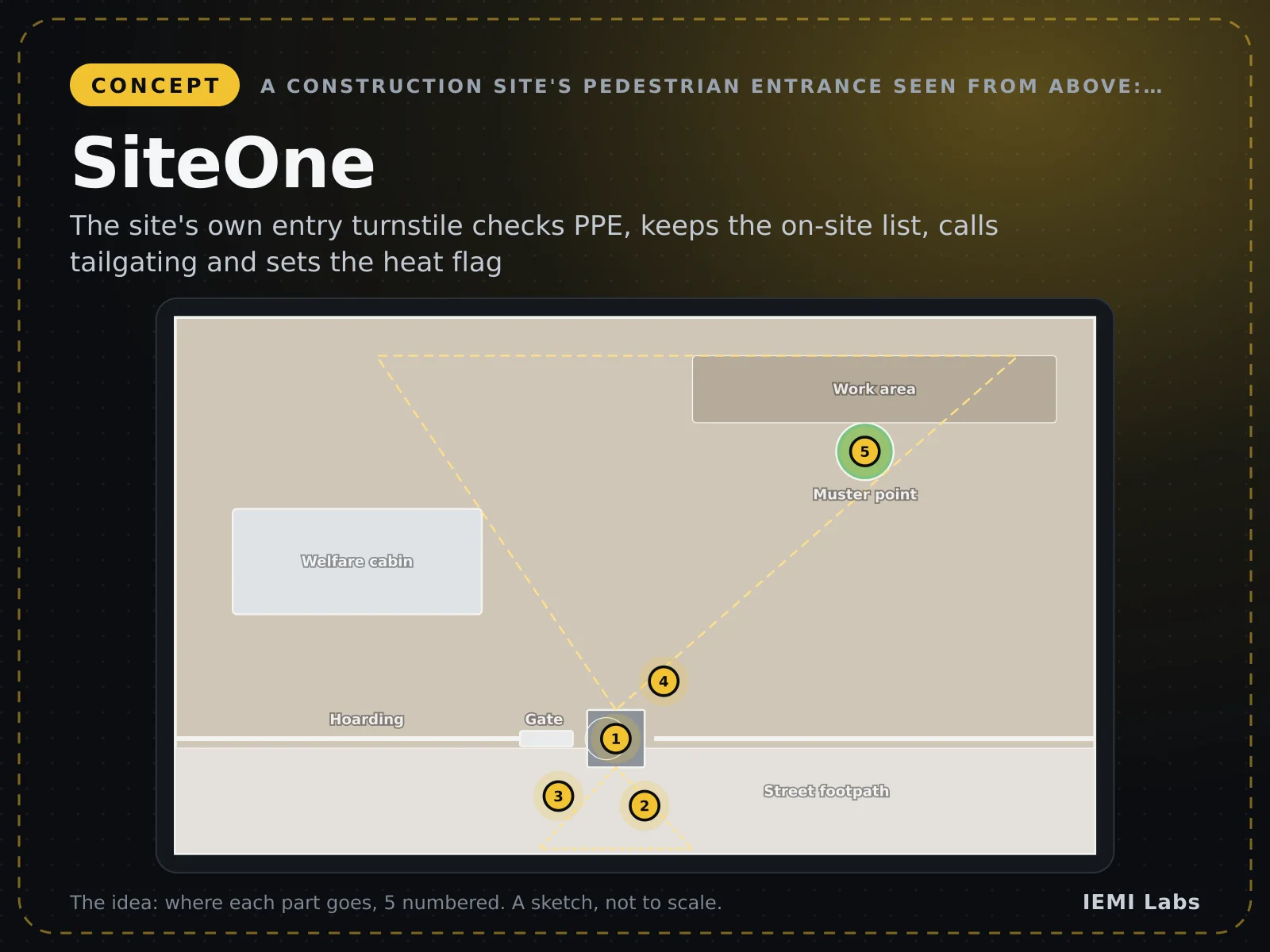
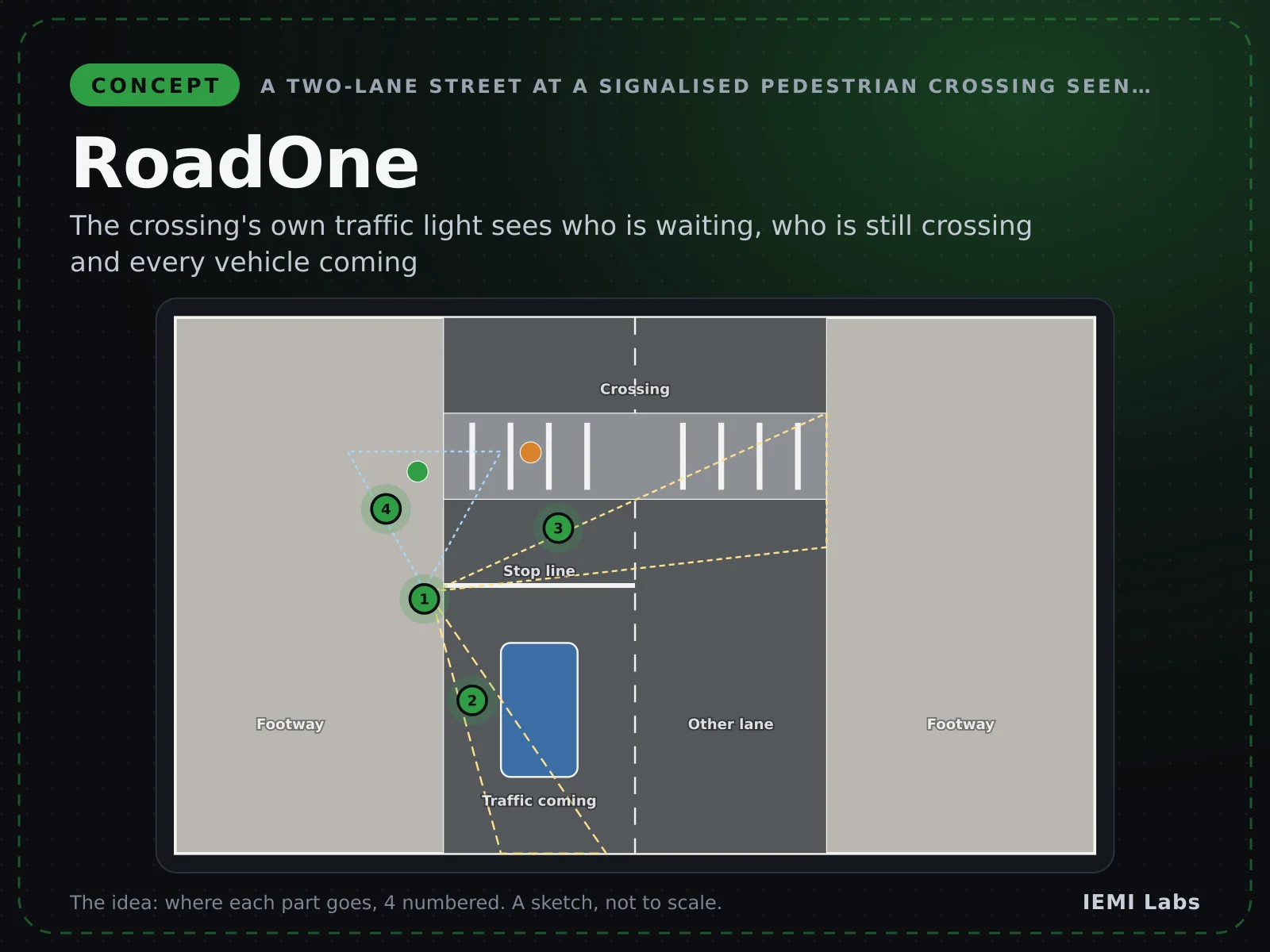
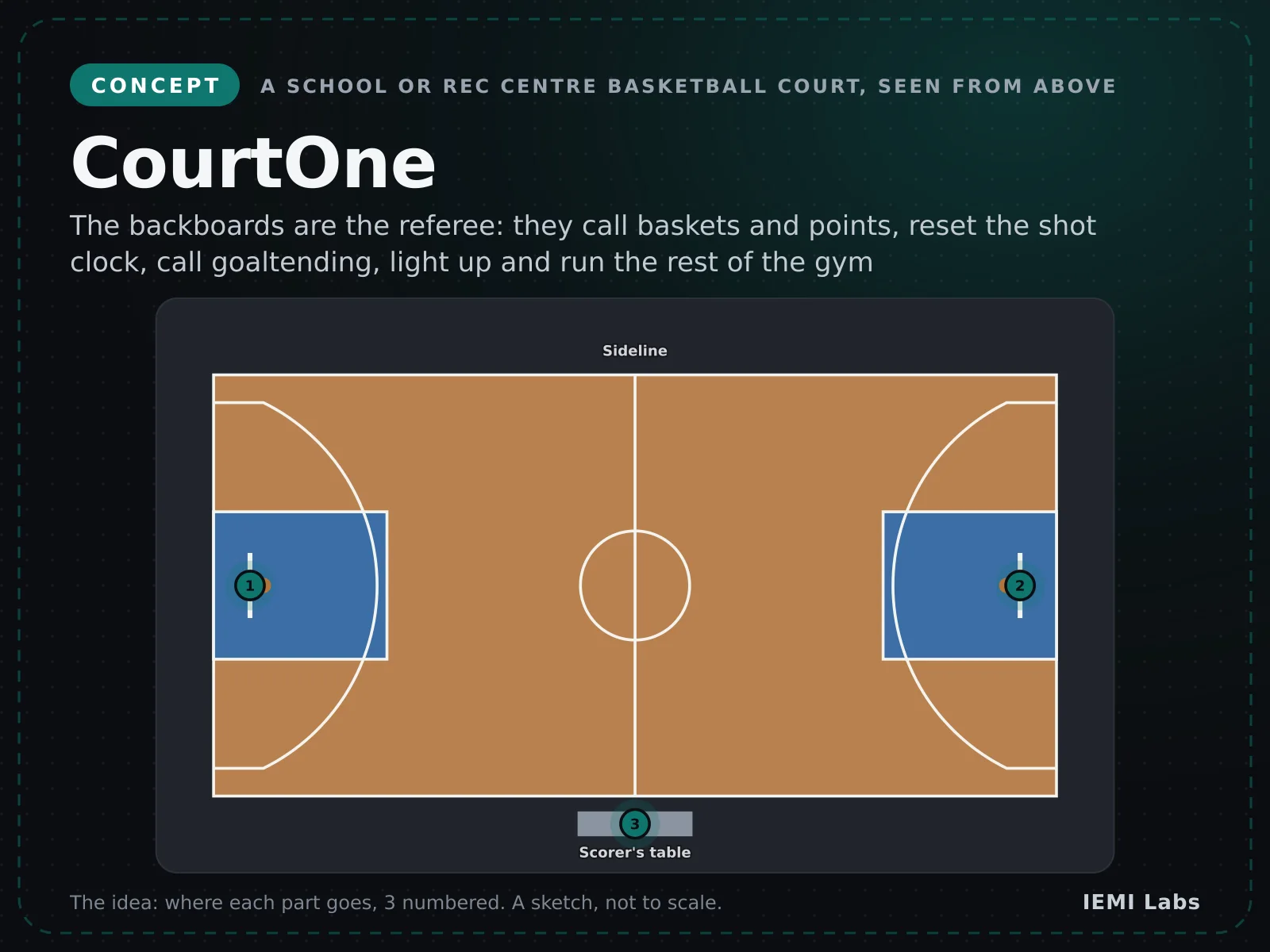
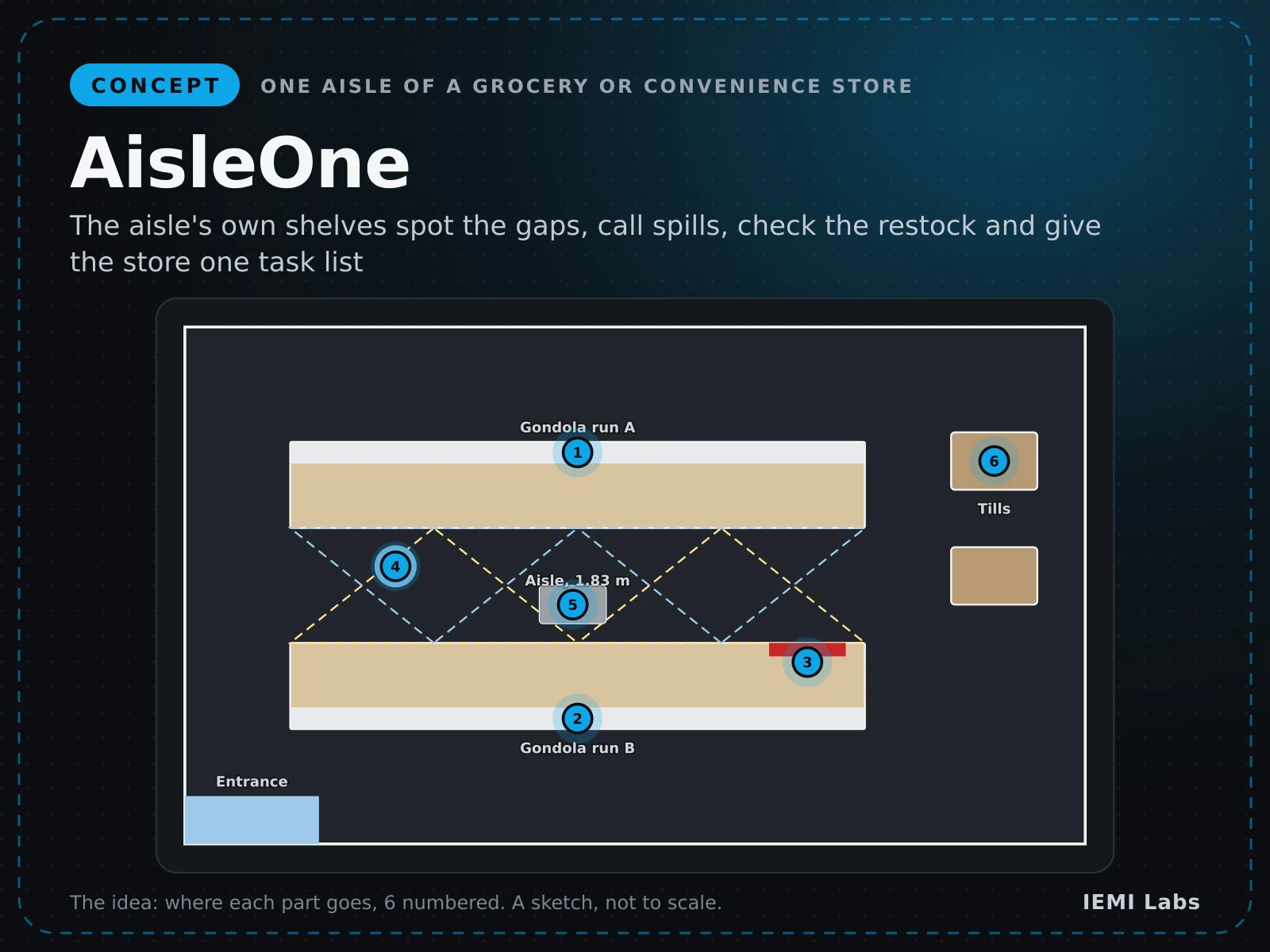
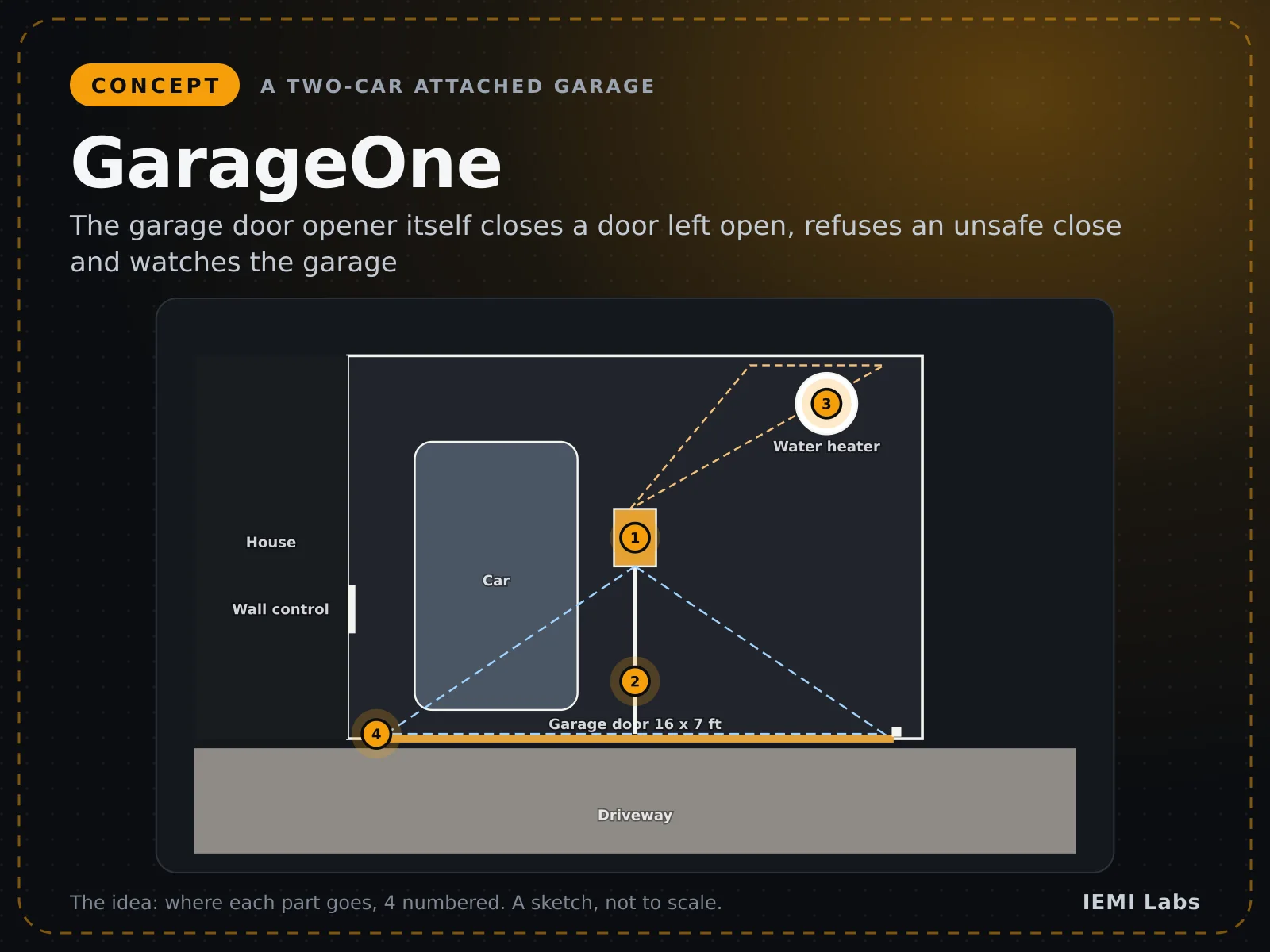
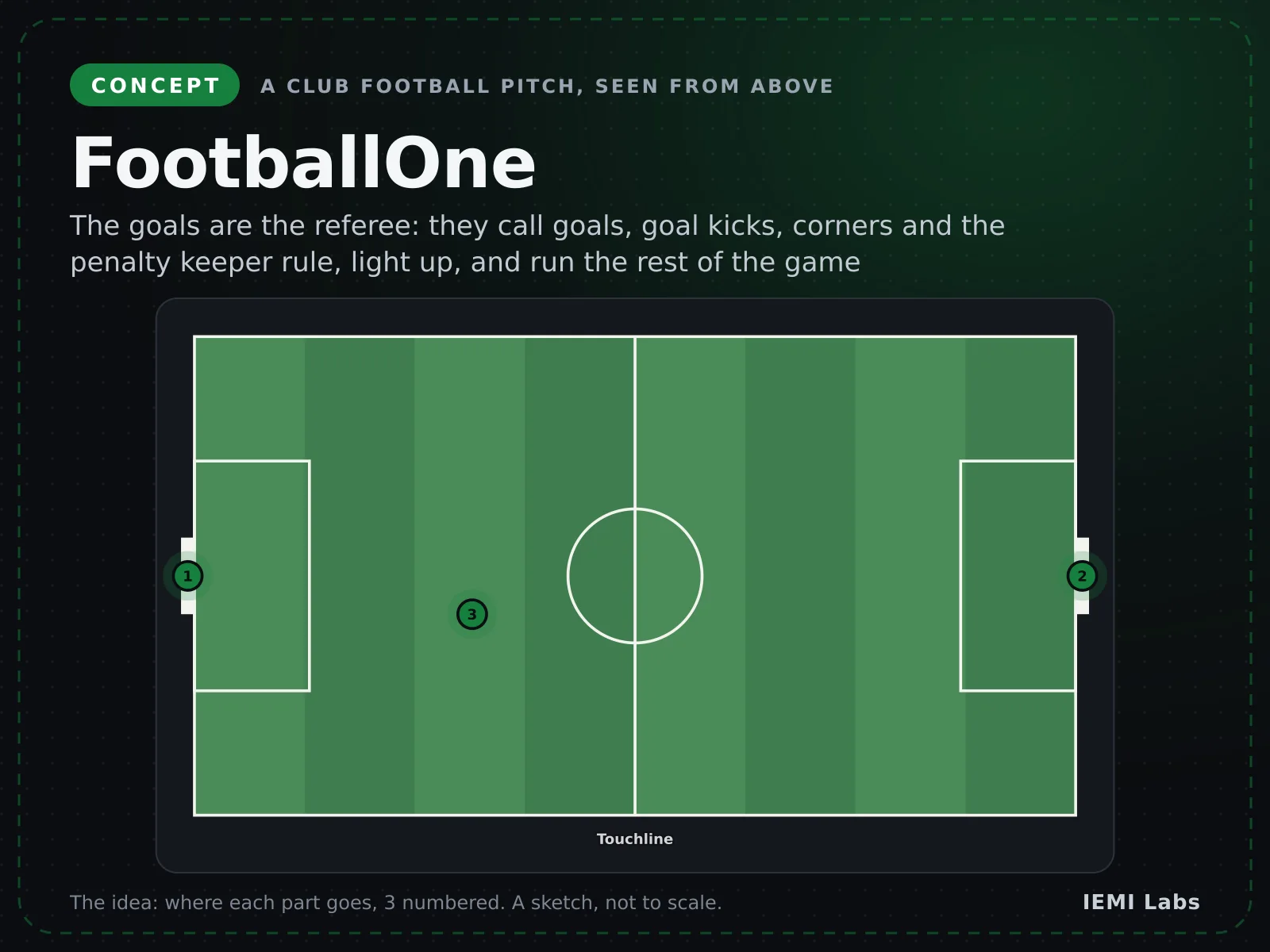
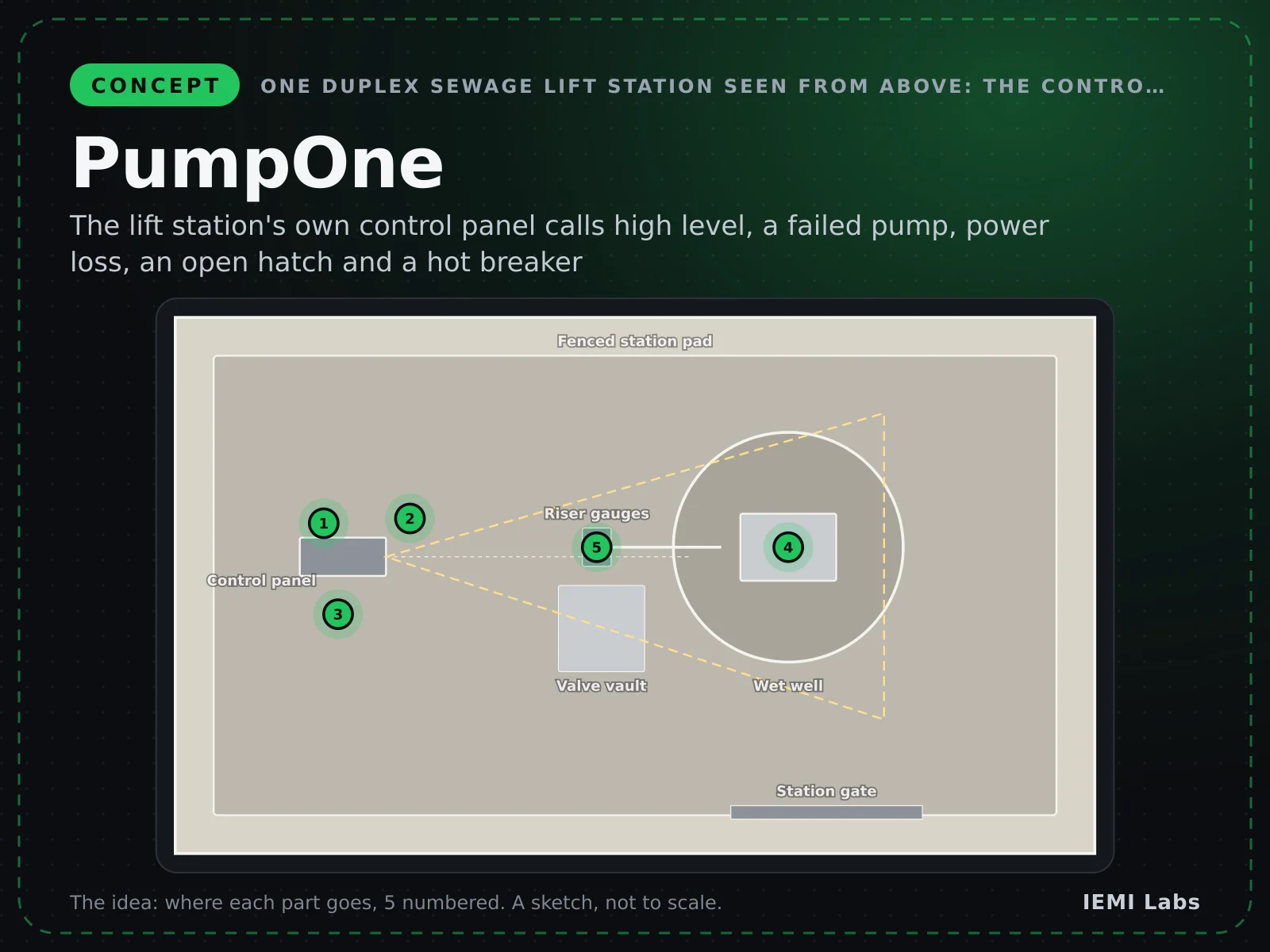
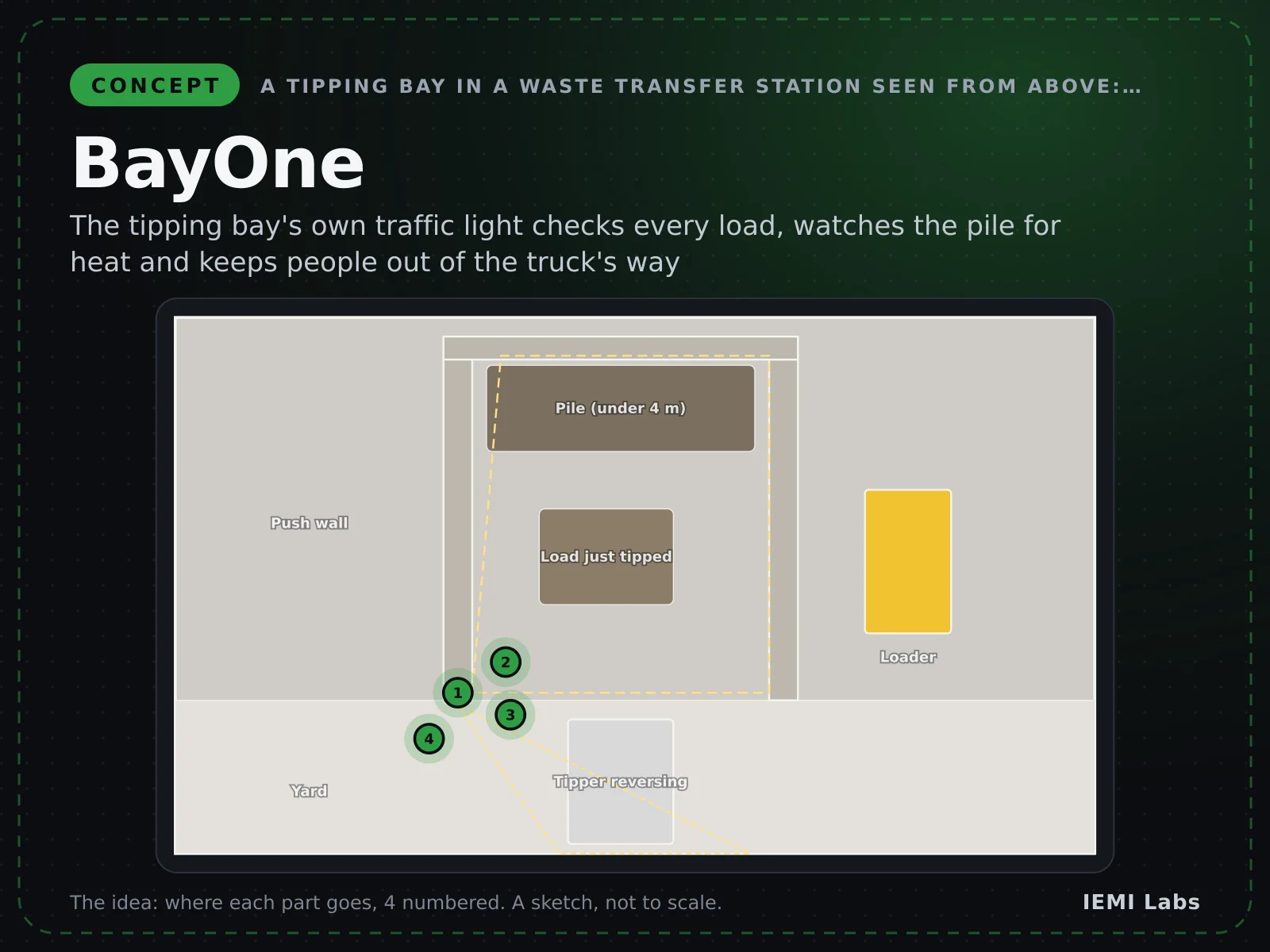
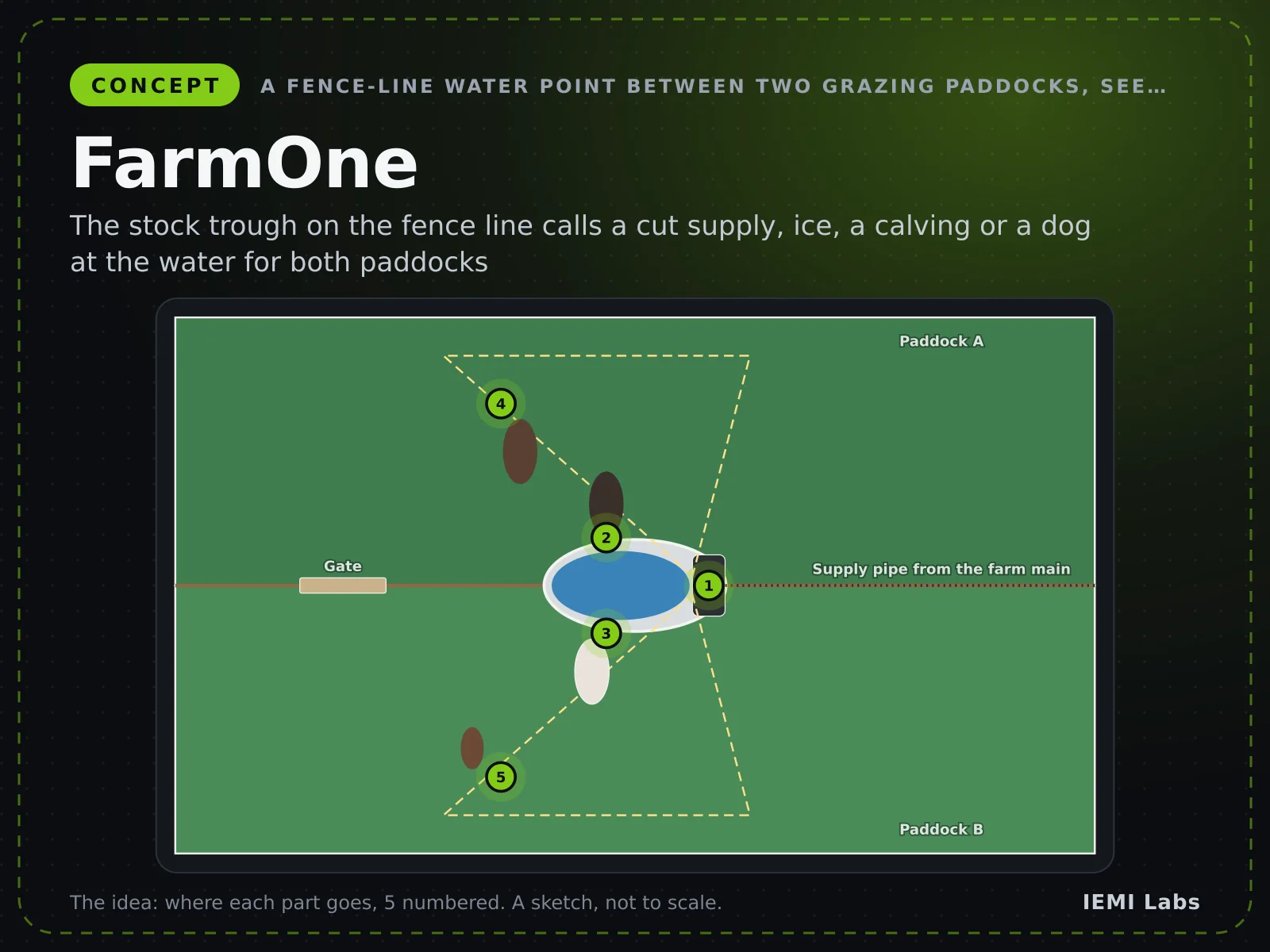
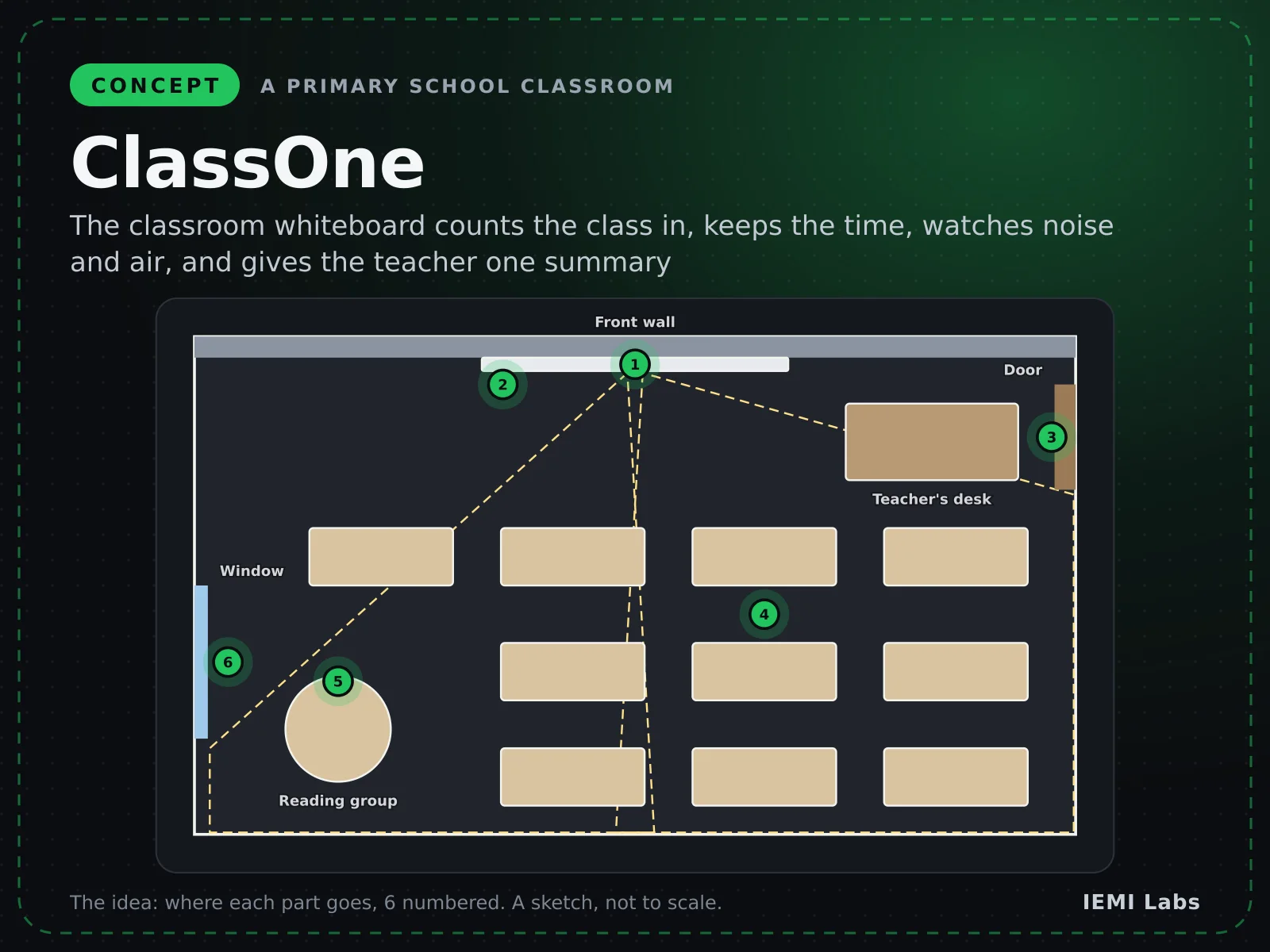
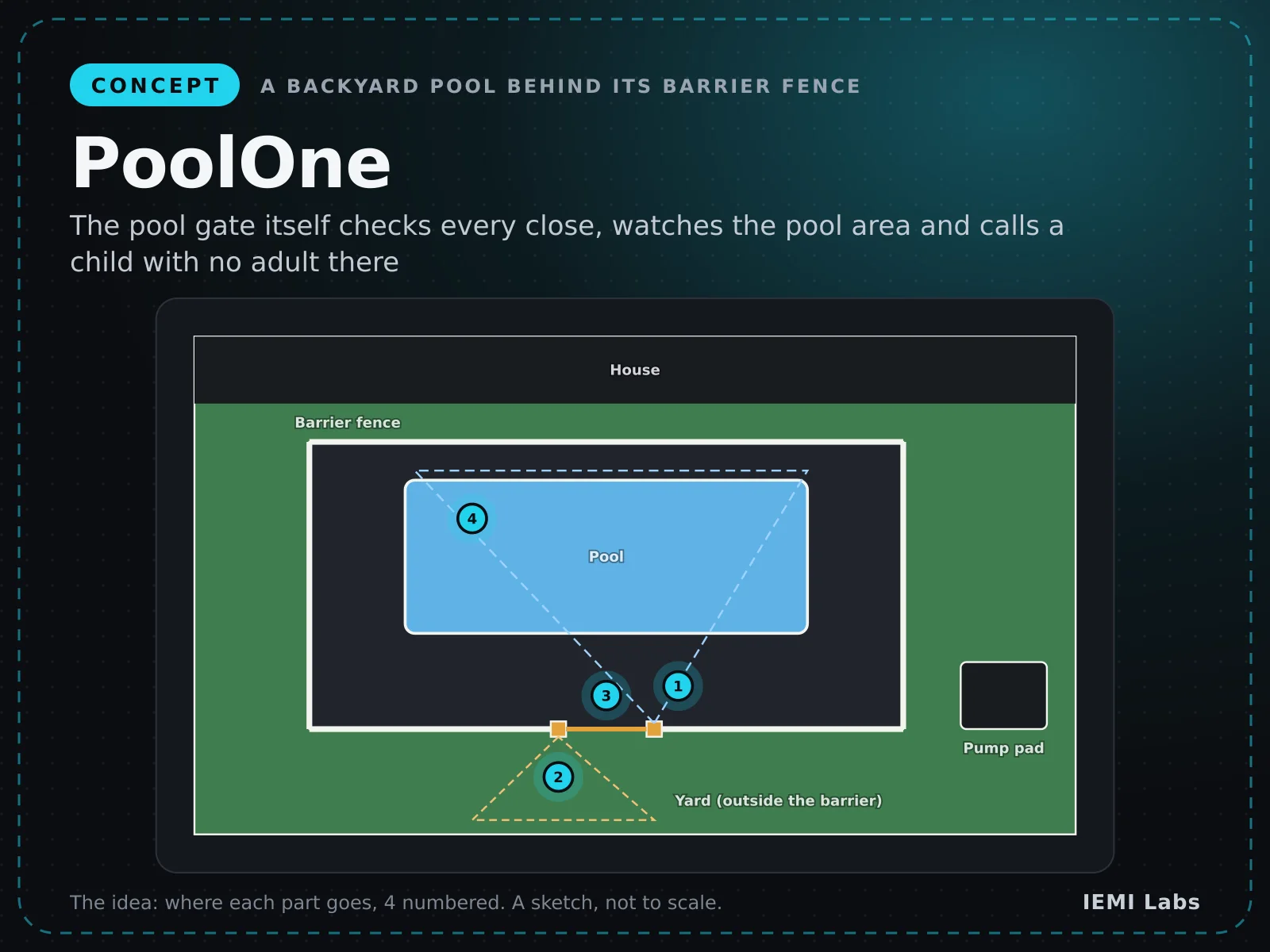
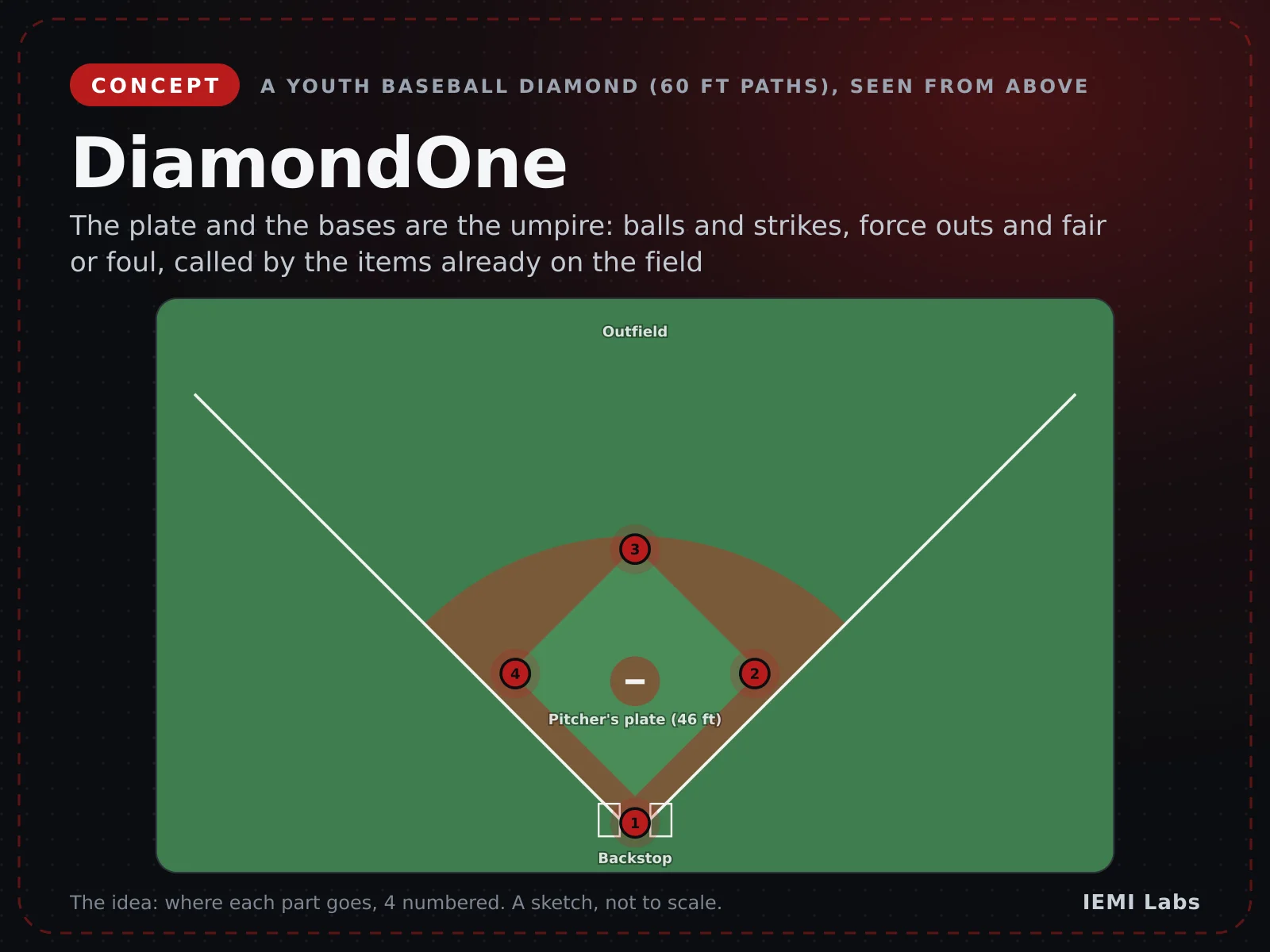
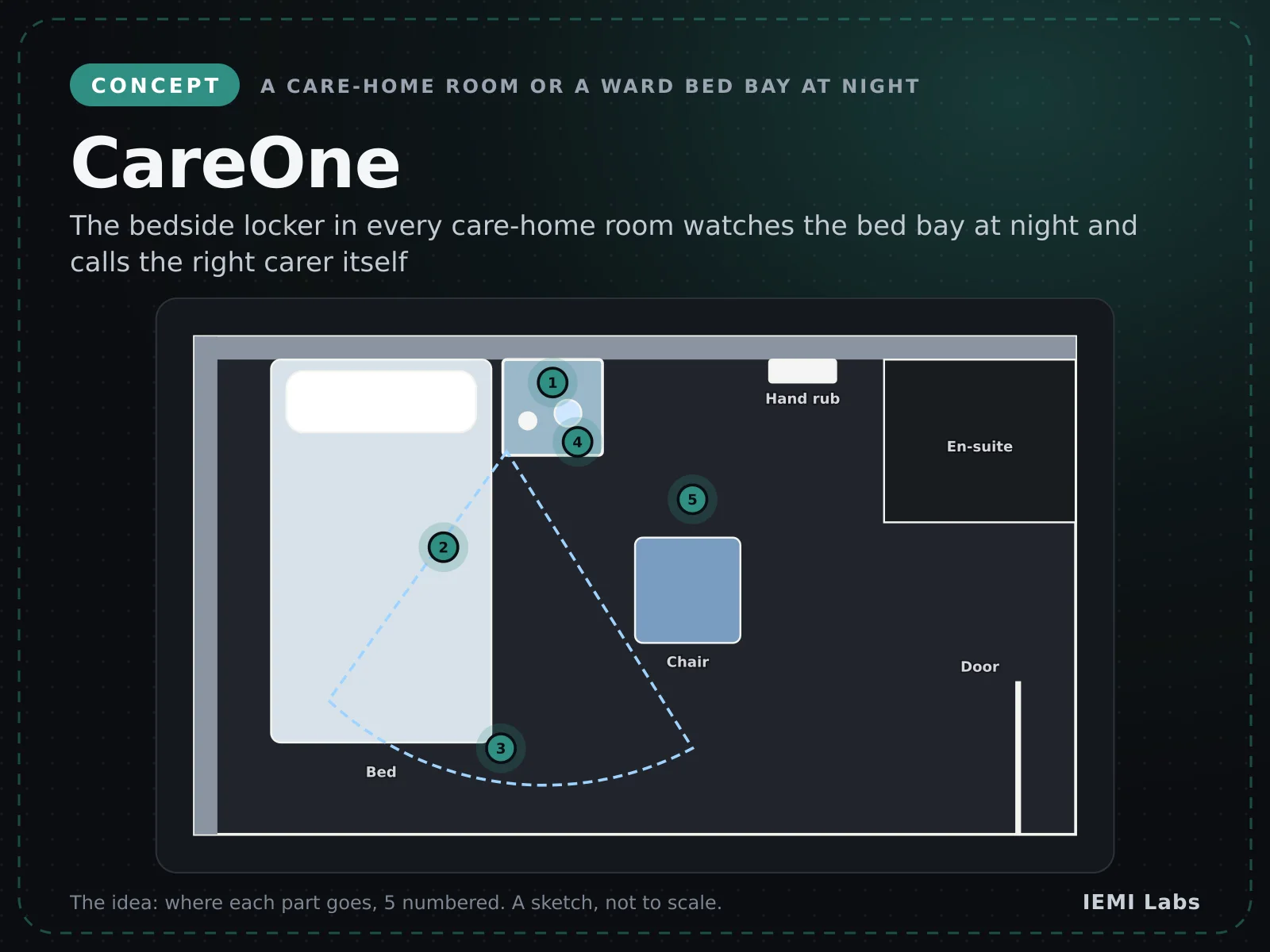
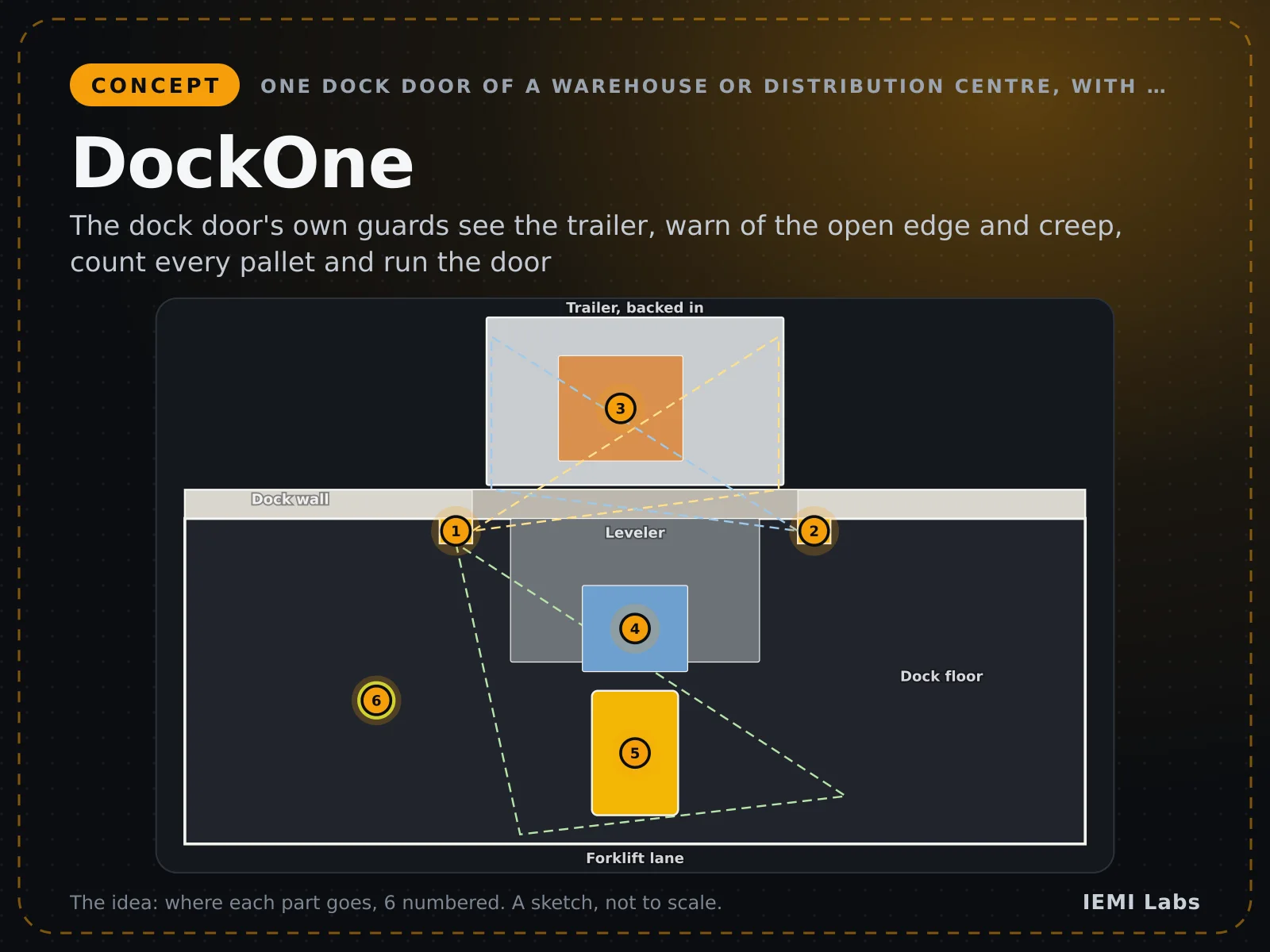
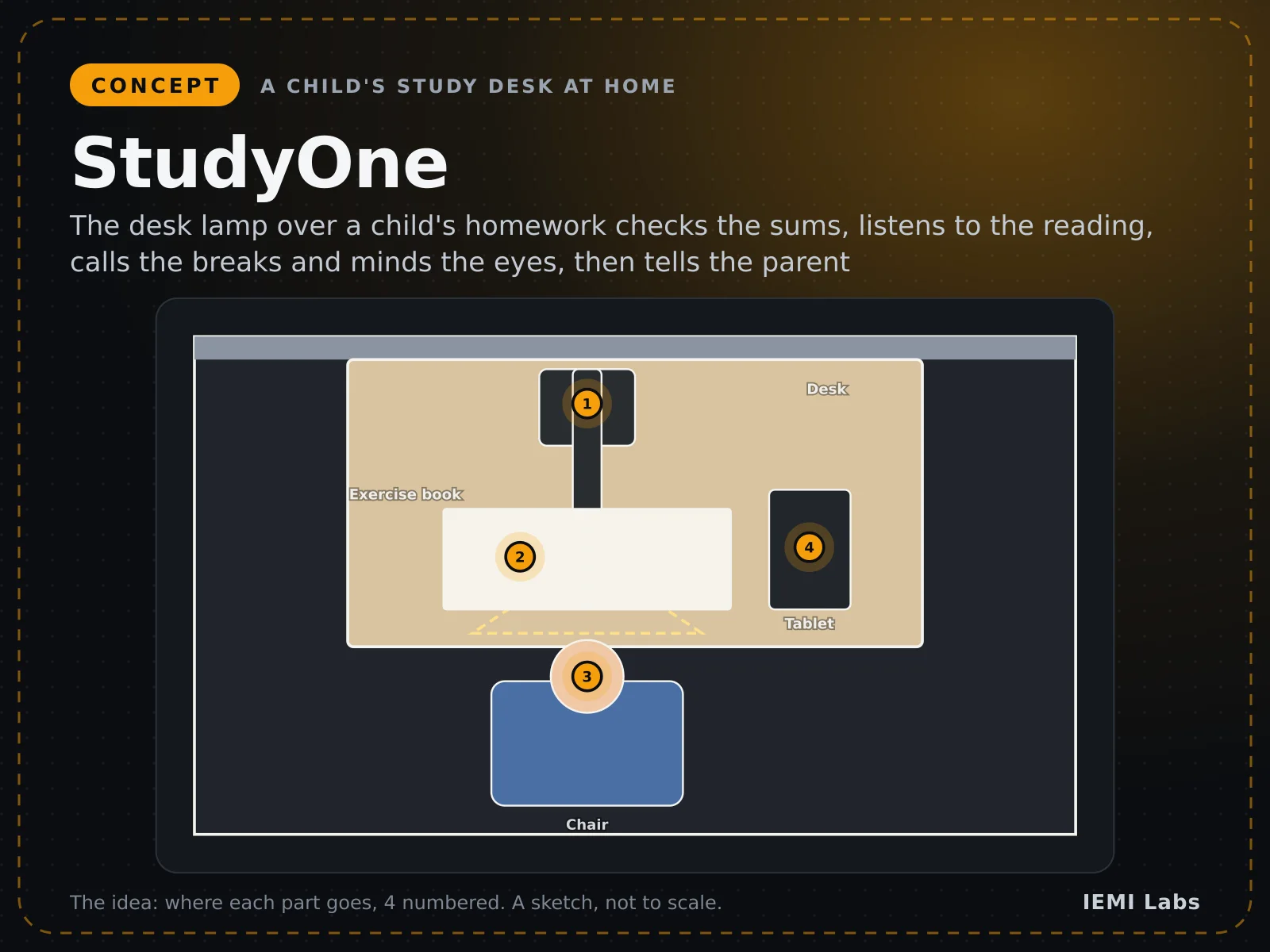
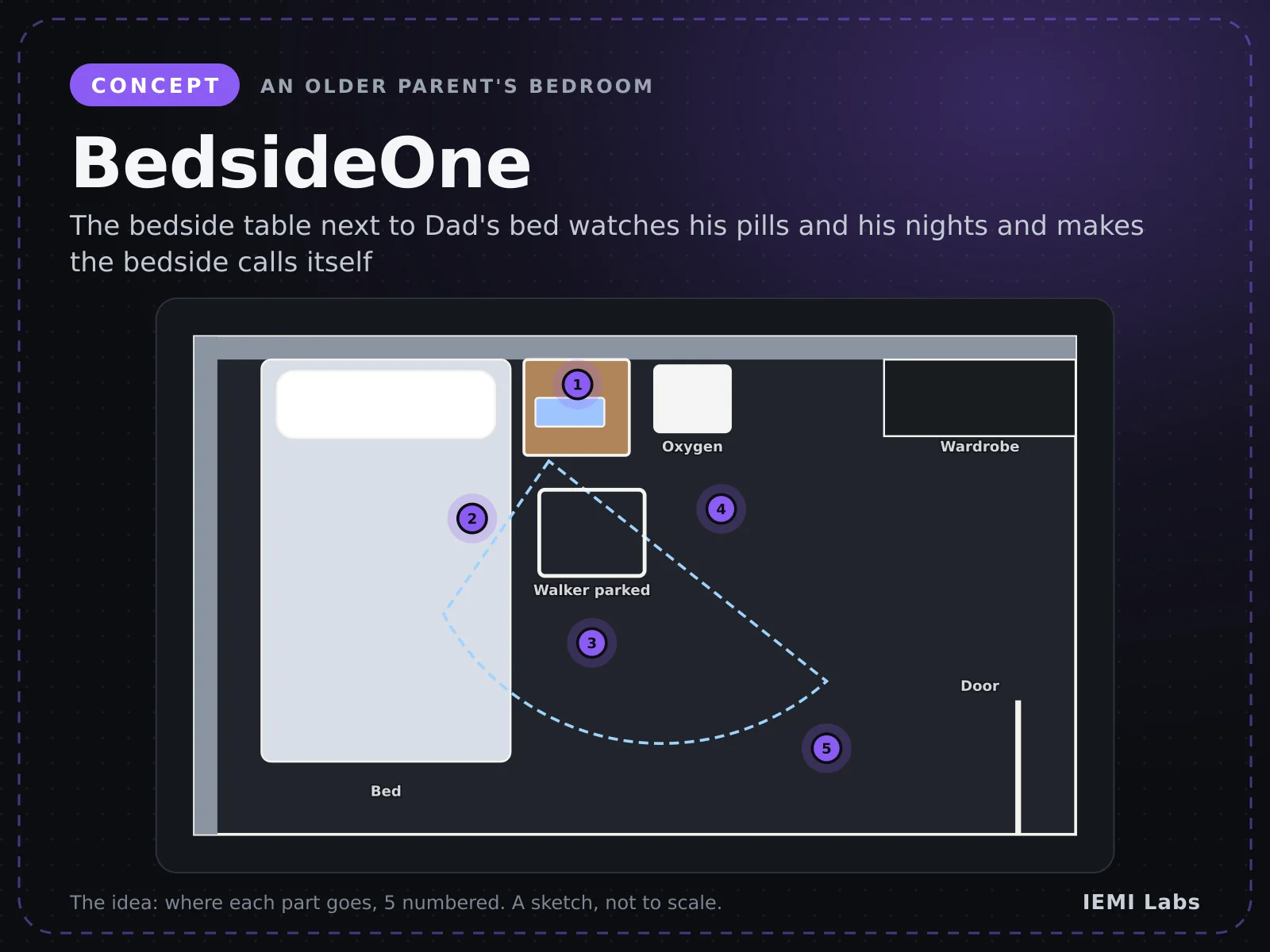
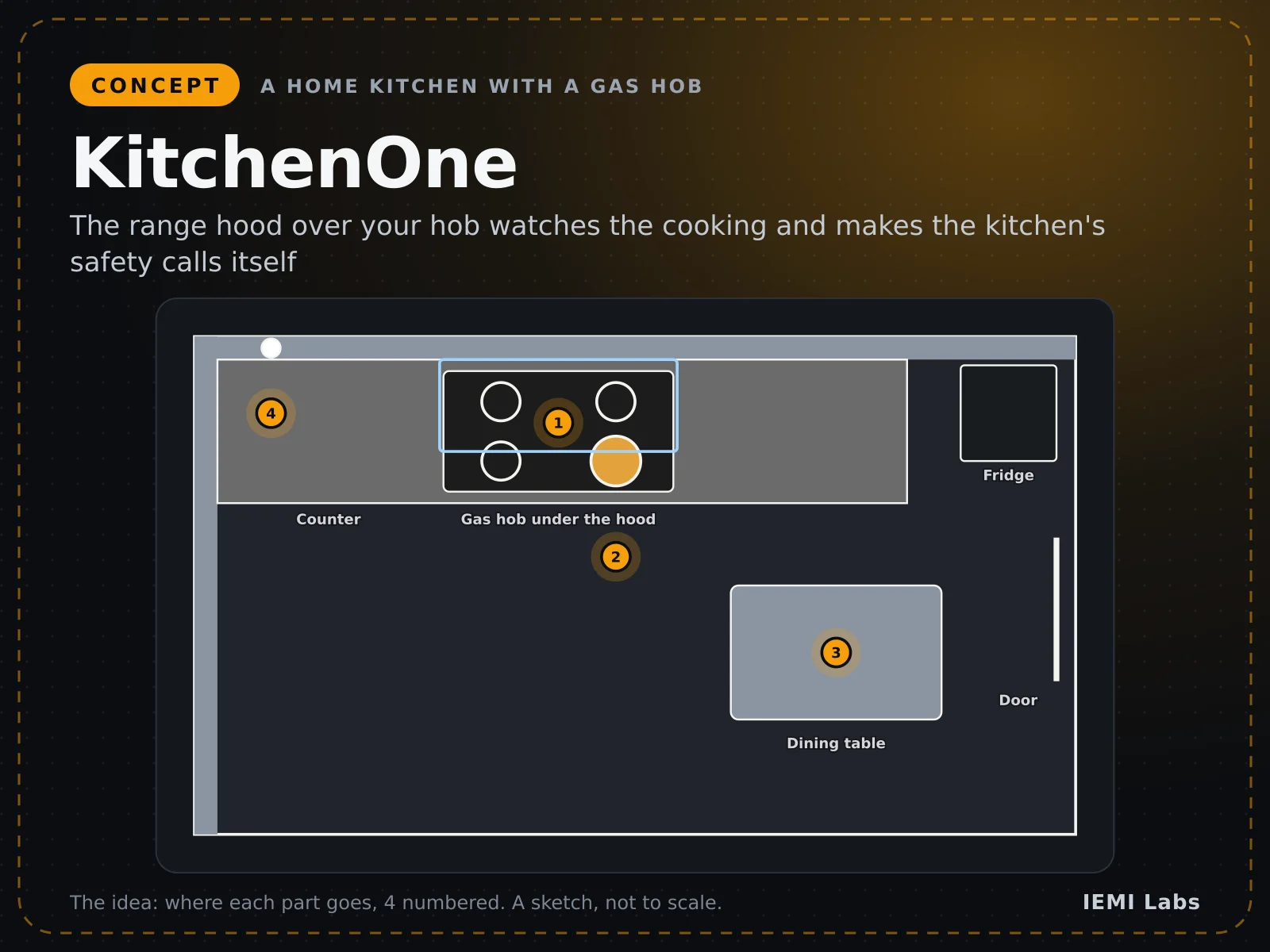
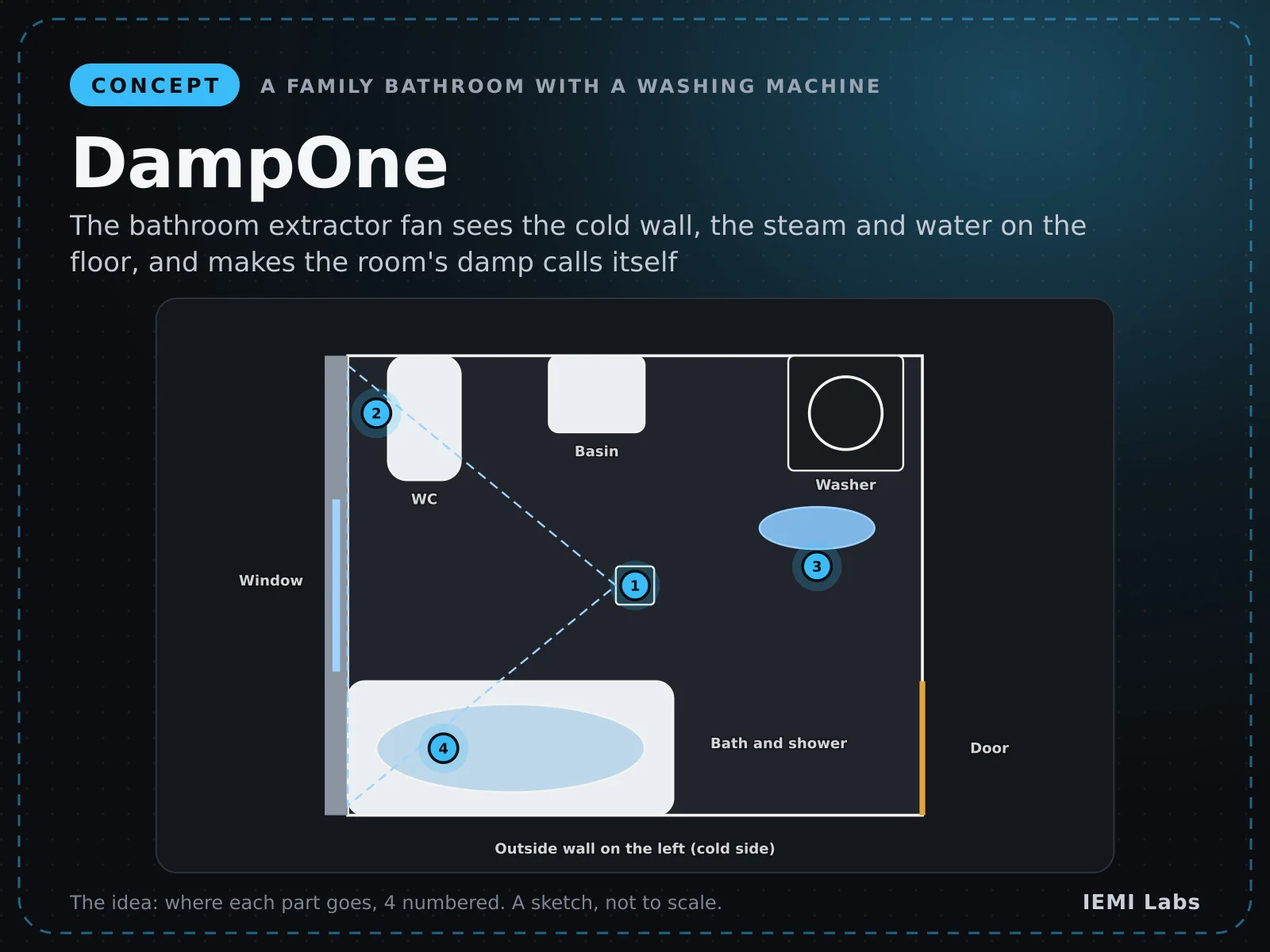
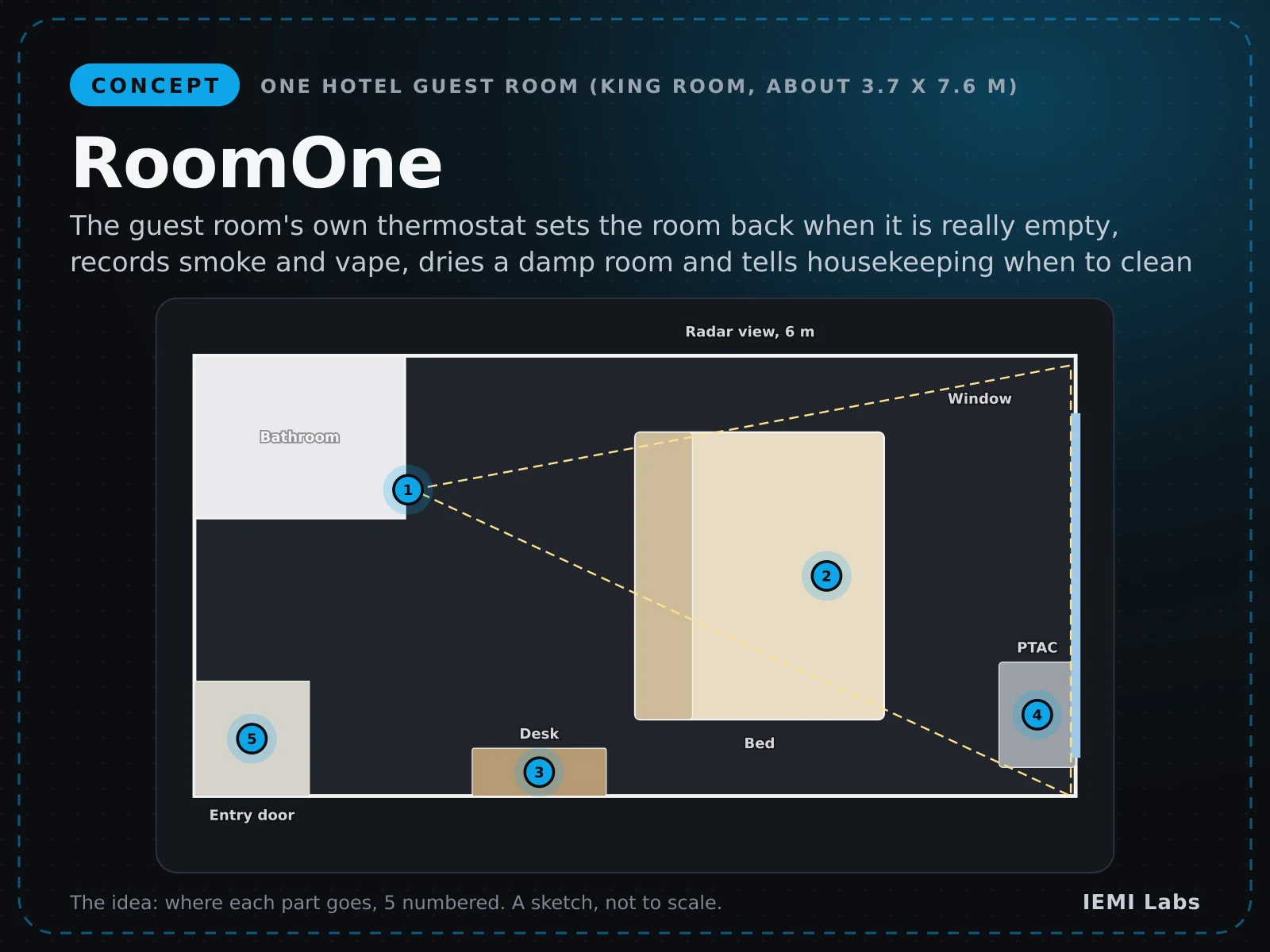
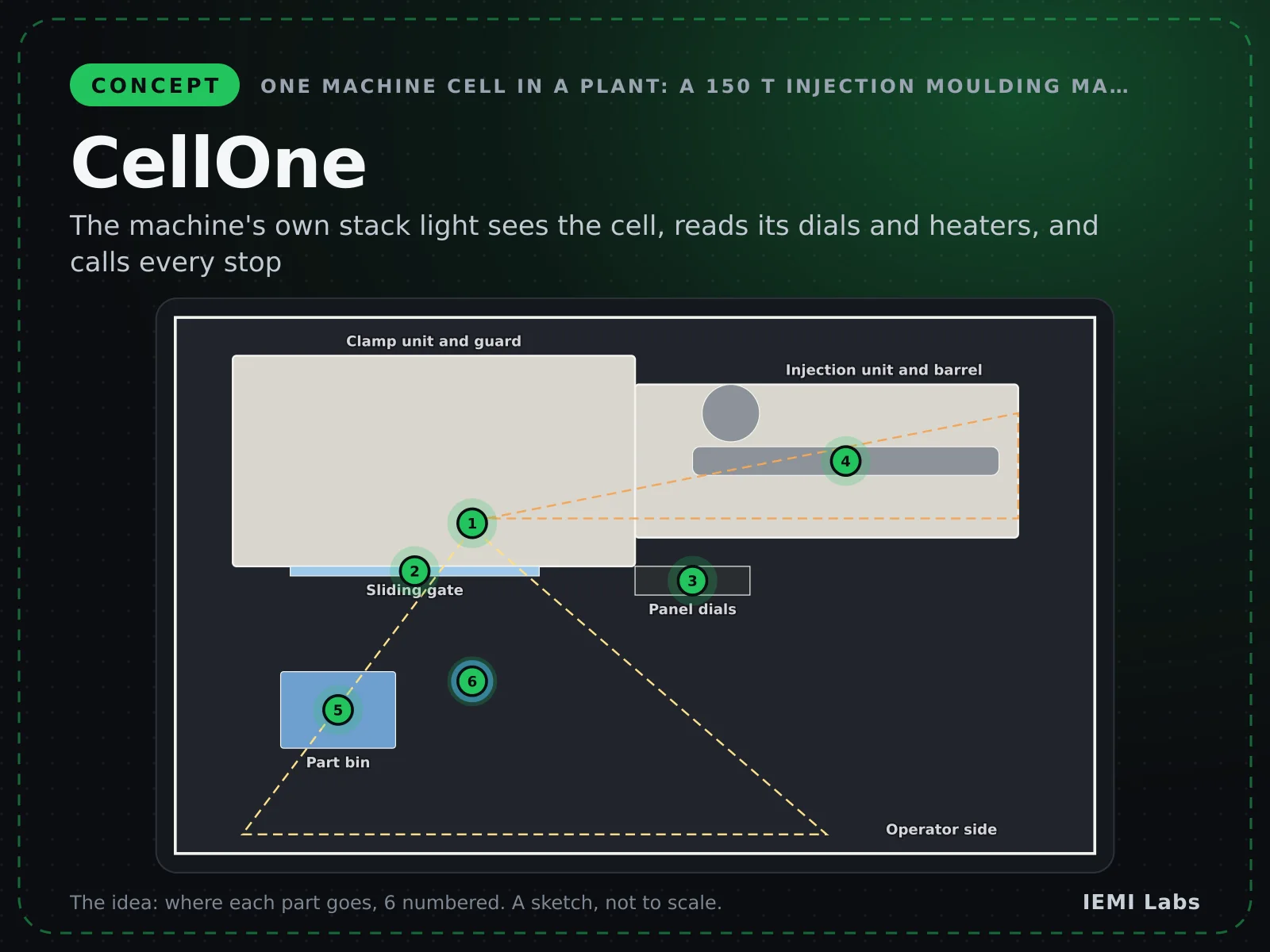
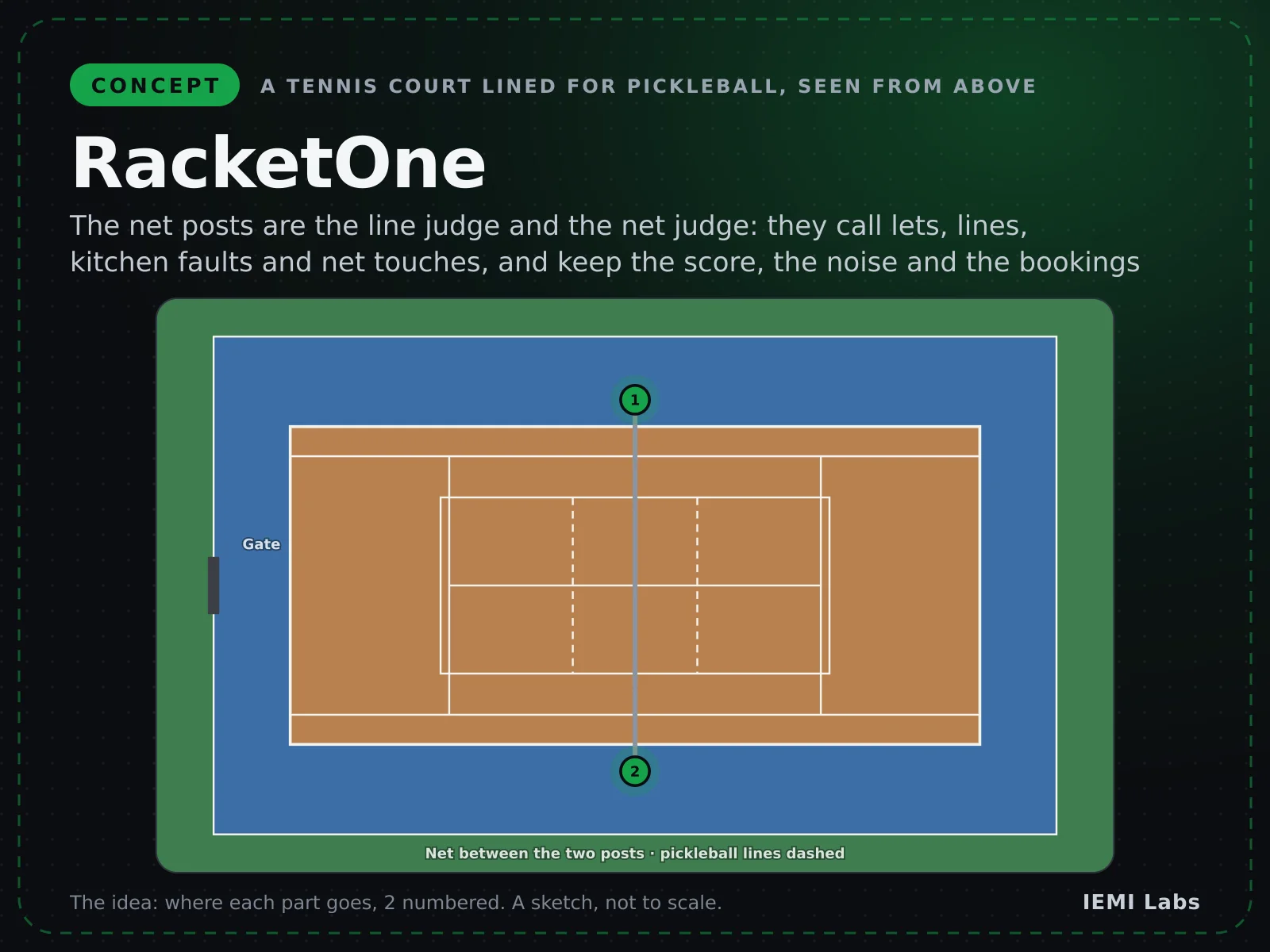
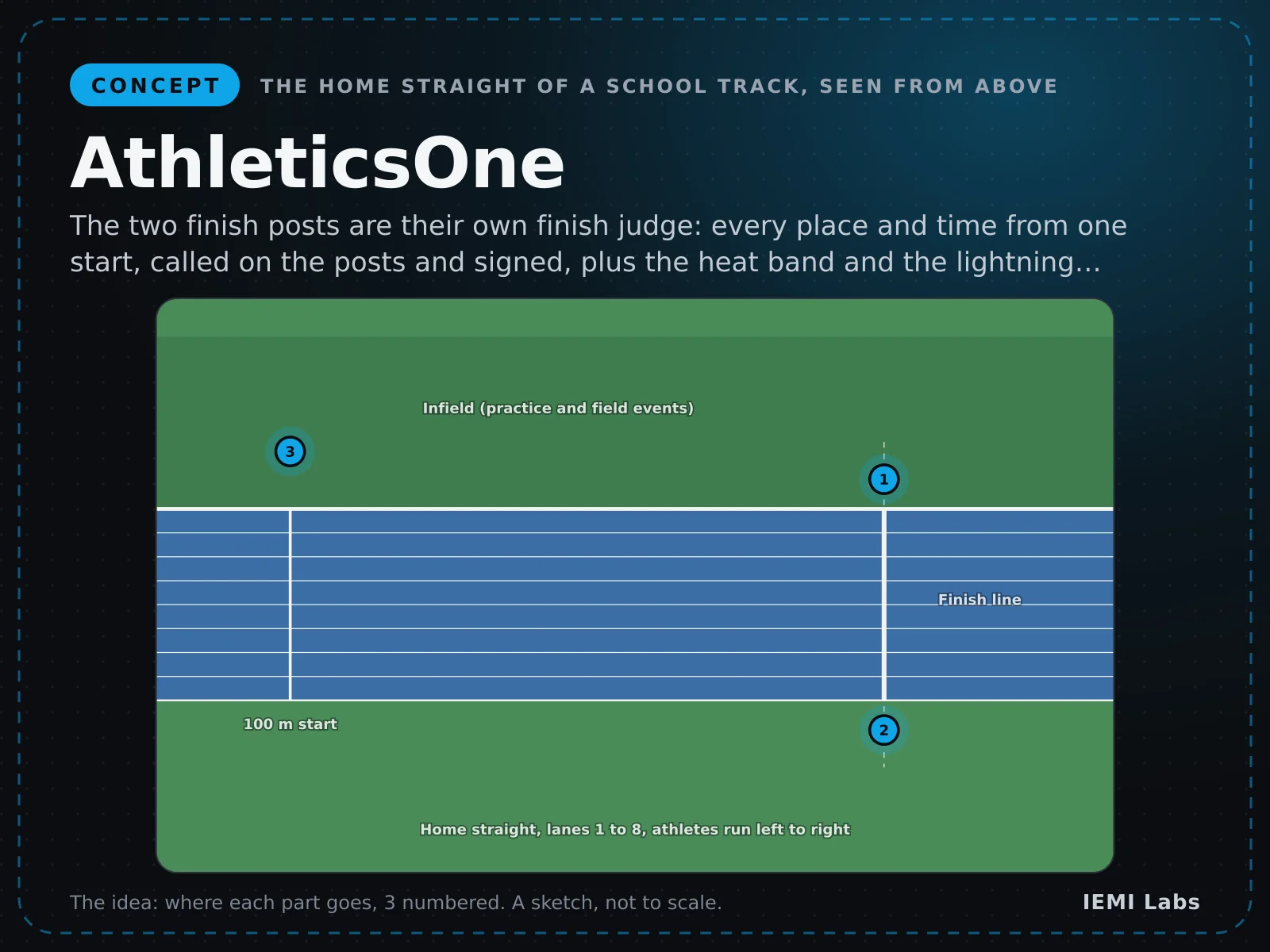
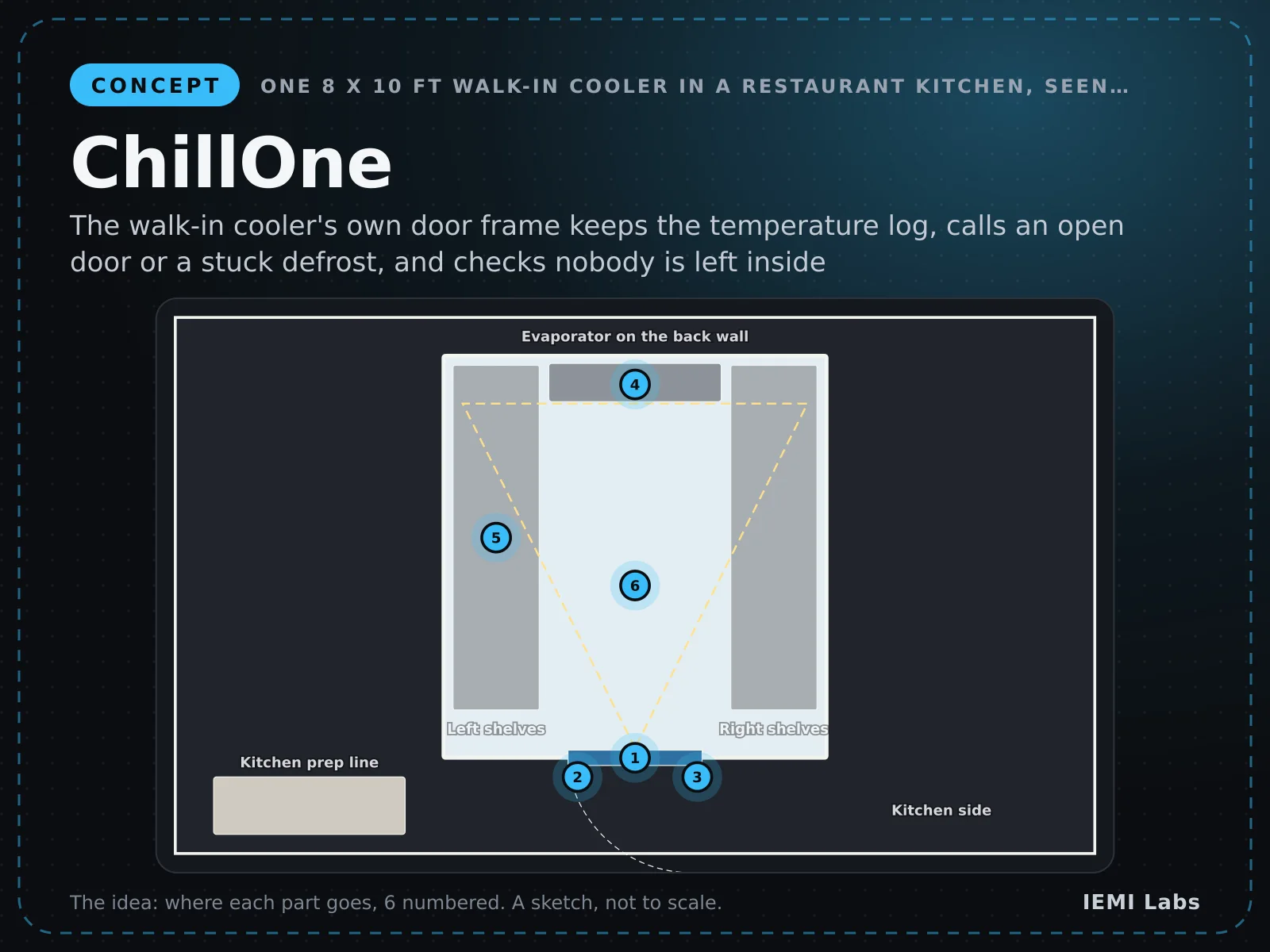
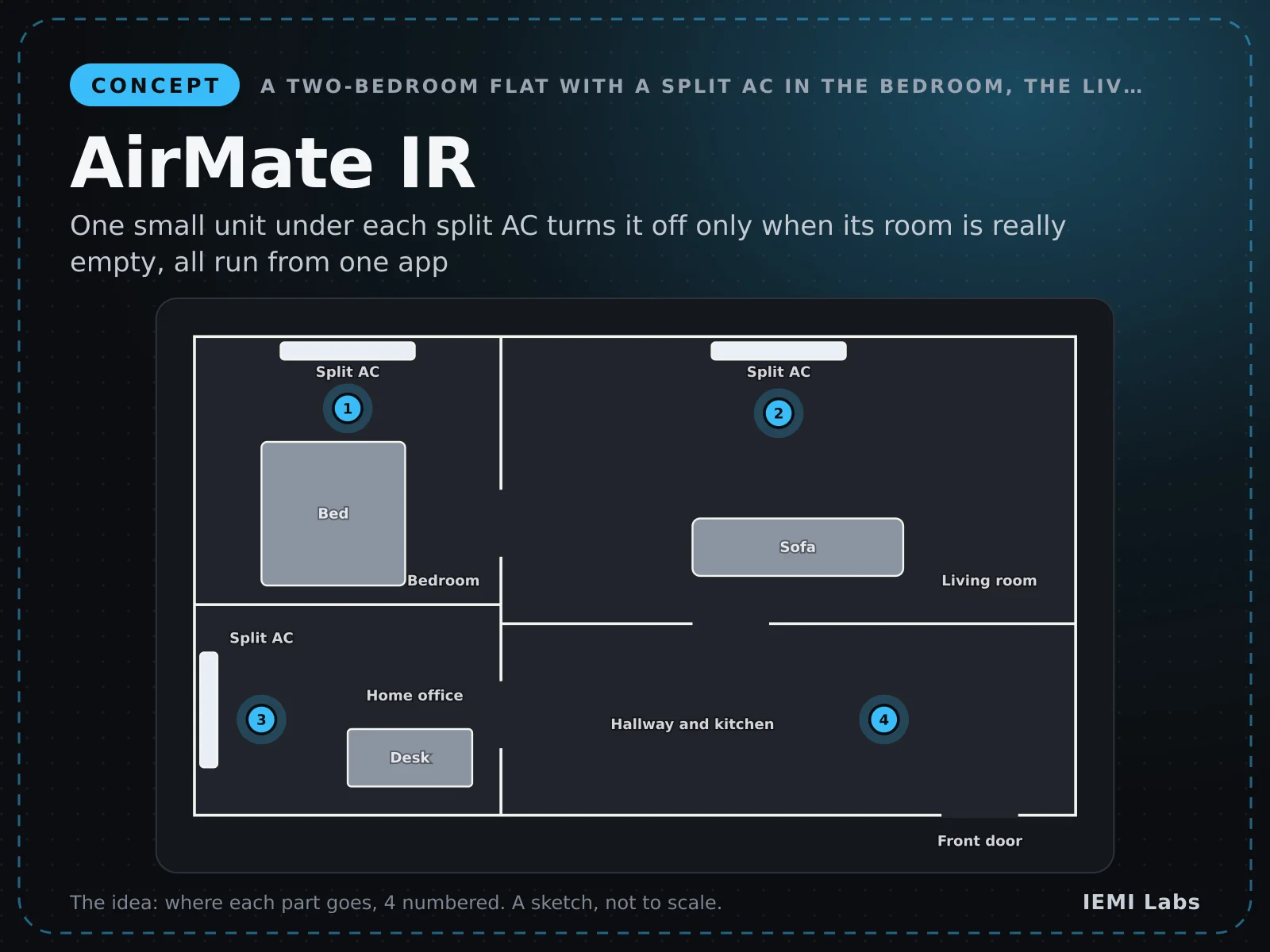
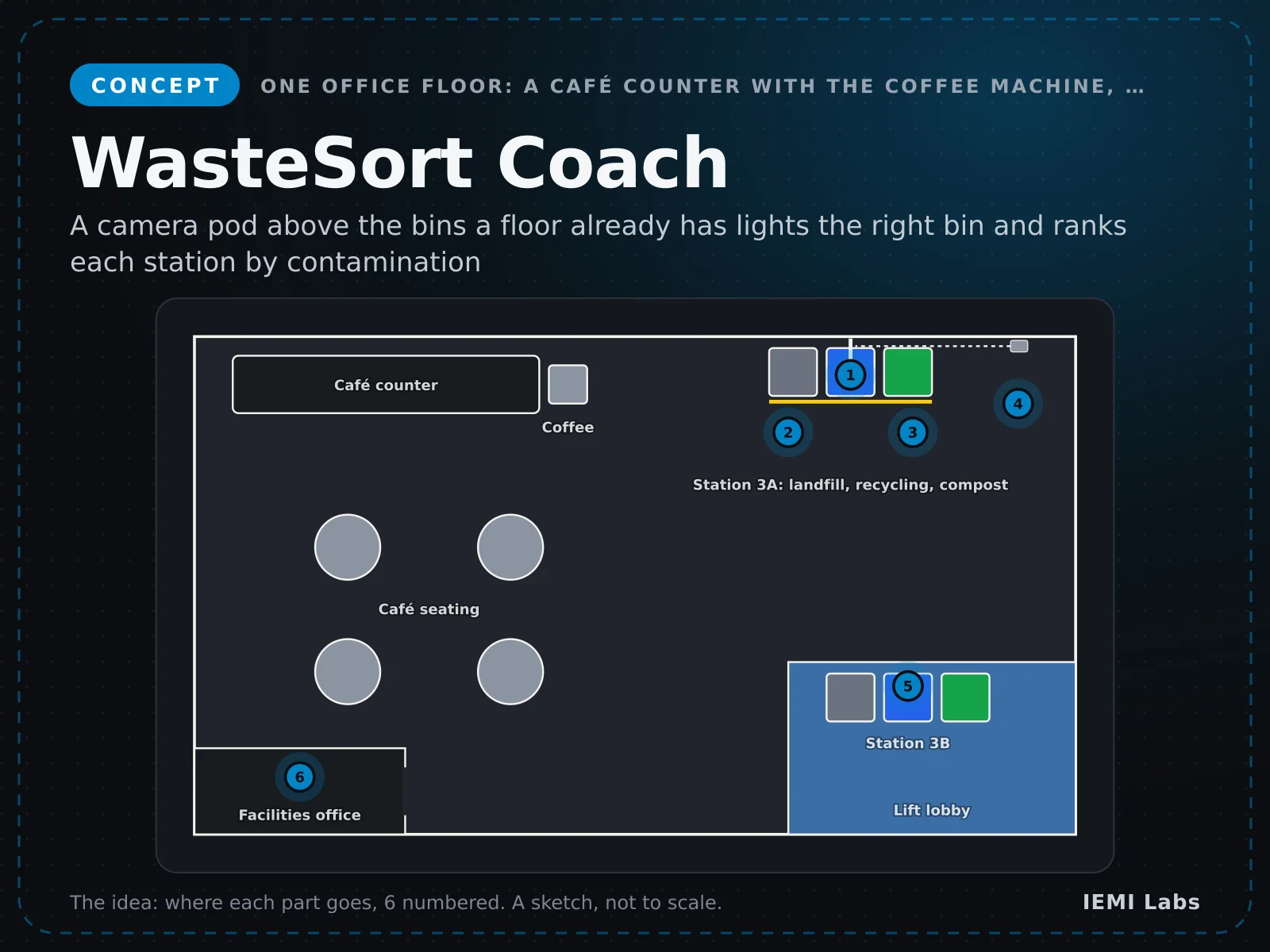
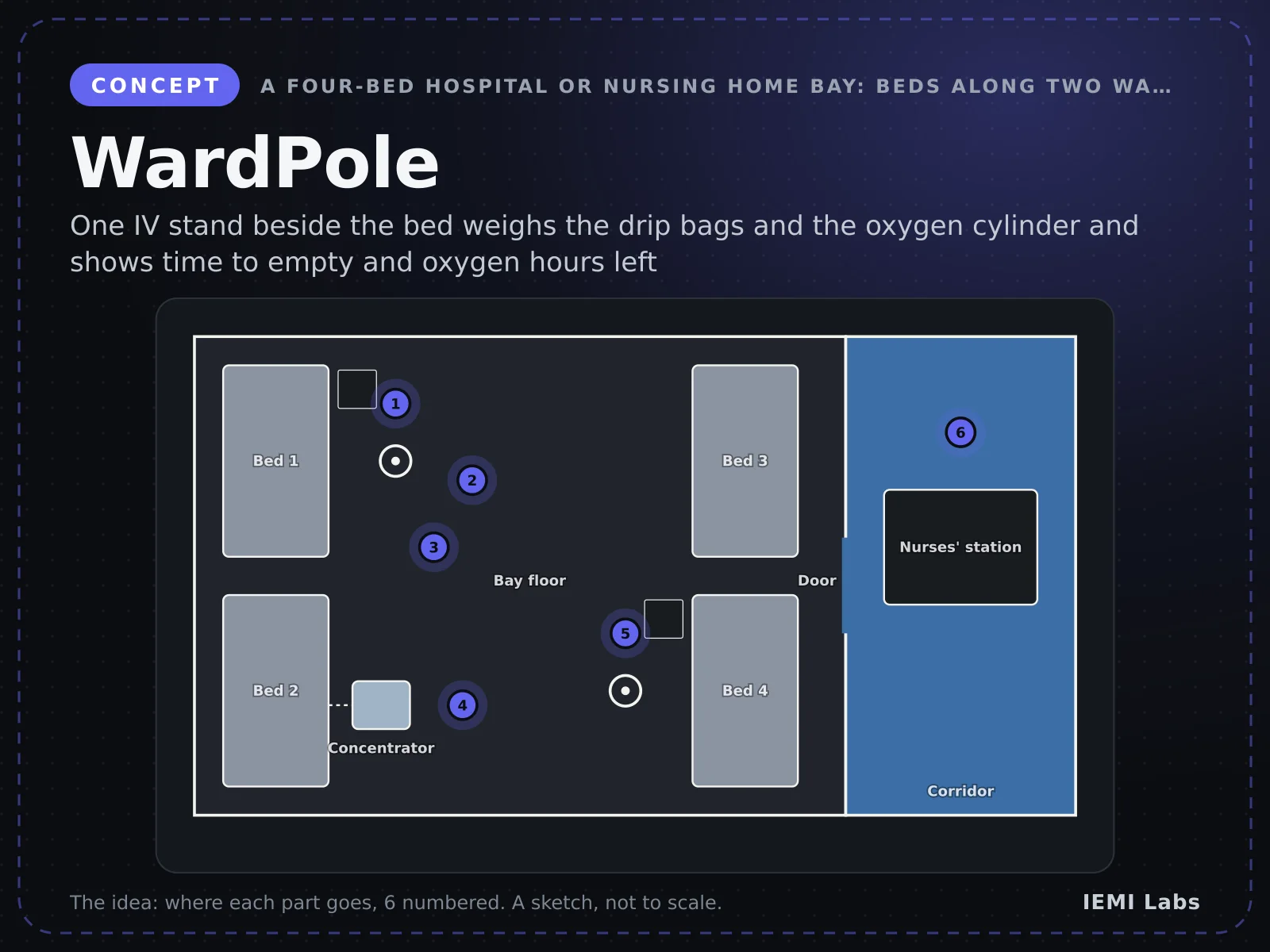
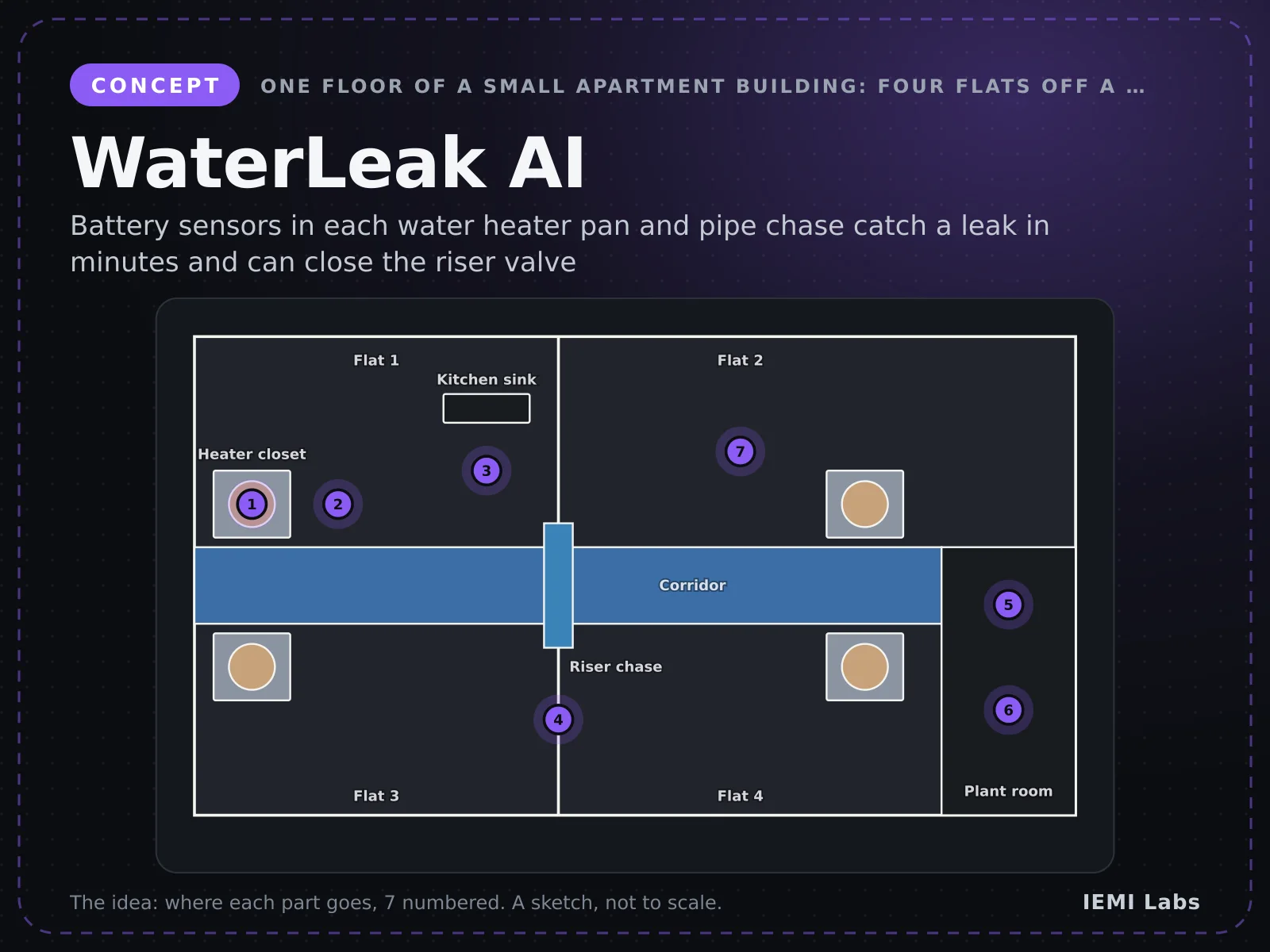
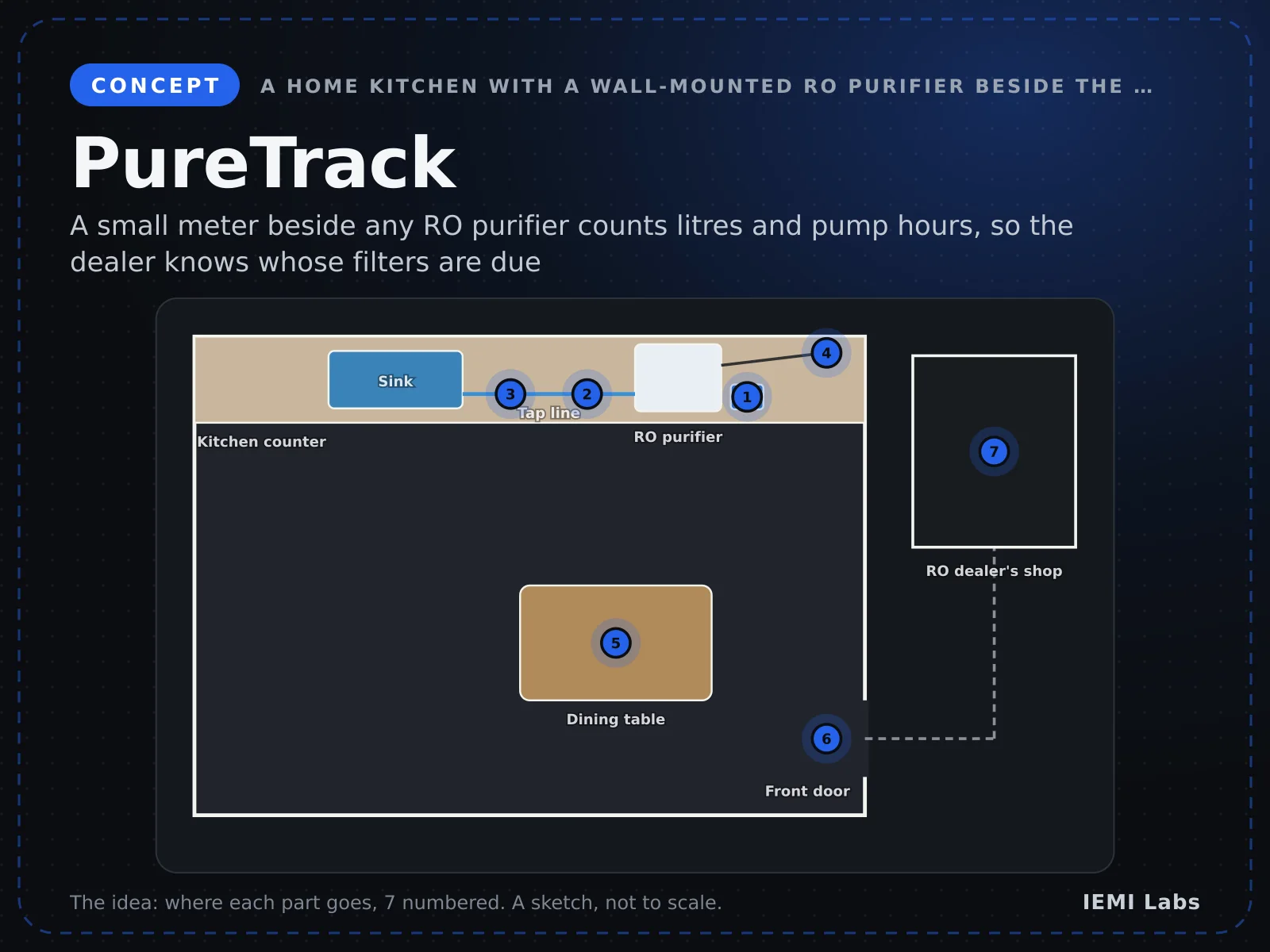

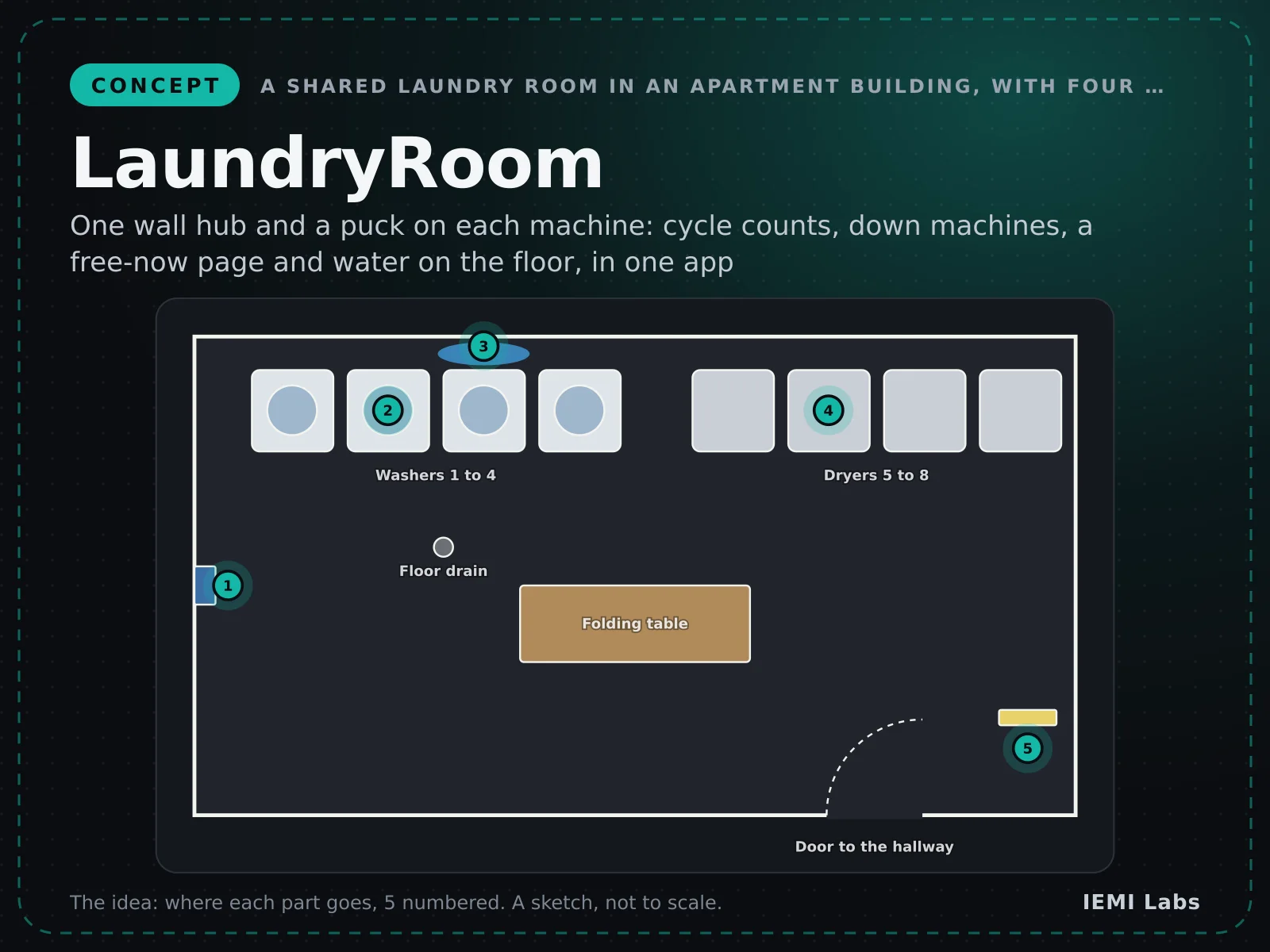
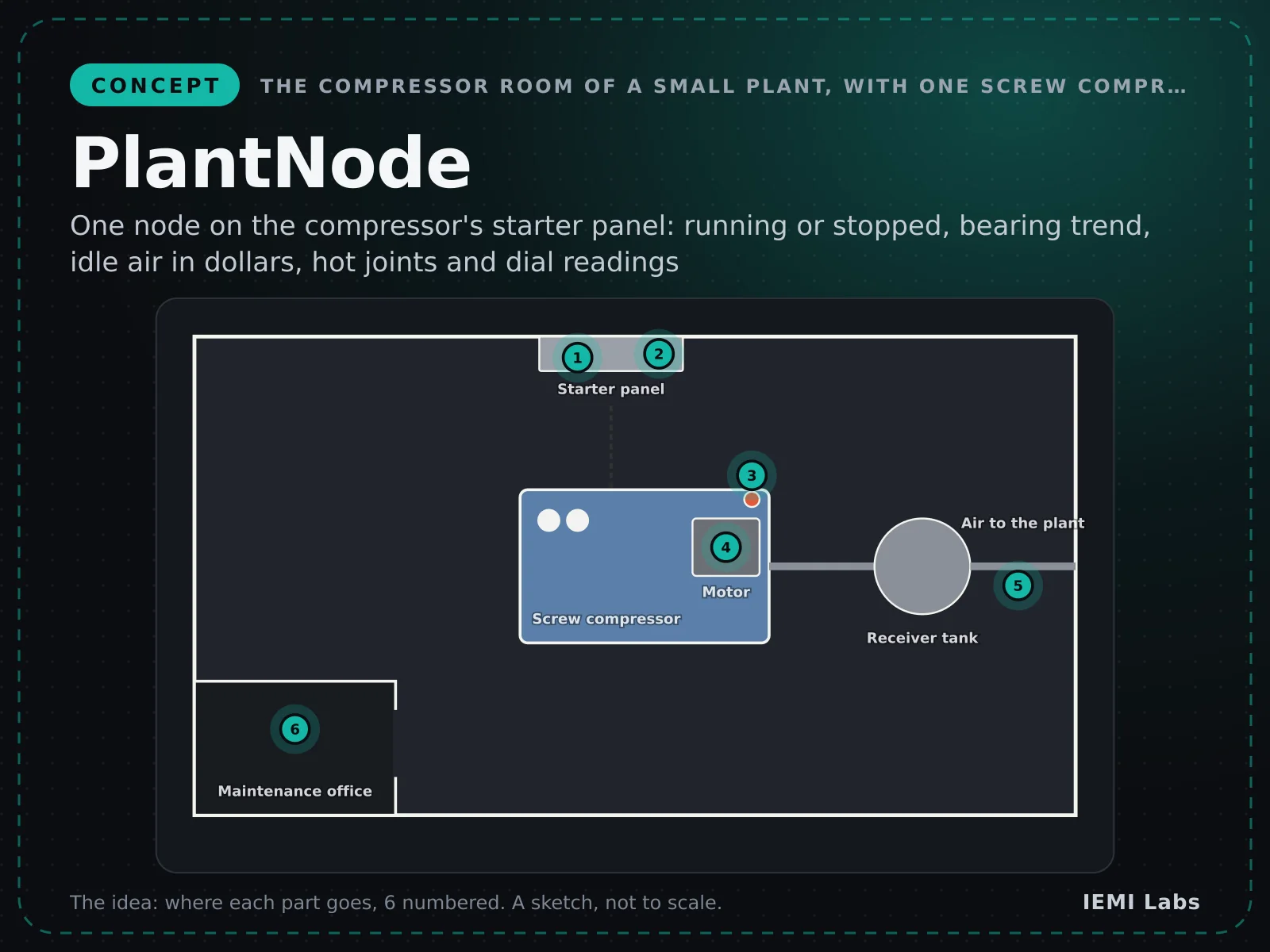

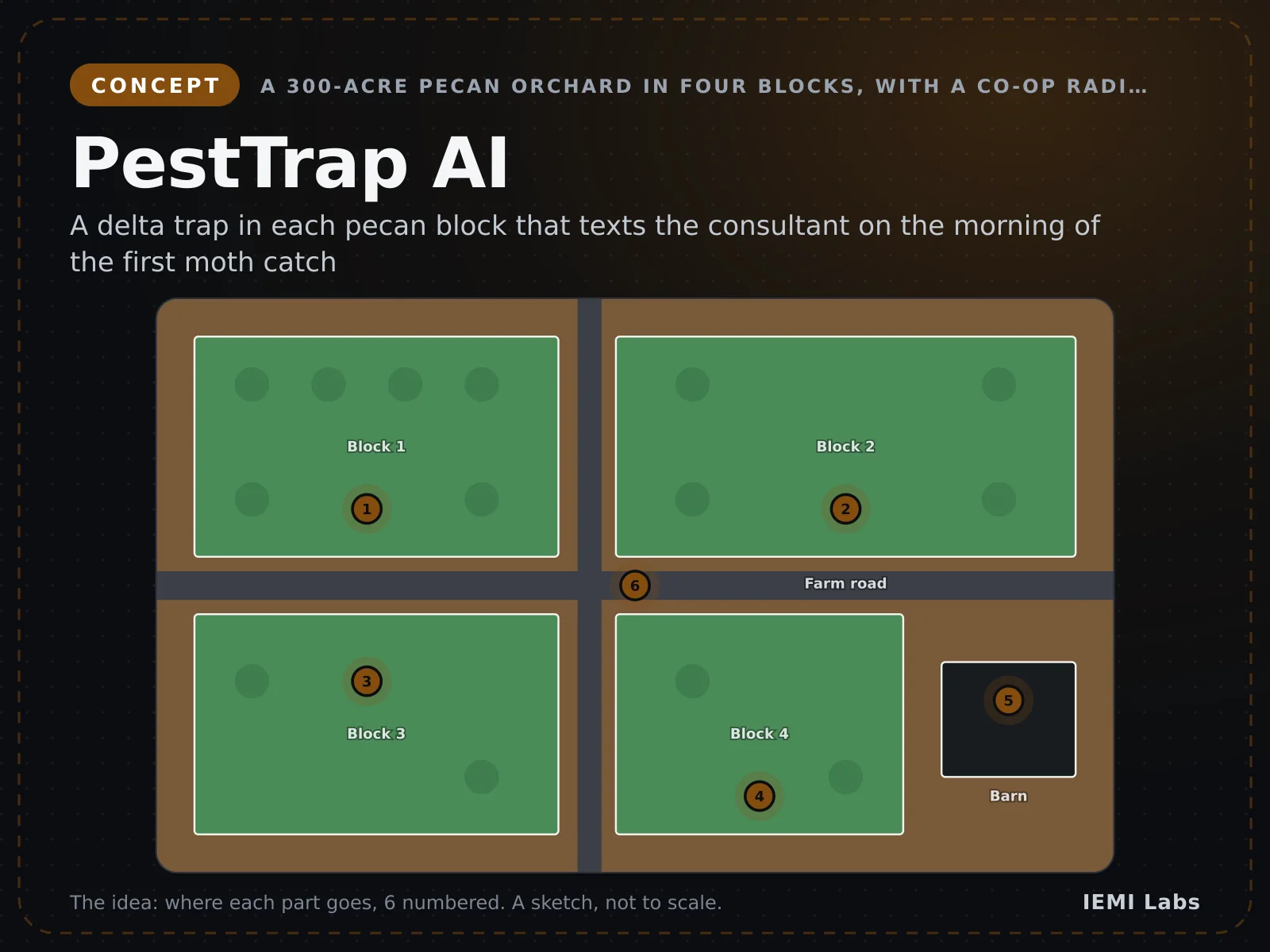





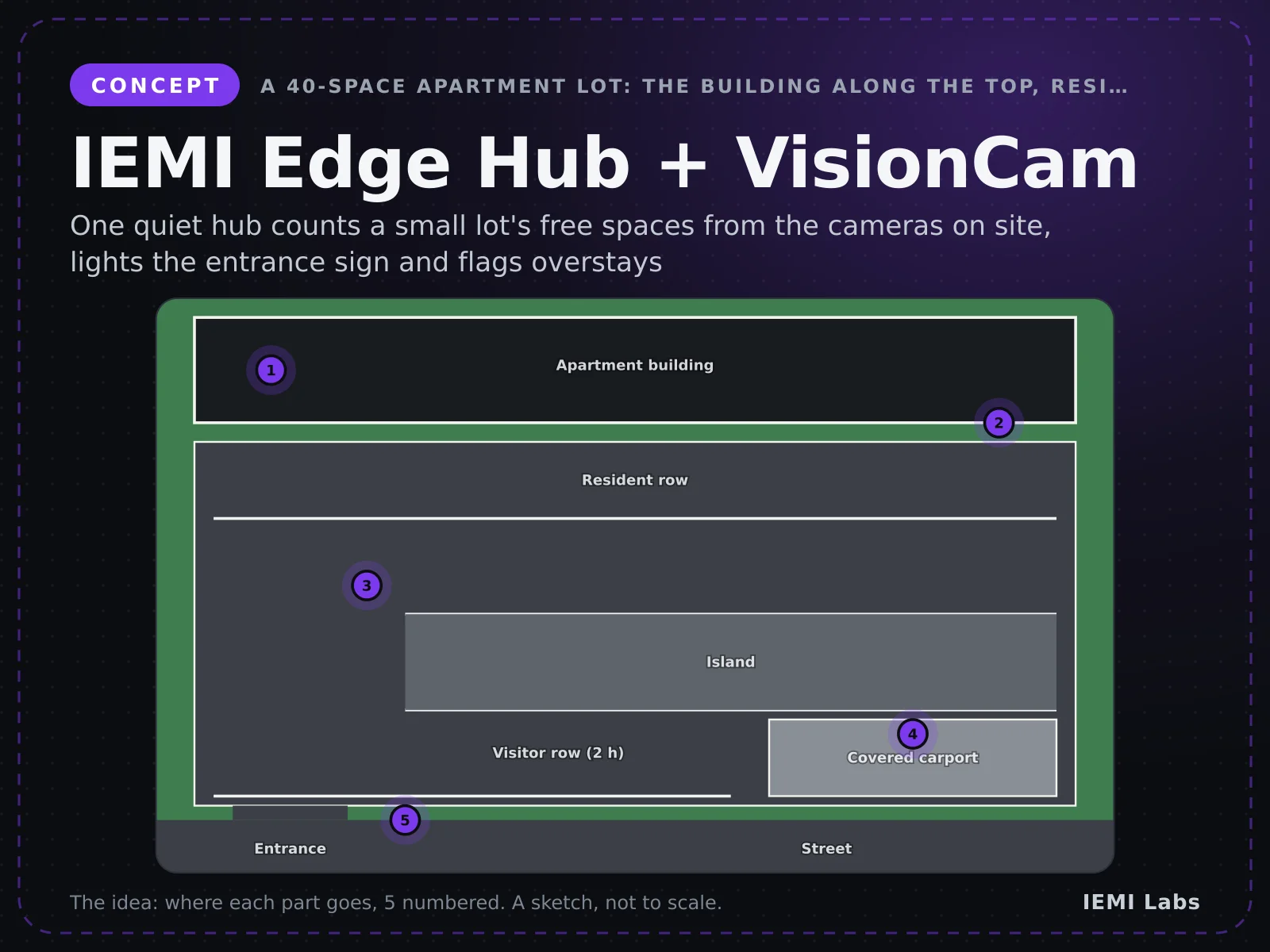
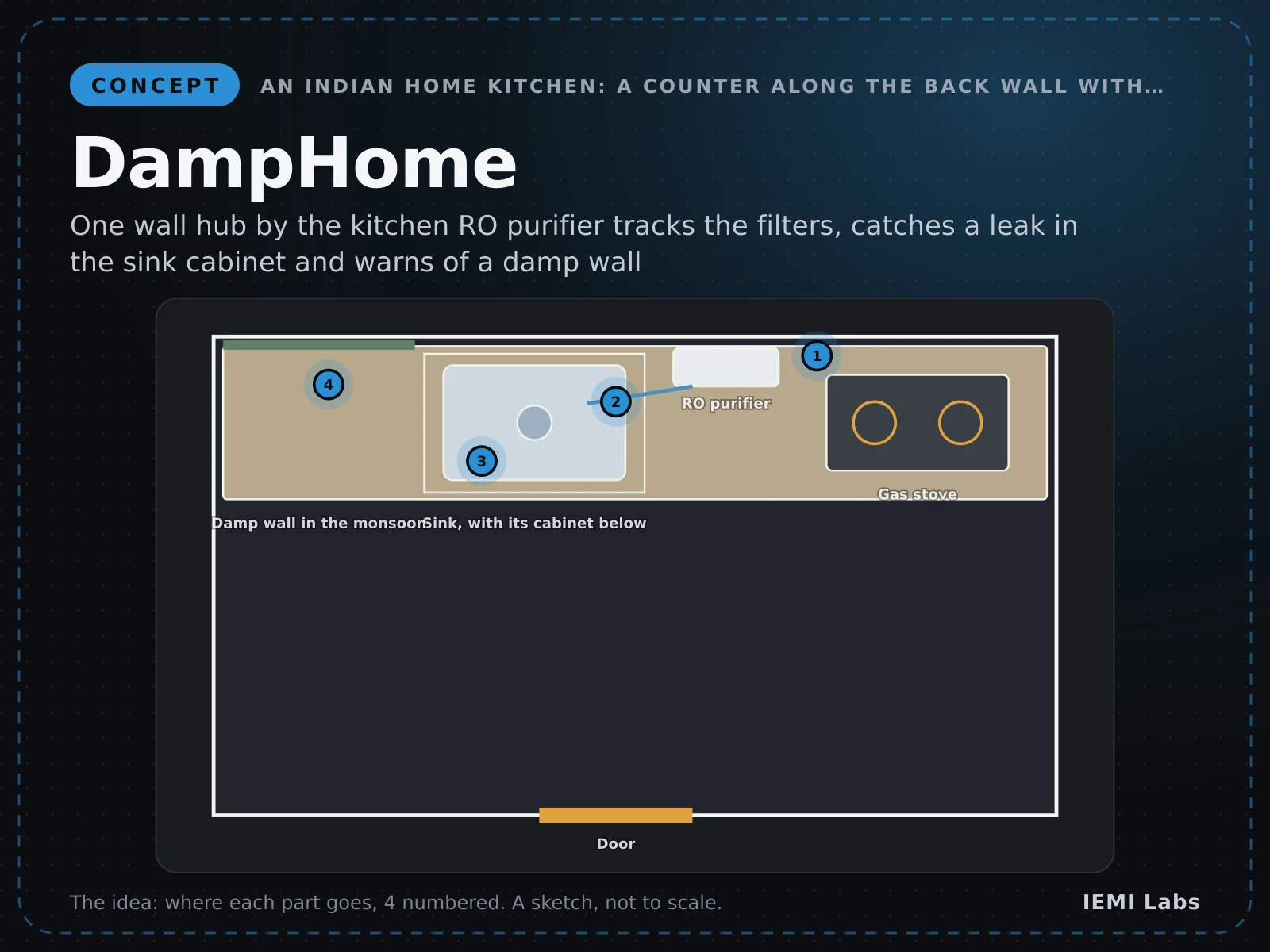
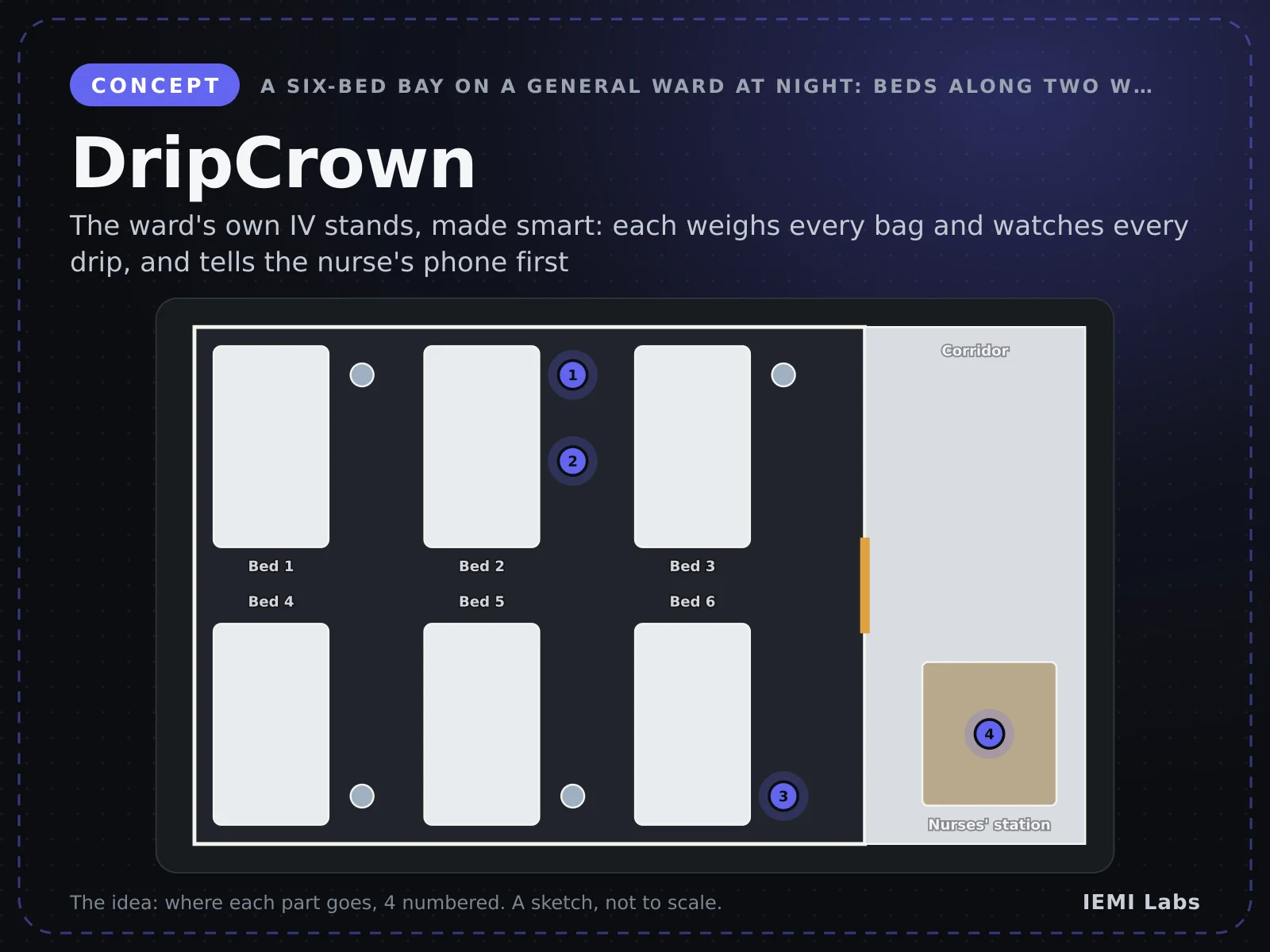
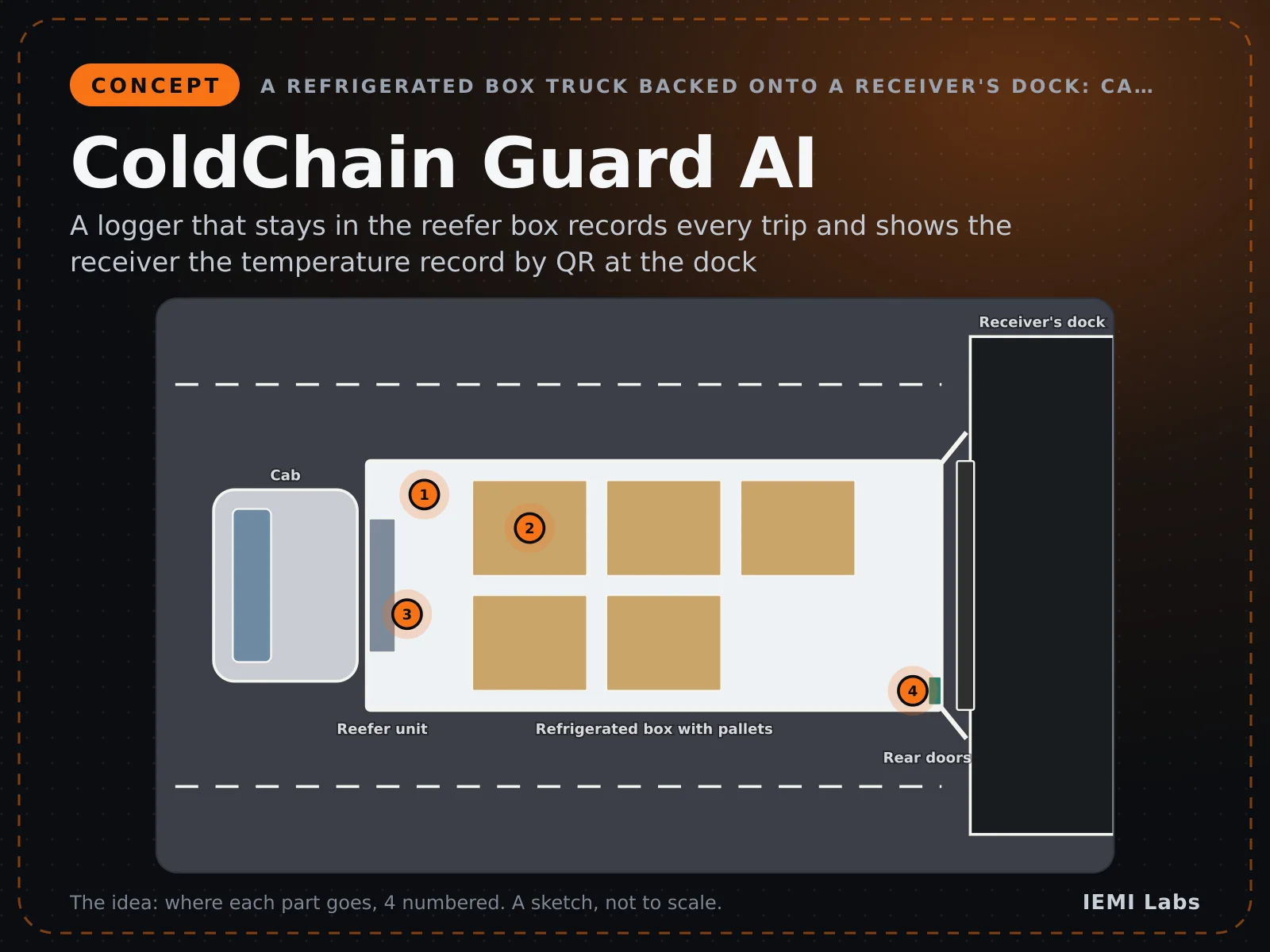
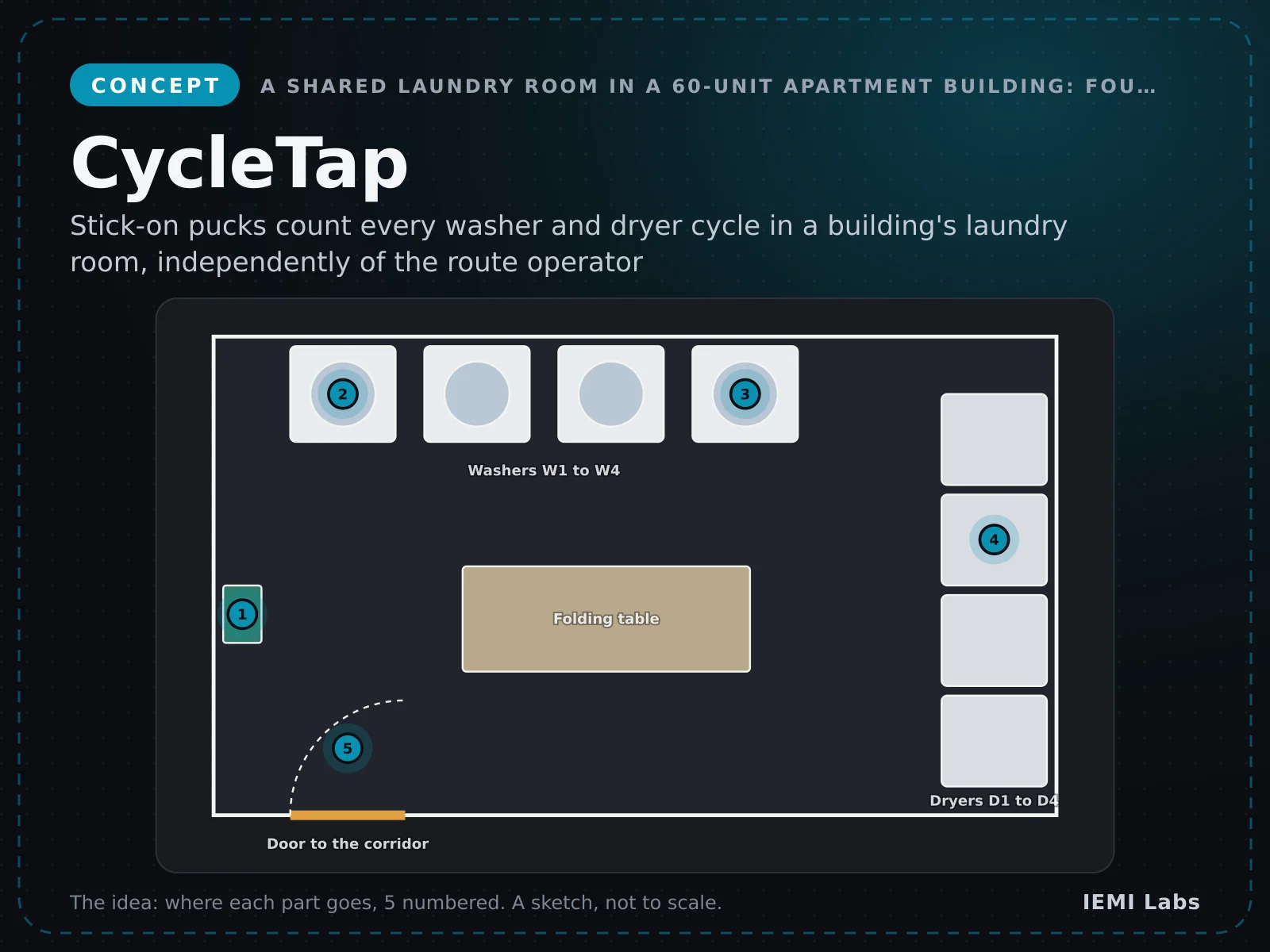
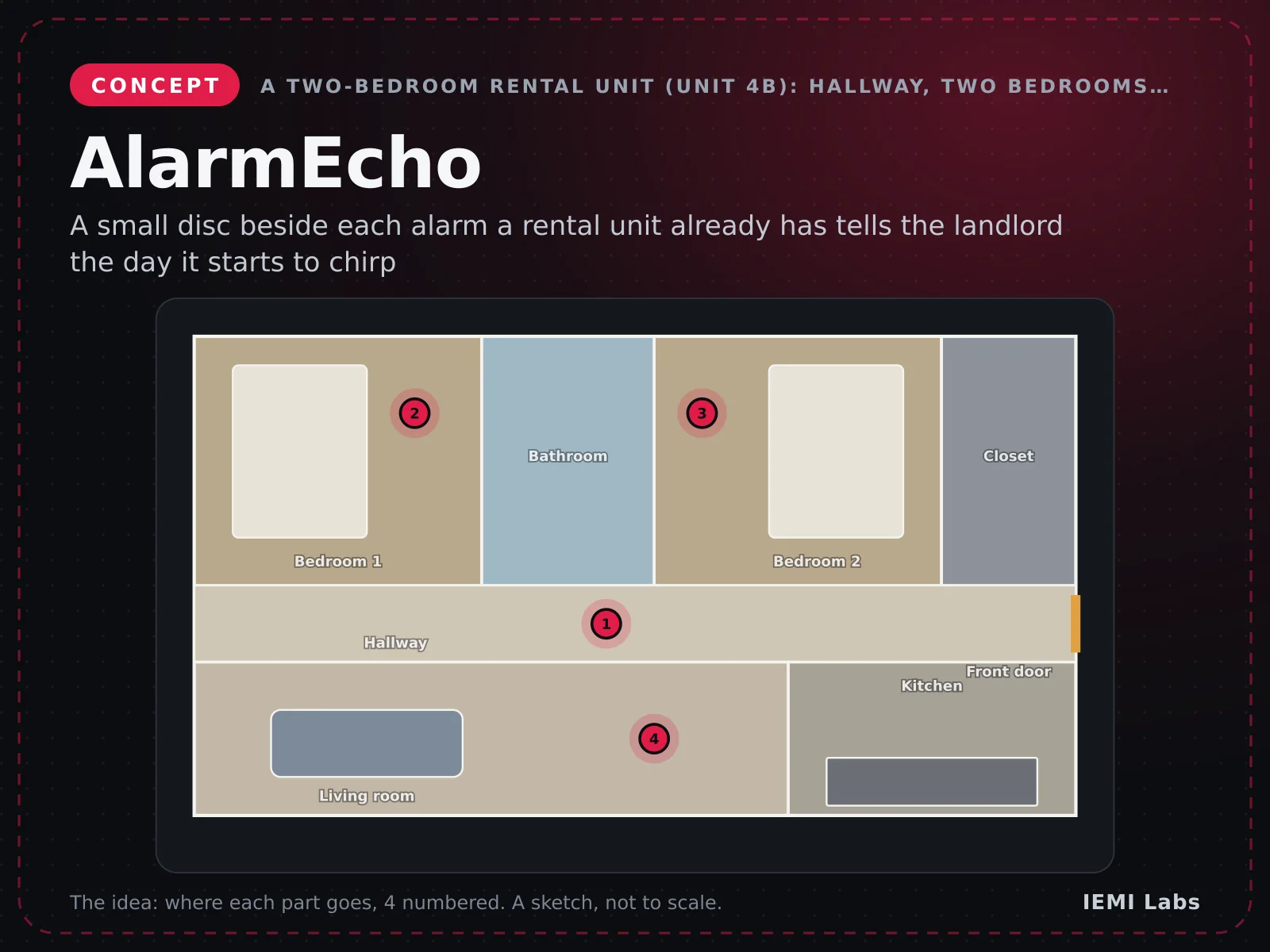
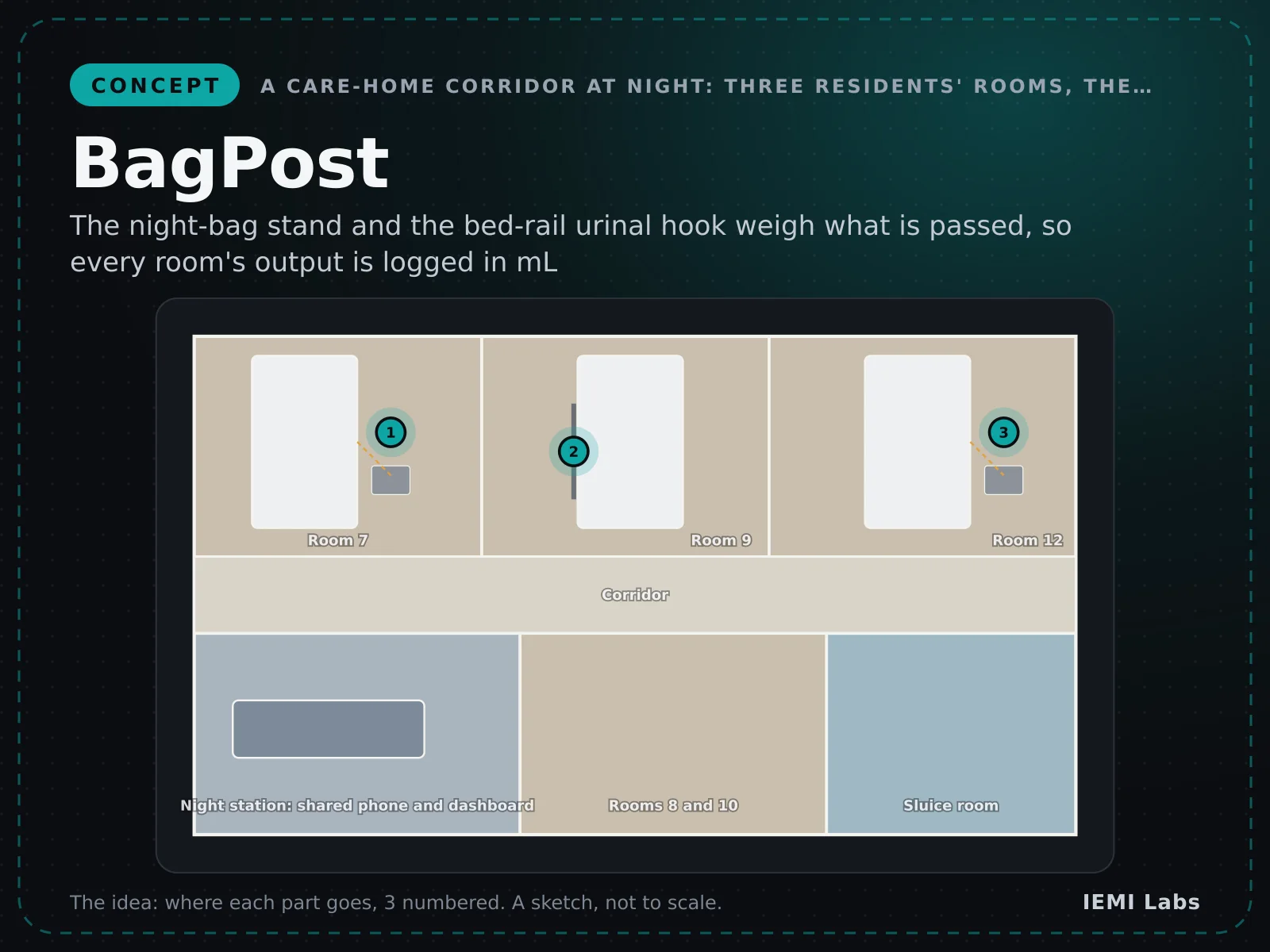
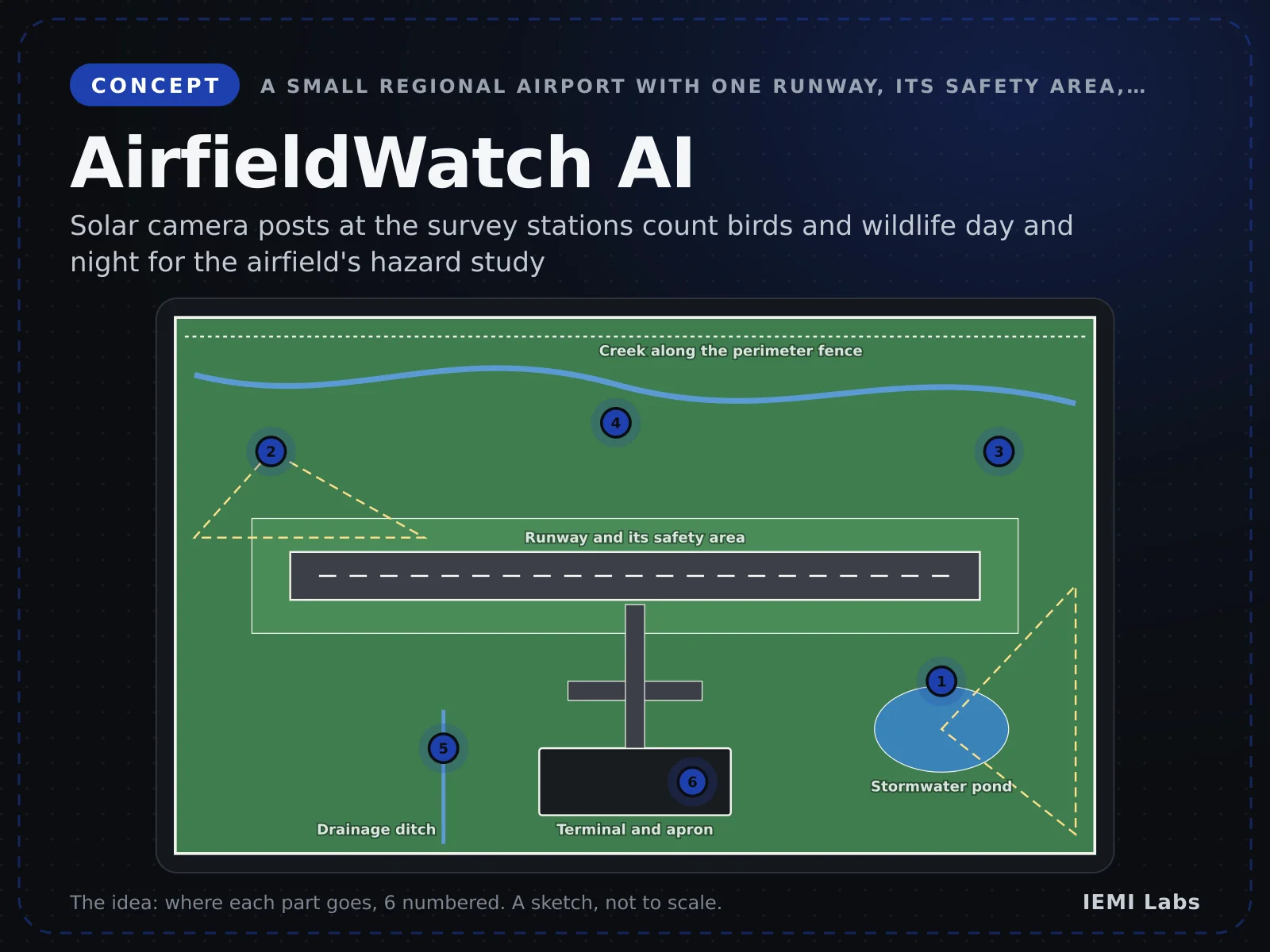
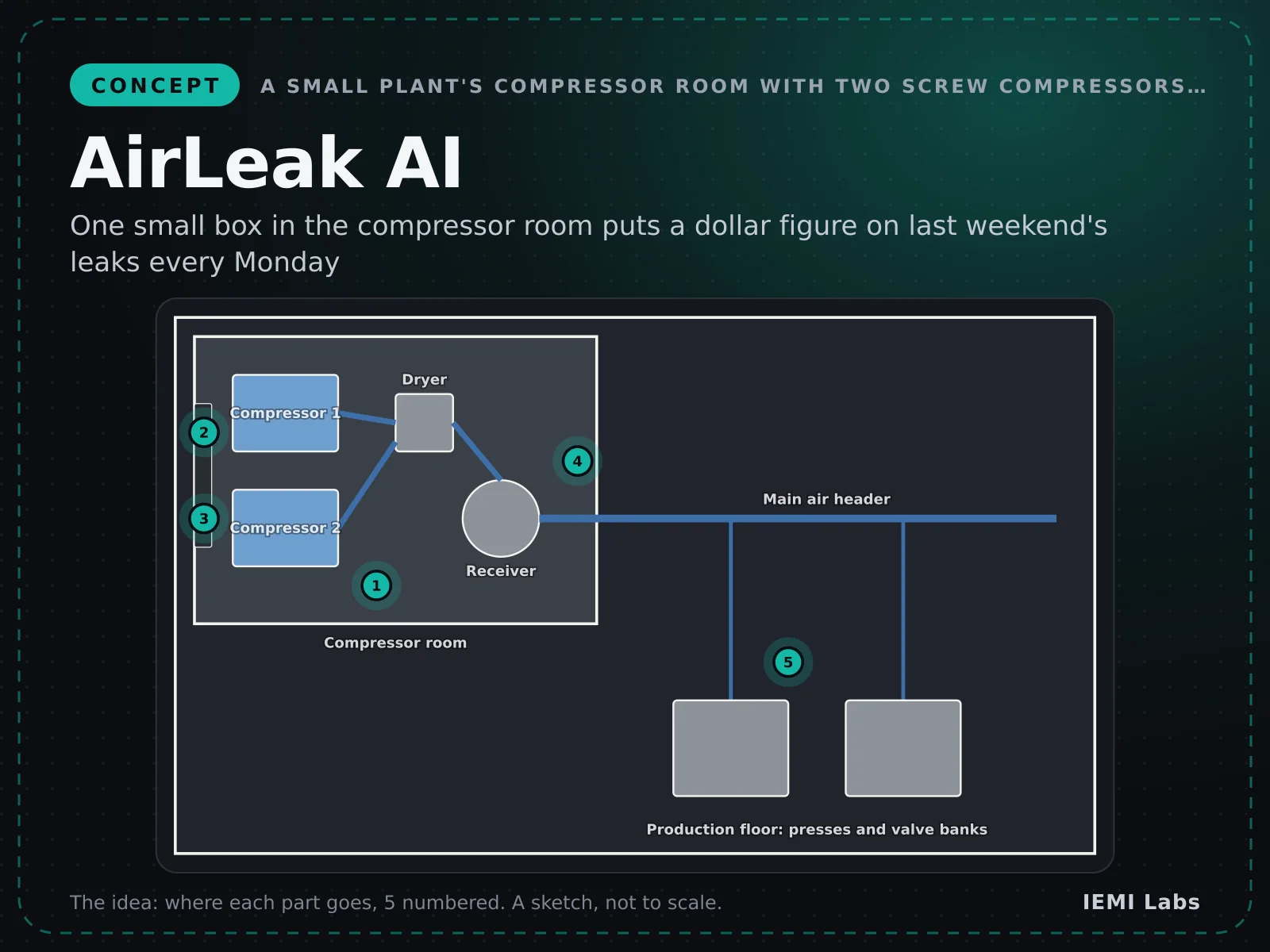
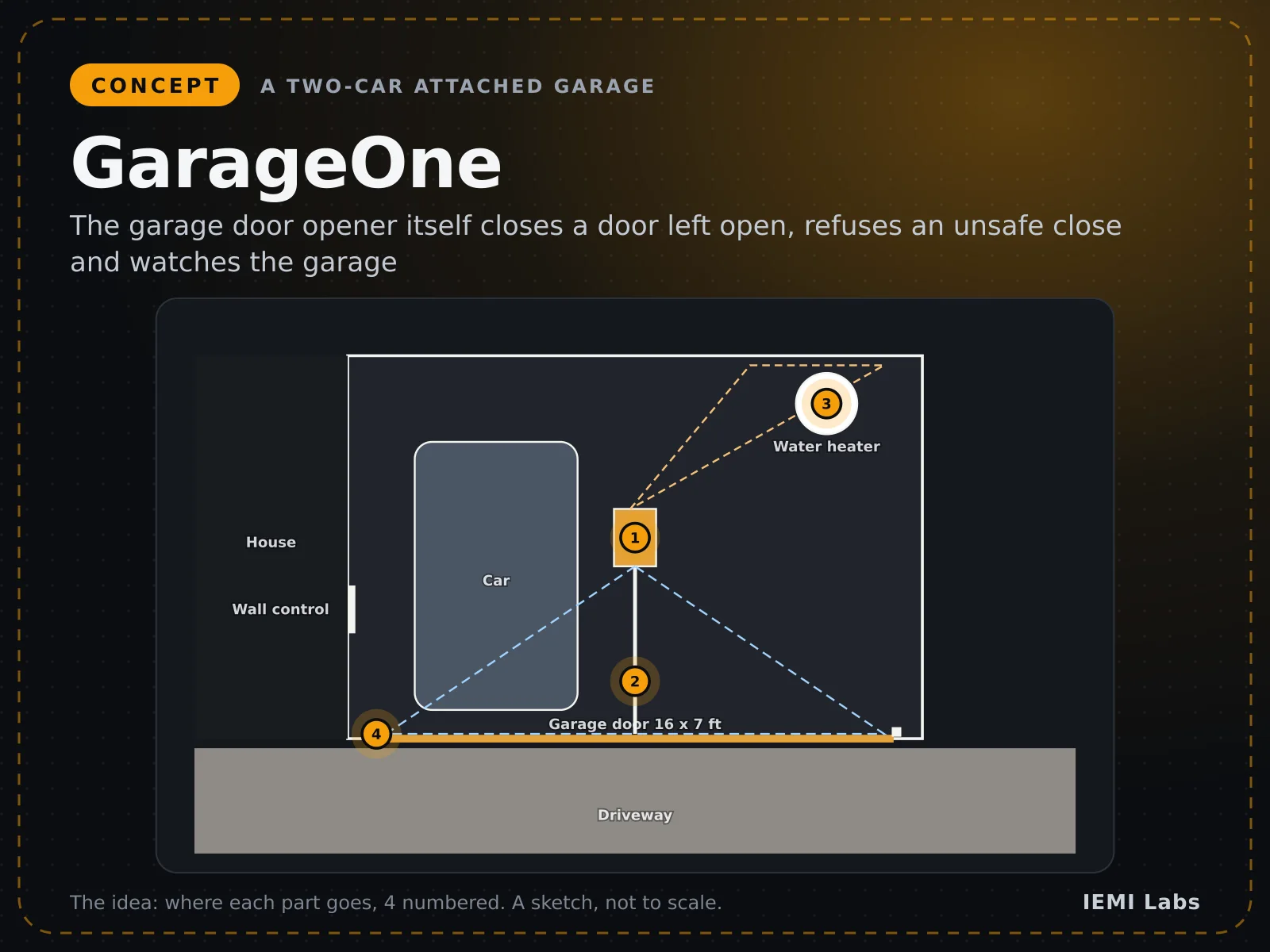
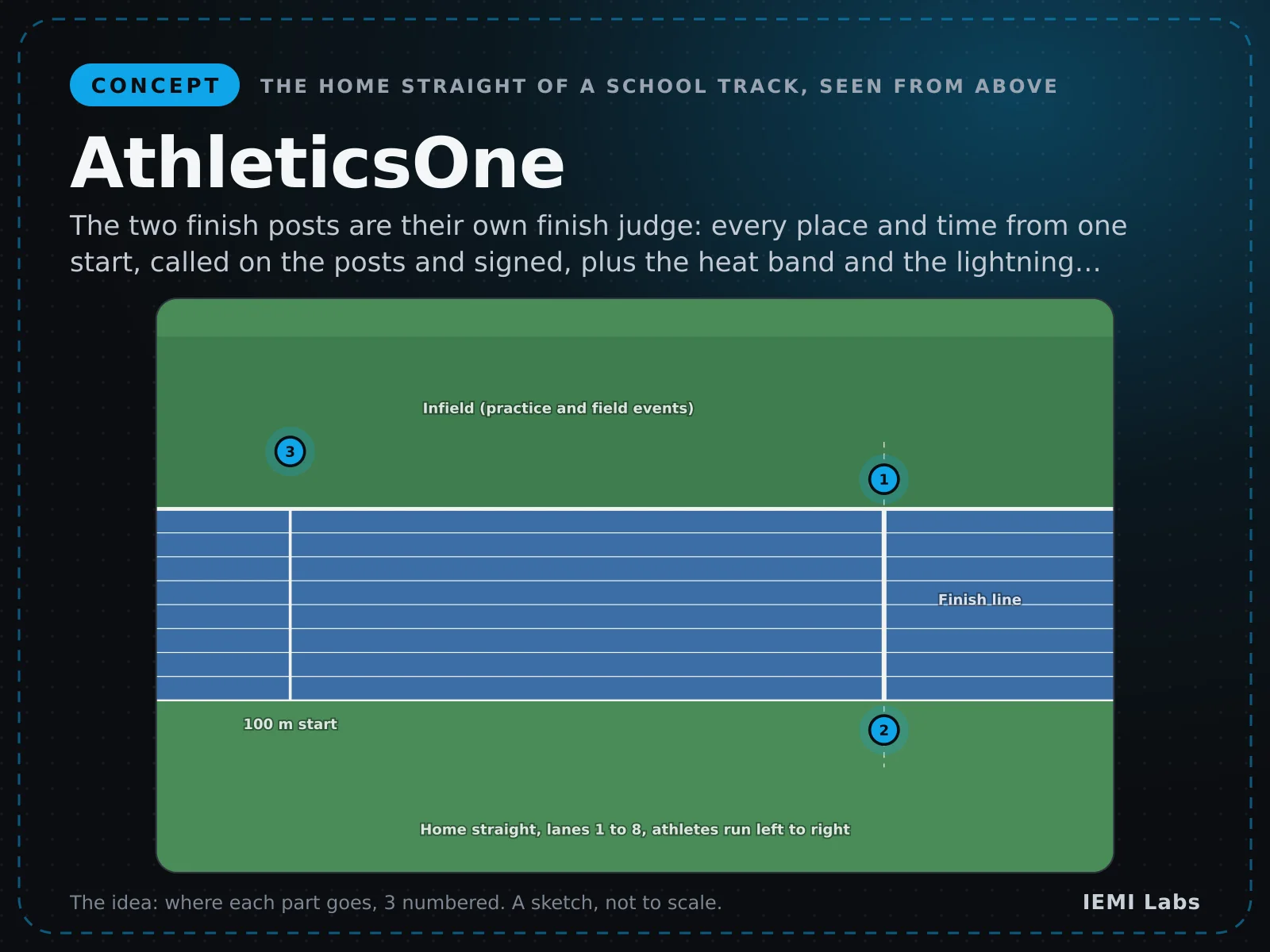
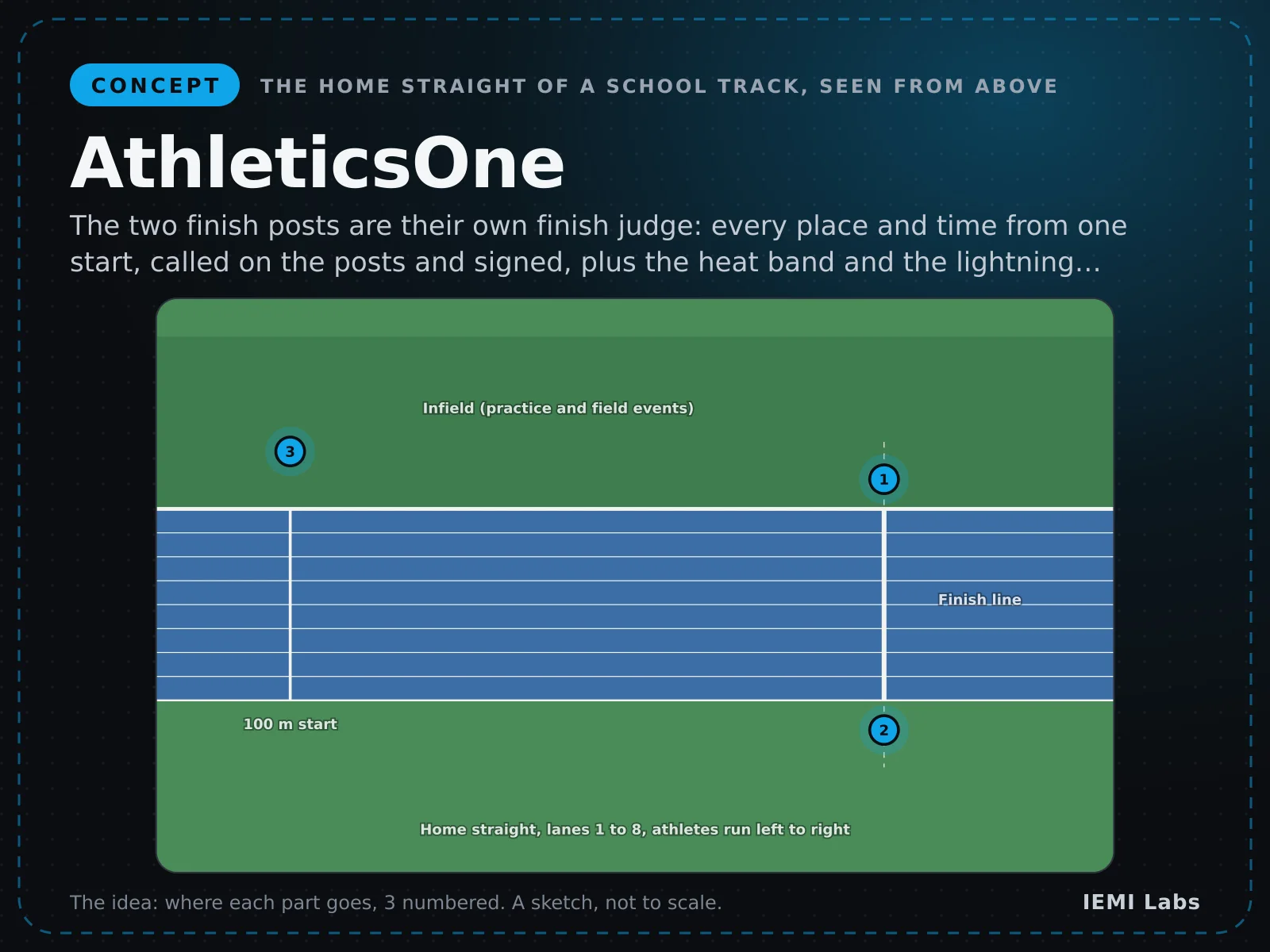
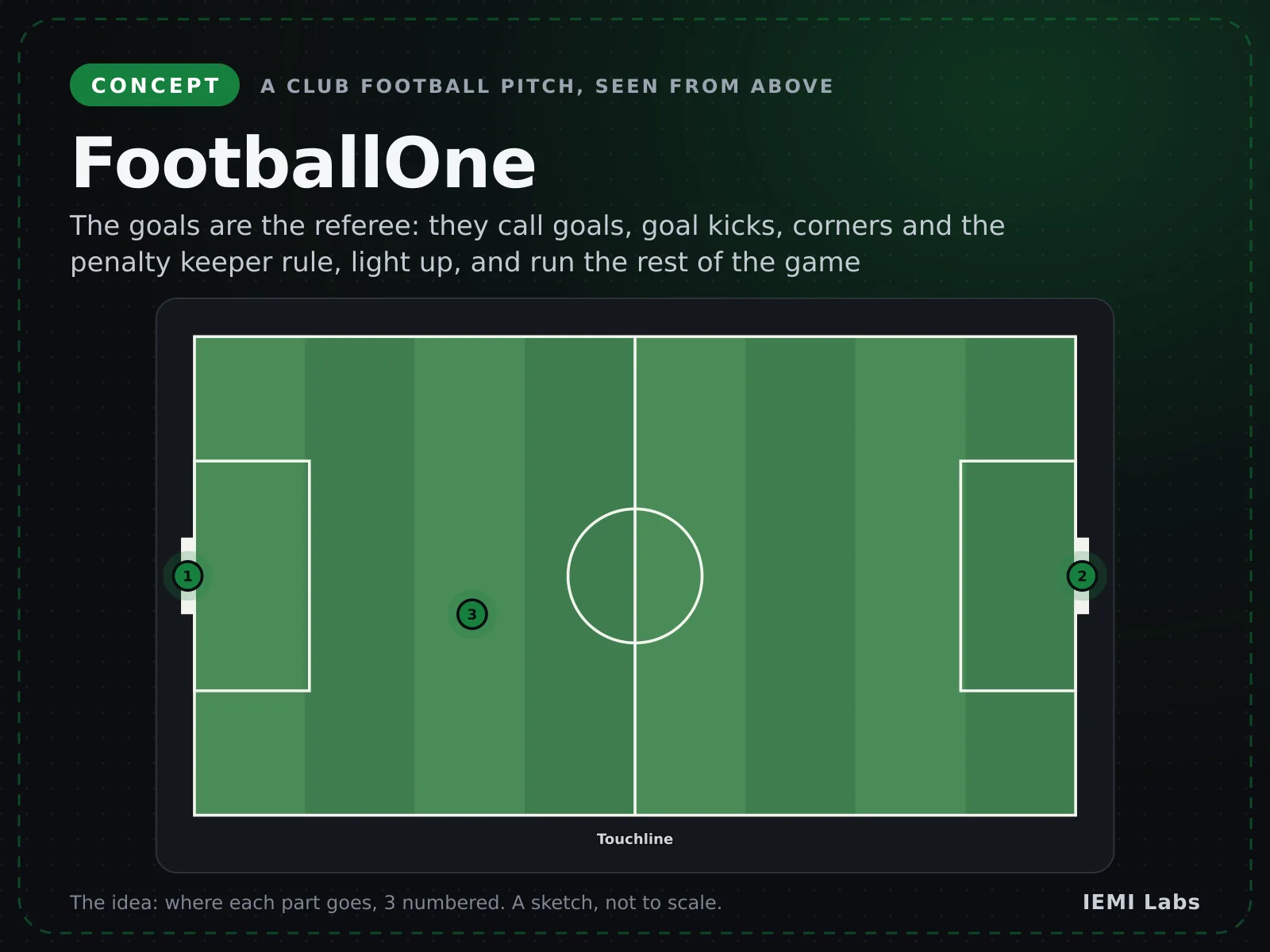
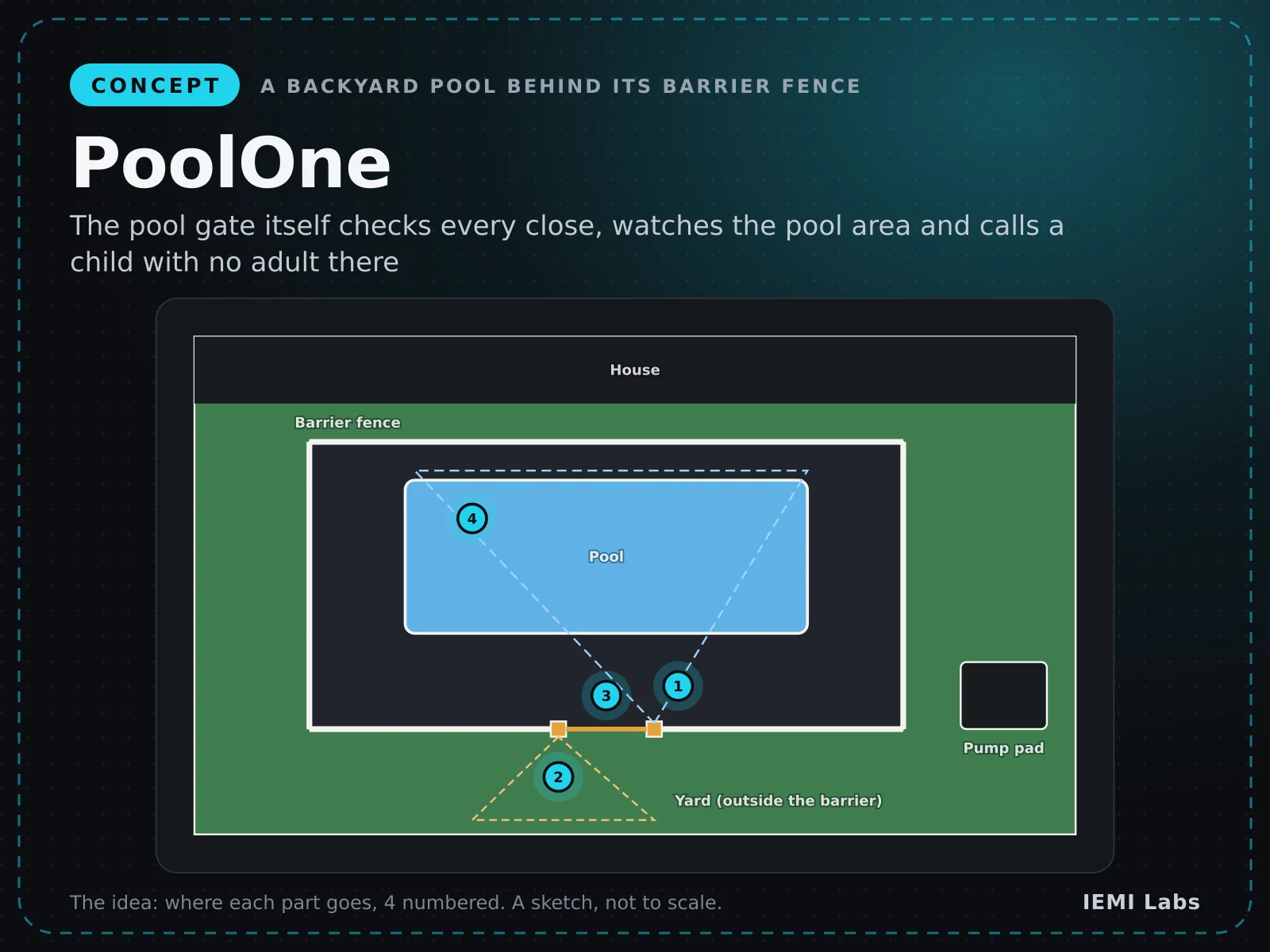
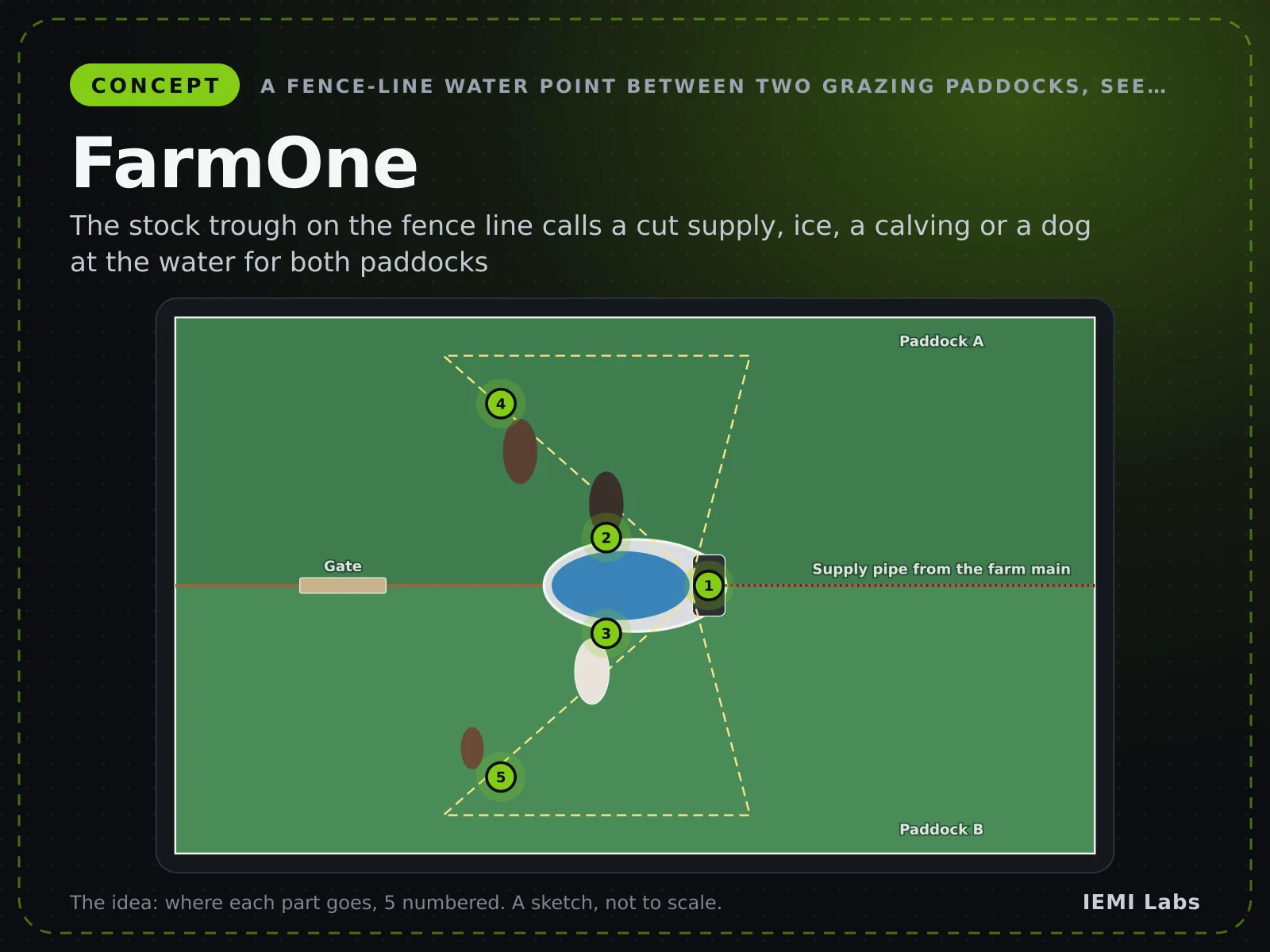
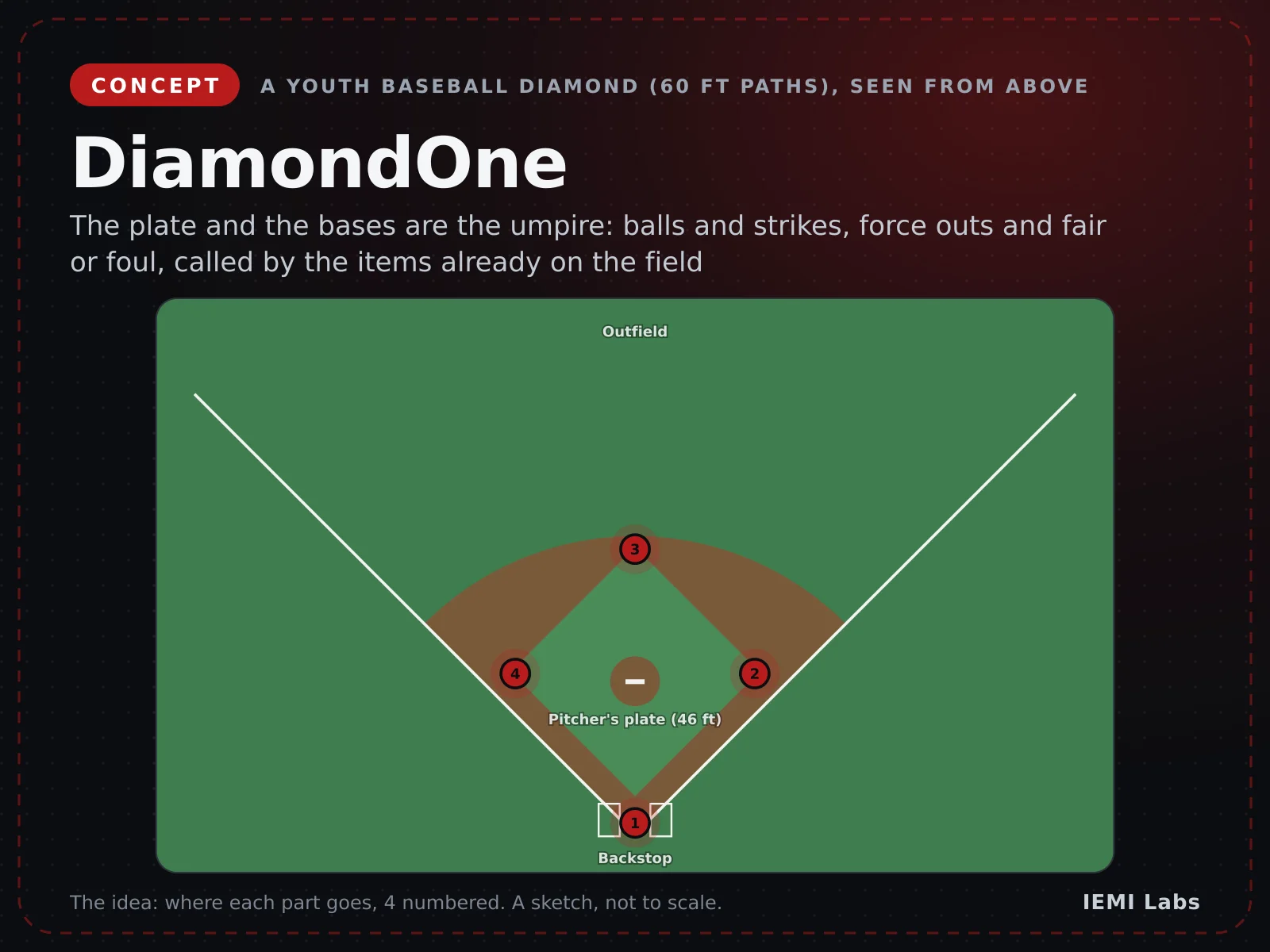
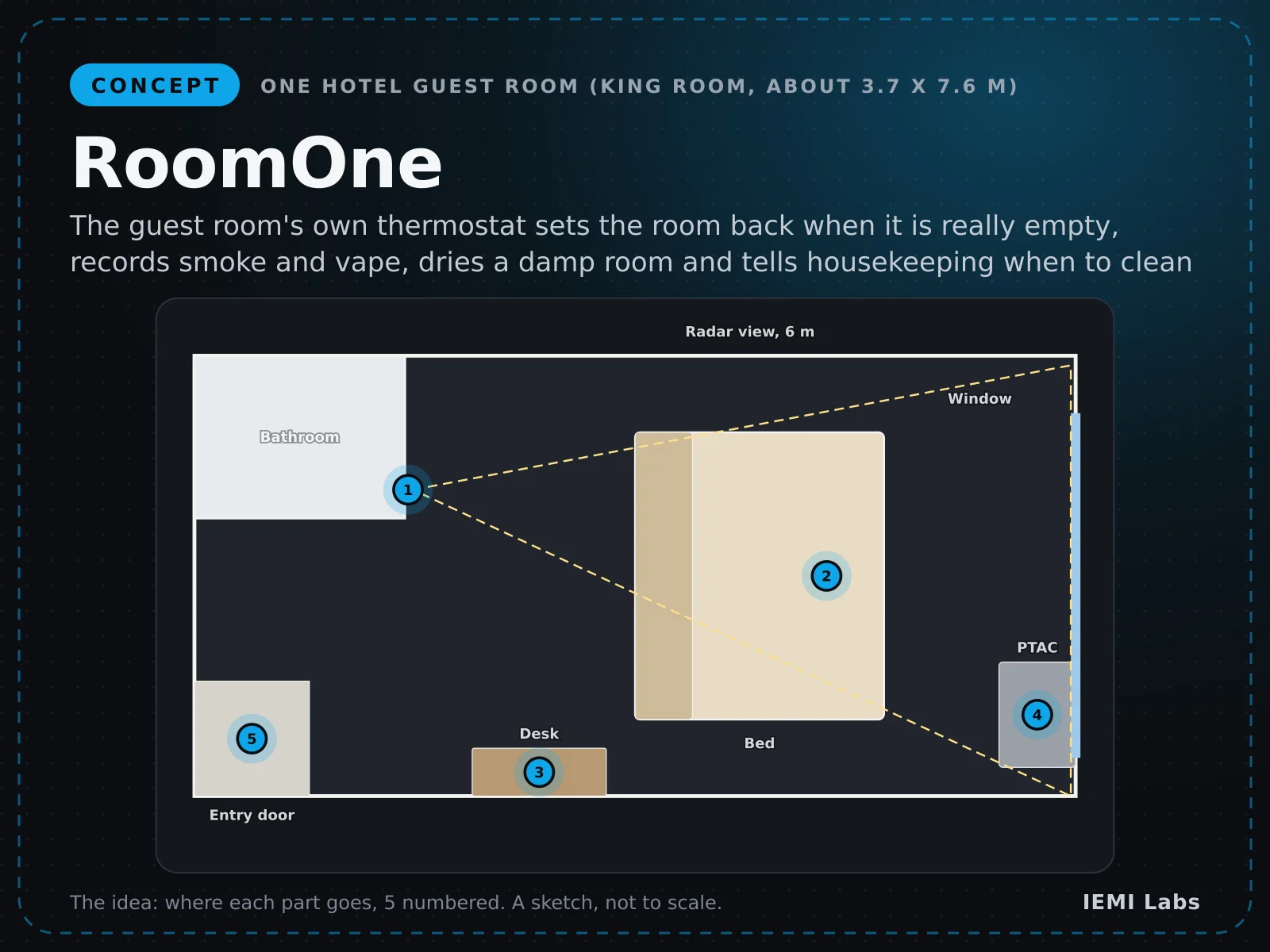
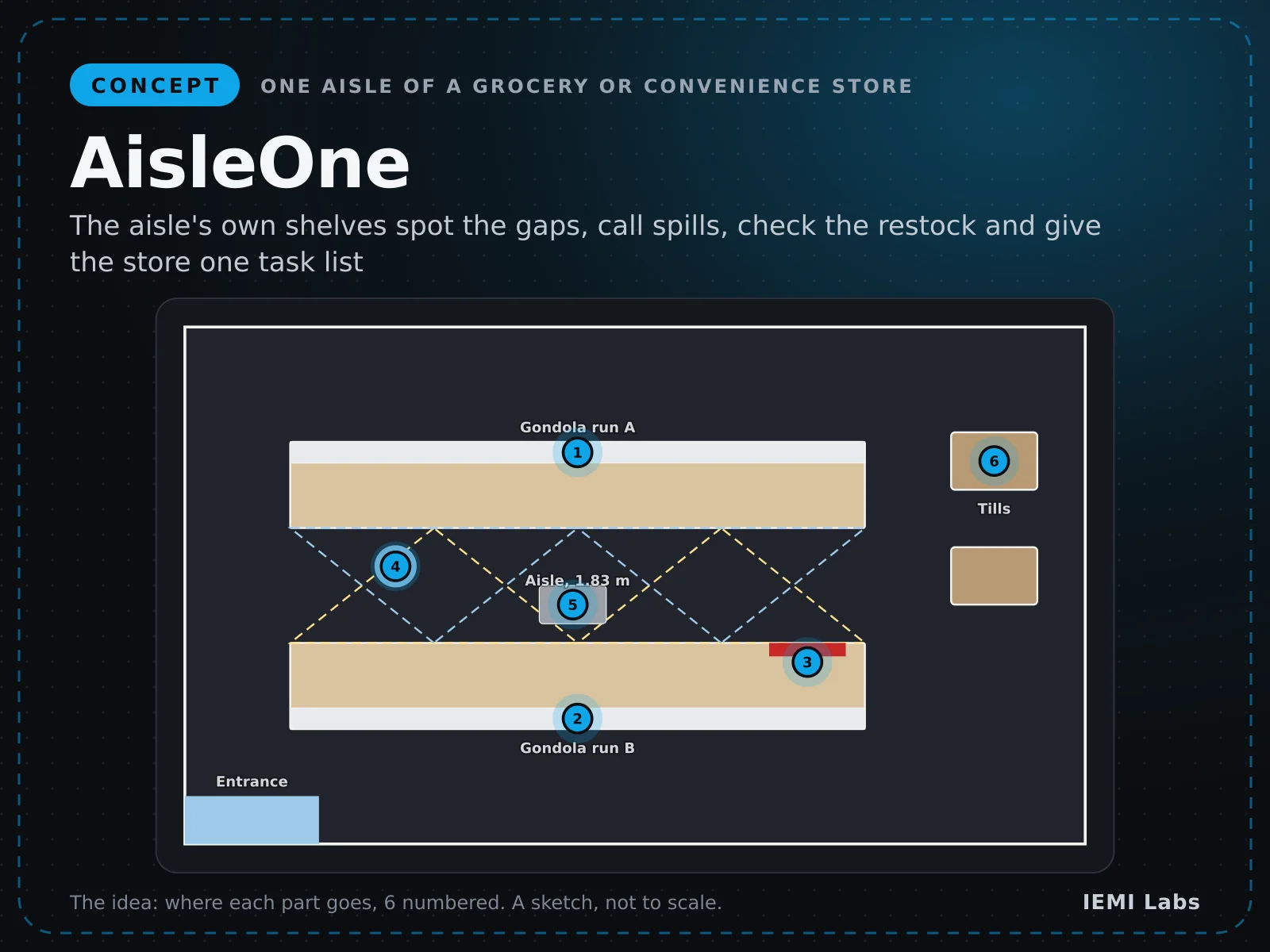
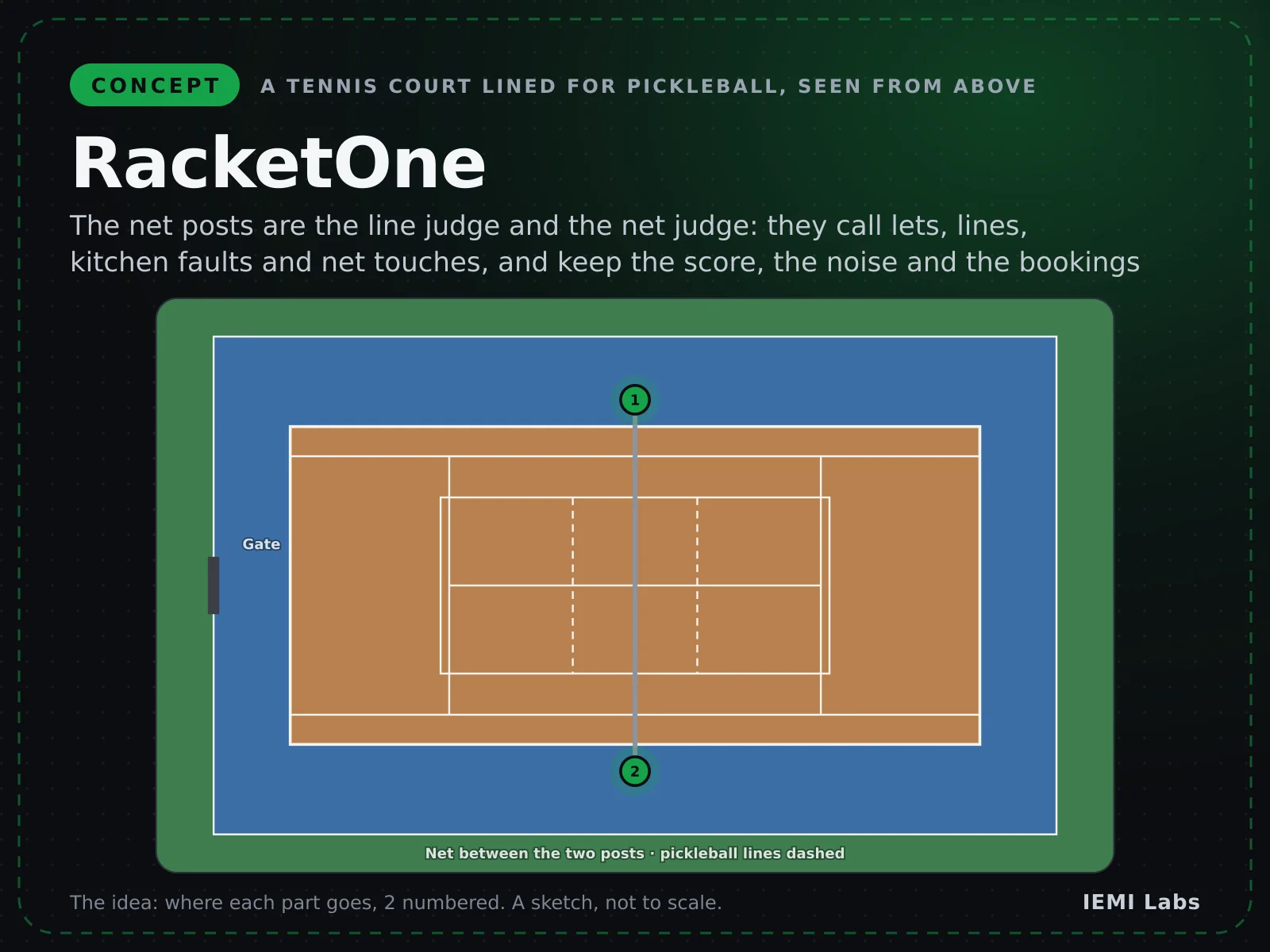
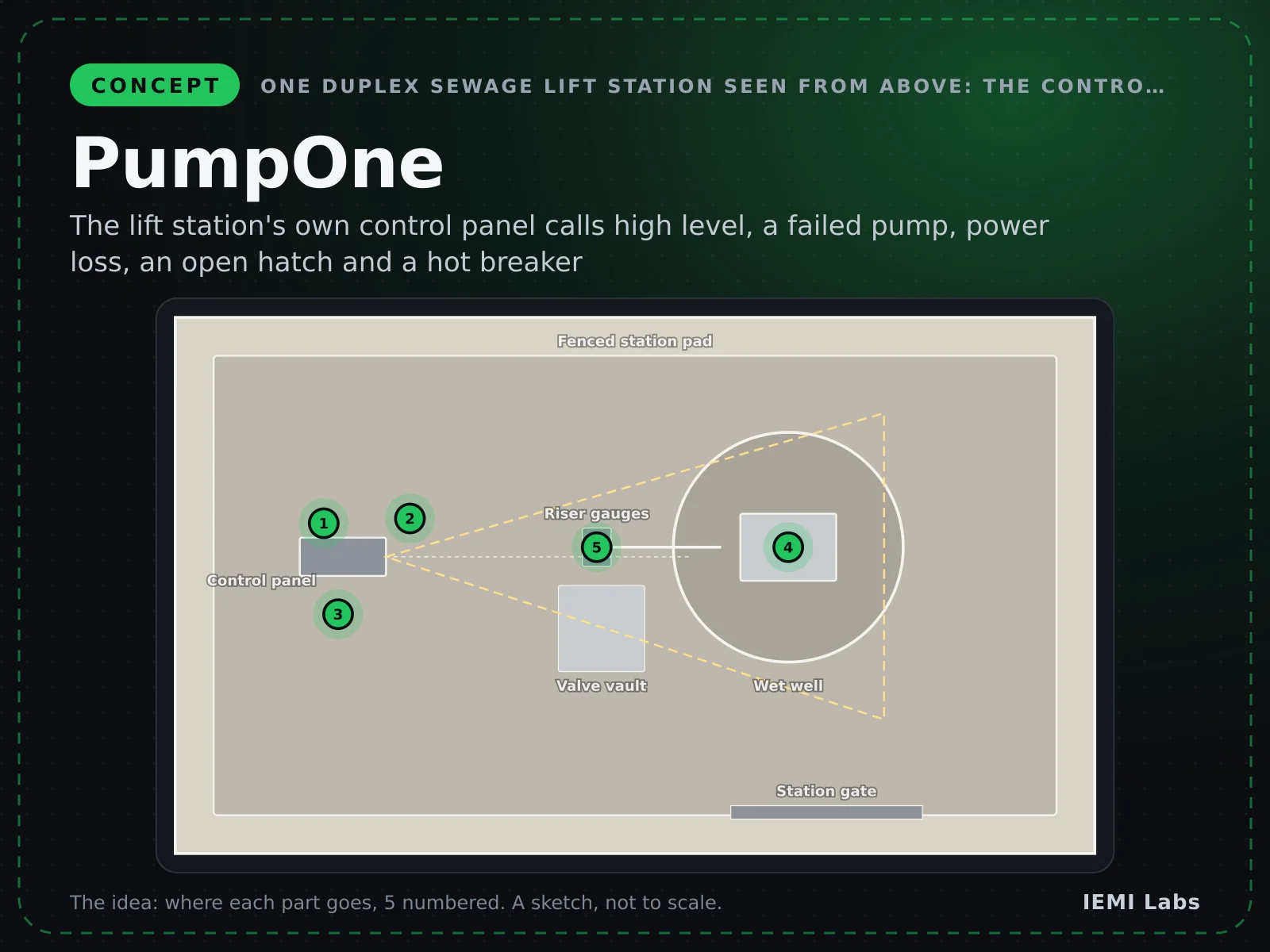
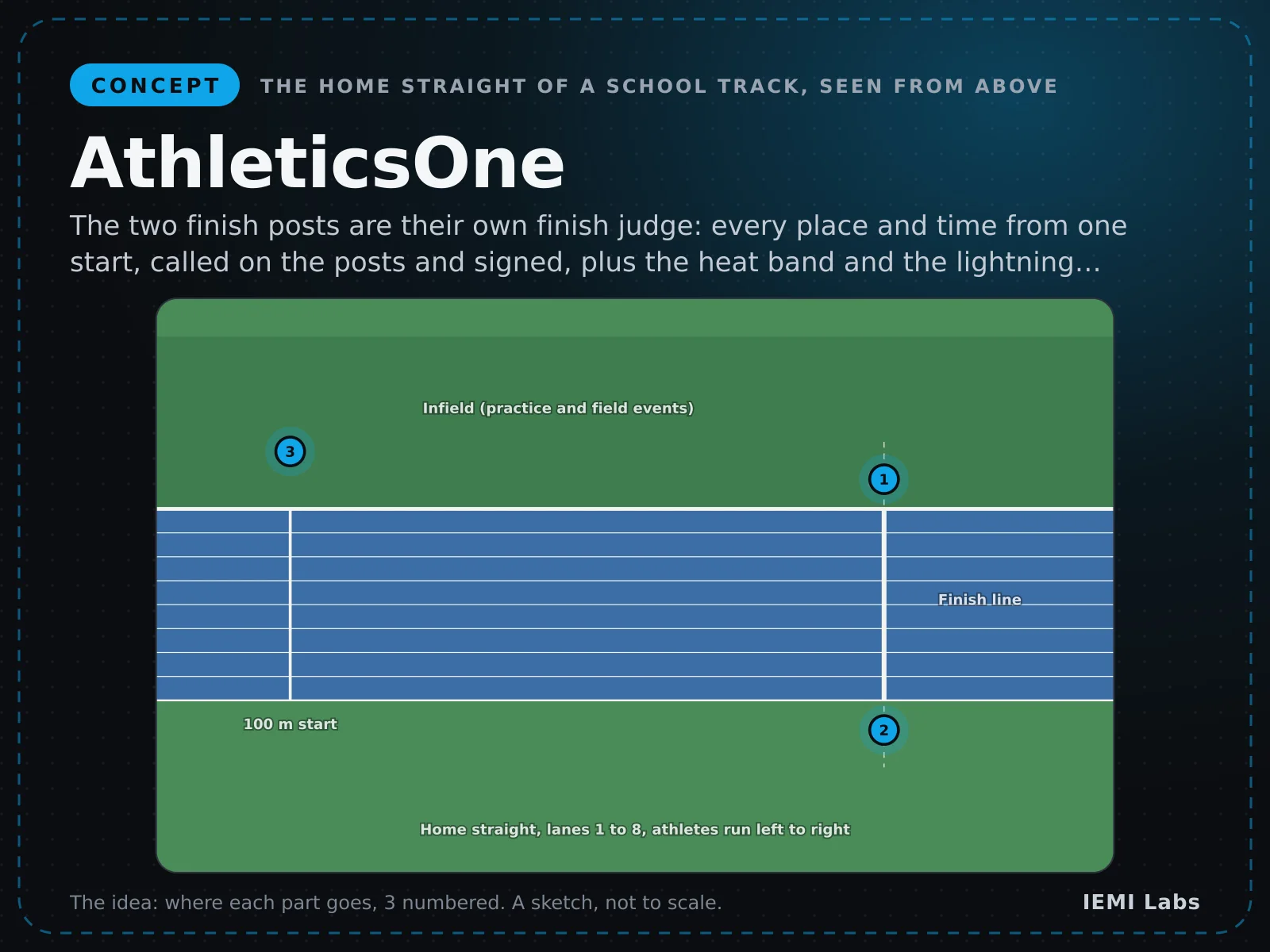
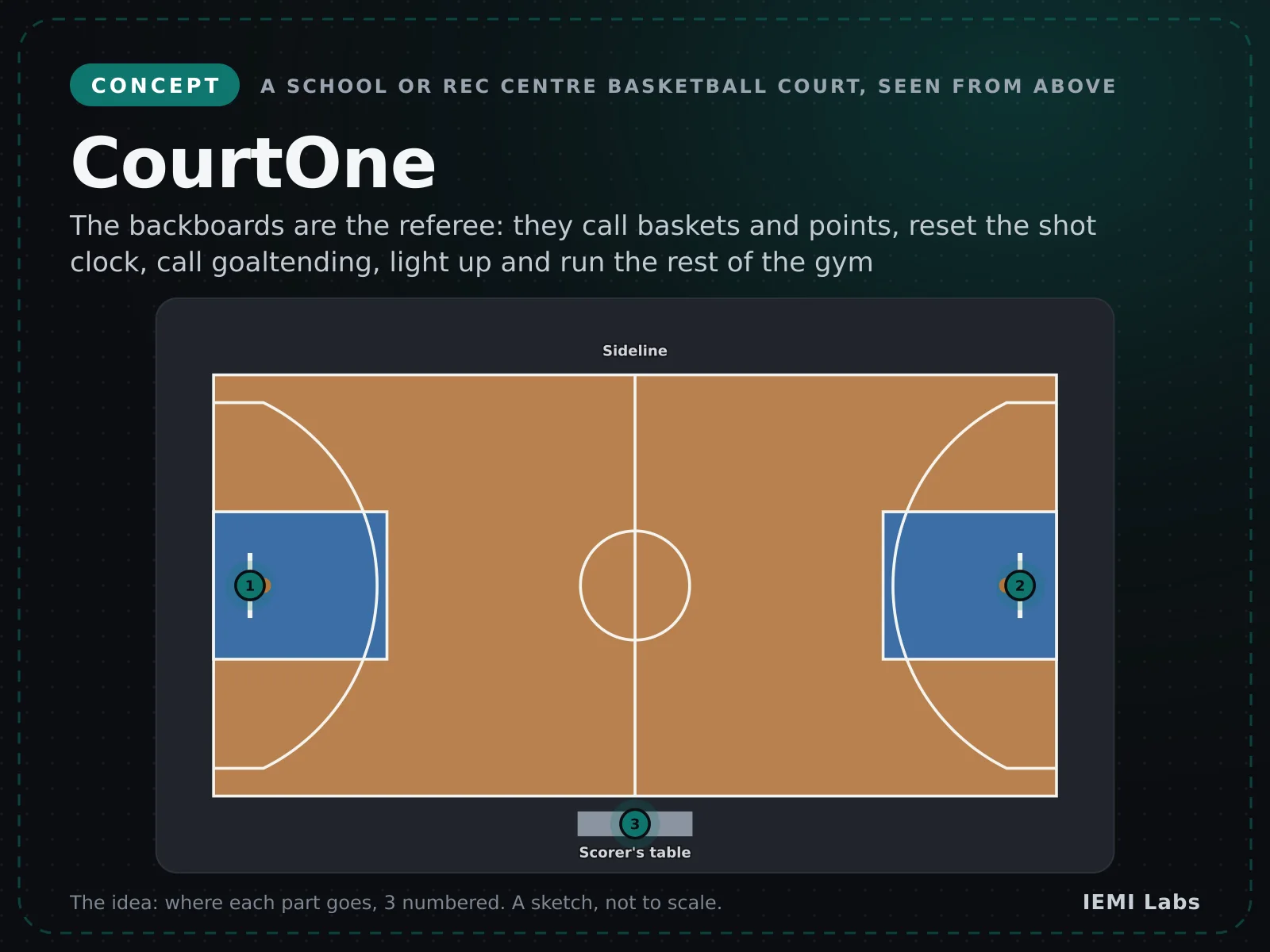
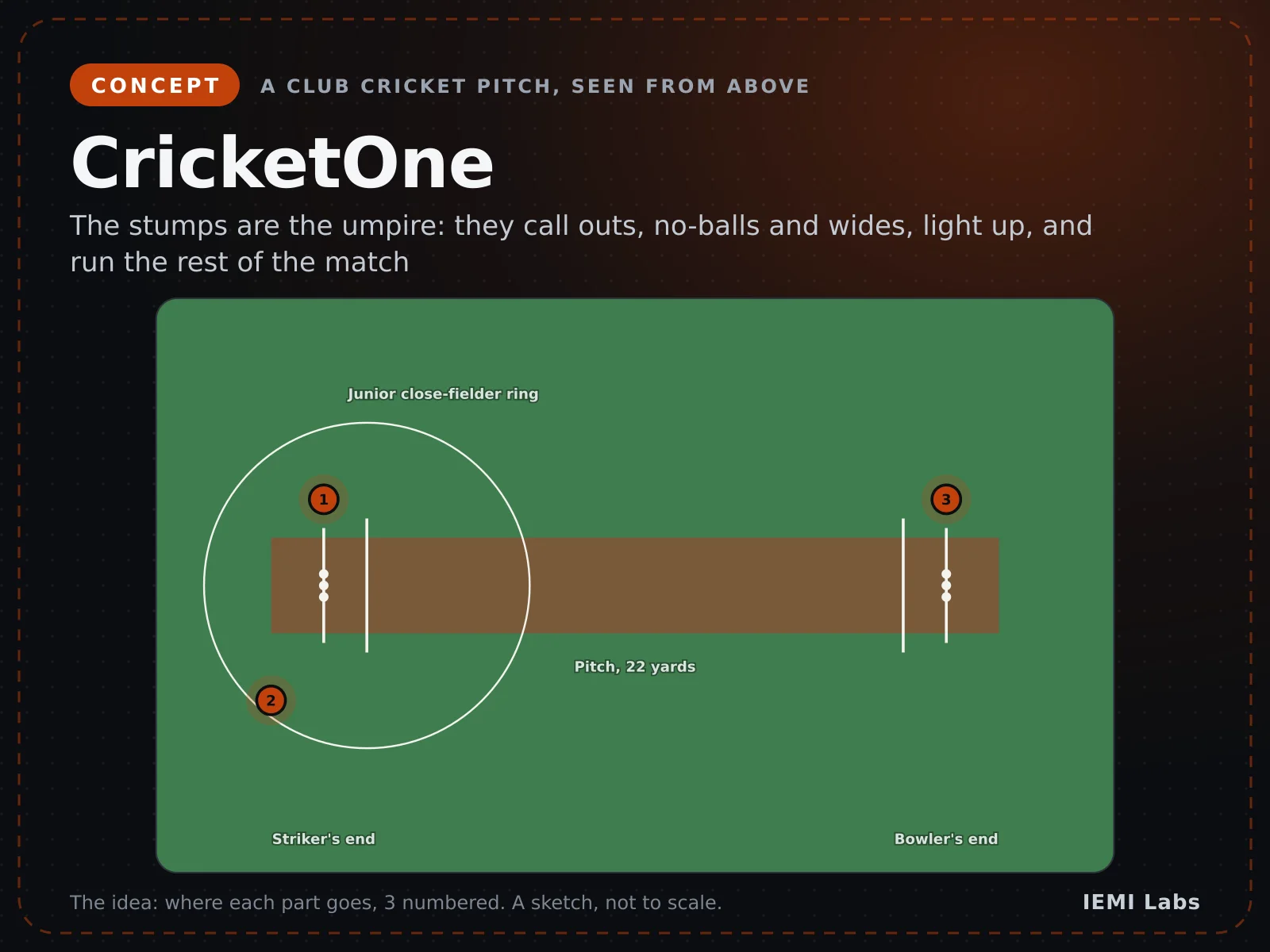
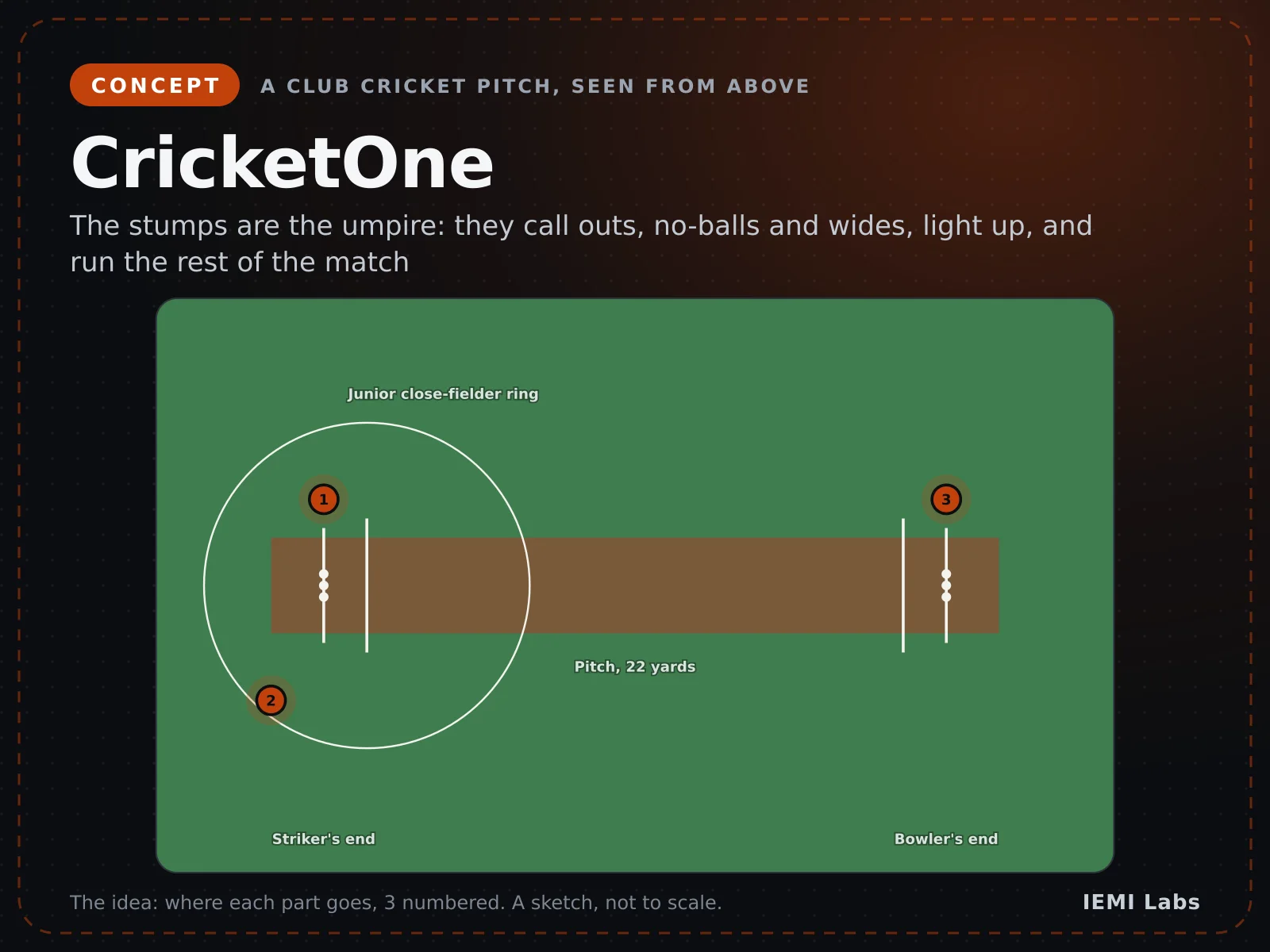
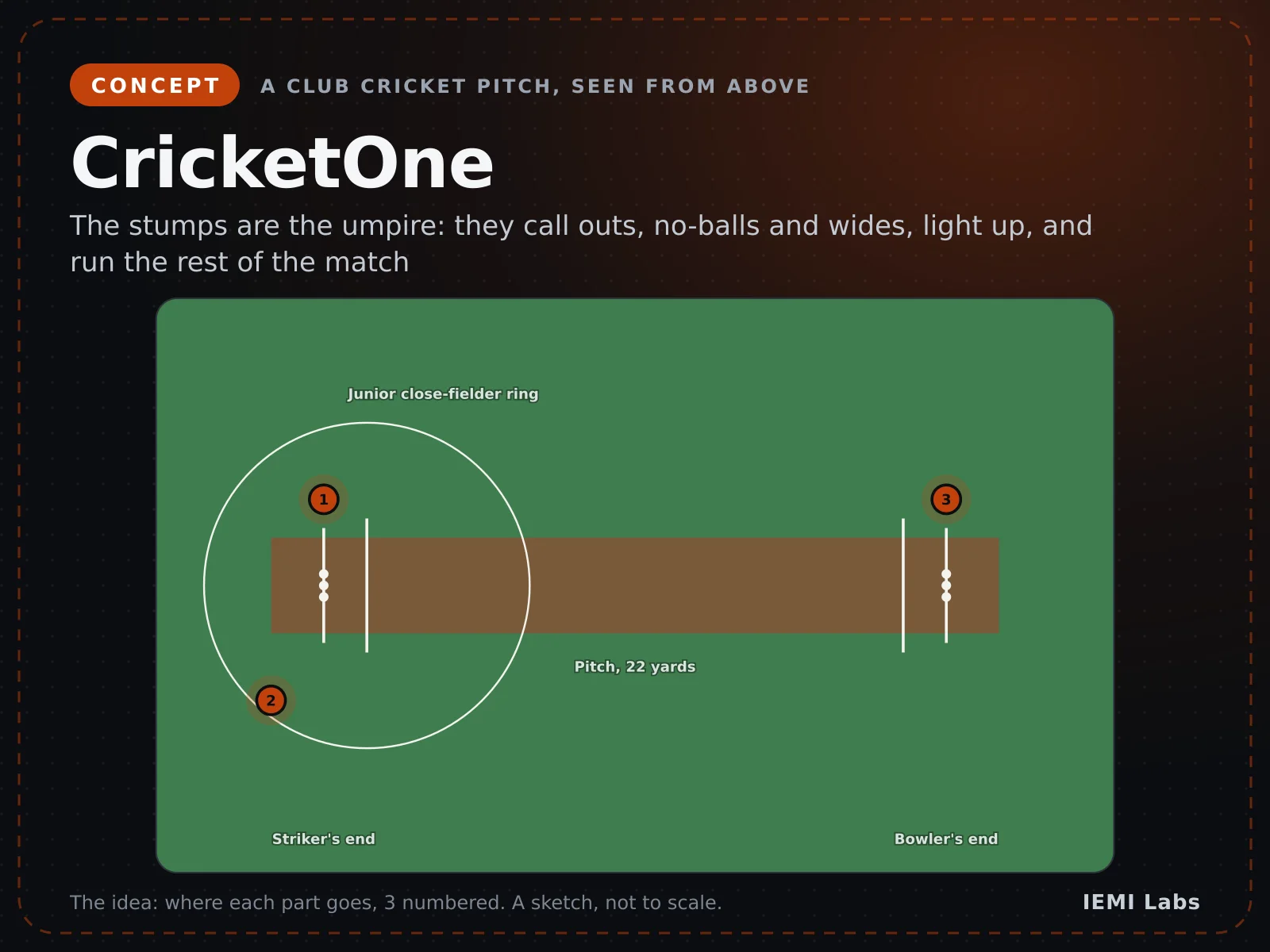
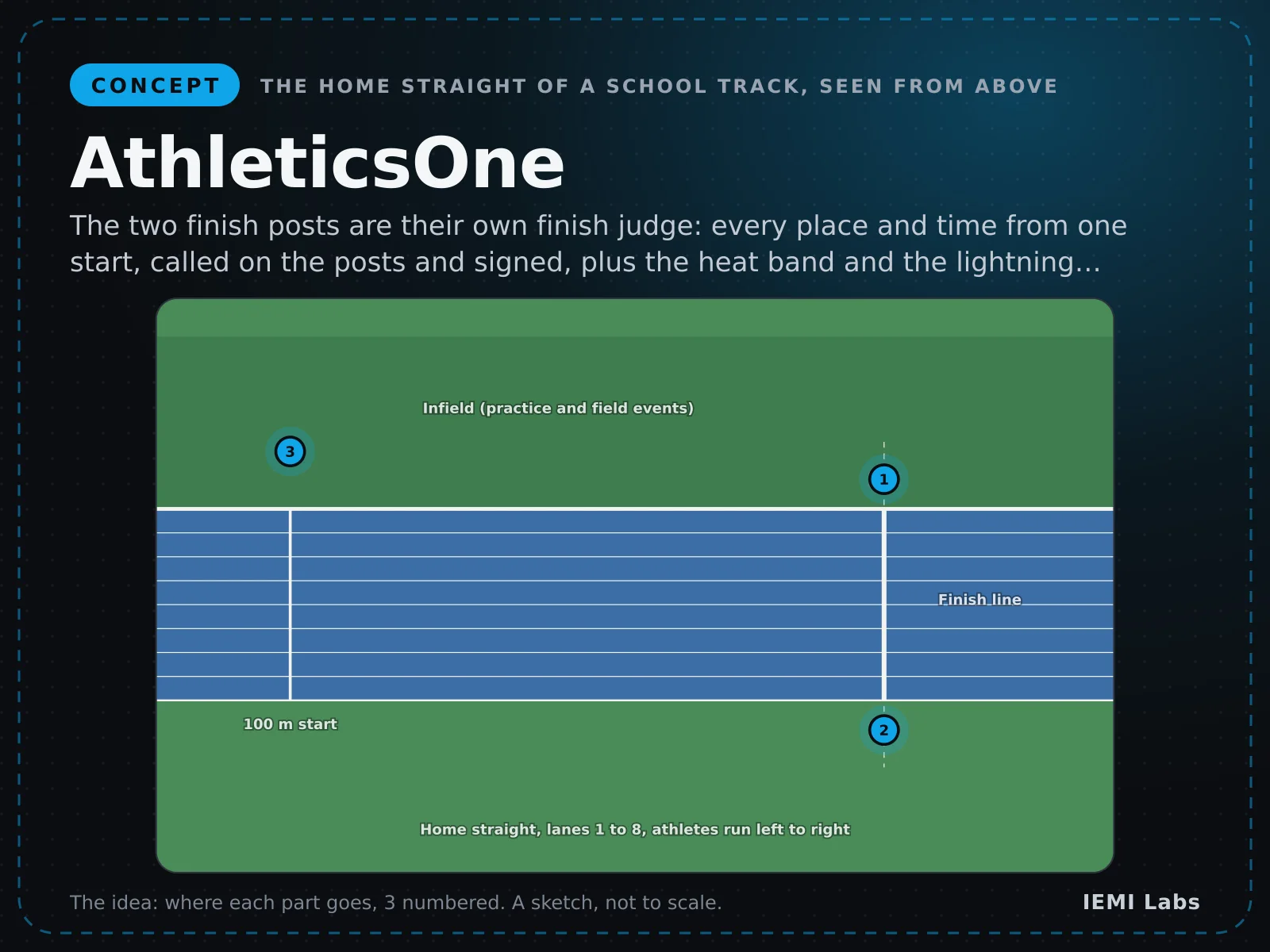
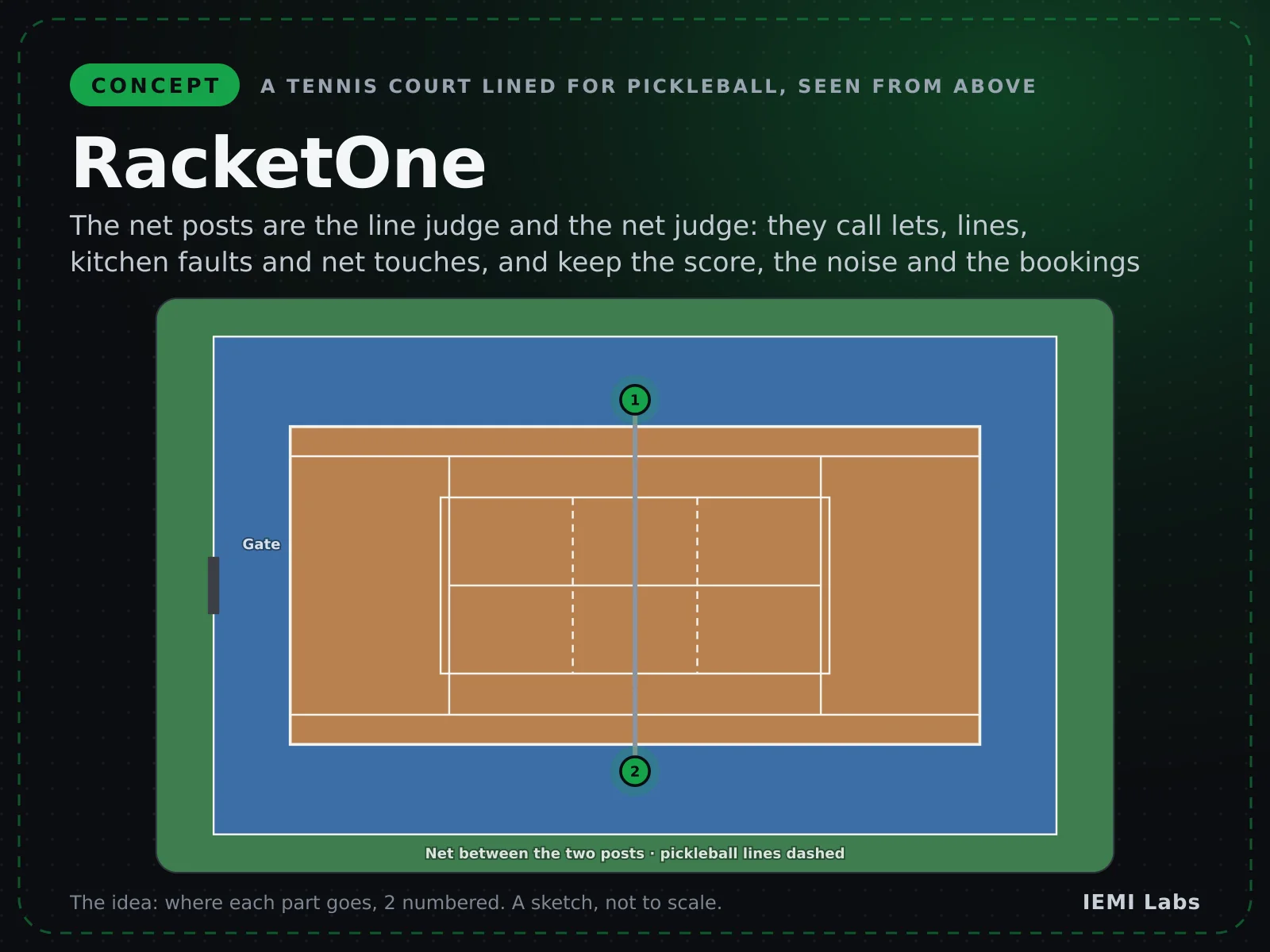
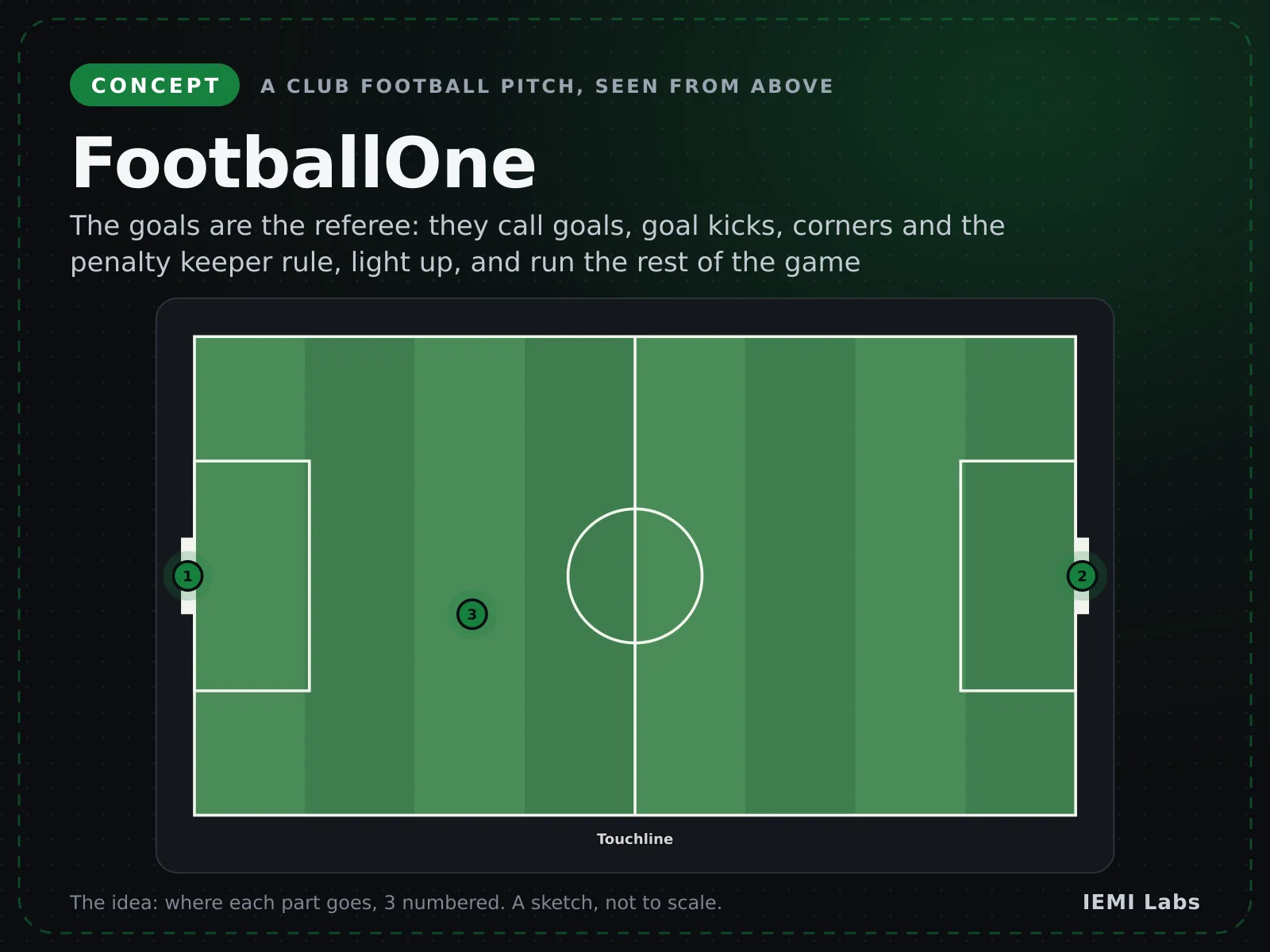
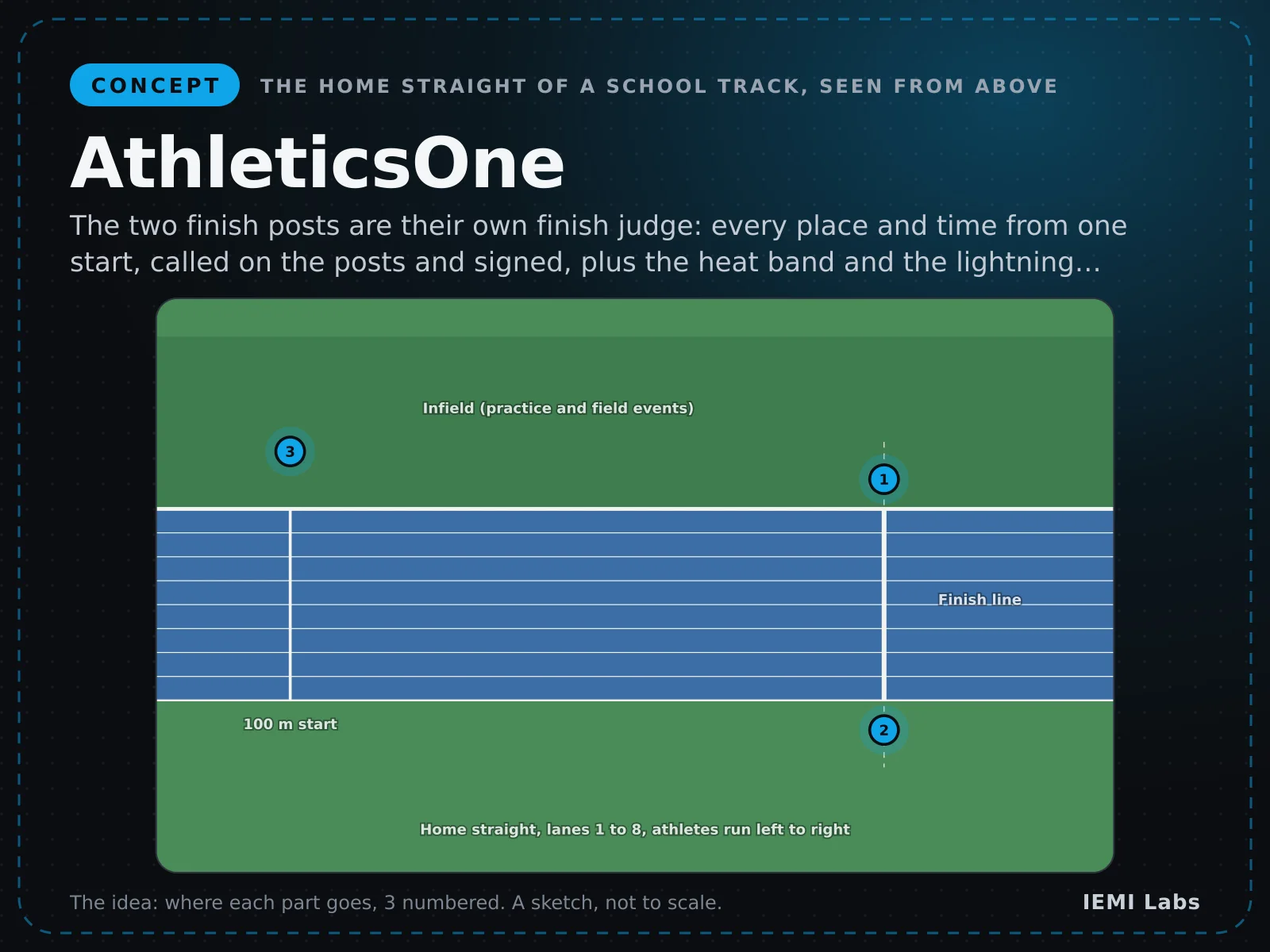
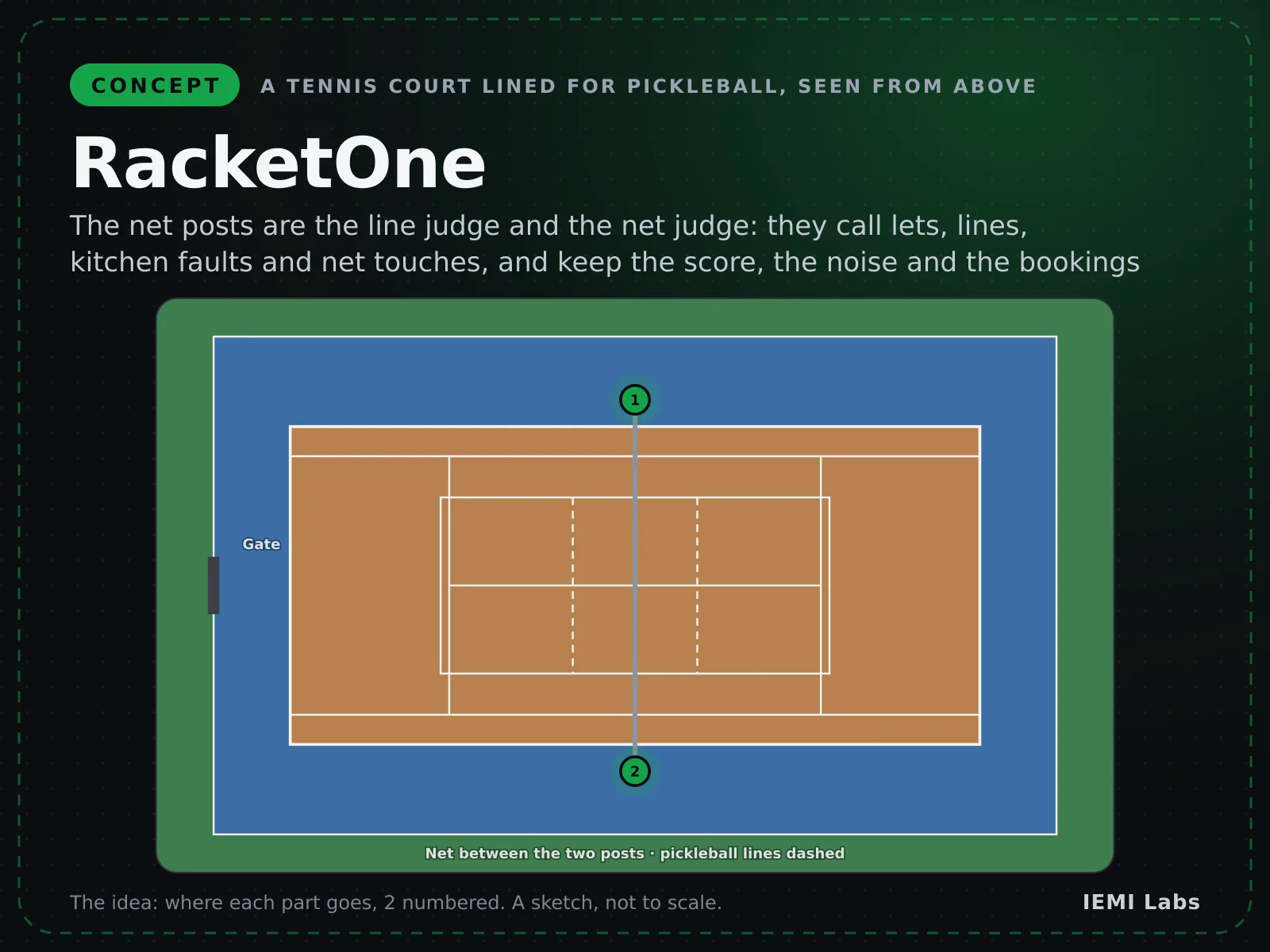
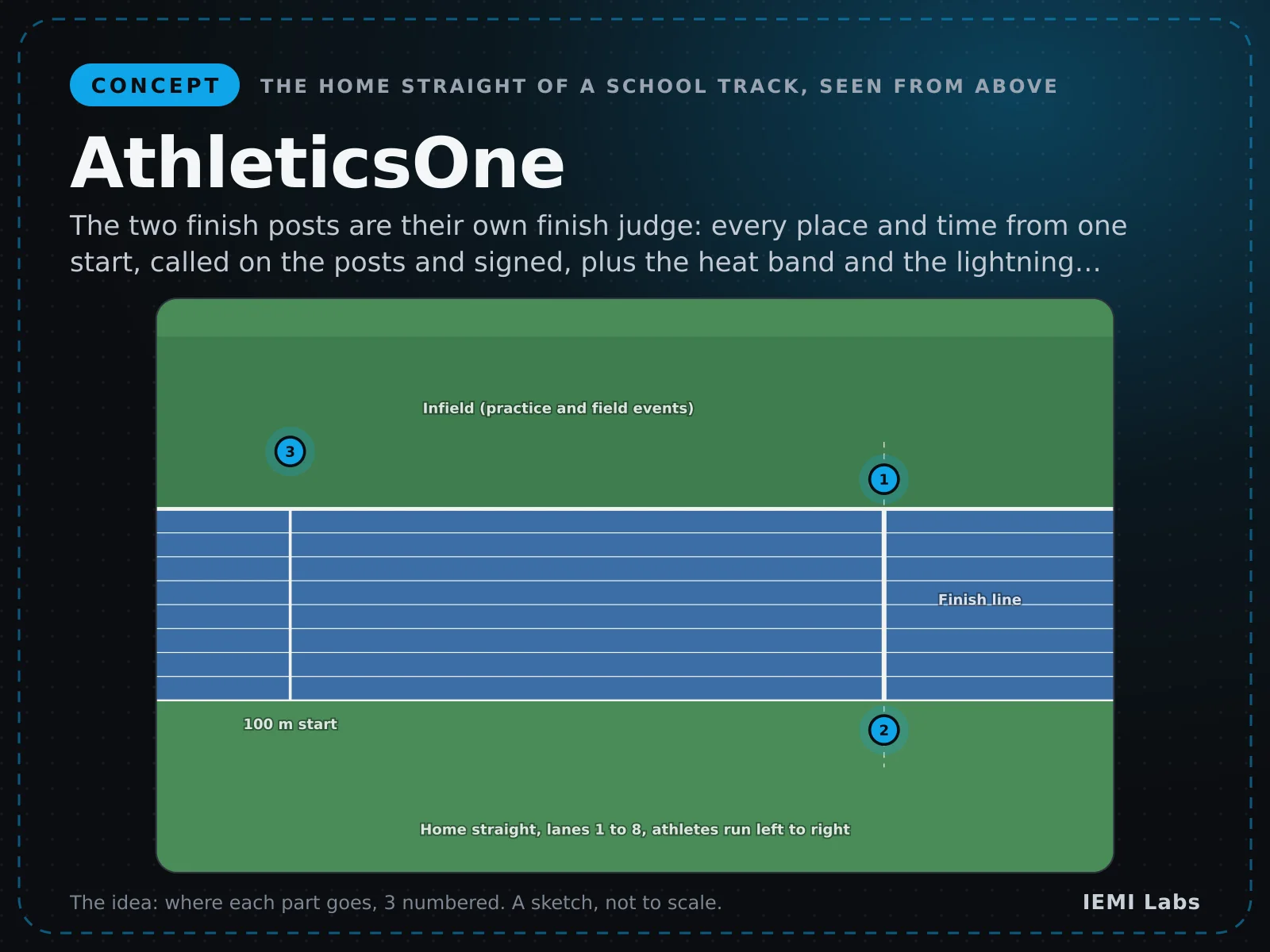
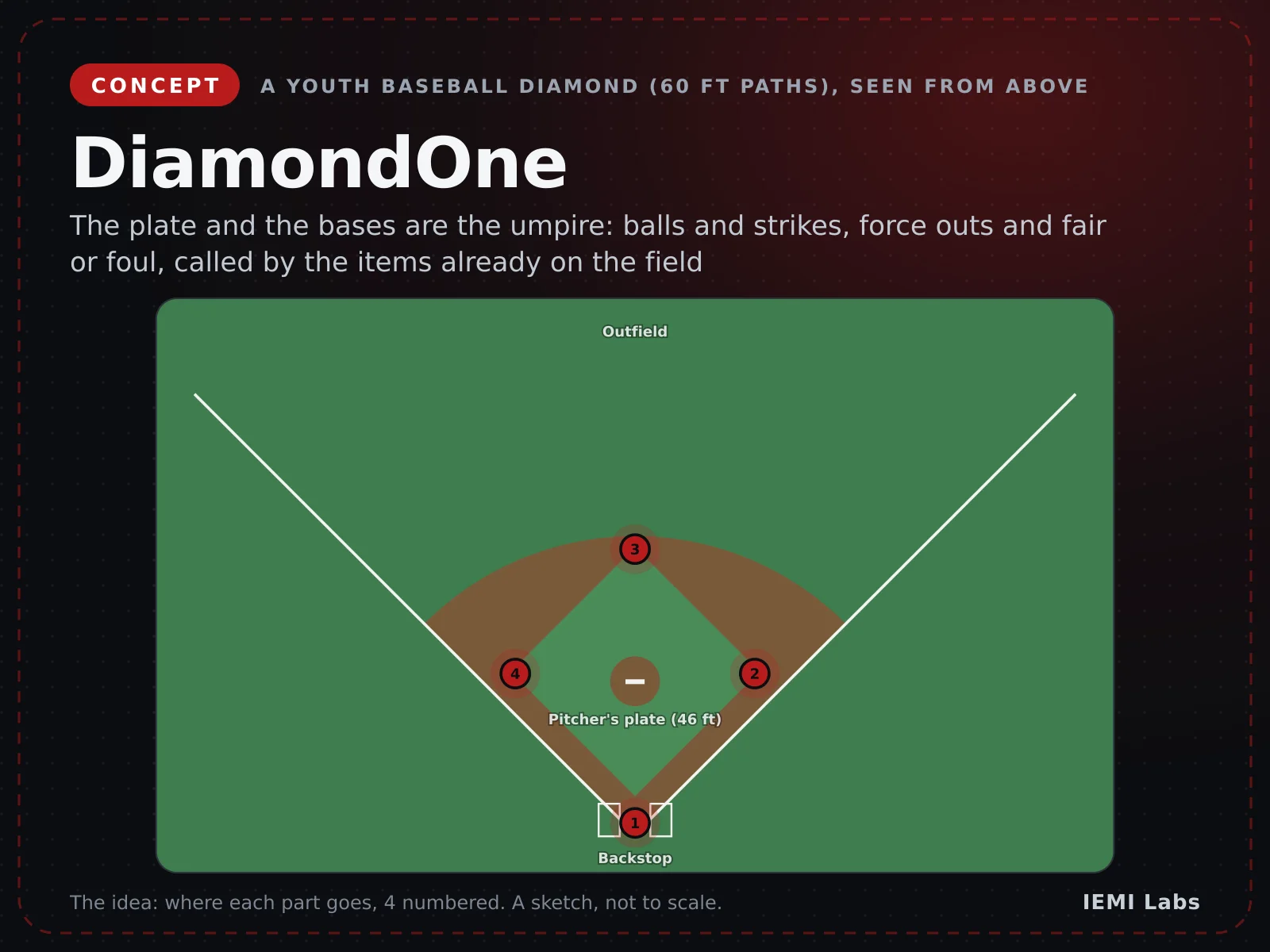
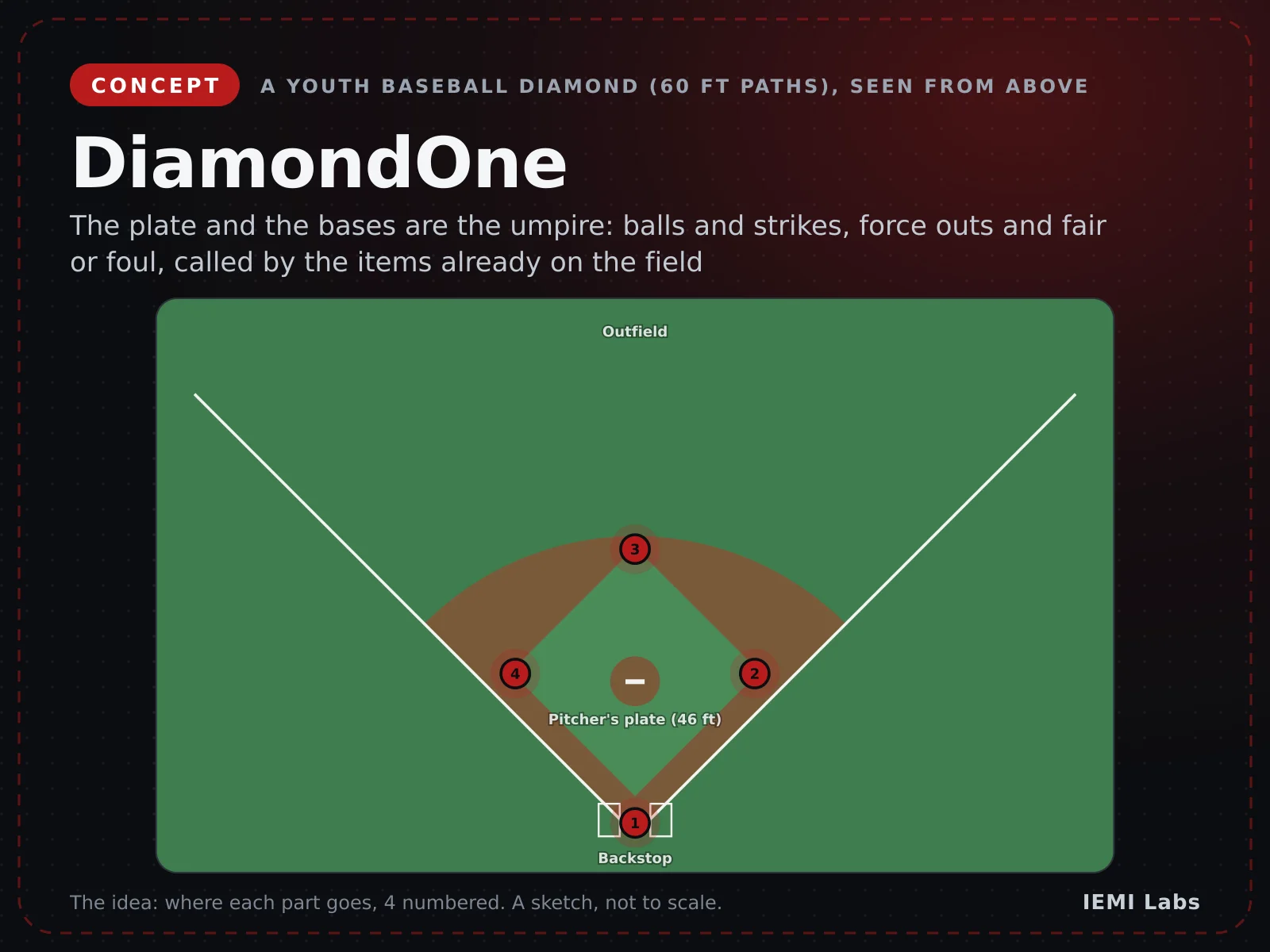
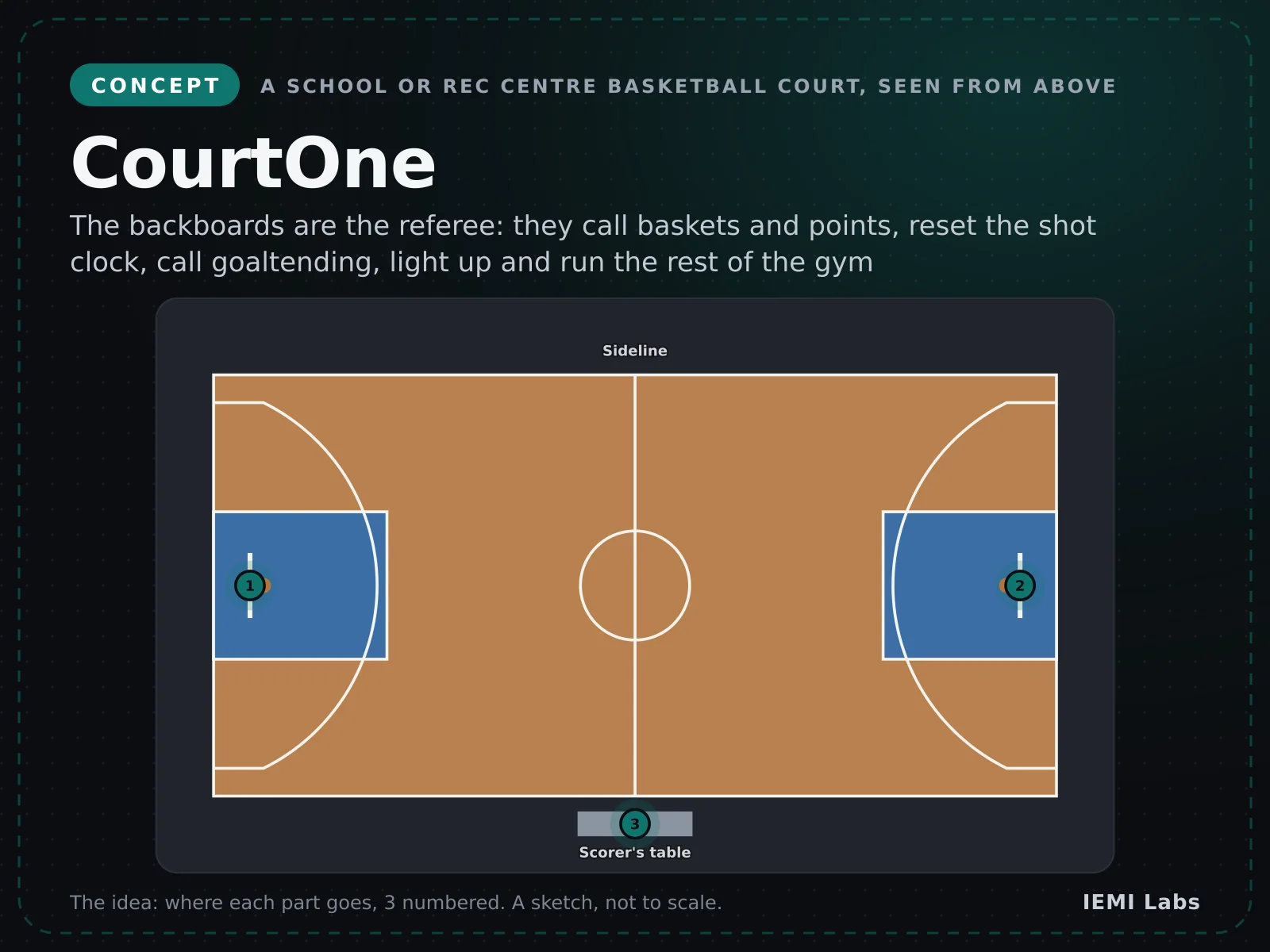
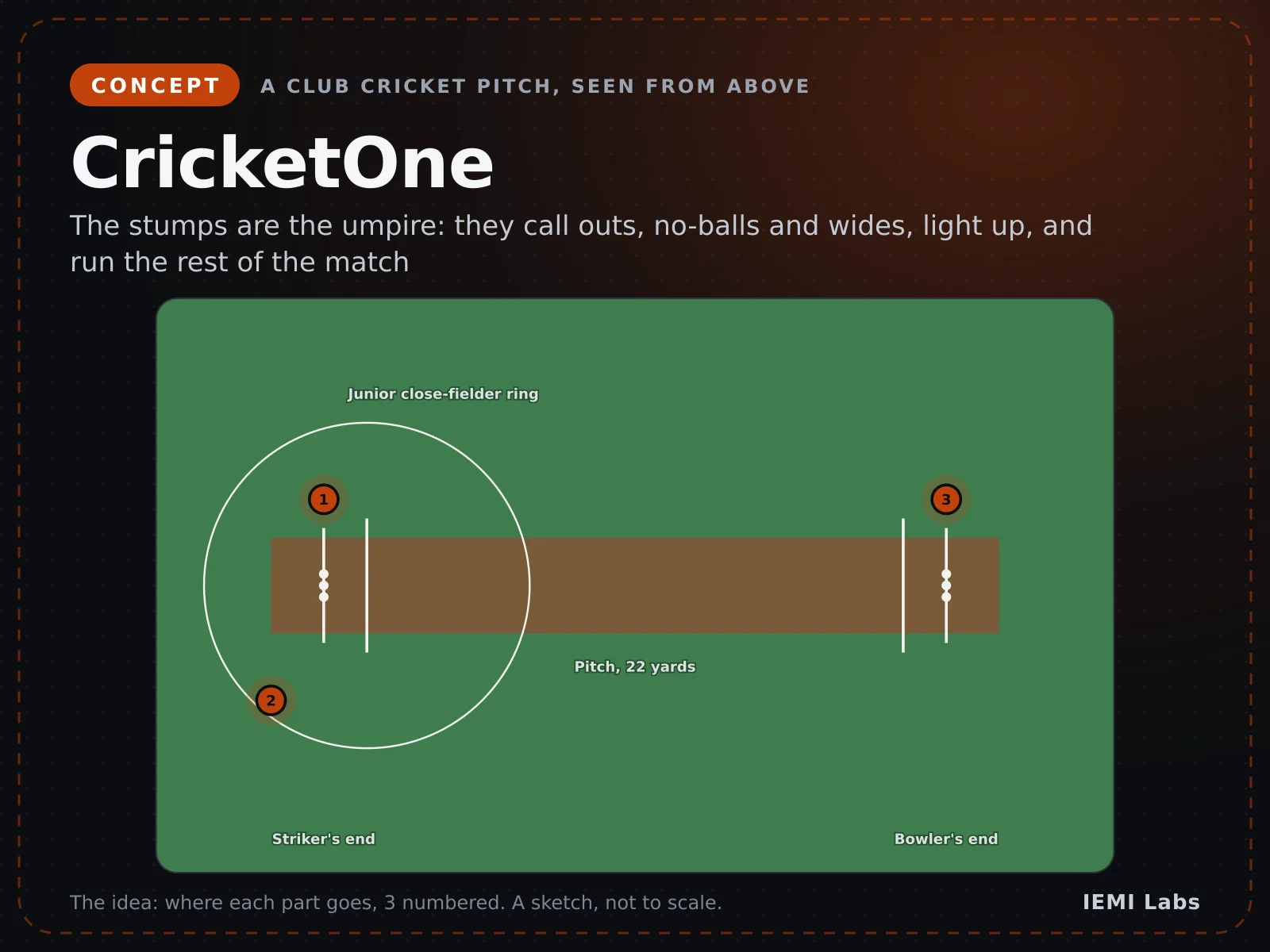
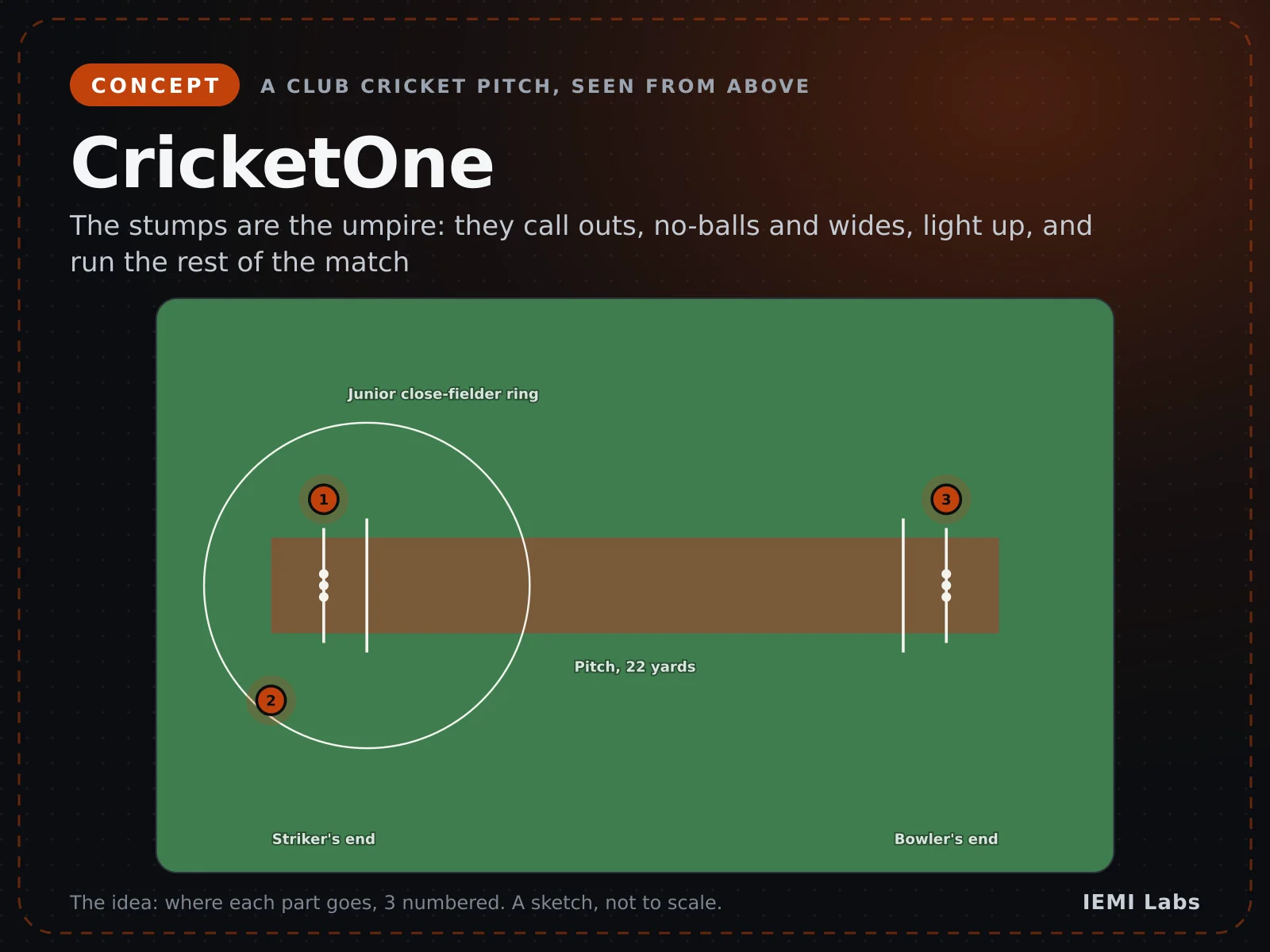
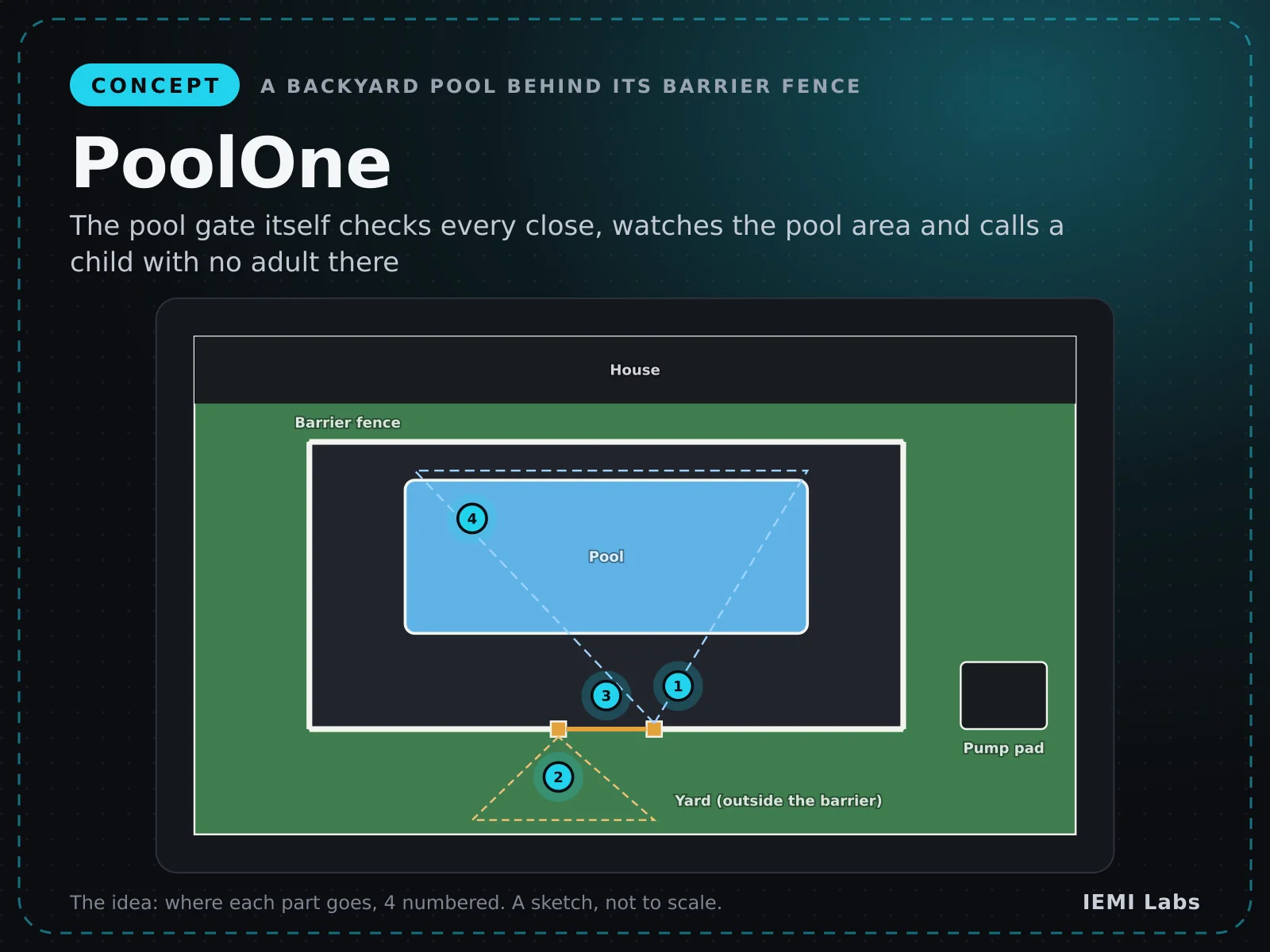
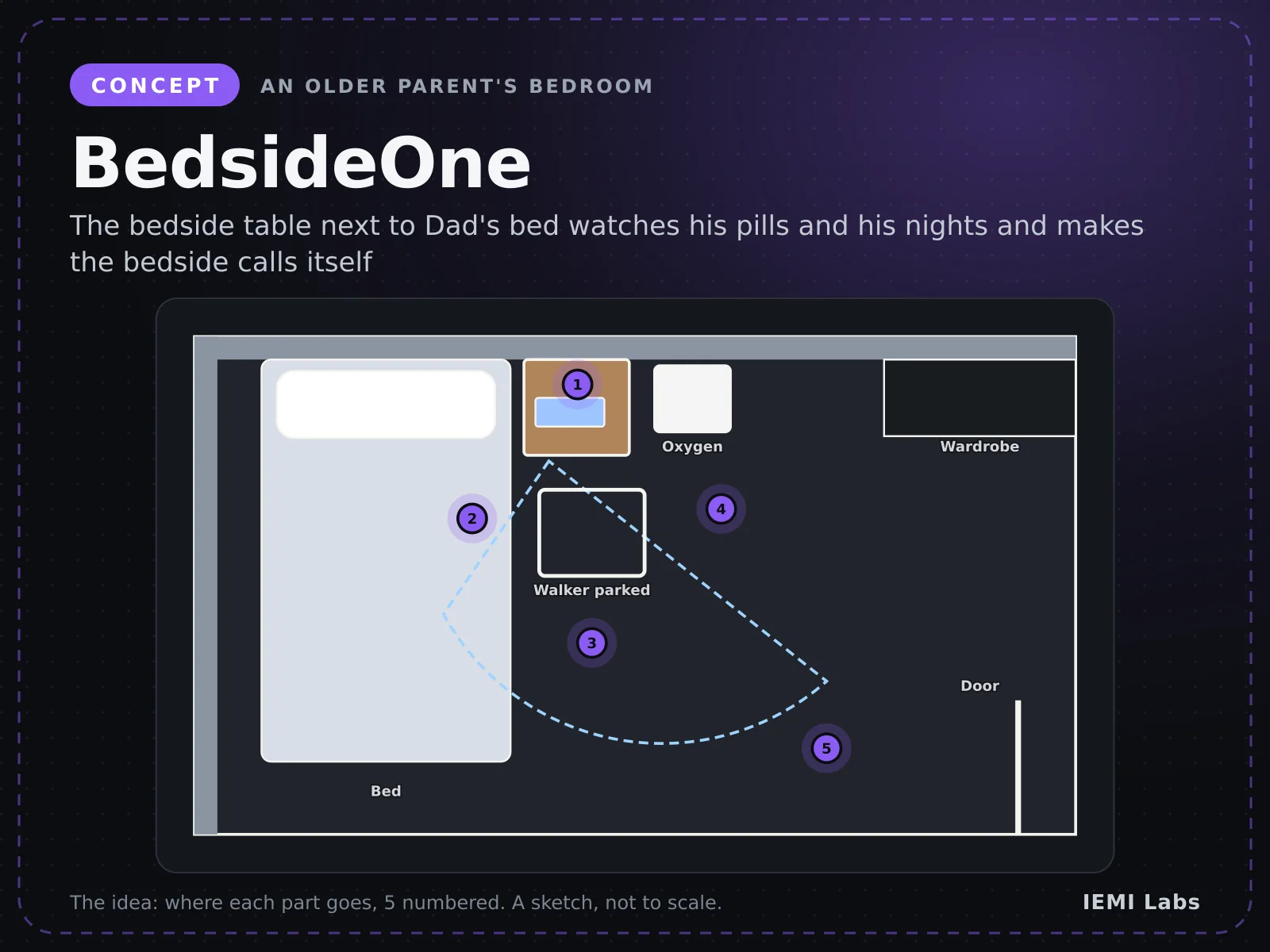
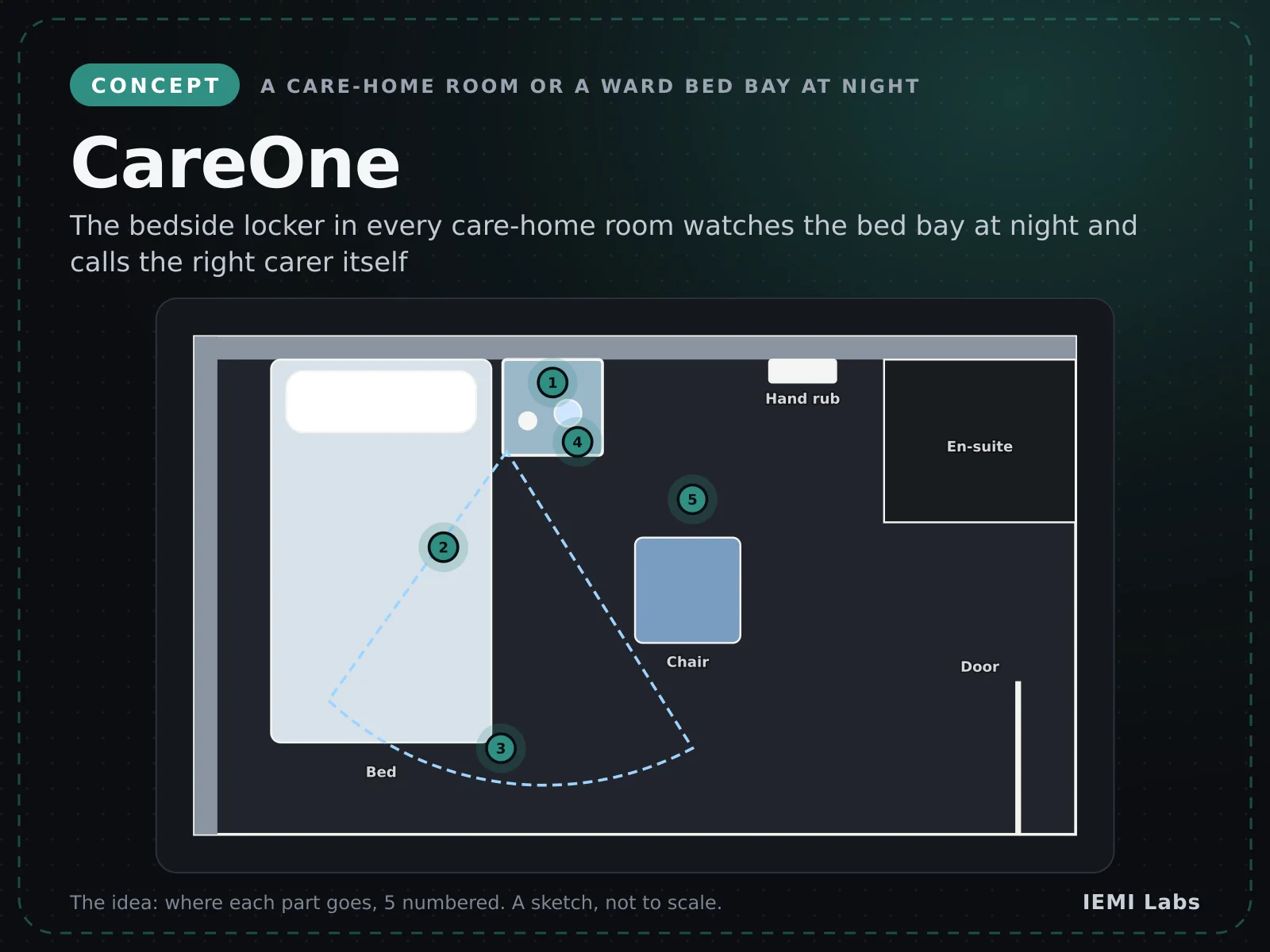
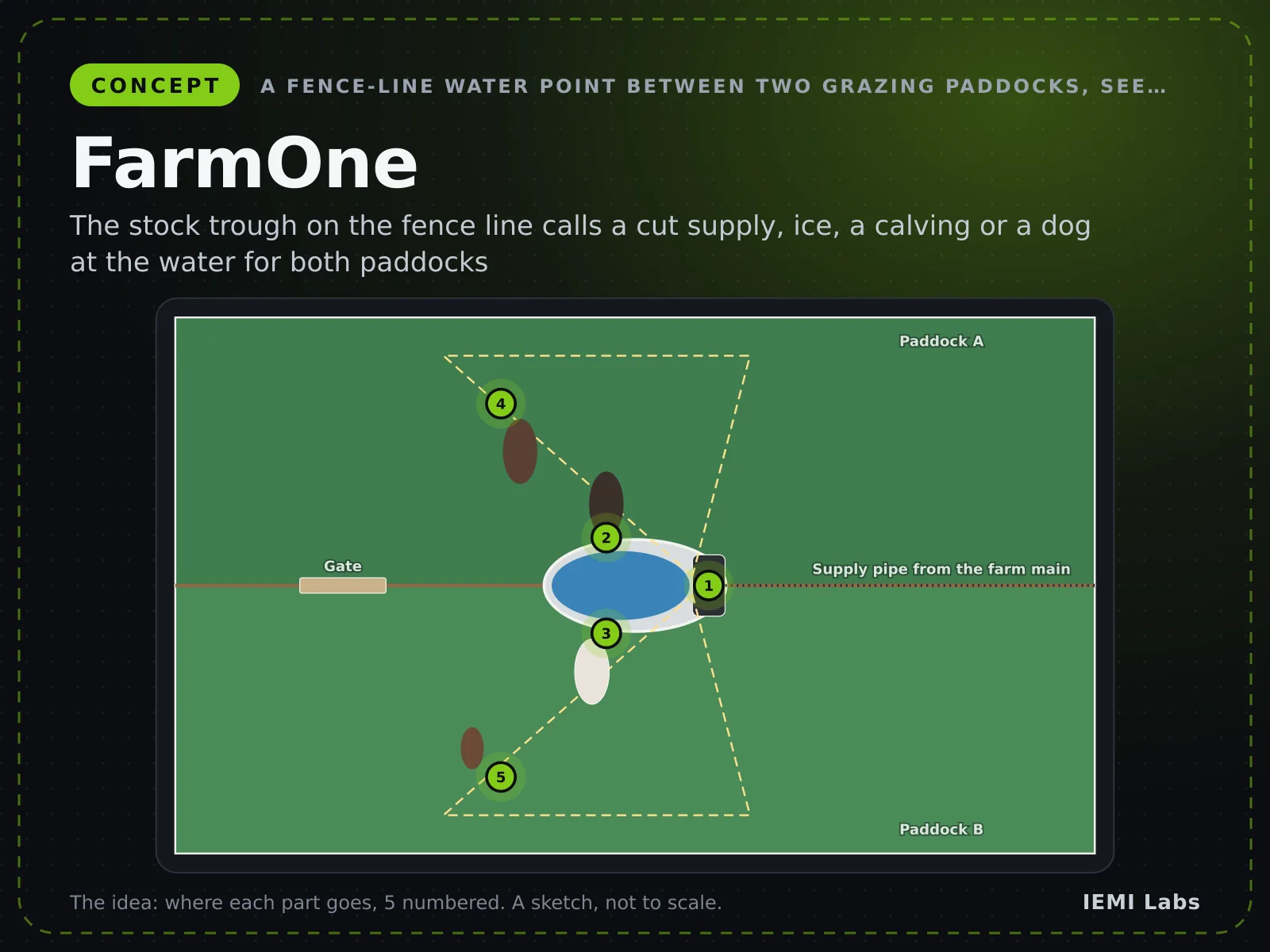
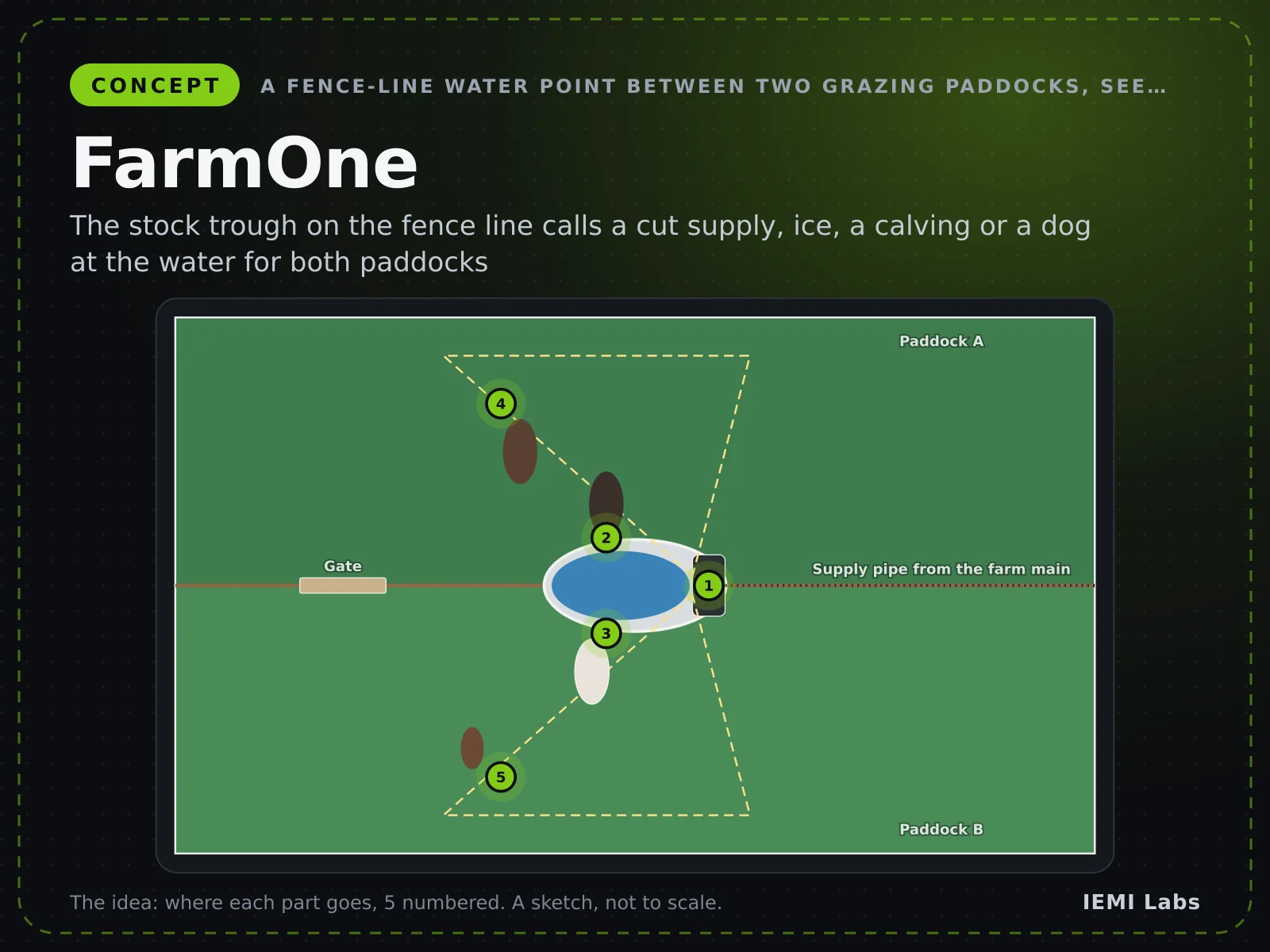
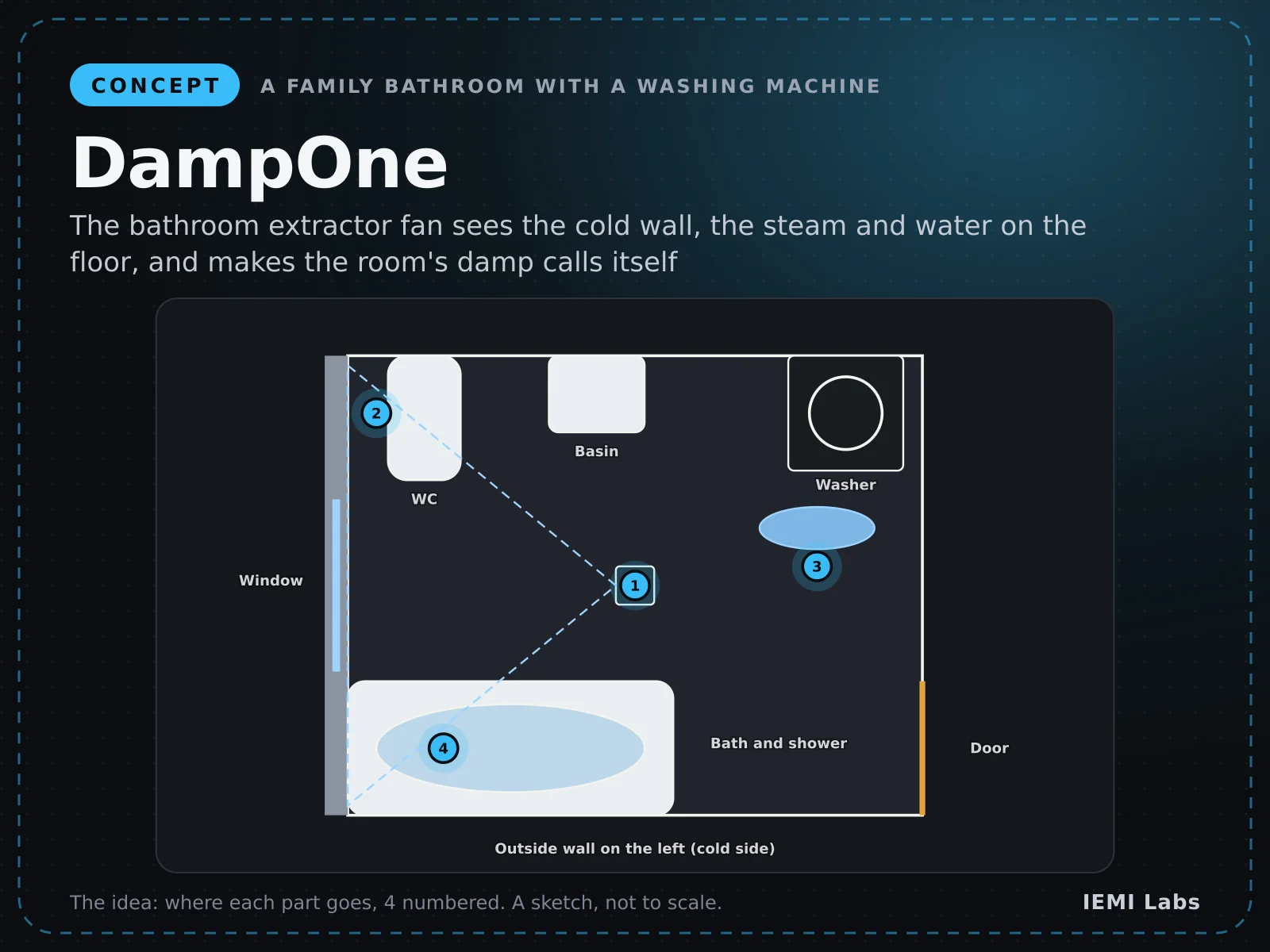
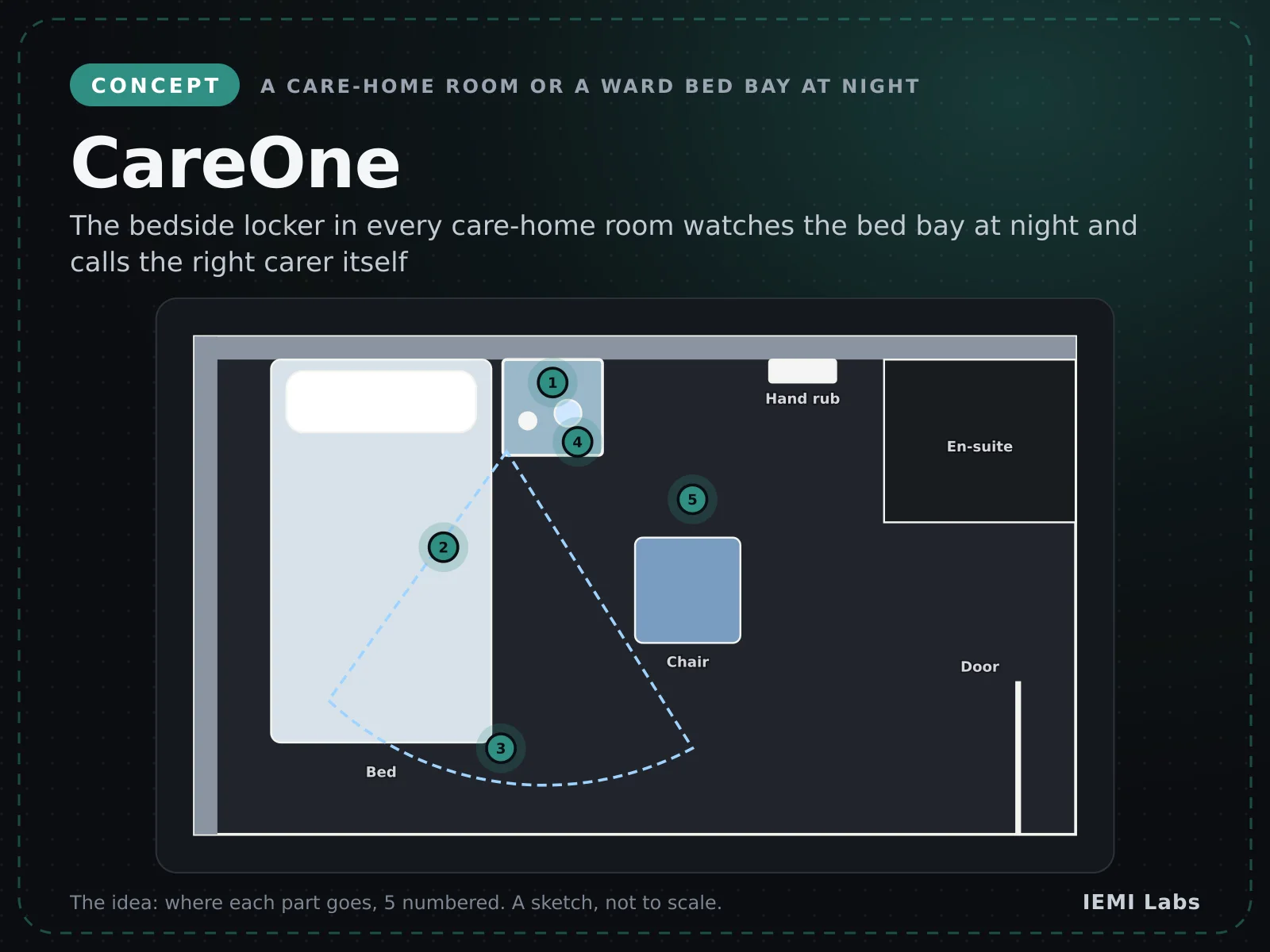
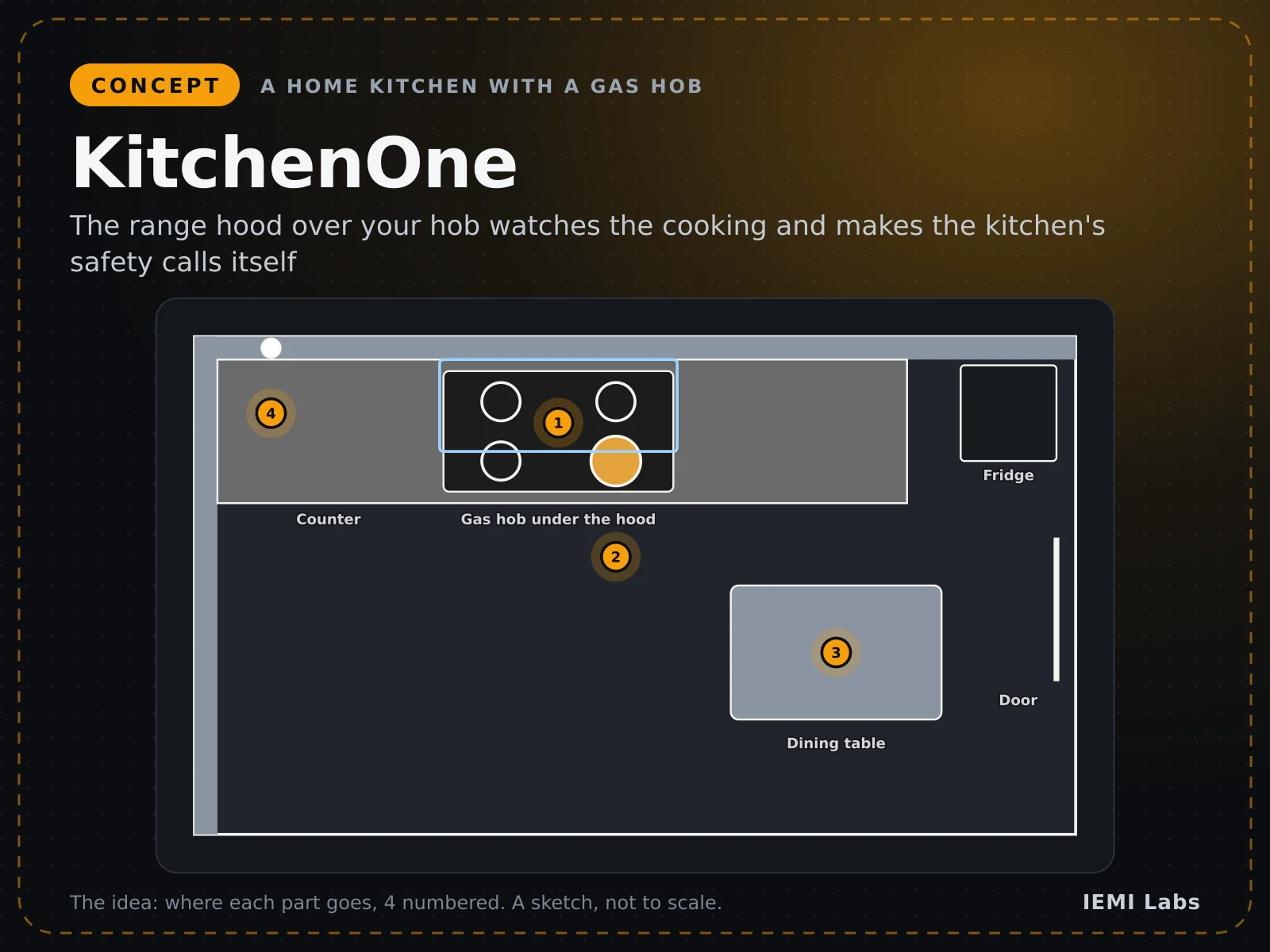
Build it yourself
Updates
- Spec & partsThe plan: from dev kits to 100 beta units in 13 weeksEarly design study: the week-by-week prototype plan we drew up for AirMate IR, from dev kits and a presence model to alpha and beta units. Kept here as part of our design record.Read update
- Spec & partsThe AirMate IR build package: parts, wiring, CAD, firmware and appEarly design study: the AirMate IR build package, with a $75 parts list per breadboard set, the pin map, a 3D-printable enclosure, ESPHome firmware with the presence rules, the presence-model pipeline and an app you can try.Read update
- Spec & partsAirMate IR gets smaller: one compact unit per AC, every AC in one appEarly design study: the AirMate IR enclosure shrinks from 70 × 70 × 25 mm to 48 × 48 × 20 mm so it sits quietly below each AC, and the app gains an All rooms screen to control every unit together.Read update
- ResearchWhy AirMate IR is our first productEarly design study: we scored eight of our concepts on speed, risk, market, competition and fit for online sales, and AirMate IR scored highest. It became our first design study; since then, market research has moved us to one flagship per sport and per industry.Read update