IEMI Gecko Classroom Kit
A print-it-yourself AI-vision robot that high-school classes build, code and train
Gives a CS or engineering teacher a ready 6-week unit on real AI hardware: students print and build a desk lizard, code it in blocks or MicroPython from a Chromebook, and teach it to recognise things on the robot itself.
- Who buys it
- A high-school CS/CTE teacher or makerspace lead, paying from a department or STEM grant budget. Users are students aged 13 and up.
- Why it pays
- A 6-robot AI unit costs $949 in year 1 and $299 a year after that. Six LEGO SPIKE Prime sets cost about $2,400 with no camera AI, and an 18-bot Ozobot Evo kit costs $2,990 (est., list prices).
- Target price
- $169 kit (school prints the body) · $949 Classroom 6-Pack incl. year-1 curriculum · $299/classroom/year after (target)
- First-minute wow
- In lesson 1 a student plugs one USB-C cable into a Chromebook, presses Connect, and Gecko looks up and nods at their face. There is nothing to install.
What the research found
And how this design answers it
- Companion robots die (Anki, Jibo, Kuri) → sold as a classroom lab kit with a syllabus, not a personality; no cloud, so kits keep working whatever happens to IEMI
- Petoi Bittle X ($279+) ships a free curriculum → Gecko teaches computer vision and on-robot machine learning instead of walking, at $169
- Schools run locked-down Chromebooks → the block editor is a static web page that talks to the robot over USB (Web Serial); no installs, no school Wi-Fi
- The ML lessons would need a Python training toolchain → few-shot learning runs on the robot (embedding model + nearest-neighbour), so students train in seconds
- A Li-ion pack for kids brings shipping and safety certification → no battery in the box; 5 V USB-C only, with a 3 A fuse
- Servos and fingers → low-torque SCS0009 bus servos, firmware torque cap and stall release, a TPU tail, and no gaps between 4 and 10 mm at moving joints
Use case
A 6-week AI unit in a high-school CS class
CS teacher24 students in pairsSchool IT
- 01Trigger: the district adds an AI unit to the CS course
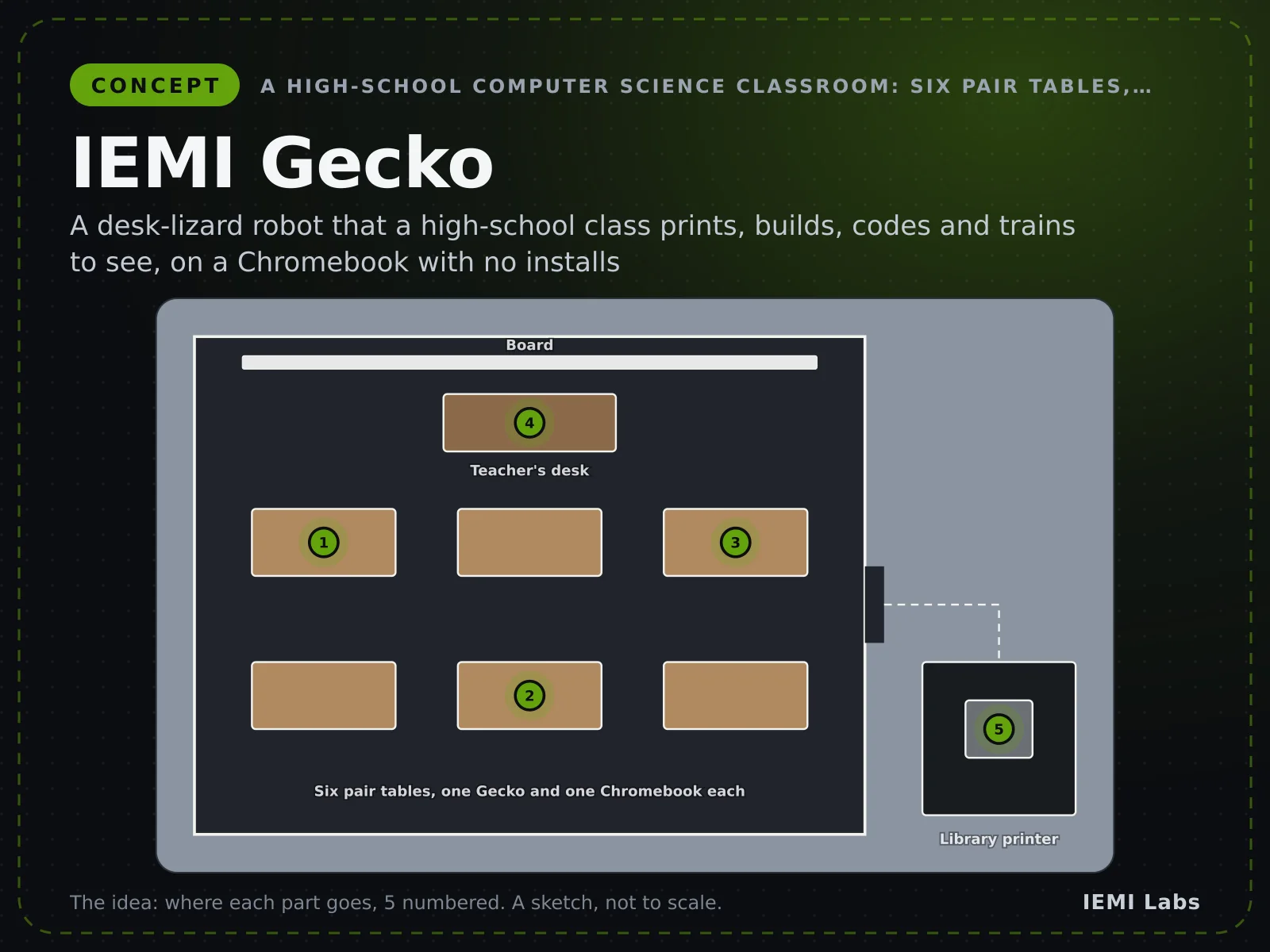
- 02Build: the library printer prints 12 bodies, and pairs assemble Gecko in one 45-minute lesson with a screwdriver
- 03Code: students move to Blockly, then Python, using servo sequences, touch events, and face tracking with a control loop
- 04Learn: students teach Gecko their own classes, measure accuracy, find bias from lighting and backgrounds, and present on demo day
- 05Grade: the teacher exports auto-check results to CSV; nothing is stored online
Outcome: A full hands-on AI unit for $1,898 in year 1 against about $4,800 for 12 SPIKE Prime sets without vision (est.)
How it works
Architecture
- 01
See: OV5647 camera into the K230D NPU (face detector and embedding model), about 15 fps target
- 02
Decide: a MicroPython runtime with a behaviour arbiter (safe > lesson > react > desk mode) and a joint-limited motion planner
- 03
Act: 5 bus servos (neck pan and tilt, tail, two push-up legs), a 240×240 animated face, and an I2S speaker
- 04
Teach: an offline web editor (Blockly + Python) over USB Web Serial, signed lesson packs, and a teacher CSV export
Hardware
Real parts, buyable today
Bill of materials: about $164 per robot at qty 1 (prototype, breakouts) and about $110 at qty 100 with the JLCPCB carrier (est.), plus about 180 g of PETG the school supplies.
| Block | Part | Why this part |
|---|---|---|
| AI brain | Banana Pi BPI-CanMV-K230D-Zero (Kendryte K230D) | A real NPU at Pi Zero size for about $29–40, with CanMV MicroPython |
| Camera | OV5647 5 MP, 2-lane MIPI-CSI | Cheap and documented, with standard M2 mounting |
| Face | Waveshare 1.54" ST7789 240×240 IPS | Expressive eyes on an SPI bus, $10.83 |
| Motion | 5 × Feetech SCS0009 serial bus servos | One daisy-chain cable, position read-back for auto-check lessons, low torque for safety |
| Power | USB-C 5 V 3 A (listed Pi 15 W PSU) + 3 A PTC + TVS on the carrier | No battery to certify; the firmware keeps the peak load under 2.5 A |
Mechanical
Printable CAD
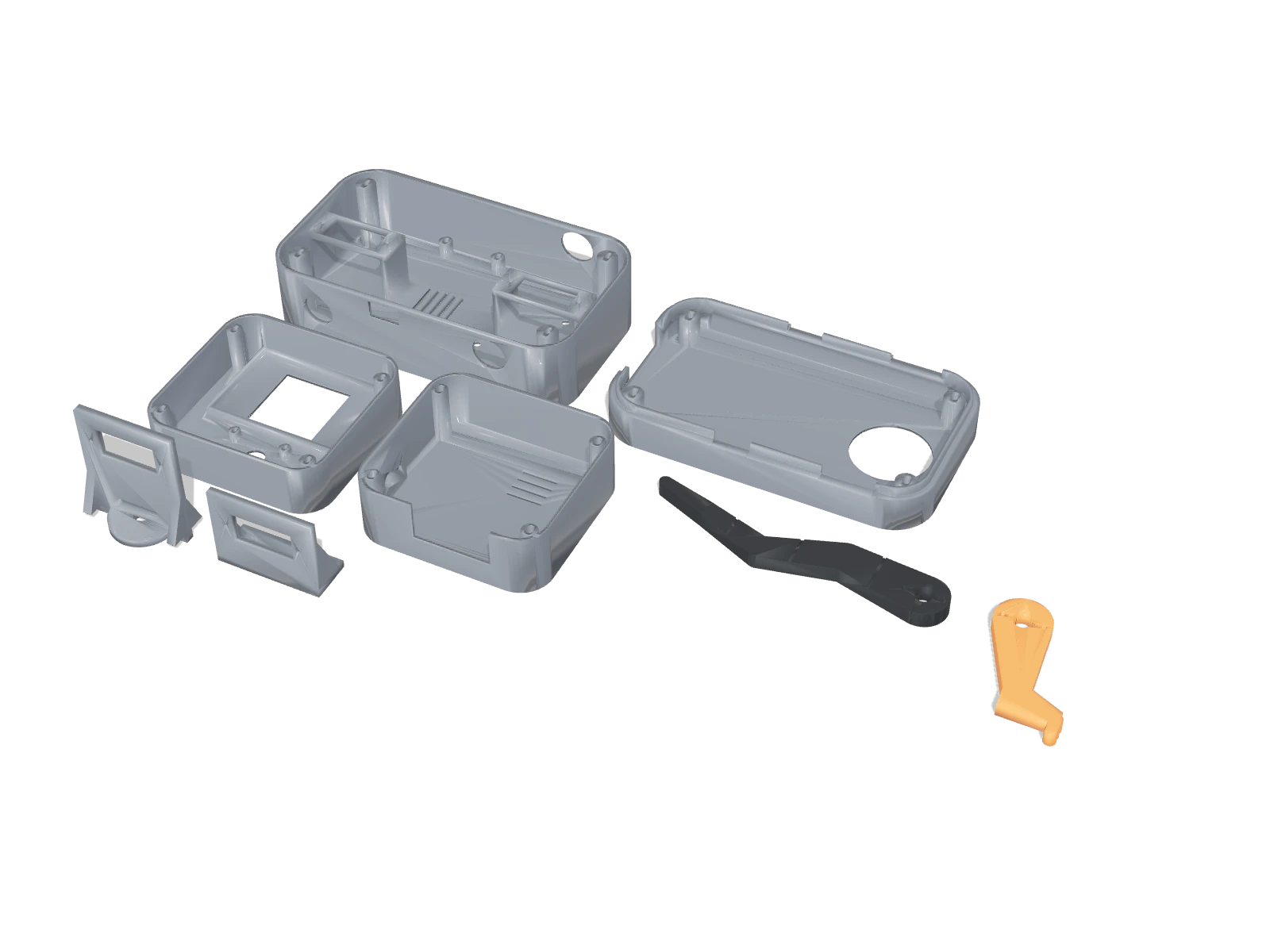
8 parts, generated from code and checked as closed solids. Pick a part to inspect it, or download the STL files to print.
See the CAD parts render
Loading the CAD…
Real CAD · drag to rotate · scroll to zoomReal CAD · swipe sideways
Bought hardware fitted inside this part (checked in the CAD: nothing collides with the plastic)
- Body base (servo decks, board standoffs)body-base.stl · PETG
- Body shell with scale patternbody-shell.stl · PETG
- Head front (LCD window, camera, mic)head-front.stl · PETG
- Head back (tilt horn mount)head-back.stl · PETG
- Neck yoke (pan to tilt)neck-yoke.stl · PETG
- Leg servo bracket (×2)servo-bracket.stl · PETG
- Push-up front leg (×2)front-leg.stl · PETG or TPU 95A
- Flexible tailtail.stl · TPU 95A
Open risks we are working on
- Demand: districts may not pay $299 a year to a one-person vendor when Petoi's curriculum is free. The kill test: 3 of 10 Austin CS teachers must commit to a paid pilot by Q1 2027
- Toolchain: compiling the face and embedding models needs nncase (Python, x86 Linux), and the lab is Node-only
- Board supply and software maturity: a single-source BPI-CanMV-K230D-Zero, whose header pin-mux and camera driver are unverified
- SCS0009 torque at 5 V, its case dimensions and its US price are unverified until the first servos are measured
- Regulatory: CPSIA status at ages 13+, FCC Part 15B for the carrier, and a school data-privacy agreement still need confirming
Design stage only: nothing on this page is for sale. Specifications and prices are targets.