SensingConcept
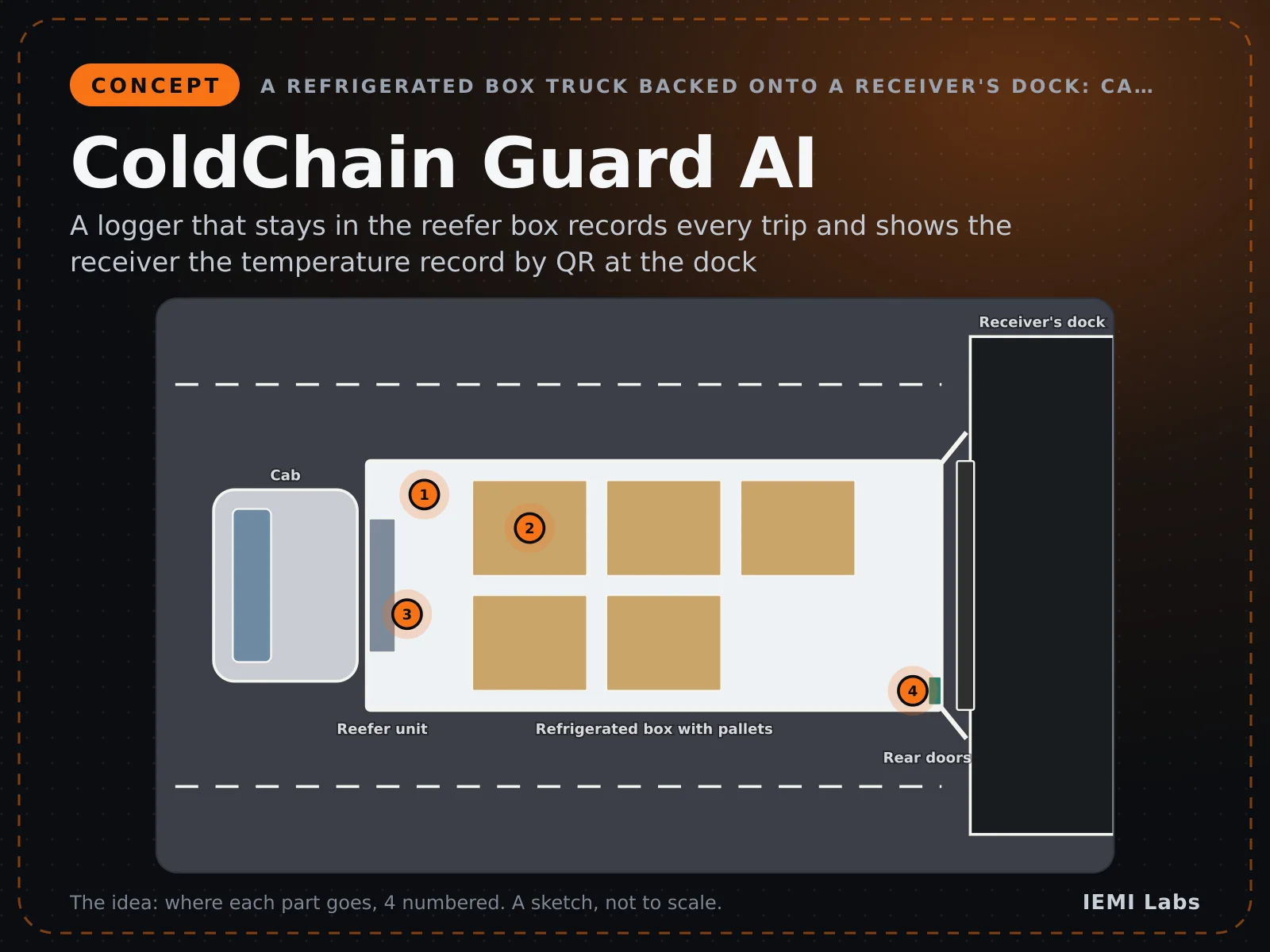
ColdChain Guard AI
A lunchbox-sized monitor that mounts inside trucks, cold rooms and fridges.
- Watches temperature around the clock
- Warns before goods get too warm
- Detects door openings and tampering
From $199 per kit
DetailsCamera-free shop analytics that tells you what to change
Software: $15 per month (target)
Concept, not for sale yet. Tell us if you want it; that decides what we build.
Rate this idea and tell us what to change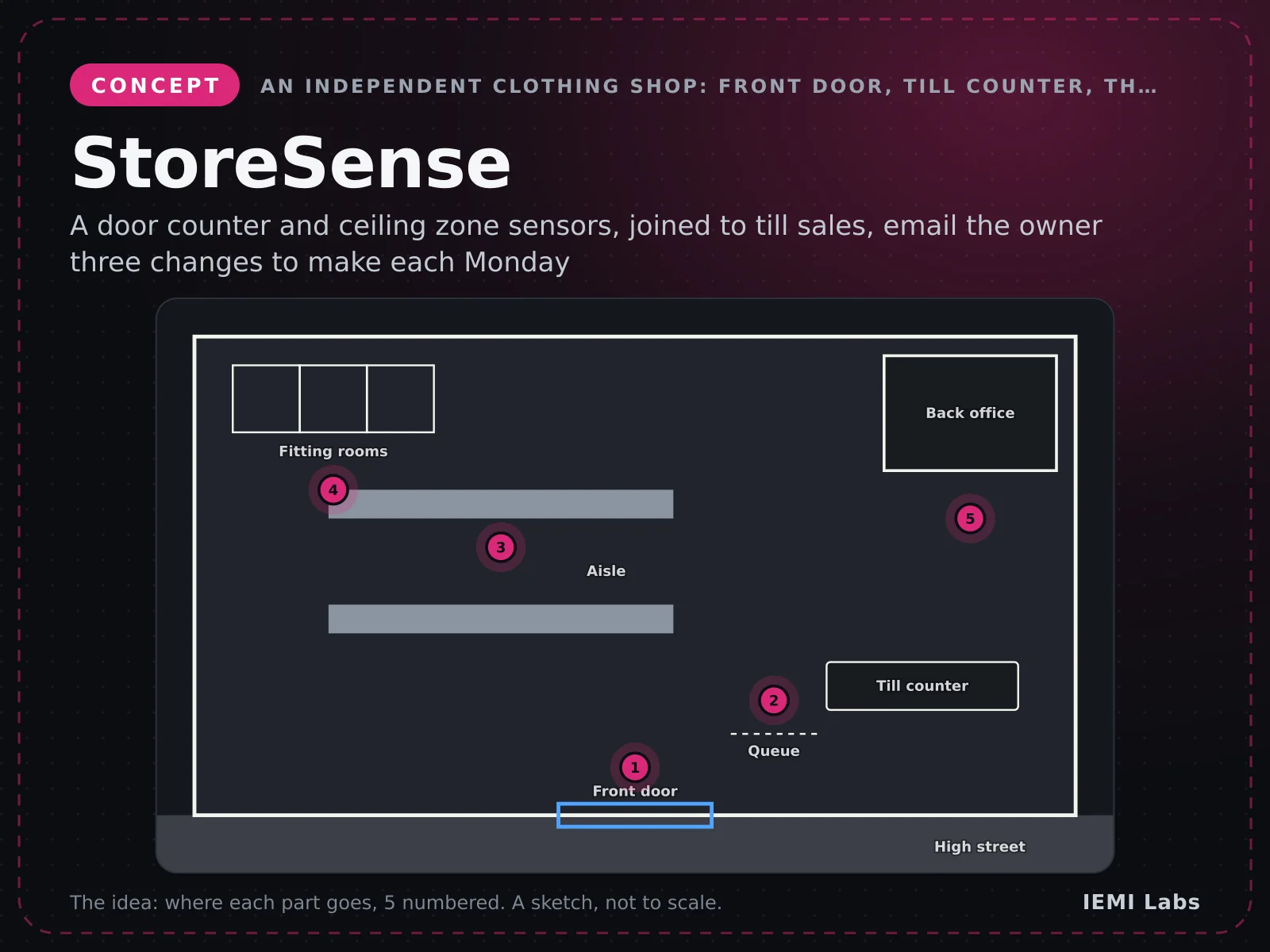
Drag to rotate · right-drag to move · scroll to zoom · click a part for its size and placeSwipe to rotate · pinch to zoom · two fingers to move · tap a part for its size
How it fits together
Scroll or tap a part. Press “See the 3D CAD design” to watch the model, built from our CAD, light each part up and show how it connects.
Real-time 3D render · drag to rotate · final design may varySwipe sideways to rotate
01
The whole StoreSense
Two ceiling sensors count heads through the shop door as dots, never pictures. Counts join till sales in the cloud for a weekly email.
02Brain
ESP32-S3 door unit
The brain: it runs the storesense door firmware program
03
Two VL53L8CX ToF sensors
Measure an 8×8 grid of heights at 15 Hz, one each side
ESP32-S3 door unit · I²C ×2 (own bus each) · 8×8 range frames
04
Zone node (till, aisle)
Counts people and dwell time in one marked area
ESP32-C6-WROOM-1 · ESP-NOW radio · Zone minute summaries
05
Status LED
Shows setup, running and fault state through a light pipe
ESP32-S3 door unit · GPIO pin (one data line) · Colour data
06
Setup button
Held 5 s to start Bluetooth setup
ESP32-S3 door unit · GPIO pin · Button press
07
USB-C 5 V supply
Powers the unit from a wall adapter or PoE splitter
ESP32-S3 door unit · USB-C 5 V lead · 5 V power
08
All connected
6 key parts, one program, and your phone
What it is
A ceiling door counter and zone sensors that use depth, not cameras, to measure shop traffic and queues.
What it does
Who it's for
Independent specialty shops and small chains on Square, Shopify POS or Clover.
The idea
The problem today
An independent shop owner knows the takings but not how many people walked in, waited too long at the till or left the fitting rooms empty-handed. Door counters give a dashboard nobody reads, and cameras worry customers and staff.
With StoreSense
StoreSense counts people in and out at the door and watches the till queue, one aisle and the fitting rooms with camera-free depth sensors. It joins that to the till sales and every Monday emails up to three plain actions, each with a dollar value, such as adding a person at the till on Saturday afternoon.
How the parts connect
Every part, what links it to the brain, and how the data reaches your phone. A solid line is a cable; a dashed line is a radio link.
The program
for (;;) {
    vl53l8cx_wait_frame(&a, &b);                 // I2C0 + I2C1, INT pins
    heightmap_update(&map, &a, &b, MOUNT_H_M);   // 16 x 8 grid, 4 cm cells
    foreground(&map, &bg, 0.45f);                // over the median floor

    head_t heads[MAX_HEADS];
    int n = find_heads(&map, heads, 0.9f);       // peaks >= 0.9 m
    tracks_step(&trk, heads, n);                 // constant-velocity Kalman

    for (cross_t *c = tracks_crossings(&trk); c; c = c->next)
        counts_add(&minute, c->dir, classify(c));   // adult / child / stroller
    if (minute_done()) mqtt_publish_counts(&minute);
}
To your phone
Owner phone (Bluetooth setup) and email
One screen for each job StoreSense does.
Till queueSaturday afternoon at a gift shop: the till line sits at three or more people, and some shoppers leave without buying.
Door countsThe door sensor sees heads as dots, never pictures. It counts shopping parties, so a family of four counts as one possible buyer.
StaffingTuesday to Thursday mornings are quiet three weeks running. The Monday email suggests moving two staff hours to the Friday rush at the same payroll.
App screens with sample data. The interface is in development.
| Door counts | 4 in, 3 out | Every 60 s |
|---|---|---|
| Shopping parties | 2 parties in | Every 60 s |
| Till queue | Avg 2.4, max 4 | Every 60 s |
| Conversion | 31% of parties bought | Weekly |
| Data quality | 0.96 | Every 60 s |
Sensors see heights only, so there is no image to leak. Counts go out; tracks stay on the unit.
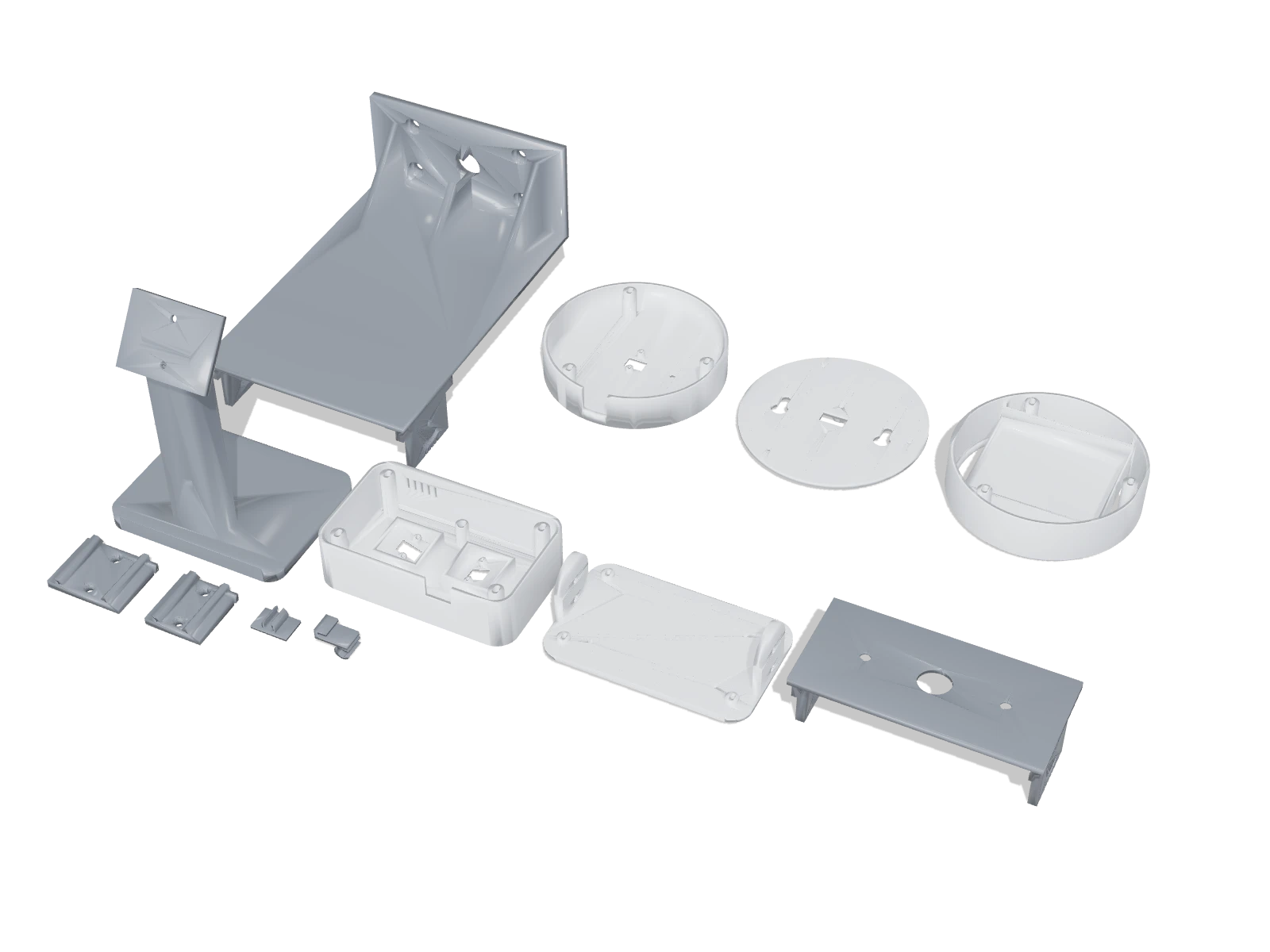
CAD design · Design complete (stages 1–6), not built, not validated
| AI processor | ESP32-S3-WROOM-1-N16R8 (door unit); ESP32-C6-WROOM-1-N8 (zone node) |
|---|---|
| Sensors | Door: 2 × ST VL53L8CX 8 × 8 multizone time-of-flight sensors, splayed ±20° for an 85° field · Zone node: ST VL53L7CX 8 × 8 time-of-flight sensor, 60° field · Optional BLE staff tags so staff are not counted |
| Connectivity | Wi-Fi · Encrypted ESP-NOW from zone nodes to the door unit · Bluetooth for setup · MQTT over TLS · Square, Shopify POS and Clover APIs |
| Power | USB-C 5 V (about 1 W door unit, 0.5 W zone node) or a PoE splitter; zone nodes can run on 4 × AA lithium for about 2–3.5 months (est.) |
| Enclosure | Matte white printed PETG housings with IR windows; tilting ceiling or header bracket for the door unit, round zone node with T-bar clips |
| Dimensions | Door unit 96 × 60 × 62 mm; zone node Ø90 × 25 mm |
| Door width | Up to 2.0 m from a 2.4–2.7 m ceiling; wider doors use two units |
|---|---|
| Accuracy gate | At least 95% single file, 90% overall over 500 entries |
| Counts | In/out, adults, children, shopping parties |
| Zones | Queue length, occupancy and dwell time |
| Sensor data | 8 × 8 distance values, processed on the device |
|---|---|
| Leaves the device | Minute counts only |
| POS data | Hourly transaction counts only |
| Retention | Minute data 90 days, hourly totals 25 months |
| Power | USB-C 5 V, PoE splitter or 4 × AA (zone node) |
|---|---|
| Mounting | T-bar clip, VHB tape or 2 screws |
| Electrician | Not needed |
Targets for production units; they may change during development.
Hardware: $149–$287 door unit; $287 with 2 zone nodes at $69 each (target)
Software: $15 per month (target)
Target pricing. Parts cost about $39 per door unit and $21–27 per zone node at qty 1, about $86 for a 1-door, 2-zone kit (est.).
Indicative launch pricing in USD, excluding taxes and shipping. Final pricing is confirmed before any balance is charged.
Community
StoreSense is in development. Rate the idea, tell us what to change about the features, specs or price, and we'll build it with your feedback.
How much people want it
–
No ratings yet
Follow StoreSense
Get build updates and first access when pre-orders open.
No comments yet. Tell us what you'd want from StoreSense.
Questions
Tell us what this would save you, or ask anything. We reply within two business days.
A member of the IEMI Labs team will reply within two business days.
From the product lab · ideation phase
No. StoreSense is a concept in the in-house design and testing stage. The design is done on paper and in CAD, but nothing has been built or measured yet. We are not taking orders; you can ask to join the pilot list.
No. The sensors measure 8 × 8 distances. They produce no images or faces, and only minute counts leave the device. It does not scan shoppers' phones.
We do not know yet. Strong sun weakens these sensors, and a bench test will decide whether glass-front shops in direct sun are supported.
Door counters such as Dor and Avia give counts. StoreSense adds till and fitting-room zones and turns them, with your sales, into a short list of actions. That edge is mostly software, and it could be copied.
A lunchbox-sized monitor that mounts inside trucks, cold rooms and fridges.
From $199 per kit
Details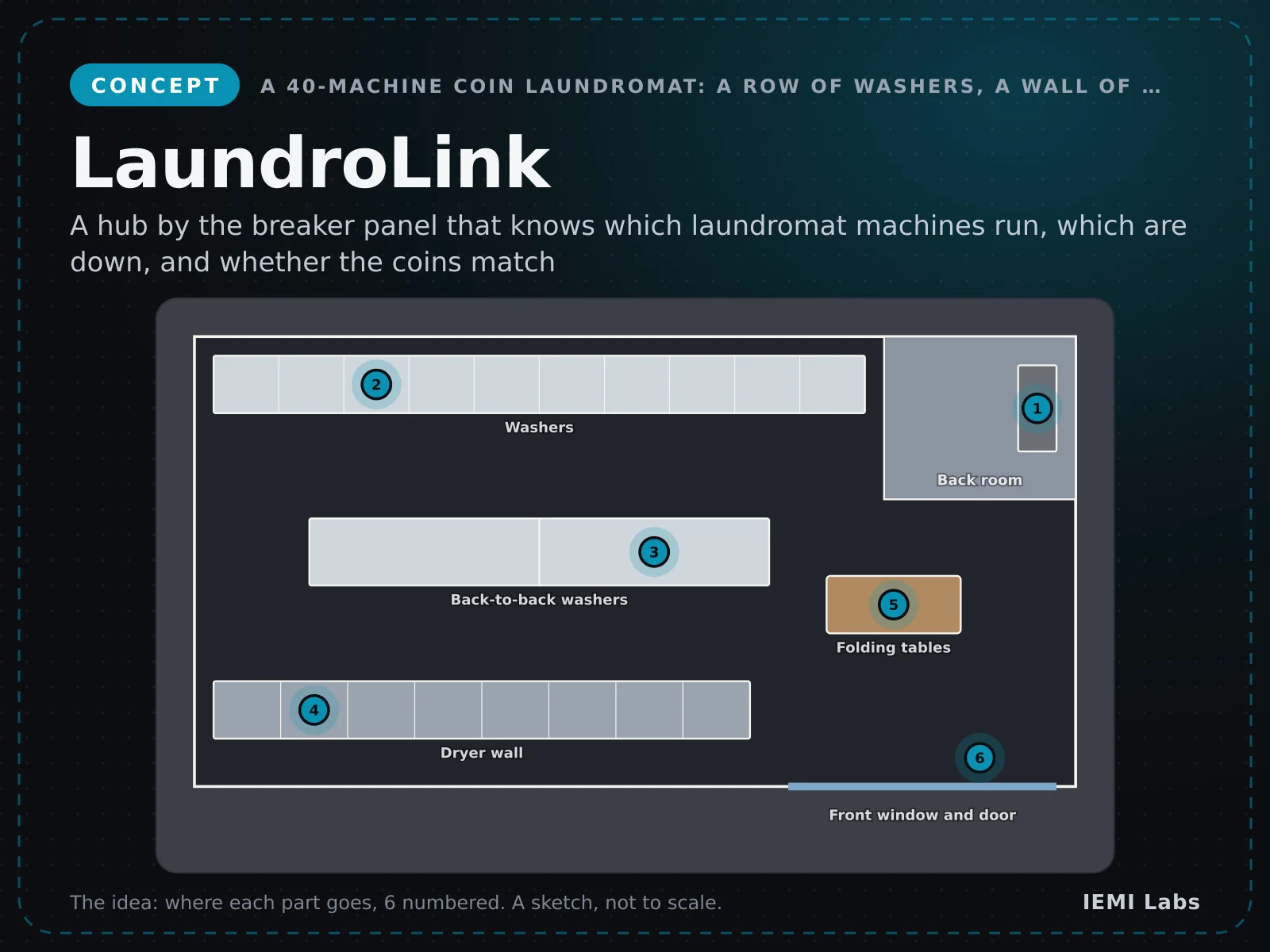
A hub at a laundromat's breaker panel that reads each machine's current to track cycles, faults and coins.
From $399 per 16-circuit hub
Details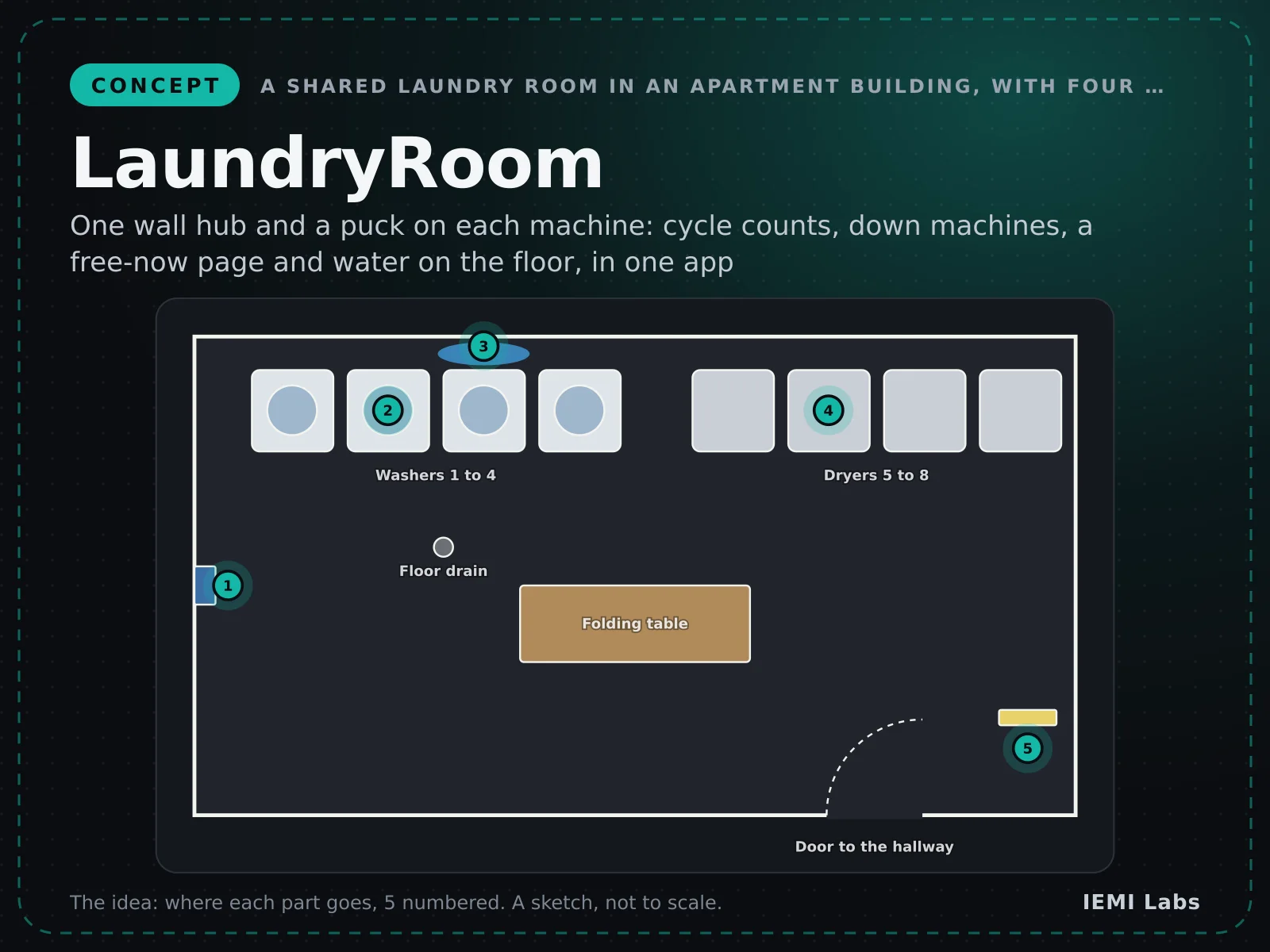
One wall hub and a battery puck on each machine that does three laundry-room jobs.
From $549 8-machine room kit: hub + 8 pucks (4 with leak feet) + tags, placards and sign; extra puck $39
DetailsStoreSense
Concept · target $149