VisionConcept
FlowCount AI
A small white ceiling sensor with two lenses that counts people without sending images.
- Measures queue length in real time
- Predicts wait times per lane
- Counts entries, exits and occupancy
From $899 per sensor
DetailsIEMI's one product for public roads: the crossing's own traffic light, made smart
Software: $59 per month per approach (app, LTE-M and calls)
Concept, not for sale yet. Tell us if you want it; that decides what we build.
Rate this idea and tell us what to change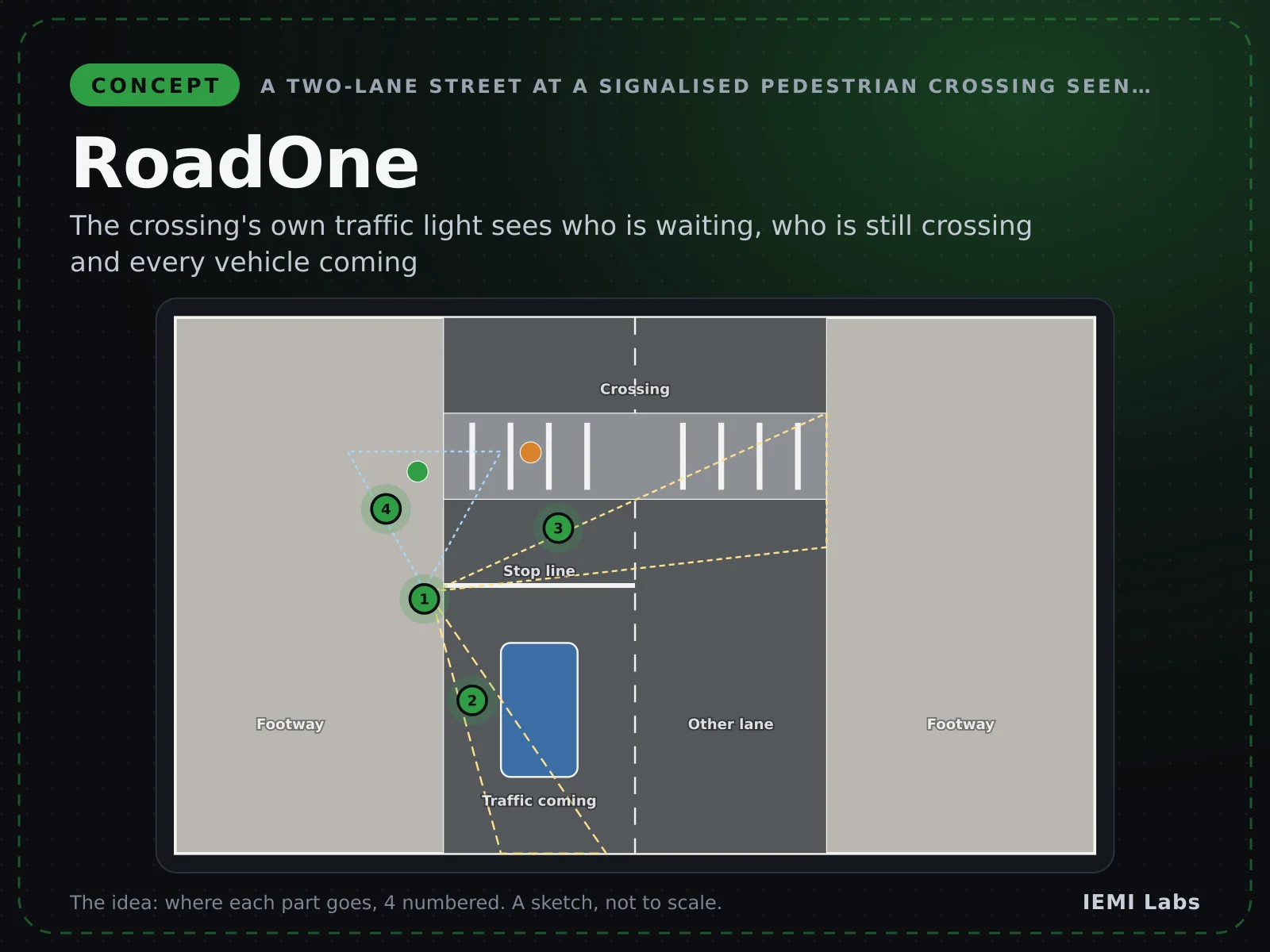
Drag to rotate · right-drag to move · scroll to zoom · click a part for its size and placeSwipe to rotate · pinch to zoom · two fingers to move · tap a part for its size
How it fits together
Scroll or tap a part. Press “See the 3D CAD design” to watch the model, built from our CAD, light each part up and show how it connects.
Real-time 3D render · drag to rotate · final design may varySwipe sideways to rotate
01
The whole RoadOne
The crossing's own near-side signal head runs the crossing's detection: an approach camera behind the door's bottom road-side corner watches the vehicles coming, a crossing camera in the road-side wall sees the stop line and the whole crossing, a kerb radar in the back wall finds people waiting and stepping off, clamps on the head's own lamp feeds tell the brain which phase is showing, and the brain on the head floor turns that into walk demand, crossing extension, vehicle demand, counts, speed, red-light, near-miss, blocked-crossing and fault calls, placed on the controller's own detector inputs and sent to one app over LTE-M.
02Brain
Raspberry Pi 5 (on the signal head floor)
The brain: it runs the roadone-fw program
03
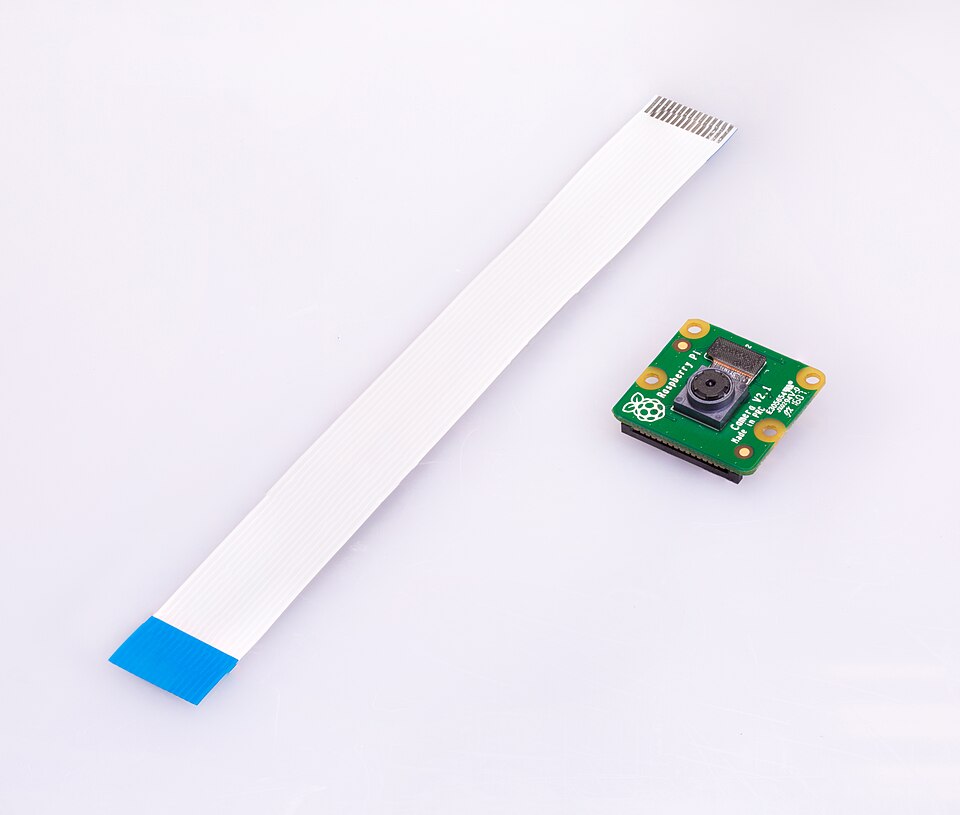
Approach and crossing cameras
The approach camera behind a window in the door's solid bottom road-side corner (below the green module), 25 degrees down the approach, sees every vehicle and cyclist coming (demand, queue, counts, class, speed); the crossing camera in the road-side wall sees the stop line and the whole crossing (red-light running, people still crossing, near misses, a blocked crossing)
Raspberry Pi 5 (on the signal head floor) · CSI-2 ribbons (both on the Pi 5's two camera ports, inside the head) · Frames at 10 fps by day and 5 fps on a quiet night; 10 s clips around calls
04
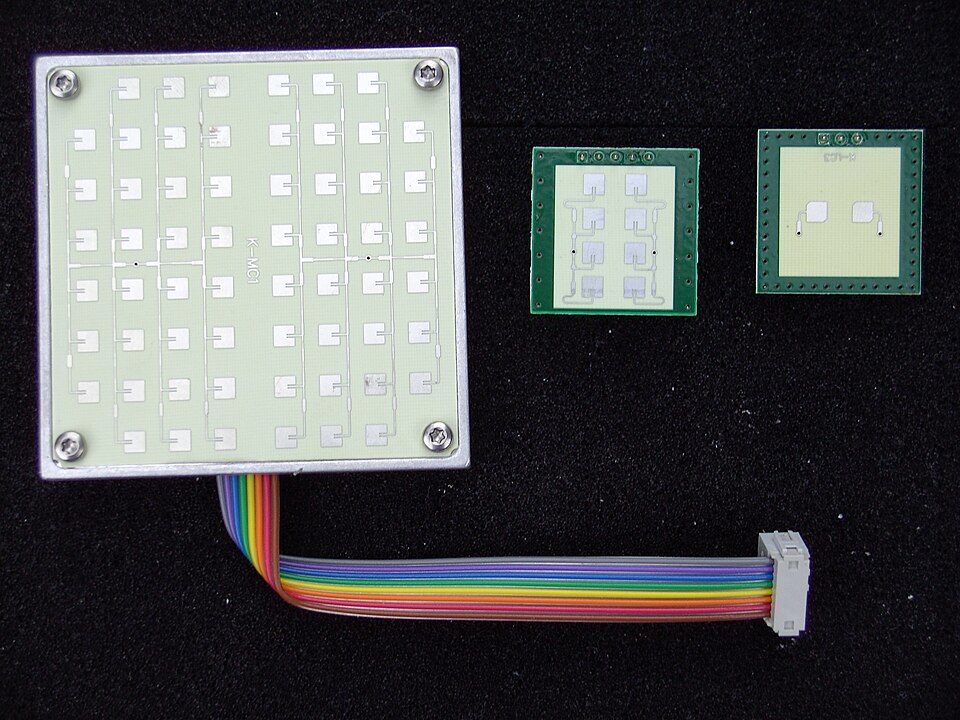
Kerb radar
In the back wall, 30 degrees down towards the crossing: people waiting at the kerb and people stepping on to and still in the near lane of the crossing, in rain, fog and the dark
Raspberry Pi 5 (on the signal head floor) · UART · Up to 3 targets with position at 10 Hz
05
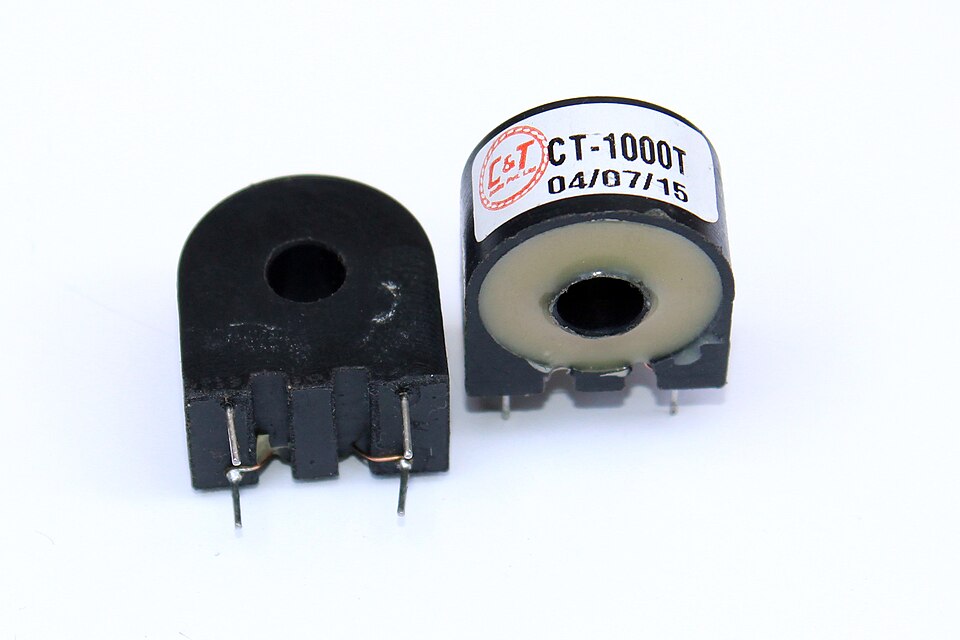
Lamp clamps and head sensor
A clamp on each of the red, amber and green module feeds tells the brain which phase the controller is showing and whether a module is dark; the IMU finds the head hit or turned
Raspberry Pi 5 (on the signal head floor) · Clamps into the ADS1115, then I²C (ADS1115 and LSM6DSOX) · Module currents at 50 Hz, shock and tilt
06
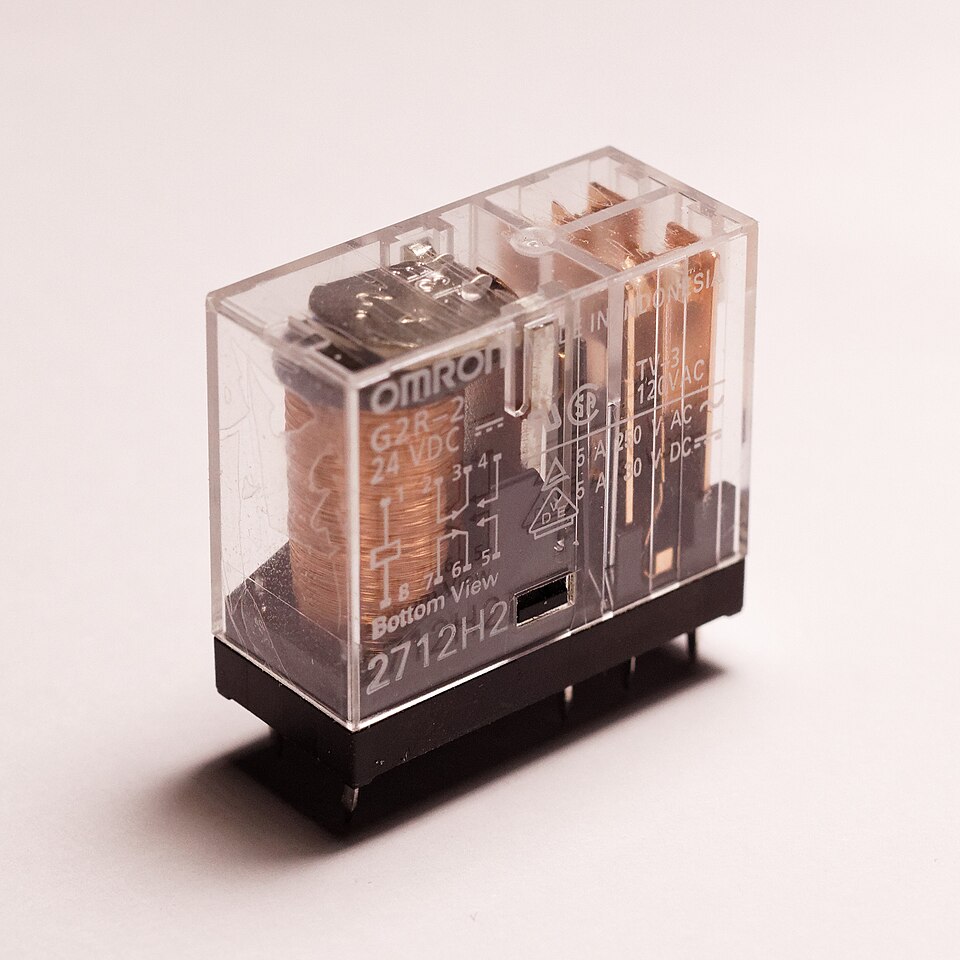
Controller contacts, call lights and tone
Three dry contacts on the controller's own detector inputs (walk demand, crossing extension, vehicle demand); the 'seen you' and red confirmation lights behind slots in the back wall and a tone through the floor
Raspberry Pi 5 (on the signal head floor) · GPIO (relays and piezo) + one data wire (lights) · Demand and extension contacts, light colour, tone
07
Secure element and tamper switch
Every call signed; the tamper switch marks the log when the door opens
Raspberry Pi 5 (on the signal head floor) · I²C + GPIO · Signatures, tamper flag
08
Power, backup and LTE-M
5 V from the head's own feed; a LiPo keeps the Walter board sending the log and a power-cut or knockdown fault when the head is dark
Raspberry Pi 5 (on the signal head floor) · 5 V rail + UART to the brain · Power about 6.5 W by day, 4.5 W at night (est.); calls and the 15-minute counts over LTE-M
09
All connected
7 key parts, one program, and your phone
Our circuit board · rev A-0
Every chip on one board we design, shaped to fit: the processor, cameras and sensors, Wi-Fi and Bluetooth, lights, sound and power. No plugs, ribbons or adapters. It is checked in our CAD against every part around it, and it arrives from the maker ready to run our software from a microSD card. Turn the model, or pick a part below to see where it sits.
Loading the 3D board…
Drag to turn · scroll to zoom · right-drag to move · click a partDrag to turn · tap a part
Every board-level number RoadOne's jobs depend on, checked against its target: camera pixels and frame rate, power and battery life, heat where it works, shock, radio and software. Every lesson from every one of our boards is a rule here, so this review runs again whenever any board teaches us something. Boards are ordered only when nothing fails and the items to prove are measured.
| Area | Check | Our board | Target | Status |
|---|---|---|---|---|
| Camera | Approach camera: a car (1.8 m wide) 60 m out on the approach at 59.35 m | 65.4 px | ≥ 30 px | passes |
| Camera | Approach camera: frame rate the calls need | 10 fps at 3840 × 2160 | chip: 30 fps at 3840 × 2160 | passes |
| Camera | Approach camera: data rate vs its 4-lane link | 0.83 Gbps (10-bit) | ≤ 80 % of 3.564 Gbps | passes |
| Camera | Crossing camera: a person (0.45 m wide) reaching the far kerb at 8.68 m | 111.8 px | ≥ 20 px | passes |
| Camera | Crossing camera: frame rate the calls need | 10 fps at 3840 × 2160 | chip: 30 fps at 3840 × 2160 | passes |
| Camera | Crossing camera: data rate vs its 4-lane link | 0.83 Gbps (10-bit) | ≤ 80 % of 3.564 Gbps | passes |
| Camera | Image processor load, all cameras | 166 Mpx/s | ≤ 480 Mpx/s (RK3576J ISP) | passes |
| Camera | AI engine time per frame | 6 TOPS | a walk-demand or extension call in under 0.5 s; counts on every frame of both views | to prove on the dev kit |
| Power | Supply | Mean Well IRM-20-5 PCB-mount 5 V 20 W supply (class II, listed) on an unswitched 120 V feed (a spare conductor of the head's own signal cable), on the power board | ≤ 70 % of the supply (14 W) | passes |
| Power | Power cut | one soldered 18650 cell (Samsung INR18650-35E) on the power board: in a power cut the crossing is dark, so the RK3576J sleeps and wakes every 60 s to log and send the fault over LTE-M, about 0.4 W, 26 h on the cell (est.) | the fault log and its message for 12 h in a power cut | to prove on the dev kit |
| Heat | RK3576J temperature, a summer afternoon (40 °C air) with sun on the dark polycarbonate head | 78 °C | ≤ 85 °C (rated) | to prove on the dev kit |
| Heat | Camera and radar chips away from the processor | approach camera 216 mm, crossing camera 177 mm, kerb radar 146 mm | ≥ 30 mm | passes |
| Shock | Shock and vibration | 100 g (est.) | standard parts | passes |
| Software | Starts our software from the microSD card, no setup | microSD socket with a hinged, latched lid (Amphenol 101-00660 class), fitted on every board: our software starts from the card | card socket fitted on every board, latched | passes |
| Software | Card power switch and protection | 1 power switch and 1 ESD array for 1 card socket | every socket: switched card supply, ESD on all 6 lines | fixed by the review |
| Software | The card wins the start | eMMC shipped empty; our loader reads the card first | the processor starts from the card every time | fixed by the review |
| Software | Card grade | industrial pSLC microSD (Kingston Industrial or Swissbit S-56u), −40 to 85 °C | rated for the heat, cold and writes | to prove on the dev kit |
| Software | Clip buffer for an unsure call | 39.5 s of 8-bit 5 fps video in 40 % of the 4 GB memory | ≥ 3 s | passes |
| Radio | LTE-M from the signal head | BG95-M3 with a soldered eSIM, its chip antenna in the back strip's top-left corner behind the polycarbonate, 73 mm from the steel pole | certified module; calls, counts and faults reach the traffic centre | to prove on the dev kit |
| Radio | BLE for the contractor's fit-up phone | AP6275S on the back strip, antenna at its left edge, 93 mm from the pole | pairing from the footway, 5 m below (est.) | passes |
| Moisture | Conformal coating | coated | coated, sensors, sockets and antennas masked | passes |
| Fit | Board inside the product CAD, every part checked in 3D | not yet in the product CAD | nothing touches | to prove on the dev kit |
| Camera | Every crossing call in view | Approach camera: worst 18.6° / 23°; Crossing camera: worst 19.5° / 23.4°; Kerb radar: worst 28.6° / 7° | inside each sensor's view | passes |
| Camera | Approach camera looks out of the door corner | window 24 × 24 in the door's solid bottom road-side corner, 22 mm clear of the green module; steepest line of sight 37° (margin 3.4 mm) | every line of sight under 82° from its wall | fixed by the review |
| Camera | Crossing and radar windows | crossing window 56 × 28 (margin 0.2 mm, steepest 70°); radar radome 54 × 24 (margin 6.8 mm) | each view inside its window | fixed by the review |
| Safety | The controller's own lamp drive untouched | three PCB current transformers with the head's own red, amber and green feed wires passing through unbroken; nothing of ours on the lamp feeds | the controller and its conflict monitor see exactly the plain head's load | fixed by the review |
| Safety | Controller contacts | three photo-MOS contacts (5,000 V isolation, est.) and a spring-clamp terminal for the controller's own detector inputs, on spare conductors back to the cabinet | a detector call like any listed detector; the controller keeps its own minimums, maximums and safety timings | to prove on the dev kit |
| Safety | Supply kept on its own board | the unswitched feed into a spring-clamp terminal on the power board, fuse, varistor, IRM-20-5 (class II); only 5 V and the contact drive on lead L1 | class II creepage on the power board; no 120 V on any other board | to prove on the dev kit |
| Fit | Sensor tabs on their brackets | Approach camera: 0.3 mm inside the wall, hinge 14.5 mm; Crossing camera: 0.3 mm inside the wall, hinge 19.5 mm; Kerb radar: 0.3 mm inside the wall, hinge 25.5 mm | chip or holder ≥ 0.3 mm inside the wall, hinge within the 40 mm flex | to prove on the dev kit |
| Fit | Behind the head's own modules | every board behind the 100 mm module zone; the corner board in the door corner 22 mm clear of the green module | the head's own LED modules, visors and door unchanged | passes |
| Fit | Flexes and the lead | F1 274 mm to the corner board, F2 44 mm to the back strip, F3 131 mm to the side strip; L1 about 0.49 m of 20 AWG, 0.032 V drop | routed and held in the rev T CAD; L1 ≤ 0.15 V | to prove on the dev kit |
| Security | Door tamper sensor | DRV5032 Hall switch on the corner board, held by a Ø6 × 3 magnet on a printed boss on the door | door opened = logged and signed | to prove on the dev kit |
Before we order the first boards, we prove these on the RV1126B development kit or in the rev A tests:
Demo · 6 real-world moments
Short animated scenes of real moments: what happens today, what RoadOne does about it, and what lands on your phone. The same scenes play in the IEMI app.
06:50 on a school day. Nobody is on duty at the Main St crossing.
Use cases
A grandparent with a pushchair waits without finding the button, then crosses in a gap; a slow walker is caught in the road when the green man ends.
The kerb radar and crossing camera see someone waiting for 2 s and place a walk demand on the controller, with the 'seen you' light on the back of the head. When the green man ends with them still on the crossing, the head holds the crossing time, up to the controller's own maximum.
Counts come from a three-day tube count every few years, which misses cyclists and people on foot.
The approach and crossing cameras count every road user by class, every 15 minutes, all year: cars, buses and trucks, cyclists and people crossing. Only the counts leave the head.
A resident's speeding complaint gets a one-week radar survey; red-light runs at a quiet crossing are never seen.
The approach camera measures speeds as statistics for the engineer. At the stop line, the crossing camera and the lamp clamps see a car cross 1.4 s into red; the red confirmation light shows on the back of the head and a signed clip goes to the app.
Near misses are never reported; the first record is a collision.
The crossing camera and kerb radar track the turning car and the person. The car passes 0.9 s from them: a near miss, logged with the clip for the weekly near-miss map.
People step out between cars into the traffic lane; nobody at the traffic centre knows it happens every evening.
The crossing camera sees a vehicle stopped on the crossing for 6 s and reports it to the app and the traffic centre feed.
A dark red lamp at night is found when a driver or the police reports it, sometimes after a crash.
The lamp clamps in the head read the red drawing 0 A during red. In under 10 s the head reports the fault over LTE-M to the maintenance contractor, even with the head's own feed off.
Demo scenes show how RoadOne and its app are designed to behave. RoadOne is in design; nothing here is recorded from real equipment yet.
What it is
IEMI's one product for a signalised crossing: the crossing's own traffic light, made smart, with one brain and one app.
What it does
Who it's for
City, county and state road authorities and their signal contractors.
The idea
The problem today
At a signalised crossing the signal head is a plain red, amber and green light. People press a button and wait, a slow walker can be left on the crossing when the green man ends, and councils count traffic a few days a year with tubes or hire a sensor on a lamp column. A video detection camera on its own mast arm, a counter and a separate near-miss study are each bought and fitted on their own.
With RoadOne
Every crossing already has a signal head on its near-side pole at the stop line. RoadOne puts the brain, an approach camera, a crossing camera, a kerb radar, lamp sensors, LTE-M and a backup cell inside that head, so the crossing calls the green man for people waiting, holds it for a slow walker, places vehicle demand, counts every road user all year, and reports red-light running, near misses, a blocked crossing and a dark lamp.
How the parts connect
Every part, what links it to the brain, and how the data reaches your phone. A solid line is a cable; a dashed line is a radio link.
The program
while True:
    phase = lamps.phase()                 # from the three clamps
    people = track(radar.read(), person_model(cam_x.frame()))
    relay_walk.set(people.waiting(2.0))     # demand, like a push button
    relay_ext.set(people.on_crossing())    # controller keeps its own maximum
    cars = track_vehicles(vehicle_model(cam_app.frame()))
    relay_veh.set(cars.in_zone())
    calls = count_rule(cars) + speed_rule(cars)
    calls += redlight_rule(phase, cars) + nearmiss_rule(cars, people)
    calls += blocked_rule(cars) + fault_rule(lamps, imu)
    for c in calls:
        if c.conf < c.line: c.kind = 'check'   # never guess
        atecc.sign(c); lights.show(c); uplink.send(c)
    time.sleep(0.1)
To your phone
Traffic signal engineers, road safety officers, the signal maintenance contractor and the transport planning team; a web page and open data feed for the council (Android, iPhone, web)
One screen for each job RoadOne does.
No one watching the crossing mode06:50 on a school day: nobody is on duty at the Main St crossing. A grandparent with a pushchair waits at the kerb without finding the button; the head places the walk demand, and when the green man ends with them still in the near lane it holds the crossing time up to the controller's maximum.
Counts all yearFunding bid week: the planner pulls a full year of counts by mode for the crossing, before and after the new cycle lane, instead of a three-day tube count.
Speed and red lightA resident complains about speeding before the school. The road safety officer sees the 85th percentile at 34 mph in a 25 zone and four red-light runs a day at school time, with the signed clips for the enforcement team.
Near misses and a blocked crossing17:40 rush hour: a right-turning car cuts 0.9 s in front of a person on the crossing. The clip goes into the weekly near-miss map, long before anyone is hurt.
Signal faults02:10: the red module on the northbound head goes dark. The maintenance contractor has the fault on their phone before the morning peak, with the head's own current reading.
App screens with sample data. The interface is in development.
| Crossing | Main St crossing: 412 walk demands today, 61 with no button press; 23 extensions for slow walkers | Live |
|---|---|---|
| Counts | 07:45-08:00: 214 cars, 9 buses and trucks, 31 cyclists, 118 people crossing | Every 15 min |
| Speed | 85th percentile 34 mph in a 25 zone; 38 % over the limit | Hourly |
| Red light | 08:12: car over the stop line 1.4 s into red, clip signed | Each event |
| Near misses | Right-turning car 0.9 s from a person on the crossing, 17:40, clip | Each event |
| Faults | Red module dark on the northbound head, 02:10 | Each event |
No face recognition and no plate reading. People and plates are blurred on the device; counts leave the head, and only clips around red-light, near-miss and blocked-crossing calls are kept, 30 days, in the authority's own account.
CAD design · Stage 2 ready, 29 Oct 2026: smart near-side signal head that runs the crossing's detection (8 calls, 6 alone, 2 assist); buyer check, prices checked ($749 parts per approach at qty 1), margin 67-76 % (est.); 21 fits and 15 camera and radar views checked in the CAD; not built
| AI processor | Boards of our own inside the signal head, behind its own LED modules: Rockchip RK3576J processor with 4 GB memory on the main board on the head floor. The bench signal head uses a Raspberry Pi 5 until the boards arrive |
|---|---|
| Sensors | Two Sony IMX415 8 MP camera chips: the approach camera looking up the road through the door's bottom road-side corner, the crossing camera in the road-side wall (102° lenses) · TI IWRL6432AOP 60 GHz kerb radar chip behind the back-wall radome (people waiting and still crossing) · Current sensors on the head's own red, amber and green feeds (the wires pass through unbroken) and a motion chip · Three isolated contacts on the controller's own detector inputs, 16 call-light LEDs, a buzzer, a security chip and a door tamper switch |
| Connectivity | LTE-M (Quectel BG95-M3 on our board, soldered eSIM), MQTT over TLS · Dry contacts to the controller detector inputs · BLE for the contractor fit-up phone · CSV, open data API and webhook to the traffic centre |
| Power | An unswitched 120 V feed on a spare conductor of the head's own signal cable into a class II Mean Well IRM-20-5 on its own power board, never the lamp feeds; one soldered 18650 cell with a thermistor keeps the fault log and its message for about 26 h in a power cut (est.); about 6 W by day (est., board design review) |
| Enclosure | The plain signal head's UV-stable polycarbonate body and door with bonded windows |
| Dimensions | 356 x 254 x 1,067 mm head (est. common 12 in 3-section size), bottom 8.7 ft above the footway |
| Weight | About +0.7 kg over a plain head of about 14 kg (est.) |
| Ingress rating | IP65 target |
| Crossing | Walk demand, extension |
|---|---|
| Vehicles | Demand, queue, counts |
| Safety | Speed, red light, near misses |
| Faults | Dark lamp, knock |
| Height | MUTCD 4D.15: 8.7 ft |
|---|---|
| Controller | Detector inputs only |
| Headroom | 80 in over the footway |
| Privacy | No faces, no plates |
| Size | 356 x 254 x 1,067 mm head (est.) |
|---|---|
| Mounting | Near-side pole, bottom 8.7 ft up |
| Power | About 6.5 W by day, 4.5 W at night (est.) |
| Power cut | Fault path about 12 h (est.) |
| Parts cost | $749 per approach at qty 1 |
Targets for production units; they may change during development.
Hardware: $2,990 per approach (replaces its near-side signal head)
Software: $59 per month per approach (app, LTE-M and calls)
Target pricing. Bought separately per approach: a plain 12 in 3-section head (about $320, est.), RoadSense AI ($1,490 + $95/month) and video detection (about $3,750 an approach, est. from a $15,000 four-approach quote): about $5,560 + $95/month (est.).
$2,990 + $59/month
Every crossing job in the approach's own signal head.
Indicative launch pricing in USD, excluding taxes and shipping. Final pricing is confirmed before any balance is charged.
Community
RoadOne is in development. Rate the idea, tell us what to change about the features, specs or price, and we'll build it with your feedback.
How much people want it
–
No ratings yet
Follow RoadOne
Get build updates and first access when pre-orders open.
No comments yet. Tell us what you'd want from RoadOne.
Questions
Tell us what this would save you, or ask anything. We reply within two business days.
A member of the IEMI Labs team will reply within two business days.
From the product lab · ideation phase
Smart equipment · legal on the field
It replaces the approach's plain near-side signal head on the same pole, at the same height, on the same bracket and lamp feeds from the same controller, with the same three LED signal modules driven by the controller's own load switches, with every part built in. Everything inside the plain 356 x 254 x 1,067 mm signal head behind its own LED modules: brain, approach and crossing cameras, kerb radar, lamp clamps, controller relays, call lights, tone, LTE-M, backup cell, secure element and tamper switch. About +0.7 kg over a plain head of about 14 kg (est.); no counter on a lamp column, no detection camera on its own mast arm, no box on the pole.
| Rule | Limit | RoadOne |
|---|---|---|
| Mounting height (MUTCD 4D.15, post-mounted, not over the roadway) | bottom of the housing and bracket 8 to 19 ft (2,438 to 5,791 mm) above the sidewalk | ✓ 2,650 mm (8.7 ft) above the footway, checked in the CAD |
| Signal section size and indications (MUTCD 4D.07 and the ITE VTCSH LED module standard) | 12 in sections; red, yellow and green as the controller drives them | ✓ the head's own three 12 in LED modules stay in front, on the controller's own load switches; RoadOne only measures their current and never drives an aspect |
| Phases stay with the controller (MUTCD Part 4, NEMA TS 2 detector inputs) | a detector may only place a call or an extension on the controller; the controller and its conflict monitor keep every safety time | ✓ three Omron G5V-1 contacts on the controller's own detector inputs (walk demand, crossing extension, vehicle demand), the same as a video detection camera; nothing else is wired to the controller |
| Nothing over the roadway | the near-side head stands over the footway; no part over a traffic lane | ✓ the whole head stays at x -678 to -322 mm (the kerb face is 0), checked in the CAD |
| Headroom over the footway (US Access Board PROWAG protruding objects; ADA 307) | at least 80 in (2,032 mm) clear under objects over a pedestrian route | ✓ 2,650 mm clear, checked in the CAD |
| Same size and installation | 356 x 254 x 1,067 mm 3-section head on the same bracket, pole and feeds | ✓ 356 x 254 x 1,067 mm, checked in the CAD; every electronic part behind the signal modules |
| Red-light and speed enforcement (state law in the US, Home Office type approval in the UK) | tickets only from systems the state or the Home Office approves | ✓ RoadOne never issues a ticket: red-light and speed calls are counts and signed clips for the authority's own engineers and approved systems |
| Electrical (NEC / BS 7671; IEC 60529) | the head's own fused feed; weatherproof head | ✓ a Mean Well IRM-20-5 inside the head on the same feed; gasketed door and bonded windows (IP65 target) |
| Privacy (US state laws, UK GDPR, the ICO video surveillance guidance) | a lawful reason, a notice, no identification of people | ✓ no face recognition and no plate reading; people and plates blurred on the device; counts leave the head, clips only around calls |
| Radio (FCC Part 15 / UKCA, carrier certification) | certified modules | ✓ certified Wi-Fi on the Raspberry Pi 5 and the certified Walter LTE-M module |
City and county traffic departments, state DOTs, UK highway authorities and their signal maintenance contractors, at signalised pedestrian crossings and the crossing arm of signalised junctions. The controller, its timings and its conflict monitor stay the authority's; RoadOne is a detector and a counter that places calls on it, like a video detection camera.
One piece of equipment does
Not done by the equipment, and why
Makes the call itself
Most crossings have no one watching them. The head runs the crossing's detection alone: it places a walk demand for people waiting, extends the crossing time for a slow walker up to the controller's own maximum, places vehicle demand, counts every road user, and reports a blocked crossing, a near miss or a dark lamp. Red-light and speed calls go to the authority's engineer as clips and counts.
| Call | Who decides | How it sees it | How players see the call · if unsure |
|---|---|---|---|
| Walk demand: people waiting at the kerb< 2 s · about 97 % (est.) | The equipment | kerb radar, crossing camera; radar targets standing in the waiting zone for 2 s, with the person detector (no faces) | Walk demand contact to the controller; the 'seen you' light on the back of the head with a short tone. Under 85 % confidence: no call; the push button still works |
| Crossing extension: someone still on the crossing< 0.5 s · about 95 % (est.) | The equipment | kerb radar, crossing camera; people tracked on the crossing studs while the clearance runs | Extension contact to the controller while anyone is on the crossing. Under 80 %: extension held (the safe side) up to the controller's own maximum |
| Vehicle demand, queue, counts and class< 1 s · about 95 % counts in daylight, 90 % at night (est.) | The equipment | approach camera, crossing camera; vehicle, cyclist and pedestrian detector with tracking, no plates (int8 on the Pi 5) | Vehicle demand contact; counts to the app every 15 min. Camera blinded (sun, snow): the contact holds a call (the safe side) and the app marks the counts as 'check' |
| Speed on the approachper vehicle · about ±3 km/h (est.) | Helps the official | approach camera; track speed against the marked lane lines, calibrated at fit-up | App only: 85th percentile speed and the share over the limit. Statistics only; never a ticket |
| Red-light running at the stop line< 1 s · about 95 % (est.) | Helps the official | crossing camera, lamp clamps; vehicle front crossing the stop line while the red module draws current | Red confirmation light on the back of the head; clip to the app. Always a signed clip for the authority's engineer; never a ticket |
| Near miss between a turning vehicle and a person on the crossing< 2 s · about 85 % (est.) | The equipment | crossing camera, kerb radar; post-encroachment time between tracks under 1.5 s | App with the clip; weekly near-miss map. Under 75 %: logged as 'check' with the clip |
| Crossing blocked by a stopped vehicle< 6 s · about 95 % (est.) | The equipment | crossing camera; vehicle stopped on the studs for more than 5 s | App and the traffic centre feed. Under 80 %: 'check' |
| Signal fault: lamp out, head dark, hit or turned< 10 s · about 99 % for a dark module (est.) | The equipment | lamp clamps, LSM6DSOX, approach camera; module current against the phase, shock and tilt, the view against its fit-up frame | Fault to the maintenance contractor over LTE-M, even with the head's feed off. Unclear: 'check' to the maintenance contractor |
Nothing added to the field
The only things in play are the items the laws already put there:
The pole, the controller cabinet, the push buttons, the road markings and the far-side heads stay as they are; no counter on a lamp column, no detection camera on its own arm, no box on the pole
Built to take the hits
Secure by design
Detection cameras need a camera or radar per approach on its own arm, plus a cabinet card and licences: a Washington State contract lists Miovision detection licences at $3,000-6,500 per intersection and $195-750 a year per service. They place vehicle calls; RoadOne also places the walk demand, holds the crossing for slow walkers, counts everyone and finds a dark lamp, from inside the signal head you already replace every few years.
$2,990 per approach plus $59 a month for the app, LTE-M data and the signed log (target). A plain 3-section LED head is about $285-320 in public bids; a plain head, RoadSense AI and a video detection camera bought separately come to about $5,560 + $95 a month per approach (est.).
Yes. It is the same 12 in 3-section head on the same bracket and lamp feeds, and it connects to the controller's own detector inputs with three dry contacts, like a video detection card (NEMA TS 2, 2070 and UK controllers). The controller and its conflict monitor keep every phase and safety time.
RoadSense AI (street counts) and a separate video detection camera for the approach, plus the plain signal head. AirfieldWatch AI (runway wildlife), FlowCount AI (airport queues) and SmokeSentinel AI (wildfire smoke) stay listed: they work in zones with no signal head.
No. Speeds and red-light runs are statistics and signed clips for the road safety team; enforcement stays with approved systems.
No. Accessible push buttons and audible signals stay. RoadOne adds a walk demand for people waiting, so nobody is missed.
No. People and plates are blurred on the device; counts leave the head, and clips are kept only around red-light, near-miss and blocked-crossing calls, for 30 days.
A small white ceiling sensor with two lenses that counts people without sending images.
From $899 per sensor
Details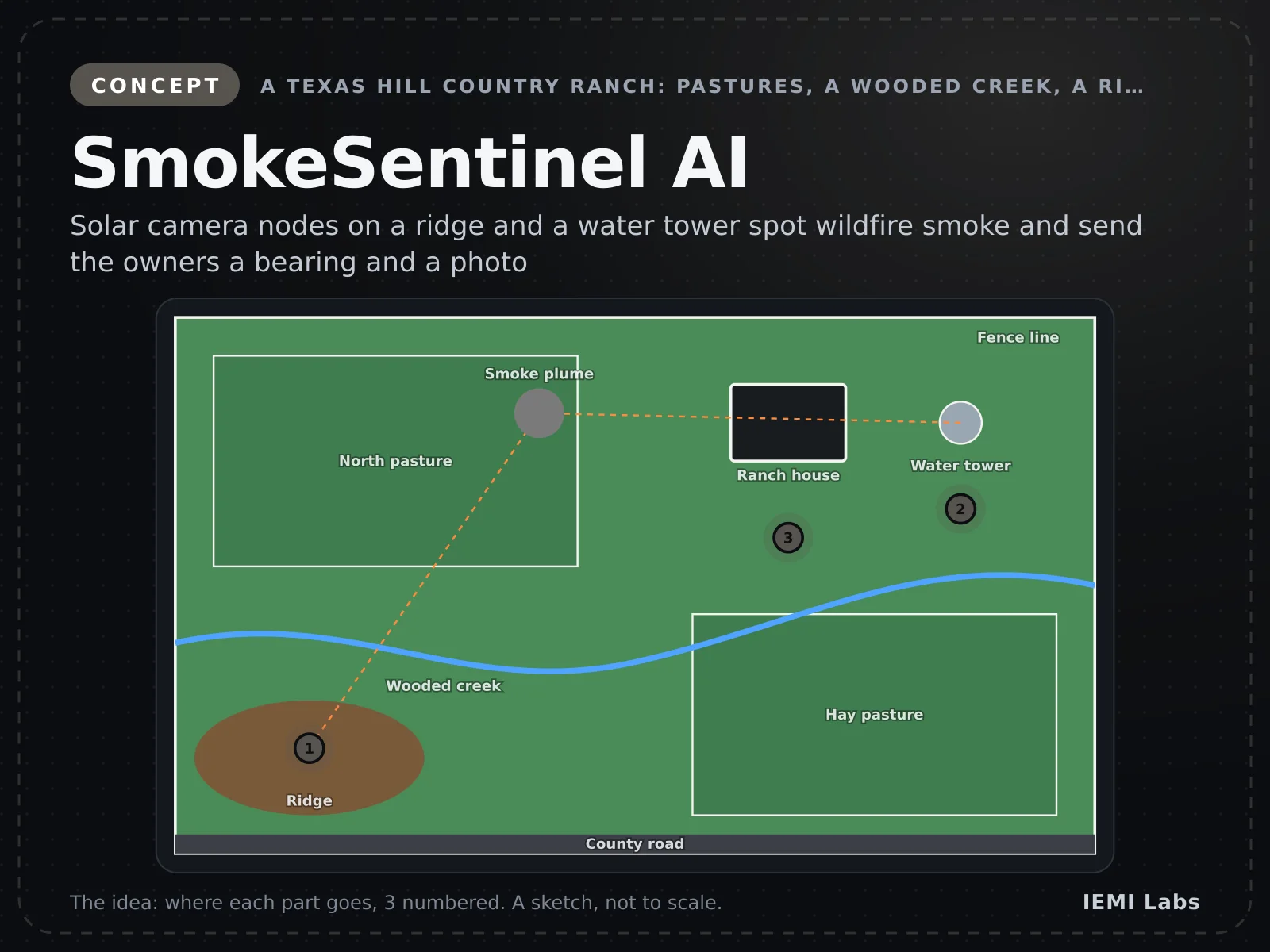
A solar-powered four-camera head on a mast that watches the horizon for wildfire smoke.
From $4,900 per node incl. solar kit
Details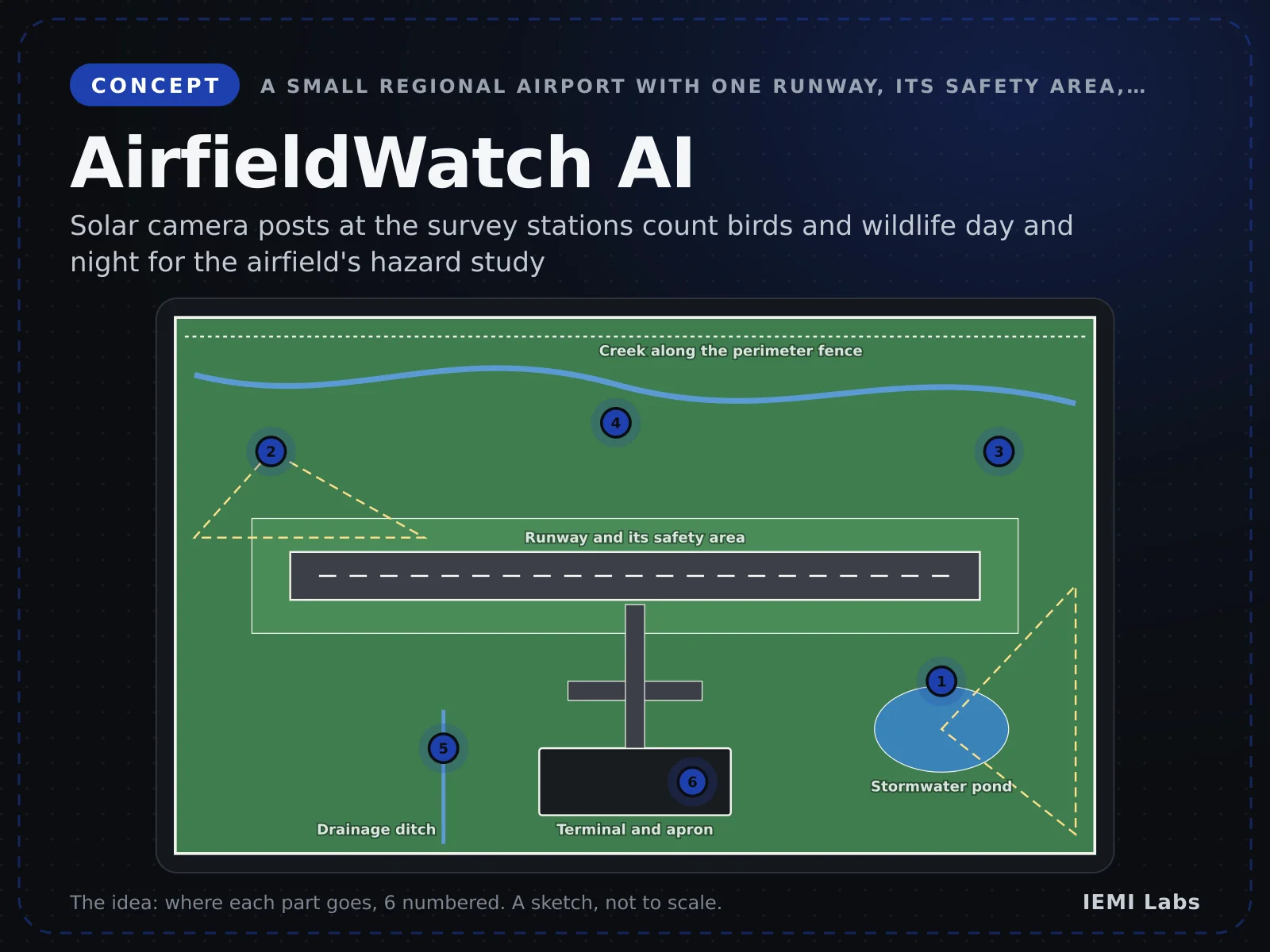
A thermal and visible camera turret on a mast that spots birds and wildlife near runways.
From $8,900 per turret
DetailsRoadOne
Concept · target $2,990