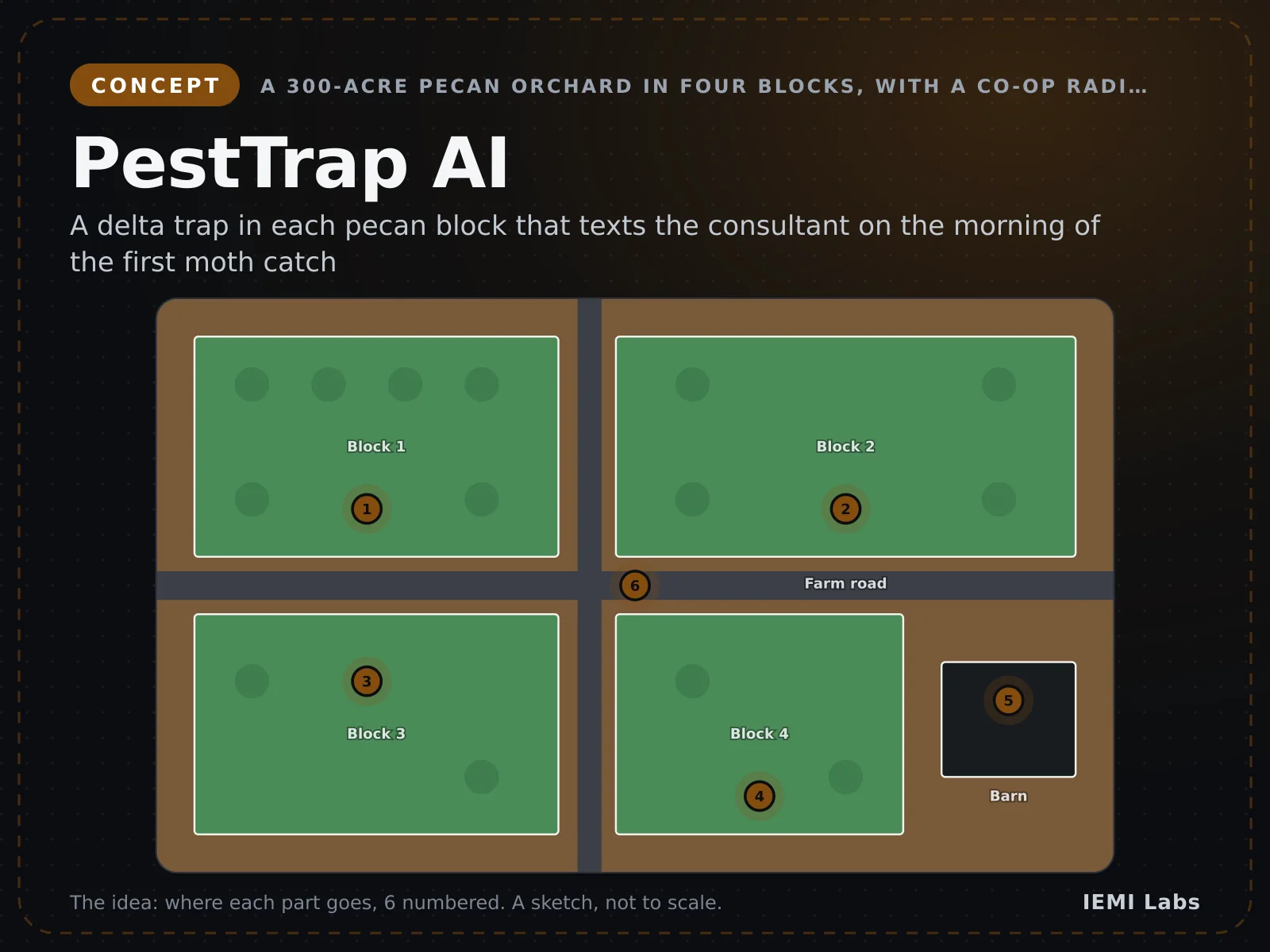
SensingConcept
PestTrap AI
A solar-powered triangular sticky trap on a stake with a camera that counts insects.
- Photographs the sticky card daily
- Identifies and counts target pests
- Sends WhatsApp or SMS alerts
From $299 per trap
DetailsThe pheromone trap you already hang, made to count its own moths
Software: $29 per trap per season
Concept, not for sale yet. Tell us if you want it; that decides what we build.
Rate this idea and tell us what to change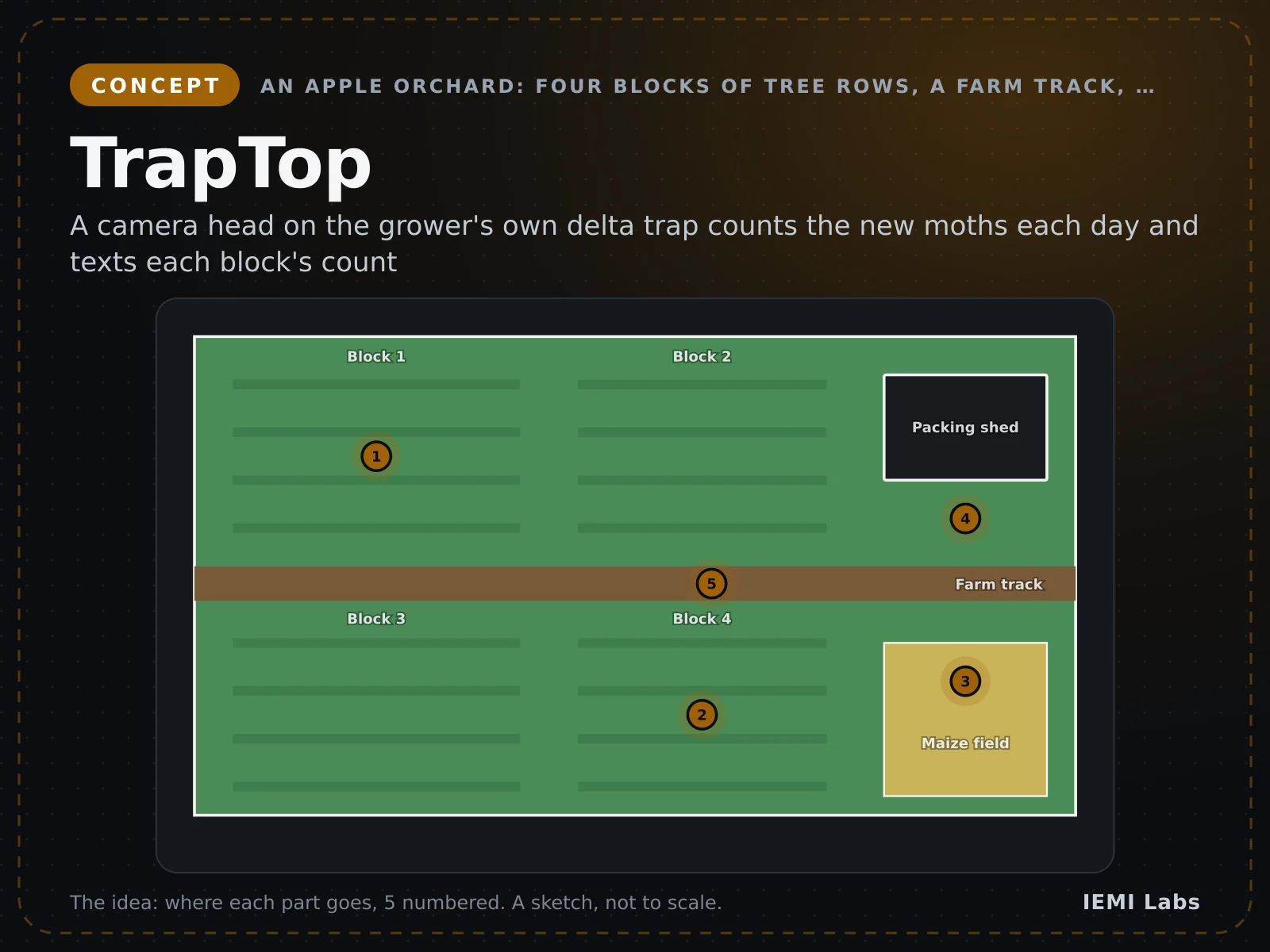
Drag to rotate · right-drag to move · scroll to zoom · click a part for its size and placeSwipe to rotate · pinch to zoom · two fingers to move · tap a part for its size
How it fits together
Scroll or tap a part. Press “See the 3D CAD design” to watch the model, built from our CAD, light each part up and show how it connects.
Real-time 3D render · drag to rotate · final design may varySwipe sideways to rotate
01
The whole TrapTop
A camera head on a moth trap photographs the sticky liner twice a day, counts new moths and sends the count by LoRaWAN.
02Brain
XIAO ESP32S3 Sense
The brain: it runs the traptop head firmware program
03
OV5640 wide camera
Photographs the whole liner at 5 MP from above
XIAO ESP32S3 Sense · Camera flex cable · 2592×1944 photos
04
Two warm-white LEDs
Light the liner from the side, so it does not glare
XIAO ESP32S3 Sense · GPIO pin · LED on for 0.3 s
05
SHT40 climate sensor
Reads temperature at the trap for degree-day counts
XIAO ESP32S3 Sense · I²C (4 wires) · Temperature and humidity
06
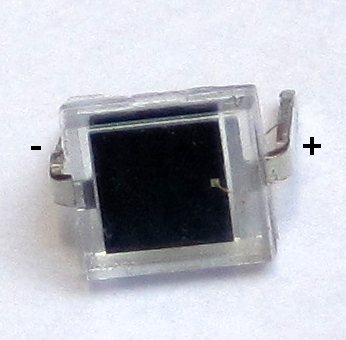
Bucket-trap beam gate
Counts moths falling past two infrared beam planes
RAK3172 · 6-core cable · Beam breaks, in or out
07
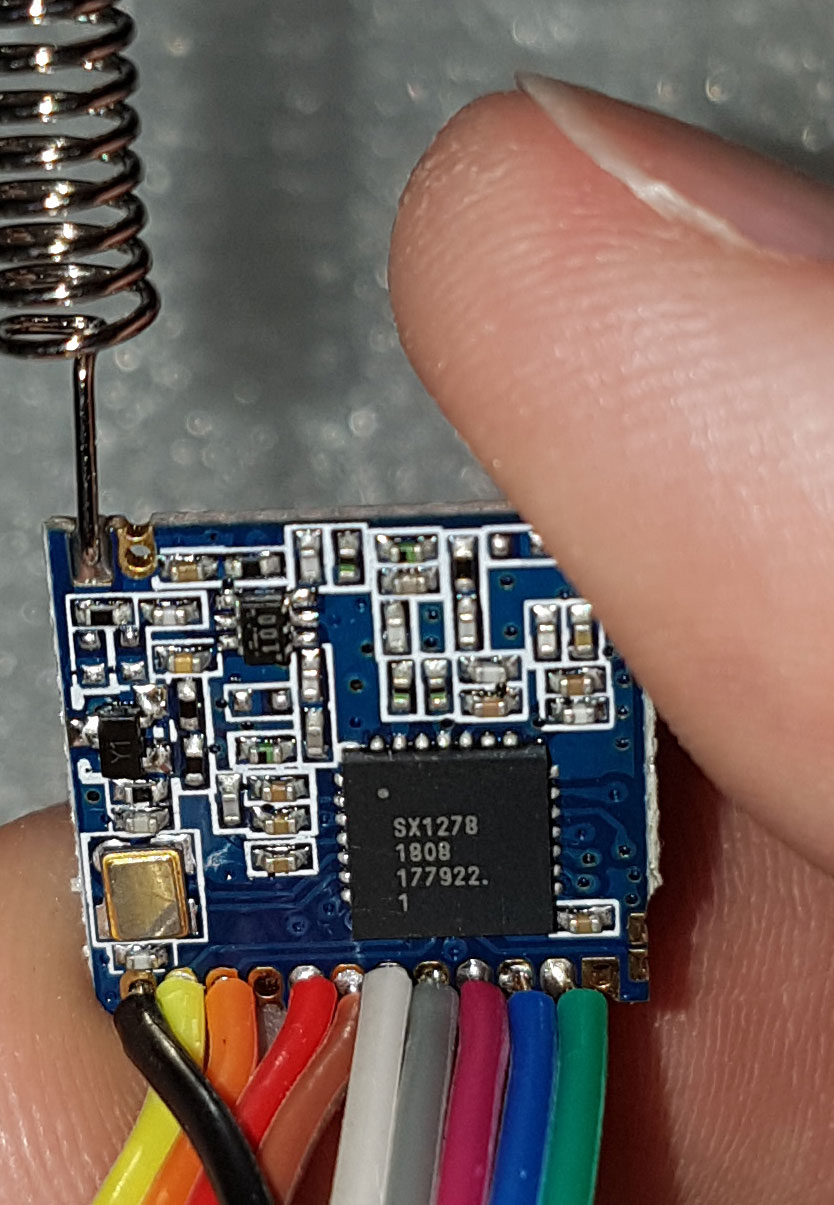
RAK3272S LoRa radio
Wakes the camera on schedule and sends counts by LoRaWAN
XIAO ESP32S3 Sense · UART + wake switch · Counts and thumbnails
08
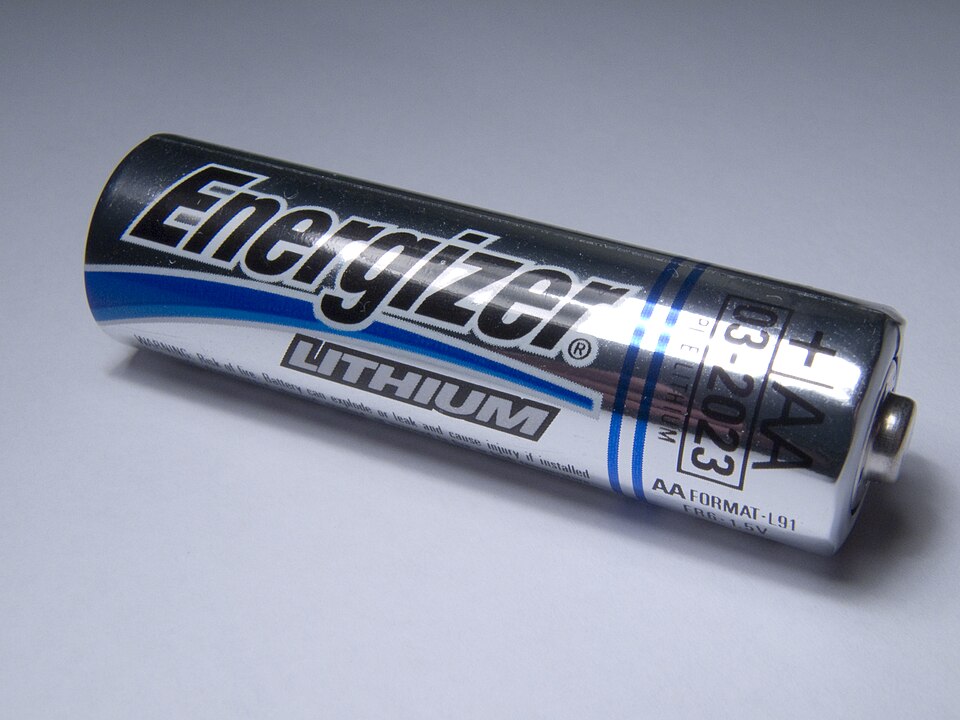
Two AA lithium cells
Run the head for a season on under 1 mAh a day
XIAO ESP32S3 Sense · Power lead via TPS63802 · 3.3 V power
09
All connected
7 key parts, one program, and your phone
What it is
A battery camera head that clips on top of a pheromone delta trap.
What it does
Who it's for
Apple and pear growers, field scouts, and fall armyworm monitoring teams.
The idea
The problem today
Scouts drive and walk a trap line every week to count codling moths on sticky liners, so a flight over the spray threshold can be seen up to seven days late. Camera traps sell as their own trap at about $2,400 each, too much for one trap per hectare.
With TrapTop
TrapTop clips on the ridge of the delta trap the grower already hangs, photographs the liner up to six times a day and counts only the moths that are new. The count and a photo reach the grower and the scout each morning, and the trap line becomes a lure-and-liner visit every four to six weeks.
How the parts connect
Every part, what links it to the brain, and how the data reaches your phone. A solid line is a cable; a dashed line is a radio link.
The program
void loop() {
  digitalWrite(LED_PIN, HIGH); delay(300);
  camera_fb_t *fb = esp_camera_fb_get();     // 2592 x 1944 JPEG in PSRAM
  digitalWrite(LED_PIN, LOW);
  Image now = decode(fb);
  register_to(now, lastPhoto);               // liner corners + printed grid
  for (Blob &b : moth_sized_changes(now, lastPhoto)) {
    Label l = classify(crop(now, b));        // int8 model
    if (l != NOT_A_MOTH) report.add(l, b.conf);
  }
  report.temp_c = sht40.readTemperature();
  radio.send(report.pack11());               // port 10, 11 bytes
  goToSleep();                               // radio chip wakes us later
}
To your phone
Scout's phone and text messages
One screen for each job TrapTop does.
Moth countEach morning the head photographs the sticky liner in trap 12 and counts only the moths that are new since the last photo.
Degree-daysAfter the first catch, the app counts degree-days for the block from the trap's own climate sensor, to time the spray window.
Liner changeThe liner in trap 12 is filling with insects and dust. The scout gets it on the morning route list before it stops catching.
Armyworm gateIn a maize field, the beam ring in the bucket trap counts every fall armyworm moth that drops in overnight.
App screens with sample data. The interface is in development.
| New moths | 2 new, 91% codling | Each photo |
|---|---|---|
| Weekly count | 6, over threshold 5 | Weekly |
| Degree-days | 250 DD since biofix | Daily |
| Liner cover | 15%: change liner | Each photo |
| Battery | 92% | Each uplink |
Photos stay on the head and the scout's phone unless shared. LoRaWAN keys are per device.
CAD design · Design complete (stages 1–6, rev A), not built, not validated
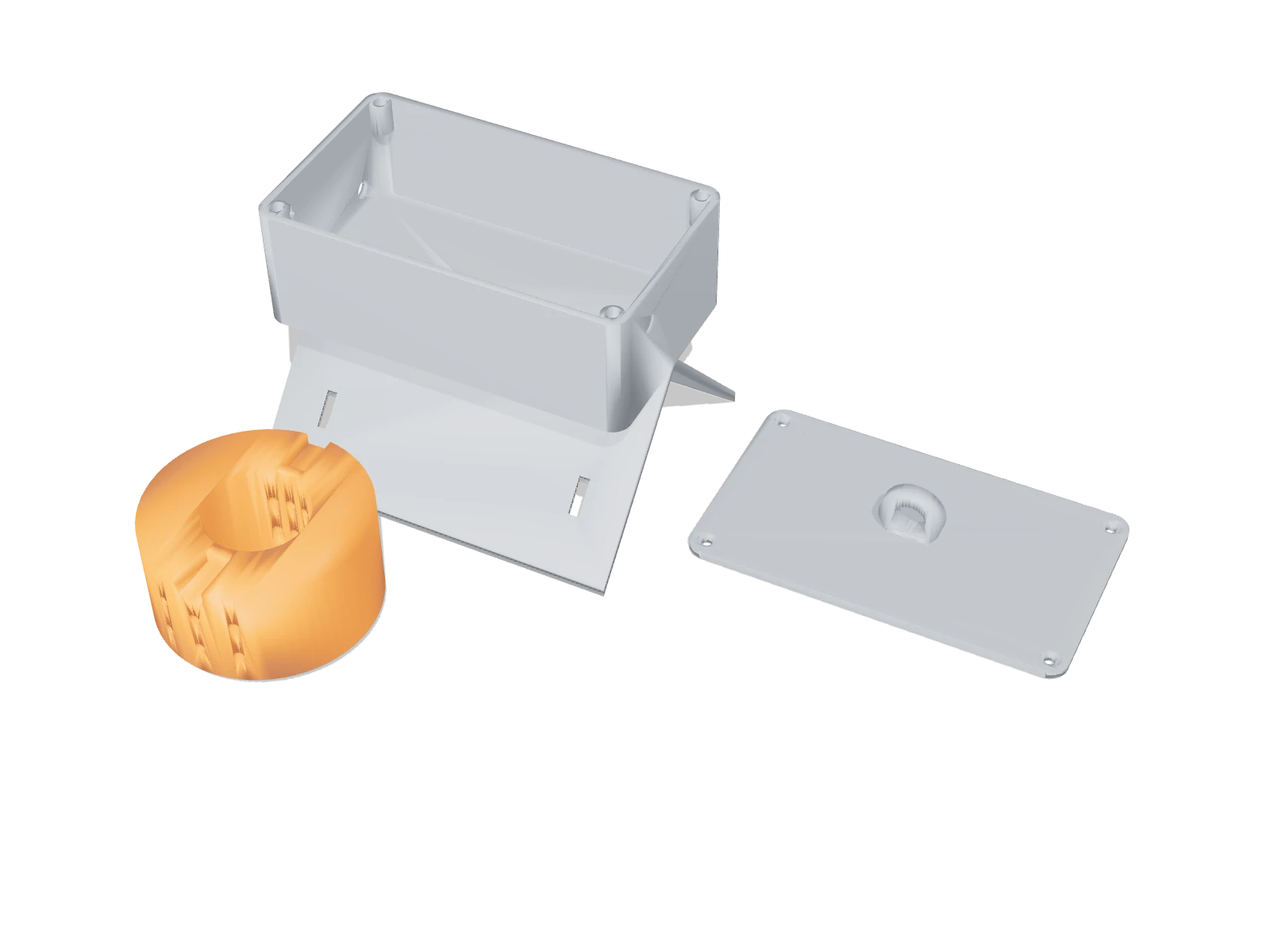
| AI processor | Seeed XIAO ESP32S3 Sense (8 MB PSRAM) + RAKwireless RAK3172 (STM32WLE5) LoRaWAN |
|---|---|
| Camera | OV5640 5 MP with 120° lens, 97 mm above the liner, 2 off-axis warm-white LEDs |
| Sensors | Sensirion SHT40 temperature and humidity, shaded by the trap roof · Gate add-on: 6 × Vishay VSLY3850 IR LEDs and 6 × TEFD4300 photodiodes in 2 planes |
| Connectivity | LoRaWAN (US915 / EU868 / IN865) to a shared co-op or consultant gateway · Wi-Fi access point for photo sync to the scout's phone at the trap |
| Power | Head: 2 × Energizer L91 lithium AA, under 1 mAh a day; Gate: 4 × D alkaline, about 260 nights (est.) |
| Enclosure | 3D-printed white ASA head with V-skirt and camera snout, lid with hang eye; yellow ASA beam ring for the bucket trap |
| Dimensions | Fits white delta traps of about 27 × 20 × 11 cm (Pherocon VI size) and Unitrap bucket traps |
| Photos | Up to 6 a day |
|---|---|
| Resolution at liner corners | About 15 px along a codling moth |
| Detection | ≥95% of new codling moths (test target) |
| False moths | ≤1 per trap per week (test target) |
| Beams | 12 in 2 planes |
|---|---|
| Sample rate | 500 Hz |
| Count error | ≤12% after filtering (test target) |
| Uplink | 11-byte LoRaWAN count |
|---|---|
| Head battery | 2 × lithium AA, a full season |
| Gate battery | 4 × D, about 260 nights (est.) |
Targets for production units; they may change during development.
Hardware: $129–$178 per trap
Software: $29 per trap per season
Target pricing: $129 per head, $49 Gate add-on. Estimated BOM about $59 per head and $27 per Gate at qty 1 (about $30 per head at qty 1,000). The grower's own trap, lures, liners and a shared LoRaWAN gateway are not included.
Indicative launch pricing in USD, excluding taxes and shipping. Final pricing is confirmed before any balance is charged.
Community
TrapTop is in development. Rate the idea, tell us what to change about the features, specs or price, and we'll build it with your feedback.
How much people want it
–
No ratings yet
Follow TrapTop
Get build updates and first access when pre-orders open.
No comments yet. Tell us what you'd want from TrapTop.
Questions
Tell us what this would save you, or ask anything. We reply within two business days.
A member of the IEMI Labs team will reply within two business days.
From the product lab · ideation phase
No. TrapTop is a concept in the in-house design and testing stage. The CAD design is complete, but it has not been built or tested in an orchard yet, and all specifications are targets.
It should not, because you keep your own trap, lure and liner, but cutting the ridge slot is a change. We plan a paired-trap test of cut traps with heads against plain traps before release.
No. TrapTop counts moths and shows the thresholds you set. Spray decisions stay with you and your consultant.
No. Beam counters cannot tell species apart, so bycatch moths in a bucket trap will be counted. A photo or a hand check is still needed to keep the count honest.
A LoRaWAN gateway within a few kilometres, usually shared by a co-op or consultant. Photos can also be synced to the scout's phone over Wi-Fi at the trap.
A solar-powered triangular sticky trap on a stake with a camera that counts insects.
From $299 per trap
Details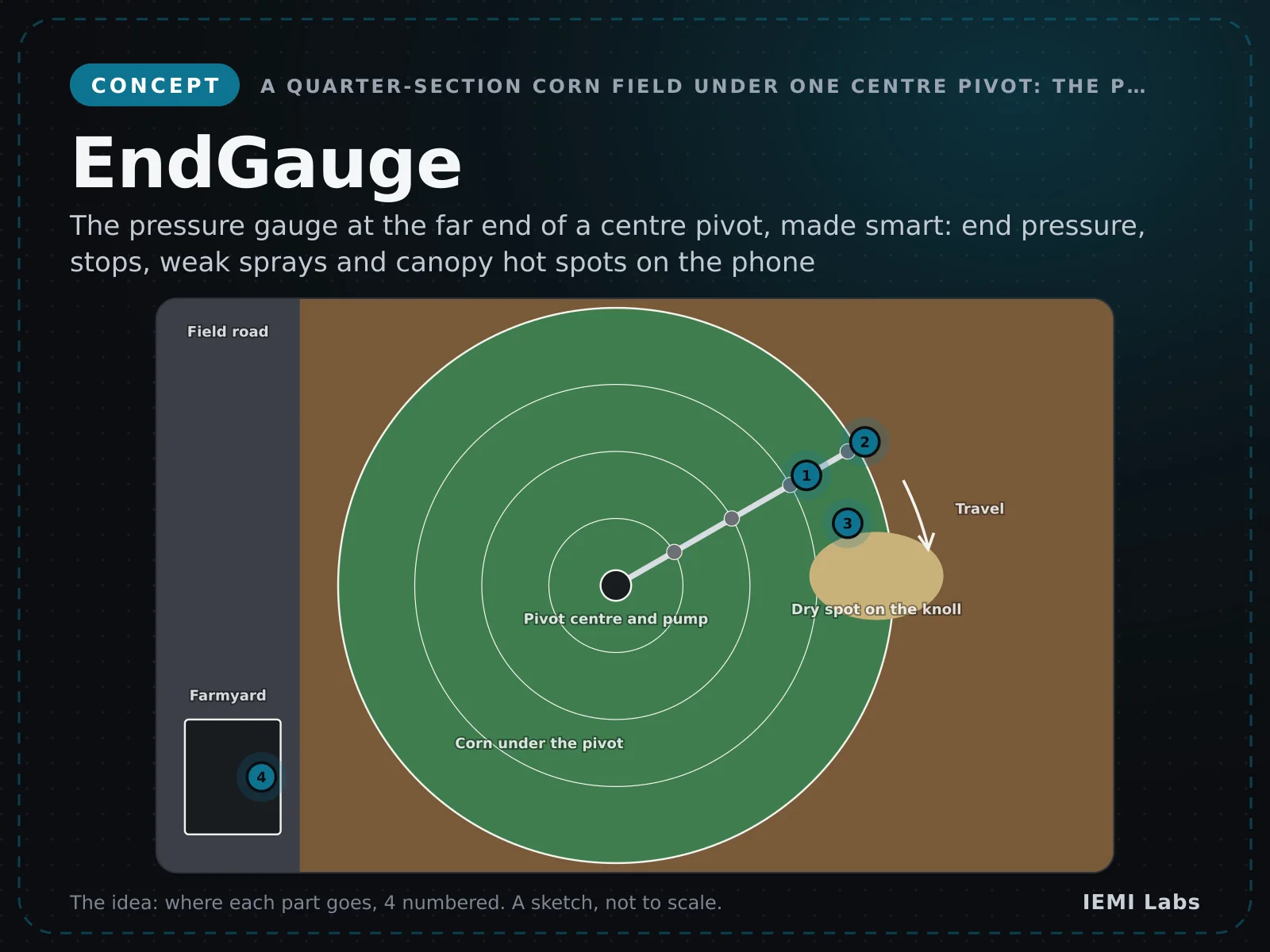
A solar box and pressure sensor that clamp on a centre pivot's last span.
From $499 per pivot
Details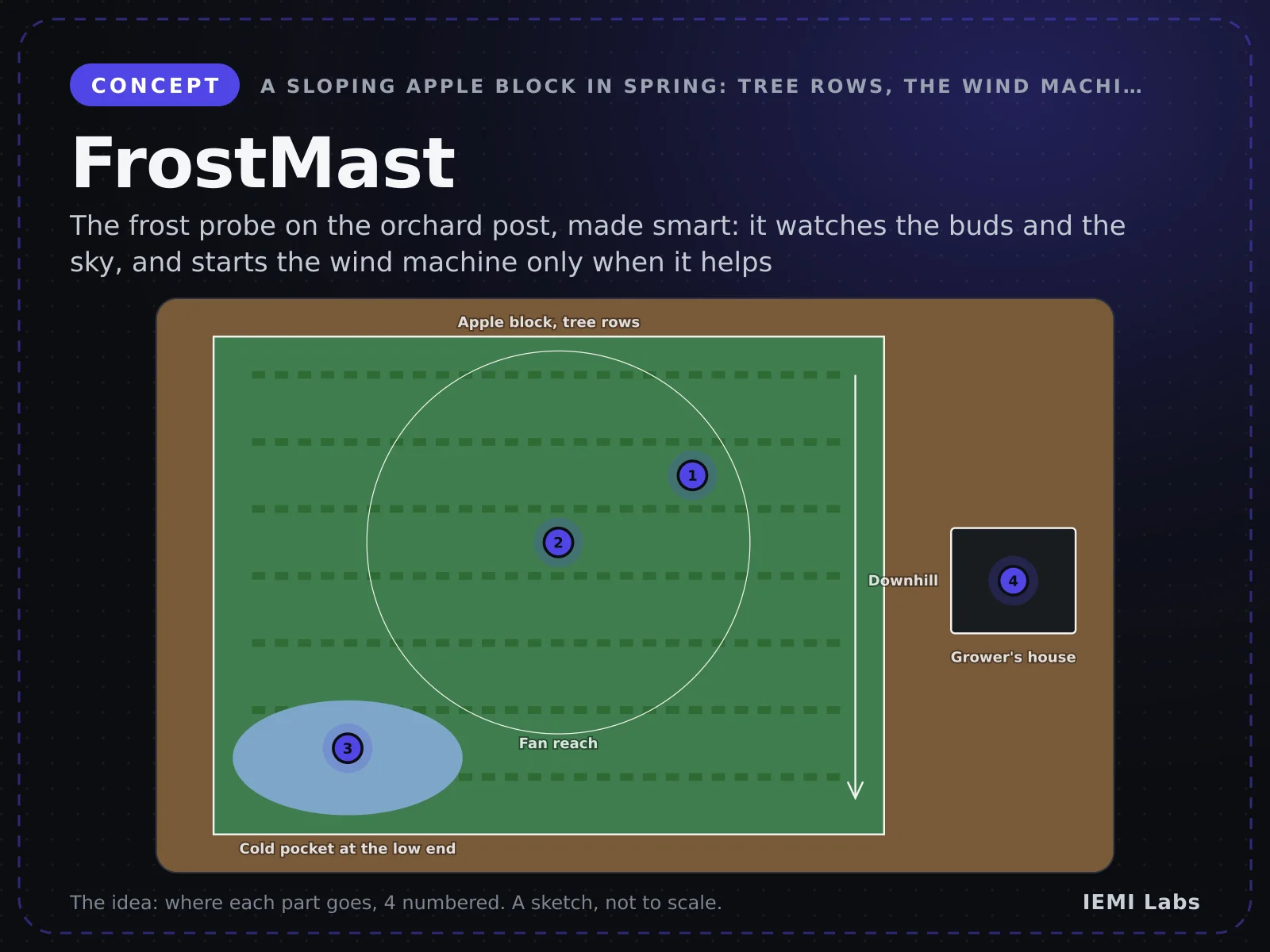
A battery sensor head for an orchard frost post, with a house bell and fan link.
From $249 per head / per Wind Machine Kit
DetailsTrapTop
Concept · target $129