Skip to content
IEMI Labs

AthleticsOne

IEMI's one product for school and club athletics: smart finish posts that are their own finish judge, calling every place and time from one start, and run the heat band and lightning clock all season, in one app

Concept · not for sale
Our one product for School athleticsEngineering design: AthleticsOne
Target price from$2,090$2,090 for the pair of smart finish posts with the starter unit

Software: $299 per pair per year (LTE data, app, alerts and logs)

Concept, not for sale yet. Tell us if you want it; that decides what we build.

Rate this idea and tell us what to change
AthleticsOne concept: the idea and where each part goes

Drag to rotate · right-drag to move · scroll to zoom · click a part for its size and placeSwipe to rotate · pinch to zoom · two fingers to move · tap a part for its size

How it fits together

AthleticsOne, part by part

Scroll or tap a part. Press “See the 3D CAD design” to watch the model, built from our CAD, light each part up and show how it connects.

AthleticsOne concept: the idea and where each part goes

Real-time 3D render · drag to rotate · final design may varySwipe sideways to rotate

  1. 01

    The whole AthleticsOne

    Two smart finish posts are their own finish judge. Rev T: one board of our own runs up each post, with no plugs.

  2. 02Brain

    Our finish-post board: the always-on ESP32-S3 in the home post

    The brain: it runs the athleticsone-posts program

  3. 03

    Camera head and processor

    OV9281 camera chip behind the window; RV1126B makes the finish calls

    RV1126B on the same board · the board's own camera flex · Crossings, lanes, laps, strip

  4. 04

    Heat, lightning and gun

    Air chip, lightning chip and gun mic on the home board

    Our finish-post board: the always-on ESP32-S3 in the home post · I²C, SPI and PDM · Air °C, strikes, gun time

  5. 05

    Call lamp and tone

    Eight lamp LEDs and a sounder inside the post

    Our finish-post board: the always-on ESP32-S3 in the home post · LED data line, PWM pin · Call colours and tones

  6. 06

    Security chip and tamper

    Signs every result; tamper switch marks the log

    Our finish-post board: the always-on ESP32-S3 in the home post · I²C and one input pin · Signatures, tamper events

  7. 07

    LTE-M, Wi-Fi, tap reader

    LTE-M modem, Wi-Fi and NFC reader behind the radio window

    Our finish-post board: the always-on ESP32-S3 in the home post · UART, SDIO, I²C on board · Results out, taps in

  8. 08

    Starter unit board

    Its own small board: ESP32-S3, mic and flash diode; sends one start

    Our finish-post board: the always-on ESP32-S3 in the home post · ESP-NOW radio · Start time, race, hold

  9. 09

    Cells and battery system

    Four 18650 cells; charger, protection and gauge on the board

    Our finish-post board: the always-on ESP32-S3 in the home post · cell strips soldered on · Power, charge state

  10. 10

    All connected

    8 key parts, one program, and your phone

Our circuit board · rev A-0

One board of our own inside AthleticsOne

Every chip on one board we design, shaped to fit: the processor, cameras and sensors, Wi-Fi and Bluetooth, lights, sound and power. No plugs, ribbons or adapters. It is checked in our CAD against every part around it, and it arrives from the maker ready to run our software from a microSD card. Turn the model, or pick a part below to see where it sits.

Loading the 3D board…

Drag to turn · scroll to zoom · right-drag to move · click a partDrag to turn · tap a part

Checked before we order

Every board-level number AthleticsOne's jobs depend on, checked against its target: camera pixels and frame rate, power and battery life, heat where it works, shock, radio and software. Every lesson from every one of our boards is a rule here, so this review runs again whenever any board teaches us something. Boards are ordered only when nothing fails and the items to prove are measured.

No check fails18 pass · 5 fixed by the review · 5 to prove before we order · 0 failDesign review of 4 November 2026
AreaCheckOur boardTargetStatus
CameraFinish camera: a runner's torso (0.3 m) in the far lane at 11 m30.3 px≥ 10 pxpasses
CameraFinish camera: smear at 43 km/h, 0.5 ms exposure6 mm≤ 1/3 of the torso (100 mm)passes
CameraFinish camera: frame rate the calls need100 fps at 1280 × 800chip: 120 fps at 1280 × 800, 180 fps at 640 × 400passes
CameraFinish camera: data rate vs its 2-lane link1.02 Gbps (10-bit)≤ 80 % of 1.6 Gbpspasses
CameraImage processor load, all cameras102 Mpx/s≤ 360 Mpx/s (RV1126B ISP)passes
CameraCameras in step for timed callscamera frame-sync input on an RV1126B timer pin; the start time from the starter unit over the S1 linktimes to 0.01 spasses
CameraAI engine time per frame3 TOPStorso finder inside the 8.3 ms frame at 120 fpsto prove on the dev kit
BatteryRun time, 4 cells, worst case (aged to 80 %, 5 °C)16.4 h≥ 10 hpasses
BatteryRun time, 4 cells, new, 20 °C23.3 h≥ 10 hpasses
BatterySpare run time, worst case64 % over 10 h≥ 20 % (the draw is an estimate until rev A)passes
BatteryCharge time10.3 h from flat at 1.5 A; 9 h overnight puts back 100 % of a daya full day back overnight (9 h)passes
BatteryPeak current from the cells1.51 A at 2.65 V≤ 32 A (4 × 8 A)passes
BatteryEach pack has its own protector2 protectors (U31, BT3) for 2 chargersshort, over-current and over-discharge cut-off on every packpasses
BatteryCharging held outside the cells' temperature rangethermistor on the pack, read by the charger0–45 °Cpasses
HeatRV1126B temperature, full sun, 35 °C air65 °C≤ 85 °C (rated)passes
HeatCell temperature, full sun, 35 °C air50 °C≤ 60 °Cpasses
ShockClocks rated for the shockMEMS oscillatorsevery clock rated for 1000 gfixed by the review
ShockBall-grid chipsunderfill under U1, U2, U10, U5no cracked joints after the drop and hit teststo prove on the dev kit
SoftwareStarts our software from the microSD card, no setupmicroSD socket with a hinged, latched lid (Amphenol 101-00660 class), fitted on every board: our software starts from the cardcard socket fitted on every board, latchedfixed by the review
SoftwareCard power switch and protection1 power switch and 1 ESD array for 1 card socketevery socket: switched card supply, ESD on all 6 linesfixed by the review
SoftwareThe card wins the starteMMC shipped empty; our loader reads the card firstthe processor starts from the card every timefixed by the review
SoftwareCard gradeindustrial pSLC microSD (Kingston Industrial or Swissbit S-56u), −40 to 85 °Crated for the heat, cold and writesto prove on the dev kit
SoftwareClip buffer for an unsure call3.3 s of 8-bit 120 fps video in 40 % of the 1 GB memory≥ 3 spasses
RadioWi-Fi/BT module clock37.4 MHz MEMS oscillator (U11)37.4 MHz next to the AP6256, MEMS (shock)fixed by the review
RadioWi-Fi between the two postsabout 11 m across the trackcertified Wi-Fi 5 module, chip antenna behind the radio windowto prove on the dev kit
MoistureConformal coatingcoatedcoated, sensors, sockets and antennas maskedpasses
FitBoard inside the product CAD, every part checked in 3Dno part touches a wall or a bought part (2026-11-03)nothing touchespasses
CameraThe two posts agree on timeclock shared over the post-to-post link≤ 1 msto prove on the dev kit

Before we order the first boards, we prove these on the RV1126B development kit or in the rev A tests:

  1. AI engine time per frame
  2. Ball-grid chips
  3. Card grade
  4. Wi-Fi between the two posts
  5. The two posts agree on time

Demo · 6 real-world moments

See AthleticsOne work

Short animated scenes of real moments: what happens today, what AthleticsOne does about it, and what lands on your phone. The same scenes play in the IEMI app.

DEMO · 1 of 6
0s

Tuesday PE lesson: no starter, no timekeepers. The teacher picks 100 m, lanes 1 to 6 in the app and blows a whistle at the start line.

Use cases

Today, without AthleticsOne

Six classmates with stopwatches get six different times, and the places are argued at the line.

What AthleticsOne does

The home post hears the whistle, takes off the 0.29 s the sound took to travel 100 m at 21 °C, and the finish cameras call every place and time. The winner's lane lights green on both posts with a two-note tone.

How the app helps

  • Places and times for all six: 1st lane 3 13.41, 2nd lane 5 13.66
  • Start source shown: sound at the post, corrected
  • Signed result for the class record
No-official race modeStart heard at the postFinish camerasLights on the postsSigned resultsOpen this scene in the app →
Every feature in these scenes (14)
  • No-official race mode
  • Start heard at the post
  • Finish cameras
  • Lights on the posts
  • Signed results
  • Dead-heat check
  • Starter unit
  • Lightning clock
  • Start hold
  • Heat band
  • Acclimatization days
  • Wristband tap
  • Coach alerts
  • Lane-line evidence

Demo scenes show how AthleticsOne and its app are designed to behave. AthleticsOne is in design; nothing here is recorded from real equipment yet.

What it is

IEMI's one product for school and club athletics: the pair of finish posts, made smart, with one brain and one app.

What it does

  • Gives places, times and lanes from one start
  • Checks heat every minute and alerts coaches
  • Runs the lightning clock and holds race starts
  • Logs acclimatization days by tap

Who it's for

School athletic directors, PE departments and athletics clubs that run practices and an athletics day.

The idea

The two finish posts are their own finish judge: every place and time from one start, called on the posts and signed, plus the heat band and the lightning clock all season

The problem today

At a school sports day several volunteers per place start their watches late and argue over who was third, and many meets cannot find enough officials (a high school meet can need 30 to 50). On PE days and at training there are no officials at all. Every practice the coach must also check the heat number and clear the track for 30 minutes after each nearby strike. Schools pay one vendor for weather and another for timing, and still stand plain finish posts on the line.

With AthleticsOne

The school swaps its plain finish posts for AthleticsOne posts of the same 80 x 20 size. A camera in each post looks along the finish line and the posts call places, dead heats, times, finishers and the bell lap themselves, light the winner's lane on both posts with a tone, and sign each result. They start from the starter unit or simply hear the gun. Unsure finishes go to the coach with the strip. The home post also runs the heat band, the lightning clock and acclimatization taps. Nothing else stands on the track.

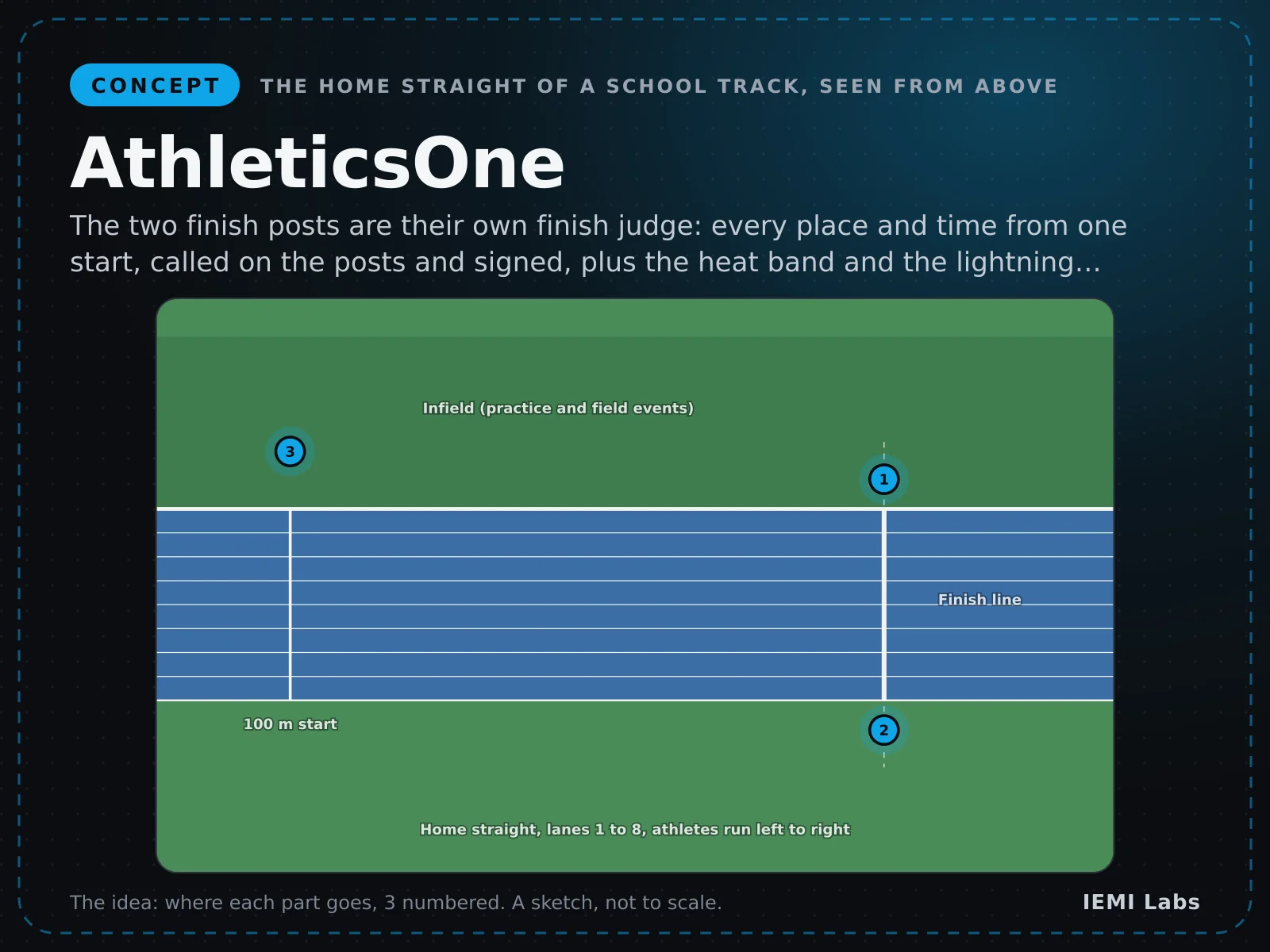
100 m startFinish lineInfield (practice and field events)Home straight, lanes 1 to 8, athletes run left to right123
  1. 1Home finish post (the brain)Walter brain, finish camera along the line, gun mic, call lamp and tone, secure element, lightning and heat sensors and tap reader: calls places, times and the bell lap, signs them, runs the heat band and the lightning clock.
  2. 2Away finish postSecond finish camera looking back along the line from outside lane 8, so a runner hidden on one side is seen from the other; call lamp, tone and secure element for the far side.
  3. 3Starter unit (docks on the home post)Optional: taken to the start line, sees the gun flash for the most exact start and holds while the lightning clock runs. No call needs it: without it the home post hears the gun.
The home straight of a school track, seen from above, drawn to show where each part goes (not to scale).

How the parts connect

AthleticsOne, wired up

Every part, what links it to the brain, and how the data reaches your phone. A solid line is a cable; a dashed line is a radio link.

Camera head and processorCrossings, lanes, laps, stripthe board's own camera…own board: RV1126B on the same boardHeat, lightning and gunAir °C, strikes, gun timeI²C, SPI and PDMCall lamp and toneCall colours and tonesLED data line, PWM pinSecurity chip and tamperSignatures, tamper eventsI²C and one input pinLTE-M, Wi-Fi, tap readerResults out, taps inUART, SDIO, I²C on boardStarter unit boardStart time, race, holdESP-NOW radioCells and battery systemPower, charge statecell strips soldered onTHE BRAINOur finish-post board: th…runs athleticsone-postsC (ESP-IDF) on the ESP32-S3; C…Home postvia ESP-NOW radioCloudvia LTE-M · MQTT/TLSCoach, AD and referee phonevia Web app, push and SMS
Drawn from the AthleticsOne parts list. The 3D view above is built separately, from the CAD.

The program

What controls AthleticsOne

Runs on
Our finish-post board: the ESP32-S3 runs the always-on jobs; it wakes the RV1126B on the same board while a race is armed
Written in
C (ESP-IDF) on the ESP32-S3; C and Python on the RV1126B (V4L2 camera, RKNN runtime)
System
FreeRTOS on the ESP32-S3; Linux from the RV1126B SDK, started from our microSD card, signed and checked
AI model
The RV1126B finds the torso crossing in a 120 fps global-shutter strip of the line, on its AI engine
  1. 1Every 60 s read the air chip and black top; pick the heat band
  2. 2On a strike within 16 km restart the 30-minute clock; hold starts
  3. 3On a start or the gun heard, wake the RV1126B and arm the camera
  4. 4Merge both posts' crossings into places, times, lanes and laps; below the line, unsure
  5. 5Sign each result in the security chip, light and sound the call, send it over LTE-M
athleticsone-posts.pymain loop
for (;;) {
    if (minute_tick()) { s = read_heat(); band = band_for(wbgt_est(&s), ruleset); }  // SHT45 + MAX31865 chips on the board
    if (as3935_irq() && strike_km() <= 16) { clock_restart(30 * 60); espnow_send(STARTER, HOLD); }
    evt_t e;
    if (espnow_pop(&e) && e.kind == START) { rv1126b_wake(); race_arm(e.t); }  // starter unit
    else if (race_waiting() && gun_heard(&e)) race_arm(e.t - dist_m() / c_air(s.t)); // home post mic
    cross_t c;
    while (rv_uart_pop(&c) || espnow_cross_pop(&c)) race_cross(&c);            // RV1126B + away post
    if (race_done()) {
        result_t r = race_result();                    // places, times, lanes, laps
        if (r.conf < CONF_MIN) r.call = UNSURE;        // never guess: strip to the coach
        atecc_sign(&r); log_append(&r);                // signed, append-only
        call_show(&r);                                 // lamps + tone on both posts
        walter_mqtt_publish("a1/dev/result", pack(&r));
    }
    if (bell_lap_due()) call_bell();
    if (tamper_open()) log_tamper();
    if ((tag = pn532_poll())) roll_tap(tag);
    vTaskDelay(pdMS_TO_TICKS(10));
}

To your phone

How the data reaches AthleticsOne app

Coach, athletic trainer, athletic director and meet referee phone or laptop browser

  1. Starter unit and away post
  2. Home post
  3. Cloud
  4. Coach, AD and referee phone

What you see in the app

One screen for each job AthleticsOne does.

  • No officialA Tuesday PE lesson: no starter, no timekeepers. The teacher picks "100 m, lanes 1 to 6" in the app and blows a whistle at the start line.

  • Finish callsSports day, girls' 100 m heat 3. Three runners dip together; lanes 2 and 6 cross 0.004 s apart.

  • StartThe starter fires the gun at the 100 m start; the starter unit sees the flash. Without it, the home post hears the gun itself.

  • Heat and lightningA storm builds to the west during a meet. The home post hears a strike 9 km away and starts the clock.

  • AcclimatizationFirst week of pre-season. New athletes tap their wristbands on the home post before practice.

App screens with sample data. The interface is in development.

What the app gets

Data AthleticsOne sends to the app
Signed result1st L4 12.84 · dead heat L2/L6 12.97 · signed home + awayEach race
Places and times1st L4 12.84 · 2nd L2 12.97 · 3rd L6 13.05Each race
StartBy flash, 0.3 ms after the gunEach race
Heat bandWBGT 87 °F (est.), band OrangeEvery minute in practice
Lightning clockStrike 9 km, 28:15 leftDuring a stop
Acclimatization dayBand 17, day 3Each tap
Sprint split#14 30 m 4.21 sEach run

Wristband, bib and lane numbers only on the posts; names live in the coach roster. Finish strips are deleted after 30 days.

CAD design · Design rev O, 28 Oct 2026: smart finish posts that are their own finish judge (6 calls, 5 alone in school and club play, lanes assist), call lamp and tone, ATECC608 and tamper switch in each post, gun mic in the home post; 26 camera views checked in the CAD; stage 2 ready 28 Oct 2026 (prices checked, $648 parts a pair, home post race power corrected to 2.8 W); not built

Designed in code, checked in 3D

  • 3 printed parts, each a single closed solid
  • Every bought part fitted inside and checked for collisions
  • Assembled exactly as shown in the 3D CAD view (the button on the picture at the top)

Key specs

AthleticsOne hardware
AI processorOne board of our own up each finish post: Rockchip RV1126B (3 TOPS AI engine) for the finish camera, with an always-on ESP32-S3 for the start, the lamp and the radios; a small ESP32-S3 board in the starter unit. The bench posts use a Walter and a Pi Zero 2 W until the boards arrive
SensorsOmniVision OV9281 global-shutter finish camera chip, 1280 × 800 at 120 fps, behind the camera window · Home post: ScioSense AS3935 lightning chip, NXP PN532 NFC tap reader, digital gun mic, PT1000 black-top and SHT45 heat chips · Starter unit: digital mic for the gun and a photodiode for the flash · Eight call-lamp LEDs, a sounder, an ST LSM6DSOX motion sensor, a Microchip ATECC608B security chip and a tamper switch in each post
ConnectivityLTE-M (Walter), MQTT over TLS · ESP-NOW between the posts and the starter unit · No cable across the track
Power4 × Samsung INR18650-35E cells (about 50 Wh) in each post base: 16.4 h worst case (cells aged and cold) for a 10-hour meet, 23 h new; one night on the charger puts back a full day (board design review, est.)
Enclosure6063 aluminium 80 x 20 mm posts, white powder coat, black top on the home post, flush polycarbonate windows; welded steel bases; printed ASA starter unit
DimensionsEach post 80 x 20 x 1,400 mm on a 400 x 250 x 40 mm base; starter unit 88 x 58 x 20 mm
WeightAbout 6.6 kg per post with base and electronics (est.)
Ingress ratingIP65 design target (not tested)
All target specifications

Jobs

Jobs target specifications
Finish judgePlaces, dead heats, times, finishers, bell lap; signed; unsure means unsure
FinishPlaces, times and lanes from both posts, 100 frames a second
StartStarter unit hears the gun or sees the flash
HeatBand every minute, coach texts, lamp colour, practice log
Lightning30-minute clock, restarted by each strike within 16 km; start hold
AcclimatizationWristband taps on the home post

Legal on the track

Legal on the track target specifications
Profile80 x 20 mm, same as plain winning posts
PlaceExtension of the finish line, 1 m outside the track
LineNothing on or over the 50 mm finish line
TimingNot a certified FAT system; times labelled by start source, ties under 0.01 s left to the referee (NFHS 3-9-6)

Run time (est.)

Run time (est.) target specifications
Between chargesAbout 9 days of heat and lightning watch
RacesAbout 15 h of armed race time per charge (home post)
Starter unitAbout 5 h armed

Targets for production units; they may change during development.

Pricing

Hardware: $2,090 $2,090 for the pair of smart finish posts with the starter unit

Software: $299 per pair per year (LTE data, app, alerts and logs)

Target pricing. Bought separately, a FieldFlag station ($699), StrikeClock ($199), RollCall ($149), sideline display ($449), GroundCheck kit ($349), GalaTime ($599), MeetTime Kit ($499) and a SplitPole Squad Kit ($649) add up to $3,592 + $299/yr, plus about $795 for plain finish posts. Parts cost about $648 a pair at qty 1 (shop prices checked 28 Oct 2026); cost about $980 a pair at qty 1 and $670 at qty 100, margin about 53-68 % (est.).

Smart finish posts

$2,090 + $299/yr

Every track job in the two finish posts.

  • Finish judge: places, times, bell lap, signed
  • Finish places, times and lanes
  • Starter unit
  • Heat band and coach texts
  • Lightning clock and start hold
  • Acclimatization taps

Indicative launch pricing in USD, excluding taxes and shipping. Final pricing is confirmed before any balance is charged.

Community

What do you think of AthleticsOne?

AthleticsOne is in development. Rate the idea, tell us what to change about the features, specs or price, and we'll build it with your feedback.

How much people want it

–

No ratings yet

  1. 50
  2. 40
  3. 30
  4. 20
  5. 10

Follow AthleticsOne

Get build updates and first access when pre-orders open.

Leave feedback

Your rating of the idea

Feedback on a product concept in development, not a review of a shipped product. Posts may be moderated; links and contact details are held for review. See our community guidelines and privacy policy.

Comments

    No comments yet. Tell us what you'd want from AthleticsOne.

    Questions

    Ask about AthleticsOne

    Tell us what this would save you, or ask anything. We reply within two business days.

    We use your details only to respond to this request. See our privacy policy.

    From the product lab · ideation phase

    Lab updates for AthleticsOne

    All lab updates
    1. LatestA buyer reading the AthleticsOne page should see the finish posts as they will be sold: one board of our own up each post. Until now the 3D view, the parts list and the wiring still lit the bench parts (a Pi Zero, a camera module, a Walter board and eight breakout boards), so the page showed a prototype, not the product.
      • What we designed: AthleticsOne rev T, the finish posts with our board inside, done the way CricketOne rev T put its board in the stump. The bench electronics come out of both posts and the starter unit; the folded board goes in: base section and battery system in the steel base, riser flex up into the post, the RV1126B brain on the track-face wall, the radio section with the always-on ESP32-S3 behind the radio window, the OV9281 camera head behind the camera window, the heat chips under the black top and the gun-mic tab on the start-side wall (home post only). The away post carries the same board without its 14 home-only parts. The starter unit gets its own small board on its floor. The Wiring and Program sections now name our board: the ESP32-S3 runs the always-on jobs and wakes the RV1126B on the same board for each race. See /products/athleticsone/ and /build/athleticsone-boards
      • How we checked it: every board part was checked against every wall and every bought part that stays (four 18650 cells, the starter cell). Two real fixes came out: the home base top needed a sealed hole for the two dock pins that charge the starter unit, and the starter shell floor a hole for its spring pins; the starter cell moves up onto a foam pad over its board. After that nothing touches, the assembly check finds no problems, and every wiring part lights its chip in the 3D view. All seven boards were re-run in the same pass: 0 placement problems, every design review 0 fail, KiCad design-rule checks 0, packs rebuilt. No new CricketOne board decisions since the last update, so no new shared rules this time
      • What we learned: a board drawn for a viewer and a board placed in CAD turn the same angles in a different order; the CAD script now applies the viewer's order, so a part shown lying flat is checked lying flat. Sloped flex runs are listed in 2 mm slices so the fit check follows the slope
      • What is next: the same step for RacketOne, CellOne, RoomOne and DampOne: board in the product CAD and the Wiring and Program sections on our own board

      See it in 3DFull research and design

    2. A school or club buys the finish posts as one pair to stand out at every meet and every training session, so each post must be one board an assembly house makes and tests the same way, with nothing plugged together inside a 16 mm deep post that is carried, knocked and left in the sun.
      • What we designed: one rigid-flex board up each finish post. A flat base section in the steel base holds the charger, protection, gauge, the screw-locked charge socket, the tamper switch and the dock pins. A spine runs up the post: the RV1126B brain pressed on the aluminium track face for cooling, a radio section behind the radio window (the always-on ESP32-S3, and on the home post the LTE-M modem, lightning chip and an NFC loop drawn in the board copper), the call lamp and tone on the track face, the global-shutter camera chip on a head tilted 10 degrees down at its window, and the air and black-top heat chips under the cap. The starter unit gets a small board of its own. It replaces the Walter, the Pi Zero, the camera ribbon, the PowerBoost and six breakout boards. See /build/athleticsone-boards
      • How we checked it: the board is written as code and opened in KiCad (0 design-rule violations). It places 71 parts at their datasheet sizes and checks that each fits its section and the 16 mm post depth, nothing overlaps, the camera, lamp, tone, vent, gun mic and dock parts sit on their places in the post design, every antenna faces the radio window, the processor sits on solid wall, and every flex is long enough. All checks pass. A 3D model shows the board folded in a see-through post or laid flat
      • What we learned: the narrow post decides the board. Every section stands on edge, so each side has only 2 to 13 mm of room, and the processor must give its heat to the track face, the only solid metal close enough. The NFC loop needs a thin ferrite sheet behind it, or the aluminium wall 6 mm away detunes it
      • What is next: the M8 charge socket and dock pins from one maker's drawings, the NFC and radio range through the window on a test post, and the next product's board, RacketOne

      See it in 3DFull research and design

    3. High school meets treat a clock started by the sound of the gun as hand timing, not fully automatic timing, and add 0.24 s to compare it (IHSA bulletin; WIAA, quoting the NFHS rules book). NFHS Rule 3-9-6 lets a meet break ties at 0.001 s. The 2026 World Athletics and 2027 NFHS rule changes do not touch the finish or the start (World Athletics, NFHS).
      • Market and rules check (DESIGN.md): the World Athletics 2026 rules and amendments, World Masters Athletics 2026, the four NFHS 2027 changes and the high school timing rules, each with what it changes in AthleticsOne
      • Times: every time now shows how the race was started (starter unit seeing the flash, or the gun heard at the post) and is never labelled fully automatic; the app can add the state's hand-time conversion in a separate column (equipment.json)
      • Ties: the posts read to 0.01 s, so a tie closer than that stays a dead heat for the referee or a certified system (NFHS 3-9-6); two new rule lines in equipment.json
      • Competitors: new phone photo-finish apps (SprintLens, June 2026; Photo Finish: Automatic Timing, free with a Pro plan) are good for training but sign nothing and do no heat or lightning jobs; FinishLynx Scholastic is still about $5,375 to $5,699 for championship meets. Price kept at $2,090 a pair + $299/yr
      • Product page https://iemilabs.com/products/athleticsone/ gains a high school seeding FAQ and the timing line in its specs
      • Next: ask state associations in phase 3 whether a wired start cable from an electronic starting gun would let the times count for seeding; close-out C9 (recommend the first product to the owner) from 30 Oct 00:00

      See it in 3DFull research and design

    4. Before customer reviews, every design in the line must pass our own checks: no missing or wrong parts, no part drawn floating in the 3D model, and every part size on a flagship taken from its datasheet. This is close-out task C4 in our phase 1 plan.
      • New section "Quality pass" in products/LINE-REVIEW.md: design checks, 3D assembly checks and the site build run across all 127 designs and 1,071 parts
      • Result: 0 errors and 0 warnings; all 24 flagships pass the 3D assembly check with no floating parts
      • Fixed six floating parts on older designs: the referee band in FieldSide now rests on the forearm, HeatFlag now shows the clamp sets and rubber pad that hold its sensor arm and battery box to the mast, and the LineCell and QualityCheck AI ring lights now show the two standoffs they hang on
      • The SchoolMeet backup stopwatch and the VapeSense AI smoke-test hood are hand-held, so they are now marked that way with the reason instead of being drawn as if fixed
      • Our checks are now stricter: from today a flagship part size without a datasheet fails the check instead of only warning
      • Next: close-out C5, buyer review preparation for the sports products: who to ask, three open questions each and a five-question survey

      See it in 3DFull research and design

    5. A school track needs places and times called fairly at PE lessons, practice and school meets when officials are short: it already buys finish posts (from $795.50, UCS), entry photo-finish now costs $5,699 (FinishLynx price sheet, Dec 2025), and Ohio's 2026 state tournament grew to five divisions that each need a full crew of officials (MileSplit Ohio).
      • Buyer check with sources: what schools pay for plain finish posts, timing systems, officials and weather services today, and the three closest products (phone photo-finish apps, FinishLynx Scholastic, Perry Weather)
      • New competitor learned: a phone photo-finish app (SprintTimer) times a race for about $5, which shows schools will time with what they have; our posts stand on the line already, see both sides, call places with no person on the line, sign results and also run the heat band and lightning clock
      • Market price updated: the entry FinishLynx package is now $5,699 on the maker's December 2025 price sheet, not under $5,000
      • Parts list prices checked on shop pages today: $648 of parts per pair at qty 1; cost and margin table in the design notes (about 53 % at qty 1 and 68 % at qty 100, est.), price kept at $2,090 a pair + $299 a year
      • Power corrected: in a race the home post stays awake to hear the gun and merge both posts, so it draws about 2.8 W and lasts about 15 hours of race time per charge, not 18
      • Product page: the first three FAQs answer the buyer's top questions (no officials, cost and why not a phone app, sanctioned meets and records), and the specs add the run time

      See it in 3DFull research and design

    6. School meets and PE lessons often run short of officials: a high school meet can need 30 to 50 officials, and one US state association had about 165 certified officials for the whole state (USATF Florida). Coaches ask parents to time and record (iBerkshires), and in PE lessons and training there are no officials at all. World Athletics decides places by the torso at the finish line and puts the finish camera in the line's extension, exactly where finish posts stand.
      • Rev O: the finish posts are their own finish judge. They call places and dead heats, times, finishers, the bell lap and the lightning start hold alone in school and club play; lanes at the line are evidence for the coach; below a stated confidence they say unsure and keep the strip
      • Each post: a call tone, a secure element that signs every result, and a tamper switch under the bolted base plate; each finish camera mounted 10 degrees down
      • Home post: a gun mic, so a race is timed from any gun, clapper or whistle with no starter unit (corrected for distance and air temperature, about ± 0.03 s, est.)
      • equipment.json: nothing added to the track, 6 calls, 4 impact cases (athlete into the post, topple onto the track, spike or baton on a window, weather) and every security key
      • App: new "No official" race mode and finish calls screens; idea plan, product page, BOM and buy list updated; $2,090 a pair vs $3,592 for our products separately plus about $795 for plain posts
      • CAD review: 28 Oct 2026, 26 camera view checks, all sizes from datasheets, no floating parts, no collisions
      • Gaps listed: false starts (they need sensors in every block), lane infringement away from the finish, lapped runners hidden in a pack

      See it in 3DFull research and design

    7. A school track already owns one piece of finish-line equipment: a pair of finish posts, 80 x 20 mm on flat bases (Mondo removable winning posts; UCS posts from $795.50, https://morleyathletic.com/collections/track-finish-line-posts). World Athletics puts the finish camera in the extension of the finish line, exactly where those posts stand, and asks that no finish equipment be an obstacle (Technical Rules, https://sports.rainbowschools.ca/pages/watrackrules21.pdf). The product must be those posts, the same size, with every part inside.
      • Redesigned AthleticsOne (rev S) as smart finish posts drawn in code CAD: two 80 x 20 mm aluminium posts, 1.4 m tall, on 400 x 250 mm bases, 1 m inside lane 1 and 1 m outside lane 8 on the finish line's extension; the script checks that nothing sticks out of the 80 x 20 profile above the base
      • Inside each post: a camera looking along the line at 100 frames a second with its own small computer, a band lamp, and four cells in the base. Inside the home post: the one brain with its mobile link, the lightning sensor, the air and black-top heat sensors and the wristband tap reader
      • The starter unit is the one detachable part: it goes to the start line, hears the gun or sees its flash, starts both posts, and docks on the home post's base. Removed the fence-post station, sideline digits, stop buttons, finish poles, wet-spot pucks, cover tags and rain gauge; pool touch timing (now phone stop buttons), wet-field readings and the wind gauge are listed gaps with the reason
      • CAD review: every bought part sized from its datasheet or maker page, both posts standing on the finish line of an 8-lane track with the starter unit docked, no collisions, no floating parts. Price $1,990 a pair + $299/yr against $3,592 + $299/yr for our products separately plus about $795 for plain posts. Next: the redesign table is done, so the next runs make each sports flagship its own official (rev O), starting with CricketOne; see https://iemilabs.com/products/athleticsone/

      See it in 3DFull research and design

    8. One school athletics product, as the smart finish posts themselves.
      • Still part of AthleticsOne, now redesigned as smart finish posts: https://iemilabs.com/products/athleticsone/

      See it in 3DFull research and design

    Smart equipment · legal on the field

    AthleticsOne is the finish posts (winning posts), made smart

    It replaces the removable finish posts a school or club track already has (for example Mondo removable winning posts, 80 x 20 mm steel profile on a metal base, set of two; UCS finish line posts from $795.50), with every part built in. Everything is inside the two posts and their bases: the finish camera and its Pi Zero 2 W in each post, the brain, lightning sensor, air and black-top heat sensors and tap reader in the home post, the cells in the bases. Same 80 x 20 profile and same place as plain winning posts. Home post about 3.2 kg of aluminium (from the CAD) plus a steel base about 3 kg (est.) and 0.45 kg of electronics (est.).

    Meets World Athletics: Technical Rules (Book C2.1): The Finish (white line 50 mm), Fully Automatic Timing (camera in the extension of the finish line), timing equipment not a significant obstacle; NFHS lightning guideline for US schools

    RuleLimitAthleticsOne
    The finish is a white line 50 mm wide; places are decided at the vertical plane of its nearer edge (WA Technical Rules, The Finish)nothing on or over the line✓ both posts stand 1.0 m outside the track, centred on the line's extension; nothing crosses the line (no beam, no cable)
    The finish camera is positioned in the extension of the finish line (WA Technical Rules, Fully Automatic Timing)camera on the line's extension✓ one Camera Module 3 in each post, centred on the line's extension (y = 0 in the CAD), looking along it
    No equipment at the finish line may be a significant obstacle or barrier to an athlete (WA Technical Rules, transponder timing)no obstacle in the running area✓ 20 x 80 mm posts 1.0 m outside lane 1 and lane 8; nothing sticks out of the profile above the 40 mm base (checked in the CAD)
    Plain finish post profile and installation (Mondo removable winning posts)80 x 20 mm rectangular profile on a metal base, removable, set of two✓ 80 x 20 mm aluminium profile, 1,400 mm, on a 400 x 250 x 40 mm base; lifted on and off like a plain post
    The start is given by the Starter's gun or an approved start apparatus (WA Technical Rules, The Start)the Starter keeps the gun✓ the posts never give a start: the starter unit, or the home post's gun mic when no starter unit is out, only hears the gun (and the unit sees its flash)
    Electrical: no mains or cables across the track at a meetbattery and radio only✓ 4 x 18650 cells in each base; the posts and starter unit talk by ESP-NOW radio; charged indoors between meets
    NFHS lightning guideline: suspend for 30 minutes after a strike; restart the clock on each new strike30 minutes from the last strike✓ the AS3935 restarts a 30:00 clock on each strike within 16 km and the starter unit will not arm while it runs
    Places are decided by the order in which any part of the torso (not the head, neck, arms, legs, hands or feet) reaches the vertical plane of the finish line's nearer edge (WA Technical Rules, The Finish)torso, not head or arms✓ the finish model finds the torso edge in each post's 100 fps strip of the line plane; head and arms are masked
    NFHS Rule 3-9-6: ties for places or for qualifying may be broken by timing to 0.001 s where the system allows itonly a system that reads to 0.001 s breaks a tie✓ the posts read to 0.01 s and never break a tie closer than that; it stays a dead heat for the referee or the certified system
    State association timing rules (e.g. IHSA bulletin): a system counts as fully automatic only when the gun's firing starts it automatically; a system started by the gun's sound is manual timingno FAT label on sound-started or app-started times✓ times are labelled by start source and never as FAT; hand-time conversion only as a separate column the meet turns on

    Training, PE lessons, club time trials and school meets, where the posts decide places and times alone (rev O). In meets under a governing body they assist only. School and club meets, sports days and training. Times are not a World Athletics certified Fully Automatic Timing system (that needs a certificate of accuracy and a composite image at 100 lines a second or more, tested); for records and championships the meet keeps its certified system and the posts are the backup. Heat and lightning readings are monitor-and-alert aids: they never say it is safe, and the coach and athletic trainer decide.

    One piece of equipment does

    • ●Finish places and times for every lane, from one start
    • ●Finish judge with no officials: places, dead heats, finishers and the bell lap, called on the posts with a tone and signed
    • ●Lane read from the finish strip (lane-line marks on the line)
    • ●Start: the starter unit hears or sees the gun, or the home post hears it itself (corrected for distance and air temperature)
    • ●Sprint and relay training: the posts are the finish gate, the starter unit the start
    • ●Heat band every minute, with coach alerts and the lamp colour
    • ●Lightning: the 30-minute clock and the storm hold on starts
    • ●Acclimatization days by wristband tap on the home post

    The one detachable part

    Starter unit: The start line is up to 400 m from the finish posts; the gun's sound and flash must be caught at the start. Docks and charges: lip dock with pogo charge pins on the home post's base, back side.

    Not done by the equipment, and why

    • Pool timing: touch pads and the TapGrip stop buttons were separate modules on the pool deck; at a gala the starter unit sends the start to timekeepers' phones in the app (phone buttons), with no extra hardware
    • Wet-field pucks, cover tags and the rain gauge: they were separate modules in the ground and on the covers; the app's ground page now shows the home post's own readings and the rain forecast only
    • Wind gauge: the rule puts it 50 m before the finish beside lane 1, which a finish post cannot reach; the heat band assumes still air (the cautious case, est.)
    • Big sideline digits: replaced by the lamp colour on both posts and the countdown in the app
    • False starts: reaction times need pressure sensors in all eight starting blocks, up to 400 m from the posts; the starter and the athletes call false starts (a re-run in no-official mode). A smart block set is a different item, not added to the posts
    • Lane infringement away from the finish (on the bend, cutting in early in an 800 m): the posts see only the last metres before the line; the umpires or the coach watch the rest
    • Lapped runners hidden in a big pack: the posts call the leader's laps and the bell; the rest assist only

    Makes the call itself

    With no officials (training, a club time trial, a PE lesson, a small school meet), a coach or athlete picks the race in the app (distance, lanes, heat). Any gun, clapper or whistle starts it: the home post hears it and corrects for the distance and the air temperature. The posts call places, dead heats, times, finishers and the bell lap themselves, light the winner on both posts with a tone, and sign the results. False starts are the athletes' own call (a re-run), and anything unsure goes to the coach with the finish strip.

    CallWho decidesHow it sees itHow players see the call · if unsure
    Finish order (places), including dead heats< 5 s after the last finisher · correct order when torsos cross 0.01 s or more apart (est.)The equipmentboth finish cameras (Camera Module 3, 720p100 strip of the line plane), fused on the home post; torso-edge detector on each 100 fps line strip; the two posts' crossings merged by lane and timeBoth post lamps light as many pixels as the winner's lane, green, with a two-note tone; amber blink and a low tone if unsure. Two torsos within 0.01 s, or a torso hidden from both posts: shown as a dead heat or "unsure" with the strip; the coach or the referee decides. NFHS 3-9-6 lets a meet break ties at 0.001 s with a timing system that reads to the thousandth; the posts read to 0.01 s, so a tie within 0.01 s stays a dead heat on the posts and is left to the referee or the meet's certified system (29 Oct 2026 check)
    Finish times< 5 s · ± 0.01 s with the starter unit, ± 0.03 s from the gun heard at the post (est.); rounded up to the next 0.01 s. Every time carries its start source: "starter unit (flash)" or "sound at the post"; neither is ever labelled fully automatic (FAT)The equipmentfinish cameras + start time (starter unit when used, else the home post gun mic + SHT45 air temperature); torso crossing time minus start time; sound delay corrected by distance over the speed of sound at the air temperatureApp and results page; the lamp shows the results are final. No clean start heard (wind, two shots): "no start, places only". High school meets: state associations count a clock started by the sound of the gun as manual timing (IHSA), so sound-started times show as hand times, and the state's conversion (for example +0.24 s after rounding up to the tenth, WIAA from the NFHS book) appears only as a separate, labelled column when the meet turns it on
    Lane at the finish, and stepping on or over the lane line in the last metres< 5 s · about 95 % on dry lines (est.)Helps the officialfinish cameras, feet 0.3 m before the line in every lane (checked in the CAD); foot and lane-line segmentation in the stripAmber blink on the lamp and a flag in the app. Always evidence only: the referee or coach decides whether it gave an advantage
    Did not finish (every starter accounted for)when the race closes · about 99 % in lane races (est.)The equipmentfinish cameras and the race entry list; crossings counted against the lanes or bibs enteredApp. A runner not seen: "DNF?" goes to the coach, never written as DNF without a tap
    Laps to go and the bell lap in distance racesat each crossing · leader laps exact (est.); lapped runners in a pack assist onlyThe equipmentfinish cameras, crossings per runner; leader's crossing count against the race distanceBell tone from both posts and a white flash for the bell lap. A pack hides runners: only the leader's laps are called; the rest go to the lap counter if there is one
    Start hold during lightning< 1 s from the strike · AS3935 distance estimate (maker); a monitor-and-alert aidThe equipmentAS3935 lightning sensor in the home post; strike distance; NFHS 30-minute clock restarted on each strike within 16 kmBoth lamps flash blue-white with a repeating tone, and the starter unit will not arm. Sensor fault: shows "no lightning data", never "clear"

    Nothing added to the field

    The only things in play are the items the laws already put there:

    • ●Two finish posts on their bases, in the extension of the finish line, 1.0 m outside lanes 1 and 8 (off the running area)

    The finish line, lane lines and kerb are the track's own paint and kerb; the starter unit is held by the starter or docked on the home base, and no call needs it

    Built to take the hits

    • Athlete runs into a post after the line (70 kg runner at about 9 m/s glancing off a free-standing post (est.), none for finish posts; the plain post's behaviour is the test): ✓ the same 80 x 20 profile and 400 x 250 base: the post tips over exactly like a plain one; no new edges, windows flush, all boards on foam shock mounts
    • Post knocked over onto the track (1.4 m topple onto the rubber, about 100 g at the top (est.), IEC 60068-2-31 drop and topple, as our in-house test): ✓ camera, Pi Zero and Walter on foam shock mounts with potted connectors; cells held in the steel base box; the app checks and re-arms the post
    • Spike shoe or baton strike on the windows (spike tip or a thrown baton, about 5 J (est.)): ✓ 3 mm flush polycarbonate windows bonded in, no glass; the tone holes are 1.6 mm and the mic port 3 mm
    • Rain, sun and heat on the track (summer track surface about 60 °C, rain (est.)): ✓ sealed windows and PTFE vents; boards inside the white post, cells in the shaded base; charged indoors

    Secure by design

    Call record:
    Each result (places, times, start source, strip hash) is signed by the ATECC608 in the post that saw it and countersigned by the home post, in an append-only log the app verifies
    Radio:
    ESP-NOW between the posts and the starter unit with encryption (CCMP, paired keys); LTE-M uplink with MQTT over TLS; the posts check each other's clocks every race
    Boot:
    ESP32-S3 Secure Boot v2 and flash encryption on the Walter and the starter unit; each Pi Zero 2 W runs a read-only image whose hash the Walter checks at boot (the Pi has no secure boot)
    Updates:
    Signed updates with rollback, refused while a race or meet is open
    Tamper:
    The bolted base floor plate presses an Omron D2F-01; opening it marks the log and stops signing until the owner re-pairs; no open debug ports
    Privacy:
    The cameras keep only the strip of the finish-line plane, not video; strips kept 30 days; lane and bib numbers on the posts, names only in the coach roster; school consent screen for junior athletes (GDPR and COPPA)
    Theft:
    Walter GNSS home-track lock: away from the home track the posts stop working until the owner unlocks them, and report where they are

    AthleticsOne FAQ

    General FAQ
    Can AthleticsOne run a race with no officials?

    Yes, in training, PE lessons, club time trials and school meets. The posts call places, dead heats, times, finishers and the bell lap themselves, light the winner's lane on both posts with a tone, and sign every result. Lane infringements at the line are shown as evidence for the coach, and false starts stay the athletes' and starter's call. In meets under a governing body the posts assist the officials and the certified timing system.

    What does it cost, and why not a phone timing app?

    $2,090 for the pair with the starter unit, plus $299 a year (target). A phone photo-finish app costs a few dollars and times one race from one side, and an entry FinishLynx package is $5,699; neither calls places with no officials, sees a hidden runner from the other side, signs results or runs the heat band and lightning clock. It replaces SchoolMeet, SplitBlock (GalaTime), SplitPole (MeetTime and sprint gates), FieldSide, FieldFlag and GroundsKit, which cost $3,592 + $299 a year together, plus about $795 for plain finish posts.

    Can we use it at a sanctioned meet or for records?

    They are the same 80 x 20 mm profile as plain winning posts, stand 1 m outside the track in the extension of the finish line, and nothing touches the line. World Athletics asks for the finish camera to stand there too. At meets under a governing body the posts assist the officials, and because they are not a certified fully automatic timing system, records and championships keep the certified system with the posts as the backup.

    Which products does AthleticsOne replace?

    SchoolMeet, SplitBlock (GalaTime), SplitPole (MeetTime and sprint gates), FieldSide, FieldFlag and GroundsKit. Their pages now link here. Pool touch timing, wet-field pucks and big sideline digits were separate modules and are listed as gaps; the app covers galas with phone stop buttons.

    Does it say when it is safe to play?

    No. It measures heat and hears lightning, and shows the rule your school uses. The coach, trainer or referee decides.

    Do I need Wi-Fi or power at the track?

    No. The home post has its own LTE-M link, and both posts run on the cells in their bases for days; charge them indoors between meets.

    Can our times count for high school seeding?

    Only as your state allows. AthleticsOne never labels a time fully automatic: each time shows how the race was started. State associations count a clock started by the sound of the gun as hand timing, so those times show as hand times, and the app can add your state's conversion in a separate column. Ties closer than 0.01 s stay a dead heat for the referee or a certified system.

    Related products

    CricketOne concept: the idea and where each part goes
    SportsConcept

    CricketOne

    IEMI's one cricket product: a smart wicket pair at Law 8 size, with every sensor inside the stumps.

    • Makes the calls: bowled, hit wicket, run-out, stumping, no-ball, wide, over
    • Tracks the ball from six global-shutter stump cameras
    • Times bail-off and checks the bat at the crease in stereo

    From $1,990 per CricketOne

    Details
    FootballOne concept: the idea and where each part goes
    SportsConcept

    FootballOne

    IEMI's one football product: a pair of legal full-size goals with cameras, computers, batteries and radios inside the posts and crossbar, and a referee wrist unit.

    • Sees the ball cross the line and buzzes the referee
    • Logs shots, saves and headers at goal
    • Counts the keeper’s 8 seconds and keeps the match clock and sin bins

    From $4,690 per pair of smart goals with sockets and the referee wrist unit

    Details
    CourtOne concept: the idea and where each part goes
    SportsConcept

    CourtOne

    IEMI's one basketball product: the backboard, ring, padding and shot clock at both ends of a court, with a camera, a computer, a rim sensor and edge lights built in, and one app.

    • Counts makes, maps shot spots and feels rim hits
    • Runs a double-sided 24/14 or 35-second shot clock from the scorer's tablet
    • Lights the board edges red at the end of a period and yellow at the shot clock signal

    From $4,990 per court: two smart backboards with rings, padding and shot clocks

    Details

    AthleticsOne

    Concept · target $2,090

    I want this