Skip to content
IEMI Labs

DustWatch AI

Dust-plume camera and PM4 trend that flags failed silica controls

Concept · not for sale
Engineering design: WetCheck
Target price from$799per unit

Software: $29 per month per unit

Concept, not for sale yet. Tell us if you want it; that decides what we build.

Rate this idea and tell us what to change
DustWatch AI concept: the idea and where each part goes

Drag to rotate · right-drag to move · scroll to zoom · click a part for its size and placeSwipe to rotate · pinch to zoom · two fingers to move · tap a part for its size

How it fits together

DustWatch AI, part by part

Scroll or tap a part. Press “See the 3D CAD design” to watch the model, built from our CAD, light each part up and show how it connects.

DustWatch AI concept: the idea and where each part goes

Real-time 3D render · drag to rotate · final design may varySwipe sideways to rotate

  1. 01

    The whole DustWatch AI

    A box on each saw checks water flows while the tool runs. A tower light warns on a dry cut; a dust monitor reads air.

  2. 02Brain

    Adafruit ESP32-S3 Feather

    The brain: it runs the wetcheck station firmware program

  3. 03

    Hall flow sensor

    Counts water pulses on the saw's supply hose

    Adafruit ESP32-S3 Feather · GPIO pin (pulse count) · Flow pulses

  4. 04

    Tool-on sensor

    Tells the box the saw motor is running

    Adafruit ESP32-S3 Feather · Dry contact, or Wi-Fi · Tool on or off

  5. 05

    Dust monitor (SPS30)

    Measures fine dust in the shop air once a minute

    ESP32-S3 Feather · Wi-Fi (MQTT) · PM1 to PM10, humidity

  6. 06

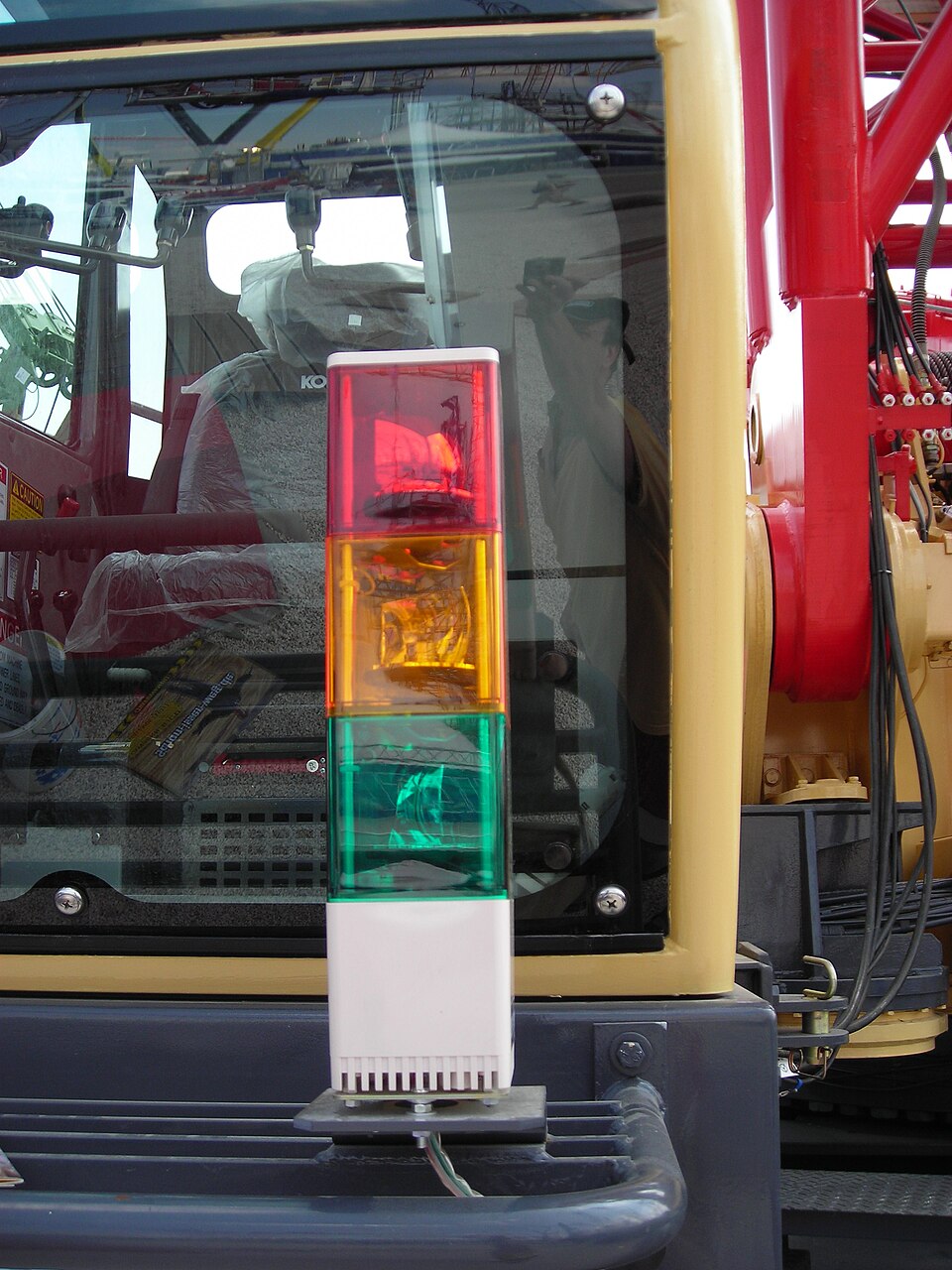
    Tower light and buzzer

    Green wet, yellow warn, red and buzzer when dry

    Adafruit ESP32-S3 Feather · 4 GPIO pins (FETs) · Lamp and buzzer states

  7. 07

    Mute button

    Silences the buzzer for 60 s; each press is logged

    Adafruit ESP32-S3 Feather · GPIO pin · Button press

  8. 08

    5 V step-down regulator

    Powers the Feather from the 12 V adapter

    Adafruit ESP32-S3 Feather · 5 V power lead · 5 V, 1 A

  9. 09

    All connected

    7 key parts, one program, and your phone

What it is

A bench-mounted camera and dust sensor that warns when dust controls on cutting tasks fail.

What it does

  • Spots visible dust plumes
  • Flags suspected dry cutting
  • Tracks a PM4 dust trend
  • Alerts supervisors in real time

Who it's for

Stone fabricators, contractors and manufacturers with silica-generating tasks.

The idea

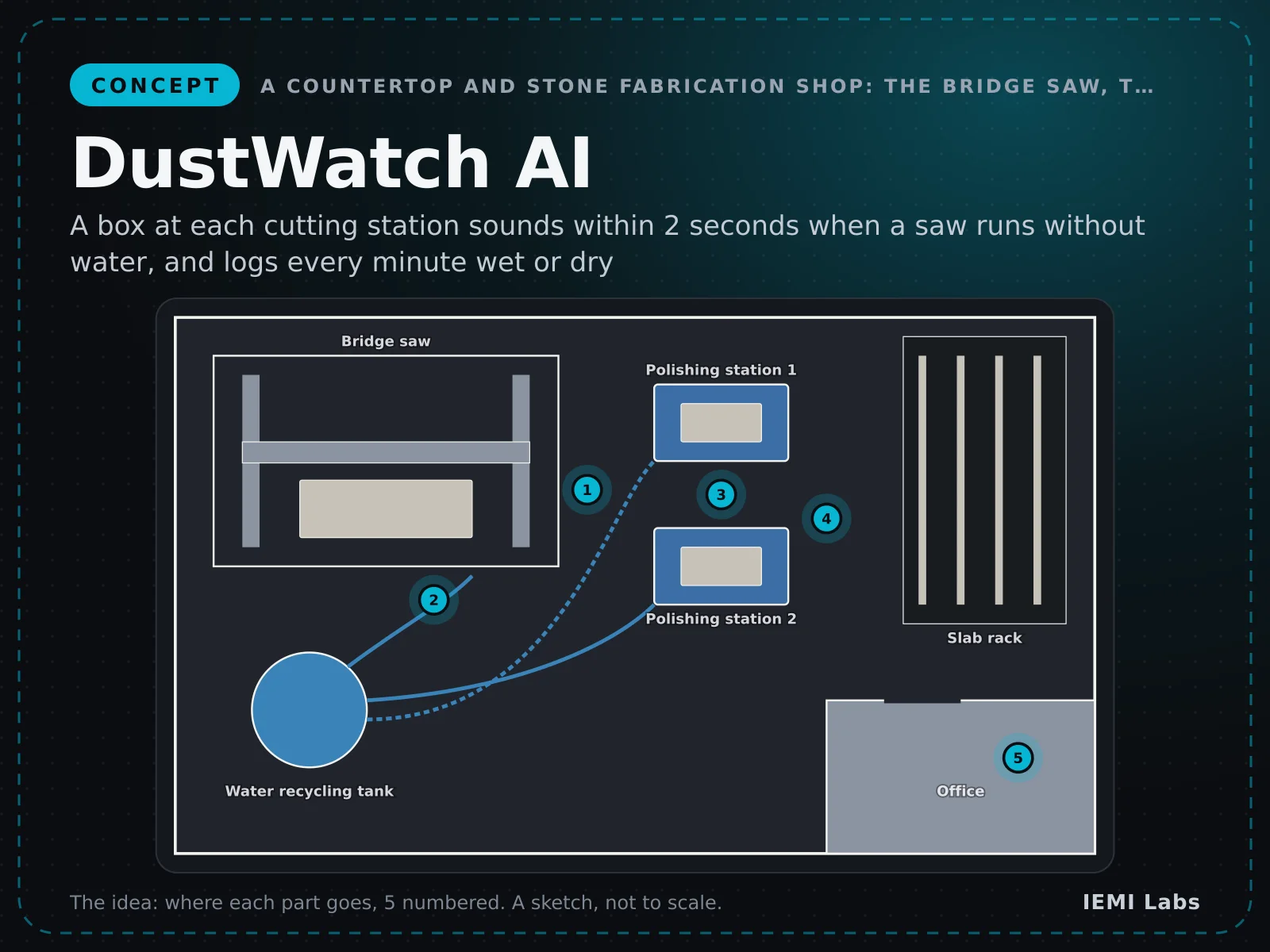
A box at each cutting station sounds within 2 seconds when a saw runs without water, and logs every minute wet or dry

The problem today

Small countertop and stone shops cut engineered stone that throws fine silica dust when it is cut dry. A closed valve, a kinked hose or a quick dry cut at the polisher goes unseen, and the shop has no record to show its insurer or hygienist that it cuts wet. Personal air samples are costly, slow and only cover a day or two.

With DustWatch AI

A station box beside each saw, grinder or polisher knows when the tool is running and when the water is flowing, and lights yellow then red with a buzzer within seconds of a dry run. One dust monitor on the shop wall shows dust events as a trend. On the 1st of each month the owner approves a wet-cutting report for the insurer or hygienist. It never gives a silica level or an exposure figure.

Bridge sawPolishing station 1Polishing station 2Slab rackWater recycling tankOffice12345
  1. 1Station box at the bridge sawLights green when cutting wet, yellow then red with a buzzer within 2 seconds of a dry cut, and logs every tool-on minute
  2. 2Flow sensor on the saw's water hoseCounts the water pulses, so a closed valve or a kinked hose shows as no flow while the blade is turning
  3. 3Tool-on plug at the polishing stationThe polisher plugs in through a listed smart plug that tells its station box the motor is running; nothing printed carries mains
  4. 4Dust monitor on the shop wallReads fine dust once a minute and flags dust events as a trend after a shift; never a silica level or an exposure figure
  5. 5Monthly report in the officeOn the 1st the owner approves the wet-cutting record for every station, ready for the insurer or the hygienist
A countertop and stone fabrication shop: the bridge saw, two hand polishing stations, the slab rack, the water recycling tank and the office, drawn to show where each part goes (not to scale).

How the parts connect

DustWatch AI, wired up

Every part, what links it to the brain, and how the data reaches your phone. A solid line is a cable; a dashed line is a radio link.

Hall flow sensorFlow pulsesGPIO pin (pulse count)Tool-on sensorTool on or offDry contact, or Wi-FiDust monitor (SPS30)PM1 to PM10, humidityWi-Fi (MQTT)own board: ESP32-S3 FeatherTower light and buzzerLamp and buzzer states4 GPIO pins (FETs)Mute buttonButton pressGPIO pin5 V step-down regulator5 V, 1 A5 V power leadTHE BRAINAdafruit ESP32-S3 Featherruns wetcheck station firmwareC with ESP-IDF 5.xWetCheck cloudvia Shop Wi-Fi · MQTT over TLSOwner's phonevia Web app, WhatsApp or SMS
Drawn from the DustWatch AI parts list. The 3D view above is built separately, from the CAD.

The program

What controls DustWatch AI

Runs on
ESP32-S3 Feather
Written in
C with ESP-IDF 5.x
System
ESP-IDF (FreeRTOS)
AI model
None: flow and current thresholds with timers
  1. 1Read tool-on from the current sensor or the smart plug
  2. 2Convert flow pulses into litres per minute
  3. 3Start a timer when the tool runs with low flow
  4. 4Show yellow after 2 s, red with buzzer after 5 s
  5. 5Log each event with a hash and publish it by MQTT
wetcheck station firmware.cppmain loop
for (;;) {                                   // 50 ms tick
    bool tool_on = shelly_current_a() > I_ON || gpio_get_level(CURRENT_SW) == 0;
    float flow_lpm = pcnt_pulses_last_1s() / K_PULSE_PER_LPM;
    if (tool_on && flow_lpm < Q_MIN_LPM) low_ms += 50;
    else if (flow_lpm >= Q_MIN_LPM) low_ms = 0;
    if (!tool_on)           state = IDLE;
    else if (low_ms > 5000) state = DRY;       // red + buzzer
    else if (low_ms > 2000) state = WARN;      // yellow + chirp
    else                    state = RUN_WET;   // green
    beacon_set(state);
    if (state_changed()) mqtt_publish_event(state, hash_chain());
    vTaskDelay(pdMS_TO_TICKS(50));
}

To your phone

How the data reaches WetCheck owner app

Owner phone (web app), WhatsApp or SMS

  1. Station box
  2. WetCheck cloud
  3. Owner's phone

What you see in the app

One screen for each job DustWatch AI does.

  • Dry cutA cutter starts the bridge saw with the water valve shut. Within 2 seconds the tower light turns red and the buzzer sounds.

  • Wet-cut recordEvery minute the saw runs is logged as wet or dry, so the owner can show the shop cuts wet.

  • Shop dustAfter the shift someone dry-sweeps the floor. The dust monitor sees the trend jump and flags it. It is a trend, not exposure.

  • Monthly reportAt month end the app drafts a report of wet-cut time and dry events. It goes to the insurer only after the owner approves.

App screens with sample data. The interface is in development.

What the app gets

Data DustWatch AI sends to the app
Dry-cut eventSierra 1, 41 s dryEach event
Wet share98% of tool timeEvery 60 s
Flow6.1 L/minEvery 60 s
Dust levelPM2.5 9.8 µg/m³Every 60 s
Monthly reportDraft PDF to approveMonthly

Alarms work with no internet. Reports go to the insurer only after the owner approves them.

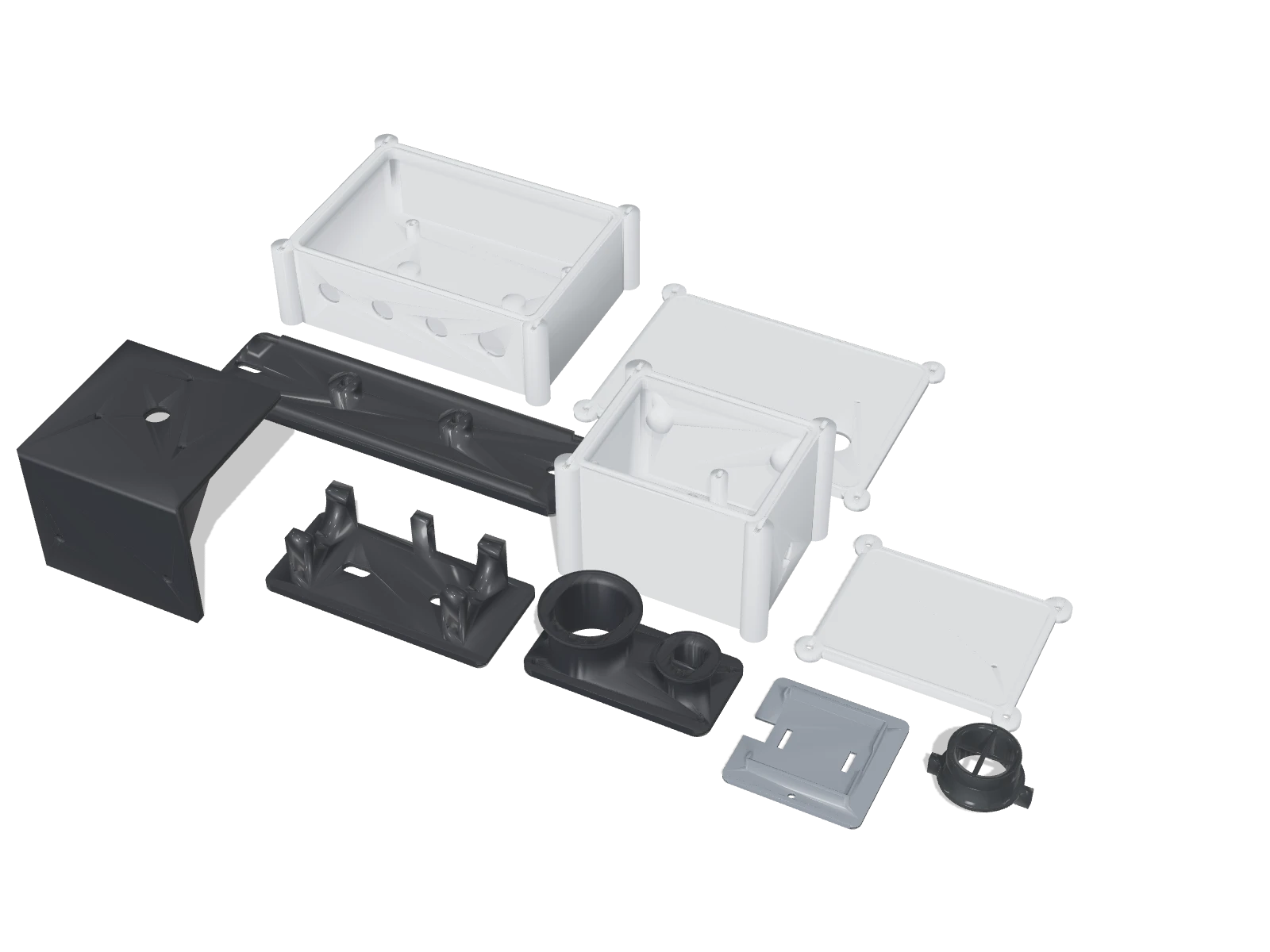
CAD design · Design complete (stages 1–6, pilot rev A), not built, not validated

Designed in code, checked in 3D

  • 10 printed parts, each a single closed solid
  • Every bought part fitted inside and checked for collisions
  • Assembled exactly as shown in the 3D CAD view (the button on the picture at the top)
See the CAD parts renderWetCheck printable parts rendered from the CAD

Key specs

DustWatch AI hardware
AI processorKendryte K230D (on-device plume detection)
CameraSony IMX462 low-light camera
SensorsSensirion SEN66 / SPS30-class optical particulate sensor (PM1 / PM2.5 / PM4 / PM10) · Temperature and humidity
ConnectivityWi-Fi · Optional LTE · Bluetooth for setup
PowerMains via USB-C adapter or 12–24 V DC; optional 8-hour battery for moving between benches (target)
EnclosureRounded light-grey box with a teal accent ring, a downward-facing Ø3 cm protected inlet cowl and a camera eye in the upper front corner; magnetic base or clamp
Dimensions20 W × 14 H × 10 D cm; mounted at 1.2–1.8 m on a bench or column
Weight~1.2 kg (est.)
Ingress ratingIP54 with heated, dust-filtered sample inlet (target)
All target specifications

Sensing

Sensing target specifications
ParticulateOptical PM1 / PM2.5 / PM4 / PM10 trend
What it measuresTotal particulate by light scattering; not crystalline silica
CameraLow-light plume and tool detection
Site correlationOptional factor entered by your hygienist from lab samples

Alerts and data

Alerts and data target specifications
AlertsPlume, suspected dry cut, PM4 spike, rising trend
ChannelsApp, email, SMS, Teams / Slack
ReportsShift dust-trend reports by bench and task
Data outCounts, trends and blurred event stills

Power and physical

Power and physical target specifications
PowerMains / USB-C or 12–24 V DC; 8 h battery option
Size20 × 14 × 10 cm
IngressIP54 with heated inlet (target)
MountingMagnetic base or clamp, 1.2–1.8 m

Targets for production units; they may change during development.

Pricing

Hardware: $799 per unit

Software: $29 per month per unit

Target pricing. Fabricator 3-pack at $2,190 + $69/mo. Lab sampling for exposure assessment is not included and is still needed.

Bench

$799 + $29/mo per unit

One workstation with plume and dust-trend alerts.

  • Plume and dry-cut detection
  • PM4 trend
  • Real-time alerts
  • Shift reports

Fabricator 3-pack

$2,190 + $69/mo

Three units for a typical stone shop or cutting area.

  • 3 units
  • Shop-wide dashboard
  • Weekly trend reports
  • Hygienist correlation factor

Multi-site

Custom

For contractors and manufacturers with many sites.

  • Volume pricing
  • Multi-site reporting
  • EHS integration (planned)
  • SLA

Indicative launch pricing in USD, excluding taxes and shipping. Final pricing is confirmed before any balance is charged.

Community

What do you think of DustWatch AI?

DustWatch AI is in development. Rate the idea, tell us what to change about the features, specs or price, and we'll build it with your feedback.

How much people want it

–

No ratings yet

  1. 50
  2. 40
  3. 30
  4. 20
  5. 10

Follow DustWatch AI

Get build updates and first access when pre-orders open.

Leave feedback

Your rating of the idea

Feedback on a product concept in development, not a review of a shipped product. Posts may be moderated; links and contact details are held for review. See our community guidelines and privacy policy.

Comments

    No comments yet. Tell us what you'd want from DustWatch AI.

    Questions

    Ask about DustWatch AI

    Tell us what this would save you, or ask anything. We reply within two business days.

    We use your details only to respond to this request. See our privacy policy.

    From the product lab · ideation phase

    Lab updates for DustWatch AI

    All lab updates
    1. LatestSmall countertop and stone shops cutting engineered stone need to show that they cut wet, but a closed valve, a kinked hose or a quick dry cut goes unseen and leaves no record for the insurer or hygienist (silica sources in the WetCheck DESIGN.md).
      • Drawn idea plan (idea.json): a stone fabrication shop from above with the bridge saw, two polishing stations, the slab rack, the water recycling tank and its hoses, and the office; pins for the station box, the flow sensor on the hose, the tool-on plug at a polisher, the dust monitor and the monthly report
      • The product picture is now this drawn plan instead of the plain fallback card; drawn from the design notes, not the CAD
      • What the plan keeps from the market work: it is early warning and evidence only, it never stops the tool, and the dust monitor shows a trend, never a silica level or an exposure figure
      • Next: more drawn plans for catalogue products that still show the fallback card, then close-out C5 (buyer review prep for sports) from 12:00

      See it in 3DFull research and design

    2. In a dusty plant (sawmill, joinery, feed mill, recycling plant) the electrical room is where dust and electrical heat meet. Washington L&I's sawmill dust alert lists electrical arcs as an ignition source, and NFPA 652 asks for regular cleaning and control of ignition sources. Today the room needs three tools: a panel heat monitor, a thermal camera for growing hot spots and a dust monitor; our own three cost $4,979 and $80 a month for one room.
      • Combined into SwitchRoom (https://iemilabs.com/products/switchroom/); DustWatch AI itself is unchanged

      See it in 3DFull research and design

    DustWatch AI FAQ

    General FAQ
    Does DustWatch measure silica or my workers' exposure?

    No. Optical sensors measure total particulate by light scattering and cannot measure respirable crystalline silica. DustWatch shows a dust trend and flags control failures. It does not show silica concentrations or exposure limits, and exposure assessment still needs personal sampling with lab analysis by a competent person.

    Does DustWatch record workers?

    The camera points at the workstation, and people are blurred on the device. Only counts, trends and blurred event stills leave the unit. There is no identity, face recognition or emotion and fatigue inference.

    Is DustWatch certified or safety rated?

    No. It is in development and holds no certifications. It is an early-warning aid, not a safety-rated system or a measuring instrument, and it does not make you compliant. It helps you evidence that controls are used. It is not intrinsically safe and is not for hazardous (classified) areas. CE/UKCA/FCC certification testing is planned.

    How is it installed?

    Fix it to a bench or column at 1.2–1.8 m with the magnetic base or clamp, point the camera at the workstation and plug it in. Setup in the app is designed to take a few minutes per unit.

    What connectivity does it need?

    Wi-Fi, or the optional LTE module for sites without a network. Alerts and plume detection run on the device, and events are sent when a connection is available.

    Is DustWatch AI available now?

    No. It is in development and the specifications are targets. It is a concept: we are not taking orders, reservations or deposits, and it has no ship date yet.

    What warranty will it come with?

    We are planning a 2-year limited hardware warranty covering manufacturing defects. Final terms will be published before shipping begins.

    Related products

    AirLeak AI concept: the idea and where each part goes
    IndustrialConcept

    AirLeak AI

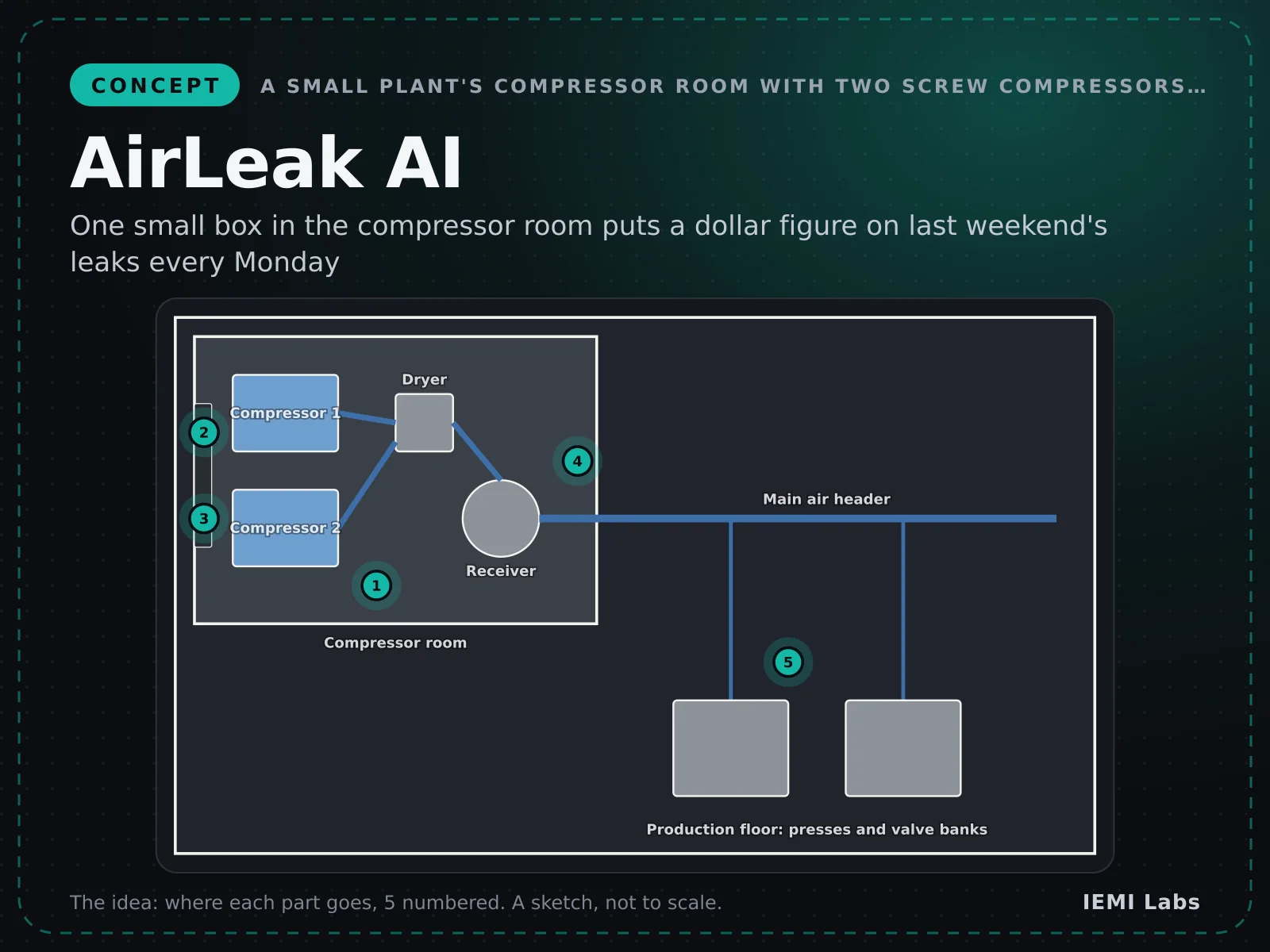
    A wall or pole-mounted ultrasonic sensor disc with a camera that listens for compressed-air and gas leaks.

    • Hears leaks around the clock
    • Marks leaks on a camera image
    • Estimates each leak's yearly cost

    From $1,490 per unit

    Details
    MotorPulse AI concept: the idea and where each part goes
    IndustrialConcept

    MotorPulse AI

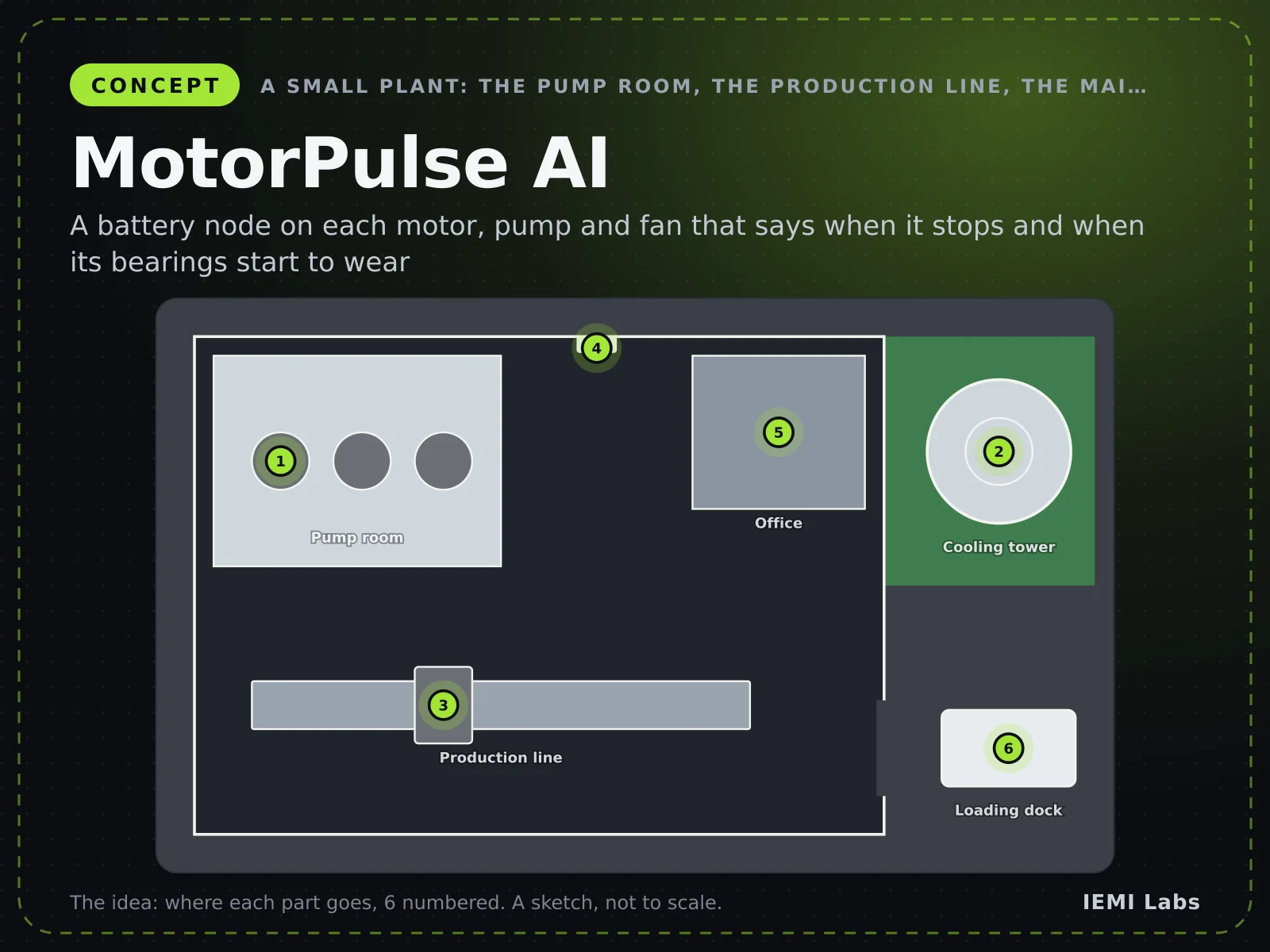
    A small battery sensor that screws onto a motor or pump and spots developing faults.

    • Measures vibration, sound and temperature
    • Flags unusual machine behaviour
    • Suggests a likely fault type

    From $249 per node (HD variant $349); gateway $399

    Details
    PlantNode concept: the idea and where each part goes
    IndustrialConcept

    PlantNode

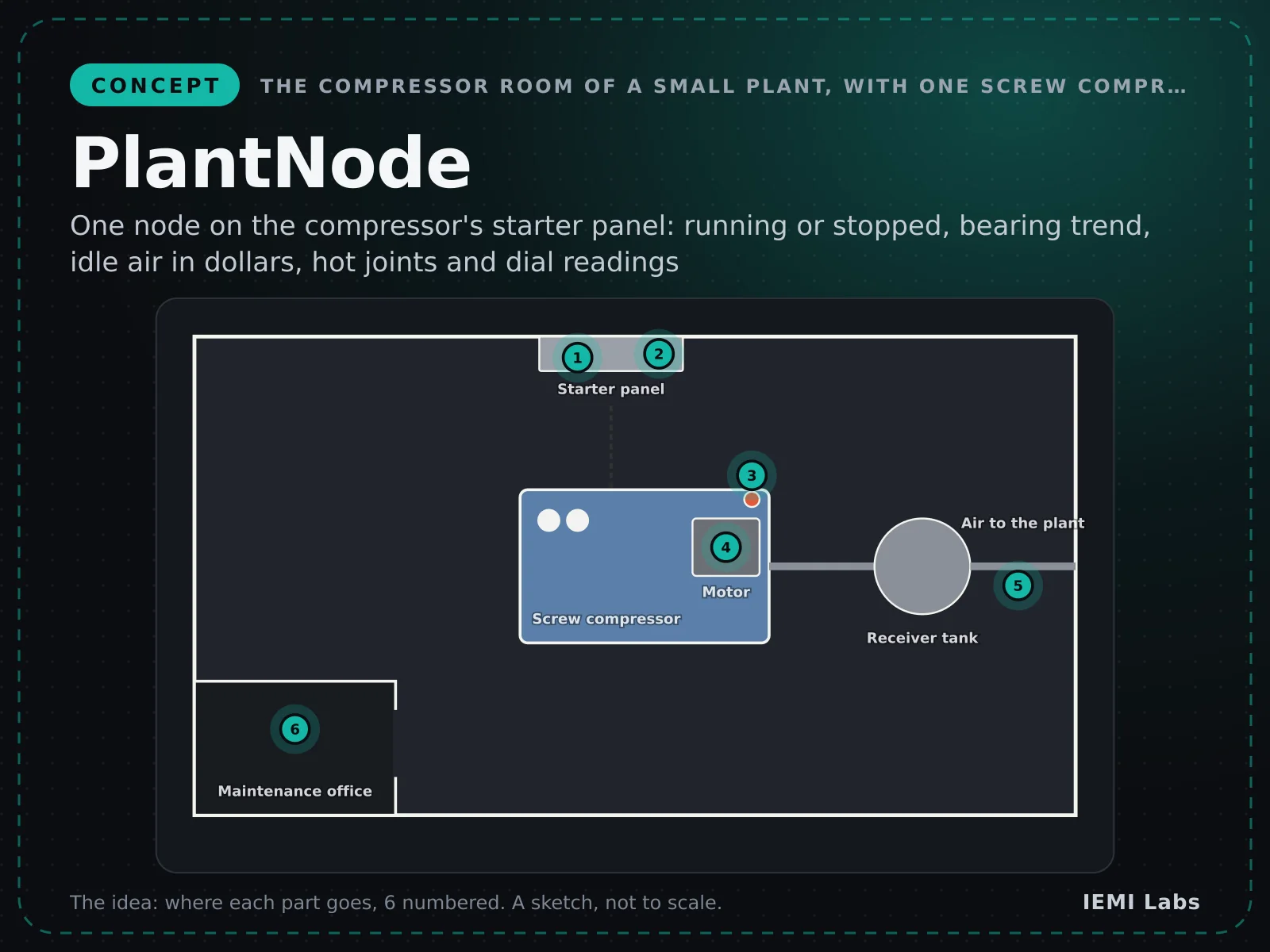
    A one-per-machine node with one brain that does five monitoring jobs at a compressor or other big machine.

    • Shows running, idle, alarm and motor bearing trend
    • Puts a dollar figure on idle air
    • Catches hot connections in the starter panel

    From $1,190 per machine (4 joint tags included); site LoRa gateway $399 once

    Details

    DustWatch AI

    Concept · target $799

    I want this