WetCheck
An alarm when a stone saw runs without water, plus a shop dust trend
When a stone saw, grinder or polisher draws current but its water isn't flowing, a beacon and buzzer go off at that station within 2 seconds, and every tool-on minute is logged as wet or dry so the shop has evidence that it cuts wet. Early warning and evidence only: never a silica level or exposure figure.
- Who buys it
- Owner of a countertop or stone fabrication shop with 1–5 cutting stations, sold through workers' comp carriers, slab distributors and industrial hygienists.
- Why it pays
- Fewer ruined diamond blades and polishing pads from dry running, and monthly records without paperwork. Expected silicosis liability avoided is about $9k/yr per shop on research assumptions (est.), mostly carried by insurers.
- Target price
- $299 per station + $10/month; 3-station kit with one dust monitor $799 + $25/month (target)
- First-minute wow
- Switch on a polisher with the valve closed and the beacon turns yellow in 2 seconds; open the valve and it goes back to green, with the event already in the log.
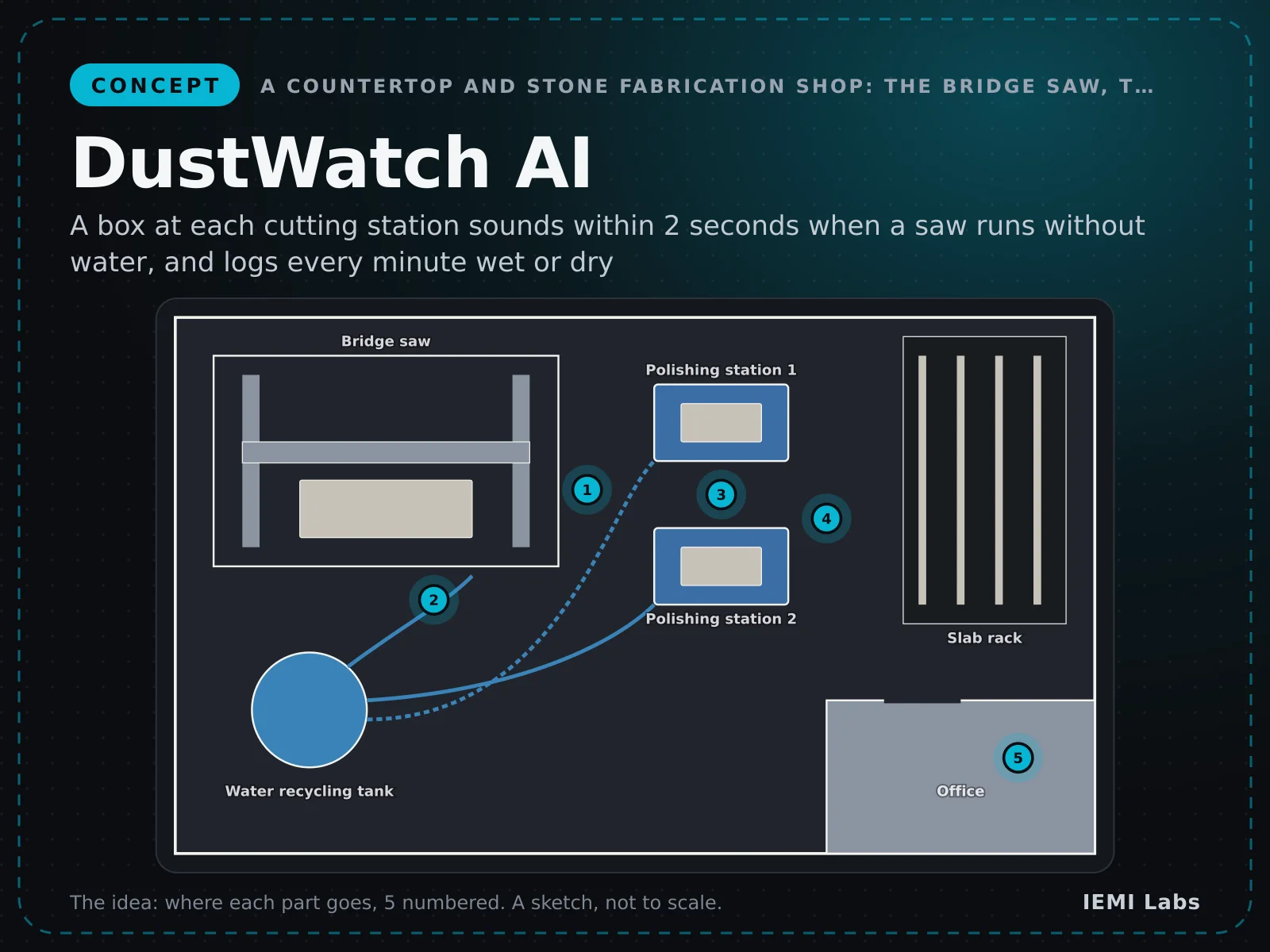
What the research found
And how this design answers it
- Camera plume AI is costly and doesn't answer the real question → dropped; tool current plus water flow answer "is it cutting dry?" for about $30 in sensors
- Optical PM can't measure silica → shop-level SPS30 raises only a relative "dust event" against its own 7-day baseline; no µg/m³ is ever shown
- Mains wiring in a wet shop → nothing printed carries mains; corded tools go through a UL-listed Shelly plug, hard-wired saws get a listed RIBXGTA current switch fitted by an electrician
- Slurry, spray and hosing down → IP65-by-design housings with silicone-cord gaskets, glands on the bottom face and a stand-off wall bracket
- Flow sensors clog on slurry → sensor on the clean supply hose behind a Y-strainer; a fouled rotor gives a false alarm, not a missed one
- Logs of dry cuts could be used against the owner → owner owns the data and approves every insurer report; each event shows the corrective action
Use case
Hose kinked mid-cut
Shop ownerSaw operatorWetCheck station and beaconWetCheck cloud
- 01Trigger: at 10:42 a slab cart kinks the bridge saw's supply hose while the operator is cutting quartz
- 02Detection: the current switch shows the spindle on while flow drops from 6.2 to 0.3 L/min, below this station's 2.0 L/min threshold
- 03Alert: yellow beacon and chirp at 2 s, red and continuous buzzer at 5 s, and a WhatsApp/SMS to the owner in Spanish and English
- 04Action: the operator mutes the buzzer, stops the saw and frees the hose; the app asks the owner for the cause
Outcome: Dry cutting lasted 41 seconds instead of until the next inspection, and the cause is on record for the monthly report
How it works
Architecture
- 01
Sense: tool current from a Shelly plug or RIBXGTA current switch; water flow from a Hall or turbine flow sensor; shop dust from an SPS30 with an SHT40 mist flag
- 02
Decide: station firmware raises WARN at 2 s and DRY at 5 s of tool-on without flow; logs every tool-on minute as wet or dry
- 03
Send: ESP32-S3 over Wi-Fi, MQTT over TLS to the cloud rules engine
- 04
Tell: tower beacon and buzzer at the station, WhatsApp/SMS to the owner, a Spanish/English app, and an owner-approved monthly evidence report
Hardware
Real parts, buyable today
Bill of materials: about $150 per station and about $93–95 per dust node at qty 1 (est.).
| Block | Part | Why this part |
|---|---|---|
| MCU | Adafruit ESP32-S3 Feather on a carrier PCB | Wi-Fi, pulse counting for flow, secure boot; solder-free prototype |
| Tool on (corded) | Shelly Plug US Gen4 (UL listed, 15 A) | A listed product carries the mains; we only read its current |
| Tool on (hard-wired) | Functional Devices RIBXGTA split-core current switch | Dry Class-2 output, installed by an electrician |
| Water flow | YF-S201 Hall sensor (Gems FT-110 turbine option; low-flow sensor for handhelds) | Only flowing-or-not against a threshold is needed |
| Beacon | Adafruit #2993 R/Y/G tower light + buzzer, 12 V | Visible from the saw; colours need no language |
| Dust monitor | Sensirion SPS30 + SHT40 | Relative dust trend; mist flag avoids false dust events |
Mechanical
Printable CAD
10 parts, generated from code and checked as closed solids. Pick a part to inspect it, or download the STL files to print.
See the CAD parts render
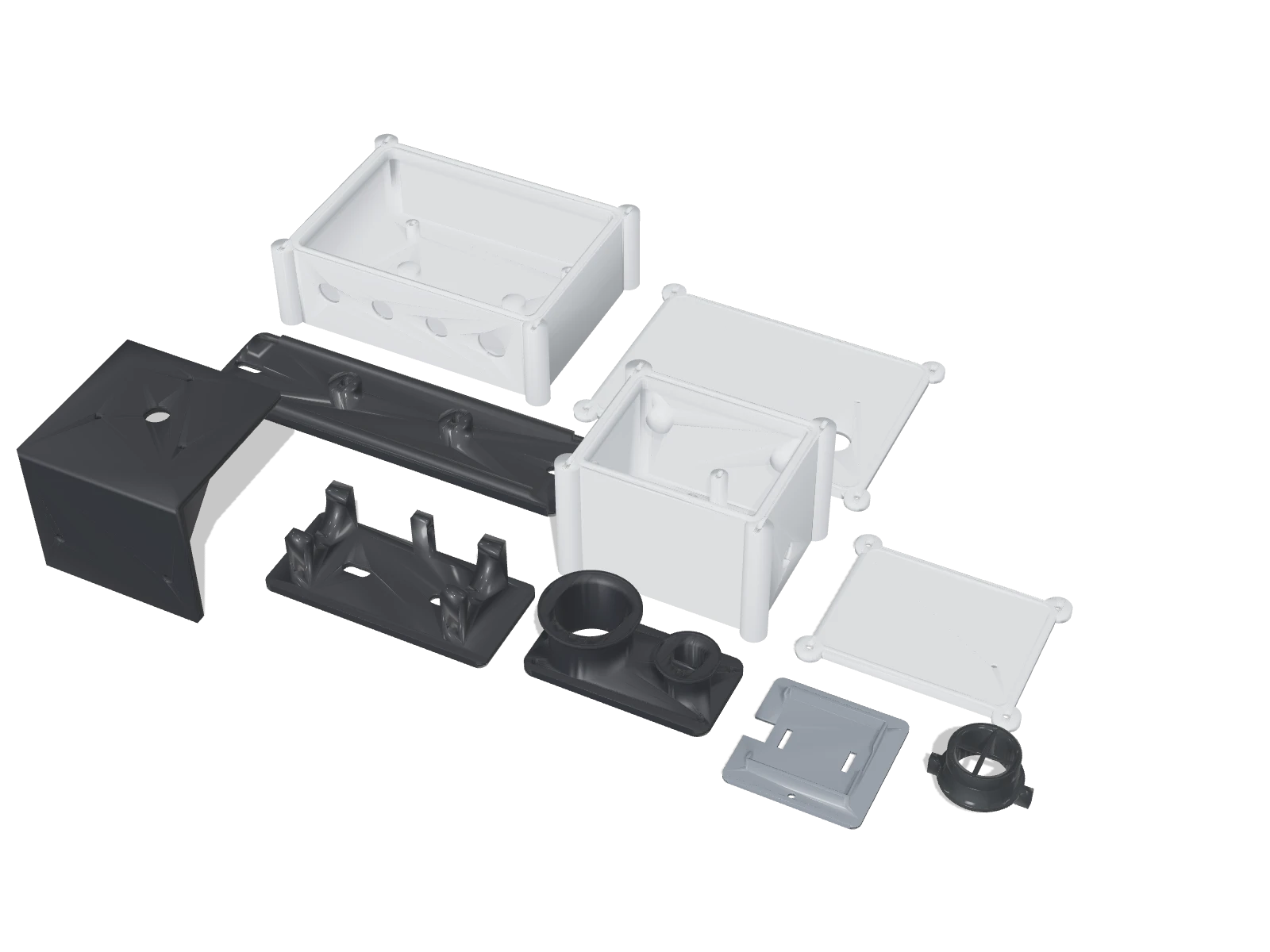
Loading the CAD…
Real CAD · drag to rotate · scroll to zoomReal CAD · swipe sideways
Bought hardware fitted inside this part (checked in the CAD: nothing collides with the plastic)
- Station enclosure backstation-back.stl · ASA
- Station enclosure frontstation-front.stl · ASA
- Flow sensor saddleflow-saddle.stl · ASA or PETG
- Beacon mountbeacon-mount.stl · ASA
- Dust monitor bodydust-body.stl · ASA
- Dust monitor liddust-lid.stl · ASA
- Dust inlet and exhaust cowldust-cowl.stl · ASA
- Push-in pre-filter framedust-filter-frame.stl · PETG or TPU 95A
- SPS30 sensor sled (quarterly cartridge)dust-sensor-sled.stl · PETG
- Stand-off wall bracketwall-bracket.stl · ASA or PETG
Open risks we are working on
- Implied-safety and product liability cannot be designed away; insurance and a lawyer review are needed before the first field unit
- The Shelly plug's 15 A rating is marginal for a 15 A saw at full load, and whether its listing covers shop use is unconfirmed
- SPS30 fouling rate in shop dust is unknown (kill criterion: fouls in under 2 weeks)
- If bridge saws already have water interlocks, the market narrows to handheld tools
- IP65 is a design target only, checked with a bench jet test, not certified
- Small market (about $6M SAM est.); owners may still read the dust trend as an exposure figure
Design stage only: nothing on this page is for sale. Specifications and prices are targets.