Skip to content
IEMI Labs

BagPost

Smart bag stand and urinal hook that log urine output in mL

Concept · not for sale
Engineering design: BagPost
Target price from$79per RailHook ($79) or stand ($159)

Software: $3–$5 per month ($3 home user, $5 per resident in care homes)

Concept, not for sale yet. Tell us if you want it; that decides what we build.

Rate this idea and tell us what to change
BagPost concept: the idea and where each part goes

Drag to rotate · right-drag to move · scroll to zoom · click a part for its size and placeSwipe to rotate · pinch to zoom · two fingers to move · tap a part for its size

How it fits together

BagPost, part by part

Scroll or tap a part. Press “See the 3D CAD design” to watch the model, built from our CAD, light each part up and show how it connects.

BagPost concept: the idea and where each part goes

Real-time 3D render · drag to rotate · final design may varySwipe sideways to rotate

  1. 01

    The whole BagPost

    A stand weighs the hanging night drainage bag. It logs each emptying in mL and alerts the carer's phone when nothing is draining.

  2. 02Brain

    Seeed XIAO ESP32-C3

    The brain: it runs the bagpost-head firmware program

  3. 03

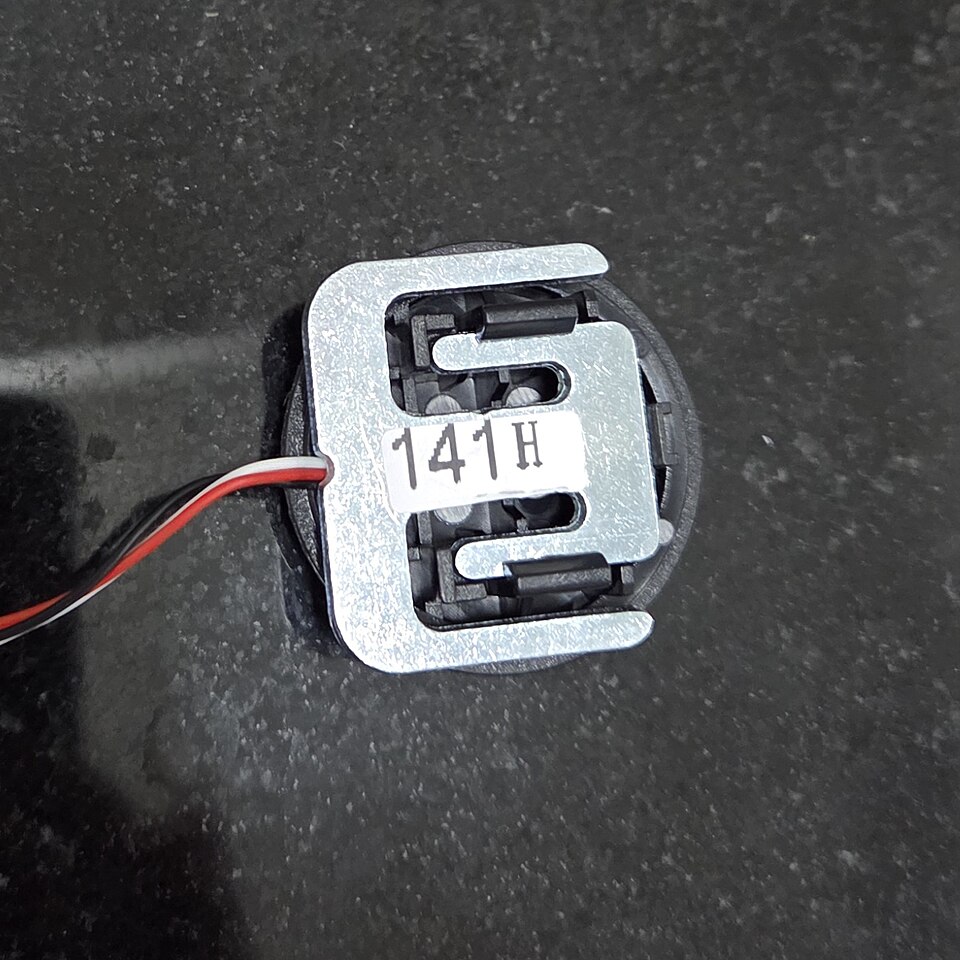
    5 kg load cell

    Weighs the bag to about 0.4 g

    Seeed XIAO ESP32-C3 · 4 wires to amplifier · Tiny bridge voltage

  4. 04

    HX711 amplifier

    Turns the load cell signal into a 24-bit number

    Seeed XIAO ESP32-C3 · 2 GPIO pins (D0, D1) · Weight readings

  5. 05

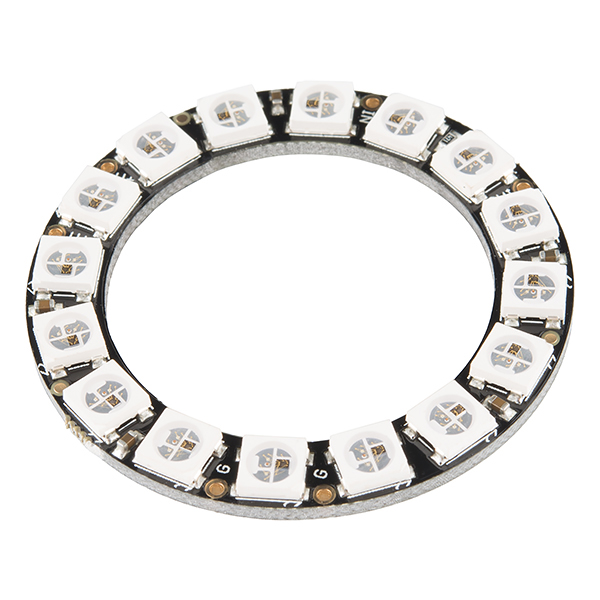
    12-LED light ring

    Shows fill level, amber for alerts, red if knocked

    Seeed XIAO ESP32-C3 · GPIO data line (D8) · LED colour data

  6. 06

    CHECK button

    Acknowledges an alert, checks the bag and tares

    Seeed XIAO ESP32-C3 · GPIO pin (D10) · Button presses, wake signal

  7. 07

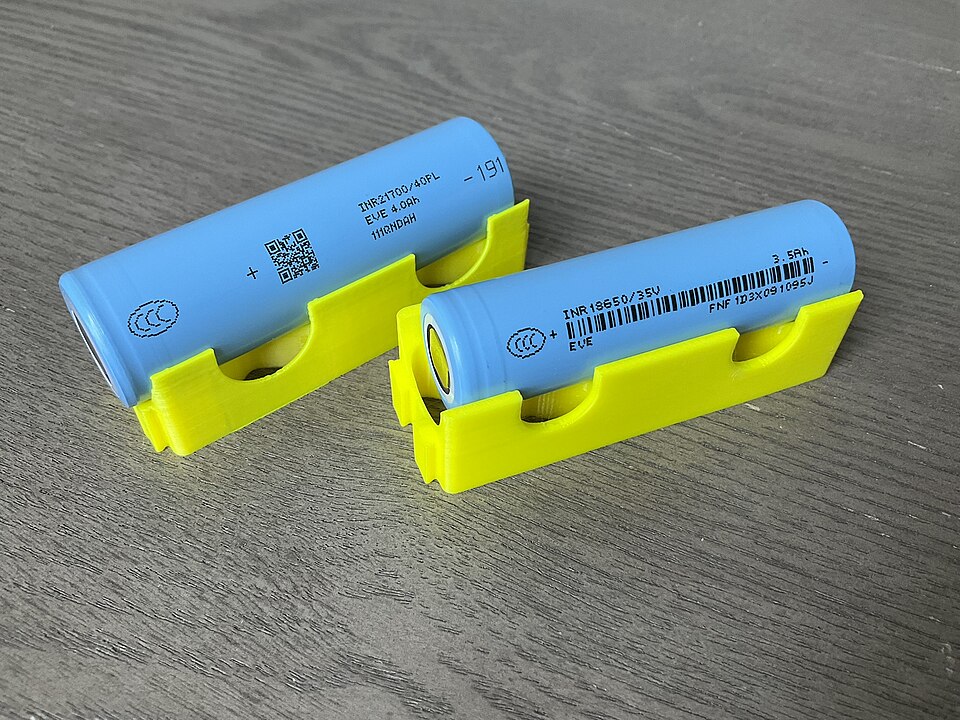
    18650 cell + USB-C

    Runs the stand for about 58 days per charge

    Seeed XIAO ESP32-C3 · Board battery pads, USB-C charge · Power

  8. 08

    All connected

    6 key parts, one program, and your phone

What it is

A night-bag stand and a bed-rail urinal hook, each with a load cell, that log urine output in mL.

What it does

  • Logs each void from a urinal
  • Logs every catheter bag emptying
  • Alerts when drainage stops
  • Builds the output chart for nurses

Who it's for

Hospital wards, care homes, district nurses and family carers.

The idea

The night-bag stand and the bed-rail urinal hook weigh what is passed, so every room's output is logged in mL

The problem today

On a night shift, carers check catheter bags on their rounds and write output on a paper chart. Ward charts are correct only about one time in five, a blocked catheter or a leg-bag valve left shut can go unseen until the next round, and urinals emptied in the toilet are charted with no volume at all.

With BagPost

Each night bag hangs on a stand that weighs it, and each urinal hangs on a bed-rail hook that weighs it. The carers' shared phone hears when nothing has drained since connection, when drainage stops against the person's own pattern, or when a bag is nearly full, and every emptying lands in the record with its mL. It monitors and alerts only; the carer still checks the person.

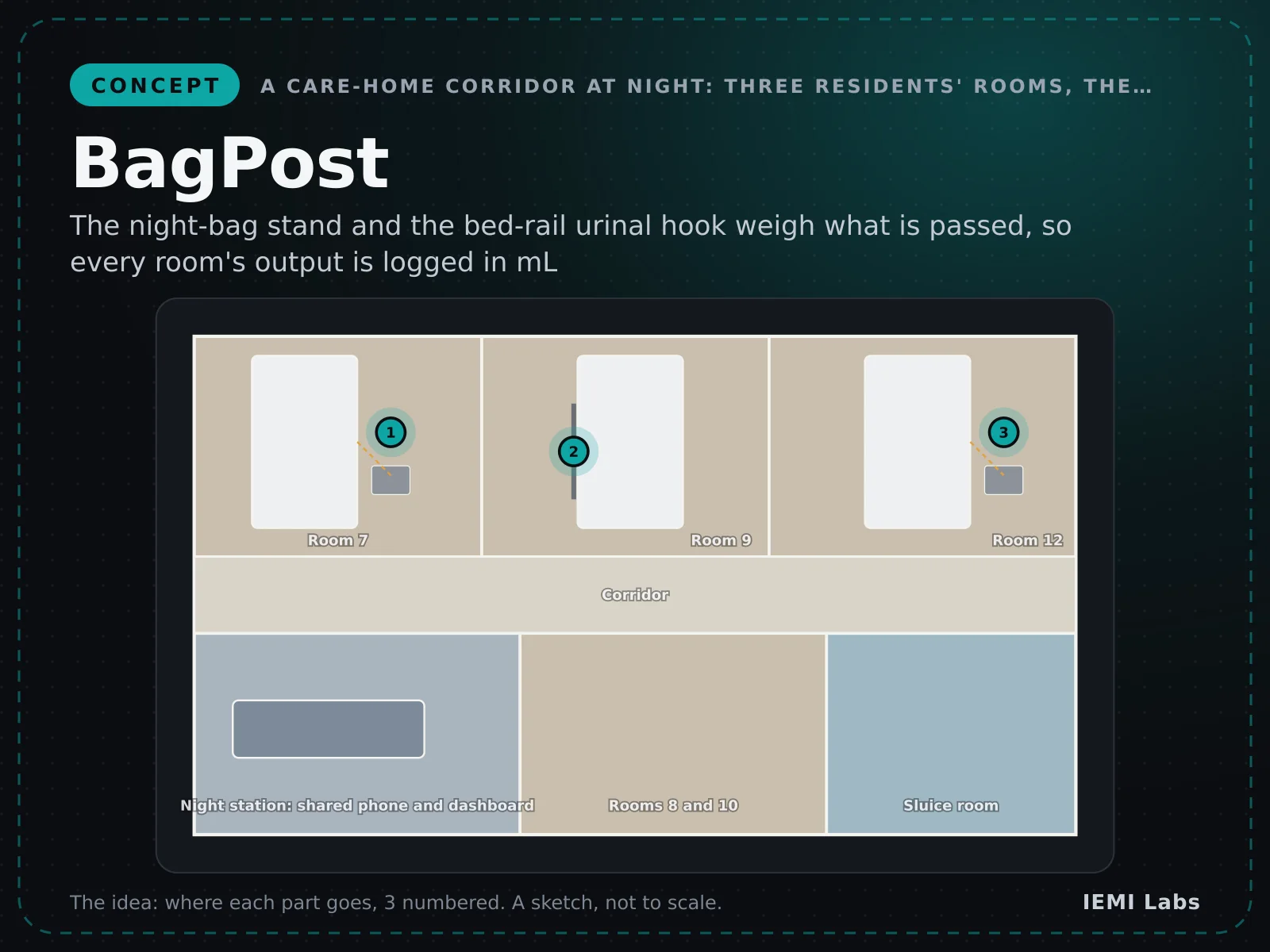
Rooms 8 and 10Room 7Room 9Room 12CorridorNight station: shared phone and dashboardSluice room123
  1. 1BagPost stand beside Room 7's bedWeighs the night bag all night; says when drainage stops against this resident's own pattern, so a blockage is seen hours before the round
  2. 2RailHook on Room 9's bed railThe urinal hangs on a hook that weighs it, so every void is logged in mL instead of 'void in toilet'
  3. 3BagPost stand beside Room 12's bedSays 'nothing drained since connected' when the leg-bag valve was left shut, and warns before the bag is full; tethered to the bed
A care-home corridor at night: three residents' rooms, the night station and the sluice room, drawn to show where each part goes (not to scale).

How the parts connect

BagPost, wired up

Every part, what links it to the brain, and how the data reaches your phone. A solid line is a cable; a dashed line is a radio link.

5 kg load cellTiny bridge voltage4 wires to amplifierHX711 amplifierWeight readings2 GPIO pins (D0, D1)12-LED light ringLED colour dataGPIO data line (D8)CHECK buttonButton presses, wake signalGPIO pin (D10)18650 cell + USB-CPowerBoard battery pads, USB…THE BRAINSeeed XIAO ESP32-C3runs bagpost-head firmwareC++ firmware (toolchain not nam…IEMI cloudvia Wi-Fi · MQTT over TLSCarer and managervia Phone alert · web dashboard
Drawn from the BagPost parts list. The 3D view above is built separately, from the CAD.

The program

What controls BagPost

Runs on
Seeed XIAO ESP32-C3
Written in
C++ firmware (toolchain not named in design)
System
None (ESP32 firmware)
AI model
None. Weight-step rules and a 7-night baseline in the cloud
  1. 1Wake every 60 s and read the cell for 2 s
  2. 2Keep a 24 h ring of 1-minute masses
  3. 3Spot steps: bag hung, emptied or knocked
  4. 4Send status every 10 min, events at once
  5. 5Light the ring only when needed, then deep sleep
bagpost-head firmware.cppmain loop
while (true) {
  power_on(HX711_VCC);                    // switched by a P-FET from D2
  grams = hx711.read_avg(20);             // 2 s at 10 samples/s
  power_off(HX711_VCC);
  ring24h.push(grams);                    // 1-minute masses
  step = grams - ring24h.previous();
  state = state_machine(state, step);     // NO_BAG, HUNG, DRAINING, REMOVED
  if (alert_rules(state, ring24h, baseline))
    mqtt.publish("event", alert_json());  // NO_DRAIN, KNOCKED, EMPTIED
  if (ten_minutes_elapsed())
    mqtt.publish("status", status_json()); // g, mL, rate, battery
  show_ring(state);                       // D8 via P-FET
  deep_sleep(60 /*s*/, WAKE_ON_BUTTON);   // button on D10 wakes early
}

To your phone

How the data reaches BagPost carer phone and manager dashboard

Shared phone or browser

  1. Stand head
  2. IEMI cloud
  3. Carer and manager

What you see in the app

One screen for each job BagPost does.

  • Drainage stoppedAt 5 am the night bag in Room 7 has stopped filling. The carer is sent to check the catheter hours before the next round.

  • Bag nearly fullRoom 4 is draining well and the 2 litre bag is filling up. The carer empties it on the next pass instead of finding it overflowing.

  • Emptying logAt the end of the night every emptying is already logged with its time and volume, so the output chart and inspection record need no jug.

  • Bedside urinalA patient on a surgical ward hangs the urinal back on the bed rail. The RailHook weighs it, so the fluid chart fills itself in mL.

App screens with sample data. The interface is in development.

What the app gets

Data BagPost sends to the app
Bag content799 mLEvery 10 min
Drainage rate46 mL/hEvery 10 min
No-drainage alertRoom 12: check catheterWhen drainage stops
Emptying log820 mL at 06:55Each emptying
Night summaryTotal mL by hour07:00 daily

The stand stores no names and has no camera or microphone. Per-device credentials over TLS, no open ports.

CAD design · Rev A design complete (stages 1-6) + RailHook urinal scale (rev A1, 25 Oct 2026), all hardware fit-checked in CAD, not built; US EXS urinometer exemption scope for the alerts is gate R1

Designed in code, checked in 3D

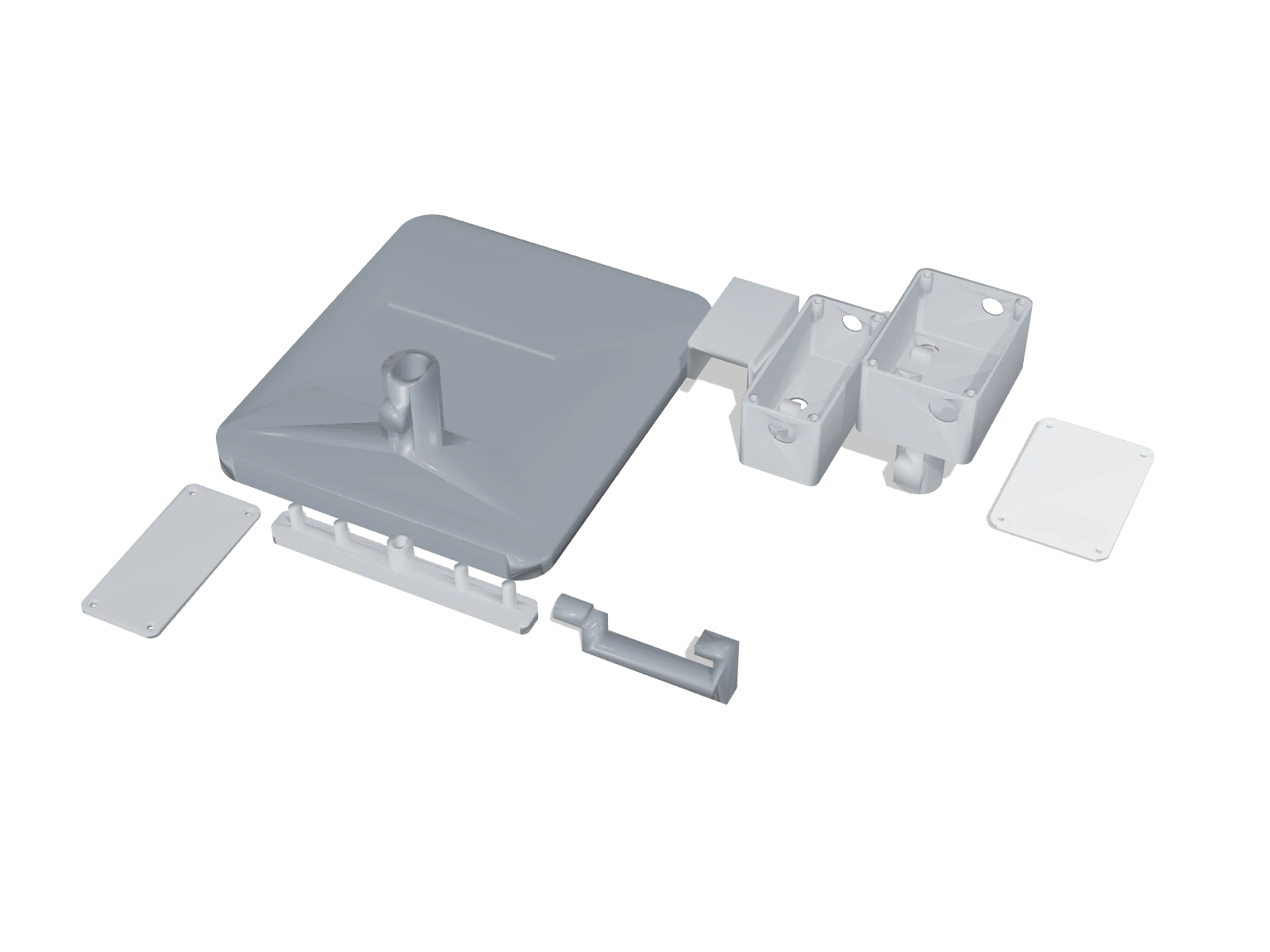
  • 7 printed parts, each a single closed solid
  • Every bought part fitted inside and checked for collisions
  • Assembled exactly as shown in the 3D CAD view (the button on the picture at the top)
See the CAD parts renderBagPost printable parts rendered from the CAD

Key specs

BagPost hardware
AI processorSeeed XIAO ESP32-C3
SensorsTAL220B 5 kg straight-bar load cell with HX711 24-bit amplifier · RailHook: a second TAL220B 5 kg cell under the urinal cradle · 12 mm IP67 CHECK button (acknowledge, tare) · Battery voltage sense
ConnectivityWi-Fi (MQTT over TLS) · IEMI cloud or on-site Edge Hub · Adafruit NeoPixel Ring 12 status light
Power18650 3,000 mAh Li-ion, about 58 days per charge (est.); IP67 USB-C charge socket
EnclosureWhite ASA head with a translucent light-ring lid on a 16 mm aluminium tube, over a weighted grey PETG foot with a 1.18 kg steel plate and a drip tray
DimensionsStand about 470 mm tall, foot 200 × 230 mm; RailHook case 46 × 100 × 44 mm plus a 60 mm rail hook (fits rails up to 30 mm, est.)
Weight~2 kg without a bag (est.)
Ingress ratingIPX4 (target, wipe-down and splashes)
All target specifications

Measurement

Measurement target specifications
Load cell5 kg; a full 2 L bag is about 44% of full scale
ResolutionAbout 0.4 g ≈ 0.4 mL
Emptying volumeAbout ±1.3–1.7% (est.)
Sample rate2 s read every minute
RailHook void±1.5 mL at 50 mL to ±11 mL at 800 mL (est.)

Alerts (target, nurse-adjustable)

Alerts (target, nurse-adjustable) target specifications
Valve shutUnder 15 g in the first 60 min after hanging
No drainageUnder 15 g rise in 2–3 h vs. own baseline
Empty soonAbove 1,300 mL, or 1,800 mL limit for ultra-low beds
Knocked or unhookedSudden loss of more than 50% of bag mass

Power and physical

Power and physical target specifications
Battery18650 3,000 mAh, about 58 days (est.)
ChargingIP67 USB-C socket with cap
BagsAny brand of 2 L night bag
StabilityBed tether included; tips at 4–10 N without it (CAD est.)
RailHook battery18650, about 32–36 days at a 10 s read (est.)

Targets for production units; they may change during development.

Pricing

Hardware: $79–$159 per RailHook ($79) or stand ($159)

Software: $3–$5 per month ($3 home user, $5 per resident in care homes)

Target pricing (£65 per RailHook, £129 per stand in the UK). Parts cost is about $47 per RailHook and $84 per stand at qty 1 (est.).

Indicative launch pricing in USD, excluding taxes and shipping. Final pricing is confirmed before any balance is charged.

Community

What do you think of BagPost?

BagPost is in development. Rate the idea, tell us what to change about the features, specs or price, and we'll build it with your feedback.

How much people want it

–

No ratings yet

  1. 50
  2. 40
  3. 30
  4. 20
  5. 10

Follow BagPost

Get build updates and first access when pre-orders open.

Leave feedback

Your rating of the idea

Feedback on a product concept in development, not a review of a shipped product. Posts may be moderated; links and contact details are held for review. See our community guidelines and privacy policy.

Comments

    No comments yet. Tell us what you'd want from BagPost.

    Questions

    Ask about BagPost

    Tell us what this would save you, or ask anything. We reply within two business days.

    We use your details only to respond to this request. See our privacy policy.

    From the product lab · ideation phase

    Lab updates for BagPost

    All lab updates
    1. LatestA care home or ward needs catheter and urinal output logged in mL and a blocked catheter seen before the next round; ward output charts are correct only 21% of the time (Lim et al., BJN 2021) and 43% of long-term catheter users need out-of-hours care in a year (sources in DESIGN.md).
      • Drawn idea plan (idea.json): a care-home corridor at night with three residents' rooms, the night station and the sluice room; pins for a BagPost stand in two rooms and a RailHook on a bed rail
      • The product picture is now this drawn plan instead of the plain fallback card; drawn from the rev A and A1 design notes, not the CAD
      • BagPost monitors and alerts only; the carer still checks the person
      • Next: drawn plans for more catalogue products, then deeper market checks on the flagships

      See it in 3DFull research and design

    2. Owner decision (27 Oct 2026): merge our single-job products into multi-job devices.
      • New product page: https://iemilabs.com/products/bedside/

      See it in 3DFull research and design

    3. Ward nurses get urine output wrong far more than intake: in a 2,199-patient chart review, output was charted correctly only 21% of the time, and the commonest wrong entry was "void in toilet" with no amount (Lim et al., British Journal of Nursing, 2021).
      • New CAD parts: RailHook case that rides over a bed rail up to 30 mm, its lid, and a J-shaped bottle cradle; 21 bought parts fit-checked, lid on case 0 mm³
      • New CAD reports for void accuracy and how often to weigh (10 s reads, about a month per charge, est.)
      • BOM: about $47 per RailHook at qty 1 (est.)
      • Design doc: dated section on the ward fluid-chart need with 4 sources and 3 new tests
      • Product page: summary, problem, highlights, use cases, how it works, pricing and FAQs updated for the RailHook

      See it in 3DFull research and design

    4. Blockage costs out-of-hours calls and A&E visits (43% and 15.5% of users a year) and first shows as no drainage → a 'no drainage for 2-3 h' alert against the person's own baseline, 5-6 h before an 8 h round (CAD flow report, est.)
      • New design: 4 printed parts in code CAD, bought parts fit-checked
      • Market research, hardware list and use case written up
      • Design page and kit render published
      • Product page added

      See it in 3DFull research and design

    BagPost FAQ

    General FAQ
    Is BagPost available?

    No. BagPost is a concept in the in-house design and testing stage. Specifications are targets, it has not been built or clinically tested, and it has no ship date yet.

    Does it detect a blocked catheter or infection?

    No. BagPost only weighs the bag. It reports mL in the bag, each emptying, 'no drainage for X hours', 'nearly full' and 'knocked'. It does not diagnose blockage, infection, kidney problems or dehydration, and it does not replace checks of the person and the catheter.

    What is the RailHook?

    It is a bed-rail urinal holder with a small scale in it. The patient lifts the bottle off, uses it and hangs it back, and the weight gain is logged as one void in mL. It is for patients without a catheter, whose output is often charted as "void in toilet" with no volume.

    Does it work with bedpans or commodes?

    Not yet. The RailHook weighs bottles that hang on the rail. A weighing tray for commode pans is a later idea.

    Will it work with our bags?

    It is designed for any brand of 2 L night drainage bag that hangs from holes or a strip at the top. Peg spacing across brands still needs to be checked.

    Why is there a strap to the bed?

    Our CAD analysis shows a tall stand can tip with a light push, which could pull on the catheter. The bed tether is part of the kit, and the stand also alerts if it is knocked.

    Is it a regulated medical device?

    Probably yes in some markets, and the exact class for the alerts is still to be confirmed with regulators. We will not sell it until that is resolved.

    Related products

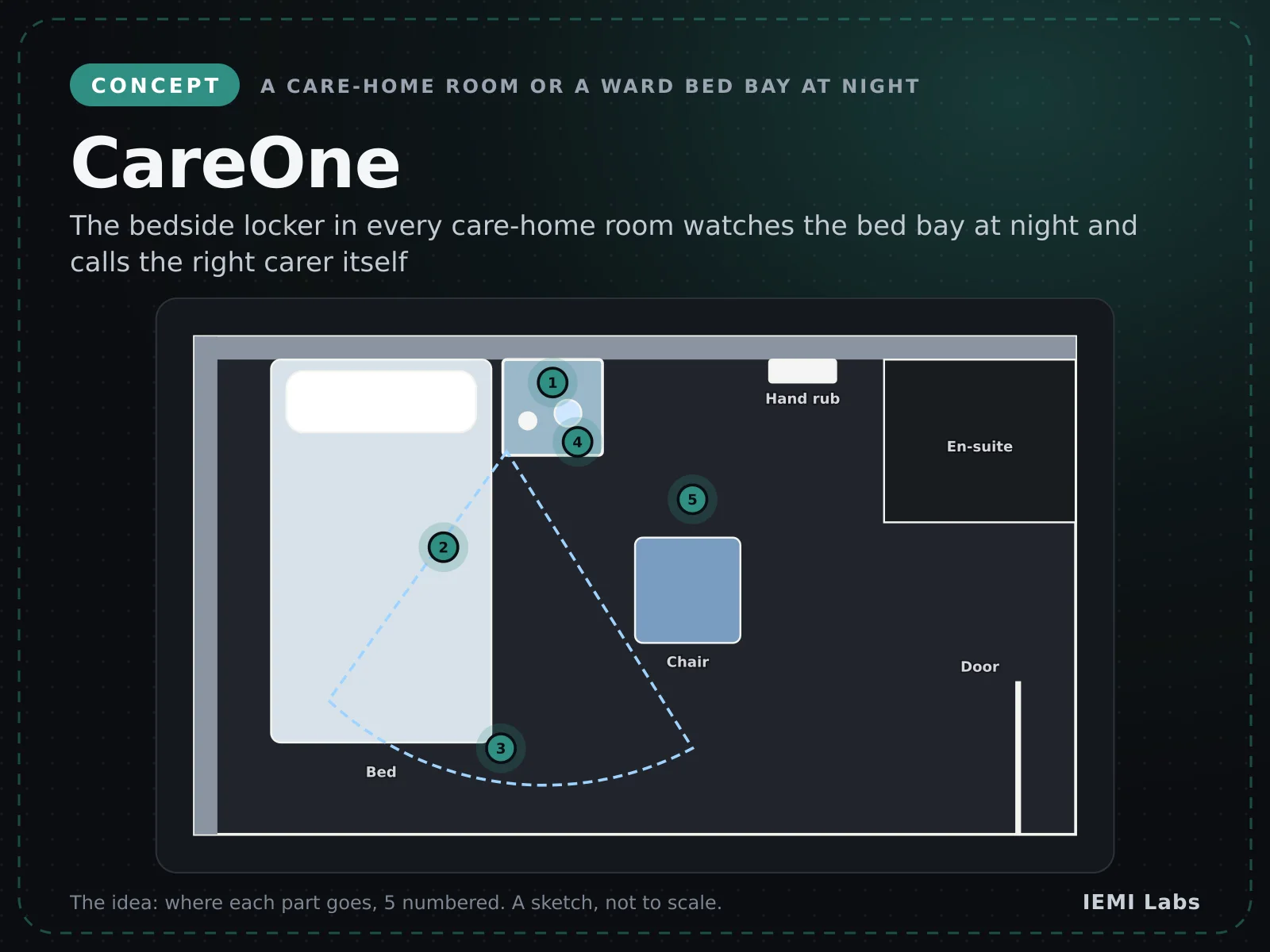
    CareOne concept: the idea and where each part goes
    SensingConcept

    CareOne

    IEMI's one product for care homes and hospital wards: the bedside locker, made smart, with one brain and one app.

    • Calls a bed exit before the resident stands, and someone on the floor
    • Takes calls with a reason and a voice note
    • Fills the turn, fluid, hand-rub and night check logs

    From $590 per smart bedside locker

    Details
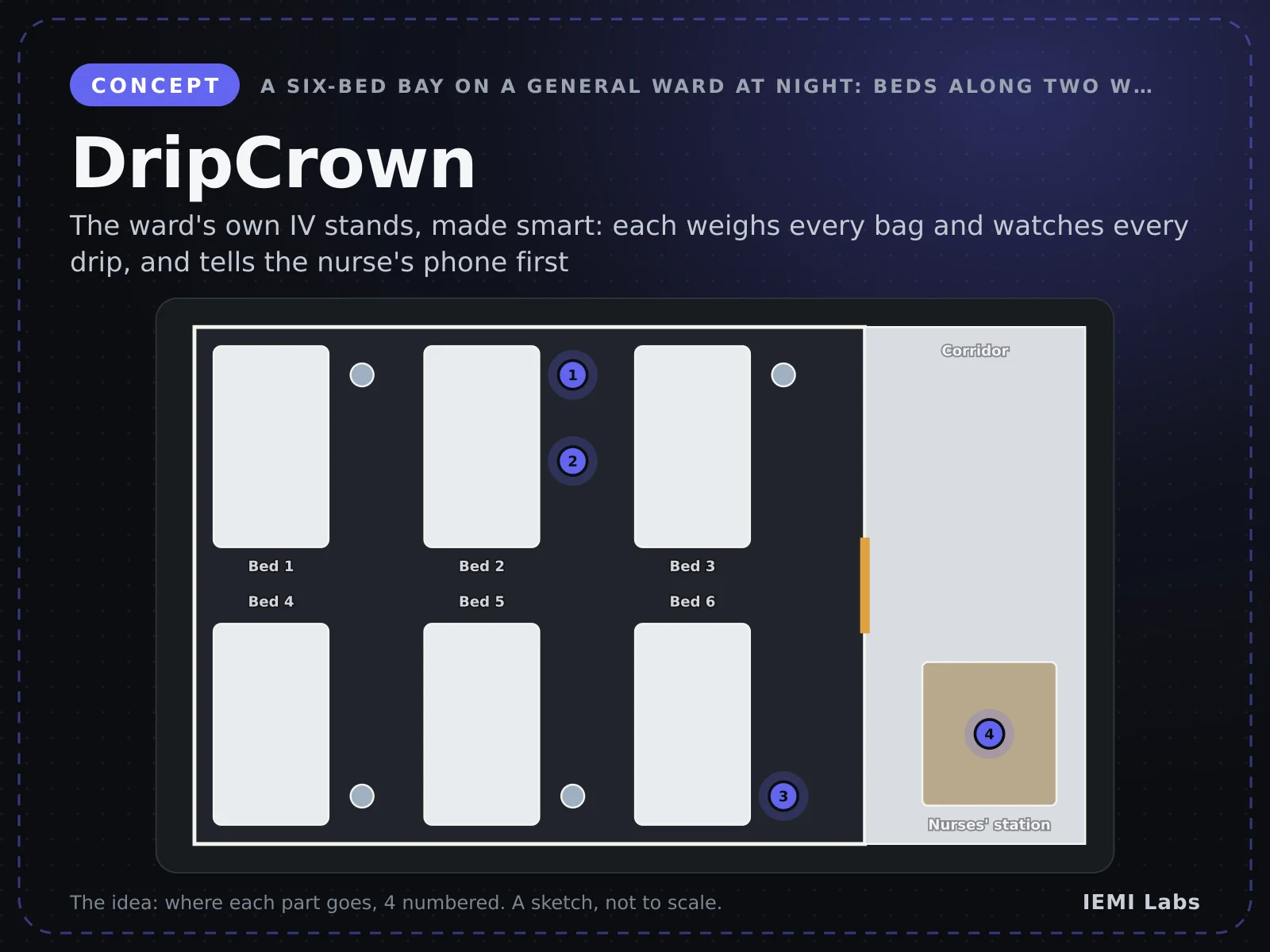
    DripCrown concept: the idea and where each part goes
    SensingConcept

    DripCrown

    A smart top for an existing IV stand that weighs each bag, plus a clip-on camera that counts drops.

    • Shows mL left and time to empty
    • Measures the real drip rate
    • Alerts on drift, stop or free flow

    From $249 per Bed Kit

    Details
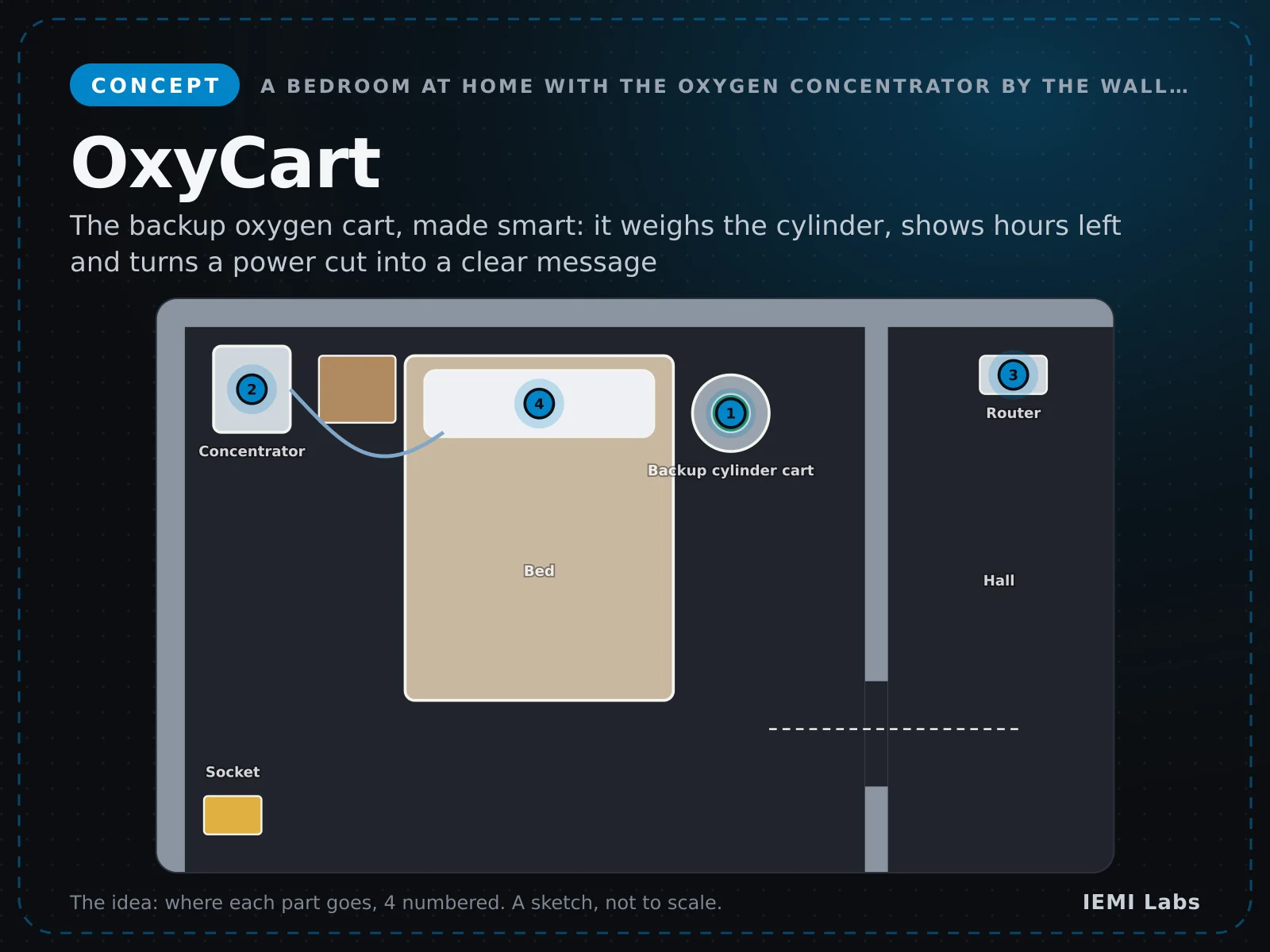
    OxyCart concept: the idea and where each part goes
    SensingConcept

    OxyCart

    A home oxygen cylinder cart with a built-in scale and a small sensor for the concentrator outlet.

    • Shows oxygen hours left
    • Measures the real flow
    • Alerts family in a power cut

    From $129 per cart

    Details

    BagPost

    Concept · target $79

    I want this