VisionConcept
QualityCheck AI
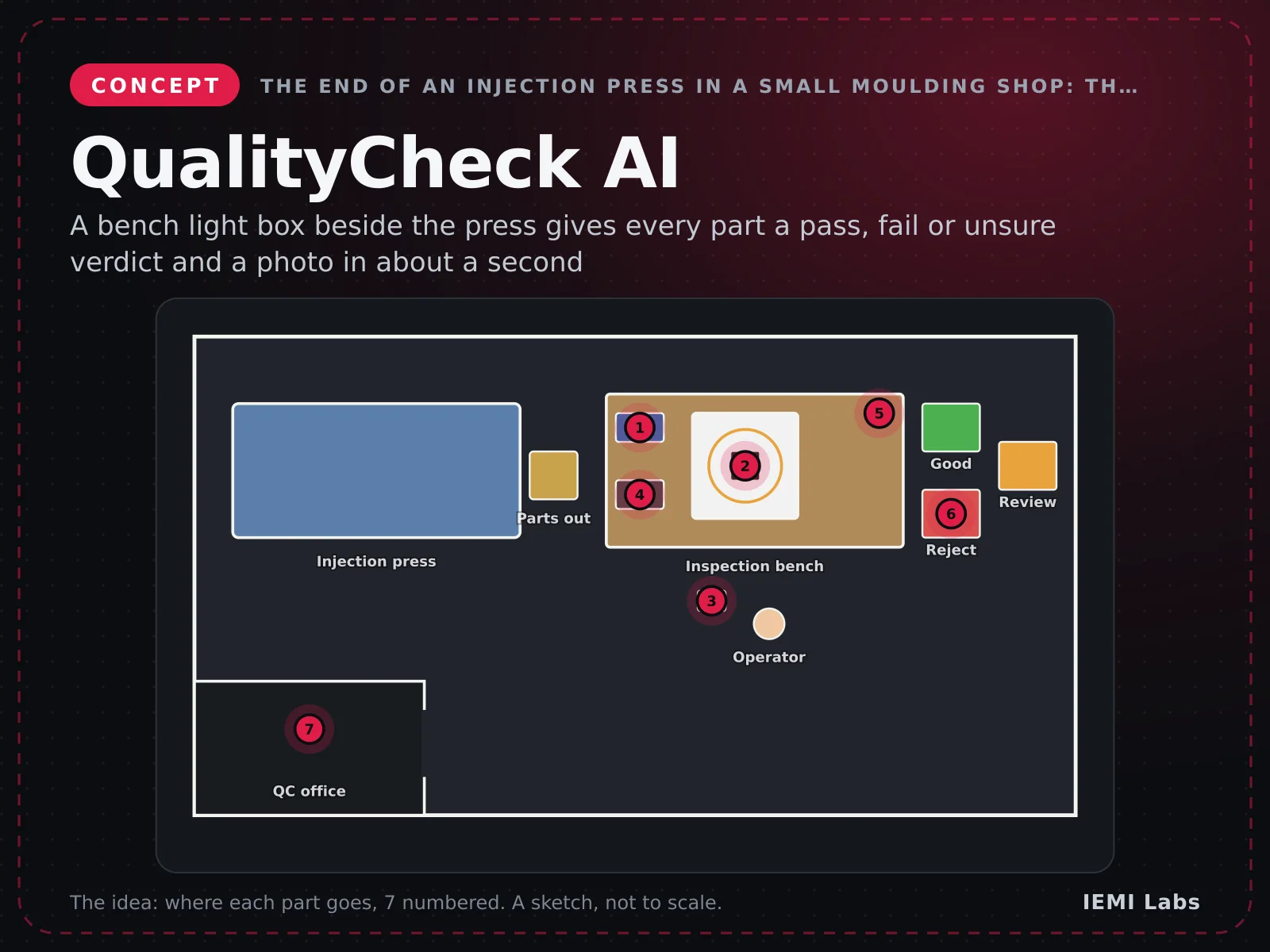
A compact camera with its own light that mounts above a production line.
- Spots defects on every part
- Checks parts are fully assembled
- Verifies labels and barcodes
From $2,499 per station
DetailsIEMI's one product for a machine cell: the machine's own signal tower, made smart
Software: $29 per month per machine (cell app)
Concept, not for sale yet. Tell us if you want it; that decides what we build.
Rate this idea and tell us what to change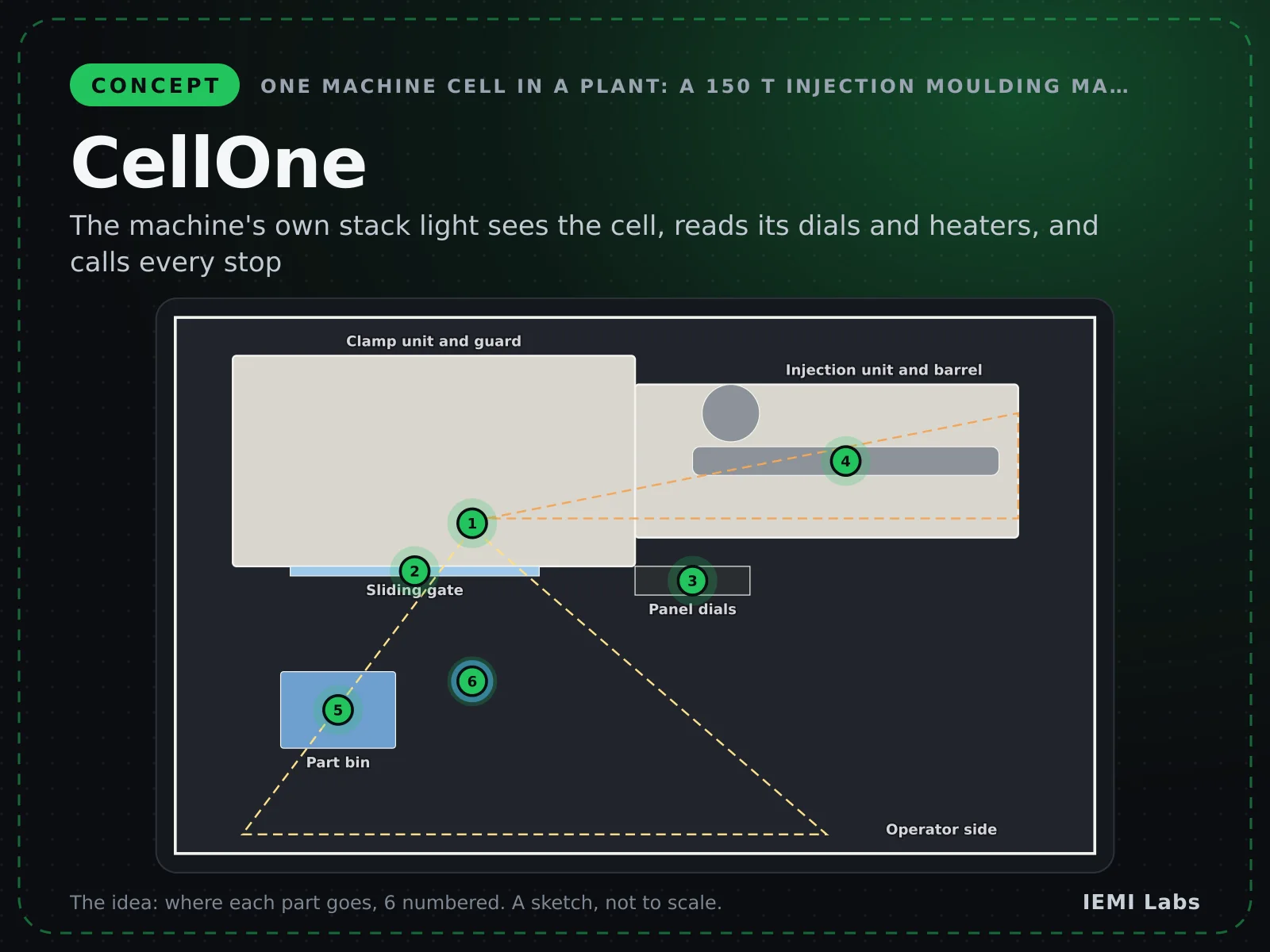
Drag to rotate · right-drag to move · scroll to zoom · click a part for its size and placeSwipe to rotate · pinch to zoom · two fingers to move · tap a part for its size
How it fits together
Scroll or tap a part. Press “See the 3D CAD design” to watch the model, built from our CAD, light each part up and show how it connects.
Real-time 3D render · drag to rotate · final design may varySwipe sideways to rotate
01
The whole CellOne
The machine's signal tower runs the cell: the four lamp lines tell it what the controller says, a cell camera and a heat camera in the sensor tier see the gate, the dials, the heaters and the bin, and the brain in the base turns that into state, gate, dial, heat and bin calls on the tower's own lamps and one cell app.
02Brain
Our tower board: the Rockchip RV1126B on the base disc
The brain: it runs the cellone-fw program
03
Cell camera
Looks 45 degrees down to the operator side: the gate, the operator, the hydraulic pressure and oil temperature dials, the part bin and the floor in front
Our tower board: the Rockchip RV1126B on the base disc · the board's own riser flex (2-lane MIPI CSI-2, no ribbon) · 2 fps frames checked on the RV1126B AI engine; 10 s clips around calls
04
Heat camera and mic
The heat camera looks along the barrel at the heater bands, nozzle and hopper dryer; the mic hears the machine's alarm beep and air hiss
Our tower board: the Rockchip RV1126B on the base disc · I²C over the wall flex (heat chip) + PDM over the mic flex (digital mic) · 32 x 24 heat frames at 2 Hz; sound level and short clips
05
Tier-line inputs
Read the four 24 V lamp lines the machine controller already drives through isolated 24 V inputs (IEC 61131-2 type), so the tower knows run, alarm, auto and operator calls exactly as the controller means them
Our tower board: the Rockchip RV1126B on the base disc · GPIO through the isolation barrier · Four line states at 20 Hz
06
Cycle and strike sensor
Feels each machine cycle through the guard (the count and cycle time) and logs knocks and strikes on the tower
Our tower board: the Rockchip RV1126B on the base disc · SPI on the base disc · Cycle times; knock g level and time
07
Lamp tiers, tone and secure element
The red, yellow, green and blue tiers show the machine state as before and flash each call, with a tone; if the brain stops, a watchdog hands each tier straight back to its controller line; every call signed; the tamper switch marks the log if the tower is opened
Our tower board: the Rockchip RV1126B on the base disc · The centre spine flex (four lamp lines and the sounder) + I²C and GPIO on the disc · Tier colour and flash, tone, signatures, tamper flag
08
Power from the tower lead
Takes the machine's own 24 V DC tower feed through the tower's M12 socket, makes 5 V, and keeps the brain alive about 2 s (est.) on supercapacitors to sign the power-off
Our tower board: the Rockchip RV1126B on the base disc · 5 V rail on the base disc · Power, about 3 W (est.)
09
All connected
7 key parts, one program, and your phone
Our circuit board · rev A-0
Every chip on one board we design, shaped to fit: the processor, cameras and sensors, Wi-Fi and Bluetooth, lights, sound and power. No plugs, ribbons or adapters. It is checked in our CAD against every part around it, and it arrives from the maker ready to run our software from a microSD card. Turn the model, or pick a part below to see where it sits.
Loading the 3D board…
Drag to turn · scroll to zoom · right-drag to move · click a partDrag to turn · tap a part
Every board-level number CellOne's jobs depend on, checked against its target: camera pixels and frame rate, power and battery life, heat where it works, shock, radio and software. Every lesson from every one of our boards is a rule here, so this review runs again whenever any board teaches us something. Boards are ordered only when nothing fails and the items to prove are measured.
| Area | Check | Our board | Target | Status |
|---|---|---|---|---|
| Camera | Colour camera: a dial face (60 mm) on the machine at 2 m | 42.4 px | ≥ 30 px | passes |
| Camera | Colour camera: frame rate the calls need | 2 fps at 2592 × 1944 | chip: 30 fps at 2592 × 1944 | passes |
| Camera | Colour camera: data rate vs its 2-lane link | 0.1 Gbps (10-bit) | ≤ 80 % of 2 Gbps | passes |
| Camera | Heat camera: one heater band (60 mm) on the barrel at 1.5 m | 0.7 px | ≥ 0.5 px | passes |
| Camera | Image processor load, all cameras | 10 Mpx/s | ≤ 360 Mpx/s (RV1126B ISP) | passes |
| Camera | AI engine time per frame | 3 TOPS | dial and bin models at 2 fps | to prove on the dev kit |
| Power | Supply | the machine's 24 V tower feed (19.2–30 V) | the IEC 61131-2 range | passes |
| Power | Power cut | supercapacitors keep the brain alive about 2 s (est.) | sign the power-off event and close files | to prove on the dev kit |
| Heat | RV1126B temperature, a 40 °C machine shop | 66 °C | ≤ 85 °C (rated) | passes |
| Shock | Shock and vibration | 50 g (est.) | standard parts | passes |
| Software | Starts our software from the microSD card, no setup | microSD socket with a hinged, latched lid (Amphenol 101-00660 class), fitted on every board: our software starts from the card | card socket fitted on every board, latched | fixed by the review |
| Software | Card power switch and protection | 1 power switch and 1 ESD array for 1 card socket | every socket: switched card supply, ESD on all 6 lines | fixed by the review |
| Software | The card wins the start | eMMC shipped empty; our loader reads the card first | the processor starts from the card every time | fixed by the review |
| Software | Card grade | industrial pSLC microSD (Kingston Industrial or Swissbit S-56u), −40 to 85 °C | rated for the heat, cold and writes | to prove on the dev kit |
| Radio | Wi-Fi/BT module clock | 37.4 MHz MEMS oscillator (Y3) | 37.4 MHz next to the AP6256 | fixed by the review |
| Radio | Wi-Fi to the shop's access point | across a machine shop | certified Wi-Fi 5 module | to prove on the dev kit |
| Moisture | Conformal coating | coated | coated, sensors, sockets and antennas masked | passes |
| Fit | Board inside the product CAD, every part checked in 3D | no part touches a wall or a bought part (2026-11-03) | nothing touches | fixed by the review |
Before we order the first boards, we prove these on the RV1126B development kit or in the rev A tests:
Demo · 6 real-world moments
Short animated scenes of real moments: what happens today, what CellOne does about it, and what lands on your phone. The same scenes play in the IEMI app.
Press 7, day shift, running 18.4 s cycles. At 11:04 it stops: the hopper has run dry.
Use cases
Stops are written on a sheet at the end of the shift, if at all, so 'no material' and 'mould change' disappear into one number nobody trusts.
The tower reads the controller's own lamp lines and the cycle rhythm, so it knows running, idle, down or alarm within 2 s and counts every cycle. When the press stops, the cell camera suggests a reason and the tower blinks blue for the operator to confirm with one tap.
Only the machine's interlock stands between the setter and the mould; nobody sees the habit until the day the interlock has a fault.
The cell camera sees a person at the open gate and the lamp lines say the press is in auto. In under 1 s the blue tier flashes with a tone. It is a warning only, never a stop: the machine's own interlocks protect the setter either way, and the tower never touches them.
Nobody notices until short shots start filling the bin, an hour of scrap later.
The heat camera in the tower watches the barrel's heater bands, and the cell camera reads the panel's dials every 4 s. Zone 2 at 188 °C, 25 °C under its band, turns the yellow tier on with a short tone before short shots start. A shiny band or blocked view is 'check', not a call.
The handler walks a fixed round, so one press runs out of material while another's bin overflows onto the floor.
Each tower's cell camera watches its own hopper and bin. Hopper low or bin full turns the blue tier steady, meaning the operator or handler should act, and sends the call in under 30 s. A bin out of view is 'check'.
The supervisor walks the floor once an hour; whatever happens in between is found in the morning scrap bin.
Each tower runs its own cell: it logs runs and stops with cycle counts, asks for a stop reason, turns yellow when a dial or heater band leaves its band, warns once at an open gate, and sends machine alarm beeps to maintenance as a clip to listen to.
Air leaks run for weeks on the compressor bill, and alarm beeps go unanswered until someone walks past.
The tower's mic listens for machine alarm beeps and air hiss near its machine, and its motion sensor feels knocks. These calls are never made alone: each goes to maintenance as a short clip to listen to, and a person decides.
Demo scenes show how CellOne and its app are designed to behave. CellOne is in design; nothing here is recorded from real equipment yet.
What it is
IEMI's one product for a machine cell: the machine's own signal tower, made smart, with one brain and one app.
What it does
Who it's for
Moulders, machine shops and small plants.
The idea
The problem today
Small plants still find out about stops, cold heater bands and dials out of band by walking the floor. Machine monitoring costs about $125 to $150 per machine per month (Guidewheel, MachineMetrics), and dial readers, heat sensors and wireless tower transmitters are separate boxes with their own apps.
With CellOne
Every machine already has a signal tower on its guard. CellOne puts a camera, a heat camera, a mic and the brain inside that tower, so it logs every run, stop and cycle, reads the panel dials, watches the heater bands, warns when someone is at an open gate in auto and calls the bin full, on its own lamps and in one app.
How the parts connect
Every part, what links it to the brain, and how the data reaches your phone. A solid line is a cable; a dashed line is a radio link.
The program
while True:
    lines = tiers.read()                     # what the controller says
    cycles.feed(imu.read())
    calls = state_rule(lines, cycles)
    if frame_due():
        f, h = cam.frame(), heat.frame()
        calls += gate_rule(f, lines.auto) + dial_rule(f) + bin_rule(f)
        calls += heat_rule(h) + sound_rule(mic.level())
    for c in calls:
        if c.conf < c.line: c.kind = 'check'   # never guess
        secure.sign(c); tower.show(c); app.send(c)
    time.sleep(0.05)
To your phone
Supervisor and maintenance phones, the plant manager's tablet and a TV on the shop floor (Android, iPhone, web)
One screen for each job CellOne does.
No supervisor on the floor modeNight shift, one supervisor for 24 machines. Each tower logs its own runs and stops, asks for a stop reason, flags a cold heater band and warns once at an open gate.
Machine state and OEEThe plant manager checks the morning: press 7 ran 6 h 12 min with 1,912 cycles; two short stops were no material.
Gate warnings07:52: a setter leans in at the open gate while press 3 is still in auto. The tower flashes blue with a tone; the machine's own interlock is untouched.
Dials and heatPress 5's barrel zone 2 drops to 188 °C after a band fails; the tower turns yellow before short shots start. The hydraulic dial reads 142 bar, in band.
Bin and materialThe towers on presses 1 to 6 show which bins are nearly full and which hopper is low, so the material handler goes to the right machine first.
App screens with sample data. The interface is in development.
| Machine state and OEE | Press 7: running 6 h 12 min, down 38 min, 1,912 cycles at 18.4 s | Live and per shift |
|---|---|---|
| Stops and reasons | 11:04 down 14 min: no material (confirmed) | Live |
| Gate warnings | Press 3: person at the open gate in auto, 07:52 (clip) | Live |
| Dials | Hydraulic 142 bar (band 120-160), oil 52 °C | Every 4 s |
| Heat | Barrel zone 2 at 188 °C, 25 °C under its band | Live |
| Bin and material | Bin 90 % full; hopper low | Live |
No face recognition. People are found only for the gate warning. Clips around calls are kept 14 days in the plant's own account; a staff notice label sits on each tower.
CAD design · Stage 2 ready, 29 Oct 2026: smart Ø70 machine signal tower that runs the cell (7 calls, 5 alone, 2 assist; EU 2027 machine and cyber rules checked 30 Oct), lamps and tone, ATECC608 and tamper switch inside; 10 camera views checked in the CAD; not built
| AI processor | One board of our own up the tower: Rockchip RV1126B (3 TOPS AI engine) on the base disc, with memory, storage and Wi-Fi/Bluetooth. The bench tower uses a Pi Zero 2 W until the boards arrive |
|---|---|
| Sensors | Sony IMX335 5 MP colour camera chip (dials, part bin, operator side) · Melexis MLX90640ESF-BAA heat camera, 32 × 24, 110° (barrel bands, nozzle, feed throat, dryer) · Infineon IM69D130 mic and ST LSM6DSOX motion sensor · Four isolated 24 V tier inputs and the lamps of all four tiers, a sounder, a security chip and a tamper switch |
| Connectivity | Plant Wi-Fi (WPA3), MQTT over TLS · BLE for admin pairing |
| Power | The machine's own 24 V tower feed (19.2–30 V): about 3.0 W running, 4.2 W calling; supercapacitors hold the brain about 2 s at switch-off (est.) |
| Enclosure | The tower's own Ø70 elements: black PC/ABS base, sensor tier and cap, translucent PC lamp tiers |
| Dimensions | Ø70 x 446 mm: 80 mm base, five 66 mm elements, 36 mm cap |
| Weight | About +90 g over a plain 5-element tower (est.) |
| Ingress rating | IP65 target, as a plain tower |
| State | Running, idle, down, alarm, cycles, OEE |
|---|---|
| Gate | Person at the open gate in auto (warning) |
| Dials and heat | Two panel dials, heater bands, dryer |
| Bin | Bin full, hopper low |
| Colours | IEC 60204-1 / NFPA 79 meanings kept |
|---|---|
| Size | Ø70 x 446 mm, same bracket and lead |
| Privacy | No face recognition; staff notice |
| Not | A safety device; the interlocks stay |
| Records | Signed software version and five-year change record |
| Size | Ø70 x 446 mm, 5 elements, 3 x M5 bracket |
|---|---|
| Power | 24 V DC tower lead; 3.0 W running, 4.2 W during a call (est.) |
| Brain | Raspberry Pi Zero 2 W in the base |
| Parts cost | $309 per tower at qty 1 (checked 29 Oct 2026) |
Targets for production units; they may change during development.
Hardware: $790 per machine (replaces its signal tower)
Software: $29 per month per machine (cell app)
Target pricing. Bought separately per machine: MachineState ($150 + $19/month), GaugeRead for two dials ($349 + $16/month), a heat watch (PanelHeat $690 + $12/month), a plain 5-tier tower (about $112) and a wireless tower transmitter (about $402): about $1,703 + $47/month (est.).
$790 + $29/month
Every cell job in the machine's own signal tower.
Indicative launch pricing in USD, excluding taxes and shipping. Final pricing is confirmed before any balance is charged.
Community
CellOne is in development. Rate the idea, tell us what to change about the features, specs or price, and we'll build it with your feedback.
How much people want it
–
No ratings yet
Follow CellOne
Get build updates and first access when pre-orders open.
No comments yet. Tell us what you'd want from CellOne.
Questions
Tell us what this would save you, or ask anything. We reply within two business days.
A member of the IEMI Labs team will reply within two business days.
From the product lab · ideation phase
Smart equipment · legal on the field
It replaces the machine's existing Ø70 signal tower (for example a WERMA KombiSIGN 71 or a Patlite LR7), on the same bracket, the same three M5 holes and the same 8-pin 24 V lead from the machine controller, with every part built in. Everything inside the Ø70 tower: Raspberry Pi Zero 2 W, cell camera, heat camera, mic, tier-line reader, cycle sensor, four lamp sticks, tone, secure element, tamper switch and the 24 V to 5 V supply. About +90 g over a plain 5-element tower (est.); no pole camera, panel box, motor puck or light box.
| Rule | Limit | CellOne |
|---|---|---|
| Indicator colours and meanings (IEC 60204-1 10.3, NFPA 79 10.3) | red emergency or danger, yellow abnormal, blue mandatory action, green normal | ✓ the same four lamp tiers, driven by the machine controller's own four 24 V lines exactly as before; CellOne's own calls flash on top of them and never change what a steady lamp means (the CAD asserts red is the top tier) |
| Machine guarding (OSHA 29 CFR 1910.212, ISO 13849 safety functions) | guards and interlocks protect the operator; a camera is not a safety device | ✓ the machine's interlocked gate, light curtains and e-stops stay and are never wired to CellOne; its gate warning is a flashing lamp and a tone, and it makes no safety claim |
| Same size and installation as the plain tower | Ø70 mm elements of 66 mm, 36 mm terminal element (WERMA 644.140.55 and 640.810.00 datasheets), the same bracket and 8-pin lead | ✓ Ø70 x 446 mm with the base, five 66 mm elements and a 36 mm cap; the CAD asserts the Ø70 profile and the height; the same 3 x M5 bracket holes and 8-pin lead |
| Electrical (NFPA 79 / UL 508 / UL 61010-1) | SELV 24 V DC tower supply from the machine; listed component | ✓ runs only on the machine's 24 V DC tower feed (Pololu D36V28F5 inside); no mains in the tower; listing tests in the first build |
| Ingress (IEC 60529) as a plain tower | IP65 for towers on machines with coolant mist | ✓ IP65 target: windows bonded flush, bayonet seals as the plain elements; mic behind a membrane |
| Cameras watching workers (New York Civil Rights Law 52-c, Connecticut 31-48d, GDPR where it applies) | written notice to staff, stated purpose, data minimised | ✓ notice label on the base and a staff notice in the app; no face recognition; only clips around calls kept, 14 days |
| Radio (FCC Part 15 / RED, with the RED cybersecurity delegated act (EU) 2022/30, in force for products placed on the EU market from 1 August 2025) | certified modules; for the EU, network protection, data protection and no misuse of the network (EN 18031-1 and -2) | ✓ Wi-Fi and BLE on the Raspberry Pi Zero 2 W's certified module; no inbound ports, WPA3 and TLS 1.3, no default password (each tower is paired by the plant admin), so the tower is built to EN 18031-1 and -2; the assessment is done with the radio tests in the first build |
| EU Machinery Regulation (EU) 2023/1230, Annex III 1.1.9 (protection against corruption) and 1.2.1 (control systems), applies from 20 January 2027 | a device connected to the machine must not make it hazardous; safety software and data protected against tampering, the installed safety software identifiable, legitimate and illegitimate interventions recorded, and logs kept five years | ✓ CellOne only reads the four tier lines through high-resistance dividers and has no wire back to the controller, the guards or the interlocks, so a corrupted tower cannot change what the machine does; its own software version is signed and shown in the app, and every update, setting change and tamper event is signed in an append-only change record kept five years (call clips still 14 days). The machine builder's own assessment decides conformity |
| EU Cyber Resilience Act (EU) 2024/2847: Article 14 reporting applies from 11 September 2026, the other duties from 11 December 2027 | the maker reports an actively exploited vulnerability or a severe incident to its CSIRT and ENISA within 24 hours, for products already on the market too; from December 2027, secure by design with security updates for the support period | ✓ IEMI keeps a security contact and a written 24-hour reporting plan before the first EU sale; signed updates with rollback, only while the machine is idle or off; a stated support period on the page and in the app |
Production machines in plants (injection moulding, CNC, presses, packaging). Listing and radio tests before sale. CellOne warns and records; the machine's own guards, interlocks and e-stops keep the operator safe, and it makes no safety claim.
One piece of equipment does
Not done by the equipment, and why
Makes the call itself
With no supervisor or maintenance tech at the machine, the tower runs the cell: it logs running, idle, down and alarm with the time and cycle count, flashes blue with a tone when a person stands at the open gate while the machine is in auto, turns yellow when a dial or heater band leaves its band, and calls the bin full or out of material. A stop reason, air hiss and odd knocks go to a person to confirm.
| Call | Who decides | How it sees it | How players see the call · if unsure |
|---|---|---|---|
| Machine state: running, idle, down or alarm, with cycle count< 2 s · about 99 % (est.) | The equipment | four 24 V tier lines through the ADS1115, LSM6DSOX cycle rhythm, cell camera; state rules on the tier lines + cycle detector on the vibration rhythm | The tower's own lamps as the controller drives them; a short green blink per counted cycle. Tier lines and rhythm disagree: 'check' to the supervisor, the state kept as the controller shows it |
| Stop reason (no material, mould change, no operator, alarm)< 10 s · about 80 % (est.) | Helps the official | cell camera, mic, tier lines; stop-reason classifier on the 30 s before the stop | Blue blink: reason to confirm. Always a suggestion the operator confirms with one tap in the app |
| Person at the open gate while the machine is in auto< 1 s · about 95 % (est.) | The equipment | cell camera, tier lines (auto mode); person and gate-open detector (no faces) | Blue tier flashing with a tone; warning only, never a stop. Under 85 % confidence: logged as 'check', no lamp; the machine's interlocks protect the operator either way |
| Hydraulic pressure or oil temperature dial out of band< 5 s · about ± 2 % of scale (est.) | The equipment | cell camera; dial needle reader on a 4 s crop | Yellow tier flashing; the reading in the app. Glare or a blocked dial: 'cannot read', no call |
| Heater band cold or too hot, nozzle or hopper dryer heat< 10 s · about ± 3 °C on painted bands (est.) | The equipment | MLX90640 heat camera; zone temperature against the learned band | Yellow tier flashing with a short tone. Shiny band or a blocked view: 'check', no call |
| Bin full or out of material< 30 s · about 90 % (est.) | The equipment | cell camera; bin fill and hopper level estimate | Blue tier steady: operator action. Bin out of view: 'check' |
| Machine alarm beep, air hiss or an odd knock< 5 s · about 75 % (est.) | Helps the official | MAX9814 mic, LSM6DSOX; sound and knock classifier | App only. Always sent to maintenance as a clip to listen to |
Nothing added to the field
The only things in play are the items the laws already put there:
The machine, its guards, gate, panel, dials, chute and bin stay as they are; no pole camera, panel box, motor puck or light box
Built to take the hits
Secure by design
A wireless tower such as the Banner TL70 (about $561) reports lamp state and counts parts; monitoring software such as Evocon ($189-319 per machine a month) or FourJaw (£36-90) needs its own sensors and a monthly plan. CellOne is the tower itself: it logs state and cycles, reads the dials, watches the heater bands and the bin, and flashes each call on its own lamps.
$790 per machine, replacing its signal tower, plus $29 a month for the cell app (target). Bought separately, a plain tower, a wireless transmitter, machine state, two dial readers and a heat watch come to about $1,703 + $47 a month (est.).
No. The gate warning is a flashing lamp and a tone. The machine's own interlocks, light curtains and e-stops keep the operator safe and are never wired to CellOne.
MachineState: its stack-light state, cycles and OEE now come from the machine's own tower, which also reads dials, heaters and bins. Starter panels and compressors (PlantNode, PanelHeat, AirLeak), motor bearings (MotorPulse) and part inspection (QualityCheck, LineCell) are other zones and stay listed.
Yes. The controller drives the red, yellow, green and blue tiers exactly as before (IEC 60204-1 and NFPA 79 meanings). CellOne's own calls flash on top and never change a steady lamp.
No. People are found only for the gate warning. Clips around calls are kept 14 days and a staff notice label sits on each tower.
It is designed for them; the tests come with the first build. From 20 January 2027 the EU Machinery Regulation asks that a device connected to a machine cannot corrupt it and that every change is recorded. CellOne only reads the tower's four lamp lines and has no wire back to the controller or the interlocks, signs its software version, and keeps a signed record of every update, setting change and tamper event for five years. Under the Cyber Resilience Act, IEMI reports an actively exploited flaw within 24 hours (since 11 September 2026). The machine builder's own assessment decides conformity.
A clip-on sensor such as Advantech's WISE-S100 ($107.70) reads only which lamps are lit, and still needs a gateway and monitoring software. CellOne is the tower itself: it gives the same state and cycles, and also reads the dials, watches the heater bands and the bin, and flashes its calls on its own lamps, for $790 + $29 a month.
It says 'check' and keeps the clip for the supervisor. A stop reason is always a suggestion the operator confirms.
A compact camera with its own light that mounts above a production line.
From $2,499 per station
Details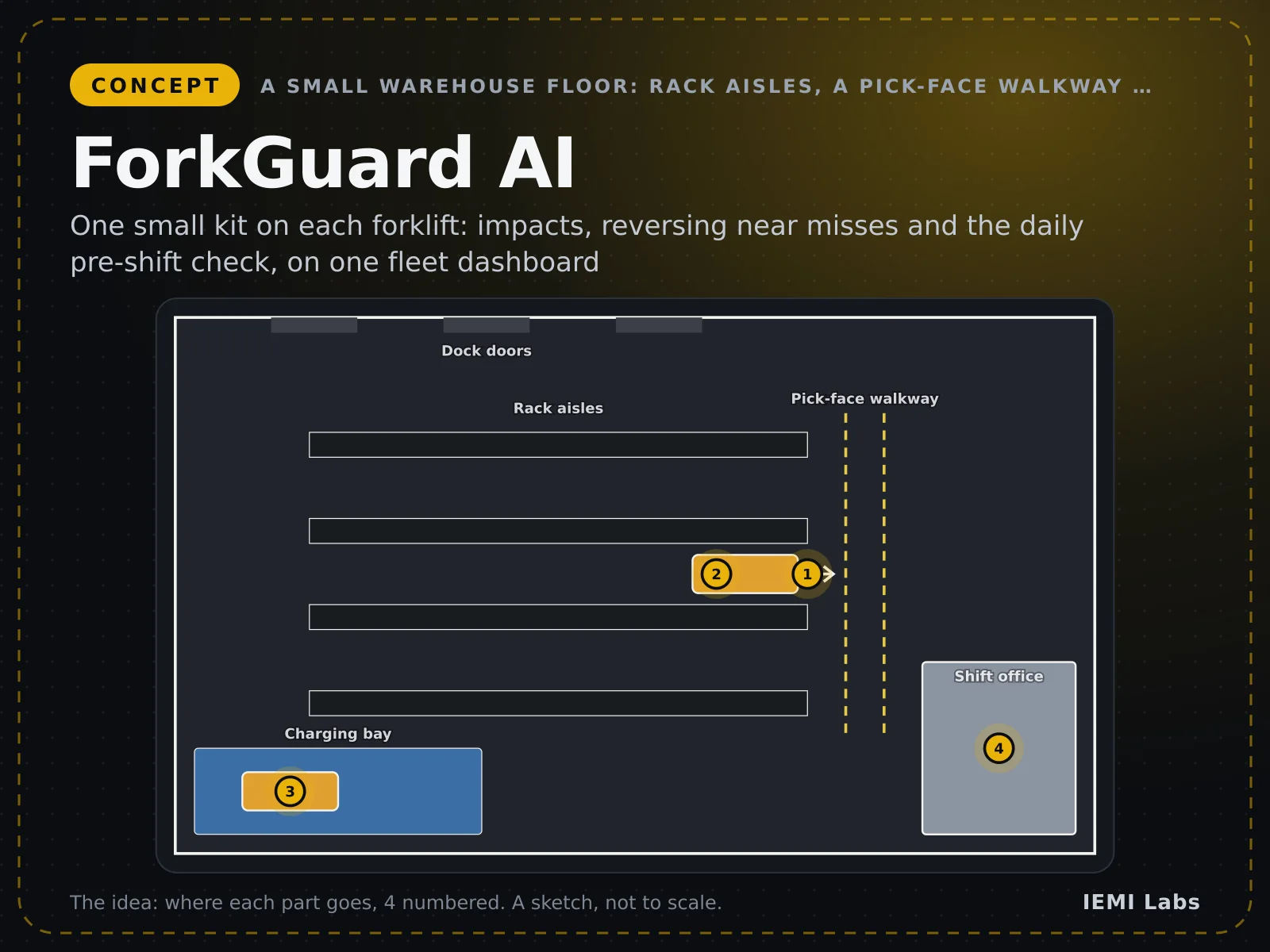
A rugged camera for the forklift roof with an in-cab display that warns of pedestrians.
From $799 per forklift
Details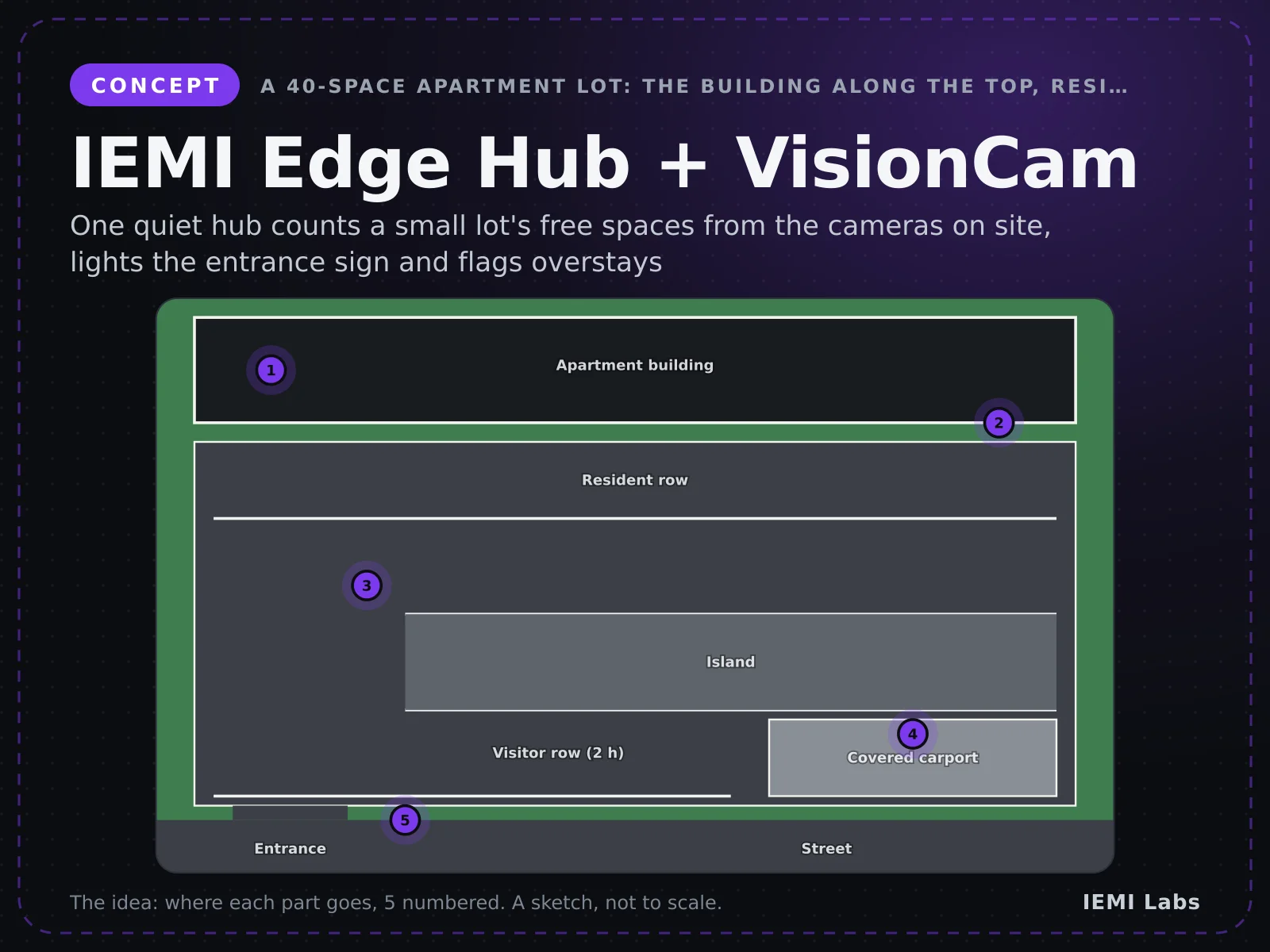
An on-site AI box for up to 8 cameras that sends events, not video, starting with parking.
From $1,190 LotWatch installed kit
DetailsCellOne
Concept · target $790