
VisionConcept
ParkSense AI
A palm-sized edge box that plugs into your existing parking cameras.
- Counts free bays in real time
- Flags overstays and wrong parking
- Guides drivers to open spaces
From $499 per edge box
DetailsIEMI's one product for a construction site: the site's own entry turnstile, made smart
Software: $99 per month per entrance (app, LTE-M and calls)
Concept, not for sale yet. Tell us if you want it; that decides what we build.
Rate this idea and tell us what to change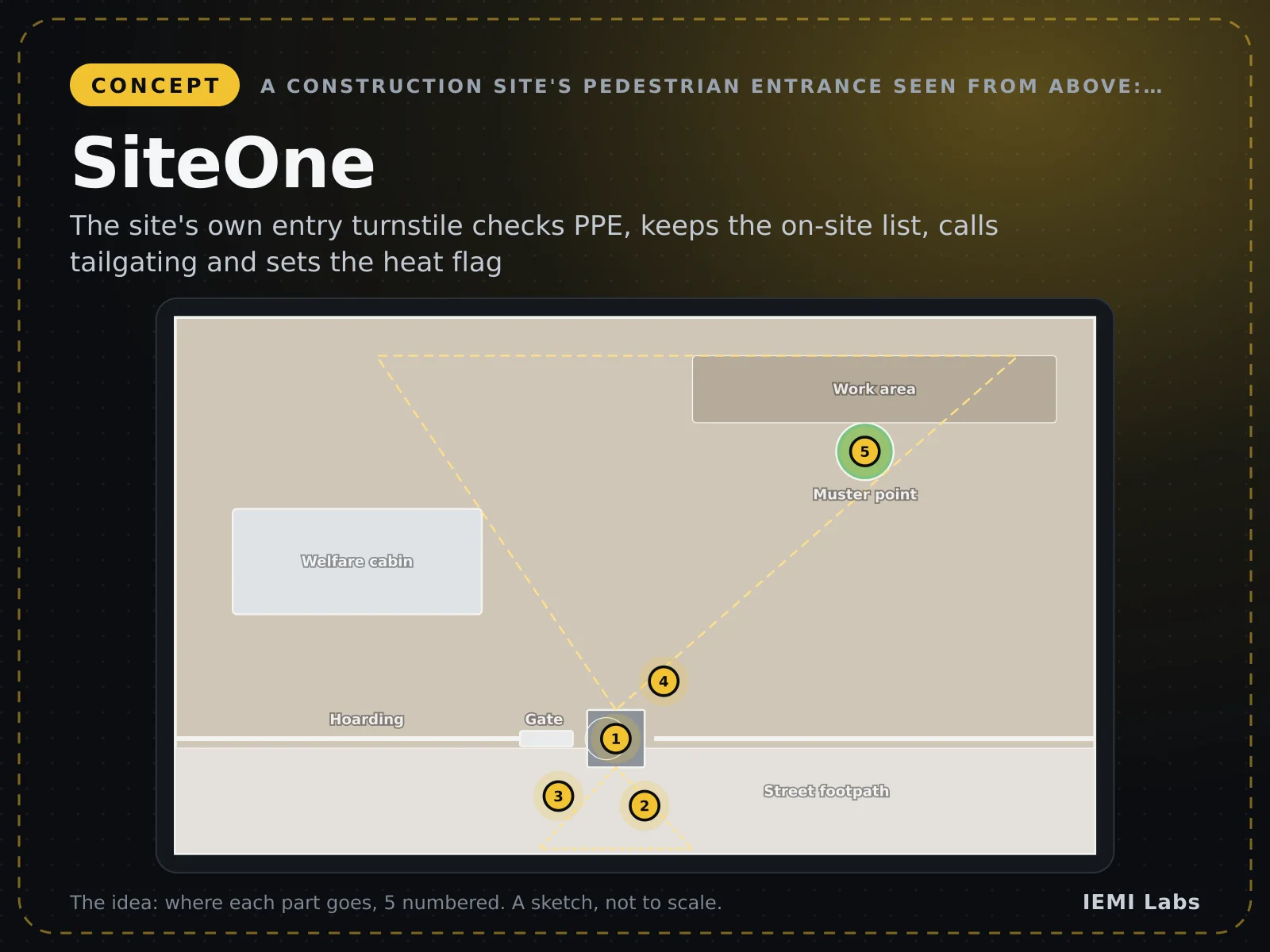
Drag to rotate · right-drag to move · scroll to zoom · click a part for its size and placeSwipe to rotate · pinch to zoom · two fingers to move · tap a part for its size
How it fits together
Scroll or tap a part. Press “See the 3D CAD design” to watch the model, built from our CAD, light each part up and show how it connects.
Real-time 3D render · drag to rotate · final design may varySwipe sideways to rotate
01
The whole SiteOne
The site's own full-height entry turnstile runs the gate: an entry camera on the street face checks PPE as people walk up, a radar in the canopy floor counts people in each turn, a tap reader in the reader head keeps the on-site list, heat, dust and sound sensors behind the side vents read the site's conditions, a site camera watches for smoke and the muster point, and the brain in the canopy turns that into PPE, on-site, tailgating, after-hours, heat, dust, smoke and noise calls on the turnstile's own lights and one app, over LTE-M.
02Brain
Raspberry Pi 5 (on the turnstile canopy floor)
The brain: it runs the siteone-fw program
03
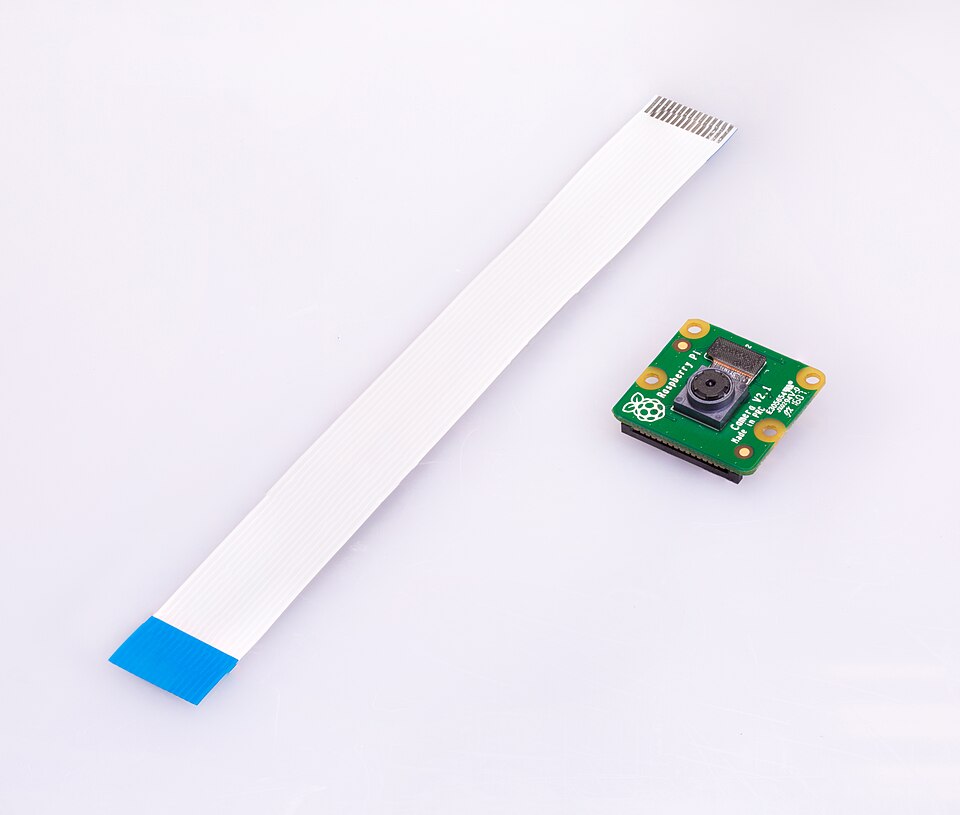
Entry and site cameras
The entry camera on the street face, 35 degrees down, sees hard hat, hi-vis and boots as each person walks up; the site camera on the site face, 20 degrees down, watches over the site for smoke and the muster point
Raspberry Pi 5 (on the turnstile canopy floor) · CSI-2 ribbons (both on the Pi 5's two camera ports, inside the canopy) · Entry frames at 10 fps while someone is at the reader; a site frame every 5 s; 10 s clips around calls
04
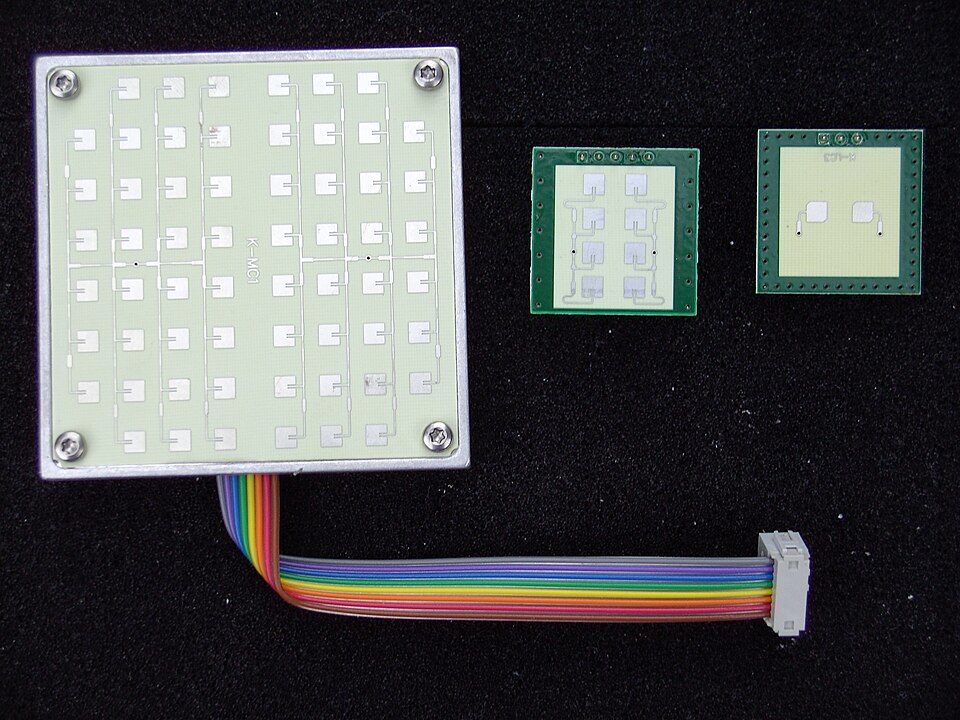
Rotor radar
Looks down through a window in the canopy floor into the passage: how many people are in each turn, and the head count
Raspberry Pi 5 (on the turnstile canopy floor) · UART · Up to 3 targets with position at 10 Hz
05
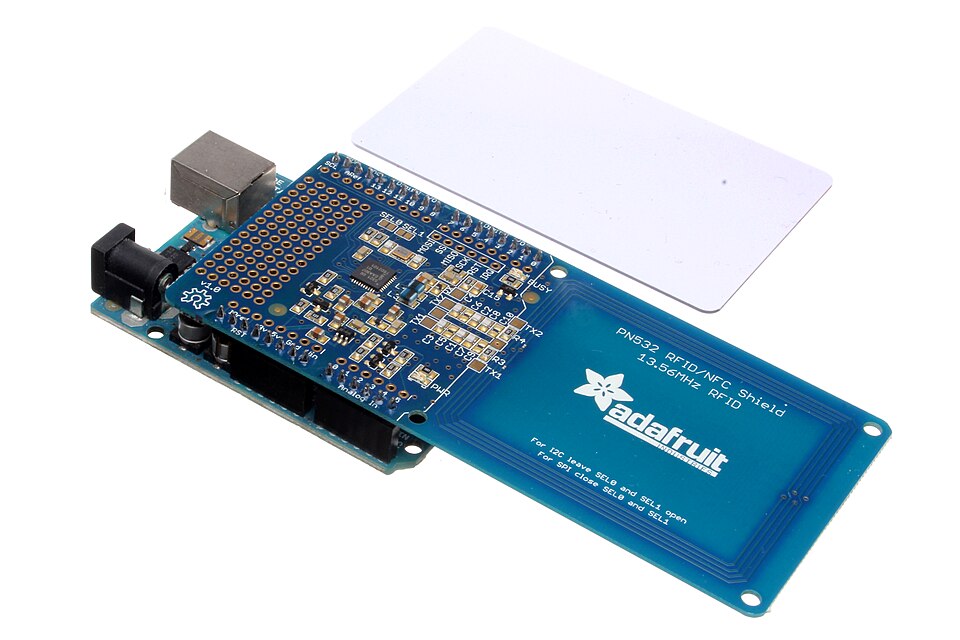
Tap reader and e-paper
Site cards and phone passes tap in and out at the reader head; the e-paper shows the heat flag, the rest time and the PPE prompt; the PPE light shows red or green
Raspberry Pi 5 (on the turnstile canopy floor) · I²C (PN532) + SPI (e-paper) + one data wire (light), in a cable up the street-side post · Pass IDs with in or out, flag and rest time, light colour
06
Heat, dust and sound
Behind the side vents: SPS30 dust, SHT45 air temperature and humidity and a MAX9814 mic; a PT1000 on the black lid patch gives the sun load for the heat index
Raspberry Pi 5 (on the turnstile canopy floor) · I²C (SPS30, SHT45) + SPI (MAX31865) + the mic level on an ADC pin of the Walter board (ESP32-S3) · PM1 to PM10 every second, air and sun-load temperatures every minute, a sound level every second
07
Call lights, voice, secure element and tamper
Red, amber, green or white on the street and site faces with a tone and a voice prompt; every call signed; the tamper switch marks the log when the lid is lifted
Raspberry Pi 5 (on the turnstile canopy floor) · One data wire (lights) + I²S (amp) + GPIO + I²C · Light colour and flash, tone, voice prompts, signatures, tamper flag
08
Power, backup and LTE-M
5 V from the turnstile's own mains feed; a LiPo keeps the Walter board holding the on-site list and sending the muster list over LTE-M when the site power is off
Raspberry Pi 5 (on the turnstile canopy floor) · 5 V rail + UART to the brain · Power about 3.2 W watching, 6.5 W at shift start (est.); calls and the 5-minute log over LTE-M
09
All connected
7 key parts, one program, and your phone
Our circuit board · rev A-0
Every chip on one board we design, shaped to fit: the processor, cameras and sensors, Wi-Fi and Bluetooth, lights, sound and power. No plugs, ribbons or adapters. It is checked in our CAD against every part around it, and it arrives from the maker ready to run our software from a microSD card. Turn the model, or pick a part below to see where it sits.
Loading the 3D board…
Drag to turn · scroll to zoom · right-drag to move · click a partDrag to turn · tap a part
Every board-level number SiteOne's jobs depend on, checked against its target: camera pixels and frame rate, power and battery life, heat where it works, shock, radio and software. Every lesson from every one of our boards is a rule here, so this review runs again whenever any board teaches us something. Boards are ordered only when nothing fails and the items to prove are measured.
| Area | Check | Our board | Target | Status |
|---|---|---|---|---|
| Camera | Entry camera: safety boots (0.12 m) at the turnstile mouth at 2.51 m | 103.1 px | ≥ 30 px | passes |
| Camera | Entry camera: frame rate the calls need | 10 fps at 3840 × 2160 | chip: 30 fps at 3840 × 2160 | passes |
| Camera | Entry camera: data rate vs its 4-lane link | 0.83 Gbps (10-bit) | ≤ 80 % of 3.564 Gbps | passes |
| Camera | Site camera: a person (0.45 m wide) at the muster point at 9.53 m | 77.9 px | ≥ 20 px | passes |
| Camera | Site camera: frame rate the calls need | 1 fps at 2592 × 1944 | chip: 15 fps at 2592 × 1944, 30 fps at 1920 × 1080 | passes |
| Camera | Site camera: data rate vs its 1-lane link | 0.04 Gbps (8-bit) | ≤ 80 % of 0.384 Gbps | passes |
| Camera | Image processor load, all cameras | 88 Mpx/s | ≤ 480 Mpx/s (RK3576J ISP) | passes |
| Camera | AI engine time per frame | 6 TOPS | a PPE call in under 1 s at the mouth; tailgating in under 2 s | to prove on the dev kit |
| Power | Supply | Mean Well IRM-20-5 PCB-mount 5 V 20 W supply (class II, listed) on the turnstile's own supply, on the power board | ≤ 70 % of the supply (14 W) | passes |
| Power | Power cut | one soldered 18650 cell (Samsung INR18650-35E) on the power board: in a power cut the turnstile free-wheels, the RK3576J sleeps with the on-site list in memory, and wakes on the fire-alarm input or every 60 s to log taps from the reader node; about 0.4 W, 26 h on the cell (est.) | the on-site list and the muster message for 12 h in a power cut | to prove on the dev kit |
| Heat | RK3576J temperature, a summer afternoon (40 °C air) with sun on the steel lid | 73 °C | ≤ 85 °C (rated) | passes |
| Heat | Camera and radar chips away from the processor | entry camera 191 mm, site camera 1222 mm, rotor radar 50 mm | ≥ 30 mm | passes |
| Shock | Shock and vibration | 50 g (est.) | standard parts | passes |
| Software | Starts our software from the microSD card, no setup | microSD socket with a hinged, latched lid (Amphenol 101-00660 class), fitted on every board: our software starts from the card; microSD socket with a hinged, latched lid (Amphenol 101-00660 class): the ESP32-S3 loads our program from the card; microSD socket with a hinged, latched lid (Amphenol 101-00660 class): the ESP32-S3 loads our program from the card | card socket fitted on every board, latched | passes |
| Software | Card power switch and protection | 3 power switches and 3 ESD arrays for 3 card sockets | every socket: switched card supply, ESD on all 6 lines | fixed by the review |
| Software | The card wins the start | eMMC shipped empty; our loader reads the card first | the processor starts from the card every time | fixed by the review |
| Software | Card grade | industrial pSLC microSD (Kingston Industrial or Swissbit S-56u), −40 to 85 °C | rated for the heat, cold and writes | to prove on the dev kit |
| Software | Clip buffer for an unsure call | 39.5 s of 8-bit 5 fps video in 40 % of the 4 GB memory | ≥ 3 s | passes |
| Radio | LTE-M from inside the steel canopy | BG95-M3 with a soldered eSIM; its antenna is the LTE element of the puck through the lid | certified module; calls, the on-site list and the muster list reach the site manager on any site | to prove on the dev kit |
| Radio | BLE for the site manager's fit-up phone | AP6275S on the main board, its antenna the 2.4 GHz element of the same puck | pairing from the gate, 3 m below (est.) | fixed by the review |
| Moisture | Conformal coating | coated | coated, sensors, sockets and antennas masked | passes |
| Fit | Board inside the product CAD, every part checked in 3D | not yet in the product CAD | nothing touches | to prove on the dev kit |
| Camera | Every gate call in view | Entry camera: worst 39.9° / 28.9°; Site camera: worst 33.4° / 25.1°; Rotor radar: worst 40.3° / 1° | inside each sensor's view | passes |
| Camera | Camera windows | entry window 40 × 42 (margin 0.5 mm, steepest 72°); site window 24 × 26 (margin 2.7 mm, steepest 48°) | each view inside its window, every line of sight under 82° from its wall | fixed by the review |
| Camera | Rotor radar under the main board | radome 50 × 20 in the canopy floor at x 100, y -550 (margin 3.8 mm); both compartments 40.3° off the chip's axis at worst | both compartments and the passage in view; the chip on a short hinge to the processor board | fixed by the review |
| Camera | Site camera on its own node | OV5640 on the site board with an ESP32-S3 (radio off), JPEG frames over RS-485 on lead L2, 1.43 m | a MIPI camera link only on a short flex | passes |
| Safety | The turnstile's egress untouched | one photo-MOS contact (5,000 V isolation, est.) on the controller's own entry-hold input; optocouplers only listen to the rotor-turn and fire-alarm signals | the exit always turns; the rotor free-wheels on power loss and on the fire alarm as before (IBC 1010.3.1) | to prove on the dev kit |
| Safety | Supply kept on its own board | the turnstile's own supply into a spring-clamp terminal on the power board, fuse, varistor, IRM-20-5 (class II); only 5 V and the controller signals on lead L1 | class II creepage on the power board; no mains on any other board | to prove on the dev kit |
| Fit | Sensor tabs on their brackets | Entry camera: 0.3 mm inside the wall, hinge 18.4 mm; Site camera: 0.3 mm inside the wall, hinge 21.2 mm; Rotor radar: 0.3 mm inside the wall, hinge 13.4 mm | chip or holder ≥ 0.3 mm inside the wall, hinge within the 40 mm flex | to prove on the dev kit |
| Fit | Reader head | e-paper active area inside the 52 × 25 window, its panel over the window edge; 8 PPE LEDs behind the new 46 × 8 slot; the tap coil 40 × 40 behind the tap mark with nothing on it | the turnstile's own reader housing, 60 mm proud, unchanged | fixed by the review |
| Fit | Flex and leads | F1 149 mm; L1 0.17 m of 20 AWG, 0.022 V drop; L2 1.43 m of 22 AWG, 0.061 V drop; L3 1.81 m of 22 AWG, 0.096 V drop; L4 1.19 m of 24 AWG, 0.03 V drop | routed and held in the next CAD revision; every drop ≤ 0.25 V | to prove on the dev kit |
| Sensors | Noise mic and air chip | ICS-43434 on the street strip on a printed duct to a new mic hole; SHT45 on a slotted island 4 mm behind the side vent | sound and air from outside the canopy, not from the boards | to prove on the dev kit |
| Security | Lid tamper sensor | TMAG5273 3D Hall sensor at the street strip's top edge, 8.2 mm under a Ø6 × 3 magnet on a boss under the lid | lid lifted = logged and signed | fixed by the review |
Before we order the first boards, we prove these on the RV1126B development kit or in the rev A tests:
Demo · 6 real-world moments
Short animated scenes of real moments: what happens today, what SiteOne does about it, and what lands on your phone. The same scenes play in the IEMI app.
06:55, shift start, with nobody on the gate. 40 people tap in over 20 minutes.
Use cases
With no gateman, PPE checks and the signing-in sheet depend on everyone doing it right; the list is wrong by the time the first lorry arrives.
Each person taps their card. The entry camera checks hard hat, hi-vis and boots in under a second. No hard hat holds the turn, lights red and asks 'hard hat please'; hat on, it goes green.
The fire marshal works from a paper signing-in book that half the site forgot to sign out of, and cannot say who is still inside.
The site camera flags the smoke with a frame. When the alarm sounds, the turnstile free-wheels for the exit, sends the on-site list to the fire marshal in under 10 s, and ticks people off as they leave.
Tailgaters are never on the list, so they are missing from the muster and from the induction records.
The rotor radar sees two bodies in one turn in under 2 s. The lights flash red with the tone and the voice asks the second person to tap.
A security patrol drives past twice a night; tools and cable go over the hoarding between visits.
The entry camera and radar see a person at the gate with no pass, out of hours. In under 5 s the lights go white with a voice warning and the frame goes out over LTE-M.
The heat plan is on paper; whether anyone checked the reading and told the crews depends on the day.
The turnstile's air sensor and the sensor under its black lid give a heat index of 36 °C and an estimated WBGT of 29 °C. It sets the amber flag on the reader head, reminds everyone at entry of 15 minutes' rest each hour, and pushes the crew leads.
The first anyone hears about dust is a neighbour's complaint, or a stop notice.
The dust sensor in the turnstile reads the PM10 trend at the boundary. The 15-minute average reaches 210 µg/m³, over the site's 190 trigger; the site-face light goes amber and the site manager gets the push to judge.
Demo scenes show how SiteOne and its app are designed to behave. SiteOne is in design; nothing here is recorded from real equipment yet.
What it is
IEMI's one product for a construction site gate: the site's own entry turnstile, made smart, with one brain and one app.
What it does
Who it's for
Contractors, quarries and mine surface entrances.
The idea
The problem today
On a building site the PPE check depends on a gateman or a supervisor being at the gate, the list of who is on site is a paper sign-in sheet or a separate access system, the heat flag is a phone app or a handheld meter, and dust at the boundary needs its own monitor on the hoarding. A contractor pays for each one separately, and none of them talk to each other in an evacuation.
With SiteOne
Every controlled site already has a full-height turnstile in the hoarding. SiteOne puts the brain, two cameras, a radar, heat, dust and sound sensors, call lights, a voice prompt, LTE-M and a backup cell inside that turnstile's canopy and reader housing, so the gate checks PPE, keeps the signed on-site list, calls tailgating and after-hours entry, sets the heat flag and sends the muster list itself.
How the parts connect
Every part, what links it to the brain, and how the data reaches your phone. A solid line is a cable; a dashed line is a radio link.
The program
while True:
    tap = reader.poll(); turn = gate.turned(); n = radar.count()
    calls = []
    if tap:
        ppe = ppe_model(cam_in.burst(10))
        calls += ppe_rule(tap, ppe); gate.hold_entry(not ppe.ok)  # exit never held
    if turn:
        calls += ledger.turn(tap, n)        # on-site list, tailgating
    calls += after_hours(cam_in, n, clock) + heat_rule(sht.read(), pt.read())
    if due(5):
        calls += smoke_rule(cam_site.frame()) + dust_rule(sps.read()) + noise_rule(mic.level())
    if gate.fire_alarm():
        calls.append(ledger.muster())
    for c in calls:
        if c.conf < c.line: c.kind = 'check'   # never guess
        atecc.sign(c); lights.show(c); uplink.send(c)
    time.sleep(0.05)
To your phone
Site manager, supervisors, the fire marshal and the contractor's safety lead; a web page for the office (Android, iPhone, web)
One screen for each job SiteOne does.
No gateman on site mode06:55, shift start with nobody on the gate: 40 people tap in over 20 minutes. The turnstile checks every hard hat, hi-vis and pair of boots, holds two entries until a hat goes on, and the on-site list is right when the first lorry arrives.
Who is on site and the muster14:02: the fire alarm sounds. The turnstile free-wheels for the exit, sends the on-site list to the fire marshal and ticks people off as they leave; the site camera shows the muster point.
Tailgating and after hours07:31: two people squeeze through one turn. At 23:40 someone tries the gate with no pass. Both are called on the turnstile's own lights and sent with the frame.
Heat flag and restA July afternoon: the heat index passes the site's amber line. The reader head shows the amber flag and 15 minutes' rest each hour, every person hears it at the gate, and the crew leads get the push.
Dust, smoke and noise at the boundaryBreaking out a slab on a dry, windy morning: the PM10 trend at the gate passes the site's trigger, so the site manager starts the water suppression before a neighbour complains.
App screens with sample data. The interface is in development.
| On site | 63 on site: 41 groundworks, 14 steel, 8 visitors | Live |
|---|---|---|
| PPE | 7:12 entry held: no hard hat; put on, let in at 7:13 | Each entry |
| Tailgating and after hours | Two in one turn at 07:31; person at the gate 23:40 | Live |
| Heat | Heat index 36 °C, est. WBGT 29 °C: amber flag, 15 min rest each hour | Every minute |
| Dust and noise | PM10 15-min 210 µg/m³, over the 190 trigger; 72 dB at 07:40, before permitted hours | Every minute |
| Smoke and muster | Smoke over the north scaffold 14:02 (frame); muster: 61 of 63 at the point | Live |
No face recognition. People are known only by their own card or phone pass. Bodies and faces are blurred on the device; only clips around calls are kept, 30 days, in the contractor's own account; camera notices on both faces.
CAD design · Design rev A, 28 Oct 2026: smart full-height site turnstile that runs the gate (8 calls, 5 alone, 3 assist), call lights, tone, voice prompt, ATECC608 and tamper switch inside; 12 camera and radar views checked in the CAD; not built
| AI processor | Boards of our own inside the turnstile's own canopy and reader housing: Rockchip RK3576J processor with 4 GB memory on the main board on the canopy floor. The bench turnstile uses a Raspberry Pi 5 until the boards arrive |
|---|---|
| Sensors | Sony IMX415 8 MP entry camera chip behind the street wall, 35 degrees down at the people walking up (102 degree lens); OmniVision OV5640 site camera on its own small board in the site wall · TI IWRL6432AOP 60 GHz radar chip looking down through the canopy floor into the rotor (one or two people in a turn) · Sensirion SPS30 dust sensor, SHT45 air chip and a PT1000 sun-load sensor on the black lid patch, a noise mic and a motion chip · NXP PN7160 tap chip and a 2.13 in e-paper in the reader head, 32 call and PPE lights, a buzzer and voice, a security chip and a lid tamper sensor |
| Connectivity | LTE-M (Quectel BG95-M3 on our board, soldered eSIM, puck antenna on the lid), MQTT over TLS · Site Wi-Fi (WPA3) where there is one · BLE for pairing the supervisor phone · CSV and webhook export |
| Power | The turnstile's own supply into a class II Mean Well IRM-20-5 on its own power board; one soldered 18650 cell with a thermistor keeps the on-site list and the muster message for about 26 h in a power cut (est.); about 6.6 W at the shift-start rush (est., board design review) |
| Enclosure | The plain turnstile's galvanised steel canopy and reader housing with bonded PC windows |
| Dimensions | 1,400 x 1,400 x 2,403 mm (frame and canopy), 787 mm passage |
| Weight | About +1.4 kg over a plain turnstile of about 450 kg (est.) |
| Ingress rating | IPX4 canopy target |
| Entry | PPE check, tap in and out |
|---|---|
| Safety | Muster list, heat flag |
| Security | Tailgating, after hours |
| Boundary | Dust, smoke, noise (indicative) |
| Egress | IBC 1010.3.1, exit never held |
|---|---|
| Passage | 787 mm, headroom 2,203 mm |
| Protrusion | Reader head 60 mm (ADA 307.2) |
| Privacy | No face recognition; passes only |
| Size | 1,400 x 1,400 x 2,403 mm, the plain turnstile |
|---|---|
| Power | Turnstile mains feed; 3.2 W watching, 6.5 W at shift start (est.) |
| Power cut | On-site list and muster about 18 h on the 1200 mAh cell (est.) |
| Parts cost | $5,739 at qty 1 incl. the plain turnstile (est.) |
Targets for production units; they may change during development.
Hardware: $8,990 per entrance (replaces its full-height turnstile)
Software: $99 per month per entrance (app, LTE-M and calls)
Target pricing. Bought separately per entrance: a plain single-lane full-height turnstile (about $7,500, est.; makers quote only) with a sign-in and access service (about $150/month, est.), PPE Gate AI ($899 + $29/month) and HeatGuard AI ($699 + $19/month): about $9,098 + $198/month (est.).
$8,990 + $99/month
Every gate job in the site's own turnstile.
Indicative launch pricing in USD, excluding taxes and shipping. Final pricing is confirmed before any balance is charged.
Community
SiteOne is in development. Rate the idea, tell us what to change about the features, specs or price, and we'll build it with your feedback.
How much people want it
–
No ratings yet
Follow SiteOne
Get build updates and first access when pre-orders open.
No comments yet. Tell us what you'd want from SiteOne.
Questions
Tell us what this would save you, or ask anything. We reply within two business days.
A member of the IEMI Labs team will reply within two business days.
From the product lab · ideation phase
Smart equipment · legal on the field
It replaces the site's plain hired or bought full-height turnstile in the hoarding line, in the same size, on the same baseplate, with the same rotor, reader position, controller and mains feed; the site keeps its own accessible and emergency gate beside it, with every part built in. Everything inside the plain turnstile's 200 mm canopy and its reader housing: brain, two cameras, radar, dust, air, sun-load and sound sensors, call lights, tone, speaker, LTE-M, backup cell, secure element and tamper switch. About +1.4 kg over a plain turnstile of about 450 kg (est.); no mast, tripod, hoarding box or pole camera.
| Rule | Limit | SiteOne |
|---|---|---|
| High turnstile in a means of egress (IBC 1010.3.1) | turns freely in the egress direction on power loss or a fire alarm; credited for at most 50 persons and 50 % of the egress capacity | ✓ the turnstile's own controller and fire-alarm input free-wheel the rotor as before; SiteOne never holds the exit direction and is wired to the controller's entry-hold input only |
| Clear width above 39 in (IBC 1010.3.1) | at least 22 in (559 mm) | ✓ 787 mm passage, the plain turnstile's rotor kept, checked in the CAD |
| Accessible and emergency route beside the turnstile (IBC 1010.3.1, ADA) | a non-revolving accessible gate on the accessible route | ✓ the site's own pedestrian gate in the hoarding stays, shown in the CAD scene |
| Headroom in the passage (IBC 1003.3.1) | nothing below 80 in (2,032 mm) | ✓ every part of ours in the passage sits in the canopy, lowest at 2,203 mm, checked in the CAD |
| Protruding objects (ADA 307.2, IBC 1003.3.3) | no more than 100 mm from a wall or post between 685 and 2,030 mm | ✓ the reader head is the plain turnstile's reader housing, 60 mm proud at 1,000-1,320 mm, checked in the CAD |
| Same size and installation | 1,400 x 1,400 mm frame, 2.4 m canopy, the same baseplate and mains feed | ✓ 1,400 x 1,400 x 2,403 mm with the lid, checked in the CAD; electronics inside the canopy and the reader head; a 60 x 22 mm antenna puck on the lid (rev T), because the closed steel canopy stops the radios |
| Site security and access (CDM 2015 regulation 27, Schedule 2) | prevent unauthorised access; know who is on site | ✓ the turnstile still controls access; SiteOne adds the signed on-site list, tailgating and after-hours calls |
| PPE on entry (OSHA 1926.100 and 1926.28; the site's own rules) | head protection where there is a danger of head injury; PPE the site requires | ✓ the entry camera checks hard hat, hi-vis and boots; a missing item holds that one entry until it is put on or a supervisor overrides; it never certifies that PPE is adequate |
| Privacy (UK GDPR / state biometric laws such as Illinois BIPA) | no biometric identification without consent; camera notice | ✓ no face recognition; people are known only by their own card or phone pass; frames blurred on the device; camera notice on both faces |
| Radio (FCC Part 15 / UKCA, carrier certification) | certified modules | ✓ certified Wi-Fi on the Raspberry Pi 5, certified Walter LTE-M module |
Construction sites, quarries and mine surface entrances in the US, UK and similar markets. The building or site egress plan stays the principal contractor's. PPE, heat and dust calls are site-rule and early-warning aids: SiteOne does not certify PPE, measure personal exposure or replace a certified boundary monitor (for example MCERTS in the UK) where a planning condition names one.
One piece of equipment does
Not done by the equipment, and why
Makes the call itself
Most gates have no gateman for most of the day. The turnstile runs the gate alone: it checks PPE at every entry, keeps the signed on-site list, calls tailgating and after-hours entry, sets the site's heat flag and reminds each person of the rest schedule, and sends the muster list the moment the fire alarm sounds. Dust, smoke and noise go to the site manager as early warnings to judge.
| Call | Who decides | How it sees it | How players see the call · if unsure |
|---|---|---|---|
| PPE missing at entry (hard hat, hi-vis, boots)< 1 s · about 94 % per item (est.) | The equipment | entry camera, tap reader; PPE detector on the person in front of the rotor, no faces (int8 on the Pi 5) | Street lights and the reader-head light red, voice prompt 'hard hat please'; green when it is on. Under 85 % confidence: amber 'check' and the supervisor's phone override; never holds the exit |
| Who is on site and the muster list< 1 s per turn; muster list < 10 s after the alarm · about 99 % of turns matched (est.) | The equipment | tap reader, rotor radar, rotor turn signal; in and out ledger per pass, matched to a counted turn | Site-face light white and the tone at the muster; list to the fire marshal's phone. A turn with no tap or a tap with no turn: marked 'check' on the list |
| Tailgating: two people in one turn< 2 s · about 95 % (est.) | The equipment | rotor radar, entry camera; radar target count in the compartment with the camera queue count | Lights flash red with the tone; the second person is asked to tap. Under 80 %: 'check' with the frame to the site manager |
| After-hours entry or loitering at the gate< 5 s · about 92 % (est.) | The equipment | entry camera, rotor radar, tamper switch; person detector out of hours, no faces | Lights white with a voice warning; callout over LTE-M. Under 80 %: a still frame to the keyholder to judge |
| Heat flag and work and restevery minute · about ±1.5 °C WBGT against a reference meter (est., checked in the first build) | The equipment | SHT45, PT1000 on the black lid patch, sun angle; heat index and an est. WBGT against the site's own heat plan (NIOSH and ACGIH tables) | E-paper flag and rest time at the reader head; reminder light and voice at every entry; push to the crew leads. Sensor fault: the last good flag stays with 'check heat' on the e-paper |
| Dust at the boundary< 15 min · indicative only (est. ±25 % against a reference monitor) | Helps the official | SPS30, wind from the site's own weather or forecast; PM10 15-minute trend against the site's trigger level | App and the site-face light amber. Always a warning for the site manager to judge; never reported as a compliant measurement |
| Smoke or fire seen over the site< 30 s · about 85 % in daylight (est.) | Helps the official | site camera; smoke and flame detector on the site frames | Site-face light amber and a push with the frame. Always sent with the frame for a person to confirm; the site's own fire alarm stays the alarm |
| Noise at the boundary in quiet hours< 5 min · indicative, about ±3 dB (est., not a Class 1 meter) | Helps the official | MAX9814 mic; A-weighted level estimate against the site's permitted hours and limit | App only. Always a report for the site manager |
Nothing added to the field
The only things in play are the items the laws already put there:
The hoarding, the accessible and emergency gate, the welfare cabin and the muster point stay as they are; no camera on a mast, no heat station on a tripod, no dust monitor on the hoarding
Built to take the hits
Secure by design
A camera service watches from a pole and tells you later; it cannot hold the one entry that is missing a hard hat, and it does not know who is on site. SiteOne is the turnstile itself, so the check, the hold, the on-site list, the muster list and the heat flag happen at the one place every person passes, with nothing added to the hoarding.
$8,990 per entrance + $99 a month. A plain full-height turnstile is $4,600-14,350 a lane installed (2026 US guide); with a sign-in service, a PPE camera service and a heat station bought separately it comes to about $9,098 + $198 a month (est.).
Rev A is sold with the turnstile, made with a turnstile maker. A hire version through plant-hire firms and a canopy kit for turnstiles already on site are the two questions we are taking to contractors in phase 3.
PPE Gate AI (hard hat and hi-vis at the gate) and HeatGuard AI (the heat flag and log) for site use, plus the plain turnstile and a sign-in sheet. DustWatch AI stays listed for cutting benches the gate cannot see, and SmokeSentinel AI for wildfire watch over open country.
No. It only uses the turnstile controller's entry-hold input. The exit direction is never held, and the turnstile's own controller free-wheels the rotor on power loss or a fire alarm, as before.
No. People are known only by their own card or phone pass. Frames are blurred on the device and only clips around calls are kept, for 30 days.
No. Dust and noise are indicative early warnings, and the heat flag follows the site's own heat plan. Where a planning condition names a certified monitor, the site keeps it.
The backup cell keeps the on-site list on the LTE-M board for about 18 h (est.), and the muster list goes to the fire marshal the moment the alarm sounds.
A palm-sized edge box that plugs into your existing parking cameras.
From $499 per edge box
Details
A compact camera with its own light that mounts above a production line.
From $2,499 per station
Details
A clip-on camera coach for the recycling bins you already have.
From $299 per 3-bin station
DetailsSiteOne
Concept · target $8,990