SensingConcept
ColdChain Guard AI
A lunchbox-sized monitor that mounts inside trucks, cold rooms and fridges.
- Watches temperature around the clock
- Warns before goods get too warm
- Detects door openings and tampering
From $199 per kit
DetailsIEMI's one product for a hotel room: its own thermostat, made smart
Software: $8 per month per room (hotel app and evidence)
Concept, not for sale yet. Tell us if you want it; that decides what we build.
Rate this idea and tell us what to change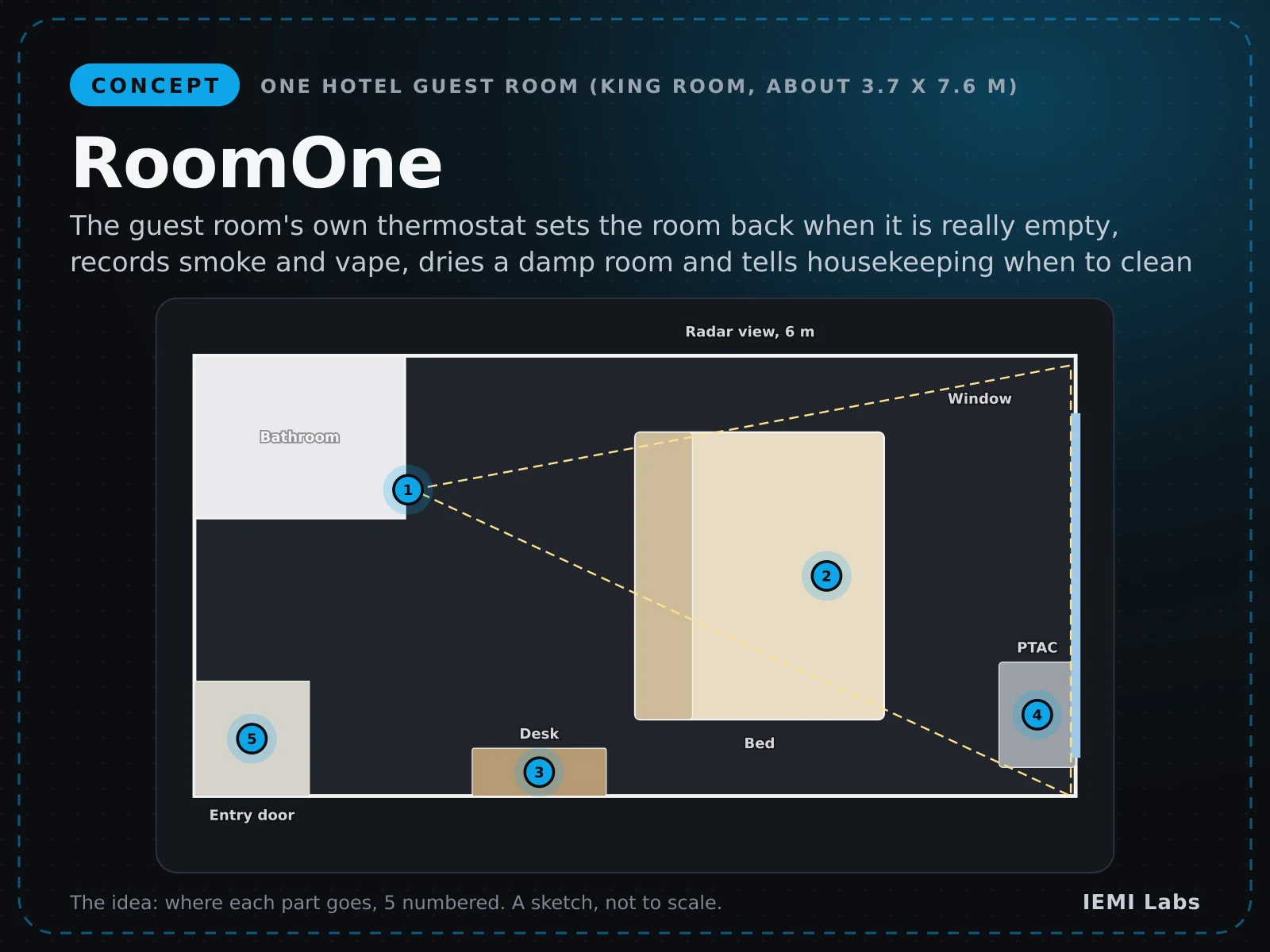
Drag to rotate · right-drag to move · scroll to zoom · click a part for its size and placeSwipe to rotate · pinch to zoom · two fingers to move · tap a part for its size
How it fits together
Scroll or tap a part. Press “See the 3D CAD design” to watch the model, built from our CAD, light each part up and show how it connects.
Real-time 3D render · drag to rotate · final design may varySwipe sideways to rotate
01
The whole RoomOne
The guest room's thermostat is the room's own helper: a radar chip that sees breathing and four air chips sit on our one board inside it, and the brain turns them into set back, smoke and vape, tamper, damp and clean-now calls on the thermostat's own light and one hotel app, while still driving the PTAC over its own wires.
02Brain
Our thermostat board: the ESP32-S3 radio module on its wall side
The brain: it runs the roomone-fw program
03
Presence radar
Sees someone in the room, a guest asleep by their breathing, the room empty, and a cover put over the thermostat
Our thermostat board: the ESP32-S3 radio module on its wall side · SPI on the board, behind the 1.5 mm radar window · Range-Doppler frames for motion and breathing, every 0.1 s
04
Air chips in the air corner
Particle bursts, VOC and NOx for smoke and vape; humidity for damp; CO2 for a stuffy room; the room temperature
Our thermostat board: the ESP32-S3 radio module on its wall side · I²C on the board (BMV080 on SPI), in the slotted air corner · PM1 to PM10, VOC and NOx index, CO2, humidity, temperature every 1 s
05
HVAC relays and power
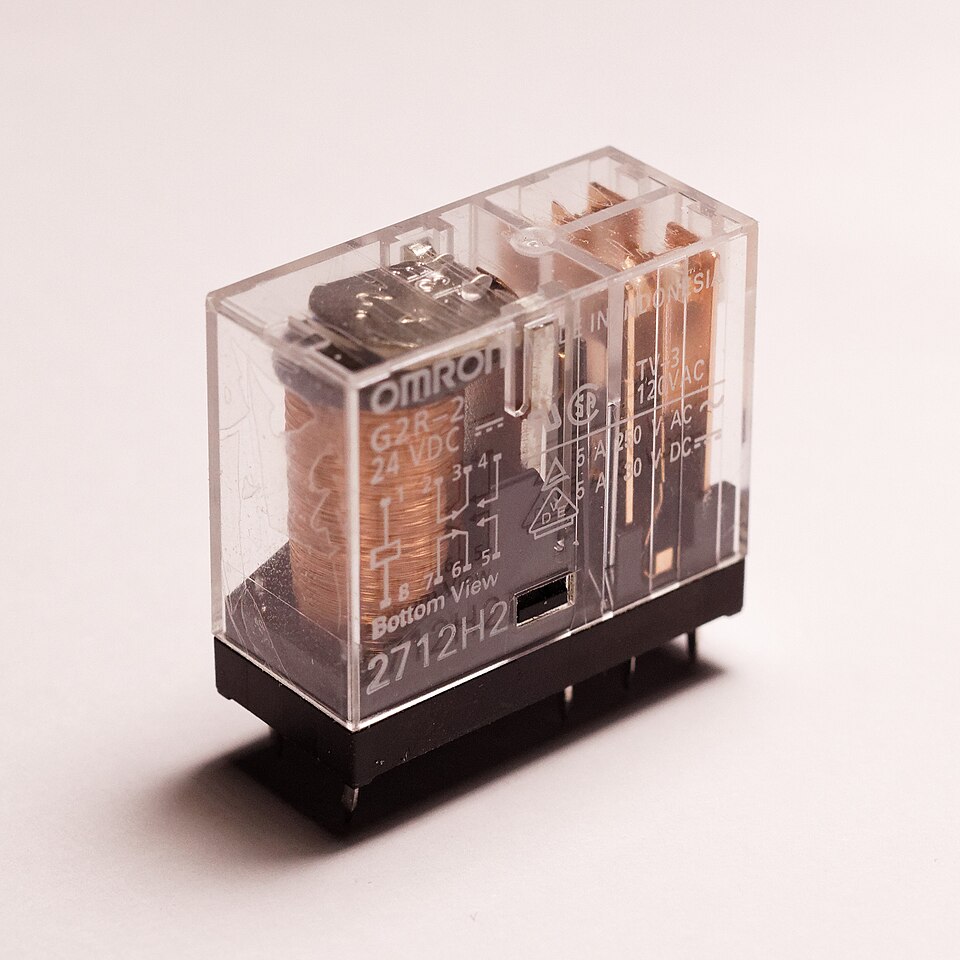
Fan, cool and heat calls to the PTAC or fan coil over its 24 VAC wires, and 5 V for the thermostat from the same wires
Our thermostat board: the ESP32-S3 radio module on its wall side · 3 x GPIO through the relay drivers; 24 VAC to 5 V on the board · Fan, cool and heat on or off; power about 1.3 W (est.)
06
Display, keys, call light and tone
Set point and room temperature on the e-paper, warmer and cooler keys, the call light (blue set back, amber damp or tamper, red smoke) and tones
Our thermostat board: the ESP32-S3 radio module on its wall side · SPI (e-paper, tail soldered) + GPIO + one LED data line · Screen, key presses, light colour, tone
07
Security chip and tamper switch
Signs every call; marks the log if the thermostat is taken off the wall
Our thermostat board: the ESP32-S3 radio module on its wall side · I²C + GPIO; the wall-plate rib presses the switch · Signatures, tamper flag
08
All connected
6 key parts, one program, and your phone
Our circuit board · rev A-0
Every chip on one board we design, shaped to fit: the processor, cameras and sensors, Wi-Fi and Bluetooth, lights, sound and power. No plugs, ribbons or adapters. It is checked in our CAD against every part around it, and it arrives from the maker ready to run our software from a microSD card. Turn the model, or pick a part below to see where it sits.
Loading the 3D board…
Drag to turn · scroll to zoom · right-drag to move · click a partDrag to turn · tap a part
Every board-level number RoomOne's jobs depend on, checked against its target: camera pixels and frame rate, power and battery life, heat where it works, shock, radio and software. Every lesson from every one of our boards is a rule here, so this review runs again whenever any board teaches us something. Boards are ordered only when nothing fails and the items to prove are measured.
| Area | Check | Our board | Target | Status |
|---|---|---|---|---|
| Power | Supply | the room's 24 VAC from R and C (20–30 VAC) | inside a 40 VA thermostat transformer | passes |
| Power | Power cut | settings in flash, the e-paper keeps its picture | comes back as it was after a power cut | passes |
| Heat | ESP32-S3 temperature, a 30 °C room | 48 °C | ≤ 85 °C (rated) | passes |
| Heat | Temperature chip warmed by the board | 47 mm from the nearest warm part, on the slotted air corner | ≤ 0.3 K reading error | to prove on the dev kit |
| Shock | Shock and vibration | 20 g (est.) | standard parts | passes |
| Software | Starts our software from the microSD card, no setup | microSD socket with a hinged, latched lid (Amphenol 101-00660 class), fitted on every board: our software starts from the card (ESP32-S3 SD bus | card socket fitted on every board, latched | fixed by the review |
| Software | Card power switch and protection | 1 power switch and 1 ESD array for 1 card socket | every socket: switched card supply, ESD on all 6 lines | fixed by the review |
| Software | The card wins the start | a small loader in the ESP32-S3 flash starts the program on the card | the program on the card runs every time | fixed by the review |
| Software | Card grade | industrial pSLC microSD (Kingston Industrial or Swissbit S-56u), −40 to 85 °C | rated for the heat, cold and writes | to prove on the dev kit |
| Radio | Wi-Fi in a hotel room | to the hall access point | certified ESP32-S3 module, antenna at the board edge | passes |
| Fit | Board inside the product CAD, every part checked in 3D | no part touches a wall or a bought part (2026-11-03) | nothing touches | passes |
Before we order the first boards, we prove these on the RV1126B development kit or in the rev A tests:
Demo · 6 real-world moments
Short animated scenes of real moments: what happens today, what RoomOne does about it, and what lands on your phone. The same scenes play in the IEMI app.
Room 412, 13:00. The guest leaves for an afternoon meeting with the cooling running at 22 C.
Use cases
The room cools an empty space all afternoon, or a key-card sensor sets it back while the guest is asleep and wakes them hot at 3 am.
The radar in the thermostat sees movement and breathing, not pictures. Twenty minutes after the last presence it sets the room back to 26 C with a 5 s blue light. When the door opens the guest's 22 C comes back in under 2 s. A sleeping guest is never set back.
Housekeeping smells it the next day, the guest denies it, and the smoking fee is waived because there is no proof; or the shower steam sets off a cheap detector.
The air chips on the thermostat board read particles, VOC and NOx. Shower steam looks different and is ignored. A vape burst is called in under 3 min: red light, three tones, and a signed event with the particle curve. Unsure is logged as 'air event, check room', never a smoking call.
The room sits wet all night; weeks of this and the bathroom ceiling and the curtains grow mould that costs a room out of order to fix.
The air sensor watches humidity and temperature. Held high for 6 hours, it turns amber, runs the PTAC in dry mode and books a maintenance task. High CO2 gets the same care with more fan. A sensor fault only books maintenance.
Housekeepers knock door to door from a printed list, wake late sleepers, and the room a new guest is waiting for gets cleaned last.
The hotel system says checked out; the radar confirms nobody is left in the room. In under 20 minutes the room moves to the top of the housekeeping clean list. If the radar is unsure, it stays 'check before entering'.
Staff respect the sign, so nobody looks in; a guest who is ill or has left without checking out goes unnoticed for days.
The radar sees presence and breathing only, never who the guest is. No movement for 48 hours under Do Not Disturb, the hotel's own policy limit, sends a welfare check to the duty manager. With any doubt it is still sent; a person always knocks and decides.
Whatever happens upstairs overnight is found in the morning, or not at all.
Each room runs itself: set back when empty, comfort for sleeping guests, smoke and vape events signed, damp rooms dried. A thermostat covered or taken off the wall is seen in under 60 s from the radar near target, the air flow and the tamper switch, and recorded with an amber light.
Demo scenes show how RoomOne and its app are designed to behave. RoomOne is in design; nothing here is recorded from real equipment yet.
What it is
IEMI's one product for a hotel guest room: the room's own thermostat, made smart, with one brain and one app.
What it does
Who it's for
Select-service and extended-stay hotels, motels and serviced apartments.
The idea
The problem today
Hotel rooms are cooled and heated all day while empty, and key-card switches and motion sensors set back rooms with a sleeping guest in them. A smoked or vaped room costs about $620 to $1,300 to clean and put back on sale, and the fee is disputed without evidence. Hotels buy a thermostat, an energy system, a vape detector and a damp sensor separately, each with its own box on the ceiling and its own app.
With RoomOne
Every room already has its thermostat on the wall by the entry. RoomOne puts a breathing-sensitive radar, an air module, a call light, a tone and the brain inside it, so the thermostat knows when the room is really empty, sets it back by the energy code, records smoke and vape with a signed curve, dries a damp room, and moves the room to the clean list after checkout. No camera and no microphone.
How the parts connect
Every part, what links it to the brain, and how the data reaches your phone. A solid line is a cable; a dashed line is a radio link.
The program
void loop() {
  Presence p = presence.update(bgt60.frame());         // in, asleep, empty, covered
  Air a = air.read();                                   // BMV080, SCD41, SGP41, SHT45
  hvac.drive(p.empty_for() > 20 * MIN ? setback(guest_sp) : guest_sp, a.rh > 65);
  for (Call c : rules(p, a, pms.status())) {
    if (c.conf < c.line) c.kind = AIR_EVENT_CHECK;   // never guess
    atecc.sign(c); face.show(c); hotel.send(c);
  }
  delay(100);
}
To your phone
The front desk, housekeeping and maintenance phones and the manager's tablet (Android and iPhone)
One screen for each job RoomOne does.
Night mode: no staff on the floorTuesday 23:00 to 06:00, one night auditor at the desk. The rooms set themselves back, one vape event is signed, one damp room dries, and the morning list is ready.
Set back when really emptyRoom 412's guest leaves for a meeting at 13:00. At 13:20 the thermostat sets the room back; at 17:40 the door opens and the guest's 22 C comes back before the bag is down.
Smoke and vape eventsAt 23:14 a guest in 307 vapes at the desk. The thermostat turns red with three tones and signs the particle and VOC curve.
Damp and stuffy roomsRoom 118 sits at 71 % humidity for 7 hours after a long shower with the PTAC off; the thermostat runs dry mode and books maintenance.
Housekeeping and welfare412 checks out at 10:40; at 10:52 the thermostat sees it empty and the room goes to the top of the clean list. 215 has had Do Not Disturb for 48 h with no movement, so the duty manager knocks.
App screens with sample data. The interface is in development.
| Occupancy and set back | Room 412: empty 13:20, set back to 26 C | Live |
|---|---|---|
| Smoke and vape events | Room 307: vape event 23:14, curve signed | Live |
| Tamper | Room 215: thermostat covered 22:40 | Live |
| Damp and CO2 | Room 118: 71 % humidity for 7 h, dry mode | Hourly |
| Clean now | Room 412 empty after checkout 10:52 | Live |
| Energy report | Set back 61 % of empty hours, about 18 kWh saved per room (est.) | Weekly |
No camera and no microphone in the room. Radar gives presence only; event curves are kept 90 days in the hotel's own account, by room number, never by guest name.
CAD design · Stage 2 ready, 29 Oct 2026 (rev A, 28 Oct): smart guest-room thermostat that runs the room itself (8 calls, 6 alone, 2 assist), call light and tone, ATECC608 and tamper switch inside; 7 radar views checked in the CAD; not built
| AI processor | One board of our own inside the thermostat: Espressif ESP32-S3 module. The bench thermostat uses a XIAO ESP32-S3 until the boards arrive |
|---|---|
| Sensors | Infineon BGT60TR13C 60 GHz radar chip: someone in the room, breathing · Bosch BMV080 particle sensor (no fan), Sensirion SCD41 CO2, SGP41 VOC and NOx, SHT45 humidity and temperature, in a slotted air corner · 2.13 in e-paper, two keys, a call light, a sounder, three relays (fan, cool, heat), a security chip and a tamper switch |
| Connectivity | Hotel back-office Wi-Fi (WPA3), MQTT over TLS · BLE for set-up only · Fan, cool and heat relays on the PTAC's 24 VAC wires |
| Power | The room's 24 VAC from R and C: about 0.6 W idle, 1.1 W at most (est.) |
| Enclosure | PC-ABS thermostat body and wall plate on a single-gang box |
| Dimensions | 140 x 110 x 32 mm, keys at about 1,125 mm |
| Weight | About 210 g (est.) |
| Ingress rating | Indoor (IP20) |
| Comfort | Set point, fan, cool, heat |
|---|---|
| Energy | Set back when really empty |
| Air | Smoke, vape, damp, CO2 |
| Housekeeping | Clean now, welfare checks |
| Reach | Keys 1,117 to 1,133 mm (ADA 308) |
|---|---|
| Protrusion | 32 mm (ADA 307.2: 100 max) |
| Set back | Within 30 min of empty (ASHRAE 90.1, Title 24) |
| Not | A smoke alarm; no camera, no microphone |
| Fee evidence | Air curve with the presence log; never charges |
Targets for production units; they may change during development.
Hardware: $349 per room (replaces the thermostat)
Software: $8 per month per room (hotel app and evidence)
Target pricing. Bought separately per room: a GuestRoom node ($329 + $8/month), a VapeSense disc ($179 + $5/month) and a networked occupancy thermostat (about $165, the Verdant VX price offered to IHG hotels, Oct 2026): about $673 + $13/month. Parts cost about $146 per room at qty 1 (checked 29 Oct 2026).
$349 + $8/month
Every guest-room job inside the room's own thermostat.
Indicative launch pricing in USD, excluding taxes and shipping. Final pricing is confirmed before any balance is charged.
Community
RoomOne is in development. Rate the idea, tell us what to change about the features, specs or price, and we'll build it with your feedback.
How much people want it
–
No ratings yet
Follow RoomOne
Get build updates and first access when pre-orders open.
No comments yet. Tell us what you'd want from RoomOne.
Questions
Tell us what this would save you, or ask anything. We reply within two business days.
A member of the IEMI Labs team will reply within two business days.
From the product lab · ideation phase
Smart equipment · legal on the field
It replaces the room's existing guest-room thermostat, on the same wall box and the same wires, with every part built in. Everything inside the thermostat: brain, air module, radar, e-paper, keys, call light, tone, secure element, tamper switch, relays and power on one carrier board. About 210 g (est.), the same outline as a plain guest-room thermostat; no ceiling disc, plug-in box or camera.
| Rule | Limit | RoomOne |
|---|---|---|
| Reach range for operable parts (ADA 2010 Standards 308.2 and 308.3) | 380 to 1,220 mm above the floor | ✓ keys 1,117 to 1,133 mm, display top 1,195 mm (the CAD asserts both) |
| Operable parts (ADA 2010 Standards 309.4) | one hand, no tight grasping or twisting, 22.2 N or less | ✓ two 16 mm push keys (Adafruit 1441), no dial |
| Protruding objects (ADA 2010 Standards 307.2) | wall objects 685 to 2,030 mm high stand out 100 mm or less | ✓ 32 mm from the wall (the CAD asserts it) |
| Guest-room HVAC set back when empty (ASHRAE 90.1 6.4.3.3.5; Title 24 120.2(e)4) | within 30 min of the room going empty, set back at least 2.2 C (4 F) in heating and cooling | ✓ radar empty call 20 min after the last presence (breathing included), then +2.5 C cooling / -2.5 C heating; back to the guest's set point when someone comes in |
| Thermostat safety (UL 60730-2-9), Class 2 wiring (NEC 725) | 24 VAC Class 2 only, no mains in the unit | ✓ 24 VAC from the fan coil's own Class 2 transformer, fused on the carrier board; listing tests in the first build |
| No hidden cameras or recording in a guest room (US state video voyeurism laws; Airbnb indoor camera ban, March 2024; UK GDPR) | no camera and no audio recording in a sleeping room | ✓ no camera and no microphone; radar gives presence only; a card on the desk says what the thermostat senses |
| Same size and installation as the plain thermostat | same wall box, wires and outline | ✓ 140 x 110 x 32 mm on a single-gang box, R C G Y W wiring (the CAD asserts the outline) |
| Radio (FCC Part 15 / RED) | certified modules | ✓ Wi-Fi and BLE on the XIAO ESP32-S3's certified module; 24 GHz radar module certified by its maker |
| FTC Trade Regulation Rule on Unfair or Deceptive Fees (16 CFR Part 464), in force 12 May 2025 for short-term lodging | mandatory fees in the total price from the first advertised price; other charges disclosed clearly before the guest agrees; no misrepresenting the nature or amount of any fee | ✓ RoomOne never charges, sets or adds a fee; the evidence page shows the hotel's own posted smoking policy beside the signed event, so the manager decides under the policy the guest saw (a check aid; the hotel decides how its fees are disclosed) |
| Telling guests about room sensors (consumer reports of Feb and June 2026 after sensor-only smoking fees were reversed; no rule text yet) | advocates ask hotels to post an in-room notice of air sensors | ✓ the e-paper shows 'Air and presence sensor: no camera, no microphone' when a guest first presses a key after check-in, and the same line is printed on the wall plate (no new part) |
Indoor guest-room use. UL 60730-2-9 and radio tests to be done before sale. It is a monitor and alert aid: smoke and vape calls are evidence for the manager, never an automatic fine, and it is not a smoke alarm (the room's listed smoke alarm stays).
One piece of equipment does
Not done by the equipment, and why
Makes the call itself
With no staff on the floor at night, the room runs itself: it sets the HVAC back when the room is really empty and back up when a guest comes in, records smoke and vape events with a red light and a tone, records a covered or removed thermostat, dries a damp room, and puts empty rooms on the clean list. Smoking fees and welfare checks go to a person to decide.
| Call | Who decides | How it sees it | How players see the call · if unsure |
|---|---|---|---|
| Room empty: set back20 min after the last presence · about 98 % of empty rooms, a sleeping guest kept as occupied (est.) | The equipment | LD2410C radar; presence state machine on the radar's motion and breathing gates | Blue light for 5 s at set back; the set point shows on the e-paper. Any breathing seen or unsure: stays occupied (comfort first) |
| Guest back: comfort set point< 2 s · about 99 % (est.) | The equipment | LD2410C radar; motion gate at the entry | Display wakes with the guest's set point. None needed |
| Smoke or vape event in the room< 3 min · about 90 % of vape events, about 95 % of cigarette smoke (est.) | The equipment | SEN66 particles, VOC and NOx; event classifier (int8) on the particle curve, VOC and decay time, trained on vape, cigarette, cannabis, shower steam, hair spray and cooking | Red light and three tones; a signed event with the curve to the manager. Steam, spray or under 85 % confidence: logged as 'air event, check room', never a smoking call |
| Smoking feeafter the stay · est.; not field-tested | Helps the official | the signed smoke or vape event, the radar presence log for the same minutes, SEN66 humidity; none for the fee (a person decides); the evidence page sets the air event beside the radar presence log, and says 'room empty at the time: do not charge' when no guest was in the room during the event, and 'hair styling or steam likely' when humidity rose with the particles (29 Oct 2026 market check: sensor-only fees were reversed when guests were out or had used hair spray and heat tools) | Evidence page in the app, with the room's presence log and the hotel's posted policy text. Room empty during the event, humidity rising with the particles, or confidence under 85 %: the page says no fee and asks for a room check; otherwise the manager decides under the hotel's posted policy, with a room check before any fee |
| Thermostat covered or taken off the wall< 60 s · about 97 % (est.) | The equipment | LD2410C near target, SEN66 flow, D2F-01 tamper switch; rule: object within 6 cm for over 60 s, air flow drop, or the plate switch open | Amber light and a signed tamper record. Unsure: 'check the thermostat' task |
| Damp room: dry mode6 h · about 95 % (est.) | The equipment | SEN66 humidity and temperature; rule: RH over 65 % for 6 h with the room empty | Amber light; dry mode and a maintenance task. Sensor fault: maintenance task only |
| Room empty after checkout: clean now< 20 min · about 98 % (est.) | The equipment | LD2410C radar with the hotel system's checkout; empty state after checkout time | Room moves to the housekeeping clean list. Unsure: stays 'check before entering' |
| Welfare check: no movement for 48 h under Do Not Disturb48 h (hotel policy) · est.; not field-tested | Helps the official | LD2410C radar; presence history (still present but no movement, or no presence at all) | Task to the duty manager. Any doubt: still sent; a person always knocks |
Nothing added to the field
The only things in play are the items the laws already put there:
The ceiling, smoke alarm, bathroom, door lock and PTAC stay as they are; no ceiling disc, camera or plug-in box
Built to take the hits
Secure by design
Hotel occupancy thermostats set the room back but use a motion sensor, so a still or sleeping guest can be set back, and they do not record smoke. Room sensors such as Minut record smoke and noise but do not run the heating. RoomOne is the thermostat itself: a breathing radar keeps sleeping guests comfortable, and the same unit signs smoke and vape events. One box on the wall, one app.
$349 per room plus $8 a month (target), against about $673 plus $13 a month for a networked thermostat, a GuestRoom node and a VapeSense disc bought separately. It goes in where the old thermostat was, on the same wall box and wires, usually at a PTAC swap or renovation.
No. The thermostat has a radar that sees presence and breathing, and an air module. Nothing records pictures or sound.
GuestRoom and VapeSense: empty-room set back, smoke and vape evidence and damp rooms now come from the room's own thermostat. Laundry rooms (LaundryRoom, LaundroLink, CycleTap), building leaks (WaterLeak), back-of-house floors (FloorSafe) and care homes (CareWatch) are other zones and stay listed.
No. The radar sees breathing, so a sleeping guest keeps the room occupied.
No. The room's listed smoke alarm stays. RoomOne records smoke and vape events as evidence for the manager; it makes no safety claim.
It logs 'air event, check room' and never calls smoking. A person always decides a smoking fee and a welfare check.
RoomOne never charges anyone. In 2026, news reports found hotels reversing $300 to $566 smoking fees based on air sensors alone, often after hair spray and heat tools, or when the guests were out of the room. So RoomOne's evidence page puts the signed air curve beside the room's presence log: if nobody was in the room during the event, it says do not charge, and if humidity rose with it (hair dryer, iron, shower) it says styling or steam is likely. Otherwise the manager decides under the hotel's posted policy, after a room check.
Yes. The thermostat's screen says 'Air and presence sensor: no camera, no microphone' when a guest first presses a key, and the wall plate carries the same line. Consumer advocates have asked hotels to post exactly this kind of notice.
No. RoomOne is the guest-room thermostat a hotel buys: set-back when the room is empty, smoke or vape events, clean-now after checkout and a covered thermostat. DampOne is the bathroom extractor fan in a home, bought by a family or landlord, for condensation, mould risk and leaks. They share a presence radar, not a job.
A lunchbox-sized monitor that mounts inside trucks, cold rooms and fridges.
From $199 per kit
Details
A matchbox-sized battery monitor that sticks near pipes, tanks and AC units.
From $199 per unit / building kit
Details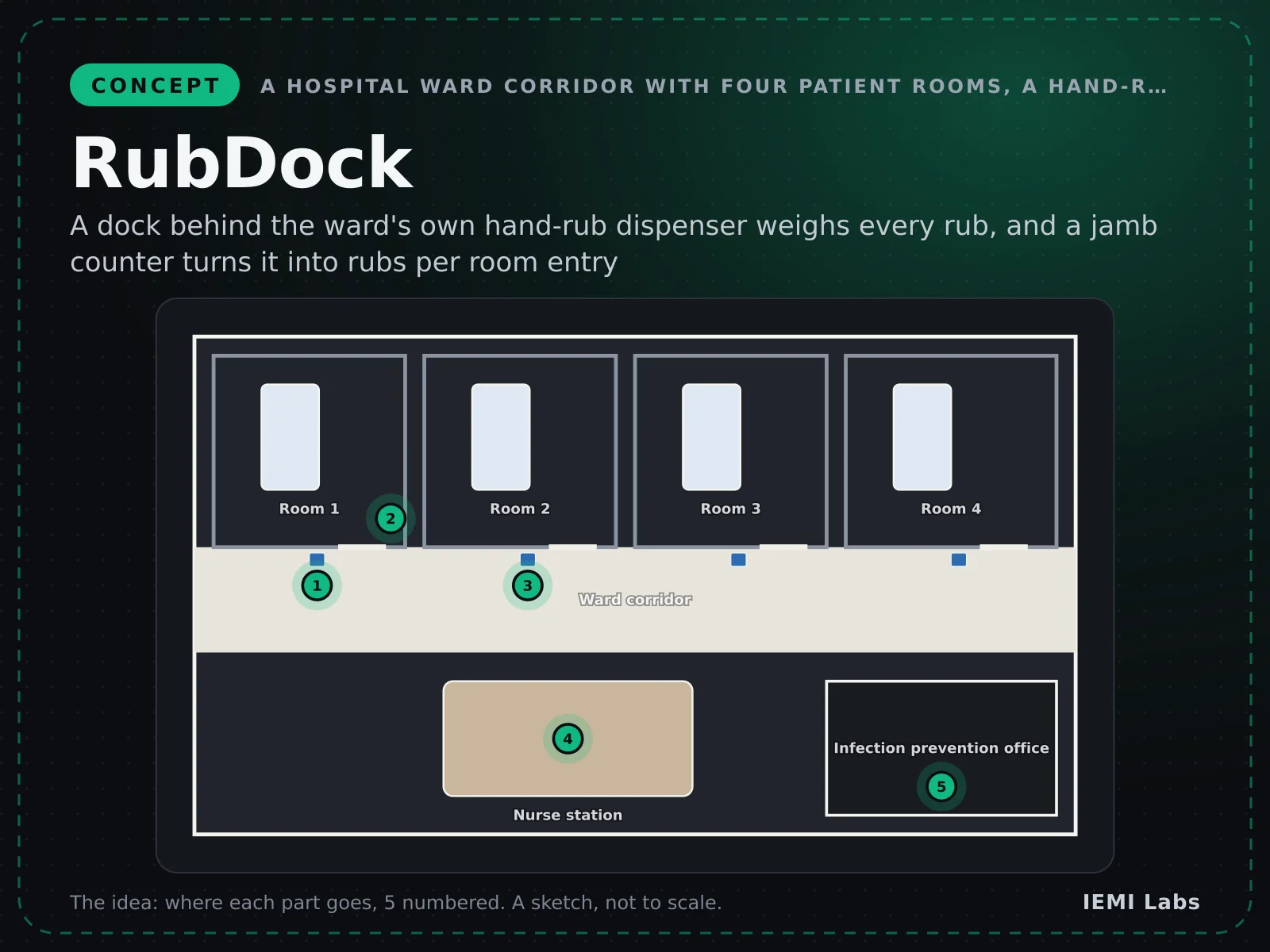
A weighing back-plate for any wall hand-rub dispenser, plus a door counter on the room's jamb.
From $99 per room
DetailsRoomOne
Concept · target $349