Skip to content
IEMI Labs

BedsideOne

IEMI's one product for an older parent's bedside: the bedside table and lamp, made smart, so it watches the pills and the nights and makes the bedside calls itself, in one family app

Concept · not for sale
Our one product for Home: an older parent's bedsideEngineering design: BedsideOne
Target price from$349per smart bedside table

Software: $5 per month (family alerts, SMS and voice calls)

Concept, not for sale yet. Tell us if you want it; that decides what we build.

Rate this idea and tell us what to change
BedsideOne concept: the idea and where each part goes

Drag to rotate · right-drag to move · scroll to zoom · click a part for its size and placeSwipe to rotate · pinch to zoom · two fingers to move · tap a part for its size

How it fits together

BedsideOne, part by part

Scroll or tap a part. Press “See the 3D CAD design” to watch the model, built from our CAD, light each part up and show how it connects.

BedsideOne concept: the idea and where each part goes

Real-time 3D render · drag to rotate · final design may varySwipe sideways to rotate

  1. 01

    The whole BedsideOne

    The bedside table is the bedside's own watcher: two weigh plates, a camera over the pill box, a tracking radar, a walker-spot sensor and a mic inside the table feed one brain in the lamp head that makes the bedside calls, lights them on the table and tells the family.

  2. 02Brain

    Seeed XIAO ESP32-S3 Sense (in the lamp head, camera and mic on board)

    The brain: it runs the bedsideone-fw program

  3. 03

    Two weigh plates

    Feel a dose leave the weekly pill box or the 'when required' box; the camera then checks which compartment

    Seeed XIAO ESP32-S3 Sense (in the lamp head, camera and mic on board) · I²C (STEMMA QT leads up the upstand) · Weight, 10 readings a second

  4. 04

    Tracking radar

    Sees sitting up, legs over the bed edge, walking out and back, and walking speed across the room

    Seeed XIAO ESP32-S3 Sense (in the lamp head, camera and mic on board) · UART · Up to 3 people: position and speed, 10 times a second

  5. 05

    Walker-spot sensor

    Knows if the walker is still parked at the table

    Seeed XIAO ESP32-S3 Sense (in the lamp head, camera and mic on board) · I²C · Distance to the walker

  6. 06

    Lamp, call light, floor glow and tone

    Shows each call on the table: green taken, amber reminder, red power cut; the amber floor glow at night; a soft chime

    Seeed XIAO ESP32-S3 Sense (in the lamp head, camera and mic on board) · One data wire + PWM pin · Light colour and tone

  7. 07

    Secure element and tamper switch

    Signs each call; marks the log if the lamp cover is opened

    Seeed XIAO ESP32-S3 Sense (in the lamp head, camera and mic on board) · I²C + GPIO · Signatures, tamper flag

  8. 08

    Backup charger and cells

    Keeps the table running about 31 h in a power cut (est.) and tells the brain the mains has gone

    Seeed XIAO ESP32-S3 Sense (in the lamp head, camera and mic on board) · 5 V rail, low-battery and USB-power sense pins · Power, mains-lost flag

  9. 09

    All connected

    7 key parts, one program, and your phone

Our circuit board · rev A-0

One board of our own inside BedsideOne

Every chip on one board we design, shaped to fit: the processor, cameras and sensors, Wi-Fi and Bluetooth, lights, sound and power. No plugs, ribbons or adapters. It is checked in our CAD against every part around it, and it arrives from the maker ready to run our software from a microSD card. Turn the model, or pick a part below to see where it sits.

Loading the 3D board…

Drag to turn · scroll to zoom · right-drag to move · click a partDrag to turn · tap a part

Checked before we order

Every board-level number BedsideOne's jobs depend on, checked against its target: camera pixels and frame rate, power and battery life, heat where it works, shock, radio and software. Every lesson from every one of our boards is a rule here, so this review runs again whenever any board teaches us something. Boards are ordered only when nothing fails and the items to prove are measured.

No check fails16 pass · 2 fixed by the review · 6 to prove before we order · 0 failDesign review of 4 November 2026
AreaCheckOur boardTargetStatus
CameraPill camera: one tablet (6 mm) left in a compartment, farthest corner at 0.39 m21.4 px≥ undefined pxpasses
CameraPill camera: frame rate the calls need2 fps at 1600 × 1200chip: 15 fps at 1600 × 1200, 30 fps at 800 × 600passes
CameraPill camera: data rate vs its 1-lane link0.03 Gbps (8-bit)≤ 80 % of 0.192 Gbpspasses
CameraPill camera: a compartment lid edge (2 mm), farthest corner at 0.39 m7.1 px≥ undefined pxpasses
CameraPill camera: frame rate the calls need2 fps at 1600 × 1200chip: 15 fps at 1600 × 1200, 30 fps at 800 × 600passes
CameraPill camera: data rate vs its 1-lane link0.03 Gbps (8-bit)≤ 80 % of 0.192 Gbpspasses
CameraImage processor load, all cameras8 Mpx/s≤ 24 Mpx/s (ESP32-S3 ISP)passes
PowerSupply5 V from a listed USB adapter at the wall socket, on one latched lead (no mains inside the table, UL 962)≤ 70 % of the adapter (2.4 A)passes
PowerPower cuttwo 18650 cells: about 27 h in a power cut, cells aged to 80 % (0.55 W: radar in low-power tracking, Wi-Fi only for alerts, the dim battery lamp, est.)≥ 24 h (the oxygen concentrator stops in a cut; the table keeps the lamp on and the family told)to prove on the dev kit
HeatESP32-S3 temperature, a warm bedroom in summer (32 °C, est.)45 °C≤ 85 °C (rated)passes
HeatCell temperature, a warm bedroom in summer (32 °C, est.)34 °C≤ 60 °Cpasses
HeatPill camera away from the radioradio module 161 mm from the camera chip; camera rails on a MEMS oscillator next to it≥ 20 mmpasses
ShockShock and vibration20 g (est.)standard partspasses
SoftwareStarts our software from the microSD card, no setupmicroSD socket with a hinged, latched lid (Amphenol 101-00660 class), fitted on every board: our software starts from the card (ESP32-S3 SD buscard socket fitted on every board, latchedpasses
SoftwareCard power switch and protection1 power switch and 1 ESD array for 1 card socketevery socket: switched card supply, ESD on all 6 linesfixed by the review
SoftwareThe card wins the starta small loader in the ESP32-S3 flash starts the program on the cardthe program on the card runs every timefixed by the review
SoftwareCard gradeindustrial pSLC microSD (Kingston Industrial or Swissbit S-56u), −40 to 85 °Crated for the heat, cold and writesto prove on the dev kit
RadioWi-Fi from the lamp headto the home router, through the wooden lamp head frontcertified ESP32-S3 modulepasses
MoistureConformal coatingcoatedcoated, sensors, sockets and antennas maskedpasses
FitBoard inside the product CAD, every part checked in 3Dnot yet in the product CADnothing touchesto prove on the dev kit
RadarEvery bedside call in the radar's viewworst 54.5° across, 14.9° up or down (legs over the bed edge), tab folded 15° to the bedinside ±70° across, ±40° up or downto prove on the dev kit
CameraPill box inside the camera viewcorners at 22.9° across, 18.7° along, straight downinside ±33° × ±26° (66 × 52° lens)passes
FitTamper switch against the lamp coverD2F-01 6.5 mm tall in an 8 mm gap; a 1.5 mm boss on the cover presses itpressed when the cover is screwed on, released when it is openedto prove on the dev kit
FitThe two long flexesup flex 18 × about 463 mm through the 20 × 20 cable way; glow tail 12 × about 523 mm down the right side panel (est.)routed and held in the rev T CAD, static bends at or above the maker's minimumto prove on the dev kit

Before we order the first boards, we prove these on the RV1126B development kit or in the rev A tests:

  1. Power cut
  2. Card grade
  3. Board inside the product CAD, every part checked in 3D
  4. Every bedside call in the radar's view
  5. Tamper switch against the lamp cover
  6. The two long flexes

Demo · 6 real-world moments

See BedsideOne work

Short animated scenes of real moments: what happens today, what BedsideOne does about it, and what lands on your phone. The same scenes play in the IEMI app.

DEMO · 1 of 6
0s

Dad lives alone; nobody is with him at night or in the morning.

Use cases

Today, without BedsideOne

When a parent lives alone, the family phones each morning to ask about the pills and the night, and only hears about a bad night afterwards.

What BedsideOne does

The table makes every bedside call itself: it lights the floor, chimes at the table first so Dad can put things right, and tells the family only when a call stands. Unsure calls go to the app with the photo or the radar track, never as an alarm.

How the app helps

  • The night and the morning on one timeline
  • Unsure calls with the pill-box photo to look at
  • One morning message instead of calls all night
Parent alone modeFloor glow at nightDose checkUnsure calls to the appSigned bedside logOpen this scene in the app →
Every feature in these scenes (16)
  • Parent alone mode
  • Floor glow at night
  • Dose check
  • Unsure calls to the app
  • Signed bedside log
  • Fill check
  • Pill-box camera
  • Walker reminder
  • Back-in-bed timer
  • Power-cut watch
  • Concentrator hum check
  • Family call
  • Backup power (about 31 h)
  • Walking speed trend
  • Tracking radar
  • Share with the physio

Demo scenes show how BedsideOne and its app are designed to behave. BedsideOne is in design; nothing here is recorded from real equipment yet.

What it is

IEMI's one product for an older parent's bedside: the bedside table and lamp, made smart, with one brain and one app.

What it does

  • Calls doses taken, missed or on the wrong day
  • Lights the floor at night and chimes for the walker
  • Calls a power cut with the oxygen cylinder's hours left
  • Tells the family only when a call stands

Who it's for

Families of a parent who lives alone, and home-care agencies.

The idea

The bedside table next to Dad's bed watches his pills and his nights and makes the bedside calls itself

The problem today

Families of a parent who lives alone buy a pill dispenser with a monthly fee, a medical alert, a night light and maybe an oxygen gadget, each with its own app, or they phone every morning to ask. The moments that matter happen at the bedside: a missed or doubled dose, a 2 am get-up in the dark without the walker, a power cut that stops the oxygen concentrator.

With BedsideOne

The bedside table is already there. BedsideOne puts weigh plates, a camera over the pill box, a radar, a walker sensor and a mic inside it, so it sees doses taken, lights the floor before he stands, chimes for the walker, calls a power cut with the cylinder's hours left, and calls the family only when needed.

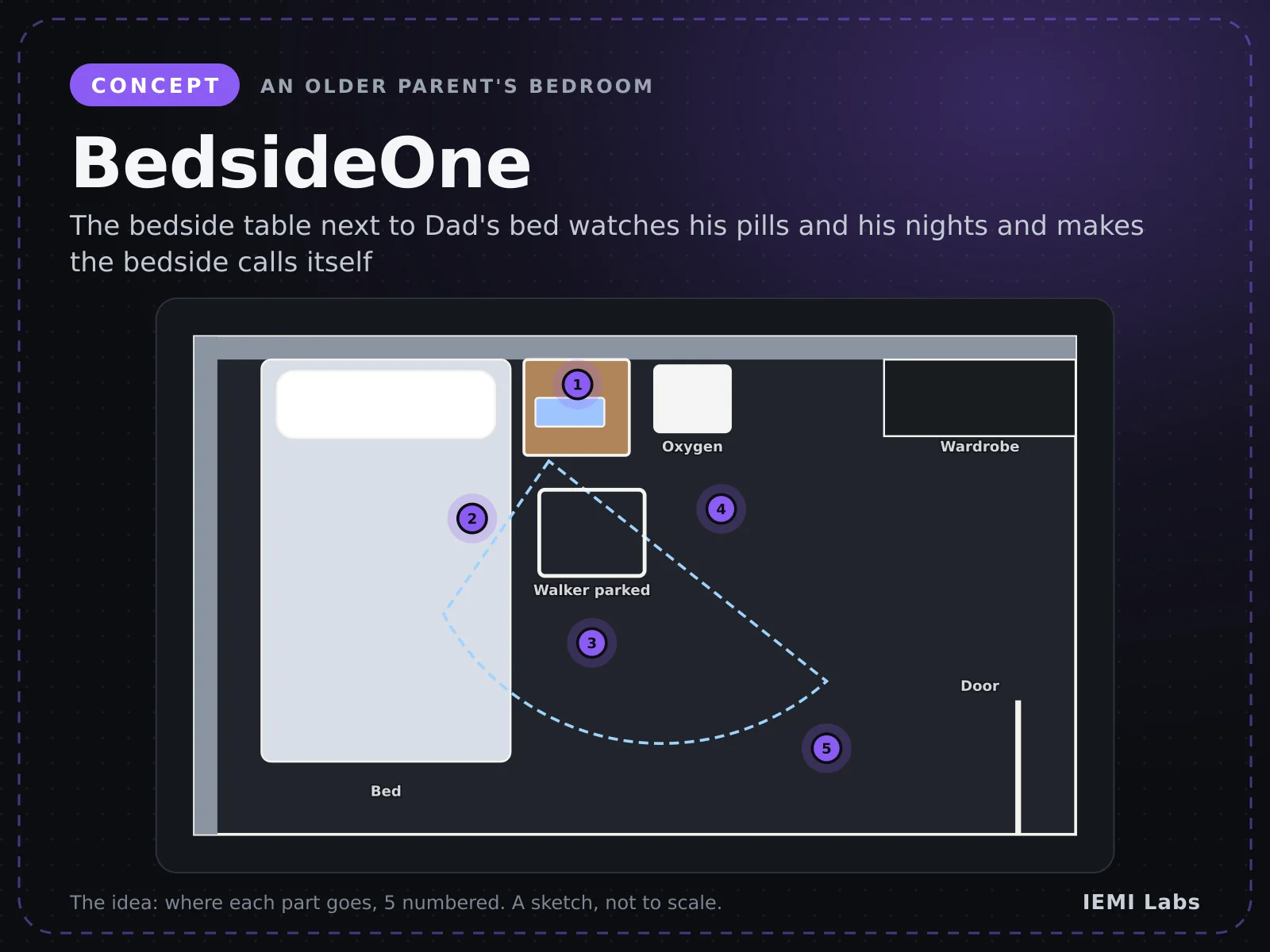
BedWalker parkedOxygenDoorWardrobe12345
  1. 1Smart bedside table (the one product)Brain, camera, mic, lamp, call light and tone in the lamp head; weigh plates, radar and backup in the top
  2. 2Bed edge watched by radarSitting up and legs over the edge at night: the floor glow comes on before he stands; out too long alerts family
  3. 3Walker's spot in front of the tableStill parked when he sets off: the table chimes 'walker please'
  4. 4Oxygen concentrator heardStays as it is; a power cut or its alarm turns the table red and sends the cylinder's hours left
  5. 5Walks across the roomStraight walks to the door give a weekly walking speed for the family and the physio
An older parent's bedroom, drawn to show where each part goes (not to scale).

How the parts connect

BedsideOne, wired up

Every part, what links it to the brain, and how the data reaches your phone. A solid line is a cable; a dashed line is a radio link.

Two weigh platesWeight, 10 readings a secondI²C (STEMMA QT leads up…Tracking radarUp to 3 people: position and speed, 1…UARTWalker-spot sensorDistance to the walkerI²CLamp, call light, floor glow…Light colour and toneOne data wire + PWM pinSecure element and tamper swi…Signatures, tamper flagI²C + GPIOBackup charger and cellsPower, mains-lost flag5 V rail, low-battery a…THE BRAINSeeed XIAO ESP32-S3 Sense…runs bedsideone-fwC with ESP-IDFIEMI cloudvia Home Wi-Fi (WPA3) · MQTT over TLSFamily phonesvia Push, SMS and voice call
Drawn from the BedsideOne parts list. The 3D view above is built separately, from the CAD.

The program

What controls BedsideOne

Runs on
Seeed XIAO ESP32-S3 Sense
Written in
C with ESP-IDF
System
ESP-IDF (FreeRTOS)
AI model
Compartment difference on before and after photos (PillPerch), bed-edge and walk tracker on the radar points, walker-spot rule, concentrator hum and alarm-beep classifier on the mic (int8 CNN, AlarmEcho method); every call carries a confidence, and below the line it says unsure
  1. 1Every 0.1 s: read both plates and the radar
  2. 2A weight step: wake the camera, compare compartments, call taken, wrong day or too soon
  3. 3Legs over the bed edge at night: floor glow on; set off with the walker still parked: chime
  4. 4Out of bed past the limit: alert the family with the track
  5. 5Mains lost or concentrator hum gone or its alarm heard: red light, chime, alert with hours left; sign each call and send it
bedsideone-fw.cppmain loop
for (;;) {
    plates_t w = nau7802_read_both();               // I2C, 10 Hz
    track_t t = ld2450_read();                      // UART
    calls_t c = {0};
    if (weight_step(&w)) { cam_snap(&after); dose_step(&plan, &before, &after, &w, &c); }
    night_step(&t, vl53_mm(), clock_now(), &c);     // glow, walker, not back
    power_step(mains_ok(), hum_heard(&mic), &oxygen, &c);
    for (call_t *k = c.list; k; k = k->next) {
        if (k->conf < k->line) k->kind = UNSURE;     // never guess
        atecc_sign(k); light_and_tone(k); publish(k); // MQTT over TLS
    }
    vTaskDelay(pdMS_TO_TICKS(100));
}

To your phone

How the data reaches BedsideOne family app

Family phones (Android and iPhone)

  1. Bedside table
  2. IEMI cloud
  3. Family phones

What you see in the app

One screen for each job BedsideOne does.

  • Parent alone modeDad lives alone. The table watches his pills and his nights, makes every bedside call itself, lights it on the table and calls the family only when a call still stands.

  • Doses and fill checkSunday afternoon the daughter refills the box on the table. Before the lids close, the camera counts each compartment and circles the one that is short.

  • Night get-upsAt 02:40 Dad's legs swing over the bed edge. The floor glow comes on before he stands; he sets off without the walker and the table chimes 'walker please'.

  • Power cut and oxygenAt 11:05 the power goes. The concentrator's hum stops, the table turns red and chimes, and the family gets the time left on the backup cylinder.

  • Walking speedEvery straight walk across the bedroom gives a walking speed. The family sees the weekly trend and can share it with the physio.

App screens with sample data. The interface is in development.

What the app gets

Data BedsideOne sends to the app
DosesWed AM taken 08:12; Wed PM due 20:00Each dose
When requiredParacetamol 10:40, next from 14:40, 2 of 4 todayEach dose
Fill checkThu AM: 3 found, 4 expectedEach refill
Nights2 get-ups, both with the walker, back in 6 and 9 minEach morning
Oxygen and powerPower cut 11:05, switch to the cylinder, about 4 h 50 minEach call
Walking speed0.58 m/s this week, 0.61 last weekWeekly

The camera looks only down at the pill box and wakes only on a weight step; no room video and no sound recordings. Only signed calls and pill photos leave the home.

CAD design · Stage 2 ready, 28 Oct 2026: smart bedside table that makes the bedside calls itself (9 calls, 7 alone, 2 assist), call light, floor glow and tone, ATECC608 and tamper switch inside; 11 sensor views checked in the CAD; parts $205 at qty 1, margin 25-46 % (est.); not built

Designed in code, checked in 3D

  • 4 printed parts, each a single closed solid
  • Every bought part fitted inside and checked for collisions
  • Assembled exactly as shown in the 3D CAD view (the button on the picture at the top)

Key specs

BedsideOne hardware
AI processorOne board of our own inside the table: Espressif ESP32-S3 module in the lamp head. The bench table uses a XIAO ESP32-S3 Sense until the boards arrive
SensorsOmniVision OV2640 camera chip in the lamp head, looking straight down at the pill box · Two Nuvoton NAU7802 weigh chips beside the 1 kg load cells under the weigh plates · TI IWRL6432AOP 60 GHz radar chip on a tab turned 15° to the bed: sitting up, bed edge, walking out and back · ST VL53L1X walker-spot chip and an Infineon IM69D130 mic (the concentrator's hum and alarm) · 24 LEDs for the lamp, call light and floor glow, a sounder, a security chip and a tamper switch
ConnectivityWi-Fi (WPA3), MQTT over TLS · BLE for pairing only
PowerListed 5 V USB adapter at the wall, one latched lead to our board (no mains in the table): about 0.9 W watching (est.). Two 18650 cells on the board with their own charger keep the dim lamp and the alerts going for about 27 h in a power cut, counted with cells aged to 80 % (est.)
EnclosureThe table itself: birch plywood carcass with a 70 mm torsion-box top and a hollow lamp head closed by a printed opal cover
Dimensions450 x 400 mm, top at 600 mm, lamp head to 1,000 mm
WeightAbout 0.9 kg more than a plain table and lamp (est.)
Ingress ratingIndoor; spill tests in the first build
All target specifications

Jobs

Jobs target specifications
DosesTaken, missed, wrong day, fill check
When requiredToo soon, daily limit
NightsFloor glow, walker please, not back
OxygenPower cut (the lamp stays on as a battery lamp, no candles), concentrator alarm, concentrator not back on after the power returns
WalkingWeekly speed across the room

Legal at the bedside

Legal at the bedside target specifications
FurnitureOpen shelves, not a clothing storage unit
Wiring5 V only, listed adapter
MedicalMedication reminder only (Class I exempt)
NotA fall detector, medical alert or oxygen controller

Targets for production units; they may change during development.

Pricing

Hardware: $349 per smart bedside table

Software: $5 per month (family alerts, SMS and voice calls)

Target pricing. Bought separately, PillPerch ($119 + $4/mo), OxyCart ($199 + $4/mo) and PaceRoll ($129 + $6/mo) add up to $447 + $14/month, plus about $120 for a plain bedside table and lamp (est.). Parts cost about $205 per table at qty 1 including the table body (prices checked 28 Oct 2026).

Smart bedside table

$349 + $5/month

Every bedside job in the table next to the bed.

  • Dose and fill calls
  • Night glow and walker chime
  • Power cut and oxygen alerts
  • Walking speed
  • Family alerts and calls

Indicative launch pricing in USD, excluding taxes and shipping. Final pricing is confirmed before any balance is charged.

Community

What do you think of BedsideOne?

BedsideOne is in development. Rate the idea, tell us what to change about the features, specs or price, and we'll build it with your feedback.

How much people want it

–

No ratings yet

  1. 50
  2. 40
  3. 30
  4. 20
  5. 10

Follow BedsideOne

Get build updates and first access when pre-orders open.

Leave feedback

Your rating of the idea

Feedback on a product concept in development, not a review of a shipped product. Posts may be moderated; links and contact details are held for review. See our community guidelines and privacy policy.

Comments

    No comments yet. Tell us what you'd want from BedsideOne.

    Questions

    Ask about BedsideOne

    Tell us what this would save you, or ask anything. We reply within two business days.

    We use your details only to respond to this request. See our privacy policy.

    From the product lab · ideation phase

    Lab updates for BedsideOne

    All lab updates
    1. LatestA family buys BedsideOne as the bedside table and lamp beside an older parent's bed, so its electronics must be one board an assembly house makes and tests the same way, with nothing plugged together inside the table, no mains wiring in the furniture (UL 962), and it must keep the lamp on and the family told in a power cut, when a home oxygen concentrator stops (NHS Highland home oxygen guidance).
      • What we designed: one rigid-flex board through the whole bedside table. A head board lies over the opal lamp cover: underneath, the camera chip looks straight down at the pill box, sixteen LEDs make the reading lamp and call light, a sounder chimes and the mic listens through its port; on top sit the radio, the security chip and the microSD card. A top board lies in the hollow top under the weigh plates, notched round the load-cell blocks, with the two weigh chips beside the cells, the charger, two backup cells and one latched lead from the 5 V adapter; a strip bends up behind the front face with the walker-spot chip, and a small tab on it turns the radar chip 15 degrees to the bed. An 18 mm flex runs up the lamp upstand to the head board, and a 12 mm flex runs down the side panel to eight floor-glow LEDs behind the kick board. It replaces the XIAO Sense, two NAU7802 boards, the LD2450 radar, the VL53L1X board, three NeoPixel sticks, the piezo, the ATECC608 board and the PowerBoost. See /build/bedsideone-boards
      • How we checked it: the board is written as code and opened in KiCad (0 design-rule violations). It places 52 parts at their datasheet sizes and checks that each sits on its board with no overlaps, clear of the load-cell notches, with heights that fit every gap; that the camera, lamp LEDs, sounder, mic, tamper switch, walker chip, radar and floor glow sit on their windows in the table design; that every corner of the turned radar tab stays behind the front skin; that all five radar calls in the table design (hips and legs at the bed edge, lying on the bed, walking across the room, the bedroom door) are inside the radar chip's view, the worst at 54.5 degrees against 70; that the walker seat and all four pill-box corners are in view; and that both long flexes fit the cable way and the side panel. Design review with the shared rules: 16 pass, 5 to prove, 0 fail. A 3D model shows it in a see-through table or laid flat, and the quote pack and design files are on the board page
      • What we learned: the bench radar module saw 60 degrees each side, too little for the legs at the bed edge without its 15-degree turn; the TI chip quotes about 70 degrees, but only as plots, so the edge is measured on its evaluation board beside a real bed. A camera chip flat on the head board sees the whole pill box straight down, so the bench camera's tilt goes, and one 6 mm tablet fills about 21 pixels. Two cells give about 27 hours with the dim lamp on in a power cut, with the cells aged. The table design needs five small changes for the board (a mic port, a tamper boss, slots for the glow flex, a lead grommet, the straight-down camera view). About $57-75 a table at 1,000 (est.)
      • What is next: the radar, camera and weigh chips from their makers' drawings; the board placed in the table CAD with every part checked in 3D; and the next product's board, StudyOne

      See it in 3DFull research and design

    2. Home oxygen concentrators switch off in a power cut; users should switch to the backup cylinder, keep a battery torch or lamp and never use candles with oxygen, and register with their energy supplier as a priority customer (NHS Highland home oxygen guidance). Some concentrators need checking after the power comes back (equipment supplier guidance). Since 2 Feb 2026 a Class I exempt medication reminder keeps only the records and complaint-file duties of the FDA Quality Management System Regulation (21 CFR 890.5050, amended 4 Dec 2025).
      • Market and rules check (DESIGN.md): the US furniture tip-over rule (unchanged since 2023), the FDA reminder rule amended for the new quality system rule, NHS home oxygen power-cut guidance and five competitors, each with what it changes in BedsideOne
      • Power cut: the lamp now stays on dim on the table's own backup cells as a battery lamp, so nobody needs a candle near the oxygen, and the family alert says so; backup is about 24 h with the lamp on (est.)
      • New assist call: when the power comes back, the table listens for the concentrator and tells the family if it has not restarted within 3 minutes; it uses the mains sense and the microphone already inside, so no new part and no CAD change
      • Rules: two new rule lines in equipment.json, the FDA complaint file and records kept before any US sale, and the home oxygen power-cut guidance
      • Competitors: Hero is still $29.99 to $59.99 a month for pills only; Walabot HOME about $149.99 plus $4.99 a month for falls in one room; NtelCare and Creatrol radars are for care facilities with no public price; none watches doses, the walker or the oxygen. Price kept at $349 + $5/month
      • Product page https://iemilabs.com/products/bedsideone/ gains a home oxygen power-cut FAQ and the new oxygen spec line
      • Next: ask families in the phase 3 buyer review whether their parent can reconnect the cylinder alone at night; close-out C9 (recommend the first product to the owner) from 30 Oct 00:00

      See it in 3DFull research and design

    3. A family whose parent lives alone with pills, a walker and home oxygen needs one answer to "is Dad all right?": today a pill dispenser alone is $29.99-59.99 a month (Hero pricing page, Oct 2026), and fall radars and bed-exit alarms are extra boxes for one job each.
      • Buyer check with sources: what families pay today for a pill dispenser plan, a fall radar, a bed-exit alarm and a medical alert, and the three closest products
      • What we learned: Hero has moved to plans only, $29.99-59.99 a month with no device fee listed, so pills alone cost about $360-720 a year; wall fall radars such as Walabot HOME (about $179-249) and bed alarms ($38-94) do one job each
      • Price kept at $349 + $5 a month: about $409 in the first year for the table, lamp, pills, nights and power cuts together
      • Parts list prices checked on shop pages today: $205 of parts per table at qty 1 (the walker distance sensor went up to $22.95); cost and margin table in the design notes (about 25 % at qty 1 and 46 % at qty 100, est.)
      • Backup power checked: the two cells run in parallel, about 31 h of alerts in a power cut (est.)
      • Product page: the first three FAQs answer the buyer's top questions (is it a fall detector, cost and why not a pill dispenser or a fall radar, is there a camera in the bedroom)

      See it in 3DFull research and design

    4. Families of a parent who lives alone pay a pill dispenser fee (Hero $99.99 + $29.99-44.99 a month, Hero pricing page) and a medical alert ($25-29 a month, AARP), and the night is the risky time: a third of over-60s' hospital falls were toilet trips, at least 44 % at night and 80 % without the usual walking aid (Rose et al. 2019). They want one answer to 'is Dad all right this morning?': pills, the night and the oxygen.
      • New flagship BedsideOne: the bedside table and its lamp made smart, at the same 450 x 400 size with a 600 mm top and open shelves (so not a clothing storage unit under the CPSC tip-over rule)
      • Lamp head: XIAO ESP32-S3 Sense brain with its camera looking down at the pill box and its mic, lamp and call lights, chime, ATECC608 secure element and tamper switch; top: two weigh plates on 1 kg load cells, a radar turned to the bed, a walker-spot sensor and backup cells; kick board: amber floor glow
      • Makes 9 bedside calls (7 alone, 2 assist), says unsure below a stated confidence; equipment.json with rules, calls, impact and security; bedroom plan, 6 integration parts, 5 app screens with Parent alone mode
      • Shared from PillPerch, ParentHome and PaceRoll NightPath; dropped the hub, mast, bed eye, cart box and walker pod; gaps listed: cylinder weight (OxyCart stays), walking away from the bedroom (PaceRoll stays), falls in other rooms
      • CAD review: 16/16 parts fit with datasheet sizes, 11 sensor views checked, no collisions, no floating parts; page at /products/bedsideone/, $349 + $5/month vs $447 + $14/month plus a table and lamp

      See it in 3DFull research and design

    5. One product for an older parent's bedside (owner decision, 27 Oct 2026).
      • Its jobs now run in BedsideOne, the smart bedside table: /products/bedsideone/

      See it in 3DFull research and design

    6. One product for an older parent's bedside (owner decision, 27 Oct 2026).
      • Its jobs now run in BedsideOne, the smart bedside table: /products/bedsideone/

      See it in 3DFull research and design

    Smart equipment · legal on the field

    BedsideOne is the bedside table with a built-in reading lamp: 450 x 400 mm, made smart

    It replaces the bedroom's existing bedside table (nightstand) and the bedside lamp on it, next to an older parent's bed, with every part built in. Everything inside the table: brain, camera, mic, lights, tone, secure element and tamper switch in the lamp head; load cells, radar, walker sensor and 2 backup cells in the 70 mm top; floor glow in the kick board. About +0.9 kg over a plain table and lamp (est.); no hub, mast, bed eye, cart box or walker pod.

    Meets US CPSC and FDA: 16 CFR 1261 / ASTM F2057-23 (clothing storage unit tip-over: only units with drawers or doors, 27 in or taller), and FDA 21 CFR 890.5050 (medication reminder, product code NXQ, Class I exempt) for the dose reminders

    RuleLimitBedsideOne
    Clothing storage unit tip-over rule (16 CFR 1261, STURDY Act)applies to freestanding units with drawers or doors, 27 in (686 mm) or taller✓ open shelves only, no drawers or doors (asserted in the CAD), so it is not a clothing storage unit; a wall strap ships in the box anyway
    Same size and place as the plain bedside tablefits beside the bed, top near mattress height✓ 450 x 400 footprint and a 600 mm top (CAD asserts the footprint, the floor contact and flush weigh plates); nothing sticks out past the footprint
    Mains wiring in furnitureno mains wiring inside unless the furniture is listed for it (UL 962)✓ only 5 V inside, from a listed 5 V USB adapter at the wall socket; the backup cells sit behind a PowerBoost charger with protection
    Medication reminder (FDA 21 CFR 890.5050, NXQ)remind and log only; no dispensing, no dose decisions, no drug identification✓ weighs and photographs the family's own organiser, reminds and alerts; it sees a compartment emptied, not a pill swallowed
    Not a fall detector, medical alert or oxygen controllerno claims a sensor cannot prove✓ monitor and alert only: night get-ups, not back in bed, walker left behind, power cuts and concentrator alarms; it never touches the oxygen flow
    Radio in a home product (FCC Part 15 / RED)licence-free bands, certified modules✓ Wi-Fi and BLE on the certified XIAO ESP32-S3 module; 24 GHz LD2450 radar
    FDA Quality Management System Regulation for a Class I exempt reminder (21 CFR 890.5050 as amended 4 Dec 2025, in force 2 Feb 2026; 21 CFR 820.35)exempt from premarket notification and most of part 820, except records and complaint files under 820.35✓ every reminder-related complaint is logged with the date, the table serial and the firmware build, kept with the signed call log; the complaint file and device records are kept under 820.35 before sale in the US (est. process, no extra hardware)
    Home oxygen in a power cut (NHS Highland home oxygen contingency guidance)concentrators switch off in a power cut; use the backup cylinder; use a battery torch or lamp and never candles with oxygen✓ on a power cut the lamp head stays on as a dim battery lamp (about 0.2 W, est.) so no candle is needed, and the family alert says to connect the cylinder and not to light candles

    Home use. Not a medical device beyond a Class I exempt medication reminder, not a fall detector or medical alert, and it never controls oxygen. Radio certification and furniture stability tests to be done before sale.

    One piece of equipment does

    • ●Dose taken or missed, from the family's own weekly box
    • ●Wrong day's compartment opened
    • ●'When required' doses too soon, and the dose gap clock
    • ●Sunday fill check
    • ●Night get-up: the floor glow comes on before the parent stands
    • ●Set off without the walker
    • ●Not back in bed at night
    • ●Power cut: switch to the cylinder, with hours left (est.)
    • ●The oxygen concentrator's alarm or stopped hum
    • ●Walking speed across the bedroom, as a weekly trend

    Not done by the equipment, and why

    • Cylinder contents by weight: the backup cylinder stands in its cart, away from the table; hours left are estimated from the cylinder size and prescribed flow the family enters (OxyCart stays listed for weighing, F12)
    • Walking away from the bedroom (metres, brakes parked, walker on its side): needs sensors on the walker itself; PaceRoll stays listed for physio clinics
    • A fall in another room: the radar sees the bedroom only; a worn help button is planned as the one detachable part in rev B
    • Pills actually swallowed: no sensor can prove it from a bedside; the table sees a compartment emptied

    Makes the call itself

    With the parent alone at night and no carer in the house, the table makes every bedside call itself: it lights the floor, chimes at the table first so the parent can put things right, and calls the family only when the call stands (a dose still missed, not back in bed after the limit, still no mains). Calls it is unsure of go to the family app as unsure, with the photo or the radar track, and are never sent as an alarm.

    CallWho decidesHow it sees itHow players see the call · if unsure
    Dose taken or missed< 3 s after the box is put back · about 97 % of compartments right (est.)The equipmentpill-plate load cell, camera over the box; weight step + before and after compartment difference (PillPerch)Green light and a soft chime for taken; amber and a chime at the end of the window; then the family alert. Under 85 % confidence (a hand in the way, a partly hidden compartment): unsure, photo to the app, no missed-dose call
    Wrong day's compartment opened< 3 s · about 95 % (est.)The equipmentcamera, load cell; compartment difference against the clockAmber light and the spoken-style chime 'That's Thursday'. Under 85 %: no chime, shown as unsure
    'When required' dose too soon< 2 s after the box lifts · about 99 % of lifts seen (est.)The equipmentPRN-plate load cell; weight drop and the gap and daily limit the family setAmber light and a soft chime; the app shows 'next from 14:40'. A lift with no weight change is logged, not called
    Night get-up< 1 s · about 92 % (est.)The equipmenttracking radar; bed-edge track: lying, sitting up, legs over the edgeAmber floor glow from the kick board and a dim lamp. A doubtful track lights the floor anyway (no harm in light) and logs unsure
    Set off without the walker< 2 s · about 90 % (est.)The equipmenttracking radar, walker-spot sensor; person leaves the bed zone while the walker is still at its spotSoft chime 'walker please' from the table. Walker spot unclear (something else parked there): no chime, logged
    Not back in bed at nightat the limit (default 20 min) · about 90 % (est.)Helps the officialtracking radar, clock; time out of bed against the parent's own nights (14 days learned) and the family's limitApp alert with the night track; lamp stays on dim. The family decides whether to call; the table never claims a fall
    Power cut: switch to the cylinder< 10 s · mains loss certain; hours left about ± 20 % (est.)The equipmentmains sense on the PowerBoost, mic (concentrator hum stopped); mains lost + hum gone; hours left from the cylinder size and flow the family enteredRed light, repeating chime, the lamp stays on dim on its backup cells (a battery lamp, no candles), family alert 'switch to the cylinder, about 4 h 50 min; no candles near the oxygen'. Hum still heard (concentrator on another socket): 'power cut in the bedroom' only
    Concentrator not back on after the power returns3 min after the mains returns · mains return certain; hum heard about 95 % (est.)Helps the officialmains sense on the PowerBoost, mic (concentrator hum); mains back + no concentrator hum within 3 min; some concentrators need a press of the power switch after a cutAmber light and chime on the table, family alert 'power is back: check the concentrator is running before leaving the cylinder'. Concentrator on another socket or too quiet to hear: 'power is back, check the concentrator' as info only
    Concentrator alarm sounding< 10 s · about 93 % (est.)The equipmentmic; alarm beep grammar + int8 CNN (AlarmEcho method)Red light, chime, family alert. Under 80 %: unsure alert, no voice call
    Walking speed trendweekly · about ± 0.05 m/s (est.)Helps the officialtracking radar; speed on straight walks of 2 m or more across the bedroomApp chart for the family and, if they share it, the physio. Too few straight walks in a week: no trend shown

    Nothing added to the field

    The only things in play are the items the laws already put there:

    • ●The bedside table and its built-in reading lamp (table body, lamp cover, two weigh plates)

    The bed, the pill box, the rollator and the oxygen concentrator stay as they are; no hub, mast, bed eye, cart box or walker pod

    Built to take the hits

    • Someone leans or falls against the table getting out of bed (an adult's hand load on the top edge, about 300 N (est.), ASTM F2057-23 stability method used as a guide (not in scope)): ✓ the same 450 x 400 open-shelf carcass with the cells low in the top and a wall strap; the lamp head is hollow and light; no new edges
    • A cup of water spilled on the top (about 250 ml over the weigh plates): ✓ no board sits under a plate opening: the load cells are bare metal bars and the ADCs, charger and cells stand on the cavity floor to the side (CAD); the app flags a sudden weight jump as a spill, not a dose
    • A rollator or wheelchair knocks the front (a walking-pace knock, about 20 J (est.)): ✓ radar and walker sensor sit behind the 6 mm front wall with only a 2 mm skin and an 8 mm window, flush; nothing sticks out

    Secure by design

    Call record:
    Each call is signed in the ATECC608 with its photo or radar track and time, in an append-only log the family app can verify
    Radio:
    WPA3 Wi-Fi, TLS 1.3 to the cloud, BLE LE Secure Connections for pairing only
    Boot:
    ESP32-S3 secure boot v2 and flash encryption: only our signed firmware runs
    Updates:
    Signed updates with rollback, only between 10:00 and 18:00 and never during a dose window or a night get-up
    Tamper:
    The screwed lamp cover presses an Omron D2F-01 tamper switch; opening it marks the log; no open debug port
    Privacy:
    The camera looks only down at the pill box and wakes only on a weight step; radar tracks are not images; no recordings of sound; only signed calls and the pill photos leave the home, kept 30 days; family members are invited by the parent or their attorney
    Theft:
    Paired to the home's Wi-Fi and the owner's account; moved to another network it stops sending until the owner unlocks it

    BedsideOne FAQ

    General FAQ
    Is it a fall detector or medical alert?

    No. It is a monitor-and-alert aid at the bedside. It lights the floor before he stands, chimes if he sets off without the walker, and alerts the family if he is not back in bed after their limit. It cannot see a fall in another room, and the family decides what to do.

    What does it cost, and why not a pill dispenser or a fall radar?

    $349 per table plus $5 a month. A Hero pill dispenser is $29.99-59.99 a month (about $360-720 a year) and does only pills; a wall fall radar such as Walabot HOME is about $179-249 and does only falls in one room; a bed-exit alarm is about $38-94. BedsideOne is the bedside table and lamp you need anyway, and does the pills, the nights and the power cut in one app: about $409 in the first year.

    Is there a camera in the bedroom?

    Only one, in the lamp head, looking straight down at the pill box, and it wakes only when the box weight changes. The bed and the room are watched by radar, which makes no images. No room video and no sound are kept.

    Which products does BedsideOne replace?

    ParentHome and PillPerch. Their pill, night and power jobs now run inside the bedside table. OxyCart (cylinder weighing) and PaceRoll (walker sensors for physio clinics) stay available on their own.

    Does it give pills or know he swallowed them?

    No. It weighs and photographs the family's own weekly box, so it knows a compartment was emptied, reminds and alerts. It never dispenses or identifies a drug.

    Does it control the oxygen?

    Never. It hears the concentrator stop or alarm and sees the mains go, and tells the family to switch to the cylinder with an estimate of the hours left.

    What does it do in a power cut if my parent uses home oxygen?

    The concentrator stops when the power goes. The table sees the mains go and hears the hum stop, turns red, and tells the family to switch to the cylinder, with an estimate of the hours left. The lamp stays on dim on its own backup cells, so nobody needs a candle: NHS home oxygen guidance says never to use candles with oxygen. When the power comes back, it listens for the concentrator, because some need their switch pressed again, and tells the family if it has not restarted within 3 minutes. It never controls the oxygen. Also register your parent on your energy supplier's priority list.

    What happens when it is not sure?

    It says unsure, sends the photo or the radar track to the app, and never sends an alarm on a guess.

    How is BedsideOne different from CareOne?

    BedsideOne is a bedside table and lamp for an older parent who lives alone, bought by their family: it checks doses, the walker, the oxygen concentrator and night get-ups, and tells the family. CareOne is the bedside locker in a care home or hospital bay, bought by the home or ward: it calls turns, drinks, hand rub and night checks for the staff. Both use the same bed-exit radar, so the bed-exit call is tested once for both.

    Related products

    KitchenOne concept: the idea and where each part goes
    HomeConcept

    KitchenOne

    IEMI's one product for the home kitchen: the chimney hood over the hob, made smart, with one brain and one app.

    • Calls a burner left on with nobody there
    • Calls dry pans, smoke, boil-overs and flares
    • Counts cooker whistles

    From $369 per smart 60 cm chimney hood

    Details
    DampOne concept: the idea and where each part goes
    HomeConcept

    DampOne

    IEMI's one product for the bathroom, laundry and damp: the extractor fan in the ceiling, made smart, with one brain and one app.

    • Runs the fan until the cold wall is dry
    • Counts mould-risk hours
    • Calls water on the floor, taps and baths

    From $349 per smart 100 mm extractor fan

    Details
    StudyOne concept: the idea and where each part goes
    HomeConcept

    StudyOne

    IEMI's one product for a child's study desk: the desk lamp, made smart, with one brain and one app.

    • Checks sums and spelling with hints
    • Follows reading aloud
    • Calls breaks, eye distance and dim light

    From $279 per smart desk lamp

    Details

    BedsideOne

    Concept · target $349

    I want this