Skip to content
IEMI Labs

GarageOne

IEMI's one product for the front door and garage: the garage door opener itself, made smart, so it closes a door left open, refuses an unsafe close and watches the garage, in one home app

Concept · not for sale
Our one product for Home: the front door and garageEngineering design: GarageOne
Target price from$499per smart garage door opener

Software: $2 per month (family alerts and the door log)

Concept, not for sale yet. Tell us if you want it; that decides what we build.

Rate this idea and tell us what to change
GarageOne concept: the idea and where each part goes

Drag to rotate · right-drag to move · scroll to zoom · click a part for its size and placeSwipe to rotate · pinch to zoom · two fingers to move · tap a part for its size

How it fits together

GarageOne, part by part

Scroll or tap a part. Press “See the 3D CAD design” to watch the model, built from our CAD, light each part up and show how it connects.

GarageOne concept: the idea and where each part goes

Real-time 3D render · drag to rotate · final design may varySwipe sideways to rotate

  1. 01

    The whole GarageOne

    The garage door opener is the garage's own watcher: a camera in its door end, a heat camera in its back end and a mic and temperature sensor inside the head feed one brain that closes a door left open after the legal warning, refuses an unsafe close and tells the family.

  2. 02Brain

    Raspberry Pi Zero 2 W (in the opener head)

    The brain: it runs the garageone-fw program

  3. 03

    Door camera

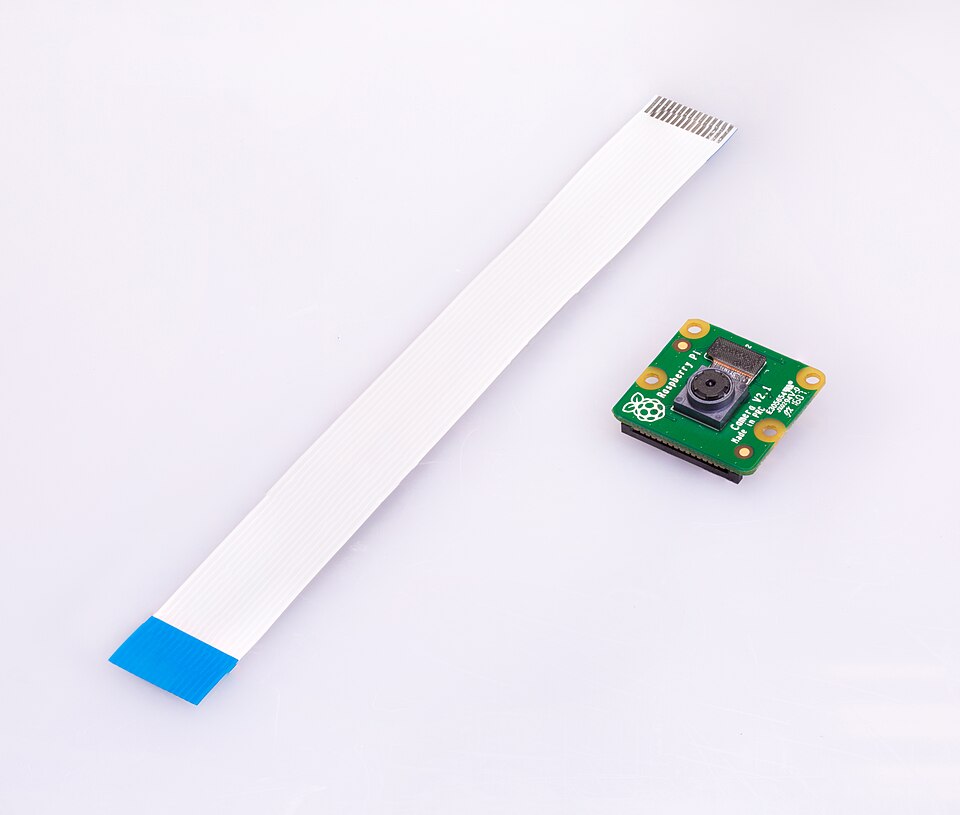
    Looks from the head's door end at the door, the doorway, both bays and the driveway when open: door state, a clear doorway before a close, cars, people, parcels

    Raspberry Pi Zero 2 W (in the opener head) · CSI-2 ribbon to the brain · Video, 2 frames a second analysed, never stored

  4. 04

    Heat camera

    Looks from the back end at the water heater and the back of the bay: a wet pan, a dripping relief pipe, someone at the back in the dark

    Raspberry Pi Zero 2 W (in the opener head) · I²C · 32 x 24 heat picture, 2 times a second

  5. 05

    Mic and garage temperature

    Hears the home's smoke and CO alarm patterns and an engine left running; reads the garage temperature for freezing

    Raspberry Pi Zero 2 W (in the opener head) · Mic through an MCP3008 ADC on SPI; SHT45 on I²C · Sound pattern scores on the device (no audio leaves it); temperature every minute

  6. 06

    Opener link

    Reads the opener's own door position and asks for a move through its wall-button input; the opener's UL 325 board, eyes and reversal stay in charge

    Raspberry Pi Zero 2 W (in the opener head) · Optocoupled wall-button input and the opener board's door-position output (GPIO) · Door open, closed or moving; move requests

  7. 07

    Call lights and tone

    Shows each call on the head and gives the 5 s flashing light and sound UL 325 needs before and during every remote close

    Raspberry Pi Zero 2 W (in the opener head) · One data wire + PWM pin · Light colour and tone

  8. 08

    Secure element, tamper switch and power

    Signs each call and door move; marks the log if the cover is opened; 5 V from the opener's mains with a backup cell

    Raspberry Pi Zero 2 W (in the opener head) · I²C + GPIO; 5 V · Signatures, tamper flag, power

  9. 09

    All connected

    7 key parts, one program, and your phone

Our circuit board · rev A-0

One board of our own inside GarageOne

Every chip on one board we design, shaped to fit: the processor, cameras and sensors, Wi-Fi and Bluetooth, lights, sound and power. No plugs, ribbons or adapters. It is checked in our CAD against every part around it, and it arrives from the maker ready to run our software from a microSD card. Turn the model, or pick a part below to see where it sits.

Loading the 3D board…

Drag to turn · scroll to zoom · right-drag to move · click a partDrag to turn · tap a part

Checked before we order

Every board-level number GarageOne's jobs depend on, checked against its target: camera pixels and frame rate, power and battery life, heat where it works, shock, radio and software. Every lesson from every one of our boards is a rule here, so this review runs again whenever any board teaches us something. Boards are ordered only when nothing fails and the items to prove are measured.

No check fails18 pass · 4 fixed by the review · 10 to prove before we order · 0 failDesign review of 4 November 2026
AreaCheckOur boardTargetStatus
CameraDoor camera: a parcel (0.3 m) on the driveway 3 m past the open door at 6.68 m96.9 px≥ 20 pxpasses
CameraDoor camera: frame rate the calls need5 fps at 3840 × 2160chip: 30 fps at 3840 × 2160passes
CameraDoor camera: data rate vs its 4-lane link0.41 Gbps (10-bit)≤ 80 % of 3.564 Gbpspasses
CameraDoor camera: a small child (0.25 m wide) at the far end of the doorway at 4.67 m115.4 px≥ 20 pxpasses
CameraDoor camera: frame rate the calls need5 fps at 3840 × 2160chip: 30 fps at 3840 × 2160passes
CameraDoor camera: data rate vs its 4-lane link0.41 Gbps (10-bit)≤ 80 % of 3.564 Gbpspasses
CameraHeat camera: water in the heater's drain pan (0.3 m patch) at 2.97 m1.7 px≥ 1 pxpasses
CameraImage processor load, all cameras83 Mpx/s≤ 360 Mpx/s (RV1126B ISP)passes
CameraAI engine time per frame3 TOPSthe doorway check within 1 s of a close being asked for; car, person and parcel checks at 2 frames a secondto prove on the dev kit
PowerSupplyMean Well IRM-10-5 PCB-mount 5 V 10 W supply (class II, listed) on the opener's own mains, on the power board≤ 70 % of the supply (7 W)passes
PowerPower cutone soldered 18650 cell (Samsung INR18650-35E) on the power board: in a power cut the camera drops to 1 frame a second and the heat chip to one frame a minute, about 1.0 W, about 7 h on an aged, cold cell (est.)the "power cut" alert, the door state and the alarm listener for 4 hto prove on the dev kit
HeatRV1126B temperature, a summer garage (45 °C air at the ceiling) with the head closed68 °C≤ 85 °C (rated)passes
HeatCamera chip away from the processordoor camera 147 mm≥ 30 mmpasses
HeatTemperature chip away from the supplySHT45 222 mm from the IRM-10-5, on an island cut free by a slot≥ 150 mm, and reads within 1 °C of the garageto prove on the dev kit
ShockShock and vibration20 g (est.)standard partspasses
SoftwareStarts our software from the microSD card, no setupmicroSD socket with a hinged, latched lid (Amphenol 101-00660 class), fitted on every board: our software starts from the cardcard socket fitted on every board, latchedpasses
SoftwareCard power switch and protection1 power switch and 1 ESD array for 1 card socketevery socket: switched card supply, ESD on all 6 linesfixed by the review
SoftwareThe card wins the starteMMC shipped empty; our loader reads the card firstthe processor starts from the card every timefixed by the review
SoftwareCard gradeindustrial pSLC microSD (Kingston Industrial or Swissbit S-56u), −40 to 85 °Crated for the heat, cold and writesto prove on the dev kit
SoftwareClip buffer for an unsure call19.8 s of 8-bit 5 fps video in 40 % of the 2 GB memory≥ 3 spasses
RadioWi-Fi/BT module clock37.4 MHz MEMS oscillator (Y3)37.4 MHz next to the AP6256fixed by the review
RadioHome Wi-Fi and BLE from inside the opener headAP6256 with a chip antenna at the main board's top left corner, behind the ABS door-end wallthe home Wi-Fi at the far end of a two-car garage, BLE pairing at the wall controlto prove on the dev kit
MoistureConformal coatingcoatedcoated, sensors, sockets and antennas maskedpasses
FitBoard inside the product CAD, every part checked in 3Dnot yet in the product CADnothing touchesto prove on the dev kit
CameraEvery garage call in viewDoor camera: worst 44.1° / 20.7°; Heat camera: worst 29.2° / 11.3°inside each sensor's viewpasses
CameraDoor camera and heat camera windowsdoor 30 × 30 (margin 4.1 mm, steepest line of sight 57°); heat 30 × 30 (margin 5.7 mm, steepest 60°)each view inside its windowpasses
FitSensor tabs on their bracketsDoor camera: 0.3 mm inside the wall, hinge 11.8 mm; Heat camera: 0.3 mm inside the wall, hinge 8.4 mmchip or holder ≥ 0.3 mm inside the wall, hinge within the 40 mm flexto prove on the dev kit
FitLights, tone and vents at their openings8 LEDs on each light strip inside the 60 × 14 side slot; the piezo over the tone holes; the SHT45 and the mic port behind the two rows of back-end ventseach at its openingfixed by the review
SafetyThe opener stays in charge of the doorone photo-MOS relay across the opener's wall-button pair (a momentary press), the door-position output through an optocoupler, the backup battery through a divider; nothing else wired to the openerGarageOne never drives the motor; the opener's UL 325 board, reversal and eyes decide every movepasses
SafetyMains kept on the power boardthe opener's mains tap into a spring-clamp terminal, fuse, varistor, IRM-10-5 (class II); only 5 V, I²C and I²S on lead L1class II creepage on the power board; no mains on any other boardto prove on the dev kit
SecurityCover tamper sensorTMAG5273 3D Hall chip at the right strip's top edge, 11.8 mm from a Ø8 × 3 magnet in a boss under the covercover off = logged and signedto prove on the dev kit
FitLeadsL1 about 0.6 m along the right side wall through the bay-wall notches (0.038 V drop); L2 about 0.35 m to the opener's logic boardleads ≤ 0.15 V drop; clipped clear of the motor and gearboxto prove on the dev kit

Before we order the first boards, we prove these on the RV1126B development kit or in the rev A tests:

  1. AI engine time per frame
  2. Power cut
  3. Temperature chip away from the supply
  4. Card grade
  5. Home Wi-Fi and BLE from inside the opener head
  6. Board inside the product CAD, every part checked in 3D
  7. Sensor tabs on their brackets
  8. Mains kept on the power board
  9. Cover tamper sensor
  10. Leads

Demo · 6 real-world moments

See GarageOne work

Short animated scenes of real moments: what happens today, what GarageOne does about it, and what lands on your phone. The same scenes play in the IEMI app.

DEMO · 1 of 6
0s

The family is away for the weekend and the garage is on its own.

Use cases

Today, without GarageOne

Away for the weekend, you wonder whether the garage door is shut, and nobody is there to check.

What GarageOne does

The opener makes the garage's calls itself: it closes a door left open only after the legal warning and a clear doorway, notes the cold, and messages only when a call needs someone. Unsure calls go to the app with a still and never move the door.

How the app helps

  • Every call since Friday on one timeline
  • Unsure calls with a still to look at
  • One message instead of checking all weekend
No one home modeClose with the legal warningGarage temperatureUnsure calls to the appSigned door logOpen this scene in the app →
Every feature in these scenes (12)
  • No one home mode
  • Close with the legal warning
  • Garage temperature
  • Unsure calls to the app
  • Signed door log
  • Doorway check
  • Lights and tone on the opener
  • Engine-running watch
  • Alarm listening
  • Family alert
  • Water heater watch
  • Someone-inside watch

Demo scenes show how GarageOne and its app are designed to behave. GarageOne is in design; nothing here is recorded from real equipment yet.

What it is

IEMI's one product for the front door and garage: the garage door opener, made smart, with one brain and one app.

What it does

  • Closes a door left open, safely
  • Refuses an unsafe remote close
  • Calls an engine running and someone inside
  • Hears your smoke and CO alarms

Who it's for

Families with an attached garage, and the installers who fit their openers.

The idea

The garage door opener itself closes a door left open, refuses an unsafe close and watches the garage

The problem today

Garage doors left open overnight are a common way into a home, and police keep asking families to check them. Families add a smart garage hub, a garage camera, a leak puck and an alarm listener: four boxes and apps, and none of them knows whether the doorway is clear before a remote close.

With GarageOne

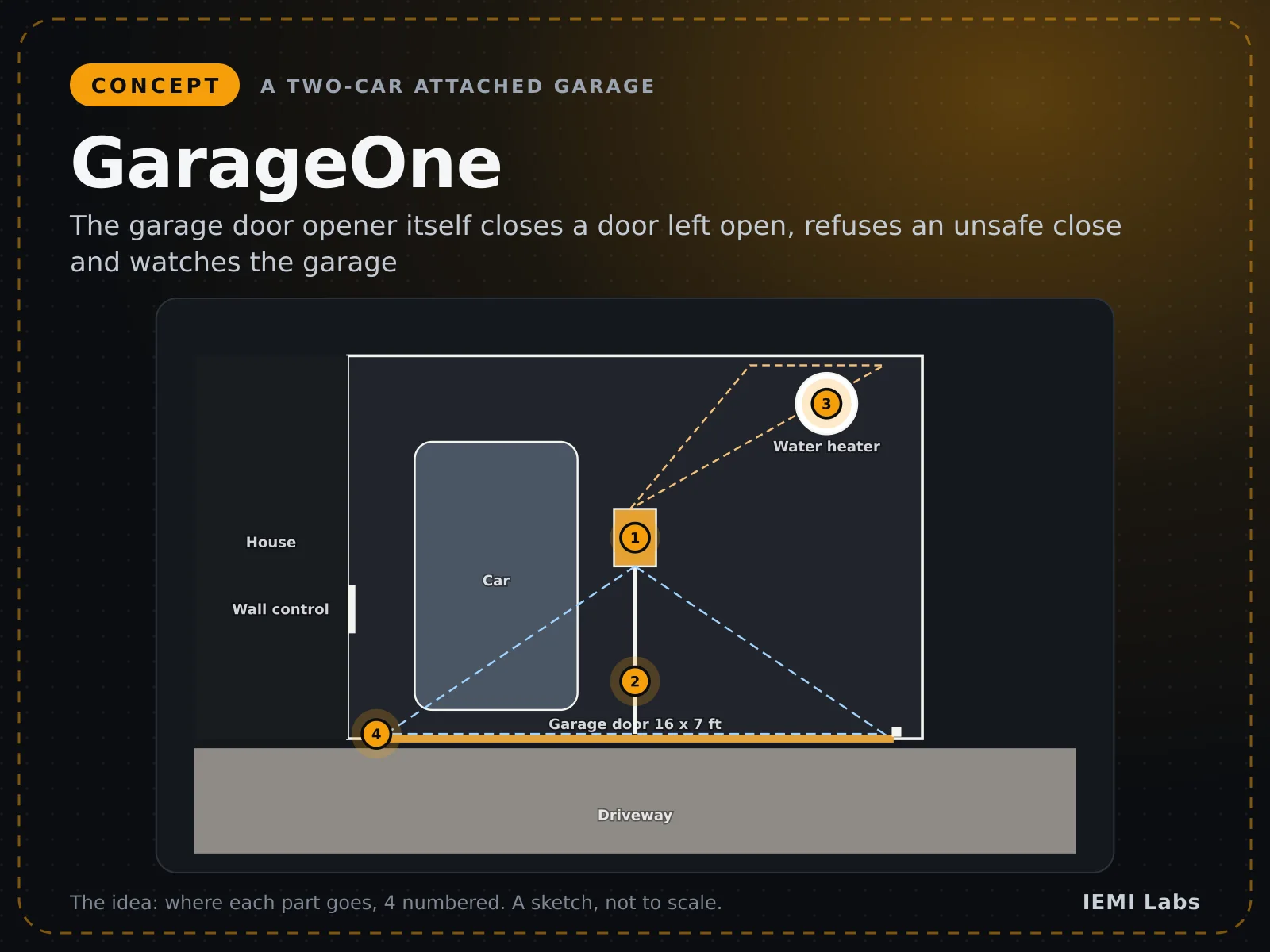
The opener already hangs from the ceiling and moves the door. GarageOne puts a camera in its door end, a heat camera in its back end and a mic and temperature sensor inside, so the opener closes a door left open after the legal warning, refuses a close with someone in the doorway, and calls an engine running, someone inside, a freezing garage, the home's alarm and a wet heater pan.

DrivewayHouseGarage door 16 x 7 ftCarWater heaterWall control1234
  1. 1Opener head (the brain)Door camera, heat camera, mic, temperature, call lights and tone: closes a door left open, refuses an unsafe close, car and engine, someone inside, freezing, alarms
  2. 2DoorwayChecked clear by the door camera before every remote or timed close; parcels and visitors when the door is open
  3. 3Water heaterSeen by the heat camera in the back of the head: a wet pan or a dripping relief valve
  4. 4Safety eyes (the opener's own)Kept as they are at 150 mm: the legal entrapment protection never changes
A two-car attached garage, drawn to show where each part goes (not to scale).

How the parts connect

GarageOne, wired up

Every part, what links it to the brain, and how the data reaches your phone. A solid line is a cable; a dashed line is a radio link.

Door cameraVideo, 2 frames a second analysed, ne…CSI-2 ribbon to the bra…Heat camera32 x 24 heat picture, 2 times a secondI²CMic and garage temperatureSound pattern scores on the device (n…Mic through an MCP3008…Opener linkDoor open, closed or moving; move req…Optocoupled wall-button…Call lights and toneLight colour and toneOne data wire + PWM pinSecure element, tamper switch…Signatures, tamper flag, powerI²C + GPIO; 5 VTHE BRAINRaspberry Pi Zero 2 W (in…runs garageone-fwPython 3IEMI cloudvia Home Wi-Fi (WPA3) · MQTT over TLSFamily phonesvia Push and SMS
Drawn from the GarageOne parts list. The 3D view above is built separately, from the CAD.

The program

What controls GarageOne

Runs on
Raspberry Pi Zero 2 W
Written in
Python 3
System
Raspberry Pi OS Lite (64-bit), secure boot
AI model
An int8 person, car and object detector on the door camera frames; a heat-picture change model on the MLX90640; the T3 and T4 alarm and engine sound models on the mic; every call carries a confidence, and below the line it says unsure and never moves the door
  1. 1Twice a second: detect people, cars and objects in the door camera; read the heat picture
  2. 2Every second: score the mic for alarm and engine patterns; read the door position
  3. 3Door left open at the set time and doorway clear: 5 s lights and tone, then ask the opener to close
  4. 4Remote close with something in the doorway: refuse and say why
  5. 5Sign each call and send it; unsure calls go to the app only
garageone-fw.pymain loop
while True:
    door = opener.position()                  # open, closed, moving
    seen = detect(doorcam.frame())            # people, cars, objects
    heat = mlx.frame()
    calls = garage_step(door, seen, heat, mic.scores(), sht.temp(), family.away())
    if close_wanted(door, calls) and doorway_clear(seen):
        warn(lights=True, tone=True, s=5)     # UL 325 unattended close
        opener.press()                        # its eyes and reversal stay in charge
    for c in calls:
        if c.conf < c.line: c.kind = 'unsure' # never guess, never move the door
        atecc.sign(c); light_and_tone(c); mqtt.publish(c)

To your phone

How the data reaches GarageOne home app

Family phones (Android and iPhone); a read-only door log link for an insurer if the family shares it

  1. Garage door opener
  2. IEMI cloud
  3. Family phones

What you see in the app

One screen for each job GarageOne does.

  • No one home modeThe family is away for the weekend. The opener watches the garage alone, closes the door if it is left open, and messages only when a call needs someone.

  • Door left openIt is 22:30 and the big door has been open since the kids put their bikes away. The opener checks the doorway is clear, flashes and sounds for 5 s, and closes it.

  • Close refusedMum taps close from the car park at work, but a bike has fallen across the doorway. The opener refuses, turns amber and tells her why.

  • Engine, alarms and someone insideA teenager leaves the car running in the closed garage to warm it up. After 2 minutes the opener turns red with a fast tone and every family phone says so.

  • Freezing and the water heaterA cold night with the door left open a crack, and a slow drip from the heater's relief valve. The opener shows the falling temperature and the heat picture of the pan.

App screens with sample data. The interface is in development.

What the app gets

Data GarageOne sends to the app
DoorClosed at 22:30 after 5 s warning; doorway clearEach move
Refused closesClose refused at 18:12: bike in the doorwayEach call
CarsLeft bay: car home since 17:40; right bay emptyEach change
Garage2.4 °C and falling, door open 12 minEvery minute
AlarmsCO alarm pattern heard at 07:15Each call
Water heaterPan cooler than usual on the left side: check for a leakEach change

Video stays in the opener head: only signed calls and stills or 10 s clips around calls leave it, kept 30 days; the driveway view is masked past the property line.

CAD design · Design rev A, stage 2 ready (28 Oct 2026): smart garage door opener that makes the garage's calls itself (8 calls, 6 alone, 2 assist), call lights and tone, ATECC608 and tamper switch inside; 12 sensor views checked in the CAD; not built

Designed in code, checked in 3D

  • 2 printed parts, each a single closed solid
  • Every bought part fitted inside and checked for collisions
  • Assembled exactly as shown in the 3D CAD view (the button on the picture at the top)

Key specs

GarageOne hardware
AI processorBoards of our own in the opener head: Rockchip RV1126B processor with 2 GB memory on the main board behind the door-end wall. The bench head uses a Raspberry Pi Zero 2 W until the boards arrive
SensorsSony IMX415 8 MP camera chip behind the door-end window, 25° down at the door, the doorway, both bays and the driveway (102° lens) · Melexis MLX90640 heat chip on the power board, 40° down through the back window at the water heater pan and the back of the bay · ICS-43434 digital mic and Sensirion SHT45 temperature chip behind the back-end vents · The opener's own door-position output and backup battery, read through an optocoupler and an ADC; 16 call-light LEDs, a piezo, a security chip and a cover tamper sensor
ConnectivityWi-Fi (WPA3), MQTT over TLS · The opener's own rolling-code remotes
PowerFrom the opener's own mains through a class II Mean Well IRM-10-5 on its own power board; one soldered 18650 cell with a thermistor keeps the head watching and listening for about 7 h in a power cut (est.); about 2.4 W watching and up to 5.5 W at a close warning (est., board design review)
EnclosureThe opener's own moulded head; a magnet in the cover marks the log if it is taken off
DimensionsHead 300 x 460 x 180 mm (est.); 3.1 m rail
WeightAbout 0.2 kg more than the plain opener (est.)
Ingress ratingIP4X design target, not tested
All target specifications

Jobs

Jobs target specifications
DoorCloses a door left open after the warning
DoorwayUnsafe remote close refused
CarsCar per bay; engine left running
GarageSomeone inside, freezing, alarms heard
HeaterWet pan, dripping relief valve (assists)

Legal at the garage door

Legal at the garage door target specifications
StandardUL 325 / 16 CFR 1211 (as amended 2024), opener's own eyes and reversal kept; battery backup for California
Remote close5 s light and sound warning
Head300 x 460 x 180, underside 2,220 mm
NotA smoke or CO alarm or a security system

Targets for production units; they may change during development.

Pricing

Hardware: $499 per smart garage door opener

Software: $2 per month (family alerts and the door log)

Target pricing; fitting by the garage door installer extra, as for a plain opener. Bought separately, an opener with a camera in the head (Chamberlain B4643T, about $369 at Home Depot), our GarageHome hub ($189) and AlarmEcho ($39) add up to about $597, and the camera opener's video storage is $3.99-9.99 a month. Parts cost about $356 per opener at qty 1 including the drive (stage 2, prices checked 28 Oct 2026).

Smart garage door opener

$499 + $2/month

Every garage job in the opener itself.

  • Door left open closed safely
  • Unsafe close refused
  • Cars and engine
  • Alarms and freezing
  • Signed door log

Indicative launch pricing in USD, excluding taxes and shipping. Final pricing is confirmed before any balance is charged.

Community

What do you think of GarageOne?

GarageOne is in development. Rate the idea, tell us what to change about the features, specs or price, and we'll build it with your feedback.

How much people want it

–

No ratings yet

  1. 50
  2. 40
  3. 30
  4. 20
  5. 10

Follow GarageOne

Get build updates and first access when pre-orders open.

Leave feedback

Your rating of the idea

Feedback on a product concept in development, not a review of a shipped product. Posts may be moderated; links and contact details are held for review. See our community guidelines and privacy policy.

Comments

    No comments yet. Tell us what you'd want from GarageOne.

    Questions

    Ask about GarageOne

    Tell us what this would save you, or ask anything. We reply within two business days.

    We use your details only to respond to this request. See our privacy policy.

    From the product lab · ideation phase

    Lab updates for GarageOne

    All lab updates
    1. LatestA family buys GarageOne as the garage door opener itself, fitted by the garage door installer and left on the ceiling for years. So the electronics must be boards an assembly house makes and tests the same way every time, inside the opener's own 300 × 460 × 180 mm head beside its motor and UL 325 logic board, through hot summers and freezing winters, and never in charge of the motor (16 CFR 1211).
      • What we designed: boards of our own in the two end bays of the opener head, either side of the opener's own motor. An 8-layer main board stands behind the door-end wall with the processor under a finned heat sink, memory, the security chip, the latched microSD card, Wi-Fi with its antenna in the corner farthest from the motor's steel, the piezo over the tone holes, and the door camera chip on a small tab at its window, 25° down. Two light strips fold out from its ends onto the side walls, 8 LEDs each behind the call-light slots, one with a magnet sensor for the cover. A 4-layer power board stands at the back end with the opener's mains into a class II supply, one soldered backup cell, the opener link (one isolated relay on the wall-button input, the door-position output and the opener's own backup battery), the mic, the temperature chip and the heat chip on a tab at the back window. See it at /build/garageone-boards.
      • How we checked it: the boards are written as code and opened in KiCad (0 design-rule violations). The code places 57 parts at their sizes and checks no overlaps, the heights in every gap, the LEDs behind their slots, the piezo over its holes, and that all 12 garage calls from the head's CAD (both ends of the door's bottom edge and its top, a child and an adult in the doorway, both cars, the driveway 3 m out, someone by the side wall, the heater pan and relief pipe, the back of the bay) are in view from where each lens or chip really sits, through the windows the head already has. The shared design review: 18 pass, 1 fixed, 9 to prove, 0 fail.
      • What we learned: the water heater's relief pipe is under one heat pixel at 3 m, so the drip call reads the water landing in the pan, and stays a call that only assists. The bench head had its mic and temperature vents in a side wall that a board on the back wall cannot reach, so they moved to the back-end wall in front of the chips; both bay walls gained a notch for the board lead and the cover a small boss for the tamper magnet. All drawn in the head CAD in the same run; every fit check and camera view still passes. There were no new CricketOne board decisions since the last update, and every board was re-run: no problems, every review 0 fail, KiCad 0 violations.
      • What is next: the boards inside the head CAD with every part checked in 3D; Wi-Fi range next to the opener's steel motor frame; the opener link with each opener maker's wall-button input; and the next board, AisleOne.

      See it in 3DFull research and design

    2. Every garage door opener sold or installed in California must keep working in a power cut on a battery backup (Health and Safety Code 19891, SB 969, after the 2017 wildfires), and installers say those batteries last about 2-5 years. The federal opener rule took in the 2023 UL 325 revisions from May 2024 (CPSC), and there is still no US rule that switches off a keyless car left running.
      • Market and rules check (DESIGN.md): California's opener battery backup law, the 2024 update of the federal opener rule to the 2023 UL 325 revisions, the keyless ignition rule still not made, and the new 2026 camera openers and controllers, each with what it changes in GarageOne (sources G1-G8)
      • New assist call: the head reads the opener's own backup battery through a two-resistor divider on a spare converter channel and says when it is worn or flat; no new part and no CAD change, now 9 calls
      • Rules: two new rule lines in equipment.json (California Health and Safety Code 19891 and 16 CFR 1211 as amended in 2024); the cycle test goes from 10,000 to 30,000 door moves to match UL 325
      • Market: Chamberlain and LiftMaster's December 2025 line adds video and battery backup, with the B6753T about $740 in a June 2026 review; no shipping opener decides anything. Price kept at $499 + $2/mo
      • Product page https://iemilabs.com/products/garageone/ gains a 2026 opener rules FAQ, a battery check in the power-cut answer and the new camera opener price
      • Next: ask California garage door installers in the phase 3 buyer review whether the battery check helps, and whether buyers want Matter; close-out C9 (recommend the first product to the owner) from 30 Oct 00:00

      See it in 3DFull research and design

    3. A family with an attached garage needs the big door closed when it is left open, a remote close that never lands on a bike or a child, and a call when a car is left running: police keep asking residents to close garage doors overnight, keyless cars left running in garages have killed people, and today's camera openers (about $369, storage $3.99-9.99 a month) only stream video.
      • Buyer check with sources: what families pay today for an opener with a camera in it (Chamberlain B4643T about $369), its video storage ($3.99-9.99 a month) and a Tailwind iQ3 controller ($60-94), and the three closest products
      • What we learned: the like-for-like product is now a camera opener, not a plain smart opener, so the separate total is about $597, not $528; camera openers show the garage but none checks the doorway before a close
      • Price raised from $449 to $499 + $2 a month (at $449 the margin was about 10 %); the page now says plainly that the installer's fitting is extra, as for any opener
      • Supply raised to the 10 W Mean Well IRM-10-5, which comes in the same case as the 5 W one (both spec sheets checked), because a call with the backup cell charging sat at the 5 W limit; CAD fit unchanged
      • Power-cut time corrected: one backup cell keeps the opener watching for about 8 hours (est.), not 3
      • Parts list prices checked on shop pages today: $356 of parts per opener at qty 1; cost and margin table in the design notes (about 19 % at qty 1 and 39 % at qty 100, est.)
      • Product page: the first three FAQs answer the buyer's top questions (why not a camera opener, will it close my door on its own, what it costs and who fits it)

      See it in 3DFull research and design

    4. A family with an attached garage needs one thing that keeps the big door from being left open overnight, never closes it on a child or a bike, and calls a car left running. Police keep asking residents to shut garage doors at night, and US law (16 CFR 1211, UL 325) requires a flashing light and a sound before any remote close.
      • New CAD: the opener head (300 x 460 x 180) and its cover, with the brain, door camera, heat camera, mic, temperature sensor, call lights, tone, secure element, tamper switch, supply and backup cell inside; 12/12 parts fit, 12 camera views checked, no collisions, no floating parts
      • equipment.json: UL 325 / 16 CFR 1211 rules (opener eyes and reversal kept, 5 s warning on every remote close), 8 calls (6 alone), 4 impact cases and every security key
      • idea.json garage plan, integration.json (6 parts, 5 app screens with No one home mode), BOM, buy.json and DESIGN.md with the market check
      • Product page at $449 + $2/month against about $528 for an opener, GarageHome and AlarmEcho; folds GarageHome and GarageEye AI; EdgeBell AI and AlarmEcho stay listed

      See it in 3DFull research and design

    5. A family with an attached garage needs one thing that keeps the big door from being left open overnight, never closes it on a child or a bike, and calls a car left running. Police keep asking residents to shut garage doors at night, and US law (16 CFR 1211, UL 325) requires a flashing light and a sound before any remote close.
      • Now part of GarageOne: https://iemilabs.com/products/garageone/

      See it in 3DFull research and design

    6. A family with an attached garage needs one thing that keeps the big door from being left open overnight, never closes it on a child or a bike, and calls a car left running. Police keep asking residents to shut garage doors at night, and US law (16 CFR 1211, UL 325) requires a flashing light and a sound before any remote close.
      • Now part of GarageOne: https://iemilabs.com/products/garageone/

      See it in 3DFull research and design

    Smart equipment · legal on the field

    GarageOne is the ceiling-mounted belt-drive garage door opener for a 16 x 7 ft sectional door: a 300 x 460 x 180 mm head (est., made smart

    It replaces the garage's existing opener (a smart belt-drive opener, about $250-330, est.); the opener's own motor, rail, UL 325 logic board, safety eyes, wall control and remotes are kept, with every part built in. Everything inside the opener head: brain, door camera, heat camera, mic, temperature sensor, call lights, tone, secure element, tamper switch, 5 V supply and a backup cell. Same head size, straps and rail; about +0.2 kg (est.); no ceiling camera box, ceiling hub, side-door station or heater probes.

    Meets US Consumer Product Safety Commission (16 CFR 1211, which adopts UL 325 for residential garage door operators): 16 CFR 1211: entrapment protection (photo eyes no higher than 6 in), reversal on contact, and an unattended (remote) close only with a flashing light and an audible warning before and while the door moves

    RuleLimitGarageOne
    Primary and secondary entrapment protectionthe opener reverses on contact and on a broken photo-eye beam; eyes no higher than 6 in (152 mm) above the floor✓ the opener's own UL 325 logic board, reversal and photo eyes at 150 mm are kept unchanged (asserted in the CAD); our brain can only ask for a move through the wall-button input, never bypass the eyes
    Unattended operation (closing from the app or on a timer)a flashing light and an audible warning before and during the close (UL 325 as adopted by 16 CFR 1211)✓ two NeoPixel call lights on the head flash and the piezo sounds for 5 s before and all through every remote or automatic close; the camera must also see the doorway clear
    Same size and installation as the plain openerhead clear of the open door's travel; hung from the ceiling on the opener's own straps✓ 300 x 460 x 180 mm head, underside at 2,220 mm above a 2,134 mm door opening, on the same straps and rail (asserted in the CAD)
    Mains safety inside the headlisted opener with mains only inside the head (UL 325, NEC)✓ a Mean Well IRM-10-5 (encapsulated, safety-approved module, 10 W) off the opener's own mains feed; only 5 V reaches the smart parts
    California Health and Safety Code 19891-19892 (SB 969, 2018): residential garage door openers manufactured for sale, sold, offered for sale or installed in California from 1 July 2019a battery backup function that works the opener in an electrical outage; a replacement door may not be connected to an opener without it; $1,000 civil penalty per opener✓ the opener drive is bought with its own battery backup for the motor (bom.csv OPENER row), separate from our 18650 that keeps the calls running; from the 29 Oct check the head also reads that backup battery's voltage on a spare ADC channel and calls it worn or flat
    16 CFR 1211 as amended by the CPSC direct final rule of 14 March 2024 (in force 13 May 2024), adopting the UL 325 Seventh Edition revisions of 21 February 2023photo-eye height measured from the level surface below the door, no longer from the floor; 30,000-cycle endurance test with a 15 lbf force threshold, repeated normal-operation test after it✓ the opener's own eyes stay at 150 mm above the level surface under the door (asserted in the CAD) and the opener maker runs the revised endurance test with our parts inside; our own G-T4 cycle test raised from 10,000 to 30,000 cycles to match

    Home use. The opener stays a UL 325 / 16 CFR 1211 opener: the maker's certified logic board, reversal and photo eyes are unchanged and our parts only ask for a move. Not a smoke alarm, a CO alarm or a security system: it hears the home's own alarms and alerts. Radio certification and a UL 325 re-listing with the opener maker before sale.

    One piece of equipment does

    • ●Door left open at night or with everyone away: closes it with the legal warning, or says why it would not
    • ●A remote close refused while a person, pet, bike or car is in the doorway
    • ●Car home or away, and an engine left running with the door shut
    • ●Someone in the garage when the family is away
    • ●A freezing garage with the door open
    • ●The home's smoke or CO alarm heard in the garage
    • ●Water heater pan wet or relief valve dripping (heat camera)
    • ●A parcel or visitor at the open door
    • ●Signed door log for the family or an insurer

    Not done by the equipment, and why

    • The front-door doorbell: the opener cannot see the front step; EdgeBell AI stays listed as the front door product
    • The garage side door and the house door: not in the camera's view from the head; their own contacts are a later option, not added now
    • The driveway with the door shut: the camera looks through the door only when it is open
    • Smoke and CO alarms in other rooms: AlarmEcho stays listed for the whole home
    • A water shut-off valve on the heater: plumbing work, not in an opener
    • Leaks behind walls and in other rooms: WaterLeak stays listed

    Makes the call itself

    With no one home, the opener makes the garage's calls itself: it lights and sounds on the head first, closes a door left open only after the legal warning and a clear doorway, and tells the family's phones when a call stands. Calls it is unsure of go to the app as unsure, with a still, and never move the door.

    CallWho decidesHow it sees itHow players see the call · if unsure
    Door left open: close itat the set time; 5 s warning before the door moves · door state about 99.9 % (from the opener's own travel sensor); clear doorway about 97 % (est., untested)The equipmentthe opener's own door position, door camera; door open past the family's set time at night or when every phone is away; doorway checked clear by an int8 person and object detectorLights flash and the tone sounds for 5 s before and all through the close; app note after. Doorway not clear or the detector unsure: no close; the app asks the family
    Remote close refused: something in the doorway< 1 s · about 97 % (est.)The equipmentdoor camera; person, pet, bike, bin or car in the doorway band before any remote or timed closeAmber lights and two short tones; the app says why. Under 90 % confidence: it says unsure and does not close; the photo eyes and reversal stay the safety system either way
    Car home or away; engine running with the door shut< 5 s for the car; 2 min for the engine · car about 99 % (est.); engine about 90 % (est.)The equipmentdoor camera, mic; car present per bay from the camera; engine sound pattern on the mic with the door closed for 2 minutesRed lights and a fast tone for the engine, then all phones; car state in the app only. Engine sound with no car seen: unsure, app note
    Someone in the garage when the family is away< 3 s · about 95 % (est.)The equipmentdoor camera, heat camera; a person detected while every family phone is away and no remote or keypad opened the doorRed lights and tone, then the family alert with a still. A family member without their phone: the app shows a still and asks
    Freezing garage with the door open10 min · ±0.1 °C (SHT45 datasheet)The equipmentSHT45, the opener's own door position; garage below 3 °C and falling with the door open for 10 minutesAmber lights; app alert offering the close. Door closed: a note only
    Smoke or CO alarm heard< 10 s · about 98 % on a garage or hall alarm within 8 m (est.)The equipmentmic; the standard T3 smoke and T4 CO beep patterns (AlarmEcho's model), on the deviceRed lights and an app and SMS alert; the door is never moved by this call. Pattern partly heard: unsure, app note
    Water heater pan wet or relief valve dripping< 10 min · about 80 % (est., untested; a heat picture sees water only when it differs from the room)Helps the officialheat camera; cool spread in the pan or a warm drip line on the relief pipe against the heater's learned heat pictureAmber lights, app note. App note with the heat picture; the family checks
    Parcel or visitor at the open door< 3 s · about 90 % (est.)Helps the officialdoor camera; person or box on the driveway or the threshold while the door is openSoft chime and app note. Info to the app only
    Opener backup battery worn or flatafter each door move; a summary once a month · flat battery about 95 %; worn about 80 % (est., until the G-T4 cycle test)Helps the officialthe opener's backup battery voltage through a divider on a spare MCP3008 channel, door position; voltage sag during each door move against the first month's moves, and the resting voltage after a night; worn below about 70 % of the first month's figure (est.)Amber blink once after the move and an app note. App note asking the family to test the door with the power off; never moves the door

    Nothing added to the field

    The only things in play are the items the laws already put there:

    • ●The garage door opener: head, its own rail and straps, its own safety eyes, wall control and remotes

    The door, the car, the water heater and the walls stay as they are; no ceiling camera box, hub, side-door station or heater probes

    Built to take the hits

    • Motor start and stop vibration, every door cycle (about 10 cycles a day, the head shaking on its straps (est.), IEC 60068-2-6 vibration and IEC 60068-2-27 shock for the electronics (to test)): ✓ boards on foam pads in the two end bays, away from the motor bay; walls between the bays
    • Garage heat, cold and dust (about -20 to 50 °C in an unheated garage (est.); dust, the opener maker's rating; IEC 60529 IP4X design target for the head): ✓ Pi Zero 2 W rated -20 to 70 °C; the cell charges only between 0 and 45 °C; windows bonded, vents behind a mesh
    • A ball, a ladder or a roof box knocking the head (knocks from below at 2.2 m, UL 325 enclosure tests (with the opener maker)): ✓ the same moulded head; the windows are flush, nothing hangs below the head
    • The door hitting something while closing (the door's own force on an obstruction, UL 325 reversal (16 CFR 1211)): ✓ the opener's own reversal and photo eyes are unchanged; our camera adds a check before a remote close, never replaces them

    Secure by design

    Call record:
    Each call and each door move is signed in the ATECC608 with its time, door state and confidence, in an append-only log the family or an insurer can verify
    Radio:
    WPA3 Wi-Fi and TLS 1.3 to the cloud; the opener's own rolling-code remotes are unchanged; the app's close command is signed per phone
    Boot:
    Raspberry Pi secure boot with a signed boot image
    Updates:
    Signed updates with rollback, only with the door closed and no one in the garage
    Tamper:
    An Omron D2F-01 pressed by the head cover: opening the head outside service mode marks the log and alerts; no open debug port
    Privacy:
    Video stays in the head; only signed calls and stills or 10 s clips around calls leave it, kept 30 days; faces are not identified; the driveway view is masked past the property line
    Theft:
    Paired to the home Wi-Fi and the owner's account; moved to another network it stops sending until the owner unlocks it; remote moves need a paired phone

    GarageOne FAQ

    General FAQ
    Why not just buy an opener with a camera in it?

    Openers with a camera in the head (Chamberlain B4643T about $369, the flagship B6753T about $740 in a June 2026 review) stream video and record clips on a $3.99-9.99 a month plan, but you have to look. GarageOne makes the calls itself: it checks the doorway before any remote or timed close, refuses an unsafe close, and calls an engine left running, someone inside, freezing, your alarms and a worn backup battery, at $2 a month.

    Will it close my door on its own?

    Only if you turn on the close time, only with the doorway clear, and only after the 5 s flashing light and sound that UL 325 asks for. If it is unsure, it does not close and asks your phone. The opener's own safety eyes and reversal stay in charge.

    What does it cost, and who fits it?

    $499 + $2 a month (target), about $100 less than a camera opener, our GarageHome hub and AlarmEcho bought separately. Your garage door installer fits it like any opener, with its own rail, safety eyes, wall control and remotes; fitting is extra, as for a plain opener.

    Which products does GarageOne replace?

    GarageHome and GarageEye AI, whose pages now link here. Their door, car, person and heater jobs run inside the opener head. EdgeBell AI stays listed for the front-door doorbell, and AlarmEcho stays listed for alarms in other rooms.

    Is it a legal garage door opener?

    Yes. The opener's own UL 325 board, reversal and safety eyes stay in charge, and every remote close gets the required flashing light and sound. Our brain only asks for a move. The opener maker re-lists it under UL 325 before sale.

    Does it replace my smoke or CO alarm?

    No. It hears your alarms in or near the garage and alerts your phones. Keep your alarms.

    Is there video of my family?

    Video stays in the opener head. Only signed calls and stills or 10 s clips around calls leave it, kept 30 days, and the driveway view is masked past your property line.

    What about a power cut?

    A backup cell keeps it watching and alerting for about 8 hours (est.); the motor runs on the opener's own backup battery, which California has required on every new opener since July 2019. GarageOne checks that battery after every door move and tells you when it is worn or flat, so the door still opens when you need to leave.

    Which garage door opener rules does it follow in 2026?

    The federal opener rule, 16 CFR 1211, was updated in May 2024 to the 2023 UL 325 revisions (photo-eye height measured from the surface under the door, a tougher 30,000-cycle test). The opener's own eyes stay at 150 mm and the opener maker runs the new test with our parts inside. In California every new opener must have a battery backup (Health and Safety Code 19891); GarageOne's opener has one and checks it for you. There is still no US rule that switches off a keyless car left running, so the engine call stays.

    Related products

    KitchenOne concept: the idea and where each part goes
    HomeConcept

    KitchenOne

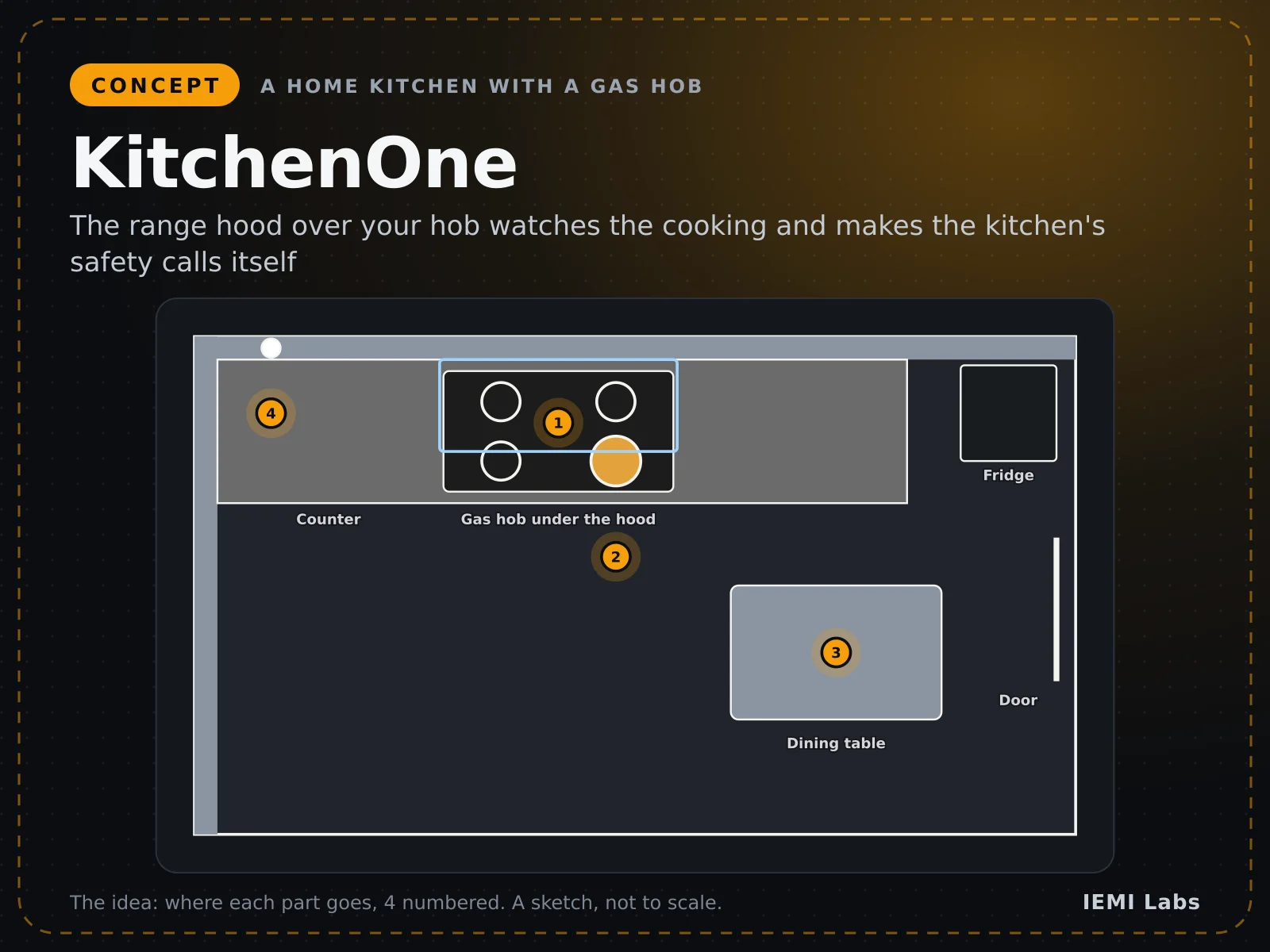
    IEMI's one product for the home kitchen: the chimney hood over the hob, made smart, with one brain and one app.

    • Calls a burner left on with nobody there
    • Calls dry pans, smoke, boil-overs and flares
    • Counts cooker whistles

    From $369 per smart 60 cm chimney hood

    Details
    BedsideOne concept: the idea and where each part goes
    HomeConcept

    BedsideOne

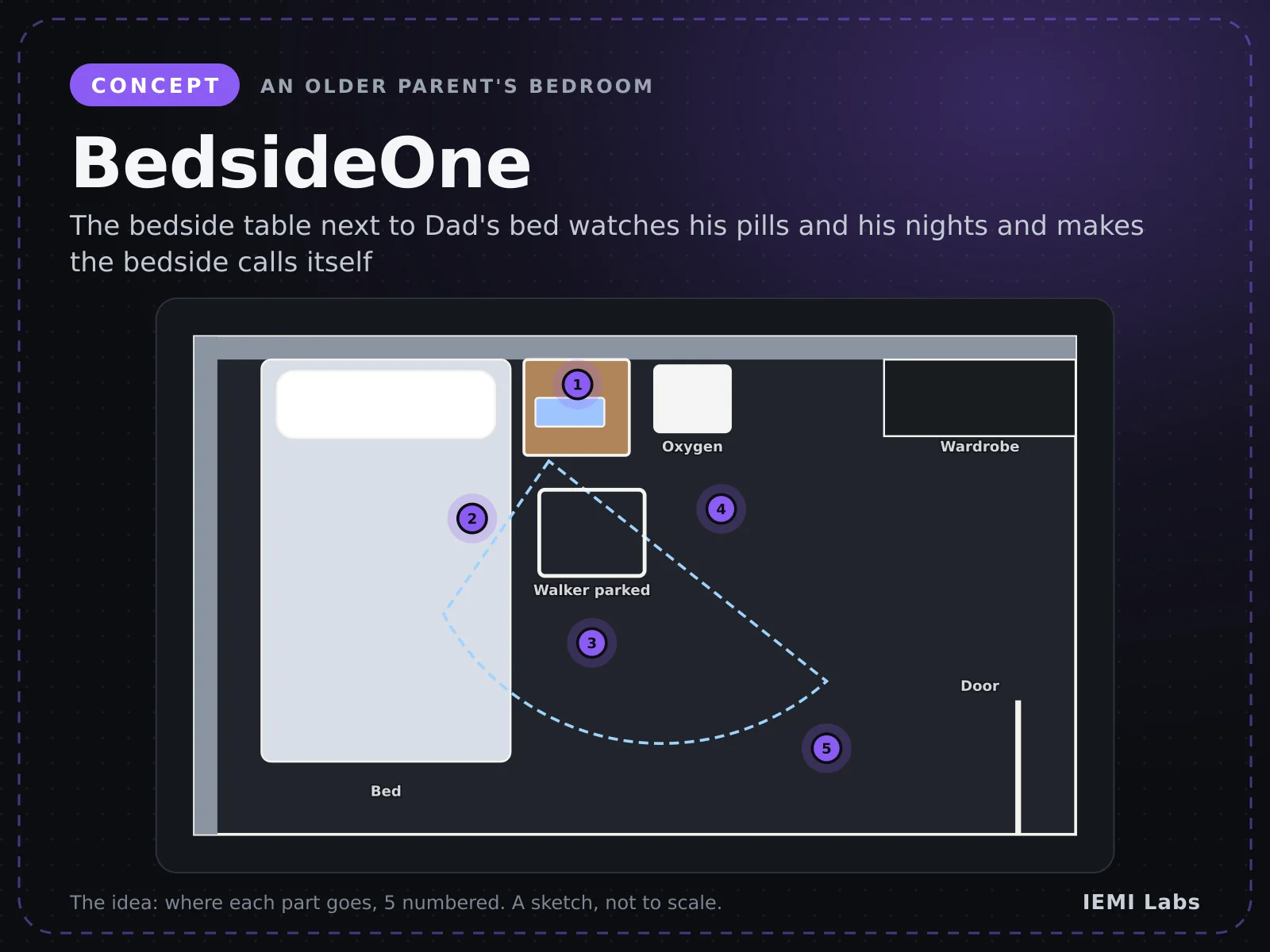
    IEMI's one product for an older parent's bedside: the bedside table and lamp, made smart, with one brain and one app.

    • Calls doses taken, missed or on the wrong day
    • Lights the floor at night and chimes for the walker
    • Calls a power cut with the oxygen cylinder's hours left

    From $349 per smart bedside table

    Details
    DampOne concept: the idea and where each part goes
    HomeConcept

    DampOne

    IEMI's one product for the bathroom, laundry and damp: the extractor fan in the ceiling, made smart, with one brain and one app.

    • Runs the fan until the cold wall is dry
    • Counts mould-risk hours
    • Calls water on the floor, taps and baths

    From $349 per smart 100 mm extractor fan

    Details

    GarageOne

    Concept · target $499

    I want this