VisionConcept
FlowCount AI
A small white ceiling sensor with two lenses that counts people without sending images.
- Measures queue length in real time
- Predicts wait times per lane
- Counts entries, exits and occupancy
From $899 per sensor
DetailsIEMI's one product for a lift station: the station's own pump control panel, made smart
Software: $45 per month per station (app, LTE-M and callouts)
Concept, not for sale yet. Tell us if you want it; that decides what we build.
Rate this idea and tell us what to change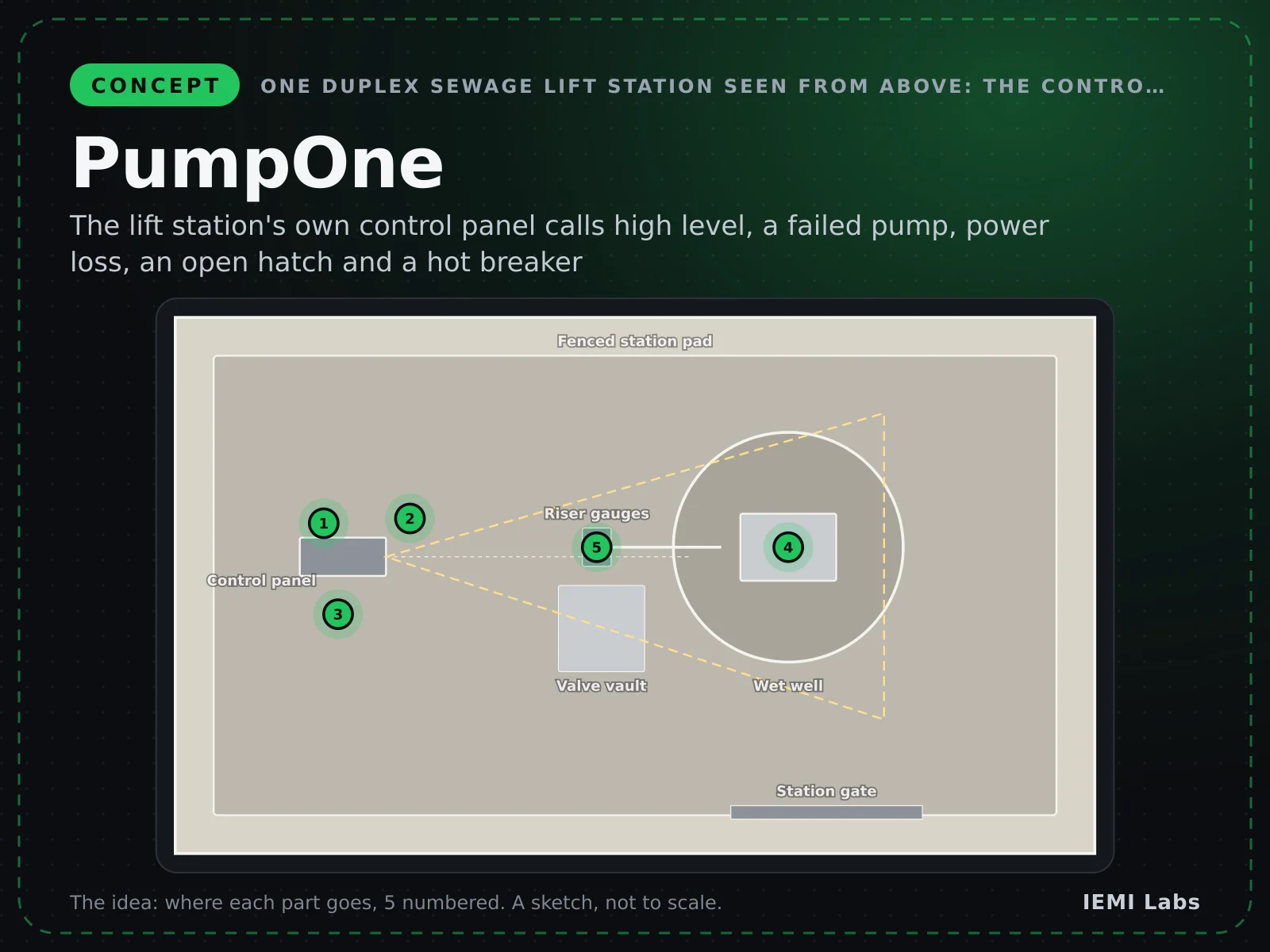
Drag to rotate · right-drag to move · scroll to zoom · click a part for its size and placeSwipe to rotate · pinch to zoom · two fingers to move · tap a part for its size
How it fits together
Scroll or tap a part. Press “See the 3D CAD design” to watch the model, built from our CAD, light each part up and show how it connects.
Real-time 3D render · drag to rotate · final design may varySwipe sideways to rotate
01
The whole PumpOne
The lift station's own control panel runs the station watch: the station's level transducer and float and two current clamps on the pump leads give level and pump state, a camera and a radar behind the side windows see the hatch, the riser gauges and the gate, a heat camera on the door watches the breakers, and the brain on the back plate turns that into level, pump, power, entry and heat calls on the door's light and one app, over LTE-M.
02Brain
Raspberry Pi Zero 2 W (on the panel back plate)
The brain: it runs the pumpone-fw program
03
Level and pump currents
Reads the station's own 4-20 mA level transducer and high float, and a current clamp round each pump motor lead
Raspberry Pi Zero 2 W (on the panel back plate) · I²C (ADS1115) + 250 Ω loop resistor and clamp burden on the back plate · Level and both pump currents at 860 samples a second; run, start and stop times
04
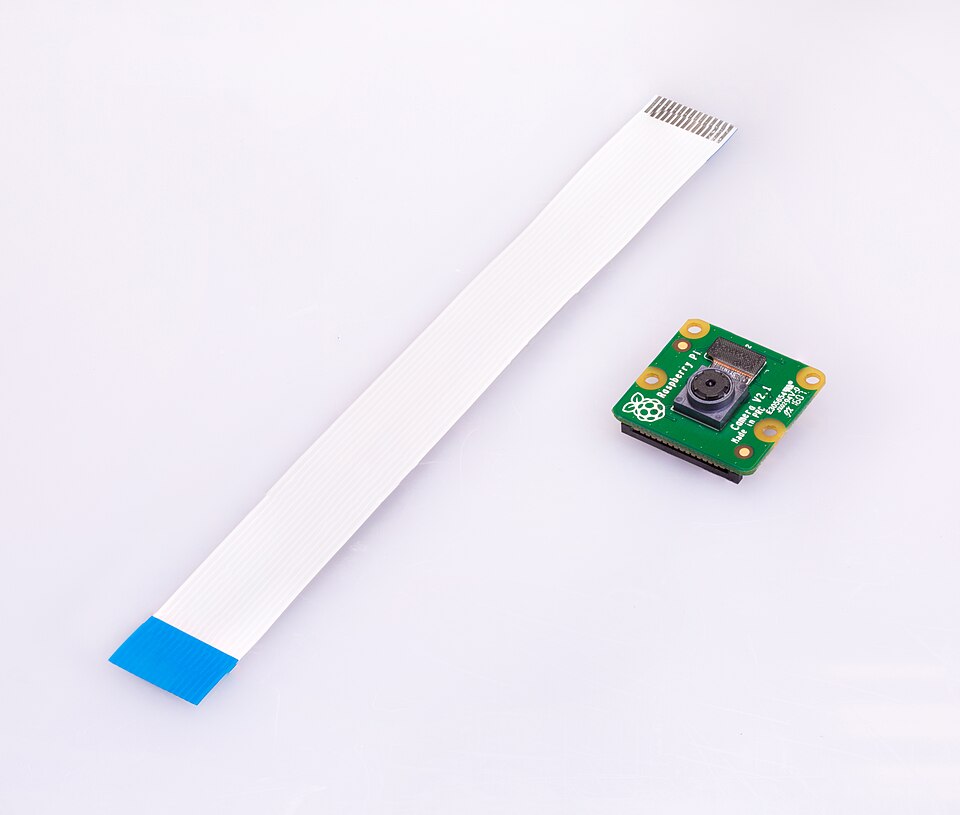
Station camera
Looks out of the right side window, 15 degrees down: the wet-well hatch, the two discharge gauges on the riser and the gate
Raspberry Pi Zero 2 W (on the panel back plate) · CSI-2 ribbon (300 mm, inside the panel) · A frame every 10 s; gauge stills on each pump run; 10 s clips around entry calls
05
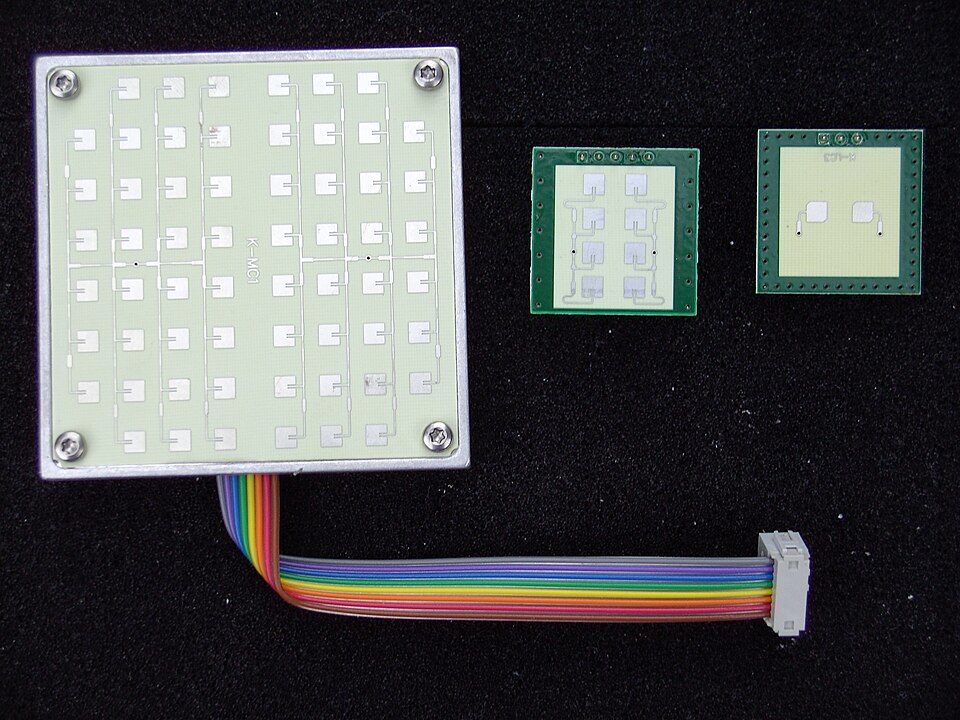
Hatch radar
Finds a person at the hatch or the riser through the side window, in the dark and the rain
Raspberry Pi Zero 2 W (on the panel back plate) · UART · Up to 3 targets with position at 10 Hz
06
Panel heat camera
On the inside of the door, looking back at both pump breakers, contactors, overloads and the terminal strip
Raspberry Pi Zero 2 W (on the panel back plate) · I²C (door lead in a strain-relieved hinge loop) · 32 x 24 heat frames at 1 Hz while a pump runs
07
Display, call light, tone and secure element
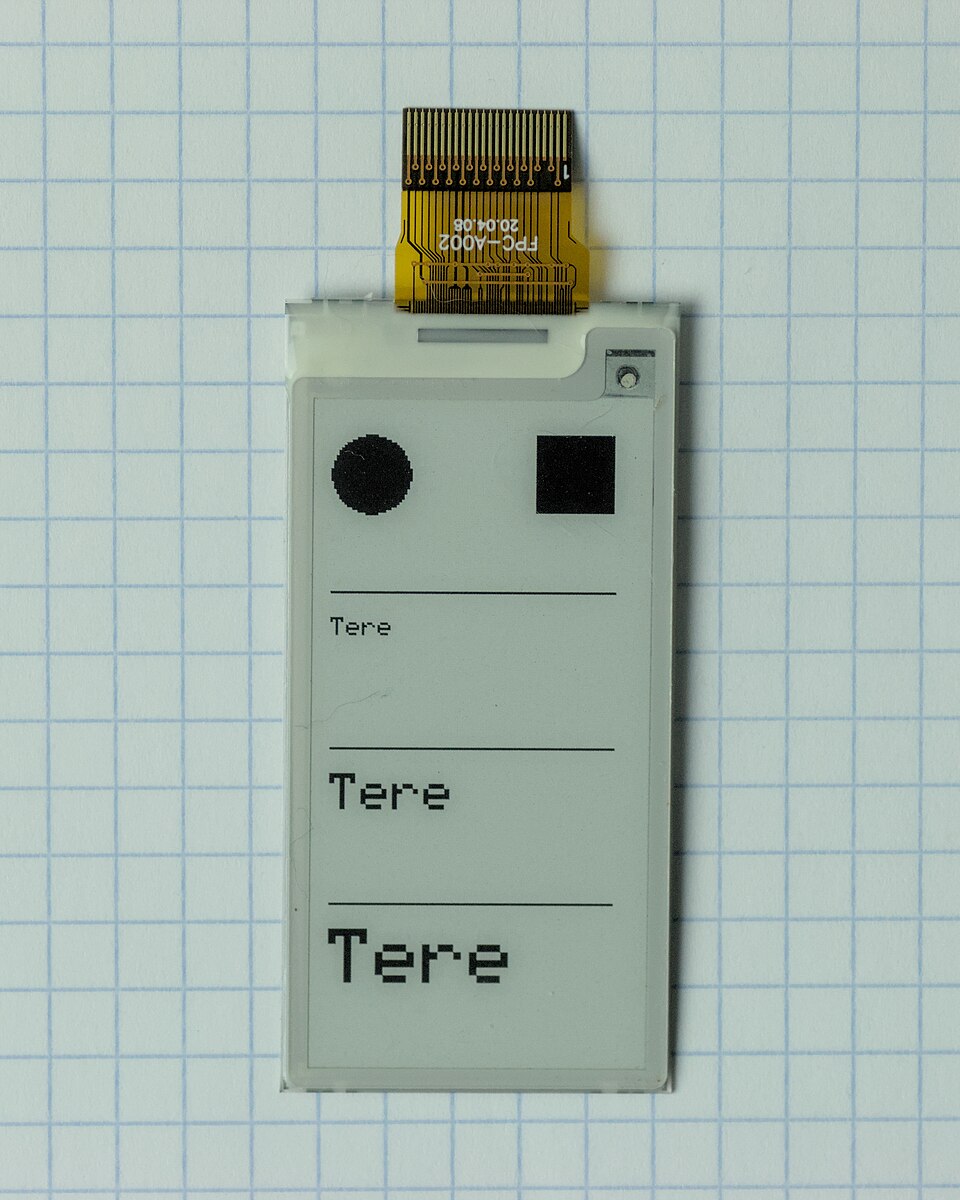
Level, pumps and the last call on the e-paper; red, amber or white on the call light with a tone; every call signed; the tamper switch marks the log when the door opens
Raspberry Pi Zero 2 W (on the panel back plate) · SPI (e-paper) + one data wire (light) + GPIO + I²C · Readings, light colour and flash, tone, signatures, tamper flag
08
Power, backup and LTE-M
5 V from the panel's own 120 V control circuit; a LiPo keeps the Walter board calling out over LTE-M when the station power is off
Raspberry Pi Zero 2 W (on the panel back plate) · 5 V rail + UART to the brain · Power about 1.5 W (est.); callouts and the 15-minute log over LTE-M
09
All connected
7 key parts, one program, and your phone
Our circuit board · rev A-0
Every chip on one board we design, shaped to fit: the processor, cameras and sensors, Wi-Fi and Bluetooth, lights, sound and power. No plugs, ribbons or adapters. It is checked in our CAD against every part around it, and it arrives from the maker ready to run our software from a microSD card. Turn the model, or pick a part below to see where it sits.
Loading the 3D board…
Drag to turn · scroll to zoom · right-drag to move · click a partDrag to turn · tap a part
Every board-level number PumpOne's jobs depend on, checked against its target: camera pixels and frame rate, power and battery life, heat where it works, shock, radio and software. Every lesson from every one of our boards is a rule here, so this review runs again whenever any board teaches us something. Boards are ordered only when nothing fails and the items to prove are measured.
| Area | Check | Our board | Target | Status |
|---|---|---|---|---|
| Camera | Station camera: a 100 mm discharge gauge dial on the riser at 1.99 m | 108.4 px | ≥ 40 px | passes |
| Camera | Station camera: frame rate the calls need | 5 fps at 3840 × 2160 | chip: 30 fps at 3840 × 2160 | passes |
| Camera | Station camera: data rate vs its 4-lane link | 0.41 Gbps (10-bit) | ≤ 80 % of 3.564 Gbps | passes |
| Camera | Station camera: a person (0.5 m wide) at the station gate at 3.35 m | 321.3 px | ≥ 20 px | passes |
| Camera | Station camera: frame rate the calls need | 5 fps at 3840 × 2160 | chip: 30 fps at 3840 × 2160 | passes |
| Camera | Station camera: data rate vs its 4-lane link | 0.41 Gbps (10-bit) | ≤ 80 % of 3.564 Gbps | passes |
| Camera | Panel heat camera: one contactor terminal block (25 mm) on the back plate at 0.29 m | 2.1 px | ≥ 1 px | passes |
| Camera | Image processor load, all cameras | 83 Mpx/s | ≤ 360 Mpx/s (RV1126B ISP) | passes |
| Camera | AI engine time per frame | 3 TOPS | the gauge reader on each pump run and the person check within 5 s of the radar seeing someone | to prove on the dev kit |
| Power | Supply | Mean Well IRM-20-5 PCB-mount 5 V 20 W supply (class II, listed) on the panel's own 120 V control circuit, on the power board | ≤ 70 % of the supply (14 W) | passes |
| Power | Power cut | one soldered 18650 cell (Samsung INR18650-35E) on the power board: when the station loses power the RV1126B sleeps, the BG95-M3 sends the power-lost call at once and a level and pump report every 5 min, about 0.35 W, about 19 h on an aged, cold cell (est.) | the power-lost call and level reports for 12 h | to prove on the dev kit |
| Heat | RV1126B temperature, a summer lift station (40 °C air) with the panel under its sun shield | 67 °C | ≤ 85 °C (rated) | passes |
| Heat | Camera and radar chips away from the processor | station camera 133 mm, radar 123 mm | ≥ 30 mm | passes |
| Shock | Shock and vibration | 50 g (est.) | standard parts | passes |
| Software | Starts our software from the microSD card, no setup | microSD socket with a hinged, latched lid (Amphenol 101-00660 class), fitted on every board: our software starts from the card | card socket fitted on every board, latched | passes |
| Software | Card power switch and protection | 1 power switch and 1 ESD array for 1 card socket | every socket: switched card supply, ESD on all 6 lines | fixed by the review |
| Software | The card wins the start | eMMC shipped empty; our loader reads the card first | the processor starts from the card every time | fixed by the review |
| Software | Card grade | industrial pSLC microSD (Kingston Industrial or Swissbit S-56u), −40 to 85 °C | rated for the heat, cold and writes | to prove on the dev kit |
| Software | Clip buffer for an unsure call | 19.8 s of 8-bit 5 fps video in 40 % of the 2 GB memory | ≥ 3 s | passes |
| Radio | Wi-Fi/BT module clock | 37.4 MHz MEMS oscillator (Y3) | 37.4 MHz next to the AP6256 | fixed by the review |
| Radio | LTE-M from inside the stainless panel | BG95-M3 with a soldered eSIM; its antenna is the LTE element of the puck through the top wall | certified module; callouts reach the on-call operator from a rural station | to prove on the dev kit |
| Radio | BLE for the operator's phone at the station | AP6256 on the main board, its antenna the 2.4 GHz element of the same puck | pairing from the hatch, 4 m away (est.) | fixed by the review |
| Moisture | Conformal coating | coated | coated, sensors, sockets and antennas masked | passes |
| Fit | Board inside the product CAD, every part checked in 3D | not yet in the product CAD | nothing touches | to prove on the dev kit |
| Camera | Every station call in view | Station camera: worst 33.9° / 10.4°; Hatch radar: worst 12° / 3.3°; heat camera: worst 16.5° / 44.6° | inside each sensor's view | passes |
| Camera | Station camera window | 20 × 20 (margin 2.3 mm); radar window 50 × 20 (margin 6.4 mm); steepest line of sight 38° | each view inside its window | fixed by the review |
| Fit | Sensor tabs on their brackets | Station camera: 0.3 mm inside the wall, hinge 13.6 mm; Hatch radar: 0.3 mm inside the wall, hinge 19.6 mm | chip or holder ≥ 0.3 mm inside the wall, hinge within the 40 mm flex | to prove on the dev kit |
| Fit | Door parts in their openings | e-paper active area inside its 26 × 52 window, 8 call-light LEDs inside the 46 × 6 slot, the piezo over the tone holes | each inside its opening | passes |
| Safety | Control circuit kept on the power board | the panel's 120 V control circuit into a spring-clamp terminal, fuse, varistor, IRM-20-5 (class II); the pump run-call inputs through optocouplers; only 5 V, cell sense and SPI on lead L1 | class II creepage on the power board; no 120 V on any other board | to prove on the dev kit |
| Safety | The station's own controls stay in charge | level loop read through an isolated amplifier across a shunt, run calls through optocouplers, current clamps with no contact; one relay contact to the panel's alarm light | PumpOne never switches a pump; a board fault leaves the level controller working | passes |
| Security | Door tamper sensor | TMAG5273 3D Hall chip on the door board, 21.4 mm from a Ø10 × 5 magnet on a printed boss on the body top wall | door opened = logged and signed | to prove on the dev kit |
| Fit | Leads and the antenna coax | L1 about 0.12 m (0.008 V drop), L2 about 0.59 m in the hinge loop (0.015 V drop); coax about 0.15 m | leads ≤ 0.15 V drop; L2 rated for 10,000 door openings; coax ≤ 0.25 m | to prove on the dev kit |
Before we order the first boards, we prove these on the RV1126B development kit or in the rev A tests:
Demo · 6 real-world moments
Short animated scenes of real moments: what happens today, what PumpOne does about it, and what lands on your phone. The same scenes play in the IEMI app.
Sunday 03:12. Pump 2 is the lead pump tonight and the wet well is filling.
Use cases
Many small stations only have a dialler or a red beacon on a pole. A failed pump is found on the weekly round, or when sewage comes up a manhole.
The level controller calls pump 2 to run and its current clamp reads nothing. In under 30 s the panel calls it failed, lights its door amber, and calls the on-call operator over LTE-M while pump 1 runs alone.
Without power the pumps stop, and an old dialler may die with the power, so the first sign is an overflow.
The panel sees its supply drop in under a minute. On its backup cell it calls the on-call operator over LTE-M, shows 'power off since' on its e-paper, and keeps watching the level so the operator knows how long they have.
Rainwater leaking into the sewer is only found by a costly flow survey; meanwhile the pumps wear out running extra hours.
The panel counts starts and run hours for each pump and the rate the level rises. Run hours at 2.6 times a dry day point to inflow after rain; the superintendent judges where to look.
Nobody knows until the next round finds the lock cut, or someone is hurt in the well.
The station camera and radar in the panel door see a person by the hatch with no operator phone paired. In under 5 s the door light flashes white with a tone, and the frame goes to the on-call operator.
A loose lug is found once a year by a thermal survey, or when it burns and the pump stops.
The heat camera on the inside of the panel door sees every breaker, contactor and terminal while the pumps run. Pump 2's contactor lug is 61 °C, 19 °C over pump 1's matching lug: a hot connection call.
The riser gauges are read by eye once a month, if at all; a pump clogging with rags shows up as a failure.
The station camera reads the discharge gauges on every pump run and the clamps read the current. Pump 1's pressure is down 4 psi in a month while its current is up 6 %: likely a rag build-up. The operator judges it.
Demo scenes show how PumpOne and its app are designed to behave. PumpOne is in design; nothing here is recorded from real equipment yet.
What it is
IEMI's one product for a lift station: the station's own pump control panel, made smart, with one brain and one app.
What it does
Who it's for
Towns, water districts and private station owners.
The idea
The problem today
Small towns and water districts find out about a failed pump or a high wet well from an overflow, read the discharge gauges and look at the panel only on the weekly round, and see a hot breaker at the yearly heat survey. Today that takes a cellular alarm dialer ($1,195 plus service), a person driving to every station and a thermography visit, each with its own record.
With PumpOne
Every lift station already has a pump control panel beside the wet well. PumpOne puts the brain, a station camera, a radar, a heat camera, current clamps, LTE-M and a backup cell inside that panel, so it calls high level, a failed pump, power loss, an opened hatch and a hot connection itself, reads the gauges, and calls the on-call operator.
How the parts connect
Every part, what links it to the brain, and how the data reaches your phone. A solid line is a cable; a dashed line is a radio link.
The program
while True:
    lv, fl, i1, i2 = adc.read_all(); near = radar.read()
    calls = level_rule(lv, fl, i1, i2) + pump_rule(lv, i1, i2) + power_rule(psu.ok())
    if due(10) or near:
        f = cam.frame(); calls += entry_rule(f, near, door.open(), phone.near())
        if pump_started(): log.gauges(read_gauges(f))
    if running(i1, i2) and due(1):
        calls += heat_rule(mlx.frame(), i1, i2)
    for c in calls:
        if c.conf < c.line: c.kind = 'check'   # never guess
        atecc.sign(c); panel.show(c); uplink.send(c)  # LTE-M, else Wi-Fi
    time.sleep(0.1)
To your phone
On-call operator, the utility superintendent and the pump contractor's phones; a web page for the office (Android, iPhone, web)
One screen for each job PumpOne does.
No operator on site modeSunday 03:12: pump 2 is called to run and draws no current. The panel calls it, the wet well keeps rising on pump 1 alone, and the on-call operator gets the call before the high level.
Level and pumpsThe superintendent checks every station from the office: level, starts and run hours per pump, and how the wet well filled after last night's rain.
Hatch and gate23:14: the hatch is lifted with no operator phone paired nearby. The panel flashes, sounds and sends the frame to the on-call operator.
Panel heatA pump 2 contactor lug works loose. The heat camera sees it 19 °C hotter than pump 1's matching lug while both run, months before the yearly survey.
Gauges and pump healthBefore the monthly round, the operator sees pump 1's discharge pressure down 4 psi while its current is up 6 %: likely a rag build-up, so they bring the hoist.
App screens with sample data. The interface is in development.
| Level | Wet well 1.42 m, pumps off at 0.9 m, high at 2.6 m | Live |
|---|---|---|
| Pumps | Pump 1: 14 starts today, 9.8 A; pump 2: failed to start at 03:12 | Live |
| Power | Power off 21:40-22:55; sent over LTE-M | Live |
| Entry | Hatch opened 23:14, nobody paired on site (frame) | Live |
| Panel heat | Pump 2 contactor 61 °C, 19 °C over pump 1 | While a pump runs |
| Gauges and trends | Pump 1 discharge 31 psi, down 4 psi in a month with current up 6 % | Each pump run |
No face recognition. People are only detected for the entry call. Gauge stills and clips around entry calls are kept 30 days in the utility's own account; a camera notice sign is on the panel.
CAD design · Design rev A, 28 Oct 2026: smart duplex pump control panel that runs the station watch (8 calls, 5 alone, 3 assist), call light, tone, e-paper, ATECC608 and tamper switch inside; 13 camera, radar and heat views checked in the CAD; not built
| AI processor | Boards of our own inside the panel: Rockchip RV1126B processor with 2 GB memory on the main board on the right side wall. The bench panel uses a Raspberry Pi Zero 2 W until the boards arrive |
|---|---|
| Sensors | Sony IMX415 8 MP camera chip behind the right side window, 15° down at the wet-well hatch, both riser gauges and the gate (102° lens) · TI IWRL6432AOP 60 GHz radar chip beside it: a person at the hatch or the riser in the dark · Melexis MLX90640 heat chip on the door board, looking back at both breakers, contactors and the terminal strip · The station's own level transducer and float, both pump run calls and 2 current clamps on the pump leads, read by a TI ADS131M04 ADC through isolated inputs; e-paper, call light, a security chip and a door tamper sensor |
| Connectivity | LTE-M (Quectel BG95-M3 on our board, soldered eSIM) through an IP67 puck antenna in the top wall, MQTT over TLS · Station Wi-Fi (WPA3) where there is one · BLE for pairing the operator phone · Modbus TCP export to SCADA from the cloud |
| Power | The panel's own 120 V control circuit into a class II Mean Well IRM-20-5 on its own power board; one soldered 18650 cell with a thermistor keeps the power-lost call and level reports going for about 19 h (est.); about 3.2 W watching and up to 7.5 W at a call (est., board design review) |
| Enclosure | The station's own 24 x 20 x 8 in NEMA 4X 304 stainless panel with bonded PC windows |
| Dimensions | 508 x 610 x 203 mm body + 25 mm door (24 x 20 x 8 in) |
| Weight | About +600 g over a plain panel (est.) |
| Ingress rating | NEMA 4X / IP66 target |
| Level and pumps | High level, failed or stuck pump |
|---|---|
| Power and entry | Power cut, hatch opened |
| Panel | Hot breaker or contactor |
| Gauges and trends | Discharge pressure, wear, inflow |
| Alarms | Ten States Standards s. 46 |
|---|---|
| Panel | UL 508A by the builder, NEMA 4X |
| Wet well | Nothing in it; NFPA 820 distance kept |
| Privacy | No face recognition; camera sign |
| Size | 508 x 610 x 203 mm + 25 mm door (24 x 20 x 8 in), the plain panel |
|---|---|
| Supply | Panel 120 V control circuit, Mean Well IRM-05-5 |
| Watching | About 1.5 W (est.) |
| Power cut | 1200 mAh cell, about 24 h of callouts (est.) |
Targets for production units; they may change during development.
Hardware: $2,690 per station (replaces its duplex control panel)
Software: $45 per month per station (app, LTE-M and callouts)
Target pricing, stage 2 checked 29 Oct 2026. Parts cost $1,446 per panel at qty 1, about $1,786 built and listed (est.). What a station pays today: a plain duplex NEMA 4X panel ($1,000-1,244 at retail) plus a cellular dialer (Mission M110 $1,195 with a $575 yearly service package, or Sensaphone Sentinel $1,561.50 plus a plan), about $2,300-2,800 + about $48/month, with no gauge, heat or hatch camera. Our own products bought separately: LiftStation AI ($1,390 + $39/month), GaugeRead AI x 3 ($1,047 + $36/month), PanelHeat AI Lite ($390 + $12/month) and a plain panel (about $1,084): about $3,911 + $87/month (est.).
$2,690 + $45/month
Every station job in the station's own control panel.
Indicative launch pricing in USD, excluding taxes and shipping. Final pricing is confirmed before any balance is charged.
Community
PumpOne is in development. Rate the idea, tell us what to change about the features, specs or price, and we'll build it with your feedback.
How much people want it
–
No ratings yet
Follow PumpOne
Get build updates and first access when pre-orders open.
No comments yet. Tell us what you'd want from PumpOne.
Questions
Tell us what this would save you, or ask anything. We reply within two business days.
A member of the IEMI Labs team will reply within two business days.
From the product lab · ideation phase
Smart equipment · legal on the field
It replaces the station's plain duplex pump control panel (breakers, contactors, alternator, level controller, alarm light and horn), in the same size, on the same stand, with the same pump leads, float cables and level transducer; the panel builder fits our back plate, door and side windows as one UL 508A listed panel, with every part built in. Everything inside the plain 24 x 20 x 8 in panel: brain, station camera, radar, heat camera, level and current inputs, LTE-M, backup cell, display, call light, tone, secure element and tamper switch. About +600 g over a plain panel (est.); no pole camera, wet-well sensor, fence box or separate dialer.
| Rule | Limit | PumpOne |
|---|---|---|
| Pumping station alarms (Ten States Standards section 46; Illinois 35 Ill. Adm. Code 370.440) | alarm on high water, power failure, pump failure, unauthorised entry or any malfunction; audio-visual on site and telemetered to the person in charge off-duty | ✓ all four calls made by the panel itself; call light and tone on the door; LTE-M callout to the on-call operator, also on the backup cell with the station power off |
| Listed control panel (UL 508A) | the panel is built and labelled by a UL 508A panel shop with listed or recognised parts | ✓ the panel builder fits our back plate, door and windows; our boards are low-voltage, class II from a listed IRM-05-5, and read the control circuit through the CTs and the transducer loop only |
| Enclosure type (NEMA 250 Type 4X) | hose-directed water, corrosion, ice; windows and openings gasketed | ✓ the same 304 stainless body and door; camera and radar windows are bonded polycarbonate discs and the door windows bonded PC, sealed to IP66 (est., tested in the first build) |
| Same size and installation | 24 x 20 x 8 in enclosure on the existing stand | ✓ 508 x 610 x 203 mm body plus the 25 mm door, checked in the CAD; same stand rails, conduits and pump leads |
| Working space and operating height (NEC 110.26, 404.8) | clear space in front of the panel; operating handles no higher than 2.0 m (6 ft 7 in) | ✓ nothing sticks out of the box (CAD checks the outline); top of the panel at 1,510 mm |
| Classified area round the wet well (NFPA 820) | no non-rated electrical equipment inside the classified envelope round the wet-well opening | ✓ nothing goes in or over the wet well; the panel stays at the plain panel's spot, 3,046 mm from the hatch edge in our scene (checked in the CAD); the station engineer's area drawing rules |
| Pump control stays hard-wired | the station's own level controller, alternator and high-float back-up run the pumps | ✓ PumpOne makes calls and callouts only; it never switches a pump in rev A |
| Radio (FCC Part 15 / carrier certification) | certified modules | ✓ Wi-Fi on the Raspberry Pi Zero 2 W's certified module; LTE-M on the certified Walter module |
Small sewage and water lift stations run by towns, water districts, HOAs, RV and mobile-home parks. UL 508A listing is the panel builder's, per panel. PumpOne monitors, calls and calls out; the station's own controller runs the pumps.
One piece of equipment does
Not done by the equipment, and why
Makes the call itself
Most small stations have nobody on site between weekly rounds. The panel runs the station watch alone: it calls high level, a failed or stuck pump, power loss, an opened hatch and a hot connection, signs each call, lights the door and calls the on-call operator over LTE-M. Discharge pressure, pump wear and inflow go to the operator as readings and trends to judge.
| Call | Who decides | How it sees it | How players see the call · if unsure |
|---|---|---|---|
| High wet-well level and overflow risk< 10 s · as the station's transducer (est. ±1 % of span) | The equipment | the station's own 4-20 mA level transducer and high float, pump currents; level band plus a rise-rate forecast with both pumps' state | Door call light red with a tone; callout over LTE-M. Transducer and float disagree: 'check level' callout with both readings |
| Pump failed to start, stuck on or tripped< 30 s · about 97 % (est.) | The equipment | 2 current clamps, level, the call-to-run from the level controller; run state from current against the level and the alternator's call | Door light amber, e-paper shows which pump; callout. Current present but no level change: 'check pump' instead of 'failed' |
| Station power lost< 1 min · about 99 % (est.) | The equipment | IRM-05-5 output, PowerBoost, Walter; supply loss rule | Callout over LTE-M on the backup cell; e-paper shows 'power off since'. LTE-M down too: logged and sent when back |
| Hatch opened or gate forced (unauthorised entry)< 5 s · about 92 % (est.) | The equipment | station camera, LD2450 radar, door tamper switch; hatch state and person detector, no faces; a paired operator phone nearby clears it | Door light flashes white with a tone; callout with the frame. Under 80 % confidence: 'check' with a still frame to the operator |
| Hot connection in the panel< 1 min · ±1.5 °C reading (est. at 0.3 m); call above 15 °C over the matching part | The equipment | MLX90640 heat camera on the door; rise over ambient and against the other pump's matching part | Door light amber; heat picture to the app. Pump not running: no call (no load, no heat); one hot frame only: 'check' |
| Discharge pressure from the station gaugeseach pump run · target ±2 % of full scale (est., bench test before any claim) | Helps the official | station camera, 850 nm-free daylight frames; needle reader on the two riser gauges | App and e-paper. Glare or rain on the dial: no reading, last good one kept |
| Pump wear or clog< 7 days · about 75 % (est.) | Helps the official | current clamp, gauge reading, level fall rate; current, pressure and drawdown trend per pump | App only. Always sent to the operator as a trend to judge |
| Inflow after rain< 24 h · about 80 % (est.) | Helps the official | run hours, level rise rate; wet against dry-weather run hours | App only. Always a report for the operator |
Nothing added to the field
The only things in play are the items the laws already put there:
The wet well, its hatch, the floats and transducer, the pumps, the riser gauges, the fence and gate stay as they are; nothing is fitted in or over the wet well and no camera stands on a pole
Built to take the hits
Secure by design
A dialer such as a Mission M110 or a Sensaphone Sentinel sends high level, pump and power alarms, and you still buy the panel, drive out to read the gauges and pay for a heat survey. PumpOne is the panel itself: it sends the same alarms and also reads both discharge gauges, watches the breakers and contactors for heat, and sees the hatch and gate, with one signed log.
$2,690 per station, in place of the control panel, plus $45 a month for the app, LTE-M and callouts (target). A plain duplex NEMA 4X panel is about $1,000-1,244 and a dialer about $1,195-1,562 plus about $48 a month, so a station pays about $2,300-2,800 + about $48 a month today for fewer calls.
PumpOne replaces the panel, so it fits best when a station is built, upgraded or its panel is due for replacement. It keeps the same size, stand, pump leads, floats and transducer, and the station controller still runs the pumps. Whether a retrofit kit for existing panels is wanted is one of our questions for customer reviews.
PumpStation and the three products it merged: LiftStation AI (level, pumps, power and callouts), GaugeRead AI (the riser gauges) and PanelHeat AI (hot connections in the station panel). Large switchgear and plant gauges are a different zone, and MotorPulse AI stays listed for motors you can reach.
No. The station's own level controller, alternator and high float run the pumps as before. PumpOne makes calls and calls out; switching a failed pump out is planned for rev B with the panel builder.
No. The wet well is a classified area, so PumpOne reads the station's own transducer and floats and looks at the hatch from the panel, at least 3 m away.
The backup cell keeps the LTE-M board calling the on-call operator for about a day (est.), and the log shows when the power went and came back.
No. It only detects a person for the entry call; an operator's paired phone clears it. Clips around entry calls are kept 30 days, and a camera sign is on the panel.
A small white ceiling sensor with two lenses that counts people without sending images.
From $899 per sensor
Details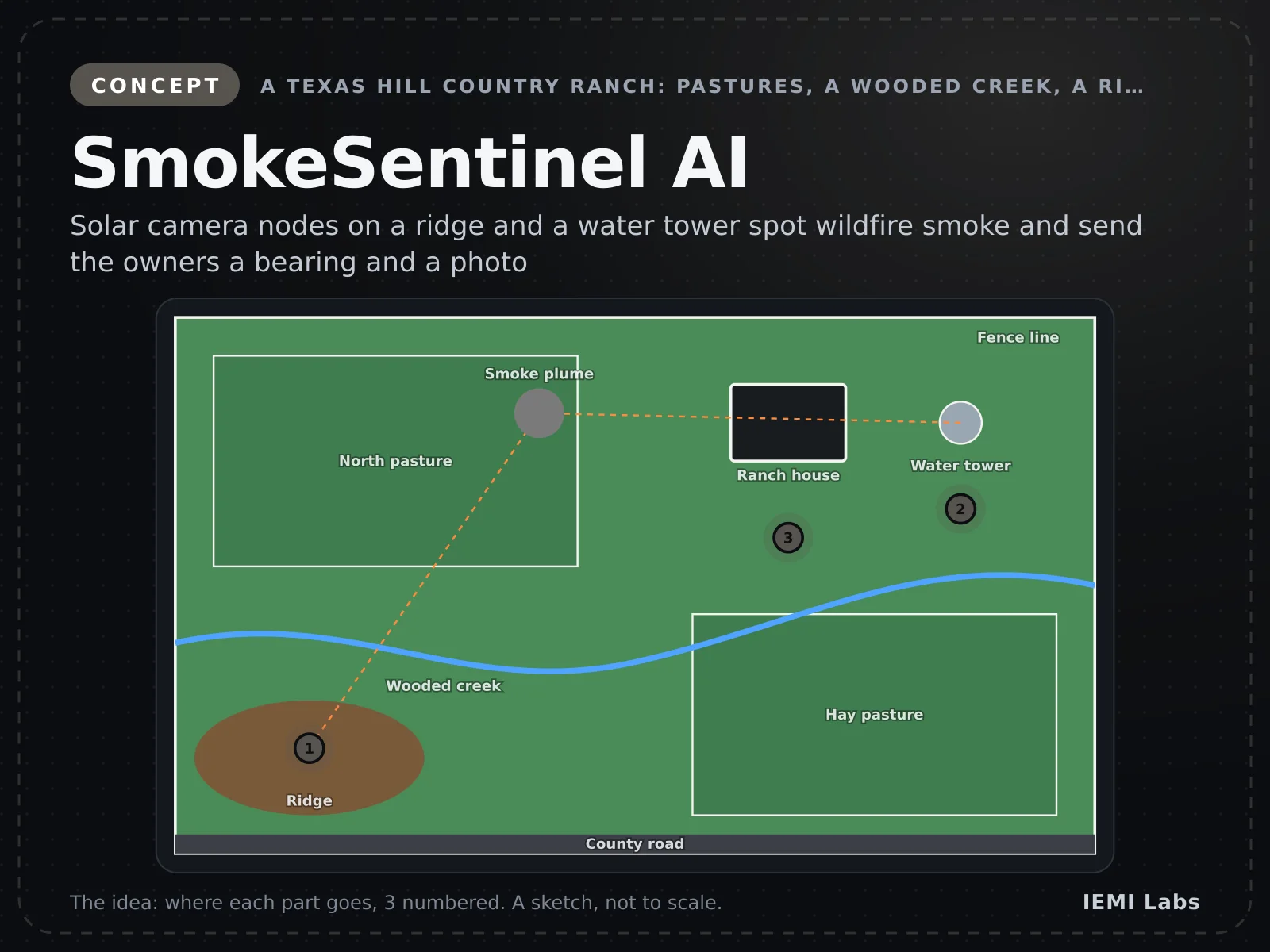
A solar-powered four-camera head on a mast that watches the horizon for wildfire smoke.
From $4,900 per node incl. solar kit
Details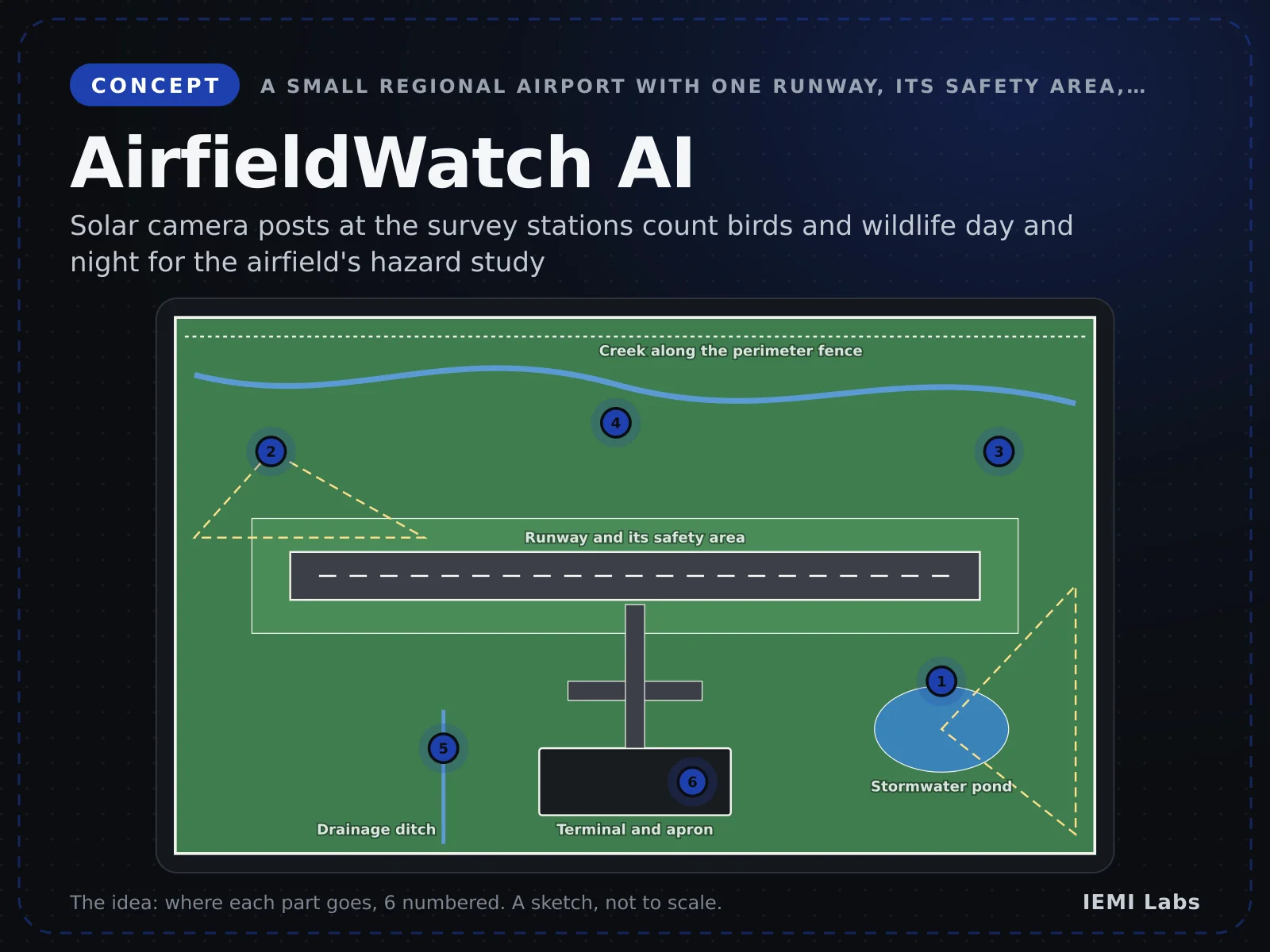
A thermal and visible camera turret on a mast that spots birds and wildlife near runways.
From $8,900 per turret
DetailsPumpOne
Concept · target $2,690