SensingConcept
ColdChain Guard AI
A lunchbox-sized monitor that mounts inside trucks, cold rooms and fridges.
- Watches temperature around the clock
- Warns before goods get too warm
- Detects door openings and tampering
From $199 per kit
DetailsHand-rub dispenser dock that counts rubs per room entry, no badges
Software: $4 per room per month
Concept, not for sale yet. Tell us if you want it; that decides what we build.
Rate this idea and tell us what to change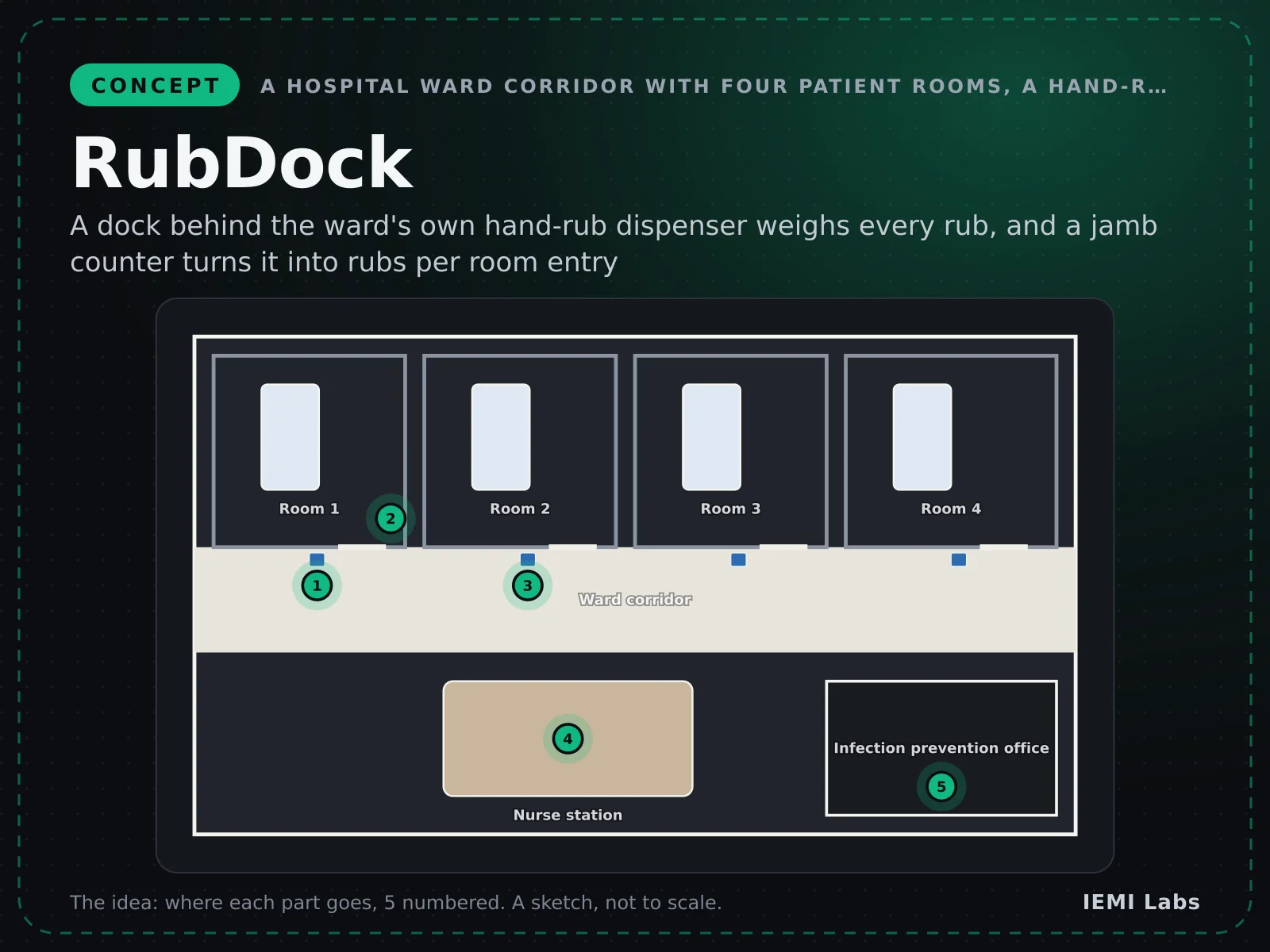
Drag to rotate · right-drag to move · scroll to zoom · click a part for its size and placeSwipe to rotate · pinch to zoom · two fingers to move · tap a part for its size
How it fits together
Scroll or tap a part. Press “See the 3D CAD design” to watch the model, built from our CAD, light each part up and show how it connects.
Real-time 3D render · drag to rotate · final design may varySwipe sideways to rotate
01
The whole RubDock
A scale under a door sanitiser dispenser counts rubs by weight; a door sensor counts entries; a ward gateway matches the two.
02Brain
XIAO ESP32-C3 (Dock)
The brain: it runs the rubdock-dock-fw program
03
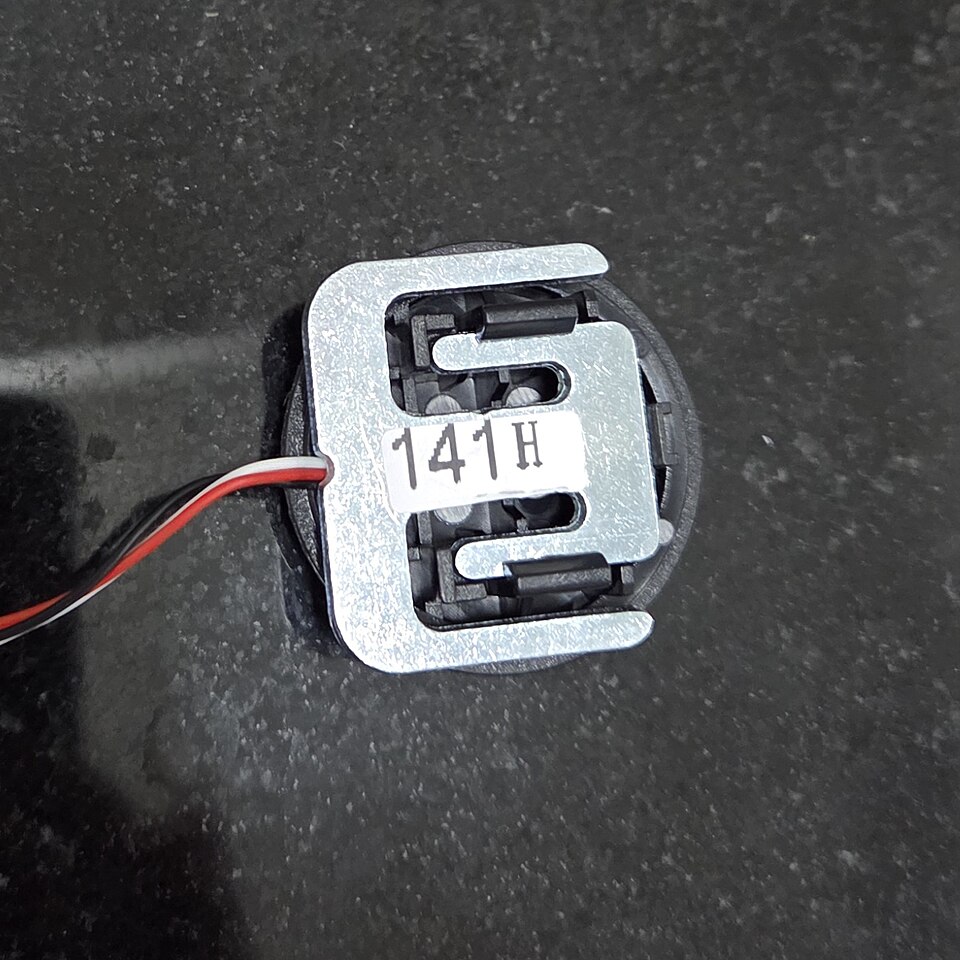
TAL220B load cell
Feels each dose leave the dispenser, to a quarter of a gram
XIAO ESP32-C3 (Dock) · 4 wires to HX711 · Tiny strain signal
04
HX711 amplifier
Turns the cell signal into a 24-bit weight reading
XIAO ESP32-C3 (Dock) · GPIO clock and data · Weight readings
05
Amber LOW LED
Blinks briefly when the bottle is under 15% full
XIAO ESP32-C3 (Dock) · GPIO pin · On/off blink
06
Two 18650 cells
Run the Dock about 184 days per charge (estimate)
XIAO ESP32-C3 (Dock) · Battery charger input · Power
07
DoorTally door counter
Counts people in and out at the door with a distance sensor
XIAO ESP32-C3 · ESP-NOW radio · IN and OUT timestamps
08
All connected
6 key parts, one program, and your phone
What it is
A weighing back-plate for any wall hand-rub dispenser, plus a door counter on the room's jamb.
What it does
Who it's for
Hospital infection prevention teams and care homes that audit hand hygiene.
The idea
The problem today
Hospitals count hand hygiene by watching staff, and hidden observers see about half the rate the auditors report. Badge systems cost hundreds per bed a year and need the maker's own dispensers, and an empty dispenser at the door goes unnoticed until someone needs it.
With RubDock
The RubDock under the dispenser the ward already owns feels each rub leave it as a gram on the scale, and knows when it will run empty. A DoorTally on the jamb counts people in and out, and the ward gateway reports rubs per room entry by unit and shift, plus a refill list. No cameras, badges or names.
How the parts connect
Every part, what links it to the brain, and how the data reaches your phone. A solid line is a cable; a dashed line is a radio link.
The program
void loop() {                                // runs after each 10 s deep-sleep wake
    w = hx711_avg(5);
    if (w - last_weight > 500) refill_reset(w);          // bottle swapped
    else if (spread() > 0.5f || w > last_weight) discard(); // hand or push
    else if (last_weight - w >= 0.25f && held_next_wake(w))
        bin_add(now_bin(), last_weight - w);          // mass of one dose
    last_weight = w;
    digitalWrite(LED_LOW, percent_left() < 15 && millis_blink());
    if (report_due() || percent_left() < 15)
        esp_now_send(GATEWAY_MAC, pack_bins(), sizeof(bins));
    esp_deep_sleep(10 * 1000000);
}
To your phone
Browser on any device
One screen for each job RubDock does.
Rubs at entryNight shift on Ward 4. The door counter counts each entry, the dispenser scale feels each rub, and the manager sees the trend by shift, never by person.
Refill soonThe dispenser at room 406 is running low. Housekeeping gets it on the list before it runs empty in the middle of a shift.
Refill roundEach morning housekeeping gets one refill list for the ward, with the empty and low dispensers marked by room.
App screens with sample data. The interface is in development.
| Rubs per bin | 1.02 doses | Every 10 s bin |
|---|---|---|
| Rubs at entry | Within 15 s of IN | Each entry |
| Liquid left | 412 g | Every 30 min |
| Refill alert | LOW, under 15% | At once |
| Battery | 3.91 V | Every 30 min |
Counts only: no images and no staff IDs. A room shows alone only with 20 or more entries.
CAD design · Rev A design complete (stages 1-6), all hardware fit-checked in CAD, not built; Leapfrog accepts 'activity monitoring' systems but the hospital must validate them, and acceptance of unit-level feedback is unconfirmed
| AI processor | Seeed XIAO ESP32-C3 (one in the Dock, one in the DoorTally) |
|---|---|
| Sensors | SparkFun TAL220B 5 kg load cell with HX711 (Dock) · Pololu VL53L1X time-of-flight sensor, two zones (DoorTally) · Panasonic EKMB low-power PIR wake (DoorTally) |
| Connectivity | ESP-NOW long-range to a ward gateway · Gateway to cloud over MQTT/TLS (counts only) · No hospital Wi-Fi needed on the devices |
| Power | Dock: 2 × 18650, about 184 days per charge (est.); DoorTally: 1 × 18650, about 157 days at 300 passages a day (est.); USB-C charging in place |
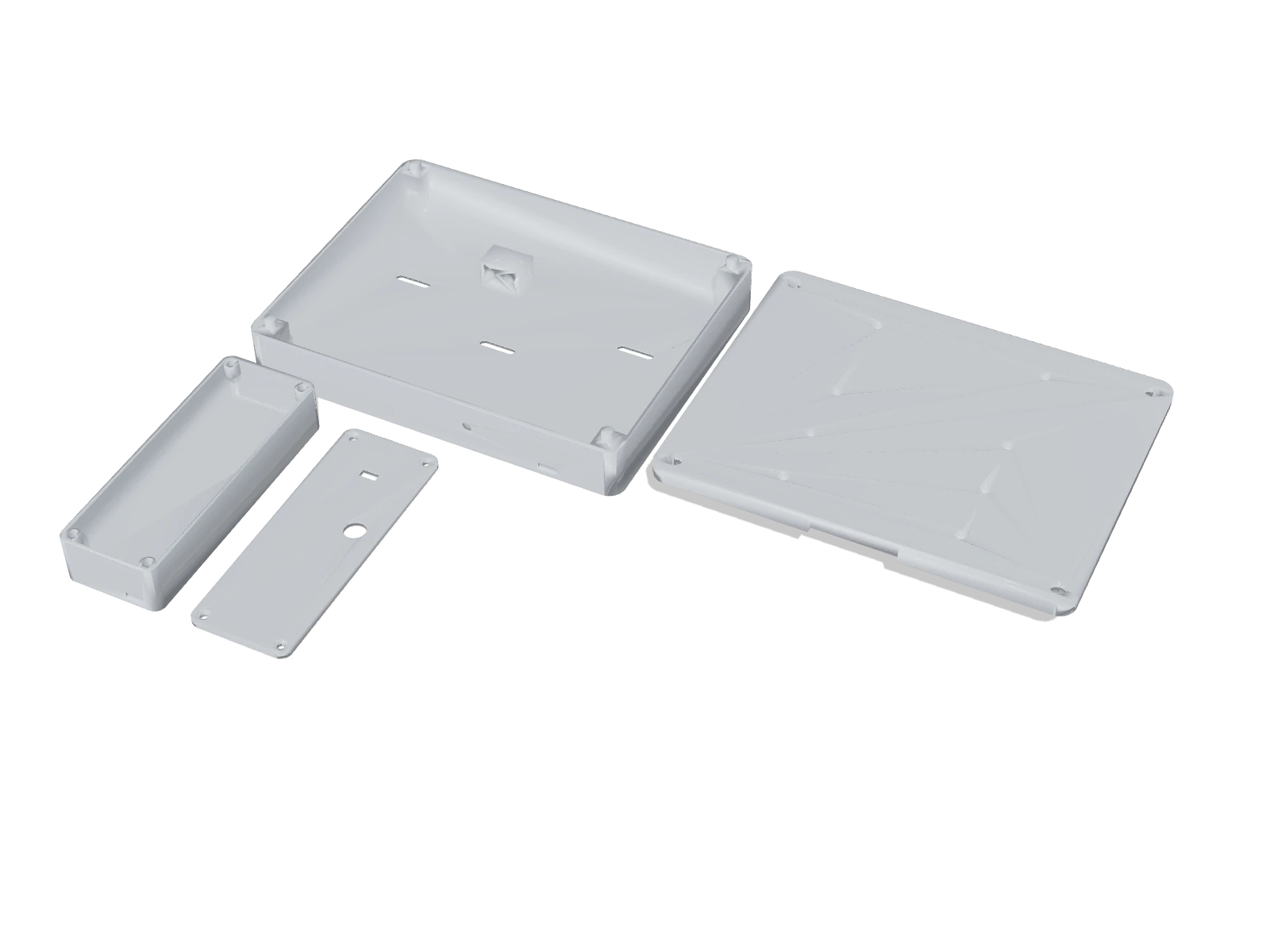
| Enclosure | Smooth white PETG Dock behind the dispenser with an amber LOW LED; slim white PETG DoorTally on the jamb with IN/OUT marks |
| Dimensions | Dock 26 mm deep (dispenser moves about 34 mm off the wall); DoorTally 48 × 130 × 27 mm |
| Rub detection | Half push about 10× averaged noise (est.) |
|---|---|
| Dispensers | Any brand up to about 3 kg full |
| Rub at entry | Within ±15 s of an IN |
| Door coverage | Whole doorway from the jamb at 1.25 m (CAD est.) |
| Unit report | Rubs per entry by shift, weekly |
|---|---|
| Leapfrog export | Opportunities, rubs, validation date |
| Refill list | Sorted by predicted empty time |
| Privacy floor | Rooms shown alone only with 20+ entries |
| Dock battery | About 184 days (est.) |
|---|---|
| DoorTally battery | About 157 days (est.) |
| Mounting | Old dispenser anchors; VHB on the jamb |
| Overload | Printed stops close at about 7.5 kg (est.) |
Targets for production units; they may change during development.
Hardware: $99–$179 per room ($179 Dock + DoorTally kit; Dock alone $99)
Software: $4 per room per month
Target pricing. The $99 Dock alone gives refill alerts only. Parts cost is about $95 per room at qty 1 and about $45 at qty 1,000 (est.).
Indicative launch pricing in USD, excluding taxes and shipping. Final pricing is confirmed before any balance is charged.
Community
RubDock is in development. Rate the idea, tell us what to change about the features, specs or price, and we'll build it with your feedback.
How much people want it
–
No ratings yet
Follow RubDock
Get build updates and first access when pre-orders open.
No comments yet. Tell us what you'd want from RubDock.
Questions
Tell us what this would save you, or ask anything. We reply within two business days.
A member of the IEMI Labs team will reply within two business days.
From the product lab · ideation phase
No. RubDock is a concept in the in-house design and testing stage. It has not been built or tested on a ward, and it has no ship date yet.
Not exactly. It reports rubs per room entry, which is a proxy. In/out counting misses the moments inside the room and counts visitors as entries. It does not prove hands were cleaned and makes no claim to reduce infections. Hospitals must validate it before using it for Leapfrog.
No. Nothing is worn, there are no cameras and no IDs. Reports are by unit and shift, and a room is only shown on its own once it has at least 20 entries.
It is designed for wall dispensers of any brand, manual or touch-free, up to about 3 kg full. Hole patterns vary, so they still need measuring and testing.
A lunchbox-sized monitor that mounts inside trucks, cold rooms and fridges.
From $199 per kit
Details
A matchbox-sized battery monitor that sticks near pipes, tanks and AC units.
From $199 per unit / building kit
Details
IEMI's one product for care homes and hospital wards: the bedside locker, made smart, with one brain and one app.
From $590 per smart bedside locker
DetailsRubDock
Concept · target $99