RubDock
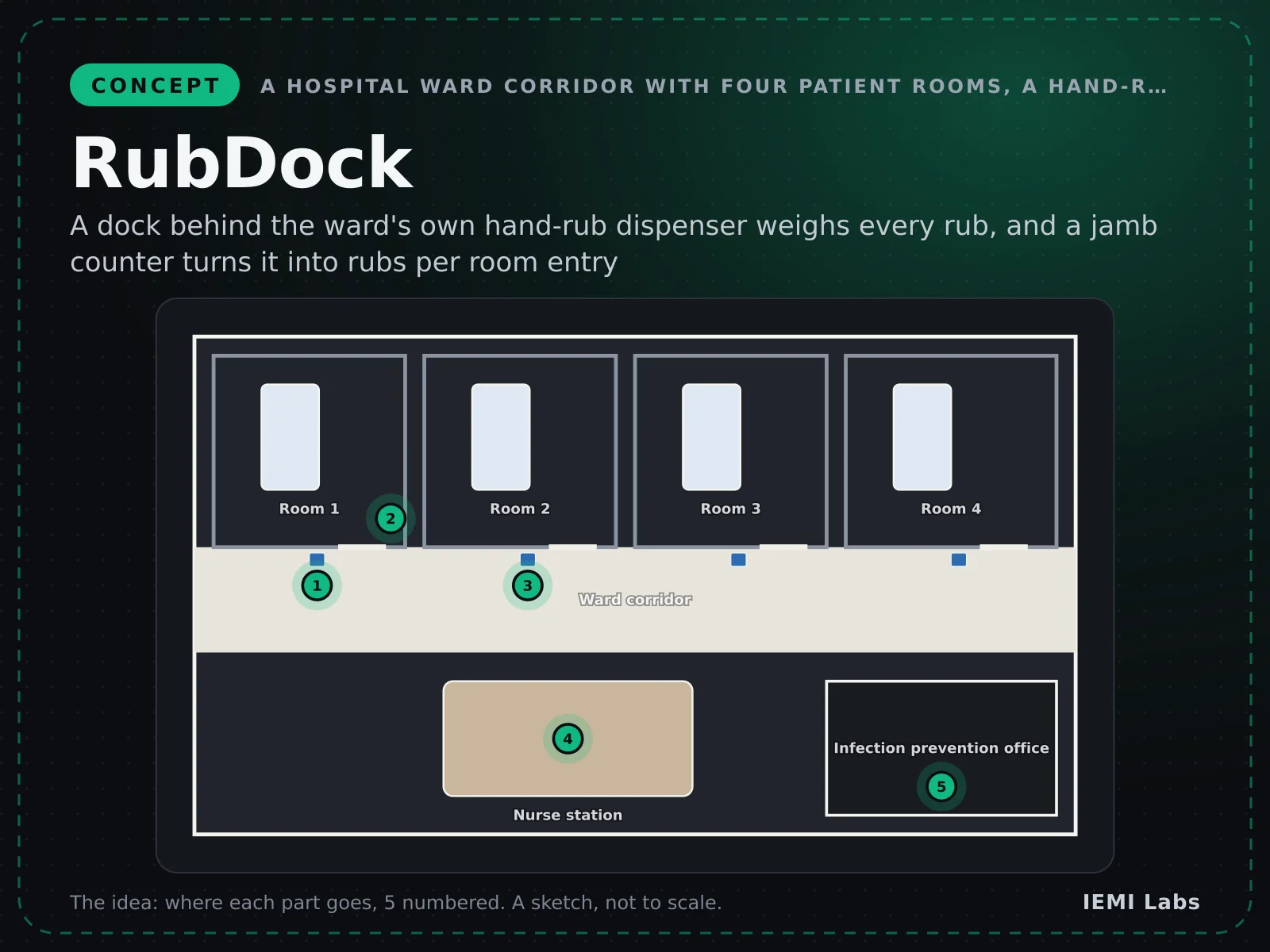
The hand-rub dispenser at the room door, made smart: it counts every rub, knows when it will run empty, and reports rubs per room entry with no badges, cameras or names
A thin Dock screws into the dispenser's old wall anchors and the ward's own dispenser screws onto it, hanging on a load cell, so every rub shows up as about 1 g leaving the scale. A DoorTally stuck on the door jamb counts people in and out with a two-zone time-of-flight sensor. The ward gateway reports rubs per room entry by unit and shift and sends a refill list before dispensers run empty. It counts and reports only: it does not prove hands were cleaned and makes no infection claim.
- Who buys it
- First: infection prevention teams at US hospitals meeting Leapfrog's standard of 200 hand hygiene opportunities per unit per month, where about 90% still use human observers. Then: care homes that must audit hand hygiene and cannot afford badge systems. Today they pay for auditor time or about $450-650 per bed per year for electronic monitoring.
- Why it pays
- Covert observers measured 50% compliance where hospitals' own auditors reported 84%, so a full count is worth more than 200 watched opportunities. RubDock targets about $48 a year in fees per room against $450-650 per bed per year for electronic systems (est.), and turns empty dispensers, the most common dispenser fault, into a planned refill list.
- Target price
- $179 per room kit (Dock + DoorTally) + $4/room/month; Dock alone $99 for refill alerts (target)
- First-minute wow
- The unit report on Monday: 9,300 room entries and 5,100 rubs at the door last week, night shift at 41%, and three dispensers that sat empty all weekend, with no badge on anyone and no camera in the corridor.
What the research found
And how this design answers it
- Human observers are biased (covert 50% vs auditor 84%) and Leapfrog wants 200 opportunities per unit per month → every entry and every rub is counted on every shift, and the export gives the opportunity count
- Staff dislike badges (78% think they are inaccurate; unions object to surprise monitoring) → nothing is worn, nothing identifies anyone, and rooms are only shown once they have 20+ entries
- Electronic systems cost $450-650 per bed per year and lock you into one brand's dispensers → a scale behind any dispenser, $179 per room plus $4 a month (target)
- 27% of dispensers in a German audit were defective or unusable, mostly empty → the Dock knows grams left and sends a refill list sorted by predicted empty time
- Only 20% of dispensers gave full volume on the first push, so push counts mislead → rubs are counted as mass steps, which also gives grams per rub
- ST's overhead people-counting layout covers only 17-36% of a 1.12 m door at body height (CAD report) → the DoorTally sits on the jamb at 1.25 m and sees every crossing point
Use case
A medical ward replaces monthly observation
Infection prevention nurseWard managerEnvironmental services
- 01Trigger: Leapfrog asks for 200 opportunities per unit per month and the ward's one auditor reports 88%
- 02Detection: 28 Docks behind the existing door dispensers and 28 DoorTallys log 9,300 entries and 5,100 rubs within 15 s of an entry in a week
- 03Alert: the unit report shows 55% overall and 41% on nights, and three dispensers empty all weekend
- 04Action: environmental services adds those rooms to the Friday refill run, and the night huddle sees the unit trend with no names
Outcome: A full count every shift instead of 200 observations a month, and about 11 auditor hours a month back (est.)
How it works
Architecture
- 01
Sense: a 5 kg bar load cell behind the dispenser, weighed every 10 s; a two-zone VL53L1X on the jamb woken by a PIR
- 02
Decide: weight drops become rubs per 10 s bin; the gateway counts a rub 'at entry' within 15 s of an IN at that door
- 03
Send: ESP-NOW to a ward gateway, then counts only over MQTT/TLS; no images, no IDs, no hospital Wi-Fi on the devices
- 04
Tell: a weekly unit report by shift, a Leapfrog opportunity export, and the environmental-services refill list
Hardware
Real parts, buyable today
Bill of materials: about $43 per Dock + $52 per DoorTally = $95 per room at qty 1, about $45 per room at qty 1,000 (est.).
| Block | Part | Why this part |
|---|---|---|
| Weighing | SparkFun SEN-14729 TAL220B 5 kg straight bar + HX711 | A half push (0.34 g) is 10x the averaged noise and a full push 30x (CAD dose report, est.) |
| Door counter | Pololu #3415 VL53L1X carrier + Panasonic EKMB PIR | Two ROI zones give direction with no image; the PIR keeps it asleep between passers |
| MCU + radio | Seeed XIAO ESP32-C3 (one in each unit) | ESP-NOW long range, 44 uA sleep, Li-ion charging over USB-C |
| Power | 2 x 18650 in the Dock, 1 x 18650 in the DoorTally | About 184 and 157 days per charge (CAD power report, est.) |
| Mechanics | Printed PETG Dock with a floating hanger on 0.6 mm stop pins | All weight goes through the cell (0 mm3 contact in CAD); hard pushes land on the pins at about 7.5 kg (est.) |
Mechanical
Printable CAD
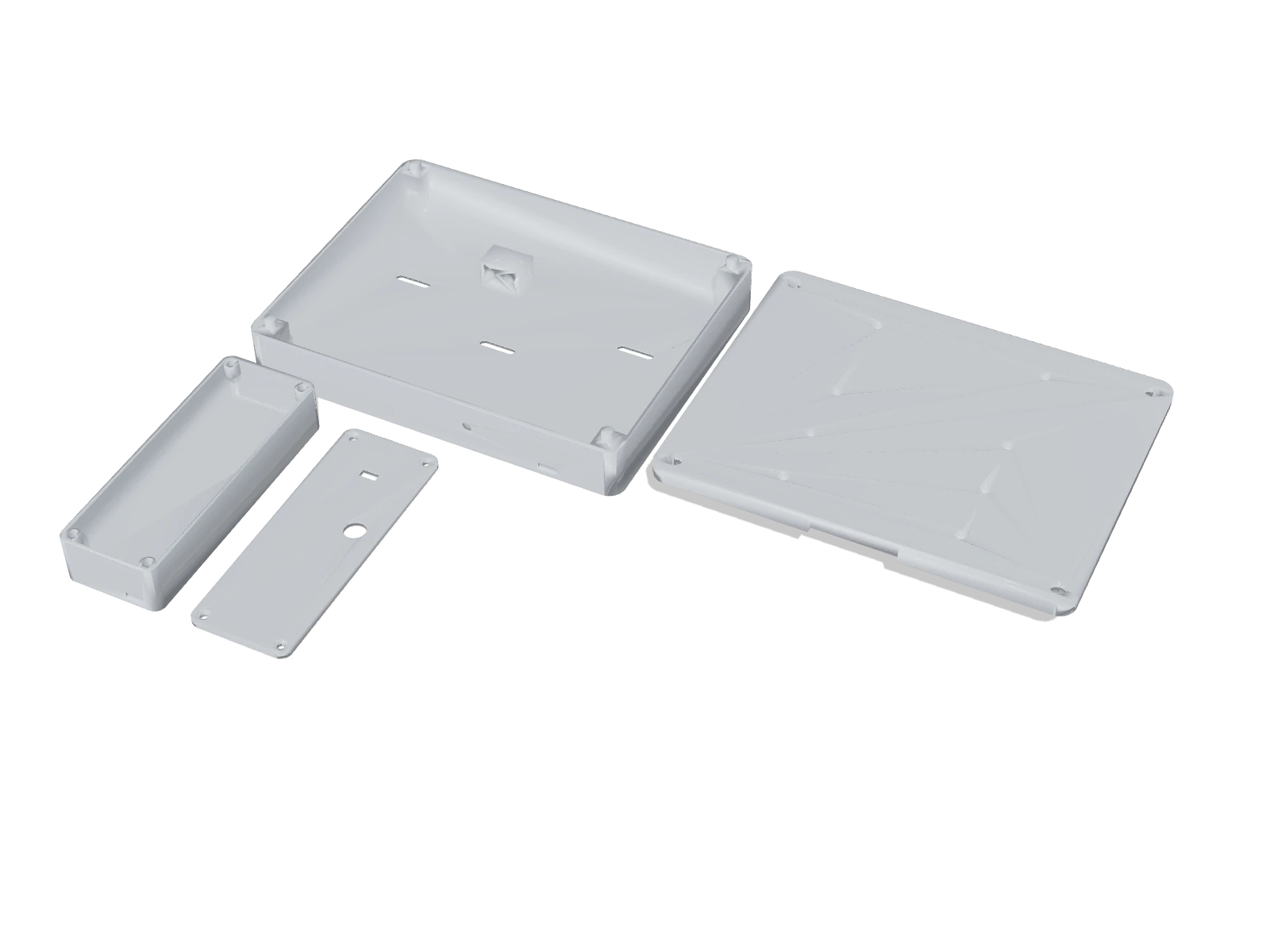
4 parts, generated from code and checked as closed solids. Pick a part to inspect it, or download the STL files to print.
See the CAD parts render
Loading the CAD…
Real CAD · drag to rotate · scroll to zoomReal CAD · swipe sideways
Bought hardware fitted inside this part (checked in the CAD: nothing collides with the plastic)
- Dock base: load-cell block, battery, HX711 and ESP32 bay, stop pins, slots for the old dispenser anchorsdock-base.stl · PETG
- Dock hanger: floating plate the dispenser screws onto, boss on the cell's free end, stop holesdock-hanger.stl · PETG
- DoorTally case: 18650, ESP32-C3, PIR and ToF, stuck on the jamb with VHBdoor-case.stl · PETG
- DoorTally lid: ToF aperture, PIR lens hole, IN/OUT marksdoor-lid.stl · PETG
Open risks we are working on
- Rubs per entry is a proxy: in/out counting sees about a third fewer opportunities than the WHO 5 moments, and visitors count as entries; reported as a trend, never as compliance
- Leapfrog accepts activity monitoring but the hospital must validate it, and whether unit-level feedback meets 'feedback to individuals' is unconfirmed (gate G2)
- GOJO, Ecolab and Deb own the dispenser contracts and could bundle monitoring with refills or refuse third-party plates
- Load-cell creep under a constant 1.8 kg, dispenser hole patterns and printed 0.6 mm stops are untested (T1, T2)
- Pairs walking side by side, beds and carts, and doors held open may miscount (T3); ESP-NOW range through ward walls is unmeasured
- No infection prevention or care-home interviews yet; gate G1 is 5 hospital teams and 3 care homes
Design stage only: nothing on this page is for sale. Specifications and prices are targets.