Reservation not completed. Checkout was cancelled and you have not been charged. You can try again whenever you are ready.
CricketOne
IEMI's one cricket product: a smart wicket that is its own umpire. The stumps call bowled, run-outs, stumpings, no-balls, wides and the over, and light up with the call
Drag to rotate · right-drag to move · scroll to zoom · click a part for its size and placeSwipe to rotate · pinch to zoom · two fingers to move · tap a part for its size
How it fits together
CricketOne, part by part
Scroll or tap a part. Press “See the 3D CAD design” to watch the model, built from our CAD, light each part up and show how it connects.
Real-time 3D render · drag to rotate · final design may varySwipe sideways to rotate
01
The whole CricketOne
The wicket is its own umpire. Rev T: every one of the six stumps carries the same circuit board of our own, folded into the stump in one piece. Its camera head sees the ball through the window, a sensor under every bail groove times the bail-off, call lights shine into the clear strips, and the battery system sits on the same board. No plugs, ribbons or adapters.
02Brain
Our stump board: the brain (RV1126B) in every stump
The brain: it runs the cricketone-official program
03
Camera head, on the same board
The OV9281 global-shutter camera chip, soldered on the board's head section behind the window, 662 mm up, tilted 12°
Our stump board: the brain (RV1126B) in every stump · the board's own camera flex (MIPI CSI-2, 2 lanes): no cable to fit · video at 120+ fps
04
Bail sensors under both grooves
A Hall switch on a thin flex finger in each of the head's Hall pockets, under the bail's magnet
Our stump board: the brain (RV1126B) in every stump · the board's flex fingers · bail on / bail off, timed to the frame
05
Call lights, sounder and security chip
Eight side-facing LEDs on two flex wings shine into the clear light strips; a sounder plays the call tone; the security chip signs every call; the tamper switch sits in the base
Our stump board: the brain (RV1126B) in every stump · the light driver and I2C on the brain · the call, shown and signed
06
Wi-Fi and Bluetooth between the stumps
The certified Wi-Fi 5 / Bluetooth 5 module and its antenna, at the top of the brain above the heat bar
Raspberry Pi Zero 2 W · on the brain (SDIO) · tracks, calls and the shared clock between the six stumps
07
LiFePO4 cells and the battery system on the board
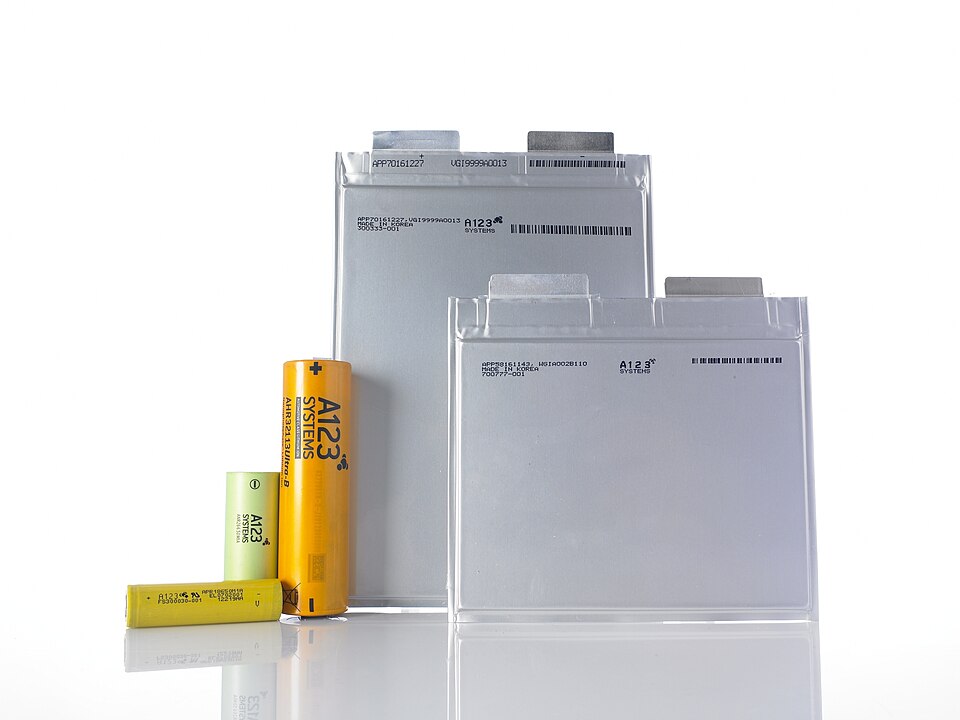
Two A123 LiFePO4 cells soldered to the flex tail; the base disc holds the charger, cell protection, battery gauge and charge pads
Our stump board: the brain (RV1126B) in every stump · the board's flex tail: cells soldered on, no plug · 3.2 V to the brain; charge from the charging case
08
All connected
6 key parts, one program, and your phone
Our circuit board · rev A-0
One board of our own inside CricketOne
Every chip on one board we design, shaped to fit: the processor, cameras and sensors, Wi-Fi and Bluetooth, lights, sound and power. No plugs, ribbons or adapters. It is checked in our CAD against every part around it, and it arrives from the maker ready to run our software from a microSD card. Turn the model, or pick a part below to see where it sits.
Loading the 3D board…
Drag to turn · scroll to zoom · right-drag to move · click a partDrag to turn · tap a part
Checked before we order
Every board-level number CricketOne's jobs depend on, checked against its target: camera pixels and frame rate, power and battery life, heat where it works, shock, radio and software. Every lesson from every one of our boards is a rule here, so this review runs again whenever any board teaches us something. Boards are ordered only when nothing fails and the items to prove are measured.
No check fails13 pass · 5 fixed by the review · 7 to prove before we order · 0 failDesign review of 3 November 2026
Area
Check
Our board
Target
Status
Camera
Ball size at the far stumps (20.12 m)
3.7 px
≥ 3 px to track
passes
Camera
Motion smear at 144 km/h, 0.5 ms exposure
20 mm
≤ 1/3 of the ball (24 mm)
passes
Camera
Frame rate the calls were simulated at
200 fps (1280 × 400 band) and 180 fps
chip: 120 fps at 1280 × 800, 180 fps at VGA
to prove on the dev kit
Camera
Camera data rate vs the 2-lane link
1.02 Gbps needed (10-bit, 200 fps band)
≤ 1.6 Gbps (2 lanes × 800 Mbps, est.)
passes
Camera
Image processor load
123 Mpx/s
≤ 360 Mpx/s (12 MP ISP at 30 fps)
passes
Camera
Shutters in step across the six stumps
frame-sync line on the camera flex; scheme B clock 0.03 ms p95
≤ 0.05 ms
passes
Camera
AI engine time per frame
3 TOPS available
ball and bat model inside the 5 ms frame at 200 fps
to prove on the dev kit
Battery
Run time, 3 cells, worst case (aged to 80 %, 5 °C)
13.8 h
≥ 10 h
fixed by the review
Battery
Run time, 3 cells, new, 20 °C
20.4 h
≥ 10 h
passes
Battery
Spare run time, worst case
38 % over 10 h
≥ 0 % (more is better)
passes
Battery
Charge time
11 h from flat at 1 A; 9 h overnight puts back 100 % of a 10-hour day
a full day back overnight (9 h)
passes
Battery
Peak current from the cells
1.23 A at 2.5 V
≤ 3 A (buck-boost), ≤ 1 C per cell
passes
Battery
Cold and hot charging
thermistor on the cells, charging held outside 0–45 °C
LiFePO4 rule
passes
Heat
Processor temperature, full sun, 35 °C air
69 °C
≤ 85 °C (RV1126B rated −20 to 85 °C)
passes
Heat
Cell temperature in full sun, 35 °C air
blue 60.5 °C → cool blue 52.5 °C
≤ 55 °C (cell rating 60 °C)
fixed by the review
Heat
Camera temperature in full sun
66 °C
≤ 85 °C operating
to prove on the dev kit
Heat
Metal near the antenna
heat bar ends 5 mm below the antenna; collar 2.6 mm above
no metal over the antenna
to prove on the dev kit
Shock
Peak shock on the board
4053 g (rigid-body upper bound)
every part rated for it
fixed by the review
Shock
Ball-grid chips
underfill under U1, U2, U10, U5
no cracked joints after the drop and ball tests
to prove on the dev kit
Software
Starts from the microSD card on battery power
J1 hinged, latched socket on every board; the maker delivers U-Boot and a device tree that start from the card
no setup on arrival
passes
Software
The card wins the start
eMMC U10 shipped empty; our loader reads the card first
the processor starts from the card every time
fixed by the review
Software
Card power switch and protection
U12 switched card supply; U13 ESD on 6 lines, 22 Ω series resistors
a stuck card can be power-cycled; the slot is ESD-safe
fixed by the review
Software
Card grade
industrial pSLC microSD (Kingston Industrial or Swissbit S-56u), −40 to 85 °C; read-only system with a separate data partition
rated for heat, cold, shock and writes
to prove on the dev kit
Software
Clip buffer for an unsure call
4 s of 8-bit 200 fps video in 40 % of the 1 GB memory (the rest: Linux, the program and the AI model)
≥ 3 s
passes
Radio
Wi-Fi between the two ends
20.12 m, line of sight
certified Wi-Fi 5 module, chip antenna
to prove on the dev kit
Before we order the first boards, we prove these on the RV1126B development kit or in the rev A tests:
Short animated scenes of real moments: what happens today, what CricketOne does about it, and what lands on your phone. The same scenes play in the IEMI app.
DEMO · 1 of 7
IEMI · CricketOnenow
0s
Under-13 Sunday friendly. No umpire turned up, so the stumps make every call.
Use cases
Today, without CricketOne
A parent or the batting side's coach umpires, and every close call turns into an argument between two sets of parents.
What CricketOne does
The bail sensors feel the bail leave its groove and the middle-stump camera sees the ball hit the off stump. The striker's wicket lights red and logs the call.
How the app helps
The scorer's phone logs every call with the over and ball
Close balls: the scorer answers from the clip, the batting side may challenge until the over is called
The signed log settles any argument after the game
The square-leg umpire guesses from 30 m away, side on, in a split second. There is no replay at club level.
What CricketOne does
The bail sensor times the bail off to the millisecond. At that instant the stereo cameras in the off and leg stumps see where the bat is, in 3D, against the popping crease.
How the app helps
Run out or not out on the scorer's and captains' phones within a second
Bat gap in millimetres, with the confidence
A signed 10-second clip of the bail-off for the umpire and captains
The umpire judges line, impact and the path to the stumps by eye from 22 yards, with no ball tracking below professional level.
What CricketOne does
Both middle-stump cameras track the ball, so the stumps know where it pitched, where it hit the pad, and where it was going. LBW stays the umpire's call: the stumps send the evidence to the app on the umpire's phone.
How the app helps
Pitched, impact and hitting, with a percentage, in the app on the umpire's phone
The ball track to show the captains after the over
The decision logged with its evidence
Ball tracking from both stumpsLBW evidence to the umpireSmartwatch buzzSigned call logOpen this scene in the app →
Today, without CricketOne
The umpire has to watch the front foot and then look up for the ball in the same instant, so most front-foot no-balls are missed.
What CricketOne does
The bowler's-end middle-stump camera fits the front foot's landing spot from two stump cameras (where it lands, not where it slides to). If no part of it landed behind the line, both wickets light amber and the umpire's watch buzzes before the shot is played.
How the app helps
No-ball with the margin in millimetres
Free hit flagged to the scorer
No-ball count per bowler for the coach's next nets session
Wides are called by feel; junior games often have no umpire at all, so the batting side decides.
What CricketOne does
All six stump cameras follow the ball after it bounces and on past the stumps, and fit where it crossed the popping crease against the off-side wide guideline (within 2.6 mm at worst, simulated); the pose model checks the batter did not reach it, then both wickets light amber.
How the app helps
Wide with how far outside, logged as an extra
Wides per bowler for the coach
Junior wide rules applied by age group
Wide checkLights on the stumpsExtras logged for the scorerBowler stats for the coachOpen this scene in the app →
Today, without CricketOne
The square-leg umpire has to see the keeper's gloves, the bail and the batter's back foot in the same instant.
What CricketOne does
The bail sensor times the bail off and the stereo stumps see the back foot still out of the crease at that instant.
Demo scenes show how CricketOne and its app are designed to behave. CricketOne is in design; nothing here is recorded from real equipment yet.
What it is
IEMI's one cricket product: a smart wicket pair at Law 8 size, with every sensor inside the stumps.
What it does
Makes the calls: bowled, hit wicket, run-out, stumping, no-ball, wide, over
Tracks the ball from six global-shutter stump cameras
Times bail-off and checks the bat at the crease in stereo
Counts overs, over-rate and junior spells
Who it's for
Cricket clubs with a league side and a junior section with nets.
The idea
The stumps are the umpire: they call outs, no-balls and wides, light up, and run the rest of the match
The problem today
Club and junior cricket runs on volunteers. Often there is one umpire, or none, and a batting-side player at square leg. Close run-outs, front-foot no-balls and wides are guessed, arguments follow, over-rates and junior spells are counted by hand, and the nets length is guesswork.
With CricketOne
The club swaps its stumps for CricketOne wickets and changes nothing else. The stumps call bowled, run-outs, stumpings, no-balls, wides and the over and light up with the call; unsure calls go to the captains. Nothing else stands on the field.
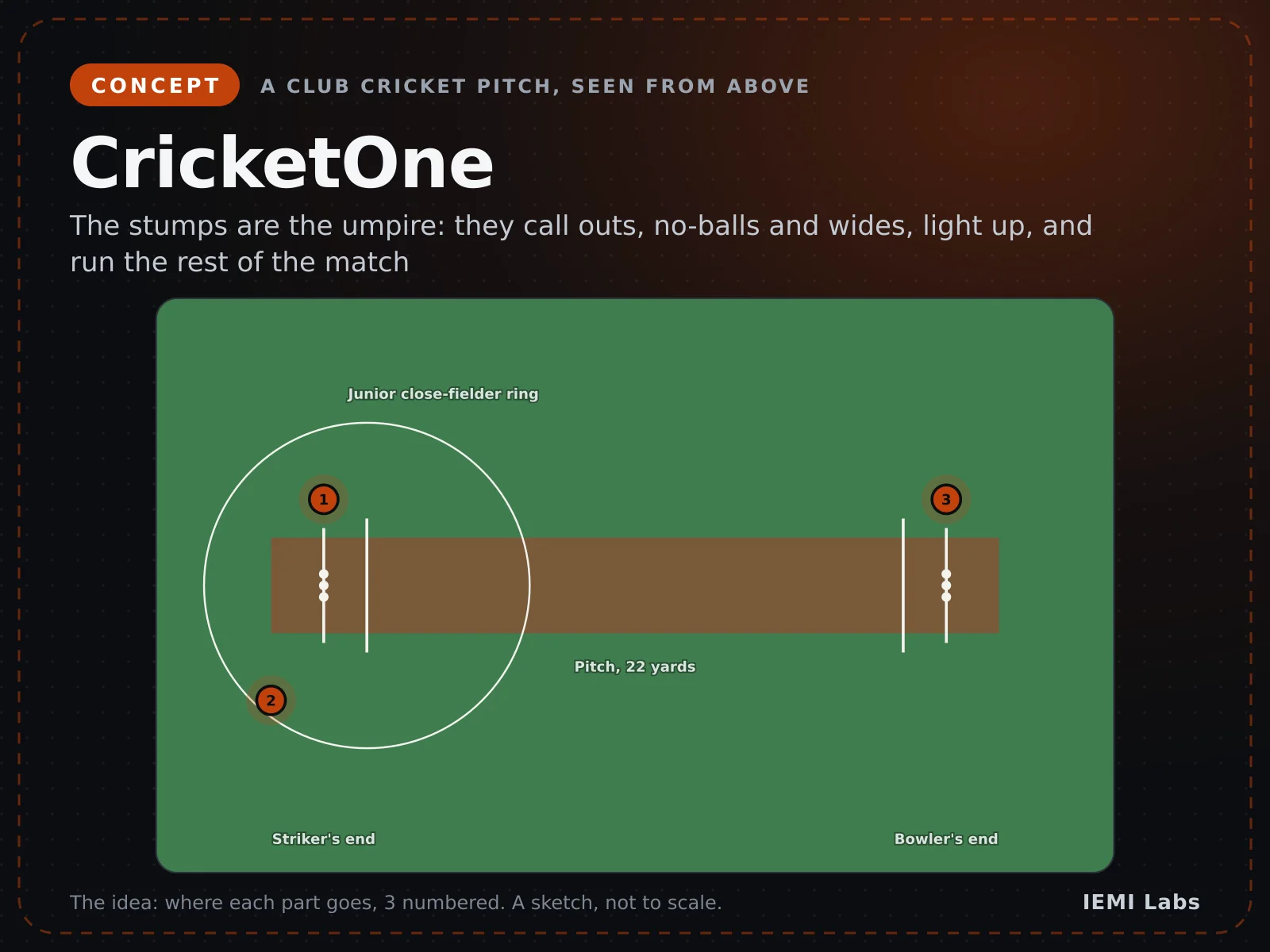
1Striker's wicket (the brain)Middle stump camera and brain: run-outs and stumpings with the bail sensors, back-foot no-balls, the count; signs every call.
2Off and leg stumps (same build)Every stump has the same global-shutter camera: three views 19 cm apart see the bat and feet in 3D at the crease, and the ball sharp; each stump feels what hit it.
3Bowler's-end wicketThe same smart wicket: front-foot no-balls as the foot lands, wides and bowled seen down the pitch, LBW evidence.
A club cricket pitch, seen from above, drawn to show where each part goes (not to scale).
How the parts connect
CricketOne, wired up
Every part, what links it to the brain, and how the data reaches your phone. A solid line is a cable; a dashed line is a radio link.
Drawn from the CricketOne parts list. The 3D view above is built separately, from the CAD.
The program
What controls CricketOne
Runs on
Our stump board (RV1126B) in every stump; the striker's middle stump is the brain
Written in
Python 3 and C: V4L2 for the camera, libgpiod for the bail sensors and lights, cryptoauthlib for the security chip, and the RKNN runtime on the RV1126B's AI engine
System
Linux from Rockchip's RV1126B SDK, on the microSD card for development and on the board's own eMMC for sale stumps; signed and checked with dm-verity
AI model
Each stump: ball, bat and feet on its NPU from its own global-shutter frames. The brain fits one physical flight path (gravity, drag, swing, bounce) through the points from all six stumps
1Between balls: each camera watches at a low rate; the bowler's run-up starts the delivery window
2In a delivery: every stump reads its cropped band at full rate, shutters staggered, and sends ball points with times
3Fit the flight: release, bounce (the ball on the ground fixes its length), impact; then the front and back foot, the wide line and the LBW evidence
4On a bail-off: what hit the stumps, or the bat and feet against the crease at that millisecond, in stereo
5Below the confidence line, or with a wet or blinded window, the call is "unsure" and goes to the umpire or captains
6Sign each call in the secure element, light and sound the stumps, send it to the app (phones, and a smartwatch buzz through the phone's notifications)
cricketone-official.pymain loop
while True:
    d = delivery.wait_runup()                    # low-rate watch between balls
    pts = stumps.track(d, fps=200, stagger=True) # six global-shutter views, points + times
    path = flight.fit(pts)                       # gravity, drag, swing, bounce
    decide(noball.check(d) or wide.check(path))  # Law 21.5, Law 22
    decide(lbw.evidence(path))                   # Law 36: evidence only
    for ev in bails.edges() + stumps.hits():     # Hall GPIO + motion sensors
        decide(wicket.judge(ev, pts))            # bowled, hit wicket, run-out, stumped
    decide(count.ball(d))

def decide(call):
    if call is None: return
    if call.conf < call.threshold or stumps.view_poor(call): call = call.unsure()
    signed = atecc.sign(call)                    # append-only log
    stumps.light(call.colour); sounder.tone(call)
    app.publish(signed)                          # phones; a watch can buzz
To your phone
How the data reaches CricketOne
Scorer's phone or laptop browser at the boundary
Striker's middle stump (the brain)
WPA3 Wi-Fi access point · MQTT over TLS
Scorer's phone, the captains and the coach
WPA3 Wi-Fi 6
Striker's middle stump
What you see in the app
One screen for each job CricketOne does.
11:52
CricketOneNo official
Close ball: answer before the next ball11:52
Over 9 ball 3: front foot close to the line. Watch the clip and tap fair or no-ball; the batting side can challenge until the over is called.
Calls
41
Answered
3 of 3
Time to answer
13 s
11:40Wide: ball 0.9 m outside, amber
11:44Bowled: ball hit off stump, red
11:49Back foot close: scorer answered fair in 9 s, no challenge
11:52Front foot close: waiting for an answer, ball 3 pending
Answer: fair or no-ball
No officialUnder-13 Sunday friendly with no umpire: the stumps make every call, and the few close balls they hand back are answered by the scorer from the clip between deliveries.
15:42
CricketOneRun-out call
Striker's end: run out15:42
Bail off at 15:42:07.312, bat 40 mm short of the crease. Stumps lit red.
Bat gap
-40 mm
Confidence
97 %
Open clip
Run-out callLeague T20: a direct hit at the striker's end; the stumps call before the fielders finish appealing.
14:21
CricketOneNo-ball call
Front-foot no-ball14:21
Over 14 ball 3: heel 30 mm past the popping crease. Both wickets lit amber.
No-balls
2 today
Margin
+30 mm
No-ball callUnder-15 game: the opening bowler drags the front foot over the line.
16:05
CricketOneLBW evidence
LBW: hitting middle16:05
Pitched in line, impact in line, 82 % hitting middle. Umpire decides.
Pitched
in line
Hitting
82 %
Show track
LBW evidenceClub second XI: a loud appeal for LBW; the umpire checks the track in the app on their phone.
14:48
CricketOneOver-rate, spells
Over-rate: 1.5 overs behind14:48
12 minutes left in the hour. Sam has 2 overs left in this spell.
Behind
1.5 overs
Sam spell
5 of 7
Balls counted
by the stumps
Overs behind the rate (overs)
Over-rate, spellsUnder-15 league game: the fielding side is slow and the opening bowler is close to the spell limit.
App screens with sample data. The interface is in development.
What the app gets
Data CricketOne sends to the app
Calls
Over 9 ball 4: run out, bat 40 mm short, signed
Each call
No-balls and wides
Over 14 ball 3: front foot no-ball, heel 30 mm over
Each ball
LBW evidence
Pitched in line, hitting middle, 82 %
Each appeal
Over-rate and spells
1.5 overs behind; Sam 2 overs left
Each over
Close fielders
Short leg 8.9 m, ring 10 m
Each run-up
Nets lengths
Good length 7.1 m ±0.4
Each ball
Only points and times leave each camera; 10 s clips around calls are kept for 30 days, signed, then deleted. Junior use needs the club consent screen. No face recognition.
CAD design · Phase 2 engineering, rev T, 3 Nov 2026: one circuit board of our own in every stump (RV1126B, camera chip, Wi-Fi/Bluetooth, battery system, bail sensors, call lights), folded into the rev S stump in one piece. CAD check: the board fits all six stumps with clearance pockets cut, nothing touching. Board at the placement stage; quotes from board makers next.
Designed in code, checked in 3D
58 printed parts, each a single closed solid
Every bought part fitted inside and checked for collisions
Assembled exactly as shown in the 3D CAD view (the button on the picture at the top)
Raspberry Pi Zero 2 W in every stump for the first build (our own RV1126B board with a neural engine in production); the striker's middle stump is the brain
Sensors
1 MP global-shutter camera (OV9281 class) behind a Ø12 window in every stump · TI DRV5055 linear Hall sensor under every bail groove, read by a small window ADC in each stump; a small magnet in each bail spigot · Motion sensor (IMU) and cell monitor in every stump · NeoPixel call lights, a sounder, a tamper switch and an ATECC608 secure element in every stump
Connectivity
Wi-Fi access point and MQTT to the scorer's phone · Wi-Fi between all six stumps, clocks synced for the staggered shutters
Power
Three A123 26650 LiFePO4 cells per stump (all above the grass, in one stainless sleeve), about 14 h (est.), a 50-over day ends 10 % above the reserve with old cells at 5 °C (simulated); flush charge pads, charged in the 6-bay case between 0 and 45 °C
Enclosure
White UV-stable stump tubes (PA12 or clear PC for fit units; a glass-fibre tube, stronger than ash in bending, for ball-test units) with screw-in spikes, sealed to an IP67 target
Dimensions
Each stump 38.0 mm across, top 711.2 mm above the pitch plus a 102 mm solid spike (813 mm overall, like a match stump), wicket 228.6 mm wide (MCC Law 8)
Weight
About 950 g per stump with spike against about 650 g for solid ash; it swings 0.78x as fast as ash when clipped (row P6, est.)
Ingress rating
IP67 target (IEC 60529), not yet tested
All target specifications
Jobs
Jobs target specifications
Calls alone
Bowled, hit wicket, run-out, stumped, no-balls, wides, the over
Assists
LBW (evidence only); league matches unless allowed
Counts
Balls, overs, over-rate, junior spells
Juniors
Close fielders against the 8 or 11 yard ring
Nets
Length and line per ball
Legal and physical
Legal and physical target specifications
Rule
MCC Law 8: 28 in high, 9 in wide, stumps 1.38-1.5 in
Run time
About 14 h per stump at 20 °C, about 12 h at 5 °C (est.)
Extra parts
None: calls show on the stumps and in the phone app
Data
Positions stay on the wicket's own Wi-Fi
Engineering (phase 2)
Engineering (phase 2) target specifications
Cameras
1 MP global shutter in all six stumps; 120 fps full frame, 200+ fps in a delivery (est.)
Ball tracking
About 1,200 looks a second across the pair, shutters staggered (est.); sure tracks within 6.7 mm, about 3 in 10 deliveries sure (simulated)
First bench test
Checked before the chip arrives: 120 frames a second needs the camera's 8-bit mode (26 % to spare, against under 1 % at 10-bit), and the camera now stands right behind the stump wall so its whole view passes the Ø10 hole; before, the hole cut most of it (row Q12, 10 checks)
Files for makers
STEP and DXF files of the stump wall, caps and base, made from the drawing's own numbers, so any tube shop or print bureau can quote (rev R row R4, 29 checks)
Stump wrap
A print-ready blue wrap with cyan stripes and our name, cut round the camera, lights and holes, one file for every stump; it showed production tubes must be 37.6 mm to stay inside Law 8.2 once wrapped (rev R row R7)
Cast white top
Our own silicone mould casts the stump's white top in tough urethane for about $2 of resin a cap, with the same outside as the printed top (rev R row R6, checked in CAD)
Stump wall drilling jig
Three printed parts put the camera hole, screw hole, notch, light slots and lead hole in the same place on every stump, with no machine shop (rev R row R5, checked in CAD)
Ball finder software
Ready for the first stump: finds the ball in 100 % of frames in good light, centre within 0.05 px (simulated, rev R row R1); bench test B1 measures it on the real chip
Wide call
Ball at the popping crease within 1.6 mm at 95 %, 2.6 mm worst, against the off-side guideline (simulated, row P20)
Impact
Designed for 145-160 km/h; 500-hit ball-cannon test per stump planned
Weather
IP67 target, sealed, no open port; all calls to 38 °C air in still air and 45 °C in a breeze, full sun (heat model, est.)
Cells
3 LiFePO4 per stump, all above the grass in one stainless sleeve; charging only 0-45 °C
Clock sync
Six stumps agree to about 0.005 ms (simulated); calls needing both wickets go unsure if a stump loses sync
Camera aim
Each camera re-finds its aim between deliveries from the far wicket and the creases, about 0.005° (simulated)
Bail-off time
The moment a bail loses contact, within 0.278 ms (simulated); a bail that settles back is not called
Targets for production units; they may change during development.
Software: $19 per month, optional (League Stream); the local app needs no plan
Target pricing. Bought separately, our CreaseCam League Kit ($1,449), CloseCheck pod pair ($199), SmartStump Match Kit ($1,599), LengthLock Junior Nets Kit ($529), PitchTally OverRate Kit ($279) and SpellCount Pair ($99) add up to $4,154. Parts cost about $1,280 per CricketOne at qty 1 (rev P, est.): the global-shutter cameras and computers in all six stumps raised it from $992.
CricketOne
$1,990
Both ends of one pitch: match days, juniors and nets.
Two smart wickets
6-bay charging case
Local app, no plan
Extra wicket pair
$1,490
A second pitch or the nets.
Same app
League
Custom
Leagues and umpire associations.
League Mode playing conditions
Over-rate reports
Volume pricing
Indicative launch pricing in USD, excluding taxes and shipping. Final pricing is confirmed before any balance is charged.
Community
What do you think of CricketOne?
CricketOne is in development. Rate the idea, tell us what to change about the features, specs or price, and we'll build it with your feedback.
Planes: solid ground on inner layer 1 under all three boards; 3.3 V on inner layer 2 (main board and camera head, ground on the base disc)
192 vias, one beside each ground and 3.3 V pad with a short track: no via in pad, none in the antenna zone or under the card socket; checked against every pad, via and track
KiCad DRC: 0 copper errors (clearance, shorts, holes, keep-outs); 183 of 499 connections made, 316 to route (48 crowded plane pads, 71 fast signals, 72 power, 125 slower signals)
Freerouting 2.5.0 (official release, checksum-verified) reached its first pass with 0 violations, but its Windows build crashes before saving (a serialization bug in that build); the Java version needs Java 25, not downloaded. The board is exported for the router (test-board.dsn in the zip)
Back-side parts kept out of the antenna's copper-free zone too (it covers both sides)
The stumps must judge a wet ball as well as a dry one on the days cricket is really played, in an English June, a Mumbai November and a Melbourne January (Law 4, the ball: https://www.lords.org/mcc/the-laws-of-cricket/the-ball; climate records: https://en.wikipedia.org/wiki/Climate_of_London , https://en.wikipedia.org/wiki/Mumbai#Climate , https://en.wikipedia.org/wiki/Climate_of_Melbourne).
New simulation sim/wetsun-r151.mjs (6 of 6 checks): the same match days, with the skies and rain reweighted to each ground's 1991-2020 sunshine hours and rain days
Learned: our skies were too sunny: the records give 42 % sunshine in a London June and 61 % in a Melbourne January, against the 79 % we assumed; Mumbai's November matches, but it has only 0.6 rain days
Learned: wet balls with the sun out are fewer than we assumed (67 in 1000 over the three seasons, not 79), and 96 % of them are wet from evening dew, not rain
Designed: no code change, because the told error still covers 97.2 % of them; the bench now starts with a lightly misted ball under a low lamp, as Mumbai's evening dew (bring-up step 66). No part, CAD or cart change
Boards: no new board-level CricketOne detail since the last run; all 24 boards re-run (0 problems, reviews 0 fail, DRC 0). Next: R152 checks when and how often dew really wets the ball
The stumps must judge a wet ball as well as a dry one, whoever is bowling: seam bowlers and spinners both bowl through dew and damp outfields (Law 4 for the ball and its seam, https://www.lords.org/mcc/the-laws-of-cricket/the-ball; Law 41, https://www.lords.org/mcc/the-laws-of-cricket/unfair-play).
New simulation sim/wetseam-r150.mjs (6 of 6 checks, est.): R148's 126 match days (60 wet) with a wet seam's own glint, look by look as the ball spins, for seam bowlers and spinners
Learned: a wet seam moves the ball's measured centre very little, 0.044 mm for seam bowlers and 0.021 mm for spinners (worst 5 %); the spin averages it out, more for spinners, whose tilted seam sweeps both ways
Learned: it does not add to what the wet correction leaves (wet balls 0.26 to 0.25 mm, worst 5 %), even held still or twice as bright, because it points wherever the seam is, not along the sun
Designed: no new code; track2d.py gets a note saying why a wet seam needs no term of its own; the told error still covers 97 % of wet balls, with no false new balls and no sure LBW decision firm and wrong
Bring-up step 65 turns a soaked ball so the seam crosses its highlight and logs the lean wet and dry. No part, CAD or cart change
Boards: no new board-level CricketOne detail since the last run; all 24 boards re-run. Next: R151 checks how often a wet day really has the sun out, against climate records for the three grounds
The stumps must judge a wet ball as well as a dry one: how much a wet ball's water film shines changes from day to day, and dew and a wet outfield are normal in evening and November cricket (Law 41, https://www.lords.org/mcc/the-laws-of-cricket/unfair-play).
New simulation sim/wetcoat-r149.mjs (7 of 7 checks, est.): R148's 126 match days (55 wet), with the highlight's brightness and width read each over in sun, and 21 ways of using them
Learned: the brightness hardly follows the water film (the highlight is under one pixel on a ball 2.8 pixels wide); the width follows it only roughly (correlation 0.387)
Learned: no reader learns the day's film shine better than our one figure; the best takes wet balls 0.21 to 0.19 mm (worst 5 %) on the days it was picked on, but only 0.00 and 0.02 mm on other days, and a plain larger figure gets most of it
Designed: no new code; track2d.py keeps the wet sizing from two runs ago and gets a note saying why; no false new balls and no sure LBW decision firm and wrong
Bring-up step 64 measures how steady a wet ball's highlight width really is at 20 m; a read about three times steadier than assumed would be worth another look. No part, CAD or cart change
Boards: no new board-level CricketOne detail since the last run; all 24 boards re-run. Next: R150 does water held in the seam lean the ball differently
The stumps must judge a wet ball as well as a dry one on every kind of wet day: how dark a soaked ball looks changes with the day, and the umpire dries the ball at intervals (Law 41, https://www.lords.org/mcc/the-laws-of-cricket/unfair-play; Law 15, https://www.lords.org/mcc/the-laws-of-cricket/intervals).
New simulation sim/wetfall-r148.mjs (6 of 6 checks, est.): R147's 126 match days (60 wet), plus the umpire drying a wet ball with a towel at each interval, and 95 ways of learning the day's figure
Learned: none of them reads the day's darkening better than our one figure: an over's darkening is the day's figure times how wet the ball is, and spray off the bounce tells the wetness only roughly; the umpire's towel reads no better
Learned: what is left on a wet ball is how much the water film shines, not how dark it looks: knowing the shine would take wet balls 0.25 to 0.21 mm and soaked balls 0.36 to 0.26 mm (worst 5 %), knowing the day's darkening would not move them
Designed: no new code; track2d.py keeps R147's wet sizing and gets a note saying why; no false new balls and no sure LBW decision firm and wrong
Bring-up step 63 measures a soaked ball's darkening, its highlight width and its lean, before and after a towel; no part, CAD or cart change
Boards: no new board-level CricketOne detail since the last run; all 24 boards re-run (0 problems, reviews 0 fail, KiCad DRC 0). Next: R149 read the water film's shine from the wet ball's own highlight
The stumps must judge a damp ball and a soaked ball as well as a dry one: dew and a wet outfield are normal in evening and November cricket, and the umpire dries the ball between balls (Law 41, https://www.lords.org/mcc/the-laws-of-cricket/unfair-play).
New simulation sim/wetsize-r147.mjs (6 of 6 checks, est.): R146's 126 match days, with the ball's dimming read against the last over that looked dry
Learned: the dimming follows how wet the ball is (correlation 0.67); its largest error is how dark a fully wet ball gets on the day, 6 to 12 % (est.)
Designed: the wet correction is now sized from the dimming on an over with a wet sign, and switches itself on at a clear dimming with no sign, never in the new-ball window (track2d.py WetSize, self-test added)
Result: soaked balls 0.39 to 0.31 mm, a worn wet ball 0.29 to 0.23 mm, every wet ball 0.27 to 0.24 mm (worst 5 %); dry balls unchanged; no false new balls; no sure LBW decision firm and wrong
Bring-up step 62 measures a real ball's dimming as it dries, beside its lean; no part, CAD or cart change
Boards: no new board-level CricketOne detail since the last run; every board re-run. Next: R148 learn the day's own wet dimming
Carry each new CricketOne board finding to every product's board in the same week. The CricketOne test-board circuit puts a protector chip and two switching transistors on its cells, separate from the charger (TI BQ2970 datasheet: https://www.ti.com/product/BQ2970).
New shared rule cellguard and a check on every cell-powered board: one protector for each charger, or a cell that carries its own protector board
Proved the check works: it found four boards with a charger and no protector the first time it ran
DiamondOne: the plate pack and the base pack each get a TI BQ2970 protector and a dual transistor in their power blocks
FootballOne: the post pack and the crossbar cell each get the same
FarmOne: U53, a protector and dual transistor beside the fuel gauge on the power wing (size est.); the board check passed first time
AthleticsOne: the starter unit's 500 mAh pouch cell is now a protected cell; the finish posts already had one; RacketOne already had one
Every board re-run: 23 boards with no problems, every review 0 fail, KiCad design-rule check 0 on all 24 board packs; quotes and design-review notes of the four boards updated
CricketOne's own board notes are the owner's and already have the protector (U31 with Q30)
The stumps must judge a wet ball as well as a dry one: dew and a wet outfield are normal in evening and November cricket, and the umpire dries the ball between balls (Law 41, https://www.lords.org/mcc/the-laws-of-cricket/unfair-play).
New simulation sim/wetlean-r146.mjs (6 of 6 checks, est.): 126 match days with a wet outfield and evening dew, the wet film's own shine added
Learned: the film adds 0.10 mm (median) and 0.41 mm (worst 5 %) to the lean at the stumps; the dry correction leaves 0.42 mm on wet balls against 0.17 mm on dry ones, most on a worn ball
Designed: on an over with a wet sign the shine correction adds one wet table (a fifth of a full coat) and the told error carries 0.15 mm more (track2d.py, self-test added)
Result: wet balls 0.42 to 0.29 mm, dew at Mumbai 0.44 to 0.30 mm, the worst 1 % of every ball 0.36 to 0.30 mm; dry balls 0.17 to 0.20 mm; no sure LBW decision firm and wrong
Bring-up step 61 measures a wet worn ball's lean on the bench; no part, CAD or cart change
Boards: no new board-level CricketOne detail since the last run; every board re-run. Next: R147 read how wet the ball is from its own dimming
CricketOne is the cricket wicket (pair): three stumps and two bails at each end, made smart
It replaces a club's match stumps and bails for both ends (the set pitched every Saturday and in the nets), with every part built in. Everything is inside the six stumps, and rev P (30 Oct 2026) puts the same build in every stump. Each has a 1 MP global-shutter camera, a Raspberry Pi Zero 2 W computer (our own RV1126B board in production) behind an aluminium heat spreader and ball shield, our power board (LiFePO4 charger, motion sensor, cell monitor), an ATECC608 secure element and three LiFePO4 cells, all above the grass in one stainless sleeve. There is a call light behind flush clear strips, a sounder, a tamper switch and flush charge pads, and a Hall sensor under every bail groove. It has the same height, width and spike as plain stumps: 711.2 mm above the ground plus a 102 mm solid spike, 813 mm overall, and only the spike goes in the ground. A stump weighs about 950 g with its spike, against about 650 g for a solid ash stump of the same shape (row P6, est.); most of the extra is low down, so a clipped stump swings about 0.78 times as fast as ash (est.).
Law 8.2: tops of the stumps above the playing surface
28 in (71.12 cm)
✓ 711.2 mm dome; the bail groove edges stand 0.5 mm lower, as the Law allows for grooves
Law 8.2: stump cylindrical above the surface, diameter
1.38 to 1.5 in (3.50 to 3.81 cm)
✓ 38.0 mm round tube, cylindrical to the dome; the camera window sits on a ledge, flush or slightly below the surface, never proud of it
Law 8.3: bails no more than 0.5 in above the stumps
≤ 12.7 mm
✓ 7.5 mm (bail barrel in the groove)
Law 8.3: bail length and parts
4.31 in (10.95 cm) overall, barrel and spigots to Law 8.3
✓ Standard wooden bails, a 3 mm magnet set into each spigot end; size unchanged
Law 8.2: stumps of equal and sufficient size to stop the ball passing between
equal stumps
✓ all six stumps share one outer profile; the electronics are inside
Club, school, junior, friendly and nets cricket: the wicket makes its calls alone. In matches under a league or governing body it only assists the umpires (evidence and a suggested call), unless that body writes it into its playing conditions, as the ICC did for approved LED wickets; we claim no approval.
One piece of equipment does
●Makes the calls: bowled, hit wicket, run-out, stumping, front-foot and back-foot no-ball, wide, over count; LBW assists
●Ball tracking from six global-shutter views, about 1,200 looks a second (est.): release, bounce, impact, wide line and LBW evidence
●Bail-off and stump-hit time, and what hit the stumps
●Bat or foot at the popping crease at bail-off, in stereo from three stumps
●Over-rate and junior spell limits
●Junior close-fielder ring before each run-up
●Nets: ball length and line for the coach
●Ball inspection photo held to the stump camera (started from the app)
Not done by the equipment, and why
Over-rate clock board at the boundary: a wicket cannot show digits readable from the square; the over-rate shows in the app
Automatic bowling-machine dial: the machine is not part of the wicket; the app tells the coach which mark to turn to
Caught: the stumps cannot reliably see a catch in the deep or a thin nick to slip; the players or the umpire call it
Wide run-outs: a batter grounding the bat more than about 1.4 m wide of the stumps (0.95 m before the outer cameras turned out 12°, row P28) leaves the stump cameras' view; the call shows unsure
Keeper's gloves at release (Law 27.3.1, 2026 Laws): a glove 10-150 mm ahead of the stumps is beside the striker's-end cameras, outside their view, and the far-end cameras cannot judge 50 mm of depth from 20 m (CAD check 30 Oct 2026); the umpire keeps this call
Makes the call itself
With no umpire (junior, school and friendly games, nets), the wickets call bowled, hit wicket, run-outs, stumpings, no-balls, wides and the over themselves: the stumps light and sound, and the scorer's app logs it. Out shows red, not out green, no-ball and wide amber, unsure white with two short tones. On unsure, and for catches and LBW, the two captains watch the clip in the app and agree; if they cannot, the batter stays (club custom, set per league).
Call
Who decides
How it sees it
How players see the call · if unsure
Bowled< 0.5 s · sure on 97.5 % of bowled balls, 0 wrong sure calls in 20,000 close deliveries (simulated, row P23)
The equipment
bail-groove sensors (bail-off within 0.278 ms, P18), the motion sensor in each stump (a ball strike clips its 16 g range), the ball track from all six global-shutter stump cameras (the bowler's-end cameras follow a played-on ball from the bat); fused check (row P23): a bail comes off and stays off within -1 to +25 ms of the moment the ball track reaches the stumps, AND the struck stump records a hard hit at that moment or the track crosses the bail zone (a bail-only clip); a ball off the bat or the striker's body still counts (Law 32.1); a later bail-off (keeper, fielder, a ball off the keeper's pad) is not bowled and goes to the stumped and run-out checks
Struck wicket lights red, long tone; the app repeats. A graze that barely moves the stump, a track that does not clear the bail zone by 3 sd, or a bail-off outside the arrival window with no hard hit: unsure, clip kept for the umpire or captains
Hit wicket< 1 s · sure on 47.8 % of hit wickets, 0 wrong sure calls in 20,000 wickets broken near the striker (simulated, row P24)
The equipment
bail-groove sensors (bail-off within 0.278 ms, P18), the motion sensor in the struck stump, the three bowler's-end stump cameras 20 m away (the striker's-end cameras look up the pitch and cannot see their own stumps), the no-ball checks (P19, P21); fused check (row P24): the bowler's-end cameras place the striker's bat, body or fallen kit nearest the struck stump at bail-off (two views in 3D when the keeper stands up, one when the keeper stands back); the pose model follows the striker from the shot and the contact must come before balance is regained (MCC Laws 2026); the ball must be a sure fair delivery (never hit wicket off a no-ball, Law 21.18); no fielder within 1 m in the last second and the striker never left the crease for a run (making ground is not out, Law 35.2)
Red lights, long tone. The contact hidden behind the striker's body, a keeper's glove within 3 sd of the bat or body, contact within 3 sd of the moment balance is regained, a fielder within 1 m, or the no-ball check unsure: unsure, clip to the umpire or captains
Run-out< 2 s · ± 10.2 mm at 95 % where two or more cameras see the bat, with the outer stump cameras turned out 12° (simulated, rows P22 and P28; ± 7.2 mm with all three facing straight)
The equipment
bail-groove sensors (bail-off within 0.278 ms, P18), the three stump cameras at that end, 1.22 m behind the crease, shutters staggered so 540 looks a second at 180 fps (the two outer ones turned out 12°, row P28); the far-end cameras for the ball in the hand; track fit (row P22): the bat toe or foot followed in 3D through every look within 30 ms, a curve along the pitch for when it crosses the popping crease and a touchdown fit of its height for when it is grounded; the safe moment is the later of the two (Law 30.1.2: grounded behind the line, and a batter who then loses contact running or diving on stays in) against the bail-off moment; then how the wicket was broken: a direct hit, or a hand that holds the ball with complete control (MCC Laws 2026), checked by the far-end cameras
Red (out) or green (not out) at the broken wicket, tone. Seen by fewer than two stump cameras (a toe in the air cannot be placed by one), a track that scatters more than 1.5x the expected noise, the bail-off not 3 sd clear of the safe moment, out of the stump cameras' view (none within 1 m of middle stump since the outer cameras turned out, row P28), or the wicket broken by a hand and the far cameras cannot see the ball held in it: unsure, clip to the umpire or captains
Stumped< 2 s · ± 3.9 mm at 95 % (simulated, rows P22 and P28)
The equipment
bail-groove sensors, the three stump cameras at the striker's end (the keeper stands behind them, not in their view); keeper's glove at the stumps holding the ball with complete control (MCC Laws 2026) + the same track fit as the run-out on the striker's back foot or bat (a lifted heel or bat counts only when it touches down); wide or no-ball checked first
Red or green, tone. Same as run-out; a glove that only touches the ball while breaking the wicket is not out
Front-foot no-ballbefore the ball reaches the batter (< 0.4 s) · ± 2.6 mm at 95 % where two cameras see the heel, sure on 98.21 % of near landings, 0 wrong sure calls (simulated, row P31; ± 10.7 mm in row P19); wide of the crease ± 12 mm at 95 % (the outer camera places a grounded heel on the ground itself, checked by the far stumps' view of the gap under it; a no-ball there must be sure on the crossing with the far fix alone), sure on 92.1 % of those landings at 3.5 sd, 0 wrong sure calls (simulated, row P33; about 25 mm (1 sd) in row P27), callable on 93 % of wide landings
The equipment
two of the three bowler's-end stump cameras in stereo, 1.22 m from the popping crease, 180 fps; for bowlers wide of the crease, the outer stump camera on that side (turned out 12°, row P27) with the far stumps' cameras fixing the lower leg sideways; landing fit: the heel's track before touchdown (staggered shutters and a 360 fps strip for the 60 ms around the stride, a heel-strike model learned from the bowler's earlier strides, the crease edge fitted at the heel, row P31; for bowlers wide of the crease the same heel-strike model finds the frames the heel rests on the ground, row P33) is extended to the ground to find where the front foot LANDS (Law 21.5.2), in 3D so a raised heel counts by the spot below it; where the foot stops after sliding is not used (row P19)
Amber at both wickets, double tone. Sure only with the heel 3 sd clear of the crease (3.5 sd wide of the crease, row P33); within that, hidden by the bowler's legs (0.1 %), or seen by one camera with no far view (1.1 %): unsure, the umpire keeps it
Back-foot no-ball< 0.5 s · ± 18 mm at 95 %, sure on 95.73 % of seen landings, 0 wrong sure calls (simulated, row P32; ± 25.3 mm in row P21)
The equipment
the three striker's-end stump cameras looking up the pitch, 20 m away, 180 fps (the bowler's-end cameras cannot see a foot beside or behind them); landing fit: the outermost point of the back foot against the inner edge of the return crease, compared in each image at the row where that part of the shoe meets the ground, over the first 5 frames after touchdown from every striker's-end camera that sees it, the ground row from the whole sole line, the inner edge fitted within 100 mm of the foot, the sole edge height learned from the bowler's earlier landings, staggered far shutters and a 360 fps strip for the stride (Law 21.5.1 within and not touching; rows P21, P32)
Amber, double tone. Sure only with the foot 3.5 sd clear of the line; within that, or hidden by the striker's pads (15.6 % of landings on the striker's leg side): unsure, the umpire keeps it
Wide< 1 s (0.1 s after the ball passes the stumps) · ± 1.6 mm at 95 %, 2.6 mm worst at the popping crease (simulated, row P20); leg-side wides sure on 83 % of close balls, 0 wrong sure calls (simulated, row P26); by reach (Law 22) sure on 86 % at 3.5 sd, 0 wrong sure calls (simulated, est. reach model, row P30)
The equipment
all six stump cameras: the fitted ball track past the striker; post-bounce ball track from the six stump cameras, followed on to 1 m past the stumps, against the league's off-side wide guideline (17 in inside the return crease, about 888 mm from middle); pose model for the striker's movement and the edge check for a touch (Law 22); row P20. Leg side (row P26): the track before the striker against the leg-stump line, a track after the striker that must not turn, and the pose placing pads and bat clear of the ball; where the match plays MCC Law 22 on reach (row P30, chosen in the app's match setup), the far stumps' pose places the striker and their normal guard and the reach comes from their height
Amber flash, single tone. Sure only with the crossing 3 sd clear of the guideline; striker moved across, a possible touch, or below 85 % on either: unsure. Leg side: ball within 3 sd of the pads (past a 15 mm brush zone) or the bat (past a 50 mm edge zone), a small turn, or no track after the striker: unsure. By reach: within 3.5 sd of the reach from where the striker stands or from their normal guard, or the striker hidden from the far stumps: unsure
Over complete (6 legal balls)at the 6th legal ball · right on 99.3 % of overs when each unsure ball is answered, about 1.38 answers an over (simulated, rows P25 to P27)
The equipment
all six stump cameras (the delivery stride, release and track), the bail sensors (a bail down before the ball is a dead ball, P18), the wide and no-ball checks (P19, P20, P21); valid-ball count (row P25, MCC Law 17.3): a ball counts only when the stumps see the stride, the release and the track, it was not dead before the striker could play it, and it is a sure fair ball; each ball unsure on a wide, no-ball or dead ball is answered in the app before the next ball (row P34: the umpire taps their own call in the app, or the scorer enters the umpire's signal; with no official the scorer answers from the clip and the batting side may challenge until the over is called)
All six stumps blue, two tones. No answer before the next ball: the ball stays pending, never guessed, and the balls after it are still counted; still unanswered when the over is called: white "check count" with the range ("6 or 7"), answered inside the field change (9.75 % of overs with no official, 2.69 % with the scorer entering the umpire's signal, simulated, row P34); with an umpire the umpire's count stands (Law 17.5.1); logged
LBW< 3 s · not rated until field-tested; target ±25 mm at the stumps for impacts within 2.5 m (est.)
Helps the official
all six global-shutter stump cameras; the main view is from the bowler's-end stumps behind the ball, which the batter cannot block; one physical flight path fitted through about 1,200 looks a second (est.): release, bounce (its length fixed by the ball touching the ground), impact on the pad, then the path to the stumps (Law 36)
White pulse and the track in the app. Always evidence only: hitting or missing with a confidence; the umpire or captains decide
Nothing added to the field
The only things in play are the items the laws already put there:
●Two wickets: six stumps and four bails, the only items the Laws put on the pitch
No mast, camera stand, board or pod anywhere on the field; the scorer's phone stays at the boundary, and the umpire gets the calls on their own phone and smartwatch
Built to take the hits
Hard ball on the stump at up to 145-160 km/h (90-100 mph)(156 g ball (Law 4) at 40.2 m/s, 126 J (154 J at 160 km/h); about 9.4 N·s, about 9 kN mean and 15 kN peak over a 1 ms contact (est., sim/impact.mjs), No stump test standard exists. Our test T1: 500 ball-cannon hits per stump at 145 km/h and 20 at 160 km/h, at six heights, straight on the window and the light slot, at 5 °C and 40 °C, with a shock logger inside): ✓ Glass-fibre and epoxy tube for the ball units, 38 x 2.5 mm, about 1.25 times an ash stump in bending (est.; plastic tubes reach only 0.23-0.30x). The call light shines through an unpainted band, so no slot; charge pads and sounder holes on the sides, out of the bending stress. Toughened glass camera window on a ledge backed by the aluminium lining, so a hit pushes it into the wall, not the lens. Parts bonded to the aluminium bar and lining for about 1,800 g (row P6: no solid potting, foam fill, an epoxy ring behind the window); the camera re-aims after every knock. LiFePO4 cells sit low, all three above the grass in one stainless sleeve. The ball meets the same 38 mm tube
A ball hit on the cell zone(the same ball strike at the base of the stump (yorkers), IEC 62133-2 and UN 38.3 cells; our test T3: a ball-cannon hit on the cell zone with voltage and temperature logged): ✓ LiFePO4, the safest common lithium chemistry if a cell is damaged. All three cells sit above the grass in one 0.5 mm stainless sleeve; only the solid spike is in the ground. The cell monitor locks the stump after a hit if voltage or temperature jump, and the app says "do not charge, send for check"
Stump knocked out of the ground and flying(about 0.7 kg stump landing 2-5 m away on turf (est.), Our drop test T2: 1.5 m onto turf and onto a concrete practice base, 50 drops): ✓ For the same hit, a heavier stump flies slower: about a third less energy towards the keeper than a 450 g ash stump (est.). Potting holds the parts, and the spike stays screwed in
Bails must fall freely(bail about 7 g (0.07 N) resting in the groove, Law 8.3 and Law 29 (wicket put down when a bail is completely removed)): ✓ The Hall sensors are not magnetic and no steel sits within 40 mm of a groove, so the 3 mm bail magnet pulls on nothing; holding force under 1 % of the bail's weight (est.)
Bat strike or a diving keeper's glove(bat about 1.2 kg at 15 m/s, about 135 J (est.), Our test T2: pendulum bat strike, 100 hits): ✓ Same build as the ball case; the glass-fibre tube flexes and springs back with no new edges. How it breaks if overloaded (fibres held in epoxy) is checked in T1 and T2
Secure by design
Call record:
Each call and each stump's sightings are signed, with their clip and sensor times, by the ATECC608 key in that stump, and kept in an append-only, hash-chained log the app can verify
Radio:
WPA3 Wi-Fi between the six stumps and to the scorer, with clocks synced for the staggered shutters; TLS to the cloud; the stumps authenticate each other
Boot:
Production: our RV1126B stump board (row Q10) boots securely; its kernel and root are signed and checked, and each stump's secure element signs only when the measured image matches. The first stump's Pi Zero 2 W has no secure boot (Raspberry Pi secure boot covers the Pi 4 and Pi 5), so it signs its calls with the ATECC608 but is a test stump, not for matches (row R12)
Updates:
Signed updates with rollback, refused while a match is open
Tamper:
Each stump is sealed (IP67 target) with no open port: flush charge pads replace the USB lead. The spike presses a tamper switch, and opening a stump marks the log and shows in the app. No open debug ports
Privacy:
Video stays in the stumps; only 10 s clips around calls are kept, for 30 days, then deleted; junior and school use needs the club's consent screen (GDPR, COPPA); no face recognition
Theft:
Locked to the home ground by its Wi-Fi and the club phone; away from home it stops working until the owner unlocks it in the app, and it reports where it was last seen
In club, school, junior and friendly games, yes for the calls it can see: bowled, hit wicket, run-outs, stumpings, no-balls, wides and the over. Catches are the players' call and LBW is evidence only. Below its confidence line it says unsure and the captains check the clip.
Can we use it in our league?
It is built to MCC Law 8 sizes: stumps 28 in high and 1.38-1.5 in across, a 9 in wicket, bails no more than 0.5 in above the stumps. Leagues still decide in their playing conditions whether stump cameras and sensors may be used; we do not claim any governing body approval.
Does it follow the 2026 Laws of Cricket?
Yes. The 2026 Laws (in force from 1 October 2026) say a hand breaking the wicket must hold the ball with complete control, and change hit wicket for a batter who hops off balance after the shot. The run-out, stumping and hit-wicket calls check both, and say unsure when the stumps cannot see the ball held. The wicket's size did not change.
How is it different from a stump camera?
Stump cameras record video for someone to review later. CricketOne makes the call itself in under 2 seconds, lights it on the stumps and signs it in the log, and still keeps the clip for every call.
Does it work in cold weather and rain?
Each stump is sealed to an IP67 target with no open port, and a waterproof vent stops the seals being pumped. The windows shed water and do not fog. The LiFePO4 cells keep about 85 % at 5 °C (est.) and never charge below 0 °C. If dew or mud covers a window, the app asks for a wipe and the calls that need that view are marked unsure.
Where does the heat go on a hot day?
Into a thin aluminium lining inside the top of the stump, then out through the wall. The computer is clamped to an aluminium bar bonded to that lining, it runs flat out only during each delivery, and the stump is white because the sun brings more heat than the electronics. Our heat model rates every call to 38 °C air in still air and 45 °C in a light breeze, in full sun (est.); an 8-hour 45 °C chamber test checks it.
How can stump cameras track a 90 mph ball?
At 90 mph the ball reaches the batter in about 0.44 s, so a normal 30 fps camera sees it only every 1.34 m. Each stump has a global-shutter camera at 120 fps full frame and 200+ fps in a delivery (est.). The six shutters are staggered, so the pair looks at the ball about 1,200 times a second, one look every 34 mm. A physics model of the flight joins the points. The bounce fixes how far down the pitch the ball was, and LBW stays evidence for the umpire until field tests rate it. A track counts as sure only when two standard deviations of its own uncertainty are within ±12.5 mm at the stumps (row P14): in 400 simulated deliveries every sure track was within 6.7 mm, and about 3 in 10 deliveries were sure; the rest are marked unsure and go to the umpire.
Does it change how the stumps and bails behave?
The bails rest in plain grooves with nothing magnetic pulling on them, and the stumps keep Law 8 size. Each stump is heavier than ash: about 950 g against about 650 g (row P6, est.). Most of the extra weight sits low, so the top of a clipped stump moves about 0.78 times as fast as ash. We will prove how it plays with ball-machine and drop tests, and ask umpires and keepers in the buyer review.
What does it cost, and what does it replace?
$1,990 for both wickets and the charging case, with a local app and no plan needed. It replaces CreaseCam, SmartStump Pro, LengthLock, PitchTally (cricket) and Cricket MatchKit, which are $4,154 bought separately. An extra wicket pair for the nets or a second pitch is $1,490.
How long do the batteries last?
About 14 hours per stump at 20 °C and about 12 hours at 5 °C (est.): a full 50-over day with margin. Between sessions the six stumps stand in the charging case, which charges them through flush pads, only between 0 and 45 °C.
Can anyone fake or change a call?
Every call is signed in a secure element inside the stump and kept in a log the app can check. Radios are paired and encrypted, updates are signed and never run during a match, and opening a stump marks the log.
Does the umpire still decide?
In league matches, yes: the wicket gives evidence and a suggested call, and only umpires open a review, unless the league allows it to decide. In club, school, junior and friendly games it makes the calls it can see, and the umpire or captains take every unsure call.
What if the ball hits the camera window?
The window is 1.5 mm toughened glass on a ledge inside the stump's round profile, backed by an aluminium lining, so a hit pushes it into the stump wall, never into the lens. Our impact calculations showed a plastic window would crack, so it changed. It is a replaceable part, and the stump re-aims its camera after any knock. Our ball-cannon test fires 500 balls at every stump, including straight at the window, before any pilot.
Is a smart stump as strong as a wooden one?
That is our target. Our hand calculations showed a plain 3 mm plastic tube is only about a quarter as strong in bending as a solid ash stump, so the ball-test stumps use a glass-fibre tube that comes out about 1.25 times as strong as ash (est.). Coupons are bent side by side with ash stumps before full stumps are made, and every result is published.
How do six separate stumps agree on when the ball was where?
Each stump has its own small computer and clock, linked by Wi-Fi. Our simulation of a full match day found that plain Wi-Fi time sync is about 0.512 ms out, enough to halve the sure ball tracks, so CricketOne syncs carefully: 16 time checks a second keeping the fastest, a real-time system, and a light-flash check at each break where one wicket's call lights flash and the other wicket's cameras find the flash. That holds the stumps to about 0.005 ms (simulated), and the bench test measures it. If a stump loses sync, calls that need both wickets go to the umpire.
A stump gets knocked and pitched again all match. How do the cameras stay aimed?
Each camera re-finds its own aim in the still half-second between deliveries, from what the Laws already put on the pitch: the far stumps and bails, which are the target itself, and the painted creases. Our simulation found that this holds the aim to about 0.003° side to side and 0.005° up and down (simulated), inside the 0.01° the ball tracking needs. It needs two factory steps on every stump: calibrating the motion sensor and the camera lens. A stump that is knocked re-aims before the next ball; if the far wicket is down at the same time, its calls go to the umpire until both are standing.
Who will you ask before CricketOne is built?
Phase 3 is a design review with the people who would use it: club chairs, league secretaries, club umpires, wicket-keepers and a nets coach (kinds of role, never named people). We show them our numbers as they are, including the open ones: a smart stump is about 950 g against about 650 g for ash and swings about 0.78x as fast when only clipped (est.), about 3 in 10 deliveries give a sure ball track with the stricter P14 rule (simulated), and LBW evidence is always unsure under club floodlights. Their answers decide how close to ash it must play, how many unsure calls are acceptable, and whether $1,990 is the right price. Junior players are never interviewed or filmed.
How does CricketOne know the exact moment the wicket is broken?
A small magnet sits in each bail spigot and a sensor under each groove measures its field. The moment a bail loses all contact with the stumps, the field drops and the stump logs the time, within about 0.278 ms in our simulation. That matters for run-outs, because the bat moves about 6 mm every millisecond. Our first design used an on/off magnetic switch, which we found could log the wicket 10.75-39.568 ms late, so we changed it. A bail that is only nudged and settles back is not counted as the wicket broken.
How does it call a front-foot no-ball?
The Law asks where the front foot lands, not where it ends up, and a fast bowler's foot often slides over the line after landing fairly. Two cameras in the bowler's-end stumps follow the heel down and fit the exact spot it lands. Their shutters are staggered and they read faster for the moment of landing, so the spot is within ±2.6 mm at 95 % in our simulation, and they are sure on about 98 % of landings near the stumps. It calls only when that spot is clearly clear of the line; for bowlers who land wide of the crease, the outer stump camera on that side, turned out a little, and the far stumps' cameras find the spot together (93 % of those landings in our simulation). When the heel is flat on the ground, that outer camera places it by itself, within ±12 mm at 95 %, and the far stumps check it is not raised; a raised heel can only look further forward, so a no-ball there needs both views to agree. That makes it sure on about 92 % of those landings, with no wrong sure calls in our simulation. Close ones stay with the umpire.
Can it call a back-foot no-ball?
Yes, from the far end. The back foot must land inside the return crease without touching it, beside the bowler's own stumps, where those stumps' cameras cannot see. The three cameras in the striker's stumps, 20 m away, see it past the batter on 92.2 % of landings in our simulation, and place the foot's outer edge against the line within ±18 mm at 95 %: they find where the sole meets the ground along its whole edge, read the painted line right at the foot and learn the bowler's own shoe from earlier balls. It calls only when the foot is clearly inside or clearly over; close ones, and feet hidden by the batter's pads, stay with the umpire.
How close a run-out can it call?
A few millimetres, when two of the three stump cameras at that end see the bat. Taking the last frame before the bail came off would not do: at 180 frames a second a sliding bat moves 17-44 mm between frames. So the stumps follow the bat through every look from all three cameras (540 a second) and fit when it crosses the crease and when it touches down, against the moment the bail loses contact. In our simulation that is within 10.2 mm at 95 % for run-outs and 3.9 mm for stumpings, with no wrong sure calls. The two outer stump cameras are turned out a little, for bowlers who land wide of the crease, so the stumps now see run-outs up to about 1.4 m wide (0.95 m before); the price is that fewer bats are seen by all three cameras, so the fit is a little looser than the 6.5 mm we had with all three facing straight. A bat seen by one camera only, a batter running wider still, or a fielder standing in the way is unsure, and the umpire checks the clip.
How does it know a batter is bowled and not stumped?
A bail coming off is not enough: the keeper can knock it off for a stumping, or the ball can hit the keeper first. The stumps call bowled only when three things agree: the bail goes off and stays off, it goes within a few hundredths of a second of the ball track reaching the stumps, and the motion sensor in the struck stump feels the ball hit (or the ball clearly clipped only the bail). A ball off the bat or pad still counts, as Law 32 says. In 20,000 simulated close deliveries that was sure on 97.5 % of bowled balls with no wrong sure calls; light grazes go to the umpire as unsure. Using the bail alone would have got about 1 in 10 wickets-down wrong.
Can it call hit wicket on its own?
About half the time, and it says so. The batter's own stumps face up the pitch, so only the far stumps, 20 m away, can watch the batter, and the batter's body often hides a back foot or pad behind the stumps. The stumps call out only when four things agree: the far cameras see the bat, body or a fallen helmet nearest the stump that was hit, it happened before the batter regained balance after the shot (the 2026 Laws), the ball was not a no-ball, and no fielder was within a metre. In 20,000 simulated cases that was sure on 47.8 % of hit wickets with no wrong sure calls; the rest show unsure and the umpire or captains watch the clip. Reading the stump hit and one view of balance alone, as we first planned, got 12.0 % wrong.
How does it know the over is finished?
It counts only valid balls, as Law 17 says: a ball the bowler did not deliver, a dead ball before the batter could play, a wide or a no-ball does not count. The stumps see each delivery stride, release and ball track, and the bail sensors see a bail fall before the ball. When they are not sure whether a ball was a wide or a no-ball, they ask in the app before the next ball: the umpire taps their own call in the app on their phone, or the scorer enters the umpire's signal; with no umpire, the scorer answers from a 10-second clip and the batting side can challenge until the over is called. In our simulation of club overs at 16 an hour, the scorer's answer from the umpire's signal came before the next ball 98.9 % of the time, and 87 % with no umpire; a ball still unanswered is never guessed, and play never had to wait. In 20,000 simulated overs that put the blue light on the right ball 99.3 % of the time; a counter that guessed every close ball got about 38 % of overs wrong. Today it asks about 0.67 balls an over (1.38 before rows P31 to P33 sharpened the front-foot and back-foot calls), mostly back feet close to the return crease; leg-side wides need only about 0.09 an over, and the front foot of bowlers who land wide of the crease no longer needs asking unless it is close.
How does it call a wide?
Club limited-overs games paint an off-side wide guideline about 888 mm from middle stump. The six stump cameras follow the ball after it bounces and on past the stumps, and fit where it crossed the popping crease: within about 1.6 mm at 95 % and 2.6 mm at worst in our simulation of 400 deliveries, with no wrong sure calls. The close ones turn on the Law, not the line: if the striker moved the ball into reach or it touched the bat or the batter, and the stumps are not sure which, they say unsure and the umpire or captains decide. Down the leg side the line is the leg stump and the hard part is a touch: the stumps compare the track before and after the batter, place the pads and bat from the far cameras, and call a wide only when the ball was clearly outside leg stump and clear of both. In 600 simulated leg-side balls that was sure on 83 % with no wrong sure calls; the track alone got 2.8 % wrong. Matches that play MCC Law 22 judge the leg side on reach instead, so you choose the rule when you set up the match: the far stumps place the batter and their normal guard, estimate their reach from their height, and call a wide only when the ball was clearly out of reach from both. In 20,000 simulated balls that was sure on 86 % with no wrong sure calls; using the leg-stump line in such a match would have got 81.1 % wrong. Simulated only; bench and nets tests come next.
Is CricketOne available now?
No. CricketOne is our first product and is in phase 2, engineering: making the design accurate, safe and to standards before it is built. Specifications are targets. We are not taking orders, reservations or deposits, and it has no ship date yet.
Why are the outer stump cameras turned out 12°?
So the stumps can see the front foot of bowlers who land wide of the crease. Turning those two cameras sees more wide landings but puts fewer points of the batting crease in all three cameras, so slightly fewer run-outs and stumpings are sure. We simulated seven angles from 0° to 14° and counted how often a club match would need the umpire or captains to answer a call the stumps were not sure of: about 136 times facing straight, about 112 at 12°, the fewest. 10° is close and would win only if an unsure run-out counts as much as about six unsure balls, which we will ask umpires. An angle that made even one wrong sure call in the simulation was ruled out. These are simulated numbers with an estimated match mix, checked on the first units.
IEMI's one football product: a pair of legal full-size goals with cameras, computers, batteries and radios inside the posts and crossbar, and a referee wrist unit.
Sees the ball cross the line and buzzes the referee
Logs shots, saves and headers at goal
Counts the keeper’s 8 seconds and keeps the match clock and sin bins
From$4,690per pair of smart goals with sockets and the referee wrist unit
IEMI's one basketball product: the backboard, ring, padding and shot clock at both ends of a court, with a camera, a computer, a rim sensor and edge lights built in, and one app.
Counts makes, maps shot spots and feels rim hits
Runs a double-sided 24/14 or 35-second shot clock from the scorer's tablet
Lights the board edges red at the end of a period and yellow at the shot clock signal
From$4,990per court: two smart backboards with rings, padding and shot clocks