Skip to content
IEMI Labs

RacketOne

IEMI's one tennis and pickleball product: smart net posts that are their own line and net judge, calling lets, lines, kitchen faults and net touches, and keep the score, noise and bookings

Concept · not for sale
Our one product for Tennis and pickleballEngineering design: RacketOne
Target price from$1,590per court: a pair of smart net posts

Software: $29 per court per month (LTE data, app, bookings link and records included)

Concept, not for sale yet. Tell us if you want it; that decides what we build.

Rate this idea and tell us what to change
RacketOne concept: the idea and where each part goes

Drag to rotate · right-drag to move · scroll to zoom · click a part for its size and placeSwipe to rotate · pinch to zoom · two fingers to move · tap a part for its size

How it fits together

RacketOne, part by part

Scroll or tap a part. Press “See the 3D CAD design” to watch the model, built from our CAD, light each part up and show how it connects.

RacketOne concept: the idea and where each part goes

Real-time 3D render · drag to rotate · final design may varySwipe sideways to rotate

  1. 01

    The whole RacketOne

    The net posts are the product and their own line and net judge. Each post carries one circuit board of our own up the tube: an RV1126B that makes the calls from two global-shutter camera chips (the line camera on its half and the low kitchen camera), an always-on ESP32-S3 that keeps the score, the keys, the radar and the cord motion between rallies, a 60 GHz radar chip, a mic, the e-paper score, the call lamp and tone, a security chip, and the battery system over four cells in the foot; the home post adds the LTE-M modem to the app.

  2. 02Brain

    Our net-post board: the always-on ESP32-S3 in the home post

    The brain: it runs the racketone-court program

  3. 03

    Line camera and processor

    OV9281 sees its sideline, service line and T; RV1126B calls them

    RV1126B on the same board · the board's own camera flex · Bounces, verdicts and the clip

  4. 04

    Kitchen camera head

    Low OV9281 sees the kitchen and net: faults, short serves, touches

    RV1126B on the same board · camera flex, frame-synced · Foot, serve and net events

  5. 05

    Radar, mic, cord motion

    Counts people on court, logs noise, feels lets through the cord

    Our net-post board: the always-on ESP32-S3 in the home post · SPI and PDM on board · People, noise, lets, net touches

  6. 06

    Score, keys, lamp, tone

    E-paper score, sealed team keys, the call lamp and tone

    Our net-post board: the always-on ESP32-S3 in the home post · SPI, GPIO, data line, PWM · Score, points, verdicts shown

  7. 07

    Security chip and tamper

    Signs every call into an append-only log; logs hatch openings

    Our net-post board: the always-on ESP32-S3 in the home post · I²C and GPIO · Call signatures, tamper events

  8. 08

    LTE-M, Wi-Fi, Bluetooth

    Home post sends to the app; the posts talk to each other

    Our net-post board: the always-on ESP32-S3 in the home post · UART and SDIO on board · Signed calls, score, use

  9. 09

    Cells and battery system

    Four 18650 cells; charger, protection and gauge; M8 charge socket

    Our net-post board: the always-on ESP32-S3 in the home post · the cell tab's strip pads · Power for a 10-hour day

  10. 10

    All connected

    8 key parts, one program, and your phone

Our circuit board · rev A-0

One board of our own inside RacketOne

Every chip on one board we design, shaped to fit: the processor, cameras and sensors, Wi-Fi and Bluetooth, lights, sound and power. No plugs, ribbons or adapters. It is checked in our CAD against every part around it, and it arrives from the maker ready to run our software from a microSD card. Turn the model, or pick a part below to see where it sits.

Loading the 3D board…

Drag to turn · scroll to zoom · right-drag to move · click a partDrag to turn · tap a part

Checked before we order

Every board-level number RacketOne's jobs depend on, checked against its target: camera pixels and frame rate, power and battery life, heat where it works, shock, radio and software. Every lesson from every one of our boards is a rule here, so this review runs again whenever any board teaches us something. Boards are ordered only when nothing fails and the items to prove are measured.

No check fails20 pass · 6 fixed by the review · 5 to prove before we order · 0 failDesign review of 4 November 2026
AreaCheckOur boardTargetStatus
CameraLine camera: a pickleball (74 mm) at the far corner of its half at 9.1 m7.3 px≥ 3 pxpasses
CameraLine camera: smear at 108 km/h, 0.5 ms exposure15 mm≤ 1/3 of the ball (25 mm)passes
CameraLine camera: frame rate the calls need120 fps at 1280 × 800chip: 120 fps at 1280 × 800, 180 fps at 640 × 400passes
CameraLine camera: data rate vs its 2-lane link1.23 Gbps (10-bit)≤ 80 % of 1.6 Gbpspasses
CameraKitchen camera: a shoe (0.1 m) at the far end of the kitchen line at 6.1 m17.4 px≥ 10 pxpasses
CameraKitchen camera: frame rate the calls need120 fps at 1280 × 800chip: 120 fps at 1280 × 800, 180 fps at 640 × 400passes
CameraKitchen camera: data rate vs its 2-lane link1.23 Gbps (10-bit)≤ 80 % of 1.6 Gbpspasses
CameraImage processor load, all cameras246 Mpx/s≤ 360 Mpx/s (RV1126B ISP)passes
CameraCameras in step for timed callsboth cameras' frame-sync inputs on one RV1126B timer pinboth cameras fire togetherpasses
CameraAI engine time per frame3 TOPS for two camerasball and foot models inside the 8.3 ms frame at 120 fpsto prove on the dev kit
BatteryRun time, 4 cells, worst case (aged to 80 %, 5 °C)12.8 h≥ 10 hpasses
BatteryRun time, 4 cells, new, 20 °C18.1 h≥ 10 hpasses
BatterySpare run time, worst case28 % over 10 h≥ 20 % (the draw is an estimate until rev A)passes
BatteryCharge time10.3 h from flat at 1.5 A; 9 h overnight puts back 100 % of a daya full day back overnight (9 h)passes
BatteryPeak current from the cells1.51 A at 2.65 V≤ 32 A (4 × 8 A)passes
BatteryEach pack has its own protector1 protector (U31) for 1 chargershort, over-current and over-discharge cut-off on every packpasses
BatteryCharging held outside the cells' temperature rangethermistor on the pack, read by the charger0–45 °Cpasses
HeatRV1126B temperature, full sun, 35 °C air63 °C≤ 85 °C (rated)passes
HeatCell temperature, full sun, 35 °C air40 °C≤ 60 °Cpasses
ShockClocks rated for the shockMEMS oscillatorsevery clock rated for 1500 gfixed by the review
ShockBall-grid chipsunderfill under U1, U2, U10, U5no cracked joints after the drop and hit teststo prove on the dev kit
SoftwareStarts our software from the microSD card, no setupmicroSD socket with a hinged, latched lid (Amphenol 101-00660 class), fitted on every board: our software starts from the cardcard socket fitted on every board, latchedfixed by the review
SoftwareCard power switch and protection1 power switch and 1 ESD array for 1 card socketevery socket: switched card supply, ESD on all 6 linesfixed by the review
SoftwareThe card wins the starteMMC shipped empty; our loader reads the card firstthe processor starts from the card every timefixed by the review
SoftwareCard gradeindustrial pSLC microSD (Kingston Industrial or Swissbit S-56u), −40 to 85 °Crated for the heat, cold and writesto prove on the dev kit
SoftwareClip buffer for an unsure call3.3 s of 8-bit 120 fps video in 40 % of the 1 GB memory≥ 3 spasses
RadioWi-Fi/BT module clock37.4 MHz MEMS oscillator (U11)37.4 MHz next to the AP6256, MEMS (shock)fixed by the review
RadioLink between the two postsabout 7 m (pickleball) to 13 m (tennis) across the netcertified Wi-Fi 5 and ESP32-S3 modules behind one radio windowto prove on the dev kit
MoistureConformal coatingcoatedcoated, sensors, sockets and antennas maskedpasses
FitBoard inside the product CAD, every part checked in 3Dno part touches a wall or a bought part (2026-11-03)nothing touchesfixed by the review
RadioRadar with a MEMS reference clock80 MHz MEMS oscillatorradar range and presence as with a crystalto prove on the dev kit

Before we order the first boards, we prove these on the RV1126B development kit or in the rev A tests:

  1. AI engine time per frame
  2. Ball-grid chips
  3. Card grade
  4. Link between the two posts
  5. Radar with a MEMS reference clock

Demo · 7 real-world moments

See RacketOne work

Short animated scenes of real moments: what happens today, what RacketOne does about it, and what lands on your phone. The same scenes play in the IEMI app.

DEMO · 1 of 7
0s

League night doubles on court 2 with no umpire. The captains pick No official on the post and play.

Use cases

Today, without RacketOne

Four players call their own lines, kitchen faults and the score, and the side-out score with the server number gets lost twice a game.

What RacketOne does

The posts call the lines near the net, the kitchen and net touches, and keep the side-out score on both screens. A white light goes to the team that won the rally.

How the app helps

  • Score 4-2-1 to 5-2-1 on both posts and in the app
  • Every call logged: 23 so far, 1 unsure replayed
  • Far baseline stays the players' call, with evidence on CHALLENGE
No-official match modeSide-out score on the postsLights on the postsSigned call logOpen this scene in the app →
Every feature in these scenes (17)
  • No-official match mode
  • Side-out score on the posts
  • Lights on the posts
  • Signed call log
  • Line calls from the posts
  • Post AI cameras
  • Kitchen cameras
  • Kitchen and net calls
  • Post sensors and radar
  • Net-cord lets
  • Noise and pop log
  • Quiet-gear hours
  • Post mics
  • Neighbour page
  • Court-in-use radar
  • No-show release
  • Bookings and lights link

Demo scenes show how RacketOne and its app are designed to behave. RacketOne is in design; nothing here is recorded from real equipment yet.

What it is

IEMI's one tennis and pickleball product: a pair of smart net posts with one brain inside, and one app.

What it does

  • Keeps and shows the score, and replays disputed line calls
  • Logs noise and paddle pops, and checks quiet-gear hours
  • Releases no-show courts, and sends lights-off and check-ins to the club's systems

Who it's for

Tennis and pickleball clubs, parks departments and HOAs with courts near homes.

The idea

The net posts are the line judge and the net judge: they call lets, lines, kitchen faults and net touches, and keep the score, the noise and the bookings

The problem today

A club or park court has no umpire and no line judges. Players argue about lets, lines near the net and kitchen faults, neighbours complain about paddle pops, booked courts sit empty with the lights on, and each fix today is another box on the fence, a device on the line or another app.

With RacketOne

The club swaps its two net posts for RacketOne posts and changes nothing else. In "No official" mode the posts call lets, net touches, sidelines and service lines, kitchen faults and short serves, and show each call on the post with a light and a tone; when unsure they say so and the point is replayed. They also keep the score, log the noise and tell the booking system when a court is empty. Nothing is added to the court.

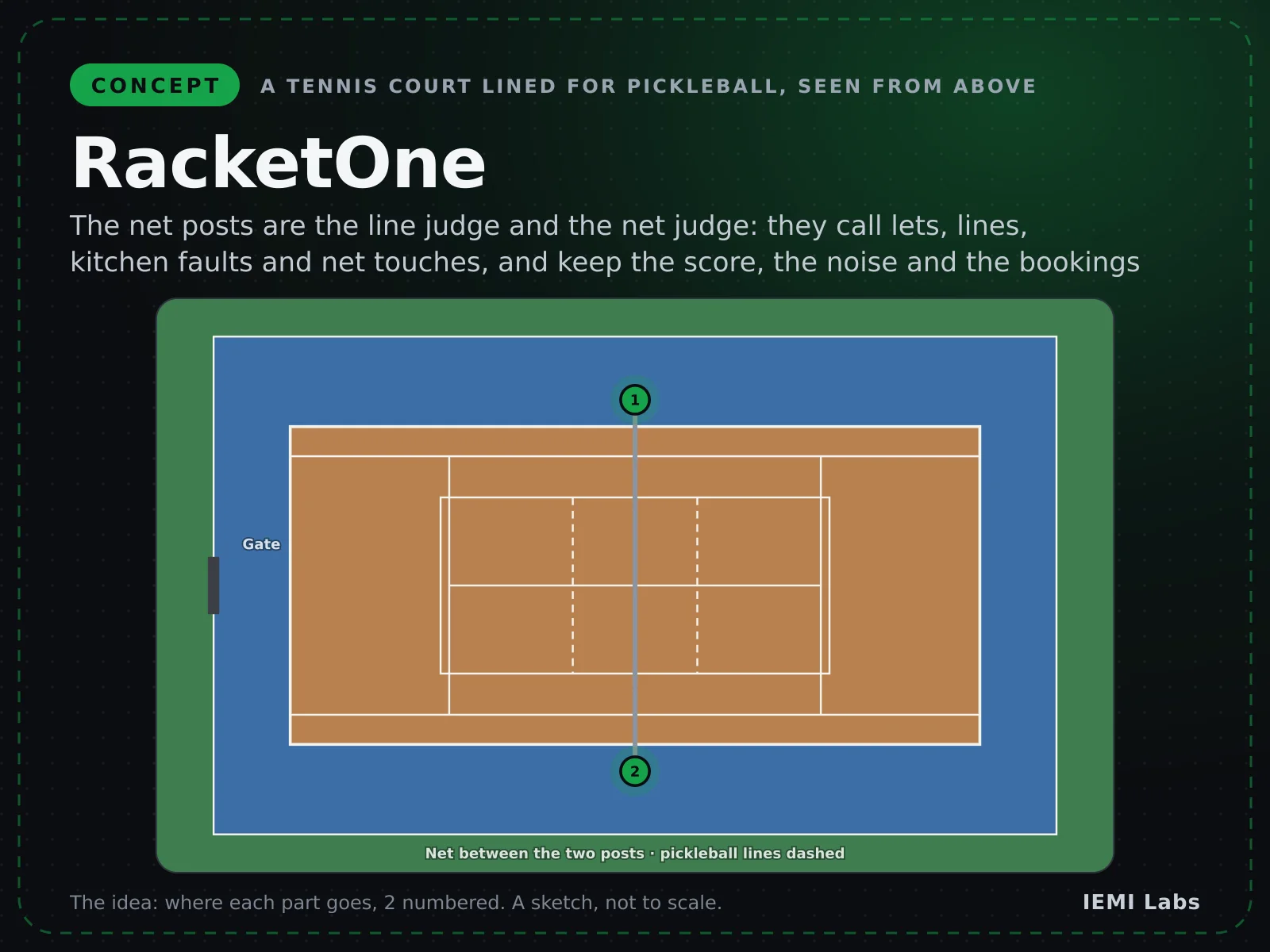
GateNet between the two posts · pickleball lines dashed12
  1. 1Home net post (the brain)Calls the north half: AI camera on the sideline, service line and T; low kitchen camera on the north kitchen and the net; feels lets and net touches through the cord; call light, tone and signer; holds the court brain and the LTE-M link.
  2. 2Away net postCalls the south half the same way: AI camera, kitchen camera, cord sensor, call light, tone and signer, score screen and team keys, linked to the home post by radio.
A tennis court lined for pickleball, seen from above, drawn to show where each part goes (not to scale).

How the parts connect

RacketOne, wired up

Every part, what links it to the brain, and how the data reaches your phone. A solid line is a cable; a dashed line is a radio link.

Line camera and processorBounces, verdicts and the clipthe board's own camera…own board: RV1126B on the same boardKitchen camera headFoot, serve and net eventscamera flex, frame-sync…own board: RV1126B on the same boardRadar, mic, cord motionPeople, noise, lets, net touchesSPI and PDM on boardScore, keys, lamp, toneScore, points, verdicts shownSPI, GPIO, data line, P…Security chip and tamperCall signatures, tamper eventsI²C and GPIOLTE-M, Wi-Fi, BluetoothSigned calls, score, useUART and SDIO on boardCells and battery systemPower for a 10-hour daythe cell tab's strip pa…THE BRAINOur net-post board: the a…runs racketone-courtC (ESP-IDF) on the ESP32-S3; C…RacketOne app and the club's bo…via LTE-M · MQTT over TLSHome net postvia BLE and UART inside the posts
Drawn from the RacketOne parts list. The 3D view above is built separately, from the CAD.

The program

What controls RacketOne

Runs on
Our net-post board: the ESP32-S3 runs the always-on jobs; it wakes the RV1126B on the same board for match play
Written in
C (ESP-IDF) on the ESP32-S3; C and Python on the RV1126B (V4L2 camera, RKNN runtime)
System
FreeRTOS on the ESP32-S3; Linux from the RV1126B SDK, started from our microSD card, signed and checked
AI model
The RV1126B finds the ball and its bounce in both global-shutter cameras and the feet on the kitchen line, on its AI engine; the ESP32-S3 reads the radar, mic and cord motion; the calls are fused on the RV1126B
  1. 1Keys add points; hold both 2 s to replay the last bounce
  2. 2In a match the RV1126B calls lines, kitchen and lets from both cameras
  3. 3Below the call's confidence show UNSURE and keep the clip; never guess
  4. 4Sign each call, show it on lamp, tone and score, send it
  5. 5Radar releases empty booked courts; mic logs noise every 15 minutes
racketone-court.pymain loop
for (;;) {
    while (keys_pop(&e)) score_key(&e);                 // SW2/SW3 under the sealed plungers
    if (match_on() && !rv1126b_awake()) rv1126b_wake();
    while (rv_uart_pop(&c) || ble_away_pop(&c)) {       // RV1126B + the away post
        if (c.conf < c.needed) c.call = UNSURE;         // never guess: keep the clip
        atecc_sign(&c); log_append(&c);                 // security chip, append-only
        lamp_show(&c); tone_play(&c); epd_draw(score_apply(&c));
        if (home_post()) lte_mqtt_publish("r1/dev/call", pack(&c));
    }
    if (radar_empty() && booking_started(10)) booking_release();  // 60 GHz radar chip
    if (every_min(15)) noise_publish(mic_levels());
    vTaskDelay(pdMS_TO_TICKS(10));
}

To your phone

How the data reaches RacketOne

Players' phones and the club or park manager's phone; a read-only page for neighbours

  1. Home net post
  2. RacketOne app and the club's booking platform
  3. Home net post

What you see in the app

One screen for each job RacketOne does.

  • No official match modeLeague night doubles on court 2 with no umpire: the captains pick "No official" on the post and play.

  • Line callsA deep ball near the north sideline, nobody to ask: the post calls it before the players turn round.

  • Kitchen and net callsA fast exchange at the net: the right south player volleys with a toe on the kitchen line.

  • Noise and quiet hoursQuiet-gear hours start at 19:00; loud paddles keep going on court 2.

  • Court in useCourt 3 is booked for 19:00 but the radar sees nobody by 19:10.

App screens with sample data. The interface is in development.

What the app gets

Data RacketOne sends to the app
CallsNorth half, sideline: OUT 14 mm (signed)Each call
ScoreCourt 2 pickleball 4-2-1Each rally
Kitchen and netKitchen fault, south team, right playerEach call
Noise and popsLAeq 58 dB, 51 pops, loud pops 34 %Every 15 min
Court in useCourt 3 empty 10 min after a 19:00 bookingOn change

Cameras keep only a short memory loop; 10 s clips around calls and challenges are kept for 7 days. The mic keeps levels and pop counts, never audio. The radar sees dots, not faces.

CAD design · Design rev O, 28 Oct 2026: smart net posts that make the calls (camera views, ITF Rule 1 and USA Pickleball 2.C checked in the CAD), everything inside the posts; not built

Designed in code, checked in 3D

  • 2 printed parts, each a single closed solid
  • Every bought part fitted inside and checked for collisions
  • Assembled exactly as shown in the 3D CAD view (the button on the picture at the top)

Key specs

RacketOne hardware
AI processorOne board of our own up each net post: Rockchip RV1126B (3 TOPS AI engine) reads both cameras, with an always-on ESP32-S3 for the score, keys and radios. The bench posts use a Walter and a Pi Zero 2 W until the boards arrive
SensorsTwo OmniVision OV9281 global-shutter camera chips per post: the line camera (82°) and the low kitchen camera (69°) · Infineon BGT60TR13C 60 GHz radar chip: court in use, no-shows, lights-off · Infineon IM69D130 mic and ST LSM6DSOX motion sensor: lets, net touches, the ball on the post · 2.13 in e-paper score, two sealed team keys, eight call LEDs and a sounder · Microchip ATECC608B security chip and tamper switch; LTE-M modem with a soldered eSIM in the home post
ConnectivityLTE-M (Sequans GM02SP on the Walter), MQTT over TLS · BLE between the two posts · Cloud links to the club's booking platform, gate lock platform and lighting controller
Power4 × Samsung INR18650-35E cells (about 50 Wh) in the foot of each post: 12.8 h worst case (cells aged and cold) for a 10-hour court day, 18 h new; one night on the charger puts back a full day (board design review, est.)
EnclosureThe posts themselves: 6063-T6 aluminium round tube 76.2 x 2.0, green powder coat, flush polycarbonate windows
DimensionsEach post Ø76.2 x 1,240 mm (1,090 above the court, 150 in the sleeve)
WeightAbout 2.1 kg per post with electronics (1.7 kg aluminium from the CAD + 0.45 kg est.)
Ingress ratingIP65 design target (not tested)
All target specifications

Calls

Calls target specifications
Decides alone (club play)Lets, net touches, ball on the post, sidelines, service lines and the T, kitchen faults, short serves, the score
Assists onlyFar baselines and foot faults; every call in sanctioned events
UnsureBlue light, two tones and UNSURE on the post; the clip is kept and the point replayed
AccuracyEst. until field-tested
Rules followedITF Rules of Tennis 2026 and USA Pickleball 2026 rulebook, incl. the ball-on-post rule and rally scoring

Jobs

Jobs target specifications
ScoreTennis games and sets; pickleball side-out score with server number, on both posts
Line replaysOn CHALLENGE, a 20 s clip from the post camera on that half, on both posts and both phones
NoiseLAeq, LAFmax, pops per hour every 15 minutes; indicative, not type-approved
CourtsNo-show release after 10 min, lights-off and check-ins through the club's systems

Legal on court

Legal on court target specifications
ITF Rule 1Posts ≤ 15 cm (ours Ø76.2), top ≤ 2.5 cm above the cord (ours 2.0 cm), centres 0.914 m outside
USA Pickleball 2.C.2Posts ≤ 3 in (ours 3 in)
InstallThe club's existing sleeves; about 15 minutes per court
ChargingAbout 13.8 h of match play per charge (est.): lighting-column supply or a USB-C pack

Targets for production units; they may change during development.

Pricing

Hardware: $1,590 per court: a pair of smart net posts

Software: $29 per court per month (LTE data, app, bookings link and records included)

Target pricing. Bought separately, ScorePost with camera pods ($649), a RallyPair ($129), a LetTap ($79) and 2 BaseClips ($300), plus a PickleQuiet fence unit ($899) with the radar ($149) and a QuietLight ($169), add up to $2,374 + $44/month per court. A plain pair of 3 in internal-wind posts is about $559. Parts cost about $664 per court pair at qty 1, about $1,096 with fabrication, a net winder, assembly and freight (est.).

Court

$1,590 + $29/mo

Every court job inside the two net posts.

  • Score and challenge replays
  • Noise and quiet hours
  • Bookings, no-shows and lights
  • Gate check-ins through the club's lock platform

Indicative launch pricing in USD, excluding taxes and shipping. Final pricing is confirmed before any balance is charged.

Community

What do you think of RacketOne?

RacketOne is in development. Rate the idea, tell us what to change about the features, specs or price, and we'll build it with your feedback.

How much people want it

–

No ratings yet

  1. 50
  2. 40
  3. 30
  4. 20
  5. 10

Follow RacketOne

Get build updates and first access when pre-orders open.

Leave feedback

Your rating of the idea

Feedback on a product concept in development, not a review of a shipped product. Posts may be moderated; links and contact details are held for review. See our community guidelines and privacy policy.

Comments

    No comments yet. Tell us what you'd want from RacketOne.

    Questions

    Ask about RacketOne

    Tell us what this would save you, or ask anything. We reply within two business days.

    We use your details only to respond to this request. See our privacy policy.

    From the product lab · ideation phase

    Lab updates for RacketOne

    All lab updates
    1. LatestA club or park buyer reading the RacketOne page should see the net posts as they will be sold: one board of our own up each post. Until now the 3D view, the parts list and the wiring still lit the bench parts (a Pi Zero with an AI camera, two XIAO boards, a radar module, an e-paper board and a Walter board), so the page showed a prototype, not the product.
      • What we designed: RacketOne rev T, the net posts with our board inside, done the way CricketOne and AthleticsOne put their boards in. The bench electronics come out of both posts; the folded board goes in: the cell tab over the four cells in the foot, the spine 22 mm in front of the post middle with every chip facing the court-face windows, the kitchen camera head low behind its window, the key tabs folded round to both faces of the net, the RV1126B brain on solid wall, the radio section with the radar chip and every antenna behind the radio window, and the line camera head behind its window on the half's face. The post itself gets the changes the board asked for: a 50 x 60 mm radio window, the tone holes and mic port on the court face, the service hatch on the court face and a screw-locked M8 charge socket. The Wiring and Program sections now name our board: the ESP32-S3 keeps the score, keys, radar and noise between rallies and wakes the RV1126B for match play. See /products/racketone/ and /build/racketone-boards
      • How we checked it: every board part was checked in 3D against the tube, with 0.3 mm clearance, and against the four cells. One real fix came out: the line camera head is turned 60 degrees and tilted 15 degrees, and a corner reached 0.07 mm into the wall, with the lens rim 0.11 mm into the window. The board's own check had only looked along the head's centre line. The head moved 0.8 mm back along its own axis (it still looks through the middle of its window), and the board code now checks every head corner and lens rim in 3D. After that nothing touches and the assembly check finds no problems. All seven boards were re-run: 0 placement problems, every design review 0 fail, KiCad design-rule checks 0, packs rebuilt
      • What we learned: a turned or tilted part has to be checked in the product, in 3D, not only on the flat board. That is now a shared rule for every board (fit3d): each board's design review shows whether it has been checked inside its product, and the ones not yet placed (CellOne, RoomOne, DampOne, ChillOne) show it as still to prove. No new CricketOne board decisions since the last update
      • What is next: the same step for CellOne, then RoomOne and DampOne: board in the product CAD and the Wiring and Program sections on our own board

      See it in 3DFull research and design

    2. A club, park or HOA buys the smart net posts as one pair per court, so each post must be one board an assembly house makes and tests the same way, with nothing plugged together inside a round 76 mm post that stands outdoors all year and takes ball and body hits.
      • What we designed: one rigid-flex board up each net post. In a round tube a flat board is widest through the middle, but every window is on the court face, so the board stands 22 mm forward, still 52 mm wide. From the bottom: a flat tab on the cells, the battery system with a screw-locked charge socket and the tamper switch, the kitchen camera chip on a head turned 16 degrees to its own half, the call lamp and tone with two small tabs folding round to the team keys, the e-paper panel soldered on by its own tail, the RV1126B brain cooled through a small aluminium block into the post, the radar chip, always-on ESP32-S3 and every radio behind one radio window, and the line camera chip on a head turned 60 degrees and tilted 15 down at its window under the net cord. It replaces the Pi Zero, the AI camera ribbon, two XIAO boards, the radar module, the e-paper board, the PowerBoost, the breakouts and, on the home post, the Walter. See /build/racketone-boards
      • How we checked it: the board is written as code and opened in KiCad (0 design-rule violations). It places 63 parts at their datasheet sizes and checks that each fits its section and stays inside the round post, nothing overlaps, the lamp, tone, mic, charge socket, tamper and e-paper tail sit on their places, both camera axes leave through the middle of their windows with lenses wide enough for the post design's camera checks, the radar and every antenna face the radio window, the processor sits on solid wall, the board stays clear of the net cord, and every flex is long enough. All checks pass. A 3D model shows the board folded in a see-through post or laid flat
      • What we learned: the round post decides the board. A board in the middle would leave the cameras and radar 36 mm behind their windows, looking out through a keyhole, so the spine moves toward the court face and the post design changes in six places: the tone and mic move to the court face, the radar slot grows into one radio window, the hatch and a screw-locked charge socket move to the court face, and the keys become sealed plungers
      • What is next: the key switches, charge socket and e-paper tail from the makers' drawings, whether the RV1126B takes both cameras at 120 frames a second, the radar and radios through the window on a test post, and the next product's board, DampOne

      See it in 3DFull research and design

    3. USA Pickleball's 2026 rulebook changed how a ball that bounces in and then hits the net post is called, how fast an out call must come, and rally scoring, and spectators must no longer be asked about calls (USA Pickleball 2026 Rulebook Change Document). The ITF's 2026 amendments clarified doubles foot faults and tie-break end errors (ITF).
      • Market and rules check (DESIGN.md): every ITF 2026 and USA Pickleball 2026 change listed with what it changes in RacketOne; the net post rules are unchanged, so the CAD and the legal checks stand
      • Ball on the post: in pickleball the posts now check whether the ball bounced in first; if it did, the hitter wins the rally (rule 10.C.5); if not clearly seen, the point is replayed (equipment.json)
      • Out calls are timed to show on the post before the opponent hits the ball (rule 8.F.3); the score follows 2026 rally scoring and the 7-point weather game, and corrections wait for the end of the rally (6.F)
      • Tennis: the doubles alley is accepted as a legal place to serve from in the foot-fault evidence, and the posts flash a change-ends reminder in tie-breaks (ITF Rules 18 and 27)
      • Competitors: PlayReplay net-post cameras on the PPA Tour and USTA Pro Circuit, Owl AI at Major League Pickleball; all run per event or venue with no public club price, and none is a club product that makes calls with nothing added to the court. Price kept at $1,590 + $29/mo for the pair
      • Product page https://iemilabs.com/products/racketone/ gains a 2026 rules FAQ and a rules line in its specs
      • Next: ask club pickleball players in phase 3 about No official mode under rule 8.J and rally scoring as the default; close-out C9 (recommend the first product to the owner) from 30 Oct 00:00

      See it in 3DFull research and design

    4. A tennis or pickleball club needs its league nights, ladders and park matches called fairly with no umpire: it already buys net posts (about $559 a pair, court supplier price), players pay $96-300 a year each for phone line-calling apps (App Store), and pro pickleball now uses cameras on the net posts (PlayReplay at PPA and MLP events, 2026).
      • Buyer check with sources: what clubs pay for posts, referees and line-calling apps today, and the three closest products (PlayReplay post-mounted cameras, SwingVision on a phone, PlaySight court cameras)
      • New competitor learned: PlayReplay puts four cameras on the net posts for pro pickleball and plans to reach clubs, reported at about $3,500-4,500 per court a year; it proves the need, and our posts stay the legal equipment themselves at a one-off price
      • Parts list prices checked on maker pages today: $648 of parts per court at qty 1; cost and margin table in the design notes (about 32 % at qty 1 and 54 % at qty 100, est.), price kept at $1,590 + $29 a month
      • Power corrected: the line calls need the camera on for the whole match, so a charge lasts about 13.8 hours of play, not 19; busy courts charge from the lighting column
      • Design data cleaned: the old rev A parts and gate story in the product data now match the rev O posts; a missing net winder was found and costed for the next CAD step
      • Product page: the summary leads with the calls, a new Calls spec group shows what it decides alone and what it only assists, and the first three FAQs answer the buyer's top questions

      See it in 3DFull research and design

    5. Most tennis and pickleball at clubs and parks has no umpire or line judges, so players argue about lets, lines near the net and kitchen faults. Club buyers pay for phone apps (SwingVision, PB Vision) or court camera systems (PlaySight) that need a phone or a fence camera; the ITF Rules (Rule 1) and the USA Pickleball rulebook (2.C) allow only the net, posts and cord on court.
      • Rev O: each post now has a kitchen camera (Seeed XIAO ESP32-S3 Sense) behind a flush window low on its court face, a call light (NeoPixel Stick 8), a call tone, a tamper switch and a secure element; the AI camera is turned to its half's lines
      • The CAD checks 14 camera views: sidelines, the service line and T, the whole kitchen line, the net and the let ball; the far baseline is evidence only
      • equipment.json: nothing added to the court, 8 calls (7 alone in club play, far baseline and foot faults assist; unsure below a stated confidence), 4 impact cases (90 J serve on the windows, player into the post, cord tension, weather) and every security key
      • App: new 'No official' match mode, line calls and kitchen and net screens; product page, idea plan, BOM and buy list updated; $1,590 per court vs $2,374 + $44/month for our products separately
      • CAD review: 28 Oct 2026, all sizes from datasheets, no floating parts, no collisions

      See it in 3DFull research and design

    6. A tennis or pickleball club, park or HOA already buys one thing for every court: a pair of net posts. ITF Rule 1 limits posts to 15 cm across with the top no more than 2.5 cm above the cord, and USA Pickleball 2.C.2 limits them to 3 in (https://www.itftennis.com/en/about-us/governance/rules-and-regulations/, https://playpickleball.com/2025-usa-pickleball-rules-section-2-court-and-equipment). The product must be those posts, legal for both sports.
      • Redesigned RacketOne (rev S) as a pair of smart net posts: Ø76.2 mm round posts drawn in code CAD, and the script checks ITF Rule 1 (under 15 cm, top 20 mm above the cord, centres 0.914 m outside the doubles court) and USA Pickleball 2.C.2 (3 in maximum)
      • Inside each post: an AI camera on its half of the court with a Pi Zero 2 W, a radar behind a flush slot, a mic and motion sensor board, an e-paper score and two team keys, and four cells in the sleeve; the court brain with LTE-M sits in the home post
      • Removed the score head above the cord, the solar cap, the base unit, the RallyPads, the fence LineCams, the GateKey and the lights relay; gate and lights now run through the club's own booking-linked lock and lighting controller; far-baseline calls and the spoken score are listed as gaps with the reason
      • CAD review: every bought part sized from its maker page or datasheet, both posts in their sleeves on a dual-lined court with the net, no collisions, no floating parts. Price $1,490 per court vs $2,374 + $44/month for our products separately. Next: DiamondOne as a smart pitching machine or L-screen; see https://iemilabs.com/products/racketone/

      See it in 3DFull research and design

    7. One tennis and pickleball product per court, as the smart net posts themselves.
      • Still part of RacketOne, now redesigned as smart net posts: https://iemilabs.com/products/racketone/

      See it in 3DFull research and design

    8. One tennis and pickleball product per court, as the smart net posts themselves.
      • Still part of RacketOne, now redesigned as smart net posts: https://iemilabs.com/products/racketone/

      See it in 3DFull research and design

    Smart equipment · legal on the field

    RacketOne is the tennis and pickleball net posts (pair): two round aluminium posts, made smart

    It replaces a club's or park's existing pair of tennis net posts on a court lined for tennis and pickleball (the same post fits a dedicated pickleball court's sleeves at 22 ft), with every part built in. Everything is inside the two posts: an AI camera, a Pi Zero 2 W, a radar, an e-paper score, two keys, a sensor board with a mic and four 18650 cells in each; the court brain with LTE-M in the home post. Rev O adds a kitchen camera, a call light, a call tone, a tamper switch and a secure element inside each post, still behind flush windows. Same Ø76.2 x 1,090 mm posts in the same sleeves. About 1.7 kg of aluminium per post (from the CAD) plus about 0.45 kg of electronics (est.).

    Meets ITF and USA Pickleball: ITF Rules of Tennis, Rule 1 The Court (net, posts and cord); USA Pickleball Official Rulebook 2.C Net Specifications

    RuleLimitRacketOne
    ITF Rule 1: centre of each net post 0.914 m (3 ft) outside the doubles court0.914 m outside✓ post centres 6,399 mm from the middle of a 10.97 m court, checked in the CAD; the club's sleeves stay where they are
    ITF Rule 1: net posts not more than 15 cm (6 in) square or in diameter≤ 150 mm✓ Ø76.2 mm round, checked in the CAD; every bought part is inside the tube (fitCheck)
    ITF Rule 1: top of the posts not more than 2.5 cm (1 in) above the top of the net cord; cord 1.07 m high at the poststop ≤ 1,095 mm, cord at 1,070 mm✓ post top 1,090 mm, cord eye at 1,070 mm, checked in the CAD
    USA Pickleball 2.C.2: maximum post diameter 3 in (7.62 cm); posts 22 ft ± 1 in apart, inside to inside (dedicated courts)≤ 76.2 mm; 22 ft apart✓ Ø76.2 mm, checked in the CAD; dedicated pickleball courts keep their own sleeves at 22 ft
    USA Pickleball 2.C.5: net 36 in at the sidelines and 34 in in the middle36 in / 34 in✓ the net and centre strap are the club's own and are set as before; the posts only hold the cord
    Nothing on the posts that a player can run into (both rulebooks treat the posts as permanent fixtures)no parts outside the post✓ camera, radar, screen and keys sit behind flush windows and holes; nothing is fixed outside the tube; no score head above the cord any more
    Nothing added to the court: the net, posts and cord are the only items in play (ITF Rule 1; USA Pickleball 2.C)no extra objects on court✓ every camera and sensor is inside the two posts' Ø76.2 profile behind flush windows; no line device, tripod or fence camera

    Club, park, school and league play and coaching. Line evidence is shown only on CHALLENGE to players who agree to use it; it is not an ITF-classified electronic line-calling system and never overrides a call. Sanctioned events keep their own officials.

    One piece of equipment does

    • ●Its own line and net judge (rev O): calls lets, net touches, sideline and service-line in or out, pickleball kitchen faults and short serves, and a ball hitting the post, shown on the post light and screen with a tone
    • ●Score: north and south team keys on each post, the score on both posts' e-paper and in the app (tennis games and sets; pickleball side-out score with server number)
    • ●Line replays on CHALLENGE from the post cameras (each post watches its own half), with net-cord lets felt by the post
    • ●Noise and paddle pops logged for a read-only neighbour page; quiet-gear hours checked by pop pitch
    • ●Court in use from the radar: no-show release after 10 minutes and court-use hours
    • ●Bookings, gate and lights through the club's own systems: check-in sent to the booking and gate platform, lights-off sent to the lighting controller

    Not done by the equipment, and why

    • Far-baseline calls and foot faults: the post cameras sit at the net and see the far end at a low angle (checked in the CAD); nothing may stand on the court or the fence to see it, so the posts only assist and the players call it
    • Gate hardware: the posts cannot reach the gate; RacketOne sends bookings and check-ins to the club's existing booking-linked lock (LTA gate access, Igloohome, Seam, RemoteLock) instead of fitting its own
    • Lights relay: courts without a networked lighting controller keep their timer; RacketOne cannot switch a contactor from the post
    • Spoken score call: the RallyPad speaker is gone; the score shows on both posts and the app can read it out
    • Noise at the neighbour's boundary: the mic is at the net, so levels at homes are estimated from distance
    • Pickleball two-bounce rule and double bounces far from the net: seen at a low angle; kept as evidence only
    • Tennis ball touching a player, and hindrance: the players call these, as in unofficiated play

    Makes the call itself

    With no umpire or line judges (club ladders, park play, school PE, league nights and coaching), the two posts call lets on serve, net touches, sidelines and service lines in or out, pickleball kitchen faults and short serves, and a ball hitting the post, and keep the score. The call shows on both posts: the light band green for in, red for out or fault, amber for a let, white for a point to the north or south team; a short tone from inside the post; the e-paper shows the call and the score. Unsure means blue light, two short tones and 'UNSURE' on the screen: the point is replayed (club custom, set per league), and both players can watch the clip in the app. Far baselines and foot faults stay the players' own calls, with the posts' evidence on CHALLENGE.

    CallWho decidesHow it sees itHow players see the call · if unsure
    Let on serve: the serve touches the net cord and lands in (tennis; pickleball plays it on, so the post only logs it)< 0.5 s · about 97 % (est.)The equipmentpost sensor IMU in both posts (the cord ties off inside them), kitchen camera (ball crossing the cord); cord-vibration classifier (ball, not wind or a hand) fused with the ball crossing time and the serve landingAmber light and one long tone on both posts; 'LET' on the screen. Vibration without a clear ball crossing, or under 90 %: unsure, replay the serve
    Ball in or out on the sidelines (both halves, every sideline the posts look down)< 1 s, shown before the opponent hits the ball (USA Pickleball 2026 rule 8.F.3) · about 96 % within 20 mm of the line (est.)The equipmentAI camera (its half from 1.5 m to the baseline), kitchen camera (the first 2 m from the net); ball detector and bounce frame on the IMX500 + line model of that court, fitted at set-upGreen (in) or red (out) light and a tone on that half's post; 'OUT 14 mm' on the screen. Bounce hidden by a player, or within 10 mm of the line under 90 %: unsure
    Serve in or out: service line and centre service line (tennis), short serve into the kitchen (pickleball)< 1 s · about 95 % (est.)The equipmentAI camera (service box, 10 to 29 degrees off its axis in the CAD), kitchen camera (kitchen line); bounce frame against the service box or the kitchen lineRed light and 'FAULT', or green; second serve shown on the screen. Under 90 %: unsure; the receiver calls it, as in unofficiated play
    Kitchen (non-volley zone) fault: volleying with a foot on or in the kitchen, or carried in by momentum< 1 s · about 93 % (est.)The equipmentkitchen camera (feet against the kitchen line, the whole 6.1 m width), AI camera and pop timing from the post mic (was it a volley); foot-on-line detector + ball-not-bounced check + momentum window until the player is setRed light, two tones, 'KITCHEN' on the screen. Foot hidden behind a partner, or under 90 %: unsure; the point is replayed
    Net touch: a player, paddle, racket or clothing touches the net or post while the ball is in play< 0.5 s · about 94 % (est.)The equipmentpost sensor IMU (cord and post vibration), kitchen camera, radar (player at the net); touch classifier on the vibration, told apart from ball hits, timed against the ball still being in playRed light and 'NET TOUCH' on the post on that player's side. Vibration with no player near the net, or under 90 %: logged, no call
    Ball hits the net post (pickleball 2026 rule 10.C.5: in the air it is a fault on the hitter; after it bounces in, a fault on the player who failed to return it; tennis: play goes on if it then lands in)< 0.5 s · about 98 % (est.)The equipmentpost sensor IMU (a sharp hit on the post body), AI camera; post-hit classifier + bounce-before-post check from the AI camera + where the ball then landsRed light on the side that lost the rally; green when tennis play goes on. Bounce before the post not clearly seen, or no clear landing: unsure, the point is replayed
    Far baseline in or out and foot faults< 2 s on CHALLENGE · about 85 % (est.)Helps the officialAI camera at a low angle to the far end; bounce frame, marked low confidence beyond the service line; in doubles the server may stand behind the baseline between the singles and doubles sidelines (ITF 2026 Rule 18 case 1)App clip and 'EVIDENCE' on the screen, no light. Always the players' call; the clip is evidence only
    Score: points, games, sets, side-out and server numberinstant · 100 % of what is entered; calls add points automatically in club modeThe equipmentteam keys on both posts, the calls above; tennis scoring (tie-break ends changed every 6 points, ITF Rule 27 fault-does-not-stand case) and pickleball side-out or 2026 rally scoring (a point every rally, the receiver can win on game point; 7-point weather games)Both e-paper screens and a white light to the team that won the point. Either team can undo the last point with both keys held; a score shown wrong is corrected before the next serve (USA Pickleball 2026 rule 6.F)

    Nothing added to the field

    The only things in play are the items the laws already put there:

    • ●Two net posts with the net, cord and centre strap: the only items the ITF Rules and the USA Pickleball rulebook put on the court

    No line sensors on the court, no fence cameras, no tripods and no umpire chair unit; players' phones stay in their bags and no call depends on them.

    Built to take the hits

    • Ball hits on the post and the flush windows (tennis ball 56.0 to 59.4 g (ITF Rules, Appendix I) served at up to about 200 km/h (56 m/s), about 90 J; pickleball about 26 g at about 25 m/s, under 10 J (est.), Our test: 500 ball-machine shots at 56 m/s on each window and the light strip): ✓ Every window is 2 mm polycarbonate bonded flush into the 2 mm aluminium wall; boards on silicone shock pads and potted; nothing stands proud of the Ø76.2 tube
    • Player running into the post (about 80 kg at 5 m/s, a short peak of several kN on the tube (est.), Same post and sleeve as a plain 3 in round post): ✓ The round profile and size are unchanged and there are no new edges; electronics sit on shock pads inside; the club's usual post padding can go on with cut-outs over the court-face windows (est.)
    • Net cord tension pulling on the post (cord tensioned by the winder to about 1 to 2 kN (est.), Plain 3 in aluminium posts carry the same load): ✓ The cord ties off on a steel eye inside the tube at 1,070 mm, where a plain post's pulley sits; the tube section is the same as a plain post; the post sensor feels the cord, it does not carry it
    • Weather and cleaning on an outdoor court (rain, UV, -10 to 50 °C and pressure washing (est.), IP65 goal for the post body (our test)): ✓ Windows bonded with sealant, the hatch on a gasket, a breather vent at the foot, cells in the sleeve end kept above standing water

    Secure by design

    Call record:
    Each call is signed, with its clip and sensor times, by the ATECC608 key in that post and kept in an append-only, hash-chained log the app can verify; the score keeps the signed call behind every point
    Radio:
    BLE LE Secure Connections between the two posts, and to players' phones only after pairing at the post; LTE-M with TLS from the home post to the cloud; the two posts authenticate each other and sync their clocks
    Boot:
    The nRF52840, ESP32-S3 and Walter boards run secure boot with flash encryption. The Pi Zero 2 W has no boot-ROM signature check, so its kernel and root are signed and checked with dm-verity, and the secure element only signs calls when the measured image matches
    Updates:
    Signed updates with rollback, refused while a match is open
    Tamper:
    The service hatch is sealed; the tamper switch under it marks the log if the post is opened; no open debug ports
    Privacy:
    Video stays in the posts; only 10 s clips around calls and challenges are kept, for 7 days, then deleted; junior use needs the club's consent screen (GDPR, COPPA); the mic keeps levels and pop counts, never audio; no face recognition
    Theft:
    Each post is locked to its court and the club account; if pulled from its sleeve and moved it stops working until the owner unlocks it in the app, and it reports where it was last seen over LTE-M

    RacketOne FAQ

    General FAQ
    Can it run a match with no umpire?

    Yes, in club, park, school and league play. Start no-official mode in the app: the posts call lets, net touches, sidelines and service lines, pickleball kitchen faults and short serves, and a ball hitting the post, show each call on the post with a light and a tone, and keep the score. Below its confidence a post shows UNSURE and the point is replayed. Far baselines and foot faults stay the players' calls, with a clip on CHALLENGE.

    What does it cost, and what does it replace?

    $1,590 per court for the pair of posts plus $29 a month for LTE data, the app, bookings and records (target). A plain pair of posts is about $559. It replaces CourtPost, ScorePost (with its RallyCall keys, LetTap and BaseClips) and PickleQuiet, $2,374 + $44 a month bought separately. SmartLine AI is not replaced: it paints grass fields, and its page stays listed.

    Can we use it in sanctioned events?

    Only to assist the officials. The posts are legal equipment (Ø76.2 mm, under the ITF's 15 cm and exactly the USA Pickleball 3 in limit, top 2 cm above the cord), but RacketOne is not an ITF-classified line-calling system and makes no calls on its own in sanctioned play.

    Can a call be changed or faked?

    Every call is signed by a secure element inside the post and kept in a log that cannot be edited without showing it. Updates are signed and never run during a match, and a tamper switch marks the log if a post is opened.

    What about the gate and the lights?

    RacketOne sends bookings and check-ins to the club's booking-linked gate lock, and lights-off to a networked lighting controller. It does not fit its own gate box or relay; courts without these keep their keys and timers.

    Is the noise record official?

    No. It is an indicative monitor, not a type-approved sound level meter. It gives a shared record of levels and pops, never audio, and never a certified compliance result.

    How is it powered?

    Four 18650 cells at the foot of each post: about 13.8 hours of full match play with every call on, or about 10 days of score, radar and noise jobs (est.). Busy courts charge from the lighting-column supply; others top up from a USB-C pack. A flat post still holds the net.

    Does it follow the 2026 tennis and pickleball rules?

    Yes. A pickleball ball that bounces in and then hits the post is now a point to the hitter (rule 10.C.5), out calls show before the next hit (8.F.3), and the score follows 2026 rally scoring when you pick it. For tennis, the doubles alley is a legal place to serve from and the posts remind you to change ends in a tie-break. The posts themselves meet the unchanged 2026 net post rules.

    Related products

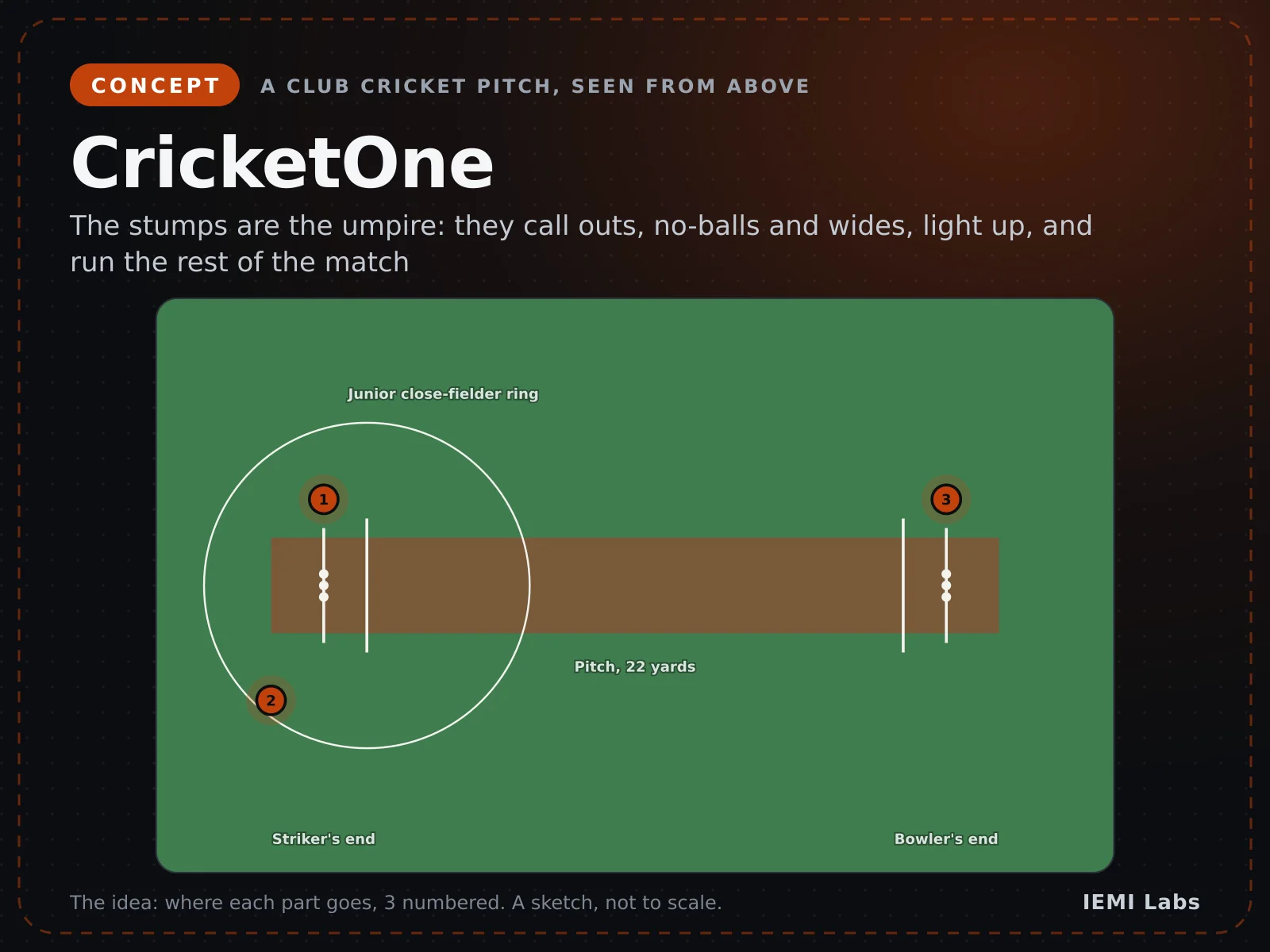
    CricketOne concept: the idea and where each part goes
    SportsConcept

    CricketOne

    IEMI's one cricket product: a smart wicket pair at Law 8 size, with every sensor inside the stumps.

    • Makes the calls: bowled, hit wicket, run-out, stumping, no-ball, wide, over
    • Tracks the ball from six global-shutter stump cameras
    • Times bail-off and checks the bat at the crease in stereo

    From $1,990 per CricketOne

    Details
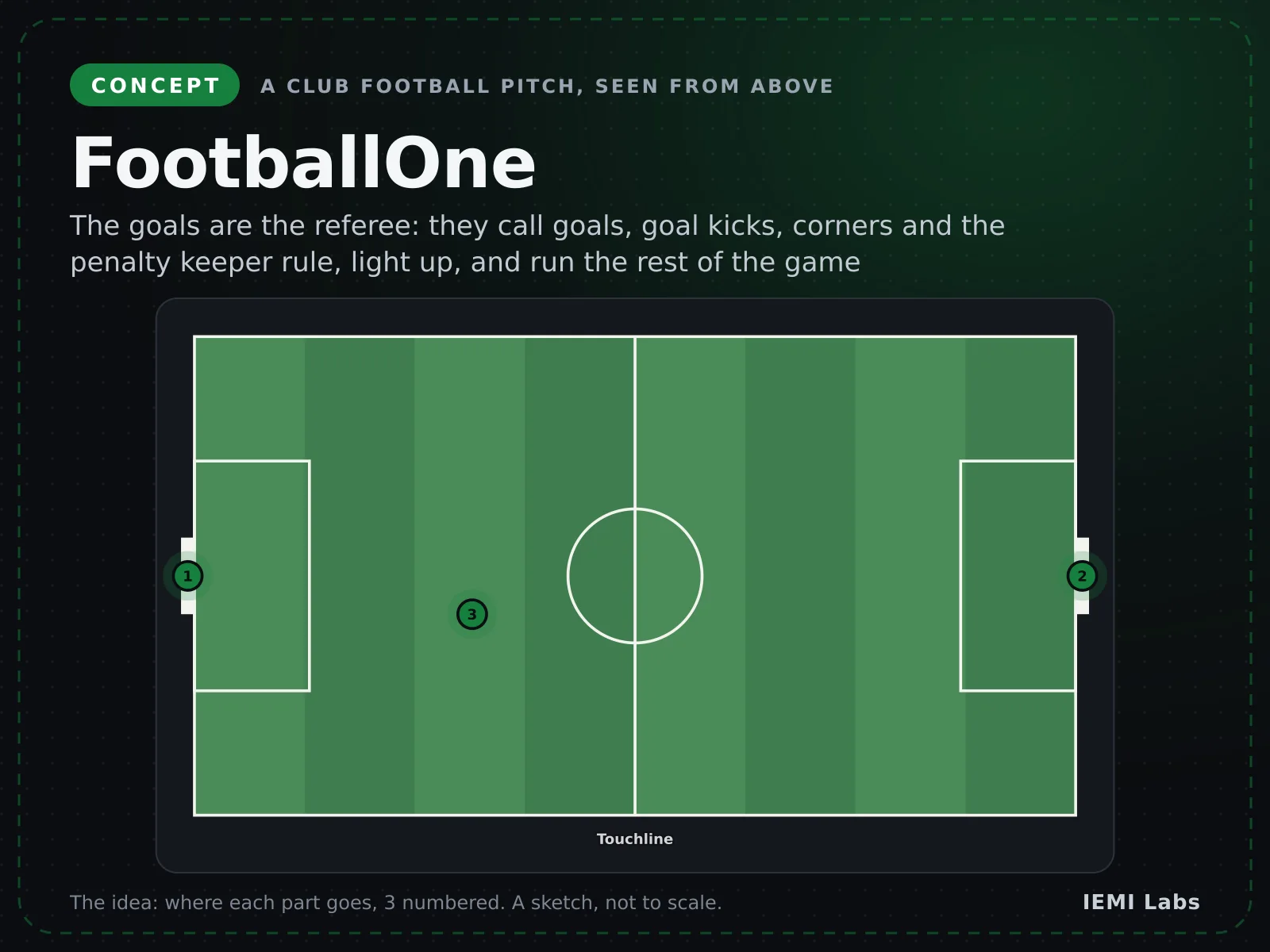
    FootballOne concept: the idea and where each part goes
    SportsConcept

    FootballOne

    IEMI's one football product: a pair of legal full-size goals with cameras, computers, batteries and radios inside the posts and crossbar, and a referee wrist unit.

    • Sees the ball cross the line and buzzes the referee
    • Logs shots, saves and headers at goal
    • Counts the keeper’s 8 seconds and keeps the match clock and sin bins

    From $4,690 per pair of smart goals with sockets and the referee wrist unit

    Details
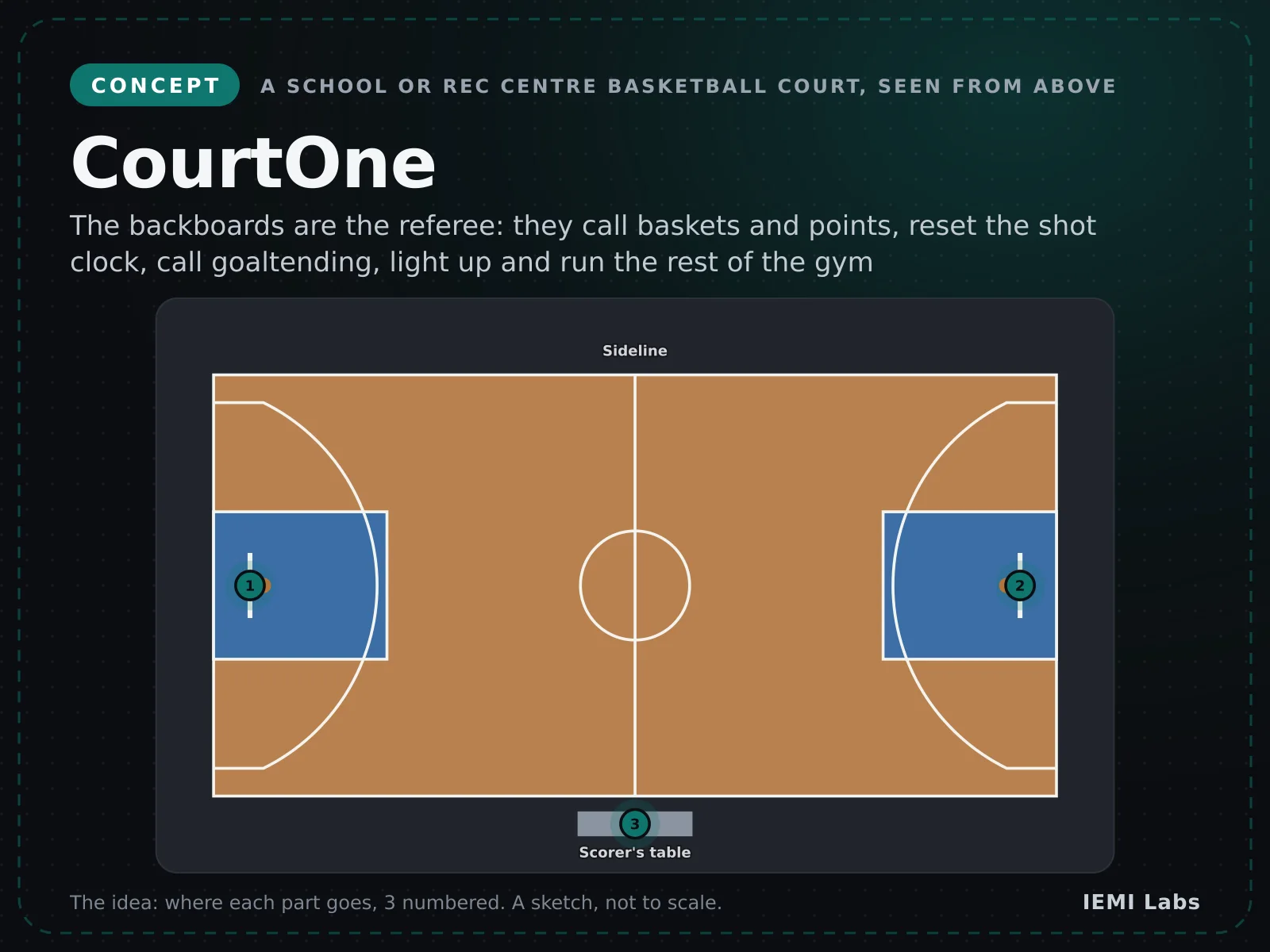
    CourtOne concept: the idea and where each part goes
    SportsConcept

    CourtOne

    IEMI's one basketball product: the backboard, ring, padding and shot clock at both ends of a court, with a camera, a computer, a rim sensor and edge lights built in, and one app.

    • Counts makes, maps shot spots and feels rim hits
    • Runs a double-sided 24/14 or 35-second shot clock from the scorer's tablet
    • Lights the board edges red at the end of a period and yellow at the shot clock signal

    From $4,990 per court: two smart backboards with rings, padding and shot clocks

    Details

    RacketOne

    Concept · target $1,590

    I want this