RacketOne
IEMI's one product for tennis and pickleball courts: smart net posts that are their own line and net judge, keep the score, log noise and quiet hours, and report bookings and lights, in one app
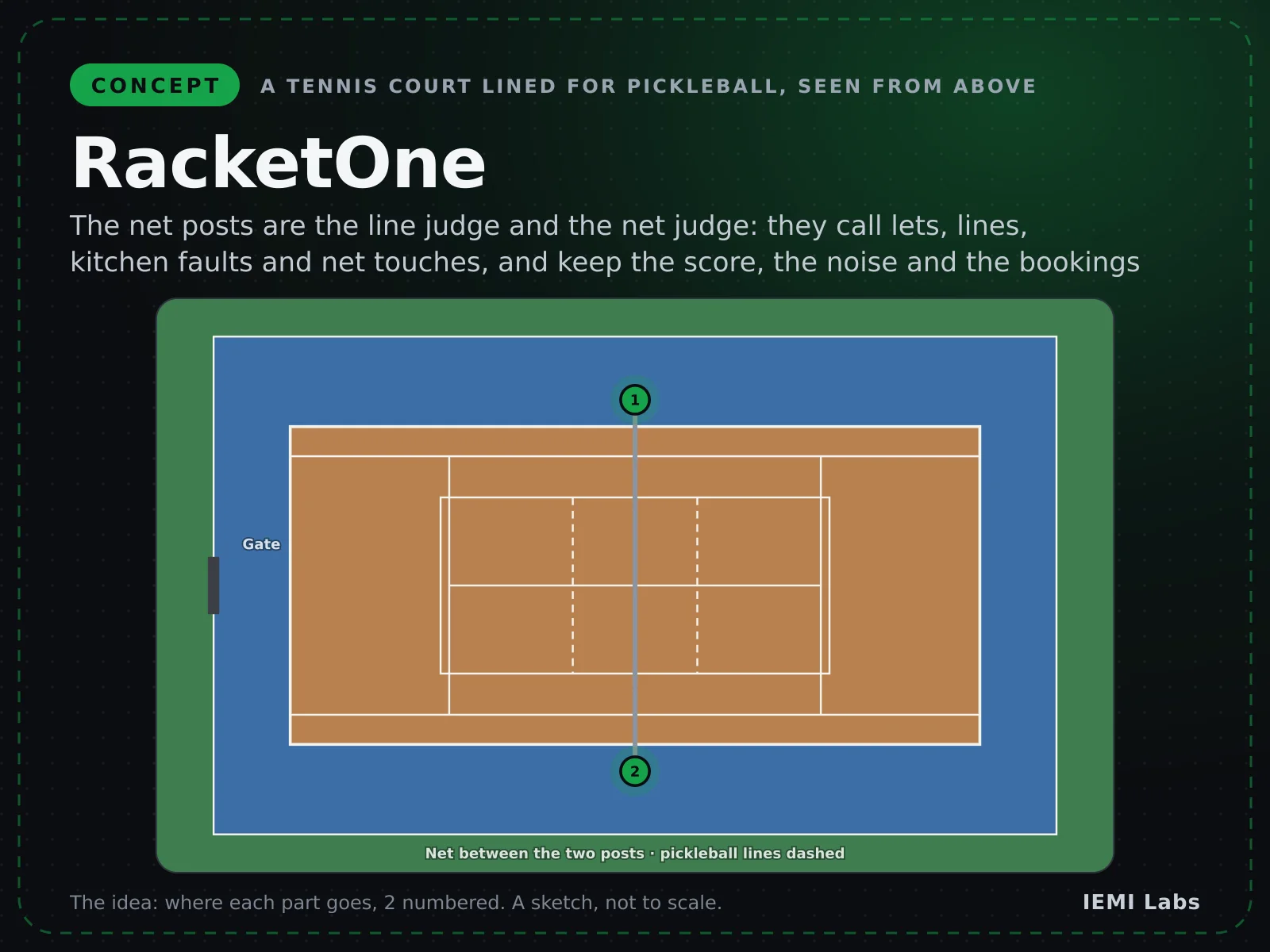
A pair of smart net posts, the same Ø76.2 mm posts in the same sleeves, call lets, net touches, sidelines and service lines, pickleball kitchen faults and short serves with no official on court, show each call on the post, keep the score, log noise and paddle pops, check quiet-gear hours, release no-show bookings and send lights-off to the club's own systems, all from inside the posts and in one app.
- Who buys it
- Tennis and pickleball clubs, parks departments and HOAs with bookable courts near homes, buying per court.
- Why it pays
- $1,590 + $29/month per court instead of $2,374 + $44/month for ScorePost (with RallyPair, LetTap and 2 BaseClips) and PickleQuiet (with radar and QuietLight) bought separately, before a gate system. Courts rent for $10–20 an hour, so each released no-show hour is worth that again.
- Target price
- $1,590 per court (pair of smart net posts) + $29/month (target)
- First-minute wow
- League night with no umpire: a toe on the kitchen line and the south post flashes red with "KITCHEN"; a deep ball near the sideline shows "OUT 14 mm"; a let serve turns both posts amber; at 19:10 court 3 goes back on the booking page.
What the research found
And how this design answers it
- Rev O (28 Oct 2026): the posts are their own line and net judge. A kitchen camera low in each post, a call light, a tone, a tamper switch and a secure element; the AI camera turned to its half's lines; calls lets, net touches, sideline and service-line in or out, kitchen faults, short serves and post hits alone in club play (far baseline and foot faults assist); every call signed; camera views checked in the CAD
- Rev S (27 Oct 2026): the product is now the pair of net posts. Ø76.2 mm round posts, legal for tennis (≤ 15 cm, top ≤ 2.5 cm above the cord) and pickleball (≤ 3 in), with every part inside
- The score head above the cord, the solar cap, the base unit, the RallyPads, the fence LineCams, the GateKey and the LightLink relay are gone; their jobs run in the posts or through the club's own booking, gate and lighting systems
- Each post: AI camera on its own half, Pi Zero 2 W replay computer, XIAO nRF52840 Sense (mic and motion), LD2450 radar, 2.13 in e-paper score, two team keys and four 18650 cells; the court brain (Walter, ESP32-S3 + LTE-M) in the home post
- No detachable part: players score at the post between points
- Flagship (27 Oct 2026): one product for tennis and pickleball folds CourtPost, ScorePost and PickleQuiet; the CourtPost court unit is the main unit
- ScorePost RallyCall pads become the RallyPad module and talk to the court brain over ESP-NOW, so the score on the screen and the spoken call agree
- ScorePost BaseClips become the LineCam module for baseline replays
- New GateKey module on the court gate: the QuietLight case, back and halo reused unchanged, with a XIAO ESP32-S3 that opens the existing 12 V lock for a booked phone in its slot (gate access was the one court job with no IEMI answer)
- SmartLine AI is not folded: it paints grass fields a few times a season and belongs with grounds products (F6)
Use case
League night at a club with four tennis and pickleball courts, no umpire
PlayersClub or park managerNeighbour
- 01Trigger: a pickleball league match starts on court 2 at 19:00 in no-official mode; quiet-gear hours start at 19:00
- 02Detection: the south post's kitchen camera sees a toe on the kitchen line on a volley; the north post's AI camera sees a ball land 14 mm outside the sideline; the cord sensor feels a let serve; court 4 is booked but its radar sees nobody by 19:10
- 03Alert: the south post flashes red with a tone and shows KITCHEN; the north post shows OUT 14 mm; both posts turn amber for the let; a close ball under the confidence line shows UNSURE in blue and the point is replayed
- 04Action: every call is signed into the court log with its clip; court 4 goes back on the booking page and lights-off goes to the club's lighting controller at 21:05
Outcome: A league match called fairly with no umpire, a signed record of each call, no wasted court hour and a noise record both sides can read (est.)
How it works
Architecture
- 01
Sense: in each post an AI camera on its half's lines, a low kitchen camera, the cord and post motion sensor and mic, a radar and two team keys
- 02
Decide: each post's Pi Zero 2 W and kitchen camera make the line, service and kitchen calls; the XIAO feels lets and net touches; the Walter brain in the home post keeps the score, signs and logs the calls, and runs bookings and quiet hours
- 03
Send: BLE LE Secure Connections between the posts; the Walter sends MQTT over TLS on LTE-M
- 04
Tell: each call on the post's light, tone and e-paper; one app for players (score, calls, clips), the club or park (bookings, lights, quiet hours) and neighbours (read-only noise)
Hardware
Real parts, buyable today
Bill of materials: about $664 of parts per court pair at qty 1 (bom.csv), about $1,096 with post fabrication, a net winder, assembly and freight (est.).
| Block | Part | Why this part |
|---|---|---|
| Brain | DPTechnics Walter (ESP32-S3 + Sequans LTE-M) in the home post | One court brain with its own LTE-M link, so no club Wi-Fi is needed at the court |
| Line calls | Raspberry Pi AI Camera (IMX500) + Raspberry Pi Zero 2 W in each post | Sidelines, service lines and the T on its own half; on for the whole match |
| Kitchen calls | Seeed XIAO ESP32-S3 Sense low in each post | Sees the whole 6.1 m kitchen line from 300 mm up for kitchen faults and short serves |
| Lets and net touches | Seeed XIAO nRF52840 Sense in each post | Its motion sensor feels the cord tied off inside the post; its mic logs noise and pop pitch |
| Occupancy | Hi-Link HLK-LD2450 radar in each post | No-show release and lights-off without a camera |
| Score and calls | Waveshare 2.13 in e-paper, two 16 mm keys, NeoPixel Stick 8 and a piezo in each post | Players score and see every call on the post itself |
| Security | ATECC608 secure element and Omron D2F-01 tamper switch in each post | Signs every call; marks the log if the post is opened |
| Power | 4 x Samsung 35E 18650 + PowerBoost 1000C in each post foot | About 13.8 h of full match play or 10 days of always-on jobs per charge (est.) |
Mechanical
Printable CAD
2 parts, generated from code and checked as closed solids. Pick a part to inspect it, or download the STL files to print.
Loading the CAD…
Real CAD · drag to rotate · scroll to zoomReal CAD · swipe sideways
Bought hardware fitted inside this part (checked in the CAD: nothing collides with the plastic)
Open risks we are working on
- Baseline calls are seen from the net at a low angle: verdicts there are marked lower confidence until tested on court
- The mic sits at the net, not at the neighbour's boundary: levels at homes are estimated from distance until checked against a meter at the property line
- Indicative noise monitor only, not a type-approved sound level meter; never a certified compliance result
- Players and leagues may not accept electronic line evidence; RacketOne shows evidence, never overrides a call
- Cells last about 13.8 h of full match play per charge (est.): busy courts need the lighting-column supply or a pack swap every day or two
- Cameras and a mic on public courts need clear signs and a privacy notice
- Gate and lights depend on the club's own booking-linked lock and lighting controller; courts without them keep their keys and timers
- PlayReplay already sells net-post cameras for pro pickleball and plans to reach clubs: our edge is posts that are the legal equipment themselves, at a one-off price
Design stage only: nothing on this page is for sale. Specifications and prices are targets.