SensingConcept
BagPost
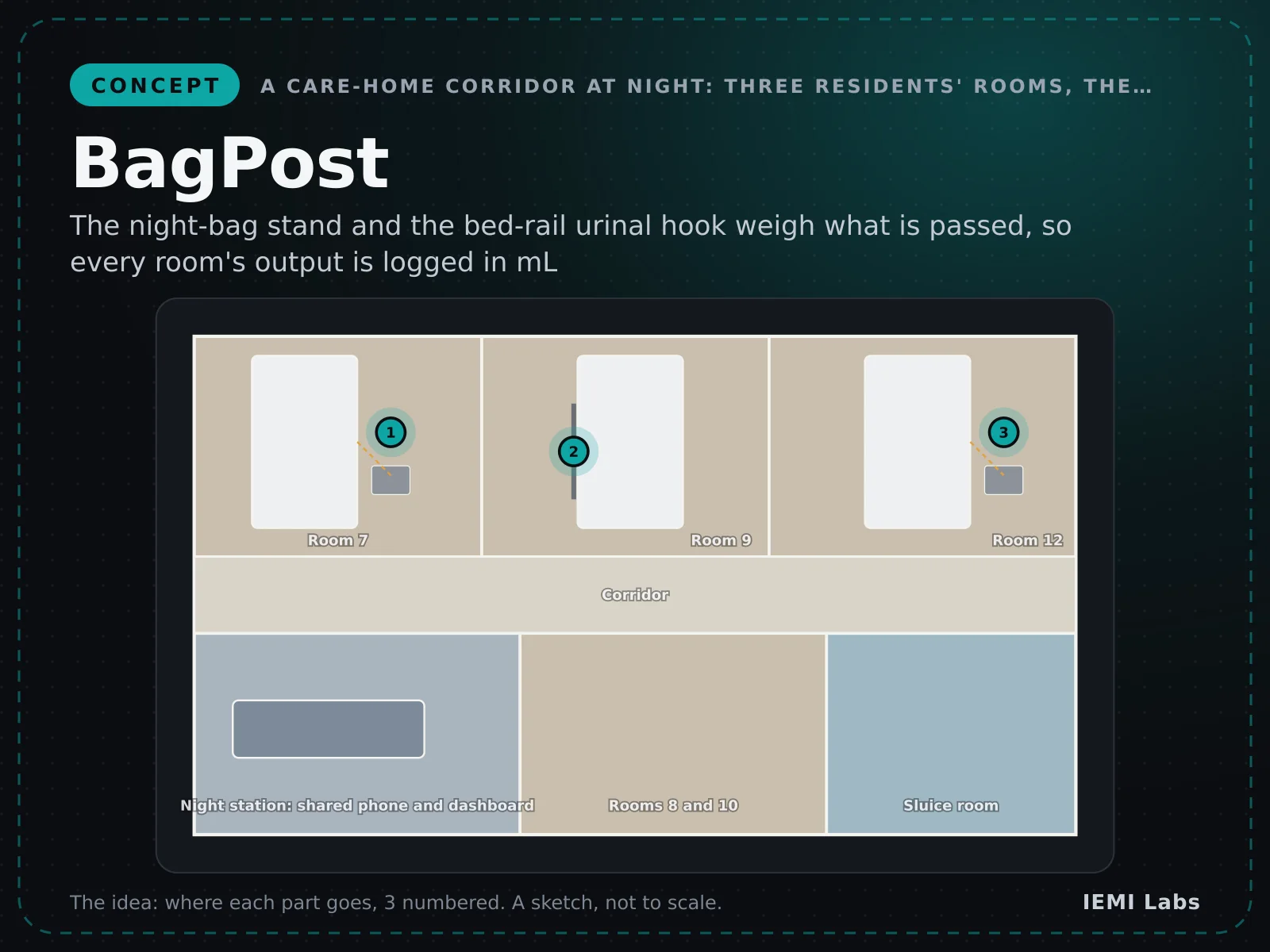
A night-bag stand and a bed-rail urinal hook, each with a load cell, that log urine output in mL.
- Logs each void from a urinal
- Logs every catheter bag emptying
- Alerts when drainage stops
From $79 per RailHook
DetailsIEMI's one product for care homes and hospital wards: the bed's own bedside locker, made smart, so it watches the bed bay at night and calls the right carer itself
Software: $15 per bed per month (carers' app, escalation, signed logs)
Concept, not for sale yet. Tell us if you want it; that decides what we build.
Rate this idea and tell us what to change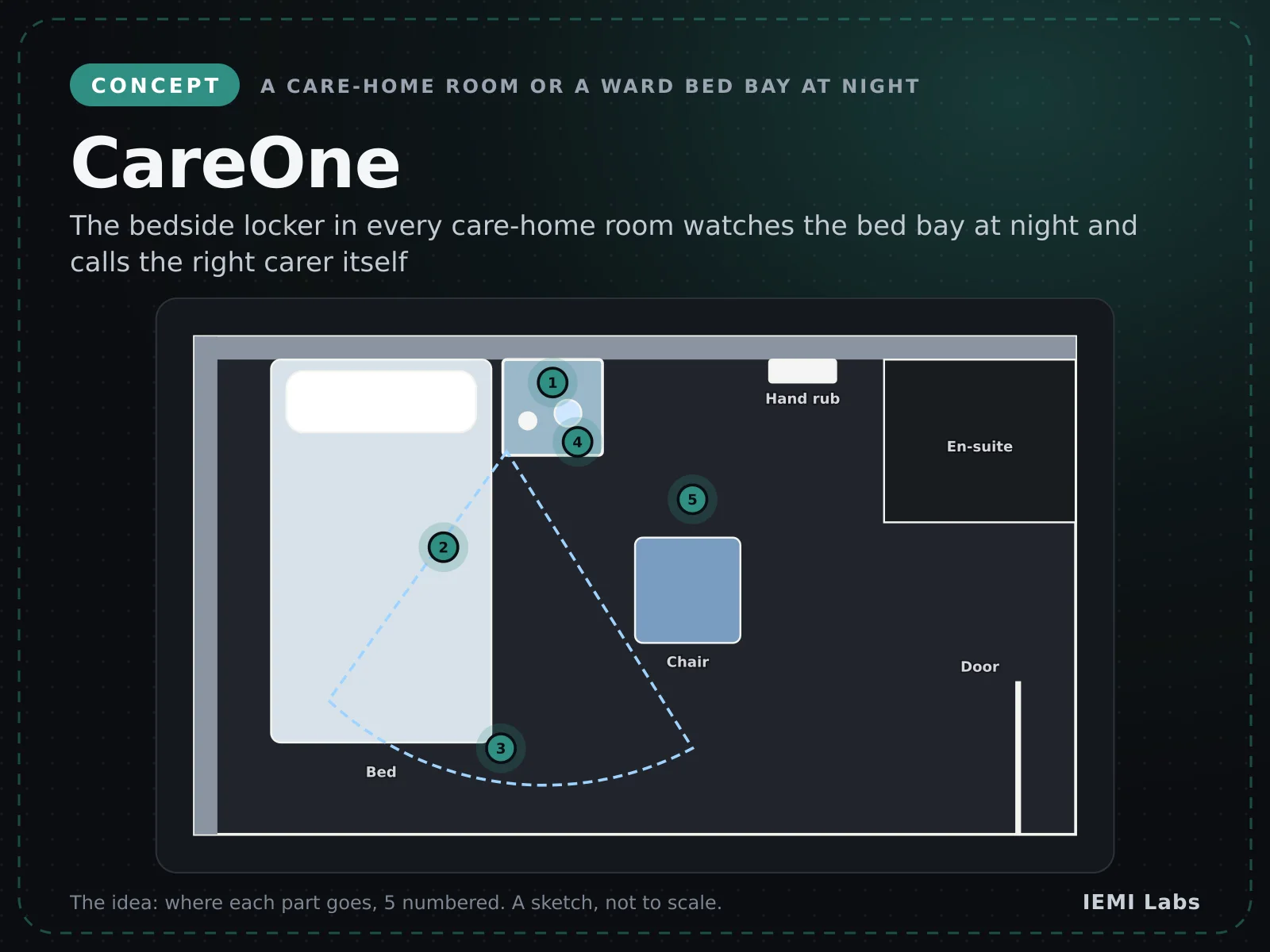
Drag to rotate · right-drag to move · scroll to zoom · click a part for its size and placeSwipe to rotate · pinch to zoom · two fingers to move · tap a part for its size
How it fits together
Scroll or tap a part. Press “See the 3D CAD design” to watch the model, built from our CAD, light each part up and show how it connects.
Real-time 3D render · drag to rotate · final design may varySwipe sideways to rotate
01
The whole CareOne
The bedside locker is the bed bay's own watcher: a tracking radar, two weigh plates, a call key and a mic inside its top feed one brain that makes the bed-bay calls, lights them on the locker and tells the right carer.
02Brain
Seeed XIAO ESP32-S3 (on the service tray in the locker top)
The brain: it runs the careone-fw program
03
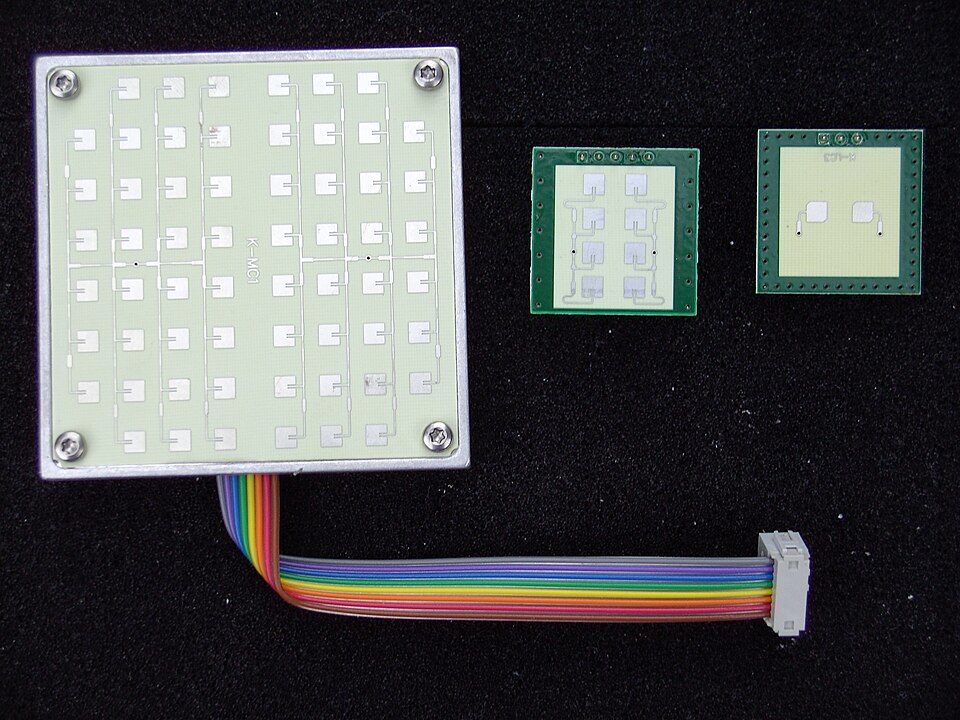
Tracking radar
Sees sitting up, legs over the edge, lying and turning in bed, someone on the floor beside the bed and a carer at the bedside
Seeed XIAO ESP32-S3 (on the service tray in the locker top) · UART · Up to 3 people: position and speed, 10 times a second
04
Jug and hand-rub weigh plates
Feel each drink leave the water jug and each pump leave the bedside hand-rub bottle
Seeed XIAO ESP32-S3 (on the service tray in the locker top) · I²C (STEMMA QT) · Weight, 10 readings a second
05
Call key and voice note mic
A press calls; a hold records a short voice note with the reason
Seeed XIAO ESP32-S3 (on the service tray in the locker top) · GPIO + analog in · Key press, 10 s voice note
06
Call light, floor glow and tone
Shows each call on the locker: amber bed exit, red on the floor, yellow call waiting, green accepted; the amber floor glow at night; a tone
Seeed XIAO ESP32-S3 (on the service tray in the locker top) · One data wire + PWM pin · Light colour and tone
07
Secure element and tamper switch
Signs each call; marks the log if the service tray is opened
Seeed XIAO ESP32-S3 (on the service tray in the locker top) · I²C + GPIO · Signatures, tamper flag
08
Backup charger and cells
Keeps the locker calling about 27 h in a power cut (est.) and tells the brain the mains has gone
Seeed XIAO ESP32-S3 (on the service tray in the locker top) · 5 V rail, low-battery and USB-power sense pins · Power, mains-lost flag
09
All connected
7 key parts, one program, and your phone
Our circuit board · rev A-0
Every chip on one board we design, shaped to fit: the processor, cameras and sensors, Wi-Fi and Bluetooth, lights, sound and power. No plugs, ribbons or adapters. It is checked in our CAD against every part around it, and it arrives from the maker ready to run our software from a microSD card. Turn the model, or pick a part below to see where it sits.
Loading the 3D board…
Drag to turn · scroll to zoom · right-drag to move · click a partDrag to turn · tap a part
Every board-level number CareOne's jobs depend on, checked against its target: camera pixels and frame rate, power and battery life, heat where it works, shock, radio and software. Every lesson from every one of our boards is a rule here, so this review runs again whenever any board teaches us something. Boards are ordered only when nothing fails and the items to prove are measured.
| Area | Check | Our board | Target | Status |
|---|---|---|---|---|
| Power | Supply | 5 V from a listed USB adapter at the wall socket, on one latched lead (no mains inside the locker, UL 962) | ≤ 70 % of the adapter (2.4 A) | passes |
| Power | Power cut | two 18650 cells: about 27 h in a power cut, cells aged to 80 % (0.55 W: the 60 GHz radar in low-power tracking, Wi-Fi only for calls, call light dim, est.; the bench LD2450 alone drew 0.6 W) | ≥ 24 h (bed exit and long-lie calls keep going through a cut) | to prove on the dev kit |
| Heat | ESP32-S3 temperature, a warm care-home room in summer (30 °C, est.) | 43 °C | ≤ 85 °C (rated) | passes |
| Heat | Cell temperature, a warm care-home room in summer (30 °C, est.) | 33 °C | ≤ 60 °C | passes |
| Heat | Weigh chips away from warm parts | charger 207.1 mm and radar rails 106.3 mm from the nearest weigh chip | ≥ 20 mm | passes |
| Shock | Shock and vibration | 20 g (est.) | standard parts | passes |
| Software | Starts our software from the microSD card, no setup | microSD socket with a hinged, latched lid (Amphenol 101-00660 class), fitted on every board: our software starts from the card (ESP32-S3 SD bus | card socket fitted on every board, latched | passes |
| Software | Card power switch and protection | 1 power switch and 1 ESD array for 1 card socket | every socket: switched card supply, ESD on all 6 lines | fixed by the review |
| Software | The card wins the start | a small loader in the ESP32-S3 flash starts the program on the card | the program on the card runs every time | fixed by the review |
| Software | Card grade | industrial pSLC microSD (Kingston Industrial or Swissbit S-56u), −40 to 85 °C | rated for the heat, cold and writes | to prove on the dev kit |
| Radio | Wi-Fi from the locker top | to the home's access point, through the 6 mm laminate side skin | certified ESP32-S3 module | to prove on the dev kit |
| Moisture | Conformal coating | coated | coated, sensors, sockets and antennas masked | passes |
| Fit | Board inside the product CAD, every part checked in 3D | not yet in the product CAD | nothing touches | to prove on the dev kit |
| Radar | Every bed-bay call in the radar's view | worst 38° across, 30° up or down, tab bent up 65° (chip 25° down) | inside ±70° across, ±40° up or down | to prove on the dev kit |
| Radar | Radar through the front skin | laminate skin 2 mm over the chip (the bench window was made for 24 GHz) | under 3 dB two-way loss at 60 GHz | to prove on the dev kit |
| Fit | Radar tab behind the front face | bent 65° up from a recess in the top board's front corner; the tab and chip 3.81 mm inside the front face at their closest | ≥ 0.3 mm, nothing touches | passes |
| Fit | Tamper switch against the service tray | D2F-01 6.5 mm tall in an 8 mm gap; a 1.5 mm boss on the tray presses it | pressed when the tray is screwed in, released when it is opened | to prove on the dev kit |
| Fit | Call key travel | sealed 6.2 mm tact switch 5.2 mm tall in a 6 mm gap behind the bed-side skin; a printed flush key cap in the Ø16.4 hole | a clear click with a 0.3 mm or more pre-travel, flush key, wipe-clean | to prove on the dev kit |
| Fit | The glow tail | 12 × about 684 mm from a tongue in the bed-side edge, through a slot in the tray and down 4 mm inside the bed-side panel past the drawer | routed and clipped in the rev T CAD, clear of the drawer, static bend at or above the maker's minimum | to prove on the dev kit |
Before we order the first boards, we prove these on the RV1126B development kit or in the rev A tests:
Demo · 6 real-world moments
Short animated scenes of real moments: what happens today, what CareOne does about it, and what lands on your phone. The same scenes play in the IEMI app.
02:40, room 14. A resident at risk of falls wakes, sits up and swings her legs over the edge of the bed.
Use cases
A pressure mat buzzes once she is already standing, or nothing happens at all, and the one carer on the unit finds out after she has walked.
The radar in the locker top tracks positions, never images. It sees her sit up and her legs go over the edge, before she stands, and calls it in under 2 s: the floor glow comes on amber so she can see, and the nearest carer is told. If a carer is already in the bay, it stays quiet.
A long lie: he may be on the floor until the next two-hourly check, cold and frightened, because nobody heard.
The radar sees a person low on the floor and still. In under 40 s the locker turns red with a repeating tone and an urgent alert goes out, escalating to every carer after 2 minutes. It says 'on the floor', never 'fall': what happened is for the nurse to judge.
A bell rings at the station with no reason. The carer walks the length of the corridor just to find out what is needed, then walks back for a commode.
He holds the key on top of the locker and says what he needs. The mic records only while the key is held; the locker turns the words into a reason and lights yellow until a carer accepts, then green, so he knows someone is coming.
Night checks every two hours; between them nobody knows if a resident has been in the bathroom for five minutes or fifty.
Every locker makes its own bed-bay calls and sends only the ones that need a person. When the radar loses her in the en-suite and she is not back by the care plan's limit (15 minutes at night), it says so as 'unsure, please check', never as an alarm.
Carers fill turn and fluid charts from memory at the end of a busy shift, so low intake is noticed the next day.
The radar sees her position change from her left side to her back and fills the turn chart. The jug sits on a weighing plate in the locker top, so each drink is logged as it happens. A change it cannot explain, like a spill, is marked unsure.
Hand-hygiene audits are a few observed visits a month, and night checks are ticked on paper after the round.
The hand-rub bottle stands on a plate in the locker top that counts each pump; the radar sees the visit start. Each check is logged with its time. A rub at the door dispenser cannot be seen, so it counts as unknown, never as missed, and no carer is ever named.
Demo scenes show how CareOne and its app are designed to behave. CareOne is in design; nothing here is recorded from real equipment yet.
What it is
IEMI's one product for care homes and hospital wards: the bedside locker, made smart, with one brain and one app.
What it does
Who it's for
Care-home groups and hospital wards.
The idea
The problem today
One night carer may cover 20 or more rooms. Homes buy bed-exit mats that false-alarm, a radar puck on the wall, call bells that only say "someone", turn charts and fluid charts filled in from memory, and hand-hygiene audits done by watching. Each has its own box and app, and most of the moments that matter happen within a metre of the bed.
With CareOne
Every bed already has a locker. CareOne puts a radar, two weigh plates, a call key with a voice note and the brain inside its top, so it sees a resident sit up to leave, someone on the floor, turns, drinks, bedside rubs and night checks, lights the floor and calls the right carer with the reason.
How the parts connect
Every part, what links it to the brain, and how the data reaches your phone. A solid line is a cable; a dashed line is a radio link.
The program
for (;;) {
    track_t t = ld2450_read();                      // UART, 10 Hz
    plates_t w = nau7802_read_both();               // I2C
    calls_t c = {0};
    bed_step(&t, &plan, clock_now(), &c);           // exit, not back, turns
    floor_step(&t, &c);                             // low and still 30 s
    plate_step(&w, &t, &c);                         // drinks, rubs, checks
    if (key_pressed()) key_step(mic_note(10), &c);  // reason + voice note
    for (call_t *k = c.list; k; k = k->next) {
        if (k->conf < k->line) k->kind = UNSURE;     // never guess
        atecc_sign(k); light_and_tone(k); publish(k); // MQTT over TLS
    }
    vTaskDelay(pdMS_TO_TICKS(100));
}
To your phone
Carers' phones and the nurses' station tablet (Android and iPhone)
One screen for each job CareOne does.
Night shift, no nurse at the bedsideOne carer covers 22 rooms at night. Every locker makes its own bed-bay calls, lights them on the locker and sends the carer only the calls that need a person.
Bed exit and on the floorAt 02:40 Mrs H in room 14 sits up and swings her legs over. The floor glows amber before she stands and the nearest carer's phone buzzes with the room.
Calls with a reasonMr P holds the key on his locker and says "I need the toilet". The carer's phone shows TOILET and plays the 4 s note.
Turns and fluidsThe turn chart and the fluid chart fill themselves: the radar sees Mrs D move from her left to her back, and the jug plate logs each drink.
Hand rub and night checksThe infection control lead sees how often a bedside visit starts with a pump from the bedside bottle, by unit and shift, never by name.
App screens with sample data. The interface is in development.
| Bed exits | Room 14 sitting up 02:40, carer there 02:41 | Each call |
|---|---|---|
| On the floor | Room 9 on the floor beside the bed 03:12, accepted 03:13 | Each call |
| Turns | Room 6: last turn 01:50 (left), due 03:50 | Each turn |
| Calls | Room 11 TOILET, voice note 4 s, accepted in 1 min 40 s | Each call |
| Fluids | Room 3: 820 ml by 14:00, plan 1,500 ml | Each drink |
| Hand rub and checks | Unit: 71 % of bedside visits with a rub; 2-hourly checks all done | Each shift |
No camera and no room video; radar tracks are positions only; the mic records only while the call key is held. Carers are never named in hand-rub totals.
CAD design · Stage 2 ready, 29 Oct 2026: smart bedside locker that makes the bed bay's calls itself (9 calls, 5 alone, 4 assist; falls plan link added 30 Oct), no camera, 7 radar views checked in the CAD, $225 of parts at qty 1, margin about 44-58 % (est.); not built
| AI processor | One board of our own inside the locker top: Espressif ESP32-S3 module on the top board. The bench locker uses a Seeed XIAO ESP32-S3 until the boards arrive |
|---|---|
| Sensors | TI IWRL6432AOP 60 GHz radar chip on a tab bent to look 25° down at the bed: sitting up, legs over the edge, lying and turning, someone on the floor beside the bed · Two Nuvoton NAU7802 weigh chips beside the load cells under the water-jug and hand-rub plates · Sealed call-key switch and an Infineon IM69D130 mic for the voice note, on a strip behind the bed-side face · 16 LEDs for the call light and floor glow, a sounder, a security chip and a tamper switch · No camera |
| Connectivity | Staff Wi-Fi (WPA3-Enterprise), MQTT over TLS · BLE for set-up only |
| Power | Listed 5 V USB adapter at the wall, one latched lead to our board (no mains in the locker): about 1.1 W watching (est.). Two 18650 cells on the board with their own charger keep the calls going for about 27 h in a power cut, counted with cells aged to 80 % (est.) |
| Enclosure | The locker itself: laminate-faced plywood carcass with a 70 mm sealed top closed by a printed service tray |
| Dimensions | 480 x 460 mm, top at 860 mm, on castors; drawer and cupboard kept |
| Weight | About 0.8 kg more than a plain locker (est.) |
| Ingress rating | Indoor; splash and daily wipe-down tests in the first build |
| Bed | Bed exit, not back, turns |
|---|---|
| Floor | Someone on the floor beside the bed |
| Calls | Key with a reason and voice note |
| Fluids | Drinks from the jug |
| Infection control | Bedside hand rubs, night checks |
| Size | 480 x 460 mm, top 860 mm |
|---|---|
| Storage | Drawer and cupboard, as before |
| Camera | None |
| Backup | About 27 h (est.) |
| Footprint | 480 x 460 mm, top 860 mm, locking castors |
|---|---|
| Power | Listed 5 V adapter, about 1.1 W (est.) |
| Power cut | About 27 h of calls on 2 x 18650 (est.) |
| Radar | 24 GHz, front corner, 40 degrees to the bed, 25 degrees down |
| Falls plan | Bed-exit, not-back and floor calls switch on per bed from the recorded falls plan and its review date (NICE NG249) |
Targets for production units; they may change during development.
Hardware: $590 per smart bedside locker
Software: $15 per bed per month (carers' app, escalation, signed logs)
Target pricing. Bought separately, CareWatch AI ($349 + $19/mo), TurnCup ($199 + $4/mo) and CallNote ($99 + $4/mo) add up to $647 + $27/month per bed, plus about $480 for a plain wipe-clean bedside locker with castors (£360 at a UK care supplier, est. in dollars), so $1,127 + $27/month. Parts cost about $225 per locker at qty 1 including the locker body (est.).
$590 + $15/month per bed
Every bed-bay job in the locker at the head of the bed.
Indicative launch pricing in USD, excluding taxes and shipping. Final pricing is confirmed before any balance is charged.
Community
CareOne is in development. Rate the idea, tell us what to change about the features, specs or price, and we'll build it with your feedback.
How much people want it
–
No ratings yet
Follow CareOne
Get build updates and first access when pre-orders open.
No comments yet. Tell us what you'd want from CareOne.
Questions
Tell us what this would save you, or ask anything. We reply within two business days.
A member of the IEMI Labs team will reply within two business days.
From the product lab · ideation phase
Smart equipment · legal on the field
It replaces the bed bay's existing bedside locker in a care-home room or a hospital ward, at the head of the bed, with every part built in. Everything inside the locker top: brain, radar, mic, both load cells and ADCs, call key, call light, tone, secure element, tamper switch and backup cells; floor glow low in the bed-side panel. About +0.8 kg over a plain locker (est.); no footboard hub, caster cups, bag hook, wall puck or call handset.
| Rule | Limit | CareOne |
|---|---|---|
| Bed-patient monitor (21 CFR 880.2400, Class I, 510(k) exempt) | signals when a patient attempts to leave the bed; general controls | ✓ the bed-exit call is that job, from a radar in the locker instead of a pad under the mattress; registration and general controls before sale |
| Surveillance in a care service (CQC guidance) | cameras in private rooms only with consent, for a stated purpose, least intrusive option first | ✓ no camera at all; a radar gives positions, not images; the mic records only while the resident holds the call key |
| Wipe-clean surfaces (HBN 00-09) | smooth, impervious, cleanable surfaces with no dirt traps near the patient | ✓ sealed top with flush plates and a flush key, no vents or grilles, laminate faces, plates lift out for washing (CAD asserts the plates are flush) |
| Same size and place as the plain locker | fits at the bed head, top near overbed-table height, storage kept | ✓ 480 x 460 footprint and an 860 mm top on castors, drawer and cupboard kept (CAD asserts footprint, floor contact and top height) |
| Mains wiring in furniture (UL 962) | no mains wiring inside unless the furniture is listed for it | ✓ only 5 V inside, from a listed 5 V adapter at the wall socket; backup cells behind a protected charger |
| Not a nurse-call system (UL 1069) | the bed's own listed nurse-call cord and wall unit stay the life-safety call | ✓ the locker's call key and voice note go to carers' phones as an extra; the bed's nurse-call cord is never removed or wired into |
| Reach from the bed (ADA 308.3 side reach as a guide) | operable parts 15 to 48 in (380 to 1,220 mm) above the floor | ✓ call key at 830 mm on the bed-side edge, beside the pillow |
| Falls sensors only inside an individualised plan (NICE NG249, 2025; NHS England response to a coroner's Regulation 28 report, 7 August 2026) | the decision to use a sensor alarm follows a holistic multidisciplinary risk assessment, is documented in the care plan and told to staff, the person and the family; NICE notes limited evidence that movement sensors prevent falls | ✓ bed exit, not back and someone on the floor are off on a new bed until a carer records in the app that the falls plan asks for them, with the plan's review date; that setting is signed in the log, shown on the night timeline, and reminded at the review date; CareOne alerts, it never claims to prevent a fall |
| US nursing homes: CMS repeal of the 2024 minimum staffing standards (interim final rule 3 December 2025, in effect 2 February 2026; enforcement also barred to 2034 by statute); the facility assessment (42 CFR 483.71) stays | no national hours-per-resident-day minimum or 24/7 RN; the home still assesses its residents' needs and the staff and technology that meet them | ✓ no staffing claim; CareOne exports a signed night workload summary per unit (calls, time to the bedside, unsure calls, night checks) that the home can use in its facility assessment; it never replaces a carer |
| Radio (FCC Part 15 / RED) | licence-free bands, certified modules | ✓ Wi-Fi on the certified XIAO ESP32-S3 module; 24 GHz LD2450 radar |
Care-home and ward use. The bed-exit call is a Class I exempt bed-patient monitor (21 CFR 880.2400); every other call is monitor and alert only. It never replaces the bed's nurse-call system. Registration, radio certification and furniture stability tests to be done before sale.
One piece of equipment does
Not done by the equipment, and why
Makes the call itself
At night one carer may cover 20 or more rooms with nobody at the bedside. The locker makes the bed bay's calls itself: it lights the floor and tells the nearest carer when a resident sits up to leave, calls someone on the floor, logs drinks, rubs and checks, and routes the call key to the right carer with its reason. A change in a resident's night pattern goes to the nurse for the falls plan review. Calls it is unsure of go to the carers' app as unsure with the radar track, never as an alarm, and the nurse decides.
| Call | Who decides | How it sees it | How players see the call · if unsure |
|---|---|---|---|
| Bed exit< 2 s from legs over the edge · about 92 % (est.) | The equipment | tracking radar; bed-edge tracker on the radar points: sitting up, then hips at the edge, then legs over (CareWatch and TurnCup NightWatch method) | Amber floor glow on, call light amber, carer phone alert with the room. Two people in the bay (a carer already there) or under 85 % confidence: no alert, logged |
| Out of bed and not backat the limit (default 15 min at night) · about 95 % (est.) | The equipment | tracking radar, clock; time out of the bed zone against the care plan's limit | Call light amber, carer alert. Track lost in the en-suite: unsure, carer asked to check |
| Someone on the floor beside the bed< 40 s · about 88 % (est.) | The equipment | tracking radar; a person low and still in the floor zone beside or below the bed for 30 s | Call light red, repeating tone, urgent carer alert. Under 80 %: unsure alert to the carer with the track; never called a fall |
| Turn dueat the care plan's interval (2 to 4 h) · about 80 % of turns seen (est.) | Helps the official | tracking radar; body position change in bed (left, back, right) from the radar point cloud | App reminder to the named carer; nothing at the bedside at night. Not sure whether a turn happened: the carer confirms in the app |
| Call with a reason< 2 s · press certain; reason words about 90 % (est.) | The equipment | call key, mic; press = help; hold = a voice note (up to 10 s) with reason words (toilet, pain, drink) found on the brain | Call light yellow until a carer accepts, then green; carer phone alert with the reason. Reason not clear: sent as "help" with the voice note |
| Drinks from the jugeach drink · about ± 30 ml a drink (est.) | Helps the official | jug plate; weight steps with the jug lifted and put back; refills and spills told apart by size and speed | Fluid chart in the app; low-intake reminder to the carer at 14:00 and 18:00. A jump the model cannot explain (spill, cup moved): marked unsure on the chart |
| Hand rub before careeach visit · about 90 % of bedside rubs seen (est.) | Helps the official | hand-rub plate, tracking radar; a pump (about 1.5 g) within 60 s before a carer reaches the bed | Unit totals for the infection control team; never names a carer. Rub at the door dispenser cannot be seen: counted as unknown, never as missed |
| Night check doneeach check · about 95 % (est.) | The equipment | tracking radar, clock; a second person at the bedside for 10 s or more | Night check log in the app; due checks remind the carer. Visit too short to be sure: unsure in the log |
| Night pattern change for the falls plan revieweach morning at handover; flagged when the night count is up by 3 or more for 2 nights running (est., settable) · exact counts of the signed calls; the change flag is only a prompt, about 80 % of flagged changes useful to the nurse (est.) | Helps the official | the signed bed-exit, not-back, floor and call-key log from the radar and key already in the top; none for the judgement (the nurse decides); a count of bed exits, times out of bed and calls per night against the resident's own last 14 nights | App only: 'night pattern changed, review the falls plan' on the handover summary, with the counts and the plan's review date. Fewer than 7 nights recorded, or many unsure calls: no flag, only the counts; the nurse and the falls lead decide any change to the plan |
Nothing added to the field
The only things in play are the items the laws already put there:
The bed, its nurse-call cord, the water jug, the hand-rub bottle, the chair and the wall dispenser stay as they are; no footboard hub, caster cups, bag hook, wall puck or call handset
Built to take the hits
Secure by design
A pad only knows the bed is empty, after the resident has stood up, and false-alarms when they roll; a wall radar is one more box with its own app and only watches. CareOne calls the bed exit while the resident sits up, someone on the floor, calls with a reason, turns, drinks and night checks from the locker that is already at the bed head, in one carers' app.
$590 per locker + $15 a month per bed (target), about the price of a plain hospital-grade locker (£360-450) plus one bed-exit alarm. CareWatch AI ($349 + $19/mo), TurnCup ($199 + $4/mo) and CallNote ($99 + $4/mo) add up to $647 + $27/month per bed, plus about $480 for a plain locker (est.), so $1,127 + $27/month.
No. A radar gives positions, not images, and the mic records only while the resident holds the call key. CQC guidance asks for the least intrusive option in private rooms.
BedSide, CareWatch AI, TurnCup and CallNote. Their bed-exit, floor, turn and call jobs now run inside the bedside locker. BagPost (urine bags), WardPole, DripCrown and OxyCart (drips and oxygen) and RubDock (the door dispenser) stay available on their own.
No. The bed's nurse-call cord and wall unit stay as the life-safety call. The locker's key adds a reason and a voice note on the carer's phone.
No. It calls "someone on the floor beside the bed" and a bed exit, which a Class I exempt bed-patient monitor may do. It monitors and alerts; carers decide.
It sends the call as unsure with the radar track, never as an alarm, and the carer decides.
CareOne is the bedside locker in a care home or hospital bed bay, bought by the home or ward, and works for the staff: bed exit, turns due, drinks, hand rub before care and night checks. BedsideOne is a bedside table and lamp a family buys for a parent living alone at home, with doses, the walker and the oxygen concentrator. Both use the same bed-exit radar, so the bed-exit call is tested once for both.
No device can promise that, and we do not claim it. A large hospital trial (REFINE, 2014) found that bed and chair pressure sensors on their own did not reduce bedside falls. CareOne is a monitor and alert aid: it warns the nearest carer earlier, while the resident sits up rather than after the bed is empty, and gives every call a reason. It works as part of the resident's falls plan, never instead of it.
NICE NG249 and NHS England (August 2026) say a bed sensor should be used only after an individual risk assessment and written into the care plan. CareOne's bed-exit, not-back and floor calls stay off on a new bed until a carer records that the falls plan asks for them, with its review date. The setting is signed in the log, and if a resident's nights change (more bed exits or calls than their own last two weeks), the morning handover flags it for the falls plan review.
A night-bag stand and a bed-rail urinal hook, each with a load cell, that log urine output in mL.
From $79 per RailHook
Details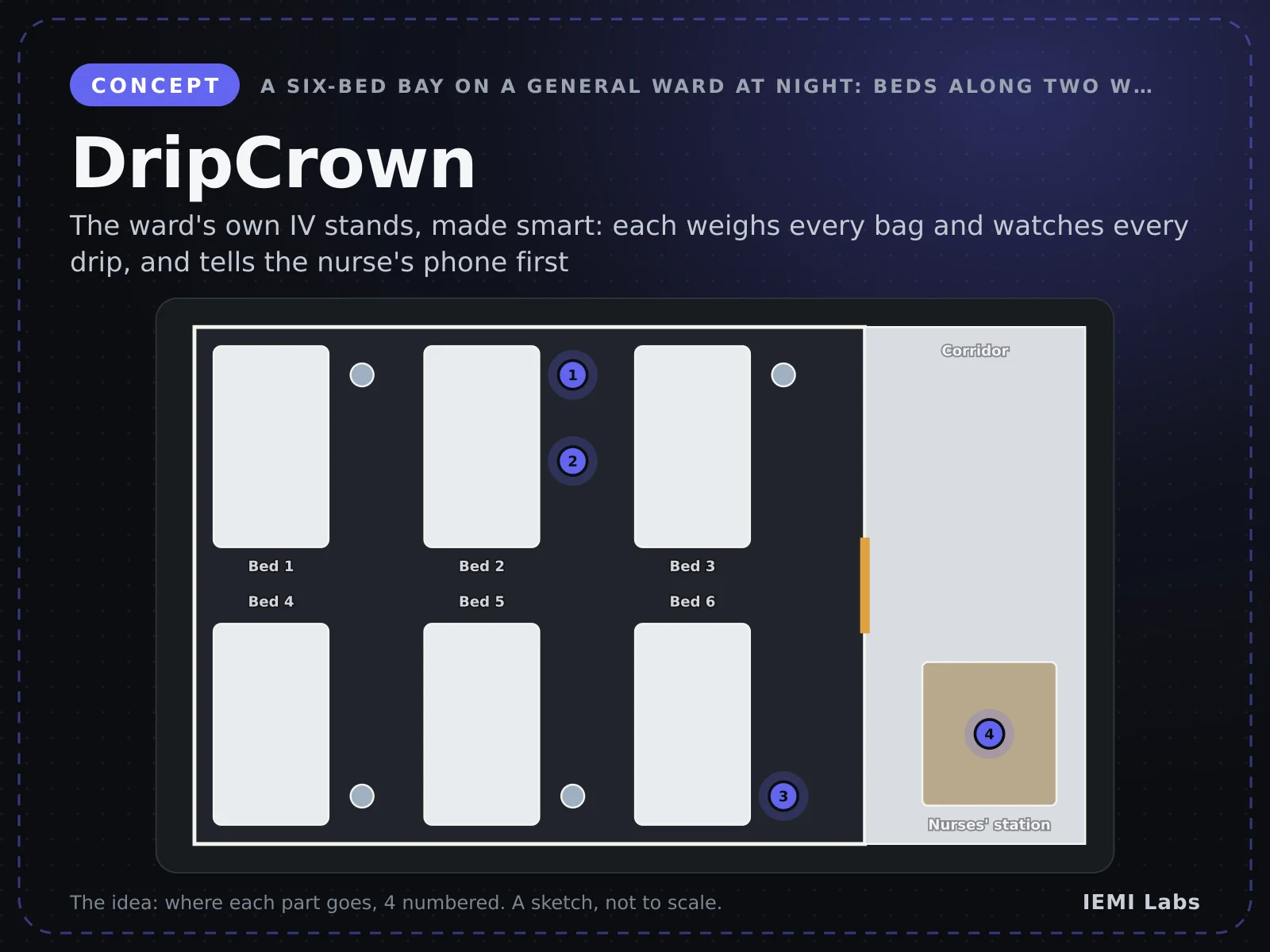
A smart top for an existing IV stand that weighs each bag, plus a clip-on camera that counts drops.
From $249 per Bed Kit
Details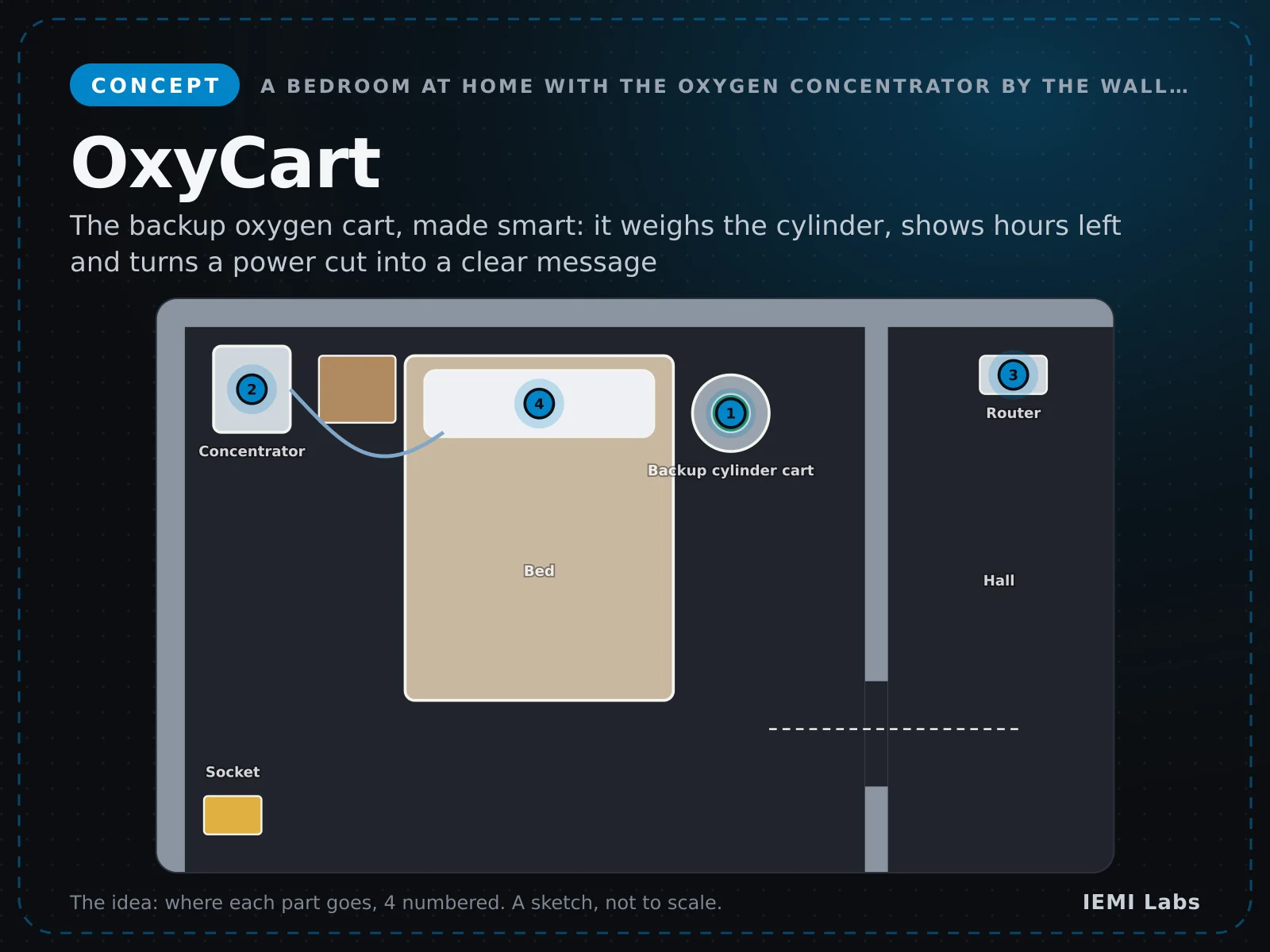
A home oxygen cylinder cart with a built-in scale and a small sensor for the concentrator outlet.
From $129 per cart
DetailsCareOne
Concept · target $590