CareOne
IEMI's one product for care homes and hospital wards: the bed's own bedside locker, made smart, so it watches the bed bay at night and calls the right carer itself, in one carers' app
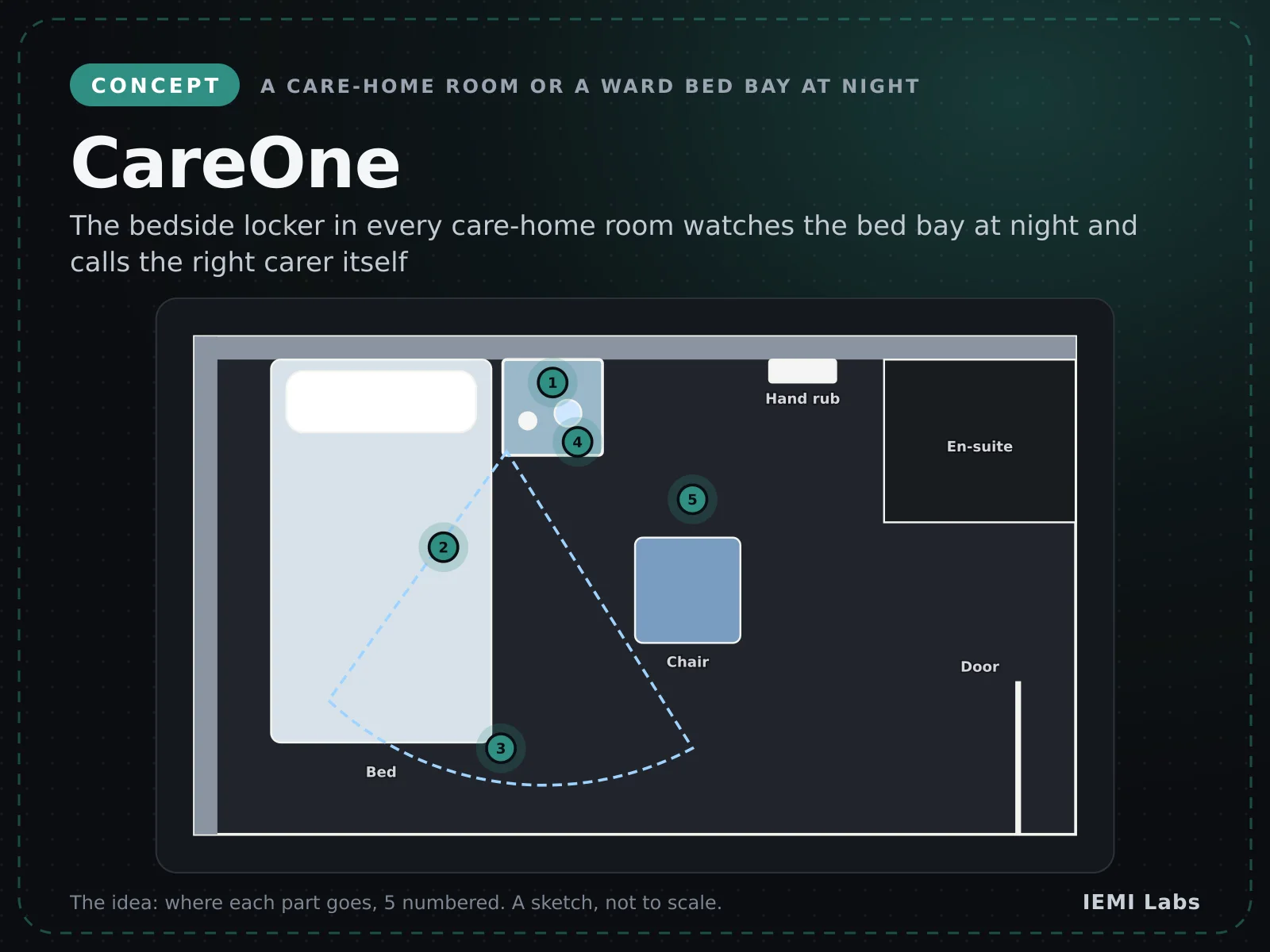
The bedside locker at the head of every bed, at the same size and place, sees a resident sit up to leave, someone on the floor beside the bed, turns and night checks with a radar in its top, weighs each drink from the water jug and each bedside hand-rub pump, takes calls with a reason and a voice note from its key, lights each call on the locker and tells the right carer. Monitor and alert only; the bed's nurse-call cord stays.
- Who buys it
- Care-home groups and their night managers; then hospital wards (falls and fluids leads) and infection control teams.
- Why it pays
- $590 + $15/month per bed instead of $1,127 + $27/month: CareWatch AI ($349 + $19/mo), TurnCup ($199 + $4/mo) and CallNote ($99 + $4/mo) add up to $647 + $27/month per bed, plus about $480 for a plain wipe-clean bedside locker (£360 at a UK care supplier, est.), so $1,127 + $27/month.
- Target price
- $590 per smart locker + $15/month per bed (target)
- First-minute wow
- At 02:40 Mrs H sits up and swings her legs over. The floor glows amber before she stands and the nearest carer's phone says "Room 14, sitting up to leave"; the carer is there in 58 s. At 14:00 the app says room 3 has drunk 820 ml of a 1,500 ml plan.
What the research found
And how this design answers it
- Rev A (28 Oct 2026): the care flagship is the bed's own bedside locker. Sealed top: XIAO ESP32-S3 brain, LD2450 radar behind 2 mm skins in the bed-side front corner, jug plate on a 5 kg load cell, hand-rub plate on a 1 kg load cell, 16 mm call key and voice-note mic, call light, tone, ATECC608, tamper switch, backup cells. Bed-side panel: amber floor glow
- Makes the bed bay's calls itself: bed exit, not back, someone on the floor, calls with a reason and night checks alone; turns, drinks and bedside hand rubs assist; unsure means unsure
- Folds BedSide, CareWatch AI, TurnCup and CallNote: the footboard hub, caster cups, wall puck and call handset are gone
- Gaps listed: urine bags (BagPost stays listed), drips and oxygen (WardPole, DripCrown, OxyCart), the door hand-rub dispenser (RubDock), en-suite falls, bed weight
- Stage 2 (29 Oct 2026): buyer check (bed-exit pads $39-118, Nobi lease about $240 a month, Ally acoustic monitoring on quote, plain lockers £360-450), price kept at $590 + $15/mo, prices checked ($221 parts qty 1, ATECC608 $4.95, piezo $1.50), bom.csv locker row quoted, cost table and margin, buyer FAQs and a power and size spec group
- Market and rules check (30 Oct 2026): NHS England (7 August 2026) says bed sensors belong only inside an individualised falls plan, decided after a risk assessment and written in the care plan, and NICE NG249 finds little evidence that movement sensors prevent falls; CareOne's bed-exit, not-back and floor calls now switch on per bed from the recorded falls plan with its review date, and a new assist call flags a night pattern change for the falls plan review at handover; the REFINE trial found bed pressure sensors did not reduce hospital falls, so CareOne makes no such claim; CMS repealed the US nursing home staffing minimums (in effect 2 February 2026), so a signed night workload summary exports for the facility assessment; Sensio RoomMate added to the competitors; no new part
Use case
A 40-bed care home with two carers at night
ResidentNight carerNight managerInfection control lead
- 01Trigger: a resident sits up at 02:40, another holds the call key, a third has drunk little by 14:00
- 02Detect: the radar sees legs over the bed edge; the key and voice note give TOILET; the jug plate shows 820 ml
- 03Act: floor glow and the nearest carer told; the call routed with its reason; a drink reminder
- 04Log: signed calls, turns, fluids, rubs and night checks in one carers' app
Outcome: Carers go to the bed that needs them with the reason already known, and the charts fill themselves, with one locker per bed instead of a hub, caster cups, a wall puck and a handset
How it works
Architecture
- 01
Sense: a tracking radar, two weigh plates, a call key and a mic inside the locker top
- 02
Decide: the XIAO ESP32-S3 runs the bed, floor, plate and call models and says unsure below the line
- 03
Show: call light, floor glow and a tone on the locker itself
- 04
Tell: signed calls over staff Wi-Fi to the carers' app, escalated after 2 minutes
Hardware
Real parts, buyable today
Bill of materials: about $225 per locker at qty 1 including the locker body (bom.csv, locker body est.).
| Block | Part | Why this part |
|---|---|---|
| Brain | Seeed XIAO ESP32-S3 | One brain with Wi-Fi on the service tray in the locker top |
| Bed and floor | HLK-LD2450 tracking radar | Bed exit, lying and turning, on the floor, carer at the bedside |
| Weighing | Adafruit 4541 5 kg + 4540 1 kg load cells + 2 x NAU7802 | Drinks from the jug and pumps from the hand-rub bottle |
| Call | Adafruit 1441 16 mm key + Adafruit 1713 MAX9814 mic | Call with a reason and a voice note |
| Show | 2 x Adafruit NeoPixel Stick 8 + Adafruit 160 piezo | Call light, floor glow and tone on the locker |
| Security | Adafruit 4314 ATECC608 + Omron D2F-01 | Signed calls, tamper log |
| Power | Listed 5 V adapter + PowerBoost 1000C + 2 x Samsung 35E | Only 5 V in the locker; about 27 h of backup (est.) |
Mechanical
Printable CAD
4 parts, generated from code and checked as closed solids. Pick a part to inspect it, or download the STL files to print.
Loading the CAD…
Real CAD · drag to rotate · scroll to zoomReal CAD · swipe sideways
Bought hardware fitted inside this part (checked in the CAD: nothing collides with the plastic)
- Smart bedside locker body (sealed top with radar, call key, call light and tone; drawer, cupboard, castors, floor glow)locker-body.stl · laminate-faced birch plywood
- Service tray (closes the top from below, carries the brain, boards, cells and load-cell blocks; presses the tamper switch)service-tray.stl · PETG, printed
- Water jug weigh platejug-plate.stl · PETG, printed
- Hand-rub bottle weigh plategel-plate.stl · PETG, printed
Open risks we are working on
- Radar bed-exit and floor tracks are unproven in shared bays and with a carer already at the bed; those calls go out as unsure
- Turns seen by radar are less certain than load cells under the bed (est. 80 %); the carer confirms
- The jug must stay on its plate; a jug carried away reads as unsure, not as a drink
- Not a fall detector, nurse-call system or medical device beyond a Class I exempt bed-patient monitor: monitor and alert only
- Care-home buying is per group and slow; the first pilot is one unit of 20 beds
Design stage only: nothing on this page is for sale. Specifications and prices are targets.