CricketOne
IEMI's one cricket product: a smart wicket that is its own umpire. The stumps call bowled, run-outs, stumpings, no-balls, wides and the over, and light up with the call
IEMI's one cricket product is the wicket itself. Three stumps at each end at MCC Law 8 size carry everything, and since rev P (phase 2) every stump has the same build: a global-shutter camera, a small computer, three LiFePO4 cells and a Hall sensor under each bail groove. Together the six stumps track the ball about 1,200 times a second. They time bail-off and check the bat at the crease, check the front foot, and count balls for the over-rate and junior spells. They also place junior close fielders against the ring and measure lengths in the nets. There is no detachable part: calls show on the stumps and in the phone app.
- Who buys it
- Cricket clubs with a first team in a league and a junior section with nets (UK, Australia, NZ, US), and leagues that write technology into playing conditions.
- Why it pays
- $1,990 instead of $4,154 for our CreaseCam League Kit, CloseCheck pods, SmartStump Match Kit, LengthLock Junior Nets Kit, OverRate Kit and SpellCount Pair bought separately (est.).
- Target price
- $1,990 CricketOne (two smart wickets, 4 bails, charging case) + $19/month League Stream optional (target)
- First-minute wow
- The bowler's-end stumps light amber and the umpire's watch buzzes 'FOOT' before the ball reaches the batter; two overs later a direct hit lifts the bail and the app reads 'BAT -40 mm' before the fielders have finished appealing. Nothing on the ground but the stumps.
What the research found
And how this design answers it
- Rev T (3 Nov 2026): the bought first-stump electronics (Pi Zero 2 W, camera board, charger, boost, fuse, plugs, power monitor, NeoPixel sticks, piezo) → one rigid-flex circuit board of our own per stump, shaped to the stump, with the cells soldered on; CAD aligned: Hall fingers in the Hall pockets, light wings at the clear strips, the tail in the back wire channel, base spring pins moved to the board's charge pads
- Rev Q (31 Oct 2026): the umpire band (pod, keys, e-paper, LiPo, buzz motor) → removed; each call shows on the stumps and in the phone app, with a buzz on the user's own smartwatch through the phone's notifications, and unsure calls are answered in the app. The lowest cell below the grass → all three cells above the grass in one stainless sleeve; only a 102 mm solid spike goes in the ground (813 mm overall, like a match stump)
- Phase 2 P9 (30 Oct 2026): phase 3 review kit for clubs, leagues, umpires, keepers and a nets coach, built from the engineering limits (weight and swing, unsure calls, light, price); page tiers corrected to $1,990 and $1,490 an extra pair
- Rev P (30 Oct 2026, phase 2): the 30 fps cameras (the ball moved 1.34 m between frames) → a global-shutter camera at 120-200+ fps in all six stumps, with the shutters staggered (about 1,200 looks a second, est.); 18650 Li-ion → LiFePO4 cells, the lowest below the grass; an aluminium heat spreader and ball shield; sealed charge pads instead of USB (IP67 target); price $1,690 → $1,990
- Rev O (28 Oct 2026): the wicket makes the calls (bowled, hit wicket, run-out, stumping, no-balls, wides, over; LBW assists): stereo cameras in the off and leg stumps, call lights and a sounder in every stump, a secure element signing every call, tamper switches; price $1,490 → $1,690
- Rev S (27 Oct 2026): the boundary MatchMast, light stand, over-rate clock, ReviewPad, CloseEye pods, BallCheck dock and DialDrive → one smart wicket pair; every job runs inside the stumps
- Three wrist units for the umpire (rev A cut them to one band; rev Q removed it) → the phone app, with a buzz on the umpire's own smartwatch
- Over-rate clock board → over-rate in the app (a wicket cannot show digits to the square: listed as a gap)
- Price $2,999 → $1,690: fewer parts, nothing to carry or set up beyond the stumps
Use case
Saturday under-13 game and league day, then Tuesday nets
Bowler's-end umpireScorerJunior coach
- 01Trigger: the bowler turns at the top of the mark and short leg creeps in
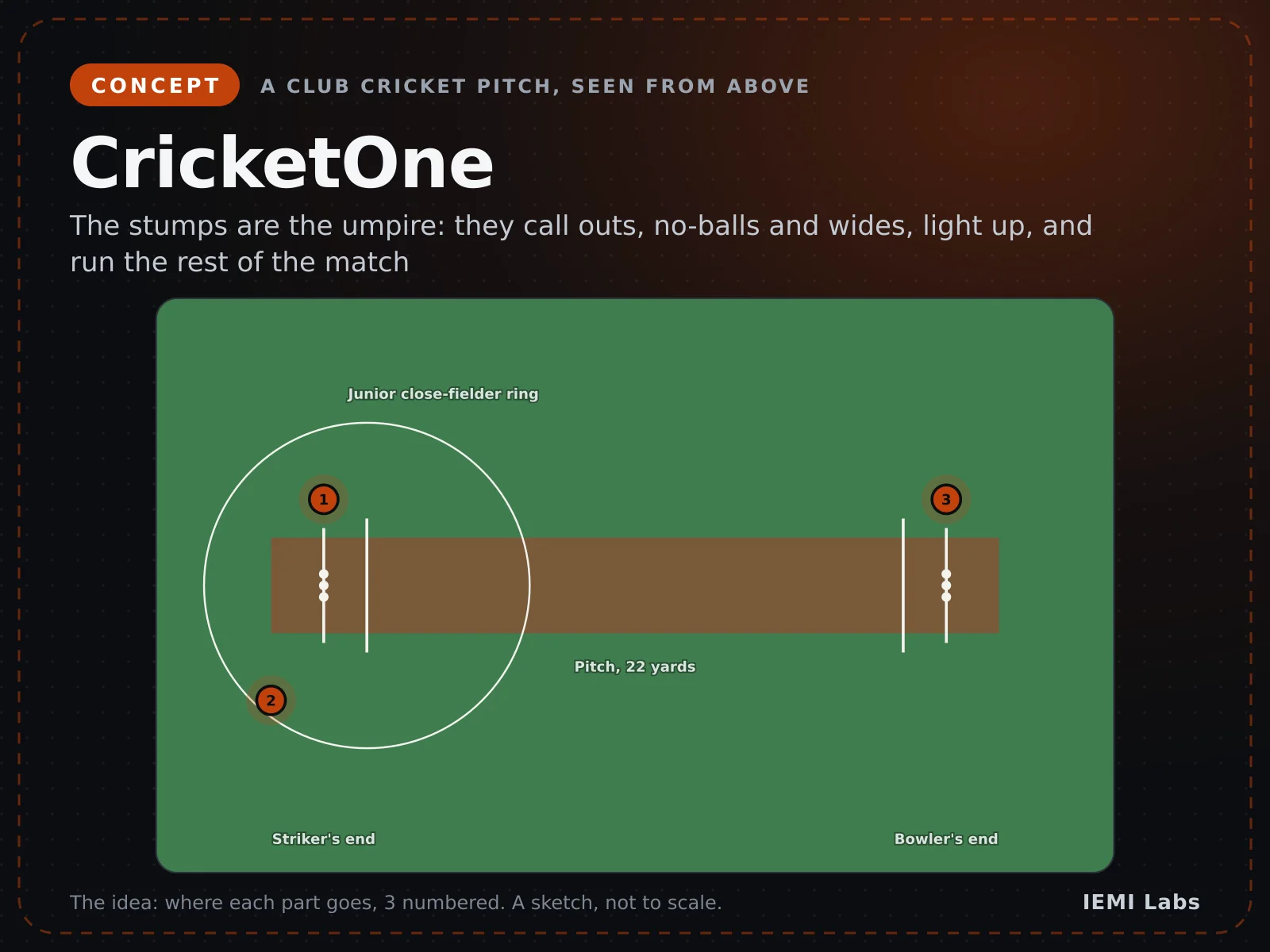
- 02Detection: the stump cameras at both ends place short leg at about 8.9 m against the 10 m ring
- 03Alert: three short buzzes on the umpire's smartwatch from the app; the umpire moves the fielder
- 04Action: later a direct hit. The groove sensor times the bail-off, the three striker's-end cameras put the bat 40 mm short at that millisecond, and the scorer's phone shows 1.5 overs behind
Outcome: One product, the stumps the club already pitches, and one app; $1,990 instead of $4,154 (est.)
How it works
Architecture
- 01
Sense: a global-shutter camera and a motion sensor in every stump, Hall sensors under every bail groove
- 02
Decide: each stump finds the ball, bat and feet in its own frames; the striker's middle stump fits one flight path through all six views and runs the calls, counts, ring and nets rules
- 03
Send: Wi-Fi between the six stumps, with clocks synced for the staggered shutters; the brain's Wi-Fi access point and MQTT to the phones
- 04
Tell: the stumps light and sound each call; the CricketOne app on the phones, with a buzz on a smartwatch through the phone's notifications
Hardware
Real parts, buyable today
Bill of materials: about $1,280 per CricketOne at qty 1 (both wickets and the charging case; bom.csv rev P, camera, computer and cell prices checked 30 Oct 2026).
| Block | Part | Why this part |
|---|---|---|
| Camera | 1 MP global-shutter camera (OV9281 class) behind a Ø12 window on a ledge, in every stump | A 145 km/h ball is not smeared: 120 fps full frame, 200+ fps in a delivery (est.) |
| Computer | Raspberry Pi Zero 2 W in every stump for the first build (our own RV1126B board in production); the striker's middle stump is the brain | Our OV9281 camera works on it today with no driver work, so programming starts now; production's own board adds a second camera port and a neural engine |
| Heat and impact | 6061 aluminium D-bar between the computer and the wall | Spreads the heat into the stump wall and takes the ball strike |
| Bails | TI DRV5055 linear Hall sensor under each groove (read by a TI ADS7142 window ADC), 3 mm magnet in each bail spigot | Bail-off time to the millisecond without a battery in the bails |
| Power | 3 x A123 26650 LiFePO4 cells (all above the grass, in one stainless sleeve) + our charger board, flush charge pads | About 14 h (est.), the safest common lithium cells, sealed with no USB port |
Mechanical
Printable CAD
58 parts, generated from code and checked as closed solids. Pick a part to inspect it, or download the STL files to print.
Loading the CAD…
Real CAD · drag to rotate · scroll to zoomReal CAD · swipe sideways
Bought hardware fitted inside this part (checked in the CAD: nothing collides with the plastic)
- Striker's leg stump: glass-fibre tubestriker-leg-tube.stl · glass-fibre tube, blue with cyan stripes; 6061 collar; PA12 head
- Striker's leg stump: collar-sidestriker-leg-collar.stl · glass-fibre tube, blue with cyan stripes; 6061 collar; PA12 head
- Striker's leg stump: head-side-topstriker-leg-head-top.stl · glass-fibre tube, blue with cyan stripes; 6061 collar; PA12 head
- Striker's leg stump: bracketstriker-leg-bracket.stl · glass-fibre tube, blue with cyan stripes; 6061 collar; PA12 head
- Striker's leg stump: inside carriers (hold the board and cells)striker-leg-carriers.stl · PA12
- Striker's leg stump: case-cellsstriker-leg-case-cells.stl · TPU 95A, black
- Striker's leg stump: case-midstriker-leg-case-mid.stl · TPU 95A, black
- Striker's leg stump: case-topstriker-leg-case-top.stl · TPU 95A, black
- Striker's leg stump: base and spike (charge pads)striker-leg-spike.stl · PA12-GF
- Far leg stump: glass-fibre tubefar-leg-tube.stl · glass-fibre tube, blue with cyan stripes; 6061 collar; PA12 head
- Far leg stump: collar-sidefar-leg-collar.stl · glass-fibre tube, blue with cyan stripes; 6061 collar; PA12 head
- Far leg stump: head-side-topfar-leg-head-top.stl · glass-fibre tube, blue with cyan stripes; 6061 collar; PA12 head
- Far leg stump: bracketfar-leg-bracket.stl · glass-fibre tube, blue with cyan stripes; 6061 collar; PA12 head
- Far leg stump: inside carriers (hold the board and cells)far-leg-carriers.stl · PA12
- Far leg stump: case-cellsfar-leg-case-cells.stl · TPU 95A, black
- Far leg stump: case-midfar-leg-case-mid.stl · TPU 95A, black
- Far leg stump: case-topfar-leg-case-top.stl · TPU 95A, black
- Far leg stump: base and spike (charge pads)far-leg-spike.stl · PA12-GF
- Striker's middle stump: glass-fibre tubestriker-middle-tube.stl · glass-fibre tube, blue with cyan stripes; 6061 collar; PA12 head
- Striker's middle stump: collarstriker-middle-collar.stl · glass-fibre tube, blue with cyan stripes; 6061 collar; PA12 head
- Striker's middle stump: head-topstriker-middle-head-top.stl · glass-fibre tube, blue with cyan stripes; 6061 collar; PA12 head
- Striker's middle stump: bracketstriker-middle-bracket.stl · glass-fibre tube, blue with cyan stripes; 6061 collar; PA12 head
- Striker's middle stump: inside carriers (hold the board and cells)striker-middle-carriers.stl · PA12
- Striker's middle stump: case-cellsstriker-middle-case-cells.stl · TPU 95A, black
- Striker's middle stump: case-midstriker-middle-case-mid.stl · TPU 95A, black
- Striker's middle stump: case-topstriker-middle-case-top.stl · TPU 95A, black
- Striker's middle stump: base and spike (charge pads)striker-middle-spike.stl · PA12-GF
- Far middle stump: glass-fibre tubefar-middle-tube.stl · glass-fibre tube, blue with cyan stripes; 6061 collar; PA12 head
- Far middle stump: collarfar-middle-collar.stl · glass-fibre tube, blue with cyan stripes; 6061 collar; PA12 head
- Far middle stump: head-topfar-middle-head-top.stl · glass-fibre tube, blue with cyan stripes; 6061 collar; PA12 head
- Far middle stump: bracketfar-middle-bracket.stl · glass-fibre tube, blue with cyan stripes; 6061 collar; PA12 head
- Far middle stump: inside carriers (hold the board and cells)far-middle-carriers.stl · PA12
- Far middle stump: case-cellsfar-middle-case-cells.stl · TPU 95A, black
- Far middle stump: case-midfar-middle-case-mid.stl · TPU 95A, black
- Far middle stump: case-topfar-middle-case-top.stl · TPU 95A, black
- Far middle stump: base and spike (charge pads)far-middle-spike.stl · PA12-GF
- Striker's off stump: glass-fibre tubestriker-off-tube.stl · glass-fibre tube, blue with cyan stripes; 6061 collar; PA12 head
- Striker's off stump: collar-offstriker-off-collar.stl · glass-fibre tube, blue with cyan stripes; 6061 collar; PA12 head
- Striker's off stump: head-off-topstriker-off-head-top.stl · glass-fibre tube, blue with cyan stripes; 6061 collar; PA12 head
- Striker's off stump: bracketstriker-off-bracket.stl · glass-fibre tube, blue with cyan stripes; 6061 collar; PA12 head
- Striker's off stump: inside carriers (hold the board and cells)striker-off-carriers.stl · PA12
- Striker's off stump: case-cellsstriker-off-case-cells.stl · TPU 95A, black
- Striker's off stump: case-midstriker-off-case-mid.stl · TPU 95A, black
- Striker's off stump: case-topstriker-off-case-top.stl · TPU 95A, black
- Striker's off stump: base and spike (charge pads)striker-off-spike.stl · PA12-GF
- Far off stump: glass-fibre tubefar-off-tube.stl · glass-fibre tube, blue with cyan stripes; 6061 collar; PA12 head
- Far off stump: collar-offfar-off-collar.stl · glass-fibre tube, blue with cyan stripes; 6061 collar; PA12 head
- Far off stump: head-off-topfar-off-head-top.stl · glass-fibre tube, blue with cyan stripes; 6061 collar; PA12 head
- Far off stump: bracketfar-off-bracket.stl · glass-fibre tube, blue with cyan stripes; 6061 collar; PA12 head
- Far off stump: inside carriers (hold the board and cells)far-off-carriers.stl · PA12
- Far off stump: case-cellsfar-off-case-cells.stl · TPU 95A, black
- Far off stump: case-midfar-off-case-mid.stl · TPU 95A, black
- Far off stump: case-topfar-off-case-top.stl · TPU 95A, black
- Far off stump: base and spike (charge pads)far-off-spike.stl · PA12-GF
- Striker's leg bail (magnet inside)striker-leg-bail.stl · PA12, white
- Striker's off bail (magnet inside)striker-off-bail.stl · PA12, white
- Far leg bail (magnet inside)far-leg-bail.stl · PA12, white
- Far off bail (magnet inside)far-off-bail.stl · PA12, white
Open risks we are working on
- Leagues must allow the calls in their playing conditions; until then it only assists the umpires in league matches
- Ball tracking is designed, not measured: the cropped frame rate (bench test B1) and the track against a 1,000 fps reference (B2) decide the LBW and wide accuracy
- No stump impact standard exists: our ball-cannon, drop and cell-zone tests (T1-T3) must pass before any pilot
- Heat: rated to 40 °C air in full sun (est.); the 45 °C chamber test (T4) decides the limit for hot countries
- Low light and low sun reduce what the cameras see; those calls are marked unsure, never guessed
- Wi-Fi from a stump 0.7 m above the grass to the scorers 50-75 m away is untested; a phone at the boundary may need to relay
- Cost: about $1,280 of parts at qty 1; at $1,990 that is about a 30 % gross margin at qty 1 after assembly and tests (est.), and a custom camera and computer board is the main cost step at volume
Design stage only: nothing on this page is for sale. Specifications and prices are targets.