PumpOne
IEMI's one product for a lift station: the station's own pump control panel, made smart
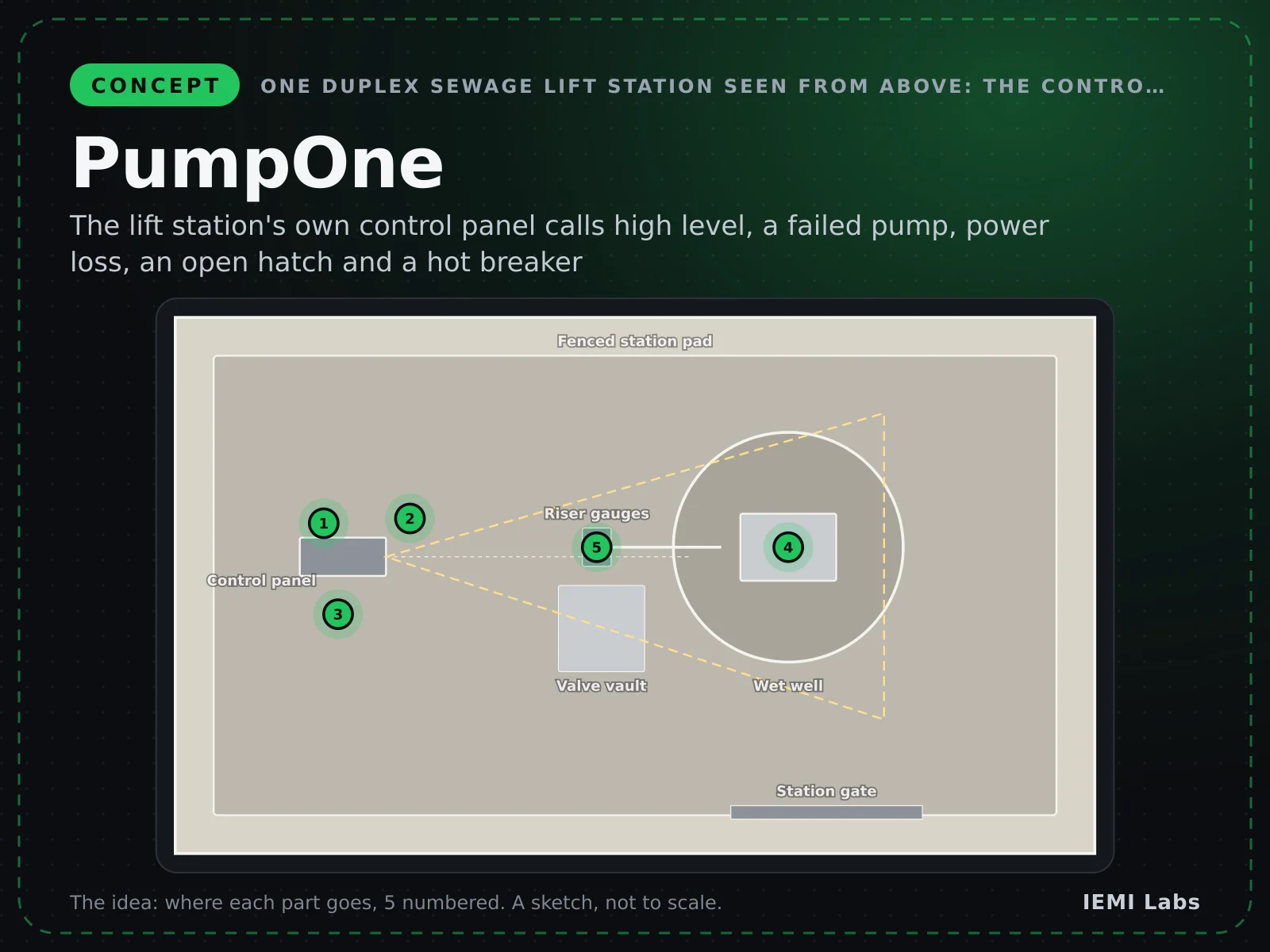
The duplex pump control panel already standing beside every small lift station's wet well, at the same 24 x 20 x 8 in size, stand and wiring, calls high level, a failed or stuck pump, power loss, an opened hatch and a hot breaker itself, reads the discharge gauges, tracks each pump's health, and calls the on-call operator over LTE-M.
- Who buys it
- Small towns, water and sewer districts, HOAs, RV and mobile-home parks with 1 to 60 lift stations, bought through their pump contractor or panel builder.
- Why it pays
- $2,690 + $45/month per station instead of about $3,911 + $87/month for PumpStation's three jobs bought separately (LiftStation AI, GaugeRead AI x 3, PanelHeat AI Lite) plus a plain duplex panel (est.).
- Target price
- $2,690 per station (replaces its control panel) + $45/month station app with LTE-M (target)
- First-minute wow
- 03:12 on a Sunday: pump 2 is called and draws no current. The panel calls it, sees the wet well rising on pump 1 alone, and the operator is on the way 40 minutes before the high level.
What the research found
And how this design answers it
- Rev A (28 Oct 2026): the water, energy and utilities flagship is the lift station's own control panel. Back plate: Raspberry Pi Zero 2 W brain, ADS1115 on the station's level transducer, float and two YHDC SCT-013-030 pump clamps, Walter LTE-M, ATECC608, IRM-05-5 on the panel's 120 V control circuit, PowerBoost 1000C and LiPo backup; right side wall: Camera Module 3 Wide and LD2450 radar behind bonded windows; door: MLX90640 heat camera, 2.13 in e-paper, NeoPixel call light and tone; D2F-01 tamper switch at the door rim
- Makes the station's calls itself: high level, failed or stuck pump, power lost, hatch opened and a hot connection alone; discharge pressure, pump wear and inflow go to the operator; unsure means 'check'
- Legal at the station: Ten States Standards section 46 alarms met (high water, power, pump failure, entry, telemetered), UL 508A panel listing by the builder, NEMA 4X kept, NEC working space and the NFPA 820 distance from the wet well checked in the CAD
- Nothing in the wet well and no pole camera: the station's own transducer, floats and gauges are read from the panel
Use case
A town with 12 small sewage lift stations and two operators
On-call operatorUtility superintendentPump contractorState inspector
- 01Trigger: a pump that will not start, a storm, a power cut, a lifted hatch, a loose contactor lug
- 02Detect: level and float, pump currents, the station camera, radar and the door heat camera inside the panel
- 03Act: the panel's own call light and tone; a callout to the on-call operator over LTE-M, also on the backup cell
- 04Log: one signed station log per panel for the superintendent, the inspector and the insurer
Outcome: Failures called before an overflow, fewer rounds just to read gauges, hot parts fixed before they fail, and a signed record after every storm
How it works
Architecture
- 01
Sense: the station's level transducer and float, two pump current clamps, a station camera, a radar and a heat camera inside the panel
- 02
Decide: level, pump, power, entry and heat models on the Pi Zero 2 W; 'check' below the line
- 03
Act: the panel's own call light, a tone and the e-paper
- 04
Tell: one signed log and callouts to the station app over LTE-M
Hardware
Real parts, buyable today
Bill of materials: $1,446 of parts per panel at qty 1 with the enclosure and the plain panel's own controls (parts prices checked 29 Oct 2026; enclosure and controls est.); about $1,786 built, listed and shipped; replaces the station's control panel.
| Block | Part | Why this part |
|---|---|---|
| Brain | Raspberry Pi Zero 2 W | Runs every station model and the calls |
| Level and pumps | Adafruit 1085 ADS1115 + 2 x YHDC SCT-013-030 | The station's own level and float; current per pump |
| See | Raspberry Pi Camera Module 3 Wide + HLK-LD2450 + Adafruit 4469 MLX90640 | Hatch, gauges and gate; people at night; hot parts in the panel |
| Calls | Waveshare 2.13 in e-paper, NeoPixel Stick 8, Adafruit 160 | Level and pumps on the door; call light and tone |
| Security, power and uplink | ATECC608, Omron D2F-01, Mean Well IRM-05-5, PowerBoost 1000C, LiPo, DPTechnics Walter | Signed calls, tamper log, callouts on LTE-M with the power off |
Mechanical
Printable CAD
3 parts, generated from code and checked as closed solids. Pick a part to inspect it, or download the STL files to print.
Loading the CAD…
Real CAD · drag to rotate · scroll to zoomReal CAD · swipe sideways
Bought hardware fitted inside this part (checked in the CAD: nothing collides with the plastic)
Open risks we are working on
- Glare, rain and dirt on the riser gauges: no reading is better than a wrong one; accuracy is only claimed after the bench test
- LTE-M coverage at rural stations varies; the panel logs and sends when it can, and the backup cell lasts about 24 h (est.)
- UL 508A listing is per panel by the builder; some utilities will want their own panel shop to fit our back plate
- Heat inside a sunny stainless panel; the station's sun shield stays and charging is held off over 45 °C
- Pump vibration cannot be measured from the panel; current signature is a partial answer
Design stage only: nothing on this page is for sale. Specifications and prices are targets.