TrapTop
The pheromone trap you already hang, made to count its own moths
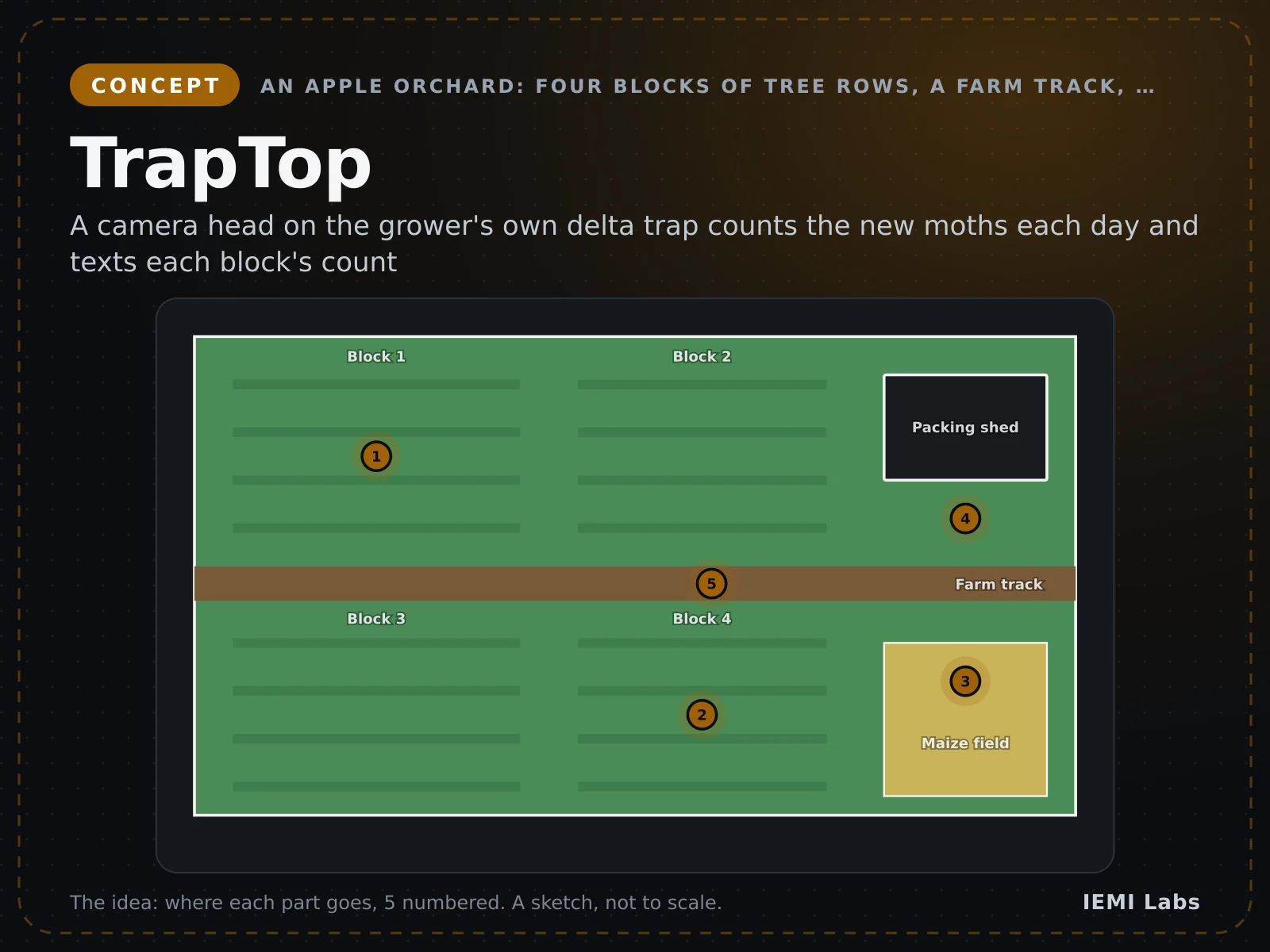
A camera head sits on the ridge of the grower's own delta trap, photographs the sticky liner up to 6 times a day, counts only the moths that are new since the last photo, and sends the count and a thumbnail to the grower and the scout; for fall armyworm a beam ring in the bucket trap counts every moth that drops in.
- Who buys it
- Apple and pear growers and the field scouts and consultants who run their codling moth trap lines; maize scouts and seed companies watching for fall armyworm.
- Why it pays
- A scout covering 40 traps a week drives and walks about 5 hours to read them (est.); TrapTop turns that into a lure-and-liner visit every 4–6 weeks. One avoided or better-timed codling moth cover spray is worth about $40–80 an acre in materials and application (est. [UNVERIFIED]).
- Target price
- $129 per head + $29 per trap per season; Gate add-on $49 (target)
- First-minute wow
- The morning text: 'Block 4: 6 new codling moths since Tuesday, over your threshold of 5 for the week', with the photo of the liner and the 6 new moths circled.
What the research found
And how this design answers it
- Camera traps sell as their own trap at about $2,400 (Trapview) → TrapTop uses the $7 delta trap the grower already owns: one slot cut at the ridge, 4 zip ties, and the trap hangs from the head
- Counting blobs on a busy liner undercounts (7% at 20 codling moths, 23% at 100, CAD crowding report) → it counts what changed since the last photo, which stays under 2% to 100 moths
- A wide lens sees the whole liner but a moth at the corner is tiny → 120 deg lens at full 5 MP: 15 px along a codling moth even at the corners; a 160 deg fisheye gives only 3 px, so it was rejected
- Delta liners fill in about 1 night at fall armyworm peaks (50 a night) and delta traps catch the fewest armyworm moths in field trials → a beam ring for the bucket trap instead, with 2 planes so a moth climbing back out is not counted twice
- Kentucky growers found traditional traps caught more than AI traps → TrapTop keeps the grower's own trap, lure and liner, so the catch is the same as the trap they trust
- Research rev A (PestTrap) needed a whole new printed trap → this design prints only a head and a ring
Use case
Codling moth flight starts in block 4
Field scoutOrchard managerTrapTop head
- 01Trigger: the 07:00 photo differs from the 19:00 photo in 2 places, both moth-sized and classified as codling moth
- 02Send: counts and a 48 x 48 thumbnail of each new moth go over LoRaWAN to the co-op gateway
- 03Alert: the scout taps Confirm on the thumbnails and the app sets the biofix date for the block and starts the degree-day count
- 04Action: the manager sees '6 this week, over threshold' on Friday and times the cover spray to degree-days instead of the calendar
Outcome: No weekly drive to every trap; the spray is timed on the block's own catch and temperature (est. 5 h of scouting a week saved per 40 traps)
How it works
Architecture
- 01
Sense: OV5640 120 deg camera 97 mm above the liner, 2 off-axis LEDs, SHT40 shaded by the trap roof; or 12 IR beams in 2 planes in the bucket neck
- 02
Decide: ESP32-S3 registers each photo to the last one and counts only new moth-sized changes, then a small classifier labels each one
- 03
Send: RAK3172 LoRaWAN 11-byte counts to a co-op gateway; thumbnails for first catches; full photos to the scout's phone over Wi-Fi at the trap
- 04
Tell: threshold texts per block, a confirm queue for first catches, biofix and degree-days, a 'liner nearly full' route list
Hardware
Real parts, buyable today
Bill of materials: about $59 per head and $27 per gate at qty 1 (est.); the grower's trap and the shared gateway are not included.
| Block | Part | Why this part |
|---|---|---|
| Vision MCU | Seeed XIAO ESP32S3 Sense (8 MB PSRAM) | Full 5 MP frames, difference count and int8 classifier on the device |
| Camera | OV5640 5 MP, 120 deg lens | Sees the whole 20.3 x 17.8 cm liner from 97 mm with 15 px per codling moth at the corners |
| Radio | RAKwireless RAK3172 (STM32WLE5) | LoRaWAN for counts, micro-amp sleep, and it runs the schedule while the S3 is off |
| Power | 2 x Energizer L91 AA + TPS63802 | Under 1 mAh a day for the delta head, no Li-ion in a hot trap |
| Bucket gate | 6 x Vishay VSLY3850 + 6 x TEFD4300 on 2 planes | Counts every moth entering the funnel; plane order tells IN from ESCAPE |
Mechanical
Printable CAD
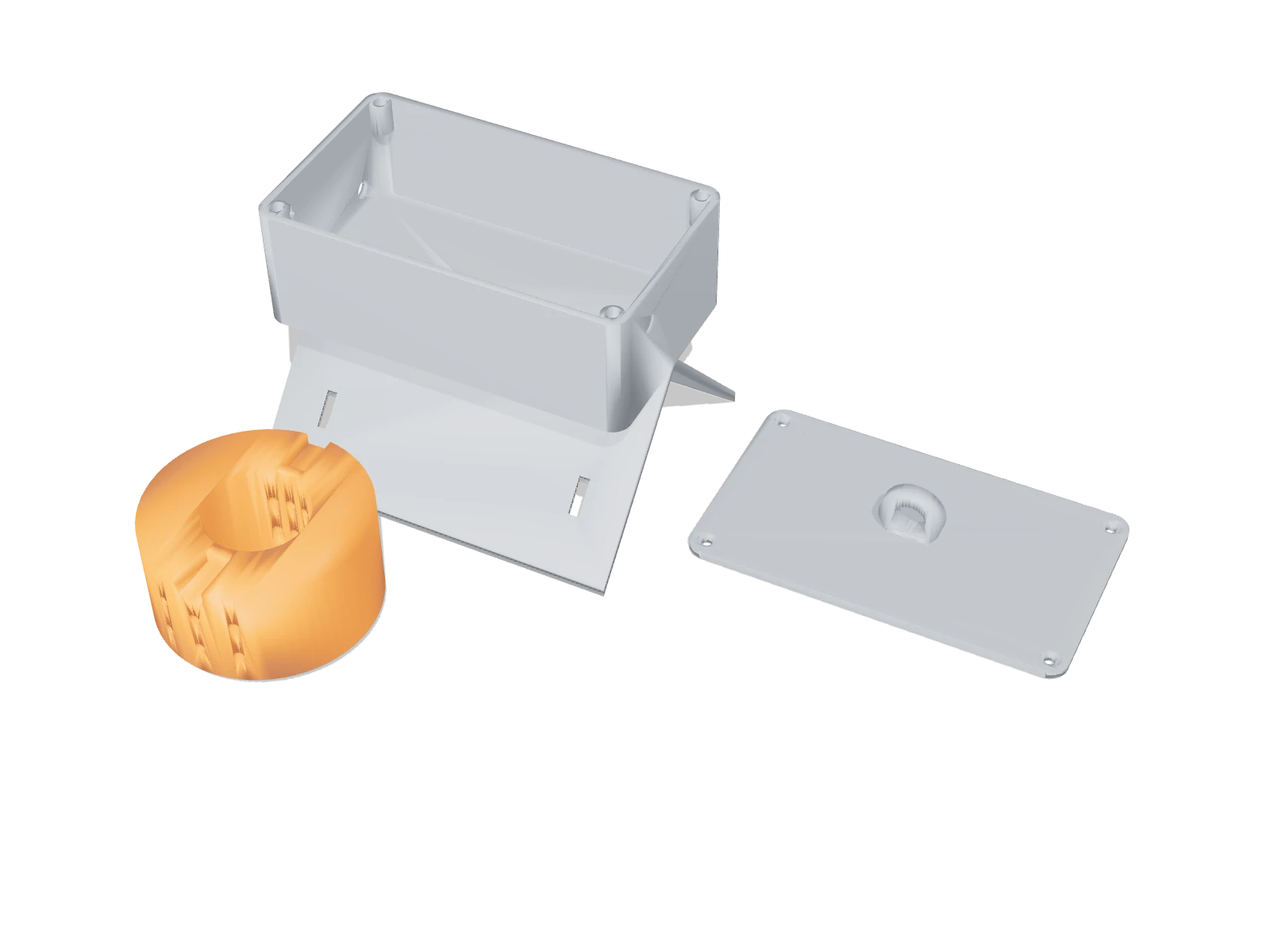
3 parts, generated from code and checked as closed solids. Pick a part to inspect it, or download the STL files to print.
See the CAD parts render
Loading the CAD…
Real CAD · drag to rotate · scroll to zoomReal CAD · swipe sideways
Bought hardware fitted inside this part (checked in the CAD: nothing collides with the plastic)
Open risks we are working on
- Classifier accuracy on real dusty liners with bycatch is unproven; a false first catch costs the scout's trust (test T1)
- The ridge slot changes the trap; it must not change the catch versus an uncut trap (paired-trap test T2)
- Beam counters cannot tell species apart, and bycatch moths in a fall armyworm bucket will be counted (11.5% error after filtering in the Hartstack study); the gate needs the photo or a hand check to stay honest
- Trapview, Semios and FarmSense already sell automated traps with service, and Trécé could add a camera to its own trap
- LoRaWAN coverage needs a gateway someone owns; the gate needs 4 x D cells for a season
Design stage only: nothing on this page is for sale. Specifications and prices are targets.