CreaseCam
Umpire-only evidence, a front-foot check and a junior close-fielder check for the lone club umpire
Two global-shutter cameras outside the boundary watch each popping crease and keep the last 8 seconds. FootCall checks every bowler's front foot as it lands and buzzes the lone bowler's-end umpire's wrist before the ball reaches the batter when no part of it is behind the line. In League Mode only an umpire can open a review, with frames sent only to the umpire's pocket ReviewPad. A double press marks a suspect bowling action with its clip for the umpires' 48-hour report, and a BallCheck dock photographs the match ball at every inspection (Law 41.3). In junior cricket, two CloseEye pods measure every close fielder against the ECB 8- or 11-yard ring before the run-up and buzz the umpire if one is inside. It also checks waist-high full tosses, short runs and the keeper under the 2026 Laws.
- Who buys it
- Club cricket leagues and umpire associations that want neutral evidence they can write into playing conditions, plus T20 tournament organisers and clubs that stream.
- Why it pays
- A pair costs $1,199 against a TV-style side-on camera setup clubs can't hire, and settles close run-outs from evidence instead of an argument between players umpiring each other (est.).
- Target price
- $1,199 CreaseCam Pair with 2 Umpire Pagers, $1,449 League Kit with 2 ReviewPads and a BallCheck dock, $199 CloseCheck pod pair for junior cricket, $649 single node (target)
- First-minute wow
- The bowler's heel lands 2 cm over the crease. Before the ball reaches the batter, the pager on the only umpire's wrist gives two long buzzes; the umpire calls no ball and looks straight up at the batter. Later the ReviewPad shows that bowler's last 6 landings with the gap in millimetres.
What the research found
And how this design answers it
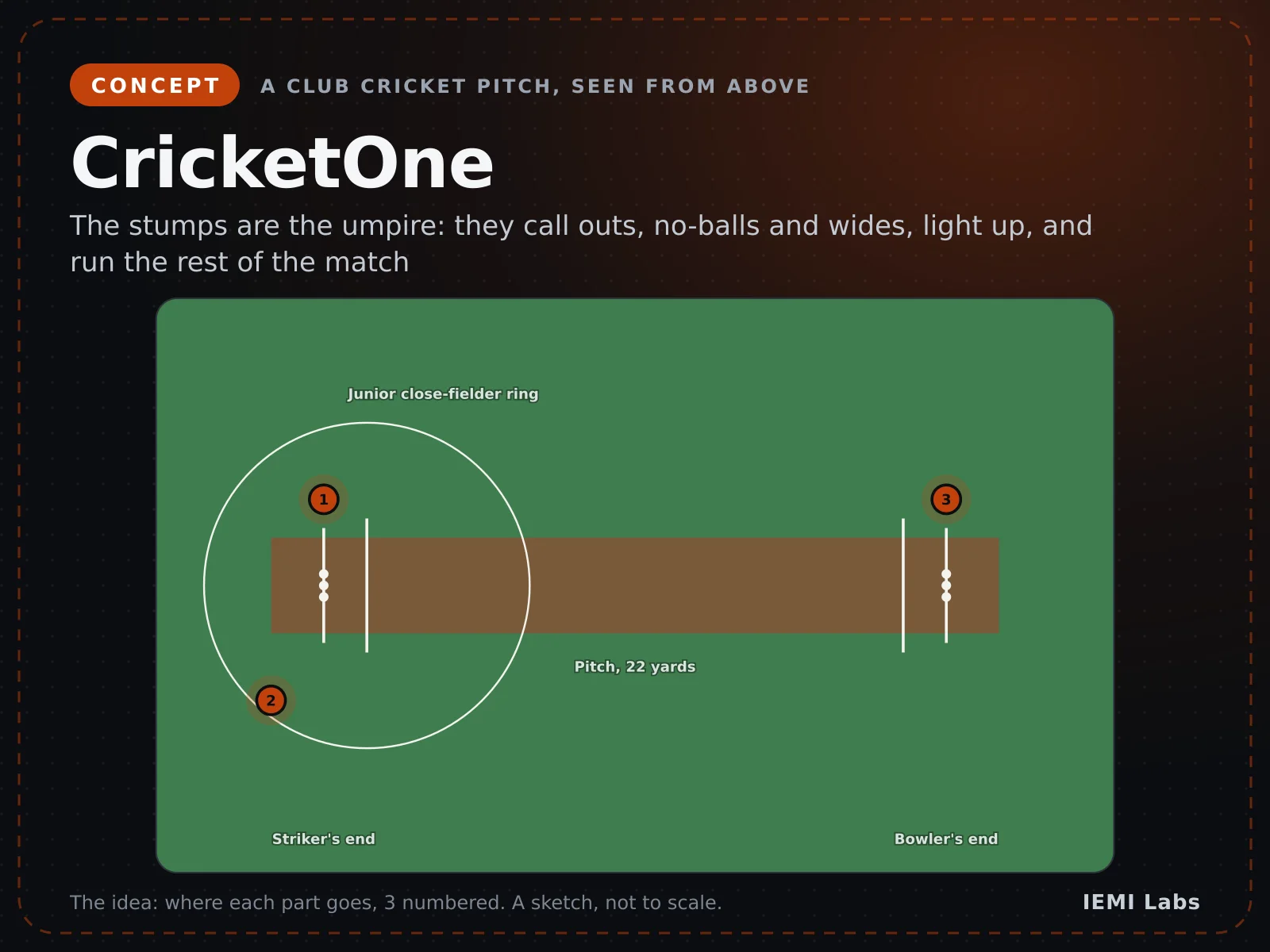
- ECB Fielding Regulations: no Under 15 within 8 yards (7.3 m) and no Under 13 within 11 yards (10 m) of the middle stump, except behind the wicket on the off side, helmet or not; the umpire must stop play at once, but nobody can judge 10 m by eye → CloseCheck: two CloseEye camera pods (striker's-end stand + sightscreen) place each fielder's feet to about ±0.25 m (est.) before the run-up; three short buzzes on the umpire's pager for INSIDE, a dot map on the ReviewPad, CHECK near the line never buzzes
- County protocols (Cornwall, Devon, Yorkshire, NCU) make the umpire note bowler, over and ball for each suspect action, compare notes at the second, tell the captain without calling no balls, and send a report signed by both within 48 h; clubs then pay £300 for an ECB assessment from 200 Hz video. Law 41.3 tampering means 5 penalty runs and a joint report → ActionMark: a pager double press keeps that delivery's side-on clip with over and ball, a "compare notes" buzz at the second mark, a signed report draft with a 48 h countdown; Assessment Clip mode at about 211 fps (est.); a new BallCheck dock photographs the ball under the same LED light at every check. It never judges legality.
- Many club leagues have one appointed umpire with a batting-side player at the other end (YPLN 2026 briefing, older league conditions), so the lone umpire looks down for the front foot and up for LBW on every ball; the ICC moved front-foot calls to the TV umpire with technology (2020 trial, 4,717 balls) → FootCall reads the landing foot against the crease plane on the node at the bowling end and gives two long buzzes on the umpire's wrist in about 0.15 s, before the ball arrives, only when no part of the foot is behind the line (MCC Law 21.5.2); CLOSE never buzzes, so the bowler keeps the benefit of the doubt; a new foot-hood snoot takes the 50 mm lens and a polariser
- Club umpires call waist-high full tosses by eye from 20 m; the square-leg umpire sees height best but the bowler's-end umpire calls it, and leagues write their own beamer rules (MCC Law 41.7, NZC umpire booklet, Club Cricket Conference) → HeightCheck reads the ball height where it crosses the popping crease against that batter's waist and buzzes both pagers in about 0.15 s; a new wrist cradle puts the pager on the bowler's-end umpire's wrist; the umpire still decides "dangerous"
- Leagues refuse a club's own camera (Kent club policy: streams must not be used to question umpires; Ballarat: a club camera overturned a run-out and the association called it unfair) → League Mode: umpire-only 5 s pager press, run out / stumped / hit wicket only, frames only to a pocket ReviewPad, nothing live to the scorer or stream, NO REVIEW fallback, and a draft playing condition for leagues
- MCC Laws 2026 (in force 1 Oct 2026): umpires must judge deliberate short running and a keeper wholly behind the stumps after release, by eye → short-turn and keeper-at-release checks on the crease nodes, a per-batter short-turn tally, and a belt-clip Umpire Pager that buzzes before the next ball; flags a turn about 2 cm short (est.)
- A phone on a tripod is rolling-shutter, 60 fps at best and unsynced: a sliding bat moves 133 mm per frame → global shutter plus interpolation at the SmartStump bail-off timestamp, about ±10 mm (est.)
- Nothing may stand on the field and the square-leg umpire stands on the crease line → nodes stand outside the boundary on the off-side crease extension with 35–50 mm lenses
Use case
Suspect action in a league match
Bowler's-end umpireSquare-leg umpireFielding captainLeague cricket officer
- 01Trigger: the umpire thinks a bowler's arm straightened on the 3rd ball of the 14th over
- 02Detection: a double press on the wrist pager marks it; the node keeps that side-on clip with bowler, over and ball
- 03Alert: on the second mark both pagers buzz short-long, and the ReviewPad says compare notes and tell the captain, no no balls yet
- 04Action: after the match both umpires sign the drafted report on their pads and send it to the league inside 48 hours
Outcome: The report has exact deliveries, times and clips instead of memory; the league and the ECB lab still decide
How it works
Architecture
- 01
Sense: Raspberry Pi Global Shutter Camera (IMX296, 60 fps) with a 50 mm lens and polariser in a foot-hood snoot, square to each popping crease
- 02
Decide: Pi 5 keeps an 8 s RAM ring; it finds the front-foot landing on every ball and bat and foot positions at bail-off
- 03
Send: Wi-Fi to the scorer's box, MQTT events and H.264 clips; clock mapped from the SmartStump LED beacon
- 04
Tell: the Umpire Pager buzzes FOOT OVER, SHORT RUN, KEEPER or ABOVE WAIST, and a double press marks a suspect action; League Mode and reports go only to the umpires' ReviewPads
Hardware
Real parts, buyable today
Bill of materials: about $327 per node, $15 per Umpire Pager, $46 per ReviewPad $33 per BallCheck dock and $46 per CloseEye pod; a League Kit (2 nodes, 2 pagers, 2 pads, 1 dock) is about $810 at qty 1 plus an access point (est.).
| Block | Part | Why this part |
|---|---|---|
| Camera | Raspberry Pi Global Shutter Camera (Sony IMX296, 1456 × 1088, 60 fps) | No rolling-shutter skew on a sliding bat; C-mount takes a 35–50 mm lens for 45–75 m boundaries |
| Compute | Raspberry Pi 5 2GB + Active Cooler | Enough RAM for an 8 s cropped RAW ring; $45 cheaper than the 4GB after the 2026 price rises |
| Lens | 50 mm C-mount (35 mm option) + 40.5 mm circular polariser in the foot-hood snoot | 3.1–5.2 mm per pixel on the heel at 45–75 m; the polariser cuts glare off whitewash and wet grass |
| Power | 25,000 mAh USB-C PD power bank | A full 50-over day with margin, no mains at the boundary |
| Mount | 1/4"-20 insert on a 2.6 m light stand | Uses the club's own stands or stream mast |
| Umpire Pager | Seeed XIAO ESP32-C3 + 400 mAh LiPo + coin vibration motor + tact key, belt-clip PETG case | Tells the on-field umpire about a short turn or keeper position before the next ball, with no screen to read |
| Umpire ReviewPad | ESP32-S3 3.5-inch 480 × 320 IPS touch board + 1,200 mAh LiPo in a pocket case with a sun hood | Puts the evidence in the umpire's hand only, so a league can allow it without a third umpire or a club laptop |
| BallCheck dock | Seeed XIAO ESP32S3 Sense + Adafruit NeoPixel Ring 12 + 500 mAh LiPo | Same light at every ball inspection, about 23 px per mm on the leather (est.), wakes when the ball covers the seat |
Mechanical
Printable CAD
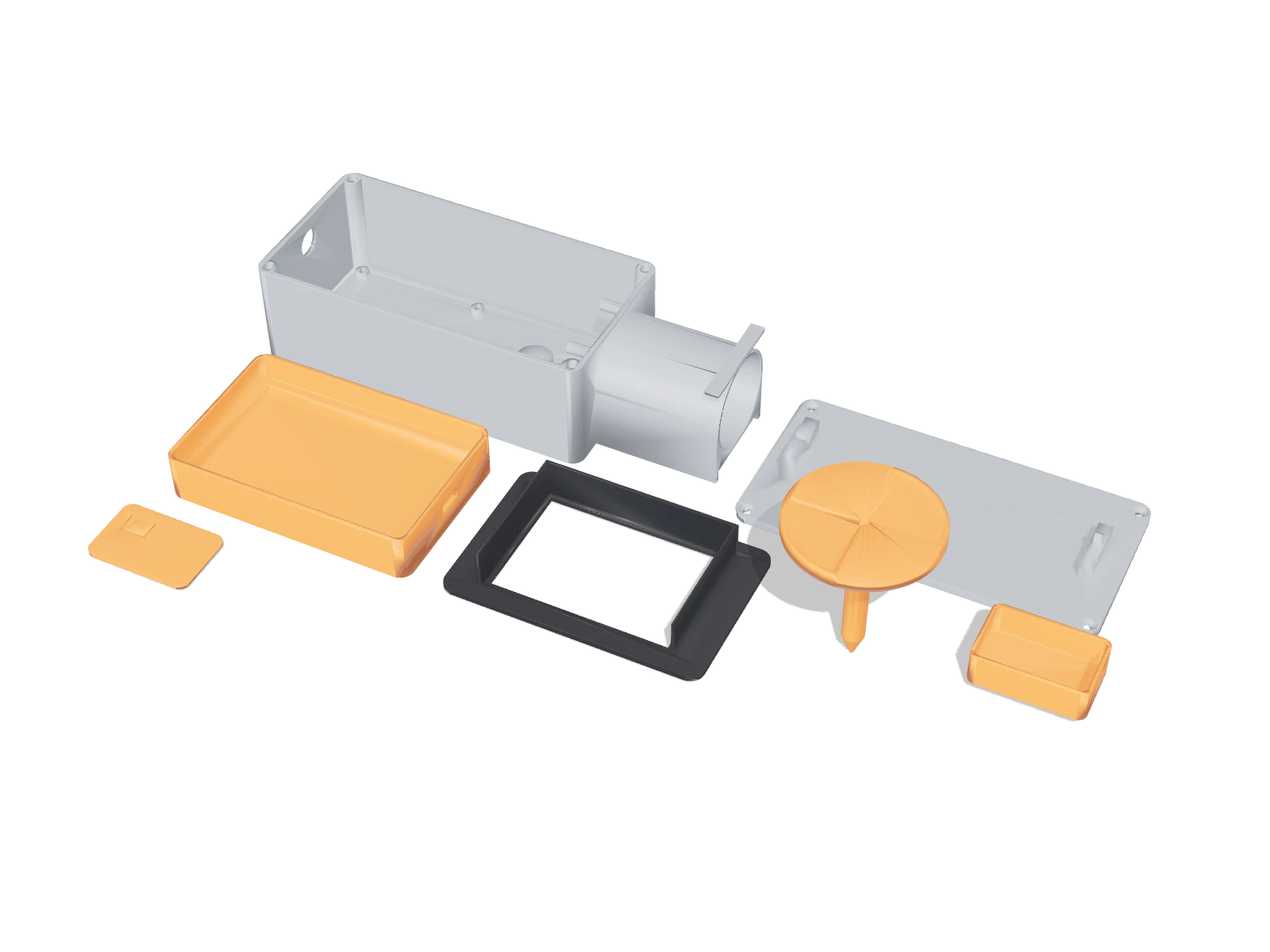
13 parts, generated from code and checked as closed solids. Pick a part to inspect it, or download the STL files to print.
See the CAD parts render
Loading the CAD…
Real CAD · drag to rotate · scroll to zoomReal CAD · swipe sideways
Bought hardware fitted inside this part (checked in the CAD: nothing collides with the plastic)
- Node box with lens hood (Pi 5 + GS camera)node-base.stl · ASA
- Node lid with aiming sightsnode-lid.stl · ASA
- Crease alignment target (setup only)crease-target.stl · PETG
- Umpire Pager case with belt clippager-case.stl · PETG
- Umpire Pager lid with flexure keypager-lid.stl · PETG
- Umpire ReviewPad case with lanyard lugreview-case.stl · PETG
- ReviewPad lid with sun hoodreview-lid.stl · PETG
- Pager wrist cradlepager-wrist.stl · PETG
- FootCall lens snoot with polariser cupfoot-hood.stl · ASA
- BallCheck dock base (camera, LED ring, battery)ball-base.stl · PETG
- BallCheck hood with ball seatball-hood.stl · PETG
- CloseEye pod case with clamp bossclose-case.stl · ASA
- CloseEye lid with lens shadeclose-lid.stl · ASA
Open risks we are working on
- A bowler can be hidden from the single side-on node; the mark then has no clip, and 60 fps match clips cannot measure an elbow (only the lab can)
- The non-striker, the bowler's back leg or the umpire can hide the landing foot from one side-on camera; FootCall then stays silent (NO VIEW), share to be measured
- Leagues must adopt a playing condition before match use; no league has seen our draft yet (gate G3)
- A 3.5-inch screen in full sun is unproven even with the hood (T15)
- 'Deliberate' is the umpire's judgement; the pager only says look. Pager Wi-Fi range (T11) and the keeper release detector (T13) are untested
- The ±10 mm interpolated gap is an estimate until the slide test (T4)
- A fielder or umpire can block the single off-side view; a 4-node kit doubles the cost
- NV Play, CricHeroes or Fulltrack AI could add synced side-on replay with better distribution
Design stage only: nothing on this page is for sale. Specifications and prices are targets.