Drag to rotate · right-drag to move · scroll to zoom · click a part for its size and placeSwipe to rotate · pinch to zoom · two fingers to move · tap a part for its size
How it fits together
CreaseCam, part by part
Scroll or tap a part. Press “See the 3D CAD design” to watch the model, built from our CAD, light each part up and show how it connects.
Real-time 3D render · drag to rotate · final design may varySwipe sideways to rotate
01
The whole CreaseCam
A camera on a stand films the crease. When the bails come off, the Pi measures bat and foot against the line and sends the gap to the umpire.
02Brain
Raspberry Pi 5
The brain: it runs the creasecam-node program
03
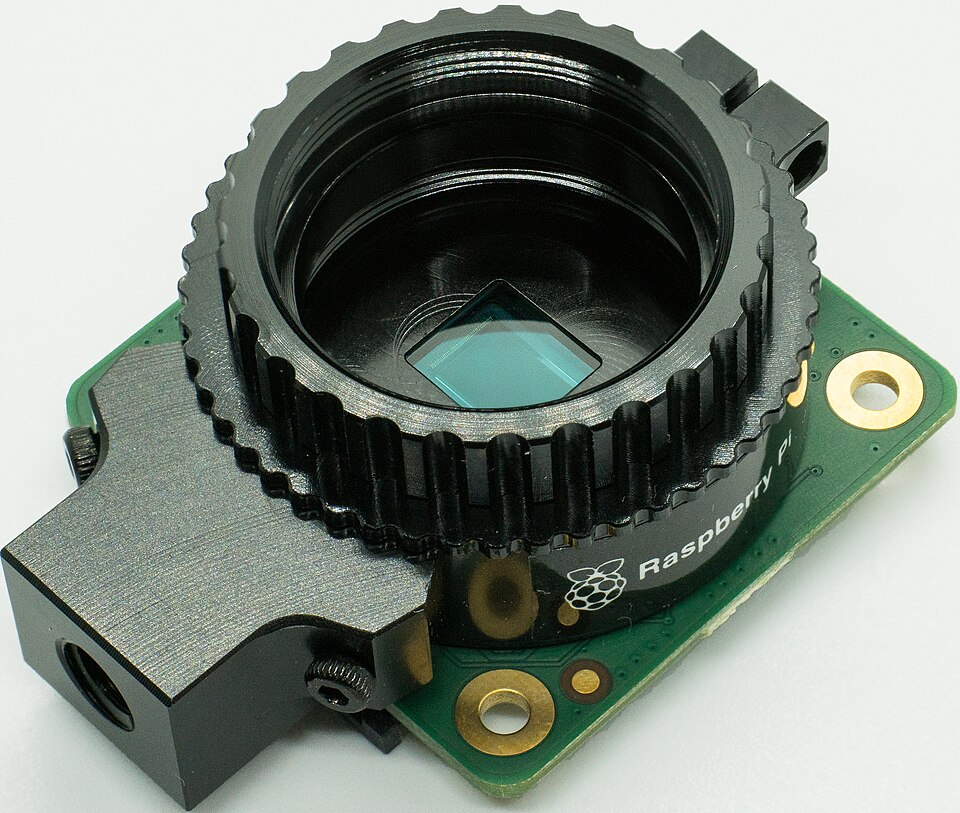
Global shutter camera
Films the crease at 60 fps with no motion smear
Raspberry Pi 5 · CSI-2 ribbon cable · 60 fps video
04
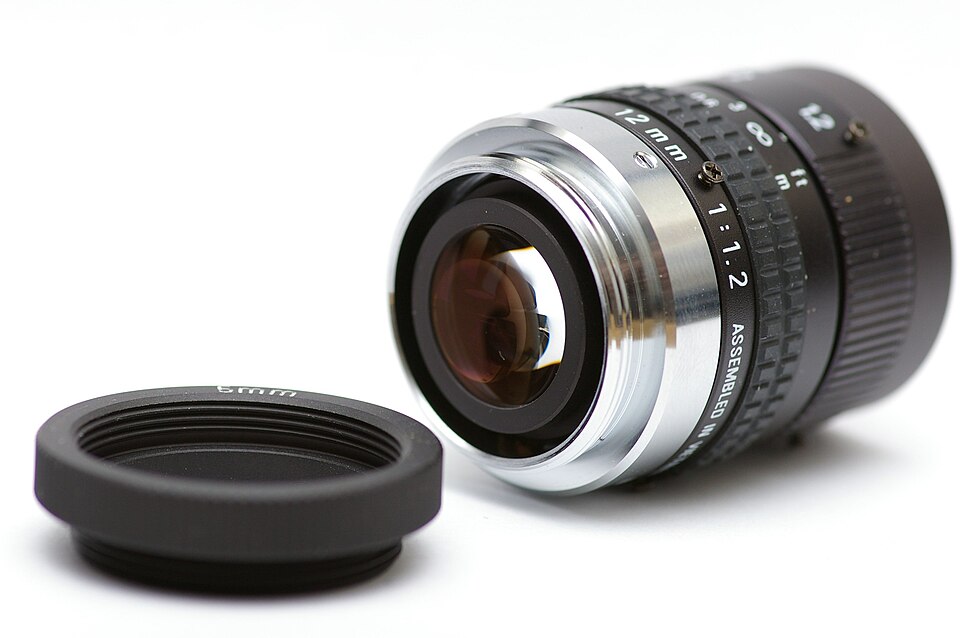
50 mm lens + polariser
Fills the frame with the crease from the boundary
Raspberry Pi 5 · C-mount thread · Light onto the sensor
05
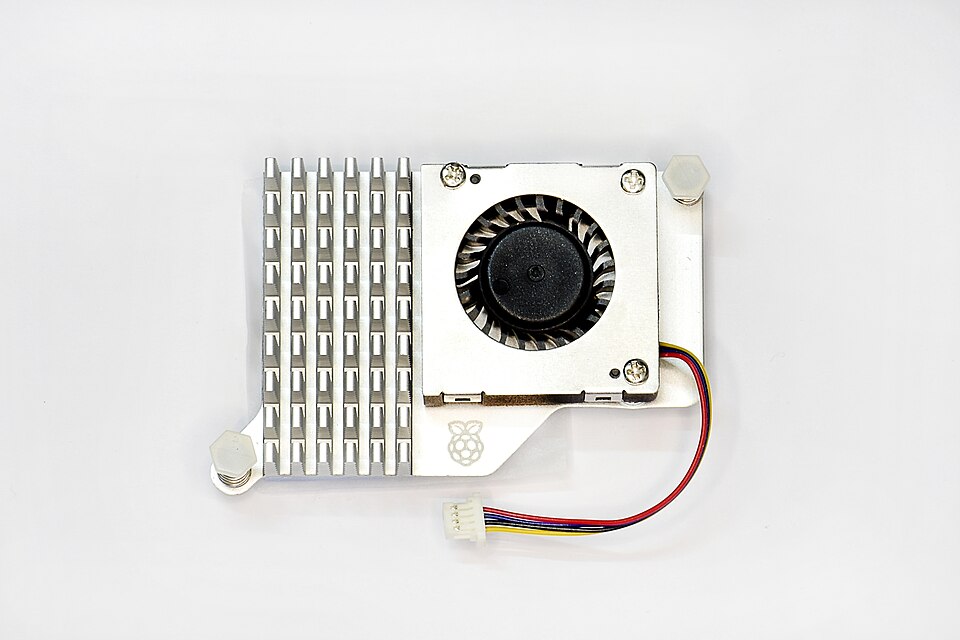
Active cooler
Stops the Pi slowing down in full sun
Raspberry Pi 5 · 4-pin fan header · Fan power and speed
06
Umpire Pager
Buzzes the umpire: foot over, short run, keeper
Raspberry Pi 5 · Wi-Fi (MQTT) · Calls and button presses
07
Umpire ReviewPad
Shows the replay to the umpire only
Raspberry Pi 5 · Wi-Fi (MQTT + clips) · Frame pair and gap
08
BallCheck dock
Photographs the ball the same way at every inspection
Raspberry Pi 5 · Wi-Fi (MQTT) · Ball photos
09
All connected
7 key parts, one program, and your phone
What it is
Two cameras on stands outside the boundary that record each popping crease side-on.
What it does
Checks the front foot on every ball
Shows the bat at bail-off
Sends reviews to the umpire only
Checks junior close-fielder distances
Who it's for
Club cricket leagues, umpire associations, T20 tournaments and clubs that stream.
How the parts connect
CreaseCam, wired up
Every part, what links it to the brain, and how the data reaches your phone. A solid line is a cable; a dashed line is a radio link.
Drawn from the CreaseCam parts list. The 3D view above is built separately, from the CAD.
The program
What controls CreaseCam
Runs on
Raspberry Pi 5
Written in
Python 3 with Picamera2
System
Raspberry Pi OS Lite (64-bit)
AI model
YOLOv8n-pose: bat tip and feet
1Keep the last 8 s of frames in memory
2Wait for bail-off from SmartStump or the video
3Map bail-off time onto the camera's own frame clock
4Find bat tip and foot, measure the gap to the crease
5Publish the result and clip to the review app
creasecam-node.pymain loop
ring = FrameRing(seconds=8)            # 480 frames at 60 fps
cam = Picamera2(); cam.start(crop=CREASE_BAND, fps=60)

while True:
    ring.push(cam.capture_request())   # each frame keeps its sensor timestamp
    evt = mqtt.poll('cc/+/evt/bailoff')
    if evt:
        t = clock_map(evt.t_set_us)       # SmartStump LED beacon fit
        frames = ring.around(t, before=3.0, after=1.0)
        bat, foot = pose_model(frames)    # YOLOv8n-pose
        gap = gap_to_crease(bat, foot, t)
        mqtt.publish(f'cc/{ground}/{node}/result', gap.json())
        save_clip(frames)
To your phone
How the data reaches CreaseCam Review
Scorer's laptop, iPhone or Android browser
Crease node
Wi-Fi · MQTT
Kit hub
Local web app
Phone or laptop
What you see in the app
One screen for each job CreaseCam does.
14:02
CreaseCam ReviewRun-out
Run-out review · Striker's end14:02
Bat 40 mm short at bail-off. Frames −8 ms and +9 ms.
Gap
−40 mm
Sync
0.8 ms
Open replay
Run-outA batter dives for the crease as the bails come off. Seconds later the umpire's ReviewPad shows the side-on frame at that instant.
15:47
CreaseCam ReviewFront foot
Foot over · Over 14.315:47
Heel landed 18 mm over the popping crease.
Front foot
18 mm over
No-balls today
2
Heel behind the line, this over (mm)
Front footThe bowler's front foot lands with no part behind the line. The umpire's wrist pager buzzes before the ball reaches the batter.
15:21
CreaseCam ReviewSuspect action
Action marked · Over 9.215:21
Clip kept, 4 s side-on. Only umpires can open it.
Clips kept
1
Node battery
71%
18:05Added to match report
15:40Clip opened on ReviewPad
15:21Clip saved, 4 s
15:21Double press · over 9, ball 2
Suspect actionThe umpire thinks a bowler's arm straightened on one delivery. A double press on the wrist pager keeps that ball's clip for the report.
16:58
CreaseCam ReviewBall check
Ball check 3 · Over 3016:58
6 photos saved. Compare them with checks 1 and 2.
Checks today
3
Photos
18
Compare checks
Ball checkAt each ball inspection the umpire sets the match ball in the BallCheck dock. It takes the same six photos every time for the report.
App screens with sample data. The interface is in development.
What the app gets
Data CreaseCam sends to the app
Gap at bail-off
−40 mm (short)
Each run-out
Front-foot landing
Heel 12 mm behind
Each ball
Replay clip
4 s, H.264
Each event
Sync quality
0.8 ms
Each over
Node battery
71%
Every 30 s
Video stays on the kit's own Wi-Fi. No cloud upload and no face recognition.
CAD design · Rev A6 design complete (CloseCheck junior close-fielder pods added 26 Oct 2026), all hardware fit-checked in CAD, not built
Designed in code, checked in 3D
13 printed parts, each a single closed solid
Every bought part fitted inside and checked for collisions
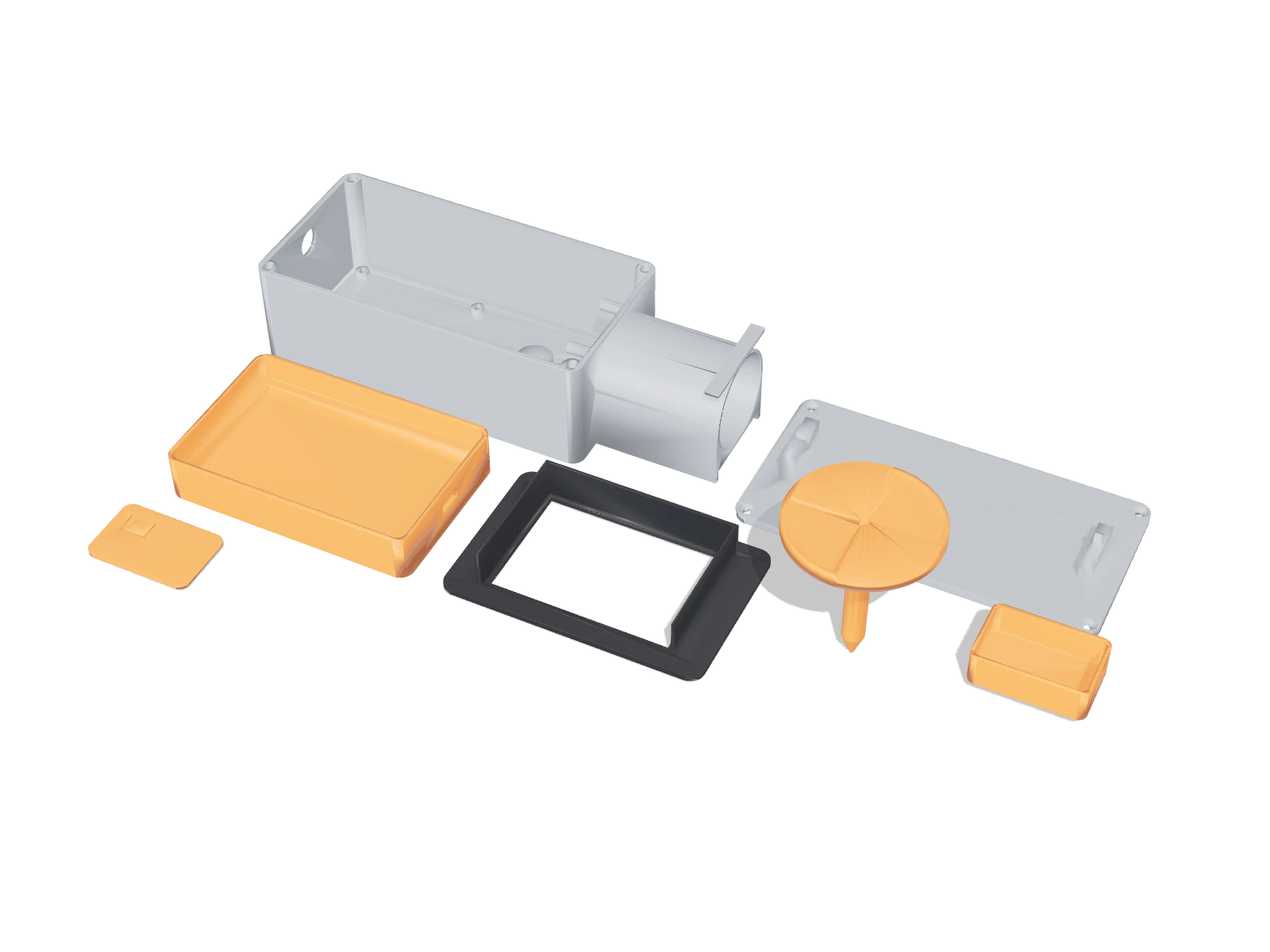
Assembled exactly as shown in the 3D CAD view (the button on the picture at the top)
Raspberry Pi 5 2GB with Active Cooler (AI runs on saved clips only)
Camera
Raspberry Pi Global Shutter Camera (Sony IMX296, 1456 × 1088, 60 fps) with a 50 mm C-mount lens and a 40.5 mm circular polariser (35 mm option for big grounds)
Sensors
Optical sync from the SmartStump LED beacon · Umpire Pager: XIAO ESP32-C3, coin vibration motor and key in a belt-clip case · Umpire ReviewPad: ESP32-S3 3.5-inch 480 × 320 IPS touch board and 1,200 mAh battery in a pocket case with a sun hood
Connectivity
Wi-Fi to an outdoor 5 GHz access point at the scorer's box · MQTT events and H.264 clips · BLE bridge to SmartStump (via laptop or Edge Hub)
Power
25,000 mAh USB-C PD power bank per node, about 36 Wh for a 50-over day (est.)
Enclosure
White ASA node box with lens hood, black ASA FootCall snoot with a polariser cup, rain visor, EPDM-sealed lid and aiming sights; 1/4"-20 mount for a 2.6 m light stand
Dimensions
Node box about 258 × 76 × 50 mm including hood and snoot; ReviewPad 110 × 72 × 20 mm (36 mm with the hood)
All target specifications
Camera
Camera target specifications
Sensor
Sony IMX296 global shutter, 1456 × 1088
Frame rate
60 fps (higher with row crop, to be tested)
Lens
50 mm C-mount with polariser; 35 mm for 75 m grounds
Resolution on crease
About 3–5 mm per pixel at 45–75 m (50 mm lens)
Measurement
Measurement target specifications
Gap at bail-off
About ±10 mm with SmartStump (est.)
Without SmartStump
Frame-accurate only
Buffer
Last 8 s in RAM
Review time
About 10 s from bail-off (est.)
Short-turn flag
About 19–25 mm short at 45–75 m boundaries (est.)
FootCall
FootCall target specifications
Law
MCC Law 21.5.2: some part of the front foot behind the popping crease
Heel position error
About ±9 mm at 45–75 m (est.)
Buzzes when
The whole foot is at least about 14 mm past the line (est.)
Buzz time
About 0.15 s after landing; ball reaches the batter in 0.6–0.95 s (est.)
Not checked
Back foot and return crease (Law 21.5.1)
Power and setup
Power and setup target specifications
Battery
25,000 mAh USB-C bank per node
Runtime
A full 50-over day (est.)
Placement
Outside the boundary, off-side crease extension
Alignment
About 5 min per node with crease targets
League Mode
League Mode target specifications
Who can open a review
On-field umpires only (5 s pager press)
Decisions covered
Run out, stumped, hit wicket
Frames to the pad
5 around bail-off + landing frame, about 0.7 s to send (est.)
Pad battery
About 55 h on 1,200 mAh (est.)
Clip retention
7 days, then deleted unless the league asks
CloseCheck
CloseCheck target specifications
Pods
2 CloseEye pods (XIAO ESP32S3 Sense, 2000 mAh), striker's-end stand and sightscreen
Rings
U13 11 yd (10 m), U15 8 yd (7.3 m), NZ 10 m, U16–18 helmet reminder 6 yd
Position error
about ±0.25 m at 45–75 m boundaries (est.)
Alert
three short buzzes before the run-up for INSIDE; CHECK near the line never buzzes
Battery
about 14 h (est.)
Targets for production units; they may change during development.
Pricing
Hardware: $649–$1,449per node or pair
Software: $19 per month (League Stream plan, review app included)
Target prices: $649 single node, $1,199 CreaseCam Pair with 2 Umpire Pagers and FootCall, $1,449 League Kit with 2 ReviewPads and a BallCheck dock, $1,899 with a SmartStump Club Set, and a $199 CloseCheck add-on (2 pods) for junior cricket. Parts cost is about $327 per node, $15 per pager, $46 per ReviewPad $33 per BallCheck dock and $46 per CloseEye pod at quantity 1 (est.), plus one outdoor access point per ground.
Single node
$649 (target)
One crease, for clubs starting with the striker's end.
1 node, 50 mm lens and FootCall snoot
2 crease targets
Run-out review
Clip export
CreaseCam Pair
$1,199 (target)
Both creases, for front-foot checks and run-outs.
2 nodes with 50 mm lenses and FootCall snoots
4 crease targets and carry case
2 Umpire Pagers with wrist cradles
FootCall front-foot buzz
Review app in League Stream ($19/mo)
League Kit
$1,449 (target)
The Pair with League Mode, for leagues that want umpire-only evidence.
Everything in the Pair
2 Umpire ReviewPads with sun hoods
League Mode key held by the league
Draft playing condition for the league committee
BallCheck dock and ActionMark report drafts
Match Kit
$1,899 (target)
CreaseCam Pair with a SmartStump Club Set for timed bail-off.
Everything in the Pair
SmartStump Club Set
Interpolated gap at bail-off
LED beacon clock sync
CloseCheck add-on
$199 (target)
Two CloseEye pods for junior cricket, added to a Pair or League Kit.
2 CloseEye camera pods with clamps
ECB 8 and 11 yard rings, NZ 10 m
Three-buzz INSIDE alert to the umpire
Dot map and fielder distance on the ReviewPad
Indicative launch pricing in USD, excluding taxes and shipping. Final pricing is confirmed before any balance is charged.
Community
What do you think of CreaseCam?
CreaseCam is in development. Rate the idea, tell us what to change about the features, specs or price, and we'll build it with your feedback.
A club with a league side and junior nets wants run-out and front-foot evidence for a lone umpire, an over-rate clock, junior spell limits and a smarter bowling machine. Today that is five separate kits, or a nets system from about GBP 2,200 (PitchVision) and sponsor-funded LED wickets (Wisden on Zing).
Combined into Cricket MatchKit (https://iemilabs.com/products/matchkit/); CreaseCam itself is unchanged
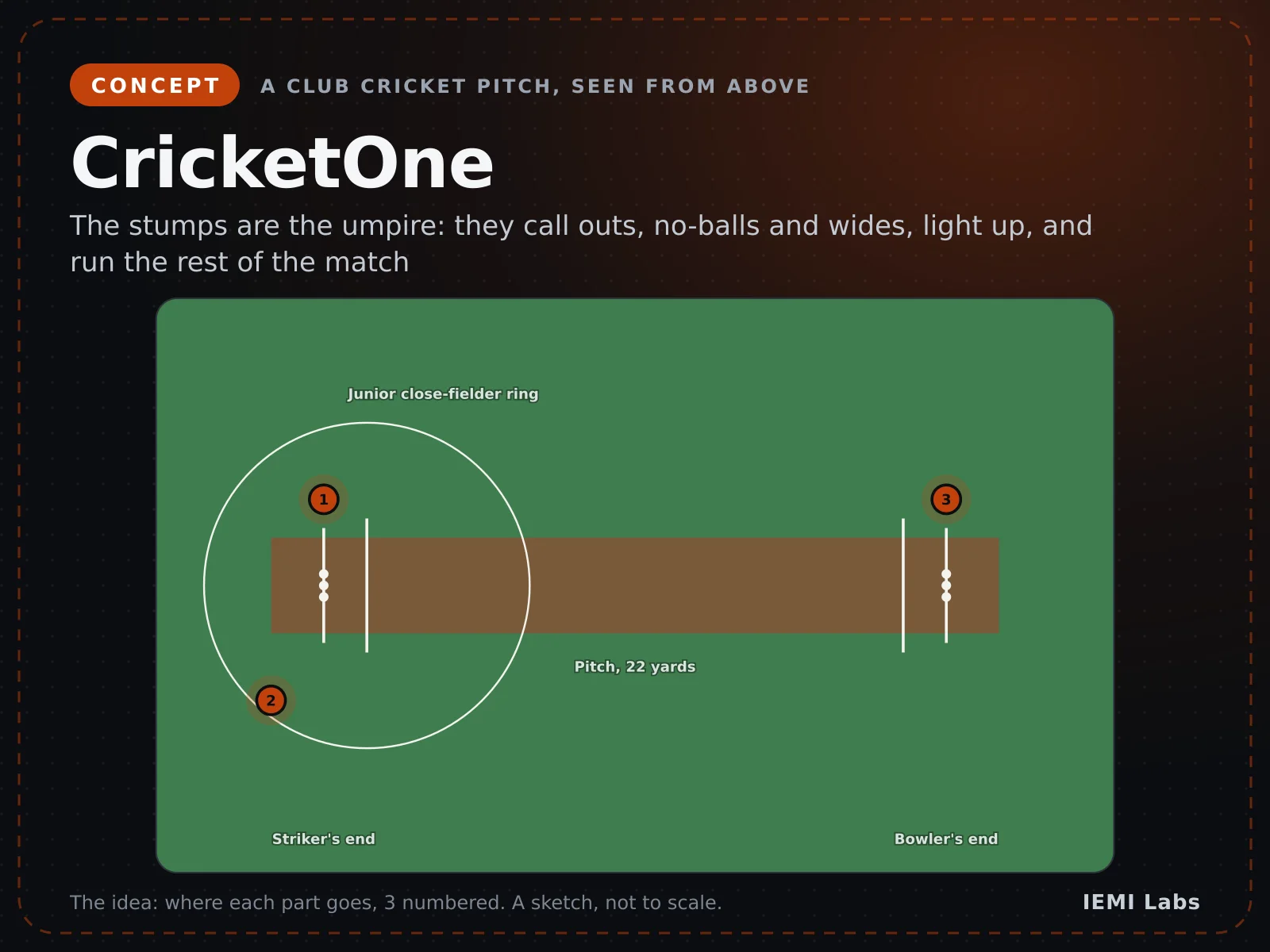
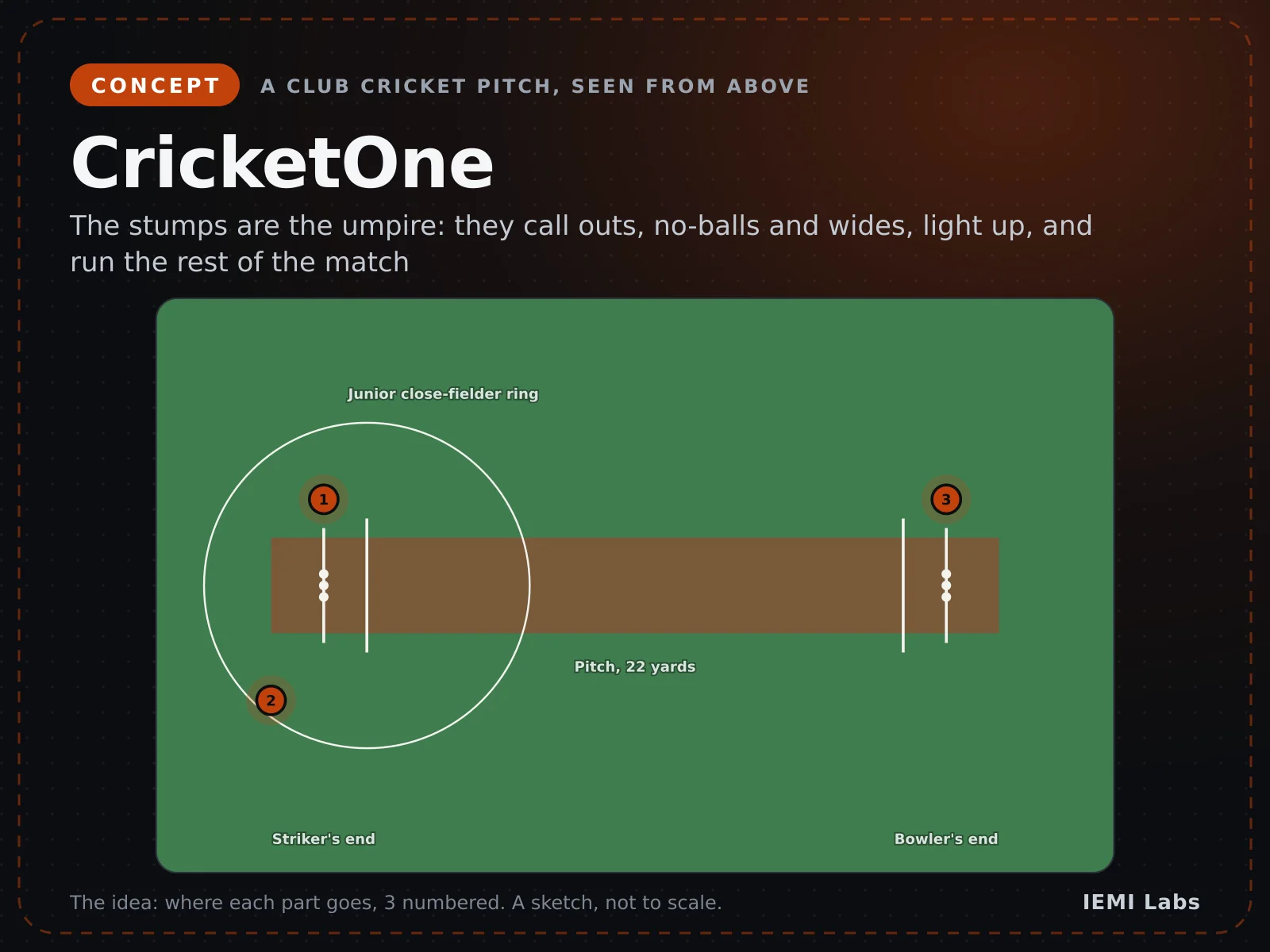
The ECB Fielding Regulations say no Under 15 may field within 8 yards (7.3 m) of the middle stump and no Under 13 within 11 yards (10 m), except behind the wicket on the off side, even in a helmet, and the umpire must stop play at once if one does. In junior cricket the umpire is 20 m away, often a parent stands at square leg, and nobody can judge 10 m by eye.
New CAD parts close-case and close-lid: a CloseEye camera pod with a 2000 mAh battery, a lens shade and a clamp thread (all bought parts fit, the lid sits clear, each part one solid)
CloseCheck: one pod on the striker's-end stand and one on the sightscreen measure each close fielder as the bowler walks back; three short buzzes on the umpire's pager if one is inside, CHECK near the line never buzzes
Rings set per match: Under 13 11 yards, Under 15 8 yards, New Zealand 10 m, and a 6-yard helmet reminder for Under 16–18s
3D view updated: a CloseEye pod clamped to a sightscreen rail beside the crease node
Product page updated: summary, a highlight, two examples, CloseCheck specs, three new questions and a $199 CloseCheck add-on; parts about $46 per pod (est.); real parts list now includes the XIAO ESP32S3 Sense camera
County cricket protocols (Cornwall, Devon, Yorkshire, NCU) make a club umpire note the bowler, over and ball for every suspect bowling action, compare notes, tell the captain without calling no balls, and send a report signed by both umpires within 48 hours; a second report means £300 for an ECB assessment from 200 Hz video. Ball tampering under MCC Law 41.3 means 5 penalty runs and a joint report too, and both reports are written from memory today.
New CAD parts ball-base and ball-hood: a BallCheck dock with a camera, LED ring and battery that holds the match ball in a seat (all bought parts fit, the ball sits clear, each part one solid)
ActionMark: a double press on the pager keeps that delivery's clip with over and ball; a second mark buzzes both umpires to compare notes; the pad drafts the 48-hour report for both umpires to sign
Assessment Clip mode: two nodes film side-on and from behind at about 210 frames a second (est.) for the club's assessment footage
3D view updated: the dock with a match ball in its seat beside the ReviewPad
Product page updated: summary, two highlights, three examples, three new questions and the League Kit at $1,449; parts about $33 per dock (est.)
Many club cricket leagues send one appointed umpire, who stands at the bowler's end while a batting-side player stands at square leg (Yorkshire Premier League North 2026 umpire briefing). That umpire has to watch the front foot land and then look up at once for LBW, and must call a no ball if no part of the foot is behind the popping crease (MCC Law 21.5.2). Professional cricket gave this call to the TV umpire with technology in 2020 (ICC).
New CAD part foot-hood: a black snoot that pushes into the lens hood, takes the 50 mm lens and holds a polarising filter with a thumbscrew (5 of 5 bought parts fit, no clash with the node)
New FootCall check: finds where the front foot lands on every ball and buzzes the umpire's wrist twice in about 0.15 s, only when the whole foot is past the line; close calls never buzz
Accuracy and timing worked out in the CAD file: about 9 mm on the heel, and the buzz arrives before the ball at 80 and 130 km/h (est.)
Product page updated with FootCall: new summary, highlights, two examples, a FootCall spec group and three new questions
Parts list: +$21.89 per camera (est.), and the pair now ships with 50 mm lenses
Club umpires must call a full toss that passes above the batter's waist as a no ball on the spot, by eye, and judge if it was dangerous (MCC Law 41.7). The square-leg umpire sees height best but the bowler's-end umpire makes the call, the New Zealand Cricket umpire booklet tells umpires to signal height to each other, and a league umpire coordinator says leagues wrote their own beamer rules (Club Cricket Conference).
New CAD part pager-wrist: a wrist cradle the existing pager clips onto, with a 20 mm strap (4/4 fit checks, no clash with the pager, one solid)
New HeightCheck software plan and height report: ball height at the crease against the batter's waist, about 22 mm error (est.), buzz in about 0.15 s
BOM: +$3.90 per wrist cradle, about $8 per kit (est.)
Product page, design page and DESIGN.md updated with a beamer use case, two FAQs, sources and a rules note (the umpire still decides)
Club cricket leagues want close run-outs and stumpings settled from evidence, but they will not accept a club's own camera: a Kent club streaming policy says a stream must not be used to question the umpire, and in Ballarat a run-out overturned with one club's private camera led the association to call it unfair. The ECB's third-umpire rules show what a league could allow: only the umpire asks, players cannot, and a stumping is checked for a no-ball first.
New CAD parts: Umpire ReviewPad case with a lanyard lug and a lid with a sun hood; all 4 fit checks pass and each part is one solid
Hardware: a 3.5-inch touch screen board and a 1,200 mAh battery per pad, about $46 per pad at qty 1 (est.); new $1,399 League Kit
Software: League Mode, where only a 5-second press on the umpire's pager opens a review, frames go only to the pad, the no-ball frame is shown first for a stumping, nothing goes to the stream, and clips are deleted after 7 days
Design doc: dated section with 6 sources, a rules note and a draft playing condition for league committees
Product page: new tagline, summary, problem, highlights, 2 use cases, a League Mode spec group, the League Kit tier and 2 new FAQs
Since the MCC's 2026 Laws of Cricket came in on 1 October 2026, club umpires must judge by eye whether batters deliberately ran short, and whether the keeper is wholly behind the stumps once the ball is released (MCC change list; IANS, myKhel and The Daily Star coverage; New Zealand Cricket umpire briefing).
New CAD parts: Umpire Pager case with belt clip, and a lid with a flexible key; 6 bought parts fit-checked, lid on case 0 mm³
New CAD reports for the short-run and keeper checks
BOM: about $15 per pager, 2 per Pair (est.)
Design doc: dated section on the 2026 Laws with sources and 4 new tests
Product page: summary, highlights, use cases, FAQs and kit contents updated for the 2026 Laws
No. CreaseCam is a concept in the in-house design and testing stage. The design is complete in CAD, but nothing has been built or measured yet, and all specifications and prices are targets.
What does CloseCheck do in junior cricket?
The ECB Fielding Regulations say no Under 15 may field within 8 yards (7.3 m) of the middle stump, and no Under 13 within 11 yards (10 m), except behind the wicket on the off side, even in a helmet, and the umpire must stop play if one does. CloseCheck uses two CloseEye pods outside the field to measure each close fielder's distance as the bowler walks back, and buzzes the umpire's wrist three times if one is clearly inside.
Does CloseCheck stop play or decide anything?
No. It only measures and tells the umpire. Within about 0.4 m of the line it shows CHECK on the ReviewPad and stays silent. The umpire decides, stops play and moves the fielder, as the regulations say.
Does it check helmets or keep video of children?
It does not check helmets; the 6-yard ring for Under 16–18s is only a reminder to look. Frames are used to measure distances and then dropped unless the umpire marks one, and clubs follow their own safeguarding and photography policy.
Does CreaseCam say whether a bowling action is legal?
No. Under the Laws the umpires judge a fair delivery, and county protocols say not to call no balls until an assessment has been made. ActionMark only keeps the deliveries the umpire chose to mark, with times and clips for the report. Legality is decided by the governing body, using a lab assessment of elbow extension.
How does BallCheck help with ball tampering?
The umpires sit the ball in the dock at each inspection and turn it through six positions. The LED ring gives the same light every time, so new marks stand out against earlier photos. The umpires still decide whether the ball was changed, award the 5 penalty runs under Law 41.3 and choose the replacement.
Who sees the suspect-action clips?
Only the two umpires on their ReviewPads, and then the league if the umpires send the report. Nothing goes to players, the scorer or a stream. Clips are deleted after 30 days unless a report was sent.
Does CreaseCam call front-foot no balls?
No. Under MCC Law 21.5.2 the bowler's-end umpire calls it. FootCall only buzzes the umpire's wrist when the camera saw no part of the front foot, grounded or raised, behind the popping crease. Close landings never buzz, so the bowler keeps the benefit of the doubt, and if the foot was hidden it stays silent. The league must allow the aid in its playing conditions.
Our league has only one umpire. Does it still work?
Yes. That is what FootCall is for. Both cameras run it and the one at the end the ball is bowled from is active, so it follows the bowling each over whether the umpire stands at one end all match or changes ends. The player at square leg needs nothing.
Can it see the back foot?
No. A side-on camera on the crease line cannot judge the return crease, so the back-foot rule (Law 21.5.1) and the side of middle stump stay with the umpire's eye.
Does CreaseCam decide whether a beamer was dangerous?
No. Under MCC Law 41.7 a full toss above the batter's waist is a no ball, and whether it was also dangerous, and any warning, is the umpire's judgement. HeightCheck only tells the umpire how high the ball was at the popping crease. It makes no safety claim.
How does it know the batter's waist?
The Law defines the waist as the top of the trousers with the batter standing upright at the popping crease. The striker's-end camera takes that line from frames where the batter stands upright between balls. It is the least certain part (about 2 cm, est.), so close balls are shown as CLOSE, not ABOVE. In-house target, not yet tested on real batters.
Does CreaseCam give out or not out?
No. Every output is evidence for the umpire, who always decides. A league must adopt a playing condition before it is used in matches; without one, CreaseCam is a training and streaming tool.
Will my league allow it?
Many leagues ban using a club's camera or stream to question umpires. League Mode is built for those rules: only an on-field umpire can open a review, players cannot ask, the frames go only to the umpire's pad, nothing goes live to the stream, and if the system is down the umpire decides as normal. We give leagues a draft playing condition to adapt; it is not an official text and no league has adopted it yet.
Why does a stumping review show the bowler's foot first?
A batter cannot be stumped off a no-ball, so, as in professional third-umpire reviews, the pad shows the front-foot landing frame of that ball before the crease frames.
How does CreaseCam help with the 2026 Laws?
Since 1 October 2026 umpires must judge whether batters deliberately ran short and whether the keeper was wholly behind the stumps after release. CreaseCam checks every turn at both creases and the keeper's gloves at release, and buzzes the umpire's pager: one long buzz for a short turn, two short for the keeper. It keeps a tally of short turns per batter, but whether a short run was deliberate is always the umpire's call.
What is the Umpire Pager?
A small belt-clip buzzer with one key and no screen, so the umpire never has to read during play. It joins the kit's Wi-Fi, should last a full day on one charge (est.) and charges by USB-C. Pressing the key acknowledges the buzz and queues the clip on the scorer's laptop.
Do I need SmartStump?
No, but it helps. Without SmartStump the node detects bail-off from the video and is accurate to the nearest frame. With SmartStump it uses the bail-off timestamp to estimate the bat position between frames.
Where do the cameras stand?
Outside the boundary, on the off-side extension of each crease line, on a 2.6 m light stand or the club's stream mast. Nothing stays on the field; the crease targets are removed before the toss.
What about filming juniors?
In League Mode the nodes keep only a strip around the crease, clips are encrypted and deleted after 7 days unless the league asks for them, nothing is streamed during a review, and there is no face recognition. Umpires are not filmed on purpose. Clubs still follow their own filming policy.
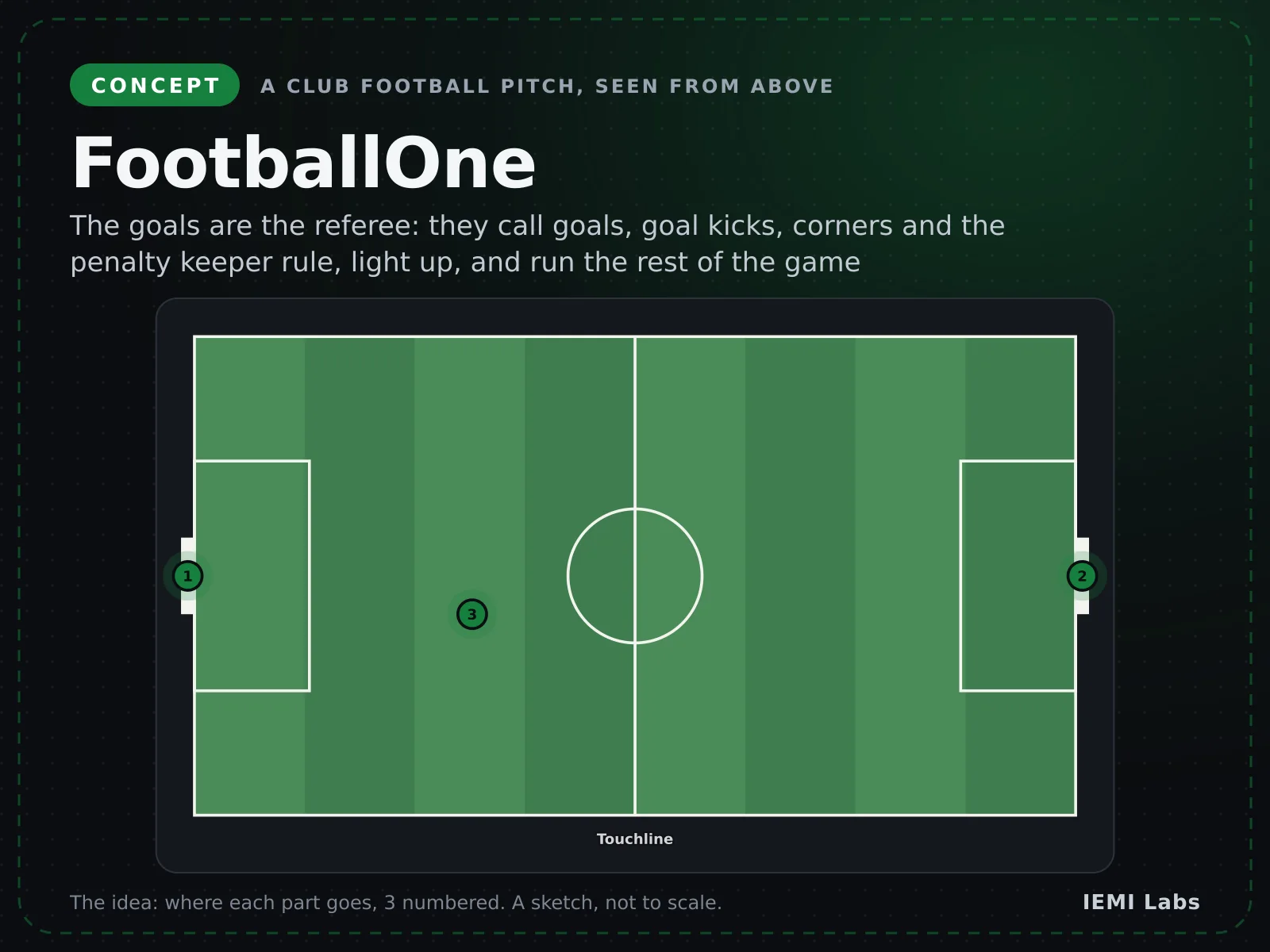
IEMI's one football product: a pair of legal full-size goals with cameras, computers, batteries and radios inside the posts and crossbar, and a referee wrist unit.
Sees the ball cross the line and buzzes the referee
Logs shots, saves and headers at goal
Counts the keeper’s 8 seconds and keeps the match clock and sin bins
From$4,690per pair of smart goals with sockets and the referee wrist unit
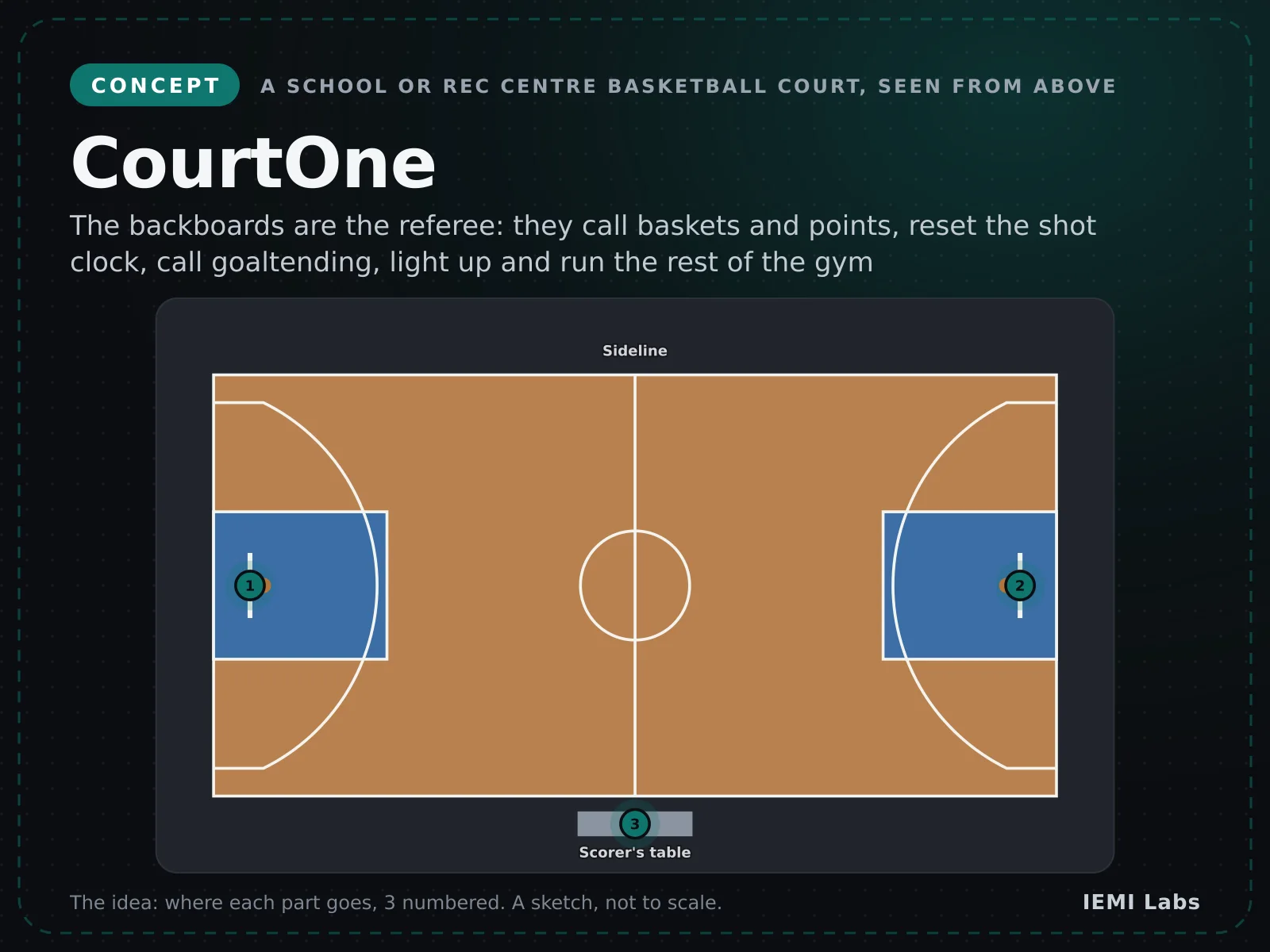
IEMI's one basketball product: the backboard, ring, padding and shot clock at both ends of a court, with a camera, a computer, a rim sensor and edge lights built in, and one app.
Counts makes, maps shot spots and feels rim hits
Runs a double-sided 24/14 or 35-second shot clock from the scorer's tablet
Lights the board edges red at the end of a period and yellow at the shot clock signal
From$4,990per court: two smart backboards with rings, padding and shot clocks