Drag to rotate · right-drag to move · scroll to zoom · click a part for its size and placeSwipe to rotate · pinch to zoom · two fingers to move · tap a part for its size
How it fits together
FieldFlag, part by part
Scroll or tap a part. Press “See the 3D CAD design” to watch the model, built from our CAD, light each part up and show how it connects.
Real-time 3D render · drag to rotate · final design may varySwipe sideways to rotate
01
The whole FieldFlag
A fence-post station finds the heat band every minute, drives a sideline display and lightning clock, and texts coaches, with a log for the AD.
02Brain
nRF9151 station board
The brain: it runs the fieldflag-station program
03
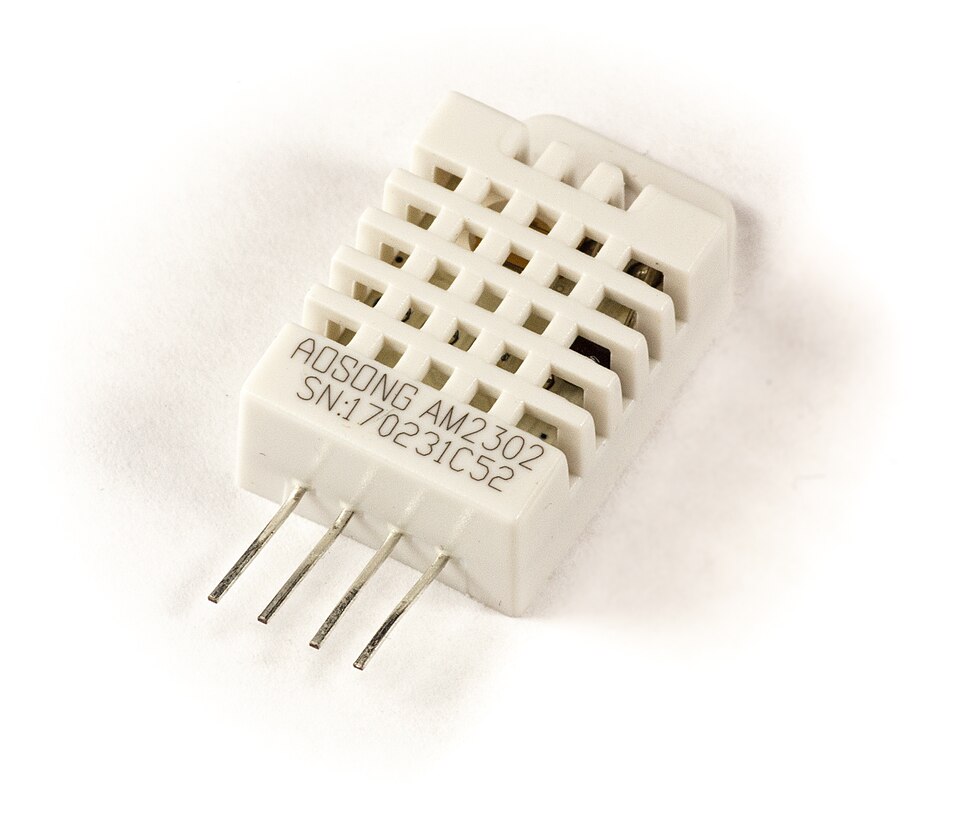
Air sensor in shield
Reads air temperature and humidity in the shade
nRF9151 station board · I²C (address 0x44) · Temperature, humidity
04
Black globe probe
Reads radiant heat from the sun at the globe's centre
nRF9151 station board · SPI (MAX31865 chip) · Globe temperature
Cover tags and wet-spot pucks report rain and soil wetness
RAK3272S receiver · LoRa 868 MHz radio · Wetness and cover state
10
All connected
8 key parts, one program, and your phone
What it is
A solar heat-stress (WBGT) station for a practice field, with an optional sideline display.
What it does
Takes WBGT readings on schedule
Runs the 30-minute lightning clock
Texts coaches the band and limits
Keeps a per-practice weather log
Who it's for
Athletic directors and head athletic trainers at high schools, and cricket club groundsmen and committees.
How the parts connect
FieldFlag, wired up
Every part, what links it to the brain, and how the data reaches your phone. A solid line is a cable; a dashed line is a radio link.
Drawn from the FieldFlag parts list. The 3D view above is built separately, from the CAD.
The program
What controls FieldFlag
Runs on
nRF9151
Written in
C with Zephyr (nRF Connect SDK)
System
Zephyr RTOS
AI model
None; a heat model and fixed rule bands
1Sample air, globe and wind sensors every 60 s
2Solve WBGT on the chip and pick the rule-set band
3Send the number and colour to the display over RS485
4Publish over LTE-M every 5 min, or at once on a change
5Keep a 7-day buffer when the network is down
fieldflag-station.cppmain loop
for (;;) {
    sample = sensors_read();            // SHT45 I2C, MAX31865 SPI, wind RS485
    wbgt = liljegren_wbgt(&sample);     // on-device, authoritative
    band = band_for(wbgt, ruleset);     // G, Y, O, R, black
    display_write(wbgt, band);          // Modbus holding registers, addr 2
    if (band != last_band || uplink_due())
        mqtt_publish_cbor("ff/dev/tele", &sample, wbgt, band);
    buffer_push(&sample, wbgt, band);   // 7 days offline
    if (band > last_band)
        evt_band(last_band, band);      // starts acknowledgement chain
    last_band = band;
    k_sleep(K_SECONDS(60));
}
To your phone
How the data reaches FieldFlag app
Coach and AD phone or laptop browser
Station
LTE-M · MQTT/TLS
Cloud
Web app, push and SMS
Coach phone
What you see in the app
One screen for each job FieldFlag does.
16:30
FieldFlag appHeat reading
Main field now Orange16:30
WBGT 87.4 °F, up from Yellow. Follow the Orange rules for breaks.
WBGT now
87.4 °F
Band
Orange
WBGT this afternoon (°F)
Heat readingFifteen minutes before practice the station reads the heat on the field. When it crosses into a hotter band, every coach is told at once.
16:52
FieldFlag appLightning stop
Clock restarted · strike16:52
Strike about 12 km away. Practice stays stopped, 30:00 from 16:52.
Clock left
18:42
Coaches told
6 of 6
18.7min
Lightning clock left
Lightning stopThe trainer presses THUNDER. The horn sounds and the sideline digits count down 30 minutes; a new strike nearby restarts the clock.
09:20
FieldFlag appHeat acclimatization
Band 31 · break too short09:20
Practised at 07:00. Your rule-set needs a 3 h break first.
Tapped in
54
Flagged
2
09:20Band 31 · day 3 · break too short
09:18Band 22 · late joiner, day 1
09:17Band 17 · day 3
09:15Band 8 · day 3
Heat acclimatizationPlayers tap in at the gate during preseason. The app counts each band's day under the state rule-set and flags a second session that comes too soon.
09:30
FieldFlag appCricket ground check
Ground page sent09:30
14 mm rain overnight, covers on 19:10 to 08:40. 2 spots wetter than baseline.
Rain overnight
14 mm
Covers
On all night
Wet spots vs baseline
Long-on
Deep square
Mid-off
Run-up north
Run-up south
Cricket ground checkAfter a wet night the cover tags and outfield pucks log the rain and wet spots. One timestamped page goes to the visitors and umpires, who decide.
App screens with sample data. The interface is in development.
What the app gets
Data FieldFlag sends to the app
Heat reading
WBGT 87.4 °F, band Orange
Every 30 min in practice
Band change alert
Yellow to Orange
On change
Lightning clock
28:15 left
During a stop
Athlete day
Band 17, day 3
Each tap
Station battery
82%
Every 5 min
Logs store band numbers, not names. Names appear only in exports by the athletic trainer or AD.
CAD design · Design complete (stages 1–6, rev A3 GroundCheck), not built, not validated
Designed in code, checked in 3D
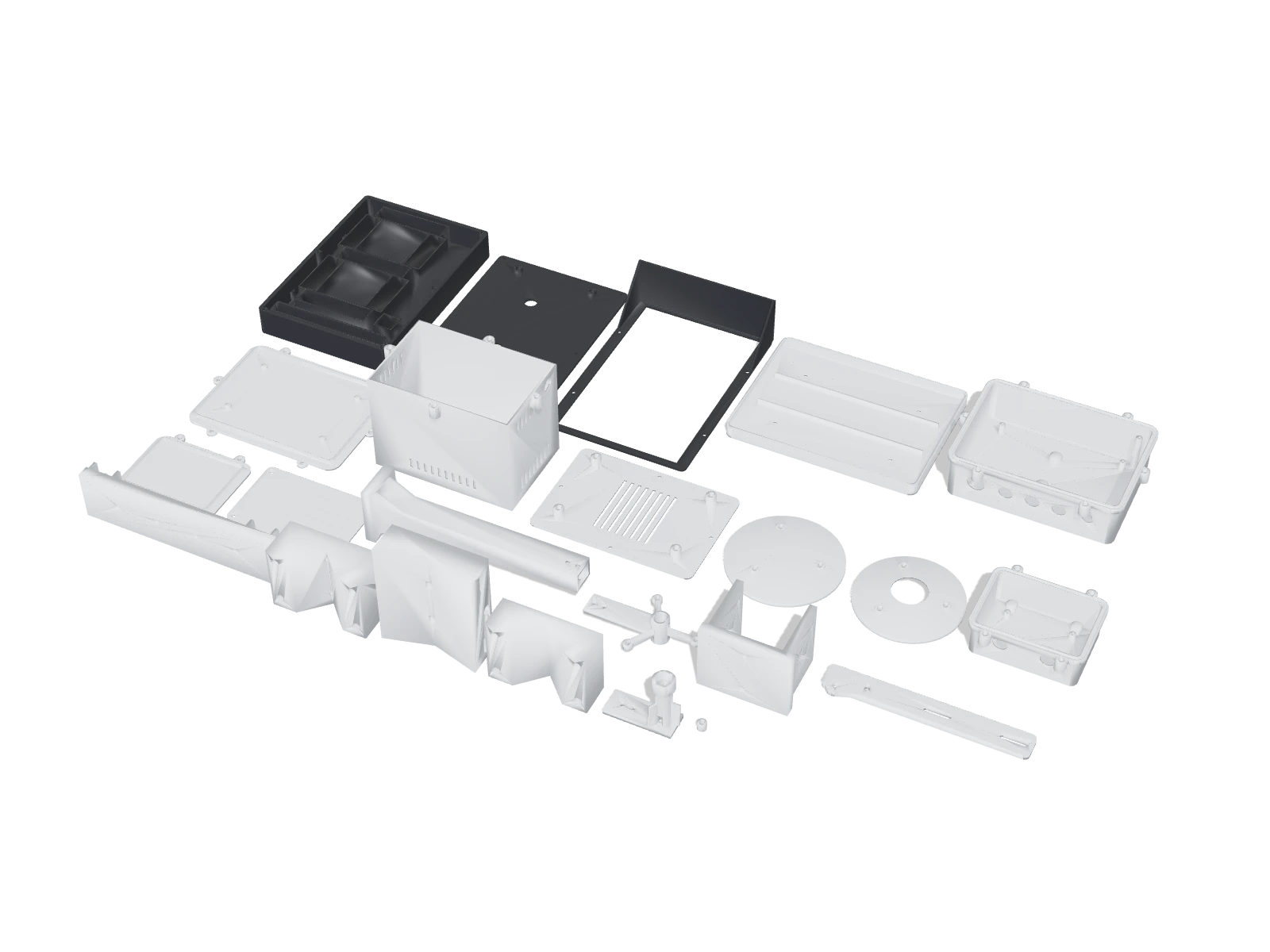
31 printed parts, each a single closed solid
Every bought part fitted inside and checked for collisions
Assembled exactly as shown in the 3D CAD view (the button on the picture at the top)
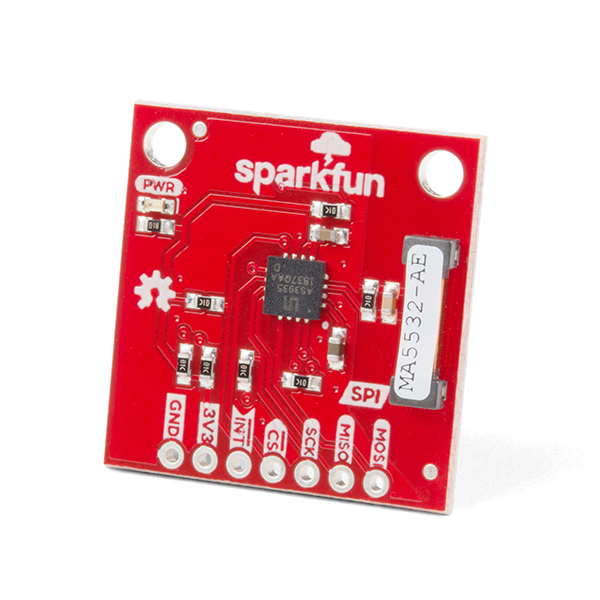
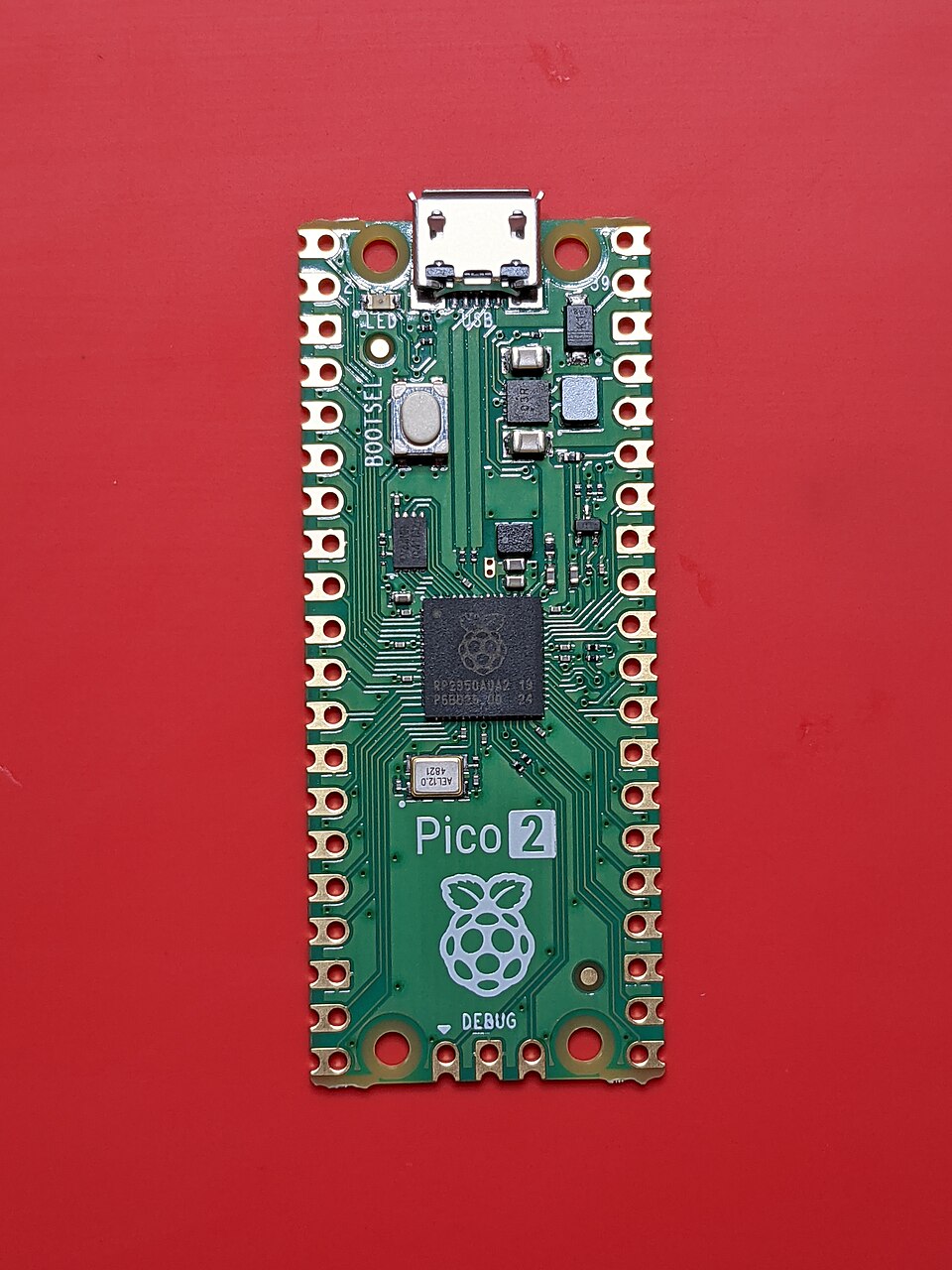
Nordic nRF9151 SiP (LTE-M + GNSS); Seeed XIAO RP2040 in the StrikeClock pod; RAK3272S LoRa (STM32WLE5) in the GroundCheck tags, pucks and receiver; Raspberry Pi Pico 2 in the optional display
Sensors
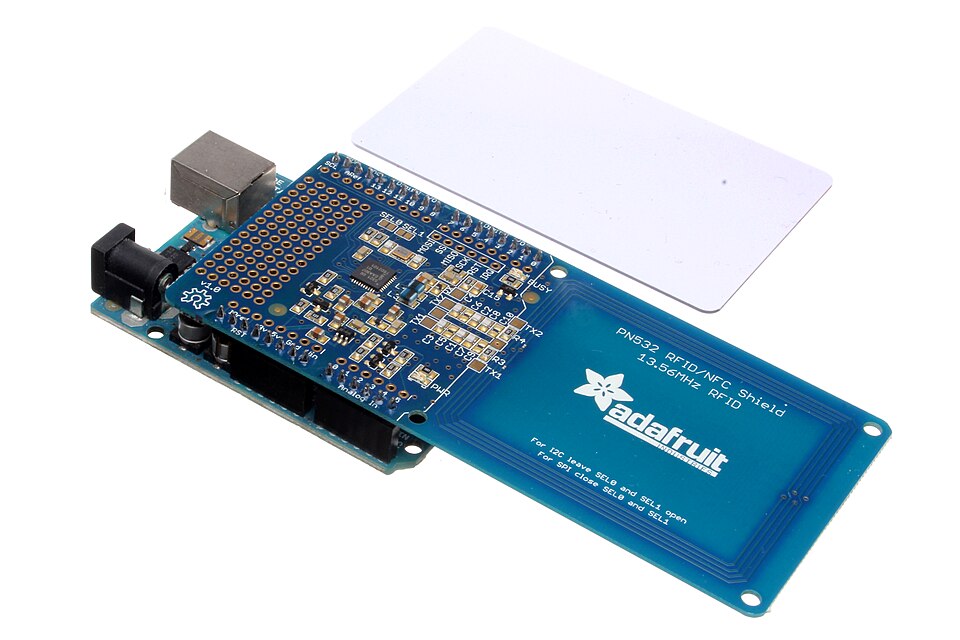
Sensirion SHT45 in an 8-plate radiation shield · PT1000 + MAX31865 in a 150 mm copper black globe · Renke RS485 ultrasonic wind sensor · ams AS3935 lightning sensor (SparkFun board) with a 16 mm IP67 THUNDER key in the StrikeClock pod · Tilt and GNSS for tamper alerts · PN532 NFC reader in the RollCall tap pod, with NTAG215 wristbands · GroundCheck: tipping-bucket rain gauge, LIS3DH motion and rain pins in each cover tag, stainless soil rods and standing-water pins in each flush wet-spot puck
Connectivity
LTE-M, MQTT over TLS with a 7-day buffer (no school Wi-Fi needed) · SMS and push alerts · RS485 Modbus to the sideline display and the StrikeClock pod · LoRa from the GroundCheck tags and pucks to a receiver box on the station bus
Power
20 W solar panel (30 W with display), BQ24650 MPPT and 12.8 V 12 Ah LiFePO4; about 4 Wh a day for the station (about 30 days in reserve), 58 Wh a day with the display, which is shed first at low battery
Enclosure
3D-printed white ASA station with hidden-screw fence clamps (41–76 mm), band-strap pole saddle (Ø100–420 mm) and cable lock; a 76 × 104 × 32 mm sealed RollCall tap pod on its own fence clamp, a 90 × 150 × 42 mm sealed StrikeClock pod with a horn port and guarded key; optional display of four black ASA 200 mm digits behind opal polycarbonate
Dimensions
Display 710 × 250 mm on two 1 in rails; station mounted at 1.2–1.5 m
Ingress rating
Display: 144 × WS2815 IP65 pixels in sealed digit boxes (hose test planned)
All target specifications
Measurement
Measurement target specifications
WBGT accuracy
MAE ≤ 0.5 °C vs an ISO 7243 reference (test target)
Calculation
Every minute, 5-minute means
Official readings
T-15, every 30 min, and on band rise
Band agreement
≥95% vs reference (test target)
Lightning clock
Lightning clock target specifications
Rule
30 min after the last thunder or strike; every new one restarts it
Inputs
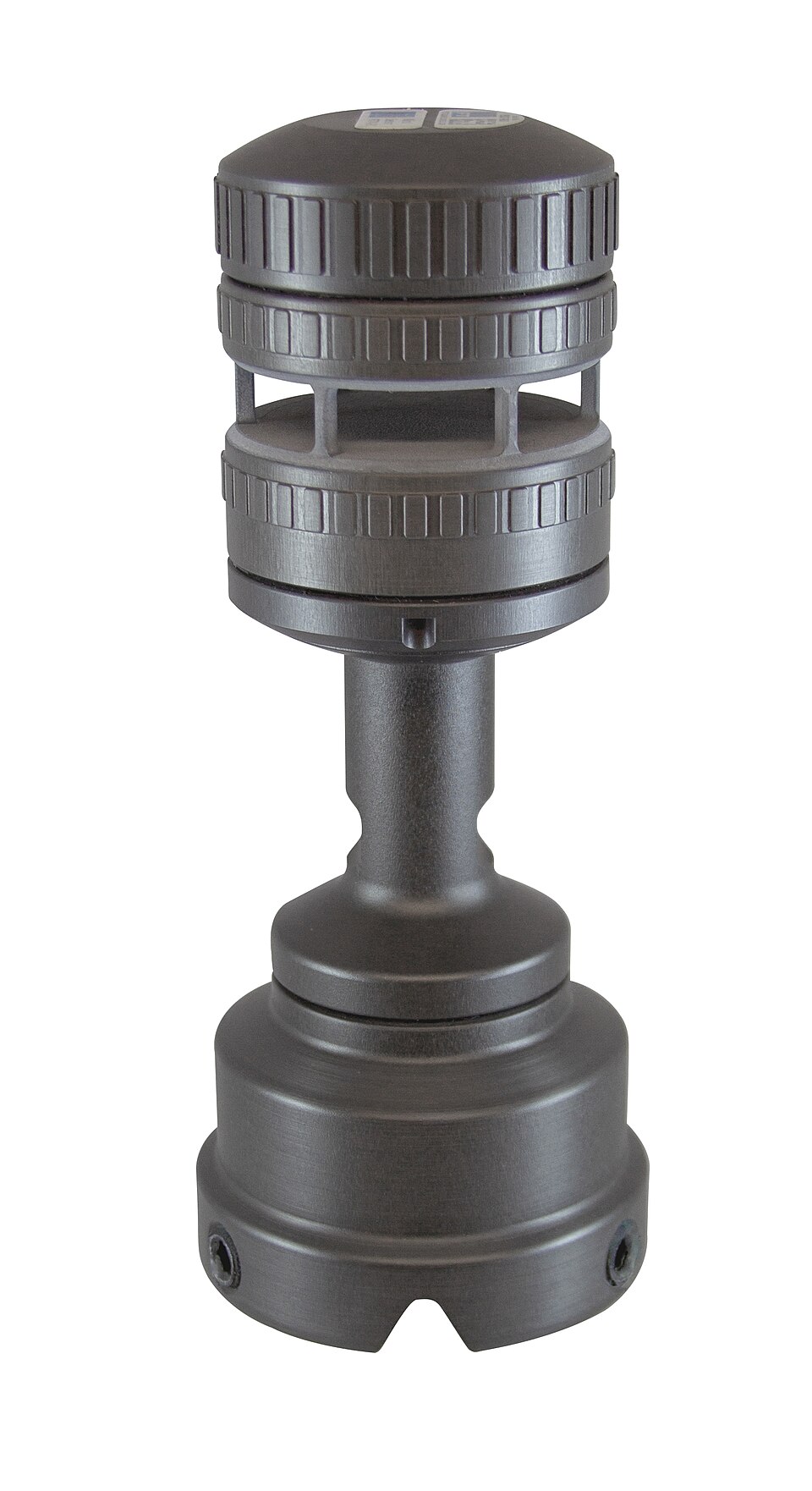
THUNDER key, app button, AS3935 strikes within the set radius
Sensor range
About 40 km, coarse 1–40 km distance steps (AS3935)
Outputs
Red countdown on the digits, horn, text to every coach and the AD
Ends a stop
Never by itself; a person gives the all-clear
Alerts and records
Alerts and records target specifications
Coach alert
Within 60 s of a band change
Escalation
AT at 10 min, AD at 20 min
Log
Hash-chained, PDF/CSV per practice
Athlete tap
≤ 0.5 s read, ≤ 3 s per athlete at the gate (test target)
Student data
Wristband numbers in the log; names only in AT/AD exports
Sideline display
Sideline display target specifications
Digits
Four 200 mm RGB digits + colour bar
Readability
Number at 30 m, colour at 60 m (to test)
Power
≤14 W at full brightness
Targets for production units; they may change during development.
Pricing
Hardware: $699–$1,496per field station
Software: $299 per station per year
Target pricing: $699 per field station, StrikeClock pod +$199, RollCall tap pod +$149 with 100 wristbands, GroundCheck cricket kit +$349, sideline display +$449, pole kit included; district bundle of 10 stations $5,990 + $2,490 a year. The subscription covers alerts, logs, the lightning clock, acclimatization tracking, the cricket ground page, the district dashboard, LTE and a recalibration swap. Estimated pilot BOM about $597 per station, $82 per StrikeClock pod, $57 per tap pod, $208 per GroundCheck kit and $333 per display.
Indicative launch pricing in USD, excluding taxes and shipping. Final pricing is confirmed before any balance is charged.
Community
What do you think of FieldFlag?
FieldFlag is in development. Rate the idea, tell us what to change about the features, specs or price, and we'll build it with your feedback.
After rain the groundskeeper must decide whether to mark lines and whether a field is playable: paint makers say to let the field dry fully before striping (Krylon, Rust-Oleum), parks departments post open or closed by 7 am (Montgomery Parks, Rainout Line), and Canberra and Moreton Bay check wet spots with sensors because damage happens under the surface. Our SmartLine Guide and a FieldFlag station with GroundCheck cost $3,538 + $647 a year together.
Combined into GroundsKit (https://iemilabs.com/products/groundskit/); FieldFlag itself is unchanged
A high-school practice field shared by football, soccer and track needs a WBGT heat reading and log (UIL rule from 1 Aug 2026, GHSA on-site rule), a 30-minute lightning clock (NFHS guidelines), heat-acclimatization check-in and weekly sprint testing, and hosts league matches where referees use electronic flags. Today that is a Kestrel ($554-786) or a Perry Weather subscription, stopwatches or $940-1,100 gate pairs, and $900 ErvoCom flags.
Combined into FieldSide (https://iemilabs.com/products/fieldside/); FieldFlag itself is unchanged
On a wet Saturday, club cricket leagues expect the home club to have covered the pitch and run-ups and to let the visitors see the ground before a match is called off. Shropshire and Birmingham leagues take 24 points from a home club that cancels without that, and a dispute needs an independent umpire. Under MCC Law 2.7 and ECB guidance, only the umpires decide, after walking the whole field. Sources: ECB Guidance on Ground, Weather and Light; Shropshire and Birmingham league rules; Yorkshire Premier League North; MCC Law 2.
New CAD parts covertag-case and covertag-lid: a small tag strapped through each cover eyelet that sees the cover pulled on or off and rain landing on it (17/17 fit checks)
New CAD parts wetspot-body and wetspot-cap: a sensor set flush in a standard 108 mm hole-cutter hole at the outfield's wet spots and the run-up ends, with soil rods and standing-water pins (19/19 fit checks)
School athletic directors must stop outdoor practice at the first thunder or lightning, wait 30 minutes after the last one, and start the 30 minutes again every time there is more; detectors can help but must never be trusted over what people see and hear (NFHS lightning guidelines, NATA 2013). Most schools keep that clock with a stopwatch, while a district lightning system cost one Tennessee board $10,000 a year plus $4,400 to set up (CNHI News).
New CAD parts: StrikeClock pod case and lid, a sealed fence pod holding a lightning sensor board, its own small controller, a 12 V horn, a red light and a guarded THUNDER key; 15 of 15 and 8 of 8 fit checks pass
Two fit problems fixed in CAD: the cable gland nut hit the floor (moved up) and the key thread was too tight (hole opened to 16.8 mm)
New lightning clock: any THUNDER press, app press or sensor strike inside the school radius restarts 30:00 in red on the sideline digits and texts every coach; it never gives the all-clear by itself
Bill of materials +11 rows: about $82 in parts per StrikeClock pod; target price +$199 per field
Product page updated: summary, highlights, use cases, how it works, specs, pricing, app screen and two new FAQs on the lightning clock and its limits
Design notes: new section 9 with 10 sources, a rules note and 5 new tests; sports shortlist re-scored at 25/30 (rank 2)
High-school coaches must run the 14-day heat-acclimatization plan for each athlete, not the team: late joiners start at day 1, missed days do not count, helmets only at first, and no second session in the first 5 days (NATA consensus statement; NJSIAA, UHSAA and MSHSAA state rules).
New CAD parts: RollCall tap pod case and lid, holding an NFC reader under a raised tap target, 3 coloured lights and a buzzer, on a fence clamp; 21 bought-part checks pass, lid on case 0 mm³
Software design: a rule-set engine that counts each athlete's day, gear level, rest days and the 3-hour gap before a second session, for 7 state rule-sets
BOM: tap pod about $57 with 100 wristbands (est.); target +$149 per field
Design doc: dated section with 9 sources, 5 new tests and a new student-data policy; product page summary, highlights, use cases, specs, price and FAQs updated
No. FieldFlag is a concept in the in-house design and testing stage. The design is complete on paper and in CAD, but it has not been built or validated, and all specifications are targets.
Is it UIL approved or required?
No. The UIL allows an on-site instrument or an internet forecast and only recommends records. FieldFlag saves the labour of taking readings, measures at your field, sends alerts and keeps evidence; it is not a compliance certification. Georgia's GHSA does require an on-site instrument.
Does it decide whether practice is safe?
No. FieldFlag measures and records. The coach and athletic trainer make the decisions.
Does GroundCheck decide if a cricket ground is fit for play?
No. Under MCC Law 2.7 the umpires alone decide whether conditions are dangerous or unreasonable, and ECB guidance says they must walk the whole field themselves. Without umpires, the captains decide under the league's rules. GroundCheck shows rain, covers, wet-spot readings and photos with times, and never shows "fit" or "unfit".
Can a home club cancel a cricket match using the ground page?
Only if the league's rules allow it. Many leagues (for example Shropshire and Birmingham) deduct 24 points from a home club that cancels without letting the visitors view the ground. The page helps both captains agree early; it does not replace the visitors' right to travel and look.
Will wet-spot pucks get in the way of fielders or mowers?
They sit in a standard 108 mm hole-cutter hole with the cap flush with the soil, like an irrigation box, placed by the groundsman in known wet spots and at the end of the run-ups, never on the pitch. Survival under mowers, rollers and spikes is still to be tested.
How does the lightning clock work?
When anyone presses the THUNDER key or the app button, or the AS3935 sensor hears a strike inside your school's radius, the sideline digits count down 30 minutes in red and every coach and the AD get a text. Any new thunder press or strike restarts it at 30:00, as the NFHS guidelines say. When it reaches zero it only tells your designated person; they check the sky and give the all-clear.
Is it a certified lightning detector?
No. The AS3935 is a low-cost sensor with a coarse distance estimate and some false alarms, and NFHS says never to rely on detectors over what people see and hear. That is why the THUNDER key comes first and FieldFlag never ends a stop by itself. It does not replace your lightning policy or safe shelter.
Why might it read lower than our Kestrel?
A published comparison found a Kestrel read about 0.7 °C warmer than an ISO-compliant meter at high-school sites. If FieldFlag is accurate it should read about 0.5–0.7 °C below a Kestrel. We will publish our accuracy test and never add an offset to match.
How does it track each athlete's acclimatization day?
Each athlete taps a numbered wristband on the RollCall pod at the gate on the way in and out. A day counts only after both taps inside a scheduled practice. FieldFlag follows the rule-set your school picks: late joiners start at day 1, missed days do not count, rest days are added, and a second session is flagged if it comes too soon. The coach and athletic trainer still decide, and can correct a day by hand.
Does it collect student data?
Only if you use RollCall. The wristband holds a random ID, the log stores band numbers, and names appear only in exports by the athletic trainer or AD. Data is not sold or shared and is deleted at the end of the season unless your district keeps it. Without RollCall, teams are labels and the only contacts are staff.
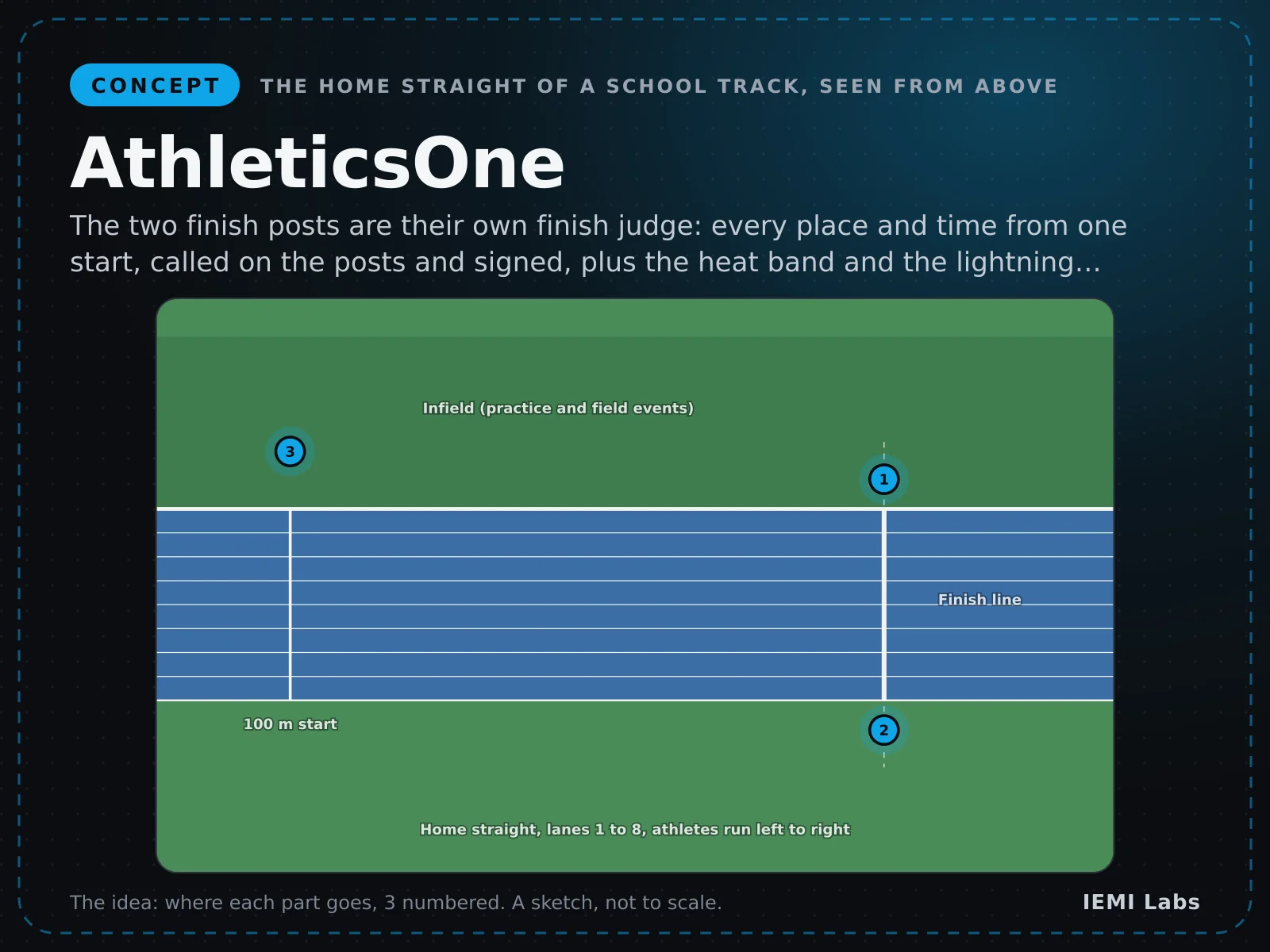
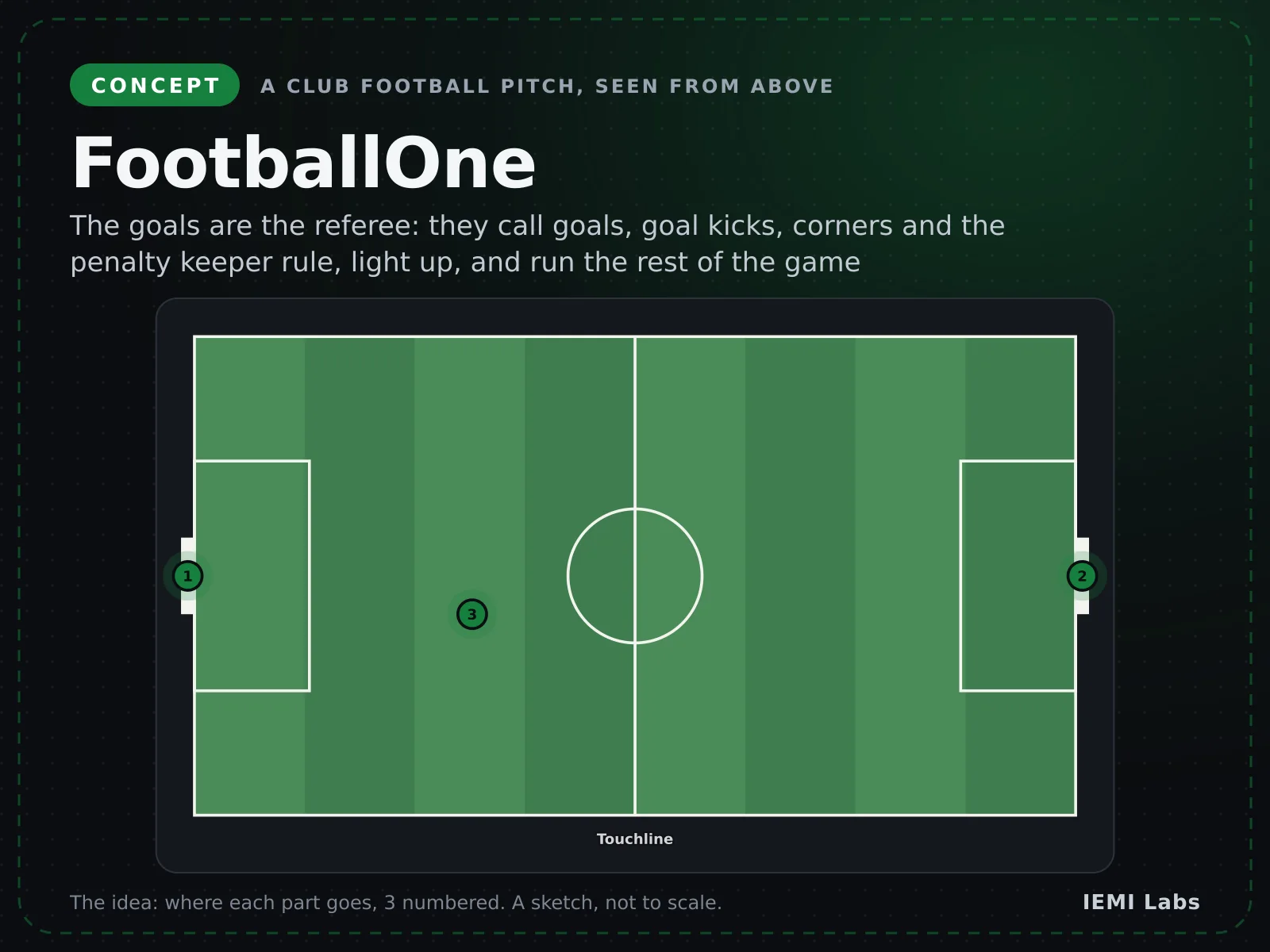
IEMI's one football product: a pair of legal full-size goals with cameras, computers, batteries and radios inside the posts and crossbar, and a referee wrist unit.
Sees the ball cross the line and buzzes the referee
Logs shots, saves and headers at goal
Counts the keeper’s 8 seconds and keeps the match clock and sin bins
From$4,690per pair of smart goals with sockets and the referee wrist unit