PanelSense
Hot electrical connections caught between annual infrared surveys
Catches hot connections in low-voltage panels between annual IR surveys, using battery-free RFID contact tags on bare busbar joints and a thermal-array node on plastic-bodied breakers, and gives the contractor written evidence of each alert and what was done.
- Who buys it
- A plant maintenance manager, buying through their thermographer or electrical contractor, who installs during a planned shutdown and resells monitoring.
- Why it pays
- One avoided connection failure in a mid-size plant is about $105k (8 h × $10k/h + $25k repair, est.); the honest expected value is about $3–10k/yr per 20-panel site (est.). No survey or insurance savings are claimed.
- Target price
- $399 node (reader included), $49 per joint tag, $299 hub, $8/node/month monitoring (target, a hypothesis for the channel test)
- First-minute wow
- A live temperature map of every panel joint on one screen.
What the research found
And how this design answers it
- Bare copper can't be read by IR (emissivity) → battery-free contact RFID tags on bare joints; high-emissivity dots on any bare metal the array must see
- MLX90640 can't separate adjacent lugs → array watches whole regions with phase-peer comparison; lugs that matter get a tag
- Installs need a de-energized outage → designed for ≤ 5 minutes per point, nothing wired except an optional CT
- Unlisted device in listed gear → no mains connection, passive tags, battery node on the door only, UL-recognised 333 mV CT, clearance record per install
- False alarms push equipment to NFPA 70B Condition 3 → peer ΔT, load normalisation, door and ambient suppression, persistence; target < 1 notification per site per week
- Steel cabinet blocks radio → sub-GHz LoRa with the antenna on a coax lead through a knockout or door seam to an outside hub
Use case
Loose lug warming over three weeks
Plant maintenance managerContractor thermographerElectricianIEMI cloud
- 01Trigger: the L2 incoming-lug tag's load-normalised rise over its L1/L3 peers climbs from +2 °C to +8 °C over 21 days
- 02Detection: the node reads the 3 tags and the CT every 20 minutes; a dashboard-only Watch appears on day 14, then a Warning when +8 °C holds for 6 h
- 03Alert: e-mail/SMS to the thermographer and manager, and the hub's dry contact raises a maintenance alarm in SCADA
- 04Action: the thermographer confirms through the IR window; the electrician re-terminates the lug at the Saturday changeover and the alert is marked Addressed
Outcome: The 70B log shows the notification raised and addressed within 6 days; a planned fix of about $400 instead of an unplanned stop of about $105k (est.)
How it works
Architecture
- 01
Sense: Axzon AZN3254 passive UHF RFID tags on bare joints; MLX90640 32×24 thermal array on plastic parts; optional CT for load
- 02
Decide: node computes per-region max/p90; the cloud applies peer ΔT, I² load normalisation, door/ambient suppression and persistence rules
- 03
Send: RAK3172 LoRa (AES-128-CCM) out of the steel cabinet to a hub, then MQTT over TLS via Ethernet or Wi-Fi
- 04
Tell: contractor dashboard, e-mail/SMS, hub dry contact to SCADA, and a quarterly NFPA 70B evidence report
Hardware
Real parts, buyable today
Bill of materials: about $317 per node at qty 1, $167 of it the RFID reader; rev B target ≤ $150 (est.).
| Block | Part | Why this part |
|---|---|---|
| Joint sensor | Axzon AZN3254 battery-free UHF RFID temperature tag | No battery on a live conductor; contact reading where IR can't see bare copper |
| Thermal array | Melexis MLX90640 (55°) | Battery-viable region monitoring of breakers and contactors |
| RFID reader | ThingMagic/JADAK M7E-HECTO (Impinj E310), power-gated | Reads tags 10–60 cm away inside the same cabinet |
| MCU + LoRa | RAK3172 (STM32WLE5CC) | Shared platform module, FCC-certified |
| Battery | Saft LSH20 D cell, Li-SOCl₂ spiral | Handles the reader's ~200 mA pulses; about 3 years at 7.7 mAh/day (est.) |
| Hub | ESP32-S3 + RAK3172 + WIZnet W5500 Ethernet, Class 2 power | Plants often bar OT from Wi-Fi; no mains inside our enclosure |
Mechanical
Printable CAD
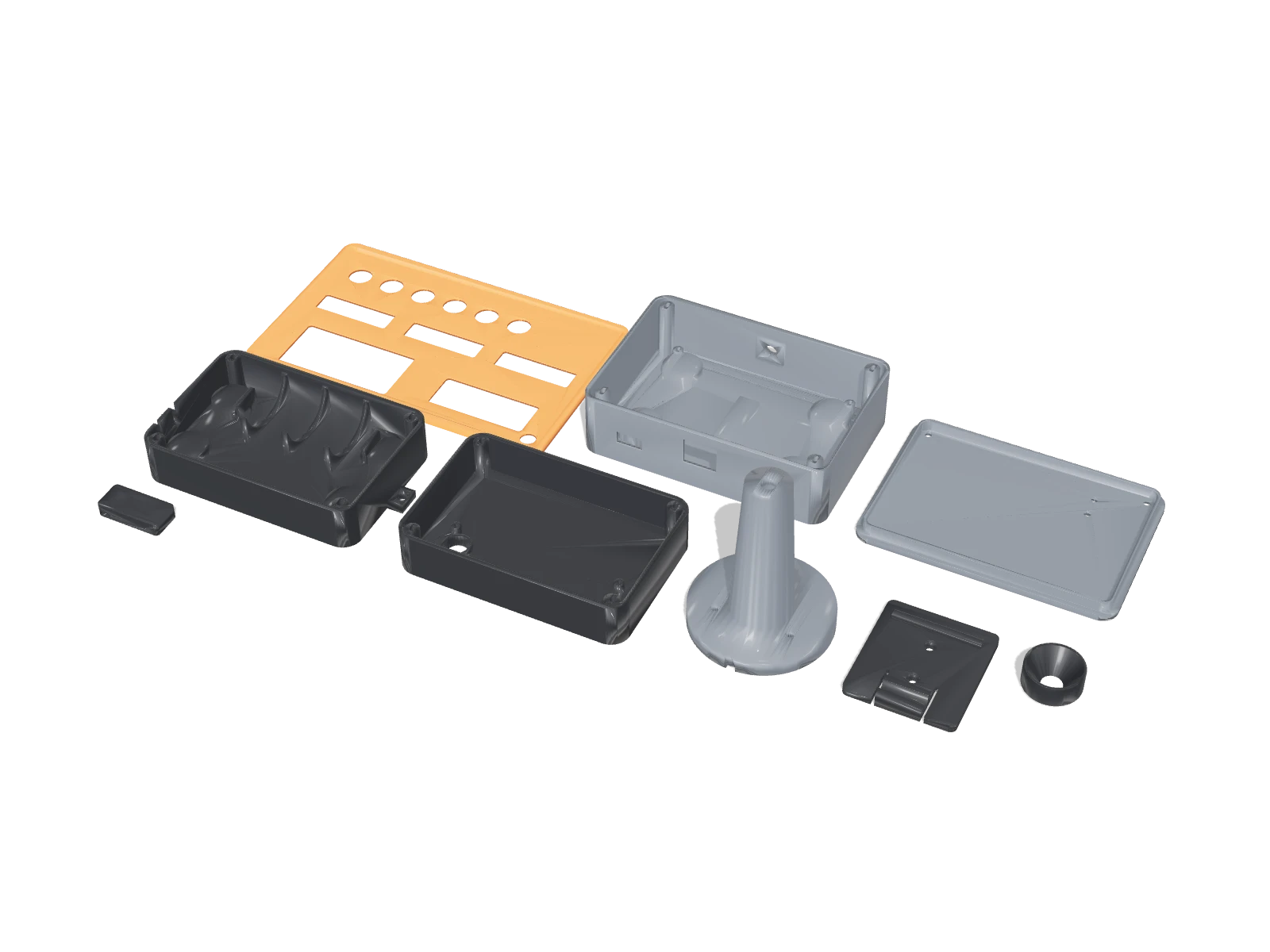
9 parts, generated from code and checked as closed solids. Pick a part to inspect it, or download the STL files to print.
See the CAD parts render
Loading the CAD…
Real CAD · drag to rotate · scroll to zoomReal CAD · swipe sideways
Bought hardware fitted inside this part (checked in the CAD: nothing collides with the plastic)
- Thermal node frontnode-front.stl · PC-FR (prototype)
- Thermal node back with magnets and tether tabnode-back.stl · PC-FR (prototype)
- Thermal array lens hoodnode-lens-hood.stl · PC-FR, black matte
- Joint tag carrierjoint-tag-carrier.stl · PC-FR (production PEI or PPS)
- Hub basehub-base.stl · PC-FR or PETG
- Hub lidhub-lid.stl · PC-FR or PETG
- Hub DIN rail cliphub-din-clip.stl · PC-FR (or PA12)
- Magnet antenna standoffantenna-standoff.stl · PETG or ASA
- Label and emissivity-dot templatelabel-template-plate.stl · PETG
Open risks we are working on
- Margin: a $399 node sold at a ~30% channel discount loses money until rev B moves the reader on-board
- AZN3254 FCC part number, US price, accuracy and reader command compatibility are unverified
- An AHJ or switchgear OEM may refuse an added device in listed gear (kill criterion)
- Printed PC-FR is for pilots only; production needs UL-recognised moulded PC/ABS V-0
- Some sites ban lithium cells in electrical enclosures
- Freedom-to-operate search and product liability insurance are needed before production and the first paid pilot
Design stage only: nothing on this page is for sale. Specifications and prices are targets.