WaterLeak Building
Supervised leak sensing for buildings, and a TankWatch kit for the water heater in your home
Finds water under water heaters, sinks, washers and in pipe chases across a whole building, alerts the on-call team, lets the manager close a listed valve on the affected riser, and keeps a tamper-evident log.
- Who buys it
- Property managers and owners of multifamily buildings (20 to 300 units) and small commercial buildings.
- Why it pays
- A leak caught in minutes stays in one unit instead of soaking the floors below (multi-unit losses often $20k to $50k or more, est.); a 96-unit building costs about $9k installed + $144 a month, against $50k to $200k for per-unit shut-off devices.
- Target price
- Sensor $29, valve node $199 (valve and plumber extra), LTE gateway $349, $1.50 per apartment per month (target); TankWatch home kit $69 (target)
- First-minute wow
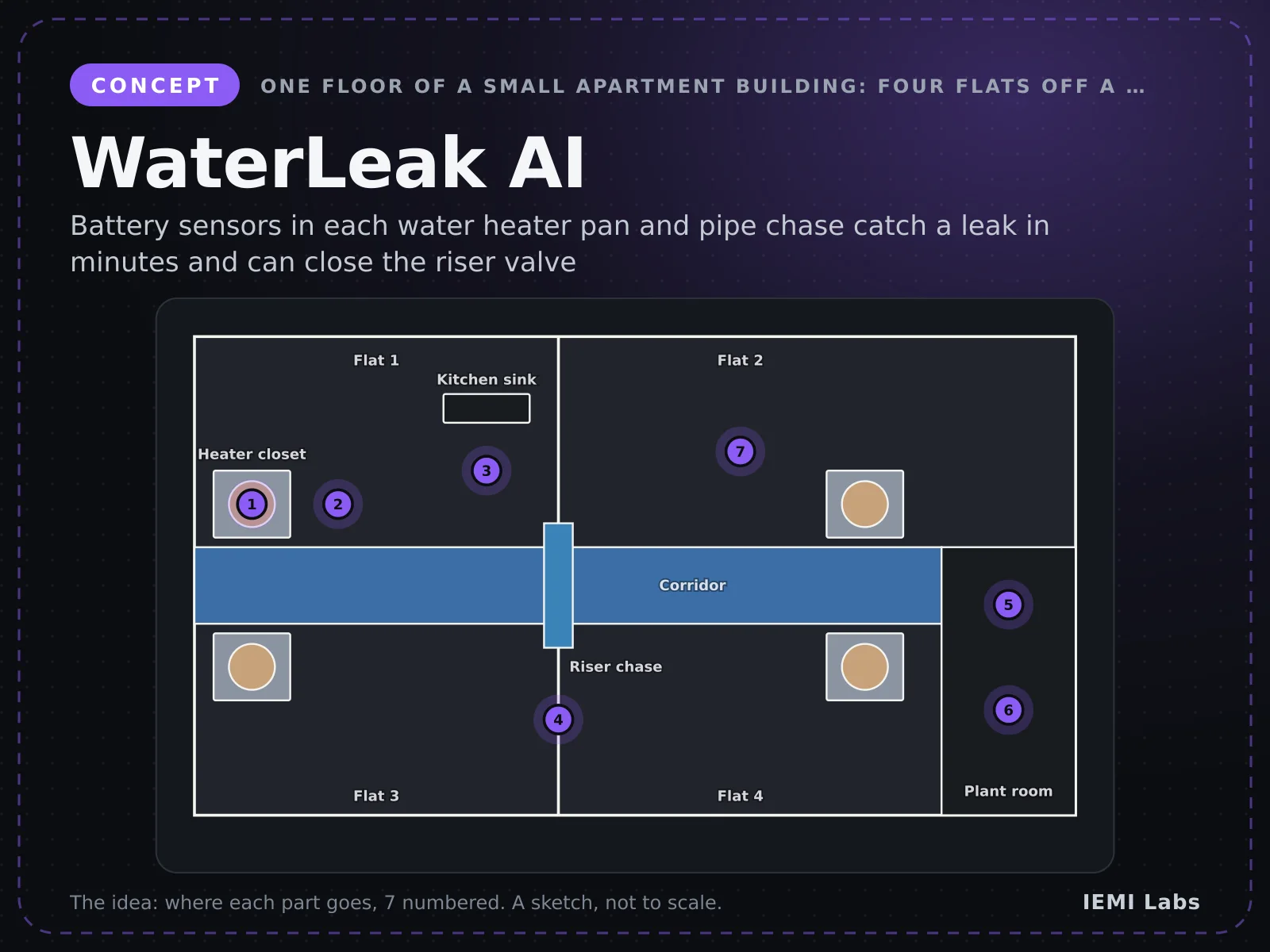
- A floors-by-risers grid of the building where a wet sensor turns its unit red, and two wet sensors on one riser bring up a 'close riser B' card naming the units that will lose water.
What the research found
And how this design answers it
- Home water heaters (R8, 26 Oct 2026): the 56 mm sensor cannot fit in the 25 mm ring between tank and pan → TankWatch pan finger puts the pads on the pan floor, and pipe clips catch a dripping relief valve, night hot-water use and freezing
- $16 Govee and YoLink sensors → sells the supervised building system (heartbeats, mapping, escalation, valve, logs), not the sensor
- Insurers give single-home shut-offs away → works at riser and branch level for buildings with shared risers, and exports logs for brokers
- Camera and NPU on battery wasn't credible and invaded tenant privacy → camera removed; contact pads, rope and humidity on 2×AA for about 5 years
- Unreliable tenant Wi-Fi → LoRaWAN through floors to a property-owned LTE gateway
- Shut-off liability → listed potable valve on domestic lines only, never fire lines; two-signal rule or manager confirm; fails as-is
Use case
Riser joint fails inside the pipe chase
Property managerOn-call technicianPlumberTenants on riser B
- 01Trigger: a fitting on riser B fails between floors 5 and 4
- 02Detection: chase sensors in 502 and 402 go wet 6 minutes apart and the riser meter shows burst flow
- 03Alert: 'Riser B leak suspected' with a tap-to-close card to the manager
- 04Action: the manager taps close, the valve node shuts the listed valve and confirms it, tenants get an SMS
Outcome: Water off to one riser 10 minutes after first detection; riser A keeps water; damage limited to two chase walls instead of several units (est.)
How it works
Architecture
- 01
Sense: RAK3172 spot sensors with stainless contact pads, optional rope and SHT40; valve nodes read meter pulses and valve position
- 02
Decide: sensors wake on water with no polling; valve nodes enforce relay interlocks and authenticated commands
- 03
Send: LoRaWAN 915 MHz to RAK7268CV2 gateways with LTE backhaul, then ChirpStack and MQTT
- 04
Tell: rules for wet, riser leak, night flow, burst, freeze and offline; escalation, floor-stack dashboard and hash-chained reports
Hardware
Real parts, buyable today
Bill of materials: about $17 per sensor, $51 per valve node (excluding valve) and $249 per gateway at qty 10–100 (est.); TankWatch home kit about $32 at qty 100 (est.).
| Block | Part | Why this part |
|---|---|---|
| Radio + MCU | RAKwireless RAK3172 (STM32WLE5 + SX1262) | LoRa through concrete floors; runs straight from 2×AA |
| Water sense | 2× M3 A2 stainless screws as pads + M8 rope input | Interrupt on wet with a 0.35 mm gap; cheap and field-replaceable |
| Valve | Belimo B2100PW-Q + LRX24-3-S (NSF/ANSI 61 + 372 per listing) | Listed potable valve with position feedback, fitted by a plumber |
| Node power | TI LMR36006 from a listed 24 V Class 2 transformer | Runs from 24 VAC or DC; no mains in the printed box |
| Gateway | RAKwireless RAK7268CV2 (LTE) | Off-the-shelf, owned by the property, independent of building Wi-Fi |
| TankWatch (home) | 3x DS18B20 stainless probes + printed pan finger on the rev A sensor | Pan water, relief-valve drip, hot-water draws and freeze from one battery sensor |
Mechanical
Printable CAD
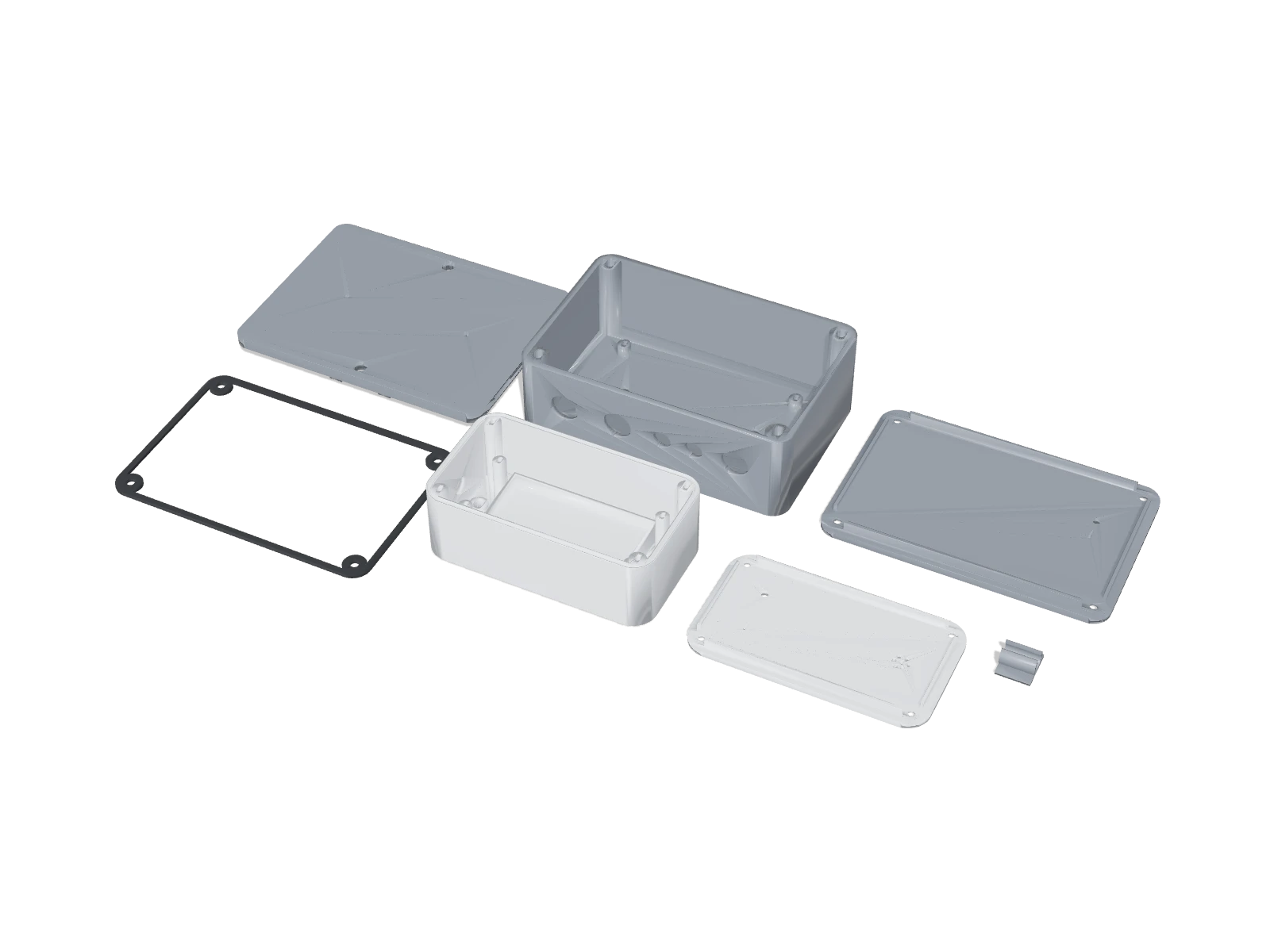
10 parts, generated from code and checked as closed solids. Pick a part to inspect it, or download the STL files to print.
See the CAD parts render
Loading the CAD…
Real CAD · drag to rotate · scroll to zoomReal CAD · swipe sideways
Bought hardware fitted inside this part (checked in the CAD: nothing collides with the plastic)
- Sensor basewl-sensor-base.stl · PETG
- Sensor lidwl-sensor-lid.stl · PETG
- Rope clipwl-rope-clip.stl · PETG
- Valve node basewl-riser-base.stl · PETG
- Valve node lidwl-riser-lid.stl · PETG
- Valve node gasketwl-riser-gasket.stl · TPU 95A
- Pipe and strut bracketwl-pipe-bracket.stl · PETG
- TankWatch pan fingerwl-pan-finger.stl · ASA
- Probe clip, 3/4 in copper or PEXwl-probe-clip-22.stl · ASA
- Probe clip, 3/4 in steel nipplewl-probe-clip-27.stl · ASA
Open risks we are working on
- Property managers may buy from bundled smart-apartment platforms instead of a single-purpose vendor
- Riser valves need plumbers, permits and owner sign-off; install friction may stall deals
- Concrete floors may need more gateways than planned; a site survey sets the count
- YoLink or SmartRent could add riser-level valves and logs
- TankWatch: whole-home leak and flow brands (YoLink, Moen, Phyn) could add a pan probe; heat-pump heaters may need tuned thresholds
Design stage only: nothing on this page is for sale. Specifications and prices are targets.