FanLamp
The blue boom light you spray by at night, made to check every nozzle
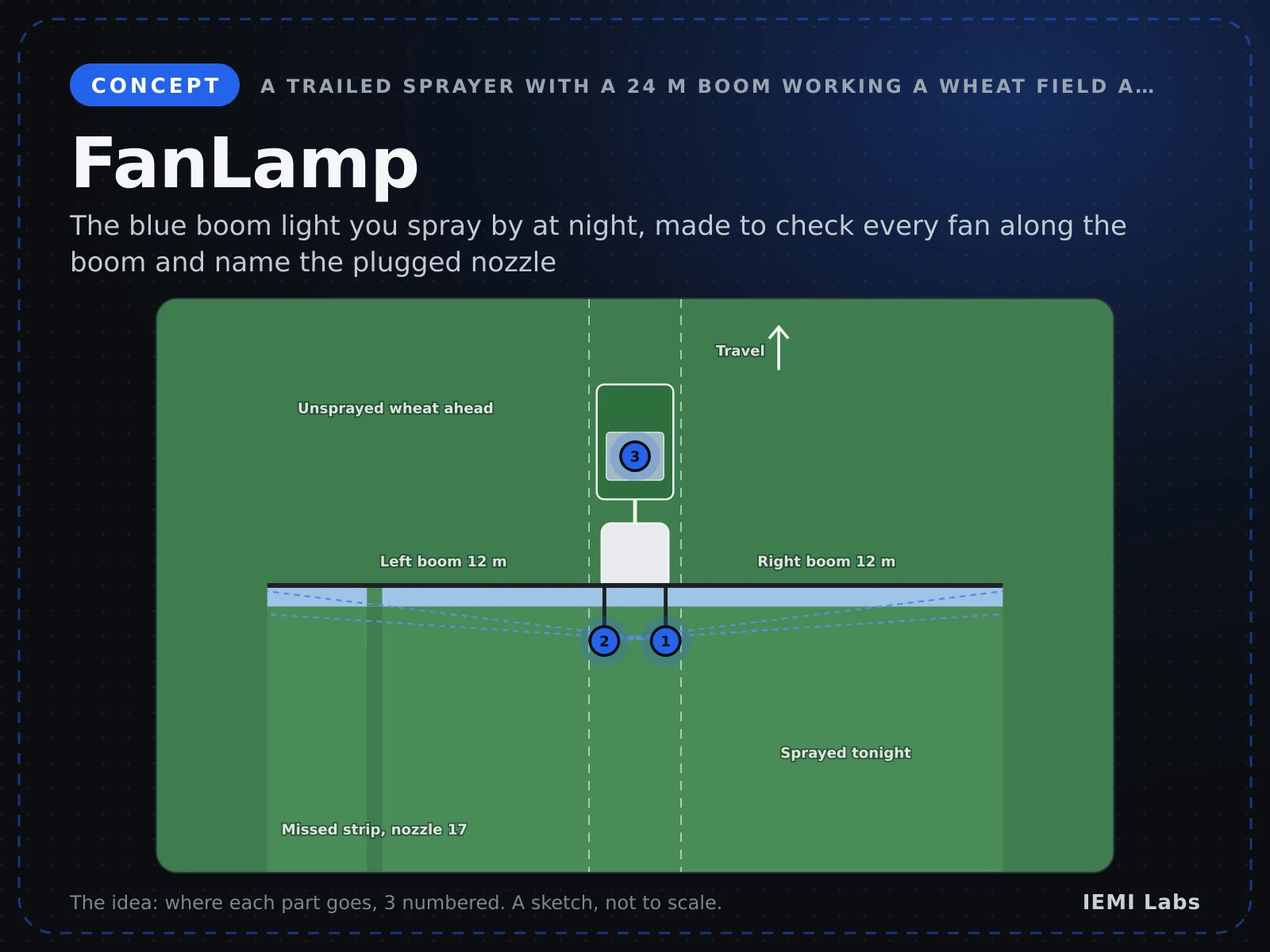
Lights the spray fans like a normal blue boom light and, with a camera beside the LEDs, checks every fan along the boom every few seconds, so a plugged, half-plugged or dripping nozzle shows up on the cab phone with its number. Monitor and alert only: it never switches a section or a nozzle.
- Who buys it
- Farmers and custom applicators with 18-36 m trailed or self-propelled sprayers who spray at dusk, at night or early morning and have no per-nozzle flow monitor.
- Why it pays
- A plugged nozzle at 20 km/h leaves about 1 ha of untreated strip per hour unnoticed (est.); a 24 m boom kit is about $273 of parts (est.) against about $1,583 for a TeeJet Sentry 6140 base kit before any nozzle sensors.
- Target price
- $249 per lamp, $449 for a 24 m pair (target)
- First-minute wow
- 'Left boom, nozzle 17: fan gone' on the cab phone 3 seconds after the tip plugs, at night, with a picture of the gap in the fans.
What the research found
And how this design answers it
- Per-nozzle flow monitors cost thousands for a full boom and only alarm at about a 20% flow drop → one camera checks every fan's shape, and the CAD report shows it sees a 3% width loss at 9 m and 9% at 15 m (est.)
- A camera beside the boom sees the fans edge-on → the lamp sits 1.5 m behind the nozzle line on an arm; at 0.5 m it only checks out to 9.4 m, at 1.5 m to 16.2 m (CAD report)
- One lamp per side misses the nozzles nearest the centre → each lamp is mounted 1 m across the centre line, so one pair covers a 24 m boom and 2 pairs a 36 m boom
- Operators trust a steady rate on the cab display and stop looking → the alert names the nozzle, so it needs no looking
- A bright boom light glares and draws 25-30 W → the LEDs strobe with the camera exposure (about 9 W total, est.)
Use case
Tip plugs with tank-mix residue, 22:40
OperatorFarm ownerCustom applicator manager
- 01Trigger: a 0.5 m tip on the left boom plugs with gel from a poorly mixed load
- 02Detection: its fan disappears between two full fans in 2 checks in a row (about 6 s)
- 03Alert: phone chime in the cab, 'Left, nozzle 17: fan gone', with the photo and the GPS point where it started
- 04Action: the operator stops, swaps the tip, and goes back over the 300 m strip marked on the map
Outcome: About 0.1 ha re-sprayed instead of finding a weedy stripe a week later (est.)
How it works
Architecture
- 01
Sense: a 12 MP camera looks along the boom while the blue LEDs strobe during each 1 ms exposure
- 02
Decide: per-nozzle columns found once at setup; each fan's width and brightness compared with its neighbours and its own history on the Pi Zero 2 W
- 03
Send: Wi-Fi to a phone or tablet page in the cab, no internet needed
- 04
Tell: chime plus nozzle number, photo and GPS point; a nightly list of nozzles to clean or replace
Hardware
Real parts, buyable today
Bill of materials: about $136 per lamp at qty 1, about $70 at qty 500 (est.); 2 lamps for a 24 m boom.
| Block | Part | Why this part |
|---|---|---|
| Camera | Raspberry Pi Camera Module 3 (IMX708, 4608 px, 66 deg) | Enough pixels to give each fan its own column out to 16 m at a 1.5 m offset |
| Compute | Raspberry Pi Zero 2 W | Runs the fan check in the lamp and serves the cab page over Wi-Fi |
| Light | 2 x royal-blue 450 nm LED stars with 15 deg optics + MEAN WELL LDD-1000H | Blue makes the droplets show at night; strobed with the exposure |
| Power | Pololu D24V22F5 buck from the 12 V light circuit | About 9 W total (est.) |
| Mount | 50 mm square aluminium arm + 2 in square M8 U-bolts | Holds the lamp 1.5 m behind the nozzles, so fans are seen at an angle, not edge-on |
Mechanical
Printable CAD
3 parts, generated from code and checked as closed solids. Pick a part to inspect it, or download the STL files to print.
See the CAD parts render
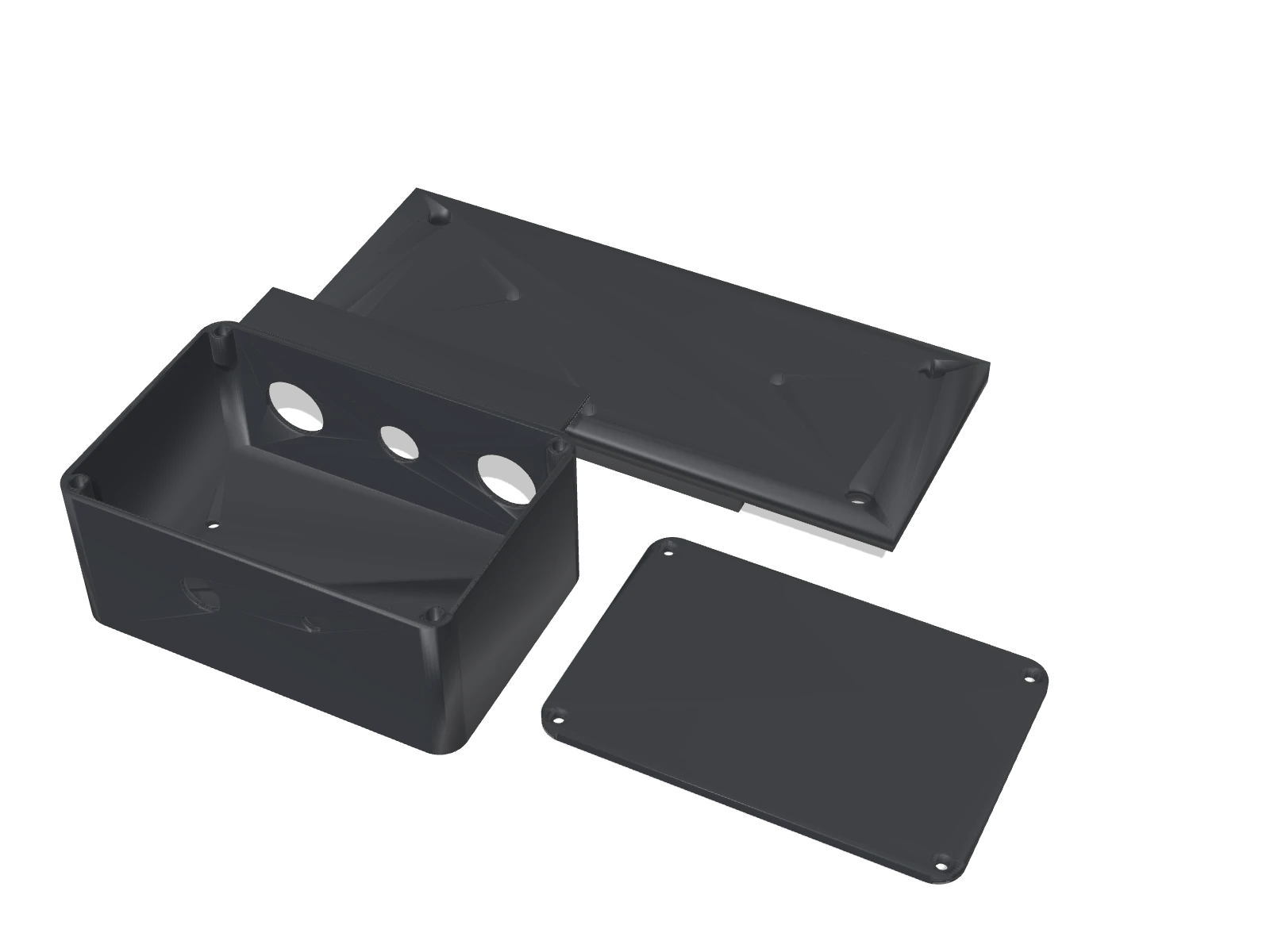
Loading the CAD…
Real CAD · drag to rotate · scroll to zoomReal CAD · swipe sideways
Bought hardware fitted inside this part (checked in the CAD: nothing collides with the plastic)
Open risks we are working on
- Daytime checking against bright sky and crop is untested; rev A is sold for dusk, night and early-morning spraying (T1)
- Some labels restrict night spraying (temperature inversions), so the night market varies by product and region
- Spray film on the window and boom bounce on rough ground may cause false alarms (T2, T3)
- Deere, Raven and TeeJet already sell nozzle monitoring on new sprayers, and camera nozzle-check patents exist (FTO R1)
- No operator interviews yet (gate G1)
Design stage only: nothing on this page is for sale. Specifications and prices are targets.