SplitBlock
The starting block your pool already has, counting laps in training, timing club galas from the horn and checking relay take-offs
Turns each lane's existing starting block into a lap counter and split clock for training, and (GalaTime) times club galas: a StartBox hears the starter's horn and starts every timekeeper's TapGrip button at the same instant, so one timekeeper per lane gives a synced-start time on the results page. TakeOff (rev A3) adds a pressure strip on the block edge and a camera looking down at the wall, so each relay changeover and each start gets a measured margin for the judges and the coach.
- Who buys it
- Age-group and masters swim clubs and high-school teams (2,745 USA Swimming clubs in 2024) whose coaches now rely on a pace clock ($129 analog to $2,289 digital), hand counting and a stopwatch.
- Why it pays
- Every swimmer gets counted laps and 50 splits without wearables: a 6-lane kit at a $1,499 target replaces per-athlete sensor plans (TritonWear about $188 per athlete per year, so about $5,600 a year for 30 swimmers, est.) and costs about what one Colorado digital pace clock does.
- Target price
- $279 per LanePod, $1,499 6-lane kit; GalaTime $599 for 8 TapGrips + StartBox, $49 per extra TapGrip (target); TakeOff $129 per lane, $699 for 6 lanes (target)
- First-minute wow
- The coach sends 4 swimmers off 5 seconds apart on 10 x 100; each time a swimmer comes into the wall the pod on the block flashes their lap and split, and the coach's phone fills a grid of every swimmer's 50s, with no watch, tag or goggles on anyone.
What the research found
And how this design answers it
- Club galas without touchpads judge relay take-offs by eye with "double confirmation" from two officials (USA Swimming), and false starts need the referee to confirm the starter; automatic relay platforms are $400 per lane refurbished plus a touchpad console (about $5,000, est.) → TakeOff: a Velostat strip on the block edge times the feet leaving to 1 ms, a TouchCam looks down at the wall for the touch, and the judge sees SAFE / CLOSE / EARLY? per exchange; inside ±50 ms it is always left to the judges, and nothing is ever an automatic disqualification
- Club galas need 1–3 volunteer timekeepers per lane (World Aquatics: 1 plus a spare, 3 advised; USA Swimming: 3, or 1 with touchpads) and each hand watch starts late by the person's reaction; a synced Dolphin system costs $3,277–7,243 → GalaTime: a StartBox at the horn starts every TapGrip at once, one timekeeper per lane presses at the touch, the official time follows the rulebook (two agree, middle, average), and the LanePod camera time only flags lanes for the referee to check
- Swim watches miss or add laps (forum reports of 10 missed in 70, or 3–10 extra per mile) → counting is done from the wall, not the wrist, and is the same for every stroke and turn style
- Wall touch pads may not work when many swimmers share a lane, and club lanes run 4–8 swimmers → the camera tracks each head into the wall and assigns it by send-off order and lane side; passes are flagged for a one-tap fix
- Cameras on a pool deck with children are a safeguarding issue (no shots from behind the blocks, written consent) → the IMX500 runs the detector on the sensor and sends only boxes, no image is stored or sent, the pod faces away from the blocks, and the club welfare officer signs off a one-page notice
- Swimmers move almost straight at a block camera, so along-lane resolution falls as 1/distance² (CAD report: 181 px/m at 1 m, 52 px/m at 2 m) → splits are taken at a virtual line 1.5 m out (8–17 ms, est.), inside the 24 ms frame limit and far better than hand timing
- Sensor plans charge per athlete per year → one pod per lane covers everyone who swims in it, including visitors and new swimmers
Use case
Masters practice: 10 x 100 on 1:40, four to a lane
CoachSwimmersClub head coach
- 01Trigger: the coach picks lane 3, enters 4 swimmers in order, 5 s apart, 10 x 100, and starts the set on the phone
- 02Detection: the lane-3 pod sees each head cross the 1.5 m line going in and coming back out and assigns it to the next expected swimmer
- 03Display: at every wall the pod shows that swimmer's lap (e.g. 3) and last 50 split (36.4); the phone grid fills in
- 04Outcome check: after the set the coach sees each swimmer's 100s and 50 splits, and two flagged passes to confirm
Outcome: Every swimmer's set is logged without the coach holding a stopwatch, so the coach can watch technique instead (est.)
How it works
Architecture
- 01
Sense: Raspberry Pi AI Camera (IMX500) on each lane's block, running a head detector on the sensor at 30 fps
- 02
Decide: Pi Zero 2 W tracks boxes, timestamps crossings of a 1.5 m virtual line and assigns them to swimmers by send-off order and lane side
- 03
Send: Wi-Fi to the lane-1 pod, which runs the access point and coach web page; no images leave any pod
- 04
Tell: 1.2 inch 4-digit display facing the swimmer at the wall, and a split grid on the coach's phone
Hardware
Real parts, buyable today
Bill of materials: about $197 per LanePod, $1,184 per 6-lane kit; GalaTime about $27 per TapGrip, $36 per StartBox, $251 for 8 grips + StartBox, at qty 1 (est.); TakeOff about $54 per lane, $326 for 6 lanes (est.).
| Block | Part | Why this part |
|---|---|---|
| Camera + AI | Raspberry Pi AI Camera (Sony IMX500) | Detection on the sensor, so only boxes leave it; 67 x 53 deg view of the near-wall water |
| Compute + Wi-Fi | Raspberry Pi Zero 2 W | Light tracking, display and Wi-Fi at about 1.3 W (est.) |
| Lane display | Adafruit 1.2 inch 4-digit 7-segment + I2C backpack | Readable from the water at the wall; lap count and last split |
| Power | Adafruit 10,050 mAh Li-ion pack + PowerBoost 1000C, IP67 USB-C socket | 11.8 h per charge (est.), charged off the wet deck, no mains on the pool deck |
| Mount | Printed split clamp with M4 inserts on the block's horizontal tube | Pivots to set the camera tilt; nothing drilled into the block |
| GalaTime (rev A2) | TapGrip: XIAO ESP32-C3 + 19 mm IP67 button + 0.91" OLED; StartBox: XIAO ESP32-S3 + MAX9814 mic at the horn + 3.5 mm start-line jack | One start message over ESP-NOW; each grip times start-to-stop on its own clock, so radio delay on the press does not matter |
| TakeOff (rev A3) | Velostat pressure strip in a printed bar on the block edge + XIAO ESP32-S3 Sense TouchCam looking down at the wall | Feet-off and touch on one clock; horn time from the StartBox for false-start flags |
Mechanical
Printable CAD
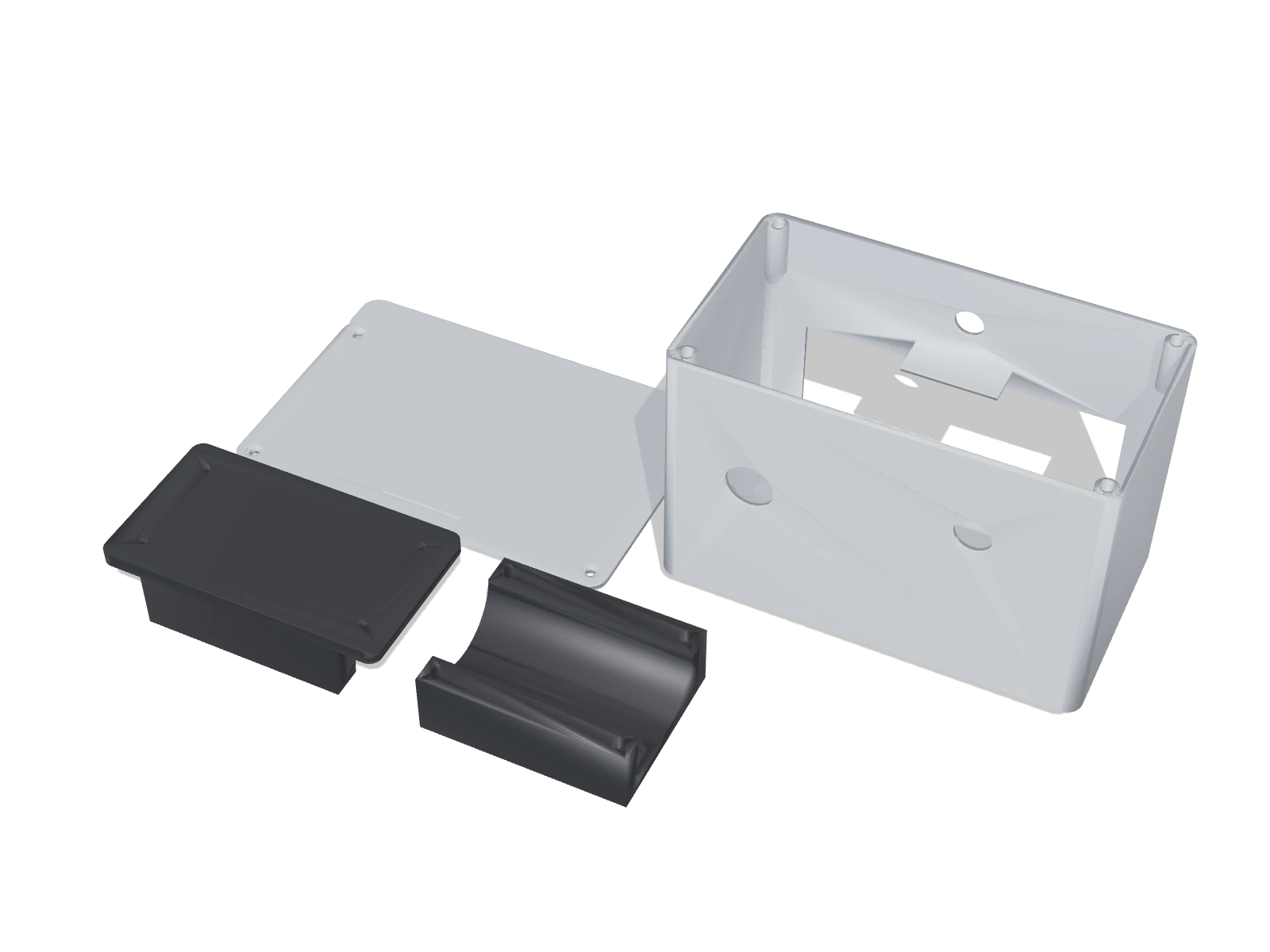
11 parts, generated from code and checked as closed solids. Pick a part to inspect it, or download the STL files to print.
See the CAD parts render
Loading the CAD…
Real CAD · drag to rotate · scroll to zoomReal CAD · swipe sideways
Bought hardware fitted inside this part (checked in the CAD: nothing collides with the plastic)
- LanePod case with display and camera windows, Pi Zero standoffs and clamp plinthlanepod-case.stl · ASA
- LanePod lid with drip visor and lane-number recesslanepod-lid.stl · ASA
- Clamp cradle: upper half on the block tube, bolted to the caselanepod-cradle.stl · ASA
- Clamp cap: lower half with M4 counterboreslanepod-cap.stl · ASA
- TapGrip body: timekeeper handle with OLED window, ESP32-C3, LiPo and haptictapgrip-body.stl · ASA
- TapGrip cap carrying the 19 mm IP67 stop buttontapgrip-cap.stl · ASA
- StartBox case strapped to the starter's horn: mic amp, ESP32-S3, start-line jackstartbox-case.stl · ASA
- StartBox lid with mic portstartbox-lid.stl · ASA
- TakeOff strip: pressure pad bar with a lip over the block front edgetakeoff-strip.stl · ASA
- TouchCam case: camera looking down at the wall, reads the striptouchcam-case.stl · ASA
- TouchCam lid with the SAFE / CLOSE / EARLY? light windowtouchcam-lid.stl · ASA
Open risks we are working on
- Safeguarding: even with no images leaving the sensor, some clubs, pools or governing bodies may refuse any camera on deck; the aim-mode preview needs an empty pool and welfare-officer sign-off
- Identity by send-off order breaks when swimmers pass or skip a repeat; passes are flagged, but busy lanes need coach fixes, and colour caps may be needed
- One pod sees only its own end: in a 50 m pool it gives 100 splits unless a second pod goes on the far end
- Starting blocks differ: the clamp needs a horizontal tube outboard of where backstrokers hold, and some blocks have none
- Accuracy is computed, not measured: splits vs a touchpad system and lap counts on a crowded lane are the first tests; the on-sensor head detector still has to be trained on pool footage
- GalaTime: a meet referee or league must accept synced-start, button-stop times; it is not automatic (touchpad) timing and not for records; the horn detector must not start on a whistle or a cheer, so a wired start line is preferred
- TakeOff: not certified automatic equipment; judges and the referee still decide, a meet may refuse it, splash can hide the touch (NO DATA) and Velostat drifts with temperature and water, so the strip is zeroed every race
Design stage only: nothing on this page is for sale. Specifications and prices are targets.