ParkSense AI
Find the cars that didn't pay on a gateless lot, and audit what the lot really earns
Counts every car on a small pay lot and matches it to the payments taken, giving the attendant a live 'unpaid now' list and the owner a monthly leak audit.
- Who buys it
- Independent operators of 1–10 surface lots, and landlords who lease a lot to an operator for a share of revenue.
- Why it pays
- A 60-space event lot that is 10% unpaid loses about $9,000 a year (est.). A landlord on a 60% share loses about $3,600 a year for every 5 points of under-reported sessions (est.). The real rate is measured in the pilot before it is quoted.
- Target price
- $1,190 site kit + $49/site/month (target); audit-only tier $29/site/month
- First-minute wow
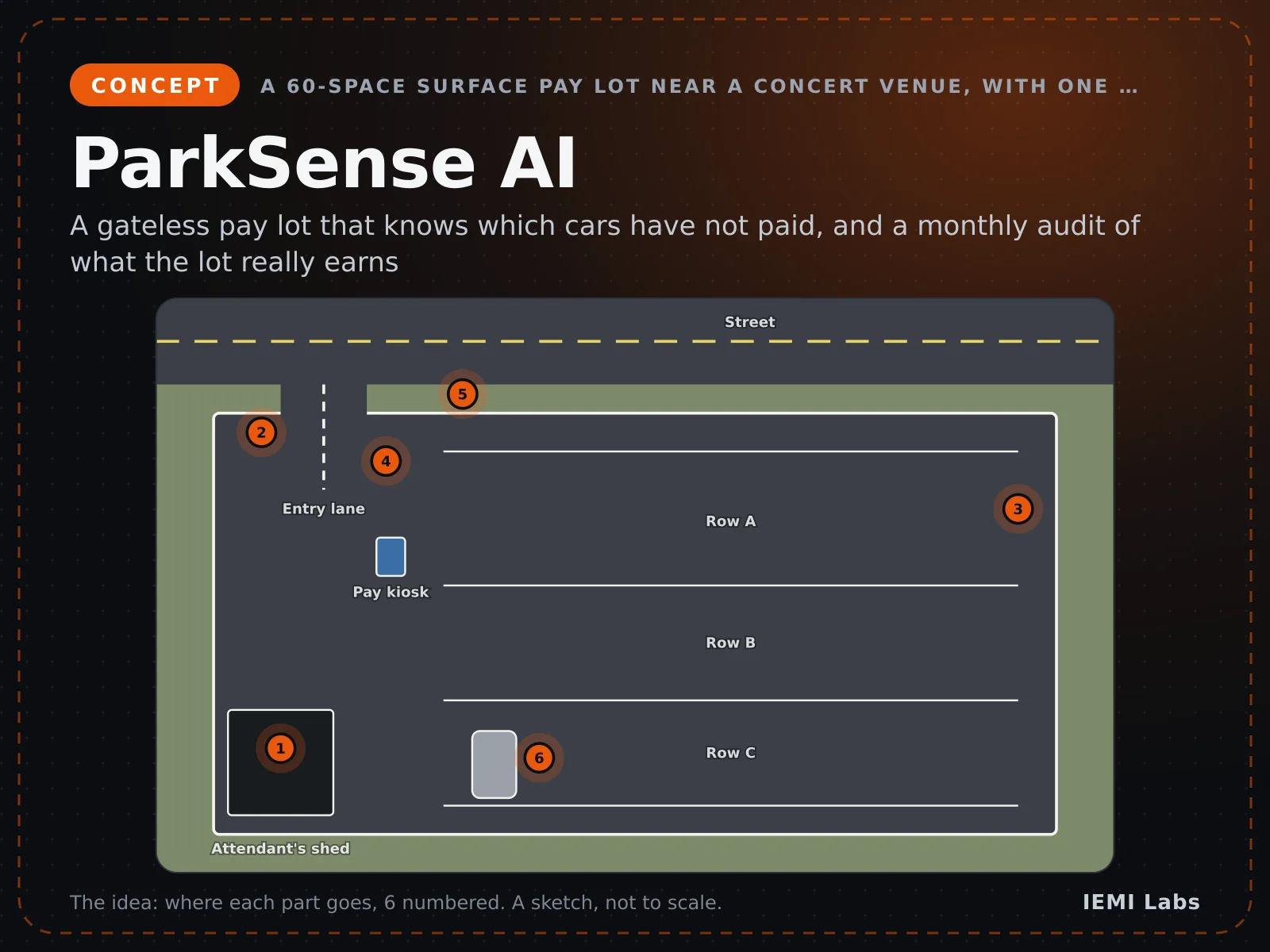
- The attendant's phone shows '3 unpaid, longest 41 min: grey SUV, row C', each with an entry photo, and clears itself when a late payment lands.
What the research found
And how this design answers it
- Enterprise CV against funded incumbents → sold to independent lots and landlords who buy with a card, not through RFPs
- Plate-read software is already about $12–55 per camera per month → the read is included; the product is matching cars against payments plus the landlord audit
- LPR cameras cost $500–1,300 → one ~$250 varifocal camera per entry lane, with OCR on the shared Edge Hub
- Existing CCTV rarely reads plates → existing cameras only count occupancy; plate reading needs our specified lane camera and aim
- False 'unpaid' flags hurt paying customers → confidence threshold, fuzzy matching, a stale-payment-data guard, and a person confirms before any action
- Plate privacy → read at the lane only, hashed, clear text leaves the hub only for listed cars, 30-day purge and a posted notice
Use case
Concert night on a 60-space lot
Lot attendantOperatorDrivers
- 01Trigger: a car enters at 18:20; the lane camera reads its plate
- 02Detection: after 15 min grace the hub finds no matching pay-by-phone or kiosk payment
- 03Alert: the car appears on the attendant's 'unpaid now' page with an entry photo and row hint
- 04Action: the attendant finds it and leaves a pay-now notice under the lot's posted policy; a late payment clears it automatically
Outcome: The attendant works 5–10 real cases instead of checking 60 dashboards; about $4,500 a year recovered on 100 event nights (est.)
How it works
Architecture
- 01
Sense: one LPR lane camera and 1–3 overview cameras on the lot, PoE to the Edge Hub
- 02
Decide: plate detection and OCR on the Hailo-8; a Node.js matcher checks plates against payment data every 60 s
- 03
Send: MQTT over TLS, events only; clear plates leave the hub only for listed cars
- 04
Tell: attendant phone page, operator night view, monthly landlord audit PDF
Hardware
Real parts, buyable today
Bill of materials: about $850 per site with 1 lane and 1 overview camera, including the shared hub (est.).
| Block | Part | Why this part |
|---|---|---|
| Hub | IEMI Edge Hub (Raspberry Pi 5 8GB + AI HAT+ 26 TOPS Hailo-8) | Shared with LotWatch; runs plate OCR locally, no video upload |
| Lane camera | 2 MP varifocal bullet with manual shutter (IPC-HFW5241E-Z12E class) | Narrow angle and fast shutter put 130+ px on each plate at up to 15 mph |
| Overview camera | Reolink RLC-510A 5 MP PoE | Occupancy and vehicle colour/type for $40–60 |
| Mount | Printed ASA pole saddle + adapter plate, stainless band clamps | Fits 50–115 mm poles without drilling the operator's pole |
Mechanical
Printable CAD
4 parts, generated from code and checked as closed solids. Pick a part to inspect it, or download the STL files to print.
See the CAD parts render
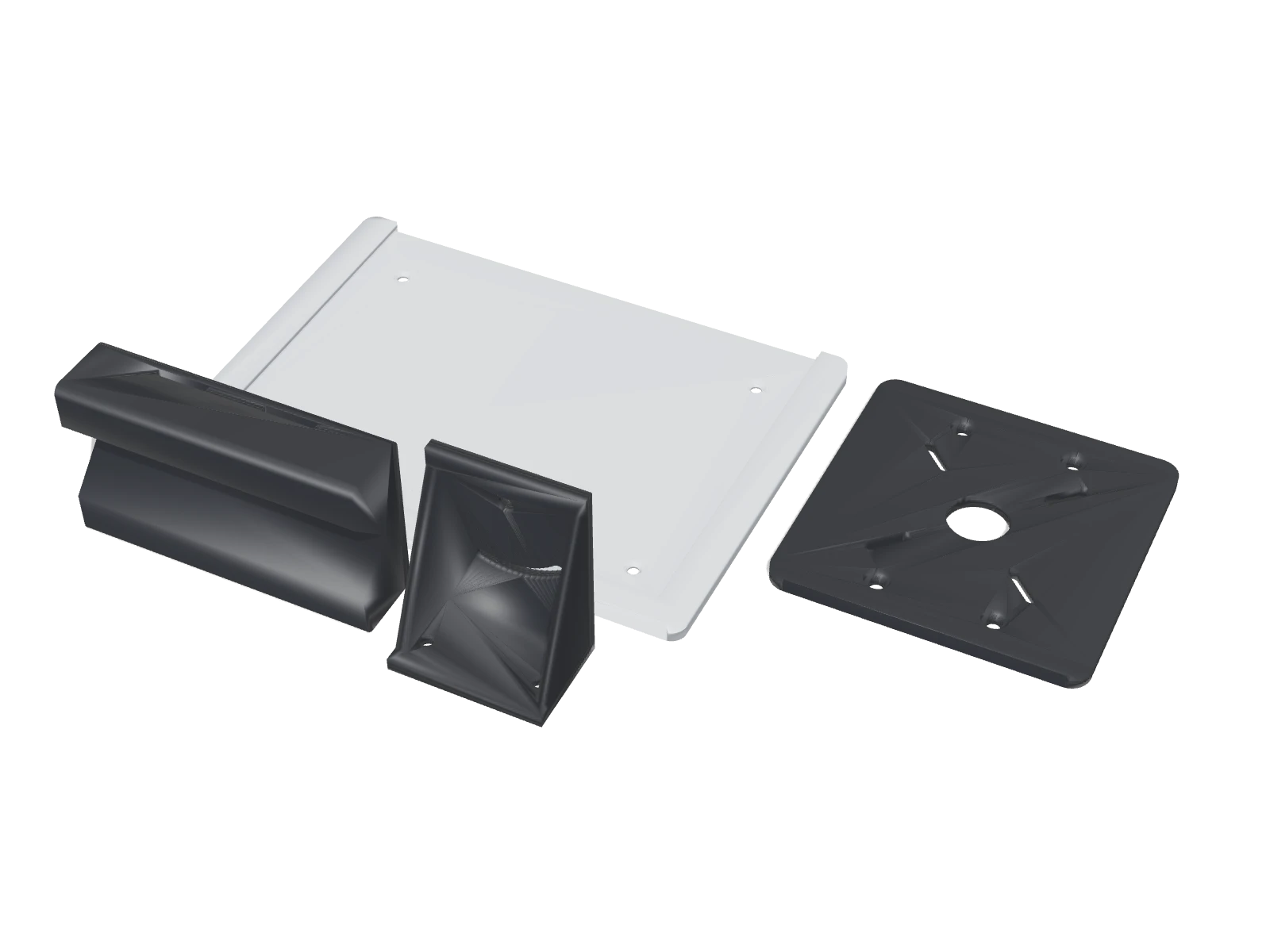
Loading the CAD…
Real CAD · drag to rotate · scroll to zoomReal CAD · swipe sideways
Bought hardware fitted inside this part (checked in the CAD: nothing collides with the plastic)
Open risks we are working on
- US plate OCR accuracy on our own pipeline is unproven, especially at night (fallback: licensed Plate Recognizer at a higher fee)
- Payment data access depends on each pay-by-phone vendor; the CSV path makes the unpaid list slower
- A false 'unpaid' flag acted on by staff; mitigated, never zero
- Large operators and vendors moving down-market to small lots
Design stage only: nothing on this page is for sale. Specifications and prices are targets.