LiftStation
Cellular alarm, callouts and pump health for small private lift stations
Calls the right people when a small lift station alarms, loses power or a pump fails, and shows weeks ahead which pump is slowing down, using only the floats and pump current already in the panel.
- Who buys it
- HOA boards and property managers, RV-park, campground and mobile-home-park owners, and small towns without SCADA, buying direct or through their pump contractor.
- Why it pays
- One avoided weekend emergency plus a saved pump every few years is worth about $1,500–2,500/yr per station, against $228/yr of service (est.).
- Target price
- $399 unit + $19/month (or $199/yr prepaid); NEMA 4X box kit +$129 (target)
- First-minute wow
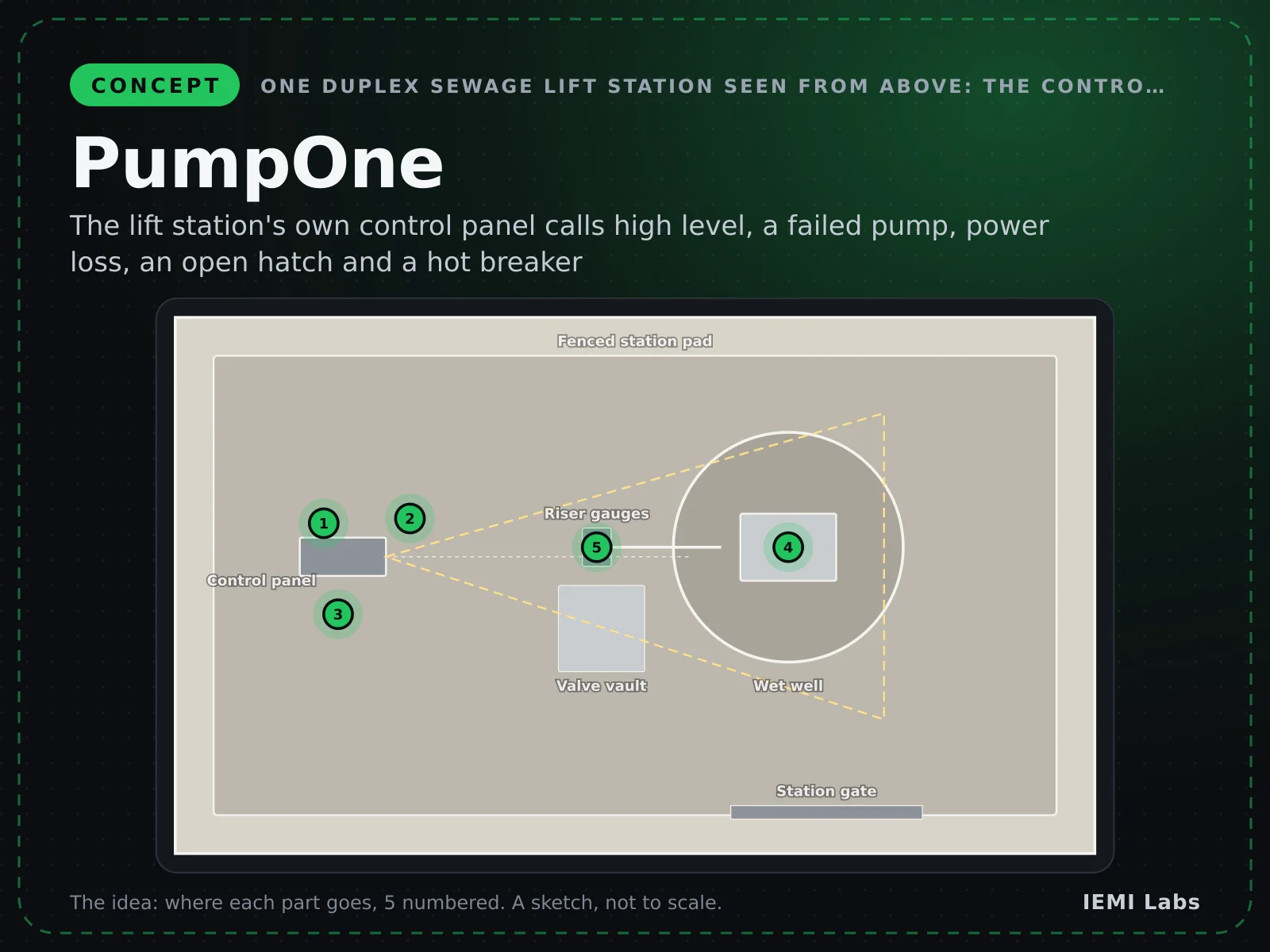
- A phone call at 2 am that says "Lift station 1 high level, press 1 to accept", and the next morning a card saying "Pump 2 capacity down about 30%, current up 12%: likely debris".
What the research found
And how this design answers it
- Utility tenders and SCADA integrators take 12–24 months → sold direct to private owners and their pump contractors, card payment, 1-hour install, no SCADA
- Mission ($1,195 + service) and Sensaphone Sentinel ($1,561 + $24.95/month) are proven alarms → $399 hardware plus pump health and acknowledged voice callouts
- Wet wells are NFPA 820 classified areas → nothing goes into the wet well; it reads only the safe-side contacts of existing IS or float relays
- Intrinsically safe level transducers cost about $1,468 plus a barrier → inflow and pump-down rate inferred from float timing and wet-well geometry
- Li-ion backup in a hot outdoor panel is a hazard → primary lithium D-cell used only during outages, no charging
- Remote pump control is a liability → rev A has no pump control; one relay drives only a local strobe
Use case
High level at 2 am in an RV park
Park managerOwnerPump contractor
- 01Trigger: the high-level float closes at 02:07 on a holiday weekend; the lag pump has failed
- 02Detection: the board sees the float relay contact and that pump 2 draws no current; the alarm reaches the cloud in under 15 s
- 03Alert: voice call to the manager, escalating to the owner and then the contractor every 5 minutes until someone presses 1
- 04Action: the contractor arrives with the live page open (floats, currents, estimated time to overflow) and resets the tripped pump
Outcome: Overflow and weekend emergency avoided, about $1,500 plus any regulator costs (est.)
How it works
Architecture
- 01
Sense: float and IS relay dry contacts, contactor aux contacts, generator-run contact, 0.333 V CTs on each pump, 24 V supply voltage
- 02
Decide (node): nRF9151 builds cycle records (fill time, pump-down time, current per pump) and raises alarms at once
- 03
Send: LTE-M/NB-IoT MQTT over TLS; alarms immediately, cycle batches every 15 min, 30-day flash buffer
- 04
Decide (cloud): inflow and pump-rate from float timing, pump-health rules, time-to-overflow estimate, callout escalation
- 05
Tell: voice and SMS callouts with acknowledgement, station page, monthly one-page report for the board
Hardware
Real parts, buyable today
Bill of materials: about $202 per unit at qty 1 including 2 CTs, PSU and antenna (est.); IoT SIM about $2/month.
| Block | Part | Why this part |
|---|---|---|
| Cellular + MCU | Nordic nRF9151 SiP (LTE-M / NB-IoT) | Modem and app MCU in one part, TLS in the modem, $17–23 |
| Pump current | Magnelab SCT-0750-050 split-core CTs + TI ADS131M04 | Clamp-on with no break in conductors; per-pump current signature |
| Inputs | 2× Toshiba TLP291-4 optocouplers | Eight isolated inputs for float relays, contactors, generator and door |
| Backup | Saft LSH20 Li-SOCl₂ D-cell | Outage reporting without charging a battery in a hot panel |
| Power | Mean Well HDR-15-24 DIN PSU (bought, electrician-installed) | Listed, finger-safe mains conversion; the board itself is 9–36 VDC |
Mechanical
Printable CAD
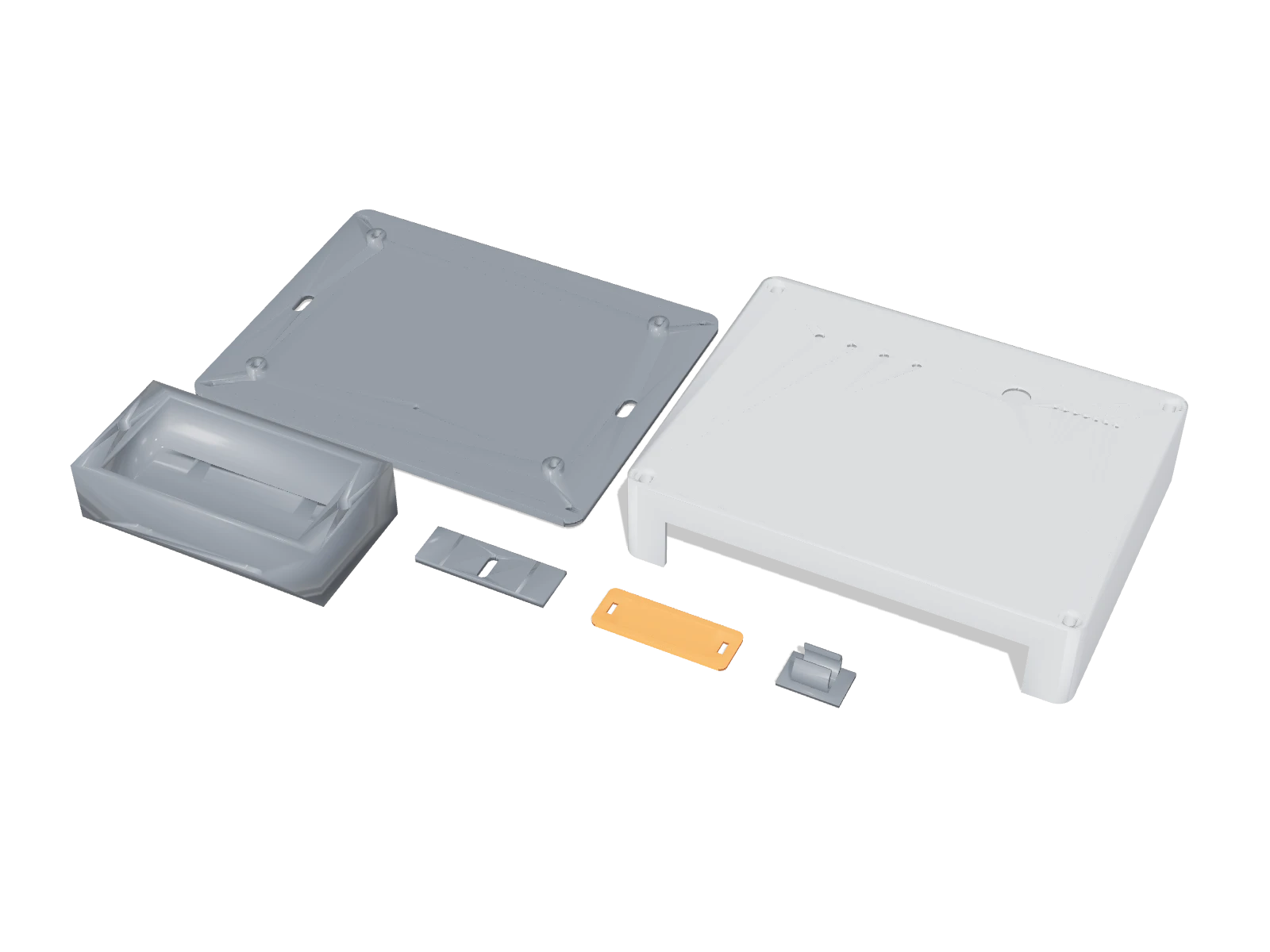
6 parts, generated from code and checked as closed solids. Pick a part to inspect it, or download the STL files to print.
See the CAD parts render
Loading the CAD…
Real CAD · drag to rotate · scroll to zoomReal CAD · swipe sideways
Bought hardware fitted inside this part (checked in the CAD: nothing collides with the plastic)
Open risks we are working on
- Plain cellular alarms are a commodity at $15–25/month; pump-health insight has to be worth the switch to owners who already have a dialer
- Float-timing inflow and pump-rate need accurate wet-well geometry; errors of ±15–30% are likely until a site is calibrated
- nRF9151 showed zero stock and a 16-week lead time; a Quectel BG95 fallback design may be needed
- Rural RV parks may have weak LTE-M coverage; each install needs a signal check before the contractor leaves
- Install quality depends on the contractor correctly identifying safe-side contacts in the panel; a wrong connection is a hazardous-area mistake
Design stage only: nothing on this page is for sale. Specifications and prices are targets.