PaceRoll
The rollator they already use, made smart: real walking speed from the wheel, a park-the-brakes reminder, a walker-down alert, and a lit, checked night trip to the toilet
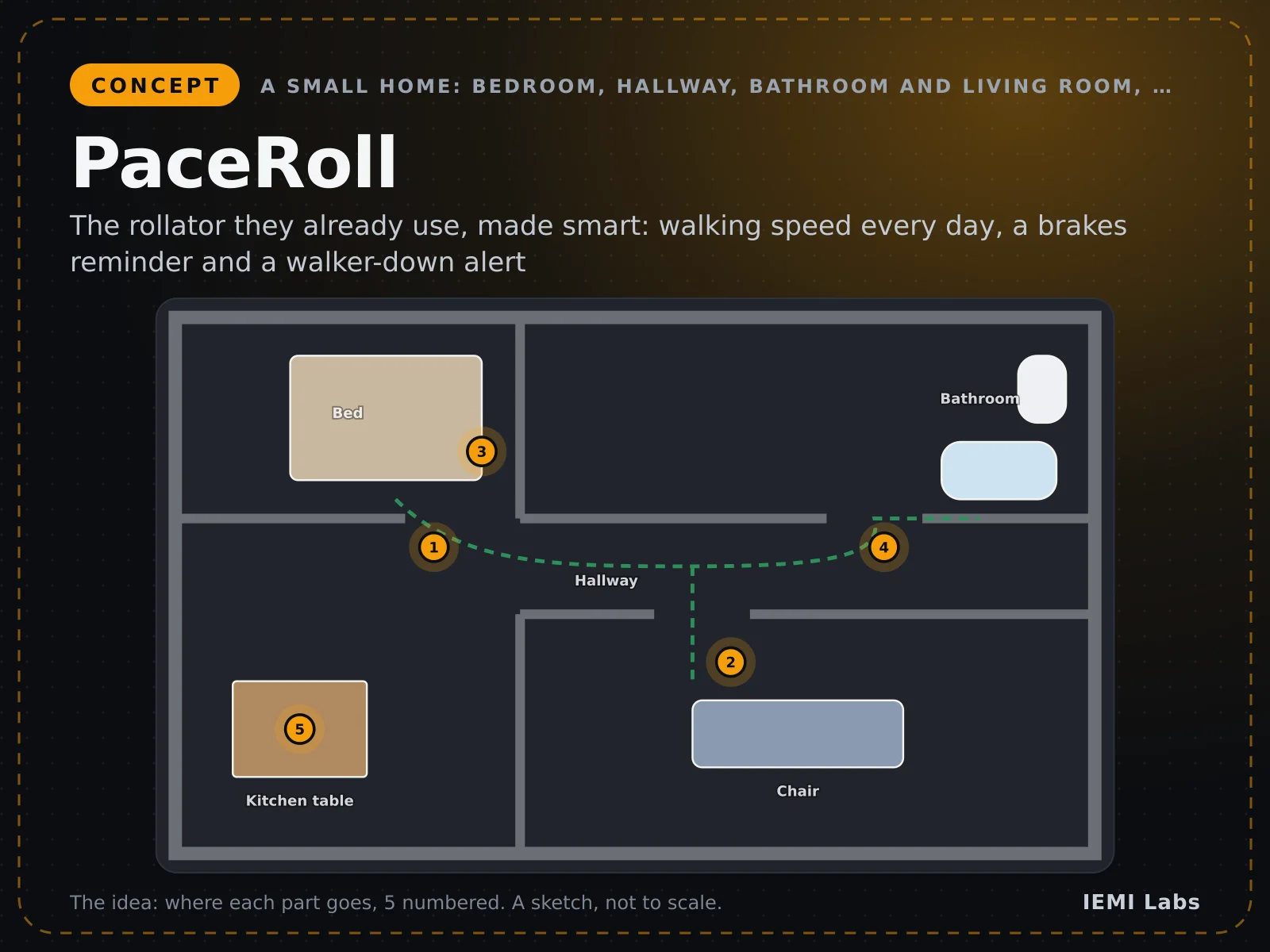
A magnet ring on one rear wheel and a Hall sensor clip make the rollator an odometer, and a HandlePod below one grip adds a gyro, an e-paper 'today' screen, an OK/HELP button and a brake-lever sensor. It logs metres walked, walks per day and gait speed on every straight walk, reminds the user to park the brakes before sitting, and alerts the family when the walker lies on its side or has not moved by the usual time. It monitors and alerts only: it cannot see a fall away from the walker and makes no fall-prevention claim. The NightPath add-on (rev A1) adds a dim amber lamp on a front leg and a BedTag on the bed's foot-end leg: legs out of bed at night turn on a glow, the walker lights the floor as it moves, a soft chime plays if the person sets off without it, and the family gets a morning summary of night trips.
- Who buys it
- First: outpatient and home-health physical therapy practices that bill the 2026 remote therapeutic monitoring codes and want an objective walking trend between visits. Then: adult children of rollator users, who today can buy Drive's WalkWise ($199 plus a subscription) for activity only, or nothing.
- Why it pays
- Clinical smart rollators cost about 3,000-9,000 euros each and are custom-made; PaceRoll is a $55 BOM kit (est.) on the rollator the person already has. A PT practice billing the musculoskeletal RTM device code earns about $40 per patient per month (vendor figures, est.), so a $129 kit pays back in the first 4 months of one episode.
- Target price
- $129 kit, $159 with NightPath, + $6/month for family alerts; clinic pack of 10 at $99 each + $8/patient/month (target)
- First-minute wow
- The physio opens a chart that shows her patient's real walking speed at home, every day for six weeks, going from 0.42 to 0.61 m/s, with no stopwatch and no extra visit.
What the research found
And how this design answers it
- Clinical smart rollators cost 3,000-9,000 euros and are closed systems → a $55 BOM clip-on kit (est.) on the user's own rollator, any brand with a fixed rear wheel
- WalkWise counts activity only → PaceRoll measures distance and gait speed, the 'sixth vital sign', on every straight walk
- One wheel is wrong by 14-58% in home-sized turns (CAD turn report) → the gyro corrects it to under 1% and gait speed only uses straight walks
- A micro-power sampled Hall switch misses wheel magnets at walking pace (CAD Hall report) → a continuous Hall sensor powered only while the IMU sees motion
- Rollator brakes depend on the user remembering to park them, and the walker can roll away when they sit → a lever magnet tells the pod the brakes are parked, and it chirps if not
- Older people may not wear a pendant or a watch → nothing to wear or charge daily; the pod runs about six months per charge (est.)
- Night toilet trips: a third of hospital falls in over-60s were toilet trips, at least 44% of them at night, 80% walking without the usual aid (Rose et al. 2019) → NightPath: a BedTag glow when legs leave the bed, a walker lamp (3-4 lux one step ahead, est.), a 'walker please' chime and a night summary for the family
Use case
Six weeks of home physio after a hip fracture
PatientPhysical therapistAdult daughter
- 01Trigger: the patient goes home with a rollator and a plan of care for walking practice twice a day
- 02Detection: PaceRoll logs 210 m a day in 9 walks and a straight-walk speed of 0.42 m/s in week 1
- 03Alert: in week 4 the walking drops to 60 m a day and the speed falls back, and one evening the walker lies on its side for 5 s and nobody presses OK
- 04Action: the daughter gets the walker-down alert and phones; it was knocked over and her mother is fine, and the PT brings forward the next visit and adjusts the programme
Outcome: An objective home walking trend for the plan of care, about 2 RTM-billable months per episode for the practice (est.), and a walker-down alert for the family
How it works
Architecture
- 01
Sense: Hall pulses from 8 magnets on one rear wheel, a 6-axis IMU and a brake-lever Hall switch in the HandlePod
- 02
Decide: on the ESP32-C3, gyro-corrected distance, walking bouts, straight-walk gait speed, park and walker-down rules
- 03
Send: a daily summary and alerts over home Wi-Fi (or a plug-in Home Node) by MQTT/TLS; no location, no camera, no audio
- 04
Tell: today's metres on the e-paper; family alerts; a weekly gait-speed and distance chart and RTM day count for the PT
Hardware
Real parts, buyable today
Bill of materials: about $55 per kit at qty 1, about $24 at qty 1,000; NightPath add-on about $35 at qty 1 (est.).
| Block | Part | Why this part |
|---|---|---|
| Wheel odometer | 8 x N52 6 x 3 magnets in a printed ring + TI DRV5023 Hall switch | 80 mm per pulse on an 8 in wheel: 0.012 m/s speed error over a 4 m walk (CAD odometry report, est.) |
| Turn correction + falls | Adafruit LSM6DSOX accel + gyro | Gyro yaw rate corrects the one-wheel error; accel gives the tilt for walker-down and the motion wake |
| MCU + radio | Seeed XIAO ESP32-C3 | Wi-Fi and ESP-NOW, 44 uA deep sleep, Li-ion charger on USB-C |
| Screen + controls | Waveshare 1.54 in e-paper, 12 mm buzzer, OK/HELP button, DRV5032 brake sensor | Readable in sun, zero power to hold; one button to cancel or call |
| Power | 1 x 18650 3000 mAh | About 192 days per charge at 1 h walking a day (CAD power report, est.) |
| NightPath BedTag + leg lamp | Pololu VL53L1X ToF + XIAO ESP32-C3 on 2 x AA; 2 amber 590 nm LEDs on a front leg | Sees legs along the bed side to ~1.9 m with a 15 deg ROI at 250 mm (CAD beam report); ~140-170 days on AA (est.) |
Mechanical
Printable CAD
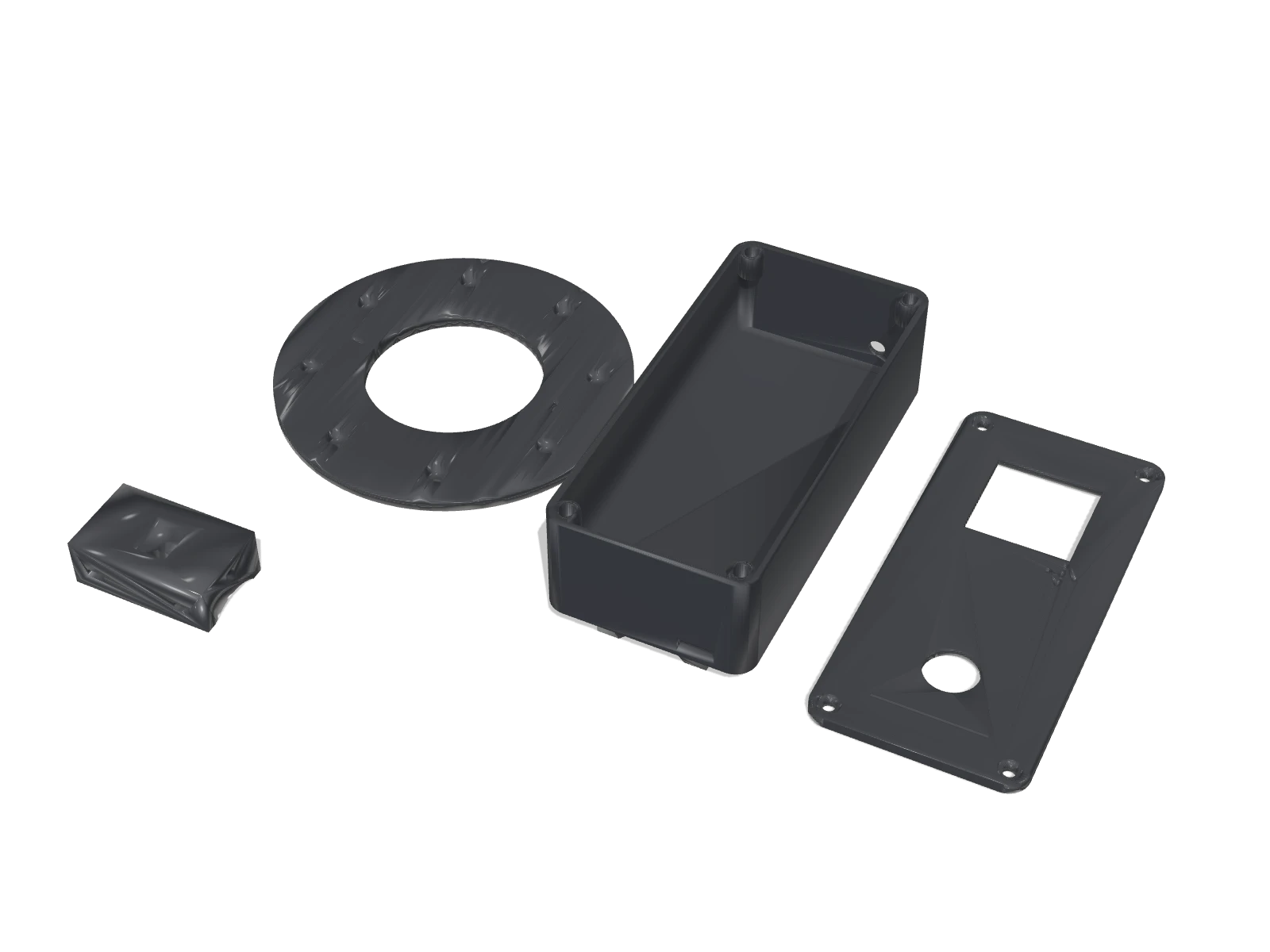
7 parts, generated from code and checked as closed solids. Pick a part to inspect it, or download the STL files to print.
See the CAD parts render
Loading the CAD…
Real CAD · drag to rotate · scroll to zoomReal CAD · swipe sideways
Bought hardware fitted inside this part (checked in the CAD: nothing collides with the plastic)
- Wheel ring: 8 magnet pockets, VHB face and spoke tie slotswheel-ring.stl · PETG
- Sensor clip: saddle for the rear leg, Hall sensor pocket facing the magnets, tie tunnels, cable channelsensor-clip.stl · PETG
- HandlePod case: battery, ESP32-C3, IMU, buzzer, brake sensor, saddle and strap tunnels for the handle tubehandle-case.stl · ASA
- HandlePod lid: e-paper window, OK/HELP button hole, buzzer holeshandle-lid.stl · PETG
- NightPath leg lamp: saddle for a front leg, amber LED pocket and diffuser facing the floor, cable channel up to the HandlePodleg-lamp.stl · PETG
- BedTag case: 2 x AA, ESP32-C3, buzzer, strap ribs for the bed's foot-end legbed-tag-case.stl · PETG
- BedTag lid: ToF window, amber glow diffuser, chime holesbed-tag-lid.stl · PETG
Open risks we are working on
- It cannot see a fall away from the walker (for example after leaving it in a doorway); walker-down is a partial signal, never a fall detector, and it is not a PERS
- RTM needs a device that meets the FDA medical-device definition; as a gait-speed monitor sold to clinicians it may need a regulatory position (Class I 890 exemption limits, or wellness-only claims for families), unconfirmed (gate R1)
- Drive DeVilbiss already sells WalkWise for walkers and could add a wheel sensor; rollator makers could build it in
- Rollator wheel, leg and handle sizes vary; fixed rear wheels are assumed and the sensor gap is untested (T1)
- The park reminder needs a sit-down signature from the IMU that is not yet validated; false chirps would get it switched off (T2)
- About 1 in 5 older adults has no home internet (est.); the Home Node with LTE-M is rev B
- NightPath: the walker lamp lights only the next step (3-4 lux at 0.2 m, under 1 lux at 0.4 m, est.), so hallways still need night lights; bed legs, duvets and pets in the BedTag beam are untested (T-N1, T-N2); a chime at 2 am may be switched off if it startles (T-N3)
- No PT or family interviews yet; gate G1 is 5 PT practices and 10 families
Design stage only: nothing on this page is for sale. Specifications and prices are targets.