FrostMast
The frost probe on your orchard post, made smart enough to know when the buds are really at risk
Reads what the frost decision needs and a plain probe cannot see: the bud's own temperature, a clear or cloudy sky, the dew point and the warm air above the trees. It rings the house, tells the grower when to start the sprinklers and asks the wind machine to start only when it will help. In greenhouses and tunnels, DewSpot hangers warn before the leaves reach the dew point at dusk and count the hours they stay wet.
- Who buys it
- Apple, cherry, peach and wine-grape growers with 5-100 acres who run wind machines or overhead sprinklers for spring frost, and the farm managers who sit up on frost nights. Also small and mid-size greenhouse and high-tunnel growers of tomatoes, cucumbers and bedding plants without a climate computer.
- Why it pays
- In a modelled 24-night spring, a fixed +1 C auto-start ran a wind machine 199 h against 62 h with a bud-stage start: about 137 h, or $3,000-3,900 of fuel per machine (est.). The machines cost $16,000-40,000 each.
- Target price
- $249 per head, $349 Wind Machine Kit (2 heads + FanLink), $79 per ColdSpot stake, $299 Frost Map Kit (4 ColdSpots + FrostBell), $89 per DewSpot, $349 Greenhouse Kit (4 DewSpots + FrostBell), no subscription (target)
- First-minute wow
- At 01:40 the bell says: 'Block 4 buds -1.1 C, pink stage, safe to -2.2. Inversion 3.5 C, the fan will help. Starting fan 2 at -1.2.' The air probe still reads +0.4 C.
What the research found
And how this design answers it
- A probe reads air, but on clear nights buds run colder (WSU) → a 5 deg infrared thermometer aimed down at a fruiting branch, plus a sky sensor that tells a radiation night from cloud
- One fixed start setting all spring wastes fuel when buds can take -8 to -9 C → start by bud stage (WSU/MSU 10% kill table): 199 h became 62 h in the modelled season (est.)
- Sprinklers started too late cool the buds by evaporation → start from the wet bulb; our calculation matches the MSU dew-point table within 0.3 C
- A wind machine only helps when warm air sits above the trees → the same head on the tower measures the inversion; nights with no gain get a 'fan will not help' alert
- Aimed level or up, an IR spot sees the cold sky and reads 7-16 C too cold (CAD spot report) → the boss is tilted 25 deg down so the background is the ground
- Remote starting is a liability → the machine's own auto-start stays armed as the backstop; FrostMast only adds a start request through the controller's own start sequence
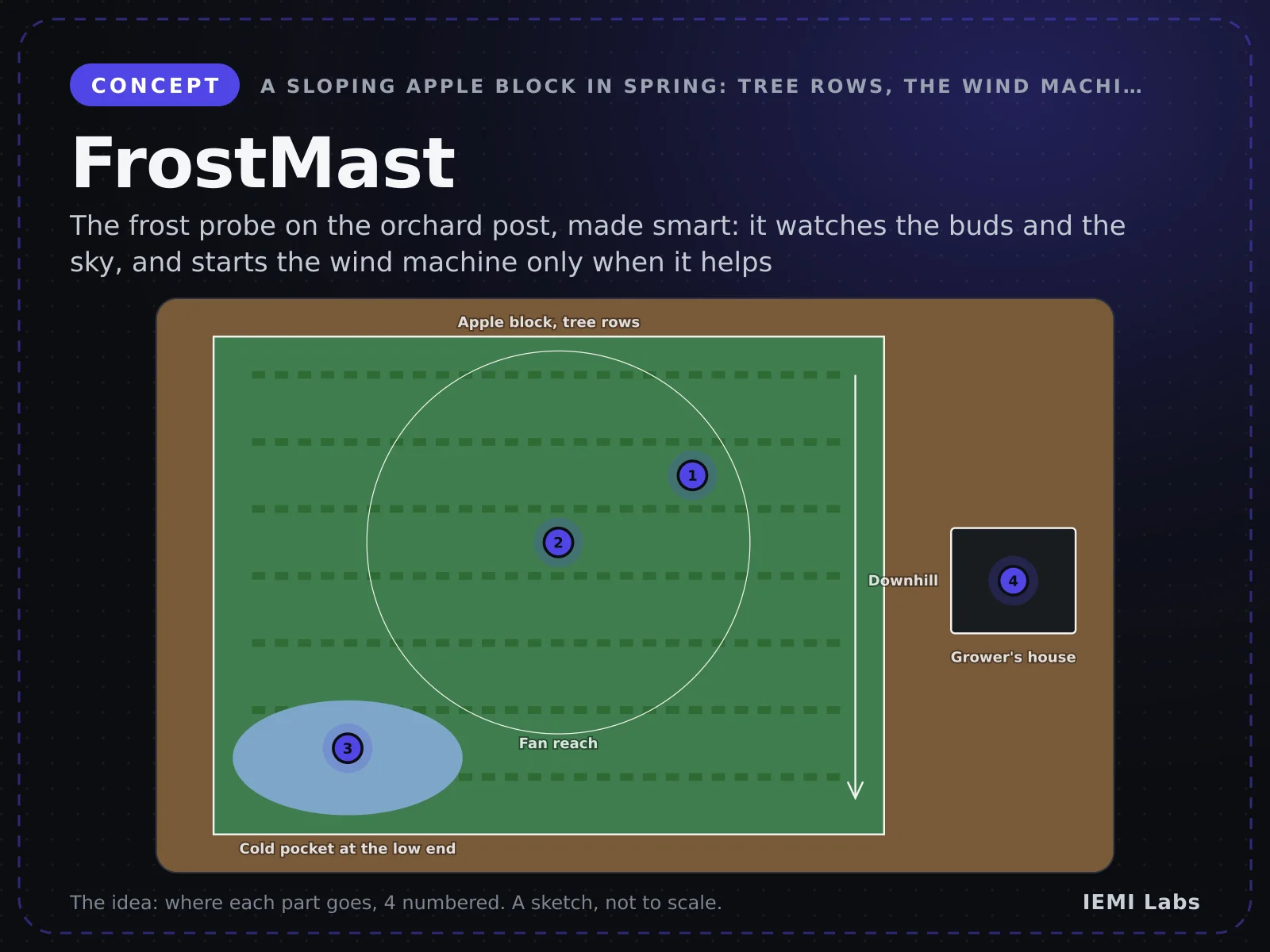
- R3 (26 Oct 2026): the April 2026 Virginia/Maryland freeze did 0-100% damage inside one vineyard because cold air pools in low rows, and one post reads one spot → ColdSpot stakes ($45 BOM, est.) in each low corner; the bell rings on the coldest stake, 35-163 min before the mast (CAD lead report, est.), with a per-stake frost-night record
- R11 (26 Oct 2026): greenhouse growers lose crop to Botrytis when the leaves go below the dew point at dusk; extension advice is to vent and heat before that, but the head-height RH alarm reads the air, not the 1-2 C colder leaf (UConn IPM, Greenhouse Grower) → DewSpot hanger: a dummy leaf (wetness board + NTC) in the canopy on the ColdSpot, "vent and heat now" 38-87 min before the leaves wet, where an RH 90% alarm comes up to 67 min late on clear nights (CAD dew-margin report, est.), plus wet hours per bay each morning
Use case
Pink-stage frost in a 40-acre apple block
GrowerFarm managerWind machine controller
- 01Trigger: a clear, calm night; the sky sensor reads 28 C below the air, so it is a radiation frost
- 02Detection: at 01:40 the bud IR reads -1.1 C while the shielded air reads +0.4 C; the tower head shows a 3.5 C inversion
- 03Alert: the FrostBell rings with the stage, the bud temperature and the expected fan gain (about 2 C)
- 04Action: the FanLink asks fan 2 to start through its own start sequence; it stops at 07:10 when the buds pass -0.2 C
Outcome: Buds held above the 10% kill point with the fan on for 5.5 h instead of all night, and the grower slept until the bell (est.)
How it works
Architecture
- 01
Sense: SHT45 in a printed 5-plate shield, MLX90614 5 deg bud IR aimed 25 deg down, MLX90614 90 deg sky IR, a second head on the tower at about 10 m
- 02
Decide: bud stage (grower taps it, or a degree-day model suggests it) sets the critical temperature; the wet bulb, the inversion and the sky set the action
- 03
Send: a 12-byte LoRa message a minute on frost nights to the FrostBell and the FanLink, no gateway, no cloud needed
- 04
Tell: the bell rings in the house and pushes to phones; the FanLink closes the wind machine's start-request contact; a morning log for each block
Hardware
Real parts, buyable today
Bill of materials: about $117 per head at qty 1, about $55 at qty 1,000 (est.); $38 FanLink, $26 FrostBell, about $44 per ColdSpot stake; about $49 per DewSpot (ColdSpot + $4.40 hanger kit, est.).
| Block | Part | Why this part |
|---|---|---|
| MCU + radio | RAKwireless RAK3272S (RAK3172) | Runs the sensors and the LoRa link on 2 AA cells |
| Air + dew point | Sensirion SHT45 in a printed radiation shield | +/-0.1 C and RH for the wet bulb |
| Bud temperature | Melexis MLX90614ESF-DCI, 5 deg FOV | Reads the buds, not the air, from 0.3-0.5 m |
| Sky | Melexis MLX90614ESF-BAA, 90 deg FOV | Clear sky = radiation frost = buds colder than air |
| Power | 2 x Energizer L91 lithium AA | Rated to -40 C; no solar needed (power report) |
| Wind machine link | FanLink: RAK3272S + Omron G5LE relay | Asks the controller to start; reads 'engine running' |
| ColdSpot stake | RAK3272S + SHT45 in a 3-ring shield + Saft LS14500 3.6 V AA | Reads the cold pockets in low rows; about 69 mAh a year (est.) |
| DewSpot leaf | Wetness board 54 x 40 + 10 k NTC on a printed hanger, on a ColdSpot | Reads when the leaf itself is wet and how close it is to the dew point |
Mechanical
Printable CAD
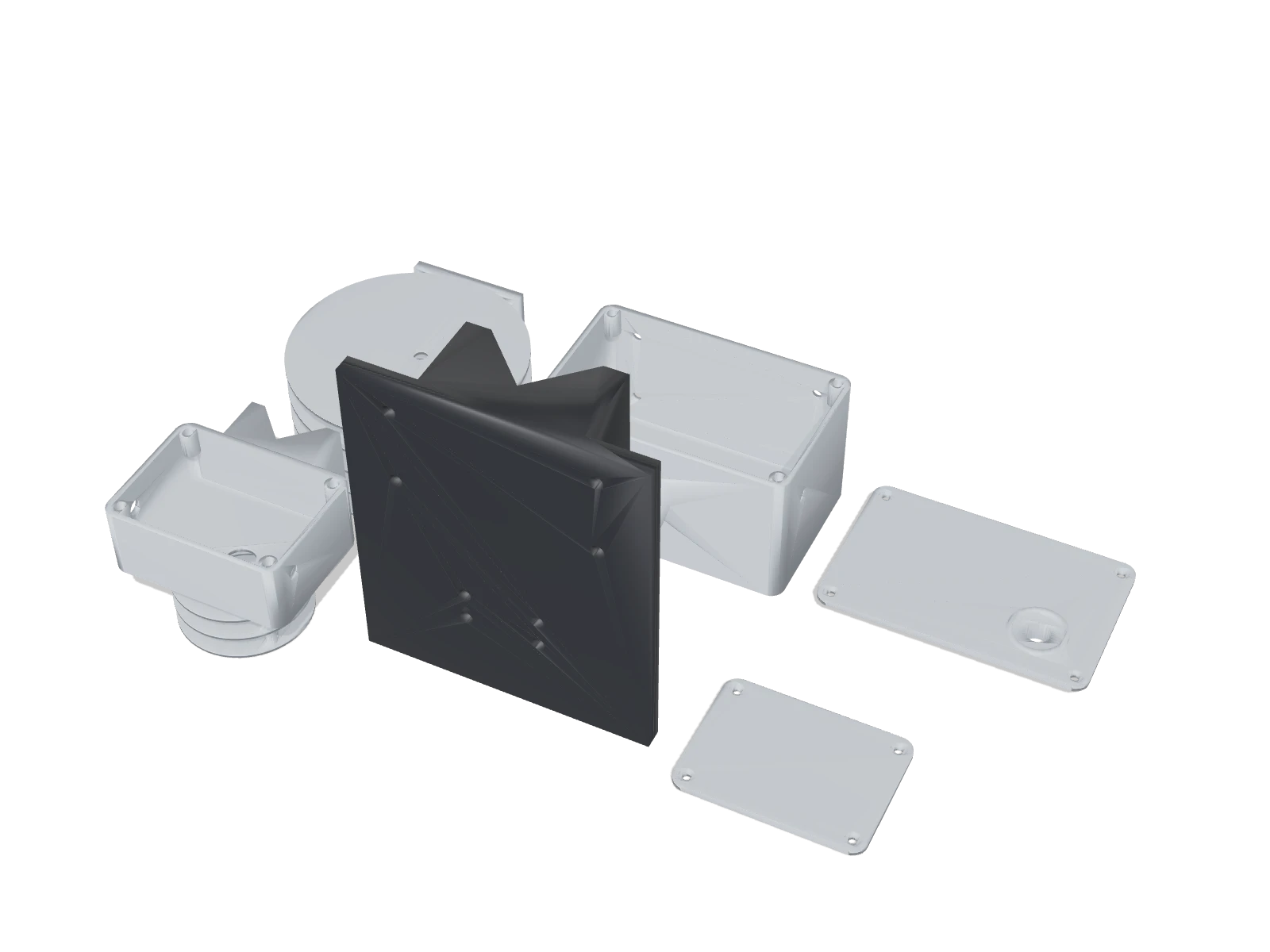
7 parts, generated from code and checked as closed solids. Pick a part to inspect it, or download the STL files to print.
See the CAD parts render
Loading the CAD…
Real CAD · drag to rotate · scroll to zoomReal CAD · swipe sideways
Bought hardware fitted inside this part (checked in the CAD: nothing collides with the plastic)
- Electronics case with tilted bud-IR bossfm-case.stl · ASA
- Lid with sky-IR windowfm-lid.stl · ASA
- 5-plate radiation shieldfm-shield.stl · ASA
- Post saddle (25-60 mm)fm-saddle.stl · ASA
- ColdSpot case with 3-ring shield and stake V-saddle (10-25 mm)cs-case.stl · ASA
- ColdSpot lidcs-lid.stl · ASA
- DewSpot hanger: crop-wire hook, Ø16 rod for the ColdSpot V, dummy-leaf trayds-hanger.stl · ASA
Open risks we are working on
- Bud IR reads between bud and ground (0.5-1.1 C warm at 0.3-0.8 m, CAD report); it must be checked against bud thermocouples (T1)
- Dew or frost on the sky and bud windows may change the readings late at night (T2)
- Not every wind machine controller has a remote-start input; some brands are alert-only (G2)
- FrostBoss already ships wireless probes and auto-start; Orchard-Rite, Semios and Harvest sell remote monitoring
- The fuel saving is against a fixed setting; growers who already change settings by stage save less (G1)
- The ColdSpot's small 3-ring shield and the 0.3-0.8 C per metre cold-pool figure are untested (T5, T6), and LoRa from low rows may need a relay (T7)
- The DewSpot dummy leaf is a circuit board, not a leaf: wet onset and leaf temperature must be checked against real leaves (T8), cheap boards may corrode (T9), and Priva, Sigrow and Aranet already sell leaf sensors to big glasshouses
Design stage only: nothing on this page is for sale. Specifications and prices are targets.