EmberWatch AI
After-hours thermal pile watch that adds early warning to your existing fire system
Watches bales, piles and battery cages overnight with radiometric thermal heads and alerts the on-call person when a hot spot is growing, with an optional supervisory signal to the existing fire panel.
- Who buys it
- Operations manager at a small or mid-size recycling facility, transfer station or scrap yard, sold and installed through the site's licensed fire-alarm contractor.
- Why it pays
- 448 waste and recycling facility fires were publicly reported in the US and Canada in 2025. Catching one overnight smoulder early can avoid a shutdown and a claim of $100k–$1M+ (est.), at a fraction of a $150k–250k detection-and-suppression install.
- Target price
- $1,290 per thermal head + $1,490 site hub + $39/head/month (target)
- First-minute wow
- A phone alert showing a tracked hot spot in the bale aisle, '+11 °C in 14 min, not a vehicle', with the thermal and colour clip side by side.
What the research found
And how this design answers it
- Life-safety liability → sold only as supplementary early warning next to a listed fire system; supervisory output via a listed monitor module fitted by a licensed contractor; never wired to suppression
- Expensive incumbents ($150k–250k installs) → zone-targeted add-on heads at $1,290 for sites with no thermal coverage at all
- Cheap fixed-threshold thermal cameras false-alarm on loader exhausts → rise-rate blob tracking plus vehicle masks from a colour camera, with measured false-alarm targets
- Low-resolution core → honest zone coverage (about 11 × 8 m per head at 10 m) instead of whole-hall claims
- Dust and €490 germanium windows → $0.25 replaceable HDPE film cartridge and an optional purge-air port
- Sites that need listed detection → Integrator tier runs our analytics on an ANSI/FM 3260-approved camera
Use case
Bale smoulder at 1:40 am
Night on-call supervisorPlant managerFire-alarm monitoring company
- 01Trigger: a crushed lithium cell inside a PET bale starts self-heating after the shift ends
- 02Detection: the bale-aisle head tracks a blob rising 0.8 °C/min, +10 °C above its own baseline for 3 minutes, not inside a vehicle mask
- 03Alert: the on-call phone gets a WARN with the thermal and colour clip; still rising, it escalates to ALERT, closes the supervisory contact and starts the call tree
- 04Action: the supervisor drives in and pulls the bale with the loader before flames appear
Outcome: No fire and no shutdown; a $100k–$1M+ loss avoided (est.)
How it works
Architecture
- 01
Sense: FLIR Lepton 3.5 radiometric heads on PoE, plus a bought colour camera per area
- 02
Decide: IEMI Edge Hub tracks each hot spot's rise rate and area, and masks vehicles and people using on-device AI
- 03
Send: events and small clips only, over outbound MQTT/TLS; dry-contact and Modbus TCP outputs on site
- 04
Tell: SMS and voice call tree, phone app, nightly and 90-day pile-temperature reports
Hardware
Real parts, buyable today
Bill of materials: about $276 per pilot head and $1,760 of hardware for a 4-head site (est.).
| Block | Part | Why this part |
|---|---|---|
| Thermal core | FLIR Lepton 3.5 (500-0771-01), 160×120 radiometric | $164, US-made, shutter-calibrated, proven on ESP32 |
| Head MCU + PoE | Olimex ESP32-POE-ISO (pilot) → ESP32-S3 + W5500 + Silvertel Ag9905 (production) | One isolated Cat6 cable per head, about 1 W |
| Window | 0.5 mm HDPE film cartridge | Replaceable in 10 s for about $0.25, instead of a €490 germanium window |
| Site hub | IEMI Edge Hub: Raspberry Pi 5 8GB + AI HAT+ 26 TOPS (Hailo-8) | Reused platform; runs vehicle masks and smoke confirmation |
| Panel interface | Relay node with Omron G6K-2F-Y relays | Dry contacts to a listed monitor module; fail-safe trouble contact |
Mechanical
Printable CAD
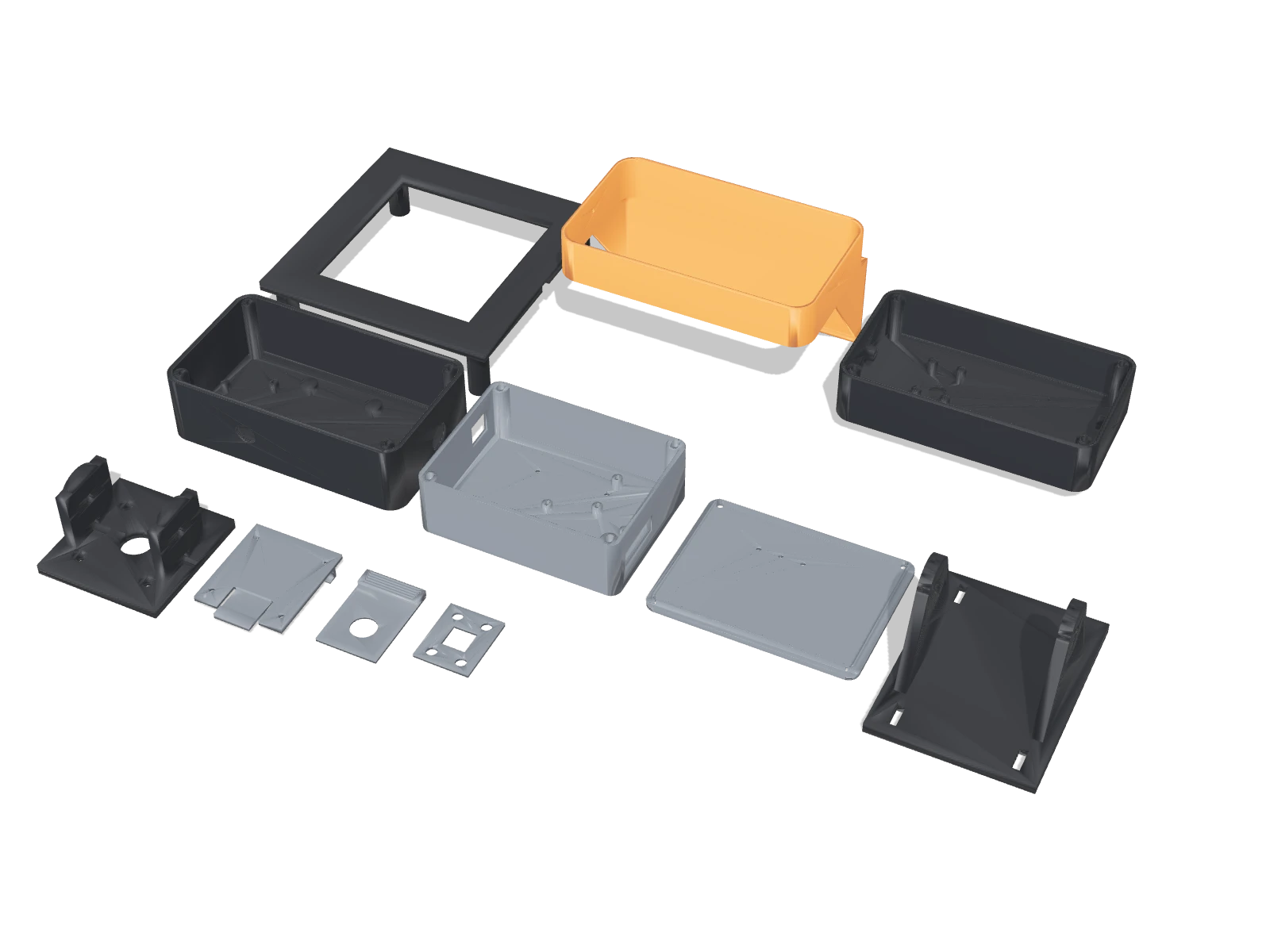
11 parts, generated from code and checked as closed solids. Pick a part to inspect it, or download the STL files to print.
See the CAD parts render
Loading the CAD…
Real CAD · drag to rotate · scroll to zoomReal CAD · swipe sideways
Bought hardware fitted inside this part (checked in the CAD: nothing collides with the plastic)
- Thermal head frontthermal-head-front.stl · ASA
- Thermal head backthermal-head-back.stl · ASA
- Film window cartridgewindow-cartridge.stl · PETG
- Sun and dust hoodsun-hood.stl · ASA
- Head adapterhead-adapter.stl · ASA
- Tilt brackettilt-bracket.stl · ASA
- Lepton retainerlepton-retainer.stl · PETG
- Relay node baserelay-node-base.stl · PETG
- Relay node lidrelay-node-lid.stl · PETG
- DIN rail cliprelay-din-clip.stl · PETG
- Bench reference target frameref-target-frame.stl · ASA
Open risks we are working on
- Demand: small sites may not pay about $6.7k when a night walk-round is free, and no insurer credit is confirmed
- False alarms in real tipping halls (exhaust, sun, hot metal) are not measured yet
- Lepton accuracy (±5 °C typical) and HDPE film transmission need bench calibration
- NRTL listing cost and the AHJ's acceptance of the panel interconnection vary by site
- Coverage per head is small, so large halls need many heads or the Integrator tier
Design stage only: nothing on this page is for sale. Specifications and prices are targets.