QualityCheck Bench Station
Teach-by-example visual inspection for small manufacturers, proven on your parts first
Checks every part at the bench or on a slow conveyor in under half a second, shows PASS, FAIL or UNSURE with the image, drives a reject output and logs each lot, after being taught with 20 good and 20 bad parts.
- Who buys it
- Owner or quality manager at a 10–200-person injection moulder, contract electronics assembler or small packer.
- Why it pays
- About 0.5 FTE of manual final inspection ($20–25k/yr) reduced to spot checks, plus fewer customer chargebacks (est.); payback under 3 months on a $2,900 station (est.).
- Target price
- $1,500 feasibility study (credited) + $2,900 station + optional $49/month (target)
- First-minute wow
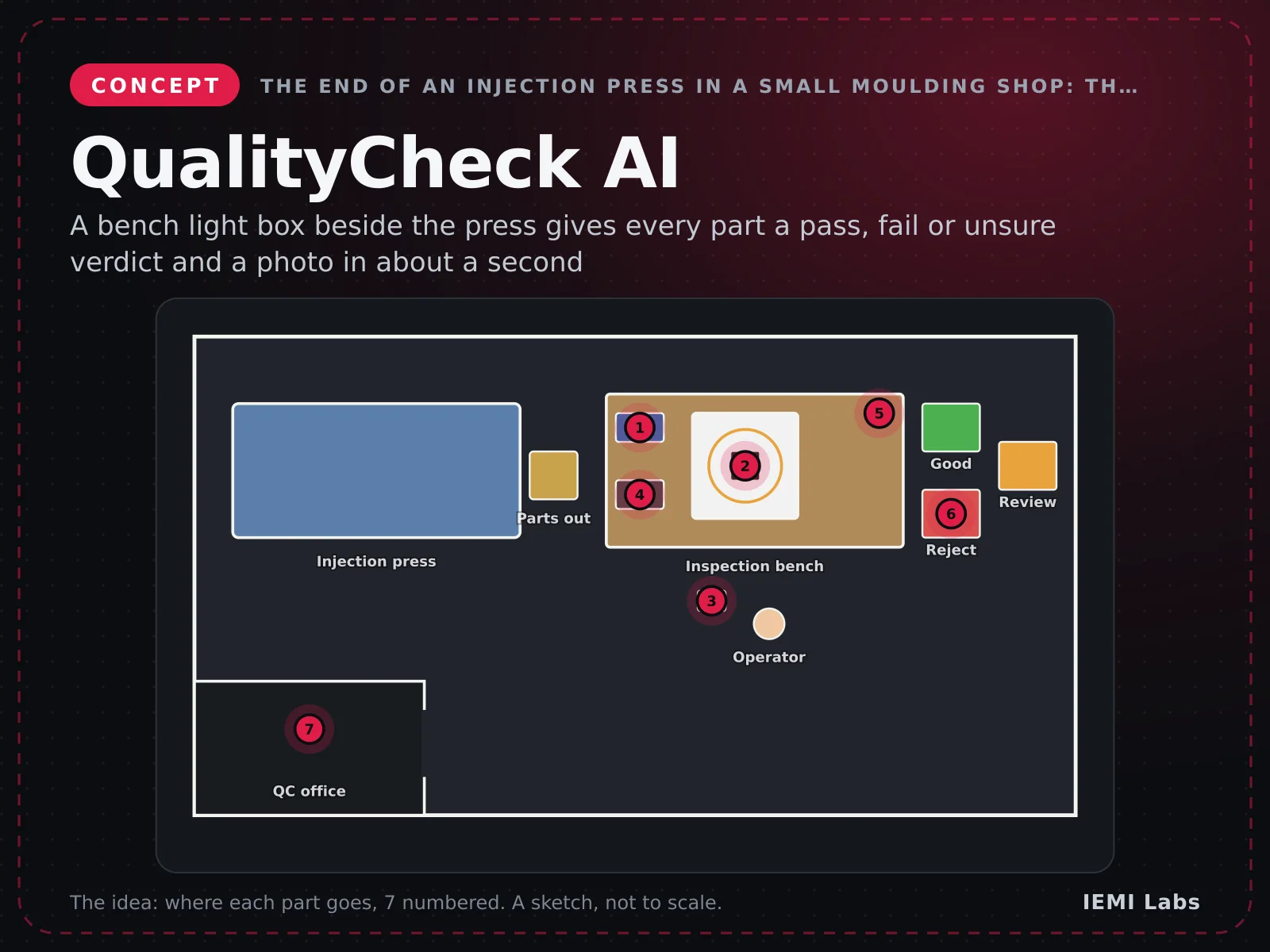
- Place 20 good and 20 bad parts in the nest, and ten minutes later a red FAIL with a heat map shows exactly where the short shot is.
What the research found
And how this design answers it
- Every line is custom → a fixed light box and part nest standardise 80% of jobs; the rest is a fixed-price $1,500 study with a GO/NO-GO
- Overview OV20i lists at $9,450 and Cognex In-Sight 2800 is about $4,500 → $2,900 installed with lighting, fixture and isolated I/O included
- 20/20 teaching is not proof → UNSURE band, human review queue and a 300-part acceptance run before go-live
- Hailo compiling needs Python on x86 → precompiled backbone with tile kNN and a logistic head in Node.js, so no per-customer compile
- Concept page over-promised 4K/IP65/10 parts per second → honest v1 limits: ≤2 parts/s, bench/indoor, 4 in / 4 out 24 V
Use case
Short shots caught at the press
Press operatorQC leadOwner
- 01Trigger: every 30 s the operator puts a moulded housing in the nest and taps the foot switch
- 02Detection: the ring strobes, the camera captures, and 16 tiles are scored against the taught good parts in about 300 ms
- 03Alert: FAIL turns the light red and fires the reject output; UNSURE parts go to a review tray
- 04Action: the QC lead labels the review tray at shift end, the model retrains in seconds, and the lot report is filed
Outcome: Every part checked with an image record per lot; about $20–25k/yr of manual inspection reduced to spot checks (est.)
How it works
Architecture
- 01
Sense: Raspberry Pi Global Shutter or HQ camera in a white light box with a strobed 24-LED ring and a printed part nest
- 02
Decide: Edge Hub (Pi 5 + Hailo-8L) runs fiducial registration, tile embeddings, kNN anomaly scoring and classic tools
- 03
Act: isolated I/O pod (ESP32-S3) takes the trigger and drives reject and stack-light outputs, failing to reject if the hub goes quiet
- 04
Tell: operator kiosk screen, optional cloud dashboard with lot reports and yield-drop alerts; images stay on site
Hardware
Real parts, buyable today
Bill of materials: about $620 per station (est.).
| Block | Part | Why this part |
|---|---|---|
| Compute | Raspberry Pi 5 8GB + AI HAT+ 13 TOPS (Hailo-8L) | Shared IEMI Edge Hub; one camera at ≤2 parts/s |
| Camera | Raspberry Pi Global Shutter Camera (IMX296, C-mount) | $63.75; no motion blur on a conveyor |
| Lighting | 24-LED ring PCB with Diodes AL8860 driver | Strobed, diffuse, repeatable inside a white box |
| I/O | ESP32-S3 + Toshiba TLP293-4 + TLP241A | 4 isolated 24 V inputs and outputs, deterministic reject timing |
| Power | Mean Well GST60A24 listed adapter | No mains inside anything IEMI builds |
Mechanical
Printable CAD
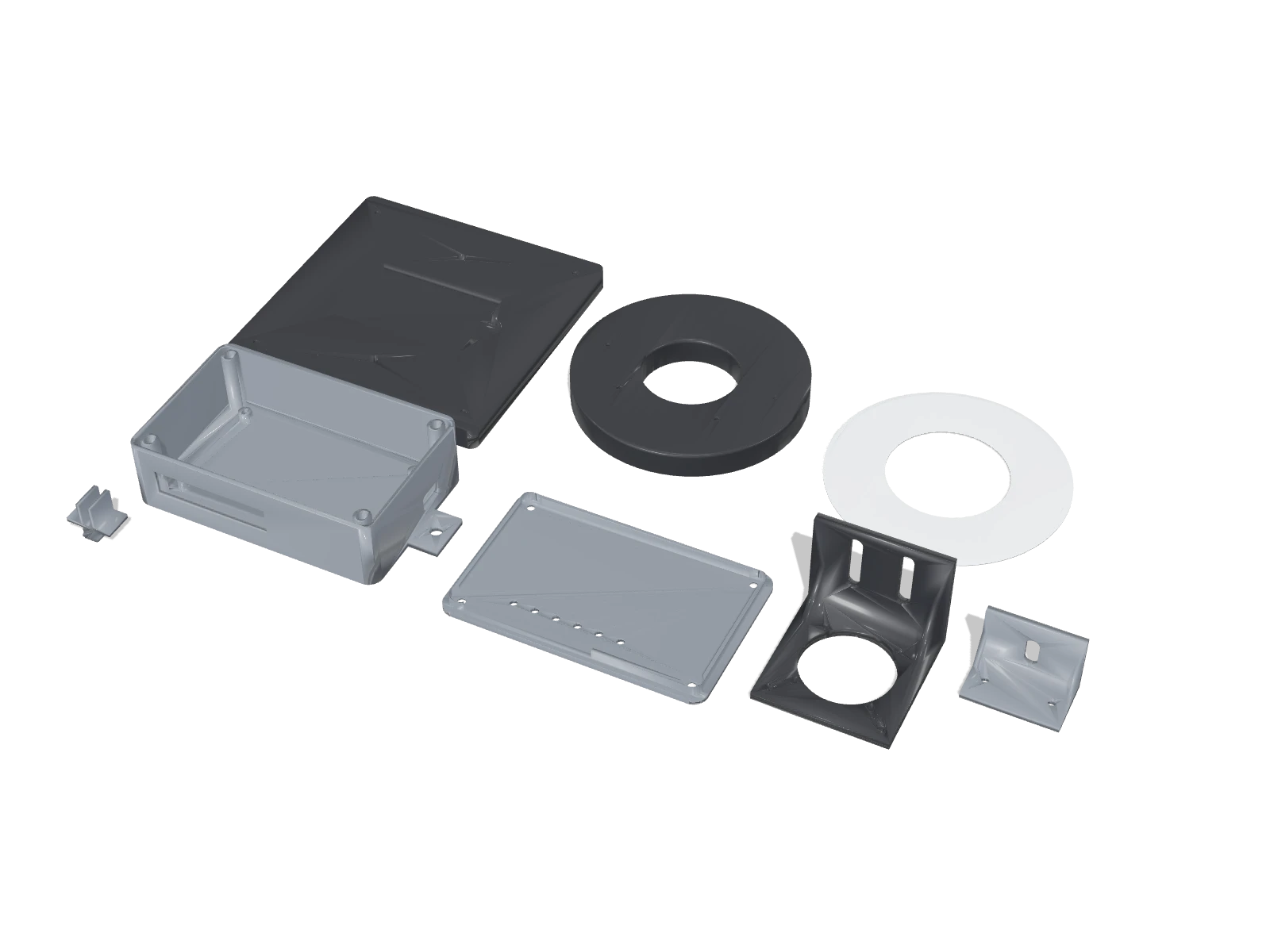
8 parts, generated from code and checked as closed solids. Pick a part to inspect it, or download the STL files to print.
See the CAD parts render
Loading the CAD…
Real CAD · drag to rotate · scroll to zoomReal CAD · swipe sideways
Bought hardware fitted inside this part (checked in the CAD: nothing collides with the plastic)
- Camera mount for 2020 barcam-mount.stl · PETG
- LED ring holderring-holder.stl · PETG
- Ring diffuserring-diffuser.stl · PETG
- I/O pod baseio-pod-base.stl · PETG
- I/O pod lidio-pod-lid.stl · PETG
- Part nest with fiducialspart-nest.stl · PETG
- Light-box panel clippanel-clip.stl · PETG
- Photo-eye bracketphoto-eye-bracket.stl · PETG
Open risks we are working on
- Feasibility studies may not convert to station sales (need ≥40% by study 10)
- Running Hailo inference from Node and choosing a precompiled backbone not yet proven
- Tiny defects under 4 pixels are out of reach; the optics rule must be enforced in every study
- Support load per station against a $49/month plan
Design stage only: nothing on this page is for sale. Specifications and prices are targets.