MotorPulse
Run/stop and bearing trend for small plants, at $99–119 a point
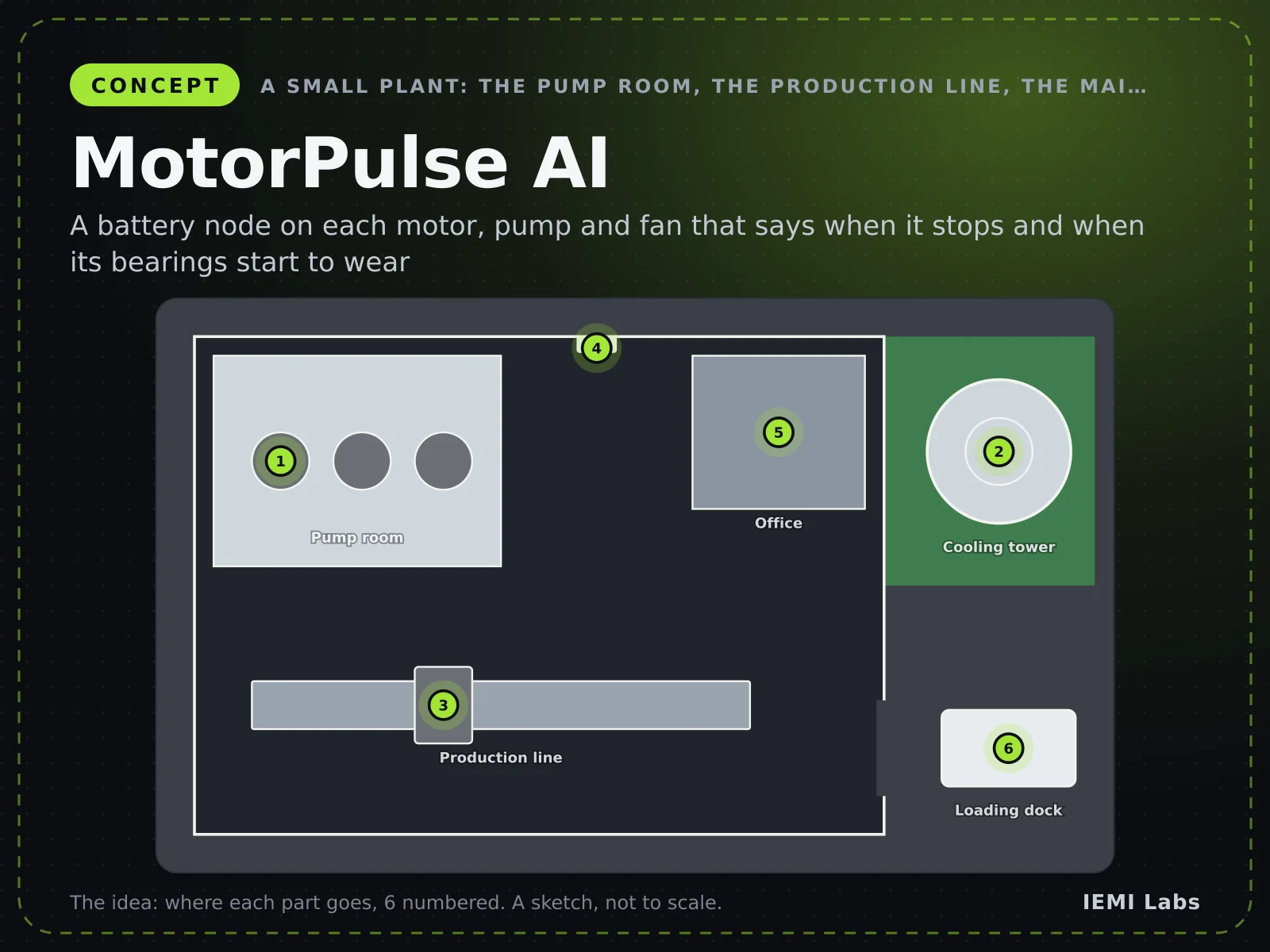
Tells a small plant when each motor, pump or fan runs, when it stops unexpectedly, and when its bearings start trending worse, weeks before a failure, with no analyst contract.
- Who buys it
- The plant manager or maintenance lead at a plant with 10–60 rotating machines; pump, motor-repair and HVAC contractors resell and install it.
- Why it pays
- Turning 2 of about 3 yearly motor or pump failures into planned repairs saves about $10,600/yr for a 12-point plant (est.).
- Target price
- Starter-6 (6 nodes + gateway) $990; extra node $119, $99 at 25+; cloud $2/node/month after year 1, or local-only with no subscription (target)
- First-minute wow
- A plant board where every machine is a tile (running, stopped, watch, plan, act), and an SMS within a minute when a pump stops that should be running.
What the research found
And how this design answers it
- Augury, Waites and Fluke are quote-based analyst services → published per-point price, no analyst, local-only mode with no subscription
- Monnit ($186–455), Banner QM30VT2 ($320) and Fluke 3561 kits ($1,195) are the real low-cost rivals → 6 kHz wideband IIS3DWB data at a basic-meter price plus first-class run hours and unexpected-stop alerts
- AI fault-type claims invite false calls → only a trend against the machine's own baseline, in plain words, with ISO 10816-3 zones as a reference
- Unproven 3–5 yr battery with an STM32N6 → one RAK3172, a 1 µA run-check accelerometer, sensor power-gated; about 0.43 mAh/day on a 3.6 Ah cell (est.)
- Plastic or magnet mounts lose high-frequency signal → PCB clamped to a CNC 316 stainless base on a 1/4-28 stud
- Building a gateway is a support burden → bought RAK7268V2 with its built-in LoRaWAN server
Use case
Booster pump trips on the night shift
Night-shift leadPlant managerMaintenance tech
- 01Trigger: pump P-3 trips on overload at 01:40 while its schedule says it should run
- 02Detection: the 1-minute run check falls below the learned threshold for 2 minutes; the node sends a state change at once
- 03Alert: SMS to the shift lead, "Pump P-3 stopped 01:40, not scheduled"
- 04Action: the lead resets the overload in 15 minutes; next week the bearing trend shows Watch, so the tech books a check
Outcome: About 4 hours of downtime avoided, about $4,000 (est.)
How it works
Architecture
- 01
Sense: IIS3DWB 26.7 kHz 3-axis accelerometer and TMP117 on a stainless stud base; LIS2DW12 1 µA run check every minute
- 02
Decide (node): run/stop with hysteresis; hourly snapshot gives velocity RMS 10–1,000 Hz, kurtosis, crest factor and 2–6 kHz envelope spectrum
- 03
Send: LoRaWAN US915, 6-byte state changes and 31-byte hourly summaries; spectra on request
- 04
Decide (cloud or local): Bearing Trend Index against the machine's own baseline, ISO 10816-3 zones, schedule-aware stop alerts
- 05
Tell: plant board, machine pages, SMS and email alerts, monthly run-hours report
Hardware
Real parts, buyable today
Bill of materials: about $73 per node at qty 1, about $55 at qty 50 (est.); gateway $139–219 per site.
| Block | Part | Why this part |
|---|---|---|
| Radio + MCU | RAK3172 (STM32WLE5 + SX1262) | LoRaWAN, low sleep current, $6–7 |
| Vibration | ST IIS3DWB wideband accelerometer | Flat to about 6 kHz for bearing data, $16–20 |
| Run check | ST LIS2DW12 | About 1 µA, so the wideband sensor sleeps between snapshots |
| Battery | Saft LS17500 3.6 Ah Li-SOCl₂ | Wide temperature, low self-discharge, $9.92 |
| Base | CNC 316 stainless hex AF 45 with 1/4-28 stud | All-metal vibration path |
| Gateway | RAKwireless RAK7268V2 | Built-in network server, local MQTT, from $139 |
Mechanical
Printable CAD
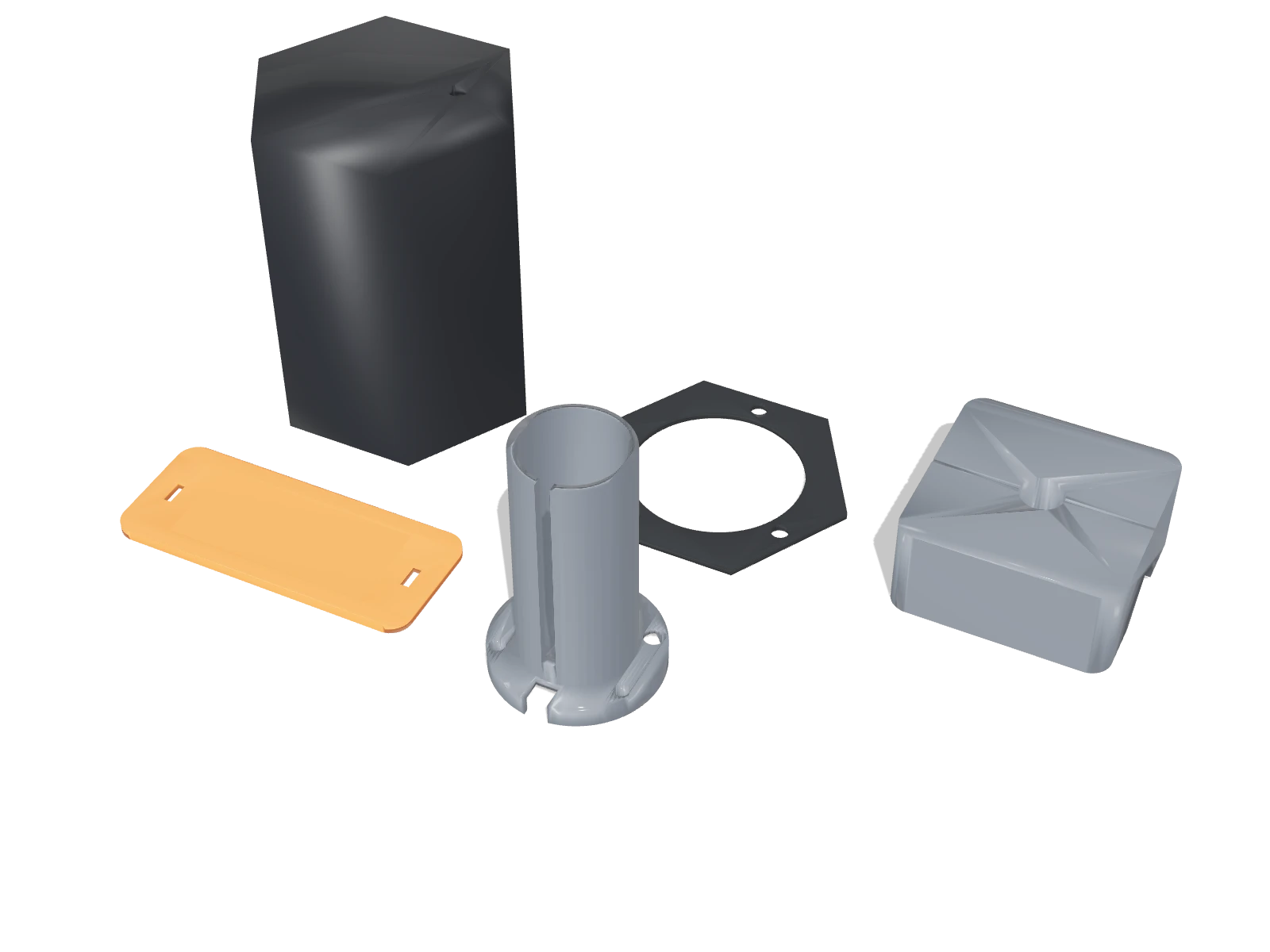
5 parts, generated from code and checked as closed solids. Pick a part to inspect it, or download the STL files to print.
See the CAD parts render
Loading the CAD…
Real CAD · drag to rotate · scroll to zoomReal CAD · swipe sideways
Bought hardware fitted inside this part (checked in the CAD: nothing collides with the plastic)
Open risks we are working on
- Differentiation vs Monnit and NCD is thin on price alone; run hours and the plain-language trend must win the pilot
- Battery life (5 yr claim) is an estimate until a measured day-profile and a 6-month field log
- No over-the-air firmware updates in rev A; bugs at ship need site visits
- BTI thresholds and weights are hypotheses; false Watch alerts would erode trust quickly
- Not for hazardous (classified) locations, which excludes some process plants
Design stage only: nothing on this page is for sale. Specifications and prices are targets.