ClassOne
IEMI's one product for a classroom: the whiteboard, made smart
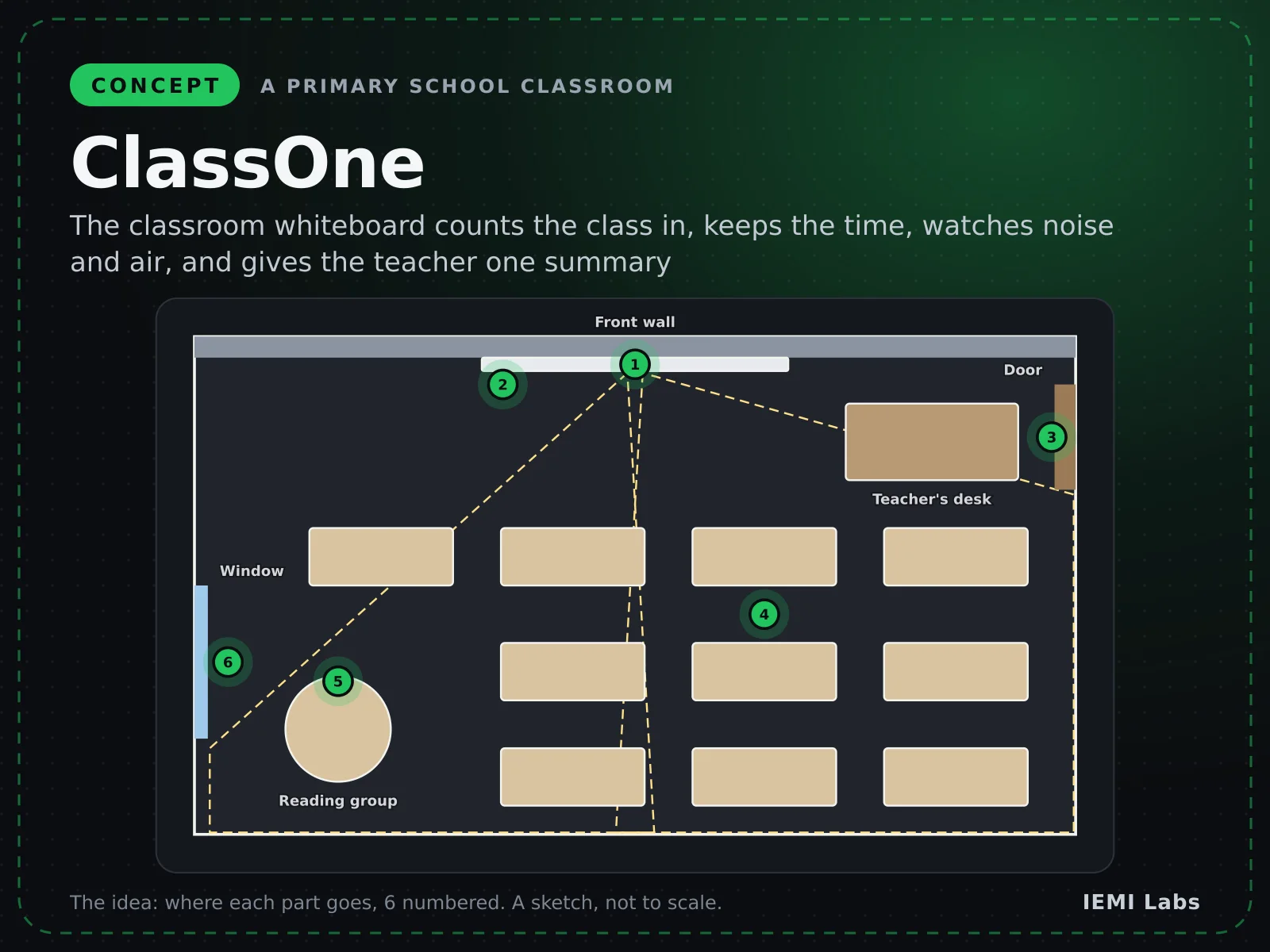
The class's front whiteboard, at the same size and place, checks the register against a head count (never faces), runs the class timer and reading-group rotations, calls noise and 'open the window' on its own time bar with a voice, counts the room clear in a fire drill, and sends the teacher one summary. No video leaves the board.
- Who buys it
- Primary and middle school heads and business managers, one classroom at a time; then multi-academy trusts and school districts.
- Why it pays
- $1,090 + $4/month per classroom instead of about $1,150 + $5/month for a plain whiteboard, a visual timer, a noise light, a CO2 monitor and a tap-in attendance reader bought separately (est.).
- Target price
- $1,090 per smart whiteboard + $4/month teacher app (target)
- First-minute wow
- The bell goes: 28 cards tapped, 29 heads counted. The board's bar shows amber 29 / 28 and the teacher's phone shows the two children who have not tapped, before the teacher has opened the register.
What the research found
And how this design answers it
- Rev A (28 Oct 2026): the classroom flagship is the front whiteboard itself. Header rail: Raspberry Pi 5 brain, two Camera Module 3 Wide room cameras (heads only), SCD41 CO2 sensor, I2S mic for sound level, 12-stick time bar, speaker, ATECC608, tamper switch. Pen tray: the PN532 tap-in reader
- Makes the room's calls itself: time up, next reading group, too loud, open the window, too hot or cold; the register check and the fire-drill room clear assist the teacher; unsure means 'check'
- Privacy first: counts heads, never faces (GDPR Article 9, New York's 2023 school ban on facial recognition); no video or sound recording leaves the board; FERPA and school consent
- Legal on the wall: 70 mm from the wall (ADA 307.2 limit 100), 5 V only, the same EN 14434 board, frame and pen tray
- Stage 2 (28 Oct 2026): stage 2 ready. Buyer check with sources (Time Timer, Yacker Tracker, Aranet4, HALO 3C, interactive panels); brain changed to the same-size Raspberry Pi 5 2 GB because the 4 GB now costs $130; prices checked, $720 of parts at qty 1; price $990 to $1,090 + $4/month; top-three FAQs
- Gaps listed: who exactly is in the room (cards and the teacher), behaviour, lesson content (not an interactive display), opening windows
Use case
A Year 3 class of 29 with one teacher and four reading groups
Class teacherPupilsSchool office
- 01Trigger: the 8:50 bell; pupils tap their cards on the pen tray as they come in
- 02Detect: two room cameras count heads; the SCD30 in the side frame reads CO2; the mic reads the sound level
- 03Act: register check on the bar, timer and group calls, 'too loud', 'open the window', room clear in a drill
- 04Log: one signed day summary to the teacher and the office
Outcome: The register is checked in seconds, the teacher stays with the reading group while the board runs the time, and the room stays under the BB101 CO2 level
How it works
Architecture
- 01
Sense: two head-counting cameras, a CO2 sensor and a sound mic in the header rail, a tap-in reader in the pen tray
- 02
Decide: the Raspberry Pi 5 merges the counts and runs the register, timer, noise, air and drill rules, and says 'check' below the line
- 03
Show: the time bar across the header and a voice from the board itself
- 04
Tell: one signed day summary over the school Wi-Fi to the teacher app
Hardware
Real parts, buyable today
Bill of materials: about $729 per classroom at qty 1 including the board, header, tray and 30 cards (29 Oct 2026: SCD30 CO2 sensor, est.; other prices checked 28 Oct 2026; board est.).
| Block | Part | Why this part |
|---|---|---|
| Brain | Raspberry Pi 5 2 GB | Counts heads from two cameras on the board, in the header rail |
| Room | 2 x Raspberry Pi Camera Module 3 Wide | Together they see every desk, the door and the group table from the board |
| Register | PN532 NFC module | Pupils tap their cards at the pen tray |
| Air and sound | Sensirion SCD30 + Adafruit 3421 SPH0645 | CO2, temperature, humidity; sound level and the alarm tone |
| Calls | 12 x Adafruit NeoPixel Stick 8 + MAX98357A and 28 mm speaker | Time bar and call colours across the header, with a voice |
| Security | Adafruit 4314 ATECC608 + Omron D2F-01 | Signed calls, tamper log |
| Power | Raspberry Pi 27 W USB-C supply | Only 5 V in the board |
Mechanical
Printable CAD
3 parts, generated from code and checked as closed solids. Pick a part to inspect it, or download the STL files to print.
Loading the CAD…
Real CAD · drag to rotate · scroll to zoomReal CAD · swipe sideways
Bought hardware fitted inside this part (checked in the CAD: nothing collides with the plastic)
- Smart whiteboard (board, header rail with brain and sensors, pen tray with tap-in compartment)whiteboard.stl · steel board, aluminium frame, header and tray
- Header cover (camera windows, opal over the time bar; presses the tamper switch)header-cover.stl · PETG, printed, opal
- Tray lid over the tap-in readertray-lid.stl · PETG, printed
Open risks we are working on
- Head counts in a busy room (children moving, coats on hooks) can wobble; it reports 'check', never an absence
- Schools must sign a consent and data agreement; some will refuse any camera, so the board also runs with cameras off (taps, timer, air and noise only)
- The legal register stays the teacher's: the board only checks it
- Electrical, radio and EN 14434 tests are still to be done
- Interactive displays already hang on many front walls; ClassOne is for rooms with a dry-wipe board or a board beside the display
Design stage only: nothing on this page is for sale. Specifications and prices are targets.