IndustrialConcept
DustWatch AI
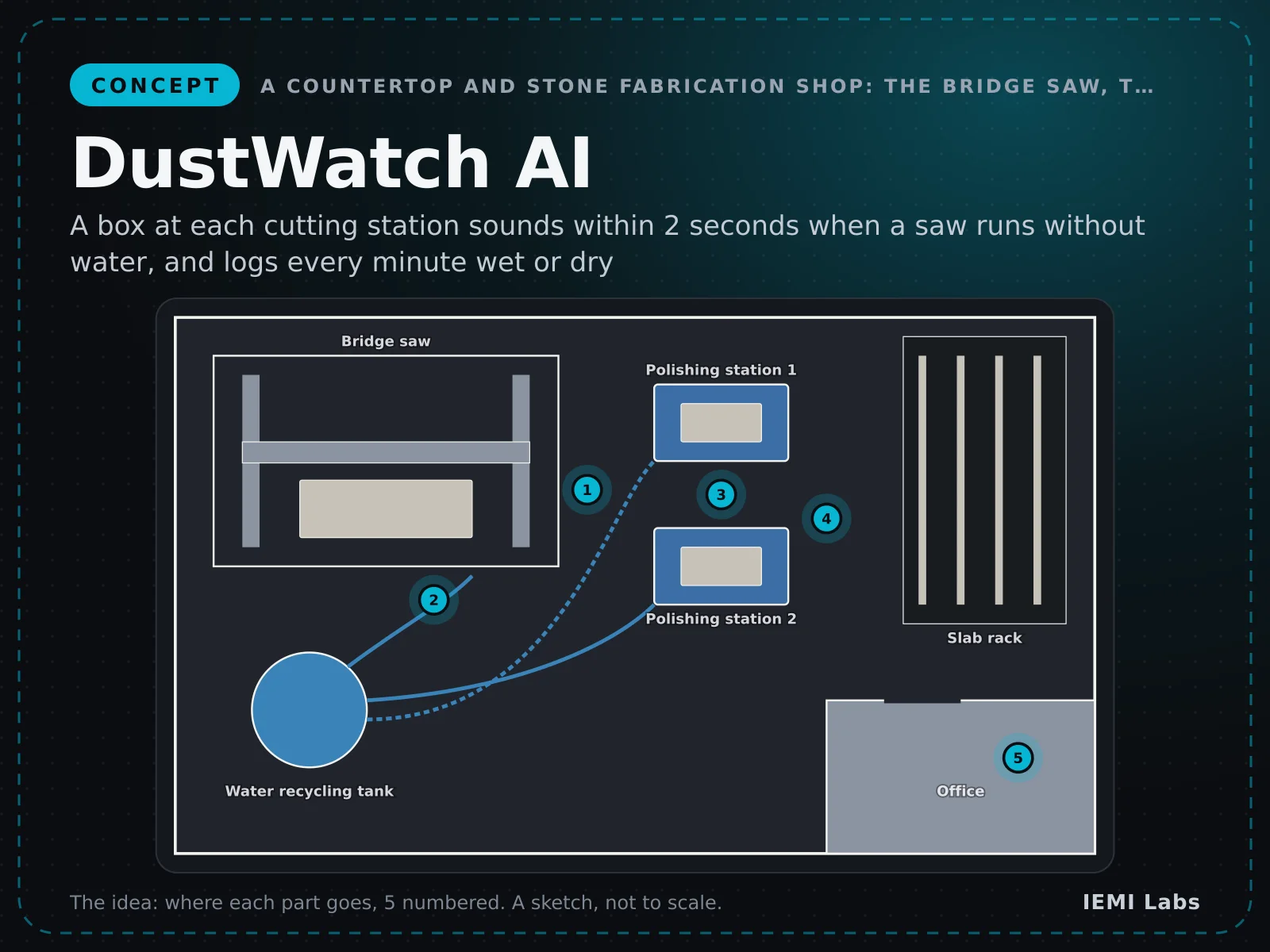
A bench-mounted camera and dust sensor that warns when dust controls on cutting tasks fail.
- Spots visible dust plumes
- Flags suspected dry cutting
- Tracks a PM4 dust trend
From $799 per unit
DetailsSolar WBGT heat-stress station with flag beacon and site siren
Software: $19 per month per station
Concept, not for sale yet. Tell us if you want it; that decides what we build.
Rate this idea and tell us what to change
Drag to rotate · right-drag to move · scroll to zoom · click a part for its size and placeSwipe to rotate · pinch to zoom · two fingers to move · tap a part for its size
How it fits together
Scroll or tap a part. Press “See the 3D CAD design” to watch the model, built from our CAD, light each part up and show how it connects.
Real-time 3D render · drag to rotate · final design may varySwipe sideways to rotate
01
The whole HeatGuard AI
A mast station measures shade air, a black globe and wind, works out heat stress, and lights a four-colour beacon for the crew.
02Brain
nRF9151 (LTE-M + GNSS)
The brain: it runs the heatflag-fw program
03
Air temp and humidity
Reads shaded air temperature and humidity inside a ventilated shield
nRF9151 (LTE-M + GNSS) · I²C (4 wires) · Air °C and RH
04
Black globe PT1000
Reads the sun's radiant heat in a 150 mm black ball
nRF9151 (LTE-M + GNSS) · SPI (MAX31865) · Globe resistance reading
05
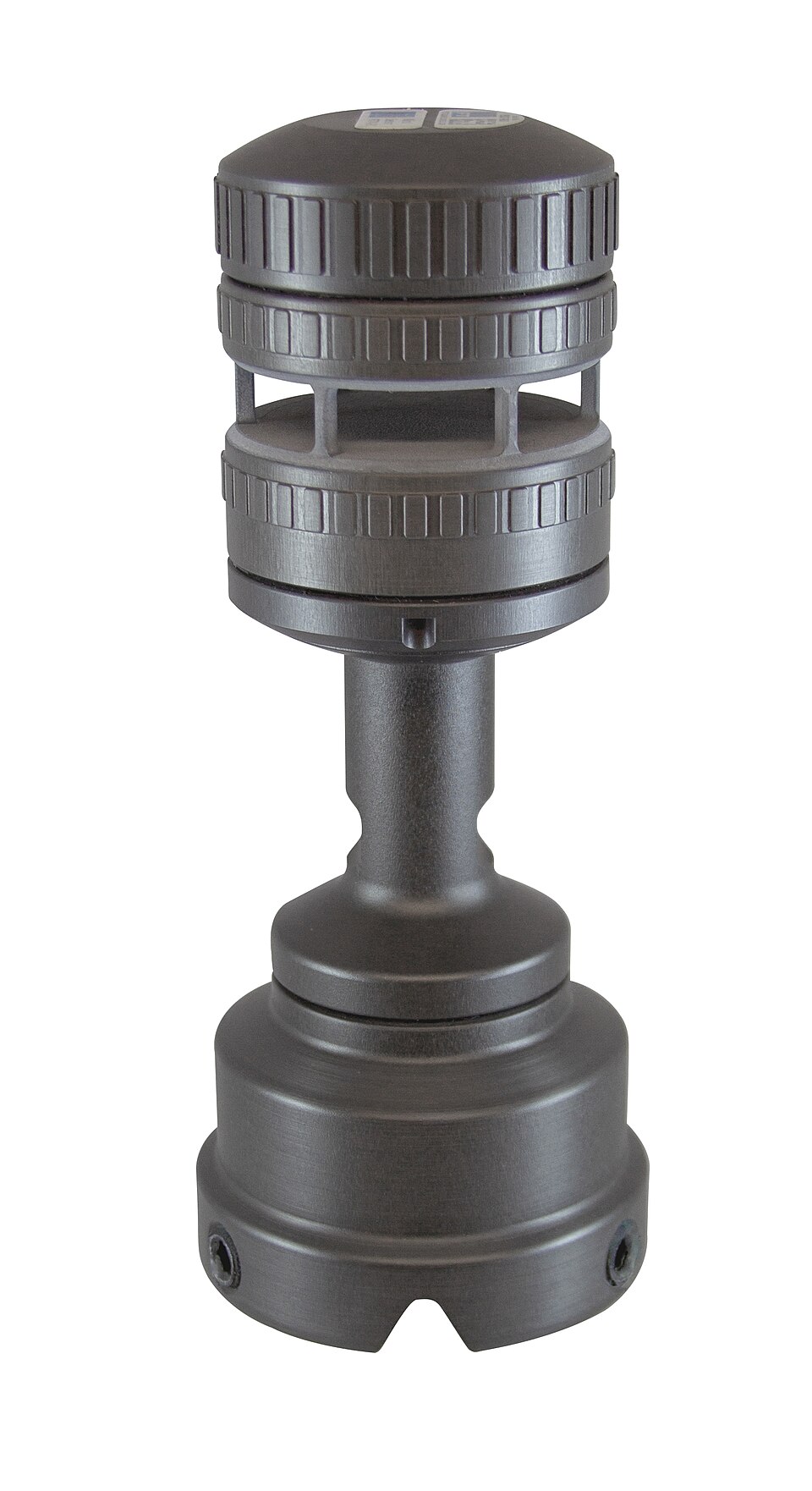
Ultrasonic anemometer
Measures wind speed and direction with no moving parts
nRF9151 (LTE-M + GNSS) · RS485 Modbus RTU (UART) · Wind speed
06
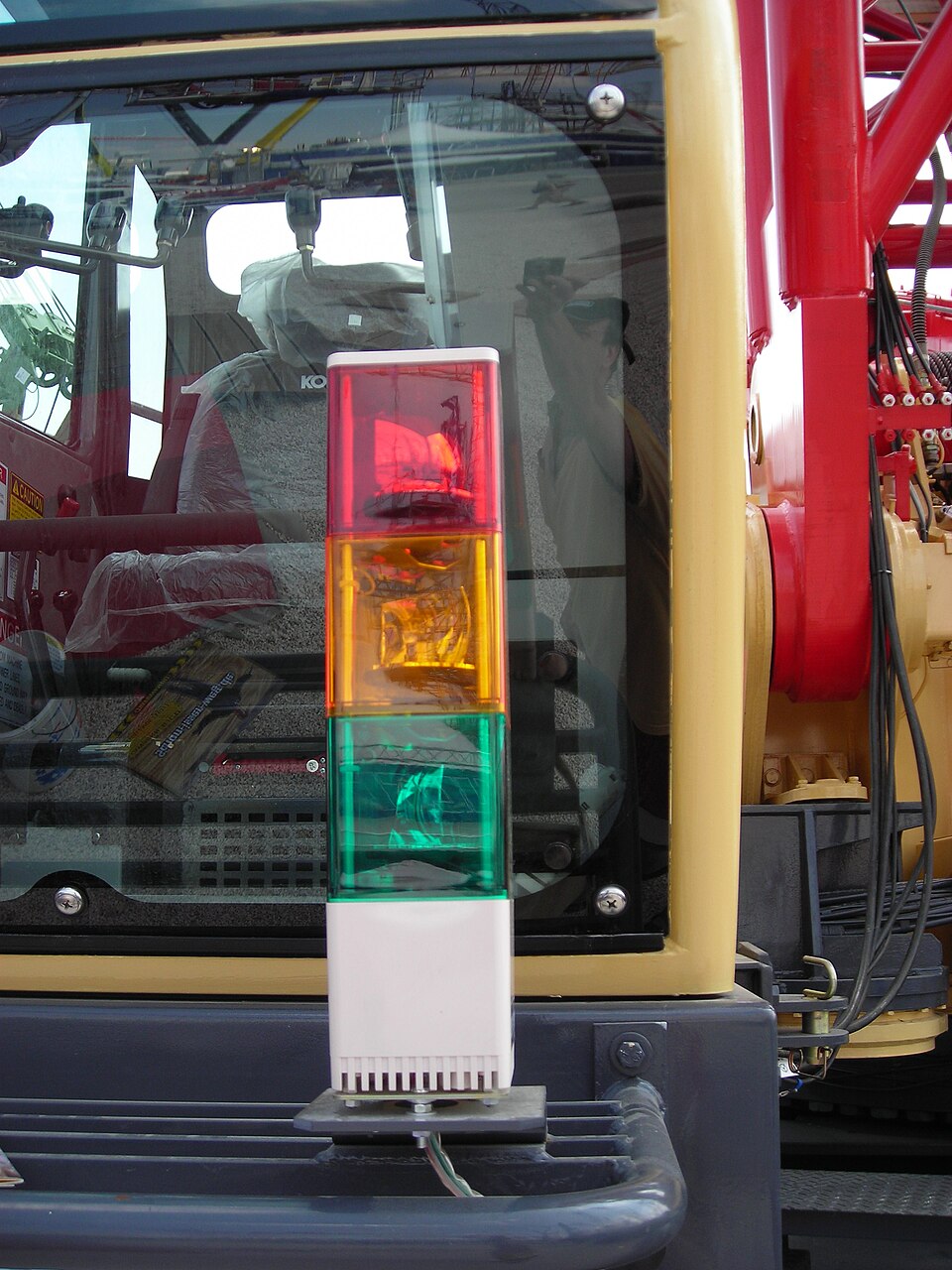
Four-tier beacon
Shows green, yellow, red or blue and chirps for breaks
nRF9151 (LTE-M + GNSS) · GPIO to MOSFETs, 24 V · Tier and buzzer on/off
07
LTE-M and GNSS antennas
Sends readings to the cloud and fixes the station's position
nRF9151 (LTE-M + GNSS) · RF antenna leads · LTE-M radio and GPS
08
Solar panel + charger
Keeps the battery charged from a 20 W panel
nRF9151 (LTE-M + GNSS) · Panel lead to BQ24650 · 18 V solar power
09
LiFePO4 battery
Runs the station through the night and cloudy days
nRF9151 (LTE-M + GNSS) · Fused 12.8 V lead · 12.8 V power
10
All connected
8 key parts, one program, and your phone
What it is
A solar-powered pole-mounted weather station that measures heat stress and signals it with a coloured beacon.
What it does
Who it's for
Construction, mining, utility, solar and farm sites with outdoor crews.
How the parts connect
Every part, what links it to the brain, and how the data reaches your phone. A solid line is a cable; a dashed line is a radio link.
The program
while (1) {
    k_sleep(K_SECONDS(60));
    s.ta_rh = sht45_read();            // I2C 0x44
    s.tg    = max31865_read_pt1000();  // SPI
    s.wind  = modbus_read_wind();      // RS485
    s.hi    = heat_index(s.ta_rh);
    flag    = pick_flag(s, cfg.rules); // state rule-set + WBGT
    beacon_show(flag);                 // GPIO gates
    ring_push(&s);
    if (flag != last_flag || ++n == 5)
        mqtt_publish("hf/dev/tele", cbor(ring));
}
To your phone
Phone or laptop browser (PWA), crew QR page
One screen for each job HeatGuard AI does.
Heat flagJust after noon on a concrete pour, the station's beacon turns red for the whole crew to see. The supervisor's phone shows the same.
Break clockWhile the flag is red, each crew rests 15 minutes an hour. Workers scan the QR sign to log breaks; a late one goes to the supervisor.
Day planAt 05:30 the supervisor checks the day's heat forecast for each station and moves the concrete pour into the cool morning.
App screens with sample data. The interface is in development.
| Flag colour | Red | Every minute |
|---|---|---|
| WBGT | 28.6 °C | Every minute |
| Heat index | 97 °F | Every minute |
| Next break due | 14:30 | While red |
| Battery charge | 86% | Every 5 min |
Crew page stores only a first name or badge number. No tracking of people; GPS is for the station only.
CAD design · Design complete (stages 1–6, rev A), not built, not validated
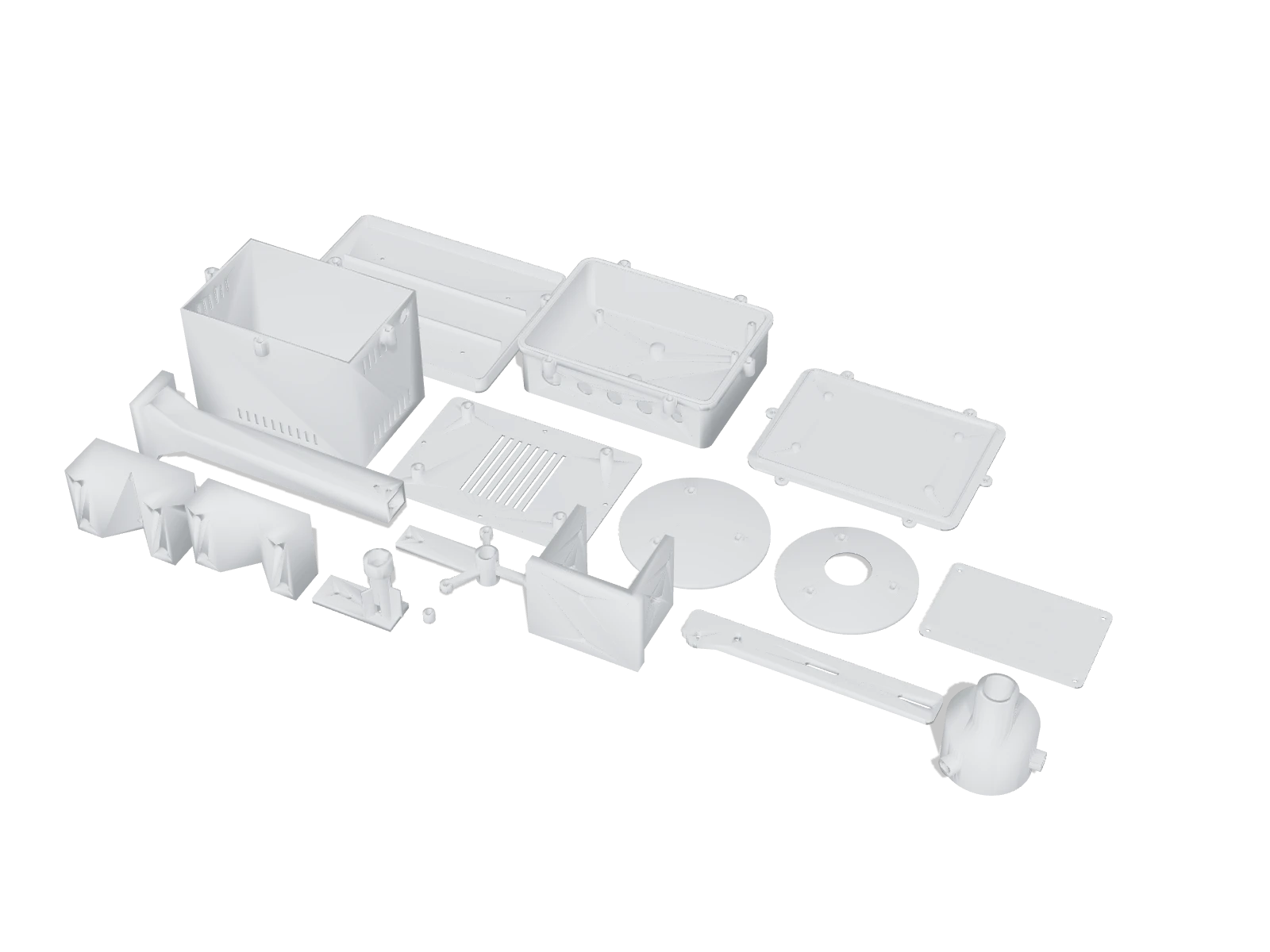
| AI processor | ESP32-S3 (on-device WBGT forecast) |
|---|---|
| Sensors | 150 mm matte-black globe with PT1000 temperature sensor · Sensirion SHT45 air temperature and humidity sensor in a 6-plate radiation shield · Solid-state ultrasonic wind sensor · Natural wet-bulb computed from globe, air, humidity and wind (waterless) |
| Connectivity | LoRaWAN to a site gateway · LTE-M / NB-IoT direct option · Wi-Fi for indoor sites · 110 dB siren and 4-colour flag beacon |
| Power | 20 W solar panel with LiFePO4 battery, ~5 days without sun (target); 12–24 V DC input option |
| Enclosure | Upright white UV-stabilised box under a solar roof tilted 15°, with a matte-black globe on a side arm, a white 6-plate radiation shield below, a green/yellow/red/black beacon on top and an orange accent stripe |
| Dimensions | Body 16 W × 9 D × 22 H cm; solar roof 34 × 26 cm; globe Ø15 cm on a 20 cm arm; shield Ø10 × 12 cm; beacon Ø6 × 14 cm |
| Weight | ~2.5 kg plus pole or tripod (est.) |
| Ingress rating | IP66 (target) |
| WBGT | Estimated from globe, air, humidity and wind |
|---|---|
| Globe | 150 mm matte black |
| Update rate | Every minute |
| Forecast | 30–120 minutes ahead |
| Beacon | Green, yellow, red, black |
|---|---|
| Siren | Up to 110 dB, adjustable |
| E-ink panel | 10 × 6 cm; EN, AR, HI, UR, ML, TL |
| Remote | SMS, WhatsApp, email and dashboard |
| Power | 20 W solar + LiFePO4, ~5 days autonomy |
|---|---|
| Body | 16 × 9 × 22 cm, IP66 (target) |
| Operating temp. | −10 °C to 60 °C ambient |
| Mounting | 40–60 mm pole clamp or 1.5 m tripod |
Targets for production units; they may change during development.
Hardware: $699 per station
Software: $19 per month per station
Target pricing. $699 + $19/mo per station with LTE-M included; Site Pack of 4 stations + 1 LoRaWAN gateway at $3,290 + $49/mo.
$699 + $19/mo
One solar WBGT station with built-in LTE-M.
$3,290 + $49/mo
Four stations and a LoRaWAN gateway for larger sites.
Custom
For contractors and operators with many sites.
Indicative launch pricing in USD, excluding taxes and shipping. Final pricing is confirmed before any balance is charged.
Community
HeatGuard AI is in development. Rate the idea, tell us what to change about the features, specs or price, and we'll build it with your feedback.
How much people want it
–
No ratings yet
Follow HeatGuard AI
Get build updates and first access when pre-orders open.
No comments yet. Tell us what you'd want from HeatGuard AI.
Questions
Tell us what this would save you, or ask anything. We reply within two business days.
A member of the IEMI Labs team will reply within two business days.
From the product lab · ideation phase
No. HeatGuard estimates WBGT from its sensors. We will not claim ISO 7243 compliance or a certified WBGT measurement until the station has been validated side by side against a reference meter and the results are published. It provides guidance; it is not a safety-rated or medical device and cannot predict an individual's heat illness.
No device can do that on its own. HeatGuard is designed to help you evidence heat monitoring and work/rest decisions, for example with daily heat logs and ban-hour flags. Your heat-illness plan, water, shade and rest breaks remain your responsibility.
No. HeatGuard has no camera, no microphone and no wearables. It measures the weather at the station only.
Clamp it to a 40–60 mm pole or set it on the 1.5 m folding tripod in full sun near the work area. It powers itself from the solar roof, so no cabling is needed. Setup in the app takes a few minutes.
Each station has built-in LTE-M. On larger sites, stations can talk to a LoRaWAN gateway instead. The beacon, siren and panel keep working on the station even without a network.
No. It is a new concept in development. Specifications are target specifications. It is a concept: we are not taking orders, reservations or deposits, and it has no ship date yet.
We are planning a 2-year limited hardware warranty covering manufacturing defects. Final terms will be published before shipping begins.
A bench-mounted camera and dust sensor that warns when dust controls on cutting tasks fail.
From $799 per unit
Details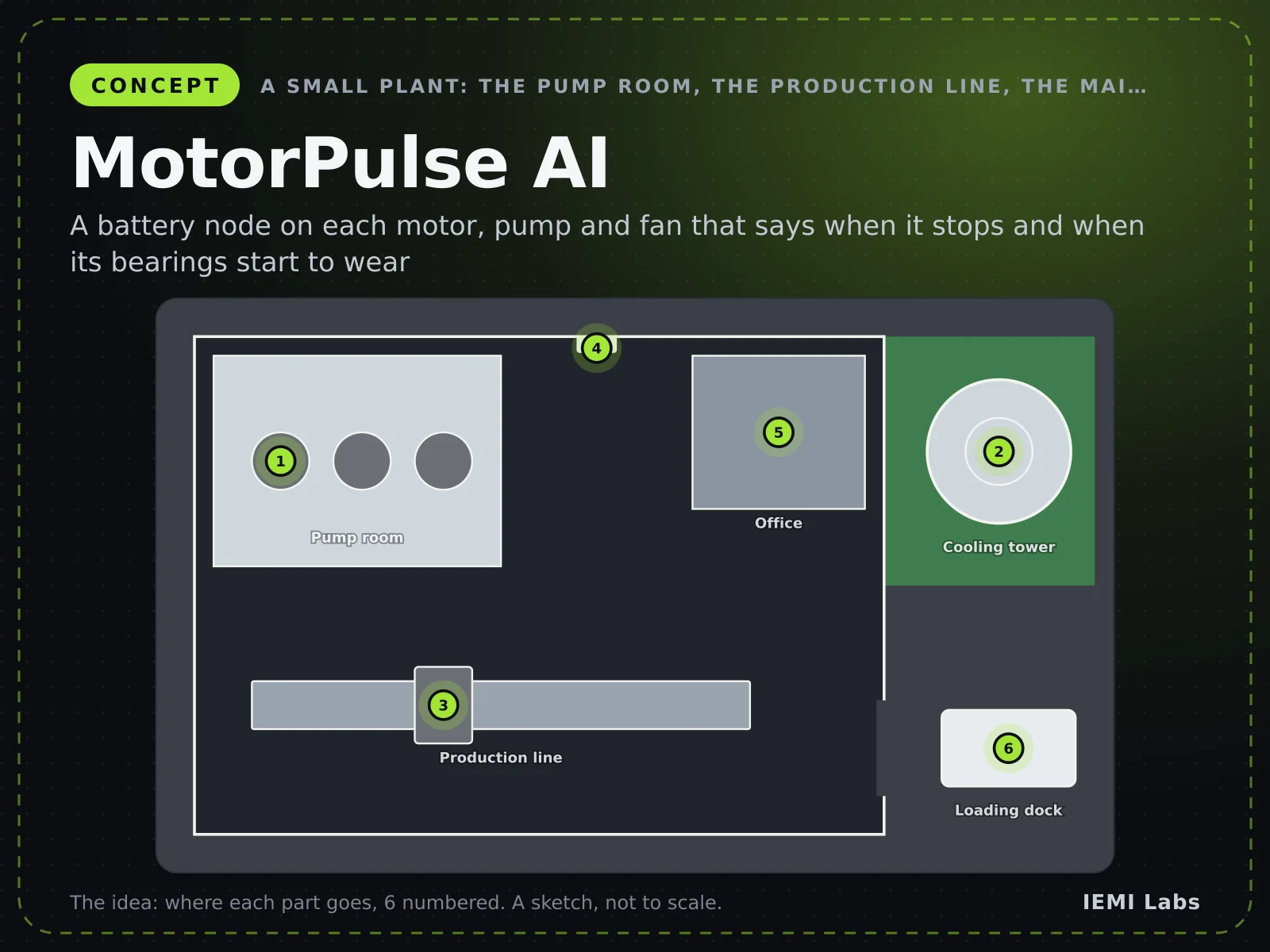
A small battery sensor that screws onto a motor or pump and spots developing faults.
From $249 per node (HD variant $349); gateway $399
Details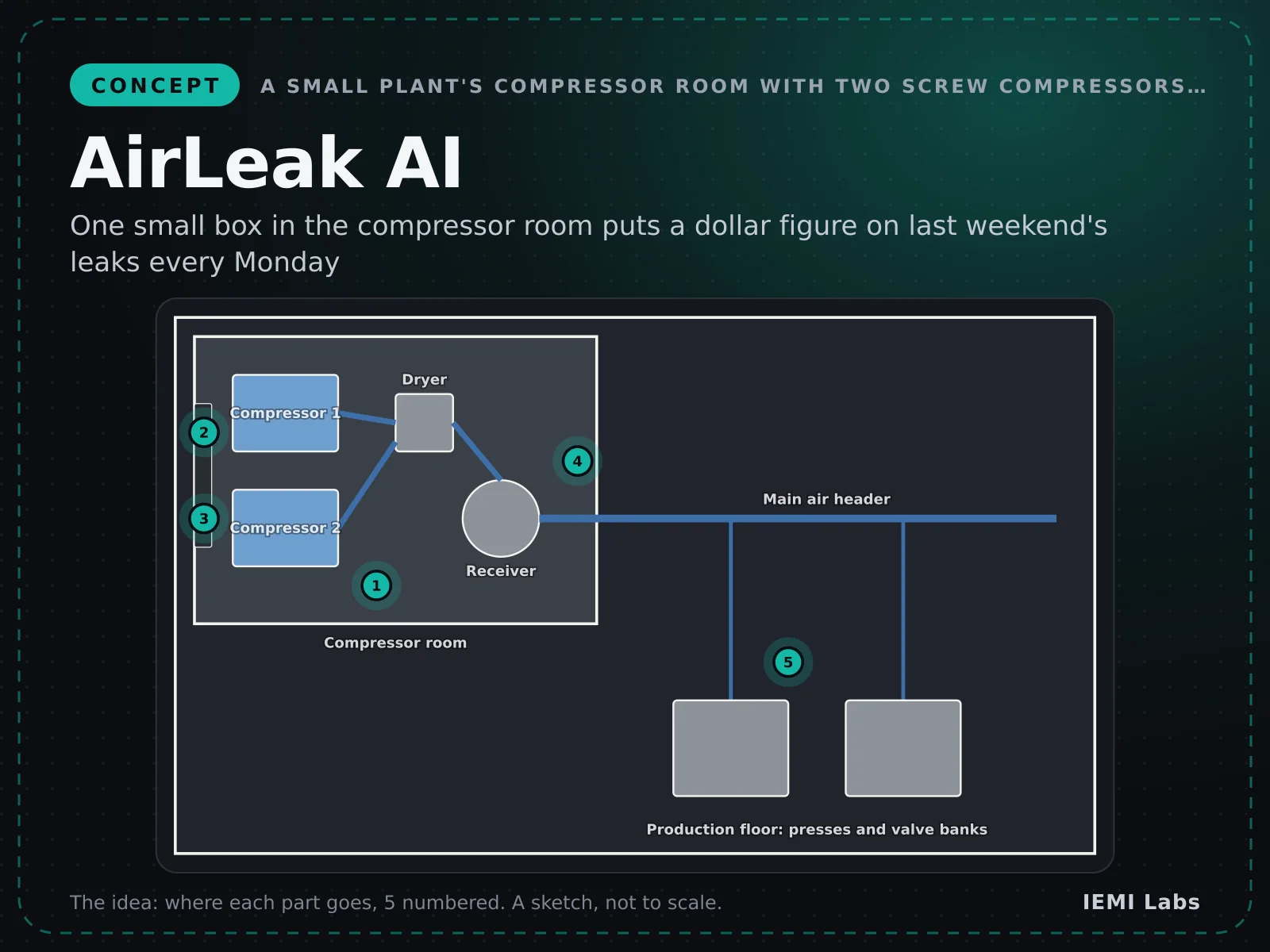
A wall or pole-mounted ultrasonic sensor disc with a camera that listens for compressed-air and gas leaks.
From $1,490 per unit
DetailsHeatGuard AI
Concept · target $699