HeatFlag
One heat colour the whole crew can see, and a heat log that writes itself
A solar pole station measures WBGT and heat index on site, shows the whole crew one colour on a pole light (green / yellow / red / blue = stop heavy work), and writes the heat log with readings, alerts, acknowledgements and QR-logged breaks. Advisory only: early warning and evidence, not a safety or compliance certification.
- Who buys it
- Safety manager or owner at a mid-size construction, roofing, landscaping or solar subcontractor in TX, CA and the Southwest (50–500 field staff).
- Why it pays
- For 3 sites and 60 workers: about $4k/yr in hard dollars (avoided claims, serious-event and citation expected value) and about $17k/yr including productivity and supervisor time (est.), against $1,047 per season.
- Target price
- $349 per station per heat season (May–Oct) rental, all-in; or $899 + $15/month in season (target)
- First-minute wow
- One light the whole crew can see from anywhere on site, and a break log that fills itself in.
What the research found
And how this design answers it
- US workplace rules trigger on heat index or air temperature, not WBGT (school athletics rules do use WBGT; see FieldFlag) → logs both every minute and flags on the stricter of the state rule-set and the WBGT work/rest level
- Cheap sensors make WBGT inaccurate → standard 150 mm copper globe with PT1000, SHT45 in an 8-plate shield, ultrasonic wind; accepted only at MAE ≤ 1.0 °C vs a Kestrel 5400
- LiFePO4 can't charge above 45 °C in Texas sun → shaded, chimney-vented battery bay and a charger NTC cut-off
- Theft on open sites → cable lock through every clamp, security screws, tilt and lid tamper alerts, GNSS tracking and a 150 m geofence
- Liability if a worker collapses → "advisory only" everywhere, raw readings and rule-set version logged with each flag, hash-chained daily logs
- Concept extras (tinyML, LoRaWAN, e-ink, siren) → cut; blue = stop plus the beacon buzzer
Use case
Heat rising from yellow to red, with breaks enforced
CrewSupervisorSafety managerHeatFlag cloud
- 01Trigger: at 10:40 WBGT reaches 25.3 °C for two 1-minute samples and the beacon flashes yellow, with an SMS to the supervisor
- 02Detection: at 12:55 WBGT reaches 28.4 °C, the flag goes red and the app starts a 15-minute-per-hour break clock
- 03Alert: the beacon chirps at each break; crew scan the QR placard, and a break more than 10 minutes overdue texts the supervisor (20 minutes: the safety manager too)
- 04Action: at 15:05 WBGT reaches 31.6 °C and the flag goes blue: stop heavy work
Outcome: Every flag change, acknowledgement and break is logged with the readings that caused it; about $3.5k/yr in avoided claims and serious-event expected value per 60 workers (est.)
How it works
Architecture
- 01
Sense: SHT45 in a radiation shield, PT1000 in a 150 mm black globe, Renke ultrasonic wind at 1.7 m
- 02
Decide: device computes heat index and an approximate WBGT; the cloud computes Liljegren WBGT and the authoritative flag
- 03
Send: nRF9151 LTE-M, MQTT over TLS with CBOR payloads, 7-day on-device buffer and back-fill
- 04
Tell: Patlite 4-tier beacon + buzzer, SMS/push to supervisors, QR break pages, PDF/CSV log export
Hardware
Real parts, buyable today
Bill of materials: about $821 per pilot station including the $198 Patlite and $80 globe; volume target ≤ $300 (est.).
| Block | Part | Why this part |
|---|---|---|
| Compute + radio | Nordic nRF9151 SiP (LTE-M/NB-IoT + GNSS) | Pre-certified cellular plus GNSS for theft tracking |
| Air temperature / RH | Sensirion SHT45 in a printed 8-plate shield | Benchmarked against a Davis 7714 shield |
| Globe temperature | PT1000 + MAX31865 in a 150 mm copper globe | Standard globe size, so no small-globe correction |
| Wind | Renke ultrasonic anemometer (RS485 Modbus) | No bearings; wind dominates natural wet bulb |
| Beacon | Patlite LR6 4-tier + buzzer, TPS55340 24 V boost | One colour visible from anywhere on site |
| Power | 20 W panel, BQ24650 MPPT, 12.8 V 12 Ah LiFePO4 | About 22 Wh/day budget and about 5.6 days autonomy (est.) |
Mechanical
Printable CAD
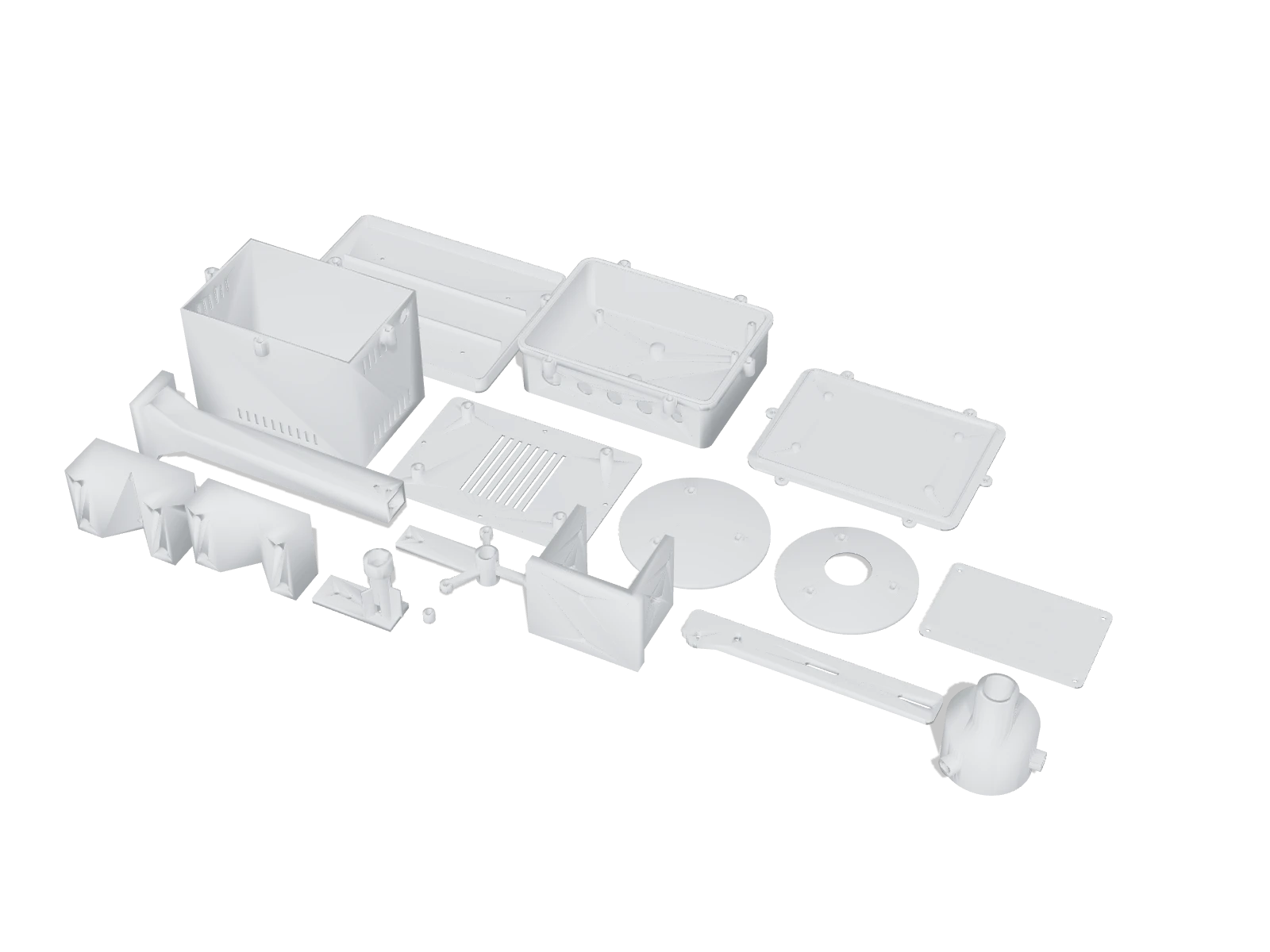
17 parts, generated from code and checked as closed solids. Pick a part to inspect it, or download the STL files to print.
See the CAD parts render
Loading the CAD…
Real CAD · drag to rotate · scroll to zoomReal CAD · swipe sideways
Bought hardware fitted inside this part (checked in the CAD: nothing collides with the plastic)
- Radiation shield plate (×8)shield-plate.stl · ASA, white
- Shield spacer (×24)shield-spacer.stl · ASA, white
- Shield rain capshield-top-cap.stl · ASA, white
- Shield base and probe hubshield-base.stl · ASA, white
- Sensor arm (×2)sensor-arm.stl · ASA, white
- Black globe mountglobe-mount.stl · ASA, white
- Electronics box backebox-back.stl · ASA, white
- Electronics box frontebox-front.stl · ASA, white
- Vented battery baybattery-bay.stl · ASA, white
- Battery bay lidbattery-lid.stl · ASA, white
- Battery sun shadebattery-shade.stl · ASA, white
- Mast clamp front with cable-lock tunnel (×5)mast-clamp-front.stl · ASA, white
- Mast clamp back (×5)mast-clamp-back.stl · ASA, white
- Beacon mast-top adapterbeacon-adapter.stl · ASA, white
- Solar panel tilt basesolar-base.stl · ASA, white
- Solar panel arm (×2)solar-arm.stl · ASA, white
- QR break placardqr-placard.stl · ASA, white
Open risks we are working on
- WBGT accuracy is unproven until the 3-day Kestrel side-by-side test passes (MAE ≤ 1.0 °C)
- On 43 °C days the battery bay may pass 45 °C at midday and charging pauses
- Patlite current and polarity are unverified, and they size the power budget and driver
- Kestrel or Perry could copy it; the edge is speed, the beacon, the break log and price
- Pilot BOM of about $821 needs a volume path to ≤ $300 for margin
- Thresholds not yet checked against the current ACGIH booklet; carrier certification cost and product liability insurance open
Design stage only: nothing on this page is for sale. Specifications and prices are targets.