DripCrown
The IV stand the ward already owns, made smart: it weighs every bag and watches every drip
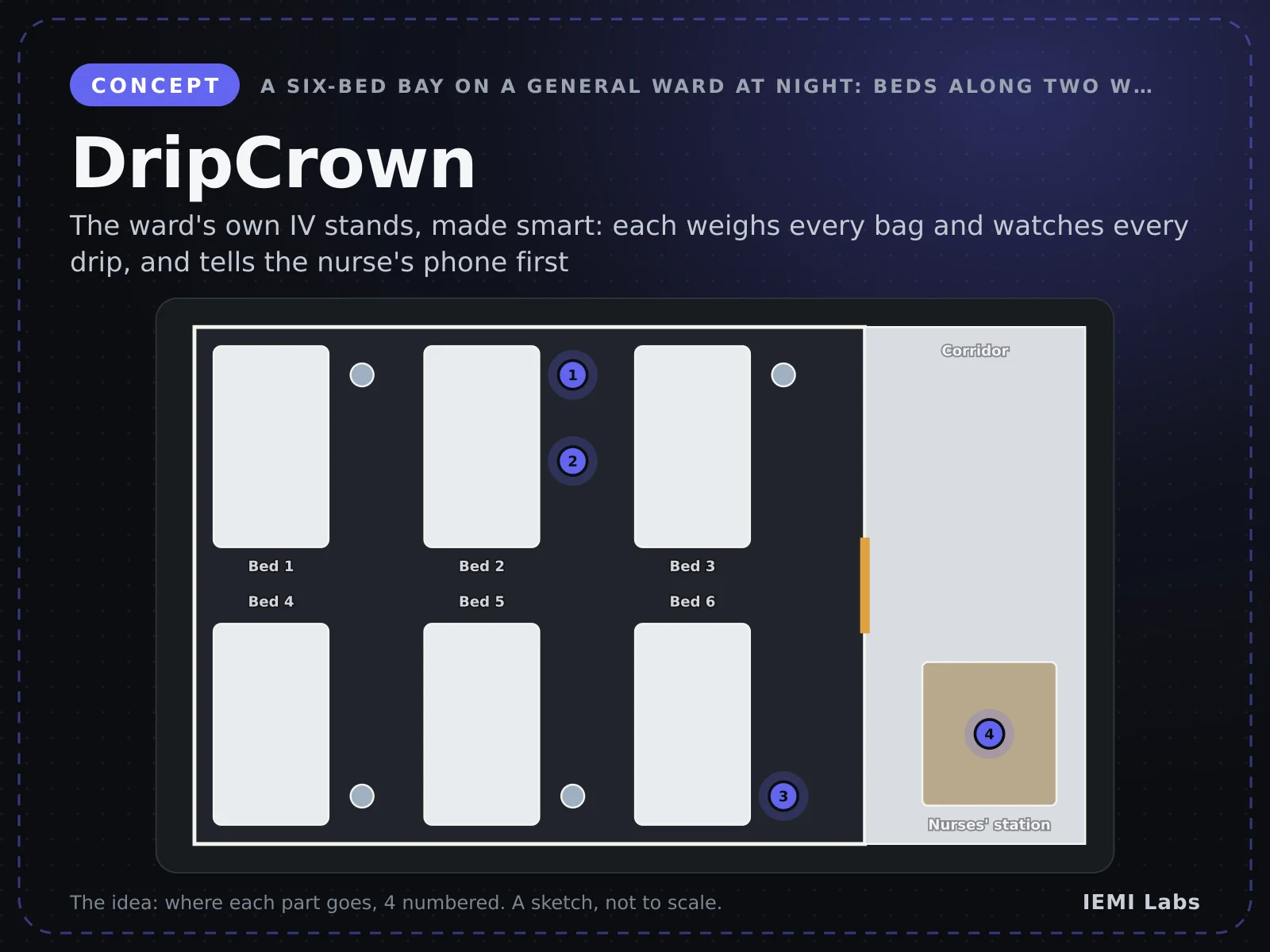
A Crown replaces the hook top of an existing IV stand and weighs each bag on its own load cell (mL left, minutes left, flow from the weight slope); a DripClip camera on the drip chamber counts drops and sees a stopped drip or a free-flow stream. Alerts go to the nurse's phone and a light ring on the stand. It monitors and alerts only and never touches the flow.
- Who buys it
- First: veterinary clinic owners and practice managers (gravity drips are routine and animal devices need no FDA premarket review). Later, after clearance: nursing superintendents in hospitals where gravity sets are the norm (India, South and South-East Asia) and home-infusion providers. Today they rely on nurse rounds, or buy a DripAssist at about $335-480 per line or a ₹14,331 drip monitor.
- Why it pays
- A Finnish study valued the nurse time freed by remote gravity-infusion monitoring at about €1,271 per ward per month; a Chinese IoT study raised on-time completion from 35.6% to 47.2% over 91,300 infusions. A Bed Kit at the $249 target costs less than one DripAssist (est.).
- Target price
- $249 Bed Kit (Crown + 1 DripClip), $49 per extra DripClip, $6/stand/month for the ward dashboard (target)
- First-minute wow
- The nurse hangs a 500 mL bag and clips the camera on; within a minute the phone shows '487 mL left, 102 mL/h, empty at 14:52', and the stand ring goes amber 15 minutes before the bag runs out.
What the research found
And how this design answers it
- Gravity drips are badly inaccurate (a 1985 study found under 15% of observations within ±10% of the ordered rate) → every bag is weighed, so flow and time left come from mass, not from a guessed drop factor
- Existing drip monitors (DripAssist, Drip Alert) count drops only, and nominal drop volume shifts with fluid and rate → the weight calibrates each line's real drop volume over 30 minutes
- Weight alone is blind at slow rates: CAD rate report shows load-cell creep is a 25-50% bias at 10-20 mL/h (est.) → below about 50 mL/h the drop camera times the line and the weight only calibrates it
- 74% of 114,793 alerts in a Chinese ward study were blockage or rate drift, only 22% completion → DripCrown alerts on stopped flow, drift and free flow, not just 'bag empty'
- Nurses walk room to room to check bags → a light ring visible from the corridor plus phone alerts, with the bedside buzzer off at night
- Clip-on gadgets get lost and are another thing to buy per line → the weighing lives in the stand top the ward already owns; the clip is a cheap add-on per line
Use case
Night shift, 22 drips on a 30-bed ward
Ward nurseCharge nursePatient
- 01Trigger: a 500 mL saline bag on bed 14 is 15 minutes from empty and bed 9's drip has slowed to half rate because the patient bent their arm
- 02Detection: the Crown sees bed 14's mass approaching the end-of-bag threshold; bed 9's DripClip sees drop intervals double and the weight slope agree
- 03Alert: the nurse's phone shows 'Bed 14: empty in 15 min' and 'Bed 9: rate -48% for 6 min'; both stand rings turn amber
- 04Action: the nurse readies the next bag for bed 14 and straightens bed 9's arm; the rate recovers and the alert clears itself
Outcome: No dry line and no re-cannulation; about 20 minutes of checking rounds saved per night (est.)
How it works
Architecture
- 01
Sense: two TAL220B load cells with HX711 amps in the Crown (bag mass at 10 SPS); an OV2640 camera with a pulsed amber backlight in each DripClip
- 02
Decide: the DripClip's ESP32-S3 finds each drop as the hanging drop at the orifice resets, and flags a stopped drip or a continuous stream; the Crown fuses drop intervals with the weight slope
- 03
Send: DripClip to Crown over encrypted ESP-NOW; Crown to the ward gateway (IEMI Edge Hub or hospital Wi-Fi) over MQTT/TLS, events only, never images
- 04
Tell: nurse phones and a ward dashboard (bed, mL left, rate, time to empty), the stand's light ring, and an optional bedside chirp
Hardware
Real parts, buyable today
Bill of materials: about $101 per Bed Kit (Crown + 1 DripClip) at qty 1, about $68 at qty 100 (est.).
| Block | Part | Why this part |
|---|---|---|
| Bag weighing | 2 x TAL220B 5 kg straight-bar load cell + 2 x HX711 | Mass gives mL left with no drop-factor guess; one cell per hook |
| Drop camera | Seeed XIAO ESP32-S3 Sense (OV2640), lens refocused to ~35 mm | Sees a 4.6 mm drop at about 80 px across (CAD framing report, est.) |
| Crown MCU | Seeed XIAO ESP32-C3 | Wi-Fi to the ward, ESP-NOW to clips, built-in charger |
| Power | 18650 3,000 mAh in the Crown, LiPo 1,000 mAh in each clip | Crown 8.7 days, clip 32 h per charge (est.); no cable on a moving stand |
| Alert | Adafruit NeoPixel Ring 12 under a translucent lid + 12 mm buzzer | Status visible from the corridor |
Mechanical
Printable CAD
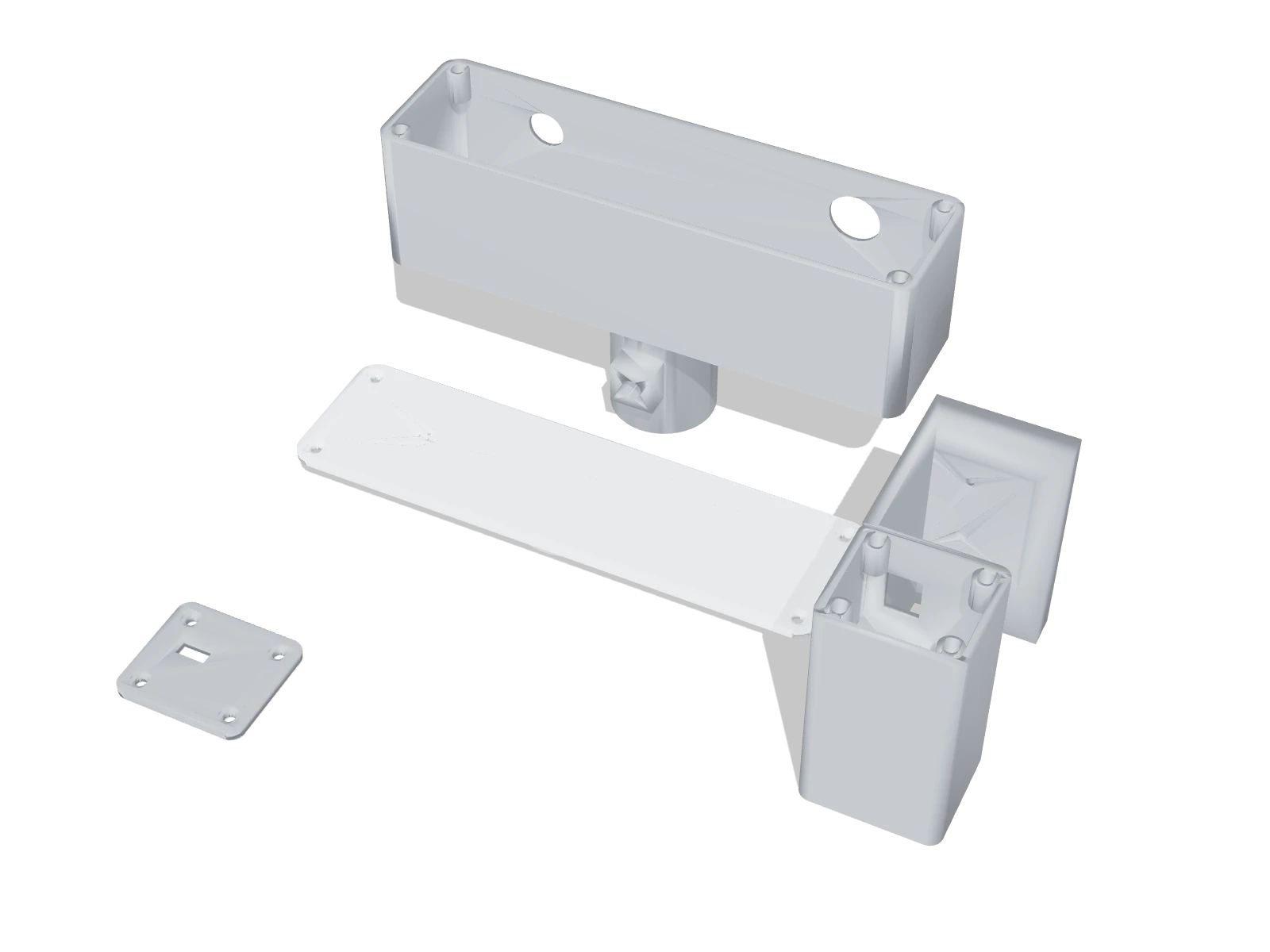
4 parts, generated from code and checked as closed solids. Pick a part to inspect it, or download the STL files to print.
See the CAD parts render
Loading the CAD…
Real CAD · drag to rotate · scroll to zoomReal CAD · swipe sideways
Bought hardware fitted inside this part (checked in the CAD: nothing collides with the plastic)
- Crown case: two load-cell pillars and hanger holes, battery bay, stand-tube socket with thumb-screw bosscrown-case.stl · ASA
- Crown lid: light-ring cup under a 0.8 mm glow skin, buzzer cupcrown-lid.stl · PETG (translucent)
- DripClip body: camera bay and lens window, battery bay, C-clamp with backlight arm for Ø14-22 drip chambersclip-body.stl · ASA
- DripClip lid with USB-C plug slotclip-lid.stl · ASA
Open risks we are working on
- Regulatory: in the US it is a Class II gravity-infusion monitor (21 CFR 880.2420, code FLN) needing a 510(k); India lists this device type as Class C (est., to verify); so rev A is sold to veterinary clinics and as evaluation units only
- Patient movement and tugging the tubing change the hook load by tens of grams; step rejection plus the drop cross-check is untested (test T2)
- In high-income hospitals most infusions already run on pumps, so the human market is mainly gravity-heavy countries, which are price-sensitive
- Load-cell creep is estimated (no TAL220B creep spec found) and decides where weight-only timing works; test T1 on a 24 h bench run
- A clip of about 95 g (est.) on a drip chamber may tilt it; the band and chamber fit across brands need a fit test (T3)
- Monidor (Finland), Dripo (India) and Chinese ward systems already sell drop counters; our case is weight plus drops on a stand the ward already owns
Design stage only: nothing on this page is for sale. Specifications and prices are targets.