PillPerch
The weekly pill organiser you already fill, made smart: it sees which compartment was opened, keeps a clock for 'when required' doses like paracetamol, and checks Sunday's fill
The family's own 7-day AM/PM organiser drops into a tray on a load cell, and a camera on a short mast looks straight down at all 14 compartments. A weight step says a dose left the tray; before/after photos say which compartment, so the base shows 'Mon AM taken 08:12', chimes on the wrong day and alerts the family when a dose window passes. The extra is the fill check: when the box is refilled, it counts pills per compartment against the plan and sends the fill photo. It monitors and reminds only; it sees a compartment emptied, not a pill swallowed, and never identifies a drug. Rev A1 (DoseClock) adds a second weighed bay for the 'when required' (PRN) box: taking tablets out logs the time, the e-paper shows 'last 10:40, next from 14:40, 2 of 4 today', and a soft chime plays if the box is opened again too soon. Time-critical doses such as Parkinson's medicines get a short window and an early alert to the family or agency, and a long press shows the visiting carer the log since the last visit.
- Who buys it
- First: adult children who fill a parent's weekly box and today check by phone (about half of adults use a pill box). Next: home-care agencies whose carers fill boxes. Today they use a $9-11 organiser, or pay Hero $99.99 + $29.99-44.99 a month. Rev A1: home-care agencies supporting people with time-sensitive and 'when required' medicines between visits.
- Why it pays
- No dispenser subscription and no new routine: the family keeps its $10 box. The value is a same-day answer to 'did Dad take it?' and a fill error caught before the week starts (60-67% of fillers made errors in two studies). Hospital cost avoided is not claimed.
- Target price
- $129 with the DoseClock bay + $4 per month for phone alerts and reports; agency pack $119 each + $6 per client per month (target)
- First-minute wow
- Sunday, 16:05: the daughter closes the last lid and her phone shows the fill photo with one compartment circled: 'Thu AM: 3 found, 4 expected.' The missing tablet is on the counter.
What the research found
And how this design answers it
- People forget whether they took today's dose (caregiver forums) -> TAKEN? button shows 'Mon AM taken 08:12' on e-paper
- People start the week on the wrong day -> the photo shows which day's compartment changed and the base chimes 'That's Thursday' at once
- 60-67% of fillers make errors (Northwestern, ULB studies) -> the fill check counts pills per compartment while the lids are open
- Dispensers lock pills in a subscription machine and get unplugged for buzzing -> it keeps the family's own $10 box and chimes only on a slip
- Compartment walls hide pills from a camera (CAD view report: 1.9 mm of a pill visible at the outer days of a deep box) -> those compartments are flagged 'partly hidden' instead of guessed
- CQC finds home-care paracetamol doses not logged and given inside 4 hours, and time-sensitive medicines late when visits run late (CQC home-care medicines guidance, inspection reports) -> rev A1 DoseClock: a weighed PRN bay logs each dose, shows 'next from 14:40' and chimes if opened too soon; time-critical slots alert the agency 30 min after the window opens
Use case
Paracetamol between visits and a late Parkinson's dose
Older person at homeHome carer on the 4-visit roundAgency coordinatorSon who lives away
- 01Trigger: at 10:40 the paracetamol box leaves the PRN bay and comes back 1.3 g lighter
- 02Detection: the PRN cell logs 2 tablets taken at 10:40; at 13:15 the box is lifted again, inside the 4 h gap set from the label
- 03Alert: a soft chime and 'Last at 10:40, next from 14:40' on the e-paper; separately, the 12:00 Parkinson's slot has no change by 12:30, so the coordinator's phone gets 'Tue 12:00 dose not taken'
- 04Action: the coordinator moves the carer's lunch visit forward; on arrival the carer long-presses the button and copies the log onto the MAR
Outcome: The carer and family see when the last PRN dose was taken, and the late time-critical dose is flagged within 30 minutes instead of at the next visit (est.)
How it works
Architecture
- 01
Sense: 1 kg bar load cell under the tray and a 780 g cell under the PRN bay (two HX711s), XIAO ESP32S3 Sense camera 360 mm above the compartments with a NeoPixel ring light
- 02
Decide: weight step + per-compartment before/after difference picks the compartment; blob count per compartment during fills
- 03
Send: Wi-Fi MQTT/TLS events; frames stay on the device except the opt-in weekly fill photo
- 04
Tell: e-paper 'taken at', next dose and the PRN 'next from' time, chimes for wrong day, late dose and too-soon PRN, family or agency phone alerts, carer visit view and a weekly fill report
Hardware
Real parts, buyable today
Bill of materials: about $118 at qty 1, ~$50 at qty 1,000 (est.).
| Block | Part | Why this part |
|---|---|---|
| Camera + MCU | Seeed XIAO ESP32S3 Sense + Adafruit NeoPixel Ring 12 | Camera, PSRAM and Wi-Fi on one 21 x 17.8 board; the ring gives the same light for every photo |
| Weighing | 1 kg straight-bar load cell + HX711, 0.4 mm overload stop | A typical tablet (0.3 g est.) is 6x the averaged noise; triggers the photo |
| PRN bay (rev A1) | Phidgets 3132 780 g bar cell + second HX711, printed prn-cup | Two 500 mg tablets (~1.3 g est.) are 26x the noise; the box stands on edge in a 98 x 23 mm pocket |
| Power | Adafruit PowerBoost 1000C + 18650, USB-C adapter | Keeps working about 13 days unplugged (est.) |
| Base UI | Waveshare 2.13" e-paper, TAKEN? button, piezo | The daily question answered on a screen that stays on with no power |
| Mechanics | Printed ASA base and tray (291 x 117 pocket), Ø16 mast, PETG camera head | Takes any 7 x 1 or 7 x 2 organiser; total height 437 mm fits under 457 mm wall cabinets |
Mechanical
Printable CAD
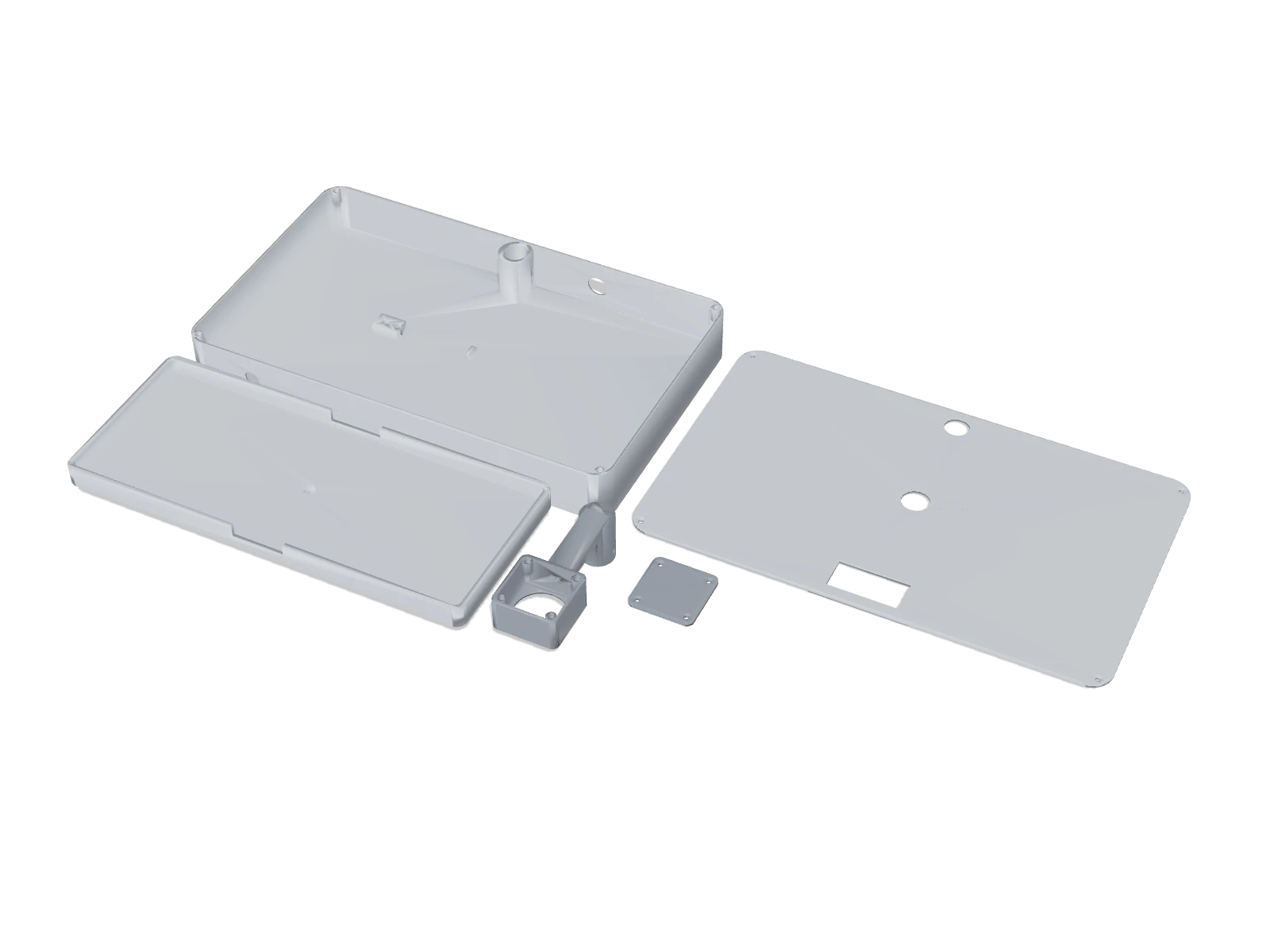
6 parts, generated from code and checked as closed solids. Pick a part to inspect it, or download the STL files to print.
See the CAD parts render
Loading the CAD…
Real CAD · drag to rotate · scroll to zoomReal CAD · swipe sideways
Bought hardware fitted inside this part (checked in the CAD: nothing collides with the plastic)
- Base case: two load-cell pillars and overload stops (tray and PRN bay), power and battery, mast socket, USB-C and buttonbase-case.stl · ASA
- Base lid: e-paper window, holes for the tray post, the PRN post and the mastbase-lid.stl · ASA
- Tray: any weekly organiser up to 291 x 117 mm drops in; post down to the load celltray.stl · ASA
- Camera head: pod with ring light and camera over the tray centre, arm and sleeve onto the mast, wire channelhead-case.stl · PETG
- Camera head caphead-cap.stl · PETG
- PRN cup (rev A1): the 'when required' box stands on edge, finger slot to lift it, post down to its own load cellprn-cup.stl · ASA
Open risks we are working on
- No family or carer interviews yet; pain evidence is forum anecdotes (gate G1: 10 families + 3 home-care agencies)
- Change detection through tinted lids and the pill count are unmeasured (bench test T1, 5 organiser brands)
- Wall occlusion: deep 3XL boxes show only 1.9 mm of a pill at the outer days (CAD view report); 2XL-depth boxes recommended
- The fill check may go beyond the Class I exempt 'medication reminder' code (NXQ); FDA 513(g) question (gate R1)
- Camera pillbox patent US10105287 needs a freedom-to-operate opinion (R2)
- PRN gap and daily maximum come from the label and care plan, entered by people; a wrong entry gives a wrong 'next from' time (two-person confirm in the agency app, test T-P2)
- Hero, MedMinder or Tricella could add a camera; voice-assistant reminders are free
Design stage only: nothing on this page is for sale. Specifications and prices are targets.