WasteSort Coach
A clip-on camera coach that shows people the right bin and measures recycling contamination
Lights the correct bin when someone holds an item over an existing recycling station, and reports each station's estimated contamination with photo evidence for waste and ESG reports.
- Who buys it
- A corporate facilities or workplace manager, or a university sustainability office.
- Why it pays
- Continuous per-station audit evidence for $228 per station per year, against about $1,500–3,000 for each contractor waste audit, plus fewer hauler contamination charges (est., unverified). One smart sorting bin cost a city $23,657.
- Target price
- $299 per 3-bin station kit + $19/station/month reports (target)
- First-minute wow
- Hold a coffee cup over the bins and the landfill bar glows green before you let go. On Friday the station shows up in a ranked contamination report with the photos to prove it.
What the research found
And how this design answers it
- Funded sorting bins cost $1,500–23,657 → a $299 clip-on kit for bins the site already owns, cheap enough to skip an RFP
- Field accuracy is poor even for the leader (37.6% reported in Saskatoon) → nothing mechanical acts on the model; there is an 'I'm not sure' amber light, and the report gives an estimate with photos a human can check
- Incumbents give units away with sponsor ads on screens → no screen, no ads, and the customer owns the data
- Dumpster cameras only see contamination after collection → Coach reports per station and per floor, where signage and placement fixes happen
- Recycling rules differ per hauler → the model outputs item classes and a per-site rules table maps them to bins, editable in a minute with no retraining
- Cameras in offices worry people → the camera points straight down at the bin openings, frames with people are discarded, and no video or faces are kept
Use case
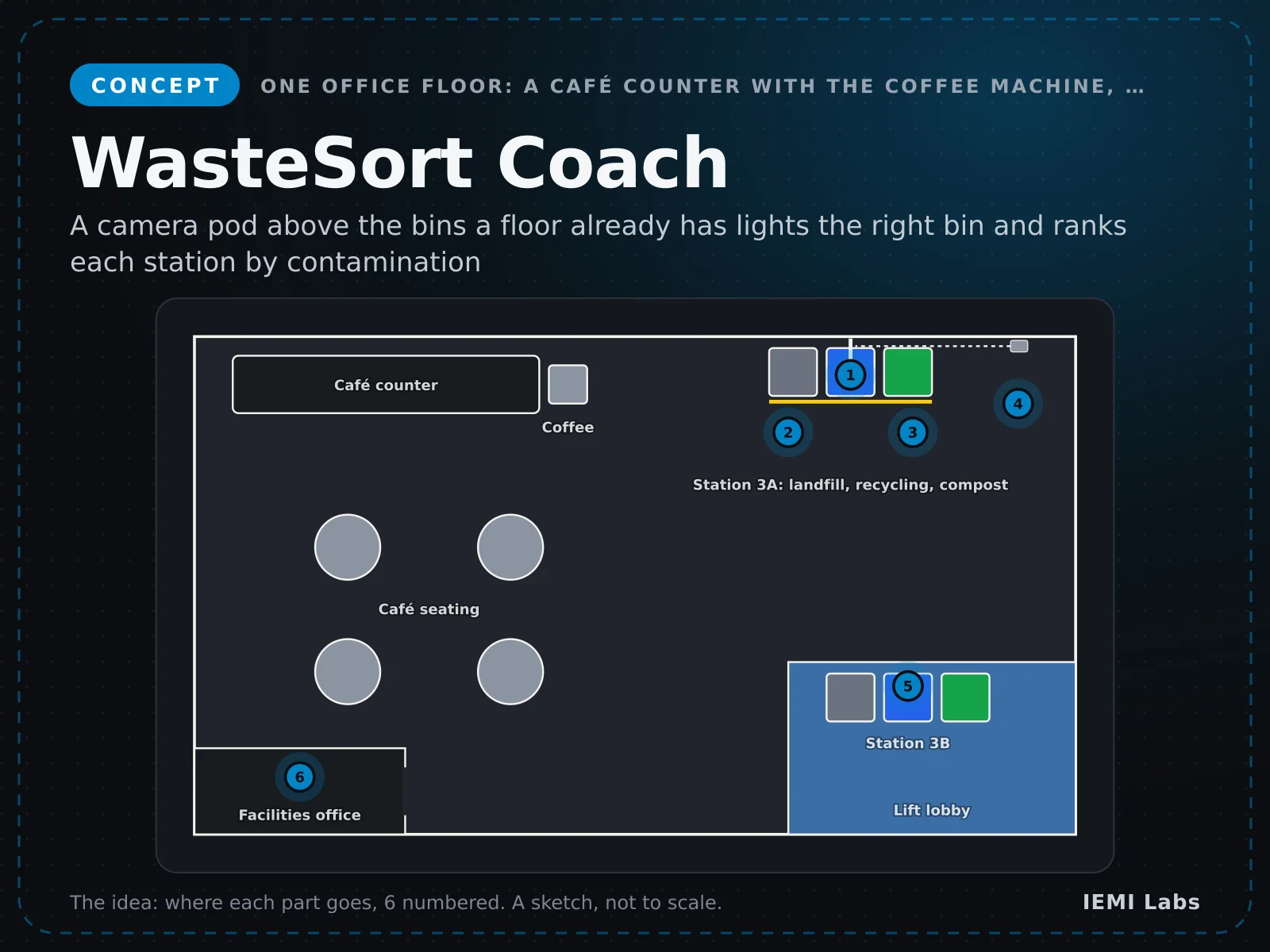
Lunch rush at the 3rd-floor café station
Employee with lunch wasteCoach podFacilities manager
- 01Trigger: a hand with a food-soiled clamshell enters the zone above the bins
- 02Detect: the pod classifies it in under 0.4 s (target) and the site rules say landfill
- 03Coach: the landfill bar glows green, the recycling bar flashes red, and a soft tone plays
- 04Log: the deposit and a bin-interior audit photo go into the weekly per-station report
- 05Act: the manager sees station 3B at 41% against an 18% site average, moves the bins and adds a cup label, then watches the trend
Outcome: Lower contamination at the worst stations and quarterly ESG figures with evidence, for $228 per station per year (est.)
How it works
Architecture
- 01
See: a wide OV5647 camera on a conduit arm looks down at the bin openings, with ROI masks
- 02
Decide: K230D NPU detector + 12-class classifier, then a per-site rules table, with an unsure threshold
- 03
Tell: WS2812B light bar per bin and a short I2S tone; no screen
- 04
Report: counts and bin-interior thumbnails over MQTT/TLS (buffered 30 days on SD) to a dashboard with weekly reports, human spot-checks and ESG export
Hardware
Real parts, buyable today
Bill of materials: about $101 per 3-bin station at qty 1 including conduit, and about $70 at qty 100 (est.), plus about 190 g of PETG.
| Block | Part | Why this part |
|---|---|---|
| Vision + compute | Banana Pi BPI-CanMV-K230D-Zero (Kendryte K230D) | Runs a detector and classifier at the station for about $29–40, so no video leaves |
| Camera | OV5647 5 MP CSI with a 120–160° lens | Covers 3–4 bin openings from about 0.55 m |
| Feedback | WS2812B strip (3 × 11 LEDs) via 74AHCT125, MAX98357A + 28 mm speaker | A clear 'this bin' cue with one data line |
| Power | Listed 5.1 V 3 A USB-C plug-in PSU, cable inside the conduit | No mains in printed parts; about 4.3 W typical |
| Mount | 3/4" EMT conduit + elbow (bought) with printed rim clamp | Stiff, $10 at any hardware store, and fits most bin rims up to 24 mm |
Mechanical
Printable CAD
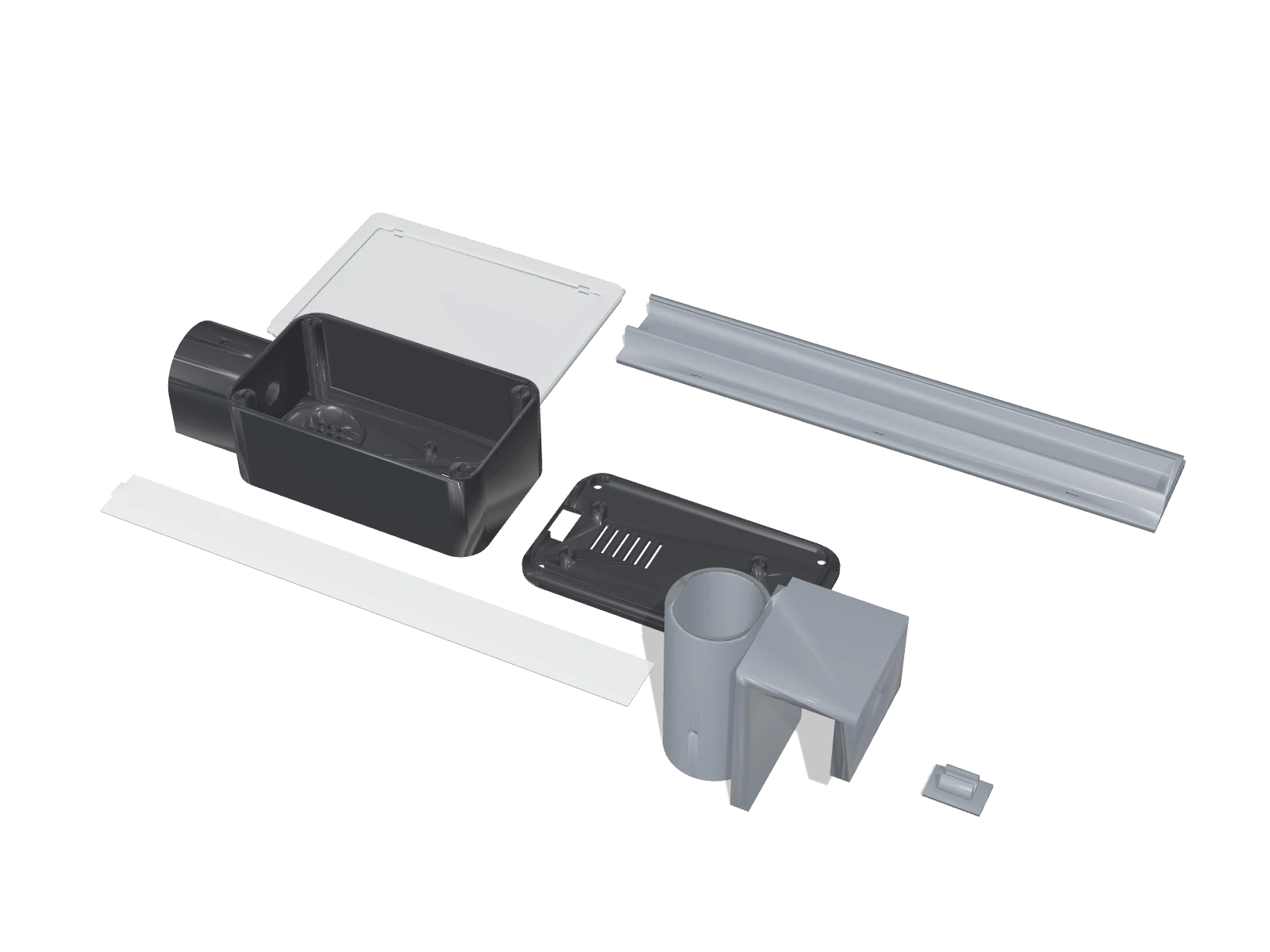
7 parts, generated from code and checked as closed solids. Pick a part to inspect it, or download the STL files to print.
See the CAD parts render
Loading the CAD…
Real CAD · drag to rotate · scroll to zoomReal CAD · swipe sideways
Bought hardware fitted inside this part (checked in the CAD: nothing collides with the plastic)
- Camera pod base with EMT arm socketcam-pod-base.stl · PETG, black
- Camera pod lid (carries the K230D board)cam-pod-lid.stl · PETG, black
- Bin-rim mast clampmast-clamp.stl · PETG
- Light-bar housing (one per bin)light-bar.stl · PETG, grey
- Light-bar diffuserlight-diffuser.stl · PETG, natural/white
- Bin label holder (100 × 70 mm card)label-holder.stl · PETG
- Cable clipcable-clip.stl · PETG
Open risks we are working on
- Accuracy in the wild: wet, crushed or hand-hidden items seen from above. The leader reported 37.6%; ours must reach ≥ 80% top-1 and stay within ±7 points of a hand audit
- Buyer: facilities may not pay $19 per station per month. The kill test: 2 of 8 Austin offices or campus departments commit to a paid 3-station pilot by Q1 2027
- Toolchain: training and model compile need Python on Linux, and the lab is Node-only
- Privacy objections from HR or staff despite the downward camera. A notice card and a data agreement are needed
- Single-source K230D Zero board; its pin-mux and wide-lens camera driver are unverified
Design stage only: nothing on this page is for sale. Specifications and prices are targets.