GasLock Trolley
The LPG cylinder trolley you already buy, made smart: gas left in days, and the day to book the refill
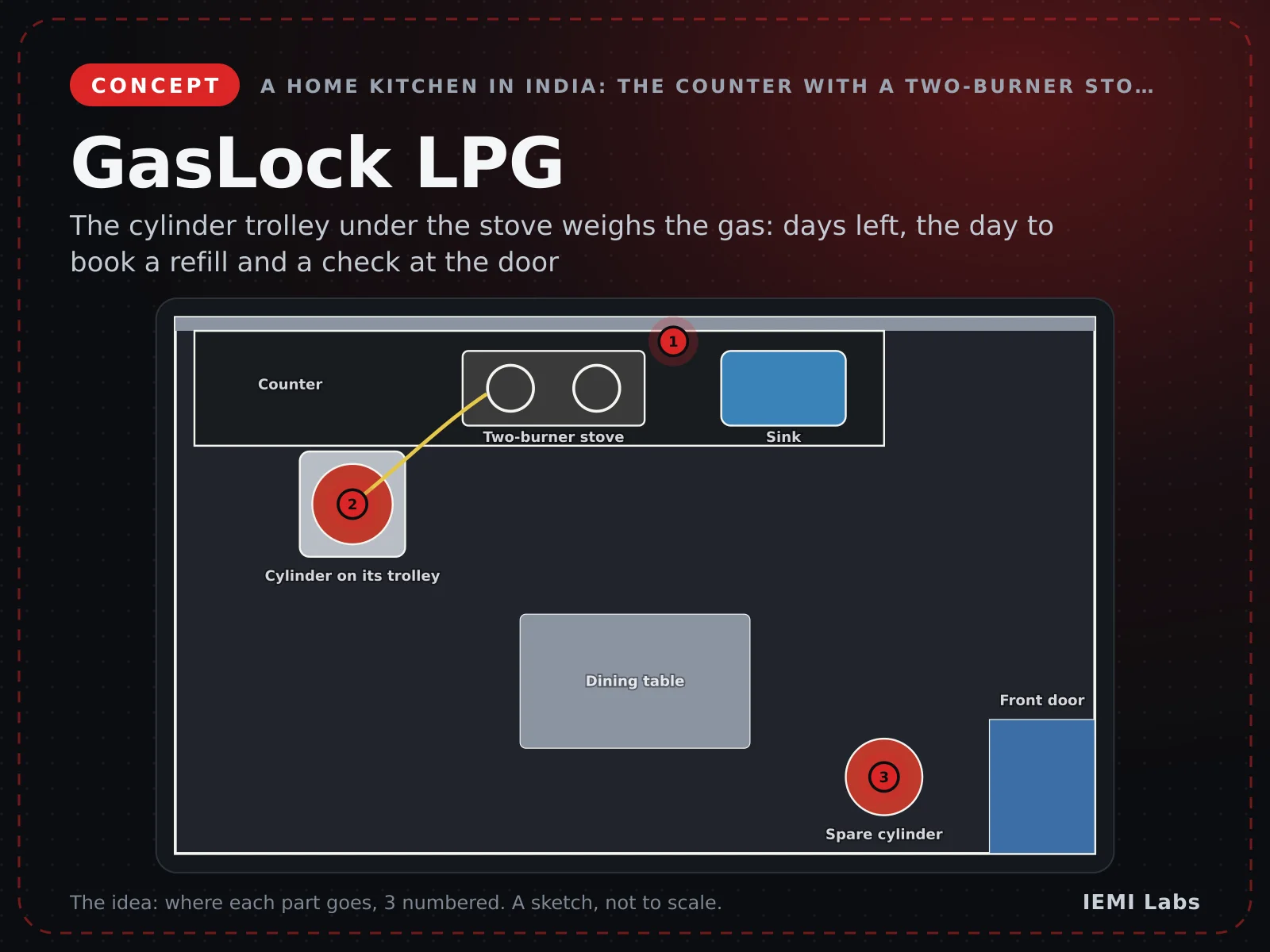
A 4-cell weighing deck in the cylinder trolley and a wall pod by the stove show kg of gas left, days left and the date a refill can be booked, check a new cylinder's net weight at the door, and tell the family's phones when gas is used at odd hours. The rev A spring shut-off is the optional Plus kit.
- Who buys it
- Adult children who live away and buy for their parents' kitchen, and PG, hostel and tiffin-kitchen owners for whom running out stops their income; sold online, then through LPG distributors' showrooms.
- Why it pays
- With a 25-day lock-out (35 for double-cylinder homes) and 15–20 day deliveries in 2026, booking on the first allowed day instead of when the flame dies avoids weeks without gas. A door check flags short-filled cylinders (a distributor was fined for 400 g short). Cash savings depend on the household (est.).
- Target price
- ₹4,999 trolley with e-paper pod; ₹3,999 deck retrofit; ₹2,999 app-only; Plus shut-off kit +₹3,999 with a partner detector (targets; Plus not on sale until certified)
- First-minute wow
- Put a new cylinder on the trolley and within 20 seconds the pod shows its net gas, how many days it will last and the date the next refill can be booked.
What the research found
And how this design answers it
- A protective clamp-on accessory was hard to sell → the product is now the cylinder trolley families already buy, with a weighing deck; the shut-off is an optional Plus kit
- Families guess the level by shaking or a wet cloth → gas left in kg and days from the weight minus the cylinder's stamped tare
- The 2026 25/35-day booking lock-out and slow deliveries → a booking clock that starts at the detected delivery and warns when gas will run out before a refill can arrive
- Short-filled cylinders → a door check of net weight, worded as a prompt to ask for the delivery person's verified scale, never a legal measurement
- Cheap load cells creep → days left from a 14-day slope, re-zeroed at every swap; an overload stop protects the cells when a cylinder is dropped on the deck
- Life-safety certification blocked rev A → the base product makes no safety claim; the Plus kit keeps every certification gate
Use case
Booking on the first allowed day
Mother living aloneSon in another cityWall podFamily app
- 01Trigger: a delivery shows as a 15 kg weight jump and the 25-day lock-out starts
- 02Learning: daily use is learned as about 0.31 kg/day; the pod shows kg left, days left and the book-from date
- 03Alert: at 07:00 on the first allowed day the son's phone says booking is open, and the pod's BOOKED key lights
- 04Action: the mother books and presses BOOKED; the app tracks gas left against the expected delivery
Outcome: The refill is booked weeks before the cylinder runs dry, instead of when the flame dies and the 15–20 day wait starts
How it works
Architecture
- 01
Sense: 4 × 50 kg half-bridge cells under a 260 mm aluminium plate in the trolley, combined into one bridge
- 02
Measure: an HX711 in the wall pod, averaged over 10 minutes, about 20 g resolution (est.)
- 03
Decide: ESP32-C6 and cloud work out gas left, the 14-day burn rate, swaps, the booking clock and odd-hour use
- 04
Tell: e-paper by the stove, phone pushes over MQTT/TLS; Plus kit keeps its own local trip path from a certified detector
Hardware
Real parts, buyable today
Bill of materials: about 5 with the trolley frame, 1 for the deck retrofit (est.); cost-down path to about 0.
| Block | Part | Why this part |
|---|---|---|
| Load cells | 4 × SparkFun SEN-10245-class 50 kg half-bridge | A full cylinder puts at most 0.24 of the rating on one cell; a carrier skirt stops overloads |
| Bridge ADC | HX711 + combinator board | 24-bit, enough for 20 g on a 30 kg load after averaging (est.) |
| MCU + radio | ESP32-C6-MINI-1 | Wi-Fi once an hour; about a year on 4 × AA (est.) |
| Display | Waveshare 1.54" e-paper + BOOKED key | Parents see kg, days and the book-from date without a phone |
| Plus kit | Rev A spring shut-off + partner certified detector | Optional automatic regulator OFF; unchanged certification gates |
Mechanical
Printable CAD
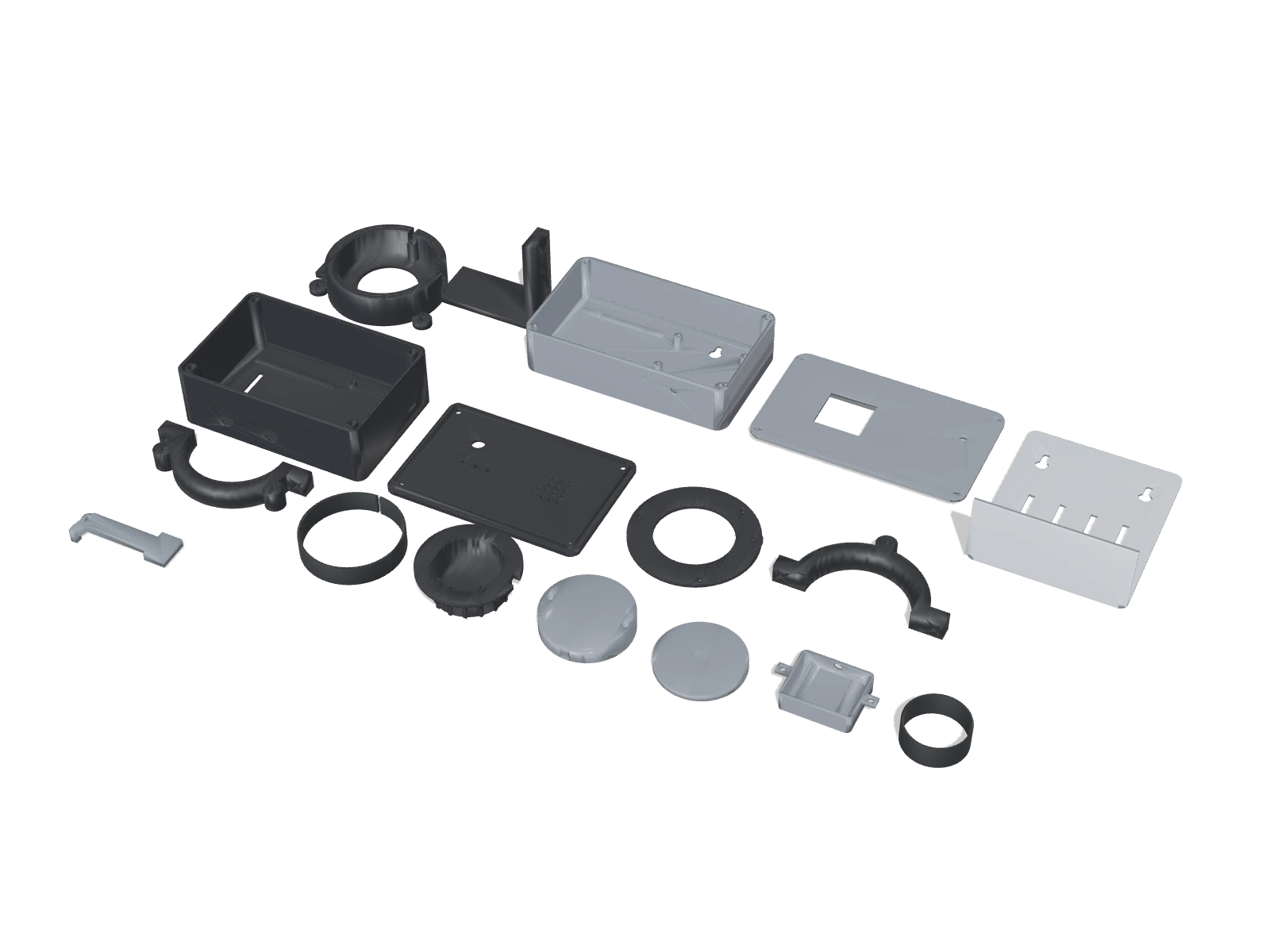
16 parts, generated from code and checked as closed solids. Pick a part to inspect it, or download the STL files to print.
See the CAD parts render
Loading the CAD…
Real CAD · drag to rotate · scroll to zoomReal CAD · swipe sideways
Bought hardware fitted inside this part (checked in the CAD: nothing collides with the plastic)
- Knob cupknob-cup.stl · ASA
- Knob linerknob-liner.stl · TPU
- Spring housingspring-housing.stl · ASA
- Spring capspring-cap.stl · ASA
- Clamp collar half Acollar-a.stl · ASA
- Clamp collar half Bcollar-b.stl · ASA
- Collar linercollar-liner.stl · TPU
- Latch leverlatch-lever.stl · PA12
- Control box basectrl-base.stl · ASA
- Control box lidctrl-lid.stl · ASA
- Detector wall bracketdetector-bracket.stl · ASA
- Deck foot (load-cell carrier, ×4)deck-foot.stl · PETG
- Foot pad (×4)foot-pad.stl · PETG
- Load-cell junction boxjunction-box.stl · PETG
- Wall pod basescale-pod-base.stl · PETG
- Wall pod lidscale-pod-lid.stl · PETG
Open risks we are working on
- Price is 5–9× a plain trolley; the e-paper versions need the cost-down to leave a margin
- Indicative only: not a Legal Metrology weighing instrument, and it does not detect leaks
- Cylinder foot-ring and trolley base sizes and load-cell creep in hot kitchens are not yet measured
- Oil companies could add level or booking reminders to their apps or cylinders
- The Plus shut-off still needs a detector partner, oil-company acceptance and third-party testing
Design stage only: nothing on this page is for sale. Specifications and prices are targets.