ScorePost
The scoreboard, made smart: tennis line-call challenges, let and foot-fault checks, a pickleball score that calls itself, and club and junior cricket scoring that checks the umpire and calls retirements
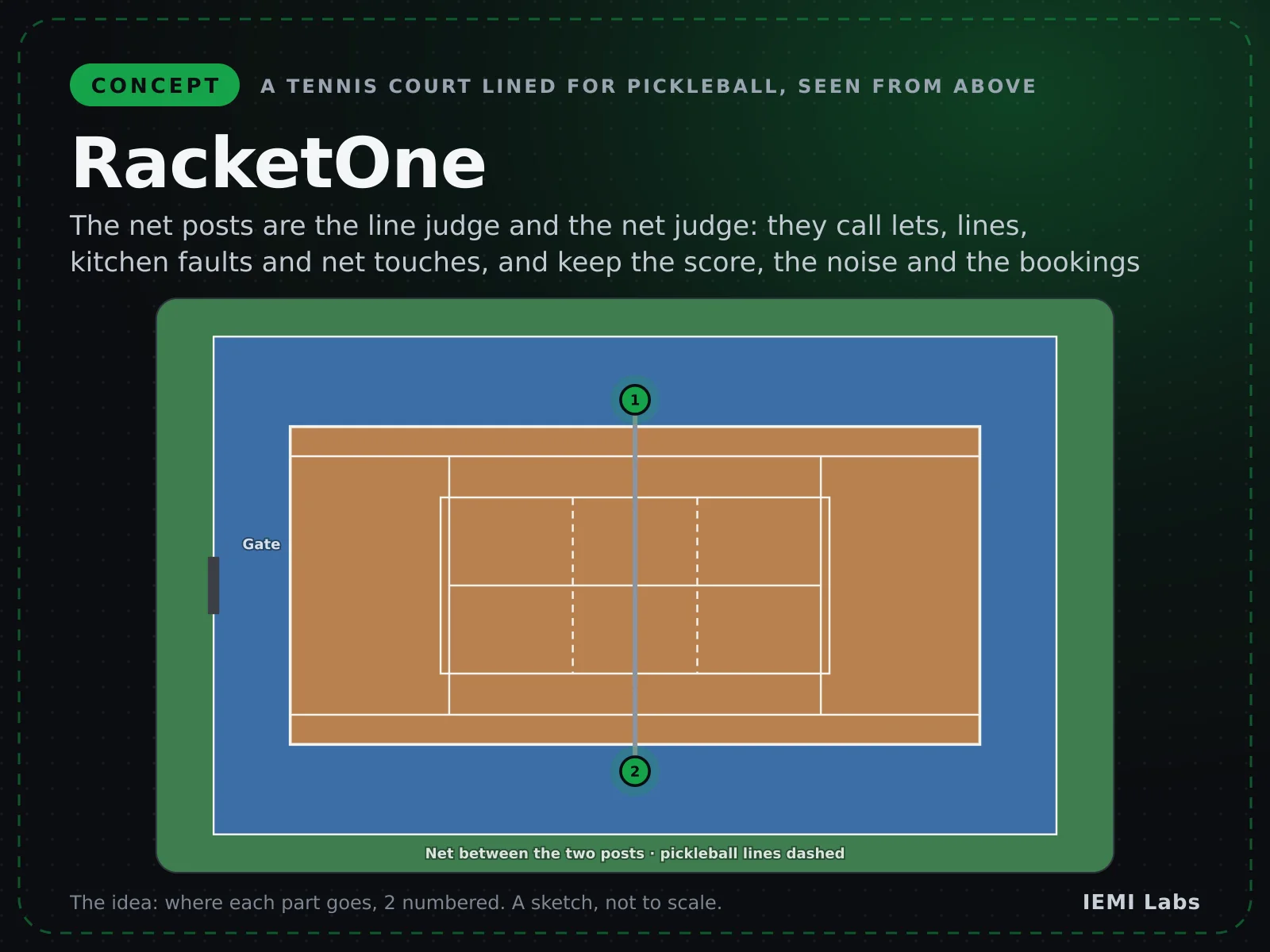
Replaces the flip scoreboard that tennis clubs already clamp to the net post: it keeps the games and sets on a 7.5" e-paper panel, and when a player presses CHALLENGE it shows the last bounce against the line, drawn from global-shutter cameras on the post and on the side fence. LetCall hangs a small LetTap on the net band that beeps when a serve touches the cord, and FootCheck uses the baseline cameras to show the server, or the league referee, when a foot touched the line before the strike. For pickleball doubles, two RallyPads on the post (one per team) keep the side-out score, know who serves from which side, and call the 3-number score aloud before every serve. For club cricket, OverCheck gives the scorer a TallyPad and the umpire an OverClick ball counter, and flags any over where the book and the umpire disagree while it is still fresh. For junior cricket, RetireCall watches every batter against the league's retirement score, buzzes the umpire when one reaches it, and shows the batting team who is next in and the order retired batters come back.
- Who buys it
- Tennis and pickleball clubs, park and school courts, USTA/LTA league venues, and cricket clubs, junior sections and schools whose games run on one volunteer scorer.
- Why it pays
- A Court Kit is a target $1,990 against an In/Out set at $550 per match setup, PlaySight or Hawk-Eye class systems far higher, and the club's own disputes, which are free but sour leagues (est.). The scoreboard-only head ($249) replaces a $115–$270 flip board.
- Target price
- $249 ScorePost (scoreboard only), $649 ScorePost with camera pods, $1,990 Court Kit (2 heads + 2 BaseClips), $129 RallyPair for pickleball (target), $99 OverCheck for cricket (TallyPad + OverClick, target), $79 RetireCall order board for junior cricket (add-on to OverCheck, target), $79 LetTap per court for service lets (target; FootCheck is free on Court Kits)
- First-minute wow
- A player taps CHALLENGE on the post; 6 seconds later the e-paper shows the baseline with the ball's mark drawn on it, 'OUT 14 mm', and the clip is on both phones.
What the research found
And how this design answers it
- In/Out's original net-post-only device judged baselines poorly (20–30 mm error in a 2021 test), and its v4 added line devices → the CAD geometry report shows why: from 1.2 m on the post, lines across the view resolve 53–117 mm per pixel, so ScorePost only gives verdicts on lines that run along a camera's view and adds a BaseClip on the side fence for each baseline (2–8 mm per pixel)
- Outdoor courts have no power → an ESP32 runs the e-paper score for about a year per charge (est.); the Pi 5 and cameras switch on only for a Camera match, about 5 matches per 20,000 mAh charge (est.)
- Leagues may not allow electronic calls → ScorePost shows evidence that the players agree to; it never overrides the player's call and is not ITF classified
- Cameras on public courts raise privacy concerns → a 20 s RAM ring buffer, nothing saved unless CHALLENGE is pressed, and ball-only crops on the display
- Pickleball doubles has no referee and forgetting the server number or the score is the commonest argument (pickleball.com, The Dink; 2026 USA Pickleball rules want prompt calls) → RallyCall: one pad per team on the post, one press per rally, side-out and server 1/2 logic tested in-house over 200 rallies, the score called aloud, CHECK when both teams press
- Club cricket rarely has the two scorers Law 3 asks for, disputed books cannot say whether the batting or bowling figures are wrong, and umpires allow 5- and 7-ball overs (Law 3, Raging Turner, Cricket NSW, ACS) → OverCheck: one ball log keeps batting = bowling = total, and the umpire's OverClick count is checked against the book every over (20-over test: a 7-ball over and a missed dot both flagged)
- Junior cricket retires batters at a set score or ball count (ECB U10/U11 25 runs; NCU 30/40/50; SA schools 20 straight away; AGSV 25 balls) and brings them back in a set order (after everyone, at the last wicket, or the 9th wicket, ACS), all tracked by one volunteer scorer → RetireCall: the TallyPad applies the league's rule every ball, the umpire's OverClick buzzes at the limit, and a hooked e-paper order board shows NEXT IN and the return queue (11/11 checks, including 50 random innings)
- Club tennis has no umpire: any player may call a service let but only before the return is out of play, and a net touch is often silent; USTA Code 24 lets the receiver call only flagrant foot faults after a warning, and Tennis Australia lets the receiver call none (USHSTA, USTA, Tennis Australia, ITF Rules 18 and 22) → LetCall + FootCheck: a LetTap on the net band beeps only for a cord touch on the serve, and the BaseClips check the server's toes against the baseline up to the strike, shown to the server or the league referee, never as a call (13/13 checks, 300 random points)
Use case
Disputed baseline call in a league doubles match
PlayersLeague captainClub pro
- 01Trigger: a deep ball is called out and the hitter disagrees
- 02Detection: a player presses CHALLENGE; the BaseClip and post pods hold the last 20 s and the final bounce is fitted from the two ball paths before and after it
- 03Alert: the e-paper shows the line with the ball mark and the gap, or 'TOO CLOSE TO SHOW' under 10 mm, and the clip goes to both phones
- 04Action: the players agree on the call; the captain has the clip if the dispute goes further
Outcome: The point is settled in about 10 seconds from evidence instead of an argument, and the match goes on
How it works
Architecture
- 01
Sense: 2 global-shutter pods on each ScorePost head (near sideline, centre service line) and a BaseClip on the side fence looking along each baseline, a LetTap on the net band (accelerometer + mic); for pickleball, a RallyPad button per team; for cricket, the scorer's TallyPad keypad and the umpire's OverClick
- 02
Decide: Pi 5 (head) and Pi Zero 2 W (BaseClip) keep a 20 s RAM ring; on CHALLENGE they fit the ball path into and out of the last bounce and measure it against the line
- 03
Send: ESP32 + Wi-Fi from a club AP or the head's own hotspot; MQTT events and short H.264 clips
- 04
Tell: e-paper scoreboard with the bounce drawing, a phone web page by QR code, optional club dashboard; RallyPad speaker calls the pickleball score before each serve
Hardware
Real parts, buyable today
Bill of materials: about $411 per head, $153 per BaseClip, $1,127 per Court Kit, $94 per RallyPair, $72 per OverCheck set, $54 per RetireCall order board, $41 per LetTap at qty 1 (est.).
| Block | Part | Why this part |
|---|---|---|
| Scoreboard | Waveshare 7.5" e-Paper V2 (800 × 480) + e-Paper ESP32 Driver Board | Readable in full sun, draws power only on refresh, so the score runs for months per charge |
| Post cameras | 2 × Raspberry Pi Global Shutter Camera (IMX296) with 4 mm CS lenses, turned 32° into the court on a Raspberry Pi 5 2GB (both CSI ports, on only for Camera matches) | No rolling-shutter smear on a 30 m/s ball; 5–9 mm per pixel along the near sideline |
| Baseline camera | BaseClip: Pi Zero 2 W + GS camera + 6 mm lens on a fence clamp | The line judge's view along the baseline, 2–8 mm per pixel |
| Power | 20,000 mAh USB-C PD bank behind an IP67 USB-C socket | No mains at outdoor courts; the club charges it weekly or monthly |
| Pickleball pads | RallyPad: 60 mm lit dome button, 40 mm speaker + MAX98357A, XIAO ESP32-C3, 2 x AA | Each team presses once per rally it wins; the serving pad calls the score; about 37 h of play per AA set (est.) |
| Cricket OverCheck | TallyPad: 4x4 membrane keypad + 2.13" e-paper + XIAO ESP32-C3, 2 x AA; OverClick: 2 buttons, 6 LEDs, buzz motor, XIAO ESP32-C3, 250 mAh LiPo | A second, independent ball count from the umpire, compared with the scorer's book every over by ESP-NOW |
| Junior RetireCall | Order board: Waveshare 4.2" e-Paper (400 x 300) + XIAO ESP32-C3, 2 x AA, in a hooked case for the dugout fence | The batting team sees who is near the limit, who is next in and the retired batters' return order; about 212 h per AA set (est.) |
| Tennis LetCall | LetTap: LIS3DH accelerometer + SPH0645 I2S mic + XIAO ESP32-S3, 2000 mAh LiPo, buzzer and amber lamp, in a pod hooked on the net headband | Beeps only for a net-cord touch on the serve and timestamps the strike for the BaseClip foot check; about 105 h per charge (est.) |
Mechanical
Printable CAD
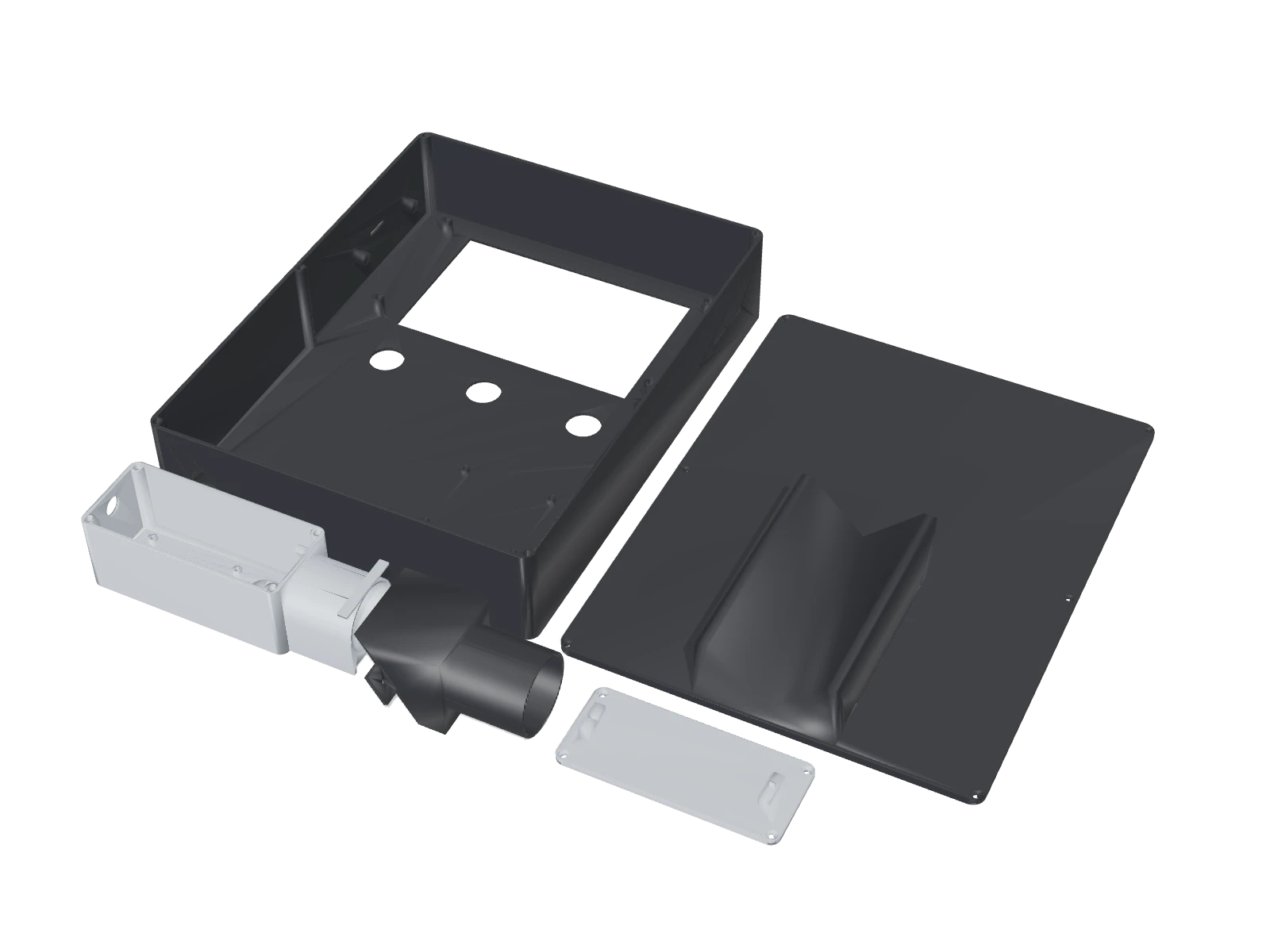
15 parts, generated from code and checked as closed solids. Pick a part to inspect it, or download the STL files to print.
See the CAD parts render
Loading the CAD…
Real CAD · drag to rotate · scroll to zoomReal CAD · swipe sideways
Bought hardware fitted inside this part (checked in the CAD: nothing collides with the plastic)
- Head shell (display, buttons, Pi 5, power bank)head-shell.stl · ASA
- Head back with V saddle for the net posthead-back.stl · ASA
- Camera pod, 32° wedge (2 per head)cam-pod.stl · ASA
- BaseClip box with lens hoodbaseclip-box.stl · ASA
- BaseClip lid with aiming sightsbaseclip-lid.stl · ASA
- RallyPad case (dome button, speaker grille, 2 per court)rally-pad.stl · ASA
- RallyPad back with V saddle for Ø32–76 postsrally-back.stl · ASA
- TallyPad case (membrane keypad recess, e-paper window)tally-pad.stl · ASA
- TallyPad back with desk wedgetally-lid.stl · ASA
- OverClick umpire counter case (2 buttons, 6 ball LEDs, lanyard eye)over-click.stl · ASA
- OverClick back with belt clipover-click-lid.stl · ASA
- RetireCall order board case (4.2" e-paper window, rain brow)order-board.stl · ASA
- Order board back with two fence hooksorder-board-lid.stl · ASA
- LetTap pod (accelerometer, mic, LET lamp)let-tap.stl · ASA
- LetTap back with headband hook and thumb screwlet-tap-lid.stl · ASA
Open risks we are working on
- Bounce accuracy is an estimate until the field test (T5); clay courts and skid marks change the contact patch
- USTA and LTA leagues may not allow it in sanctioned play; it only gives evidence players agree to
- In/Out ($550), SwingVision ($179.99/yr) and PlayReplay (USTA-backed, raised $12M in 2026) are ahead on software and distribution
- Ball strikes and vandalism on public courts; the post head is in the line of play near the net
- RallyCall depends on players pressing after each rally; a $15 wrist scorekeeper is the cheap alternative, and a spoken score may annoy next-door courts
- OverCheck needs the umpire to press BALL every ball and leagues to allow an umpire's electronic counter; Play-Cricket upload is not built
- RetireCall depends on the league's retirement rule being set correctly before the match, and every league writes its own; it reminds, the umpires and captains decide
- LetCall beeps may start arguments where players never called lets they did not hear; the cord threshold is untested on a real net. FootCheck is sensitive: off by default, never on the public scoreboard, and leagues must allow it
Design stage only: nothing on this page is for sale. Specifications and prices are targets.