StoreEye
One ceiling camera per aisle: shelf gaps, spills, the wet-floor sign, floor walks and footfall
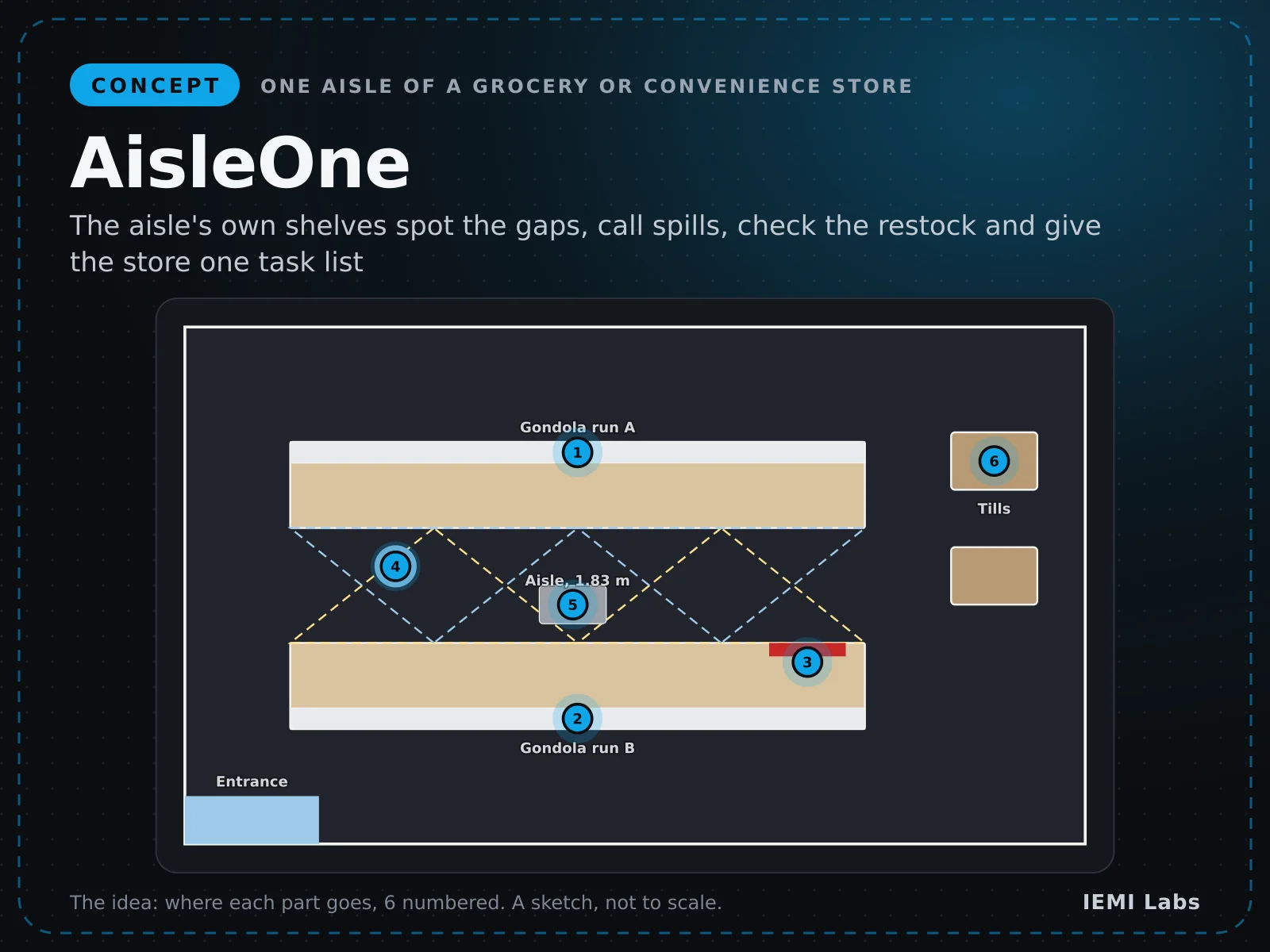
One small camera on the ceiling of each aisle sends staff an empty-shelf task with a photo, flags a possible spill and logs the wet-floor sign, proves floor walks with phone taps, and counts shoppers, queues and conversion for a Monday email.
- Who buys it
- Owner or operations manager of an independent grocer, convenience store or small chain (1–10 stores), often prompted by their insurance broker.
- Why it pays
- Independents ran 6.6% out of stock in fiscal 2025 (FMS/NGA); a slip-and-fall claim commonly settles at $15–75k (law-firm figures, est.). For a 6-aisle store StoreEye is $2,490 + $129/month instead of about $4,476 + $466/month for our four products separately (est.).
- Target price
- $2,490 store pack (8 heads + 12 walk plaques) + $129/store/month; extra heads $299 + $15/month (target)
- First-minute wow
- The same aisle camera sends 'Aisle 4 shelf 3 about 40% empty' with a photo at 10:12, and at 14:05 'possible spill in aisle 6, no sign out yet'; the sign appears on camera 3 minutes later and the timeline shows the last walk tap 11 minutes before.
What the research found
And how this design answers it
- Four products, four kinds of hardware (ToF door unit and zone nodes, battery ShelfCams + Hub Lite, SignTags + hotspot cameras + hub, FlowCount nodes) → one PoE ceiling head with an IMX500 per aisle
- No store hub needed → the Pi Zero 2 W in each head scores its own shelf rows and floor; only results leave
- Shoppers in shelf photos → the camera chip already knows where people are, so shelf stills are taken only when nobody is in view
- SignTag batteries → the camera sees the yellow sign go out and come back in its aisle; SignTags stay in SpillGuard for signs out of view
- Top shelves far down a long aisle are out of view (top shelf seen to about 2 m) → aisles over 3.6 m get a head at each end
- StoreSense was camera-free → counting still happens on the chip as dots; the privacy line is kept by never storing people
Use case
Saturday afternoon in a 6-aisle grocer
Store managerStockerCashierStoreEye headsInsurance broker
- 01Trigger: at 14:05 a new shiny patch appears on the aisle 6 floor and stays for 2 minutes with nobody standing on it
- 02Detection: the aisle 6 head flags a possible spill; the aisle 4 head has an open shelf task; the till head counts 6 in line
- 03Alert: the stocker's phone gets the floor crop; the manager gets 'open till 2: wait about 5 min'
- 04Action: the stocker puts the sign out (seen 14:08), cleans up and taps the aisle plaque; the timeline keeps it all
Outcome: The spill is met within minutes with a record for the broker, the gap is restocked during the peak, and the queue is cut; one avoided claim is worth $15–75k (est.)
How it works
Architecture
- 01
Sense: one Raspberry Pi AI Camera (IMX500) per head finds people on the chip, gives grey floor frames each second and a 12 MP shelf still every 15 min
- 02
Decide: the Pi Zero 2 W tracks dots for door, till and aisle counts, scores shelf rows, and checks the floor for new wet patches and the yellow sign
- 03
Send: results every 5 s over the PoE cable and MQTT over TLS; staff walk taps go from the phone over HTTPS
- 04
Tell: one StoreEye app with restock and spill tasks, the floor timeline PDF, queue alerts and the Monday email joined with till sales
Hardware
Real parts, buyable today
Bill of materials: about $132 per head and $2 per walk plaque at qty 1; about $1,080 for a 6-aisle store pack (est.).
| Block | Part | Why this part |
|---|---|---|
| Brain | Raspberry Pi Zero 2 W | Enough for dots, row scores and a 1 fps floor check at about 3.3 W |
| Camera + AI | Raspberry Pi AI Camera (Sony IMX500, 12 MP) | People found on the sensor chip; the same camera takes shelf stills and floor frames |
| Power + network | UCTRONICS U6115 PoE splitter + USB Ethernet adapter | One ceiling cable; no batteries and no shop Wi-Fi |
| Mount | FlowCount T-bar clip + new 30° aisle wedge | No-drill drop-ceiling fit, looking down the aisle |
| Walk proof | NXP NTAG 424 DNA sticker in a printed plaque | Each tap makes a one-time code that cannot be back-filled |
Mechanical
Printable CAD
5 parts, generated from code and checked as closed solids. Pick a part to inspect it, or download the STL files to print.
Loading the CAD…
Real CAD · drag to rotate · scroll to zoomReal CAD · swipe sideways
Bought hardware fitted inside this part (checked in the CAD: nothing collides with the plastic)
Open risks we are working on
- Spill vision on glossy floors is unproven; it is sold as 'possible spill, go and look', and the walk log must stand on its own
- Shelf-gap scoring from an oblique ceiling view at 3 m is coarser than ShelfScan's shelf-edge cameras; a bench test sets which rows count
- The Zero 2 W (512 MB) must run tracking, a floor check and a 12 MP still; the still pauses counting for about a second every 15 minutes (est.)
- Cameras in a shop need signs and a privacy notice; people are never stored, but a possible-spill crop is an image
- Records cut both ways: a missed walk is evidence too, so stores should ask their lawyer before using the timeline
- IMX500 model conversion toolchain is not set up in the lab yet
Design stage only: nothing on this page is for sale. Specifications and prices are targets.