TurnCup
The caster cups under the bed, made smart: they log every position change and only wake the carer when a turn is really due
Four load-cell caster cups go under the legs or wheels of the bed the person already sleeps in. From the shift of weight between the left and right legs they log every position change, whether the carer turned the person or they moved themselves. A footboard TurnClock and the carer's phone show the time since the last change and the side, and remind the carer only when the interval in the person's care plan is up. It monitors and reminds only; it does not treat or prevent anything by itself.
- Who buys it
- First: families caring at home for a bed-bound parent or partner, and the home-care agencies that visit them. Then: care-home managers who must show repositioning records to inspectors and who lose residents to night falls and long lies. Today they use a paper turn chart and a phone alarm every 2 hours, a $40-110 bed-exit pad that only says 'out of bed', or, in hospitals, a wearable Leaf sensor or a smart bed costing thousands.
- Why it pays
- Pressure injuries cost US hospitals an estimated up to $26.8 billion a year, about $10,700 per case (Padula 2019). At home the cost is sleep: a carer who turns every 2 hours wakes 4 times a night; if the log shows the person already moved, the carer can follow the care plan instead of a fixed alarm (est., the interval is the clinician's call). A care home saves the time spent writing turn charts by hand (est.).
- Target price
- $249 home kit (4 cups + TurnClock), no subscription for one bed; care homes $199 per bed + $4/bed/month, NightWatch included, FloorWatch $79 per room (target)
- First-minute wow
- At 3 am the carer's phone stays silent, because the TurnClock already shows 'Moved herself to RIGHT at 02:10, next due 04:10'. In the morning the family sees a night strip: back, right, back, left, with who did each turn.
What the research found
And how this design answers it
- Repositioning adherence is poor and the paper chart is often one signature per shift (an NJ appellate case called that inadequate) → every position change is logged automatically with time, side and who did it, and the carer only taps when the sensor can't see a change
- Wearables like Leaf need a sensor stuck on the patient's chest and work in hospitals → nothing touches the person; the cups go under the bed they already have, so it works at home and in care homes
- A fixed 2-hourly alarm wakes the family even when the person moved on their own (carers' forums describe exactly this) → a self-made position change resets the clock, so the reminder follows the care plan's interval, not the clock on the wall
- Published load-cell research proved the method (94.2% lab accuracy, F1 0.982 in 9 homes) but no one sells it → we package it as a cup the family can fit in 10 minutes
- A carer leaning on the bed looks like a turn → a turn counts only when the total mass returns to the patient-only value and the side shift holds for 60 s
- Care-home night falls (R7, 26 Oct 2026): sensor mats give many false bed-exit alarms (35% under traditional practice in one trial) and managers set long-lie limits anywhere from 1 h to 6+ h → NightWatch alerts at SIT-UP, EDGE or OUT per resident (EDGE = a 9-20 kg mass drop as the feet reach the floor, so turns and leaning carers are not exits), a not-back-in-bed timer on the home's own limit, and a FloorWatch ceiling radar, listened to only while the cups say the bed is empty, that sends FLOOR: go now
Use case
A night at home with a bed-bound parent
Family carerVisiting nurseBed-bound parent
- 01Trigger: the nurse's care plan says reposition at least every 2 hours at night; the carer turns the parent onto the left side at 00:05
- 02Detection: the cups see the weight move about 6.6 kg towards the left legs with the total mass back to normal, and log 'LEFT, by carer, 00:05'; at 02:10 the parent rolls onto the right side unaided and it logs 'RIGHT, self, 02:10'
- 03Alert: the 02:05 reminder never fires because the clock reset at 02:10; at 04:10 the phone vibrates 'Due: on RIGHT since 02:10'
- 04Action: the carer turns the parent once at 04:10 instead of at 02:05 and 04:05; the visiting nurse checks the night strip and the skin in the morning
Outcome: One wake-up instead of two that night, and a turn record the nurse can trust (est.)
How it works
Architecture
- 01
Sense: 4 cups, each a 200 kg scale made of 4 half-bridge cells, on one HX711 channel each at 10 SPS
- 02
Decide: the hub's ESP32-C3 computes total mass and the centre of pressure; a side shift with the total mass back to the patient-only value, held 60 s, is a position change; a mass jump is a carer leaning or someone sitting
- 03
Send: Wi-Fi to the home router or the care-home gateway, MQTT/TLS, events only (no images, no camera at all)
- 04
Tell: the footboard e-paper TurnClock, the carer's phone, and a night strip and audit export for the nurse or inspector
Hardware
Real parts, buyable today
Bill of materials: about $225 per bed at qty 1 (16 SparkFun cells are $100 of it), about $95 at qty 100 (est.); FloorWatch adds about $47.50 per room at qty 1, about $28 at qty 100 (est.).
| Block | Part | Why this part |
|---|---|---|
| Weighing | 16 x 50 kg half-bridge load sensor (SparkFun SEN-10245), 4 per cup | 200 kg per cup for about $25 in cells; a 30 deg tilt of a 70 kg person moves about 6.6 kg side to side (CAD turn report, est.) |
| Amplifiers | 4 x HX711 24-bit | One per cup, 10 SPS; noise is 1/400 of the turn signal (est.) |
| Hub | Seeed XIAO ESP32-C3 + Waveshare 2.9" e-paper | Wi-Fi, tiny, and a display that is readable at night without lighting the room |
| Power | 5 V USB-C adapter + 18650 backup | No mains in the plastic; 136 h on the backup (est.) |
| Mechanics | Printed PETG cup with a guide skirt and a 0.4 mm overload stop, TPU pad | Raises the bed only 25 mm; the stop takes loads above 267 kg per cup off the cells (est.) |
| FloorWatch (rev A1, per room, optional) | Seeed MR60FDA2 60 GHz fall-detection radar kit with XIAO ESP32-C6, in a printed ceiling pod with a 1.5 mm radome | Sees a person low and still on the floor beside the bed with no camera; covers 100% of the bedside strip at 2.4-3.0 m ceilings (CAD floor report, est.); gated by the cups so a person in bed never sets it off |
Mechanical
Printable CAD
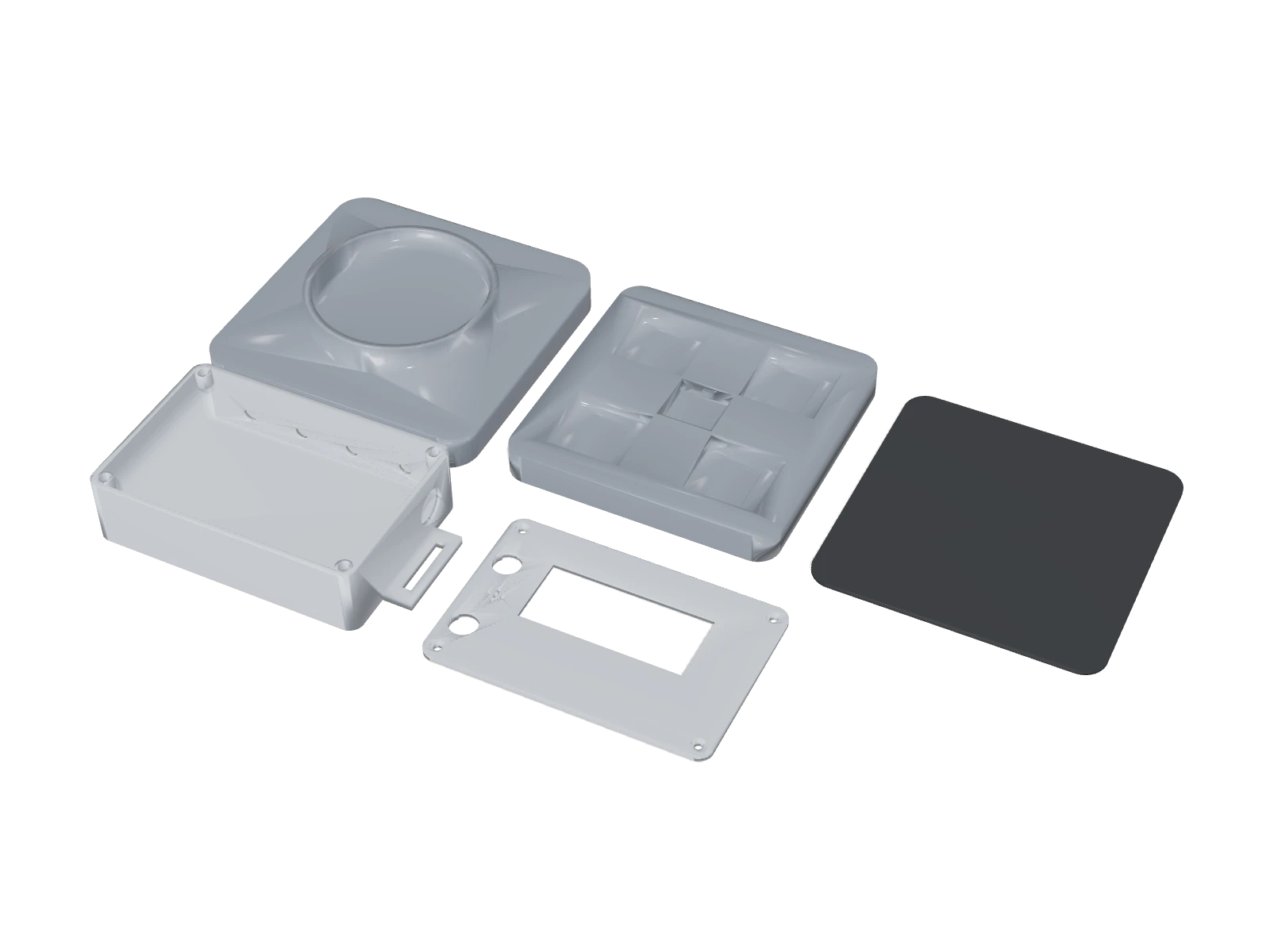
7 parts, generated from code and checked as closed solids. Pick a part to inspect it, or download the STL files to print.
See the CAD parts render
Loading the CAD…
Real CAD · drag to rotate · scroll to zoomReal CAD · swipe sideways
Bought hardware fitted inside this part (checked in the CAD: nothing collides with the plastic)
- Cup base (x4): four load-cell pockets with free space under each beam, wiring junction and cable channelcup-base.stl · PETG
- Cup top (x4): caster/leg pocket, four load bosses, guide skirt with a 0.4 mm overload stopcup-top.stl · PETG
- Anti-slip pad (x4) with grip groovescup-pad.stl · TPU
- TurnClock case: 4 amp boards, ESP32-C3 on the backup cell, USB-C socket, strap tabs for the footboardhub-case.stl · ASA
- TurnClock lid: e-paper window, ACK and TURNED buttons, buzzer holeshub-lid.stl · ASA
- FloorWatch case (rev A1): ceiling pod holding the 60 GHz radar kit, 2 ceiling screws, USB-C cable exitfw-case.stl · ASA
- FloorWatch lid (rev A1): faces the floor, 1.5 mm radome over the radar, status light holefw-lid.stl · ASA
Open risks we are working on
- Claims: we may say 'logs position changes and reminds'; we may not say it prevents pressure injuries. Leaf (cleared as a KMI bed-patient monitor, K141877) showed fewer injuries in one trial, but that was a different sensor and a hospital ICU
- Confounders: a carer leaning, a pillow or wedge moved, the bed head raised or an alternating-pressure mattress cycling could look like a turn; rules exist but are untested (tests T2, T3)
- Raising the bed 25 mm and putting wheels in cups changes bed height and stops it rolling; locked casters only, and a fall-risk note for the care plan
- The method is published (Gabison et al., Toronto) and patents exist on furniture-leg sensors; freedom to operate is unchecked
- Half-bridge cell size, deflection and creep are unverified; the 0.4 mm stop needs a printed-tolerance test (T1)
- No caregiver interviews yet; gate G1 is 10 home-care families and 3 care-home managers
- Night falls: we alert on sitting up, edge, out, not back and low on the floor; we do not claim to prevent falls (a 2022 HTW review found sensor-mat evidence uncertain). A radar "fall" output may be read as a fall detector, so its regulatory class is gate R-W1; stage lead times and radar accuracy are tests T-W1 and T-W2
Design stage only: nothing on this page is for sale. Specifications and prices are targets.