ColdChain Guard
A reusable reefer logger that hands the receiver the trip record at the dock
Stays in the reefer box for years, records every trip by itself (product-simulant and air temperature, door openings, route), warns the driver while the load can still be saved, and gives the receiver a read-only trip record by QR code.
- Who buys it
- The owner of a 1–20 truck reefer fleet or a small food distributor running its own box trucks and vans, not the large shipper.
- Why it pays
- Replaces $20–31 single-use USB loggers per load, about $4,160–6,450 a year per truck at 4 loads a week (est.). One disputed or rejected load ($3,000–8,000, est.) costs more than five years of the service.
- Target price
- $249 kit (logger, door tag, 2 probes) + $9/truck/month including data (target)
- First-minute wow
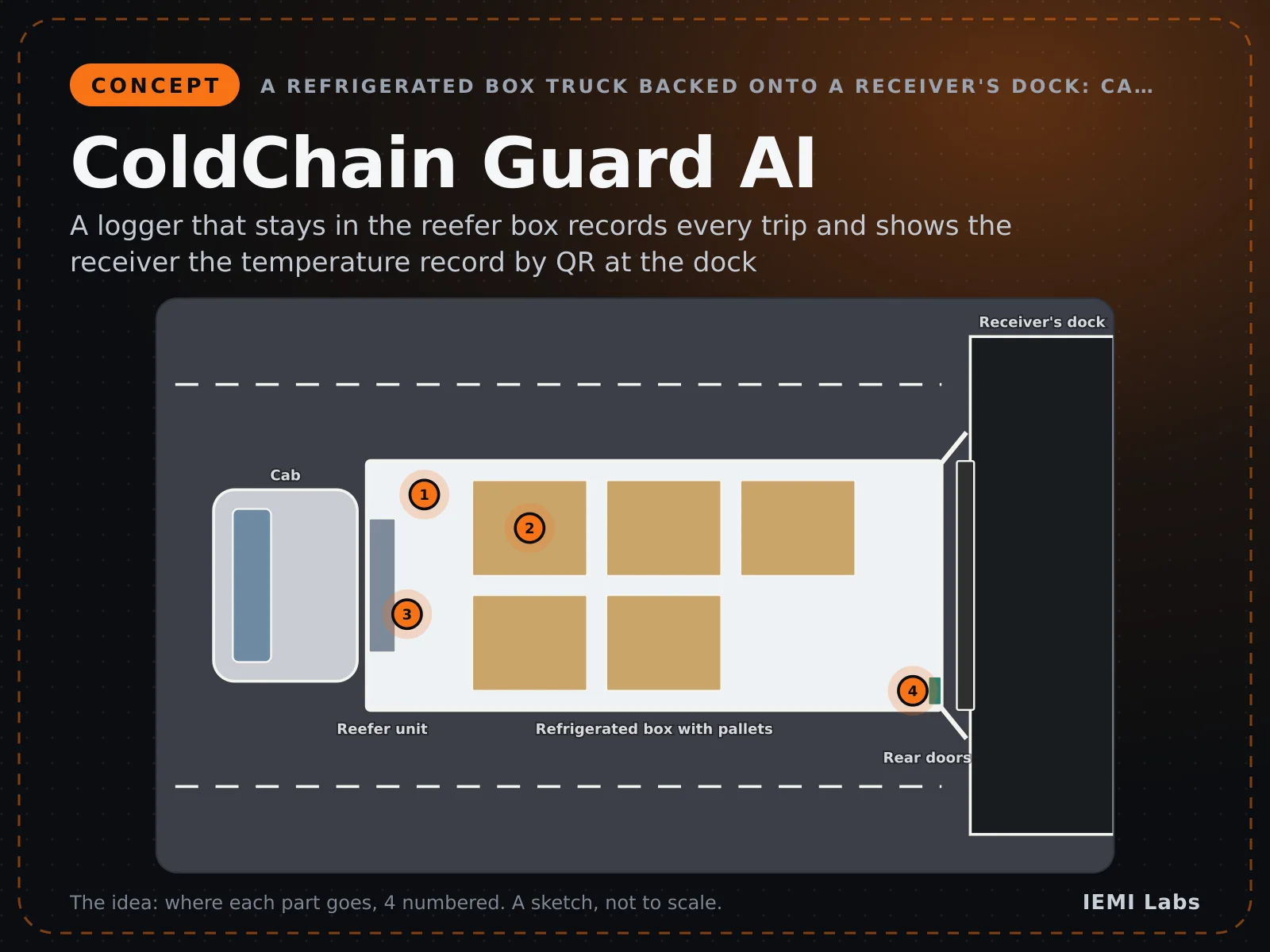
- At the dock the receiver scans the QR code on the logger and sees the whole trip chart, with door openings marked, before signing the bill of lading.
What the research found
And how this design answers it
- Tive, Sensitech and Emerson own per-shipment cargo tracking → sold per truck to small carriers; the logger stays bolted in the box and the trip is the record
- Single-use loggers cost only $20–31 → cheaper than a USB logger per load after about 7 weeks, with live warnings and no PC or cradle
- Camera and 'AI' added cost and no value → camera deleted; plain rate-of-rise and defrost-aware rules that a driver can read in one SMS
- Door openings cause air-spike false alarms → product probe in a glycol vial drives alerts, and a BLE door tag labels every opening
- Radio can't get out of a closed aluminium box → 120 days stored on the device, upload at every door opening, optional external antenna through the door seal
- Batteries fail in the cold → primary Li-SOCl₂ C cell, about 2 years per $12 swap, PA12 and TPU parts for −30 °C
Use case
Yogurt load about to be refused at the dock
Owner-operatorGrocery DC receiverBrokerColdChain Guard cloud
- 01Trigger: the receiver probes the top pallet layer by the door at 41 °F against a 33–38 °F spec
- 02Evidence: the driver points to the QR code; the trip page shows the product simulant at 35.8–37.4 °F for 11 h with two door events
- 03Decision: the receiver re-probes the pallet core, reads 37 °F and accepts; the broker gets the trip PDF
- 04Record: the trip is closed with a hash-chained record and kept for 13 months
Outcome: About $5,000 load kept and no claim filed (est.)
How it works
Architecture
- 01
Sense: 2 TMP117 probes (glycol vial + air), SHT45 inside, LIS2DH12 motion, BLE door tag with a Hall switch
- 02
Decide: trip state machine, limit and rate-of-rise rules run on the device so they work with no signal
- 03
Send: MQTT over TLS on LTE-M (nRF9151) hourly and at every door opening, with 120 days of store and forward
- 04
Tell: SMS to the driver and owner, fleet dashboard, receiver trip page by QR, 12-month CSV/PDF archive
Hardware
Real parts, buyable today
Bill of materials: about $168 per kit at qty-1 prices, about $120 at qty 100 (est.).
| Block | Part | Why this part |
|---|---|---|
| Cellular + GNSS + MCU | Nordic nRF9151-LACA-R7 SiP | LTE-M with PSM and GNSS in one part, $22.69 at qty 1 |
| BLE | Raytac MDBT42Q (nRF52832) | Talks to the door tag without a cable across the hinge |
| Product probes | 2× TI TMP117 in 6 mm stainless tubes | ±0.1 °C class digital probes on one I²C bus |
| Power | Saft LS26500 Li-SOCl₂ C cell + supercap | Works to −30 °C, about 2 years per cell, nothing for the driver to charge |
| Door tag | nRF52832 + TI DRV5032 Hall switch + LS14250 | Solid-state door sensing, more than 5 years per cell |
Mechanical
Printable CAD
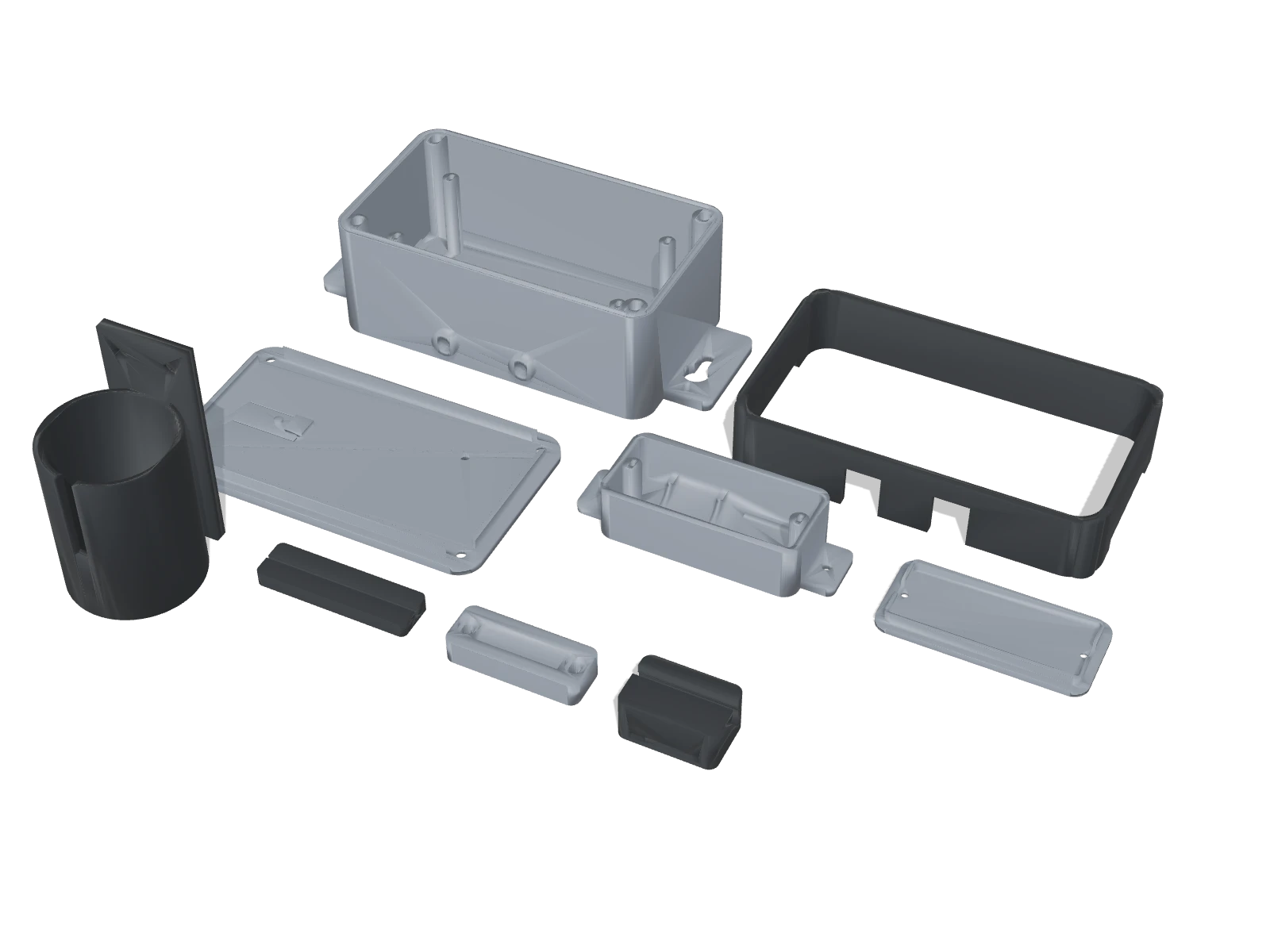
9 parts, generated from code and checked as closed solids. Pick a part to inspect it, or download the STL files to print.
See the CAD parts render
Loading the CAD…
Real CAD · drag to rotate · scroll to zoomReal CAD · swipe sideways
Bought hardware fitted inside this part (checked in the CAD: nothing collides with the plastic)
- Logger base (hanging ears)logger-base.stl · PA12 (MJF)
- Logger lid with flexure trip buttonlogger-lid.stl · PA12 (MJF)
- Impact bumperlogger-bumper.stl · TPU 95A
- Door tag basedoor-tag-base.stl · PA12 (MJF)
- Door tag liddoor-tag-lid.stl · PA12 (MJF)
- Door-frame magnet holdermagnet-holder.stl · PA12 (MJF)
- Air probe clipprobe-clip.stl · TPU 95A
- Glycol vial holdervial-holder.stl · TPU 95A
- Door-seal antenna pass (option)antenna-pass.stl · TPU 95A
Open risks we are working on
- LTE-M may not get out of a closed insulated box; live alerts then depend on door openings or the external antenna kit (bench test T7)
- Small carriers are price-sensitive and hard to reach; the channel (brokers, reefer dealers, load boards) is untested
- Receivers may not accept a carrier-owned record over their own probe reading; it is evidence, not a verdict
- Li-SOCl₂ pulse behaviour at −25 °C with LTE peaks needs the supercap sizing proven (T8)
- Kit margin is thin at low volume; the business depends on subscription retention
Design stage only: nothing on this page is for sale. Specifications and prices are targets.